Thursday, May 15, 2008
Mutua on New Historiography and the Long Civil Rights Era
Athena Mutua, SUNY at Buffalo Law School, takes up implications of scholarship on "The Long Civil Rights Movement" in a new essay, Restoring Justice to Civil Rights Movement Activists?: New Historiography and the Long Civil Rights Era. Here's the abstract: This paper seeks to engage ongoing discussions and conceptualizations about the Civil Rights and Restorative Justice Project and its meanings, boundaries, and goals. It tells two different but overlapping stories of the civil rights era and argues that the dominant abbreviated story of the movement, focusing on the ten-year period centered on the King-led nonviolent movement in the South, should be rejected as a framework for the Project. This ten-year story truncates, decontextualizes, and tames the movement while rendering it legalistic, episodic, triumphant and nostalgic. The effect is that it obscures the movement's relevance to today's circumstances; it distorts the nature, objectives and activities of the masses of ordinary black people who fought its battles, including their broad egalitarian democratic agenda; and it allows forces hostile to the movement's objectives to easily appropriate and misappropriate its ideas. As such it undermines the goals of the Project, justice for civil rights activists. Based on new historiography, this paper advocates for an understanding of the civil rights period as constituting what Nikhil Pal Singh calls the long civil rights era, and part of what scholars such as Manning Marable and Clayborne Carson call the black freedom struggle. New historiography is beginning to expose the limitations of the truncated civil rights story and to provide a fuller picture of the era. For instance, it suggests that the civil rights era begins in the 1930s, is transformed in the 1950s, and again in the mid-1960s and ends but remains unfinished sometime around the early eighties with its broad egalitarian democratic agenda largely unmet.


Wednesday, May 14, 2008
Schull reviews Peters, Crime and Punishment in Islamic Law
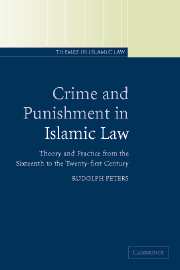 Rudolph Peters, Crime and Punishment in Islamic Law: Theory and Practice from the Sixteenth to the Twenty-first Century (Cambridge: Cambridge University Press, 2005) is reviewed for H-Levant by Kent F. Schull, Department of History,University of Memphis. Hat tip. Schull finds the book
an excellent, accessible, clearly delineated, and insightful introduction to the development, doctrine, and practice of Islamic criminal law from the sixteenth century to the present. Peters's volume,the second in the Cambridge University Press series Themes in Islamic Law, brings together various lines of scholarship on practice and theory into one well-organized work divided into six chapters, including a brief introduction and a conclusion.
For Schull, chapter 3 is the author's strongest. "Peters utilizes the Ottoman Empire as a case study to explore the implementation of Islamic criminal law and to illustrate its relationship with state authorities during what he refers to as 'the pre-modern period' (sixteenth to eighteenth centuries)." He demonstrates "the Ottoman state's weighty influence on the implementation, interpretation, and enforcement of Islamic criminal law." The author "also effectively illustrates the interaction of state (qanun) and Shari`a law in the state's efforts to maintain power and order."
Overall, the book "makes an invaluable contribution to the fields of history, Islamic studies, and comparative legal studies, and will, I believe, serve as the impetus to additional research."
The full review is here.
Zelizer on The Conservative Embrace of Presidential Power
Julian Zelizer, Princeton, has a new essay, THE CONSERVATIVE EMBRACE OF PRESIDENTIAL POWER in the Boston University Law Review. Zelizer's essay appears in a special issue on The Role of the President in the Twenty-First Century, which includes contributions from Dawn Johnson, Neal Devins, John Yoo and others. Hat tip. Zelizer's essay begins:
The power of the presidency has become a contentious issue for the conservative movement. In recent years, many conservatives have been furious with their colleagues for accepting the growth of presidential power. However, this criticism ignores how deeply ingrained presidential power has become in the conservative movement since the 1970s.
During the past three and a half decades, a growing number of conservatives have embraced the presidency and have come to privilege this branch of government. While conservatives have traditionally justified their position by arguing that the presidency is often the best agent for achieving smaller and more accountable government, they have also recently relied on an aggressive and centralized presidency to advance their agenda. For many conservatives,
the congressional reforms that passed in response to Watergate dangerously eroded the power of the executive branch. Moreover, many conservatives view the reforms as symbols of what went wrong as a result of the 1960s. Furthermore, conservatives add that the gradual delegation of authority to independent agencies has resulted in unaccountable bureaucrats making big decisions that are beyond the control of elected officials. Continue reading here.
The power of the presidency has become a contentious issue for the conservative movement. In recent years, many conservatives have been furious with their colleagues for accepting the growth of presidential power. However, this criticism ignores how deeply ingrained presidential power has become in the conservative movement since the 1970s.
During the past three and a half decades, a growing number of conservatives have embraced the presidency and have come to privilege this branch of government. While conservatives have traditionally justified their position by arguing that the presidency is often the best agent for achieving smaller and more accountable government, they have also recently relied on an aggressive and centralized presidency to advance their agenda. For many conservatives,
the congressional reforms that passed in response to Watergate dangerously eroded the power of the executive branch. Moreover, many conservatives view the reforms as symbols of what went wrong as a result of the 1960s. Furthermore, conservatives add that the gradual delegation of authority to independent agencies has resulted in unaccountable bureaucrats making big decisions that are beyond the control of elected officials. Continue reading here.
Tuesday, May 13, 2008
Barrett on A Rehnquist Ode on the Vinson Court
A Rehnquist Ode on the Vinson Court (Circa Summer 1953) is a new essay by John Q. Barrett, St. John's University. It appears in Green Bag 2d (Spring 2008). The accompanying photos are priceless. All it lacks is audio. Here's the abstract: This article publishes for the first time a 55-year-old composition - a spoof of Gilbert and Sullivan lyrics - by the late William H. Rehnquist. Rehnquist's ode, which dates back to his Supreme Court clerkship with Justice Robert H. Jackson during 1952 and 1953, demonstrates the young author's sense of humor. It also reflects his inside knowledge of the low regard that some of the 1950s Supreme Court justices had for some of their judicial brethren. Among other topics, the Rehnquist composition touches on the plethora of separate opinions that these Justices habitually produced, and on Chief Justice Fred M. Vinson's preoccupation with baseball.
Kedar and Cohen on Colonialism, Nationalism and Legal Education in Mandatory Palestine
Colonialism, Nationalism and Legal Education in Mandatory Palestine is a new paper by Nir Kedar, Bar-Ilan University, and Uri Cohen, Tel-Aviv University School of Education on a topic on which there is much more to be written: nation-building and the role of legal education in various parts of the world. Here's the abstract:
The aim of this article is to describe the complex mosaic of interests, values, and relationships in the colonial legal field and their manifestations in the law and legal education system. After presenting four modes of legal interaction between the "natives" and colonizer and within the local population, we trace the Jewish population's fruitless efforts to preserve its national-cultural identity and a relative degree of legal autonomy while at the same time cooperating with the British colonial regime in Palestine.
Our discussion focuses on legal education in Mandatory Palestine, taking the Tel Aviv School of Law and Economics (TASLE), which was established in 1935, as a case study. TASLE's failure to obtain official recognition from the British reveals a fascinating, multi-layered picture of the legal-academic field in Mandatory Palestine. While the local Jewish elite generally supported TASLE's national-cultural ideas regarding the integration of Jewish and modern law, conflicting institutional, political, legal, and academic interests drove it to cooperate with the colonizer in opposing the school's initiative.
The aim of this article is to describe the complex mosaic of interests, values, and relationships in the colonial legal field and their manifestations in the law and legal education system. After presenting four modes of legal interaction between the "natives" and colonizer and within the local population, we trace the Jewish population's fruitless efforts to preserve its national-cultural identity and a relative degree of legal autonomy while at the same time cooperating with the British colonial regime in Palestine.
Our discussion focuses on legal education in Mandatory Palestine, taking the Tel Aviv School of Law and Economics (TASLE), which was established in 1935, as a case study. TASLE's failure to obtain official recognition from the British reveals a fascinating, multi-layered picture of the legal-academic field in Mandatory Palestine. While the local Jewish elite generally supported TASLE's national-cultural ideas regarding the integration of Jewish and modern law, conflicting institutional, political, legal, and academic interests drove it to cooperate with the colonizer in opposing the school's initiative.
Monday, May 12, 2008
Feeley and Aviram on The Decline of Women in the Criminal Justice Process
Malcolm M. Feeley, U.C. Berkeley, Boalt School of Law, and Hadar Aviram, U.C. Hastings College of Law, have posted a new paper, Where Have All the Women Gone? The Decline of Women in the Criminal Justice Process. The paper is part of a forthcoming book. The abstract discusses the scope of research in the book, while the paper itself focuses on findings from The Netherlands. Here's the abstract: This project sets out to refute the common criminological assumption that women have always constituted a negligible percentage of those subjected to the criminal justice process. Using a variety of primary and secondary datasets drawn from dozens of European courts, we prove that, in the 17th and 18th century, women constituted a significant proportion of criminal defendants all over Europe, particularly in large, urban areas. Female percentage then dramatically declined over the 19th century. This general tendency transcends local explanations, and cannot be fully accounted for by any traditional historical explanation. We suggest that the decline of women in the criminal justice process reflects the shift in patriarchal patterns before and during the industrial revolution; during this period, women were removed from the public sphere, the labor market and the control of their communities and confined in the private sphere of the home, where their opportunities to commit crime decreased, their socialization into feminine roles increased, and the state‘s willingness to draw them into the public sphere for criminal trial declined. This pattern can be incorporated into two broader theoretical explanations: Elias‘ process of civilization, and Foucault‘s rise of disciplinary structures. We conclude by suggesting the project‘s value for criminology, feminist scholarship and the dialogue between history and sociology.
Purdy on Presidential Popular Constitutionalism
Presidential Popular Constitutionalism is a new article by Jedediah S. Purdy, Duke Law School. It is forthcoming in the Fordham Law Review. Here's the abstract:
This Article adds a new dimension to the most important and influential strand of recent constitutional theory: popular or democratic constitutionalism, the investigation into how the Constitution is interpreted (1) as a set of shared and defining national commitments and practices, not necessarily anchored in the text of the document and (2) by citizens and elected politicians outside the judicial branch. Wide-ranging and ground-breaking scholarship in this area has neglected the role of the President as a popular constitutional interpreter, articulating and revising normative accounts of the national community that interact dynamically with citizens' understanding of the constitutional community. This Article explains the basic operation of presidential popular constitutionalism, lays out the historical development and major transformations in its practice, proposes a set of thematic alternatives for today's presidential popular constitutionalism, and locates presidential popular constitutionalism within the larger concerns of constitutional theory. In particular, it argues that some of the major political developments of recent decades, such as the "Reagan Revolution" and the Clinton-Bush era, can be fully understood only by grasping that they are episodes in presidential popular constitutionalism.
This Article adds a new dimension to the most important and influential strand of recent constitutional theory: popular or democratic constitutionalism, the investigation into how the Constitution is interpreted (1) as a set of shared and defining national commitments and practices, not necessarily anchored in the text of the document and (2) by citizens and elected politicians outside the judicial branch. Wide-ranging and ground-breaking scholarship in this area has neglected the role of the President as a popular constitutional interpreter, articulating and revising normative accounts of the national community that interact dynamically with citizens' understanding of the constitutional community. This Article explains the basic operation of presidential popular constitutionalism, lays out the historical development and major transformations in its practice, proposes a set of thematic alternatives for today's presidential popular constitutionalism, and locates presidential popular constitutionalism within the larger concerns of constitutional theory. In particular, it argues that some of the major political developments of recent decades, such as the "Reagan Revolution" and the Clinton-Bush era, can be fully understood only by grasping that they are episodes in presidential popular constitutionalism.
Sunday, May 11, 2008
Tamanaha on The Bogus Tale About the Legal Formalists
Brian Z. Tamanaha, St. John's University School of Law, has posted a new paper that has already generated a debate: The Bogus Tale About the Legal Formalists. Here's the abstract:
It is widely accepted that legal formalist views dominated at the turn of the last century: judges, legal academics, and lawyers purportedly believed that law was comprehensive, gapless, and logically ordered, and believed that judges reasoned mechanically or deductively from this body of law to produce right answers in individual cases. This view of law held sway until the 1920s and 1930s, when the legal realists destroyed formalist beliefs by exposing gaps and indeterminacy in law, and by arguing that bias infects judging.Larry Solum on the Legal Theory Blog recommends the paper and has more. Brian Leiter expresses skepticism, which Tamanaha replies to in the comments and here.
This story has been repeated innumerable times by legal historians, legal theorists, political scientists, and many others. The formalist-realist antithesis shapes contemporary views and debates about judging.This familiar story is false. A previous draft, The Realism of the Formalist Age, showed some of the evidence for this, but inadequately and without understanding its full implications. This completely revised version expands on the evidence and explains how the story got started, why it is fundamentally wrong, and how it nonetheless successfully secured a place in conventional accounts of US legal history. Through a combination of mistakes and deliberate deceptions, the initial piece of the story was constructed early in the century by political opponents of courts. In the 1970s, motivated by contemporary concerns, leftist legal historians and legal theorists reached back to the earlier period and reinvented the story about the legal formalists, producing an account which then swept the legal academy. This false story has been taken as true ever since.
This article is not just about getting our history right. It provides an object lesson in how modern practices of legal history and legal theory - how reliance upon specialists, and the adoption and repetition of stock stories - can lead to the spread and perpetuation of a falsehood, with real consequences.
Washburn reviews Eskridge, Dishonorable Passions: Sodomy Laws in America, 1861-2003
Dishonorable Passions: Sodomy Laws in America, 1861-2003 by William N.  Eskridge Jr. (Viking) is reviewed in the San Francisco Chronicle by Michael Washburn, Center for the Humanities, City University of New York. According to Washburn, "As Eskridge details in this exhaustive - sometimes exhausting - volume, when regulating homosexual desire, our courts have often endorsed the most anxious logic of American society's moral panic." The book is "best in its discussion of post-Stonewall litigation, especially the 17 years between Bowers vs. Hardwick and Lawrence vs. Texas, when the gay community experienced its own truncated journey from Dred Scott to the 14th Amendment." While the reviewer sometimes finds the book heavy reading, "the chapters on these cases are riveting."
 Eskridge Jr. (Viking) is reviewed in the San Francisco Chronicle by Michael Washburn, Center for the Humanities, City University of New York. According to Washburn, "As Eskridge details in this exhaustive - sometimes exhausting - volume, when regulating homosexual desire, our courts have often endorsed the most anxious logic of American society's moral panic." The book is "best in its discussion of post-Stonewall litigation, especially the 17 years between Bowers vs. Hardwick and Lawrence vs. Texas, when the gay community experienced its own truncated journey from Dred Scott to the 14th Amendment." While the reviewer sometimes finds the book heavy reading, "the chapters on these cases are riveting."
Schulman and Will review Perlstein, Nixonland
Nixonland: The Rise of a President and the Fracturing of America by Ri ck Perlstein (Scribner) is reviewed today by Bruce J. Schulman, Boston University, the in the Boston Globe and by George F. Will in the New York Times. Schulman finds it "a vivid, cinematic history of American politics in the 1960s and early 1970s. In bracing prose, Rick Perlstein propels us through the epic events, the assassinations and protests, somber news broadcasts and irreverent television comedies, as he recounts the dramatic decade-long turnaround that continues to shape our national life."
 ck Perlstein (Scribner) is reviewed today by Bruce J. Schulman, Boston University, the in the Boston Globe and by George F. Will in the New York Times. Schulman finds it "a vivid, cinematic history of American politics in the 1960s and early 1970s. In bracing prose, Rick Perlstein propels us through the epic events, the assassinations and protests, somber news broadcasts and irreverent television comedies, as he recounts the dramatic decade-long turnaround that continues to shape our national life."
 According to Schulman,
if ordinary voters occupy the leading roles in Perlstein's account, a "strange, stiff man" lurks in the shadows, never far from center stage. Nixon grasped the demands of a new age of mass media (however bad he looked on television himself). Driven by rages and resentments, Nixon also embodied the insecurities that ate at the hearts of millions of white, middle-class Americans, for whom the turmoil of the '60s - war and protest, the violence in Watts and other inner cities, the outrageousness of the counterculture, pornography and affirmative action - had proved deeply unsettling....Bucking the conventional wisdom, Perlstein recognizes Nixon's central role in the rise of the American right.
George Will's lengthy first-page NYT review finds Nixonland a "high-energy — sometimes too energetic — romp of a book also serves, inadvertently, a serious need: it corrects the cultural hypochondria to which many Americans, including Perlstein, are prone." The author's "thorough excavation of the cultural detritus of that decade refutes his thesis, which is that now, as then, Americans are at daggers drawn."
Perlstein’s thesis is that America became Nixonland because of “the rise of two American identities” in the 1960s — actually between 1964, when Johnson won 61.1 percent of the vote, and 1968, when the combined votes for Nixon and George Wallace were 56.9 percent. Perlstein says Nixon’s legacy is the “notion that there are two kinds of Americans.” On one side of the barricades are “values voters” and other conservatives who are infuriated by the disdain of amoral elites conservatives consider (in the brilliantly ironic phrase that Perlstein appropriated from Kevin Phillips) a “toryhood of change” determined to supervise their lives. On the other side are Hofstadterian liberals who feel threatened by these nincompoops who have been made paranoid by their status anxieties.
While Perlstein argues that Nixonland is still a feature of American politics, Will argues that "America has long since gone off the boil."
Saturday, May 10, 2008
Bell on The Obligation Thesis: Understanding the Persistent 'Black Voice' in Modern Legal Academia
The Obligation Thesis: Understanding the Persistent 'Black Voice' in Modern Legal Academia is a recent article by Monica Bell, Yale Law School (JD candidate) revisiting and assessing an important moment in the intellectual history of the legal academy. It appears in the University of Pittsburgh Law Review (2007). Here's the abstract: This Article revisits the debate over minority voice scholarship, particularly African-American scholarship, that raged in the late 1980s and early 1990s with the advent of critical race theory (CRT). Many critical race theorists elevated the voices of minority scholars, arguing that scholarship in the minority voice should be accorded greater legitimacy than white intellectuals' work on race. Many scholars of all ethnicities disagreed with Crits' analyses. They charged that good scholarship by minority writers should be judged as a fact-in-itself, not ghettoized or subjected to less rigorous analysis than other scholarship. This Article explores the work of four current up-and-coming black legal scholars to revisit that early disagreement and its ramifications in the modern black legal academy. By and large, it appears that the anti-CRT writers have won the debate. Today's legal academy more closely reflects the anti-narrative perspective on scholarship. Black scholars continue to write on racial topics, but tend not to convey points through claims of authenticity. This Article suggests that one reason African-American legal scholars continue to write about race, despite the risks of doing so, is their sense of obligation to the black community. I contend that this obligation runs just as deeply for black academics as it does for black practitioners, who tend to closely relate the legal profession with the struggle for racial justice.
Levy on Constitutions without Social Contracts
Not so Novus an Ordo: Constitutions without Social Contracts is an interesting new article by Jacob T. Levy, McGill University - Department of Political Science. It is forthcoming in Political Theory. Here's the abstract: Social contract theory imagines political societies as resting on a fundamental agreement, adopted at a discrete moment in hypothetical time, that both bound individual persons together into a single polity and set fundamental rules regarding that polity‘s structure and powers. Written constitutions, adopted at real moments in historical time, dictating governmental structures, bounding governmental powers, and entrenching individual rights, look temptingly like social contracts reified. I argue in this article, however, that something essential is lost in the casual slippage between social contract theory and the practice of constitutionalism. Enacted constitutions do not come into being against the background of a state of nature of isolated individuals; and by this I do not mean to invoke the too-familiar critique of the supposedly decontextualized liberal person, but rather to critique the aspiration to decontextualize the legal and political order. Constitutions are enacted in ongoing societies (whether newly politically sovereign or otherwise) with pre-existing laws and legal systems, political organizations, cultural and linguistic and religious divisions, and norms and mores. Moreover, the practice of constitutionalism is usually, at least in part, a practice of reconciling those legacies to a new political order, of making use of those legacies to build loyalties to or counterbalances against the state (or both). Most constitutions cannot be well-understood by retrospectively characterizing them as the kind of complete and radical break with the past envisioned by social contract theory. Contractarian blinders lead us to look for greater individualism, greater social unity, and greater coherence of principles than can actually be expected of constitutions or constitutionalism. Real constitutional orders appropriate, incorporate, and channel the histories and divisions of the societies they govern. Treating them as if they are social contracts will flatten and distort them, making those engagements with the past or with social plurality appear anomalous and encouraging their minimization. I aim to redirect some of our attention to non-contractarian constitutionalism, or non-contractarian strands within constitutionalism, both as intellectual inheritance and as lived practice. Non-contractarian elements persisted in constitutional theory across the apparent break of the late 1700s, even though these have to some degree been lost sight of more recently; and they have persisted and should persist in constitutional practice.
Friday, May 9, 2008
Villazor on Blood Quantum Land Laws and the Race Versus Political Dilemma
Blood Quantum Land Laws and the Race Versus Political Dilemma is a new article by Rose Cuison Villazor, Southern Methodist University - Dedman School of Law. It is forthcoming in the California Law Review. Here's the abstract: Modern equal protection doctrine treats laws that make distinctions on the basis of indigeneity defined on blood quantum terms along a racial versus political paradigm. This dichotomy may be traced to Morton v. Mancari and, more recently, to Rice v. Cayetano. In Mancari, the Supreme Court held that laws that privilege members of American Indian tribes do not constitute racial discrimination because the preferences have a political purpose - to further the right of self-government of federally recognized American Indian tribes. Rice crystallized the juxtaposition of the racial from the political nature of indigeneity by invalidating a law that privileged Native Hawaiians. That law, according to the Court, used an ancestral blood requirement to construct a racial category and a racial purpose as opposed to the legally permissible political purpose of promoting the right of self-government of American Indian tribes. Close analysis of the dichotomy between the constitutive notion of indigenous blood as either racial or political has largely escaped scholarship. An analysis deconstructing their juxtaposition is sorely needed. As recent challenges to blood quantum laws show, there remain unanswered questions about the extent to which the racialized (and thus invalid) Native Hawaiian-only voting law impact other blood quantum laws. Among the laws implicated by the dichotomy between the racial and political meaning of indigeneity are land ownership laws that privilege indigenous peoples who are not federally recognized tribes. Specifically, in some jurisdictions in the United States, including Hawaii, Alaska, and the U.S. territories, only indigenous peoples may purchase or possess property. Perhaps more problematically, these property laws define indigeneity on the basis of blood quantum. Under the contemporary race versus political meaning of blood quantum, these laws arguably violate equal protection principles because they do not fit the current framing of what constitutes political indigeneity. Using these laws, what I collectively refer to as blood quantum land laws, as frames of reference, this Essay interrogates and criticizes the juxtaposition of the racial and political meaning of indigeneity. Specifically, the Essay examines the legal construction of political indigeneity and demonstrates how its narrowed construction would undermine these blood quantum land laws that were enacted to reverse the effects of colonialism. Consequently, this Essay calls for the liberalization of the binary racial and political paradigm by expanding equal protection law's interpretation of the meaning of political indigeneity. Toward this end, this Essay provides an initial analysis of how to broaden the political notion of indigeneity, focusing in particular on the relationships among property, indigeneity, and the right to self-determination.
Thursday, May 8, 2008
Lanctot on The Suffrage Pickets and Freedom of Speech During World War I
"We are at War and You Should Not Bother the President": The Suffrage Pickets and Freedom of Speech During World War I is a new paper by Catherine J. Lanctot, Villanova University School of Law. The paper draws upon the archives of the National Women's Party, and is part of the author's on-going work on women's rights activist Alice Paul. Those familiar w ith women's history will find the author's statements a bit strong when she says the story of Alice Paul and the White House protests is "almost unknown." I believe I first read about it in Eleanor Flexner's classic Century of Struggle while in graduate school, and I always teach about it in my 20th century constitutional history course. But it is certainly the case that there is much more to learn from this history, and the author is right on point when she notes that woman suffrage should be part of the history of struggles over rights in wartime. And there is certainly more to say about the legal history of this conflict. I will look forward to more from Lanctot on this. Here's the abstract:
 ith women's history will find the author's statements a bit strong when she says the story of Alice Paul and the White House protests is "almost unknown." I believe I first read about it in Eleanor Flexner's classic Century of Struggle while in graduate school, and I always teach about it in my 20th century constitutional history course. But it is certainly the case that there is much more to learn from this history, and the author is right on point when she notes that woman suffrage should be part of the history of struggles over rights in wartime. And there is certainly more to say about the legal history of this conflict. I will look forward to more from Lanctot on this. Here's the abstract:
 The story of Alice Paul's National Woman's Party and its 1917 picketing campaign on behalf of woman suffrage is almost unknown in legal circles. Yet the suffrage pickets were among the earliest victims of the suppression of dissent that accompanied the entry of the United States into World War I. Nearly forty years before the modern civil rights movement brought the concept of nonviolent civil disobedience to the forefront of American political discourse, the NWP conducted a direct action campaign at the very doorstep of the President of the United States, and they did so during a time of war.
In the course of this campaign, Paul and her supporters learned to use the apparatus of the municipal courts and the prison system to focus attention on the powerlessness of women, while at the same time elevating their very real suffering to a kind of suffrage martyrdom. Their principal goal was to keep pressure on government officials so that the cause of woman suffrage would not be swept away in the wartime hysteria that gripped the nation in 1917. As the police regularly hauled them off to jail, however, the suffragists began to real ize that their ability to pursue that goal hinged largely on the recognition of a constitutional right to free speech.
This Article represents the first step in recovering this forgotten story. I present, for the first time, a detailed narrative account of the legal battles of the suffrage pickets of 1917, beginning with the first round of arrests in late June, and concluding with their victory in the Court of Appeals in March 1918. Although the women themselves did not directly shape legal doctrine, the saga of the suffrage pickets provides an excellent vehicle for examining the emergence of free speech consciousness during 1917. Bringing the story of the suffrage pickets to the attention of legal scholars may cause a significant reevaluation of the traditional narrative of First Amendment history.
In the course of this campaign, Paul and her supporters learned to use the apparatus of the municipal courts and the prison system to focus attention on the powerlessness of women, while at the same time elevating their very real suffering to a kind of suffrage martyrdom. Their principal goal was to keep pressure on government officials so that the cause of woman suffrage would not be swept away in the wartime hysteria that gripped the nation in 1917. As the police regularly hauled them off to jail, however, the suffragists began to real
 ize that their ability to pursue that goal hinged largely on the recognition of a constitutional right to free speech.
This Article represents the first step in recovering this forgotten story. I present, for the first time, a detailed narrative account of the legal battles of the suffrage pickets of 1917, beginning with the first round of arrests in late June, and concluding with their victory in the Court of Appeals in March 1918. Although the women themselves did not directly shape legal doctrine, the saga of the suffrage pickets provides an excellent vehicle for examining the emergence of free speech consciousness during 1917. Bringing the story of the suffrage pickets to the attention of legal scholars may cause a significant reevaluation of the traditional narrative of First Amendment history.
Wednesday, May 7, 2008
Kraus, From Langdell to Law and Economics: Two Conceptions of Stare Decisis in Contract Law and Theory
Jody S. Kraus, University of Virginia, has posted a new paper, From Langdell to Law and Economics: Two Conceptions of Stare Decisis in Contract Law and Theory. Here's the abstract: In his classic monograph, The Death of Contract, Grant Gilmore argued that Christopher Columbus Langdell, Oliver Wendell Holmes, and Samuel Williston trumped up the legal credentials for their classical bargain theory of contract law. Gilmore's analysis has been subjected to extensive criticism, but its specific, sustained, and fundamental charge that the bargain theory was based on a fraudulent misrepresentation of precedential authority has never been questioned. In this Essay, I argue that Gilmore's case against the classical theorists rests on the suppressed premise that the precedential authority of cases resides in the express judicial reasoning used to decide them. In contrast, I argue that the classical theorists implicitly presuppose that the precedential authority of cases consists in the best theory that explains their outcomes, even if that theory is inconsistent with the case's express judicial reasoning. The classical view of precedential authority completely defuses Gilmore's charge of fraud. In Gilmore's view, merely demonstrating the inconsistency between the proposition for which the classical theorists cited a case and the express reasoning in that case suffices as proof of misrepresentation. But in the classical theorists' view, the express reasoning in a case is simply a theory of its precedential authority, which, like any theory, can be wrong. Thus, the classical theorists simply reject Gilmore's claim that a case cannot properly be cited for a proposition inconsistent with its express reasoning. The real dispute, then, between Gilmore and the classical theorists is over the nature of precedential authority and not the content of contract law. Having reframed the classic death-of-contract debate, I then trace these competing conceptions of precedential authority through the major schools of contemporary contract theory. I argue that a contract theory's embrace of one view instead of the other can be explained by the relative priority it accords to each of the two components in a conception of adjudicative legitimacy. A conception of adjudicative legitimacy consists in a theory of what it means for a decision to be based on law and a theory of what is required for law to be justified. I explain why theories according priority to the former tend to subscribe to the precedents-as-outcomes view, while theories according priority to the latter tend to favor the express reasoning view. The Essay concludes by arguing that the economic analysis of contract law subscribes to the precedents-as-outcomes view and therefore is the contemporary jurisprudential successor to the late nineteenth-century classical theorists.
Greene on 40 years of FTC and Dept. of Justice regulation of Antitrust
Agency Character and Character of Agency Guidelines: An Historical and Institutional Perspective is a recent article by Hillary Greene, University of Connecticut School of Law. It appeared in the Antitrust Law Journal (2005). Here's the abstract: Though antitrust guidelines have become commonplace, their approach was novel when first introduced. In a 1964 front-page article entitled, Industries Will Get Merger Guidelines, The New York Times observed, 'An entirely new approach to the enforcement of the antitrust laws is about to be attempted by the Federal Trade Commission.' Similarly, the American Bar Association's 1968 Antitrust Developments treatise described these first antitrust agency guidelines as a new method to advise businessmen about how the FTC would gauge the competitiveness of mergers. In the nearly forty years since the introduction of the first merger guidelines, the federal antitrust agencies have issued numerous additional guidelines. Nearly all of those promulgated or revised over the last decade and a half have been joint efforts between the FTC and the U.S. Department of Justice. However, the agencies' respective entrances into this policymaking realm were not only separate but also distinctive. This essay explores the FTC's evolving approach to antitrust guidelines, beginning with an overview of the general context in which the FTC first introduced guidelines as an antitrust policy tool. The FTC's merger guidelines can be roughly divided into three successive waves: industry- specific; general; and jointly promulgated with the DOJ. What emerges is a picture of guidelines as a dynamic institution along many dimensions, including content, form, and manner of promulgation. This essay explores some of the FTC's unique institutional features that likely contributed to the particular contours of the agency's various guidelines.
Tuesday, May 6, 2008
Lecture on Nineteenth-Century Cohabitation and the Law
"Moral Marriage, Mistresses and Mayhew:
Cohabitation and the Law in Nineteenth-Century England"
Speaker: Rebecca Probert, School of Law, Warwick University
Date and Time: 07 May 2008, 18:00 - 19:00
Description: This paper examines the prevalence of, and legal and social attitudes to, cohabitation in nineteenth-century England. It challenges the conventional understanding that cohabitation was popular in the eighteenth century and declined in the nineteenth, arguing that the reverse was in fact the case, and that cohabitation was associated with urbanisation and industrialisation. It then goes on to discuss how the legal system treated cohabitants who came before the courts, noting how this depended on the legal context of the case rather than the nature of the relationship.
Venue : Institute of Advanced Legal Studies; University of London; Charles Clore House; 17 Russell Square; London WC1B 5DR
Cohabitation and the Law in Nineteenth-Century England"
Speaker: Rebecca Probert, School of Law, Warwick University
Date and Time: 07 May 2008, 18:00 - 19:00
Description: This paper examines the prevalence of, and legal and social attitudes to, cohabitation in nineteenth-century England. It challenges the conventional understanding that cohabitation was popular in the eighteenth century and declined in the nineteenth, arguing that the reverse was in fact the case, and that cohabitation was associated with urbanisation and industrialisation. It then goes on to discuss how the legal system treated cohabitants who came before the courts, noting how this depended on the legal context of the case rather than the nature of the relationship.
Venue : Institute of Advanced Legal Studies; University of London; Charles Clore House; 17 Russell Square; London WC1B 5DR
Oxford Legal History Forum
On Friday, May 9th, at 1:00, the Oxford Legal History Forum will host Professor David Rabban (University of Texas at Austin), who will present a paper entitled, "Maine to Maitland via America." The talk will be at the Oxford Law Faculty's Senior Common Room.
Reviewed: Dudziak, Exporting American Dreams
The first review for my new book, Exporting American Dreams: Thurgood Marshall's African Journey, is just out from Publishers Weekly. Here's what they have to say:
While Marshall is best known for his pivotal role during Brown v. Board of Education and his appointment to the Supreme Court, Dudziak (Cold War Civil Rights) recovers a nearly buried undertaking, “one of the great adventures of his life”: Marshall's contributions to the Kenyan Bill of Rights. Marshall arrived in London in January 1960; a month later, the Greensboro, N.C., sit-in began, and Marshall found himself “torn between two continents and two movements.” The author effectively sketches those events in the civil rights movement (civil disobedience, urban riots, Black Power) and in Kenya (President Kenyatta's early moderation and subsequent mistreatment of the Asian minority and suppression of opposition) that supported and undermined Marshall's “faith in the law as a vehicle for social change.” The tensions between Marshall's desire for equal rights and Kenyatta's priorities of “sovereignty and national unity” are still heartbreakingly unresolved, as are Marshall's great hope for the “entrenchment in Kenya of the rights he still hoped for in America.” Dudziak's clarity and careful documentation make her book accessible to the general reader and a valuable tool for African and African-American studies.
Here's the book description:
Thurgood Marshall became a living icon of civil rights when he argued Brown v. Board of Education before the Supreme Court in 1954. Six years later, he was at a crossroads. A rising generation of activists were making sit-ins and demonstrations rather than lawsuits the hallmark of the civil rights movement. What role, he wondered, could he now play? When in 1960 Kenyan independence leaders asked him to help write their constitution, Marshall threw himself into their cause. Here was a new arena in which law might serve as the tool with which to forge a just society.
In Exporting American Dreams , Mary Dudziak recounts with poignancy and power the untold story of Marshall's journey to Africa. African Americans were enslaved when the U.S. constitution was written. In Kenya, Marshall could become something that had not existed in his own country: a black man helping to found a nation. He became friends with Kenyan leaders Tom Mboya and Jomo Kenyatta, serving as advisor to the Kenyans, who needed to demonstrate to Great Britain and to the world that they would treat minority races (whites and Asians) fairly once Africans took power. He crafted a bill of rights, aiding constitutional negotiations that helped enable peaceful regime change, rather than violent resistance.
Marshall's involvement with Kenya's foundation affirmed his faith in law, while also forcing him to understand how the struggle for justice could be compromised by the imperatives of sovereignty. Marshall's beliefs were most sorely tested later in the decade when he became a Supreme Court Justice, even as American cities erupted in flames and civil rights progress stalled. Kenya's first attempt at democracy faltered, but Marshall's African journey remained a cherished memory of a time and a place when all things seemed possible.
And the blurbs:
"Dudziak brings out with impressive clarity how Thurgood Marshall's greatness stemmed from his Whitman-esque ability to contain multitudes: committed to the rule of law, he could chide Kenya's new leadership for departing even slightly from it, work for justice in segregated America, and sustain a relationship with young civil rights activists taking direct and 'illegal' action in the early 1960s."--Mark Tushnet, Harvard Law School and author of Making Civil Rights Law: Thurgood Marshall and the Supreme Court, 1956-1961
"In this gem of a book, Mary Dudziak brings vividly to life the important but little known history of Thurgood Marshall's intense involvement with Kenya during its journey toward independence in the 1960s. This great champion of the American civil rights struggle never relinquished his hope that democracy and equality would one day flourish in Kenya, even as he became painfully aware of the obstacles that stood in the path of this dream. A powerful and poignant story, beautifully told."--Gary Gerstle, Vanderbilt University and author of American Crucible: Race and Nation in the Twentieth Century
"By dint of creative and exhaustive research, Mary Dudziak has written an excellent book about a facet of Thurgood Marshall's career that has never before received substantial attention. Who knew that 'Mr. Civil Rights' contributed significantly to African as well as American legal systems. All students of this great man's life owe a major debt to Professor Dudziak's labors."--Randall Kennedy, Harvard Law School and author of Sellout: The Politics of Racial Betrayal
The publication date for the book is July, but it should be available soon.
While Marshall is best known for his pivotal role during Brown v. Board of Education and
 his appointment to the Supreme Court, Dudziak (Cold War Civil Rights) recovers a nearly buried undertaking, “one of the great adventures of his life”: Marshall's contributions to the Kenyan Bill of Rights. Marshall arrived in London in January 1960; a month later, the Greensboro, N.C., sit-in began, and Marshall found himself “torn between two continents and two movements.” The author effectively sketches those events in the civil rights movement (civil disobedience, urban riots, Black Power) and in Kenya (President Kenyatta's early moderation and subsequent mistreatment of the Asian minority and suppression of opposition) that supported and undermined Marshall's “faith in the law as a vehicle for social change.” The tensions between Marshall's desire for equal rights and Kenyatta's priorities of “sovereignty and national unity” are still heartbreakingly unresolved, as are Marshall's great hope for the “entrenchment in Kenya of the rights he still hoped for in America.” Dudziak's clarity and careful documentation make her book accessible to the general reader and a valuable tool for African and African-American studies.
Here's the book description:
Thurgood Marshall became a living icon of civil rights when he argued Brown v. Board of Education before the Supreme Court in 1954. Six years later, he was at a crossroads. A rising generation of activists were making sit-ins and demonstrations rather than lawsuits the hallmark of the civil rights movement. What role, he wondered, could he now play? When in 1960 Kenyan independence leaders asked him to help write their constitution, Marshall threw himself into their cause. Here was a new arena in which law might serve as the tool with which to forge a just society.
In Exporting American Dreams , Mary Dudziak recounts with poignancy and power the untold story of Marshall's journey to Africa. African Americans were enslaved when the U.S. constitution was written. In Kenya, Marshall could become something that had not existed in his own country: a black man helping to found a nation. He became friends with Kenyan leaders Tom Mboya and Jomo Kenyatta, serving as advisor to the Kenyans, who needed to demonstrate to Great Britain and to the world that they would treat minority races (whites and Asians) fairly once Africans took power. He crafted a bill of rights, aiding constitutional negotiations that helped enable peaceful regime change, rather than violent resistance.
Marshall's involvement with Kenya's foundation affirmed his faith in law, while also forcing him to understand how the struggle for justice could be compromised by the imperatives of sovereignty. Marshall's beliefs were most sorely tested later in the decade when he became a Supreme Court Justice, even as American cities erupted in flames and civil rights progress stalled. Kenya's first attempt at democracy faltered, but Marshall's African journey remained a cherished memory of a time and a place when all things seemed possible.
And the blurbs:
"Dudziak brings out with impressive clarity how Thurgood Marshall's greatness stemmed from his Whitman-esque ability to contain multitudes: committed to the rule of law, he could chide Kenya's new leadership for departing even slightly from it, work for justice in segregated America, and sustain a relationship with young civil rights activists taking direct and 'illegal' action in the early 1960s."--Mark Tushnet, Harvard Law School and author of Making Civil Rights Law: Thurgood Marshall and the Supreme Court, 1956-1961
"In this gem of a book, Mary Dudziak brings vividly to life the important but little known history of Thurgood Marshall's intense involvement with Kenya during its journey toward independence in the 1960s. This great champion of the American civil rights struggle never relinquished his hope that democracy and equality would one day flourish in Kenya, even as he became painfully aware of the obstacles that stood in the path of this dream. A powerful and poignant story, beautifully told."--Gary Gerstle, Vanderbilt University and author of American Crucible: Race and Nation in the Twentieth Century
"By dint of creative and exhaustive research, Mary Dudziak has written an excellent book about a facet of Thurgood Marshall's career that has never before received substantial attention. Who knew that 'Mr. Civil Rights' contributed significantly to African as well as American legal systems. All students of this great man's life owe a major debt to Professor Dudziak's labors."--Randall Kennedy, Harvard Law School and author of Sellout: The Politics of Racial Betrayal
The publication date for the book is July, but it should be available soon.
Mildred Loving
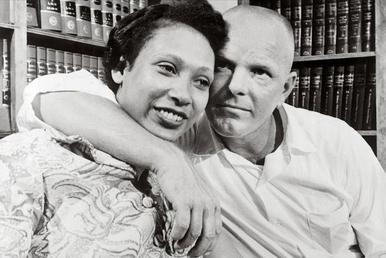 "When my late husband, Richard, and I got married in Washington, DC in 1958, it wasn't to make a political statement or start a fight. We were in love, and we wanted to be married.
"We didn't get married in Washington because we wanted to marry there. We did it there because the government wouldn't allow us to marry back home in Virginia where we grew up, where we met, where we fell in love, and where we wanted to be together and build our family."
Mildred Loving, one of the parties in the landmark case overturning Virginia's ban on interracial marriage, wrote these words, and an evocative recollection, for the commemoration of the 40th anniversary of Loving v. Virginia last year. She is remembered today, following her death at 68.
When the ACLU took up their case, and attorney Bernard S. Cohen tried to explain the legal theories they would rely on, Richard Loving replied, “Mr. Cohen, tell the court I love my wife, and it is just unfair that I can’t live with her in Virginia.”
Reminder: Politics and the Constitution conference, deadline July 1
The deadline for proposals for San Francisco State University's conference on Politics and the Constitution is July 1, 2008. The conference will be September 16 and 17, 2008. Details are here.
Six from Finkelman on slavery, the 14th Amendment, James Madison and more
Paul Finkelman, Albany Law School, a leading historian of American slavery and other topics, has posted a number of articles, recent and not so recent, on SSRN.
John Bingham and the Background to the Fourteenth Amendment appeared in the Akron Law Review (2003).
John Bingham and the Background to the Fourteenth Amendment appeared in the Akron Law Review (2003).
An understanding of the Fourteenth Amendment begins not in Congress, but in the history leading up to the Civil War. The first crucial story in understanding the Fourteenth Amendment is the striking changes in the law of race relations that took place in the North - especially in Bingham's home state of Ohio - in the dozen or so years before the Civil War began. The second story is about the South, and the legal repression and brutal racial violence that took place there immediately after the Civil War ended. These two stories complement each other. The first gives insight into the legal and political history that shaped Bingham's thoughts about race and his aspirations for a racially just society. The second helps understand what Bingham was struggling against in drafting Section one of the Fourteenth Amendment, and thus illuminates what he hoped the Amendment would accomplish.Legal Ethics and Fugitive Slaves: The Anthony Burns Case, Judge Loring, and Abolitionist Attorneys was published in the Cardozo Law Review (1996).
The Anthony Burns case paralyzed Boston for a week while lawyers debated Burns's debate before United States Commissioner Edward G. Loring, and stimulated a evolution in public antislavery sentiment in Massachusetts. This Article explores the issues of legal ethics through an analysis of the rendition of Anthony Burns, the most famous return of a fugitive slave in American history, and the key figures in the legal proceedings.Fugitive Slaves, Midwestern Racial Tolerance, and the Value of "Justice Delayed" was published in the Iowa Law Review (1992).
Despite the importance of swift justice, there are times when justice delayed can be justice acquired. This Article examines two cases that explore the problem of delaying justice in the context of fugitive slave renditions in the antebellum Midwest.A careful reexamination of legal developments and cases in the antebellum North shows far greater complexity and ambiguity in Northern race relations than the generally bleak picture that scholars paint. The cases detailed in this article underscore the point that the North was far less racist than many scholars have claimed, and in the process tell us something about the meaning of race and race relations in antebellum America and in our own times as well.International Extradition and Fugitive Slaves - The John Anderson Case appeared in the Brooklyn Journal of International Law (1992).
The John Anderson extradition case of 1860-61 was the last attempt to remove a fugitive slave from Canada, and underscores the uncertain protection the Union Jack offered fugitive slaves and the extent to which Canadians were not immune to Negrophopia and racism.This article uses the John Anderson case as an example of the tensions between law, justice and international politics in the antebellum era, and to illustrate the ambiguities of the 1842 Webster-Ashburton Treaty.James Madison and the Bill of Rights: A Reluctant Paternity was published in the Supreme Court Review (1990).
In 1789, James Madison, despite opposition from former federalist allies, introduced a series of twelve constitutional amendments to the newly formed Congress, ten of which were ratified in 1791; earning him the title `father of the Bill of Rights.' This article explores the route Madison's reluctant support of the amendments and the political realities that forced him to take his well-earned place in the history of liberty.Exploring Southern Legal History appeared in the North Carolina Law Review (1985).
As interest in legal history increases, many scholars have begun to examine what role regionalism - particularly southern regionalism - has played in the growth of American law, realizing that through legal history they can better understand the law they study, practice, and apply.This essay discusses southern legal history through an examination of race relations, violence, crime, legal institutions, and legal culture, concluding that marked differences exist between northern legal history and southern legal history.
Monday, May 5, 2008
Edlin on Judicial Review Without a Constitution
Judicial Review Without a Constitution by Douglas Edlin, Dickinson College is a recent essay in Polity (2006). Here's the abstract: In the United States, judicial review is understood, since Marbury v. Madison (1803), as judicial evaluation of government action to ensure compliance with the Constitution. But before and after Marbury, state and federal courts developed and practiced a form of judicial review in which common law principles, along with or instead of a canonical document, were the foundational body of legal doctrine against which public actions were assessed. This article carefully examines the cases in which this alternative form of judicial review emerged, and corrects certain misconceptions that Marbury must be the only form of judicial review that has existed or can exist in this country. More particularly, the article clarifies a failure by certain writers to distinguish properly between common law and natural law as matters of legal theory and legal doctrine. In correcting some of these theoretical and historical errors, the article outlines an understanding of judicial review that more fully captures its development during the formative period of American constitutional thought.
Olken on Justice Sutherland Reconsidered
Justice Sutherland Reconsidered is a new article by Samuel R. Olken, John Marshall Law School. It is forthcoming in the Vanderbilt Law Review (2009). Here's the abst ract:
ract:
Long considered one of the Supreme Court's more conservative justices in matters of economic liberty, George Sutherland's reputation has suffered largely because of his vigorous opposition to the fabled revolution of the 1930s in which a bare majority of the justices began to adapt the Constitution to changing economic circumstances and departed from the jursiprudential premises of legal classicism and guardian judicial review. Neither laissez-faire economics, Social Darwinism nor natural rights wielded much influence upon his perspective. Rather, his skepticism about public regulation of private economic affairs emanated from his aversion toward political factions and his abiding commitment to the equal operation of the law. Sutherland adhered to guardian review in which judges used seemingly neutral principles of law, historical custom and precedent in assessing the constitutional limits of governmental authority to protect individual rights and liberties from the tyranny of democratic majorities manipulated by political factions. However, Sutherland often failed to perceive the practical effects of his decisions and the limits of his constitutional vision. His was essentially a negative view of the Constitution in terms of economic affairs; it restricted governmental authority to protect individual liberty. Yet this prevented him from appreciating the importance of adapting its provisions to changing economic circumstances. Nor did Sutherland recognize the growing obsolescence of his jursiprudence and its inability to resolve issues arising from conflicts between interest groups. In dissent, his jursiprudence appeared myopic and vulnerable to misconceptions about his judicial motivation. Consequently, Sutherland's more progressive views about criminal procedure and the business of expression have received much less attention than they deserve, overshadowed by his seemingly reactionary opinions concerning economic liberty. Indeed, the ultimate lesson of Sutherland's economic liberty jursiprudence is how strict adherence to the past can relegate even the most conscientious jurist to the dustbin of obsolescence.
 ract:
ract:Long considered one of the Supreme Court's more conservative justices in matters of economic liberty, George Sutherland's reputation has suffered largely because of his vigorous opposition to the fabled revolution of the 1930s in which a bare majority of the justices began to adapt the Constitution to changing economic circumstances and departed from the jursiprudential premises of legal classicism and guardian judicial review. Neither laissez-faire economics, Social Darwinism nor natural rights wielded much influence upon his perspective. Rather, his skepticism about public regulation of private economic affairs emanated from his aversion toward political factions and his abiding commitment to the equal operation of the law. Sutherland adhered to guardian review in which judges used seemingly neutral principles of law, historical custom and precedent in assessing the constitutional limits of governmental authority to protect individual rights and liberties from the tyranny of democratic majorities manipulated by political factions. However, Sutherland often failed to perceive the practical effects of his decisions and the limits of his constitutional vision. His was essentially a negative view of the Constitution in terms of economic affairs; it restricted governmental authority to protect individual liberty. Yet this prevented him from appreciating the importance of adapting its provisions to changing economic circumstances. Nor did Sutherland recognize the growing obsolescence of his jursiprudence and its inability to resolve issues arising from conflicts between interest groups. In dissent, his jursiprudence appeared myopic and vulnerable to misconceptions about his judicial motivation. Consequently, Sutherland's more progressive views about criminal procedure and the business of expression have received much less attention than they deserve, overshadowed by his seemingly reactionary opinions concerning economic liberty. Indeed, the ultimate lesson of Sutherland's economic liberty jursiprudence is how strict adherence to the past can relegate even the most conscientious jurist to the dustbin of obsolescence.
Sunday, May 4, 2008
Reviewed: Holloway, Sexuality, Politics, and Social Control in Virginia, 1920-1945
Pippa Holloway, Sexuality, Politics, and Social Control in Virginia,1920-1945 (Chapel Hill: University of North Carolina Press, 2006) is reviewed for H-Women by Julian B. Carter, Program in Critical Studies, California College of the Arts. Hat tip. Carter writes:
Pippa Holloway's deep research into Virginia politics, at both state and city levels, allows her to demonstrate beyond a shadow of a doubt that state regulation of sexual behavior and reproduction was an important means of social control in early twentieth-century Virginia. More specifically, she shows that a small group of white elite males consistently and consequentially built social policies that reflected their belief that African Americans and poor whites posed sexual dangers to the state. Sexual regulation, she argues, helped draw and enforce a line between the "governing class" and the "class that was governed" (p. 6). Holloway nuances this broad picture of social control by white elites in two ways. She is careful to depict and explore disagreements within the governing class to show "how it resolved differences within its ranks,"and she is equally careful to describe the ways that changes in the larger political context influenced which "visions of sexual regulation prevailed" (p. 3). Holloway's deft handling of the relationship between continuity and change makes for a convincing argument that the overall function of sexual regulation remained constant, although its focus changed considerably between 1920 and 1945. She notes that "white elites raised the possibility of sexual threats in different ways to define themselves as the class that could use the state to restrict others" (p.6). Thus, the introduction of film censorship and the active pursuit of eugenic sterilization in the 1920s gave way to blood testing for venereal disease as a prerequisite for marriage in the 1930s and to the regulation of prostitution as part of the fight against venereal disease during the Second World War, but the core reality remained the same. Across the decades, "white elites directed the authority of the state at those with the least ability to fight back," the disenfranchised majority whose putative lack of sexual self-control seemed to testify to the folly of allowing them to participate in governing themselves (p.2). Continue reading here.
Reviewed: Wilentz, The Age of Reagan
THE AGE OF REAGAN: A History, 1974-2008 by Sean Wilentz (Harper) is reviewed by Kevin Phillips for the Washington Post. For Phillips, "Wilentz deserves kudos for biting off a challenge that few historians would have dared to undertake." Rather than a more confined history, the author "goes for sweep, and in a number of ways achieves it." Wilentz is right, Phillips argues, that

although a major trend to the right in U.S. national politics began in the 1960s, Democratic leaders time after time found some reason for perceiving an ongoing or restored liberal dominance -- in 1974, in 1982, in 1986-88 and at both the beginning and conclusion of the Clinton era. Reagan was the most successful Republican president of the 1960-2008 period, which can reasonably support naming the larger era after him....The author "is also reasonably correct when he says the unfolding conservative zeitgeist of late-20th-century America produced a string of excesses from Watergate and Vietnam down to the George W. Bush years." However, "by formally beginning his narrative in 1974, he manages to avoid any serious analysis of the three-tiered Democratic failure under Lyndon Johnson."
Continue reading here.
Thursday, May 1, 2008
Stebenne reviews Scheiber, Earl Warren and the Warren Court: The Legacy in American and Foreign Law
Harry N. Scheiber, ed., Earl Warren and the Warren Court: The Legacy in American and Foreign Law (Lanham: Lexington Books, 2007) is reviewed for H-Law by David Stebenne, Department of History and College of Law, Ohio State University. Stebenne writes:


What is truly new and most interesting in this volume are the essays that deal with the Warren Court's influence on other (i.e., foreign) legal systems. The comparative approach has thus far mostly been lacking in studying the Warren Court, and this collection makes a serious start on filling in that gap in the scholarly literature. Earl Warren and the Warren Court includes essays by Javier Couso on Latin America, Thomas Ginsburg on East Asia, Edward Greenspan on Canada, Eivind Smith on Europe, and Kjell Ake Moder on Scandinavia.Of these, the ones dealing with the Warren Court's influence on Latin America,East Asia, and Europe are especially illuminating. Couso, an assistant professor of law and political science at the Universidad Diego Portales in Santiago, Chile, argues persuasively that during the 1980s and 1990s, Latin American reformers were influenced by the Warren Court's legacy....In East Asia, the pattern was somewhat different. Thomas Ginsburg, an associate professor of law and director of the Program in Asian Law,Politics, and Society at the University of Illinois, Urbana-Champaign,chose three places (Japan, South Korea, and Taiwan) as case studies.These cases suggest that in East Asia, the Warren Court's rulings in the area of criminal procedure, and especially the rulings formulating the exclusionary rule (Mapp v. Ohio [1961]) and finding the right to counsel for criminal defendants (Gideon v. Wainright [1963]) instate courts, have had the biggest impact....In Europe, the pattern is different from either Latin America or East Asia. Eivind Smith, a professor and director of the Department of Public and International Law at the University of Oslo, argues that the European legal systems have tended to view the Warren Court's innovations "much more as products of political activism than of' law'" (p. 323).
Read the full review here.
Bosniak reviews Dudziak & Volpp, Legal Borderlands
Between the Domestic and the Foreign: Centering the Nation's Edges, a review essay by Linda Bosniak, Rutgers University School of Law, Camden, has just been posted on SSRN. Bosniak reviews LEGAL BORDERLANDS: LAW AND THE CONSTRUCTION OF AMERICAN BORDERS, Mary L. Dudziak, Leti Volpp, Eds. (Johns Hopkins University Press, 2006). The review essay appears in Constitutional Commentary. Here's the abstract:
Most American constitutional thought presumes the existence of a firm divide between national-self and outside-other - between the domestic and the foreign - that doesn't hold up. Some issues do fall neatly on one side of the line or the other, but it is also true that the national self and its others converge in a multiplicity of moments and manners and locations. These convergences complicate the presumed divide between the in-here and the out-there. Whether formally or informally, violently or uneventfully, the domestic and the foreign interact;they mutually engage. Those occasions and locations of interaction between the domestic and the foreign are themselves neither entirely domestic nor entirely foreign; they are interstitial spaces. Whether arising at the nation's geographic frontiers or its figurative ones,they require their own attention as an analytical matter.
But a focus on on national boundaries makes clear, in addition, that there are really no unalloyed domestic and foreign spaces after all. The nation's inside and its outside are always interpenetrated. The emerging field of border studies anatomizes these domains of interface; and in the process, allows us to see how the domestic and the foreign are constantly making and remaking one another. One implication is that attention to the nation's edges, wherever those are located, is of essential importance even for those whose primary interest remains inward-looking, domestic constitutional law. For it turns out that the constitutional inside is comprised not merely by matters of ruling and being ruled and other issues conventionally understood to lie at the heart of the field, but by all of the rules and practices that govern thescope - personal and territorial - of the community within which people are ruling and being ruled. Policies and practices regarding immigration and citizenship status, extraterritorial jurisdiction, military occupation, management of territorial possessions,assignment of enemy combatant status in war, rights of noncitizens, status of refugees and escapees ¿all of these infuse and give shape to the presumptive who and where which serve as backdrop to many of the questions that are conventionally considered to lie at the core of constitutional inquiry.
This excellent volume of essays directs its gaze precisely at the domains of interaction between the foreign and the domestic in the context of the American nation-state. Originally published as a special issue of the American Quarterly, it is a collection of articles by scholars in law, literature and history who are devoted to making sense of the United States by way of its legally constructed edges. Sometimes these edges are located at the nation's geographic frontier, but just as often they can be found on the other side of the world or in very heart of the nation's territory. And it is often in, and through, the bodies and minds of persons whether they happen to be territorially inside or not that these edges are most consequential. As the collection's editors Mary Dudziak and Leti Volpp write in their introduction, the volume's essays address not only spaces on the edge of American sovereignty, but also internal places at the heart of American identity. These are the legal borderlands of the volume's title.
 abstract:
Most American constitutional thought presumes the existence of a firm divide between national-self and outside-other - between the domestic and the foreign - that doesn't hold up. Some issues do fall neatly on one side of the line or the other, but it is also true that the national self and its others converge in a multiplicity of moments and manners and locations. These convergences complicate the presumed divide between the in-here and the out-there. Whether formally or informally, violently or uneventfully, the domestic and the foreign interact;they mutually engage. Those occasions and locations of interaction between the domestic and the foreign are themselves neither entirely domestic nor entirely foreign; they are interstitial spaces. Whether arising at the nation's geographic frontiers or its figurative ones,they require their own attention as an analytical matter.
But a focus on on national boundaries makes clear, in addition, that there are really no unalloyed domestic and foreign spaces after all. The nation's inside and its outside are always interpenetrated. The emerging field of border studies anatomizes these domains of interface; and in the process, allows us to see how the domestic and the foreign are constantly making and remaking one another. One implication is that attention to the nation's edges, wherever those are located, is of essential importance even for those whose primary interest remains inward-looking, domestic constitutional law. For it turns out that the constitutional inside is comprised not merely by matters of ruling and being ruled and other issues conventionally understood to lie at the heart of the field, but by all of the rules and practices that govern thescope - personal and territorial - of the community within which people are ruling and being ruled. Policies and practices regarding immigration and citizenship status, extraterritorial jurisdiction, military occupation, management of territorial possessions,assignment of enemy combatant status in war, rights of noncitizens, status of refugees and escapees ¿all of these infuse and give shape to the presumptive who and where which serve as backdrop to many of the questions that are conventionally considered to lie at the core of constitutional inquiry.
This excellent volume of essays directs its gaze precisely at the domains of interaction between the foreign and the domestic in the context of the American nation-state. Originally published as a special issue of the American Quarterly, it is a collection of articles by scholars in law, literature and history who are devoted to making sense of the United States by way of its legally constructed edges. Sometimes these edges are located at the nation's geographic frontier, but just as often they can be found on the other side of the world or in very heart of the nation's territory. And it is often in, and through, the bodies and minds of persons whether they happen to be territorially inside or not that these edges are most consequential. As the collection's editors Mary Dudziak and Leti Volpp write in their introduction, the volume's essays address not only spaces on the edge of American sovereignty, but also internal places at the heart of American identity. These are the legal borderlands of the volume's title.
Wednesday, April 30, 2008
Charles Tilly
 Crooked Timber and other blogs carry the news this morning of the death of Charles Tilly, Joseph L. Buttenwieser Professor of Social Science, Columbia University and path-breaking scholar on war, the state and social change and other topics. Tilly's work has been important to new scholarship on the history of law and war. Among his works are European Revolutions: 1492-1992, Durable Inequality, and "War Making and State Making as Organized Crime."
Tilly was just awarded the Albert Hirschman Prize from the Social Science Research Council. An interview with Tilly is here. Johann Peter Murmann's blog provides a guide to Tilly's writing about methodology and many links including one to the article How (and What) Are Historians Doing?
Maatman on Lawyers and Resistance to the End of White Supremacy
Speaking Truth to Memory: Lawyers and Resistance to the End of White Supremacy is a recent article by Mary Ellen Maatman, Widener University School of Law. It appeared in the Howard Law Journal (2006). Here's the abstract: This article critically examines how elite lawyers built and defended the legal framework for White Supremacy in the Deep South both before and after Brown v. Board of Education. Although turn of the century commentators freely discussed how lawyers blocked African Americans' access to the ballot box, time has largely obliterated that story from our profession's memory. Some recent legal commentators have discussed post-Brown massive resistance, but few have specifically considered the role of lawyers qua lawyers in that movement. In contrast, this article analytically connects these eras to a decades-long program of legal work dedicated to defending and attempting to save White Supremacy. The elite lawyers of the Deep South who most deeply engaged in this work began by opposing the Supreme Court's 1944 Smith v. Allwright decision that outlawed the white primary, and ended with assisting the defense of anti-miscegenation laws at issue in the Court's 1967 Loving v. Virginia decision. Throughout two decades, the legal work I describe stemmed from the lawyers' belief in the racist assumptions underlying White Supremacy, and their desire to embed those assumptions in the law of the land. I believe it is time for the legal profession to take full stock of its role in the progress of racial justice. Failure to do so falsely depicts the profession as a monolithic champion of justice. In turn, we are hobbled in our analysis of the role of law in hindering or promoting the progress of civil rights. To better understand our profession's history and our nation's civil rights progress, we must learn of, and challenge, the work of segregationist lawyers.
Chafetz on The Constitutional Status of Resignation from the House of Representatives
Leaving the House: The Constitutional Status of Resignation from the House of Representatives is a new article by Josh Chafetz, Cornell University - School of Law. It is forthcoming in the Duke Law Journal (2008). Here's the abstract: Do Members of the House of Representatives have a constitutional right to resign their seats? This Article seeks to use that question as a window onto broader issues about the relationship between legislators and citizens and the respective roles of liberalism and republicanism in the American constitutional order. The Constitution explicitly provides for the resignation of Senators, Presidents, and Vice Presidents, but curiously, it does not say anything about resigning from the House of Representatives. Should we allow the expressio unius interpretive canon to govern and conclude that the inclusion of some resignation provisions implies the impermissibility of resignation where there is no such clause? Or should we consider this a meaningless variation? This Article examines how Members left (or were prevented from leaving) the House of Commons, the colonial American legislatures, the early state legislatures, and the Continental Congress and concludes that the background assumption at the Founding was that legislative seats could not be resigned. Moreover, the scant available evidence from the Constitution's drafting shows that the Founders understood there to be a difference between the House and Senate with regard to resignation. The Article presents several reasons, based on the different institutional designs and functions of the two houses, why this might have been the case, including different term lengths and methods of appointment and the early Senate's role as a quasi-ambassadorial body. From this historical evidence, the Article suggests that the House has the power to prevent its Members from resigning. However, the House of Representatives has never exercised this power. After surveying the debates over resignation in the early Congresses, the Article concludes by considering policy reasons for requiring Members to get the House's permission in order to quit their seats. Specifically, the Article offers two paradigm cases for returning to the original understanding. The first case deals with Members who wish to resign while they stand accused of ethical transgressions; the second case deals with Members who wish to leave because legislative service has ceased to be convenient for them. The Article argues that both cases point toward the need for a return to a previous, more republican, understanding of resignations.
Tuesday, April 29, 2008
Cunningham reviews Lerner, Dry Manhattan: Prohibition in New York City
Michael A. Lerner, Dry Manhattan: Prohibition in New York City (Cambridge: Harvard University Press, 2007) is reviewed for H-Urban by Patricia Cunnin gham. Hat tip. Cunningham writes that Dry Manhattan "is a long-awaited alternative to popular images of the Prohibition era. Rum runners, bootleggers, gangsters in Chicago, moonshine stills in rural states, and specially designed transport cars are not the focus of this work, even though some of them are featured." This book features instead:
 gham. Hat tip. Cunningham writes that Dry Manhattan "is a long-awaited alternative to popular images of the Prohibition era. Rum runners, bootleggers, gangsters in Chicago, moonshine stills in rural states, and specially designed transport cars are not the focus of this work, even though some of them are featured." This book features instead:
the ordinary citizen harassed on the street for possibly concealing a hip-flask; the overwhelmed judge with an impossible caseload of criminal casual drinkers, waiters, and restaurant owners; the law enforcer tempted beyond typical possibilities by the corruption of his extended powers. There is a good chapter about women and their "pivotal and surprising role in the demise of the noble experiment" (p. 171)....
"Much greater in scope than a debate over alcohol consumption, the Prohibition era in New York turned out to be a time of confrontation over how citizens could be governed, the value placed on diverse cultures within a cosmopolitan arena, and the right to rebel against ... moral absolutism."
The full review is here.
Garnett on "No Taking Without a Touching?" Questions from an Armchair Originalist
'No Taking Without a Touching?' Questions from an Armchair Originalist, is a new paper from Nicole Stelle Garnett, Notre Dame Law School. It is forthcoming in the San Diego Law Review. Here's the abstract: This paper is an invited contribution to the Bernard Siegan Memorial Conference on Economic Liberties, Property Rights, and the Original Meaning of the Constitution at the University of San Diego School of Law. The paper poses three questions about the historical evidence used to support the dominant academic view that the Fifth Amendment's Takings Clause, as originally understood, extended only to physical appropriations or invasions of private property. First, the paper questions the relevance of state and local regulatory practices to the pre-incorporation understanding of the Takings Clause. Second, the paper expresses concern about the use of state-court cases decided well into the nineteenth century to elucidate the meaning of a late-eighteenth-century legal provision. Finally, the paper asks whether the state decisions frequently cited for the "no taking without a touching" principle might have been answering different questions than the modern "regulatory takings" problem.
Monday, April 28, 2008
Legal historian Reva Siegel elected to American Academy of Arts and Sciences

Again this year the American Academy of Arts and Sciences has added a prominent legal historian to its ranks. This year it is Reva Siegel, Yale Law School. (Last year it was Herb Hovenkamp, University of Iowa.) Hat tip. The full list of new fellows is here. Eight historians are on the list. Among them are: Nancy Cott, Harvard; Daniel Rodgers, Princeton; and Joan Wallach Scott, Institute for Advanced Study.
Brophy on William and Mary's History with Slavery: The Case of President Thomas Roderick Dew
Alfred L. Brophy, University of Alabama, has a new article, Considering William and Mary's History with Slavery: The Case of President Thomas Roderick Dew . It appears in the William & Mary Bill of Rights Journal (2008). Here's the abstract: 

Amidst the recent apologies for slavery from the legislatures of Virginia, Maryland, North Carolina, Florida, and Alabama, there is significant controversy over the wisdom of investigations of institution's connections to slavery and apologies for those connections. The divide over attitudes towards apologies falls along racial lines. This paper briefly looks to the controversy on both sides of the apology debates.
Among those questions about investigations of the past, Universities occupy a special place. Efforts at recovery of their connections to slavery include a study released by graduate students at Yale in 2001, Brown University's Steering Committee on Slavery and Justice, and the University of Virginia's board of visitors' spring 2007 apology for that institution's connections to slavery.
That leads to a question about whether other schools ought to consider a self-investigation. William and Mary is a particularly good place to ask such questions. This paper focuses on Thomas R. Dew, first a professor, then president at William and Mary, from 1828 to his early death in 1846. Dew is the author of Review of the Debates in the Virginia Legislature, one of the most reprinted arguments on slavery in the years leading into Civil War. He is also the author of one of the most comprehensive and important histories published in the United States in the nineteenth century, A Digest of the Laws, Customs, Manners and Institutions of Ancient and Modern Nations. Dew focused on considerations of utility and history to suggest the impracticality of gradual emancipation. Through Dew we can gauge the intellectual connections to slavery, then ask the important question, what - if anything - is an appropriate institutional response today? We can use him to begin a discussion of the virtues and pitfalls of apologies and to assess the value of talk of the connections to the past.
Among those questions about investigations of the past, Universities occupy a special place. Efforts at recovery of their connections to slavery include a study released by graduate students at Yale in 2001, Brown University's Steering Committee on Slavery and Justice, and the University of Virginia's board of visitors' spring 2007 apology for that institution's connections to slavery.
That leads to a question about whether other schools ought to consider a self-investigation. William and Mary is a particularly good place to ask such questions. This paper focuses on Thomas R. Dew, first a professor, then president at William and Mary, from 1828 to his early death in 1846. Dew is the author of Review of the Debates in the Virginia Legislature, one of the most reprinted arguments on slavery in the years leading into Civil War. He is also the author of one of the most comprehensive and important histories published in the United States in the nineteenth century, A Digest of the Laws, Customs, Manners and Institutions of Ancient and Modern Nations. Dew focused on considerations of utility and history to suggest the impracticality of gradual emancipation. Through Dew we can gauge the intellectual connections to slavery, then ask the important question, what - if anything - is an appropriate institutional response today? We can use him to begin a discussion of the virtues and pitfalls of apologies and to assess the value of talk of the connections to the past.
Merkel on Jefferson's Failed Anti-Slavery Proviso of 1784 and the Nascence of Free Soil Constitutionalism
Jefferson's Failed Anti-Slavery Proviso of 1784 and the Nascence of Free Soil Constitutionalism is a new article by William G. Merkel, Washburn University - School of Law. It will appear in the Seton Hall Law Review (2008). Here's the abstract: Despite his severe racism and inextricable personal commitments to slavery, Thomas Jefferson made profoundly significant contributions to the rise of anti-slavery constitutionalism. This Article examines the narrowly defeated anti-slavery plank in the Territorial Governance Act drafted by Jefferson and ratified by Congress in 1784. The provision would have prohibited slavery in all new states carved out of the western territories ceded to the national government established under the Articles of Confederation. The Act set out the principle that new states would be admitted to the Union on equal terms with existing members, and provided the blueprint for the Republican Guarantee Clause and prohibitions against titles of nobility in the United States Constitution of 1788. The defeated anti-slavery plank inspired the anti-slavery proviso successfully passed into law with the Northwest Ordinance of 1787. Unlike that Ordinance's famous anti-slavery clause, Jefferson's defeated provision would have applied south as well as north of the Ohio River.
Sunday, April 27, 2008



Reviewed: Books on Ida B. Wells, The Library at Night, and Labor
 Peter Conrad has a decidedly 1.0 review (or 0.0, if there is such a thing) of Alberto Manguel, The Library at Night (Yale University Press) in The Guardian. Conrad imagines Manguel sitting in his library,
preferably at night, with the 'shapeless universe' outside expunged by darkness. Warmed by the pools of light that spill from his lamps, he does not even need to read: the smell of the wooden shelves and 'the musky perfume of the leather bindings' is enough to pacify him and prepare him for sleep....Within his global, multilingual book collection, he can effortlessly travel in both time and space.
This world is fading, however, for "libraries like his are now imperilled by their virtual equivalents on the internet. A book read on a screen has dematerialised; we can neither own nor love it, and if we can't hold it in our hands how can we absorb it into our minds?"
Eric Arnesan has a fine review of Ida: A Sword Among Lions, by Paula J. Giddings (Amistad/HarperCollins), on pathbreaking African American journalist and anti-lynching activist Ida B. Wells, for the Chicago Tribune. He writes:

What emerges clearly from Giddings' account is a portrait of a courageous activist who desperately longed for recognition and credit but found herself instead perpetually frustrated when passed over for office or denied the praise she believed she deserved. One of the many strengths of Giddings's biography is her reluctance to either romanticize or minimize Wells' contributions. She is also appropriately attentive to the broader canvas of black politics, continually situating Wells in a spectrum of black perspectives that can no longer be reduced to Booker T. Washington's accommodationism and W.E.B. DuBois' militancy. If excessively detailed at times, "Ida: A Sword Among Lions" is nevertheless a skillfully constructed and often moving account of a life and a time whose complexity is always central to its story.
Two books on labor history, THE BIG SQUEEZE: Tough Times for the American  Worker, by Steven Greenhouse (Knopf), and AMERICAN-MADE: The Enduring Legacy of the WPA: When FDR Put the Nation to Work, by Nick Taylor (Bantam) are reviewed by H.W. Brands for the Washington Post. For Brands, Greenhouse offers "enlightened counterpoints to the dark force of Wal-Mart," even though it is "hard to imagine how government will summon the will to effect the changes" Greenhouse believes are necessary for American workers. Taylor's book is "bigger than its title suggests; he provides a succinct survey of the Great Depression and particularly its consequences for workers." Even though "a warm glow of history enshrouds the WPA," Brand writes, "no one should want to see the WPA experiment repeated, for the reason that it would require reliving the economic circumstances that made it necessary. All the same, the WPA experience demonstrates that democracy can act decisively in a national emergency."
 Worker, by Steven Greenhouse (Knopf), and AMERICAN-MADE: The Enduring Legacy of the WPA: When FDR Put the Nation to Work, by Nick Taylor (Bantam) are reviewed by H.W. Brands for the Washington Post. For Brands, Greenhouse offers "enlightened counterpoints to the dark force of Wal-Mart," even though it is "hard to imagine how government will summon the will to effect the changes" Greenhouse believes are necessary for American workers. Taylor's book is "bigger than its title suggests; he provides a succinct survey of the Great Depression and particularly its consequences for workers." Even though "a warm glow of history enshrouds the WPA," Brand writes, "no one should want to see the WPA experiment repeated, for the reason that it would require reliving the economic circumstances that made it necessary. All the same, the WPA experience demonstrates that democracy can act decisively in a national emergency."
Saturday, April 26, 2008
Sharfstein on Racial Migration and the One-Drop Rule, 1600-1860
Daniel J. Sharfstein, Vanderbilt, has posted a recent article, Crossing the Color Line: Racial Migration and the One-Drop Rule, 1600-1860. It appeared in the Minnesota Law Review (2007). Here's the abstract: Scholars describe the one-drop rule - the idea that any African ancestry makes a person black - as the American regime of race. While accounts of when the rule emerged vary widely, ranging from the 1660s to the 1920s, most legal scholars have assumed that once established, the rule created a bright line that people were bound to follow. This Article reconstructs the one-drop rule's meaning and purpose from 1600 to 1860, setting it within the context of racial migration, the continual process by which people of African descent assimilated into white communities. While ideologies of blood-borne racial difference predate Jamestown, the rhetoric of purity was always undermined by the realities of mixture. Cases such as Hudgins v. Wright and State v. Cantey simultaneously strengthened and undermined the color line, expressing confidence in the permanence of racial difference while allowing people of color to become white. Instead of simply widening the racial divide, restrictions on the liberty and livelihoods of African Americans pushed many into whiteness. As more people became vulnerable to reclassification, courts acted to preserve social stability in Southern communities, shielding them from the insecurity that an insistence on racial purity would engender. The one-drop rule's transformation from ideological current to legal bright line and presumed social reality is a story not of slavery, but of freedom. In the 1840s and 1850s, the prospect of emancipation hastened the rule's spread as whites attempted to preserve property relations in slavery's absence. In Northern border states such as Ohio, the rule emerged by 1860 as a legal argument and a social attitude. The rule's ostensible opponents - abolitionists - propagated it, deploying it as a rhetorical weapon to symbolize slavery's cruelty and to argue that Northern whites could be enslaved. But the rule's ascent did not make it any more enforceable than it had ever been.
Friday, April 25, 2008
The impact of cutbacks at the National Archives
Eric Muller at Is That Legal? has run into the effects of cutbacks at the National Archives. Eric was disappointed to find that, in the words of the Archives staff he spoke to, they "really have no one" to replace a senior archivist who was an expert in Justice Department records.
The broader impact of cutbacks at the archives was addressed last spring in a post on this blog: Losing American History at the Archives, linking to a NYT op-ed on the topic. While the National Archives now appears to have restored its regular hours, the enduring problem, which Eric encountered, is the loss of experienced senior staff. This does not just make research more difficult and time-consuming. It will mean that some nuggets of history go unfound by researchers, who rely on assistance from those who know the records the best. To repeat the point I made last spring: Undermining the role of the archivist in the production of American history writing will undermine the way the story of American history itself is told.
The broader impact of cutbacks at the archives was addressed last spring in a post on this blog: Losing American History at the Archives, linking to a NYT op-ed on the topic. While the National Archives now appears to have restored its regular hours, the enduring problem, which Eric encountered, is the loss of experienced senior staff. This does not just make research more difficult and time-consuming. It will mean that some nuggets of history go unfound by researchers, who rely on assistance from those who know the records the best. To repeat the point I made last spring: Undermining the role of the archivist in the production of American history writing will undermine the way the story of American history itself is told.
Subscribe to:
Posts (Atom)