Showing posts with label Legal education. Show all posts

Monday, October 6, 2025

Schlegel to Lecture on Legal Education and the Postwar Middle Class

[We have the following announcement.  DRE]

The Fall 2025 James McCormick Mitchell Lecture at the University at Buffalo School of Law

 Friday, November 14, 2025. Lecture at 2:30 p.m. Panel Discussion at  3:30 p.m. Reception at 4:30 p.m.  Charles B. Sears Law Library, John Lord O’Brian Hall, UB (North Campus)

“Reflections on Legal Education and the Post-War Middle Class,” by John Henry Schlegel

The history of American legal education, the one that “everybody knows,” begins with Christopher Columbus Langdell, the first Dean of the Harvard Law School, who discovered, not a continent, but case law, the large class, and the cold call and used them to wrestle legal education from practicing lawyers who apparently didn’t understand what they did every day. Thereafter, Legal Realism moved the focus of the classroom from what the case law was to what it should be, and their grandchildren attended to matters of ethnicity, race and gender. Matters of social class, while not verboten, are seldom adverted to in this story. Reflections on Legal Education and the Post-War Middle Class attempts to repair this historical absence by inserting aspects of class into the story both generally and more specifically in explaining behavior by contemporary law students that their professors complain about while they teach as if without students.

Join us as we celebrate Prof. Schlegel on his 50+ years of distinguished teaching and scholarship at a reception to follow the lecture.  Free and open to the public. Registration is required.  Prof. John Henry Schlegel is a UB Distinguished Professor and Floyd H. & Hilda L. Hurst Faculty Scholar at the University at Buffalo School of Law. He joined the UB Law faculty in 1973, teaching for more than five decades primarily in the areas of corporate and commercial law and regional economic development.

A legal historian, his scholarship has focused on the history of legal education and the evolution of American Legal Realism in the 1920s and 30s. He is the author of numerous books and articles, including, most recently, While Waiting for Rain: Community, Economy and Law in a Time of Change (University of Michigan Press, 2022).

Friday, October 3, 2025

Treanor and Uelman on Religious Freedom, Jesuit Mission, and DEI

William Michael Treanor and Amy Uelmen, Georgetown University Law Center, have posted Religious Freedom, Jesuit Mission, and DEI, which is forthcoming in a special issue of the Jesuit Educational Quarterly entitled "Legal Education and the Society of Jesus."

The ability of Jesuit educational institutions to pursue a central part of their mission that of fostering diverse, equitable and inclusive educational environments is under attack. This essay outlines several dimensions of their religiously-grounded mission and the reasons to strongly protect from government interference the rights of Jesuit universities to implement programs and practices that align with DEI values. First, for Jesuit universities, these programs and practices are rooted in a much deeper culture of the more than 2,000-year old Catholic intellectual tradition and the now 500-year old tradition of Jesuit spirituality. Second, drawing on the classic work of Alexis de Tocqueville, Democracy in America, this essay highlights the important role that Jesuit universities play in protecting liberty and democracy. Third, a Jesuit university's control of its curriculum and admissions practices are protected by well-established First Amendment principles, including freedom of religion. In addition, the First Amendment principle of religious freedom also protects Jesuit universities' ability to have race-conscious programs of student support that advance the Jesuit pedagogic mission. The final section of this essay describes some of the curricular and co-curricular innovations and programmatic offerings at Georgetown University Law Center to illustrate how a Jesuit Law School might advance the Jesuit mission of creating an inclusive environment that supports reflective practices and the free exchange of ideas across differences. 

--Dan Ernst 

Saturday, August 9, 2025

Weekend Roundup

  • Thurgood Marshall, assisted by Wife and Family (LC)
    “Becoming Thurgood: America’s Social Architect,” a documentary on the life and career of Thurgood Marshall, premiers Tuesday, September 9, 2025, on PBS.  The DuSable Black History Museum and Education Center in Chicago hosts and preview and discussion on August 21 (WTTW)
  • "David Carrillo, executive director of UC Berkeley Law’s California Constitution Center, will become editor-in-chief of California Legal History in 2026" (UC Berkeley Law).
  • Richard Primus, University of Michigan Law School, and John Harrison, University of Virginia School of Law discuss Professor Primus’s The Oldest Constitutional Question: Enumeration and Federal Power.  "Their conversation traces how this fundamental disagreement has shaped key moments in American constitutional history, from the Founding Era to the New Deal, and why the debate remains unsettled today" (National Constitution Center).  Also on YouTube.  
  • Stefan Kadelbach on the "Frankfurt Documents" and the birth of a new constitutional order for Germany in 1948 (Goethe-Universität).
  • Jill Lepore will discuss her forthcoming book, We the People: A History of the U.S. Constitution, at  Congregation Beth Israel in San Diego on Sunday, September 7, 2025 from 4 PM to 5:30 PM
  • The district court opinion in that lawsuit over the cancellation of National Endowment for the Humanities grants. The American Historical Association's update.  An update on new awards (NYT).
  • If you happen to be in Hyde Park, NY, on August 13, you can take in a showing of William Randolph Hearst's authoritarian fantasy from March 1933, Gabriel over the White House, at the FDR Library and Museum. 
  • Lawbook Exchange 's August list of Scholarly Law and Legal History.  
  • ICYMI: The Adam Liptak column behind all those skeets: As the Supreme Court Focuses on the Past, Historians Turn to Advocacy (NYT).  David Blight asks, What If History Died by Sanctioned Ignorance? (New Republic/Bunk). Eric Segall asks How the Hell To Teach Constitutional Law in 2025?  (Many of his questions involve history) (Dorf on Law).  NAACP LDF's historical timeline on the Voting Rights Act of 1965.

 Weekend Roundup is a weekly feature compiled by all the Legal History bloggers.

Monday, August 4, 2025

Penn's Certificate of Study in History and Historical Research Methods

[Penn Carey Law has posted the following announcement.  DRE] 

Beginning in the 2025-2026 academic year, the University of Pennsylvania Carey Law School will offer a new Certificate of Study in History and Historical Research Methods, granted by the History Department in the School of Arts and Sciences at Penn.

The Certificate, one of more than a dozen certificates of study offered at the Law School, is open to all Penn Carey Law students. Certificates of study provide opportunities for credentials in additional areas, allowing for more concentrated coursework en route to specialized or focused career paths.

“I was immediately excited by Professors Karen Tani and Serena Mayeri’s proposal to create this new Certificate, because the topics are increasingly important to the practice of law,” said Amanda Aronoff, Managing Director, Cross-Disciplinary Programs at the Law School and Director of Student Engagement for the Francis J. & William Polk Carey JD/MBA Program at the University of Pennsylvania Carey Law School and the Wharton School. “In addition, even though Penn Carey Law offers numerous and diverse cross-disciplinary offerings, there isn’t anything else like this Certificate.”

The Certificate arrives at a time of exciting growth for legal history at the Law School, which has seen the national recognition of multiple Penn legal historians in recent years as well as the continued expansion of the Legal History Consortium, uniting the Law School and Penn’s History Department to foster innovative research, scholarship, and education in law and history.

“Despite the strength of legal history at Penn, we didn’t previously offer students structured opportunities that join law and history, aside from our JD/PhD program,” said Seaman Family University Professor Karen Tani L’07, PhD’11. “That struck me as a big gap.”

Additionally, Tani believes that offering law students more opportunities to engage with history as part of their education and careers will better equip them for today’s legal landscapes.

“It’s clear that history has become increasingly important to Supreme Court rulings,” she said. “We see this in the Court’s deepening commitment to originalism to decide constitutional questions, as well as in its turn to ‘history and tradition’ to determine whether the Constitution protects various ‘unenumerated’ rights.”

Tani points to some of the most important decisions of the past five years as examples – regarding abortion, affirmative action, firearms regulation, nationwide injunctions, and more.

“We wanted to create a certificate that allows law students to be educated consumers of legal opinions that rely on history and to meaningfully engage with the methods and commitments of the discipline,” she said.

Students pursuing the Certificate must complete four courses in the general area of History and Historical Research Methods – one at the Law School and three in History – as well as attend four History-sponsored events, such as workshops, lectures, or pedagogy seminars.

“Penn has long been a leader in legal history, and our JD-PhD joint program in American legal history has been a proud success,” said Jared Farmer, Chair of the Department of History at Penn. “We are excited to deepen the relationship between the School of Arts and Sciences and Penn Carey Law with this certificate program.” 

Saturday, July 5, 2025

Weekend Roundup

  • Northwestern Law has a post on the grants Ajay K. Mehrotra received in support of his book project, “American Outlier: Economic Inequality and the U.S. Historical Resistance to National Consumption Taxes.”  On that NEH grant, though, see this and this. 
  • Columbia Law's notice of new faculty member and legal historian Kate Redburn.     
  • Balkinization has completed its symposium in honor of Ken Kersch.  Contributors were Jack Balkin, Rogers M. Smith, Mark A. Graber, Sanford Levinson, George Thomas, Mary Ziegler, James E. Fleming, Linda C. McClain, Carol J. Nackenoff, Logan E. Sawyer III, and Dennis J. Wieboldt III. 
  • Samantha Barbas, Iowa Law, recently spoke on the history of freedom of speech and press at the Aspen Ideas Festival.     
  • "The Margery Hunter Brown Indian Law Clinic at the University of Montana has embarked on an ambitious project to create the Indian Law Portal – a comprehensive digital archive of legal documents from each of Montana’s tribal nations" (University of Montana).  
  • "Preliminary report into Indian boarding school history lays the groundwork for dismantling policies that have harmed Indigenous people" (Washington State Attorney General).
  • “Becoming Thurgood: America’s Social Architect,” a new one-hour documentary, premieres on Tuesday, September 9, on PBS.  "What sets this film apart is that for the first time, [Thurgood] Marshall’s story is told in his own words—drawn from a rare eight-hour oral history recording" Chicago Defender).
  • At Inside Higher Ed: Michael Bannerjee (UC Berkeley) draws on the 1819 Dartmouth College case to argue that "Universities Need to Go Corporate"; doing so could "preserve institutional autonomy and defend academic freedom." 
  • The Institute of Historical Research has posted online its archive of interviews with UK historians, including Christopher Hill, Eric Hobsbawm, E P Thompson, Dorothy Thompson, and Maurice Cowling (History and Policy). 
  • The comments on that proposal of the American Bar Association to double the number of required experiential credit hours from six to twelve have been posted online and are summarized here.  Mine is one of them.  DRE 
  • The July 2025 newsletter of the Historical Society of the D.C. Circuit is now available here.
  • ICYMI:  Brandan Buck on the Lost Liberalism of America First (Cato). Noria Doyle on How Plessy v. Ferguson sparked early civil rights activism from Milwaukee’s Black community in 1896 (Milwaukee Independent).  Alexis Coe, American History columnist for the NYTBR, lists some books to read on the US Supreme Court in "this moment of constitutional crisis" (NYT).  The rare book collection of the the Indiana Supreme Court Law Library (Indiana Lawyer).  Justice Jackson's inclusive original public meaning (Slate).

 Weekend Roundup is a weekly feature compiled by all the Legal History bloggers.

Wednesday, July 2, 2025

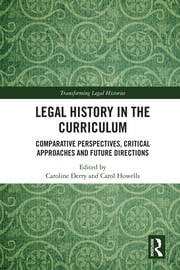
Legal History in the Curriculum

New from Routledge: Legal History in the Curriculum: Comparative Perspectives, Critical Approaches and Future Directions, edited By Caroline Derry and Carol Howells:

As legal education faces fresh challenges and opportunities, and a growing literature calls for subversive new approaches, this book engages with vital questions about the place of history in the law school. How and why should we teach legal history? What is its place in the curriculum? What can different jurisdictions learn from each other?

This collection offers an overview and examples of cutting-edge practice in teaching legal history across the law curriculum, challenging expectations of its place and potential. The book’s three sections explore practices and possibilities in the core curriculum, in dedicated legal history courses and in law schools across the world. They highlight how legal history offers diverse and inclusive content, global perspectives, and transnational understandings to students. By exploring contributors’ own purposes and practices, they provide insight and fresh ideas on how and why readers can incorporate legal histories into their own teaching.

The volume will be an invaluable resource for all those involved in the teaching of law and the law school curriculum.

–Dan Ernst.  TOC after the jump.

New in Touro: Calabresi, Emoluments, and Steven Duke

There's quite a bit of legal history in the current issue (40:2) of the Touro Law Review.  Roger Newman reviews of Guido Calabresi's oral history in On Guido Calabresi.  Liam E. Cronan explores the Dutch origins of the Foreign Emoluments Clause in "In Defiance of Gifts."  Steven B. Duke describes growing up in Arizona, clerking for Justice William O. Douglas, and becoming a criminal defense attorney while a full-time member of the Yale Law faculty, in On Becoming and Being a Criminal Defense Attorney.

--Dan Ernst

Wednesday, June 4, 2025

Kroncke on American Legal Education and Chinese Law Reform

Jedidiah J. Kroncke, University of Hong Kong Faculty of Law, has posted Model, System, or Node? Understanding Legal Education Reform in Twentieth-century China and Beyond:

This chapter examines the complex influence and impact of American legal education models in China's 20th-century legal reforms. It argues that while American legal ideas were widely discussed and promoted, their actual influence on China's legal education system was limited. A conceptual framework is introduced which distinguishes between a country's system of legal education, its ideal model of a law school, and episodic nodes for integrating elite domestic and international legal capital. The analysis reveals that American legal education, particularly the "Harvard model," was often presented as an ideal for reform in China. However, it primarily functioned as a model for elite, non-replicable nodes. Ultimately, this chapter challenges claims of significant American influence. It also highlights the importance of understanding the contested nature of legal education reform within China's specific historical and political context.

--Dan Ernst 

Wednesday, March 5, 2025

CFP: Legal Education Prognosticators in Retrospect

[We have the following announcement.  DRE]

The Journal of Legal Education is the official scholarly journal of the [Association of American Law Schools] and in that role it has and continues to play an important role in chronicling the development of legal education in the United States. For a special symposium issue dedicated to analyzing that role, the editors invite submissions of articles that reflect on one or more articles published in the journal which at the time of publication discussed the future of United States legal education and then assess how the events in the years following the publication exhibited the arguments put forward by the authors. For example, publication of the McCrate and Carnegie reports inspired articles on the what the future should hold in light of those studies. How prescient were the authors of those articles? Other articles have discussed and assessed what at the time were new developments in pedagogy, scholarship, and the profession in general. Have those developments simply continued, flourished, or withered away?

The goal is to publish in JLE work honoring its history by presenting thoughtful assessments of the plans and predictions put forward in the past with the goal of helping think more rigorously about our own future.  The entire run of JLE is available on HeinOnline and from the mid-1980s on Westlaw. Both platforms, of course, have search functions, and Hein provides a complete view of each issue.

Proposals for individual responses or collections of shorter responses all responding to the same article with an abstract of the work are due March 24, 2025 to the New York Law School editorial team at JLE-CFP@law.nyls.edu. Contributors will be notified promptly with the expectation that final drafts of articles will be due July 15, 2025.

Saturday, November 2, 2024

Weekend Roundup

  • David S. Tanenhaus (UNLV)
    Heartfelt congratulations to David S. Tanenhaus on his receipt of the American Society for Legal History's Craig Joyce Medal, awarded to recognized extraordinary and sustained service to ASLH (UNLV Boyd School of Law).
  • Garrett Epps reviews Stuart Banner's The Most Powerful Court in the World, "a fresh and readable one-volume history of the Court [that] explains how we got from Marbury to Dobbs" (Washington Monthly).
  • On Saturday, November 9, from 12:30pm to 1:30pm, Alison L. LaCroix will discuss The Interbellum Constitution as part of the Chicago Humanities Festival, at the Reva and David Logan Center for the Arts, 915 E 60th St, Chicago, IL 60637.  The event is open to the public.
  • The Smithsonian American Women’s History Museum has launched We Do Declare: Women’s Voices on Independence, a "multi-year oral history and education project" commencing with the fiftieth anniversary of the Equal Credit Opportunity Act.

  • On Monday, November 4, at Noon ET at the National Constitution Center, Keith Richotte, Jr., and Matthew L.M. Fletcher (University of Michigan) will discuss "Native American history and law through the stories of landmark Supreme Court cases."
  • Christine Kexel Chabot, Marquette University Law School, is again making available the syllabus for her course Litigating the Lessons of History, in response to the revived debate making legal history part of the law-school curriculum.
  • A notice of Molly Brady's  Brandeis Chair lecture at HLS, much of which she devoted to the legal history of single-family dwellings in the United States (Harvard Law Today).
  • The University of Helsinki Faculty of Law "invites applications for a fixed term employment as a doctoral researcher or a postdoctoral researcher" with the project Comparing Early Modern Colonial Laws, led by Academy Professor Heikki Pihlajamäki.   More.
  • The Stanford Law School has announced its latest round of Sallyanne Payton Fellows.  I mentioned this here not simply because two legal historians, Greg Ablavsky and Bernadette Meyler, are their mentors, but because I gained lasting insights into the mindset of the first, postwar generation of Washington lawyers when then-Professor Payton shared her recollections of Charles Horsky when I presented at Michigan Law, some years ago.  DRE
  • ICYMI:  Kristina M. Lee, University of South Dakota, on "What the history of blasphemy laws in the US and the fight for religious freedom can teach us today" (Akron Legal News).
Weekend Roundup is a weekly feature compiled by all the Legal History bloggers.

Sunday, October 13, 2024

History, Tradition, and Legal History in the Law-School Curriculum

Yesterday, Bloomberg Law published the reporters Lydia Wheeler and Kimberly Strawbridge Robinson’s story, Justices’ History Focus Tests Lawyers, Judges, and Law Schools.  Among other things, they report that the history and tradition approach of the U.S. Supreme Court is putting a premium on law students who can do legal history–beyond the skills taught in originalism “boot camps.”  They quote a lawyer with a Supreme Court practice: “History and tradition I do think is tough because you’re expanding the playing field to include everything that happened, potentially at both the state and federal level at a given point in time, which could have been hundreds of years ago.”  They observe, “Historical research isn’t a skill that law students traditionally learn” and quote Saul Cornell for the proposition that law schools aren’t teaching students how to do historical research.  “Right when this is most important, law schools don’t have the infrastructure,” Professor Cornell said.

--Dan Ernst

Friday, September 27, 2024

Tomlins's "Legal History/History of Law at Berkeley"

Christopher L. Tomlins, Berkeley Law, has written, as a digital "flipbook," Legal History/History of Law at Berkeley, 1870-2024.  Presently it resides here, although in time it might migrate to California Digital Library.  (For good measure, we're putting a QR code at right.)  

Here is Professor Tomlins's introduction:

As a field of study and practice in the modern university, history has always balanced, somewhat uneasily, between the humanities and the social sciences. The same is true of law. Is law art or science? Is it formed in the cloister of knowledge or the forensics of action?

Now put these two fields together. Legal history. Legal history purports to study the history of law – of legal discourse, and legal institutions, and legal cultures, and of the circumstances in and by which they are formed. Is this art studying art, or science studying science? Both?

At Berkeley, history and law have been entangled in one fashion or another virtually since the creation of the University of California in 1868, so this question – what is the connotation of “legal history”? – should always have been ripe for a response at the university, whether from among the academic lawyers of the law school or the scholarly historians of the history department. Instead, despite (or more likely because of) their original entanglement, each party mostly preferred to go its own way. 

But developments at the law school in the 1960s and 1970s made their encounter unavoidable. First came the creation of an interdisciplinary “Center for the Study of Law and Society” (CSLS); then a PhD  program called “Jurisprudence and Social Policy” (JSP), followed by an undergraduate “Legal Studies” program. Separately, but parallel to these developments, the law school became host to an extraordinary manuscript and rare book archive, the Robbins Collection, which made it a home (whether or not it wished to be) for ancient and medieval legal history, and the history of law and religion.

Legal History/History of Law at Berkeley, 1870-2024 is an account of the entanglement of history with law at Berkeley, both before and after the arrival of “law and society.” It describes how legal history at Berkeley was incubated in the law school. This came about despite the law school’s central institutional imperatives (its pedagogical and professional emphasis on training lawyers), but also partly in reputational tandem with those imperatives (the scholarly achievements of various high-profile faculty members, the development of its world-renowned rare book and manuscript archive). In substance, these roots meant that as it developed, legal history at Berkeley Law sprawled widely – beyond the history of the United States and beyond the practical context of “recent” history.

The creation of JSP in the mid-1970s did not mean any sudden new departure from these tendencies. Still, we will see that much would change in the fifty years following the program’s inception. JSP added a new and valuable center of orientation, with its own problems and possibilities to work out. Most important, it added graduate students. In the field of legal history it added emphasis on the United States where before there had been little, while simultaneously helping to ensure that Berkeley’s legal history would be deeply interdisciplinary – as one can tell from the dissertations written and from the careers pursued. This essential plurality of purpose would eventually become the character of legal history elsewhere on campus, in the History Department and beyond.

Over time, trends in legal scholarship, trends in historical scholarship, and the temptations and rewards of interdisciplinarity have slowly created a contemporary intellectual world at Berkeley in which legal history – the history of law and legal institutions, of legal discourse, and legal cultures, and legalities – has never been better served by a greater range of Berkeley scholars, campus-wide, than it is now. Legal History/History of Law at Berkeley, 1870-2024 tells the story of how this came to be.

--Dan Ernst

Friday, September 20, 2024

CFP: Historical Perspectives on Lay Legal Education

[We have the following CFP.  DRE.]

Learning about the law: Historical perspectives on public legal education for laypersons and underprivileged groups.  20-21 May 2025, University of Helsinki

This conference focuses on public legal education in a historical perspective. It aims to discuss the various ways in which legal information has been disseminated to groups of laypersons or underprivileged people in order to enhance their legal literacy. Such groups can include e.g. women and children, workers, people with disabilities, immigrants and refugees.
 
In the wake of industrialisation and the growth of the working class, many countries implemented legislation regarding workers' protection in the late 19th and early 20th centuries. This in turn caused the need to educate workers on their rights. The early 20th century also witnessed the growth of women's rights regarding e.g. education, occupation, property and marriage - all of which women needed information on. Throughout history, there have been waves of immigration around the world for various reasons. Those leaving their homes and moving to another country have also needed knowledge on their rights and the laws they need to follow. Moreover, besides underprivileged groups, educating laypersons in general on legal matters has also been part of building liberal, democratic nation states in which citizens are aware of the legal system and know how to navigate it. This kind of public legal education can take various forms. Legal knowledge has been distributed e.g. through handbooks, magazine articles, popular lectures and courses.
 
The conference aims to bring together historical research on the topic from different countries or regions to form a comparative understanding on the reasons for such activities, the forms they take and the consequences these practices had for each group of people and even society as a whole.
 
Papers could discuss e.g.:

  • the motives for distributing legal knowledge to laypersons and underprivileged groups
  • the different actors involved (providers and recipients of public legal education)
  • whether the activities are initiated from within the specific group or from the outside
  • what kind of legal information was seen as relevant for each group
  • the role of professional lawyers in these activities
  • the role of various interest groups in promoting these activities (associations, political parties etc.)
  • the role of the state in these activities
  • the different media used to disseminate legal education (courses, lectures, handbooks, magazines, radio and tv programmes etc.)
  • the role of publishers or media outlets
  • public legal education as part of developing a civil society
  • how has the increasing legal awareness impacted each group
  • the topic from a broader comparative perspective
  • a longue durée view on the phenomenon

Keynote presentations will be given by: Dr. Kate Bradley (University of Kent); Dr. Elsa Trolle Önnerfors (Lund University); and Prof. Felice Batlan (Chicago-Kent College of Law, Illinois Institute of Technology).
 
Deadline for paper proposals with abstracts (max. 400 words) and a short description of the presenter is 30 November 2024.  For further information, as well as sending paper proposals, please contact Marianne Vasara-Aaltonen (marianne.vasara-aaltonen@helsinki.fi), University Lecturer in Legal History at the University of Helsinki.

Saturday, August 3, 2024

Weekend Roundup

  • Noah Rosenblum, NYU Law, discusses Securities and Exchange Commission v. Jarkesy in WilmerHale's podcast series. "Leveraging his background as a legal historian, Rosenblum provides historical context and explains how applying a traditional Constitutional interpretation to the case increases its complexity."
  • The Securities and Exchange Commission held a 90th Anniversary Celebration, including remarks by Michael Beschloss and Joel Seligman.  The recording is here.
  • George Garnett asks why constitutional history is coming back in fashion in university history departments in Britain (History Today).
  • Learning to teach Milliken v. Bradley at “a two-week institute, 'Democracy in Education: A View from Detroit,' at the Walter P. Reuther Library” at Wayne State University (Chalkbeat).
  • The Comfort Fund of the University of Sydney’s law school, founded in July 1940 “to keep legal men and students in the Services in touch with the school and the legal professions, but the main object of the fund was to provide reading matter to those whose name was on the roll.”
  • George Yin, UVA Law, on what Stanley Surrey would have made of the New Textualism (UVA Law).
  • ICYMI: “Explore the history of politics and the Constitution in ‘A More or Less Perfect Union’” with Judge Douglas H. Ginsburg (NBC Montana).

  Weekend Roundup is a weekly feature compiled by all the Legal History bloggers.

Saturday, May 18, 2024

Weekend Roundup

  • Saul Cornell’s contribution to the Slate series, “How Originalism Ate the Law,” is Why the Right Dominates When It Comes to Legal “History.”  (His answer?  “They’re invested in legal education, creating an originalist industrial complex with outsize influence.”)  Also, Thomas Wolf explains the Brennan Center's efforts to mobilize historians to counter the Supreme Court's historical claims.
  • For Members of the American Society for Legal History:  A reminder that the ASLH  has announce "a new virtual initiative – the Early Career (Virtual) Legal History Workshop – designed to provide support and intellectual community to early career scholars working in legal history, broadly defined.  Applications are invited from early career, pre-tenure scholars, publishing in English, who have completed PhDs or JDs (those working toward a JD/PhD must have completed the PhD)."  Deadline for Applications: June 30, 2024.  More.
  • "History and the Law," a panel conversation "on important moments in American legal history, applying history education to the study and practice of the law, and more," presented as an introduction to the History Pre-Law Concentration at Villanova University (YouTube).
  • Ariela Gross, UCLA School of Law, will lecture on  “Erasing Slavery – How Stories of Slavery and Freedom (in Natchez) Shape Battles Over the Constitution” at the Tuesday, May 28 meeting of the Natchez Historical Society (Natchez Democrat).
  • LHB Founder Mary Dudziak, Emory Law, on the legacy of Korean War at the recent TCU Conference on the Korean War (YouTube).
  • More on that recent conference on the political history of the New Deal at Vanderbilt University.
  • Erika Rappaport, University of California, Santa Barbara, reviews The Rise of Mass Advertising, Law, Enchantment and the Cultural Boundaries of British Modernity, by Anat Rosenberg in the English Historical Review. Christopher Tomlins, Berkeley Law, reviews Joseph Fishkin and William E. Forbath’s The Anti-Oligarchy Constitution: Reconstructing the Economic Foundations of American Democracy in the Journal of Law and Political Economy.  And Ajay K. Mehrotra, Northwestern Law, reviews Andrew Koppelman's Burning Down the House: How Libertarian Philosophy Was Corrupted by Delusion and Greed, also in JLPE.

 Weekend Roundup is a weekly feature compiled by all the Legal History bloggers.

Saturday, December 30, 2023

Weekend Roundup

  • Could be worse: In Martinez and Tobia's recent survey, Legal History is in the middle of the pack for "should be central to the law school curriculum," although well back for "is central to the law school curriculum." H/t: Tommy Bennett.
  • Jack Goldsmith discusses The Court at War: FDR, His Justices, and the World They Made with its author, Cliff Sloan, Georgetown Law (Lawfare Podcast). And Scott R. Anderson discusses State of Silence: The Espionage Act and the Rise of America's Secrecy Regime, with Sam Lebovic, George Mason University (Lawfare Podcast).
  • The latest on Section 3 and the Presidency: Kurt Lash in the NYT and Mark Graber's reply in Balkinization.  Also: Seth Barrett Tilman's brief in LeBrant v. Benson.
  • ICYMI: Storm King Mountain, Oppenheimer and the birth of environmental law (Times Union). 

Weekend Roundup is a weekly feature compiled by all the Legal History bloggers.

Friday, December 15, 2023

CSCHS Review (Fall/Winter 2023)

The (Fall/Winter 2023) issue of the California Supreme Court Historical Society Review is now available here.  And here is the TOC:

Serranus Clinton Hastings: A Counterpoint on Culpability, by Kristian Whitten

The California Academy of Appellate Lawyers: A Half Century of Accomplishments, by Benjamin G. Schatz

Appreciations by Justice John A. Arguelles and Norman L. Epstein

On the Bookshelf: Stephen Field Reconsidered, by Bob Snider; Doing Well While Doing Good, by Hon. Joseph R. Grodin

California Legal History's New Editor, Justice George Nicholson

Legal History Winners recognized at Virtual Roundtable

The editor writes: 

Our lead story continues a debate we began in our spring/summer issue over the legacy of Serranus Hastings, California's first chief justice and founder of what became UC Hastings College of the Law--a debate that should be of interest to historians well beyond California. As you may know, the California Legislature, following the recommendation of the school's board of directors, voted last year to drop Hastings' name from the school based on research into his involvement in the Indian massacres of the mid-19th century. Gov. Newsom approved the change, and the school has been renamed UC College of the Law, San Francisco. In our current issue, Kristian Whitten, a Hastings alum and retired California deputy attorney general, asserts that renaming the law school was unjustified and that Hastings has been accused of crimes he didn’t commit under the laws of the time, including murder and the theft of native lands. In our spring/summer issue, San Francisco attorney and historian John Briscoe detailed what he regards as the ample evidence of Hastings involvement in these massacres and appropriation. This debate over Serranus Hastings' culpability mirrors painful and ongoing conversations across the nation in recent years about how to weigh tradition against changing appraisals of our past.

Also in this issue, Benjamin Shatz, who leads appellate practice at Manatt, Phelps & Phillips, marks the fiftieth anniversary of the founding of the California Academy of Appellate Lawyers with an account of this accomplished group of elite practitioners. The academy came together in the 1970s as an effort by the deans of the state’s appellate bar to encourage best practices and help address burgeoning caseloads, particularly in the California Court of Appeal. What its founders once jocularly called the “Appellate Lawyers Eating and Drinking Association” — the group coalesced over dinners at La Scala and Trader Vic’s, venerable Beverly Hills restaurants — has become an influential and respected force for significant improvements in appellate practice and judicial administration. And there's more in this issue.

Finally, we warmly welcome readers of this blog to solicit article ideas and suggestions of books to review. Is there a topic you're itching to write about? We're a place for shorter (1500-5000 words) articles on just about any subject involving our state's legal system and the men and women whose tragedies and triumphs built that system. Email me with your ideas at molly.selvin@gmail.com.

--Dan Ernst

Saturday, November 25, 2023

Weekend Roundup

  • The Birnbaum Women's Leadership Center at New York University invites applications for Visiting Fellows-in-Residence for the 2024-25 academic year. "Ideal candidates are legal scholars with sabbatical funding who seek to undertake research and writing, organize events, and otherwise collaborate on projects focused on women’s rights and gender equity and justice."

  • Judge Ryan Nelson of the U.S. Court of Appeals for the Ninth Circuit, will be teaching Constitution in the Early Republic next semester at Berkeley Law.  H/t: Orin Kerr.
  • The Oral History Center at the University of California, Berkeley, has announced "the launch of the Japanese American Intergenerational Narratives Project, featuring 100 hours of oral history interviews with 23 Japanese American narrators who are survivors and descendants of two World War II-era sites of incarceration." 
  • More on “Legacies of 1619: Law and Race at Jamestown,” a public education project, in which the Jamestown Rediscovery Foundation has partnered with the William & Mary Law School’s Legal History Society, a student organization advised by Thomas McSweeney.  The public historian Mark Summers explains that the project will “connect programs looking at the early days of race-based slavery in Virginia and the First Assembly, the first representative governing body to meet in the Americas” (Virginia Gazette).
  • “Himanshu Agarwal, an associate professor at Jindal Global Law School; Sebastian Spitz, a doctoral student in Sociology at Harvard; and Rohit Sharma, a researcher at the Mittal Institute”  “presented archival research on the history of punishment in India during a webinar panel Monday morning hosted by Harvard’s South Asia Institute. ... The event was moderated by Adaner Usmani, an assistant professor of Sociology and Social Studies at Harvard (Harvard Crimson).
  • The Law Society of Ireland’s Barry Whelan will speak about the life of Michael Noyk, “legal advisor to Michael Collins during the War of Independence” and “one of the principal solicitors acting on behalf of arrested Republican figures,” on Wednesday, January 24 (6pm to 8pm) at the Moya Quinlan Lecture Theatre, Education Centre, Law Society of Ireland, Blackhall Place, Dublin 7 (Law Society Gazette).
  • ICYMI: Prosecuting a Wobbly in Iowa in the 1920s (Cedar Rapids Gazette). Amanda Levendowski on Barbara Ringer, from 2014, but on the 50th anniversary of Ringer's appointment as the first female Register of Copyrights (The Atlantic, via Internet Archive).  Joshua Getzler joins Cornerstone Barristers as an associate member (Local Government Lawyer).

Weekend Roundup is a weekly feature compiled by all the Legal History bloggers.

Thursday, October 12, 2023

The Legacy of Stanley Surrey

The Legacy of Stanley S. Surrey, a special issue of Law and Contemporary Problems, has been published.   Its editors are Ajay K. Mehrotra and Lawrence Zelenak.

Foreword: The Legacy of Stanley S. Surrey
Ajay K. Mehrotra & Lawrence Zelenak

When an Aspiring Tax Lawyer Considered Labor Unions Important to the Future of Capitalism
Catherine L. Fisk

Stanley Surrey, The New Deal, and the Virtues of Incremental Tax Reform
Joseph J. Thorndike

The Surprising Surrey: Stanley S. Surrey as Educator, Mentor, and Institution Builder
Ajay K. Mehrotra

Surrey’s Silence: Subpart F and the Swiss Subsidiary Tax that Never Was
Steven A. Dean

Stanley Surrey, the Shoup Mission, and Tax Administration in Japan
W. Elliot Brownlee & Eisaku Ide

Textualism, the Authoritativeness of Congressional Committee Reports, and Stanley Surrey
George K. Yin

Stanley Surrey, the American Law Institute Income Tax Project, and the Normative Structure of the Income Tax
Charlotte Crane

Stanley Surrey and Taxing Unreallized Appreciation
Lawrence Zelenak

Stanley Surrey’s Lasting Influence
Assaf Harpaz & C. Eugene Steuerle

What Would Surrey Say? The Long Reach of Stanley S. Surrey
Reuven Avi-Yonah & Nir Fishbien

The (Tax) Policy Entrepreneur
Mirit Eyal-Cohen

‘Moralist’ Versus ‘Scientist’: Stanley Surrey and the Public Intellectual Practice of Tax Policy
Daniel Shaviro

Saturday, September 16, 2023

Weekend Roundup

  • “At UC Law SF this year, [UCLA History Professor Benjamin Madley] he will embark on a new research project, with Indigenous Law Center Faculty Director Jo Carrillo, to explore the laws, executive actions and court rulings that affect Native Americans in California” (UC Law SF).
  • "The Division of the Humanities and Social Sciences at the California Institute of Technology invites applications for a two-year Postdoctoral Instructor appointment in medieval history, with a particular interest in the history of law and legal practices, documentary culture, power, or violence, in the broader Mediterranean (including Islamic and Byzantine) and North Atlantic/Scandinavian worlds as well as in Europe, which will begin Fall 2024." More information here.
  • The American Political History Conference has posted a call for panel and paper submissions. The 2024 meeting will be June 6-8 at Vanderbilt University, on the theme "Reconstructing Democracy: Power, Politics, and Participation." Submissions are due December 31, 2023.

Weekend Roundup is a weekly feature compiled by all the Legal History bloggers.