Showing posts with label World War II. Show all posts

Monday, August 24, 2026

Teaching the Japanese American Incarceration

Heart Mountain High School Campus Scene, 1943 (LC)
We have the following announcement.  DRE.]

Federalism in Action: Teaching Japanese American Incarceration During WWII.  Thursday, September 10, 2026, 9am ET.  [Register here.]

Join the National Constitution Center, the UCLA Asian American Studies Center, and Densho for a full-day professional development workshop exploring the incarceration of Japanese Americans during World War II through the lens of federalism and the Constitution. 

Using the World War II incarceration of Japanese Americans as a case study, participating educators will examine fundamental constitutional questions about the scope and limits of government power, the protection of civil liberties during wartime, and the role of the courts in reviewing government action. Through primary sources, historical scholarship, and classroom-ready resources, teachers will consider these questions from multiple perspectives and develop strategies for engaging students in rigorous constitutional inquiry.

Participating teachers will receive a $100 stipend and workshop materials, as well as light breakfast and a boxed lunch (dietary needs will be accommodated).

This program was made possible because of the National Constitution Center and The Asian American Foundation (TAAF). 

Friday, August 14, 2026

Reparations and Restitution

[Via H-Law, we have word of the publication of a special issue (53:2) of istorical Reflections/Réflexions Historiques devoted to Reparation and Restitution.  DRE.]

Reparations and Restitution: Comparative Perspectives on Austria, France, Germany, and the United States 
Julia Roos 

Revisiting the 1825 Indemnity Law in France 
Elisabeth C. Macknight   

Reparations and the Reconstruction of Jewish Livelihoods in Postwar West Germany  
Anna Holian  

Compensation for Nazi Injustice as Administrative Practice: Baden-Württemberg Sinti and Roma Inside the “Contact Zone” 
Joey Rauschenberger 

Reparations as Learning Process?  West Germany and the Nazi-Era Sterilizations of Biracial Rhinelanders 
Julia Roos 

Europeanization through Repair? Austria's Belated Reparations to Holocaust Survivors and Their Descendants in the 1990s and 2000s 
Emily Marker 

The Case for Thinking Comparatively about Reparative Justice: Race and Reckoning in the United States and Germany 
Rita Chin

Friday, December 26, 2025

Baylin Duryea on Judicial Review of Wartime Price Control

Catherine Baylin Duryea, St. John's University School of Law, has published Emergency Oversight in the FIU Law Review.  It is an excellent study of an institution familiar to Federal Courts scholars but not enough others, the Emergency Court of Appeals, which heard challenges to the orders of the Office of Price Administration during World War II and to that extent ensured the the United States fought, not in a state of exception, but, as Charles Evans Hughes might have put it, under "a fighting constitution." Here is the abstract:

This Article examines one of the most pressing questions in administrative law: How much judicial oversight should administrative agencies face during an emergency? This issue was particularly salient during the COVID epidemic, but it is not new. The Second World War saw a significant expansion and consolidation of the power of administrative agencies as well as experimentation with the appropriate oversight role for courts. This Article analyzes one such experiment: judicial oversight of agencies implementing wartime anti-inflationary measures, i.e., price controls and rationing. During the war, Congress created a specialized court, the Emergency Court of Appeals (ECA), to hear disputes arising out of these domestic economic programs. The ECA took a minimalist approach to oversight of agency decisions; it intervened to protect individual rights only so far as it could do so without impairing the overall regulatory scheme. The court embraced the view that its responsibility was to protect constitutional rights and guard against wartime inflation. The Supreme Court fully endorsed the approach of the ECA. This vision of courts and agencies working in harmony during a crisis stands in stark contrast to their contemporary relationship.

This Article makes two significant contributions. The first is a descriptive analysis of the relationship between administrative agencies and courts with respect to price control and rationing during WWII. That relationship, described in detail here for the first time, provides a valuable historical comparison for the contemporary era, where the courts similarly found themselves navigating expansive economic regulation in the context of national emergencies. During COVID, the court took a far more interventionist, restrictive approach towards limiting agency action. That tees up the second contribution of the Article, which is to raise the normative question: Is it desirable for courts to strictly limit administrative responses to national emergencies? The historical comparison cannot provide an answer, but it highlights another, more collaborative model for balancing individual rights with effective and efficient governance.

--Dan Ernst 

Friday, October 10, 2025

Klaus on Lemkin and the Tokyo Tribunal

Julia Klaus, Friedrich-Alexander-Universität Erlangen-Nürnberg, has posted "The Right of Existence of Peoples as Independent Nations": Raphael Lemkin, the Tokyo Tribunal, and Aggression:

Raphael Lemkin (wiki)
The article uncovers a significant historical connection between Raphael Lemkin, known for his work on genocide, and the International Military Tribunal for the Far East in 1947. Archival discoveries reveal Lemkin's involvement in discussions on defining the legal concept of aggressive war, aiming to influence the proceedings of the Tokyo Tribunal. A transcript of a US War Department conference shows how Lemkin's legal philosophy, balancing natural law and practical pragmatism, guided his views on aggression. His preference for a common law approach to formulating legal norms also became evident. Linking the 1947 conference report to an earlier publication by Lemkin sheds light on his role in imagining a practicable legal concept of aggression during the pre-and post-World War II era. This historical connection and a survey of the epistemic communities around Lemkin foster a deeper understanding of his multifaceted contributions to international law and the prevention of mass atrocities. 

--Dan Ernst

Tuesday, May 27, 2025

Lange on Nazi Lawyers and the Invasion of Poland

Felix Lange, University of Cologne, has published, open access, Claiming Legality: German Lawyers under the Swastika and the Aggression against Poland, in Zeitschrift für ausländisches öffentliches Recht und Völkerrecht 85:1 (2025) 17-42:

The article studies how German lawyers under the swastika justified the German aggression against Poland in 1939 and questioned the support of the United States for Poland and its Allies. It distinguishes three lines of argument: First, they claimed that the Kellogg-Briand Pact was devoid of normative content and thus could not bind the German Reich. This argument was coupled with a political critique of the League of Nations Covenant and the Kellogg-Briand Pact as instruments for maintaining the territorial status quo. Second, they put forward that the German Reich was acting in self-defence and that it was Poland, France, and Great Britain who had violated the Covenant and the Pact. Third, they rejected efforts to reconceptualise the existing rules of neutrality in light of the Covenant and the Pact. Reliance on a more traditional understanding of neutrality was intended to raise legal obstacles to siding with Poland, France, and Great Britain for third states such as the United States.

--Dan Ernst.  H/t ESCLH.

Saturday, January 18, 2025

Weekend Roundup

  • A reminder: Amanda Tyler will speak on Mitsuye Endo and Japanese Incarceration on Zoom for the Supreme Court Historical Society on January 23 at 12 pm EST.
  • Chelsea Gibson interviews Kenyon Zimmer, a historian of transnational radicalism, on his “comprehensive digital archive of Red Scare deportees” (SHGAPE Blog).
  • Online and at the Signet Library in Edinburgh, Chloe Kennedy will discuss her book Inducing Intimacy: Deception, Consent and the Law on January 30, 6 - 8pm GMT.  More.
  • Paul Finkleman discussed the complicated history of “John McLean: Southern Ohio’s Homegrown Anti-Slavery Justice" (UCNews).
  • The Lillian Goldman Law Library at the Yale Law School, has a new exhibit.  Running through May 25, 2025, Flowers at Lambach "follows the history of a single manuscript volume: a collection of texts relating to canon law, produced by the scriptorium at the Benedictine Abbey of Lambach in Austria in the late 15th century, and entering into the collections of the Yale Law Library in 1949.
  • An excerpt from Michelle Adams's The Containment: Detroit, the Supreme Court, and the Battle for Racial Justice in the North (Literary Hub) and Michigan Law's notice of the book.
  • Update: Kenneth W. Mack and other historians (including Sarah Igo, Donald Critchlow, and Sean Wilentz) on Biden's presidential legacy (Politico).  An obituary of Shirah Neiman (1943-2025), who, some years after Eunice Hunton Carter left the office of the U.S. Attorney for the Southern District of New York, joined its by then all-male Criminal Division and became its expert on criminal tax law (NYT).  Holly Brewer on becoming a Friend of the Court (Perspectives in History).

Weekend Roundup is a weekly feature compiled by all the Legal History bloggers.

Saturday, November 9, 2024

Weekend Roundup

  • Eric Muller, a leading legal historian of the Japanese-American "internment," took students in his “Lawyers in Justice and Lawyers’ Injustice” seminar at the University of North Carolina School of Law to Heart Mountain, Wyoming, over fall break.  "Students spent their mornings analyzing government documents and court cases, while afternoons were dedicated to exploring the museum’s exhibits and original structures. In the restored barracks and historic root cellar, the reality of what government lawyers helped implement became tangible."  More.
  • Johnny Rex Buckles, University of Houston Law Center, reviews Lawrence A. Zelenak and Ajay K. Mehrotra's edition of Stanley Surrey's memoirs in the Florida Tax Review.
  • The recording of that National Constitution Center session on Native Americans and the Supreme Court, with by Keith Richotte Jr., and Matthew L.M. Fletcher, is here.
  • ICYMI:  David E. Kyvig on Clarence Thomas's Constitution (HNN).

Weekend Roundup is a weekly feature compiled by all the Legal History bloggers.

Wednesday, October 16, 2024

Barrett on the “Nuremberg Trials”

John Q. Barrett, St. John's University School of Law, has posted The Nuremberg Trials: A Summary Introduction:

This lecture was delivered on May 4, 2016, at Jagiellonian University in Krakow, Poland, at “The Nuremberg Symposium: The Nuremberg Laws & the Nuremberg Trials,” sponsored by the International March of the Living, the Raoul Wallenberg Centre for Human Rights, and Jagiellonian University.  The lecture explains that following World War II, there were thirteen “Nuremberg trials” of Nazi war criminals and introduces those proceedings by discussing:   

(1)   The predicate human behavior: making war;
(2)   International law's progress in addressing that behavior before World War II;
(3)   Nazism as human and national regression;
(4)   World War II;
(5)   Legal analysis and war condemnation during World War II;
(6)   The Allied nations' military defeat of Nazi Germany;
(7)   The Allies' international Nuremberg trial of 1945-1946;
(8)   The twelve subsequent American trials in Nuremberg;
(9)   The legal legacy of the Nuremberg trials; and
(10) The human rights legacy, including the Holocaust knowledge legacy, of the Nuremberg  trials.

This lecture appears in a symposium issue that also includes lectures and remarks by Wojciech Nowak, Richard Heideman, Shmuel Rosenman, Irwin Cotler, Alan Dershowitz, Samantha Power, Justin Trudeau, Robert Badinter, Luis Moreno-Ocampo, Ayelet Shaked, Zdzislaw Mach, Michael Berenbaum, Edward Mosberg, John Dyson, Dorit Beinish, Sam Rugege, Rosalie Silberman Abella, Marie Thérèse Mukamulisa, Malcolm Hoenlein, Ron Prosor, Elizabeth Buettner, Brooke Goldstein, Stuart Eizenstat, Phyllis Greenberg Heideman, David Machlis, Gregory Peterson, and Aleksandra Gliszczynska-Grabias.

--Dan Ernst

Saturday, August 10, 2024

Weekend Roundup

  • Some JOTWELL items of interest: Ilya Somin reviews David Pozen's The Constitution of the War on Drugs; Scott Cummings reviews Ann Southworth's Big Money Unleashed: The Campaign to Deregulate Election Spending (2023); Jedidiah Kroncke reviews J. Benton Heath's "Economic Sanctions as Legal Ordering," forthcoming in the Michigan Journal of International Law.
  • ICYMI: Justin Simard on the Citing Slavery Project (Mississippi Free Press). James H. Coleman Jr., the first Black associate justice of the New Jersey Supreme Court, has died (northjersey.com).

Weekend Roundup is a weekly feature compiled by all the Legal History bloggers.

Saturday, August 3, 2024

Weekend Roundup

  • Noah Rosenblum, NYU Law, discusses Securities and Exchange Commission v. Jarkesy in WilmerHale's podcast series. "Leveraging his background as a legal historian, Rosenblum provides historical context and explains how applying a traditional Constitutional interpretation to the case increases its complexity."
  • The Securities and Exchange Commission held a 90th Anniversary Celebration, including remarks by Michael Beschloss and Joel Seligman.  The recording is here.
  • George Garnett asks why constitutional history is coming back in fashion in university history departments in Britain (History Today).
  • Learning to teach Milliken v. Bradley at “a two-week institute, 'Democracy in Education: A View from Detroit,' at the Walter P. Reuther Library” at Wayne State University (Chalkbeat).
  • The Comfort Fund of the University of Sydney’s law school, founded in July 1940 “to keep legal men and students in the Services in touch with the school and the legal professions, but the main object of the fund was to provide reading matter to those whose name was on the roll.”
  • George Yin, UVA Law, on what Stanley Surrey would have made of the New Textualism (UVA Law).
  • ICYMI: “Explore the history of politics and the Constitution in ‘A More or Less Perfect Union’” with Judge Douglas H. Ginsburg (NBC Montana).

  Weekend Roundup is a weekly feature compiled by all the Legal History bloggers.

Friday, July 19, 2024

Blackhawk on American Indians and Japanese Internment

Maggie Blackhawk, New York University School of Law, has posted The Crisis in Colonial Administration: American Indians and Japanese Internment, which is forthcoming in the American Historical Review:

On March 24, 1943, Acting Secretary of the Department of the Interior, Abraham “Abe” Fortas, and Director of the War Relocation Authority (WRA), Dillon Myer, agreed to repurpose a former Indian boarding school into the primary prison for camps that interned over a hundred thousand individuals “of Japanese ancestry” during World War II.  Built in 1909 on the homelands of the Navajo Nation and only recently closed to students, the Leupp Training School offered the WRA a foundation upon which to construct a prison for the “aggravated troublemakers” in the ten internment camps.  These “aggravated troublemakers” were largely dissidents—individuals who challenged their detention and forced loyalty oaths through collective action like strikes and other uprisings; these individuals were imprisoned at Leupp without charges or trial, and some were transported to the prison in “coffin-like” four-foot-by-six-foot wooden boxes with a single air hole that only narrowly prevented suffocation during the thirteen-hour trip.

Located 30 miles away from its nearest town of Winslow, Arizona (population ca. 4,500), the Leupp Isolation Center imprisoned approximately 80 of the circa 120,000 Japanese and Japanese Americans detained by the United States—seemingly yet another drop of injustice in a wave of “morally repugnant” policy.  But the Leupp Isolation Center provides a particularly paradigmatic example of the central role of American colonialism in facilitating Japanese internment.  Few scholars to date have drawn connections between American colonialism, Native nations, and Japanese internment.  Even fewer scholars have unearthed the direct, enduring, and broad relationship between the federal government’s efforts to colonize Native people and its efforts to intern people of Japanese ancestry.  Initially, all ten Japanese relocation centers were sited to be built on Indian reservations, and Commissioner of Indian Affairs, John Collier, campaigned to head the project he described as “colonization of the Japanese,” including the administration of all camps he termed “colonies.”  Disputes over how much self-determination to foster at the camps disrupted those initial plans, however, and the agency created to oversee Japanese internment, the War Relocation Authority, cobbled together seasoned colonial administrators from the Indian Service and another, more top-down, colonial administration agency, the Soil Conservation Service.    

This Essay explores how the administrative agencies and actors who built and maintained American colonial projects across Indian Country turned these same tools toward the detention, internment, and incarceration of individuals with Japanese ancestry.  This history is necessarily one of administration—it finds continuities between federal administrative institutions, their officials, and the legal justifications they offered (or did not) in accomplishing their aims.  Disputes between administrative officials over how best to colonize Indian Country spilled over into disputes over how best to intern Japanese Americans and Japanese nationals.  These disputes, in turn, then impacted federal policy for Indian Country as these officials returned to the Indian Service following closure of the internment camps.  This history is a history of American colonialism writ large. It reveals the ways that the American colonial project was not tethered to particular populations (Indians) or contexts (Indian Country) but was instead an effort to build infrastructure—legal, constitutional, technological, bureaucratic—to govern a range of populations.
--Dan Ernst

Tuesday, July 2, 2024

Batlan on Antisemitism and the Displaced Persons Act

Felice Batlan, Chicago-Kent College of Law, has posted The 1948 Displaced Persons Act and Home-Grown Antisemitism:

This Article examines the 1948 Displaced Persons Act which provided for the ability of certain European refugees to immigrate to the United States following World War II. The 1948 Act discriminated against Jewish survivors of the Holocaust and imprinted Nazi racial laws and ideology upon U.S. law. Moreover, in debates over passage of such a law, a vast amount of overt antisemitism emerged, generated by politicians and ordinary citizens, which went well beyond the question of the admission of refugees to the United States. By examining the complex and transnational events leading up to the 1948 Displaced Persons Act, and drawing upon underutilized archival material, this Article helps to uncover and explain antisemitism in the immediate post-war period. This analysis has substantial implications for how we think about the history of antisemitism and its relationship to law in the United States.

--Dan Ernst

Thursday, June 27, 2024

Amann on the Woman Acquitted at Nuremberg

Diane Marie Amann, University of Georgia School of Law, has posted Inge Viermetz, Woman Acquitted at Nuremberg:

Inge Viermetz (wiki)
Conventional narratives tend to represent the post-World War II international criminal proceedings as a men’s project, thus obscuring the many women who participated, as lawyers, journalists, analysts, interpreters, witnesses, and defendants. Indeed, two women stood trial before Nuremberg Military Tribunals. This article examines the case of the only woman found not-guilty: Inge Viermetz, who had been an administrator at Lebensborn, the Nazi SS adoption and placement agency. The article outlines the prosecution’s child-taking case against Viermetz, as well as her successful gendered self-portrayal as a conventionally feminine caregiver. With references to Professor Megan A. Fairlie, at whose memorial symposium it was presented, the article concludes by considering contemporary implications of this acquittal at Nuremberg.

--Dan Ernst

Monday, October 16, 2023

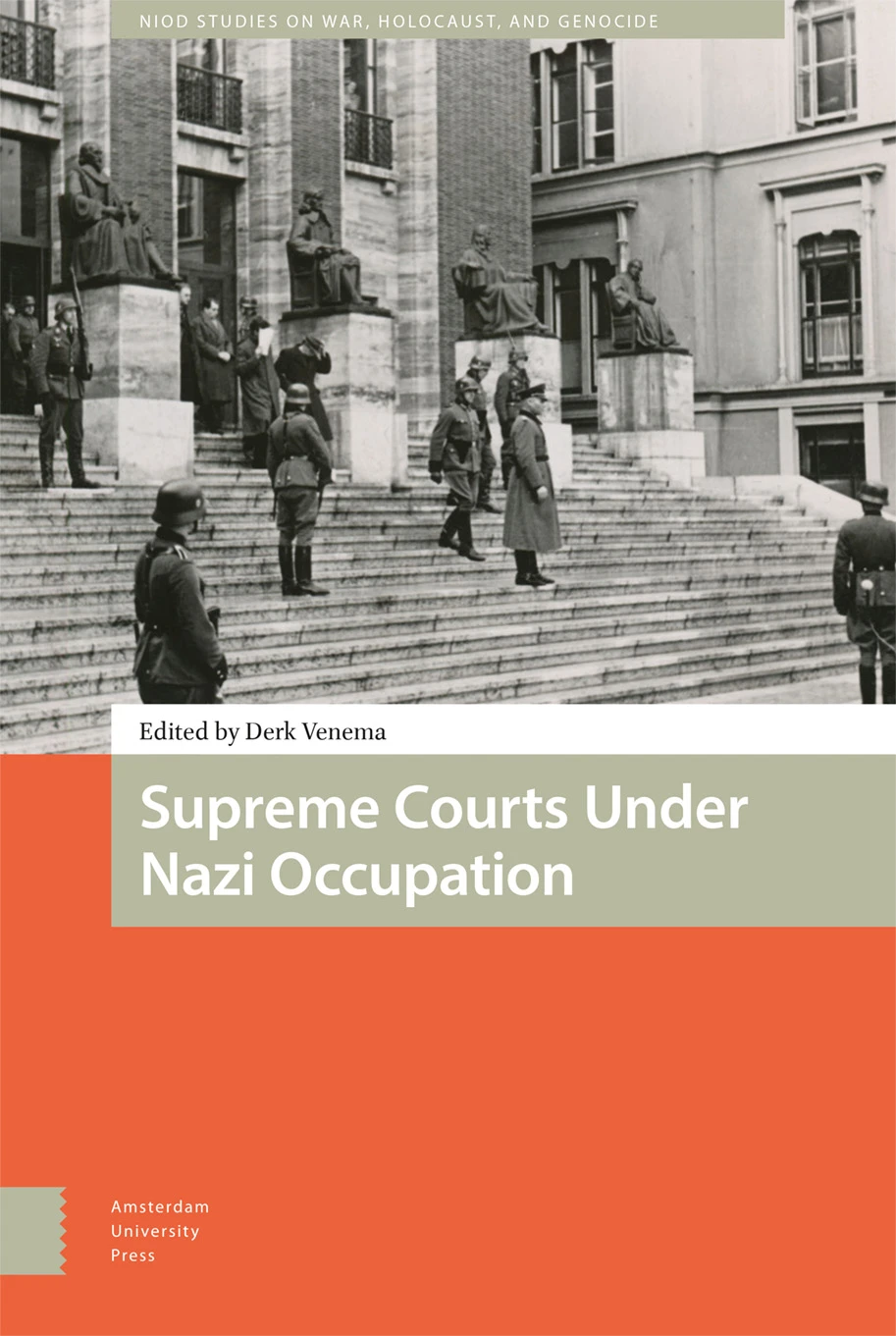
Venema, ed., "Supreme Courts Under Nazi Occupation"

Amsterdam University Press has published Supreme Courts Under Nazi Occupation (2022), edited by Derk Venema (Open University, Netherlands). A description from the Press:

This is the first extensive treatment of leading judicial institutions under Nazi rule in WWII. It focusses on all democratic countries under German occupation, and provides the details for answering questions like: how can law serve as an instrument of defence against an oppressive regime? Are the courts always the guardians of democracy and rule of law? What role was there for international law? How did the courts deal with dismissals, new appointees, new courts, forced German ordinances versus national law? How did judges justify their actions, help citizens, appease the enemy, protest against injustice? Experts from all democracies that were occupied by the Nazis paint vivid pictures of oppression, collaboration, and resistance. The results are interpreted in a socio-legal framework introducing the concept of ‘moral hygiene’ to explain the clash between normative and descriptive approaches in public opinion and scholarship concerning officials’ behaviour in war-time.

More information is available here. An interview with Professor Venema is available here, at New Books Network.

-- Karen Tani

Saturday, September 23, 2023

Weekend Roundup

  • Marci Hamilton and Michael McConnell discussed he Founders and religious liberty at the National Constitution Center (YouTube). 
  • There's some useful history of the Administrative Procedure Act and judicial deference to the statutory interpretation of administrative agencies in an administrative law professors' brief in Loper Bright Enterprises v. Raimondo.  Among other things, it engages with Aditya Bamzai's The Origins of Judicial Deference to Executive Interpretation, 126 Yale L.J. 908 (2017).
  • Robert L. Tsai, Boston University, has reviewed Cliff Sloan’s The Court at War: FDR, His Justices, and the World They Made in the Washington Monthly.  “Sloan has written an eminently readable book,” Professor Tsai writes, but “it is hard to escape the sense that The Court at War misses an opportunity to show us all the ways in which the imperative to go to war presented both opportunity and peril.” The Washington Post's review is here.  Sloan, a Professor from Practice at Georgetown Law, discusses his book with Malcolm Ferguson in the Washingtonian.
  •  A recording of a program held on September 7 by the Historical Society of the New York Courts’ on its exhibit on the "Lemmon Slave Case" is here.
  • Paul Lombardo, Georgia State University, on Buck v. Bell and eugenics in Virginia (VPM).
 Weekend Roundup is a weekly feature compiled by all the Legal History bloggers.

Saturday, August 19, 2023

Weekend Roundup

  • Steven A. Steinbach, once a litigation partner Williams & Connolly LLP and latterly a teacher of United States History and American Government courses at the Sidwell Friends School in Washington, DC, on how United States history can also be taught and understood by focusing on constitutional history (YouTube).


  • of his article on the compulsory arbitration decision, Epic Systems Corp. v. Lewis (U.S. 2018).
  • Justin Driver’s Robert H. Jackson Lecture at the Chautauqua Institution, on the constitutionality of racial diversity-seeking affirmative action in college admissions, is here.
  • ICYMI: Rice University mourns Harold Hyman (Rice).  

Weekend Roundup is a weekly feature compiled by all the Legal History bloggers.

Thursday, August 10, 2023

Rutherford on American Economists and Race, 1898-1945

Malcolm Rutherford, University of Victoria, has posted Racism, Segregation, Acceptance: American Economics and Black Issues, 1890-1945:

The American economics profession has a tortured relationship with the study of issues relating to Black Americans. This paper traces that history from overt racism in the period up to about 1910, the rejection of Du Bois' attempts to work with the American Economic Association, a long period during which Black scholarship on Black issues was simply ignored, to the gradual acceptance of work dealing with Black issues after World War II.
--Dan Ernst

Wednesday, July 12, 2023

Drummond's "The Watchdog"

Steve Drummond has published The Watchdog: How the Truman Committee Battled Corruption and Helped Win World War Two (HarperCollins)

Months before Pearl Harbor, Franklin D. Roosevelt knew that the United States was on the verge of entering another world war for which it was dangerously ill-prepared. The urgent times demanded a transformation of the economy, with the government bankrolling the unfathomably expensive task of enlisting millions of citizens while also producing the equipment necessary to successfully fight—all of which opened up opportunities for graft, fraud and corruption.

In The Watchdog, Steve Drummond draws the reader into the fast-paced story of how Harry Truman, still a newcomer to Washington politics, cobbled together a bipartisan team of men and women that took on powerful corporate entities and the Pentagon, placing Truman in the national spotlight and paving his path to the White House.

Drawing on the largely unexamined records of the Truman Committee as well as oral histories, personal letters, newspaper archives and interviews, Steve Drummond—an award-winning senior editor and executive producer at NPR—brings the colorful characters and intrigue of the committee’s work to life. The Watchdog provides readers with a window to a time that was far from perfect but where it was possible to root out corruption and hold those responsible to account. It shows us what can be possible if politicians are governed by the principles of their office rather than self-interest.
A recording of Mr. Drummond’s book event at Politics and Prose is here.

--Dan Ernst

Monday, May 15, 2023

Muller's "Lawyer, Jailer, Ally, Foe"

Eric L. Muller, the Dan K. Moore Distinguished Professor of Law in Jurisprudence and Ethics at the University of North Carolina School of Law,  has published Lawyer, Jailer, Ally, Foe: Complicity and Conscience in America's World War II Concentration Camps (University of North Carolina Press):

It is 1942, and World War II is raging. In the months since Pearl Harbor, the US has plunged into the war overseas—and on the home front, it has locked up tens of thousands of innocent Japanese Americans in concentration camps, tearing them from their homes on the West Coast with the ostensible goal of neutralizing a supposed internal threat.

At each of these camps the government places a white lawyer with contradictory instructions: provide legal counsel to the prisoners, and keep the place running. Within that job description are a vast array of tasks, and an enormous amount of discretion they can use for good or for ill. They fight to protect the property the prisoners were forced to leave behind; they help the prisoners with their wills and taxes; and they interrogate them about their loyalties, sometimes driving them to tears. Most of these lawyers think of themselves as trying to do good in a bad system, and yet each ends up harming the prisoners more than helping them, complicit in a system that strips people of their freedoms and sometimes endangers their lives.

In Lawyer, Jailer, Ally, Foe, Eric L. Muller brings to vivid life the stories of three of these men, illuminating a shameful episode of American history through imaginative narrative deeply grounded in archival evidence. As we look through the lawyers’ sometimes-clear and sometimes-clouded eyes, what emerges is a powerful look at the day-by-day, brick-by-brick perpetration of racial injustice—not just by the system itself, but by the men struggling to do good within it.
Some endorsements:

"Eric Muller has built a series of stories of novelistic detail and craft—he's got a gift for storytelling—that's firmly anchored in the primary sources and focused on life in the camps."—Kermit Roosevelt, University of Pennsylvania Carey Law School

"The questions Eric Muller raises can be applied to anyone who played a role in the forced removal and confinement of Japanese Americans, to the War Relocation Authority in general, and, more broadly, to anyone who takes part in an unjust endeavor, even with the best of intentions."—Brian Niiya, Densho.org

"A fascinating and detailed account of one of America’s darkest chapters. Through the eyes and work of three dedicated lawyers we see the struggles of Japanese American citizens stripped of their dignity and rights and locked away simply because of their race." —John Grisham

--Dan Ernst

Thursday, February 2, 2023

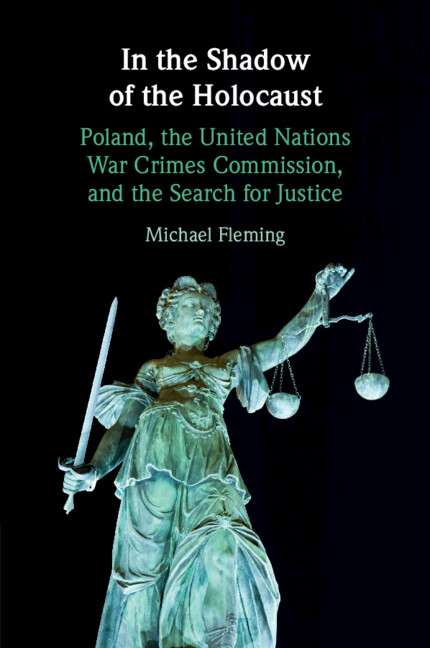
Fleming on "Poland, the United Nations War Crimes Commission, and the Search for Justice"

Cambridge University Press has published In the Shadow of the Holocaust: Poland, the United Nations War Crimes Commission, and the Search for Justice (2022), by Michael Fleming (Polish University Abroad, London). A description from the Press:

In the midst of the Second World War, the Allies acknowledged Germany's ongoing programme of extermination. In the Shadow of the Holocaust examines the struggle to attain post-war justice and prosecution. Focusing on Poland's engagement with the United Nations War Crimes Commission, it analyses the different ways that the Polish Government in Exile (based in London from 1940) agitated for an Allied response to German atrocities. Michael Fleming shows that jurists associated with the Government in Exile made significant contributions to legal debates on war crimes and, along with others, paid attention to German crimes against Jews. By exploring the relationship between the UNWCC and the Polish War Crimes Office under the authority of the Polish Government in Exile and later, from the summer of 1945, the Polish Government in Warsaw, Fleming provides a new lens through which to examine the early stages of the Cold War.
A sample of advance praise:

"This pathbreaking book sheds important new light on post-war attempts to prosecute Nazi war criminals and collaborators through an analysis of the participation in the United Nations’ War Crimes Commission of representatives of the Polish government, first that established in the west after the Polish defeat and then by the pro-communist government established by the Soviets. It is essential reading for all those interested in the problem of how to prosecute genocide and crimes against humanity." -- Antony Polonsky

 More information is available here. (h/t New Books Network)

-- Karen Tani