Showing posts with label immigration. Show all posts

Thursday, June 25, 2026

CLH 14:1

Comparative Legal History 14:1 (2026) has been published. 

Editorial
David Schorr & Agustín Parise

Comparative law today – tomes, themes, trends
Ralf Michaels
This essay surveys recent themes and trends in comparative law scholarship, with a particular eye towards the connections between comparative law and legal history. The author observes a significant movement towards encyclopaedisation, marked by a proliferation of handbooks and encyclopaedias that attempt to systematise knowledge, though these works often struggle with comprehensiveness and persistent Eurocentrism. While traditional treatises continue to show fealty to established functionalist models, there is an observable shift away from the historical dominance of private law towards holistic, post-doctrinal, and interdisciplinary approaches. A primary concern raised is the ‘turn to method’, where the discipline has become increasingly self-absorbed with methodological pluralism and theory, sometimes resulting in ‘method without comparison’. Furthermore, the survey highlights the vital emergence of decolonial and postcolonial scholarship originating from the Global South, facilitating South-South comparison and challenging the field's colonial and Eurocentric foundations. Finally, the author examines the uneasy relationship between comparative law and legal history, questioning whether the discipline can move beyond viewing legal systems as separate entities towards a more integrated world law approach.
Early conflict-of-laws rules: Vietnam’s Lê Code (1483) in East Asian and global contexts
Thào Anh Hoàng
This article examines one of the earliest codified conflict-of-laws rules in East Asia and its overlooked reception in Vietnam. While systematic codifications of conflict rules in Europe developed much later, the Tang Code of China (652 CE) had already incorporated a provision regulating disputes involving foreigners within its territory. This rule was subsequently received in the legal systems of several Sino-sphere countries, including Vietnam. Vietnam’s Lê Code, in force from the fifteenth to the eighteenth century, preserved this conflict rule even after its removal from later Chinese codes beginning in the thirteenth century. This renders the Lê Code the only known continuation of the Tang conflict-of-laws provision.

Long mistranslated as a criminal clause concerning ‘minority ethnic groups’, the relevant provision in the Lê Code is re-evaluated here as a conflict-of-laws rule applicable to both civil and criminal matters. This reinterpretation is situated within the context of East Asian legal culture with a functional equivalence approach. The study shows that Vietnamese law should not be viewed only as a marginal recipient of Chinese legal influence, but rather as a key site where an early conflict-of-laws rule was preserved, adapted, and given historical significance within the development of conflict-of-laws regulations across different jurisdictions. The paper also offers a comparative analysis with other legal traditions of the same period as Tang law, including those of early medieval Europe and the Islamic world.
Ius commune, Venetian governance, and Croatian Glagolitic culture: testaments from the countryside of Šibenik in the early modern period (1637–1713)
Henrik-Riko Held
In the article, I discuss the entanglement of ius commune and Croatian Glagolitic culture under the auspices of Venetian rule in the early modern period. I analyse 222 testaments written in the Croatian language and Glagolitic script between 1637 and 1713 by Glagolitic priests in the countryside of Šibenik, on the eastern Adriatic coast, then under Venetian rule. I address in particular the terminology employed, as well as the structure of the testaments. I compare them with models found elsewhere in Europe, as evidenced by relevant notarial formularies. Finally, I examine the issue of the validity of testaments composed by ostensibly unauthorised persons (parish priests).
The Polish Blackstone: an examination of nineteenth-century Polish scholars’ interpretations of Blackstone and his Commentaries
Lukasz Jan Korporowicz
The principal goal of this article is to address the reception of William Blackstone's legal thought and the awareness of his contributions within the context of nineteenth-century Polish legal scholarship. Despite the considerable differences between English and Polish legal traditions, the limited proficiency in the English language within Poland, and the relatively gradual evolution of Polish legal thought, Blackstone's works were acknowledged by academic circles in Poland in the nineteenth century. Over time, this awareness manifested in direct engagement with certain aspects of Blackstone's perspectives. Nonetheless, the temporal disparity between Blackstone's period of influence and the evolution of legal scholarship in partitioned Poland significantly limited the practical opportunities for the integration and application of Blackstonian jurisprudence.
Re-enacting the judicial philosophy of Oliver Wendell Holmes, Jr.: Saunders v Vautier and Claflin v Claflin compared
Ann Mumford
Oliver Wendell Holmes Jr. sat on the Supreme Judicial Court of Massachusetts in 1889, when, in the case of Claflin v Claflin, he joined the decision that a trust may not be modified if the intention of the testator would be undermined. Claflin rejected Lord Cottenham’s reasoning in Saunders v Vautier that, under certain circumstances, beneficiaries may compel the termination of the trust and transfer the property to them. Claflin v Claflin and Saunders v Vautier are perhaps the two most famous cases in Anglo-American Equity. Through a detailed examination of manuscripts, this article offers a comparative expansion of the US and English histories, and particularly considers the role played by Holmes. Re-enactment theory offers the possibility of creating, or reliving, the intellectual process that led to Claflin, thus revealing a significant moment in the history of US federalism.
--Dan Ernst.  Book Reviews after the jump.

Monday, January 19, 2026

CFP: The Refugee-Migrant Distinction: Toward a Global History

[We have the following CFP.  DRE.]

"The refugee-migrant distinction: toward a global history,” October 15-16, 2026, Darwin College, Cambridge, UK.  Organizers: Bastiaan Bouwman (Utrecht University, the Netherlands), Fabrice Langrognet (CNRS, France), Jeremy Adelman (University of Cambridge).  Funded by Princeton Institute for International and Regional Studies (Fung Global Network Fund) and Gates Cambridge Trust
  
The distinction between refugees and migrants is central to current law, policy, and public debate around asylum and migration. While the distinction between refugees and migrants is far from the only factor in shaping migration policies (Thiollet et al., 2024), states' prerogative of granting refugee status serves as an important albeit unreliable carve-out from a generally restrictive mobility regime. Opponents and proponents of permissive immigration rules each tend to emphasize the binary nature of the distinction - and its close corollary, "forced" versus "voluntary" migration - to their own ends. Restrictionists argue that most people crossing borders in search of asylum, especially in irregular ways, are not "deserving" refugees, but are actually unwelcome "economic migrants." Conversely, most refugee advocates, and especially the United Nations High Commissioner for Refugees (UNHCR) (Carling, 2023), insist that it is essential to defend the legally protected status and essential nature of "refugees" as distinct from "migrants." Scholars have shown, however, that the empirical difference between refugees and migrants is often tenuous (Lucassen, Lucassen and Manning, 2010), even in good-faith attempts to adjudicate it, whereas the fraught politics of migration ensures that attempts to police the distinction in practice are often deeply arbitrary and capricious. Yet insistence on this binary allows liberal states to legitimize their exclusionary bordering practices, relegating "mere" migrants to a realm of virtually unrestrained state discretion (Long, 2013; Hamlin, 2021). Meanwhile, sweeping policies ostensibly aimed at deterring only migrants also impede access to asylum, hurting "genuine" refugees as well (Costello, 2018; FitzGerald, 2019). Hence, some leading refugee advocates have wondered whether refugee scholars should "hold the line" separating refugees from (other) migrants (Aleinikoff, 2021).
 
A view of refugees and migrants as ontologically distinct has permeated much scholarship, including recent work on "refugee history," which has sought to redress forced migrants' previous erasure from much of the historical record (Langrognet, 2023; Marfleet, 2025). Yet historians have, like social scientists, paid increasing attention to the construction and contestation of the "refugee" label, denaturalizing it by analyzing its contingent, situated manifestations over time. Most scholars now understand that "in writing the history of refugees, they need to be alive to the process of constructing refugees and not simply to take 'refugee' as a pre-existing category" (Stone, 2018: 103). By attending to this process, historians have begun to show how the uneven implementation of political and legal categories - (im)migrant, refugee, displaced person, etc. - has been produced by and influenced a range of social and political factors, and the ability of people to challenge or evade these (Reinisch and Frank, 2014; Gabaccia, 2022; Huhn and Rass, 2025; Struillou, Zehni and Manneh, 2025; Gatrell, 2025). In this manner, refugee history has made visible the wider ideological tensions at stake, including nationalism versus cosmopolitanism, mobility versus immobility, and pluralism versus essentialism.

The aim of this conference is to more fully elucidate the relational nature of the distinction between refugees and migrants, its function in the wider field of migration, and its genealogy. Much of the scholarship on the refugee-migrant distinction has been carried out by social scientists and legal scholars (Zetter, 1991; Crawley and Skleparis, 2018; Erdal and Oeppen, 2018; Atak and Crépeau, 2021; Abdelaaty and Hamlin, 2022; Bialas et al., 2025), whose work is focused on the present. While engaging in conversation with the narratives and arguments they advance, the conference will take a more historical perspective, which will also better inform contemporary debate. While historians have in recent years gone beyond methodological nationalism to trace the evolution of the "international refugee regime" and other transnational dimensions of twentieth-century forced displacement (e.g. Bresselau von Bressensdorf, 2019; Jansen and Lässig, 2020; Taylor et al., 2021; Schönhagen, 2023; Bouwman, 2026), there is no agreement on how, why, and where the refugee-migrant distinction surfaced, circulated, and functioned, be it in the interwar era, the postwar and Cold War periods, or the "restrictive turn" of the 1980s. Whereas the historiographies of forced displacement and migration have too often remained separate, answering these questions promises to productively chart overlaps between these fields (Gatrell, 2019).

The conference also aims to expand our understanding of the refugee-migrant distinction's role beyond the West, given the Eurocentric origins of the 1951 Refugee Convention and the field of refugee law (Madokoro, 2016; Ballinger, 2025). Scholarship on flight and migration still centers heavily on Western countries that receive people on the move, especially their policies of admission or contributions to the international refugee regime's stated goal of achieving "durable solutions." This remains an important topic, especially since in the US and elsewhere, we are arguably witnessing the "end of asylum", with indiscriminate anti-immigration policies casting the distinction between refugees and migrants in doubt (Ngai, 2025). But more work is needed on other world regions, which always knew migration and forced displacement but only gradually, partly, and sometimes not at all became subject to the institutions and categories that rose in the West - and even when they were, not without contestation. Non-Western states and regions also generated their own conceptions of the relationship between refugees and migrants, moreover, calling the historiographical centrality of Western-centric institutions into question (Abdelaaty, 2021; Kapoor, 2022; Moretti, 2022; Reed and Schenck, 2023; Hamed-Troyansky, 2024; Moon, 2025).

The conference will bring together both established and early-career scholars. While historical in focus, interdisciplinary approaches and reflection are welcomed. A form of joint publication following the conference is envisioned, such as a special issue in a leading journal.
 
We welcome proposals on any aspect of the above, including from such standpoints as:

  • Agency of refugees and migrants
  • Advocacy for migrants' rights
  • Labor/economic policy
  • Socioeconomic rights, e.g. the right to work
  • Differential functioning of the refugee-migrant distinction based on national origin, ethnicity, race, class, gender, sexual orientation, age, or religion
  • Collaboration and competition in international governance, e.g. between UNHCR and IOM
  • Externalization of border control
  • Consequences for the refugee-migrant distinction of the recent erosion of the right of asylum (e.g. in the U.S. since 2020)
  • Public attitudes toward refugees and migrants
  • Knowledge production about (forced) migration and its governance

Proposals, including an abstract of ca. 300 words and a biographical note of ca. 100 words, should be sent by 16 February 2026 to fgnf.cambridge@gmail.com. Applicants will be notified in March 2026. Note that participants will be asked to submit papers for pre-circulation by the end of September 2026.
 
Early-career scholars are encouraged to apply. On a case-by-case basis, financial help can be provided to applicants upon request; please include such requests with your proposal, including explanation as to why support is required.
 
[Bibliography after the the jump.]

Saturday, March 15, 2025

Weekend Roundup

  • To celebrate its 90th anniversary, the Stair Society held a legal history moot, according to Scottish law in 1851, a case involving wages for domestic service and an action of seduction (SLN).
  • Daniel Huslebosch, NYU Law, will deliver a virtual talk, “Confiscation in the American Revolution: Taking Property, Making the State,” before the Schenectady County Historical Society on April 2, at 7:00pm (News10).
  • The American Historical Association and the Organization of American Historians have issued a joint statement on "federal censorship of American History."
  • The Madison minimizers still have their work cut out for them, judging from this essay for Voice of America.
  • Law professors and historians at Willamette University "addressed the authoritarian tendencies of President Donald Trump’s second administration and debated historical similarities with European fascism" (Salem Reporter).
  • Members of the Women and the Law Division of Indiana State Bar have created All Rise, a coloring book on inspirational women in the state's history.
  • ICYMI: A notice of the first six months of the honorary historian of the New York State Unified Court System, former Court of Appeals Judge Albert M. Rosenblatt (LAW360).  Social Security Is Not a Ponzi Scheme, writes Lawrence B. Glickman (Boston Review).  Peter Neal says, No, Let's Not Bring Back Letters of Marque (Lawfare).  The Wisconsin Historical Society and the Barron County Historical Society are preparing a new historical marker on Ojibwe treaty rights and the “Walleye Wars” near Rice Lake (Barron News-Shield).

Weekend Roundup is a weekly feature compiled by all the Legal History bloggers.

Tuesday, July 2, 2024

Batlan on Antisemitism and the Displaced Persons Act

Felice Batlan, Chicago-Kent College of Law, has posted The 1948 Displaced Persons Act and Home-Grown Antisemitism:

This Article examines the 1948 Displaced Persons Act which provided for the ability of certain European refugees to immigrate to the United States following World War II. The 1948 Act discriminated against Jewish survivors of the Holocaust and imprinted Nazi racial laws and ideology upon U.S. law. Moreover, in debates over passage of such a law, a vast amount of overt antisemitism emerged, generated by politicians and ordinary citizens, which went well beyond the question of the admission of refugees to the United States. By examining the complex and transnational events leading up to the 1948 Displaced Persons Act, and drawing upon underutilized archival material, this Article helps to uncover and explain antisemitism in the immediate post-war period. This analysis has substantial implications for how we think about the history of antisemitism and its relationship to law in the United States.

--Dan Ernst

Saturday, May 25, 2024

Weekend Roundup

  • Over at Balkinization, an interesting symposium on David Pozen's The Constitution of the War on Drugs (Oxford University Press, 2024) has wrapped up. This response by Pozen (Columbia Law) links to the various contributions, including by legal historian Shaun Ossei-Owusu (Penn Law).
  • Edward A. Purcell, New York Law School, looks back to Charles Evans Hughes's Supreme Court of the United States for inspiration on how Chief Justices can induce the resignations of Associate Justices  (The Hill).
  • Jus Gentium is out with a special issue (9:2), The Historicization of International Law and its Limits, organized by Jean d’Aspremont and Thomas Kleinlein.  It includes the article “Lather, Rinse, Repeat: The Historical Returns of International Law,” by Carl Landauer.
  • “On May 16, in celebration of the 70th anniversary of the Supreme Court Brown v. Board of Education decision, the National Archives in Washington, DC, hosted a panel discussion on the lasting impact of the historic legal decision.”  The panel included Sheryll D. Cashin, Georgetown Law; Randall L. Kennedy, of Harvard Law School; and Michael K. Powell, who moderated.  More.
  • Also, “Meet all the families behind the 5 school cases that swayed the Supreme Court” (LA School Report).
  • “Dr. John Kirk, George W. Donaghey Distinguished Professor of History at UA Little Rock, and the students in his fall 2023 Seminar in Public History class, a capstone course that focuses on collaborative research for students who are earning a Master of Arts in public history, have received the Lucille Westbrook Award from the Arkansas Historical Association” for the paper “Racial Discrimination in Jury Selection: The Arkansas Cases of the Bone Brothers, 1938-1940.”  More.
  • The program for the 2024 annual meeting of the American Political Science Association is now online.
  • ICYMI: Hardeep Dhillon on The Immigration Act of 1924 (Penn Today). "The 'Originalist' Justices Keep Getting History Spectacularly Wrong" (Balls & Strikes).  That "Appeal to Heaven" flag (AP; MSNBC).
 Weekend Roundup is a weekly feature compiled by all the Legal History bloggers.

Saturday, May 27, 2023

Weekend Roundup

  • The Immigration and Ethnic History Society "is offering two awards, up to $1,500 each, to support graduate students seeking to develop or engage with digital history work connected to migration history and related fields." 
  • The deadline for submissions for the Irish Legal History Society's student-essay competition is Wednesday, May 31 (Law Society Gazette).
  • Medieval Leases and Modern Leases in English Law, a lecture by Dr. Lorren Eldridge, an Early Career Fellow at the University of Edinburgh, presented recently to the Centre for English Legal History at the University of Cambridge, is now available on YouTube.
  • Michael Z. Green, Texas A&M Law, on Dylan C. Penningroth, Race in Contract Law, 170 U. Pa. L. Rev. 1199 (2022) in JOTWELL.
  • Among the recipients of grants to improve public access to historical records from the National Archives is the Chicago Covenants Project, “which draws on volunteers to locate, digitize, and make available racially restrictive covenants in the analog land records from Cook County, through a project sponsored by Virginia Tech University.”
  • The Center for Political Economy at Columbia World Projects has announced the first recipients of its program granting Columbia University faculty “support to engage in interdisciplinary research that promotes new approaches to political economy.”  They include Kellen Funk for “Cities of Bail: Mapping the market of bail bond securities on urban communities” and Richard R. John for “Bad Business: Anti-trust as anti-monopoly.”
  • Charles L. Barzun, University of Virginia School of Law, and John C. P. Goldberg, Harvard Law School, have posted their introduction to the symposium in the Yale Journal of Law and the Humanities honoring the centenary of Benjamin Cardozo’s The Nature of the Judicial Process.
  • David W. Blight reviews James Oakes’s The Crooked Path to Abolition: Abraham Lincoln and the Antislavery Constitution (NYRB).
  • ICYMI:  “What the Constitution Means to” Joanna Grisinger and Kate Masur (Northwestern Now). 

Weekend Roundup is a weekly feature compiled by all the Legal History bloggers.

Saturday, January 28, 2023

Weekend Roundup

  • Reva Siegel, YLS, on Dobbs and the Politics of Constitutional Memory on Balkinization.  Also, here
  • Stanford Law School has a report on that Celebration of Lawrence Friedman, during which “nine panelists showered tributes on the still-prolific, 92-year-old legal historian," and "Amalia Kessler, director of the Stanford Center for Law and History and an organizer of the event, spoke of  “our beloved” Friedman’s 'great intellect' and 'tremendous menschlichkeit,'”
  • The Harvard Law School "will collaborate with the Royall House and Slave Quarters--a museum in Medford, Massachusetts that is among the last freestanding quarters where enslaved people lived in the north--to conduct research and collaborate on educational programming" (Reuters).
  • Randall Kennedy, HLS, will speak on Wednesday, February 1, at the University of Mississippi School of Law on“The Greatest Lawyer in American Legal History: Thurgood Marshall.”  More.
  • John Q. Barrett, St. Johns, discusses the new documentary “Nazis at Nuremberg: The Lost Testimony,” over at the Jackson List.
  • Chicago-Kent College of Law invites submissions for the Roy C. Palmer Prize on Democracy, Civil Liberties, and the Rule of Law. This $10,000 prize “honors a work of scholarship that explores threats to, or supports of, the liberal democratic constitutional order.” (H/t Legal Scholarship Blog)
  • The Labor and Working-Class History Association and Labor: Studies in Working-Class History will jointly award a $2,000 research grant for a contingent faculty scholar, independent scholar, or community college faculty member engaged in work related to working people, their lives, workplaces, communities, organizations, cultures, activism, and societal context in any period and place.” Deadline February 1.
  • ICYMI: Is debt limit unconstitutional? Answer is yes, some argue, based on the 14th Amendment's public debt clause (ABAJ).  A timeline on the history of reproductive rights  (History).

 Weekend Roundup is a weekly feature compiled by all the Legal History bloggers. 

Saturday, July 24, 2021

Weekend Roundup

  • Joseph D. Kearney, Marquette Law, and Thomas W. Merrill, Columbia Law, “discuss the shenanigans that ultimately gave the city and the state of Illinois one of its most priceless parcels of land and preserves it for public use” in a podcast on the ABA Journal’s Legal Talk Network.  They are the authors of  Lakefront: Public Trust and Private Rights in Chicago (Cornell University Press).
  • Congratulations to William & Mary Assistant Professor of History Brianna Nofil, the recipient of the 61st annual Allan Nevins Prize by the Society of American Historians for her dissertation, “Detention Power: Jails, Camps, and the Origins of Immigrant Incarceration, 1900-2002.”  (More.)
  • More CRT: The New Hampshire attorney general says that “teaching about the country’s history of slavery, its racist Jim Crow Laws, the Civil Rights Movement of the 1960s and the modern Black Lives Matter movement won’t violate state law even if those lessons make students uncomfortable, according to legal advice from the state Attorney General’s Office" (Concord Monitor).  
  • And still more: Over 140 organizations, have signed onto this Joint Statement on Legislative Efforts to Restrict Education about Racism in American History, authored by American Association of University Professors, the American Historical Association, the Association of American Colleges & Universities, and PEN America. 
  • We recently discovered the "Now & Then" podcast, hosted by historians Joanne Freeman (Yale University) and Heather Cox Richardson (Boston College). For a particularly relevant recent episode, checkout "Judging the Supreme Court."   
  • Fire in the White House!  At 7 PM EDT on July 28, the Elk Rapids Area Historical Society hosts a live stream of Craig G. Wright, Herbert Hoover Presidential Library and Museum, discussing the fire that gutted the West Wing and ruined the Oval Office on Christmas Eve, 1929.
  • For anyone working on socio-legal history and technology: check out the new Law and Society Fellowship at the Simons Institute at Berkeley.
  • ICYMI: George Thomas on America’s Imperfect Founding (The Bulwark). A notice of The Great Dissenter: The Story of John Marshall Harlan, America’s Judicial Hero, by Peter S. Canellos (Courier Journal). Woman suffrage and Prohibition in Iowa (Cedar Rapids Gazette).  The Buffalo-Niagara LGBTQ History Project’s first historic marker recognizes “local gay rights activist Bob Uplinger,” whose battle in an entrapment case contributed to decriminalization in New York (Buffalo Rising).
  • Update: Colbert King on Karen Hastie Williams (WaPo).
Weekend Roundup is a weekly feature compiled by all the Legal History bloggers.

Monday, January 25, 2021

Breen on "The Origins of Immigration’s Home within the Department of Justice . . ."

The University of Hawai'i Law Review has published "Labor, Law Enforcement, and 'Normal Times': The Origins of Immigration’s Home within the Department of Justice and the Evolution of Attorney General Control over Immigration Adjudications," by Jennifer Breen (Syracuse University College of Law). Here's the abstract:

This article aims to contribute a new perspective to the extensive scholarship historicizing the evolution of immigration law and policy in the United States by examining the 1940 move of the immigration agencies out of the Department of Labor and into the Department of Justice. This initiated a fundamental reorganization of the administrative state surrounding immigration, by moving immigration enforcement and adjudication out of a civilian agency focused on labor standards and other humanitarian concerns into an agency tasked with criminal law enforcement. With this reorganization as context, the second part of this article examines the Attorney General’s power to review immigration adjudications, arguing that the Attorneys General of President George W. Bush worked a profound transformation in the norms and actual use of this power. Specifically, Attorney General review is now accomplished solely via self-referral, a previously rare use of the power that has now become the exclusive means of Attorney General review.

Studying these two issues in tandem reveals an administrative system designed in crisis to respond to the threat of war yet stubbornly persistent in its growth and entrenchment over the years. The historical analysis of this article foregrounds the question of whether these roles are appropriate or whether a reorientation of the purpose and goals of our immigration system around the issues of labor and humanitarian concerns would better serve the individuals within the system and the nation as a whole. 

The full article is available here.

-- Karen Tani

Monday, May 4, 2020

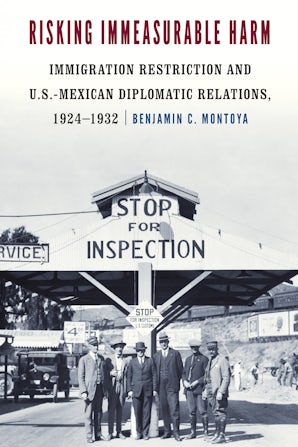
Montoya on Immigration Restriction and U.S.-Mexican Diplomatic Relations, 1924–1932

The University of Nebraska Press has released Risking Immeasurable Harm: Immigration Restriction and U.S.-Mexican Diplomatic Relations, 1924–1932 (April 2020), by Benjamin C. Montoya (Schreiner University). A description from the Press: 
The debate over restricting the number of Mexican immigrants to the United States began early in the twentieth century, a time when U.S.-Mexican relations were still tenuous following the Mexican Revolution and when heated conflicts over mineral rights, primarily oil, were raging between the two nations. Though Mexico had economic reasons for curbing emigration, the racist tone of the quota debate taking place in the United States offended Mexicans’ national pride and played a large part in obstructing mutual support for immigration restriction between the United States and Mexico.

Risking Immeasurable Harm explains how the prospect of immigration restriction affects diplomatic relations by analyzing U.S. efforts to place a quota on immigration from Mexico during the late 1920s and early 1930s. The controversial quota raised important questions about how domestic immigration policy debates had international consequences, primarily how the racist justifications for immigration restriction threatened to undermine U.S. relations with Mexico.

Benjamin C. Montoya follows the quota debate from its origin in 1924, spurred by the passage of the Immigration Act, to its conclusion in 1932. He examines congressional policy debate and the U.S. State Department’s steady opposition to the quota scheme. Despite the concerns of American diplomats, in 1930 the Senate passed the Harris Bill, which singled out Mexico among all other Latin American nations for immigration restriction. The lingering effects of the quota debates continued to strain diplomatic relations between the United States and Mexico beyond the Great Depression.

Relevant to current debates about immigration and the role of restrictions in inter-American diplomacy, Risking Immeasurable Harm demonstrates the correlation of immigration restriction and diplomacy, the ways racism can affect diplomatic relations, and how domestic immigration policy can have international consequences.
A few blurbs:
“This carefully researched and elegantly crafted book provides timely lessons on the importance of building and sustaining bilateral diplomatic relationships across the Mexico-U.S. border. Montoya’s new analysis of early twentieth-century legislative practices reminds us that marginalized immigrants have always been central to the discourses and practices of state sovereignty and nation formation.”—Mark Overmyer-Velázquez

“Timely and pathbreaking. . . . With a focus on diplomacy and politics from the mid-1920s to the early 1930s, Risking Immeasurable Harm sheds new light on U.S.-Mexican diplomatic developments as they relate to controversies over quotas, racism, sovereignty, and immigration restriction. This important book reveals how and why diplomacy factored centrally in the failure of congressional attempts to restrict Mexican migration, even as the United States implemented draconian cuts to overall immigration.”—Christopher McKnight Nichols
More information is available here.

-- Karen Tani

Saturday, November 9, 2019

Weekend Roundup

  • The Law and Society Association has issued a call for applications for a Graduate Student & Early Career Workshop. It will be held May 26-27, 2020, in Denver, Colorado, immediately preceding the LSA Annual Meeting. More information here.
  • The University of Chicago Law School celebrated Nelson Willis (LL.B. 1918), its first African American graduate.
  • Philip Girard, Osgoode Hall Law School, delivered the keynote address to the first conference of the Legal History Society of Nigeria.  More
  • Victoria Woeste presented “Fake News: Antisemitic Propaganda from the Protocols of the Elders of Zion to the Era of Trump,” at the conference on Social Media and Antisemitism, Edge Hill University, England.
  • Tulane Law celebrated the gift of a 200-year-old manuscript on Civil Law of Louisiana by Louis Moreau Lislet.
Weekend Roundup is a weekly feature compiled by all the Legal History bloggers.   

Saturday, July 6, 2019

Weekend Roundup

  • Eric Rauchway will speak on his book, Winter War: Hoover, Roosevelt, and the First Clash over the New Deal, on Thursday, July 18, 2019 at 7:00 p.m., in the Henry A. Wallace Center at the FDR Presidential Library and Home.   I recently read Winter War and learned a great deal from it.  In particular, I was struck by its depiction of Hoover as a person who, incapable of taking no for an answer on November 8, 1932, at once started laying the foundation for what he was certain would be his inevitable vindication.  But even this was to be denied him: when conservatives finally looked for an early twentieth-century president to exalt, they rejected Hoover (the Reconstruction Finance Corporation looked too much like the Troubled Asset Relief Program) in favor of Coolidge.  DRE
Weekend Roundup is a weekly feature compiled by all the Legal History bloggers.

Monday, March 25, 2019

Two articles on Jewish law in French history

Back in 2017, raldine Gudefin (American University) published two articles on Jewish law in French history. We missed these earlier. Here are some details:

(1) "Creating Legal Difference: The Impossible Divorce of Russian Jews in Early Twentieth-Century France," Nashim: A Journal of Jewish Women's Studies & Gender Issues 31 (2017), 11-36

Abstract: Much of the scholarship on Jewish divorce assumes that civil marital laws are beneficial to Jews. This article complicates that assumption by focusing on a rarely acknowledged aspect of Jewish immigration in France. As France moved towards a stricter understanding of the separation of church and state, civil courts rejected the possibility of applying religious divorce laws to foreigners. Combined with the French practice of applying foreign law in cases involving immigrants, this shift resulted in Russian Jews being denied the right to civil divorce from 1905 to the 1920s. The confessional nature of Russian divorce thus continued to shape the lives of Russian Jews even after their immigration to France. The case of Russian Jewish divorce casts light on the shifting and contradictory understand-ings of the separation of church and state in France during the early years of the twentieth century.

(2) "Reforming Jewish Divorce: French Rabbis and Civil Divorce at the Turn of the Twentieth century (1884-1907" in Martine Gross, Sophie Nizard, and Yann Scioldo-Zurcher, eds., Gender, Families and Transmission in the Contemporary Jewish Context (2017)

Excerpt from introduction: "In the months and years following the passage of the law of 1884 [restoring civil divorce in France], rabbis in France became increasingly aware of the plight of Jewish women who were denied a religious divorce. Over the next two decades, French rabbis designed myriad proposals in an effort to reform Jewish marital laws and  prevent the problem of
agunot; these rabbinical proposals became widely  publicized in the French Jewish press. This article examines the manifold suggestions for reforming Jewish divorce between 1884 and 1907, focusing particularly on the conflicting pressures faced by French rabbis. On the one hand, Jewish communal leaders were extremely influenced by French debates about civil divorce, sharing similar ideas with reformers of civil divorce about the adaptive nature of the law and the need for more  balanced gender relations. On the other hand, owing to the transnational nature of Jewish law and life, the discussion about religious divorce transcended France's national borders, thus complicating attempts at reform."

Further information is available here.