Showing posts with label medieval history. Show all posts

Monday, May 12, 2025

A New Look at Domesday Book

Stephen Baxter, Julia Crick, and C. P. Lewis have published Making Domesday: Intelligent Power in Conquered England (Oxford):

Making Domesday presents a fresh interpretation of William the Conqueror's survey of England, made possible by a major collaborative study and a new online edition of Exon Domesday, the earliest of the three original manuscripts to survive from the Domesday survey. The book addresses big questions about pre-modern government, written records, and the use of intelligence in both senses: the minds behind the planning and execution of Domesday, and the information about England that Domesday gathered. It characterizes Exon as the surviving part of the 'working papers' of one of the writing offices that over a period of ten weeks in summer 1086 dealt with all seven 'circuits' (regional groupings of shires) of the Domesday survey. The circuit offices had the task of recasting the manorial descriptions assembled in an earlier stage of the survey into an interim form intended for further redaction as Great Domesday Book by rearrangement, rewording, and abbreviation. A new deep understanding of the codicology and palaeography of Exon underpins every part of the analysis, and offers a model of documentary production for royal government at an exceptionally early period in western Europe. Part I describes and analyses each Exon text in unprecedented detail; Part II places Domesday in context and in broad comparative perspective, ranging across and beyond the Latin West. The dual approach provides a new interpretation of Domesday and a deeper understanding of both the Domesday survey and Domesday Book. It emerges that the survey was even more complex than we had dared to imagine, involving the production of different kinds of text intended to meet a range of fiscal and political needs. It is also clear that the survey was immediately effective, transforming the politics of land in a newly conquered society. Domesday has always been thought awesome, as its very name shows; Making Domesday contends that it was also a feat of intelligent government deployed by an aggressive and ambitious regime. As such it speaks to broader concerns with the colonial domination of conquered societies through the purposeful collection of systematic statistical information.

--Dan Ernst

Saturday, December 28, 2024

Weekend Roundup

Weekend Roundup is a weekly feature compiled by all the Legal History bloggers

Friday, November 8, 2024

Desierto et al. on the Political Economy of Magna Carta

Desiree Desierto and Mark Koyama (George Mason University) and Jacob Hall (University of Pennsylvania) have posted Magna Carta:

King John Granting Magna Charta (NYPL)
Magna Carta, a pivotal moment in history, institutionalized constraints on royal power. We model it as an optimal agreement between two coalitions capable of violence: the king’s loyalists and the rebel barons. This agreement is more likely when the king extracts large rents; the distribution of rents among barons is egalitarian; and barons have large resources that are non-appropriable by the king. Under these conditions, even the baron that enjoys the largest rents would be willing to lead a rebel coalition that has sufficient resources to defeat the loyalists. We test predictions with data on the universe of barons in England between 1200-1270.
--Dan Ernst

Friday, May 17, 2024

CFP: The Medieval Academy's Centenary

[We have the following Call for Papers.  DRE]

The Medieval Academy at 100: The 2025 Annual Meeting of the Medieval Academy of America.  Harvard University, Cambridge MA,  20-22 March 2025.

The Centennial Meeting of the Medieval Academy of America will take place on the campus of Harvard University in Cambridge, Massachusetts, hosted by Harvard University, Boston College, Boston University, Brandeis University, Fitchburg State University, the Massachusetts Institute of Technology, Stonehill College, Tufts University, and Wellesley College. While the conference will take place in person, the plenary lectures and some other events also will be live streamed. Plenary addresses will be delivered by Kristina Richardson (Professor of History and Middle Eastern and South Asian Languages and Cultures, University of Virginia), Sara Lipton (Incoming President of the Medieval Academy of America and Professor of History, Stony Brook University), and Wendy Belcher (Professor of Comparative Literature and African American Studies, Princeton University). The Annual Meeting will be followed by the Sunday annual meeting of the Medieval Academy's Committee on Centers and Regional Associations (CARA). [More.]

Saturday, September 16, 2023

Weekend Roundup

  • “At UC Law SF this year, [UCLA History Professor Benjamin Madley] he will embark on a new research project, with Indigenous Law Center Faculty Director Jo Carrillo, to explore the laws, executive actions and court rulings that affect Native Americans in California” (UC Law SF).
  • "The Division of the Humanities and Social Sciences at the California Institute of Technology invites applications for a two-year Postdoctoral Instructor appointment in medieval history, with a particular interest in the history of law and legal practices, documentary culture, power, or violence, in the broader Mediterranean (including Islamic and Byzantine) and North Atlantic/Scandinavian worlds as well as in Europe, which will begin Fall 2024." More information here.
  • The American Political History Conference has posted a call for panel and paper submissions. The 2024 meeting will be June 6-8 at Vanderbilt University, on the theme "Reconstructing Democracy: Power, Politics, and Participation." Submissions are due December 31, 2023.

Weekend Roundup is a weekly feature compiled by all the Legal History bloggers.

Thursday, August 31, 2023

Papp Kamali on Fact Finding in Medieval English Law

Elizabeth Papp Kamali, Harvard Law School, has published open access Finding Facts in Medieval English Law, in the Journal of Legal Analysis 15 (2023): 158-182:

Accounts of the post-Lateran IV period tend to emphasize the different procedural paths taken by English courts, which adopted jury trial for felony cases, and continental European courts, which turned toward inquisitorial methods and a greater reliance on confession. This article argues that the fact-finding strategies of the two systems had more in common than may appear at first glance due, in part, to a shared cultural reservoir exemplified by the strategy of circumstantial inquiry employed by confessors. Rather than focusing on the point of greatest difference, the trial jury, this article examines pre-trial investigative processes to emphasize shared jurisprudential priorities.

--Dan Ernst

Tuesday, August 22, 2023

Gibbs's "Lordship, State Formation, and Authority"

Spike Gibbs, Universität Mannheim, has published Lordship, State Formation and Local Authority in Late Medieval and Early Modern England (Cambridge University Press):

Providing a new narrative of how local authority and social structures adapted in response to the decline of lordship and the process of state formation, Spike Gibbs uses manorial officeholding – where officials were chosen from among tenants to help run the lord's manorial estate – as a prism through which to examine political and social change in the late medieval and early modern English village. Drawing on micro-studies of previously untapped archival records, the book spans the medieval/early modern divide to examine changes between 1300 and 1650. In doing so, Gibbs demonstrates the vitality of manorial structures across the medieval and early modern era, the active and willing participation of tenants in these frameworks, and the way this created inequalities within communities.
--Dan Ernst

Tuesday, May 30, 2023

McSweeney on Medieval French Pleading Texts

“Those Things Which Are Written in Romance: Language and Law Teaching in Thirteenth-Century England,” an article by Thomas J. McSweeney, William & Mary Law, has been published, gated in American Journal of Legal History 62 (December 2022): 285-304:

Around 1250, a shift began to occur in texts written on the common law. Where earlier texts on the practices of the king’s courts had mostly been written in Latin, a number of the new texts written after 1250 were written in French. The shift to French initially occurred mostly in the context of texts on counting and pleading, the oral parts of court procedure, which were conducted in French, and one author of the 1280s even suggested that by his time a norm had developed that texts on counting and pleading should be written in French. This article examines the evidence for such a norm and the reasons for the shift to French in the later thirteenth century. It uses texts on counting and pleading to examine how both French and Latin were used in the education of pleaders and concludes that, although a norm probably did exist that the oral parts of procedure should be taught in French, Latin was still being used for a number of different purposes in the education of pleaders.

--Dan Ernst


Saturday, May 27, 2023

Weekend Roundup

  • The Immigration and Ethnic History Society "is offering two awards, up to $1,500 each, to support graduate students seeking to develop or engage with digital history work connected to migration history and related fields." 
  • The deadline for submissions for the Irish Legal History Society's student-essay competition is Wednesday, May 31 (Law Society Gazette).
  • Medieval Leases and Modern Leases in English Law, a lecture by Dr. Lorren Eldridge, an Early Career Fellow at the University of Edinburgh, presented recently to the Centre for English Legal History at the University of Cambridge, is now available on YouTube.
  • Michael Z. Green, Texas A&M Law, on Dylan C. Penningroth, Race in Contract Law, 170 U. Pa. L. Rev. 1199 (2022) in JOTWELL.
  • Among the recipients of grants to improve public access to historical records from the National Archives is the Chicago Covenants Project, “which draws on volunteers to locate, digitize, and make available racially restrictive covenants in the analog land records from Cook County, through a project sponsored by Virginia Tech University.”
  • The Center for Political Economy at Columbia World Projects has announced the first recipients of its program granting Columbia University faculty “support to engage in interdisciplinary research that promotes new approaches to political economy.”  They include Kellen Funk for “Cities of Bail: Mapping the market of bail bond securities on urban communities” and Richard R. John for “Bad Business: Anti-trust as anti-monopoly.”
  • Charles L. Barzun, University of Virginia School of Law, and John C. P. Goldberg, Harvard Law School, have posted their introduction to the symposium in the Yale Journal of Law and the Humanities honoring the centenary of Benjamin Cardozo’s The Nature of the Judicial Process.
  • David W. Blight reviews James Oakes’s The Crooked Path to Abolition: Abraham Lincoln and the Antislavery Constitution (NYRB).
  • ICYMI:  “What the Constitution Means to” Joanna Grisinger and Kate Masur (Northwestern Now). 

Weekend Roundup is a weekly feature compiled by all the Legal History bloggers.

Tuesday, February 28, 2023

Camphuijsen, "Scripting Justice in Late Medieval Europe: Legal Practice and Communication in the Law Courts of Utrecht, York and Paris"

Amsterdam University Press has published Scripting Justice in Late Medieval Europe: Legal Practice and Communication in the Law Courts of Utrecht, York and Paris, by Frans Camphuijsen. A description from the Press:

Late medieval societies witnessed the emergence of a particular form of socio-legal practice and logic, focused on the law court and its legal process. In a context of legal pluralism, courts tried to carve out their own position by influencing people’s conception of what justice was and how one was supposed to achieve it. These “scripts of justice” took shape through a range of media, including texts, speech, embodied activities and the spaces used to perform all these. Looking beyond traditional historiographical narratives of state building or the professionalization of law, this book argues that the development of law courts was grounded in changing forms of multimedial interaction between those who sought justice and those who claimed to provide it. Through a comparative study of three markedly different types of courts, it involves both local contexts and broader developments in tracing the communication strategies of these late medieval claimants to socio-legal authority.

More information is available here. An interview with the author is available here, at New Books Network.

 -- Karen Tani

Monday, January 9, 2023

Walker on Del Mar's "Artefacts of Legal Inquiry"

In the Netherlands Journal of Legal Philosophy, Greg Walker, Regius Professor of Rhetoric and English Literature at the University of Edinburgh, has published a very thoughtful assessment, from “a literary perspective,” of Maksymilian Del Mar’s Artefacts of Legal Inquiry: The Value of Imagination in Adjudication (Hart, 2020).  It commences:

Maksymilian Del Mar’s ground-breaking monograph, Artefacts of Legal Inquiry: The Value of Imagination in Adjudication (hereafter Artefacts) offers a rich, multi-faceted account of what happens when judges examine the submissions of advocates and decide how the English common law should be applied in particular cases. Based on voracious reading in, and thinking through, the principles and practises of English common law, European philosophy, and global literary studies, it is a book which only someone trained and acculturated in all three disciplines could produce. It is demonstrably a tour de force of up-to-the-minute interdisciplinary scholarship.

But what, it might be asked, does a book that offers a detailed, case-specific account of the linguistic and cognitive dimensions of judicial inquiry in the field of twentieth-century common law practise have to interest a scholar of sixteenth-century literature and politics? The answer, it turns out, is a great deal, not least because many of the roots of both modern legal conventions and early Tudor literature, deep and long-lasting in the first case, relatively newly formed and close to the surface in the second, can be traced to the legal training, the moots and disputations of the early-modern Inns of Court, an institution in which both Del Mar and I have an abiding scholarly interest. But, more generally, what is not to like for a literary scholar in a book that talks about genres, figures, metaphors, audiences and performances, scenarios, figures and tropes, and which discusses the literariness and narrativity of inquiry, and its ‘poetic character’?
More.

---DRE

Monday, November 7, 2022

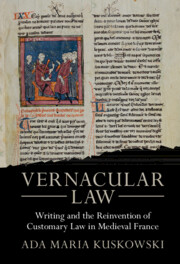
Kuskowski, "Vernacular Law Writing and the Reinvention of Customary Law in Medieval France"

 The Studies in Legal History Series at Cambridge University Press has released by Vernacular Law: Writing and the Reinvention of Customary Law in Medieval France, by Ada Maria Kuskowski (University of Pennsylvania). A description from the Press:

Custom was fundamental to medieval legal practice. Whether in a property dispute or a trial for murder, the aggrieved and accused would go to lay court where cases were resolved according to custom. What custom meant, however, went through a radical shift in the medieval period. Between the twelfth and thirteenth centuries, custom went from being a largely oral and performed practice to one that was also conceptualized in writing. Based on French lawbooks known as coutumiers, Ada Maria Kuskowski traces the repercussions this transformation – in the form of custom from unwritten to written and in the language of law from elite Latin to common vernacular – had on the cultural world of law. Vernacular Law offers a new understanding of the formation of a new field of knowledge: authors combined ideas, experience and critical thought to write lawbooks that made disparate customs into the field known as customary law.

Advance praise:

"This book is a marvel, mixing erudition and imagination. Describing the cultural upheaval of the writing of custom, Ada Kuskowski opens new doors to the understanding of medieval law." -- James Q. Whitman, 

"By studying the first coutumiers as a coherent whole, with a focus on language and manuscripts and an eye toward recent scholarship in legal history generally, Kuskowski defines a subject every bit as complex, interesting, and influential as the medieval Roman and canon laws that overshadow it in the historiography." -- Adam Kosto

More information is available here.

-- Karen Tani

Tuesday, September 6, 2022

Virtual Launch of a Special Issue: Rethinking Chaucer and Cecily Chaumpaigne

After a content warning that the event would "discuss sensitive and potentially triggering topics including sexual assault," the National Archives of the United Kingdom posted the following announcement of and registration for a virtual launch of a special issue of the Chaucer Review, entitled Geoffrey Chaucer and Cecily Chaumpaigne: Rethinking the Record:

NYPL
Few medieval records have received as much attention from literary scholars as a group of documents dating from May to July 1380 that involve Geoffrey Chaucer and Cecily Chaumpaigne, the daughter of a London baker. At the heart of this group of records is a quitclaim of May 4, enrolled in the Close Rolls of the English Chancery, releasing Chaucer from “all manner of actions related to my raptus”. The word raptus, which in legal contexts can denote “rape,” “abduction,” and much of the spectrum lying between these terms, has challenged Chaucer scholars ever since Frederick J. Furnivall announced this find in 1873. The matter was given significant new impetus in 1993, when Christopher Cannon discovered a second quitclaim by Chaumpaigne – with the word raptus removed – enrolled in the plea rolls of the Court of King’s Bench a few days after the first. Cannon’s discovery has energised foundational strands of Chaucer studies, in particular feminist scholarship, over the last thirty years, but in this time no new documentary evidence has come to light.

Now, new research into the medieval legal collections at The National Archives has uncovered two new life-records relating to the dispute of 1380 – including evidence of the original legal accusations brought against the poet – which offer a radically different understanding of the documentary evidence

More.

--Dan Ernst

Monday, August 22, 2022

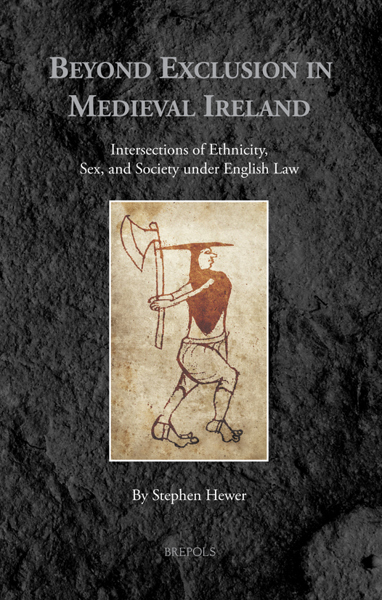
Hewer, "Beyond Exclusion in Medieval Ireland"

Brepols Publisher has released Beyond Exclusion in Medieval Ireland: Intersections of Ethnicity, Sex, and Society Under English Law (2022), by (University of Liverpool). A description from the Press:

The notion that all Gaelic peoples were immediately and ipso facto denied access to the English royal courts in Ireland, upon the advent of the English in 1167, has become so accepted in academic and popular histories of Ireland that it is no longer questioned. This book tackles this narrative of absolute ethnic discrimination in thirteenth- and early fourteenth-century English Ireland on the basis of a thorough re-examination of the Irish plea rolls. A forensic study of these records reveals a great deal of variation in how members of various ethnic groups and women who came before the royal courts in Ireland were treated. Specifically, it demonstrates the existence of a large, and hitherto scarcely noticed, population of Gaels with regular and unimpeded access to English law, identifiable as Gaelic either through explicit ethnic labelling in the records or implicitly through their naming practices.  

More information is available here. (h/t New Books Network.)

-- Karen Tani

Saturday, October 30, 2021

Weekend Roundup

  • Congratulations to Annette Gordon-Reed on her receipt of Mass Humanities’s Governor’s Award in the Humanities!  (HLT)
  • UC Irvine’s notice of Elizabeth Allen’s Uncertain Refuge: Sanctuary in the Literature of Medieval England (University of Pennsylvania Press, 2021).
  • ICYMI: The "Groveland Four" were wrongly accused in 1949, prosecutor says in motion to clear their names (ABAJ).  Lawsuit Against Harvard May Decide Who Owns Images of Enslaved People, by Valentina Di Liscia (Hyperallergic).  The Hastings College of the Law naming controversy (ABAJ).  Name the Marble Palace after the first Justice John Marshall Harlan?  (Politico).  Daniel Farber on the Four Myths of Presidential Power (HNN).

  Weekend Roundup is a weekly feature compiled by all the Legal History bloggers.

Saturday, February 27, 2021

Weekend Roundup

  • The American Historical Association has established $500 emergency grants to "assist un/underemployed historians who have been financially affected by the COVID-19 outbreak."
  • Princeton Ph.D. candidate Teal Acardi asked Twitter for reading recommendations on state building and infrastructure. He turned the results into a crowd-sourced #InfrastructureSyllabus. It includes lots of legal history.
  • Harvard Law professor Jeannie Suk Gersen's New Yorker piece on the latest comfort women controversy ignited by her colleague J. Mark Ramseyer.
  • Randall Kennedy, Martha Minow and Cass Sunstein have founded the American Journal of Law and Equality (Harvard Law Today).

Weekend Roundup is a weekly feature compiled by all the Legal History bloggers. 

Sunday, November 15, 2020

Law and Culture in Medieval England: NEH Seminar at WMU

 [We have the following press release from Western Michigan University.  DRE.]

Two Western Michigan University faculty members have been awarded a prestigious National Endowment for the Humanities—NEH—grant to host a seminar program this summer for higher education faculty and graduate students. It was one of 11 grants chosen nationwide, totaling $1.9 million.

The more than $169,000 grant allocated to Western will fund a four-weeklong institute for university and college faculty participants from around the country. This virtual program hosted by WMU's Medieval Institute, like other NEH institutes, will provide ongoing education for faculty and advanced graduate students to learn about specialized areas of knowledge, led by nationally recognized experts in their fields.

The "Law and Culture in Medieval England" institute will examine law through various perspectives using legal, literary and historical texts. This includes famous documents, such as the Magna Carta, as well as lesser-known sources, some appearing in English translation for the first time. The institute will be interdisciplinary, involving visiting scholars and participants from many fields.

WMU's Dr. Robert Berkhofer III, associate professor of history, and Dr. Jana Schulman, director of the Medieval Institute, will co-direct the program from June 21 to July 16, 2021. Berkhofer is a historian of the central Middle Ages, whose research examines literacy and uses of writing in England and France. Schulman is a specialist in Old English and Old Norse language and literature, focusing on women and the law. In addition to Berkhofer and Schulman, instructors will include six experts in history, English, law and medieval studies from the U.S. and Britain.

The co-directors and visiting scholars of the institute will choose 25 applicants whose teaching responsibilities are in the humanities or social sciences, including those who are not medievalists. Participants may apply beginning December 1. To learn more, visit the Law and Culture in Medieval England website.

Tuesday, October 13, 2020

Selden Society Prizes to Papp-Kamali and Kennefick; Honorable Mention to McSweeney

[We have the following announcement from the Selden Society.  DRE] 

David Yale Prize

Instituted in 1998, this biennial prize is awarded for an outstanding contribution to the history of the law of England and Wales from scholars who have been engaged in research in the subject for not longer than about ten years.  Since 2017, separate prizes have been given for the best book and the best article published  in the preceding two years. The prize is named in honour of Mr David Yale, QC, FBA, then President of the Society and formerly Literary Director.

The 2019 David Yale Book prize was awarded to Elizabeth Papp Kamali for Felony and the Guilty Mind in Medieval England (Cambridge University Press, 2019). The prize committee said of this work:

Papp-Kamali’s Felony and the Guilty Mind in Medieval England is a wide-ranging and deeply researched contribution to the history of criminal law. In seeking to understand what ‘felony’ meant in medieval England, Papp-Kamali takes on a question which Maitland considered unanswerable. This book changes our existing understanding, using a challenging methodology which uses a much wider range of sources than is often the case in legal history scholarship. In doing so she places legal history within the history of wider cultural norms and influences to produce perceptive and valuable conclusions.
The committee also recommended that an honourable mention be given to Thomas J. McSweeney for his book Priests of the Law: Roman Law and the Making of the Common Law’s First Professionals (Oxford University Press, 2019)

The 2019 David Yale article prize was awarded to Ciara Kennefick for ‘‘The Contribution of Contemporary Mathematics to Contractual Fairness in Equity, 1751-1867’ in the Journal of Legal History 39 (2018), pp.  307-339. The prize committee said of this article:
Kennefick’s ‘The Contribution of Contemporary Mathematics to Contractual Fairness in Equity, 1751-1867’ is a genuinely novel re-examination of an important part of English legal history, highlighting the interaction between questions of law about contractual fairness, and mathematics. Interest in legal questions drove interest in the study of probability, while developments in the mathematics of probability came to resolve legal questions. The article changes the way we look at the history of this area of law.

Thursday, April 30, 2020

Byrne's "Justice and Mercy"

Apologies for having missed this one.  Philippa Byrne has published Justice and Mercy: Moral Theology and the Exercise of Law in Twelfth-Century England (Manchester University Press, 2018):
This book examines one of the most fundamental issues in twelfth-century English politics: justice. It demonstrates that during the foundational period for the common law, the question of judgement and judicial ethics was a topic of heated debate - a common problem with multiple different answers. How to be a judge, and how to judge well, was a concern shared by humble and high, keeping both kings and parish priests awake at night. Using theological texts, sermons, legal treatises and letter collections, the book explores how moralists attempted to provide guidance for uncertain judges. It argues that mercy was always the most difficult challenge for a judge, fitting uncomfortably within the law and of disputed value. Shining a new light on English legal history, Justice and mercy reveals the moral dilemmas created by the establishment of the common law.
–Dan Ernst