Showing posts with label Teaching. Show all posts

Monday, August 24, 2026

Teaching the Japanese American Incarceration

Heart Mountain High School Campus Scene, 1943 (LC)
We have the following announcement.  DRE.]

Federalism in Action: Teaching Japanese American Incarceration During WWII.  Thursday, September 10, 2026, 9am ET.  [Register here.]

Join the National Constitution Center, the UCLA Asian American Studies Center, and Densho for a full-day professional development workshop exploring the incarceration of Japanese Americans during World War II through the lens of federalism and the Constitution. 

Using the World War II incarceration of Japanese Americans as a case study, participating educators will examine fundamental constitutional questions about the scope and limits of government power, the protection of civil liberties during wartime, and the role of the courts in reviewing government action. Through primary sources, historical scholarship, and classroom-ready resources, teachers will consider these questions from multiple perspectives and develop strategies for engaging students in rigorous constitutional inquiry.

Participating teachers will receive a $100 stipend and workshop materials, as well as light breakfast and a boxed lunch (dietary needs will be accommodated).

This program was made possible because of the National Constitution Center and The Asian American Foundation (TAAF). 

Thursday, August 20, 2026

Teaching for Research

When I started working on my second book, Fear of the False: Forensic Science and the Law of Crime in Colonial South Asia, I created a course to help my research. Specifically, I designed an undergraduate Legal Studies/History course called “History of Forensic Science” (HFS). I’d like to use this 3rd guest post for August to reflect on how and why this was such a valuable experience.

More after the jump.

Saturday, August 15, 2026

Weekend Roundup

  • Berkeley Law's notice of its new legal historian, Aaron Hall (UC Berkeley Law).  
  • Daniel F. Gosling, Principal Legal Records Specialist at UK's National Archives, has announced the completion of his searchable database of 
  • Legal Histories of Empire has posted a "save the date" for its fifth conference, 13-15 July 2028, at NLSIU Bengaluru.   
  • The University of Kansas's notice of Raj Bhala's article on the rule of law in “Measure for Measure" (KU News).
  • Julia Rose Kraut, Sam Lebovic and Ellen Schrecker's amicus brief in an ideological deportation case, AAUP v. Rubio (1st Cir.) (Brennan Center).   
  • The legal historian Patti Minter has been appointed to Kentucky’s Board of Education (College Heights Herald). 
  • Noticed in the New York Almanack: Carol Kammen's Smut: An 1883 Obscenity Trial and Its Echoes Today (Paul Dry Books, 2026), on an 1883 trial for “selling and exhibiting obscene pictures.” 
  • Robert P. George, Princeton University, and Jonathan Gienapp, Stanford University, on the Declaration of Independence as the nation’s “promissory note” (SLS Podcasts).
  • Did the Constitution Lay the Groundwork for Abolition? A Federalist Society webinar with Timothy Sandefur and Kenneth Williams.  The recording of the National Constitution Center's book even for Mr. Sandefur's new book Proclaiming Liberty: John Adams, Thomas Jefferson, and the Declaration of Independence is here.  
  • "Founding Friends, Founding Foes": Kurt Graham and Steve Light on John Adams and Thomas Jefferson, at the Harry S. Truman Library on September 23.   
  • A notice of Gautham Rao's course, HIST-196 America at 250: Revolution (AU Magazine).

Weekend Roundup is a weekly feature compiled by all the Legal History bloggers.

Saturday, June 20, 2026

Weekend Roundup

  • The recording of the National Constitution Center's session on the Constitution and the Courts, held in conjunction with the Federal Judicial Center, is now available.  It consists of a panel on the Constitution in the Founding Era with Akhil Reed Amar, Christopher Bonner, and Gerald F. Leonard, moderated by Thomas Donnelly, and a discussion on the Constitution and the federal judiciary with Kevin Arlyck, moderated by Julie Silverbrook.  
  • Alison L. LaCroix's speech to the University of Chicago's graduates is here.  H/t: JDM. 
  • From In Custodia Legis: "A Deep Dive into Library Resources on Phillips v. Martin Marietta Corp." -- Part 1 and Part 2.   
  • Saul Cornell appears in "The American Experiment," a five-part documentary on the nation’s founding that starts streaming on Netflix on June 24 (Fordham Law).
  • Margaret Burnham and Brenda E. Stevenson on opening the federal archives on Civil Rights Cold Cases (AHA Perspectives). 
  • "The Brennan Center for Justice at NYU Law is pleased to announce the 2026–2027 recipients of the Steven M. Polan Fellowship in Constitutional Law and History: Kate Andrias, Olatunde Johnson, William Novak, Alice O’Brien, and Julie Suk."   

  • "Is the United States on the Road to a New Civil War?" David Blight's lecture to the American Academy in Berlin. 
  • ICYMI: More Gordon Wood tributes (LOA).  250 Years of State Constitutions (SCR). The NJ State Library's exhibit on the state's first constitution (tapinto).  Jesse Wegman discusses James Wilson (Fresh Air).  The University of Pennsylvania Almanac notes Serena Mayeri's receipt of the 2026 James Willard Hurst Book Prize From Law & Society Association.  The lessons of the Harry Raymond car bombing of 1938 for police accountability today (DJ).  When Robert E. Lee's daughter was arrested in a Jim Crow streetcar dispute (Alexandria Brief).

Weekend Roundup is a weekly feature compiled by all the Legal History bloggers.

Saturday, February 7, 2026

Weekend Roundup

  • Elizabeth Brand Monroe (1947-2026), a legal and public historian who received the Supreme Court Historical Society's Gossett Award for her article on the Dartmouth College Case (IndyStar). 
  • Robert Post, Yale Law School, and Daniel Holt,  Historical Office of the U.S. Senate, discuss the passage of the Judiciary Act of 1925 in this recording of a lecture sponsored by the Supreme Court Historical Society. 
  • The American Historical Association hosts a Congressional Briefing on the history of vaccines on Wednesday, February 11, at 9:00 a.m. ET in Rayburn House Office Building Room 2044.  Panelists Elena Conis (Univ. of California, Berkeley), David M. Oshinsky (New York Univ.), and Michael Willrich (Brandeis Univ.) will discuss the history of vaccines against diseases including smallpox, polio, and measles.
  • Madiba Dennie will discuss her book The Originalism Trap: How Extremists Stole the Constitution and How We the People Can Take it Back at UVA Law. 
  • The latest Part of the Philip C. Jessup papers is open at the Library of Congress.  Here's Rachel McNellis's account.  (Unfolding History.)
  • A notice of Scott Sandage's teaching on the Constitution in the Special Collections Department at Carnegie Mellon University.
  • Now online from the National Constitution Center: "Lucas Morel and Melvin Rogers join to discuss how African American leaders and citizens, such as Prince Hall, Frederick Douglass, Ida B. Wells, and Rev. Martin Luther King, Jr. have invoked the ideas and principles of the Declaration of Independence throughout American history to push for a more free and equal America." 
  • Although the event for which it was produced was last year, the American Historical Association has just circulated this very useful handout on the history of the tariff. 
  • ICYMI: A GWB-appointed judge blasts the removal of the mention of George Washington's slaves  from his Philadelphia home (ATL).  Relatedly, SHEAR has a tracker of this and similar purging of public history (Panorama).  Jack Rakove on Playing the Grinch at America’s 250th Birthday Party (Washington Monthly). George Liebmann provides Historical Perspective on the Unitary Executive (Law & Liberty).  Adolpho Birch, the first Black judge appointed in Nashville (Fox17). Noah Shusterman says there's still historical work to be done on the Second Amendment (DCFL).  The criminalizing of protest and dissent has a long history in America (Guardian).  Yearlong project restores lost videos of civil rights foot soldiers (Tuscaloosa News).

 Weekend Roundup is a weekly feature compiled by all the Legal History bloggers.

Tuesday, July 29, 2025

Jarvis's "Neglected Amendments"

Robert M. Jarvis has published The Neglected Amendments of the U.S. Constitution: Text, History, and Interpretation (Carolina Academic Press):

Although the U.S. Constitution has twenty-seven amendments, most law students graduate having studied only the twelve "big" amendments: First (freedom of association, press, religion, and speech); Second (right to bear arms); Fourth (protection from unreasonable searches and seizures); Fifth (due process); Sixth (right to counsel); Seventh (trial by jury); Eighth (banning cruel and unusual punishments); Tenth (unenumerated powers); Eleventh (state immunity from federal lawsuits); and the Reconstruction Amendments (Thirteenth, Fourteenth, and Fifteenth), which were passed to protect the country's newly freed slaves.

This book is designed to fill the gap left by other constitutional law casebooks. It examines the following fifteen "neglected" amendments: Third (quartering of troops); Ninth (unenumerated rights); Twelfth (Electoral College); Sixteenth (income tax); Seventeenth (direct election of U.S. senators); Eighteenth (outlawing liquor); Nineteenth (giving women the vote); Twentieth (presidential and Congressional terms); Twenty-First (repealing the Eighteenth Amendment); Twenty-Second (limiting presidents to two terms); Twenty-Third (District of Columbia voting rights); Twenty-Fourth (poll taxes); Twenty-Fifth (presidential disability and succession); Twenty-Sixth (lowering the voting age to eighteen); and Twenty-Seventh (Congressional pay raises). It also discusses the six unratified amendments as well as the thousands of proposed amendments that, for one reason or another, have never made it out of Congress.

There is much to be gained from studying the neglected amendments. Far from merely occupying their own orbits in the Constitutional constellation, they often have been relied on by courts interpreting the big amendments. They also shine a light on our country's history; help chart its development from a small, agrarian society to a modern, industrial nation; and illustrate how much America's view of itself has changed since the Constitution's ratification in 1789.

--Dan Ernst.  TOC here.

Saturday, January 11, 2025

DLI Remembered and the Required Legal History Course

As an heir, through John Langbein when he taught at the University of Chicago, to the "Development of Legal Institutions" tradition in American Legal History, I was thrilled--really thrilled--by the publication of The Tradition of History at Harvard Law School, a note in the Harvard Law Review.  I may have some thoughts later, but I want to note its appearance now.  From the introduction:

This Note examines the available archival documents to recount the evolution of the DLI course and reflect on the issues that law schools would have to consider in adding a similar legal history requirement today. HLS’s experience with DLI demonstrates that schools may face two major challenges: unpopularity among students and difficulties in optimizing a required history class syllabus for law schools — especially if the goal of such a class is to help budding lawyers apply tests like Bruen’s. Furthermore, fundamental tensions between historical practice and a legal test like “history and tradition” would make it difficult for even a perfectly designed course to meet the goal of training students to apply the test.

--Dan Ernst

Saturday, December 7, 2024

Weekend Roundup

  • From Process, the blog of the Organization of American Historians: Jennifer Thomson (Bucknell University) reflects on her June 2024 Journal of American History article on “The Environmental Protection Agency, Sewer Infrastructure, and the Racialized Geography of the United States.”
  • Julian Ku ‘s review essay of Curtis Bradley’s Historical Gloss and Foreign Affairs: Constitutional Authority in Practice (Federalist Society). 
  • Keith Whittington, YLS, discusses his book, The Impeachment Power: The Law, Politics, and Purpose of an Extraordinary Constitutional Tool in the podcast series of the Princeton University Press.
  • The final Helsinki Legal History Series seminar of the year is “Corporations and Jurisdictional Culture: Exploring the Political Identity of Early Modern Iberian Monarchies,” presented by Pedro Cardim, Nova University Lisbon. Tuesday, December 10th, 2024, 3:00 PM - 4:30 PM (UTC+2) at University of Helsinki Main Building, Room U3039.  More.
  • "The next online meeting of the Environment, Law, and History Global Workshop will take place at 9 pm GMT on Thursday, January 16. We will discuss with Rebecca McLennan (UC Berkeley History Department) her "Litigating Extinction, Anticipating the Anthropocene: Law, Nature, and the ‘Fur Seal Trial’ of 1893", with comments by Angela Fernandez (U Toronto Law)" (H-Law).
  • CFP: "The Bentham Project is hosting a two-day conference entitled ‘Jeremy Bentham, the Panopticon penitentiary scheme, and “A Picture of the Treasury”’, which will take place at Bentham House, Faculty of Laws, University College London, on 23 and 24 July 2025"  (H-Law). 
  • ICYMI: The legal historian Nathan Perl-Rosenthal got a shout out when his student entered the transfer portal (Press-Telegram).  As a former Fulbrighter to NZ, I feel for that country's humanists (RNZ) (DRE).  Five times martial law was declared (History).  The first blind woman licensed to practice law in California (UC Law SF). A virtual tour of Hawaii's King Kamehameha V Judiciary History Center (KHON). Ned Blackhawk’s list of best recent books about Native America (New Yorker).
Weekend Roundup is a weekly feature compiled by all the Legal History bloggers.

Saturday, November 2, 2024

Weekend Roundup

  • David S. Tanenhaus (UNLV)
    Heartfelt congratulations to David S. Tanenhaus on his receipt of the American Society for Legal History's Craig Joyce Medal, awarded to recognized extraordinary and sustained service to ASLH (UNLV Boyd School of Law).
  • Garrett Epps reviews Stuart Banner's The Most Powerful Court in the World, "a fresh and readable one-volume history of the Court [that] explains how we got from Marbury to Dobbs" (Washington Monthly).
  • On Saturday, November 9, from 12:30pm to 1:30pm, Alison L. LaCroix will discuss The Interbellum Constitution as part of the Chicago Humanities Festival, at the Reva and David Logan Center for the Arts, 915 E 60th St, Chicago, IL 60637.  The event is open to the public.
  • The Smithsonian American Women’s History Museum has launched We Do Declare: Women’s Voices on Independence, a "multi-year oral history and education project" commencing with the fiftieth anniversary of the Equal Credit Opportunity Act.

  • On Monday, November 4, at Noon ET at the National Constitution Center, Keith Richotte, Jr., and Matthew L.M. Fletcher (University of Michigan) will discuss "Native American history and law through the stories of landmark Supreme Court cases."
  • Christine Kexel Chabot, Marquette University Law School, is again making available the syllabus for her course Litigating the Lessons of History, in response to the revived debate making legal history part of the law-school curriculum.
  • A notice of Molly Brady's  Brandeis Chair lecture at HLS, much of which she devoted to the legal history of single-family dwellings in the United States (Harvard Law Today).
  • The University of Helsinki Faculty of Law "invites applications for a fixed term employment as a doctoral researcher or a postdoctoral researcher" with the project Comparing Early Modern Colonial Laws, led by Academy Professor Heikki Pihlajamäki.   More.
  • The Stanford Law School has announced its latest round of Sallyanne Payton Fellows.  I mentioned this here not simply because two legal historians, Greg Ablavsky and Bernadette Meyler, are their mentors, but because I gained lasting insights into the mindset of the first, postwar generation of Washington lawyers when then-Professor Payton shared her recollections of Charles Horsky when I presented at Michigan Law, some years ago.  DRE
  • ICYMI:  Kristina M. Lee, University of South Dakota, on "What the history of blasphemy laws in the US and the fight for religious freedom can teach us today" (Akron Legal News).
Weekend Roundup is a weekly feature compiled by all the Legal History bloggers.

Saturday, October 5, 2024

Weekend Roundup

  • The University of Florida Levin College of Law has announced its inaugural conference on originalism, Originalism: The What, Why, and How?  It will be held Thursday, October 24 and Friday, October 25. 
  • On Tuesday, October 8 at 1 p.m. ET at the National Constitution Center, “Stanford University professor Jonathan Gienapp, . . . is joined by Stephen Sachs of Harvard Law School to discuss Gienapp’s challenge to originalists’ unspoken assumptions about the Constitution, the history of originalism as a constitutional methodology, and its role in constitutional interpretation today.”  Register to attend online here.
  • On October 8, 2024, from 7:00 p.m. - 8:00 p.m., the Supreme Court Historical Society and the Washington Presidential Library will host, at Mount Vernon, “a conversation between American University professor Gautham Rao, Georgetown Law professor Steve Vladeck, and Lindsay Chervinsky, the new Executive Director of the George Washington Presidential Library” on “the history of the U.S. Supreme Court and politics.”  More.
  • On October 9, the University of Kentucky Libraries will welcome Judge Robert L. Wilkins of the United States Court of Appeals for the District of Columbia Circuit, for a roundtable discussion, in which Judge Wilkins “will share how an entry in UK Libraries’ Notable Kentucky African Americans database led him to find his family’s stories in court records at the Kentucky Department of Libraries and Archives" (UK News).
  • At the National Constitution Center at Noon ET on Wednesday, October 16, Kenneth Mack, Harvard University joins David Greenberg to discuss Greenberg’s new biography, John Lewis: A Life.  More.
  • Caroline Burnham Kilgore, Pennsylvania's first female lawyer, gets a historical marker (Daily Times).
  • The Historical Society for the DC Circuit has published its October 2024 newsletter.  The contents include notice of a memorial celebration for the life and career of Magistrate Judge Alan Kay and the opening of an oral history I conducted with him in 1997. DRE.
  • Historical Society of the New York Courts has named Julia Rose Kraut its new Director of Programs, Education, and Research.  More.
  • Thank you, Helen Knowles-Gardner, for noting that the US Supreme Court has digitized and posted its Journal online!  As soon as she did, I used it and learned that in 1919 the Court granted Charles Evans Hughes's request that each side receive two hours to argue Commercial Cable Co. v. Burleson, before it decided that the case was moot and reversed Learned Hand's opinion below.  DRE 
  • The Right Honourable Richard Wagner, Chief Justice of Canada, previews the celebration next year of 150th anniversary of “ the only bilingual and bijural apex court in the world.”
  • “Cambridge University PhD student Emily Rhodes delved into petitions submitted by women to the Lancashire quarter sessions courts between 1660 and 1720 ...  to get financial help for taking in parentless children” (BBC).
  • On her summer vacation from Syracuse University, Abi Greenfield compiled a dataset of about 500 political cartoons about the Canadian Constitution from five periods in Canadian history (Syracuse University News).
  • When University of Miami doctoral candidate Jordan Rogers is not working on his degree, he is the part-time curator of history at the City of Miami Black Police Precinct and Courthouse Museum.  In that capacity, he opened the exhibit, “Anything but a Slum: Miami-Overtown Before I-95/395.” On display until November 1, it “provides a detailed look into the history of segregated Black life in Miami in the decades before the implementation of the U.S. highway system in the 1950s and 1960s” (University of Miami).
  • "After five years of planning, a group of Shenandoah University faculty and students has unveiled a virtual reality experience called ‘the Great Experiment.’  [It] takes users to Philadelphia in 1787, where the founders of a new nation are creating the Constitution. Through the virtual reality experience, users get to visit the room where it happened" (WHSV). 
  • C-SPAN Classroom's lesson plan for teaching The Federalist Papers.
  • Lawbook Exchange's October catalogue of Scholarly Law & Legal History is here.
Weekend Roundup is a weekly feature compiled by all the Legal History bloggers.


Tuesday, August 6, 2024

Balkin and Sobkowski on Teaching Constitutional History

History figures in two recent posts on the teaching of Constitutional law in American law schools.  The first is Teaching Constitutional Law Historically, by Jack M. Balkin, Yale Law School:

This short essay explains why I teach the introductory constitutional law course historically. It explains the advantages of a historical approach and the problems of canon formation inherent in an introductory course, which for many students, is the only constitutional law course they will ever take. A historical approach is also a great way to bring constitutional theory into the introductory course, including debates about originalism and the uses of history in constitutional interpretation.

The historical approach helps students learn to think about constitutional law from both internal and external perspectives; each perspective is essential to learning constitutional law, and each enriches the other. A historical approach also helps students understand the nature of constitutional revolutions, including the current changes wrought by the Roberts Court. Finally, a historical approach can help students understand the current moment of democratic backsliding in the United States and the country's periodic episodes of constitutional rot and constitutional renewal. 

The second, in which the Warren Court figures, is The Enduring Crisis in Teaching Constitutional Law, by Patrick J. Sobkowski, Marquette University:

Constitutional law is in crisis. The 6-3 conservative majority of the Supreme Court has generally produced the desired results of the current Republican Party. This has led to calls of illegitimacy, activism, and partisanship from left liberal and progressive scholars and politicians. In 2024, Jesse Wegman published an opinion essay in the New York Times documenting these criticisms from progressive law professors. In this essay, I argue that there is not much unique about the current crisis. Rather, the political nature of cases is a result of "juristocracy," which knows no party. In light of this, I provide important context and argue for more principled views on the current Supreme Court on the part of liberals and progressives. Finally, I propose several suggestions for progressives who teach constitutional law while strongly disagreeing with the results.
--Dan Ernst

Monday, September 11, 2023

Vorenberg on AI in the Legal History Seminar

We note a report of Michael Vorenberg's very interesting thoughts on an issue many of us are coming to grips, the use of Artificial Intelligence by students in our legal history seminars.  The following is from Sophia Barnett's story in today's Brown Daily Herald:

On the first day of his weekly seminar, “HIST 1972A: American Legal History, 1760-1920,” Vorenberg spoke candidly with his students about general attitudes regarding AI in education and the opportunities for exploration these developments afford.

“Most of what educators are hearing about are the negative sides of generative AI programs,” Vorenberg wrote in a message to The Herald. “I am also interested in how generative AI might be used as a teaching tool.”

Vorenberg outlined two broad potential uses for AI in his class: The examination of sources generated by ChatGPT — allowing students to probe into the “appropriateness” of the retrieved documents from a historian’s perspective — and the intentional criticism of said generated sources, understanding how a historian’s perspective could have produced a stronger source.

“The underlying assumption behind the exercise is that even a moderately skilled historian can do better at this sort of task than a generative AI program,” Vorenberg explained. “Until (this) situation changes, we who teach history have an opportunity to use generative AI to give concrete examples of the ways that well-trained human historians can do history better than AI historians.”

--Dan Ernst

Saturday, August 26, 2023

Weekend Roundup

  • "Surviving members of the Little Rock Nine, a group of students who faced extreme harassment and threats of violence for integrating Little Rock Central High School in 1957, have spoken out against Arkansas education officials who decided last week not to recognize an Advanced Placement (AP) course on Black history" (Truthout).  Governor Sarah Sanders met with "members of the Arkansas Legislature, including leadership of the Legislative Black Caucus," to discuss the controversy  (TB&P).
  • The University of Arkansas has noted the retirement of the constitutional historian Mark Kellenbeck after thirty-five years as a member of the faculty of its law school.  In May 2012, he delivered "A Prudent Regard to Our Own Good? The Commerce Clause, in Nation and States,” at the U.S. Supreme Court as part of the Leon Silverman Lecture Series of the Supreme Court Historical Society (U Ark News).
  •  The Jurisprudence and Social Policy Program at Berkeley Law "invites entry-level and lateral applicants for a full-time, tenured or tenure-track faculty position in the field of race and law." View the ad here. 
  • The Federal Judicial Center has posted a "user guide' to its website on the history of the federal judiciary. 
  • Matthew Waxman, Columbia Law School, on Daniel Webster and the Guano Islands near-war (Lawfare).
  • A notice of this summer’s projects by undergraduates in the Digital Legal Research Lab under the mentorship of Katrina Jagodinsky and William Thomas at the University of Nebraska, Lincoln.
  •  At noon on November 3, in the Claire Priest, Yale Law School, is to speak on “From Invasion to Formalization: The Peruvian Origins of the Property Titling Movement” at the Baldy Center for Law and Social Policy at the University at Buffalo School of Law.  (Yesterday, Samantha Barbas present her book, Actual Malice: Civil Rights and Freedom of the Press in New York Times v. Sullivan.)  More.
  • The Supreme Court Historical Society announces the world premiere of “Holmes” on October 30, 2023, at Arena Stage, Washington, DC.  “Veteran actor Kevin Reese will bring the Justice from Beacon Hill to life, showcasing his humor and wisdom."  One night only.
  • In person and streamed on line: Texas Gulf Sulphur at 55, Friday, September 29, 2023, 9 a.m. to 4 p.m. EST.  Sponsored by the SEC Historical Society and Quinnipiac School of Law.

Weekend Roundup is a weekly feature compiled by all the Legal History bloggers.

Saturday, August 19, 2023

Weekend Roundup

  • Steven A. Steinbach, once a litigation partner Williams & Connolly LLP and latterly a teacher of United States History and American Government courses at the Sidwell Friends School in Washington, DC, on how United States history can also be taught and understood by focusing on constitutional history (YouTube).


  • of his article on the compulsory arbitration decision, Epic Systems Corp. v. Lewis (U.S. 2018).
  • Justin Driver’s Robert H. Jackson Lecture at the Chautauqua Institution, on the constitutionality of racial diversity-seeking affirmative action in college admissions, is here.
  • ICYMI: Rice University mourns Harold Hyman (Rice).  

Weekend Roundup is a weekly feature compiled by all the Legal History bloggers.

Saturday, August 12, 2023

Weekend Roundup

  • Victoria Saker Woeste on "The Charlottesville Verdict: American Antisemitism and Resurgent Nationalisms" (AHA Perspectives on History).
  • Boston University Law welcomes its new faculty, including Jed Handelsman Shugerman.
  • ICYMI: More on that merger of the Virginia Museum of History & Culture and the John Marshall Center for Constitutional History & Civics (Richmond Magazine).  Lee Fennell on Karl N. Llewellyn in her remarks at the Diploma and Hooding Ceremony at the University of Chicago Law School.  A notice of Sabarish Suresh’s receipt of the Julien Mezey Dissertation Award for his doctoral dissertation, “The Unconscious of the Indian Constitution: Traumatic Histories and Repetitions” (Hans India).

Weekend Roundup is a weekly feature compiled by all the Legal History bloggers.

Saturday, June 24, 2023

Weekend Roundup

  • Word from George Burton Adams, via Samuel Bray, Notre Dame Law (Volokh Conspiracy). 
  • Legal historians continue to garner teaching awards! Congratulations to Greg Ablavsky (Stanford Law School) on being selected by the SLS graduating class for the John Bingham Hurlbut Award for Excellence in Teaching.
  •  The recording of the Supreme Court Historical Society’s commemoration of Juneteenth, a “conversation on the lynching of Ed Johnson in 1906 and United States v. Shipp with Judge Curtis Collier and the Society’s Executive Director, Jim Duff,” is now on YouTube.
  • The historians and law professors amicus curiae brief in  CFPB v. Cmty. Fin. Servs. Ass’n Am., Ltd., No. 22-448 (U.S. May 15, 2023) is here.  Its authors are Kevin Arlyck, Georgetown University Law Center; Brian Balogh, University of Virginia; Aziz Z. Huq, University of Chicago Law School; Richard R. John, Columbia University; Gautham Rao, American University; and Noah A. Rosenblum, New York University School of Law.  Check back on LHB for links to two articles relating to this case on Monday.
 Weekend Roundup is a weekly feature compiled by all the Legal History bloggers.

Tuesday, May 16, 2023

Guido Calabresi and the “Economic Style,” Part 4 (Conclusion): A “Mixed System”

This post, by Karen Tani (University of Pennsylvania), is the fifth in a series of posts in which legal historians reflect on Outside In: The Oral History of Guido Calabresi (Oxford University Press), by Norman I. Silber.

In three earlier posts in this series (here, here, and here), I suggested the fruitfulness of placing Guido Calabresi’s life alongside the rise of what sociologist Elizabeth Popp Berman has called “the economic style of reasoning”—an approach to governance that flourished in the later decades of the twentieth century and has now become embedded in institutions (e.g., the Congressional Budget Office) and in law (e.g., the consumer welfare standard in antitrust law, executive orders mandating cost-benefit analysis of proposed regulations). [All the Berman quotes in what follows are from Thinking Like an Economist: How Efficiency Replaced Equality in U.S. Public Policy (Princeton University Press, 2022) (“TLE”).] This rise to prominence merits our attention, Berman argues, because, over time, it narrowed the boundaries of what is politically possible, in domains ranging from environmental policy, to social welfare provision, to the governance of regulated industries. It did so by de-legitimizing or crowding out political claims that conflicted with those of the “economic style,” including “claims grounded in values of rights, universalism, equity, and limiting corporate power” (TLE 4). The result, in Berman's assessment, was to reinforce a “conservative turn” in American politics--even though “the most important advocates for the economic style in governance consistently came from the center-left” (TLE 13, 19). (For the fullest and most careful explanation of the argument, please read the book!)
 
In my previous posts, I argued that Calabresi’s scholarship has resonances with “the economic style,” but also sits outside of it. The insider/outsider character of Calabresi's work was a natural outgrowth of his unique path into Law & Economics. It also reflects his real-time reactions to the success of Law & Economics. As he helped that field expand and thrive, he also felt compelled to point out the limitations of economic theory and methodology. The question I ended my last post with was: Did Calabresi’s nuanced approach to Law & Economics help legitimize and spread the less nuanced “economic style” of Berman’s concern? Or (and?) did his work plant seeds of skepticism and resistance?
 
A historian cannot answer this question with any certainty (especially not in a short blog post!), but I will surface some evidence that seems relevant to me. In doing so, I must also acknowledge my affection for the subject of this post (I was one of Calabresi’s law clerks in 2007-08 and cherish that experience). That relationship colors my views, but also, I hope, gives me insight. In what follows, I’ll discuss (1) scholarship (which I’ll bundle with teaching), (2) judicial decisions, and (3) network.

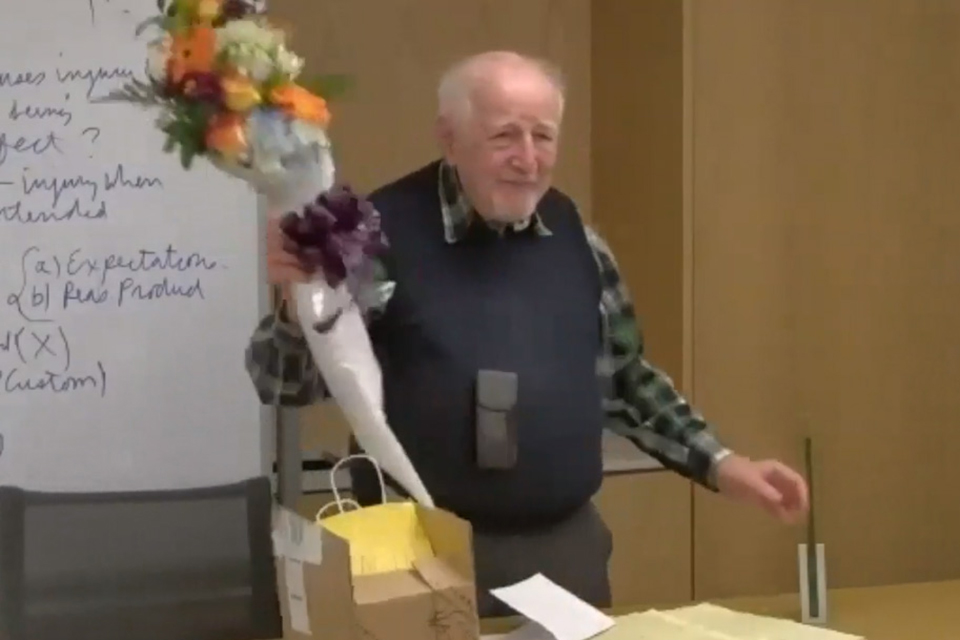
Guido Calabresi standing in front of a classroom holding a boquet of flowers.
"Guido Calabresi Lauded at His Final Torts Class"

I’ve already discussed some of Calabresi’s most important scholarly writings, so I won’t repeat myself here. I’ll simply add this brief assessment. His writings—which informed six decades(!) of teaching at Yale Law School—undoubtedly did give some people their first exposure to the use of economic thinking in law and governance. That matters. Among the consumers of Calabresi’s ideas were powerful people in politics, policymaking, legal practice, and academia, as well as people who would become powerful in those domains later in life.  Moreover, I suspect that Calabresi’s stature, reputation, and charisma gave weight to his ideas. In The Rise of the Conservative Legal Movement, Steve Teles also credits Calabresi with giving Law & Economics respectability, by rebutting the notion “that it was an entirely conservative, University of Chicago project” (Teles 99).

Saturday, April 29, 2023

Weekend Roundup

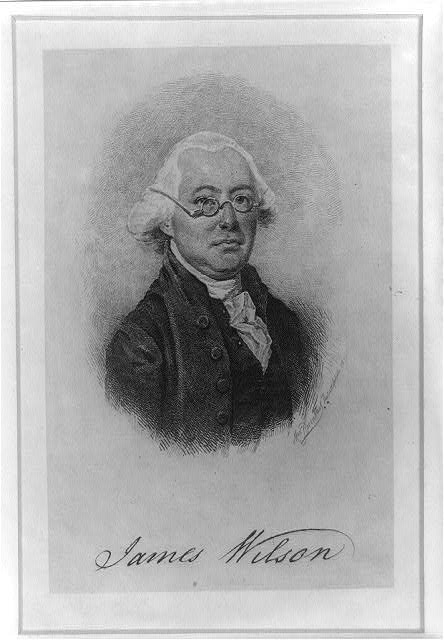
  • James Wilosn: (LC)
    John Mikhail, Georgetown Law, will speak on "James Wilson and 'We The People'" over Zoom as the Supreme Court Historical Society’s Law Day Lecture on Tuesday, May 2 at Noon, EDT.  Register here.
  • In A Model of Feminist Legal History, Rosemary Auchmuty reviews Sharon Thompson's Quiet Revolutionaries: The Married Women’s Association and Family Law (Frontiers of Socio-Legal Studies).
  • Benjamin C. Waterhouse reviews Scalia: Rise to Greatness, 1936 to 1986, Newsmax’s James Rosen’s “unapologetic ode to Antonin Scalia” (WaPo).
  • For the 60th anniversary of the promulgation of General Orders No. 100 to Union Army soldiers, Weekly War Books of the War Military Institute at West Point recommended five books, including John Fabian Witt’s Lincoln’s Code and Amanda L. Tyler’s Habeas Corpus in Wartime.
  • The history of the “true threats” doctrine under the First Amendment: Genevieve Lakier and Gabe Walters in conversation with Jeffrey Rosen on the National Constitution Center’s podcast.”
  • ICYMI: Ned Blackhawk discusses The Rediscovery of America: Native Peoples and the Unmaking of U.S. History in Mother Jones and, with Jonathan Capehart, in WaPo.  ICYMI: R v Penguin Books Ltd: When Lady Chatterley’s Lover was Put on Trial (The Collector).  An excerpt from Slandering the Sacred: Blasphemy Law and the Shaping of Indian Secularism, by J. Barton Scott (Scroll.in).
Weekend Roundup is a weekly feature compiled by all the Legal History bloggers.

Saturday, August 27, 2022

Weekend Roundup

  • The amicus brief of the Organization of American Historians in Brackeen v. Haaland, on “whether the placement preferences of the 1978 Indian Child Welfare Act discriminates on the basis of race,” is here.
  • “The Institute for Political History, the Journal of Policy History and the newly established Arizona State University Center for American Institutions are hosting the Policy History Conference in Columbus, Ohio from Wednesday, June 7 to Friday, June 9, 2023.”  Deadline for submissions of panels and papers is December 31. 
  • Jeffrey Rosen reviews Democratic Justice, Brad Snyder's biography of Felix Frankfurter, in the New York Times (NYT).  Update: we understand that John Fabian Witt's review in The New Republic is now ungated.
  • The 2021-2022 Stanford Law School Legal History Paper Prize has been awarded to joint JD/PhD (History) candidate, Tanner Allread, for The Origins of Indigenous Constitutionalism: Choctow Law and Governance, 1826-1830.  Honorable mentions go to recent JD graduate, Taylor Nicolas, for Who Was Your Grandfather on Your Mother's Side: Seduction, Race, and Gender in 1932 Virginia, and JD candidate, Audrey Spensley, for The Specter of Class in Fourteenth Amendment Equal Protection Doctrine: Housing Claims and the Burger Court Era.  
  • UConn historians discuss abortion in Colonial America in  Kimberly Phillips’s “Abortion in Colonial America: A Time of Herbal Remedies and Accepted Actions” (UConn Today).
  • AP History versus new CRT laws (The Conversation).  Also: An AP African American Studies course (Time).
  • The Summer 2022 issue of the Journal of the Texas Historical Supreme Court Society "features influential women in Texas legal history." Check it out here.
  • ICYMI: SCOTUSblog on Reva Siegel's Jackson lecture on Dobbs and Cherry-Picked history.  Annette Gordon-Reed interviewed (E-International Relations).  Sheffeld, Massachusetts, honors Elizabeth Freeman, who prevailed in a freedom suit 241 years ago, with a bronze statue (NPR).  Thoughts on moral panics as Massachusetts exonerates a witch (HNN).

Weekend Roundup is a weekly feature compiled by all the Legal History bloggers.