Showing posts with label Security. Show all posts

Monday, February 12, 2024

Kroncke on Labor in the American Empire

Jedidiah J. Kroncke, University of Hong Kong, has posted Suspended in Empire: The Imperial Legacies of American Territorial Labor:

On the Trail, Northern Luzon, 1924 (LC)
A great deal of recent attention has been giving to acknowledging the full historical scope of American empire and its legal foundations. A recurrent focus of this attention has been the impact of the Insular Cases—a set of early 20th-century doctrines that legitimate American territorial acquisitions while denying their full incorporation under the Constitution. Issues of political citizenship and property have thus predominated critical work on the Insular Cases.

This article expands on this resurgent interest by focusing on another critical element of this acknowledgment: the history of territorial labor which has long been central to the political economy of American empire. Explicating the role and regulation of territorial labor reveals enables of more complete picture of American empire, as well as its evolving pursuit of new legal forms to project national power while avoiding democratic accountability.

Most concretely, the unprincipled doctrines of the Insular Cases have led to a paradigm of perpetually precarious bargaining in which territorial labor only enjoys the formal protection of labor and employment law subject to complete federal discretion and potential revocation. Mapping the diverse and contingent legal regimes this bargaining has produced unearths all too many tragedies past and present as the largely invisibilized labor of territorial people has been circulated throughout American empire while building its economic and military foundations.

Further complicating this formally inchoate set of rights are the practical realities territorial labor has historically been subject to under conditions of American empire: localized employer domination, tactics of racialized labor migration, and the overshadowing anti-democratic disciplinary rationales of U.S. national security. These realities are evident throughout the diverse range of contemporary territories as well as in their scarring effects within former American territories and military occupations. Moreover, imperial labors’ roaming logics of dehumanization are today increasingly displaced onto even more vulnerable foreign migrant workers within many territories themselves.

Acknowledging the role of territorial labor in American empire blurs the line between territorial and incorporated life and law. Most powerfully, it reveals how the conditions of territorial labor reflect back the enervated nature of American economic citizenship writ large. This reflection is just one of the many ways in which territorial history presents lessons increasingly applicable to broader swaths of American life under conditions of modern economic globalization. The article ultimately integrates territorial history into renewed demands for a democratic political economy for all those living under American sovereignty.

--Dan Ernst

Saturday, December 30, 2023

Weekend Roundup

  • Could be worse: In Martinez and Tobia's recent survey, Legal History is in the middle of the pack for "should be central to the law school curriculum," although well back for "is central to the law school curriculum." H/t: Tommy Bennett.
  • Jack Goldsmith discusses The Court at War: FDR, His Justices, and the World They Made with its author, Cliff Sloan, Georgetown Law (Lawfare Podcast). And Scott R. Anderson discusses State of Silence: The Espionage Act and the Rise of America's Secrecy Regime, with Sam Lebovic, George Mason University (Lawfare Podcast).
  • The latest on Section 3 and the Presidency: Kurt Lash in the NYT and Mark Graber's reply in Balkinization.  Also: Seth Barrett Tilman's brief in LeBrant v. Benson.
  • ICYMI: Storm King Mountain, Oppenheimer and the birth of environmental law (Times Union). 

Weekend Roundup is a weekly feature compiled by all the Legal History bloggers.

Tuesday, November 21, 2023

Lebovic's "State of Silence"

Sam Lebovic, George Mason University, has published State of Silence: The Espionage Act and the Rise of America's Secrecy Regime (Basic Books):

In State of Silence, political historian Sam Lebovic uncovers the troubling history of the Espionage Act. First passed in 1917, it was initially used to punish critics of World War I. Yet as Americans began to balk at the act’s restrictions on political dissidents and the press, the government turned its focus toward keeping its secrets under wraps. The resulting system for classifying information is absurdly cautious, staggeringly costly, and shrouded in secrecy, preventing ordinary Americans from learning what their country is doing in their name, both at home and abroad.  

Shedding new light on the bloated governmental security apparatus that’s weighing our democracy down, State of Silence offers the definitive history of America’s turn toward secrecy—and its staggering human costs.  
Here is an endorsement:
“A thoughtful and much-needed study of one of the most controversial laws in United States history. From World War I through the Trump indictments, the Espionage Act has shaped some of our most dramatic political moments. Sam Lebovic’s book is an essential guide to this history of trial and error—and to the law of unintended consequences.”
 
Beverly Gage, Pulitzer Prize–winning author of G-Man

We know of two events for the book: From Spies to Leakers: The History of the Espionage Act, an online event at the National Constitution Center on December 4, and a State of Silence: The Espionage Act, Politics, and Press Freedom, a panel discussion at the Knight First Amendment Institute at Columbia University, on December 6.

--Dan Ernst

Wednesday, May 10, 2023

Farnia, "Imperialism and Black Dissent"

Stanford Law Review has published "Imperialism and Black Dissent," by Nina Farnia (Albany Law School). The abstract:

As U.S. imperialism expanded during the twentieth century, the modern national security state came into being and became a major force in the suppression of Black dissent. This Article reexamines the modern history of civil liberties law and policy and contends that Black Americans have historically had uneven access to the right to freedom of speech in the United States. Through archival research and legal analysis, I conduct four case studies that are representative of key trends in Black dissent after World War II: Black Communism, the Civil Rights Movement, the Black Power movement, and the Movement for Black Lives. These case studies illustrate how the modern national security state has affected the First Amendment right to freedom of speech and managed Black dissent in the United States, particularly when such speech is anti-imperialist or anticapitalist.

I argue that the modern national security state is one of the power structures undergirding free-speech jurisprudence. It operates in concert with free-speech colorblindness, a phenomenon I track in the final Part of this Article, to suppress domestic dissent by subordinated racial groups. The case studies suggest that the practical consequence of free-speech colorblindness is the narrowing of speech rights for Black dissenters and the overall containment of Black dissent.

Read on here. 

Readers interested in this topic may also wish to read Farnia's "Imperialism in the Making of U.S. Law," which we missed when it came out in 2022.

-- Karen Tani

Saturday, April 22, 2023

Weekend Roundup

  • My Georgetown Law colleagues Brad Snyder and David Vladeck have filed a FOIA suit against the National Archives over access to the FBI’s records on Angelo Herndon (Atlanta Journal-Constitution).  DRE
  • Gregory Ablavsky and Tanner Allread discuss their recent article "We the (Native) People? How Indigenous Peoples Debated the U.S. Constitution," on SLS Blog.
  • We're ready with some primo material for exam-grading-season procrastination: Hearst Metrotone Newsreels, from 1929 through 1967.  Hugh Johnson denouncing the San Francisco General Strike of 1934!  H/t: DW/JHS.
  • Manisha Sinha, the James L. and Shirley A. Draper Chair in American History at the University of Connecticut, delivered "The Abolitionist Roots of the Reconstruction Constitution," as the biannual Ubbelohde Lecture at Case Western Reserve University last Thursday (The Daily).
  • "Radcliffe Fellow Omer Aziz, a lawyer and the former foreign policy adviser to Canadian Prime Minister Justin Trudeau, discussed fascism in America at a Radcliffe Institute for Advanced Studies presentation Wednesday” (Harvard Crimson).
  • The revelations concerning Supreme Court Justice Clarence Thomas have generated interest in the resignation of Abe Fortas from the Court in 1969.  John P. MacKenzie, The Supreme Court justice who resigned in disgrace over his finances, in WaPo.  Business Insider India quotes Laura Kalman's Abe Fortas: A Biography.
  • ICYMI: Cay Risen on the fuzzy border between journalism and history (AHA Perspectives on History).  The legal history of national security charges, from espionage to sedition to whistleblowers (GBH).
Weekend Roundup is a weekly feature compiled by all the Legal History bloggers.

Thursday, July 15, 2021

Larsen on the Espionage Act of 1917

Daniel Larsen, Trinity College, University of Cambridge, has posted Before “National Security”: The Espionage Act of 1917 and the Concept of “National Defense, which appears in the Harvard National Security Journal 12 (2021): 329-372:

This Article upsets current understandings of the Espionage Act of 1917 by challenging a key, long-engrained assumption about the statute itself. The Espionage Act is not the highly punitive behemoth that shrouds enormous swathes of the government in secrecy, as is presently imagined. The term “national defense” does not capaciously expand to cover any government secret a prosecutor might deem worth protecting; rather, “national defense” actually has a highly specific and coherent meaning—one that is dramatically narrower than anyone has realized. 

--Dan Ernst

Monday, January 18, 2021

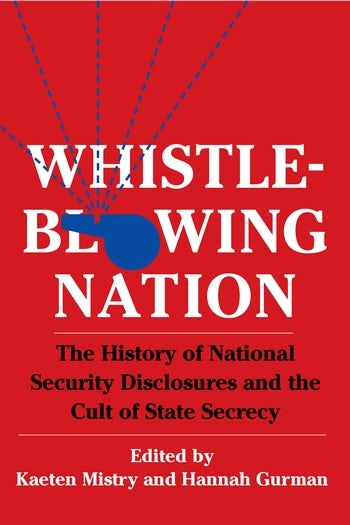
Mistry & Gurman, eds., "Whistleblowing Nation: The History of National Security Disclosures and the Cult of State Secrecy"

Columbia University Press has published Whistleblowing Nation: The History of National Security Disclosures and the Cult of State Secrecy (2021), edited by Kaeten Mistry (University of East Anglia) and Hannah Gurman (New York University Gallatin School of Individualized Study). A description from the Press:

The twenty-first century witnessed a new age of whistleblowing in the United States. Disclosures by Chelsea Manning, Edward Snowden, and others have stoked heated public debates about the ethics of exposing institutional secrets, with roots in a longer history of state insiders revealing privileged information. Bringing together contributors from a range of disciplines to consider political, legal, and cultural dimensions, Whistleblowing Nation is a pathbreaking history of national security disclosures and state secrecy from World War I to the present.

The contributors explore the complex politics, motives, and ideologies behind the revelation of state secrets that threaten the status quo, challenging reductive characterizations of whistleblowers as heroes or traitors. They examine the dynamics of state retaliation, political backlash, and civic contests over the legitimacy and significance of the exposure and the whistleblower. The volume considers the growing power of the executive branch and its consequences for First Amendment rights, the protection and prosecution of whistleblowers, and the rise of vast classification and censorship regimes within the national-security state. Featuring analyses from leading historians, literary scholars, legal experts, and political scientists, Whistleblowing Nation sheds new light on the tension of secrecy and transparency, security and civil liberties, and the politics of truth and falsehood.

Advance praise:

As Kaeten Mistry and Hannah Gurman demonstrate in this brilliant and compelling collection, the fates of national security whistleblowing and democracy are linked. These sharply written essays examine the characteristics of whistleblowers, the way secrecy and whistleblowing have changed over time, the interests at stake when the government prosecutes whistleblowers, and much more. Whistleblowing Nation is essential reading on the tensions between government secrecy and the transparency essential in a democracy. -- Mary L. Dudziak

For a list of contributors, check out the Table of Contents. More information is available here. 

H/t New Books in Law, where you can find an interview with the editors.

-- Karen Tani

Friday, February 17, 2017

Official Leaks, the Reporter's Privilege, and the Law

We were quite fortunate Tuesday to attend "In re Judith Miller: National Security Privilege," an extremely timely and important reargument and panel discussion, sponsored by the Historical Society of the DC Circuit, in which the historical nature of the topic permitted judges, lawyers (including former DOJ officials), and a law professor (Columbia Law's David Pozen) to address the difficult issues raised by leaking by public officials.  A brief report of the proceedings is on the Society’s website.  A recording will soon be streaming there and on the website of the Federal Judicial Center.

Update: Could reporters be hunted down if Trump goes after leakers?

Friday, January 13, 2017

In re Judith Miller: The Oral Argument Reenacted

[We have the following announcement of In re Judith Miller: National Security and the Reporter’s Privilege, sponsored by the D.C. Circuit Historical Society to be held Tuesday, February 14, 2017, 4:30 p.m.–6:00 p.m., in the Ceremonial Courtroom, 6th Floor, E. Barrett Prettyman U.S. Courthouse, 3rd Street & Constitution Avenue, N.W., Washington, D.C.  Admission is free.  Reservations are not required.  A reception with light refreshments will follow the program.]

In 2003, following articles in the press identifying Valerie Plame as a CIA agent, the Department of Justice undertook an investigation into whether government employees had violated federal law by unauthorized disclosure of her identity.  A special counsel was named and a grand jury convened.  The Government issued a subpoena to New York Times reporter Judith Miller seeking documents and testimony related to conversations she had had with a government official concerning Valerie Plame. Ms. Miller refused to comply with the subpoena and was held in civil contempt. She appealed, arguing both that the First Amendment affords journalists a constitutional right to conceal their sources and that reporters enjoy an evidentiary privilege under the common law to conceal confidential sources. The Court of Appeals (with separate concurring opinions by Judges Sentelle, Henderson, and Tatel) rejected both arguments and affirmed the District Court’s orders compelling Ms. Miller’s testimony. Our program will include a reenactment of arguments presented to the Court of Appeals, focusing on the existence of a reporter’s privilege founded on federal common law. Professor David Pozen will set the stage. Laura Handman will argue for Ms. Miller, Amy Jeffress for the United States, and Judges Tatel and Sentelle will preside.

Following the reenactment, Stuart Taylor will moderate a discussion exploring the appropriate balance between free speech and common law protections of reporters’ sources, on the one hand, and the government’s need to know in aid of its law enforcement and national security responsibilities, on the other.  Panelists will include Professor Pozen, the advocates Ms. Handman and Ms. Jeffress, as well as James Cole, who, as Deputy Attorney General, was a key person in the 2014 revision of the Department of Justice’s news media policies.

Setting the Stage
David Pozen, Professor of Law, Columbia University

Reenactment
For appellant Judith Miller, Laura R. Handman, Davis Wright Tremain LLP
For appellee United States, Amy Jeffress, Arnold & Porter LLP
Sitting as judges: David S. Tatel, Judge, U.S. Court of Appeals for the D.C. Circuit; David B. Sentelle, Senior Judge, U.S. Court of Appeals for the D.C. Circuit

Panel Discussion
Moderator: Stuart S. Taylor, Jr., author, journalist, and lawyer
Panelists: James M. Cole, Sidney LLP; Laura R. Handman, Amy Jeffress, David Pozen

Tuesday, December 27, 2016

Ethel Rosenberg as the "Government's Hostage"

Mark Denbeaux, director of the Center for Policy and Research at Seton Hall University School of Law, and four co-authors and research fellows have posted The Government's Hostage: The Conviction and Execution of Ethel Rosenberg:
Ethel and Julius Rosenberg (Wiki)
Whether or not Ethel Rosenberg was guilty of the offense for which she was tried, convicted, and executed, there is little doubt that the evidence upon which the conviction was based was threadbare. Indeed, even the government itself thought so. The government’s prosecution of Ethel relied exclusively on the testimony of David and Ruth Greenglass, Ethel’s brother and sister-in-law. A July 17, 1950 internal FBI memo declared there was not enough evidence to arrest Ethel Rosenberg. The government did not discover any new evidence against Ethel between the release of that memo and Ethel’s arrest on August 11, 1950. Furthermore, no new evidence was discovered in the time between her arrest and her indictment on January 31, 1951, shortly before her trial in March. And it was in that brief period that both the Greenglasses’ stories dramatically evolved as to the extent of Ethel’s supposed connections with the alleged conspiracy.

Her conviction and execution rested on three claims: (1) Ethel asked Ruth to convey Julius’ espionage recruitment offer to David; (2) Ethel typed up notes containing nuclear secrets in order to transmit them to the Soviets; and (3) Ethel and Julius received a mahogany table and other gifts from the Soviets as a reward for their commitment to the cause. Of the three, the only evidence present at the time Ethel was indicted was Ruth’s statement that Ethel asked Ruth to convey Julius’ recruitment offer to David. Despite giving several statements, over the course of eight months, neither Ruth nor David Greenglass mentioned Ethel typing up the notes until two weeks before trial. The indictment and pretrial documents also fail to report that Ethel received gifts from the Russians. This accusation was first introduced into the trial documents during the Greenglasses’ trial testimony.

The conclusion in the July 17, 1950 FBI memo, stating that the evidence against Ethel was insufficient to warrant prosecution, remained true throughout her arrest, prosecution, conviction, and execution.

The reason for her prosecution seems clear: Ethel was executed because she refused to cooperate with the Government to help convict her husband, Julius. Ethel was merely a pawn used for leverage in the government’s attempt to build a case against Julius Rosenberg.

Friday, May 13, 2016

Jones to Speak on Mexican Anti-Subversion Laws, 1941-70

On Monday, May 16, 2016, 4:00pm - 5:30pm, in the 6th Floor Moynihan Boardroom of the Woodrow Wilson International Center for Scholars, Halbert Jones, St. Antony's College, University of Oxford, will present “Crimes Against the Security of the Nation”: World War II, the Cold War, and the Evolution of Mexico’s Anti-Sedition Laws, 1941-1970:
While, until recently, relatively little attention has been given to the importance of international conditions in accounting for the longevity of Mexico’s post-revolutionary regime, Halbert Jones will show how World War II and the Cold War played a pivotal role in enabling successive Mexican governments to enact, expand, and apply one of its most controversial legal tools, a provision in the federal penal code criminalizing what it described as acts of “social dissolution.”  The legislation, in force from 1941 to 1970, prescribed severe penalties for vaguely defined crimes of subversion, and it was invoked over the course of those decades against striking workers, student protesters, and a famous communist muralist, among others who were said to be spreading “foreign propaganda” and undermining national security.  By the time Mexico’s 1968 student movement called for the repeal of the measure, however, it had become a symbol of what critics saw as the arbitrary nature of the regime.  The removal of the provision from the books in 1970 – and its replacement with a clause introducing the new crime of “terrorism” – therefore highlights the ability of an authoritarian political system to adapt to changing international and domestic political conditions.

Tuesday, April 5, 2016

The Color of Surveillance: A Conference at Georgetown Law

The Color of Surveillance: Government Monitoring of the African American Community, a conference on “the role of law enforcement and national security surveillance in the relationship between African Americans and their government – beginning with the colonial era and continuing to the present day,” will take place on April 8 at the Georgetown University Law Center.  Speakers include David Garrow and David Levering Lewis.  It is hosted by my Georgetown Law colleague Paul Butler.

Tuesday, November 10, 2015

Law and Ideology in the National Security State: A Roundtable

Over at Balkinization, Mary L. Dudziak is presiding over a roundtable whose contributers presented at the ASLH panel at its recent annual meeting.  As Professor Dudziak explains:
At the American Society for Legal History annual meeting recently, I had the pleasure of chairing a panel on Law and Ideology in the National Security State. All of the panelists presented work that intersects with past discussions on this blog, so I've organized a roundtable to bring the panel to Balkinization.

Over the next few days, I will post contributions by Aziz Rana, Cornell Law School; Jeremy Kessler, Columbia Law School; Anne Kornhauser, Department of History, CUNY; and the panel commentator Christopher Capozzola, Department of History, MIT.

These scholars all see American constitutionalism as deeply affected by the United States role in the world. They differ in the ways they periodize global influence, and in the kinds of outside influences that matter. And though national security is the conceptual frame for the panel, these contributions -- explicitly or implicitly -- work with different ideas about what national security was thought to  require, and even what it is that American constitutionalism was securing. Together, however, they make clear that scholars examining the path of American constitutional history must set the story in the context of the U.S. role in the world.
We’ll update with links to the contributions.

Jeremy Kessler on The Myth of the Strong American State
Aziz Rana on Empire and the Creedal Constitution in the Philippines
Anne Kornhauser on German Émigré Intellectuals and the Struggle Over the Emerging National Security State

Wednesday, May 13, 2015

Walter Gellhorn's Loyalty Board File

Walter Gellhorn (1974), UVA Law Library
In my last post, I mentioned the Oversize Personnel Security Investigation Case Files, inventory A1, entry 2, Records of the Office of Personnel Management (RG 478).  Here are some views of the Columbia law professor Walter Gellhorn from a file (box 683) compiled in connection with his possible appointment to the National War Labor Board  file in the 1940s.  One FBI informant described the great administrative law scholars as “a man of brilliant intellect but a man whose views are not in accord with the usual ideas of American Government” because he “desires to have every phase of human endeavor and activity regulated by the Government.”  Another said that Gellhorn thought “the Courts should not be permitted to review the decisions or findings of the various Government Boards of Agencies after they had made their decision in a particular case."  A neighbor in Englewood, NJ, described him as 35 years old, 180 pounds, with blonde hair, no visible scars, and an “air of conceit."

The rating examiner charged with assessing Gellhorn's loyalty for a possible appointment to the National War Labor Board concluded, "The information concerning the appointee’s loyalty to the United States is in a sense favorable and yet is disquieting.”  To be sure, the "ultra-liberal," Gellhorn was "fully loyal to the United States.” Still,
[t]he information is disquieting in that the appointee has clearly affiliated himself with numerous Communist front and Communist dominated groups; that he has used his professional ability to advise, aid and defend Communists and organizations known to be Communist saturated; and, in that it is inconceivable that an individual as intelligent and well -informed as this appointee must be ignorant of that fact that his affiliations were with Communist dominated groups and his activities were serving to aid the Communist cause.  The possibility of the appointee’s innocence in these matter diminished in proportion to the numerical rise in his memberships and capacities until such a possibility of innocence must be dismissed as unreasonable.

Louis Rothschild Mehlinger (1882-1987)

[Longtime LHB readers will recall that the exam in my annual survey of American legal history includes a biographical essay.  Here is this year's.]

Louis Rothschild Mehlinger (1882-1987) was born along the shores of the Mississippi River to Ferdinand Mehlinger, a German Jew who had emigrated to New Orleans in 1865, and the former Catherine Hayes, who had been born a slave in 1863.  He grew up in rural Mississippi, where his father was a postmaster and merchant.  Louis was sent off to a historically black college in Jackson, Mississippi, where the instruction was vocational.  One day, Booker T. Washington visited and Mehlinger was among the students assigned to look after the great man.  “I never will forget,” he later said, “I got to shine the dear gentleman’s shoes.”  Looking back, he thought the educator’s focus on vocational training was right “under the circumstances in which Booker Washington found himself.”

Upon graduating he briefly taught carpentry in Florida, but in January 1907, during Theodore Roosevelt’s presidency, he arrived in Washington, DC, to take a job as clerk in the Treasury Department.  He boarded in the same house with Carter Woodson and would serve as secretary of the historian’s Association for the Study of Afro-American Life and History.  He enrolled in Howard University’s night dental school, but it closed before he could get his degree.  By studying shorthand, typing, and bookkeeping, he qualified for a stenographer job at Treasury.  In 1916 he entered Howard’s night law school but his studies were interrupted by the United States’ entry into World War I.  After a stint in a black officer’s training school, he became a captain in an infantry division that served in France. 

After the war, Mehlinger returned to Treasury and recommenced his nighttime legal studies at Howard.  He graduated magna cum laude in 1921, soon after the start of Warren G. Harding’s presidential administration.  Solo practice was unpromising, as “most black families with any means” wanted a white lawyer.  Fortunately, the Department of Justice’s only black lawyer, a member of the Republican National Committee from Mississippi, had Mehlinger appointed his stenographer.  Because his politically connected boss “ran around a lot,” all the law work of the office fell to him.  “Pretty soon,” he recalled, “I was appointed assistant attorney and assigned to argue cases in the Court of Claims,” a juryless court that heard monetary claims against the federal government. 

Some members of the government were offended when they realized that the Department of Justice had sent a black lawyer to discuss a case with them.  When Mehlinger traveled in the South to investigate a claim, he routinely left the day before the returned trip he had booked, fearful that if he left as scheduled “Ku Klux Klan elements” might take him off the train in some rural area.  His caution was understandable: in 1925, white Mississippians murdered his brother and drove his father from the state.  Despite such handicaps, Mehlinger became so good at his job that even FDR's patronage-starved Democrats decided they had to retain him–a Republican–when they came into office in 1933.

Mehlinger had subscribed to the NAACP’s journal as early as 1915, when he wished its editor W.E.B. Du Bois and the NAACP itself “smooth seas and prosperous gales on its great voyage for manhood rights.”  (Mehlinger later called Du Bois “the most brilliant man I ever knew.”)  In 1919, he testified against racially segregated passenger cars at a congressional hearing over the return of railroads to private hands after their wartime nationalization.  With Charles Hamilton Houston and five others, Mehlinger co-founded a black lawyer’s group, the Washington Bar Association, in 1925.  But he also thought that “Houston had the Harvard stamp on him.”  Unlike Houston, Mehlinger believed one could study law successfully at night and co-founded a night law school that produced 600 graduates over fifteen years starting in the 1930s.

As perhaps befits a fellow who delivered patriotic Flag Day speeches to schoolchildren, in December 1941 Mehlinger offered his services to the Secretary of War “in whatever field of endeavor they may be used in defense of my country.”  He also tried to persuade Brigadier General Benjamin O. Davis to help him be called to active duty.  (Davis told him that “he would be of more service, due to his age and so forth, to the government by remaining in his present assignment.”) Mehlinger was active in his church (where he was a deacon), the American Legion, the Elks, and his college fraternity.  In these groups he always argued against those who counseled collaborating with Communists.  “I have always maintained that all the ills eventually could be adjusted,” he later explained.  One his superiors at DOJ agreed.  Although Mehlinger concerned himself with the welfare of “his own people,” Francis Shea recalled, “he was moderate and seasoned in his views of how to push forward the welfare of the Negroes.”

Mehlinger refused to join the National Negro Congress but he did join the National Lawyers Guild in 1946 because he understood from Judge James A. Cobb that it “had received a clearance”–apparently a reference to the decision not to place the Guild on the Attorney General’s List of Subversive Organizations.  Although placed on the Guild’s Civil Rights Committee, he attended no more than three Guild meetings.

You can imagine Mehlinger’s shock and surprise, then, when, in September 1948, he was notified to appear before the Department of Justice’s Loyalty Review Board, created by executive order by President Harry S. Truman, to show why he should not be removed from his position for disloyalty.  The only basis offered was his “sympathetic association with the Southern Negro Youth Congress,” a group long under surveillance by the Federal Bureau of Investigation.  Mehlinger had agreed to have his name listed as a sponsor of the group’s national meeting after receiving a circular listing one of his fraternity brothers, Du Bois, and other African American leaders.  “Being a Negro myself and having suffered the indignities of Jim Crowism,” he explained at his hearing, “naturally I was in sympathy.”  He only learned that the group was considered subversive when notified of his charges.

When presented with the pamphlet of the Southern National Youth Congress that listed Mehlinger as a sponsor, the lawyer was repulsed.  The figures on it, he said at his hearing in October 1948, reminded him of a “passage from Dante’s Inferno. . . .  I would have suffered my right hand to be cut off before I put my name” to it.  Many witnesses–white and black–testified to his loyalty and none to his disloyalty.  One former Assistant Attorney General testified that he was “dumbfounded “ to hear of the charges.  Another DOJ lawyer called Mehlinger “one of the most loyal people that I have ever known” and “one of the most faithful government servants that I have ever come into contact with.”  Although Mehlinger kept his position, his file was not closed until after his retirement in 1952. 

At his loyalty hearing, Mehlinger ventured, “I have achieved as well as any man who started as low as I was.”  The Washington Post reporter who caught up with him on his hundredth birthday found that he still had a few court-appointed clients.  Asked his philosophy of life, he quoted Micah: “What does the Lord require of the old man?  But to love mercy, do justly and walk humbly with thy God.”  He died a few weeks short of his 105th birthday.

[The principal sources for this essay are digitized newspapers and the Oversize Personnel Security Investigation Case Files (inventory A1, entry 2, box 1303) of the Records of the Office of Personnel Management (RG 478), which Landon R. Y. Storrs rescued from historical obscurity and used so effectively in her excellent Second Red Scare and the Unmaking of the New Deal Left (2013).]

Saturday, January 31, 2015

Weekend Roundup

  • From the Consumer Law & Policy Blog: historical perspectives on the Supreme Court's current Fair Housing Act case (here and here). (Hat tip: Torts Today)
  • From Inside Higher Ed: A law school vice dean tells students that the historical record could do without the gender biased comments they have been leaving in female professors' teaching evaluations ("If you have any doubts that posterity will somehow muddle through without the benefit of your fashion advice, allow me to dispel them once and for all”). 
  • The Georgetown Journal of Law & Modern Critical Race Perspectives is hosting the conference The Moynihan Report: 50 Years Later, Thursday, February 5, 2015, 10AM to 4PM, Gewirz Student Center, 12th Floor, Georgetown University Law Center.  Speakers include my GULC colleagues Paul Butler, Anthony Cook and Gary Peller, as well as Donald Tibbs, Drexel University, and Justin Hansford, St. Louis University.  DRE
Weekend Roundup is a weekly feature compiled by all the Legal History bloggers.

Friday, November 7, 2014

Knowles on National Security Rulemaking

In the process of arguing that Administrative Procedure Act’s exception from notice-and-comment requirements for National Security Rulemaking is outdated, Robert Knowles, Valparaiso University Law School, reviews the mid-twentieth-century history of administrative law.  Here is the abstract:
Agencies performing national security functions regulate citizens' lives in increasingly intimate ways. Yet national security rulemaking is a mystery to most Americans. Many rules - like those implementing the National Security Agency's vast surveillance schemes - remain secret. Others are published, but the deliberations that led to them and the legal justifications for them remain hidden.

Ordinarily, these rules would undergo the Administrative Procedure Act's notice-and-comment process, which has earned wide, if not universal, praise for advancing democratic values and enhancing agency effectiveness. But a national security exception from notice-and-comment in the APA itself, along with the overuse of classification authority, combine to insulate most national security rulemaking from public scrutiny and meaningful judicial review. The result is a national security administrative state that is insular and unaccountable to the public.

Some scholars find this exceptional treatment inevitable, while others have proposed reforms. But no one has sought to provide a full accounting of national security rulemaking's scope and historical origins. By doing so, this Article demonstrates that the APA exception is historically contingent - a response to the rise of totalitarian states and the Second World War. As a product of its time rather than an essential attribute of all administrative law systems, it is a relic in a globalized world in which the foreign and the domestic are increasingly intertwined, and the line between national security and ordinary rulemaking therefore begins to fade entirely.

This Article suggests reforms that would increase public deliberation in national security rulemaking, while accounting for the importance of secret-keeping when truly necessary. Among these proposed reforms is a change to the current practice allowing national security agencies to invoke the security exception to notice-and-comment after a rule is challenged in court, rather than at the notice-and-comment stage itself. These reforms would improve the current rulemaking practice, which undermines the transparency necessary for effective democratic participation.

Thursday, August 21, 2014

Dudziak on the Future as a Concept in National Security Law

LHB Founder Mary L. Dudziak, Emory University School of Law, has posted The Future as a Concept in National Security Law, which is forthcoming in the Pepperdine Law Review.  Here is the abstract:    
With their focus on the future of national security law, the essays in this issue share a common premise: that the future matters to legal policy, and that law must take the future into account. But what is this future? And what concesption of the future do national security lawyers have in mind? The future is, in an absolute sense, unknowable. Absent a time machine, we cannot directly experience it. Yet human action is premised on ideas about the future, political scientist Harold Lasswell wrote in his classic work The Garrison State. The ideas about the future that guide social scientific work are rational predictions, he suggested.

If law is premised on ideas about something unknowable, something that can, at best, be a prediction, then it seems important to examine what those ideas, assumptions and predictions are. This essay examines future-thinking in prominent works related to national security, including the ideas that the future is peacetime, a long war, a "next attack," and the future as a postwar. Drawing from scholarship on historical memory and conceptions of temporality, this essay argues that understandings of the future depend on more than the rational empirical predictions that Lasswell had in mind. The future is a cultural construct that depends in part on the way we remember the past. It does not exist apart from the politics and values that inform our perceptions. The future does not unfold on its own. We produce our future through both our acts and our imaginations. Culture matters deeply in this context, for the future we imagine is a well-spring of law.

Friday, May 30, 2014

A Congressional Briefing on the History of Congress and the Intelligence Community

[From the National History Center's website:]

The National History Center of the American Historical Association will be presenting a Congressional briefing on the history of Congress’s relationship with the intelligence community.  The briefing will be held on June 9, 2014, at 9:30 a.m. in Room 121 of the Cannon House Office Building.  Professors Laura Donohue of Georgetown Law School [sic: Georgetown University Law Center]  and Mark Lowenthal of The Intelligence & Security Academy and Johns Hopkins University will discuss the origins and consequences of the Church Committee and more.  James Grossman, the Chairman of the National History Center’s Board and Executive Director of the American Historical Association, will moderate the discussion.

[Read more.]

Saturday, March 29, 2014

Weekend Roundup

  • From the Chronicle of Higher Education: "Doctoral students at Brown University are testing a new model for interdisciplinary studies that allows them to pair advanced degrees in sometimes-disparate fields, with the goals of broadening their knowledge and improving their marketability." Read on here.
  • The University of Alabama School of Law and the ABA Journal invite submissions for the Harper Lee Prize for Legal Fiction ("given annually to a book-length work of fiction, published in the preceding year, that best illuminates the role of lawyers in society and their power to effect change"). (Hat tip: In Custodia Legis).
  • Gale Cengage announces new on-line resources: Indigenous Peoples: North America and the Associated Press's City Bureau Collection for Atlanta, Austin, Birmingham, Chicago, Dallas, Miami, New Orleans, Philadelphia, and Pittsburgh, dating from 1931 to 2004.  The Washington Bureau is due out in the spring and should be a valuable source on legal-political doings in the capital
  • Via the Historical Society: the latest issue of Historically Speaking is now available online.
Weekend Roundup is a weekly feature compiled by all the Legal History bloggers.