Showing posts with label book prize. Show all posts

Saturday, May 9, 2026

Weekend Roundup

  • "On the 250th anniversary of America’s independence, Harvard Law historian and legal scholar Bruce H. Mann argues that colonists were fighting to uphold English common law rights and traditions" (Harvard Law Bulletin). 
  • The Penn Carey Law School welcomes Christian Burset to its faculty. 
  • A notice of Stanford’s “America at 250,” one-unit course, cross-listed in the History and American Studies departments and the Law School.  It is “an exploration of where America has been, and based on that, where it might be going or might need to go,” according to Jonathan Gienepp, who is one of its instructors, with Pamela Karlan (Stanford Daily).
  • A Q&A with Len Niehoff about his new book, Meeting Shakespeare at the Bar: Reading the Bard Through the Lens of the Law (American Bar Association, 2026) (Michigan Law). 
  • On Thursday, May 7, Christine Chabot, Jane Manners and Lev Menand presented papers on removal, with a comment Nick Parrillo, in one of the Academic Paper Workshops at the Spring conference of the Administrative Law and Regulatory Practice Section of the American Bar Association."  
  • "Alex Votta recently received Michigan Law’s Dimond Prize for his paper “The Great Rampart in Protecting Human Liberty: The Right to Education in Antebellum and Reconstruction Black Constitutional Consciousness.”  He credits Sam Erman, Rebecca Scott et al. (Michigan Law).

Weekend Roundup is a weekly feature compiled by all the Legal History bloggers.

Saturday, March 14, 2026

Weekend Roundup


  • A head's up to those thinking about submitting proposals for the annual meeting of the American Society for Legal History in Banff, November 12-14: the deadline is March 24.   
  • Legal history bulks large among the finalists for the book division of the American Bar Association’s Silver Gavel Awards for Media and the Arts: The Zorg: A Tale of Greed and Murder that Inspired the Abolition of Slavery, by Siddharth Kara; The Radical Fund: How a Band of Visionaries and a Million Dollars Upended America, by John Fabian Witt; We The People: A History of the U.S. Constitution, by Jill Lepore; You Can't Kill a Man Because of the Books He Reads: Angelo Herndon's Fight for Free Speech, by Brad Snyder; American Scare: Florida's Cold War on Black and Queer Lives, by Robert Fieseler; and The Containment: Detroit, the Supreme Court, and the Battle for Racial Justice in the North, by Michelle Adams.  
  • The Irish Legal History Society has announced its 2026 essay prize.  "Submissions are invited by 31 May on any topic within Irish legal history, broadly conceived, from both undergraduates and postgraduates."
  • The U.S. Department of Justice has announced that a museum devoted to its past will open in July 2026. 
  • Anna Snyder on the "odd omission" of lawyers in commemorations of the 250th anniversary of independence (AHA Perspectives). 
  • "The 1957 executive order signed by President Dwight Eisenhower to enforce the desegregation of Little Rock Central High School is one of the documents on display at the Clinton Presidential Center at a new exhibit chronicling the history of the 27 amendments to the Constitution" (Arkansas Advocate).    
  • Michele Goodwin’s Presidential Address to the Law & Society Association prompted June Carbone to reflect on teaching Johnson v. McIntosh and Dred Scott in the comment Claiming History.
  • ICYMI:  Phillip W. Magness on Justice Thomas's dissent in the IEEPA decision (Law & Liberty). A notice of Vernon Burton's talk, “The First Amendment and Lincoln’s Constitutional Legacy" at Clemson's "week of celebrating First Amendment rights and history" (Clemson News). Tarun Choudhury on Sir Garfield Barwick (Legal Service India).  Ernie Walton thinks that Originalists Need the Classical Legal Tradition (Public Discourse).

 Weekend Roundup is a weekly feature compiled by all the Legal History bloggers.

Saturday, October 18, 2025

Weekend Roundup

  • Congratulations to Alison LaCroix, University of Chicago Law School, upon the awarding to her of the American Historical Association’s Littleton-Griswold Prize in American Law and Society for The Interbellum Constitution: Union, Commerce, and Slavery in the Age of Federalisms!
  • Laura F. Edwards, Class of 1921 Bicentennial Professor in the History of American Law and Liberty at Princeton University, will deliver three lectures on the theme “The Legal Geography of the Civil War Era and Its Lasting Legacy,” as the 2025 Steven and Janice Brose Distinguished Lecture Series at Penn State University on October 23-25. 
  • A notice of Emma Brush, a legal historian recently appointed Assistant Professor of Law, Jurisprudence and Social Thought at Amherst College (Amherst Student).  
  • Evan D. Bernick, Northern Illinois University College of Law, has posted his review of Born Equal by Akhil Amar, Yale Law School.
  • Jane Manners's historian's amicus brief for the Brennan Center in Grundmann v. Trump (D.C. Cir.), involving the Trump administration’s motion to dismiss Susan Tsui Grundmann's challenge to her removal from the Federal Labor Relations Authority.   
  • “The Origins of the Major Questions Doctrine,” which Rachel Rothschild, Michigan Law, presented at last year's annual meeting of the ASLH, has been selected "one of the top 10 environmental law papers published in 2024" (Michigan Law). 
  • ICYMI: Still more Lepore: Arts FuseJustice Amy Coney Barrett on originalism (and more) (C-SPAN).  Marcus Rediker reviews The Zorg by Siddharth Kara (NYT).

Weekend Roundup is a weekly feature compiled by all the Legal History bloggers.

Saturday, August 2, 2025

Weekend Roundup

  • "History in Action: A Conversation with Professor Felicia Kornbluh"(UVM). 
  • Richard Epstein on his career as a legal scholar (and other topics) in the "Capitalism and Freedom in the Twenty-First Century" podcast series of the Hoover Institution (Hoover).  
  • Lindsay Chervinsky joins Saikrishna Prakash, Virginia Law, online to discuss her book, Making the Presidency: John Adams and the Precedents that Forged the Republic, and “how the Constitution and the presidency were shaped by the demands of the times and how both continue to evolve.”  Thursday, September 4, 2025, 11 a.m.-12 p.m.  Sponsored by the UVA Miller Center (UVA Law).
  • The University of Chicago Law School's notice of Alison LaCroix's receipt of that SHEAR book prize for The Interbellum Constitution: Union, Commerce, and Slavery in the Age of Federalisms.
  • Mary Ziegler, UC Davis School of Law, and Stephen Gilles, Quinnipiac University School of Law discuss Professor Ziegler’s book Personhood: The New Civil War over Reproduction in a National Constitution Center podcast.   
  • "Gerard Magliocca is the winner of the Erwin N. Griswold Prize [of the Supreme Court Historical Society] for his book Washington’s Heir: The Life of Justice Bushrod Washington (Oxford University Press, 2022). The Griswold Prize is awarded on an occasional basis when a book about the history of the Supreme Court" (SCHS).
  • This year, University of New Mexico School of Law is looking to hire in the fields criminal law, civil procedure, Law and Indigenous People, clinic and legal research and writing 

Weekend Roundup is a weekly feature compiled by all the Legal History bloggers.

Monday, March 17, 2025

ASLH Prizes

[We have the following announcement from the American Society for Legal History.]

Each year the ASLH and the Cromwell Foundation sponsor a number of prizes for books, articles, dissertations, and digital  legal history projects. Scholars are encouraged to apply, and to encourage others to apply. Please note that in some cases eligibility criteria have shifted slightly from last year. Applicants should double-check the specific language to ensure eligibility.

All ASLH prize nominations (including self-nominations) are due June 1.

--Dan Ernst  The descriptions of the prizes appear after the jump.

Saturday, December 14, 2024

Weekend Roundup

  • Congratulations to Dylan C. Penningroth as co-winner of the Order of the Coif Book Award for Before the Movement: The Hidden History of Black Civil Rights (Liveright, 2023). He shares the prize with my Georgetown Law colleague Stephen Vladeck for The Shadow Docket: How the Supreme Court Uses Stealth Rulings to Amass Power and Undermine the Republic (Basic Books, 2023).  DRE
  • The National Historical Publications and Records Commission awarded the University of Cincinnati's Archives and Rare Books Library a grant to complete the processing of the records of the Cincinnati Branch of the NAACP related to the Bronson v. Cincinnati Board of Education (1974) (H-Law).
  • Allen Boyer reviews Joshua C. Tate's Power and Justice in Medieval England and Lorren Eldridge's Law and the Medieval Village Community in The Docket.
  • Glenn Fine, the author of Watchdogs: Inspectors General and the Battle for Honest and Accountable Government, discussed the history of inspectors general with Jack Goldsmith on Lawfare.
  • Update: The University of Sheffield's notice of the Old Bailey Online's receipt of the 2024 Mary Dudziak Legal History Prize by the American Society for Legal History.

 Weekend Roundup is a weekly feature compiled by all the Legal History bloggers.

Monday, July 29, 2024

George Washington Prize Finalists Announced

The finalists for the $50,000 George Washington Prize for 2024 are (in alphabetical order):

Michael A. Blaakman, Speculation Nation: Land Mania in the Revolutionary American Republic (Philadelphia: University of Pennsylvania Press, 2023)

Ned Blackhawk, The Rediscovery of America: Native Peoples and the Unmaking of U.S. History (New Haven: Yale University Press, 2023)

Cassandra A. Good, First Family: George Washington’s Heirs and the Making of America (Toronto, ON: Hanover Square Press, 2023)

Cynthia A. Kierner, The Tory’s Wife: A Woman and Her Family in Revolutionary America (Charlottesville: University of Virginia Press, 2023)

David Waldstreicher, The Odyssey of Phillis Wheatley: A Poet’s Journeys through American Slavery and Independence (New York: Farrar, Straus, and Giroux, 2023)

--Dan Ernst  H/t: AGR

Saturday, June 1, 2024

Weekend Roundup


  • Thomas G. Corcoran, 1935 (LC)
    A side note to the forgoing: At the start of his post, Dr. Reft reproduces a letter from Edward Holmes, the justice's nephew and executor, to Tom Corcoran, the justice's favorite legal secretary, in which the executor refers to "a question that intervenes between us."  Perhaps the question was the disposition of the Black Book.  In his often reliable memoir, Corcoran claimed that on the night the justice died, Edward Holmes said that the Black Book was "too personal" and should be destroyed, but that when the nephew's back was turned he "slipped it behind some other volumes on a shelf.  A little later I smuggled it out of the house under my shirt and sent it by courier the next day to the Harvard Law School."  Thomas G. Corcoran with Philip Kopper, “Rendezvous with Democracy: The Memoirs of ‘Tommy the Cork,’” Holmes, pp. 39-40, box 586, Corcoran MSS, Library of Congress.  I've never looked for corroborating evidence in the Edward J. Holmes Collection or other HLS records.  DRE.

  • The Beinecke Rare Book and Manuscript Library at Yale University has issued a call for applications for its Fellowship Program. The library "welcome[s] applications from scholars and graduate students locally and globally who utilize traditional methods of archival and bibliographic research as well as from individuals who wish to pursue creative, interdisciplinary, and non-traditional approaches to conducting research in the collections." 
  • The New-York Historical Society has announced substantial postdoctoral and predoctoral fellowships in Women's History.  Due date: June 30
  • New on the Digging a Hole podcast: David C. Schleicher and Samuel Moyn interview Dylan C. Penningroth on his book Before the Movement: The Hidden History of Black Civil Rights.  And congratulations to Professor Penningroth for winning the J. Willard Hurst Book Prize of the Law and Society Association for Before the MovementBerkeley Law's notice of the awards the book has garnered is here.
  • On the New Books in Intellectual History podcast,  Kunal M. Parker discusses The Turn to Process: American Legal, Political, and Economic Thought, 1870-1970.
  • On the New Books in African American Studies podcast, Robert K. D. Colby discusses An Unholy Traffic: Slave Trading in the Civil War South.
  • ICYMI: Robert W. Gordon, Stanford Law, on the Trump Conviction and the History of Presidential Crimes (SLS Blogs).  The 1924 Indian Citizenship Act (Smithsonian; History Today).  Policy approaches to addressing a history of racial discrimination (Stanford IEPR).  Delaware marks 70th anniversary of its role in landmark Brown v. Board decision (WHYY).
 Weekend Roundup is a weekly feature compiled by all the Legal History bloggers.

Saturday, May 25, 2024

Weekend Roundup

  • Over at Balkinization, an interesting symposium on David Pozen's The Constitution of the War on Drugs (Oxford University Press, 2024) has wrapped up. This response by Pozen (Columbia Law) links to the various contributions, including by legal historian Shaun Ossei-Owusu (Penn Law).
  • Edward A. Purcell, New York Law School, looks back to Charles Evans Hughes's Supreme Court of the United States for inspiration on how Chief Justices can induce the resignations of Associate Justices  (The Hill).
  • Jus Gentium is out with a special issue (9:2), The Historicization of International Law and its Limits, organized by Jean d’Aspremont and Thomas Kleinlein.  It includes the article “Lather, Rinse, Repeat: The Historical Returns of International Law,” by Carl Landauer.
  • “On May 16, in celebration of the 70th anniversary of the Supreme Court Brown v. Board of Education decision, the National Archives in Washington, DC, hosted a panel discussion on the lasting impact of the historic legal decision.”  The panel included Sheryll D. Cashin, Georgetown Law; Randall L. Kennedy, of Harvard Law School; and Michael K. Powell, who moderated.  More.
  • Also, “Meet all the families behind the 5 school cases that swayed the Supreme Court” (LA School Report).
  • “Dr. John Kirk, George W. Donaghey Distinguished Professor of History at UA Little Rock, and the students in his fall 2023 Seminar in Public History class, a capstone course that focuses on collaborative research for students who are earning a Master of Arts in public history, have received the Lucille Westbrook Award from the Arkansas Historical Association” for the paper “Racial Discrimination in Jury Selection: The Arkansas Cases of the Bone Brothers, 1938-1940.”  More.
  • The program for the 2024 annual meeting of the American Political Science Association is now online.
  • ICYMI: Hardeep Dhillon on The Immigration Act of 1924 (Penn Today). "The 'Originalist' Justices Keep Getting History Spectacularly Wrong" (Balls & Strikes).  That "Appeal to Heaven" flag (AP; MSNBC).
 Weekend Roundup is a weekly feature compiled by all the Legal History bloggers.

Thursday, May 9, 2024

Willrich a Pulitzer Finalist for "American Anarchy"

Congratulations to American Society for Legal History Past President, Michael Willrich upon being named a 2024 Pulitzer Prize Finalist in History for American Anarchy: The Epic Struggle between Immigrant Radicals and the US Government at the Dawn of the Twentieth Century (Basic Books):

A riveting and beautifully written story of how anarchists and their lawyers remade American law, with profound implications for modern jurisprudence, and prompting serious reflection on the meaning and limits of democracy.

--Dan Ernst

Saturday, April 27, 2024

Weekend Roundup

  • Holly Brewer, University of Maryland, discusses the Trump immunity case on the Law Dork podcast Nancy Isenberg, Louisiana State University, does so as well, here.  And Donald Nieman, University of Binghamton does here.
  • Legal history was well represented when the Society for Historians of the Gilded Age and Progressive Era met for its annual luncheon at the annual meeting of the Organization of American Historians.  Laura Edwards, Princeton University, gave the Distinguished Historian Address, “No Account: Rethinking the Narrative of Women and Property in the Late Nineteenth Century.”  Michael Willrich, Brandeis University, won the President’s Book Prize for American Anarchy: The Epic Struggle between Immigrant Radicals and the U.S. Government at the Dawn of the Twentieth Century (Basic Books, 2023).  Elizabeth D. Katz, University of Florida, received Honorable Mention for the Fishel-Calhoun Prize, an article prize for new scholars, for “Sex, Suffrage, and State Constitutional Law: Women’s Legal Right to Hold Public Office,” Yale Journal of Law and Feminism (2022).  And Mazie Hough, University of Maine, won the 2024 JGAPE Best Article Prize for “‘There is Nothing So Sacred as Human Life:’ Infanticide and the State of Maine, 1877-1917.” (SHGAPE Blog).   
  • ICYMI: Throckmorton's Case continues to fascinate decades after we first encountered it in John Langbein's DLI  (The Leaflet).  Ronald G. Shafer on Justice Joseph P. Bradley and the Hayes-Tilden Commission (WaPo Retropolis). A notice of Michael Hoeflich’s Legal Feasts (KU News).

Weekend Roundup is a weekly feature compiled by all the Legal History bloggers.

Friday, March 22, 2024

BHC Prizes to Con Díaz and Canaday

Several prizes of interest to legal historians were awarded at the just-concluded Business History Conference.  One was the Anne Fleming Article Prize, awarded jointly ever other year jointly with the American Society for Legal History “to the author or authors of the best article published in the previous two years in either Law and History Review or Enterprise and Society on the relation of law and business/economy in any region or historical period.”  This year’s recipient is Gerardo Con Díaz, Yale University, for Patent Law and the Materiality of Inventions in the California Oil Industry: The Story of Halliburton v. Walker, 1935–1946, published in Enterprise and Society:

This article examines a patenting conflict between the Halliburton Oil Well and Cementing Company and an independent inventor named Cranford Walker. It argues that Halliburton’s effort to lower the barriers to entry into the oil well depth measurement industry facilitated the re-emergence of materiality as a pre-condition for the patent eligibility of inventive processes. In 1941, Walker sued Halliburton for infringement of three of his patents, and Halliburton responded with an aggressive defense aimed at invalidating them. Over the next five years, the courts handling this conflict adopted very narrow legal theories developed during the Second Industrial Revolution to assess the patent eligibility of inventions that involved mental steps—processes such as mathematical computations, which people can perform in their minds. The resulting legal precedent cleared the path for Halliburton’s short-term industrial goals and continued to shape patent law for the rest of the century.
The BHC’s Hagley Prize in Business History, "for the best book in business history, broadly defined," went to Margot Canaday, Princeton University, for Queer Career: Sexuality and Work in Modern America:

Workplaces have traditionally been viewed as “straight spaces” in which queer people passed. As a result, historians have directed limited attention to the experiences of queer people on the job. Queer Career rectifies this, offering an expansive historical look at sexual minorities in the modern American workforce. Arguing that queer workers were more visible than hidden and, against the backdrop of state aggression, vulnerable to employer exploitation, Margot Canaday positions employment and fear of job loss as central to gay life in postwar America.

Rather than finding that many midcentury employers tried to root out gay employees, Canaday sees an early version of “don’t ask / don’t tell”: in all kinds of work, as long as queer workers were discreet, they were valued for the lower wages they could be paid, their contingency, their perceived lack of familial ties, and the ease with which they could be pulled in and pushed out of the labor market. Across the socioeconomic spectrum, they were harbingers of post-Fordist employment regimes we now associate with precarity. While progress was not linear, by century’s end some gay workers rejected their former discretion, and some employers eventually offered them protection unattained through law. Pushed by activists at the corporate grass roots, business emerged at the forefront of employment rights for sexual minorities. It did so, at least in part, in response to the way that queer workers aligned with, and even prefigured, the labor system of late capitalism.

Queer Career shows how LGBT history helps us understand the recent history of capitalism and labor and rewrites our understanding of the queer past.
Other prize winners and honorable mentions, many for scholarship of interest to legal historians, are here.

--Dan Ernst.  H/t: SB

Wednesday, November 8, 2023

Peter Gonville Stein Book Award to Chira

We complete the day's series of posts on book prizes awarded at the recently concluded annual meeting of the American Society for Legal History with the Peter Gonville Stein Book Award, which went to Adriana Chira, Patchwork Freedoms: Law, Slavery, and Race Beyond Cuba’s Plantations (Cambridge University Press, 2022).  Here is the citation:

Adriana Chira
Adriana Chira’s Patchwork Freedoms is a compelling account of the ways in which the free and semi-free black residents of eastern Cuba used law and custom to eke out their freedom over the course of the nineteenth century. Chira demonstrates how “day in and day out, enslaved people chipped away at enslavers’ authority locally, by negotiating the terms of their manumission and land access. They pulled one another out of plantation slavery gradually, yet consistently.” The committee was especially impressed by how Patchwork Freedoms integrates legal and social history by seamlessly weaving together legal and nonlegal sources to tell a story that is complex, nuanced, and locally grounded.

--Dan Ernst

Tuesday, May 30, 2023

LSA Prizes Announced

The Law and Society Association has announced its annual prizes and awards, several of which will interest legal historians.  The first is the Harry Kalven Award, which LSA describes as “not a book award, nor is it a career achievement award, but is given in recognition of a body of scholarly work, including some portion of work having been completed within the past few years.”  The two recipients are Christopher L. Tomlins, University of California, Berkeley, and Michael McCann, University of Washington.  The  James Willard Hurst Prize, awarded annually “for the best work in socio-legal history published in the previous year,” goes to Jessica M Marglin, University of Southern California, for The Shamama Case: Contesting Citizenship Across the Modern Mediterranean (Princeton University Press, 2022).  Honorable mention for the Hurst Prize goes to Robert Travers, Cornell University, for Empires of Complaints: Mughal Law and the Making of British India, 1765-93 (Cambridge University Press, 2022).  And Charlotte Rosen, “a historian of U.S. prisons and prisoner resistance, with a focus on the politics of prison overcrowding” who received her Ph.D in History from Northwestern University in 2023, won the Graduate Student Paper Prize.H/t: MS.

--Dan Ernst

Thursday, April 20, 2023

Nominations Sought for ASLH Prizes

[We have the following announcement from the American Society for Legal History.  DRE]  

The ASLH awards a number of annual prizes that celebrate legal history research published or defended in the previous calendar year. Please see the following award descriptions [here], and visit specific prize pages on our website for complete information. Note that each prize that requires nomination has a June 1, 2022 deadline.

Monday, November 21, 2022

Cromwell Foundation Book Prize to Ablavsky

Every year, at the annual meeting of the American Society for Legal History, the William Nelson Cromwell Foundation announces a series of prizes awarded on the recommendation of subcommittees of the ASLH’s Advisory Committee on the Cromwell Prizes.  At the Chicago meeting earlier this month, John D. Gordan III, who chairs the William Nelson Cromwell Foundation and the ASLH’s Advisory Committee on the Cromwell Prize, announced this year's winners. Today we will recap those announcements, starting with the Cromwell Foundation Book Prize, "awarded annually to the best book in the field of American legal history by an early career scholar."

This year's winner is Gregory Ablavsky (Stanford Law School), for Federal Ground: Governing Property and Violence in the First U.S. Territories (Oxford: Oxford University Press, 2021). Here is the citation: 

Federal Ground, an analysis of early territorial governance, is beautifully written, deeply researched, innovative, and sophisticated. Mining a wide variety of legal and governmental sources, Ablavsky makes original arguments of consequence to several fields in addition to legal history, including Native American history, settler colonialism, and early American state-building. What appears at first to be a narrative of a failed state turns, unexpectedly, into a curious story of limited state “success,” illuminating how the federal state earned legitimacy and practical power in the only regions where it was in charge. Ablavsky shows how both the Natives and white settlers/speculators used or lobbied inchoate federal institutions – at first, just a handful of officers and their ad hoc commissions – to shape the legal landscape in ways that furthered their interests and visions of the Ohio and Mississippi Valleys. These contestants constructed the state by demanding that it arbitrate disputes – and then taking its money. Ablavsky uses contests over property and federal responses to violence as his chief examples, pulling from diverse and scattered records to weave a complex yet coherent story of competing claims and their often-contingent resolution. He traces federal officials’ encounters with Indigenous law and with Native understandings of consent, efforts to monopolize the legitimate use of violence, and deployment of federal funds with nuance and sensitivity to his sources’ limitations even as he wrings insights from what must have been an unwieldy archive. In Ablavsky’s telling, the federal government emerged not because of an effective or even coherent federal plan of pacification, land-granting, or settlement, but literally from the ground up. His is a knotty tale of furious claims-making in which there are few heroes and that perhaps only in retrospect takes on the majesty of the tragic. The story is complicated and sometimes counterintuitive, yet told crisply and with wit and insight. Ablavsky unearths and interprets sources with the creativity and mastery of a much more senior scholar. Federal Ground is ambitious and illuminating, without overestimating historians’ ability to reconstruct a contested and thorny past. For years to come, this should be the authoritative history for understanding the earliest phase of American territorial, and thus imperial, history.

Congratulations to Professor Ablavsky! And thank you to the members of the book prize subcommittee, chaired by Serena Mayeri.

-- Karen Tani

Tuesday, October 25, 2022

Littleton-Griswold Prize to Masur

Credit
Congratulations to Kate Masur, Northwestern University, upon her winning the Littleton-Griswold Prize in “US law and society, broadly defined,” from the American Historical Association for Until Justice Be Done: America’s First Civil Rights Movement, From the Revolution to Reconstruction (W. W. Norton, 2021).  The AHA announcement and its announcement of other prizewinners for legal-history adjacent books is here.  She will be speaking about the book at an NU Faculty Live event on November 16, 2022.

--Dan Ernst

Monday, July 25, 2022

Ablavsky Wins LSA's Hurst Prize

Congratulations to Gregory Ablavsky, Stanford Law School, for winning the J. Willard Hurst Book Prize of the Law and Society Association “for this year’s best sociolegal history book. Ablavsky’s book, Federal Ground: Governing Property and Violence in the First U.S. Territories (Oxford University Press, 2021), explains the growth of federal authority in the first two U.S. federal territories—the Northwest and Southwest. While the Washington administration, Congress, federal officials, land office administrators and other federal bureaucrats sought to assert their vision of federal power over the West, the land they sought to govern and transform was far from empty. His book addresses the underlying questions of what federal power is and who its architects are. The book further identifies how the federal government can be studied—not as a monolith, but as the outcome of many different struggles playing out at grass-roots levels.”

We hear that Nada Moumtaz, University of Toronto, received Honorable Mention for God’s Property: Islam, Charity, and the Modern State (University of California Press, 2021).

--Dan Ernst

Monday, October 18, 2021

AHA Prizes Announced

The American Historical Association has announced its prizes for 2021.  The Littleton-Griswold Prize in US law and society, broadly defined, goes to Douglas J. Flowe (Washington Univ. in St. Louis) for Uncontrollable Blackness: African American Men and Criminality in Jim Crow New York (Univ. of North Carolina Press, 2020).  The George Louis Beer Prize in European international history since 1895 goes to Francine Hirsch (Univ. of Wisconsin–Madison) for Soviet Judgment at Nuremberg: A New History of the International Military Tribunal after World War II (Oxford Univ. Press, 2020). The John Lewis Award for History and Social Justice to recognize a historian for leadership and sustained engagement at the intersection of historical work and social justice goes to Mary Frances Berry (Univ. of Pennsylvania). 

--Dan Ernst

Monday, June 21, 2021

2021 Boucher Prize to Wood

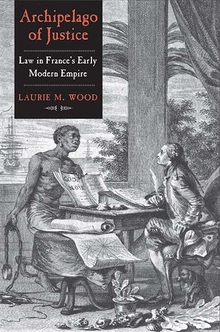
Laurie Wood (Florida State University) has won the 2021 Boucher Prize from the French Colonial Historical Society for her book, Archipelago of Justice: Law in France's Early Modern Empire, published by Yale University Press in 2020. 

Here's the citation: 
Laurie M. Wood’s Archipelago of Justice: Law in France’s Early Modern Empire is the winner of the 2020 Mary Alice and Philip Boucher prize. Archipelago of Justice offers a major contribution to an emerging scholarship seeking to integrate the histories of the Atlantic and Indian Ocean empires in order to better understand how the early modern French empire operated as a whole. Wood achieves this remarkable accomplishment through her focus on the conseils. In the early modern French empire, the conseils—regional law courts—bound a far-flung and diverse imperial system together through a network of institutions, people, and practices. In Archipelago of Justice, Wood focuses our attention across the entire system of these crucial legal institutions (the administrative equivalent of the parlements of metropolitan France), along with the people who staffed them and the subjects who petitioned them, to show how they created power, order, and the very nature of French colonialism. Based on astonishing archival tenacity, the book is beautifully written through powerful case studies and stories that bring to life both the powerful and the marginalized in vivid detail. Its most powerful and creative intervention is surely at the level of framing. Approaching the conseil and its agents as a whole, Wood navigates from the Caribbean to the Indian Ocean, helping us see these frequently separate worlds together, as they were legally bound together in the early modern era through the fascinating history of the conseil.

Professor Wood will be guest blogging at the LHB in the future. In the meantime: many congratulations!

--Mitra Sharafi