Showing posts with label Germany. Show all posts

Monday, July 27, 2026

Li's "Translating Weimar"

[We have the following announcement from our friends at the Max Planck Institute for Legal History and Legal Theory of a new open access publication in its series, Global Perspectives on Legal History.  DRE]

Fupeng Li, Translating Weimar: The Cultural Translation of the Weimar Constitution in China (1919-1949).  Global Perspectives on Legal History. Vol. 28

How can a constitution imagine social revolution? This book answers this question by placing social rights at the center of the Weimar Constitution's long journey to China. It tells a global legal history of how jurists and legislators used constitutional language to conceptualize 20th-century projects of social transformation.

Moving between Germany and China, the book follows the Weimarer Reichsverfassung as it was read, translated, and rewritten by Chinese actors. Rather than treating the Weimar Constitution's influence as a simple "reception" of foreign ideas, it reconstructs how Chinese jurists used debates on labor, welfare, and economic order to rethink what a social constitution could be - and what kind of social revolution it might legitimately guide.

At the core of the analysis lies a structural shift: from the Weimar Constitution's rights-based model of social order to the policy-oriented constitutionalism that came to characterize modern China. Drawing on multilingual archives and constitutional drafts, the study traces how the Weimar Constitution's catalog of fundamental social rights was progressively reframed as Fundamental National Policies, transforming social rights into state programs, planning targets, and ideological commitments.

Organized around the triad of space, time, and tradition, the book maps the routes by which German Staatsrechtslehre and the Weimar Constitution's concept of social rights entered Chinese debates, shows how they were positioned within changing temporal narratives of crisis and revolution, and examines how they were negotiated in the encounter with Confucian statecraft, revolutionary nationalism, and socialist planning. In doing so, it offers a new framework for understanding how constitutions mediate social revolution through the cultural translation of rights into policies.

The book will interest scholars and students of constitutional law, global legal history, and modern Chinese history who seek to understand how social rights traveled across borders - and how, in the process, they quietly remade the meaning of both "constitution" and "revolution" in the 20th century.

Thursday, April 30, 2026

Grimm on German Constitutional History since 1949

Dieter Grimm has published Constitutional Effectiveness: The Case of Germany's Basic Law with Hart/Bloomsbury:

This book presents a unique account of the social and political impacts of the German Basic Law on the German Republic from 1949 to the present day.

It considers the way in which the history of the Federal Republic of Germany has been decisively influenced by its Constitution, the Basic Law of 1949, and by the jurisprudence of the Federal Constitutional Court.

The book argues that the historiography of the Federal Republic does little to reflect this influence. The Basic Law is mentioned and so occasionally rulings of the Federal Constitutional Court. But the reader does not get the impression that they were of specific importance in Germany before and after reunification.

Legal scholars, on the other hand, are concerned about the legal consequences of the Basic Law, but do not analyse its impact in the real world. There is, thus, a gap between the two disciplines – one not being familiar with social reality, the other not familiar with the normativity of the law. The history of the effectiveness of the constitution falls into this gap.

In this book, Dieter Grimm, himself a Justice of the Federal Constitutional Court from 1987 to 1999 and an expert on interdisciplinary research in law, history and political science, guides the reader through important developments and events that were determined or influenced by the constitution and its judicial interpretation.

--Dan Ernst 

Saturday, April 4, 2026

Weekend Roundup

  • An alarming opinion of the Office of Legal Counsel of the US Department of Justice advising White House Counsel that the Presidential Records Act is unconstitutional.  WaPo's story is here.
  • In the American Prospect: Felicia Kornbluh (University of Vermont) writes about the Supreme Court's recent decision in Chiles v. Salazar (involving a Colorado ban on "conversion therapy"). The piece also quotes legal historian Marie-Amélie George (Wake Forest University Law School). 
  • Via Brian Rosenwald: "Made by History" has a new home. Going forward, it will partner with the Philadelphia Inquirer. New pitch email: madebyhistory@inquirer.com.  
  • On Friday, April 10, Alejandro de la Fuente, Harvard University, will deliver the sixteenth annual Presidential Lecture at Tufts University on Slavery, Freedom, Race, and the Law in the Americas.  The lecture will be based on his and Ariela J. Gross’s book, Becoming Free, Becoming Black: Race, Freedom, and Law in Cuba, Virginia, and Louisiana (THR).
  • Over at Divided Argument, William Baude hosts a roundtable with Christian Burset, Jonathan Green, and Ryan Snyder on their recent articles, which Baude describes as some of the best contributions to a "recent round of scholarship on history and tradition in legal interpretation."    
  • And over at Modern American History, Sarah Seo hosts a roundtable of historians to discuss  "the benefits of and challenges to translating historical scholarship for a legal audience."  With Laura Edwards, Jennifer Mittelstadt, Samuel Erman, Nathan Perl-Rosenthal, Maggie Blackhawk and Ned Blackhawk.
  • G. Edward White discovers who pranked the U.S. Supreme Court "by filing a phony cert petition challenging an absurd DC noise ordinance" (Oyez).
  • The NYT review of Mark Peterson's The Making and Breaking of the American Constitution: A Thousand-Year History (Princeton University Press) and a blog post by the author.
  • The April 2026 newsletter of the Historical Society of the District of Columbia Circuit is here

  • More on Birthright Citizenship.  John Yoo says that it has a long historical precedent (AEI).   Kate Masur  "Fact-Checks President Trump’s Birthright Citizenship Order" (CBS Chicago).  John Mikhail on Jurisdiction, Domicile, and the Ratio Decidendi of Wong Kim Ark (Balkinization).  Yet another dispatch from the war between the law professors on the history of the citizenship clause.  (Courthouse News Service).  And has the distance between law professor Bluesky and NYT opinion page ever been shorter? 
  • ICYMI: A new book on Sarah Keys Evans, "The Black Veteran Who Desegregated Interstate Buses" (Mother Jones).  Tom Lee on the Declaration of Independence at 250 (Fordham Law). A Century of Colonial Tariffs (LPE Project).  High school students explore Münster’s legal history (Universität Münster).

 Weekend Roundup is a weekly feature compiled by all the Legal History bloggers. 

Saturday, February 14, 2026

Weekend Roundup

  • Daniel Kuehn discusses a paper W. E. B. Du Bois wrote when he was a Harvard graduate student that, Kuehn argues, anticipated important insights in marginalist wage theory (AEA).
  • The National Constitution Center in Philadelphia has opened a new gallery, titled “America’s Founding.” Per local reporting, it "provides attendees with an interactive experience on the early conflicts leading up to the creation of the U.S. Constitution, including early protests, the American Revolution and the adoption of the Bill of Rights." 
  • The National Constitution Center has announced the appointment of Jon Meacham as its Semiquincentennial Scholar, "a one-year appointment designed to anchor the Center’s intellectual and civic programming celebrating the nation’s 250th anniversary" (NCC).
  • In related news, the ARC Justice Clinic at Penn Carey Law, representing the Avenging the Ancestors Coalition and The Black Journey, has filed an amicus brief in City of Philadelphia v. Burgum, et al. As the Clinic's website explains, "[t]he case concerns the removal of educational exhibits about slavery from the President’s House Site near Independence Hall, where President George Washington enslaved nine people in the late eighteenth century." Read the brief here
  • Alexandra Natapoff, Harvard Law School, has launched Rule of Law 101, a free, ten-part video series, which "features world-class legal experts from top law schools around the nation explaining and analyzing important decisions by the Supreme Court" (Harvard Law Today).  
  • Jud Campbell, Jonathan Gienapp, and Orin Kerr discuss originalism before Stanford Law students in a recording appearing in the Institute for Justice's Short Circuit Podcast
  •  On April 14, 2026 at 10:00am (EDT), the Modern Criminal Law Review will hold a book forum live on YouTube on  David Garland’s Law and Order Leviathan: America’s Extraordinary Regime of Policing and Punishment (Princeton 2025).  In addition to Professor Garland, the panelists include Amna Akbar, University of Minnesota, Law; Patricia Faraldo Cabana and José Ángel Brandariz García, University of A Coruña, Law; Katja Franko, University of Oslo, Criminology, Rocío Lorca, University of Chile, Law; and Sara Wakefield, Rutgers University, Criminal Justice.  Register here.
  • ICYMI: Six Black Legal Trailblazers (Solove Law).  Trailblazing Black Ohio Lawyers (CNO).  The descendants of Plessy and of Ferguson at Tulane Law.   
Weekend Roundup is a weekly feature compiled by all the Legal History bloggers.

Tuesday, January 6, 2026

Italian Review of Legal History 11

[Italian Review of Legal History 11 (2025) has been published open access online.  Unsurprisingly, most of the contributions are in Italian.  We note those available in English below.  H/t: ESCLH Blog.  DRE.]

Sul Diritto dei popoli, il pensiero di John Rawls (English
Antonio Padoa Schioppa

La diserzione nel contesto della mobilitazione generale: Esperienza storica e sfide attuali (English
Serhii Khalymon, Liudmyla Litvin, Viktor Tyshchuk
 
Giurisdizione militare e stato democratico. Dalla giustizia dei capi alla legge 180/1981
Floriana Colao

Cura dei poveri e sicurezza sociale nell’Inghilterra di Età Tudor: Il ruolo dei Justices of the Peace
Dolores Freda

La colonizzazione democratica. Lotte per la terra, riforma agraria e attuazione costituzionale nel dopoguerra
Paolo Passaniti

Lo sviluppo della teoria dell’atto amministrativo come espressione dei valori del diritto amministrativo (English)
Andrzej Adamczyk

El espejo tiznado: el Tratado de París (1898) en la historia jurídica de Puerto Rico (English
José R. Gómez Biamón 

Il concetto di “popolo” nella prospettiva intergenerazionale
Raffaele Marzo

Un esame filosofico del patto sociale nella ricostruzione della società sudafricana (English
Konanani Happy Raligilia, Rorisang Gomolemo Thage, Lufuno Tokyo Nevondwe, Kolawole Olusola Odeku, Lesiba Benedict Moshoeu

Altri temi

Para uma história de gavetas: o projeto de código penal brasileiro de Galdino Siqueira (1913)
Ricardo Sontag

Schede bibliografiche


Recensione a Antonio Grilli, Resistenza e repressione. Il Tribunale speciale per la difesa dello Stato nella RSI (1943-1945), Roma, Carocci, 2024
Floriana Colao

Recensione a Paolo Passaniti, La riforma agraria in Italia. La Maremma dell’Ente Maremma, Pisa, Pacini, 2024
Federico Roggero

Il fascino dell’anomalia: leggendo Davide Rossi, Il lungo Novecento della frontiera adriatica. Transizioni istituzionali e modifiche giuridiche, Soveria Mannelli, Rubbettino, 2025
Alberto Sciumè

Recensione a Mario Ascheri e Fabrizio Ricciardelli, The City-states in Late Medieval Italy, Roma, Viella Editrice, 2024
Claudia Storti

Dibattiti: Una storia non solo per storici. Presentazione della monografia di Marzia Lucchesi, Diritto, pedagogia e femminismo. Valeria Benetti (1908-1914), Napoli, Satura Editrice, 2023 (San Salvatore Monferrato, 27 giugno 2025)
Introduzione al dibattito sul libro di Marzia Lucchesi Diritto, pedagogia e femminismo. Valeria Benetti 1908-1914
Enrico Beccaria

Valeria Benetti e il lungo itinerario della questione femminile
Ettore Dezza

Considerazioni sul volume di Marzia Lucchesi Diritto, pedagogia e femminismo. Valeria Benetti (1908-1914)
Giulia Giustetto

Alcune considerazioni tra passato e presente sul libro di Marzia Lucchesi Diritto, pedagogia e femminismo. Valeria Benetti 1908-1914
Claudia Storti

L’attualità del pensiero e dell’opera di Valeria Benetti
Marzia Lucchesi

Thursday, September 11, 2025

An Exhibit and Conference on German Constitutional History

We have word of a library exhibit and panel at the Washington & Lee University School of Law: Locating the Law: Places of German Constitutional History.  First, the exhibit, which runs from September 4 – October 31, 2025:

Locating the Law explores the places where Germany’s constitutional identity has taken shape—from medieval cathedrals and Enlightenment-era town halls to postwar courthouses and modern office buildings. Featuring photographs by Alexander Telesniuk and adapted from the book Verfassungorte/Constitutional Places by Russell A. Miller, Markus Lang, and Kai-Michael Sprenger, the exhibition considers how democracy is rooted not just in texts but in physical spaces and shared public memory.

Spanning over five centuries, the exhibition highlights sites where constitutions were debated, drafted, or defended. Telesniuk’s images reflect the symbolic and practical importance of these locations, reminding viewers that building and maintaining a constitutional society is a collective, ongoing effort. The project builds on an original book project funded and published by Stiftung Orte der deutschen Demokratiegeschichte (The Foundation for the Places of the History of German Democracy).

The panel discussion is Wednesday October 22, 2025, 4:00–5:30 pm in Lykes Atrium, with a light reception following.  The panelists are:

Alexander Telesniuk, Constitutional Places Photographer, Frankfurt am Main, Germany
Russell Miller, Co-author of Constitutional Places, W&L University School of Law
Kish Parella, W&L University School of Law
Richard Wetzell, German Historical Institute, Washington DC 

--Dan Ernst 

Saturday, August 9, 2025

Weekend Roundup

  • Thurgood Marshall, assisted by Wife and Family (LC)
    “Becoming Thurgood: America’s Social Architect,” a documentary on the life and career of Thurgood Marshall, premiers Tuesday, September 9, 2025, on PBS.  The DuSable Black History Museum and Education Center in Chicago hosts and preview and discussion on August 21 (WTTW)
  • "David Carrillo, executive director of UC Berkeley Law’s California Constitution Center, will become editor-in-chief of California Legal History in 2026" (UC Berkeley Law).
  • Richard Primus, University of Michigan Law School, and John Harrison, University of Virginia School of Law discuss Professor Primus’s The Oldest Constitutional Question: Enumeration and Federal Power.  "Their conversation traces how this fundamental disagreement has shaped key moments in American constitutional history, from the Founding Era to the New Deal, and why the debate remains unsettled today" (National Constitution Center).  Also on YouTube.  
  • Stefan Kadelbach on the "Frankfurt Documents" and the birth of a new constitutional order for Germany in 1948 (Goethe-Universität).
  • Jill Lepore will discuss her forthcoming book, We the People: A History of the U.S. Constitution, at  Congregation Beth Israel in San Diego on Sunday, September 7, 2025 from 4 PM to 5:30 PM
  • The district court opinion in that lawsuit over the cancellation of National Endowment for the Humanities grants. The American Historical Association's update.  An update on new awards (NYT).
  • If you happen to be in Hyde Park, NY, on August 13, you can take in a showing of William Randolph Hearst's authoritarian fantasy from March 1933, Gabriel over the White House, at the FDR Library and Museum. 
  • Lawbook Exchange 's August list of Scholarly Law and Legal History.  
  • ICYMI: The Adam Liptak column behind all those skeets: As the Supreme Court Focuses on the Past, Historians Turn to Advocacy (NYT).  David Blight asks, What If History Died by Sanctioned Ignorance? (New Republic/Bunk). Eric Segall asks How the Hell To Teach Constitutional Law in 2025?  (Many of his questions involve history) (Dorf on Law).  NAACP LDF's historical timeline on the Voting Rights Act of 1965.

 Weekend Roundup is a weekly feature compiled by all the Legal History bloggers.

Wednesday, May 7, 2025

Erkkilä and Gries on Popularizing GDR's Lower Courts

Ville Erkkilä and Luisa Gries have published “The Problem Can Be Solved Only by Those Imbued with a Socialist Sense of Justice!”: Social Conflict and the Lower Courts in the German Democratic Republic open access in Law and History Review:

The article concentrates on the massive project of popularizing the court system and penal practice in the GDR in the 1960s. From then on, the GDR transferred a considerable amount of jurisdiction to collectives, which were further assigned the task of adjudicating “close to the people” within and alongside the existing legal system. We will analyze how the government with this project managed to translate the ideological task of sanctioning the inner-state enemy into existing legal concepts, and how it used law as a means to advance its political aims. By focusing on the judicialization of politics in the GDR, the article examines the legal history of the GDR as an important example in the broader and pressing phenomenon of the relationship between law and authoritarian politics.

--Dan Ernst

Saturday, November 30, 2024

Weekend Roundup

  • The Institute for Advanced Legal Studies at the University of London has announced the establishment of the Law and the Humanities Hub (LHub), led by Anat Rosenberg.  It “aims to foster academic expertise, creativity, and intellectual leadership in law and the humanities.”  Here are its 2024/25 Visitors.
  • The Illinois Supreme Court Historic Preservation Commission has digitized approximately 3,700 case files from 1819 to 1865.  Its "freely accessible and user-friendly website . . . will be publicly available within the next few months."  More.
  • The University of Chicago Law School will host a book launch for Curtis Bradley’s Historical Gloss and Foreign Affairs: Constitutional Authority in Practice, with comments by Will Baude and David Strauss, on Wednesday, December 3, 12:15pm to 1:10pm, at the Law School.  The event is open to the public.
  • A notice of a conference at Kings College London in support of the Cambridge History of International Law volume on the Pacific from circa 1500 until 1920 (KCL).
  • The next session in the American Society for Legal History series, Making Connections: New Works in Legal History, will occur on Wednesday, December 11, 6-7pm Central Time. Chlöe Kennedy will discuss her Inducing Intimacy: Deception, Consent and the Law (2024) with interlocutor Catherine Evans.  ASLH President Barbara Welke will moderate.  Register here.
  • On Lawfare's "Chatter" podcast, Rachel Shelden, Penn State University, discusses how widespread violence and another civil war were avoided as the nation resolved the disputed presidential election of 1876.
  • Thomas McSweeney's Jot on Ada Maria Kuskowski's, "The Time of Custom and the Medieval Myth of Ancient Customary Law," 99 Speculum 143 (2024).
  • ICYMI: Sandra Day O'Connor was no conservative (HNN).  The price America paid for the Chinese Exclusion Act (NPR).  Open access (for a few more days): The Case of the Slave Ship Zong (History Today).

 Weekend Roundup is a weekly feature compiled by all the Legal History bloggers.

Monday, August 12, 2024

Puder on Thibaut and Von Savigny's Codification Debate

Markus G. Puder, Loyola University New Orleans College of Law, has posted Dystopian or Not: Alternate Realities for Thibaut and Von Savigny's Codification Debate:

Friedrich Carl von Savigny (wiki)
In 1814, after Napoleon’s military defeat and with major European political re-alignments afoot, two German law professors of Huguenot lineage—Anton Friedrich Justus Thibaut and Friedrich Carl von Savigny—debated the question of whether Germany was ripe for a national code that could replace the motley patchwork of legislated and customary laws swirling amidst the German law and language space.

Savigny—with his position that neither the German legal profession nor the German language was ready for such a leap—initially prevailed, at least inasmuch as the remainder of the nineteenth century is concerned. Still, the private law codification so vigorously fought by Savigny ultimately emerged with the German Civil Code of 1900.

In addition to delving deeply into the legal, political, and cultural contents of the Thibaut-Savigny debate, this Article enquires about the consequences of alternate outcome realities—whether dystopian or not. These alternatives include a much earlier codification as well as the possibility of no codification at all. Both scenarios are vetted against the themes of law and language, code and unity, and codification and democracy.

Both Protestants.

--Dan Ernst

Friday, December 1, 2023

Donges et al. on Patent Litigation in the German Empire

Alexander Donges, University of Mannheim, Felix Selgert, University of Bonn, and Jochen Streb, University of Mannheim, have posted Patent Litigation in the German Empire:

Factory of Westingtouse-Eisenbaum-Bremsen (wiki)
We provide an empirical analysis of patent litigation in the German Empire by using a new data set that includes detailed information on patent proceedings. Our data combine micro-level information on nullification decisions by the Imperial Patent Office and the court of appeal, the Imperial Court, with data on high-value patents. By using nullification decisions as a proxy for patent conflicts, we analyze the differences in the intensity of patent conflicts across industries. Our results reveal a significant heterogeneity. By introducing the new concept of technological concentration, we show that in industries with high technological concentration patent litigation was less frequent. We argue that, unlike small and medium-sized enterprises, innovative companies with market power had the option of resolving patent disputes outside the courts through cartel-like agreements such as patent pools. 
--Dan Ernst

Thursday, November 2, 2023

Rabban on Jhering and American Legal Thought

David Rabban, University of Texas at Austin School of Law, has published "Jhering’s Influence on American Legal Thought” in the collection, Jhering Global: Internationales Symposium Zum 200. Geburtstag Rudolf Von Jherings (1818-1892), which was the product of this conference.  From Professor Rabban's introduction:

Rudolph von Jhering has influenced American legal thought since the late nineteenth century, though the nature of his influence has varied over time. In this essay, I proceed chronologically. I begin with the late nineteenth-century American legal scholars who admired Jhering as part of the great tradition of German legal scholarship they viewed as a model for their own. Like American scholars in numerous disciplines during this period, many of them had studied as postgraduates in Germany. Jhering himself declared in an 1881 letter to his German colleague, Oskar von Bülow: “my writings are widely read even in the United States, and a review of my book, The Ends of Law, is the most brilliant which has ever appeared about any of my works.”1 I then address Jhering’s substantial influence on Oliver Wendell Holmes, Jr. and Roscoe Pound, two of the most important figures in the history of American legal thought. I focus on Holmes’s famous book, The Common Law, published in 1881, and Pound’s development of “sociological jurisprudence” in the decade before World War I. Jhering also influenced both adherents and critics of the “legal realism” that emerged in the 1920s and 1930s, which many perceive as an extension of sociological jurisprudence. Scholars in the United States often applied to American law their understanding of Jhering’s position that the prevailing overemphasis on deductive logic and abstract legal theory should be replaced by a social theory of law consciously designed to promote the present public interest. They relied on Jhering as well in analyzing technical legal doctrine, as I point out in discussing classic articles on contract law by Lon Fuller in the 1930s and Friedrich Kessler in the 1960s. Kessler emigrated to the United States as a refugee from Nazi Germany in the 1930s after receiving his legal education in Germany.
–Dan Ernst

Friday, April 21, 2023

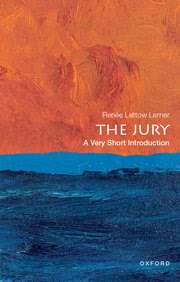
Lettow Lerner's "Very Short Introduction" to the Jury

Renée Lettow Lerner, George Washington Law, has published The Jury: A Very Short Introduction (Oxford University Press):

From ancient Athens to modern Asia, cultures have wanted ordinary people involved in making legal decisions. This Very Short Introduction charts juries from antiquity through the English-speaking world and beyond to Europe, Latin America, Africa, and Asia. Today, juries have become a symbol of democracy and popular legitimacy.

But in English-speaking countries, jury trials are declining. Civil juries have been virtually abolished everywhere except the United States, and plea bargaining is taking the place of criminal jury trials. In this book, Renée Lettow Lerner describes the benefits and challenges of using juries, including jury nullification. She considers how innovations from non-English-speaking countries may be key to the survival of citizen participation in the legal system.

Along the way, the book tells how a small German state invented a way of using jurors that is now found around the world. And it reveals why some defendants preferred to be crushed to death by weights rather than convicted by a jury.

--Dan Ernst

Thursday, March 23, 2023

Schmidt on Legal Realism, Free Law, and Hermann Kantorowicz

Katharina Isabel Schmidt’s article How Hermann Kantorowicz Changed His Mind About America and Its Law, 1927–34, is now available open access from  Law and History Review.  Highly recommended!

Hermann Kantorowicz crossed the Atlantic twice: to take up a visiting professorship at Columbia Law School in the summer of 1927, and to find refuge at New York's University in Exile in 1933/1934. Between his first and second stay, the German-Jewish émigré changed his mind about America and its law fundamentally. While he had—patronizingly—praised his US colleagues for “catch[ing] up… intellectually” in 1927, he accused them of “destroy[ing] the Law itself” in 1934. Reconstructing Kantorowicz's change of heart, my article uncovers just how open the transatlantic 1930s still were in jurisprudential matters. As leader of the so-called “free law” movement, Kantorowicz had sparked a turn to “life” in German legal science in the years before World War I. Throughout the 1920s, he had then watched contentedly, as American “realist” scholars drew on free law ideas for their own critical projects. By 1934, however, Kantorowicz could not help but notice parallels between New Deal and Nazi law. To his mind, both Roosevelt's and Hitler's jurists had started turning his moderate free law ideas into a radical—and dangerous—legal nihilism: in designating law as life's only source, they shunned scientific legal methods. In light of these concerns, my article excavates life-law's delicate suspension between peril and potential. My sources reveal a striking, triangular relationship between German free law, American legal realism, and Nazi life-jurisprudence.
–Dan Ernst

Wednesday, July 20, 2022

Schorling on the Longer History of German Law

Felix Schorling, University of Munster, has posted A Deeper History of German Law:

Most textbooks introducing German law devote special attention to the corruption of law and
Sachsenspiegel (Wiki)

legal institutions that took place during the Nazi dictatorship. And then they describe the period in German legal history after the Second World War. This era involved dramatic developments that reoriented (West) German society – politics and law – towards democracy. The most remarkable achievement of the post-war period must be the promulgation in 1949 of the West German Basic Law or constitution. To underscore the new legal regime’s categorical break with Germany’s Nazi past, the Basic Law’s first Article declares: “Human dignity shall be inviolable.” But West Germany’s post-war legal order – eventually extended to all of a reunited Germany – also involved a significant continuation of well-established legal institutions, practices, and norms. In fact, that deeper dimension of German legal history extends back thousands of years. Some provisions of the law have roots in the time of the Roman Emperors. This essay aims to achieve the impossible: to give a brief overview of two millennia of German legal history, even considering the law of the Germanic peoples before there even was a Germany. In pursuing that grand, sweeping assignment, the essay will give special attention to law in the Medieval age (roughly from the fall of the Western Roman Empire to the fall of the Byzantine Empire).
--Dan Ernst

Tuesday, April 19, 2022

German Legal History 2022

[We have the following announcement of German Legal History Conference 2022.  DRE.]

Forms of Validity of Law

Legal norms claim to be binding and thus valid. However, their validity cannot be taken for granted.  Depending on its social, political, economic and cultural environment, legal normativity is described in very different ways, and its declared binding and enforced by very different mechanisms.  The presentations, talks and discussions of the 43rd Legal History Conference will identify, analyze, and compare notions and limits of "legal validity" at different historical stages.  

Plenary lectures will ask about types and forms of legal validity in antiquity, the Middle Ages, the early modern and the modern period.  

In contrast, the sections of the Legal History Conference will focus on special contexts and problematic situations of the rule of law. With legal pluralism, the much-discussed question of the coexistence and, if necessary, also coexistence of claims to validity of different legal norms is examined. The section on arbitration focuses on the validity of legal norms and their application beyond the state. In the section on religious rights, the question is asked how and in what way the validity of law arises in the context of religious associations, sometimes in competition with secular sovereign rule. The interstate sphere of the rule of law is the subject of the section on the history of international law. The section “Media Change and Law” is devoted to the interdependence of the rule of law and the medial shaping of law. Last, but not least, the importance of specialized legal knowledge for the validity of law is the subject of the section “Expert Cultures of Law”.  

The validity of law, its foundations, its limits, and its content have repeatedly become questionable in the present. The 43rd Legal History Conference 2022 offers a broad historical horizon of reflection also and especially to these debates.

Wednesday, March 31, 2021

Michael Stolleis (1941-2021)

Michael Stolleis, an Honorary Fellow of the American Society for Legal History since 2001, has died.  Here is the notice of the Max Planck Institute for Legal History and Legal Theory:

Michael Stolleis passed away in Frankfurt on 18 March 2021, just a few months before his 80th birthday. The Max Planck Institute owes him a great deal. Since joining the Max Planck Society in 1991, he shaped our Institute like no other. He led it alone for many years, and even after his retirement, he took on the responsibility again. His approachability, his unconditional reliability and his rhetorical elegance have been exemplary for many members of staff. Without Michael Stolleis, we would not have this new building on the Westend Campus, something he was always quite pleased about – and without him, we would likely no longer exist as an Institute.

We have placed a book of condolence in the foyer of the Institute until the 16 April, which Institute staff members are invited to sign. We will also include letters in the book that are submitted to us; they can be addressed to the Managing Director Thomas Duve, for the attention of Nicole Pasakarnis.
Thomas Duve's obituary is here

--Dan Ernst.  H/t: DS

Friday, March 12, 2021

Langford and Bryan on the German Free Law Movement

Peter Langford, Edge Hill University, and Ian Bryan, Lancaster University, have posted Kelsen, Weber and the Free Law Movement, which appears in Jahrbuch für Soziologiegeschichte 2020, , 113-145:

The article concentrates upon the emergence, in the first decade of the twentieth century, of the distinctive German language tradition of the sociology of law and, in particular, the early work of Hermann Kantorowicz, as the exemplary representative of the Free Law Movement (Freirechtsbewegung). The Free Law Movement challenges the preceding conception of judicial decision-making of Begriffsjurisprudenz, initiating the wider question of the status and foundation of a theory of law. The challenge is considered through the engagement of Hans Kelsen and Max Weber with Kantorowicz, tracing the appropriation of the insights of the Free Law Movement for a Kelsenian pure theory of positive law and for a Weberian sociology of law.

--Dan Ernst.  H/t: Legal Theory Blog

Friday, January 22, 2021

Schmidt on Theodor Sternberg and the "Closet of Conceptualism"

Over at the blog "History | Sexuality | Law," Katharina Isabel Schmidt, a PhD candidate in history at Princeton University and a JSD candidate in law at the Yale Law School, has posted Theodor Sternberg and the Closet of Conceptualism.  The essay commences:

Sometime in the mid-1930s, German jurist Theodor Sternberg (1878-1950) concluded that law and love were incompatible. In one of his “erotosophical” fragments, he claimed that affective bonds thrived under anarchy. Love, for Sternberg had to be free from egoism and compulsion, eschew both duty and obligation. “Coitus,” especially, was divine in origin—God’s love for the world incarnate—and just like God’s love was limitless, sexuality knew no law.

--Dan Ernst

Monday, December 21, 2020

Morris, "Legal Sabotage: Ernst Fraenkel in Hitler's Germany"

Cambridge University Press has published Legal Sabotage: Ernst Fraenkel in Hitler's Germany (Aug. 2020), by Douglas Morris (Federal Defenders of New York). A description from the Press:

The Jewish leftist lawyer Ernst Fraenkel was one of twentieth-century Germany's great intellectuals. During the Weimar Republic he was a shrewd constitutional theorist for the Social Democrats and in post-World War II Germany a respected political scientist who worked to secure West Germany's new democracy. This book homes in on the most dramatic years of Fraenkel's life, when he worked within Nazi Germany actively resisting the regime, both publicly and secretly. As a lawyer, he represented political defendants in court. As a dissident, he worked in the underground. As an intellectual, he wrote his most famous work, The Dual State – a classic account of Nazi law and politics. This first detailed account of Fraenkel's career in Nazi Germany opens up a new view on anti-Nazi resistance – its nature, possibilities, and limits. With grit, daring and imagination, Fraenkel fought for freedom against an increasingly repressive regime.

A few blurbs:

'German-Jewish lawyer Ernst Fraenkel is remembered for his study of Nazi Germany, The Dual State. But talented historian Douglas Morris goes far beyond reconstructing Fraenkel’s biography, and following his path to his classic book, in order to dramatize the difficult choices of a pivotal lawyer in resistance. The result is an absorbing contribution not just to the history of German law in the twentieth century. It helps us to ponder the dilemmas of resistance for believers in the rule of law anywhere and even today.' -- Samuel Moyn

'There is a rich biographical and analytical literature on the lawyer and political scientist Ernst Fraenkel. We know his clear description of the Nazism as a 'dual state', we also know how important he was for the modernization of political theory, especially in Western Germany. But an investigation of his activities as a lawyer and author in the underground after 1933, based on all available sources, has not yet been carried out. It is presented here in an excellent manner, and at the same time it sheds light on the old problem: How can one use the legal order as a means of sabotage against a system of tyranny?' -- Michael Stolleis

More information is available here. H/t: New Books Network.

-- Karen Tani