Showing posts with label intellectual history. Show all posts

Friday, November 28, 2025

ASLH John Phillip Reid Book Award to Parker for "The Turn to Process"

Continuing with our notices of the awards, prizes, and fellowships announced at the recent meeting of the American Society for Legal History, we turn now to the John Phillip Reid Book Award. 

About the award: This prize is "awarded annually for the best monograph by a mid-career or senior scholar, published in English in any of the fields defined broadly as Anglo-American legal history. The prize is named for John Phillip Reid, the prolific legal historian and founding member of the Society, and made possible by the generous contributions of his friends and colleagues. When awarding this prize, preference is given to work that falls within Reid’s own interests in seventeenth- through nineteenth-century Anglo-America and Native American law."  

This year's award went to Kunal M. Parker (University of Miami School of Law) for The Turn to Process: American Legal, Political, and Economic Thought, 1870–1970 (Cambridge University Press, 2024. The citation:
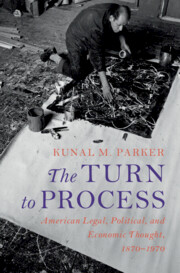
Kunal Parker’s The Turn to Process is a brilliant intellectual history of how social science thinkers in law, political science, and economics between 1870 and 1970 stopped emphasizing ostensibly knowable truths and focused instead on methods, techniques, and processes. Parker shows how this transformation was entwined with the rise of the administrative state. After documenting this major epistemological shift, he argues that during the Cold War, once-supple claims about the importance of process and method were narrowed and decontextualized, playing oppositional roles to democratization, civil rights, and managed capitalism. This highly effective, very creative book places law, as practice and as a field of inquiry, in a larger context and illuminates essential questions about the history of knowledge and intellectual authority.

Congratulations to Professor Parker! 

-- Karen Tani

Wednesday, June 4, 2025

Symposium on the Intellectual History of Legal History

 [We have the following announcement.  DRE]

International Symposium (12-13 Juni 2025): An Intellectual History of Legal History

On 12–13 June 2025, leading scholars from across Europe will gather in Thurnau, Germany, for the international symposium An Intellectual History of Legal History (INTELLEX).

The INTELLEX Symposium (12–13 June 2025) explores the intellectual history of legal history through a diverse range of themes, periods, and regions. Participants examine how legal knowledge has been shaped, taught, and transmitted from the early modern period to the 20th century, across Europe and into colonial and post-colonial contexts.

The symposium is organized by the Bayreuth Humboldt Centre, University of Bayreuth. It is hosted at the Institut für Fränkische Landesgeschichte (IFLG) in Thurnau, Germany.  The head of our research group, Sören Koch, is among the keynote speakers.

More information about the symposium can be found here. 

Friday, April 4, 2025

Poole and Clark on Adam Smith's Concept of "The Federative"

Thomas Poole and Martin Clark have published The Fragile Power of Political Nations: Adam Smith’s Federative open access in Modern Intellectual History:

Adam Smith (NYPL)
This article examines Adam Smith’s concept of the federative: the double-facing constitutional power to conduct international relations today called the treaty or foreign-affairs power. We reconstruct Smith’s account of the federative from his major and minor works and demonstrate its importance in his account of law and empire. We first examine Smith’s early “internal federative,” where the power grows from the internal constitutional organization of the state. What starts as a democratic right to wage war and make peace becomes concentrated over time in the sovereign and its advisers as a “senatoriall” power. We then turn to the “external federative” in Smith’s later works, where the federative is redesigned as a power to unify colonial legislative bodies, connecting the familial sentiments of Britain and America, and forming a model for moving, slowly, towards the conditions Smith deemed necessary for international justice.

--Dan Ernst

Thursday, February 6, 2025

Brophy on the Jurisprudence of Antebellum Phi Beta Kappa Addresses

Alfred L. Brophy, University of North Carolina School of Law, has posted The Jurisprudence of Antebellum Phi Beta Kappa Addresses:

Ralph Waldo Emerson (NYPL)
Ralph Waldo Emerson spoke at Harvard University in 1837 in a Phi Beta Kappa address. That address known as American Scholar reaches for individual expression, not history and social hierarchy. There are many Phi Beta Kappa addresses, both before and after him. Many Transcendentalists orators at Harvard and a few anti-Transcendentalists orators as well. And many others who are optimists, technology, and utilitarians at many colleges. After the Fugitive Slave Act in 1850, three speakers of Harvard, Brown, and Yale advocated law, rather than conscience. All three of them were lawyers. There was a rich diversity of opinion: Transcendental oratory, anti-Transcendentalists, and optimist, technological, and utilitarian thought. 
--Dan Ernst

Monday, July 8, 2024

Lanham on "How W.E.B. Du Bois and the Black Antiwar Movement Reimagined Civil Rights and the Laws of War and Peace"

Andrew Lanham (University of Houston Law Center) has posted "How W.E.B. Du Bois and the Black Antiwar Movement Reimagined Civil Rights and the Laws of War and Peace." The article appears in Volume 99 of the Washington Law Review (2024). The abstract:

This Article reconstructs the history of Black antiwar activism in the twentieth-century United States and argues that Black antiwar activists played a significant but largely forgotten role in the development of both modern civil rights law and the international law of war and peace. The Article focuses on the career of W.E.B. Du Bois, tracing how he built coalitions between civil rights and antiwar organizations to pursue a series of shared legal campaigns. Du Bois’s antiwar work was also representative of a larger tradition, and his career illuminates how a range of Black activists and civil rights lawyers like Pauli Murray, Prentice Thomas, Ella Baker, and Martin Luther King, Jr. creatively merged civil rights and antiwar protest.

These activists redefined the very idea of peace, as both a legal and a political category, to include racial equality. As a result of that conceptual shift, they also advocated for a much richer set of legal proposals to regulate warfare. While mainstream white peace activists and international lawyers in the first half of the twentieth century emphasized a formalistic legal ban on war, Du Bois and other Black activists consistently pursued a much more radical set of structural interventions in the socio-economic system that they believed would, functionally, help to prevent war. Their proposed interventions included global decolonization, economic redistribution, and equal civil, political, and socio-economic rights, which they saw as the path to lasting peace.

This Article recovers the legal and intellectual history of that more radical vision for the law of peace. It shows how a “long antiwar movement” collaborated with the better-known “long civil rights movement” across the twentieth century, and it traces how those collaborations helped remake civil rights and global governance. The Article then explores the normative lessons this history holds for vital debates today about movement building, movement lawyering, and the best legal tools to secure racial equality and constrain the use of military force.

The full article is available here.

-- Karen Tani

Tuesday, May 28, 2024

Ruskola on Montesquieu and "Oriental Despotism"

Teemu Ruskola, University of Pennsylvania Carey Law School, has posted Oriental Despotism Inside Out: On the Global Travels of Montesquieu’s De l’esprit des lois:

Baron de Montesquieu (NYPL)
This speculative essay analyzes Montesquieu’s comparative method in his De l’esprit des lois (1748) and its contemporary legacies. It takes as its focus his theory of Oriental despotism. The first half of the paper focuses on two aspects of his method. First, Montesquieu’s empirical approach to political theory marks him apart from his humanist predecessors. Turning away from natural law and a search for universal principles, he instead attends to nature itself in order to understand the diversity of social and legal phenomena. Second, I comment briefly on Montesquieu’s reworking of Europe’s metageographic status. I analyze him as a key figure in replacing an essentially religious distinction between the Christian world and a heathen Orient with a more plural world divided into continents marked by cultural and political differences.

In the second half of the paper I turn to Montesquieu’s use of China as a paradigmatic instance of “Oriental despotism.” Paradoxically, Montesquieu develops his idea of despotism as a critique of French absolutism while projecting its prototype into the Orient, China in particular. In the final analysis, however, Montesquieu himself is forced to admit that in several key respects China does not fit the category it supposedly exemplifies. Yet despite its flawed empirical foundation, over time Oriental despotism mutates from a theory of politics into a theory of scientific racism with global implications. I conclude by examining the geopolitical implications of Montesquieu’s analysis with respect to the discourse of Chinese authoritarianism today.
--Dan Ernst

Wednesday, March 20, 2024

Kroncke on the Lost Era of US-China Constitutional Engagement

On March 29, 2024, from 12:20 pm - 1:20 pm, Jedidiah Kroncke, Associate Professor of Law, University of Hong Kong, will present the paper Thomas Jefferson, Carsun Chang and A Lost Era of U.S.-China Constitutional Engagement in 308 Morgan Meeting Room of Austin Hall, at the Harvard Law School.

Professor Kroncke’s study recovers a lost era of Sino-American constitutional imagination surrounding the drafting of the 1946 Republic of China Constitution. It examines the transnational dynamics that led the Constitution’s initial drafter, Carsun Chang, to travel to the U.S. in 1945 to ostensibly study the ideas of Thomas Jefferson then ascendant in New Deal constitutional rhetoric.

This study recontextualizes Chang’s life as one of China’s new generation of cosmopolitan intellectuals moving between its contentious post-dynastic politics and the institutions of the post-World War II international legal order. Chang’s invitation by the Roosevelt Administration involved many little known but determinative turns, including the role of a subset of Truman Administration officials actively enamored with Jefferson’s own study of Confucianism.

Transnationalizing our understanding of the 1946 Constitution helps reveal how the geopolitics of the Chinese Civil War intersected with the presumed projection of American constitutional values increasingly embedded in American internationalism. The fallout from the drafting process also illuminates the transition of America from a global symbol of constitutional revolution to a symbol of global racial empire. Recapturing this era has implications for originalist-styled constitutional arguments made in contemporary Taiwan, as well as evaluating the international dimensions of Jefferson’s deeply problematic domestic legacy.
A boxed lunch will be provided.  East Asian Legal Studies is sponsoring the event.

--Dan Ernst

Thursday, March 7, 2024

Del Mar on Character, Intellectual Historiography, and Neil MacCormick

Maksymilian Del Mar, Queen Mary University of London, will address the Helsinki Legal History Series on Monday 29 April 2024, 15-16:30 (UTC+2) in the Porthania Building, Room P545, University of Helsinki and on Zoom (Link to be published later).  His lecture is entitled, Beyond Belief and Deeper than Argument: Character and Intellectual Historiography:

This talk explores the value of character for writing intellectual history, and in particular the history of philosophy and politics. The talk first considers the long and rich history of character - especially character writing in the rhetorical tradition - before suggesting what we might take from that history for historicising philosophy and politics. Character, on the model developed here, is a relational phenomenon: it consists in the manner or style with which a person relates with others in certain circumstances and over time. The talk illustrates this character-based intellectual historiography by showing how it can illuminate the philosophical and political life of Neil MacCormick, but also how it allows us to convey the complexity, richness, and value of the activities of philosophy and politics.

--Dan Ernst

Saturday, January 6, 2024

Weekend Roundup

  • David A. Bell on Sam Moyn's anti-liberalism.  (Liberties). 
  • The latest newsletter of the Historical Society of the District of Columbia Circuit is here.
  • ICYMI:  The July 1859 Wyandotte (Kansas) Constitutional Convention (Hastings Tribune).  Taft, and TR were kept off some state ballots in 1912 (Cleveland.com).  Forster Alexander Sondley, an Asheville, N.C.,  historian, lawyer, and bibliophile (Tribune Papers). Samuel Issacharoff on the folly of exhuming Section 3 of the 14th Amendment (Just Security).

 Weekend Roundup is a weekly feature compiled by all the Legal History bloggers.

Monday, December 18, 2023

Delgado on Charles Sumner's Constitutionalism

Sebastián Delgado, University of Cambridge, has posted The Utopian Liberal: Continuity and Change in the Thought of Charles Sumner, which also appeared in The Docket’s series, “A Focus on Undergraduate Scholarship, which aims to spotlight outstanding legal history projects being done by undergraduate students.”  

Charles Sumner (LC)
Charles Sumner cannot be accused of having an unwarranted consideration for the virtues of consistency. The New Englander Sumner of the 1840s advocated for sectionalist interests so long as they provided a strong counter to the Southern warmongering and slave-owning desires, while the nationalist Sumner of the 1850s championed the federal government as far as it committed itself to limiting slavery’s growth and then eradicating it. The strict constructionist Sumner of 1855 advocated for a narrow construction of the Constitution in discrediting the Fugitive Slave Act, while the Sumner of the 1860s and 1870s demanded an elastic construction for carrying out Reconstruction and ensuring equal rights.

Despite these swings in his interpretive philosophy and party switches, Sumner’s thought was consistent, founded on an integral idealism that remained constant despite politics’ vicissitudes. “His partisanship … served as a means to advance moral ends." 
--Dan Ernst

Thursday, November 2, 2023

Rabban on Jhering and American Legal Thought

David Rabban, University of Texas at Austin School of Law, has published "Jhering’s Influence on American Legal Thought” in the collection, Jhering Global: Internationales Symposium Zum 200. Geburtstag Rudolf Von Jherings (1818-1892), which was the product of this conference.  From Professor Rabban's introduction:

Rudolph von Jhering has influenced American legal thought since the late nineteenth century, though the nature of his influence has varied over time. In this essay, I proceed chronologically. I begin with the late nineteenth-century American legal scholars who admired Jhering as part of the great tradition of German legal scholarship they viewed as a model for their own. Like American scholars in numerous disciplines during this period, many of them had studied as postgraduates in Germany. Jhering himself declared in an 1881 letter to his German colleague, Oskar von Bülow: “my writings are widely read even in the United States, and a review of my book, The Ends of Law, is the most brilliant which has ever appeared about any of my works.”1 I then address Jhering’s substantial influence on Oliver Wendell Holmes, Jr. and Roscoe Pound, two of the most important figures in the history of American legal thought. I focus on Holmes’s famous book, The Common Law, published in 1881, and Pound’s development of “sociological jurisprudence” in the decade before World War I. Jhering also influenced both adherents and critics of the “legal realism” that emerged in the 1920s and 1930s, which many perceive as an extension of sociological jurisprudence. Scholars in the United States often applied to American law their understanding of Jhering’s position that the prevailing overemphasis on deductive logic and abstract legal theory should be replaced by a social theory of law consciously designed to promote the present public interest. They relied on Jhering as well in analyzing technical legal doctrine, as I point out in discussing classic articles on contract law by Lon Fuller in the 1930s and Friedrich Kessler in the 1960s. Kessler emigrated to the United States as a refugee from Nazi Germany in the 1930s after receiving his legal education in Germany.
–Dan Ernst

Friday, August 11, 2023

van den Berge, "Phersu, Prosōpon, Persona: On Legal Personhood, Roman Sculpture and the Art of Law"

Lukas van den Berge (Utrecht University) has posted "Phersu, Prosōpon, Persona: On Legal Personhood, Roman Sculpture and the Art of Law." The abstract: 

Many legal scholars and philosophers have recently embraced the idea of granting legal personhood and rights to entities other than human beings or their collective organisations. In search for effective innovations, however, it is also important to rethink the notions of legal personhood and rights themselves. This article aims to contribute to such a process of rethinking by examining the intellectual history of legal personhood. Tracing down the modern concept of the legal person not only to Latin persona, but also to Greek prosōpon and Etruscan phersu, it supplements (and partly also corrects) leading analyses of that concept’s history such as those of Hannah Arendt. Concurringly, it will not only connect (as Arendt and others have done) Roman legal personhood to ancient drama, but also to ancient sculpture. Finally, it will be argued that a deeper and broader understanding of the concept’s intellectual history may serve as a surprising source for future renewal.

Read on here, at SSRN.

h/t Legal Theory Blog

-- Karen Tani

Tuesday, July 4, 2023

Conclusion: Legal Historians' Reflections on "Outside In: The Oral History of Guido Calabresi"

This is the conclusion to a series of posts in which legal historians reflected on Outside In: The Oral History of Guido Calabresi (Oxford University Press), by Norman I. Silber.
 
“Why am I worried today? Blogs.”
 
This quote, from one of Norman Silber’s interviews with Guido Calabresi, was part of a reflection on the role of academics in society. Calabresi was explaining his view that academics should be truth-tellers, “whose job is to look into dark places, to tell us what is going on” (OI, v.1, 350). Blogs, to him, raised concerns about academics’ willingness and freedom to tell the truth, because (if I’m reading him correctly) blogs encourage and enable scholars to weigh in immediately on the controversies of the day and, likewise, to receive real-time feedback on their views.
 
I like to think that this blog raises fewer concerns, and that this series of posts might even strike Calabresi as a worthwhile pursuit of truth. Contributors have admired the wealth of autobiographical and biographical content found in Outside In, and they have paired it with their own scholarly and personal insights in order to enrich readers’ understanding of the past.
 
Here is a compilation of all the posts in this series:

Should Silber or Calabresi wish to reply, we would welcome the exchange. As Calabresi wisely notes in his "Subject's Note" at the beginning of Volume 1, his own remembrances of particular events and actions did not always align with the conclusions that Silber drew from his research—but the two collaborators’ acceptance of multiple viewpoints is part of what made the project “a joy” and the resulting volumes a treasure.
 
-- Karen Tani

Thursday, June 22, 2023

"The Long Law and Economics Movement" -- Gocke on "Outside In: The Oral History of Guido Calabresi"

This post, by Alison Gocke (Associate Professor of Law, University of Virginia School of Law) is the tenth in a series of posts in which legal historians reflect on Outside In: The Oral History of Guido Calabresi (Oxford University Press), by Norman I. Silber.

The Long Law and Economics Movement
 
In Karen Tani’s earlier posts on Guido’s life and work (which readers can find here, here, here, and here), she has reflected on the ways in which Guido does and does not embody a certain kind of “economic style of reasoning.” As Tani points out, Guido is associated with bringing “economics precepts and insights into legal domains where they had not previously had much purchase.” But Tani, I think rightfully, also distinguishes Guido from others whom we might group in the Law and Economics school because of his recognition that economics provides only one way of thinking about legal problems, and that societies often settle on “mixed” collectivist and market-based systems. This analysis leaves Tani somewhat ambiguous about where Guido falls in the Law and Economics tradition. I would like to use this post to suggest a different law and economics legacy to which it may be useful to compare and contrast Guido, with the hope of shedding further light on his scholarship and the history of law and economics in the United States.
 
The body of legal thought which interests me here is that of public utility regulation. Public utility regulation describes the doctrine we use to regulate certain industries, including electricity, natural gas, telecommunications, transportation, and finance and banking. It has a close association with the Law and Economics school of Guido’s cohort. Indeed, many of the economists and lawyers that make appearances in Outside In—including Harold Demsetz, George Stigler, and Richard Posner (see, e.g., OI, v.1, 228, 292-95, 327, 357-58)—cut their teeth writing influential pieces on public utility regulation before they extended their law and economics ideas to other contexts. In this light, it is curious that Guido himself chose not to step into the public utility mix early in his career.
 
But the connection between public utility regulation and law and economics appeared decades before the modern Law and Economics movement, and it is this earlier instantiation that is of interest to me. Public utility regulation as a distinct field of law arose at the end of the nineteenth and the beginning of the twentieth centuries in the United States. (For those who are interested, William Novak has written about how public utility regulation as a body of administrative law developed from a variety of common law and other principles.) Many of the economists and lawyers involved in crafting public utility regulation were part of what Herbert Hovenkamp has dubbed “The First Great Law and Economics Movement.” Hovenkamp describes members of this movement as being, on the whole, more liberal in their ideology, more “interested in the relationship between the law and the distribution of wealth in American society,” and more “dubious about markets and about the common law as a welfare-enhancing device” as compared to the modern Law and Economics movement. (Hovenkamp, p. 995)

Monday, June 12, 2023

"An Illustrious Immigrant: Guido in Historical Time" -- Rosenblum on "Outside In: The Oral History of Guido Calabresi"

This post, by Noah Rosenblum (Assistant Professor of Law, New York University School of Law) is the ninth in a series of posts in which legal historians reflect on Outside In: The Oral History of Guido Calabresi (Oxford University Press), by Norman I. Silber. In Outside In, Silber uses italicized, indented text to present digressions related to the main narrative account. Rosenblum has adopted a similar convention below.

An Illustrious Immigrant: Guido in Historical Time

As readers of the blog know, Guido has already left his mark on history. This symposium has stressed the significance of his development of a version of the “economic style” in legal thinking, reformulation of the common law, influence on the law of the workplace and religious freedom, and transformation of the judicial role. Yet we could multiply the list of Guido’s influential contributions many times over and still not be done. At Yale University’s recent commencement, where he received an honorary doctorate in laws, the citation did not even try to list his accomplishments. “[T]he name ‘Guido’ says it all.”

Guido has not only shaped history, though; he is himself a historical figure. Norman Silber, in his note at the start of Part One of Outside In, professed some small surprise at how deeply rooted in history Guido turned out to be. “When our project started,” he writes, “I planned to cover Guido’s memories of his Italian childhood and his family tree briefly before getting on to Guido’s life in America. Then, on meeting his wife Anne for the first time, she told me emphatically that it was impossible to understand him without plunging full bore into his Italian roots. I have found this to be true.” (I:5)

Norm and Anne are, of course, correct, as the other contributions to this symposium and Volume I of Outside In all make clear. Guido’s style, taste, and habits are inexplicable without knowing where he came from, and that he came from somewhere else. Indeed, to grasp Guido we need to grasp his character. And for that we need to understand him as a particular kind of Italian immigrant from the first half of the twentieth century.  

Thursday, March 23, 2023

Schmidt on Legal Realism, Free Law, and Hermann Kantorowicz

Katharina Isabel Schmidt’s article How Hermann Kantorowicz Changed His Mind About America and Its Law, 1927–34, is now available open access from  Law and History Review.  Highly recommended!

Hermann Kantorowicz crossed the Atlantic twice: to take up a visiting professorship at Columbia Law School in the summer of 1927, and to find refuge at New York's University in Exile in 1933/1934. Between his first and second stay, the German-Jewish émigré changed his mind about America and its law fundamentally. While he had—patronizingly—praised his US colleagues for “catch[ing] up… intellectually” in 1927, he accused them of “destroy[ing] the Law itself” in 1934. Reconstructing Kantorowicz's change of heart, my article uncovers just how open the transatlantic 1930s still were in jurisprudential matters. As leader of the so-called “free law” movement, Kantorowicz had sparked a turn to “life” in German legal science in the years before World War I. Throughout the 1920s, he had then watched contentedly, as American “realist” scholars drew on free law ideas for their own critical projects. By 1934, however, Kantorowicz could not help but notice parallels between New Deal and Nazi law. To his mind, both Roosevelt's and Hitler's jurists had started turning his moderate free law ideas into a radical—and dangerous—legal nihilism: in designating law as life's only source, they shunned scientific legal methods. In light of these concerns, my article excavates life-law's delicate suspension between peril and potential. My sources reveal a striking, triangular relationship between German free law, American legal realism, and Nazi life-jurisprudence.
–Dan Ernst

Thursday, April 14, 2022

Gordon Reed to Deliver Inaugural David T. Konig Lecture (4/21/22)

On April 21, 2022, the History Department at Washington University in St. Louis will host the inaugural David T. Konig Lecture. Professor Annette Gordon-Reed (Harvard University) will deliver a lecture titled "The Jefferson Image in the American Mind in the 21st Century. The changing meaning of Jefferson's legacy in Modern America":

Annette Gordon-Reed will take Thomas Jefferson as a point of departure for a thought-provoking consideration of how Americans understand their own history.  She will consider how terms like freedom and slavery—terms now inseparable from Jefferson—have shaped the ways people talk about Jefferson.  This will be a wide-ranging consideration that explores politics and race, nation and identity, memory and memorials.

Gordon-Reed is Carl M. Loeb University Professor at Harvard University, where she is on the faculty of both the Harvard Law School and the Department of History.  She is the author of numerous books in both law and history.  She has received over sixteen major book prizes, including the Pulitzer Prize for The Hemingses of Monticello, a magisterial study that explores one enslaved family on Thomas Jefferson’s plantation and in the process reimagines how we understand both Jefferson’s landmark home and the experience of slavery.  Her most recent book is the New York Times best-seller On Juneteenth, which combines both American history and family history in telling the story of commemoration of emancipation.

More information is available here.

-- Karen Tani


Monday, February 7, 2022

Society for U.S. Intellectual History Upcoming Virtual Events

The Society for U.S. Intellectual History is hosting a number of virtual events this spring. Here's one of particular interest to legal historians:

February 24, 2022, 7PM EST (6PM CST) online via Zoom

Status, Discrimination, and the Market in American Law, 1960-1990
  • Sara Mayeux (Vanderbilt), chair
  • Gregory Briker (Yale University), “Projects, Playgrounds, and the Transformation of Fair Housing”
  • Deborah Dinner (Cornell University), “Difference as Proxy for Risk: Between Antidiscrimination and Actuarial Logics”
  • Gabriel Levine (Princeton University), “Property and The New Property”
  • Kate Redburn (Yale University), “Beyond Culture Wars: The Conservative Christian Legal Movement and Market Formation"

The full schedule of events is here. Advance registration is required.

-- Karen Tani

Tuesday, October 19, 2021

Somos & Peters, eds., "The State of Nature: Histories of an Idea"

Brill has published The State of Nature: Histories of an Idea, edited by Mark Somos (Deutsche Forschungsgemeinschaft) and Anne Peters (Max Planck Institute for Comparative Public Law and International Law). A description from the Press:

The phrase, “state of nature”, has been used over centuries to describe the uncultivated state of lands and animals, nudity, innocence, heaven and hell, interstate relations, and the locus of pre- and supra-political rights, such as the right to resistance, to property, to create and leave polities, and the freedom of religion, speech, and opinion, which may be reactivated or reprioritised when the polity and its laws fail. Combining intellectual history with current concerns, this volume brings together fourteen essays on the past, present and possible future applications of the legal fiction known as the state of nature. 

The Table of Contents:

Saturday, July 3, 2021

Weekend Roundup

  • Thursday, July 8 at 4:00 pm ET, in the Washington History Seminar, Orville Vernon Burton and Armand Derfner on Justice Deferred: Race & The Supreme Court, with comments from Barbara Y. Phillips, University of Mississippi School of Law, and Dianne Pinderhughes, University of Notre Dame.  More.  And here is the Princeton Alumni Weekly's notice of the book.
  • There is much of interest to legal historians in the June 2021 issue of the Journal of American History, but note especially “The Roots of Redlining: Academic, Governmental, and Professional Networks in the Making of the New Deal Lending Regime,” by LaDale C. Winling and Todd M. Michney.  And Dylan C. Penningroth’s Everyday Use: A History of Civil Rights in Black Churches in the March 2021 issue of the JAH is available open access.
  • At Harvard Law Today: summer reading for your list from legal historians Elizabeth Papp Kamali and Ken Mack.
  • Congratulations to Thomas J. Davis, professor emeritus of history at Arizona State University, upon his receipt of Founder's Community Partner Award of Arizona Humanities, the Arizona affiliate of the National Endowment for the Humanities (ASU News).
  • The International Society for Intellectual History has announced New Work in Intellectual History, a series in which “scholars working in intellectual history [can] discuss and develop proposals for new projects and funding applications.”

Weekend Roundup is a weekly feature compiled by all the Legal History bloggers.