The William Nelson Cromwell Foundation annually awards to junior scholars two prizes for excellence in scholarship in the field of American Legal History. A $5,000 book prize and a $2,500 prize for dissertations or articles of comparable aspiration are designed to recognize and promote new work in the field by graduate students, law students, and faculty not yet tenured. The work may be in any area of American legal history, including constitutional and comparative studies, but scholarship in the colonial and early national periods will receive some preference. The Foundation awards the prize on the recommendation of the Cromwell Prize Advisory Committee of the American Society for Legal History. The Committee will consider books and articles published, or dissertations accepted, in the previous calendar year. It will announce the award at the annual meeting of the Society in the following autumn.
Anyone may nominate works for the prizes. The Committee will accept nominations from authors, dissertation advisers, presses, or anyone else. Nominations for this year’s prizes should include a curriculum vitae of the author and be accompanied by a hard copy version of the work (no electronic submissions, please) sent to each member of the committee and postmarked no later than May 31, 2009:
Professor Richard Ross, Chair
Professor of Law and History
University of Illinois College of Law
504 E. Pennsylvania Avenue
Champaign, IL 61820
Professor Holly Brewer
History Department, Campus Box 8108
North Carolina State University
Raleigh, NC 27695-8108
Professor Tony Freyer
University of Alabama School of Law
101 Paul Bryant Dr., East
Box 870382
Tuscaloosa, AL 35487-0382
Professor Risa Goluboff
237 Thompson St., Apt. 8C
New York, NY 10012
Professor Gerard Magliocca
Indiana University School of Law--Indianapolis
Lawrence W. Inlow Hall
530 West New York St
Indianapolis, IN 46202-3225
Professor Christian McMillen
Department of History
Randall Hall
PO Box 400180
University of Virginia
Charlottesville, VA 22904
Saturday, May 23, 2009
Friday, May 22, 2009
Grossman on Roscoe Pound's Flawed Portrait of James Coolidge Carter's Historical Jurisprudence
'From Savigny through Sir Henry Maine': Roscoe Pound’s Flawed Portrait of James Coolidge Carter’s Historical Jurisprudence is a new paper by Lewis A. Grossman, American University Washington College of Law. Here's the abstract:
In Roscoe Pound’s scathing 1909 review of Law: Its Origin, Growth and Function, American jurist James Coolidge Carter’s magnum opus [available here on Google books and here in a reprint edition], Pound asserted that Carter’s conception of law “comes from Savigny through Sir Henry Maine.” Frederich Karl von Savigny and Sir Henry Maine were the most prominent representatives of the German and English historical schools of jurisprudence, respectively. For his part, Carter was the leading representative of historical jurisprudence in the United States. Other scholars, following Pound, have similarly linked Carter to Savigny and Maine, especially to the former. Moreover, various authors have noted the great effect these European jurists had on American legal thought in general in the late nineteenth century. However, few studies have closely analyzed the impact Savigny and Maine had on Carter or other particular American legal thinkers. Because Carter’s perceived debt to these giants of jurisprudence has significantly influenced how others have viewed him, and American historical jurisprudence generally, it is important to examine the precise extent and nature of this debt. This working paper argues that Carter did not simply borrow his jurisprudence from Savigny and Maine, but rather conceived it largely on his own. The paper then explores how Pound’s mistaken assumption that Carter’s thought was essentially equivalent to Savigny’s led him to paint an influential but flawed portrait of Carter as a rigidly logical jurist in the natural law tradition. By pigeonholing Carter as a Savigny-inspired “metaphysical historical jurist,” Pound blinded himself to various ways in which Carter’s thought was actually compatible with his own “sociological” approach.


David Herbert Donald remembered
Lincoln scholar David Herbert Donald, who passed away last weekend, has  been remembered around the blogosphere. J. Gordon Hylton writes:
 been remembered around the blogosphere. J. Gordon Hylton writes:
The noted historian, Professor David Herbert Donald of Harvard University, passed away on Sunday, May 17, at the age 88. Professor Donald was a two-time winner of the Pulitzer Prize for Biography and was widely recognized as the preeminent Lincoln scholar of the twentieth century. Although not normally classified as a legal or constitutional historian, scholars who work in those fields are enormously indebted to Donald’s work, particularly in regard to the era of the Civil War and Reconstruction.
Hylton's tribute continues here.
Discussing Donald's man y works, Richard Bernstein writes on H-Law:
 y works, Richard Bernstein writes on H-Law:
Donald...may have had his greatest influence through a small book of essays, LINCOLN RECONSIDERED: ESSAYS ON THE CIVIL WAR ERA(1956), that went through two further expanded editions. This remarkable book helped spur study of Lincoln's evolving historical and political reputation, as well as illuminating various aspects of Lincoln's political, legal, and constitutional views. In 1995,Donald's biography, LINCOLN, swiftly won general recognition as the definitive life of the sixteenth president, due to its lucid prose,its formidable research, its balanced and even-handed view of its subject, and its interpretative strategy of presenting events as Lincoln saw, heard about, or otherwise experienced them. In 2004, he published "WE ARE LINCOLN MEN: ABRAHAM LINCOLN AND HIS FRIENDS, a study that supplemented his biography. He also published a volume of selections from the Civil War diaries of Treasury Secretary and Chief Justice Salmon P. Chase, INSIDE LINCOLN'S CABINET.
More from Bernstein is here. Donald is also remembered by Gil Troy on HNN, Al Brophy at the Faculty Lounge, in the NY Times and many other papers.
Update: following up on a DAH's suggestion in the comments, you can find Donald discussing his work on Book TV on YouTube.
Special Issue: Personal Law, Identity Politics and Civil Society in Colonial South Asia
Indian Economic and Social History Review has a special double issue, "Persona l law, Identity Politics and Civil Society in Colonial South Asia," co-edited by Eleanor Newbigin, Leigh Denault, and Rohit De (January/March 2009, Volume 46, No. 1). It explores the ways in which law provided a forum for the construction of new notions of gender, family and community relationships in South Asia. The articles treat law as a discursive framework that guides and sets the social templates through which Indian subjects were forced to interact with the colonial state.
 l law, Identity Politics and Civil Society in Colonial South Asia," co-edited by Eleanor Newbigin, Leigh Denault, and Rohit De (January/March 2009, Volume 46, No. 1). It explores the ways in which law provided a forum for the construction of new notions of gender, family and community relationships in South Asia. The articles treat law as a discursive framework that guides and sets the social templates through which Indian subjects were forced to interact with the colonial state.
Eleanor Newbigin, Leigh Denault, and Rohit De
Introduction: Personal law, identity politics and civil society in colonial South Asia
Erica Wald
From begums and bibis to abandoned females and idle women: sexual relationships, venereal disease and the redefinition of prostitution in early nineteenth-century India
Leigh Denault
Partition and the politics of the joint family in nineteenth-century north India
Mitra Sharafi
The semi-autonomous judge in colonial India: Chivalric imperialism meets Anglo-Islamic dower and divorce law
Eleanor Newbigin
The codification of personal law and secular citizenship: Revisiting the history of law reform in late colonial India
Rohit De
Mumtaz Bibi's broken heart: The many lives of the Dissolution of Muslim Marriages Act
Introduction: Personal law, identity politics and civil society in colonial South Asia
Erica Wald
From begums and bibis to abandoned females and idle women: sexual relationships, venereal disease and the redefinition of prostitution in early nineteenth-century India
Leigh Denault
Partition and the politics of the joint family in nineteenth-century north India
Mitra Sharafi
The semi-autonomous judge in colonial India: Chivalric imperialism meets Anglo-Islamic dower and divorce law
Eleanor Newbigin
The codification of personal law and secular citizenship: Revisiting the history of law reform in late colonial India
Rohit De
Mumtaz Bibi's broken heart: The many lives of the Dissolution of Muslim Marriages Act
Thursday, May 21, 2009
Scholarship for Graduate Study in the History of Scots Property Law, Univ. of Edinburgh
The Edinburgh Law School (Scotland) is pleased to announce that it proposes to elect an Allan Menzies Scholar to study for the degree of PhD starting in September 2009.  This is a scholarship for three years covering fees (at home/EU level) with a stipend for maintenance comparable to those offered by the AHRC and the ESRC.
The holder of the scholarship will be expected to research and write a thesis on a topic reflecting the history and growth of Scots property law in the late eighteenth and nineteenth centuries. The School is particularly interested in theses that reflect the relationship of property law to intellectual, economic, and social changes arising out of Enlightenment and industrialisation.
Candidates should have a degree in law (not necessarily from Scotland) or in another relevant discipline. [Note to U.S. readers: this refers to an undergraduate degree, not a J.D.]
Application Procedure
The deadline for applications for the Allan Menzies Scholarship is 30 June 2009. Applicants must satisfy the School's usual criteria for admission and must apply for admission as a PhD student in the normal way. In parallel to that application, applicants should send a separate email to pg.law@ed.ac.uk to indicate that they wish to be considered for this award.
Prospective applicants are encouraged to contact Professor John W. Cairns (Chair of Legal History) or Professor Kenneth Reid (Chair of Property Law).
 This is a scholarship for three years covering fees (at home/EU level) with a stipend for maintenance comparable to those offered by the AHRC and the ESRC.
The holder of the scholarship will be expected to research and write a thesis on a topic reflecting the history and growth of Scots property law in the late eighteenth and nineteenth centuries. The School is particularly interested in theses that reflect the relationship of property law to intellectual, economic, and social changes arising out of Enlightenment and industrialisation.
Candidates should have a degree in law (not necessarily from Scotland) or in another relevant discipline. [Note to U.S. readers: this refers to an undergraduate degree, not a J.D.]
Application Procedure
The deadline for applications for the Allan Menzies Scholarship is 30 June 2009. Applicants must satisfy the School's usual criteria for admission and must apply for admission as a PhD student in the normal way. In parallel to that application, applicants should send a separate email to pg.law@ed.ac.uk to indicate that they wish to be considered for this award.
Prospective applicants are encouraged to contact Professor John W. Cairns (Chair of Legal History) or Professor Kenneth Reid (Chair of Property Law).
Photo credit.
Calo on the Evolution of Catholic Social Thought and Progressive Reform, 1900-1919
From Charity to Justice: The Dissolution of Catholic Conservatism and the Birth of Progressive Catholicism, 1900-1919 is a new paper by Zachary R. Calo, Valparaiso University School of Law. Here's the abstract: This paper, the second chapter in a draft book manuscript, considers the development of early twentieth century American Catholic ethical and economic thought about socialism, capitalism, and the living wage. The chapter traces the movement within Catholic social thought from a focus on the ameliorative and spiritual work of charity towards an embrace of progressive social legislation.
Dimento on Urban Freeway Planning
Joseph F. Dimento, University of California, Irvine, has posted Stent (or Dagger?) in the Heart of Town: Urban Freeways in Syracuse, 1944-1967, which originally appeared in the Journal of Planning History, 8 (2009). Here is the abstract:
Image credit.This is a case study of decision making on urban freeways in American cities using Syracuse, New York. Although many transportation decisions have affected this central New York city, among the most important are those surrounding the state and interstate highways through Syracuse (New York State Thruway and Interstates 81 and 690). The author traces important steps and events in the city's decisions to allow major highways to traverse the city center, decisions that had important effects on patterns of urban formation, growth, and decline. The case is another illustration of the importance of urban freeways in city history. Information sources are historical archives and secondary data. The case suggests that Syracuse falls into a class of cities whose fates are dependent to a great extent on major forces linked to the transportation sector but whose urban infrastructure decisions and growth patterns are not alike. These patterns are related to a set of interacting phenomena - from timing of transportation decisions within an environment of changing state and federal funding opportunities and environmental law to governmental philosophy. Central to the city outcome was the convergence, before and relatively early in the evolution of environmental and preservation law and policy, of the city planning goals of "slum clearance" and redevelopment (later, urban renewal), on the one hand, and the transportation goals of eliminating congestion and improving vehicle mobility, on the other. Also important was the availability of nonlocal funding to a fiscally conservative city administration, one that was also deferential, often legally obligated to be, to state highway planning directions.

Vintage Hovenkamp on the History of Law and Economics
Herbert J. Hovenkamp, University of Iowa College of Law, has posted two earlier articles on SSRN. The first is The First Great Law & Economics Movement, which appeared in the Stanford Law Review (1990). Here's the abstract:
Hovenkamp has also posted Knowledge About Welfare: Legal Realism and the Separation of Law and Economics, which was published in the Minnesota Law Review (2000). Here's the abstract:
Beginning in the 1880s American economists turned their attention to the law in a way unprecedented in American thought. Some legal academics in turn incorporated economics into their thinking about the law. Whether their output or its impact were great enough to warrant calling their efforts a law and economics "movement" is worth debating. This essay argues that there was such a movement. Four things account for the increasing interest in law and economics at the turn of the century: (1) the widespread application of evolutionary models to the development of both law and economic theory; (2) the influence of the German Historical School, which encouraged economists to spend more time studying social institutions, including law; (3) the rise of marginalist welfare economics, with its enhanced concern about the relationship between distribution and welfare; and (4) the development of the social sciences, which were perceived to include both law and economics, and the widespread belief that the social sciences must somehow be "unified". Why did the critics of Progressive law and economics make the value judgments that they did? Principally, it seems, because of a preference for markets over state command as a mechanism for allocating resources. Even under the strictest ordinalist criteria for measuring welfare, markets were welfare enhancing: Someone makes a voluntary exchange only if the exchange makes him better off. Thus, ordinalist economics recovered the strong preference for the market reflected in classical political economy but which had gradually eroded during the late nineteenth century under the marginal utility theory. Use of the positivist economist's rather than the psychologist's behavioral criterion of welfare has led to quite astonishing real world consequences. The real reason that neoclassical economics gave up marginal utility as the basis for welfare economics was not because utilitarianism was less "scientific" than the alternatives. Before one could know whether it was scientific, he had to settle on a definition of science. That decision was driven by the fact that marginal utility economics was traveling down a politically unacceptable path, leading economics directly to socialism.
Hovenkamp has also posted Knowledge About Welfare: Legal Realism and the Separation of Law and Economics, which was published in the Minnesota Law Review (2000). Here's the abstract:
The welfare state could not function without judgments about how well off its citizens are. For example, governments devise progressive income taxes, which are designed to capture more wealth from the well off and less from the impecunious. These policies presume an ability to take a manageable amount of information about an individual's income or assets and make judgments about her welfare. In fact, people do this all the time, mostly without thinking about the methodological problems involved. The superficial casualness of our daily observations about welfare belies the state of the economic science of welfare measurement. Economists have attempted to measure welfare scientifically for more than a century, but after an early period of optimism, the general history of welfare measurement has not been a happy one. In the 1930s many economists began to conclude that the measurement of welfare involved interpersonal comparisons of utilities, and that we lacked the observation and measurement tools to make such comparisons scientifically. Progressive legal thought, and particularly the Legal Realists, developed out of the coalescence of three important ideas: (1) Darwinism in the social sciences, which was the view that all organisms, including the human race, are both evolving and struggling to survive in an essentially hostile environment; (2) marginalism in economics, which stressed that rational people make choices by ranking their preferences, committing resources to that which they want most first, and so on; and (3) objective welfare judgments, which are basically judgments about welfare that do not depend on assumptions about other people's mental states. Progressive legal thought was more republican than liberal in its social theory, and was never very comfortable with mainstream neoclassical economics. While economists became increasingly strict and pessimistic about the science of measuring welfare, Progressive legal policy was able to lay the foundation for the New Deal, and later the Great Society - both based on visions about the role of government that required elaborate and ubiquitous assumptions about people's welfare. The Progressives’ use of “objective” welfare judgments serves to remind us that technical methodologies in the social sciences are used for a purpose, that they rarely lack alternatives, and that the search for methodological elegance and sophistication should never trump the search for answers.
Wednesday, May 20, 2009
Tate on Late Roman Inheritance Law
Joshua C. Tate, Southern Methodist University School of Law, has posted a series of papers on Roman inheritance law. We noted earlier ones here and here. Now he has posted another, Codification of Late Roman Inheritance Law: Fideicommissa and the Theodosian Code, which appeared in Tijdschrift voor Rechtsgeschiedeni 76 (2008). Here's the abstract:
It has long been known that most of the private law content of the Theodosian Code has not been preserved independently of the Lex Romana Visigothorum, or Breviary of Alaric. Certain constitutions, not contained in the Breviary but dating to the period covered by the Theodosian Code, have survived in the Code of Justinian. There has been debate, however, as to whether all of these constitutions were contained in the Theodosian Code.
This Article discusses this problem with respect to a particular topic: fideicommissa. The Article considers whether a particular constitution, CJ 6.37.21, might have been included in the Theodosian Code either as part of a general rubric concerning inheritance or as part of a separate rubric on fideicommissa, and concludes by suggesting what the constitution might have looked like had it been included under a separate heading.
Cross on Colonial Laws in South and Central America
Jane Ellen Cross, Nova Southeastern University Shepard Broad Law Center, has posted South and Central America: British, Dutch and French Colonial Laws, which originally appeared as an entry in the Encyclopedia of Legal History (Oxford University Press, 2008). Here's the abstract:
British Honduras, British Guiana, Dutch Guiana and French Guiana. Colonial settlement in Belize (British Honduras), Guyana (British Guiana), Guyane (French Guiana) and Suriname (Dutch Guiana) began with incursions into Spanish territory. Spanish discovery of Guiana occurred in 1499, after Christopher Columbus' third voyage to the America in 1498, and Spain laid claim to all of Guiana and Central America. Nonetheless, Dutch trade in Guiana began shortly after Netherland gained independence from Spain in the late 1500's. Spain sanctioned Dutch trade in the region and Dutch settlements emerged in the early 1600's. By 1665, immigrants from the Netherlands, Great Britain and France had established settlements in various areas of Guiana. About the same time, in Central America, English and Scottish buccaneers and logwood and mahogany cutters were also making incursions into Spanish territory. No one country was able to occupy more than a few areas scattered throughout the infiltrated regions.
VanderVelde on The Labor Vision of the 13th Amendment
The Labor Vision of the Thirteenth Amendment has just been posted on SSRN by Lea S. Vandervelde, University of Iowa College of Law. It appeared in the University of Pennsylvania Law Review (1989). Here's the abstract: The conventional understanding of the Thirteenth amendment is that it abolished the particular antebellum southern institution that subjugated black persons as slaves. Yet, the congressional debates reveal a much more expansive vision of labor reform. This theme has largely been lost in modern interpretation. Historical events rarely result from a single cause, and a single idea rarely drives legislative action. Nonetheless, beside the more religious abolitionist arguments, one finds numerous speakers who focused on labor conditions. Consequently, this Article aims to recapture the strong pro-labor theme that runs consistently through the debates. As a whole, the Reconstruction debates reflect a desire to improve all workers' status by recognizing the dignity of labor, guaranteeing workers a wide range of opportunities for advancement, and raising the floor of legal rights accorded all working men. The pattern of discourse in the debates reveal a structure formed by three types of statements. The first addresses the historical need to rid employment relations of the master's patriarchal dominion over all laborers in his household and to accord the employee a realm of family and personal privacy free from employer control. The second describes the core concept of autonomy for laborers in their social and economic relations with employers. The final group targets certain specific labor practices as inconsistent with the spirit of labor autonomy. This three part configuration is useful in exploring the amendment's reach in restructuring baseline rights in the modem employment relation. The Reconstruction debates constitute an important resource because they record the original attempt to mandate constitutionally a minimum level of worker protection. The debates follow an interesting dialectical pattern. In order to respond to the criticisms of slavery's advocates, the Radical Republicans had to create both a positive vision as well as the negative condemnation of slavery. The free labor ideal provided its affirmative side. The free labor ideal grew out of the Republican Party's origins in the Free Soil, Free Labor Movement as well as the self-interest of the northern white working class. Together, they present a powerful argument for constitutionally grounding the protection of working people from overreaching subjugation and abuses at the hands of employers. The evidence suggests that the thirteenth amendment was animated by a conception of labor reform broader than the elimination of racial servitude which was its catalyst. From this perspective, race slavery was objectionable not only for its pernicious racism, but also as the most obvious and brutal violation of the free labor principle. Senator Henry Wilson’s remarks typify this perspective when he explained the party’s motivation as concern for the condition of the "worst off working man," rather than merely his formal legal reclassification. This free labor vision has potentially far-reaching implications for constitutional interpretation of the thirteenth amendment and for many aspects of the modern employment relation.
Tuesday, May 19, 2009
Miller Center Fellowship Conference
 [I'm moving this up, as the audio and vidoe of the manuscript review of Balogh's Government Out of Sight is now available here.]
The Miller Center for Public Affairs of the University of Virginia is webcasting live and then archiving its annual "Fellowship Conference," to be held May 7-8, in Charlottesville, Virginia. The fellows will present and mentors and others will comment at four sessions: Foreign Aid and Incorporating Foreign Nationals; Instigating and Consolidating Regime Change; Region and Empire; and Political Impact of Mass Media. In addition, the 9:30 session on May 8 will be a manuscript review of Brian Balogh's A Government Out of Sight: The Mystery of National Authority in Nineteenth-Century America (Cambridge, 2009), noted previously here. Hugh Heclo, Clarence J. Robinson Professor of Public Affairs at George Mason University, and Julian E. Zelizer, Professor of History and Public Affairs at Princeton, will provide comments. The program will be webcast live and archived here. More information.
Schauer on Llewellyn's 'The Theory of Rules'
Frederick Schauer, University of Virginia School of Law, has posted Editor 's Introduction to Karl Llewellyn's 'The Theory of Rules'. An edition of Llewellyn's THE THEORY OF RULES, is forthcoming from the University of Chicago Press, 2010. Here's Schauer's abstract:
Photo credit.
 's Introduction to Karl Llewellyn's 'The Theory of Rules'. An edition of Llewellyn's THE THEORY OF RULES, is forthcoming from the University of Chicago Press, 2010. Here's Schauer's abstract:
From 1938 to 1940 Karl Llewellyn worked on and substantially completed a book-length manuscript entitled The Theory of Rules. With the book almost completed, Llewellyn turned to other things, primarily his work on law and anthropology and his efforts relating to the Uniform Commercial Code. The book on rules remained uncompleted at his death, and is now to be published by the University of Chicago Press in 2010, edited and with an Introduction by Frederick Schauer, David and Mary Harrison Distinguished Professor of Law at the University of Virginia. The Introduction situates The Theory of Rules within the corpus of Llewellyn’s work, within the Legal Realist perspective on legal rules, and within the jurisprudential and philosophical literature on rules in general.
Congress and Political Development
 The Governing America in a Global Era (GAGE) program at the University of Virginia's Miller Center of Public Affairs announces a panel to be held at the Center on May 20, 2009, at 4:00, entitled “At the Crossroads: Congress and American Political Development.” The announcement explains:
At the Crossroads will look more closely at the role that Congress has played in American Political Development and why the institution has been less thoroughly studied than the presidency, court, and political parties. The discussion will center around the essay, "At the Crossroads: Congress and American Political Development" by Ira Katznelson and John Lapinski.Brian Balogh (University of Virginia) will chair the panel. The other participants are Jeff Jenkins, Elizabeth Sanders (Cornell University), John Lapinski (University of Pennsylvania), Ira Katznelson (Columbia University), and Charles Stewart III (Massachusetts Institute of Technology).
This event is free and open to the public, and will be webcast live and archived here.
Image credit.
Monday, May 18, 2009
Partrick on Blasphemy in Early Canada
Jeremy J. Patrick, a Ph.D. candidate at Osgoode Hall Law School, has posted Blasphemy in Pre-Criminal Code Canada: Two Sketches. Here is the abstract:
This article briefly explores the history of legal prohibitions on blasphemy in Pre-Criminal Code Canada by researching the documentary record of two specific time-periods: Quebec in the New France era and rural Ontario during the early 1800s. The article suggests that blasphemy prosecutions were relatively rare and that blasphemers were treated relatively leniently in light of the harsh punishments available.
Gross on Slavery as a Legal Transplants in New Orleans
Ariela J. Gross, University of Southern California Law School, has posted Legal Transplants: Slavery and the Civil Law in Louisiana. Here is the abstract:
Image credit.Can Louisiana tell us something about civil law vs. common law regimes of slavery? What can the Louisiana experience tell us about a civil law jurisdiction "transplanted" in a common-law country? Louisiana is unique among American states in having been governed first by France, then by Spain, before becoming a U.S. territory and state in the nineteenth century. Unlike other slave states, it operated under a civil code, first the Digest of 1808, and then the Code of 1825. With regard to the regulation of slaves, these codes also incorporated a "Black Code," first adopted in 1806, which owed a great deal to both French and Spanish law. Comparisons of Louisiana with other slave states tend to emphasize the uniqueness of New Orleans' three-tier caste system, with a significant population of gens de couleur libre (free people of color), and the ameliorative influence of Spanish law. This reflects more general assumptions about comparative race and slavery in the Americas, based on the work of Frank Tannenbaum and other historians of an earlier generation, who drew sharp contrasts between slavery in British and Spanish America. How does the comparison shift if we turn our attention away from slave codes, where Tannenbaum focused, to the "law in action"? At the local level, one can see the way slaves took advantage of the gap between rules and enforcement, and to fathom racial meanings at the level of day-to-day interactions rather than comparisons of formal rules. This essay surveys three areas of law involving slaves - manumission, racial identity, and "redhibition" (breach of warranty) - to compare Louisiana to other jurisdictions, and particularly to its common-law neighbors.

Gross on The Constitution of History and Memory
The Constitution of History and Memory is a new essay by Ariela J. Gross, University of Southern California Law School. It is forthcoming in the COMPANION TO LAW AND THE HUMANITIES, Austin Sarat, Cathrine Frank, and Matthew Anderson, eds. (Cambridge Univ. Press, 2009). Here's the abstract:
Almost twenty years ago, the historian Pierre Nora wrote about the growing number of “lieux de mémoire” - museums, monuments, and memorials - where post-modern society situates public memory of traumatic or triumphant events. Yet he devoted little sustained attention to what may be the quintessential “lieu de mémoire” today, the courtroom or truth commission hearing room. Traces of our contemporary obsession with the encounter among law, history and memory are everywhere. And so are lawyers: writing new constitutions for new republics, staffing international tribunals for war criminals, taking testimonies for truth commissions. Yet much of the enthusiasm for legal strategies to “come to terms with” the past draws on individual psychoanalytic metaphors for collective “traumas,” and relatively simplistic theories of historical practice, law, and narrative - whether that personal narrative will humanize law, or that justice will be secured by the search for historical truth. This essay discusses efforts by scholars of law and the humanities to address law’s relationship to history and collective memory, often through the lens of literature or literary theory. It draws together the theoretically sophisticated work on trials of twentieth-century mass atrocities - the Holocaust and South African apartheid in particular - with the relatively under-theorized literature on the memory of slavery and the slave trade. And it puts the new law and humanities scholarship in the context of the much greater body of work by sociologists, anthropologists, political scientists, and historians on collective memory, as well as the work of legal scholars on the role of trials and truth commissions in undoing historical injustice.
Sunday, May 17, 2009
A South Carolinian Law Library
The Coleman Karesh Law Library of the University of South Carolina School School of Law has mounted an exhibit exploring the lives and law practices of five generations of South Carolina lawyers through the medium of a nineteenth-century law library it acquired for its South Carolina Legal History Collection in August 2007. (Among the original owners was Charles Jones Colcock, 1771-1839, pictured below.) In addition to the physical exhibit, the law librarians have prepared quite a good virtual one here. It commences:
Hat tip.To celebrate the 25th anniversary of the South Carolina Legal History Collection, the Coleman Karesh Law Library has mounted an exhibit exploring the lives and law practices of five generations of South Carolina lawyers. In August of 2007, the Law Library received a donation of 419 books that had been part of the library accumulated by five generations of Colcocks and Hutsons, lawyers who lived in Beaufort, Jasper, and Hampton Counties from 1744 to 1939. The donor, Charles Cook, had been given the books by a family friend, Miss Dollie Hutson, forty-five years earlier, in the summer of 1962. Mr. Cook was the son of a Presbyterian minister who was serving two churches in the lowcountry, one of them Stoney Creek Presbyterian Church in McPhersonville, SC. When Miss Hutson, a member at Stoney Creek, learned that the younger Mr. Cook was about to enter law school, she decided to give him the books that her great-great-grandfather, great-grandfather, grandfather, father, and brother had used in their own law practices. The books had survived several wars and a great depression. While Mr. Cook never used the books in his own practice, which included fourteen years as Reporter of the South Carolina Supreme Court, he kept the library intact and his donation provides a vehicle for examining the practice of law from the eighteenth, through the nineteenth, to the early twentieth century.

Saturday, May 16, 2009
Levine on Jewish Lawyers and Rent Control, 1920
Samuel J Levine, Pepperdine University School of Law, has posted Louis Marshall, Julius Henry Cohen, Benjamin Cardozo, and the New York Emergency Rent Laws of 1920: A Case Study in the Role of Jewish Lawyers and Jewish Law in Early Twentieth Century Public Interest Litigation, which appeared in the Journal of the Legal Profession 33 (2008). Here’s the abstract:
In this Article, Levine examines the litigation surrounding the New York Emergency Rent Laws of 1920. In particular, he focuses upon a series of cases litigated by two of the most prominent Jewish lawyers in United States in the first half of the twentieth century: Louis Marshall and Julius Henry Cohen. Among other notable aspects of the litigation, the cases reached the New York Court of Appeals and the United States Supreme Court, which at that time included two of the most eminent jurists in the history of the United States, Judge Benjamin N. Cardozo and Justice Oliver Wendell Holmes, Jr., respectively. One element of the strategy Cohen employed in advocating before these courts adds yet another component to the significance of Jewish lawyers and Jewish law in the context of the Emergency Rent Laws cases. Specifically, in both his briefs and his oral arguments, Cohen relied, in part, on materials from medieval Jewish legal history. Part I of this Article provides a brief background of the New York Emergency Rent Laws, tracing the enactment of the legislation as well as the course of the ensuing litigation. Part II explores the roles of Marshall and Cohen in these cases, placing their contributions in the context of their broader efforts and shared commitments to furthering public and Jewish communal interests. Finally, Part III of the Article focuses on Cohen's reliance on Jewish legal sources and other historical precedents in his arguments supporting the constitutionality of the New York Emergency Rent Laws. In light of the limited substantive relevance of Jewish law to the legal issues surrounding the Emergency Rent Laws, Levine looks at alternative motivations for Cohen's inclusion of these materials in his briefs and arguments. In particular, Cohen's memoirs recall the remark of one of the judges on the New York Court of Appeals suggesting that the reference to Jewish law was an effective method for influencing Cardozo. Levine concludes that this story, even if accurate, was most likely not a reliable reflection of Cohen's reasons for relying on Jewish law, and indeed, that Cohen may have recounted the colorful story primarily as means of entertainment. This conclusion is reached on the basis of a number of factors, including a consideration of Cardozo's attitude toward the law and toward his Jewish heritage, as well as an examination of the interactions of lawyers and judges involved in the New York Emergency Rent Laws Cases. Ultimately, Levine suggests, Cohen's anecdote provides a valuable framework for reflection on the interests and interrelationships that might have influenced judicial decision making in the early twentieth century. Moreover, in light of controversies that have arisen regarding the religious beliefs and personal relationships of members of the current Supreme Court, this exercise has abiding relevance and potential application in the early twenty-first century as well.
Friday, May 15, 2009
The Leiter Poll: Top Legal Thinkers in the Twentieth Century
 Mary and I are having busy weekends, so the postings will be thin. In the interim, check out the results of Leiter's poll of The Most Important Legal Thinkers in American Law of the Past Century. No surprise: Holmes is number 1--but wasn't his best work done before 1909? The Common Law, "The Path of the Law," and "Privilege, Malice and Intent" all date from the nineteenth century.
Thursday, May 14, 2009
Blackman on Justice Harlan, Professor of Law
Linda Przybyszewski used Justice John Marshall Harlan’s lectures on Constitutional Law at what is now the George Washington University to great effect in The Republic According to John Marshall Harlan (University of North Carolina Press, 1999). Now Josh Blackman, George Mason University School of Law, has posted the paper Justice John Marshall Harlan, Professor of Law. Here is the abstract:
Image credit.Justice John Marshall Harlan taught at Columbian University, which later became George Washington University from approximately 1891-1910. He primarily lectured in Constitutional Law, but also taught personal property law, torts, conflicts of law, jurisprudence of the United States, domestic relations, commercial law, evidence, and perhaps others. During the 1897-98 academic year, one of his students, George Johannes, transcribed verbatim twenty-seven lectures Justice Harlan gave on the Constitution. In 1955, Johannes sent the transcripts to the second Justice John Harlan. The papers were ultimately deposited in the Library of Congress. In large part, historians have neglected these lecture notes. After thoroughly reviewing approximately 500 pages of Justice Harlan’s lecture notes and other papers, I seek to explore Justice Harlan’s role as a teacher, as an inspiration to his students, and as a faculty member.
Justice Harlan’s experiences at Columbia University are very revealing of his jurisprudential philosophy, his pedagogical approach, as well as his personal beliefs. In this paper, I will explore these concepts through the prism of his lecture notes, interspersing contemporary newspaper clippings, personal correspondences with Justice Harlan, as well as weaving in relevant Supreme Court opinions he wrote. I seek to use these lecture notes, a veritable treasure trove of insights into one of the greatest Constitutional Law scholars of the late 19th century, to paint a picture of who Justice Harlan was, what he believed, and how he sought to impart that knowledge on the future lawyers of America.
.jpg)
Brown-Nagin on the Civil Rights Movement at YLS
 Some desultory browsing of iTunes turned up the James A Thomas Lecture delivered by Tomiko Brown-Nagin, University of Virginia Law School, at the Yale Law School last November. It is entitled "Re-envisioning the Civil Rights Movement: Courts, Communities and Legal Liberalism" and takes up civil rights lawyers outside the NAACP, such as the members of Atlanta's Gate City Bar Association. (Try "Yale Law" on iTunesU .)
Image Credit: Gate City Bar Association
 Another find was five lectures by Isaiah Berlin, posted by Oxford University in honor of his centenary. Berlin's introduction to and reading of Turgenev's "A Fire at Sea," from 1957, was, for me at least, riveting. (Try "Isaiah Berlin Centenary.")
Image credit: Isaiah Berlin Virtual Library
Wednesday, May 13, 2009
Caudill on 19th Century 'Mad Scientists' as Experts
Arsenic and Old Chemistry: Images of Mad Alchemists, Experts Attacking Experts, and the Crisis in Forensic Science is a new article by David S. Caudill, Villanova University School of Law. It appears in the Boston University Journal o.JPG) f Science and Technology Law (2009). Here's the abstract:
f Science and Technology Law (2009). Here's the abstract:
Photo.
f Science and Technology Law (2009). Here's the abstract:Drawing on research into the use of experts in early 19th-century criminal trials, the image of mad alchemists in popular culture representations of science, and the distinction between empirical and contingent "interpretive repertoires" in the discourse of scientific controversies, this article explores the controversy over arsenic-detection technologies prior to the Marsh test. In addition to noting the predictable criticism of incompetent expertise in the service of law, this article highlights implied accusations of hubris and amorality on the part of over-confident experts, both in the early 19th-century and in today's crisis of forensic science.
The New New Deal, Cato Style
The Cato Institute weighs in on the implications of the New Deal for the Obama Administration with a conference featuring the journalist Amity Shlaes, to be held at the Cato's headquarters in Washington on June 1. The announcement for the conference, "Brother, Can You Spare a Trillion: Lessons from the New Deal and the Great Depression," commences:
With the economy in a deep recession and policymakers turning to massive government intervention in an attempt to create jobs and bolster the financial system—it feels like the 1930s all over again. Today’s new New Deal is rapidly unfolding, with the Obama administration and many lawmakers making it clear that any question of the success of FDR’s New Deal policies was resolved long ago: government intervention worked, and history bears repeating.The program is here, but if you want a really good shot at the same issues by a thoughtful historian, try Anthony Badger's downloadable lecture on the Gilder Lehrman's website, FDR’s First 100 Days . . . and Obama’s.
However, there are deep disagreements about the New Deal, and whether Roosevelt’s policies deepened the depression and delayed recovery.
Join us at the Cato Institute on June 1 to be a part of a highly informative half-day conference. Recognized national experts will discuss the economic and legal impact of the New Deal, and how its legacy is being used and misused to shape policy responses to current economic hardships.
Tuesday, May 12, 2009
Comparative Administrative Law at Yale Law School
Last week the Yale Law School hosted a workshop on Comparative Administrative Law. The first panel, chaired by Jerry Mashaw, Yale Law School, was entitled "State-Formation and the History of Administrative Law." It included the following papers:
Bernardo Sordi (Università degli Studi di Firenze, Centro Studi per la Storia del Pensiero Giuridico Moderno), “The Science of Administration and Administrative Law in European History” (with Luca Mannori)
Nicholas Parrillo (Yale Law School), “The Rise of Non-Profit Government in the United States: A Conceptual Overview and a Case Study of Federal Customs Collection”
Janet McLean (University of Dundee), “British Idealism and the Administrative State
John Ohnesorge (University of Wisconsin), “Pathways to Administrative Law”
[A later panel included the paper by Thomas Merrill (Yale Law School), “The Origins of the Appellate Review Model of Administrative Law.”]
The schedule for the entire conference and links to four of these papers are here.
Bernardo Sordi (Università degli Studi di Firenze, Centro Studi per la Storia del Pensiero Giuridico Moderno), “The Science of Administration and Administrative Law in European History” (with Luca Mannori)
Nicholas Parrillo (Yale Law School), “The Rise of Non-Profit Government in the United States: A Conceptual Overview and a Case Study of Federal Customs Collection”
Janet McLean (University of Dundee), “British Idealism and the Administrative State
John Ohnesorge (University of Wisconsin), “Pathways to Administrative Law”
[A later panel included the paper by Thomas Merrill (Yale Law School), “The Origins of the Appellate Review Model of Administrative Law.”]
The schedule for the entire conference and links to four of these papers are here.
Fox on Antebellum Contract Law
The Law of Many Faces: Antebellum Contract Law Background of Reconstruction-Era Freedom of Contract is an article by James W. Fox Jr., Stetson University College of Law. It appeared in the American Journal of Legal History (2006). Here's the abstract:
This article, published in late-2008, has two goals. First, it seeks to connect doctrinal histories of contract law with the political and social histories of contract ideology. In doing so I hope to show how the tales about the development of contract doctrine can be told more richly by considering the political and ideological developments of the period. Second, and more significantly, this article highlights the ambiguous strands of contract law that were part of the culture of contract surrounding Reconstruction, and shows how contract law was far more contextualized than historians of either free labor ideology or contract doctrine typically acknowledge. This failure to explore the rich context and ambiguity of mid-nineteenth century contract law produces, on the one hand, an inappropriately narrow view of Reconstruction-era conceptions of the potential role of contract, and, on the other hand, a general inattentiveness to the potential uses of contract law and ideas to challenge the otherwise dominant ideologies. The article proceeds through four topics: antebellum equity jurisprudence, antebellum labor law, inn and carrier law, and antebellum feminist uses and critiques of contract. By connecting contract-as-doctrine to contract-as-political-ideology through these four areas, I hope to show that during Reconstruction there was more possibility for both than often seems apparent to those looking back after the Lochner era.
Whitman on Pitched Battles
David Schraub, a student blogger, reports on James Q. Whitman's Fulton Lecture on Legal History at the University of Chicago Law School. Mr. Schraub's post commences:
MoreJames Q. Whitman, Ford Foundation Professor of Comparative and Foreign Law at Yale Law School, came to Chicago this past Thursday to deliver the annual Fulton Lecture in Legal History. His topic was not necessarily the first one you'd associate with law, however: Pitched battles. Not metaphorically, or as an allusion to courtroom dramas -- actual pitched battles, such as Waterloo or Hastings. Yet, Professor Whitman persuasively documented how difficult it is to make sense of pitched battles without viewing them within a fundamentally legal context.

Monday, May 11, 2009
Strassfeld on How the Cleveland Bar Became Segregated, 1870-1930
How the Cleveland Bar Became Segregated: 1870-1930 is a new paper by Robert N. Strassfeld, Case Western Reserve University School of Law. Here's the abstract:
This article examines the changing perimeters of professional opportunity and the professional choices made by Cleveland's African American lawyers in the early twentieth century. At the turn of the century, the Cleveland bar could fairly be described as racially integrated. The openness of the bar and the response of African American lawyers shaped the day-to-day professional lives of those lawyers. This openness manifested itself in a number of interracial law practices, in a client base for black lawyers that was predominantly white, in the court appointment practices of white judges, and in the general openness of the institutions of the Cleveland legal community to black participation. The bar was also geographically integrated. African American lawyers opened their offices in the same downtown office buildings as their white counterparts.
By 1930 a new African American lawyer in Cleveland faced a different professional landscape. While a small African American presence still existed downtown, consisting of the remnants of the earlier generation of lawyers and the handful of younger lawyers they had brought into their practices, most black lawyers could now be found in the emerging black neighborhoods of Cleveland. Increasingly, African American lawyers were invisible to non-black Cleveland. While a number of causes contributed to this invisibility, residential segregation leading to the division of the city into white and black space played an especially important role. The increasing segregation of the bar did not only result from such external forces, however. It also reflected a division within the African American legal community regarding the value of integration versus the merits of building institutions within the black community. While this division was not purely generational, members of the older generation of lawyers were the primary advocates of a robust integrationist strategy. In this way, the experience of Cleveland lawyers turns on its head the standard characterization of early twentieth century African American lawyers first described by historian Carter Woodson and by Charles Hamilton Houston.
Law and History Review 27:2
 The Summer 2009 issue of Law and History Review (volume 27, issue 2) is now available on-line via the History Cooperative. An introduction by the editor, David S. Tanenhaus, is here. The articles in the issue are:
Rashes, Rights, and Wrongs in the Hospital and in the Courtroom: German Measles, Abortion, and Malpractice before Roe and Doe
Leslie J. Reagan
The Framing of a Right to Choose: Roe v. Wade and the Changing Debate on Abortion Law
Mary Ziegler
The Politics of Administrative Law: New York's Anti-Bureaucracy Clause and the O'Brian-Wagner Campaign of 1938
Daniel R. Ernst
Judicial Free Speech versus Judicial Neutrality in Mid-Twentieth Century England: The Last Hurrah for the Ancien Regime?
Gerry R. Rubin
Control over Marriage in England and Wales, 1753–1823: The Clandestine Marriages Act of 1753 in Context
Rebecca Probert
Sunday, May 10, 2009
Mother's Day in History
"Mother's Day" in the late-19th century was an an anti-war protest. Julia Ward Howe, author o f the Battle Hymn of the Republic, wrote a Mother's Day Proclamation in 1870. It reads, in part:
 f the Battle Hymn of the Republic, wrote a Mother's Day Proclamation in 1870. It reads, in part:
 Arise, then, women of this day! Arise all women who have hearts,whether our baptism be that of water or of fears!
Say firmly: "We will not have great questions decided by irrelevant agencies. Our husbands shall not come to us, reeking with carnage, for caresses and applause. Our sons shall not betaken from us to unlearn all that we have been able to teach them of charity, mercy and patience.
We women of one country will be too tender of those of another country to allow our sons to be trained to injure theirs. From the bosom of the devastated earth a voice goes up with our own.It says "Disarm, Disarm! The sword of murder is not the balance of justice."
The rest is here.
According to Ruth Rosen,
The story [of Mother's Day] begins in 1858 when a community activist named Anna Reeves Jarvis organized Mothers' Works Days in West Virginia. Her immediate goal was to improve sanitation in Appalachian communities. During the Civil War, Jarvis pried women from their families to care for the wounded on both sides.Afterward she convened meetings to persuade men to lay aside their hostilities.
In 1872, Julia Ward Howe, author of the "Battle Hymn of the Republic", proposed an annual Mother's Day for Peace....For the next 30 years, Americans celebrated Mothers' Day for Peace on June 2.
More from Rosen is here (scroll down).
Valarie Ziegler, author of Diva Julia: The Public Romance and Private Agony of Julia Ward Howe, was interviewed by Amy Goodman about Howe and Mother's Day in May 2005, on Democracy Now. She addresses the tension between Howe's Mother's Day Proclamation and The Battle Hymn of the Republic, which celebrated war.
I have seen Him in the watch fires of a hundred circling camps
They have builded Him an altar in the evening dews and damps;
I can read His righteous sentence by the dim and flaring lamps;
His day is marching on.
According to Ziegler, Howe "was absolutely committed to the Civil War." In The Battle Hymn, Howe was "asking people to devote themselves even to the last measure to get rid of slavery. So slavery was an important cause for her. Peace and women’s rights was also an important cause, and I mean, she clearly changed methods."
In a Slate essay, Soap to Ploughshares: How to return Mother's Day to its original meaning, Ruth Rosen discusses the way Mother's Day became the cards-and-flowers holiday we are now familiar with. Hat tip. Even non-profits capitalize on Mother's Day. But Rosen argues that
it is anti-war organizations like the Ploughshares Fund that return us to the original meaning of Mother's Day. Ploughshares has always promoted peace. Its current e-mail asks you to sign a declaration for Ground Zero, a campaign to create a nuclear-free world. In making this request, Ploughshares urges, "After all, what better way to honor our mothers than to return to the holiday's original purpose. … Reclaim the true meaning of Mother's Day, and leave a peaceful legacy to our children."
Call for Papers: History of American Rights
 [I'm moving up this post on SFSU's conference on "Rights," as the deadline of May 15 is almost upon us. In a recent post on H-Law, Chris Waldrep explains that the conference "is geared toward promoting the teaching of the Constitution."]
San Francisco State University has circulated the following call for papers for "a conference exploring rights in American history":
The conference will meet on the campus of San Francisco State University on September 17 and 18, 2009. Rights, both individual and collective, have long been a theme in American history, often seen in conflict with governmental power. We welcome papers on assertions of rights by insurgent groups, resistance to rights claims, and governmental efforts to suppress or promote rights. Our goal is to examine the place the history of rights occupies within the larger American history narrative.Hat tip: H-Law.
We invite proposals from graduate students and established scholars on topics dealing with the history of rights--broadly defined--covering all time periods.
The deadline for submission of proposals, consisting of an abstract(s) and a one-page c.v. is July 1, 2009. [sic. The due date of May 15 is in the more recent H-Law post.] Complete panels or individual paper proposals will be considered. Send your proposal to Christopher Waldrep, Department of History, San Francisco State University, San Francisco, California 94132. Alternatively, you can send your proposal as an e-mail attachment to cwaldrep@sfsu.edu.
Saturday, May 9, 2009
Kalhan on Emergency Powers in Postcolonial Pakistan and India
Constitution and 'Extraconstitution': Emergency Powers in Postcolonial Pakistan and India is a new essay by Anil Kalhan, Drexel University Earle Mack School of Law. It is forthcoming in EMERGENCY POWERS IN ASIA, Victor V. Ramraj & Arun K. Thiruvengadam eds. (Cambridge University Press, 2009). Here's the abstract:
This essay explores the experiences with emergency and emergency-like powers in postcolonial Pakistan and India to illustrate the ways in which constitutional and extraconstitutional states of exception can converge in their application. The experiences in Pakistan with what I term its "extraconstitution" - illustrated most recently by the state of "emergency" declared by Pervez Musharraf in 2007 - demonstrate, perhaps unsurprisingly, that extraconstitutional assertions of emergency powers can provide a ready template for authoritarian rulers to usurp power, violate fundamental rights, and transform the constitutional landscape in the guise of addressing a crisis. At the same time, the authoritarianism in such moments is not entirely "lawless," and the experiences of both Pakistan and India suggest that the assertion of constitutionally-authorized emergency powers - as perhaps most notably exercised by Indira Gandhi in India from 1975-77 - can be as difficult to constrain as extraconstitutional regimes of the sort seen in Pakistan, and can lead to excesses and lasting transformations that are at least as severe. While constitutionality is not necessarily irrelevant in constraining or legitimising emergency powers regardless of context, in postcolonial South Asia the significance of constitutionality has had limits. Owing in part to the persistence in both countries of the shared discourse of emergency powers inherited from the British colonial state, the antidemocratic tendencies inherent in the use of emergency powers have continued to manifest themselves in the laws and institutions of both India and Pakistan, albeit in evidently and importantly different ways in each country. Whether those tendencies have operated through constitutional or extraconstitutional means, the basic results have in some respects been strikingly similar.
Bankruptcy Court: The Movie
 The history of bankruptcy in New Jersey received a cinematic treatment recently, according to a story in the Star-Ledger:
[L]ocal legal history buffs paid tribute yesterday to the nine judges who preside over the U.S. Bankruptcy Court for the District of New Jersey.More.
"They are such an important part of the federal court, and they don't always get the recognition they deserve," said Leda Wettre, president of the Historical Society for the U.S. District Court of New Jersey, which sponsored the event.
It drew more than 200 people to the Lautenberg Federal Courthouse in Newark. They sipped wine, munched canapés and watched a short film recalling some of the district's more noteworthy -- and notorious -- tales of financial ruin.
Friday, May 8, 2009
Last minute Mother's Day gift
If your mom's broadband speed is faster than my mom's, she just might appreciate somet hing like this. (No need to watch the whole thing -- there is a link on the page to create your mom's own video, or at the end to send it to all the mother-figures you know.)
With thanks to Alicia and Ben.
 hing like this. (No need to watch the whole thing -- there is a link on the page to create your mom's own video, or at the end to send it to all the mother-figures you know.)
With thanks to Alicia and Ben.
Matheson on Presidential Constitutionalism in Perilous Times
The Division of United States Studies at the Woodrow Wilson International Center for Scholars announces the book launch of Presidential Constitutionalism in Perilous Times, by Scott M. Matheson, Jr., S. J. Quinney College of Law, University of Utah, on May 27, 2009, from 2:00-4:00. The announcement explains,
Harvey Rishikof, Professor of National Security Law, National War College, will comment. The event is free and open to the public, but RSVP to This is a free public event, but RSVPs are requested to usstudies@wilsoncenter.org. It will take place in the 6th Floor Moynihan Board Room, 1300 Pennsylvania Avenue, N.W., Washington, DC.What is appropriate scope of presidential power during a crisis? How far can presidents go in bending or breaking the rules to protect the country from serious, even irreparable, harm? Presidential Constitutionalism in Perilous Times examines this quandary, from Abraham Lincoln’s suspension of the writ of habeas corpus during the Civil War, Woodrow Wilson’s enforcement of the Espionage Act of 1917 during World War I, Franklin D. Roosevelt’s evacuation and internment of West Coast Japanese during World War II, Harry S. Truman’s seizure of the steel mills during the Korean War to George W. Bush’s torture, surveillance, and detention programs following the September 11, 2001 terrorist attacks. Join us for a discussion of serious constitutional concerns about individual liberties and assertions of executive power in wartime.

Flu History
AHA Today has a post with great links on the 1918 Spanish Flu Pandemic.

Links include:
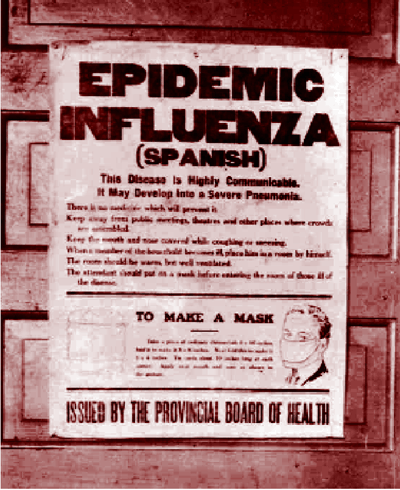
Links include:
- National Archives page on the pandemic
- Department of Health and Human Services site, which includes information about the state of health care at the time
- Stories of survivors, compiled by the Centers for Disease Control
- Lesson plans from National Geographic
- And much more
Torrens System in Victoria
The spread of the Torrens system is an important story in the migration of legal institutions. The chapter for Victoria is told in The Torrens System's Migration to Victoria, posted by Greg Taylor, Monash University Faculty of Law, and published in Monash University Law Review 33 (2007). Here is the abstract:
Image Credit: Sir Robert Torrens2008 will see the 150th anniversary of the invention of South Australia's revolutionary Torrens system of lands title registration. it quickly spread from its home to the other Australian colonies. it was introduced in Victoria in October 1862, four-and-a-half years after its adoption in South Australia. While the adoption of the Torrens system in Victoria may, from this historical distance, seem rapid and thus inevitable, it was not without considerable effort that the proponents of the Torrens system in Victoria were able to overcome the tenacious opposition to its introduction from certain lawyers. This article traces the seven stages in the adoption of Torrens in Victoria and shows that the Torrens system succeeded because it was truly the people's cause in Victoria, as it had been in its South Australian home.


.JPG&imgrefurl=http://christianmontone.blogspot.com/2007_09_01_archive.html&usg=__4VBBJ47QVd9lVKeLWY4KCwJ_1Os=&h=300&w=400&sz=26&hl=en&start=13&tbnid=9yqJNM2dnFYu1M:&tbnh=93&tbnw=124&prev=/images%3Fq%3Dchemistry%2B19th%2Bcentury%26gbv%3D2%26hl%3Den%26sa%3DG)


Thursday, May 7, 2009
About that conference paper...
Since the Law & Society Association Meeting is coming up, and since LSA meetings tend t o attract both a wide-ranging and stimulating set of papers -- and also the worst of bad conference behavior -- it is probably a good time for a post about conference papers. Especially late ones.
 o attract both a wide-ranging and stimulating set of papers -- and also the worst of bad conference behavior -- it is probably a good time for a post about conference papers. Especially late ones.
Everyone presenting a conference paper likes to have a generous commentator who will discuss their contributions in a positive light, and will point out inevitable shortcomings in as gentle a way as possible. The best way to forfeit that is to do what a paper presenter once did to me: turn in a paper the evening before the panel, which is 70 pages long, and has no citations. (This was not at LSA, but at a history meeting.) The best thing for a commentator to do in that circumstance is usually to note the time the paper arrived, and then simply ignore it. But what if you're a paper writer, and the deadline is approaching, and you find you are going to be late? This happens to the best of us. Here are some suggestions about how to handle it:
1. As the deadline nears, if you realize it will be impossible for you to meet it, contact your panel chair and commentator(s) to tell them that the paper will be late. Do not wait until they track you down.
2. Give your chair and commentator(s) a realistic estimate of when you will be sending in the paper. Then be sure to send in the paper by that date. Your date should not be less that two weeks before the panel. Preparing a good comment, as opposed to a seat-of-the-pants comment, takes time. Sometimes I look up sources the author is citing, for example. Two weeks often works for me; less time becomes a serious problem.
3. Besides an apology, what do you say? If you have a very good reason, especially for the rare circumstance when you'll have to send in a paper with only a week to go, say it in your email. I had a baby last month is a good excuse. I'm on vacation (yes, I've been told that) is not an excuse. Don't provide a laundry list of excuses -- this never makes you look good. And when faced with a real crisis, your co-panelists will understand, but there is no need to provide too much personal information. "I am in the middle of a family crisis" will do it, rather than "my partner just left me and took the kids," unless of course your commentator is a personal friend. Same with medical details.
4. Do not send a preliminary paper, following up with a final version the week of the panel. Send one copy as early as possible.
5. If much of your paper is finished, but you haven't been able to write a particular section, you might insert a brief description of what will go in that section, and what sort of research will support it, rather than waiting to write it up and sending an unconscionably late paper. The paper is a draft, after all, and not a polished, final product.
6. Present at the panel the work you've sent your commentator(s), not work you didn't have time to get to until after you sent the paper in.
Presenting a conference paper is a great way to create and build scholarly relationships. To do this, it is important to avoid bad conference behavior, like the last-minute paper. If you're presenting at the LSA, and you haven't sent in your paper yet, you are already late. But it is not too late to save face. Best of luck!
Harris on Comparative Judicial Review of Treaty Rights
Douglas C. Harris, University of British Columbia Faculty of Law, has posted an essay, The Boldt Decision in Canada: Aboriginal Treaty Rights to Fish on the Pacific. It appears in THE POWER OF PROMISES: RETHINKING INDIAN TRE ATIES IN THE PACIFIC NORTHWEST, Alexandra Harmon, ed. (University of Washington Press, 2008). Here's the abstract:
 ATIES IN THE PACIFIC NORTHWEST, Alexandra Harmon, ed. (University of Washington Press, 2008). Here's the abstract:
The Oregon Boundary Treaty of 1846 established the forty-ninth parallel as the boundary between British and American interests in western North America. After 1846, Aboriginal peoples to the north of the border negotiated with the British Crown the terms of their coexistence with incoming settlers, those to its south with the United States. As a result, while some of the Coast Salish and Kwak’waka’wakw peoples in what would become British Columbia concluded treaties between 1850 and 1854 with the Crown’s representative, James Douglas, the tribes in the United States settled with the governor of the Washington territory, Isaac I. Stevens, in 1854 and 1855.
The Douglas and Stevens treaties, as the agreements came to be know, included monetary payment and guarantees of reserved land, hunting rights, and fishing rights. The fisheries provisions were short. The Douglas treaties reserved to Aboriginal peoples the right to “their fisheries as formerly”; the Stevens treaties provided that “the right of taking fish at usual and accustomed grounds and stations is further secured to said Indians in common with all citizens of the Territory.”
This essay focuses on the relationship between U.S. and Canadian judicial interpretations of these treaty rights to fish. In particular, it explores the impact of two U.S. decisions – United States v. Washington ("the Boldt decision") and Washington v. Washington State Commercial Passenger Fishing Vessel Association – on the general development of Aboriginal and treaty rights in Canada. Although not widely cited in Canadian courts, the decisions have had a profound influence on Canadian Aboriginal law. In addition, this essay considers the historical evidence pertaining to the fishing rights in the Douglas treaties and suggests various interpretations. In doing so, it turns back to the U.S. decisions to consider whether they provide useful guidance for the interpretation of the fishing rights provision in the Douglas treaties.
Law and Public Affairs Fellows for 2009-10
The Law and Public Affairs Program at Princeton University has announced its Fellows for 2009-10. They include legal historian Susanna Blumenthal, University of Minnesota Law School, and law and humanities scholar Bernadette Meyler, Cornell Law School. Other Fellows include:
Jeannine Bell, Indiana University Maurer School of Law
Ralf Michaels, Duke University School of Law
Eli M. Salzberger, Dean of the Faculty of Law, University of Haifa
Jim Staihar, currently a Law and Philosophy Fellow, University of Chicago Law School
Jeannine Bell, Indiana University Maurer School of Law
Ralf Michaels, Duke University School of Law
Eli M. Salzberger, Dean of the Faculty of Law, University of Haifa
Jim Staihar, currently a Law and Philosophy Fellow, University of Chicago Law School
Wednesday, May 6, 2009
Adkins on Lincoln's Constitution Revisited
Lincoln's Constitution Revisited is a new article by Jason A. Adkins, staff attorney, Minnesota Institute for Justice. It appears in the Northern Kentucky Law Review (200 9). Here's the abstract:
Photo.
 9). Here's the abstract:
This article demonstrates that the animating spirit of Lincoln’s constitutional actions was his civil religion - his belief that God had given America a special role to play in the history of the world, and it was up to America to be faithful to that charge. Crucial to that goal was thwarting the fundamental attack launched against the whole work of the Founders by Calhoun and his disciples. That struggle, which produced the Civil War, forced Lincoln to reinterpret, re-apply, and in some ways complete the principles and work of the Founders. Lincoln rededicated America to the cause of the Founders, particularly the Declaration of Independence, and thus unleashed a “new birth of freedom.” It is through this lens that we should understand “Lincoln’s Constitution.”
The article specifically addresses those partisans in today’s constitutional debate who seek to use Lincoln as a cudgel to advance their own arguments. Partisans should tread lightly; “Lincoln’s Constitution” is bound up heavily in America’s civil religion - a religion that attempts to explain America’s purpose and destiny within the scheme of Providence. Here, the rhetoric and the constitutional parallels between Lincoln’s time and our own are unmistakable. But unless those involved in the debate seek to come to terms with Lincoln’s own view, they should refrain from using him as a standard; unless of course, they believe America (and the world) must continue to have “a new birth of freedom.”

Subscribe to:
Posts (Atom)