Tuesday, January 17, 2012
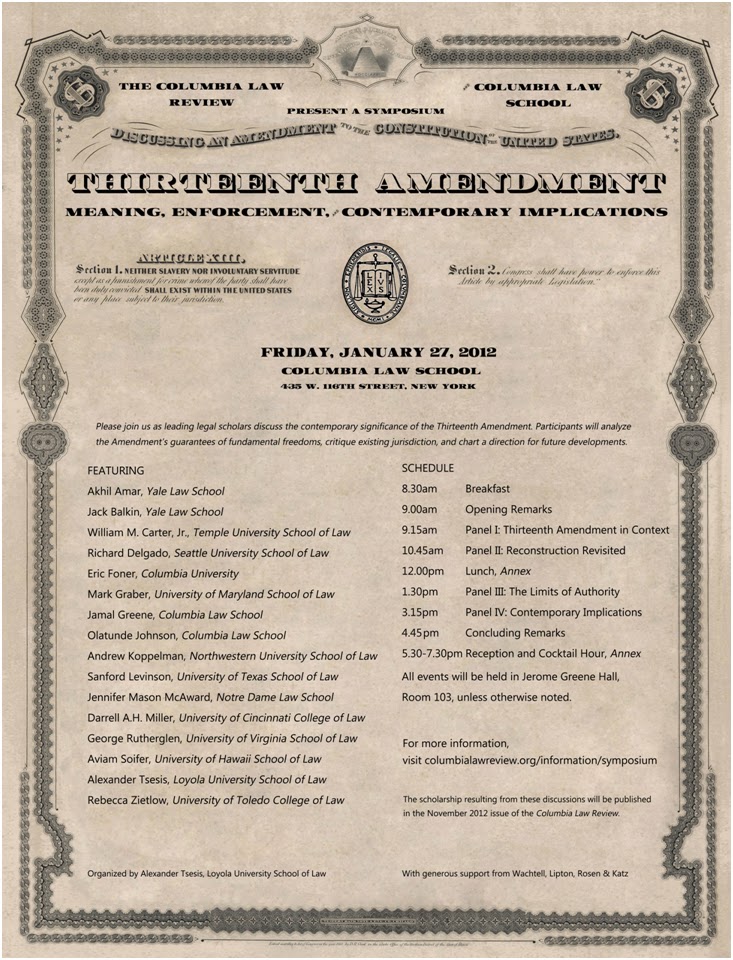
The Thirteenth Amendment at the Columbia Law School


Fletcher's Legal History of the Grand Traverse Ottawa and Chippewa
Matthew L. M. Fletcher,a Professor and the Director of the
Indigenous Law and Policy Center at the Michigan State University College
of Law, has published The Eagle Returns: The
Legal History of the Grand Traverse Band of Ottawa and Chippewa
Indians, with the Michigan State University Press. Here is the publisher's description:
Hat tip
An absorbing and comprehensive survey, The Eagle Returns: The Legal History of the Grand Traverse Band of Ottawa and Chippewa Indians shows a group bound by kinship, geography, and language, struggling to reestablish their right to self- governance. Hailing from northwest Lower Michigan, the Grand Traverse Band has become a well-known national leader in advancing Indian treaty rights, gaming, and land rights, while simultaneously creating and developing a nationally honored indigenous tribal justice system. This book will serve as a valuable reference for policymakers, lawyers, and Indian people who want to explore how federal Indian law and policy drove an Anishinaabe community to the brink of legal extinction, how non- Indian economic and political interests conspired to eradicate the community’s self-sufficiency, and how Indian people fought to preserve their culture, laws, traditions, governance, and language.
credit


Mossoff on Locke and Marx
Adam Mossoff, George Mason University School of Law, has posted Saving Locke from Marx: The Labor Theory of Value in Intellectual Property Theory, which is forthcoming in Social Philosophy and Policy 29 (2012). Here is the abstract:
The labor theory of value is fundamental to John Locke’s justification for property rights, but philosopher Edwin Hettinger argued in an oft-cited article that it fails to justify intellectual property rights. In making this critique, though, Hettinger redefined Locke’s theory into a theory about proportional physical labor creating economic value, just as Robert Nozick, G.A. Cohen and other philosophers have done. In response to this strawman attack, this article describes Locke’s labor theory of value and how Locke himself applied it to intellectual property rights. It does so by analyzing the actual text of the Second Treatise, including many forgotten or neglected sections, and by integrating Locke’s property theory within the context of his natural law ethical theory, as presented in An Essay Concerning Human Understanding and in other works. In its proper context, Locke’s concept of labor refers to production, which is both an intellectual and physical activity. His concept of value refers to what serves the flourishing life of a rational being, which is a conception of the good that is more robust than merely physical status or economic wealth. Locke’s own text and philosophical arguments answer the absurdities imposed on him by Hettinger, Nozick, Cohen and others. Even more important, understanding his labor theory of value explains why Locke expressly approves of inventions in his property theory and why he explicitly argues that authors have property rights (copyrights) in their writings, which are arguments that are seemingly lost on his modern critics.
Mazzacano on Puritanism in Massachusetts Bay
Peter Mazzacano, Osgoode Hall Law School, York University, has posted Puritanism, Godliness, and Political Development in Boston and the General Court (1630-1640), which also appears in The Journal Jurisprudence 12 (2011): 599-678. Here is the abstract:
The goal of this article is to examine the degree to which Puritanism influenced early American political culture. That is, how did Puritan values and practices facilitate the development of an exceptional political culture during the formative years of Massachusetts Bay? Utilizing a case-study method of analysis, this article examines the political developments in the General Court and the town of Boston during the decade 1630 to 1640. The research methods used are primarily the writings of leading Puritans, and concomitant town, church, and colonial records. The main finding is that the Puritans paid little heed to notions of democracy, theocracy, oligarchy, or British political traditions; instead, Puritan institutions and practices were based on the primary Puritan ideal of godliness. However, the formative influence of the godly ideal inadvertently reinforced democratic and republican ideals. The conclusion is that the focus on godliness provides a comprehensive and multiple explanations for the course of political developments in early Massachusetts Bay.
Monday, January 16, 2012
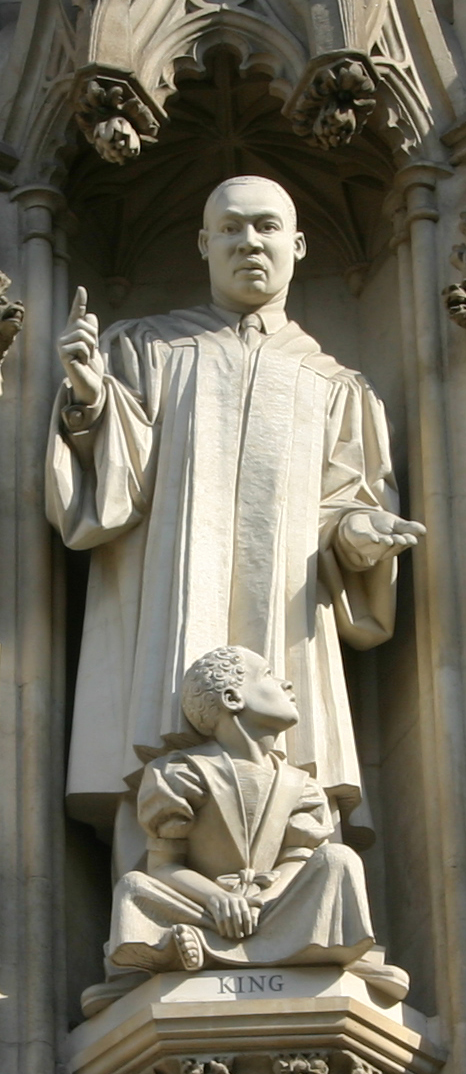
Tuck on King's Global Impact
 |
| image credit |
Today, King’s legacy abroad remains profound, and as contested as ever. In Britain, his statue stands above the west entrance to Westminster Abbey, while the American civil rights movement is among the top five most popular history subjects in high schools.Read the rest here. Tuck is a lecturer at Pembroke College, Oxford, and visiting fellow at the W.E.B. Du Bois Institute at Harvard.
But absent from Westminster is a statue of a black British figure, and black British history remains on the sidelines at schools and universities. Looking to King helps us think about racial justice, but he can be used to forget about it, too.
CFP: Islamic Law and Society
 |
| image credit |
papers that deal with the intersection between Islamic law and society particularly as it pertains to such issues as: the status of women and/or family law, property rights, land tenure, criminal law, finance/economy, and inter-faith relations. Papers from all periods of history and all disciplines are welcome, as are papers that examine the impact of Islamic law in western contexts.The editors are particularly interested in the following questions:
-- How is the law a ‘living law’? To what extent have legal thinkers integrated custom into the lawmaking process?
-- To what extent has the law provided an arena for individuals of different religions to negotiate and/or settle their disputes?
-- What sort of relationship has existed between the various schools of law and have legal thinkers drawn upon schools of law other than their own in formulating laws?
-- To what extent have Western legal systems accommodated Islamic law? What impact has this had on notions of citizenship and minority rights?
-- How have state law/secular law and shari’a overlapped and/or informed one another in the lawmaking process? How has this relationship evolved over time?Follow the link for more information about the application process.
Hat tip: H-Law
Call for Nominations: John Hope Franklin Prize
The Law & Society Association is still accepting nominations for the 2012 John Hope Franklin Prize. Here's the announcement:
The John Hope Franklin Prize is awarded annually by the Law and Society Association to recognize exceptional scholarship in the field of Race, Racism and the Law. The 2012 Prize will recognize an article published in 2010 or 2011. The competition is open to all forms of law and society scholarship, to authors at any stage of their careers, and to authors from any country of origin, although article copies submitted to the committee must be in English. Articles may be published in any scholarly journal, including socio-legal journals, journals in other disciplines, and law reviews, or may be a chapter in a book volume. Co-authored articles may be submitted for consideration. The Award will be announced during the Annual Meeting. The prize is a cash award of $500 and appropriate recognition of the recipient(s) during the Association’s Annual Meeting.Hat tip: Poverty Law
The prize is named for John Hope Franklin, a professor of history and law whose interdisciplinary research documented the history of racism and its effects, whose scholarship had both national and international influence, and whose commitments to intellectual freedom, professional service, and civic activism were resolute.
While there is not a limit on the number of articles one may nominate, an article may not be considered for the John Hope Franklin prize and another LSA prize. The decision in determining whether an article should be submitted for consideration by the Franklin prize committee rather than another LSA prize committee rests with the article’s nominator in consultation with the author.
The committee to select the year 2012 recipient of the award includes Tonya Brito, chair (Law, University of Wisconsin), Mario Barnes (Law, UC Irvine), and Tanya K. Hernandez (Law, Fordham University), Blanca G. Silvestrini (History, University of Connecticut), and Kaimipono D. Wenger (Thomas Jefferson School of Law).
Nomination Process: Nominations may be submitted by authors or others. Articles and letters of nomination must be submitted as an attachment in Word.doc or PDF.pdf format by February 1, 2012 to this address: franklin_prize_nom@lawandsociety.org.
Law and History Review Seeking New Editor

After seven years of exceptional service, David Tanenhaus has decided to step down as editor of the Law and History Review, which is sponsored by the American Society for Legal History and published by the Cambridge University Press. The ASLH Publications Committee invites applications for the position. Applicants should be members of the Society who are accomplished legal historians, have the intellectual range to work with manuscripts from different periods and regions in legal history, and are conversant with both law and history. The departmental or institutional support required for the position is usually modest.Thanks, David, for your service and dedication. We are all in your debt!
The editor's responsibilities include soliciting manuscripts in all fields of legal history, shepherding submitted manuscripts through the peer review and editorial processes, working with the journal's print and electronic publisher Cambridge University Press, and maintaining collaborative relationships with the journal's Editorial Board and the Board ASLH Board of Directors. Production management is the responsibility of the Cambridge University Press. Appointment is for an initial five-year term.
Interested scholars should send an electronic version of their current c.v. and a statement of what they would like to accomplish as editor of the journal by March 30, 2012, to the Chair of the Publications Committee: Michael Grossberg. Inquiries about the position should be directed to the same email address or by phone at: 812-855-3882.
Sunday, January 15, 2012
Hartog, Bargaining for a Child's Love
"Economic malaise and political sloganeering have contributed to the increasingly loud conversation about the coming crisis of old-age care: the depletion of the Social Security trust fund, the ever rising cost of Medicare, the end of defined-benefit pensions, the stagnation of 401(k)’s," legal historian Dirk Hartog writes in the New York Times, in an op-ed drawn from his new book.
News accounts suggest that overstretched and insufficient public services are driving adult children “back” toward caring for dependent parents.Continue reading here.
Such accounts often draw on a deeply sentimental view of the past. Once upon a time, the story line goes, family members cared for one another naturally within households, in an organic and unplanned process. But this portrait is too rosy. If we confront what old-age support once looked like — what actually happened when care was almost fully privatized, when the old depended on their families, without the bureaucratic structures and the (under)paid caregivers we take for granted — a different picture emerges.
Free Speech, Middle Age, and More: This Week in the Book Pages

Although Inazu and Zick wrote their books before the Occupation [of Wall Street] emerged, their histories help to explain—and even to justify—the . . . movement’s extreme mode of assembly: an assembly that insists on peculiar decision-making procedures, engages in twenty-four-hour protest, and refuses to cooperate with government officials and their permitting regimes.Read on here.

Another review (paired with a nice screen shot of Bill Murray clutching a stuffed owl in Lost in Translation) is here, in the Wall Street Journal.
Also in the WSJ book pages: A short review of The Plots Against the President: FDR, A Nation in Crisis, and the Rise of the American Right (Bloomsbury), by Sally Denton; a list of five all-time best books on the Nuremberg trials, selected by British writer William Shawcross; and an announcement of the release of Lewis Hine (D.A.P.), a "handsome survey" of Hine's "social photography."

The Los Angeles Times takes up The Partnership: Five Cold Warriors and Their Quest to Ban the Bomb (Harper), by journalist Philip Taubman. The book "traces the evolution of five former Cold War hawks into relative doves and follows their efforts to spur U.S. and Russian political leaders to dismantle stockpiles of nuclear weapons." Read more here.
Also reviewed: The Operators: The Wild and Terrifying Inside Story of America's War in Afghanistan (Blue Rider Press), by Michael Hastings.
Saturday, January 14, 2012
Weekend Round-up
- This week we've been rounding up coverage of the AHA. Read even more here, at the Chronicle of Higher Ed.
- The inter-disciplinary Centre for Citizenship, Civil Society and Rule of Law at the University of Aberdeen has announced that it will offer 3-year Ph.D. studentships. More info is here. (Hat tip: H-Law)
- How does one write a dissertation from afar? GradHacker offers advice.
- Inspired by a recent AALS panel, Al Brophy at the Faculty Lounge has posted some thoughts on the legacy of Derrick Bell.
- The latest issue of Rorotoko features an interview with Brian C. Kalt on his book Constitutional Cliffhangers: A Legal Guide for Presidents and Their Enemies (Yale University Press).
- The doctoral program in Law in a Changing World at the University of Helsinki has issued a call, here, for applications for eight doctoral student positions for the period beginning September 2012. (Hat tip: H-Law)
The Dakota War at William Mitchell College of Law
 The William Mitchell College
of Law is observing the 150-year anniversary of the Dakota War of 1862 with a series of events, lectures, law review articles, and a
new course on Dakota Legal History. An exhibit officially opens with a reception at 5 pm
on Tuesday, January 17.
The William Mitchell College
of Law is observing the 150-year anniversary of the Dakota War of 1862 with a series of events, lectures, law review articles, and a
new course on Dakota Legal History. An exhibit officially opens with a reception at 5 pm
on Tuesday, January 17.The exhibit "provides viewers with a visual history of the causes of the war, the conflict itself, and the aftermath." It was developed by Mitchell’s Indian Law Program, with funding from the Minnesota Historical Society.
Friday, January 13, 2012
Join the LHB Facebook Team
I am looking for a second administrator for the Legal History Blog Facebook page to work with me to manage page content and maintain daily updates and features. These tasks do not demand a substantial time commitment, but require consistent and daily attention, so it would be great to have a second person to help keep up the page.
This is a great opportunity for a graduate student, but I welcome expressions of interest from any legal historian with basic Facebook knowledge. You should have experience using Facebook and have a personal profile, but you need not have experience administering a page. Ideally, we are looking for someone who can commit to working with the page for a year.
If you are interested, please contact me at cjaltman@brandeis.edu to express your interest. A copy of your cv and a brief description of your experience as a legal historian would be helpful too.
Facebook Page Update

If you follow the Legal History Blog on Facebook, you have probably noticed some changes on the page. If not, I want to invite you to join us on Facebook where you will find new features and new ways to enjoy the Legal History Blog. If you “like” us on Facebook, you’ll receive notifications and links to all new blog posts in your daily newsfeed.
On Facebook, we keep you updated on what our guest blogger is writing about, and provide reminders of upcoming conference and other deadlines. In addition, each week we will spotlight a topic in legal history by providing links to recent and older blog posts.
Spotlight on: Law and War
This week, to reflect on nine years of war in Iraq, we are spotlighting law and war including links to the following posts:
Mary Dudziak, "An Age Without Surrender Ceremonies," November 1, 2010
Mary Dudziak, "'Wartime' Becomes 'Crisis Time' in Post 9/11 Legal Thought," February 17, 2011The topic for next week is writing and publishing.
In case you miss any of these features on Facebook, I’ll round-up everything here on the blog at the end of each week.
Click here to join the Legal History Blog on Facebook.
Likhovski on Jewish Voluntary Taxes in Mandatory Palestine
Assaf Likhovski, Tel Aviv University School of Law, has posted Taxation Without a State: Jewish Voluntary Taxes in Mandatory Palestine, 1938-1948. Here is the abstract:
In the late 1930s and 1940s, the Jews of British-ruled Palestine established an informal system of direct and indirect taxation. This system, which raised large amounts of money, was similar in some senses to a charity and in other senses to a governmental tax system. This paper provides an outline of the history of this system and some of its unique characteristics (such as the absence of formal rules of taxation and tribunals for the adjudication of disputes, the participatory nature of the system, the use of tax publicity or the role of this system in constructing a notion of Jewish “citizenship.”) While the system discussed in the paper was the result of the unique context of Palestine in the 1940s, a context which no longer exists, the history of this system is still relevant today. This history can be used theoretically to rethink some of our assumptions about the role of formal law (and other types of governmental techniques of control) by modern states, and the appropriate balance between civic rights and civic duties. It may also be relevant practically, by pointing to the utility of the use of civil society organizations in the process of tax collection and the disadvantages of tax privacy.
Land Tenure Patterns among the Pre-Hispanic Aztec Nobility
Anastasia Kalyuta, the Kislak Fellow at the Library of Congress, is to lecture on the topic, "Who really owned the estate in the place of ‘Place of Dog Tail’?: Land Tenure Patterns among the Pre-Hispanic Aztec Nobility in the late 15th-early 16th centuries.” The lecture will be delivered on Thursday, January 26, at 12:00 PM, at LJ 119, Thomas Jefferson Building, 10 First St. S.E., Washington DC.
Dr. Kalyuta’s lecture will focus on comparative analysis of land tenure and related practices of inheritance, land distribution and exploitation among Aztec nobility on the eve of Spanish conquest and aftermath. The lecture will explore distinctions of elite land tenure in two main centers of Aztec empire-Tenochtitlan and Tetzcoco. A native of Saint Petersburg Russia, Dr. Kalyuta studied at Saint Petersburg State University and the Institute of Anthropology and Ethnology of the Russian Academy of Science in Moscow. She has conducted field studies in Mexico City through the Institute of Anthropological Investigations at the National Autonomous University of Mexico and has held several fellowships including a Fulbright fellowship and a fellowship at the Dumbarton Oaks.For more information, contact the Kluge Center at (202) 707-3302. Request ASL and ADA accommodations five days in advance at 202-707-6362 or ADA@loc.gov.
The Politics of Birthright Citizenship in Historical Perspective
[The Center for the History of the New America Announces its inaugural conference, “Born in the USA: The Politics of Birthright Citizenship in Historical Perspective.” It will be held on March 29 & 30, 2012, at the University of Maryland at College Park. It is co-sponsored by the Institute for Constitutional History and the University of Maryland Francis Carey King Law School. The conference is free and open to the public. Its organizers explain:]
Next March, an interdisciplinary group of prominent academics, lawyers, jurists, and political figures will assemble in College Park for the Center for the History of a New America's first major conference. Their goal: to place in historical perspective the current debate as to whether the United States ought to reconsider birthright citizenship, which grants automatic citizenship to most persons born on the soil of the United States. Birthright citizenship is part of the Constitution, having been put there by the Fourteenth Amendment, ratified in 1868. It has given the United States one of the most liberal citizenship regimes in the world, and it has helped to build America's reputation as a land of immigrants, where anyone can come to seek opportunity, liberty, and equality in a regime of laws that does not discriminate on the basis of race, creed, or national origins.
Some who want to eliminate birthright citizenship argue that it has acted as a perverse incentive for immigrants to seek illegal entry to the United States. Birthright citizenship, some argue, permits illegal immigrants to think that they can find a route to permanent residence and security in the United States by giving birth to children on American soil. Their children, who become American citizens upon birth, the argument goes, will "anchor" the illegal parents to America, thus rewarding behavior that ought to be punished. The state of Arizona is at the forefront of this campaign against birthright citizenship, as it is for other aspects of the campaign against illegal immigrants. In the short term, anti-illegal immigrant forces in the state hope to trigger a legal challenge to a nineteenth century Supreme Court ruling that declared that a child born to non-citizens on American soil is in fact an American citizen. In the long term these forces hope to stimulate a national campaign to amend the Fourteenth Amendment.
As with many issues regarding immigration, the debate sometimes proceeds with a lot of passion and without a strong knowledge of history. Here are some questions that would benefit from a robust exploration: First, how aware were the framers of the Fourteenth Amendment about the immigration question? To the extent to which they were, what were their thoughts about immigration and birthright citizenship? What do we know of the original intent of the framers of the Fourteenth Amendment's citizenship clause? Second, why did the Supreme Court in 1898 uphold birthright citizenship for the children of non-citizens? And why in some cases were Native Americans treated differently with regard to birthright citizenship? Third, how well or how poorly did birthright citizenship work for America, in regards both to legal and illegal immigration, over the course of American history after 1868? On balance, has birthright citizenship been a source of cohesion or discord, of Americanization or cultural balkanization, in American life? Fourth, what evidence can be marshaled to show that illegal immigrants today are motivated to come by the promise of birthright citizenship for their children? And, finally, what would be the consequences to the Constitution, to personal liberties, and to immigration of a successful effort to remove birthright citizenship from the Fourteenth Amendment?
2011 Pulitzer Prize Winner Eric Foner of Columbia University will open the conference with a keynote address. Other confirmed participants include former acting Solicitor General of the United States Walter Dellinger, New York Times immigration reporter Marc Lacey, 14th Amendment experts Peter Schuck (Yale Law School), Garrett Epps (University of Baltimore Law School), and Mark Graber (University of Maryland Law School); noted historians Gary Gerstle (Vanderbilt), David Gutierrez (UCSD), Linda Kerber (Iowa), Heather Cox Richardson (Boston College), Mae Ngai (Columbia), and Aristede Zolberg (The New School); immigration expert Tamar Jacoby, political scientist James Hollifield (SMU), and legal scholars Christina Burnett (Columbia Law School), Linda Bosniak (Rutgers Law School), , William Novak (University of Michigan), Ayelet Shachar (University of Toronto Law School), Rebecca Tsosie (Arizona St. Law School), Patrick Weil (Yale Law School), and Marley Weiss (UMD Law).
For more information contact Ira Berlin (iberlin@umd.edu) or Michael A. Ross (maross@umd.edu).
Next March, an interdisciplinary group of prominent academics, lawyers, jurists, and political figures will assemble in College Park for the Center for the History of a New America's first major conference. Their goal: to place in historical perspective the current debate as to whether the United States ought to reconsider birthright citizenship, which grants automatic citizenship to most persons born on the soil of the United States. Birthright citizenship is part of the Constitution, having been put there by the Fourteenth Amendment, ratified in 1868. It has given the United States one of the most liberal citizenship regimes in the world, and it has helped to build America's reputation as a land of immigrants, where anyone can come to seek opportunity, liberty, and equality in a regime of laws that does not discriminate on the basis of race, creed, or national origins.
Some who want to eliminate birthright citizenship argue that it has acted as a perverse incentive for immigrants to seek illegal entry to the United States. Birthright citizenship, some argue, permits illegal immigrants to think that they can find a route to permanent residence and security in the United States by giving birth to children on American soil. Their children, who become American citizens upon birth, the argument goes, will "anchor" the illegal parents to America, thus rewarding behavior that ought to be punished. The state of Arizona is at the forefront of this campaign against birthright citizenship, as it is for other aspects of the campaign against illegal immigrants. In the short term, anti-illegal immigrant forces in the state hope to trigger a legal challenge to a nineteenth century Supreme Court ruling that declared that a child born to non-citizens on American soil is in fact an American citizen. In the long term these forces hope to stimulate a national campaign to amend the Fourteenth Amendment.
As with many issues regarding immigration, the debate sometimes proceeds with a lot of passion and without a strong knowledge of history. Here are some questions that would benefit from a robust exploration: First, how aware were the framers of the Fourteenth Amendment about the immigration question? To the extent to which they were, what were their thoughts about immigration and birthright citizenship? What do we know of the original intent of the framers of the Fourteenth Amendment's citizenship clause? Second, why did the Supreme Court in 1898 uphold birthright citizenship for the children of non-citizens? And why in some cases were Native Americans treated differently with regard to birthright citizenship? Third, how well or how poorly did birthright citizenship work for America, in regards both to legal and illegal immigration, over the course of American history after 1868? On balance, has birthright citizenship been a source of cohesion or discord, of Americanization or cultural balkanization, in American life? Fourth, what evidence can be marshaled to show that illegal immigrants today are motivated to come by the promise of birthright citizenship for their children? And, finally, what would be the consequences to the Constitution, to personal liberties, and to immigration of a successful effort to remove birthright citizenship from the Fourteenth Amendment?
2011 Pulitzer Prize Winner Eric Foner of Columbia University will open the conference with a keynote address. Other confirmed participants include former acting Solicitor General of the United States Walter Dellinger, New York Times immigration reporter Marc Lacey, 14th Amendment experts Peter Schuck (Yale Law School), Garrett Epps (University of Baltimore Law School), and Mark Graber (University of Maryland Law School); noted historians Gary Gerstle (Vanderbilt), David Gutierrez (UCSD), Linda Kerber (Iowa), Heather Cox Richardson (Boston College), Mae Ngai (Columbia), and Aristede Zolberg (The New School); immigration expert Tamar Jacoby, political scientist James Hollifield (SMU), and legal scholars Christina Burnett (Columbia Law School), Linda Bosniak (Rutgers Law School), , William Novak (University of Michigan), Ayelet Shachar (University of Toronto Law School), Rebecca Tsosie (Arizona St. Law School), Patrick Weil (Yale Law School), and Marley Weiss (UMD Law).
For more information contact Ira Berlin (iberlin@umd.edu) or Michael A. Ross (maross@umd.edu).
Thursday, January 12, 2012
A Remembrance of the Honorable Robert Carter: Judge, Lawyer, and Mentor

Judge Robert L. Carter passed away last week. I had the honor of serving as a law clerk to the judge and found that experience profoundly rewarding. The judge, a brilliant man best known for his role as a chief strategist in Brown v. Board of Education, inspired me and many others. I share memories of my experience with him to shed light on his stupendous legal ability, his character, and his contributions as a mentor who taught invaluable lessons about life and the law.
As a NAACP Legal Defense Fund lawyer, Judge Carter litigated Briggs v. Elliott, the South Carolina case consolidated with four others as Brown. We initially bonded over my South Carolina roots: he had a hand in my life’s trajectory, and he knew it. I, in turn, saw in the judge a model of professional success and outstanding moral character. Each day, he made something extraordinary seem ordinary: the idea that one individual could touch another’s life and radically alter its course. After spending a year in the presence of this great man — a lawyer who faced racial threats and insults merely for practicing his profession — a clerk for Judge Carter could scarcely contemplate disengagement from the world. The judge’s life and work taught social responsibility.
Over the course of his career as a lawyer, Judge Carter earned a reputation as a man of strong convictions, unyielding principle, and great passion. Carter earned the reputation when, as Thurgood Marshall’s lieutenant, he consistently took the most “radical” view among LDF strategists, and when he resigned as General Counsel of the NAACP to support a colleague’s right to criticize the Warren Court. Yet, the judge, a Nixon appointee, taught me that success in the legal profession requires a clear head, a balanced and context-specific assessment of a problem, and a judicious temperament. He conveyed that passion for one’s work or causes can be productive, only if coupled with strategic thinking and professionalism.
[More after the break]
What makes History, History?
I do Twenty-First century history – and, yes, it does sound strange to my ears to be saying this. Over one-third of my published work deals with events that happened after Y2K. In a future blog entry, I’ll discuss some of the promise and perils of doing Twenty-First Century history, but now I want to address a related question: what makes the work that I do history?
It isn’t history simply because it is a study of the past, because what I write about isn’t the past -- at least not for most of us; it’s too close to the present to look or feel like the past. On the other hand, most freshman students are too young to remember Bush v Gore at all or to have clear memories of 9/11. (Here, I invoke the exchange between the Ghost of Christmas Past and Ebenezer Scrooge in Charles Dickens’s A Christmas Carol: When this ghost announces itself, Scrooge asks, “Long past?” The ghost answers, “Your past.”) So chronology alone isn’t enough to make what I do history.
My work also isn’t what a purist would consider to be “proper” history as it includes elements of a presentist agenda. Although such concerns do not drive my work, I believe that my work does have a lot to add to our current debates about how we can make practical democracy work. For example, in arguing that we need to evaluate the events of November and December 2000 as comprising a breakdown of the American electoral system – a breakdown that could have been fixed but was not -- I inevitably find myself commenting on current electoral practices. In fact, the events of the last few years has largely proved my thesis that the only people who really took to heart the lessons of 2000 (that we had a broken electoral system, not just broken voting machines) were the partisans who took advantage of such opportunities to skew the electoral process in their favor and against their foes.
In the end, the only answer that I’ve been able to devise is methodological. What I do is history and not journalism because, to the best of my ability, I treat even recent events in the same way that I would treat events that took place a century ago. I examine all the primary sources that I can find; I work to set these sources and the events they explain within a wider historical context; and then I try to craft a narrative that expresses these insights. Similarly, what I do is not political science because I don’t build my work around theoretical models, nor do I subordinate my narrative to an abstract, normative agenda about political processes. Although my work has theoretical, analytical, and normative foundations, I bury each in the narrative -- letting the voices and actions of the historical actors who appear in my work drive the narrative. (That is to say, I shape the theoretical, analytical, and normative elements of my work by reference to what those historical actors tell us, rather than applying my facts to suit the needs of testing or explaining those theoretical, analytical, and normative elements).
So I conclude by turning the question back on those among this blog’s readers who find themselves doing recent history – why (or how) do you situate your work as history as opposed to journalism or political science? Or to repeat this blog's title: In your view, what makes history, history?
Hartog, Someday All This Will Be Yours: A History of Inheritance and Old Age
Someday All This Will Be Yours: A History of Inheritance and Old Age, by Hendrik Hartog, has just been published by Harvard University Press. Attendees of the 2010 American Society for Legal History Conference will remember the very fine and moving keynote lecture Dirk gave, drawn from the book.
Here's the press book description:
Here's the press book description:
And the endorsements:We all hope that we will be cared for as we age. But the details of that care, for caretaker and recipient alike, raise some of life’s most vexing questions. From the mid-nineteenth to the mid-twentieth century, as an explosive economy and shifting social opportunities drew the young away from home, the elderly used promises of inheritance to keep children at their side. Hendrik Hartog tells the riveting, heartbreaking stories of how families fought over the work of care and its compensation.
Someday All This Will Be Yours narrates the legal and emotional strategies mobilized by older people, and explores the ambivalences of family members as they struggled with expectations of love and duty. Court cases offer an extraordinary glimpse of the mundane, painful, and intimate predicaments of family life. They reveal what it meant to be old without the pensions, Social Security, and nursing homes that now do much of the work of serving the elderly. From demented grandparents to fickle fathers, from litigious sons to grateful daughters, Hartog guides us into a world of disputed promises and broken hearts, and helps us feel the terrible tangle of love and commitments and money.
From one of the bedrocks of the human condition—the tension between the infirmities of the elderly and the longings of the young—emerges a pioneering work of exploration into the darker recesses of family life. Ultimately, Hartog forces us to reflect on what we owe and are owed as members of a family.


In this gem of a book, Hartog reveals the human drama of growing old and dependent, and the enduring dilemma in mixing love and economic need.Felicia Kornbluh posted her thoughts and Dirk's, about the book and his body of work, here. Naomi Cahn, George Washington Law School, reviews the book on Concurring Opinions.
--Martha Minow, Dean, Harvard Law School
Hartog brilliantly illuminates the central role that law has played in shaping Americans' ideas about getting old. Poignant, funny, and analytically razor-sharp, this is a groundbreaking book.
--Dylan Penningroth, author of The Claims of Kinfolk: African American Property and Community in the Nineteenth-Century South
With empathy and captivating style, Hartog, a superb historian, offers a memorable analysis of changing family struggles over inheritance and care.
--Viviana A. Zelizer, author of Economic Lives: How Culture Shapes the Economy
This is a disturbing book, in the best sense--a transformative book. With unique sensitivity and ingenuity, Hartog tells a profound story about the meaning of inheritance and what one owes and is owed as a member of a family, making brilliant history of seemingly eternal human predicaments.
--Amy Dru Stanley, author of From Bondage to Contract: Wage Labor, Marriage, and the Market in the Age of Slave Emancipation
Subscribe to:
Posts (Atom)