Published posthumously in 1773, John Erskine’s An Institute of the Law of Scotland is the most important work on Scots law of the eighteenth century. Even today, it is one of the small canon of ‘institutional’ writings which continues to be consulted and to be cited in court. This paper begins by examining what is known of Erskine’s career, first as an advocate and then, from 1737 to 1765, as Professor of Scots Law at Edinburgh University. Detailed consideration is given to the writing of the Institute, to its publication, to the later editions, and to the fluctuations in the work’s reputation. Finally, the text of the Institute itself is examined, with particular attention being given to its structure, the range and depth of treatment, the relationship to the earlier Principles of the Law of Scotland (intended as a student text), and to the sources used.
Tuesday, August 18, 2015
Reid on Erskine's Institute of the Law of Scotland
Kenneth Reid, University of Edinburgh School of Law, has posted John Erskine and the Institute of the Law of Scotland, which appeared in volume 5 of John Erskine, An Institute of the Law of Scotland, Old Studies in Scots Law (Edinburgh Legal Trust, 2014).


Anglicization of Law and through Law
[We have the following announcement.]
2015-16 Symposium on Comparative Early Modern Legal History: Anglicization of Law and through Law: Early Modern British North America, India, and Ireland Compared, Friday, April 8, 2016, Newberry Library, Chicago
Organized by Jane Ohlmeyer (Trinity College, Dublin), Richard Ross (University of Illinois at Urbana-Champaign), and Philip Stern (Duke University)
Scholars have long asked whether and how English settlements in North America, India, and Ireland converged towards metropolitan models, or anglicized, over the seventeenth and eighteenth centuries. This question has commonly been asked about each region separately. Our conference poses the question comparatively—and from the perspective of legal history. We want to study the comparative anglicization of law and the anglicization of society through law in different portions of the English empire. To this end, we are interested in the following sorts of questions: To what extent does the notion of “anglicization” make sense in the dissimilar contexts of early modern North America, Ireland, and India? What value does the concept have as English law adapted to and conformed with extant legal systems from Belfast to Boston to Bombay? How did local material, demographic, and ideological environments shape the meaning of anglicization? How did imperial officials, settlers, merchants, and indigenous leaders, from their distinct perspectives, treat anglicization as a goal to be advanced, reworked, or resisted? In what ways did each region serve as a laboratory for ideas and policies about anglicization that were later exported to other regions, and there reshaped? The conference will bring together law professors, historians, and social scientists to think about a comparative legal and social history of anglicization across the dispersed early modern English empire.
Speakers and commentators [here.]
The Symposium on Comparative Early Modern Legal History gathers to discuss the comparative legal history of the Atlantic world in the period c. 1492 to 1815. The one-day symposium brings together law professors, historians, and social scientists to explore a particular topic in comparative legal history, broadly understood. We traditionally meet at the Newberry Library in Chicago. The symposium is overseen by Professor Richard Ross. Funding has been provided by the University of Illinois College of Law.
H.t: Legal Scholarship Blog
Coffee, Jr., on Entrepreneurial Litigation
New from Harvard University Press: Entrepreneurial Litigation: Its Rise, Fall, and Future (June 2015), by John C. Coffee, Jr. (Columbia Law School). The Press explains:
More information, including the TOC, is available here.
Uniquely in the United States, lawyers litigate large cases on behalf of many claimants who could not afford to sue individually. In these class actions, attorneys act typically as risk-taking entrepreneurs, effectively hiring the client rather than acting as the client’s agent. Lawyer-financed, lawyer-controlled, and lawyer-settled, such entrepreneurial litigation invites lawyers to sometimes act more in their own interest than in the interest of their clients. And because class litigation aggregates many claims, defendants object that its massive scale amounts to legalized extortion. Yet, without such devices as the class action and contingent fees, many meritorious claims would never be asserted.

John Coffee examines the dilemmas surrounding entrepreneurial litigation in a variety of specific contexts, including derivative actions, securities class actions, merger litigation, and mass tort litigation. His concise history traces how practices developed since the early days of the Republic, exploded at the end of the twentieth century, and then waned as Supreme Court decisions and legislation sharply curtailed the reach of entrepreneurial litigation. In an evenhanded account, Coffee assesses both the strengths and weaknesses of entrepreneurial litigation and proposes a number of reforms to achieve a fairer balance. His goal is to save the class action, not discard it, and to make private enforcement of law more democratically accountable. Taking a global perspective, he also considers the feasibility of exporting a modified form of entrepreneurial litigation to other countries that are today seeking a mechanism for aggregate representation.
More information, including the TOC, is available here.
Monday, August 17, 2015
Guzmán on Civil Rights in the Texas Borderlands
New from the University of Illinois Press: Civil Rights in the Texas Borderlands: Dr. Lawrence A. Nixon and Black Activism, by Will Guzmán (Florida A&M University/Carrie Meek-James Eaton Southeastern Regional Black Archives
Research Center and Museum). A description from the Press:
Physician Lawrence A. Nixon fled the racial violence of central Texas to settle in the border town of El Paso. There he became a community and civil rights leader, working on integration and antilynching cases and cofounding the local NAACP chapter. In 1923, Nixon challenged the law that banned African Americans from voting in the Democratic primary. His victory in two subsequent Supreme Court decisions paved the way for dismantling all-white primaries across the South.

Will Guzmán delves into Nixon's lifelong, and mostly unknown, struggle against Jim Crow. Linking Nixon's successful activism to his independence from the white economy, support from the NAACP, and indefatigable courage, Guzmán places Nixon within the context of the larger historical narratives of his era. At the same time, he sheds light on Nixon's presence in both symbolic and literal borderlands--as an educated professional in a time when few went to college, as someone who made waves when most feared violent reprisal, and as an African American living on the mythical American frontier as well as an international boundary.
Enlightening and powerful, Civil Rights in the Texas Borderlands adds to the growing literature on African Americans in the Southwest while exploring a seldom-studied corner of the Black past and the civil rights movement.More information is available here.
DC Working Class History Seminar
Here’s the line-up for the DC Working Class History Seminar for 2015-16:
September 19
Jennifer Luff (Durham University-UK)
“Banning reds: the origins of Britain's secret government purge, 1926-1928”
Dana Caldemeyer (ABD, University of Kentucky)
"Undermined: Blacklegging Businessmen and the 1889 Coal Strike”
November 7
Seth LaShier (ABD, George Washington University)
“Limits to Protest: Hosea Williams and the Struggle for Civil and Economic Rights in Atlanta, 1972-1973”
Libby Cook (ABD, William & Mary)
“Labor Disputes, Price Gouging, and Ornamental Arches: Negotiating a New Building Culture at the Virginia State Penitentiary, 1797-1802."
March 19
Ron Schatz (Wesleyan University)
"George Taylor, David Cole and the Rise of Public Employee Unions in the 1960s"
Sara Stanford-McIntyre (ABD, William & Mary)
"Refining the Desert: Building the West Texas Oil Infrastructure, 1920-1970"
May 21
Monica Gisolfi (UNC-Wilmington)
“Redeem This Land: African-American Farmers, Economic Justice, and the Long Civil Rights Movement, 1965-2014”
Jon Free (ABD, Duke University)
"Making Mining 'Safe': The Long History of the 1969 Coal Mine Health and Safety Act"
Population Control, Immigration, and Environmentalism
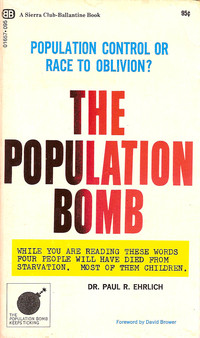
Population controllers
are some of the most fascinating characters to appear in After Roe. Some of these activists, like former Columbia
student Judy Senderowitz, saw themselves as committed feminists. Others
presented family planning as a necessary step in saving the environment. Some,
like Stanford biologist Paul Ehrlich, saw reproductive rights as a side issue.
Older population controllers even argued that women’s-rights questions were a waste of
resources for a movement dedicated to stopping the nation from populating
itself to death.
 In After Roe, the population controllers’ story illuminates the
changing relationship between the movements for legal abortion and women’s
liberation. From the beginning, women played a crucial role in demanding legal
access to abortion. Just the same, the early movement for abortion rights often
shied away from women’s-rights arguments, and the relationship between the two
movements was often rocky. At a time when women’s liberation remained
controversial and women struggled for respect in the workplace, movement
pragmatists believed that they would get results faster if they could convince
voters and judges that legalizing abortion would have other desirable effects.
Arguing that women had a right to abortion said nothing about how everyone else
would benefit from legalization. By sometimes focusing on lower welfare costs,
environmental benefits and reduced illegitimacy rates, movement members hoped
to reach a larger audience.
All of that changed
when the population-control movement found itself buried in scandal in the
later 1970s. Sterilization abuse at home and abroad persuaded many observers
that population policies were irrevocably racist and coercive. As population
control became more controversial, feminists gained new influence in what would
become the pro-choice movement. Population controllers also began staying away from
the abortion issue, seeing it as another controversy that they could ill
afford.
It seems that the
implosion of population control had ramifications beyond the issues of abortion
and family planning. In the 1970s, leading population organizations often
advocated for abortion and family planning, environmental protection, and
immigration limits. By contrast, organizations that lobby today for immigration
limits, like NumbersUSA and the Federation for American Immigration Reform
(FAIR), almost never discuss environmental issues. Conversely, groups like the
Sierra Club consistently avoid arguments about the environmental damage some
tie to overpopulation. Nor does FAIR or NumbersUSA identify family planning as
a way of preventing the kind of harm members associate with immigration.
These changes came partly
because both parties cemented their positions on abortion and family planning
by the 1980s. While leading politicians in each party could be found on either
side of the abortion issue for much of the 1970s, in the 1980s, it became costly for a candidate to depart from a party’s official position on
reproductive issues.
I imagine that the
story of party positions on immigration and environmental issues is equally surprising
and rich. In the 1970s, it was far from obvious that environmentalism would be
primarily embraced by Democrats. If we understood how the parties established a
position on environmental issues and immigration in the decades after Roe, we might discover some of the lost
possibilities for advocacy on either issue.
Sunday, August 16, 2015
Sunday Book Roundup
After a weekend off, here's this Sunday's Book Roundup:
 The Los Angeles Review of Books reviews Contraband: Louis Mandrin and the Making of a Global Underground by Michael Kwass (Harvard University Press).
The August issue of The Federal Lawyer is out, with a review by Henry S. Cohn of A Broken Regiment: The 16th Connecticut's Civil War by Lesley J. Gordon (Louisiana State University Press)--all reviews found here.
From The New Rambler is a review of Philip Wallach's To The Edge: Legality, Legitimacy, and the Responses to the 2008 Financial Crisis (Brookings Institution Press).
H-Net adds plenty of reviews for reading. For starters, James Corbett David's Dunmore's New World: The Extraordinary Life of a Royal Governor in Revolutionary America--with Jacobites, Counterfeiters, Land Schemes, Shipwrecks, Scalping, Indian Politics, Runaway Slaves, and Two Illegal Royal Weddings (University of Virginia Press) is reviewed.

Also up on H-Net is a review of Melissa Estes Blair's Revolutionizing Expectations: Women's Organizations, Feminism, and American Politics, 1965-1980 (University of Georgia Press).
 The New Books Series has an interview with Eva Hemmungs Wirten in which she discusses Making Marie Curie: Intellectual Property and Celebrity Culture in an Age of Information (University of Chicago Press).
Barak Kushner talks about his Men to Devils, Devils to Men: Japanese War Crimes and Chinese Justice (Harvard University Press) with New Books in Law.
And, Gyanendra Pandey discusses his A History of Prejudice: Race, Caste, and Difference in India and the United States (Cambridge University Press).
 The Los Angeles Review of Books reviews Contraband: Louis Mandrin and the Making of a Global Underground by Michael Kwass (Harvard University Press).
"Contraband is a sparkling micro-history nestled within a sprawling macro-history. The book reads as if Kwass has his finger on the zoom wheel of a mouse, here scrolling in to examine most intimate details of his protagonist’s childhood, there zooming out so that the vast mercantile connections linking Europe, the Americas, and the East Indies all appear in frame. Kwass transitions between the two deftly, at times imperceptibly, so that the picture is both expansive and highly detailed."Books & Ideas has a summer roundup with essays and reviews of interest to legal historians, including essays by Joan Scott and Ronald Dworkin.
The August issue of The Federal Lawyer is out, with a review by Henry S. Cohn of A Broken Regiment: The 16th Connecticut's Civil War by Lesley J. Gordon (Louisiana State University Press)--all reviews found here.
From The New Rambler is a review of Philip Wallach's To The Edge: Legality, Legitimacy, and the Responses to the 2008 Financial Crisis (Brookings Institution Press).
H-Net adds plenty of reviews for reading. For starters, James Corbett David's Dunmore's New World: The Extraordinary Life of a Royal Governor in Revolutionary America--with Jacobites, Counterfeiters, Land Schemes, Shipwrecks, Scalping, Indian Politics, Runaway Slaves, and Two Illegal Royal Weddings (University of Virginia Press) is reviewed.

"David’s biography of Dunmore shows a complex character filled with ambition and lapses of frustration. David demonstrates that there is still room for biographies in modern historiography. This lively account of Dunmore’s life illuminates his pivotal role in the history of America and the British Empire. This well-written monograph provides a wonderful glimpse into the world of Lord Dunmore and would be beneficial for Atlantic World historians and history buffs alike."Jeremy J. Tewell's A Self-Evident Lie: Southern Slavery and the Threat to American Freedom (Kent State University Press) is reviewed on H-Net, too.
Also up on H-Net is a review of Melissa Estes Blair's Revolutionizing Expectations: Women's Organizations, Feminism, and American Politics, 1965-1980 (University of Georgia Press).
Lastly, Kafka's Law: The Trial and American Criminal Justice by Robert P. Burns (University of Chicago Press) is reviewed on H-Net."Blair’s central argument is essentially this: members of mainstream women’s organizations played a mediating but crucial role in the successes of second-wave feminism. They did so in two specific ways. First, they helped “translate” national ideas and campaigns (most important, the decade-long effort to ratify the Equal Rights Amendment [ERA]) into programs and agendas that would address the needs of local communities. Second, because of their established presence in their home communities, long-standing women’s organizations helped to soften the local political environment by making more radical ideas seem less threatening."

 The New Books Series has an interview with Eva Hemmungs Wirten in which she discusses Making Marie Curie: Intellectual Property and Celebrity Culture in an Age of Information (University of Chicago Press).
Barak Kushner talks about his Men to Devils, Devils to Men: Japanese War Crimes and Chinese Justice (Harvard University Press) with New Books in Law.
And, Gyanendra Pandey discusses his A History of Prejudice: Race, Caste, and Difference in India and the United States (Cambridge University Press).
Saturday, August 15, 2015
Weekend Roundup
- Guest blogger Sarah Barringer Gordon's new research on church and state in early America has the enthusiastic endorsement of the Economist's Erasmus blog.
- Constitution Day 2015 at the Cato, including William N. Eskridge, Jr. (Yale Law School), and Steven G. Calabresi (Northwestern University School of Law).
- “Controlling Sexuality and Reproduction, Past and Present,” a “three-day conference exploring the history of controlling sexuality and reproduction,” concluded this week at the University of Lethbridge (Alberta). Paul Lombardo (Georgia State University College of Law) keynoted. H/t: Lehbridge Herald
- ICYMI: In a New York Times op-ed, Robby and Michael Meeropol argue that the recently unsealed grand jury testimony in the Rosenberg case shows that the prosecution of their mother Ethel Rosenberg was tainted by perjured testimony. Our post on the release of the testimony is here.
- Over at Balkinization, Stephen Griffin (Tulane) has started a series of posts on "The New Originalism and Living Constitutionalism." The first one is here. H/t: Saul Cornell
- Legal historian Kyle Graham, author of the incomparable law blog noncuratlex, is leaving academia to return to private practice. Read his heartfelt "goodbye" note here. (KMT)
- From Inside Higher Ed: why history PhDs may want to consider careers in the federal government.
Friday, August 14, 2015
Daly on Constitutional Courts in Canada and the UK
Paul Daly, University of Montreal Faculty of Law, has posted A Supreme Court's Place in the Constitutional Order – Contrasting Recent Experiences in Canada and the United Kingdom, which is forthcoming in the Queen's Law Journal:
There is a wealth of recent cases and commentary on the constitutional roles of two important common law supreme courts: the Supreme Court of Canada and the United Kingdom Supreme Court. Both have recently expressed distinctive understandings of their positions in their respective constitutional orders, drawing in part on supporting narratives by way of justification.
What emerges is that the Canadian high court is much clearer about its constitutional role. Recently, it confirmed beyond all doubt its entrenchment in the Canadian Constitution, weaving together a supporting narrative that allowed the Court to describe itself both as a neutral arbiter of disputes relating to federalism and human rights, and as a champion of the distinct values of the province of Quebec. By contrast, the UK Supreme Court has found it much more difficult to identify its place in the constitutional order, most notably in the area of rights protection. In a series of recent decisions, it has emphasized its fundamental role in expounding the common law. In doing so, it has relied on a narrative that venerates the common law and describes the Court as a protector of home-grown constitutional values.
My comparison reveals three points of particular interest. First, the framework for constitutional change in Canada was much more favourable to the Supreme Court of Canada, in part because of several of its own decisions, whereas its UK counterpart has never really been in a position from which it could formally complicate the process of constitutional reform. Second, the Supreme Court of Canada’s institutional position as arbiter of fundamental constitutional disagreements has long been undisputed, whereas the UK Supreme Court has operated in the shadow of the Strasbourg-based European Court of Human Rights. Recent Canadian history also indicates that the UK Supreme Court’s claims to the guardianship of the domestic constitutional tradition are likely to increase in both number and force Third, narratives that lawyers develop about their legal traditions influence the substantive law, but these narratives must be viewed critically, because they are often contingent on context and may not always reveal the whole story. Recent developments in Canada and the UK were not quite as inevitable as the supporting narratives developed by their high courts would have the reader believe.
Sir Geoffrey Palmer on NZ's ACC
 Now comes an SSRN posting by Sir Geoffrey Palmer QC, Victoria University of Wellington Faculty of Law, of Big Change, Exciting Adventures: Accident Compensation, a chapter from his Reform: A Memoir (Wellington: Victoria University Press, 2013), 198-226:
It concerns New Zealand’s novel accident compensation scheme that replaces tort law as a means of compensating the victims of accidents. It reviews the author’s involvement with the reform from its earliest days up until the present. It traces the difficulties with enacting the scheme, its administration and its financing. It also reviews efforts to take the reform to Australia where it was not enacted. It reflects upon the difficulties of securing general deterrence through the allocation of accident costs.
The Rise of the Undue-Burden Test
 |
| Pro-Life Activists, March for Life, 2015 (Credit: American Life League) |
I have only a few clues
about where the test came from. Historians have documented the appearance of
the undue-burden test in Solicitor General Rex Lee’s 1983 amicus brief in City of Akron v. Akron Reproductive Health Center (Akron I) a case on the
constitutionality of what was then the blueprint for incrementalist
regulations. But before Akron I, the
Court had used similar language in certain kinds of abortion cases—particularly
those involving minors and demands for financial support. In defending the Hyde
Amendment, leading antiabortion attorneys from Americans United for Life
suggested that an undue burden test applied to all abortion regulations. So too
did Solicitor General Rex Lee and the Reagan Administration in Akron I.
In 1986, in Thornburgh v. American College of Obstetricians and Gynecologists, the Court issued its first 5-4 decision on
the constitutionality of a multi-restriction law, making clear that Reagan’s
nominees could revolutionize abortion law. After Thornburgh, both antiabortion attorneys and their allies in the
White House often stopped pushing for the undue-burden test, instead asking for
Roe to be overruled altogether. In a brief signed by Solicitor General Charles
Fried, the United States argued that the Court had already adopted an
undue-burden test but should go further and abandon the 1973 decision.
Attorneys working with the National Right to Life Committee pursued a similar
strategy.
Much about this story
remains obscure for me. Who came up with the undue-burden test? Did the Reagan
Administration borrow from or collaborate with cause lawyers opposed to
abortion? How vigorously did antiabortion lawyers come to oppose an
undue-burden test when they believed they could convince the Court to overrule Roe?
If my knowledge of the
history of the undue-burden test is incomplete, the stakes of the history seem
clear. Where the test came from, and whose interests it advanced, may change
our understanding of how it works today. At least at some points, antiabortion
attorneys promoted the use of an undue-burden approach, viewing it as another
weapon in the effort to chip away at Roe.
Pro-life attorneys may have seen the test as an important tactic in the broader
incrementalist agenda. The Reagan Administration also relied on the test, and
administration officials may have treated it as a way of
satisfying antiabortion constituents without offending swing voters. A third
possibility is that the Court’s undue-burden test, at least as set forth in Casey, differs from any version set out
by opponents of the Roe decision. This third account would lend credibility to arguments that the undue-burden test was designed to balance the competing interests of the fetus and the woman.
The politics of the
undue-burden test vary considerably in each of these narratives. Possibly, the
undue-burden test emerged from the kind of incrementalist approach documented
in After Roe. Or the undue-burden
test could be what some in the Reagan Administration proposed, a political
settlement that could defuse antiabortion anger without straying too far from
what most voters seemed to want. Finally, Casey’s
test could reflect an honest effort on the part of the Court to grapple with
the hard moral and constitutional questions surrounding abortion.
The origins of the undue-burden test certainly deserve further study. As the Court weighs taking certiorari
on a pair of abortion cases this fall, the undue-burden test will likely take center
stage. We still know far too little about what that means for the future of
abortion law and politics.
Thursday, August 13, 2015
Domínguez on Chilean Family Law
Carmen Domínguez, Pontificia Universidad Catolica de Chile, has posted Los Principios Que Informan El Derecho De Familia Chileno: Su Formulación Clásica Y Su Revisión Moderna (The Principles Underlying the Chilean Matrimonial Law: Its Classic Formulation and Modern Review), which appeared in the Revista Chilena de Derecho 32 (2005): 205-18:
English Abstract: This paper develops the historical evolution of Private Law in general and family law in particular. It also elaborates upon the guiding principles that in-nerve the many deep changes that family law has undergone over the years. The second part of the article is a critical analysis of the effects of such changes, suggesting the different directions of the recent reforms sought to be introduced into Chilean law. These directions are basically referred to the need to strengthen the family, as stated by the Constitution, and to tackle and reach the idea of what is good for the whole society, as included within the concept of family as the first and foremost community of individuals.
Socio-Legal Review Invites Submissions
[We have the following call for submissions.]
The Socio-Legal Review welcomes contributions for its twelfth volume to be released in 2016.
The Socio-Legal Review (SLR) is a student-edited, peer-reviewed interdisciplinary journal published by the Law and Society Committee of the National Law School of India University, Bangalore. SLR aims to be a forum that involves, promotes and engages students and scholars to express and share their ideas and opinions on themes and methodologies relating to the interface of law and society. The Journal thus features guest articles by eminent scholars as well as student essays, providing an interface for the two communities to interact. From 2012, SLR has become a biannual publication from an annual publication.
The Journal subscribes to an expansive view on the interpretation of "law and society" thereby keeping its criteria for contributions simply that of high academic merit, as long as there is a perceivable link. This would include not just writing about the role played by law in social change, or the role played by social dynamics in the formulation and implementation of law, but also writing that simply takes cognizance of legal institutions/institutions of governance/administration, power structures in social commentary, and so on. Through this effort, the Journal also hopes to fill the lacunae relating to academic debate on socio-legal matters among law students.
SLR has been listed in the Directory of Open Access Journals and has been uploaded on Westlaw and HeinOnline. It was supported by the Modern Law Review for three years since its inception.
Guidelines for submission after the jump.
Brophy on Rights and Race in Georgia History
Alfred L. Brophy, University of North Carolina School of Law, has posted Re-Integrating Spaces: The Possibilities of Common Law Property, which appears in the Savannah Law Review 2 (2015): 1-20:
"Re-Integrating Spaces" is part of a symposium on progressive property held at Savannah Law School as part of the re-dedication of their building, which was constructed in the early nineteenth century and used as a hospital for much of its existence.
The essay uses the building's long history as a guide for exploring the history of property rights and race in Georgia and the United States. It emphasizes that while the central tendency of property is about exclusion and control -- as Georgia's history with slavery, Native American removal, and Jim Crow demonstrate. Yet, it points out that sometimes the protection of property rights benefits racial minorities. And it also discusses the long history of the critique of such robust property rights. This lead to discussion of some of the instances where other elements of common law property (and statutory rights) help to shift away from the right of exclusion and control.
Wednesday, August 12, 2015
Somin on Kelo and the Limits of Eminent Domain
New from the University of Chicago Press: The Grasping Hand: "Kelo v. City of New London" and the Limits of Eminent Domain, by Ilya Somin (George Mason University School of Law). A description from the Press:
More information is available here.
A few blurbs:In 2005, the Supreme Court ruled that the city of New London, Connecticut, could condemn fifteen residential properties in order to transfer them to a new private owner. Although the Fifth Amendment only permits the taking of private property for “public use,” the Court ruled that the transfer of condemned land to private parties for “economic development” is permitted by the Constitution—even if the government cannot prove that the expected development will ever actually happen. The Court’s decision in Kelo v. City of New London empowered the grasping hand of the state at the expense of the invisible hand of the market.
In this detailed study of one of the most controversial Supreme Court cases in modern times, Ilya Somin argues that Kelo was a grave error. Economic development and “blight” condemnations are unconstitutional under both originalist and most “living constitution” theories of legal interpretation. They also victimize the poor and the politically weak for the benefit of powerful interest groups and often destroy more economic value than they create. Kelo itself exemplifies these patterns. The residents targeted for condemnation lacked the influence needed to combat the formidable government and corporate interests arrayed against them. Moreover, the city’s poorly conceived development plan ultimately failed: the condemned land lies empty to this day, occupied only by feral cats. The Supreme Court’s unpopular ruling triggered an unprecedented political reaction, with forty-five states passing new laws intended to limit the use of eminent domain. But many of the new laws impose few or no genuine constraints on takings. The Kelo backlash led to significant progress, but not nearly as much as it may have seemed.
Despite its outcome, the closely divided 5-4 ruling shattered what many believed to be a consensus that virtually any condemnation qualifies as a public use under the Fifth Amendment. It also showed that there is widespread public opposition to eminent domain abuse. With controversy over takings sure to continue, The Grasping Hand offers the first book-length analysis of Kelo by a legal scholar, alongside a broader history of the dispute over public use and eminent domain and an evaluation of options for reform.

"Somin's thorough rebuttal of the constitutional reasoning and philosophical implications of the Supreme Court's Kelo decision demonstrates why that ruling was a constructive disaster: It was so dreadful it has provoked robust defenses of the role of private property in sustaining Americans' liberty." -- George F. Will
“The Grasping Hand is likely to be the definitive analysis of the Supreme Court’s controversial decision in the Kelo case. But Somin attends to much more than that. He sets out the political and doctrinal history that led up to Kelo and critiques the legislative and judicial developments provoked by the reaction to it. Somin has long been a champion of strong property rights. What he has to say will be of value to those who share that commitment and perhaps even more to those who don’t.” -- James E. Krier
Mask and MacMahon on Revolutionary-War Prize Cases
Deirdre Mask, London School of Economics, Political Science, and Paul MacMahon
London School of Economics, Law Department, have posted The Revolutionary War Prize Cases and the Origins of Diversity Jurisdiction, which appears in the Buffalo Law Review 63 (2015): 477-547.
London School of Economics, Law Department, have posted The Revolutionary War Prize Cases and the Origins of Diversity Jurisdiction, which appears in the Buffalo Law Review 63 (2015): 477-547.
Why did the Framers give the federal courts diversity jurisdiction? This Article brings to light a crucial but forgotten source of inspiration for diversity jurisdiction, showing that previous explanations ignore the Framers’ experience judging prize case appeals during the Revolutionary War. Scholars have largely rejected the view that the Framers anticipated state bias in diversity litigation, arguing, for example, that diversity jurisdiction was designed to provide a high-quality venue for commercial disputes. Yet placing the Framers’ decision in the context of their lived experience as judges in contentious "Prize Cases" during the Revolutionary War rehabilitates the geographic bias theory. During the War, the Continental Congress relied heavily on privateers — private citizens, who, with the financial support of individual states or Congress, were authorized to capture British ships. At George Washington’s urging, the Continental Congress set up an adjudicatory committee within Congress itself, the Committee on Appeals, to resolve appeals from prize cases in the state courts. The Framers’ taste of judicial work exposed them to contentious interstate disputes — a preview of what diversity litigation would look like in the new country. We argue that this experience, almost entirely ignored by contemporary scholars, directly inspired the otherwise perplexing decision to include diversity jurisdiction in Article III.
Alexander on Informational Works and 18th-Century Copyright Cases
Isabella Alexander, University of Technology Sydney, Faculty of Law, has posted “Manacles Upon Science”: Re-Evaluating Copyright in Informational Works in Light of 18th Century Case Law, which appeared in the Melbourne University Law Review 38 (2014): 317-61:
Questions over whether, and if so how, copyright law should protect works of fact and information have occupied the courts of several common law countries in recent decades. In Australia, they recently came to the fore in two Federal Court decisions relating to telephone directories. While the Court paid considerable attention to nineteenth century cases, consideration of the eighteenth century cases on which these precedents were based sheds greater light on the later development of the law. This article takes a microhistorical legal approach and examines a series of cases relating to road books from the late eighteenth century to explore some of the earliest legal approaches to works of geographical information, placing them in their social and cultural context.
Tuesday, August 11, 2015
Tate on Episcopal Power and Royal Jurisdiction in Angevin England
We have already noted the publication of Studies in Canon Law and Common Law in Honor of R.H. Helmholz, ed. Troy L. Harris (Robbins Collection Studies in Comparative Legal History, 2015. Here is a contribution by Joshua C. Tate, Southern Methodist University Dedman School of Law, Episcopal Power and Royal Jurisdiction in Angevin England.
During the second half of the twelfth century, powerful and charismatic bishops presented a threat to the emerging jurisdiction of the king’s courts. By contrast, King John was able to fill key episcopal vacancies with loyal bureaucrats who acted as servants to the king. This paper will consider how the assertion and subsequent cession of power by English bishops under the Angevin kings shaped the developing jurisdiction of the common-law courts, particularly in disputes over advowsons, or rights of presentation to churches. The evidence suggests that the bishops played a significant role in the development of the early common law, first by sending litigation into the king’s courts and later by declining to challenge the primacy of royal jurisdiction.
Monday, August 10, 2015
Hupper on Foreign Lawyers and the US JSD
Gail J. Hupper, a visiting scholar at the Harvard Law School, has posted Educational Ambivalence: The Rise of a Foreign-Student Doctorate in Law, which appears in the New England Law Review 49 (2015): 319-449:
This article joins the author’s two earlier ones in tracing the history of the academic doctorate in law – commonly called the S.J.D. or J.S.D. degree – at Columbia, George Washington, Harvard, Michigan, N.Y.U., Wisconsin and Yale. Conceived in an era in which law was emerging as a subject of university study, by the 1920s the degree focused primarily on training U.S. law graduates for teaching careers in U.S. law schools. Today, by contrast, the vast majority of those who pursue the degree are foreign-trained lawyers, many of whom plan academic careers in their home countries. The current article seeks to explain this shift in orientation by examining a confluence of circumstances during the thirty or so years following the end of World War II. In so doing, it raises important questions about the nature of U.S. legal education: professional training versus academic discipline; the particular nature of that discipline; and the communities (local, national, and global) that legal education serves.
Tomlins on the Turner Rebellion and the Lordship/Bondage Dialectic
Christopher Tomlins, University of California, Berkeley, Jurisprudence and Social Policy Program, has posted The Work of Death: Massacre and Retribution in Southampton County, Virginia, August 1831:
What does it mean, particularly to a slave, to describe dealing death as “work?” This essay employs G.W.F. Hegel’s famous lordship/bondage dialectic (from The Phenomenology of Mind) to explore the massacre of 55 members of white slaveholding families that took place on Monday August 22nd 1831 in St. Luke’s Parish, Southampton County, Virginia, now known as “The Turner Rebellion.” I argue that certain specificities of the Hegelian dialectic, notably the centrality of work to the bondsman’s “direct apprehension” of its self as independent, are key components of the massacre. Likewise, I argue that the dialectic helps us understand the specifically juridical form of retributive killing that followed the massacre, in which 18 slaves, variously accused of “feloniously counselling, advising and conspiring with each other and divers other slaves to rebel and make insurrection and making insurrection and taking the lives of divers free white persons of the Commonwealth” were executed. The essay also explores the sociology and social anthropology of the killing that was the focal point of the rebellion. It considers whether this killing was incidental to some other purpose, such as revenge, or revolution, or central and essential to what Nat Turner desired to achieve.
Representing the Unborn
 |
| James Bopp, June 2011 (Credit: Gage Skidmore) |
After Roe tells the story of how
lawyers like Bopp transformed the movement they represented. In particular,
over the course of the 1970s, attorneys began to question the wisdom of prioritizing
a constitutional amendment. Bopp and his colleagues saw themselves as realists,
and in the short term, they believed that the antiabortion movement needed
victories to survive.
These attorneys crafted
an incremental attack on Roe that
served several purposes. First, by convincing the Court to uphold regulations
that were theoretically compatible with Roe,
incrementalists limited abortion access and reduce the number of procedures
performed across the country. Second, an incremental attack energized
demoralized constituents and convinced politicians that the pro-life movement
was a force to be reckoned with. Finally, incrementalists set the stage for the
eventual overruling of Roe. Over
time, as the Court narrowed abortion rights, incrementalists believed that it
would be far easier to convince the justices to get rid of the 1973 decision
altogether.
The
incrementalists’ story raises interesting questions about what it meant for
lawyers to represent unborn children. How did lawyers like Bopp define their
role in the larger movement? Did they believe that their professional status or
expertise made them more qualified to create a strategy for the larger
movement? How did antiabortion lawyers’ understanding of themselves and their
professional role change in the following decades?
It
is striking how much lawyers’ influence in the antiabortion movement grew over
time. When pro-life groups first formed across the country, they often rejected traditional hierarchies of gender and class, placing homemakers in positions of
power. Influence often came with past success. Antiabortion activists who had defeated
efforts to repeal or reform abortion bans in the 1960s and early 1970s gained
credibility and power. These advocates did not always or even often belong to
the movement’s elite wing.
By the 1980s, however,
the movement had once again invested in the courts, and lawyers held positions
of power across leading organizations. This shift—and how it affected pro-life
lawyers’ identities—deserves further study. Legal historians often ask us to
think about the ways in which attorneys sometimes limit the claims of the
movements they represent. As the evolution of lawyers’ role in the antiabortion
movement suggests, we have more to learn about whether this story often applies
to movements that we identify with the Right.
Saturday, August 8, 2015
Weekend Roundup
- Just published is a much-expanded second edition of The Complete Bill of Rights: The Drafts, Debates, Sources, & Origins (Oxford University Press), by Neil Howard Cogan, Whittier Law School. Ronald K. L. Collins’s appreciation is here.

- Zachary D. Kaufman has posted From the Aztecs to the Kalahari Bushmen -- Conservative Justices' Citation of Foreign Sources: Consistency, Inconsistency, or Evolution? which also appears in the Yale Journal of International Law Online.
- The Miller Center for Public Affairs and the University of Virginia Press have launched a new book series, Miller Center Studies on the Presidency.
- “The Centre for Law and Policy Research (CLPR),” a non-profit organization based in Bangalore, “invites applications for the post of Associate Editors for a new initiative titled –Constitutional and Civic Citizenship – where it aims to foster greater public awareness of India’s constitutional history and an understanding of how this history has shaped and informed the most challenging legal, governance and public policy issues that we encounter today.” More
Friday, August 7, 2015
Price on the Legislative History of Yellow Fever Quarantines
Polly J. Price, Emory University School of Law, has posted A Legislative History of the Shotgun Quarantine:
The recent Ebola threat from western Africa raised unanswered questions about the scope of the U.S. federal government’s quarantine authority. For decades, a widespread assumption has existed that states have absolute control over quarantines imposed within their boundaries. This article suggests that the presumption of limited federal authority is overly restrictive and not constitutionally mandated. The history of the “shotgun quarantines” imposed during the yellow fever epidemics of the late 19th and early 20th centuries offers an alternative constitutional interpretation. This fascinating but previously untold account reveals that leading politicians of the day believed the federal government had a broad constitutional authority. The human suffering and disruption to commerce caused by the local shotgun quarantine led the South to implore Congress for legislation to remedy it – the only significant instance in which the post-Civil War South united in favor of ceding state’s rights to the federal government. The controversy faded as effective measures against yellow fever were found, only to emerge again when Ebola confronted public health policy makers a century later. Because Congress never acted, we have largely forgotten the history of these legal debates over interstate quarantine authority. In recovering that history, this Article offers a new perspective on how to manage public health crises in our federal system. The need for regulatory standards that could preempt an unnecessary, parochial local quarantine requires Congress to act.
Tomlins on the Soterial-Legal History of the Turner Rebellion
Christopher Tomlins, University of California, Berkeley, Jurisprudence and Social Policy Program, has posted Debt, Death, and Redemption: Toward a Soterial-Legal History of the Turner Rebellion, which is forthcoming in Exploring the Legal in Socio-Legal Studies, ed. David S. Cowan and Dan Wincott (London: Palgrave-Macmillan 2016).
The objective in this essay is to question the conjunction “socio-legal,” resorted to routinely by law and society scholars who locate “law” in a determined/determining relationship to social “context.” Concretely, the essay examines the capacity of the socio-legal to assist us in explaining a particular incident in antebellum U.S. history, the Turner Rebellion, a slave revolt or “insurrection” that occurred in Southampton County, southeastern Virginia, in August 1831 by counterposing the agency of the soterial, which stands at about as stark a polar opposite to the social as it is possible to imagine. Soterial means salvific, pertaining to salvation, to the eschatology of redemption. If social connotes the profane, the world of the creature, the world of fallen humanity, where law reigns and justice is an afterthought, soterial connotes the sacral, beyond law, where justice is eternal. The question posed is which – the social or the soterial, empiricism or metaphysics – better helps us understand the Turner Rebellion? Which of them, in particular, unleashes from that incident the energy that might alter the way we understand American history and, not incidentally, the way we understand law?
How Did Roe Become a Popular Symbol of Judicial Activism?
 If you follow abortion politics today, you probably think that the pro-life movement has long prioritized Roe v. Wade. As attorney Clark Forsythe's recent book, makes clear, arguments against the Roe Court's activism have become a centerpiece of movement strategy.
overruling
But in the 1960s and 1970s, as my book shows, few committed movement members would have seen that as a worthwhile goal. Robert Byrn, a pro-life conservative who openly opposed birth control, wrote that the movement did not have to take a position on judicial activism. The legal strategy that intrigued many pro-lifers more closely resembled one forged by liberal lawyers. For much of the decade, antiabortion activists who agreed on very little prioritized a constitutional amendment. That amendment would have made unborn children a protected class under the Equal Protection Clause, recognized a fundamental right to life, and banned all abortions. Movement members like Byrn did not entirely see the appeal of attacks on judicial activism. Indeed, pro-lifers believed that the unborn had rights that should be protected from popular politics.
Only later did movement leaders emphasize the evils of judicial activism. Pro-lifers had believed Roe to be an incoherent, unprincipled decision from the start, but few had expressed concern about the role of the judiciary. When the movement’s focus shifted, leaders partly responded to new political opportunities. When it was clear that a constitutional amendment was out of reach, groups like the National Right to Life Committee (NRLC) and Americans United for Life (AUL) put new emphasis on federal judicial nominations. To influence either presidential elections or judicial selections, pro-lifers had to build powerful alliances, and the most promising potential allies took issue with a variety of Supreme Court opinions, including those on school prayer and busing. Speaking the language of judicial activism was strategically smart, and over time, more movement leaders came to deeply believe what they were saying.
Studying the politics of judicial activism in the antiabortion movement made me curious about the public came to see Roe as a symbol of judicial overreaching. To be sure, legal academics had highlighted flaws in the Court’s 1973 decision as soon as it was issued. But the story of antiabortion activism in the 1970s reveals that arguments about judicial role did not immediately or inevitably resonate outside the academy, even for groups that would most logically have led an attack on the courts.
A little more than a decade later, the picture looked very different. The AUL tried to reach undecided voters by pointing out the supposed errors in the Roe decision and the threat it posed to American democracy. Within the Reagan Administration, lawyers from Rex Lee to Edwin Meese III took arguments about judicial activism to both the courts and popular audiences. Antiabortion extremists cited the Court’s supposed abuse of power in justifying civil disobedience and even anti-clinic violence. After Roe describes some of the very different paths that abortion law and politics could have taken after the Court legalized abortion in 1973. I imagine that a closer investigation of the politics of judicial activism in the 1980s and 1990s would reveal similar lost possibilities.
Kushner on "Japanese War Crimes and Chinese Justice"
We missed this January 2015 release from Harvard University Press: Men to Devils, Devils to Men: Japanese War Crimes and Chinese Justice, by Barak Kushner (University of Cambridge). A description from the Press:
Hat tip: New books in history
The Japanese Army committed numerous atrocities during its pitiless campaigns in China from 1931 to 1945. When the Chinese emerged victorious with the Allies at the end of World War II, many seemed ready to exact retribution for these crimes. Rather than resort to violence, however, they chose to deal with their former enemy through legal and diplomatic means. Focusing on the trials of, and policies toward, Japanese war criminals in the postwar period, Men to Devils, Devils to Men analyzes the complex political maneuvering between China and Japan that shaped East Asian realpolitik during the Cold War.

Barak Kushner examines how factions of Nationalists and Communists within China structured the war crimes trials in ways meant to strengthen their competing claims to political rule. On the international stage, both China and Japan propagandized the tribunals, promoting or blocking them for their own advantage. Both nations vied to prove their justness to the world: competing groups in China by emphasizing their magnanimous policy toward the Japanese; Japan by openly cooperating with postwar democratization initiatives. At home, however, Japan allowed the legitimacy of the war crimes trials to be questioned in intense debates that became a formidable force in postwar Japanese politics.
In uncovering the different ways the pursuit of justice for Japanese war crimes influenced Sino-Japanese relations in the postwar years, Men to Devils, Devils to Men reveals a Cold War dynamic that still roils East Asian relations todayMore information is available here.
Hat tip: New books in history
Thursday, August 6, 2015
Harlow on the Impostor De Arnaud
James Harlow, US Department of Justice, has posted An Impostor If There Ever Was One": The Trials of Charles De Arnaud, which appears in Prologue: Quarterly of the National Archives and Records Administration 47 (2015): 6-14:
Charles De Arnaud was the most infamous government claimant of the Gilded Age. He was “known by almost every public man in the country.” To some, he was a gentleman-soldier, who had served the United States at great personal cost during the Civil War and never received his full due. To others, he was an irrepressible fraudster, who shamelessly pursued undeserved money and honors for decades.
De Arnaud also was the most prolific government claimant of the time. From 1885 until his death in late 1905, among other requests, he sought a gold medal, a medal of honor, a veteran’s pension, and a $50,000 payment from the United States. De Arnaud haunted the hallways of Congress and bedeviled federal bureaucrats. The courts too, including the United States Supreme Court, were not spared his pleas; albeit others as often hailed him into court as he commenced the suit.
The saga of Charles De Arnaud reveals the law and politics surrounding the Civil War veterans’ pension scheme. Interlaid with this backdrop is a story of an indomitable fraudster’s quest for fame and fortune. As an epilogue, newly unearthed evidence provides the basis for an ultimate judgment on the worthiness of De Arnaud’s cause.
Bloch and Lamoreaux on Associations, Corporate Rights and the States
Ruth H. Bloch and Naomi R. Lamoreaux have posted a gated NBER Working Paper (No. 21153) that issued in May 2015 that is a nice complement to Professor Gordon’s recent article. It’s Voluntary Associations, Corporate Rights, and the State: Legal Constraints on the Development of American Civil Society, 1750-1900:
The freedom of citizens to form voluntary associations has long been viewed as an essential ingredient of modern civil society. Our chapter revises the standard Tocquevillian account of associational freedom in the early United States by accentuating the role of state courts and legislatures in the creation and regulation of nineteenth-century American nonprofit corporations. Corporate status gave associations valuable rights that went beyond the basic right of individuals to associate. Government officials selectively used their power to grant and enforce corporate charters to reward politically favored groups while denying equivalent rights to groups they viewed as politically or socially disruptive.
Georgetown International History Seminar, 2015-16
[We have the following announcement.]
The Georgetown University Institute for Global History and the Mortara Center for International Studies present the 2015-16 International History Seminar. Conveners: Toshihiro Higuchi, John McNeill, David Painter, and Aviel Roshwald
Unless otherwise noted, the seminar will meet on Tuesdays, 6:00-7:30 in the Mortara Center for International Studies at the corner of N and 36th Streets, NW (3600 N St., Washington, DC). Papers will be pre-circulated among participants (except for our first event, which is a book launch). Light refreshments will be served.
Thursday, October 8, 2:30-4:00 in ICC 662: Presentation by Michael Goebel (Free University, Berlin) about his new book, Anti-Imperial Metropolis: Interwar Paris and the Seeds of Third World Nationalism (Cambridge University Press, 2015).
November 17: Sophie de Schaepdrijver (Pennsylvania State University), "The German Occupation of Belgium during the First World War"
January 26: Laura Beers (American University), "The Women's International League for Peace and Freedom"
March 1: Ruth Ben-Ghiat (New York University), "Italian Prisoners of War, 1940-1950: What We Learn from Studying Defeat"
Thursday, March 17, 6:30-8:00: Max Paul Friedman (American University) "Containing the New Empire: Latin American Strategies against U.S. Hegemony in the Early Twentieth Century"
Center for the Study of Law and Society Speaker Series: Fall 2015
The Center for the Study of Law and Society at the University of California, Berkeley, has posted the fall lineup for its speaker series. Of particular interest to our readers:
Monday, November 9 – William Forbath
Lloyd M. Bentsen Chair in Law
Associate Dean for Research, School of Law, University of Texas at Austin
“Wealth and Commonwealth, and the Constitution of Opportunity: A Story of Two Traditions”Monday, November 23 – Lawrence Friedman
Marion Rice Kirkwood Professor of Law
Professor of History and Political Science, Stanford University
“The Butterfly Effect: Law, Technology, and the Human Body”
Wednesday, August 5, 2015
Job Notice: History of the Islamic/Muslim World
[We have the following job announcement.]
History of the Islamic World/Muslim World, Assistant Professor, Tenure-Track. The History Department at Duke University invites applications for the position of a tenure-track, assistant professor from scholars of the history of Muslim societies and cultures, broadly defined. Theme, period, and geographic specialty are open. The appointment will begin July 2016, at the start of the 2016-2017 academic year. Candidates should provide evidence of excellence in research with a commitment to teaching at both the graduate and undergraduate levels. Please submit the following application materials online (https://academicjobsonline.org/ajo/jobs/): (a) cover letter addressed to Professor Bruce Hall, search committee chair, (b) curriculum vitae, (c) a writing sample, and (d) three letters of references. Complete applications received by November 9, 2015 are guaranteed full consideration. The search will remain open until filled. Duke University is in Durham, North Carolina and is an Affirmative Action/Equal Opportunity Employer committed to providing employment opportunity without regard to an individual's age, color, disability, genetic information, gender, gender identity, national origin, race, religion, sexual orientation, or veteran status.
History of the Islamic World/Muslim World, Assistant Professor, Tenure-Track. The History Department at Duke University invites applications for the position of a tenure-track, assistant professor from scholars of the history of Muslim societies and cultures, broadly defined. Theme, period, and geographic specialty are open. The appointment will begin July 2016, at the start of the 2016-2017 academic year. Candidates should provide evidence of excellence in research with a commitment to teaching at both the graduate and undergraduate levels. Please submit the following application materials online (https://academicjobsonline.org/ajo/jobs/): (a) cover letter addressed to Professor Bruce Hall, search committee chair, (b) curriculum vitae, (c) a writing sample, and (d) three letters of references. Complete applications received by November 9, 2015 are guaranteed full consideration. The search will remain open until filled. Duke University is in Durham, North Carolina and is an Affirmative Action/Equal Opportunity Employer committed to providing employment opportunity without regard to an individual's age, color, disability, genetic information, gender, gender identity, national origin, race, religion, sexual orientation, or veteran status.
CFP: Journal Quaestio Iuris
The Journal Quaestio Iuris (ISSN 1516-0351), quarterly electronic publication of the professors of Law School of the State University of Rio de Janeiro (UERJ), classified by Brazilian Ministry of Education as Qualis A2, Law, is pleased to announce our new number (vol. 08, no. 02, 2015) (see [after the jump] and open call for papers for the next number of Journal Quaestio Iuris which will be published in November 2015.
Created from the need to investigate the law from multidisciplinary matrices, the Journal Quaestio Iuris receives in a continuous flow, papers on Legal Theory, Philosophy of Law, Sociology of Law, History of Law, State Theory, Philosophy, Epistemology and others disciplines that having the law by subject matter.
In order to promote greater participation and interaction between researches, we invite university professors to participate in the journal by sending your papers to our next issue, noting that the Journal Quaestio Iuris seeking entries streaming, submitted in our webpage or through the e-mails referred to below of our Editorial Team. Papers will be accepted in Portuguese, Spanish or English.
It should be borne in mind that the Journal Quaestio Iuris has multidisciplinary debate on the scope of its editorial policy, whose contents can be accessed through our website.
We are still open call for participation of university professors who want to collaborate in the Journal Quaestio Iuris as Referees Assessors in sporadic review articles, which are sent for the online submission system (standard opinion of 02 pages, assessing the strengths and weaknesses of article, approving, suggesting corrections or not accepting for publication).
If you are interested in publishing articles or participation as an evaluator referee, send by the journal system or through e-mails listed below of our Editorial Team.
TOC for JQI 8:2 after the jump. Contributors include Tony Freyer and Mark Tushnet.
Smith on Intestate Succession in Quebec
Lionel Smith, McGill University Faculty of Law (et al.), has posted Intestate Succession in Quebec
forthcoming in Comparative Succession Law, volume II: Intestate Succession, ed. Kenneth G C Reid, Marius J de Waal, and Reinhard Zimmermann (Oxford University Press, 2015):
forthcoming in Comparative Succession Law, volume II: Intestate Succession, ed. Kenneth G C Reid, Marius J de Waal, and Reinhard Zimmermann (Oxford University Press, 2015):
When Quebec became part of the British Empire, its private law was the Custom of Paris. By the Quebec Act 1774, this customary law was retained with the important exception that full freedom of testation was granted. The customary law continued to apply, including for intestate succession, until 1866, long after it had ceased to operate in France. In that year the Civil Code of Lower Canada came into force; for intestate succession, a system based on that of the French Civil Code was adopted. This system was modified only slightly with the coming into force in 1994 of the Civil Code of Québec.
This paper traces the evolution of the law of intestate succession in Quebec up to the modern day, touching also on the different intestacy rules that may apply to First Nations people living in the province.
Resta and Zeno-Zencovich on Italy's "Racial Laws"
Giorgio Resta, Università degli Studi di Bari, Law Faculty, and Vincenzo Zeno-Zencovich
University of Rome III Department of Law, have posted a pdf of their book Leggi Razziali. Passato/Presente [Racial Laws. Past/Present] (Roma, 2015). Here is the English abstract:
University of Rome III Department of Law, have posted a pdf of their book Leggi Razziali. Passato/Presente [Racial Laws. Past/Present] (Roma, 2015). Here is the English abstract:
This book provides an analysis of the racial laws approved by the Italian fascist regime in 1938, reflecting on their reasons, features and long-term impact on the Italian society. It is divided in two parts. The first one focuses on the fascist legislation, and analyzes the attitudes of the Italian legal culture toward the discrimination of the Jews. The second part deals with the resilience of racism and antisemitism in contemporary societies, reflecting on the role of law in redressing historical injustices and preventing the renewal of the tragedies of the last century.
Tuesday, August 4, 2015
Supreme Court Fellows Program
[We have the following announcement for the Supreme Court Fellows Program.]
 |
| Credit |
As a prestigious national program, the Supreme Court Fellowship has attracted first-rate candidates for more than 40 years. The program is particularly interested in candidates who are completing a judicial clerkship, are interested in pursuing an academic career or a career in public service, and wish to deepen their knowledge of the federal judicial system.
The Supreme Court Fellowship is a one-year appointment, beginning in August or September. Supreme Court Fellows become employees of the federal court system and receive salaries equivalent to the GS -12/1 of the government pay scale at the applicable locality rate. Fellows are eligible for health and life insurance, and other benefits programs offered to federal employees.
Candidates must have excellent written and verbal communication skills. They will be expected to perform well in demanding office environments that reward initiative, collegiality, discretion, and sound judgment. Ideal candidates are highly motivated and creative. Applicants must be U.S. Citizens, and are required to have a J.D. or other post-graduate degree to be eligible for consideration.
Applications must include the following:
- a candidate information form;
- a résumé highlighting academic, professional, and personal achievements;
- an original research proposal on a legal topic of scholarly interest;
- two candidate recommendations mailed directly to the Supreme Court Fellows Program.
For more information and to access the online application, please visit here. For questions regarding the application process, please contact program staff at 202-479-3415 or fellowsprogram@supremecourt.gov
Rakove on the Constitution on YouTube
 Stanford has posted on its YouTube channel six lectures by Jack Rakove on “the history and future of the U.S. Constitution” from his course "The Constitution: A Brief History.” The Stanford Humanities Center's notice is here. H/t: Mary Dudziak
YLS Legal History Forum, 2015-16
[Here’s the line-up for the Yale Law School Legal History Forum for 2015-16. We’ll add a link once it becomes available. “As always,” we are told, “events are open to everyone.” H/t: Noah Rosenblum]
All sessions meet from 4:30-6:00 p.m. (reception begins at 4:15 p.m.) in the Yale Law School Faculty Lounge (second floor)
Tuesday, September 29 — Edward Rugemer | Yale University (History)
Tuesday, November 17 — Elizabeth Papp Kamali | Harvard Law School
Tuesday, February 9 — Michele Landis Dauber | Stanford Law School & Stanford University (Sociology)
Tuesday, February 23 — Ada Ferrer | New York University (History)
Tuesday, March 8 — Rabia Belt | Stanford Law School
Tuesday, April 12 — Sophia Z. Lee | University of Pennsylvania Law School & University of Pennsylvania (History)
For more information, please contact noah.rosenblum@yale.edu or brent.salter@yale.edu.
LHR 33:3
 Here’s the TOC for Law and History Review 33:3 (August 2015):
Legacies of British Colonial Violence: Viewing Kenyan Detention Camps through the Hanslope Disclosure, by Aoife Duffy
A “Manifest Violation” of the Rights of Englishmen: Rights Talk and the Law of Property in Early Eighteenth-Century Jamaica, by Lee B. Wilson
Olmsted's Police, by David Thacher
“Beyond the Pale of Mercy”: Victorian Penal Culture, Police Court Missionaries, and the Origins of Probation in England, by Sascha Auerbach
“The Peculiar Anomaly”: Same-Sex Infidelity in Postwar Divorce Courts, by Alison Lefkovitz
Marrying “Well”: Debating Consanguinity, Matrimonial Law, and Brazilian Legal Medicine, 1890–1930, by Okezi Otovo
Helen Lacey, The Royal Pardon: Access to Mercy in Fourteenth-Century England, Woodbridge: York Medieval Press / Boydell & Brewer Ltd., 2009. Pp. 260. $95.00 (ISBN 978-1-903153-28-4), reviewed by David J. Seipp
David F. Allmendinger, Nat Turner and the Rising in Southampton County, Baltimore: Johns Hopkins University Press, 2014. Pp. xi + 401. 49.95 ebook (ISBN 9781421414805), reviewed by Christopher Tomlins
John W. Compton, The Evangelical Origins of the Living Constitution, Cambridge, MA: Harvard University Press, 2014. Pp. 261. $45.00 (ISBN 9780674726796), reviewed by Kyle G. Volk
David Brion Davis, The Problem of Slavery in the Age of Emancipation. New York: Alfred A. Knopf, 2014. Pp. xii + 422. 16.95 paper (ISBN 978-0-307-38989-5); $12.99 ebook (ISBN 978-0-385-35165-2), reviewed by R. B. Bernstein
Gerard Magliocca, American Founding Son: John Bingham and the Invention of the Fourteenth Amendment, New York: NYU Press, 2013. Pp. 304. $39:00 cloth (ISBN: 9780814761458), reviewed by Rebecca E. Zietlow
Stuart Banner, The Baseball Trust, Oxford: Oxford University Press, 2013. Pp. xv + 283. $29.95 cloth (ISBN 978-0199930296); Nathaniel Grow, Baseball on Trial: The Origin of Baseball's Antitrust Exemption, Urbana: University of Illinois Press, 2014. Pp. ix + 282. $35.00 paper (ISBN 978-0252079757), reviewed by Christopher W. Schmidt
Philip Hamburger, Is Administrative Law Unlawful? Chicago: University of Chicago Press, 2014. Pp. 648. $55.00 cloth (ISBN 9780226116594), reviewed by David E. Bernstein
Mark Edwin Miller, Claiming Tribal Identity: The Five Tribes and the Politics of Federal Acknowledgment, Oklahoma: University of Oklahoma Press, 2013. Pp. 490. $29.95 paper (ISBN-10: 0806143789), reviewed by William Boulware
Jean-Christian Vinel, The Employee: A Political History, Philadelphia: University of Pennsylvania Press, 2013. Pp. 304. $40.85 cloth (ISBN:10-0812245245), reviewed by Deborah Malamud
h/t: @LHR_editor
Monday, August 3, 2015
Penningroth to UC Berkeley
To many readers, this is old news, but I don't think we've officially announced it yet. Dylan Penningroth, formerly of Northwestern University and the American Bar Foundation, has joined the faculty at the University of California, Berkeley, where he will split time between the Law School's Jurisprudence and Social Policy (JSP) program and the History Department. Here's an excerpt from the Law School's announcement:
“At Berkeley, there’s a constellation of faculty coming together in my fields of interest,” he said. “When you look at what the university offers in terms of legal history, and more specifically in American and British legal history related to race, that’s hard to beat.”
Credit: MacArthur Foundation

In addition to his duties at Northwestern, Penningroth has been a research professor at the American Bar Foundation since 2007. There, he coordinated weekly seminars and other programming while sharing ideas with other socio-legal experts.
“That experience opened my eyes to what you can do when examining law and legal foundations with the tools of a historian,” he said. “It brought me into this law school universe.”
His first book, The Claims of Kinfolk: African American Property and Community in the Nineteenth-Century South, won the Organization of American Historians’ Avery Craven Prize. Penningroth’s many other honors include a prestigious MacArthur Foundation fellowship.
Currently, he is working on a study of African Americans’ encounters with law from the Civil War to the civil rights movement—which examines the practical meaning of legal rights for black life.Penningroth joins a large and growing community of legal historians at UC Berkeley, including Mark Brilliant, Robin Einhorn, Stephanie Jones-Rogers, David Lieberman, Laurent Mayali, Rebecca McLennan, Harry Scheiber, Chris Tomlins, and Amanda Tyler (and me).
Subscribe to:
Posts (Atom)