Tuesday, February 14, 2017

Ghachem at BC on Jesuits and the Souls of Slaves in 18th-Century Haiti

[And that’s not all from our friends at Boston College!]

We invite you to join us on Thursday, Feb. 16 at 4:30, in the Rare Book Room of the Boston College Law School Library for our fourth and final event of the Legal History Roundtable 2016-2017. We are delighted to welcome Malick Ghachem, Professor of History at MIT. . . .

Professor Ghachem will be presenting a paper, “The Jesuits, the Souls of Slaves, and the Battle for Haiti, 1720-1730.” The paper is available on the website.

Refreshments are available beginning at 4:15 pm. outside the Library Conference Room. The discussion will begin at 4:30. The Clough lecture with Dr. Peer Zumbansen will not start until 5:30 so those who plan to attend both events should be able to.
The story of the Society of Jesus in Saint-Domingue (Haiti) begins in the early years of the eighteenth century, when the French monarchy expelled the resident Capuchin friars and invited the Jesuit order to take their place.  The remarkable priests who served during these years laid the foundations of the Catholic Church in Haiti, attending to the spiritual needs of a nascent French planter community while also organizing parishes and building the main cathedral in Cap Français.   The work of carving out an Ignatian space in this emerging crucible of eighteenth-century Atlantic capitalism unfolded against the backdrop of a near-total breakdown of political order in the colony during the early 1720s.  As local creoles mounted a dramatic rebellion against the slave trading monopoly of the French Indies Company in Saint-Domingue, the Jesuits found themselves drawn into some unexpected realms of secular and spiritual effort alike: the writing of Haiti’s first histories and the proselytization of its rapidly expanding and already resistant community of slaves.  How the Ignatians carried out these two missions tells us much about both the Jesuit order itself and the circumstances of Haiti’s sudden rise as the most profitable plantation colony in the world by the third decade of the eighteenth century.
Malick W. Ghachem is a historian and lawyer.  His primary areas of concentration are slavery and abolition, criminal law, and constitutional history.  He is the author of The Old Regime and the Haitian Revolution (Cambridge University Press, 2012), a history of the law of slavery in Saint-Domingue (Haiti) between 1685 and 1804.  The book received the American Historical Association’s J. Russell Major Prize for the best work in English on French history and was co-winner of the Caribbean Studies Association’s Gordon K. and Sybil Lewis Prize for the best book published in the field of Caribbean studies over the past three years.  He teaches courses on the Age of Revolution, Slavery and Abolition, American criminal justice, and other topics.

Professor Ghachem earned his undergraduate and law degrees from Harvard University and his doctorate in history from Stanford.  He clerked for the Honorable Rosemary Barkett of the U.S. Court of Appeals for the Eleventh Circuit in Miami, FL in 2004.  A member of the Massachusetts bar, Professor Ghachem practiced law in Boston from 2005 to 2010 for two law firms: Zalkind, Rodriguez, Lunt & Duncan LLP and Weil, Gotshal & Manges LLP.  For part of that period (2006-2007) he served as a lecturer in MIT’s Political Science Department.  Between 2010 and 2013, he taught at the University of Maine School of Law in Portland, ME, where he is now a Senior Scholar.

Robert Morris: Lawyer & Activist: An Exhibit at BC

[Our friends at Boston College sent us the following announcement.]

We are pleased to announce the opening of the spring exhibit in the Daniel R. Coquillette Rare Book Room at the Boston College Law School]. Curated by Laurel Davis and Mary Bilder, the exhibit is entitled Robert Morris: Lawyer & Activist. Morris (1823-1882), long known as one of the first African-American lawyers in the country, was a mover and shaker in Boston anti-slavery circles but also a full-throated civil rights activist in many other areas. He also had a fascinating relationship with Boston's Irish community and a very young Boston College.

We were thrilled to discover that the Burns Library on main campus has his personal library in its collection; the staff at the Burns generously loaned us all of the books in our exhibit. Additionally, the Boston Athenaeum kindly loaned multiple items from their Robert Morris papers. Through his books and papers, we were able to explore Morris's many dimensions. We invite you to come view the exhibit--it was a fun and rewarding collaboration, and we are excited to share it with everyone.

For a sneak peek, please visit the exhibit webpage. Many thanks to Lily Olson, Access Services Librarian, for her indispensable help on the webpage and the bookmark.

Legal History Turns from Schultz and friends

Here is another Commonwealth title we missed from The Federation Press in 2015: a volume edited by Griffith University'Karen Schultz, Legal History Turns. From the publisher:
Legal History TurnsThis volume concerns legal history turns – that is, new directions or volte-faces  in legal history and its interdisciplinarity. Legal history turns include deviations from historically-situated interpretations and practices in law and legal scholarship. The papers in this volume grew from the Griffith Law School’s Legal History Seminar Series, a public lecture initiative intended to contribute to the interest in legal history of the profession, judiciary, academe, and the public. Written by a cast that includes authors with internationally-impressive legal history credentials, this collection illustrates legal history turns’ dynamism and diversity, and is introduced with a foreword by The Honourable Justice Susan Kiefel AC.
Table of Contents after the jump.

Monday, February 13, 2017

Gold on "The Jacksonian Conservatism of Rufus P. Ranney"

New from Ohio University Press: The Jacksonian Conservatism of Rufus P. Ranney: The Politics and Jurisprudence of a Northern Democrat from the Age of Jackson to the Gilded Age (2017), by David M. Gold (independent scholar). A description from the Press:
Ohio’s Rufus P. Ranney embodied many of the most intriguing social and political tensions of his time. He was an anticorporate campaigner who became John D. Rockefeller’s favorite lawyer. A student and law partner of abolitionist Benjamin F. Wade, Ranney acquired an antislavery reputation and recruited troops for the Union army; but as a Democratic candidate for governor he denied the power of Congress to restrict slavery in the territories, and during the Civil War and Reconstruction he condemned Republican policies.

Ranney was a key delegate at Ohio’s second constitutional convention and a two-time justice of the Ohio Supreme Court. He advocated equality and limited government as understood by radical Jacksonian Democrats. Scholarly discussions of Jacksonian jurisprudence have primarily focused on a handful of United States Supreme Court cases, but Ranney’s opinions, taken as a whole, outline a broader approach to judicial decision making.

A founder of the Ohio State Bar Association, Ranney was immensely influential but has been understudied until now. He left no private papers, even destroying his own correspondence. In The Jacksonian Conservatism of Rufus P. Ranney, David M. Gold works with the public record to reveal the contours of Ranney’s life and work. The result is a new look at how Jacksonian principles crossed the divide of the Civil War and became part of the fabric of American law and at how radical antebellum Democrats transformed themselves into Gilded Age conservatives.
More information is available here.

Yang on China's Illiberal Regulatory State

Dali L. Yang, University of Chicago, has posted China’s Illiberal Regulatory State in Comparative Perspective, which is forthcoming in the Chinese Political Science Review.
Abstract In the spirit of Philippe Schmitter, this study reviews the development of Chinese regulation against the history of the development of the regulatory state in the West. Section One discusses the rise of the regulatory state in western democracies in an age of concern about state expansion. It notes that, generally speaking, the regulatory state in a liberal democratic setting has become accepted as enabling liberal democracies to combine democratic legitimacy with the independence and professionalism of unelected regulatory bodies. Section Two offers a quick overview of the establishment and proliferation of regulatory institutions in China in the context of continued single-Party rule and strong state dominance. Section Three delineates the politics of changes to the regulatory regime from the perspective of political risk and points to dynamics that are animating regulatory state building with Chinese characteristics. Section Four concludes.

Sunday, February 12, 2017

Sunday Book Review Roundup


Good morning, legal historians.  Enjoy these book reviews.

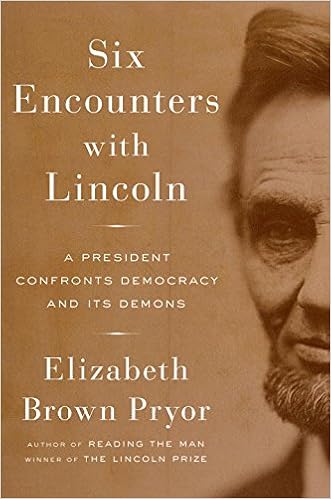
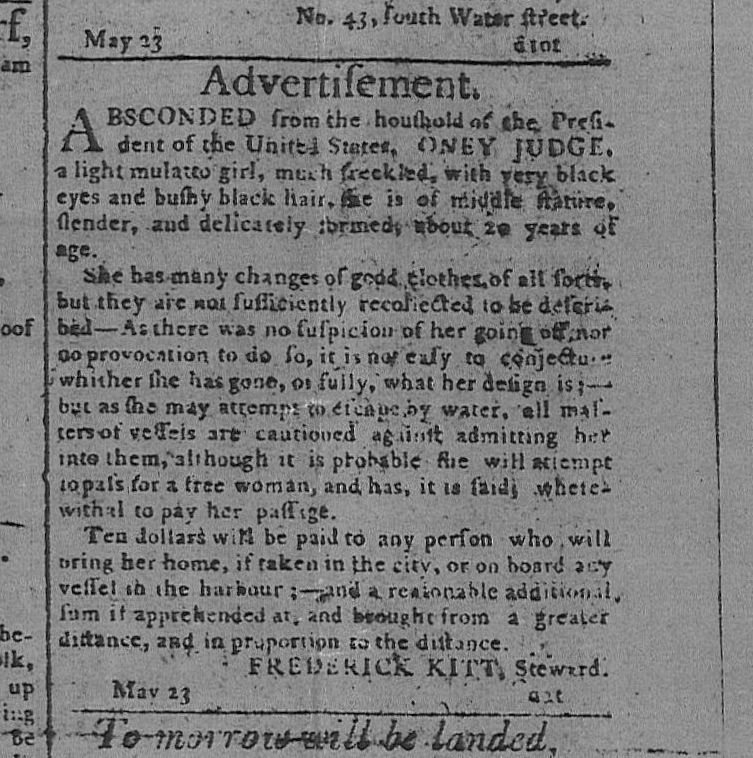
The New York Times reviews Joshua Kurlantzick’s A Great Place to Have a War: America in Laos and the Birth of a Military CIA, which is also on NPR and the Council on Foreign Relations’s Blog. Also in the Times, Alice Kessler Harris reviews Six Encounters with Lincoln: A President Confronts Democracy and Its Demons, Elizabeth Brown Pryor’s “portrait of a president whose failures to act often undermine the democratic ideals and the moral values to which he claims commitment.” Lincoln seems to be on everyone’s mind--perhaps in celebration of his upcoming birthday (one could hope for no better gift than a portrait of their failures to act!). Robert Merry reviews “Fit for the Presidency?” by Seymour Morris Jr. in the Wall St. Journal, and Colson Whitehead reviews a novel about the President. The Times also covers Erica Armstrong Dunbar’s Never Caught: The Washingtons’ Relentless Pursuit of Their Runaway Slave, Ona Judge, in a feature about the book and its author (no reference, surprisingly, to this more whimsical retelling of Judge’s story).

The WSJ also has a review of Tony Smith’s Why Wilson Matters (a “painstaking, take-no-prisoners attack on those who believe that America’s historical experience can be duplicated everywhere”) and Giles Milton’s “Churchill’s Ministry of Ungentlemanly Warfare: The Mavericks Who Plotted Hitler’s Defeat” (a “rousing account of World War II’s most insidious and devious heroes”).

In the Chicago Tribune, Wendi C. Thomas reviews Elizabeth Dowling Taylor’s The Original Black Elite: Daniel Murray and the Story of a Forgotten Era, which “chronicles the colored aristocracy's brief taste of nearly equal citizenship in the nation's capital in the late 1880s.”

The Guardian features an article about American writers and fascism. In the NYRB, Gary Wills reviews ~7 histories of Jesuits and global politics.

The Nation features reviews of Wesley Lowery’s “They Can’t Kill Us All”: Ferguson, Baltimore, and a New Era in America’s Racial Justice Movement (link here), which “sets out not only to track the latest developments in Black Lives Matter, but also to search for the movement’s deeper roots,” and Gareth Stedman Jones’ Karl Marx: Greatness and Illusion, which “portrays a Marx who, as a creature of the public controversies and sectarian intrigues of his time, belongs to the past rather than the future, his thought a historical curiosity with little enduring explanatory power.” As we mentioned in the Weekend Roundup, The Nation also published this analysis of modern immigration policy and resistance to the fugitive slave act by Eric Foner.

Finally, the New Books Network has posted reviews of The Watchman in Pieces: Surveillance, Literature, and Liberal Personhood a “wide ranging, deeply researched, and compellingly argued” theory of surveillance that claims that “the ultimate target of all surveillance activity” is “the individual self”; Eve Rosenhaft and Robbie Aitken’s Black Germany: The Making and Unmaking of a Disapora Community, 1884-1960 ; and Michael Roth’s Convict Cowboys: The Untold History of the Texas Prison Rodeo.

Saturday, February 11, 2017

A Book Talk on Castañeda Anastacio's "Foundations of the Modern Philippine State"

On Tuesday, February 14, between noon and 1:30pm, with lunch provided, the Harvard Law School Library staff and the Harvard Law School East Asian Legal Studies Program will host a a book talk and discussion on The Foundations of the Modern Philippine State: Imperial Rule and the American Constitutional Tradition in the Philippine Islands (Cambridge University Press, 2016), by Leia Castañeda Anastacio, a research fellow in the HLS East Asia Legal Studies Program. The event will take place in Harvard Law School Room Lewis 214A , Massachusetts Ave., Cambridge.  The commentators will be Professor Gerald Neuman, J. Sinclair Armstrong Professor of International, Foreign, and Comparative Law, and the Co-Director of the Human Rights Program, Harvard Law School, and Professor Chris Capozzola, Associate Professor of History at MIT.

About the book (from CUP’s website):
The US occupation of the Philippine Islands in 1898 began a foundational period of the modern Philippine state. With the adoption of the 1935 Philippine Constitution, the legal conventions for ultimate independence were in place. In this time, American officials and their Filipino elite collaborators established a representative, progressive, yet limited colonial government that would modernize the Philippine Islands through colonial democracy and developmental capitalism. Examining constitutional discourse in American and Philippine government records, academic literature, newspaper and personal accounts, The Foundations of the Modern Philippine State concludes that the promise of America’s liberal empire was negated by the imperative of insulating American authority from Filipino political demands. Premised on Filipino incapacity, the colonial constitution weakened the safeguards that shielded liberty from power and unleashed liberalism’s latent tyrannical potential in the name of civilization. This forged a constitutional despotism that haunts the Islands to this day.
About the author:
Leia Castañeda Anastacio is an independent scholar affiliate of Harvard Law School’s East Asian Legal Studies program. Placing first in the 1993 Philippine Bar Examinations, she was awarded Harvard Law School’s Yong Kim ’95 Memorial Prize in 2008 and the American Society of Legal History’s William Nelson Cromwell Foundation Dissertation Prize in 2010.

Weekend Roundup

  • From the Washington Post: "America got a civics lesson Tuesday night when Senate Republicans used an obscure rule to shut down a speech by Sen. Elizabeth Warren (D-Mass.) that criticized Sen. Jeff Sessions (R-Ala.), the nominee for attorney general." They got a legal history lesson, too -- on the origins of Rule 19. More on the same topic in the New York Times op-ed section, via contributors James Grimmelmann (Cornell Tech) and Jan Ellen Lewis (Rutgers-Newark).
  • Have we mentioned that legal historian Jed Shugerman (Fordham) now has a blog? The latest installment dusts off the old English writ of quo warranto and asks how state attorneys general might use quo warranto proceedings today to enforce the Emoluments Clause.
  • Ana Delić, Tilburg University, posted a report on the conference  International Law and the Long Nineteenth Century (University of Leuven, November 24-25, 2016), on the blog of the  European Society for Comparative Legal History.
  • Which reminds us: On Valentine's Day at 4:30 in the ceremonial courtroom of the E. Barrett Prettyman U.S. Courthouse in Washington, DC: "National Security and Reporter's Privilege," a reenactment of the oral argument in In re Judith Miller, sponsored by the Historical Society of the DC Circuit.
  • Also on Valentine's Day, "Denison University’s Department of History welcomes historian and legal scholar Barbara Young Welke presenting 'Law and the Borders of Belonging' at 4:30 p.m. on Feb. 14, in the lecture hall at Burton D. Morgan Center."  More.
Weekend Roundup is a weekly feature compiled by all the Legal History bloggers.

Friday, February 10, 2017

Research Grants at the State Historical Society of Iowa

The State Historical Society of Iowa (SHSI) announces a grant program for the 2017/2018 academic year. SHSI will award up to ten stipends of $1,000 each to support original research and interpretive writing related to the history of Iowa or Iowa and the Midwest. Preference will be given to applicants proposing to pursue previously neglected topics or new approaches to or interpretations of previously treated topics. SHSI invites applicants from a variety of backgrounds, including academic and public historians, graduate students, and independent re-searchers and writers.  Applications will be judged on the basis of their potential for producing work appropriate for publication in The Annals of Iowa. Grant recipients will be expected to produce an annotated manuscript targeted for The Annals of Iowa, SHSI’s scholarly journal.

Applications for the 2017/2018 awards must be postmarked by April 15, 2017. Download application guidelines from our web site or request guidelines or further information from:

Research Grants
State Historical Society of Iowa
402 Iowa Avenue
Iowa City  IA  52240-1806

Chetail on Sovereignty and Migration from Vitoria to Vattel

Vincent Chetail, Graduate Institute of International and Development Studies, has posted Sovereignty and Migration in the Doctrine of the Law of Nations: An Intellectual History of Hospitality from Vitoria to Vattel, which appears in the European Journal of International Law 27 (2016): 901–922:
This intellectual history of hospitality from Vitoria to Vattel provides an alternative story to the prevailing narrative of migration control. Although migration control is frequently heralded as falling within the domestic jurisdiction of states, the movement of persons across borders is a permanent feature of history that has been framed by international law for ages. The early doctrine of the law of nations reminds us that migration was at the heart of the first reflections about international law through the enduring dialectic between sovereignty and hospitality. This long-standing debate was framed by early scholars following three main trends, which constitute the focus of this article. The free movement of persons was first acknowledged by Vitoria and Grotius as a rule of international law through the right of communication between peoples. By contrast, Pufendorf and Wolff insisted on the state’s discretion to refuse admission of aliens as a consequence of its territorial sovereignty. Yet, in-between these two different poles – sovereignty versus hospitality – Vattel counterbalanced the sovereign power of the state by a right of entry based on necessity. As exemplified by the founding fathers of international law, the dialectic between sovereignty and hospitality offers innovative ways for rethinking migration.

Bessler's "Death Penalty as Torture"

John D. Bessler, University of Baltimore School of Law, has published The Death Penalty as Torture: From the Dark Ages to Abolition, with the Carolina Academic Press:
During the Dark Ages and the Renaissance, Europe’s monarchs often resorted to torture and executions. The pain inflicted by instruments of torture—from the thumbscrew and the rack to the Inquisition’s tools of torment—was eclipsed only by horrific methods of execution, from breaking on the wheel and crucifixion to drawing and quartering and burning at the stake. The English “Bloody Code” made more than 200 crimes punishable by death, and judicial torture—expressly authorized by law and used to extract confessions—permeated continental European legal systems. Judges regularly imposed death sentences and other harsh corporal punishments, from the stocks and the pillory, to branding and ear cropping, to lashes at public whipping posts.

In the Enlightenment, jurists and writers questioned the efficacy of torture and capital punishment. In 1764, the Italian philosopher Cesare Beccaria—the father of the world’s anti–death penalty movement—condemned both practices. And Montesquieu, like Beccaria and others, concluded that any punishment that goes beyond absolute necessity is tyrannical. Traditionally, torture and executions have been viewed in separate legal silos, with countries renouncing acts of torture while simultaneously using capital punishment. The UN Convention Against Torture strictly prohibits physical or psychological torture; not even war or threat of war can be invoked to justify it. But under the guise of “lawful sanctions,” some countries continue to carry out executions even though they bear the indicia of torture.

In The Death Penalty as Torture, Prof. John Bessler argues that death sentences and executions are medieval relics. In a world in which “mock” or simulated executions, as well as a host of other non-lethal acts, are already considered to be torturous, he contends that death sentences and executions should be classified under the rubric of torture. Unlike in the Middle Ages, penitentiaries—one of the products of the Enlightenment—now exist throughout the globe to house violent offenders. With the rise of life without parole sentences, and with more than four of five nations no longer using executions, The Death Penalty as Torture calls for the recognition of a peremptory, international law norm against the death penalty’s use.

Schillings, "Enemies of All Humankind"

New from Dartmouth College Press: Enemies of All Humankind: Fictions of Legitimate Violence (2017), by Sonja Schillings (Justus Liebig University, Giessen, Germany). A description from the Press:
Sonja Schillings argues that the legal fiction designating certain persons or classes of persons as enemies of all humankind does more than characterize them as inherently hostile: it supplies a narrative basis for legitimating violence in the name of the state. The book draws attention to a century-old narrative pattern that not only underlies the legal category of enemies of the people, but more generally informs interpretations of imperial expansion, protest against structural oppression, and the transformation of institutions as “legitimate” interventions on behalf of civilized society. Schillings traces the Anglo-American interpretive history of the concept, which she sees as crucial to understanding US history, in particular with regard to the frontier, race relations, and the war on terror.
A few blurbs:
“Schillings expands the discussion of legal and philosophical concepts in the current context of the 'war on terror' with greater historical depth than is usually found in such conversations, and she also makes a highly welcome contribution to the study of narrative fiction in such contexts.” —Ingo Berensmeyer

“This is he best kind of legal-historical scholarship. . . . Schillings illuminates central concepts, such as that of legal fictions, and explains their usefulness in situations that are from a legal perspective inchoate." —Greta Olson
More information is available here.

Thursday, February 9, 2017

Skeel on Equality of Creditors in Bankruptcy

David A. Skeel, Jr., University of Pennsylvania Law School, has posted The Empty Idea of "Equality of Creditors”:
For two hundred years, the equality of creditors norm — the idea that similarly situated creditors should be treated similarly — has been widely viewed as the most important principle in American bankruptcy law, rivaled only by our commitment to a fresh start for honest but unfortunate debtors. I argue in this Article that the accolades are misplaced. Although the equality norm once was a rough proxy for legitimate concerns, such as curbing self-dealing, it no longer plays this role. Nor does it serve any other beneficial purpose.

Part I of Article traces the historical emergence and evolution of the equality norm, first in the federal bankruptcy laws that applied to individuals and small businesses, and then as it diffused (much later) into large scale corporate reorganization practice. Part II describes how easy it has become to circumvent the norm, focusing on five strategies for giving a favored group of creditors a higher payout than other unsecured creditors. Although these evasions could and in some cases should be halted (as shown in Part III), it turns out that equality of creditors is a distraction (Part IV). It contributes nothing to an assessment of the relevant doctrines, and in several contexts seems to have had a pernicious effect. Elsewhere in the law, equality language can provide valuable benefits, such as “telling us that different treatment of people does matter.” Because none of these benefits is present in bankruptcy (Part V), the equality principle should be discarded.

Rahman Reviews Gerstle, "Liberty and Coercion"

Writing for JOTWELL's Legal History Section, K. Sabeel Rahman (Brooklyn Law School) has posted a review of Liberty and Coercion: The Paradox of American Government from the Founding to the Present (2015), by Gary Gerstle (Cambridge University). Here's the first paragraph:
As a field, legal history has long been centrally concerned with the patterns and trajectories of American political development and state formation. In his recent book, Liberty and Coercion: The Paradox of American Government from the Founding to the Present (Princeton University Press, 2015), Gary Gerstle offers a compact and highly readable synthesis of the long arc of the battles over the idea of a strong and central American state, from the constitutional founding through recent clashes between the Obama administration and the Tea Party. Gerstle and his work are of course well-known in the field. In this new book, he offers a cautionary narrative about this long process of state formation, and how it has set in place pathologies that fuel recurring crises of governance and legitimacy.
Read on here.

Wednesday, February 8, 2017

Preston on Australian military law

We're catching up on a few titles published in Commonwealth countries back in 2015. Here's the first—from Federation Press, Military Law in Colonial Australia by Neil Preston, OAM. From the publisher:
Product Details

This book breaks new ground in reviewing the naval and military law of the Australian colonies before their federation in 1901. Its particular focus is on the disciplinary codes contained in Acts of Parliament and subordinate legislation. A disciplinary code takes a certain form having regard to the nature of the force to which it is to apply, which in turn depends on the circumstances in which the force is raised and its proposed role.
Matters dealt with include:
  • an examination of the colonies’ many disciplinary codes and a discussion of their adequacy.
  • the political development of the colonies to the stage where they were prepared to raise local forces.
  • the development of the British part-time forces and the British naval and military disciplinary codes, because the colonies looked to Britain for precedents for the kinds of forces they might raise and the disciplinary codes they might provide.
  • the various kinds of naval and military forces that the colonies experimented with.
  • the colonies’ responses to the withdrawal of British regular army troops in the period 1860-70.
  • the colonies’ responses to the reports of senior British officers sent to the colonies to advise on defence matters, including the colonial forces.
  • the naval and military law applying to colonial forces serving in the Sudan, the Boer War and the Boxer rebellion in China.

Table of Contents after the jump.

Tuesday, February 7, 2017

Brophy on Black Power in a Prison Library

Alfred L. Brophy, University of North Carolina School of Law, has posted Black Power in a Prison Library:
Credit
“Black Power in a Prison Library” focuses on a list of 90 books on the black experience in America that were ordered added to the Marion, Ohio Correctional Institution in 1972. It uses the list as a way of gauging what books the plaintiffs (and thus the court) thought were essential to telling the African American experience. And in that way, we can use the list to reconstruct the contours of the bibliographic world of the African American experience in the early 1970s. The list reflects an interest in history of slavery, Reconstruction and Jim Crow, the literature of the Harlem Renaissance, the 1960s Civil Rights Movement, and contemporary works on Black Power. Notably thin is prison literature. Together the books help form a picture of the critique of law made by Black Power writers and the ways those claims built on historical, sociological, and civil rights literature. The book list, thus, suggests some of the ways that books propagated and gave definition to Black Power claims.

Johnson on Indigeneity and Settler States

Miranda Johnson, University of Sydney has published The Land Is Our History: Indigeneity, Law, and the Settler State with Oxford University Press. From the publisher:
The Land Is Our History tells the story of indigenous legal activism at a critical political and cultural juncture in Australia, Canada, and New Zealand. In the late 1960s, indigenous activists protested assimilation policies and the usurpation of their lands as a new mining boom took off, radically threatening their collective identities. Often excluded from legal recourse in the past, indigenous leaders took their claims to court with remarkable results. For the first time, their distinctive histories were admitted as evidence of their rights. 
Miranda Johnson examines how indigenous peoples advocated for themselves in courts and commissions of inquiry between the early 1970s to the mid-1990s, chronicling an extraordinary and overlooked history in which virtually disenfranchised peoples forced powerful settler democracies to reckon with their demands. Based on extensive archival research and interviews with leading participants, The Land Is Our History brings to the fore complex and rich discussions among activists, lawyers, anthropologists, judges, and others in the context of legal cases in far-flung communities dealing with rights, history, and identity. The effects of these debates were unexpectedly wide-ranging. By asserting that they were the first peoples of the land, indigenous leaders compelled the powerful settler states that surrounded them to negotiate their rights and status. Fracturing national myths and making new stories of origin necessary, indigenous peoples' claims challenged settler societies to rethink their sense of belonging.
Praise for the book:
"Miranda Johnson's wonderful, engaging, and nuanced new work, The Land Is Our History, crosses disciplinary, theoretical, geographic, and national boundaries. It not only compares the emergence of distinct indigenous rights movements across three Commonwealth settler states but also examines how such movements have transformed the meanings of national history within them. Impressively conceptualized and deeply comparative, this work is an important addition to the growing field of global indigenous history." -Ned Blackhawk 
"An important book, The Land is Our History offers critical insights into the tensions between white settler colonialism and indigenous peoples in the struggle over land. Over the last thirty years, Australia, New Zealand, and Canada shifted from policies of assimilation to recognition of indigenous claims to land. This book traces the structures of power which dispossessed indigenous peoples from their lands at the same time as it recognizes the capacity of indigenous leaders and particular judges and lawyers to change this trajectory. It brilliantly shows the capacity of law to offer, from time to time, power to the powerless, to those who have moral claims but lack economic and political power."-Sally Engle Merry 
"The Land Is Our History is an exemplary illustration of the complex and intertwined histories of indigenous politics and indigeneity in settler colonial societies. Moving beyond a conventional nation-state paradigm, it engages with the re-imagining of nationalist identities since the 1960s within a global context. Underscored is the forging of new legal spaces and opportunities to reframe nationalist myths, while also acknowledging the pitfalls and compromises involved in pursuing indigenous justice within formal western law. This sophistical historical account deserves attention from everyone interested in indigenous peoples' engagement with state law and the ways such engagement informs contemporary politics and cultural relations." -Eve Darian-Smith
More information is available here.

Monday, February 6, 2017

NHC's Congressional Briefing on the History of Executive Orders

[We have the following announcement.]

The National History Center will hold a Congressional briefing on the history of executive orders on Friday, February 17, at 10 a.m. in the Rayburn House Office Building, Room 2103, Washington, DC.

How does the flurry of executive orders issued by President Trump in his first few weeks in office compare to previous presidents' use of this power?  Three leading authorities on the subject will discuss the origins of the executive order and how it has been exercised in the past.

Speakers:  Julia Azari (Marquette), Matt Dallek (George Washington University), and Andrew Rudalevige (Bowdoin)

RSVPs are requested, here.

Snyder's "House of Truth"

Brad Snyder, University of Wisconsin School of Law, has just published The House of Truth: A Washington Political Salon and the Foundations of American Liberalism (Oxford University Press):
In 1912, a group of ambitious young men, including future Supreme Court justice Felix Frankfurter and future journalistic giant Walter Lippmann, became disillusioned by the sluggish progress of change in the Taft Administration. The individuals started to band together informally, joined initially by their enthusiasm for Theodore Roosevelt’s Bull Moose campaign. They self-mockingly called the 19th Street row house in which they congregated the “House of Truth,” playing off the lively dinner discussions with frequent guest (and neighbor) Oliver Wendell Holmes, Jr. about life’s verities. Lippmann and Frankfurter were house-mates, and their frequent guests included not merely Holmes but Louis Brandeis, Herbert Hoover, Herbert Croly - founder of the New Republic - and the sculptor (and sometime Klansman) Gutzon Borglum, later the creator of the Mount Rushmore monument.

Weaving together the stories and trajectories of these varied, fascinating, combative, and sometimes contradictory figures, Brad Snyder shows how their thinking about government and policy shifted from a firm belief in progressivism - the belief that the government should protect its workers and regulate monopolies - into what we call liberalism - the belief that government can improve citizens’ lives without abridging their civil liberties and, eventually, civil rights. Holmes replaced Roosevelt in their affections and aspirations. His famous dissents from 1919 onward showed how the Due Process clause could protect not just business but equality under the law, revealing how a generally conservative and reactionary Supreme Court might embrace, even initiate, political and social reform.

Across the years, from 1912 until the start of the New Deal in 1933, the remarkable group of individuals associated with the House of Truth debated the future of America. They fought over Sacco and Vanzetti’s innocence; the dangers of Communism; the role the United States should play the world after World War One; and thought dynamically about things like about minimum wage, child-welfare laws, banking insurance, and Social Security, notions they not only envisioned but worked to enact. American liberalism has no single source, but one was without question a row house in Dupont Circle and the lives that intertwined there at a crucial moment in the country’s history.
Professor Snyder's story on the book in Politico Magazine is here.  And here are some endorsements:

“For the first time, we have the real story of this incredible little galaxy that included such disparate figures as Felix Frankfurter, Walter Lippmann, and Gutzon Borglum, and reached out to cultivate and invigorate the aged Justice Oliver Wendell Holmes--with profound and lasting influence on the course of American politics. Brad Snyder tells this story with verve and insight. This is a major work in the history of this nation’s public life.” -- John Milton Cooper, Jr., author of Woodrow Wilson: A Biography

“With his deep understanding of history and the law, Brad Snyder has crafted a notably illuminating and refreshing book. Deeply researched and finely written, The House of Truth brings to life a group of brilliant friends whose passion for justice helped shape what became known as the American Century.” -- David Maraniss, author of Once in a Great City: A Detroit Story

“This dazzling book provokes reconsideration of the Progressive era, legal reform and modern American liberalism. I know of no other work that so ably transports its readers into the packed and exciting years of the early twentieth century.” -- Laura Kalman, Professor of History, University of California, Santa Barbara

Saturday, February 4, 2017

Weekend Roundup

  • Historians affiliated with the Immigration History Research Center at the University of Minnesota and the Immigration and Ethnic History Society have created a terrific resource for anyone seeking to "provide historical context to current debates over immigration reform, integration, and citizenship." #ImmigrationSyllabus
  •  Over at the Atlantic: Emma Green interviews Hidetaka Hirota (City College of New York) on the Trump Administration's proposal to deny admission to immigrants who would rely on government support. Spoiler alert: nothing new here. (Hat tip: History News Network)
  • If you are a junior scholar or practitioner interested in comparative constitutionalism, you may want to apply for an upcoming interdisciplinary summer course on Constitution-building in Africa at the Central European University in Budapest (July 3-14, 2017)Applications are due on Valentine's Day. More info here.
  • A Transregional Academy on Redistribution and the Law in an Antagonistic World will take place in Berlin, Aug.21-30, 2017. Doctoral students and postdoctoral scholars from the humanities, social sciences, and law are eligible to apply. The deadline is March 12, 2017. Full details here
  • Want to be part of a Selden Society-sponsored panel on English law at the NACBS in Denver, Nov.3-5, 2017? E-mail Peter.Larson@ucf.edu by Feb.20 with a title, abstract (250-300 words), and short CV (1-3 pages).
  • On Feb.8, Itimar Mann (University of Haifa) will give a lecture, "Humanity at Sea: Maritime Migration and the Foundations of International Law, 1945-2015" at the Columbia Global Centers in Paris, 7-9pm. Karen Akoka, Delphine Dogot, and Ben Gidley will be discussants. (Hat tip: H-Law)  
  • The American Historical Association has condemned the Executive Order Restricting Entry to the United States.  The Organization of American Historians has endorsed the AHA’s statement.  "Thirty AHA affiliated history organizations have done likewise."
  • ICYMI: A story on originalism in the Washington Post prompted by Judge Gorsuch's nomination, and another in the Guardian, on which see Larry Solum's clarification on Legal Theory Blog.
Weekend Roundup is a weekly feature compiled by all the Legal History bloggers.

Friday, February 3, 2017

Magliocca Reviews Bilder's "Madison's Hand"

Gerard N. Magliocca, Indiana University Robert H. McKinney School of Law, has posted A Faction of One: Revisiting Madison's Notes on the Constitutional Convention, which is forthcoming in Law and Social Inquiry:
This Essay on Madison’s Hand: Revising the Constitutional Convention, Mary Bilder’s revisionist account (2016) of James Madison’s Notes on the Constitutional Convention argues that her central thesis, which is that Madison substantially revised the Notes long after the Convention adjourned, is groundbreaking but will have no effect on constitutional law. Madison’s Hand is groundbreaking because the book yields many powerful insights into the deliberations of the Convention and into the evolution of Madison’s thought. Nevertheless, constitutional practice in the Supreme Court and among elite lawyers is so divorced from the Notes that even a dramatic shift in their interpretation will not disturb the evolution of judicial doctrine applying the text written in 1787.

Bernstein on the History of Substantive Due Process

David Bernstein, George Mason University Antonin Scalia Law School, has posted The History Of ‘Substantive’ Due Process: It's Complicated, which appeared in Texas Law Review 95 (2016): 1-11:    
The history of what has come to be known as substantive due process is fraught with political implications, even more so now that same-sex marriage has joined abortion as a right protected by the Court under the rubric of due process. It’s tempting to create a simplified version of the past that explains how we got from point A to point B, and that implicitly or explicitly teaches some profound lesson about the present. History, rarely truly lends itself to such convenience. It’s complicated.

With that in mind, this essay discusses a recent Texas Law Review article by Joshua Hawley. Hawley seeks to demonstrate that modern substantive due process jurisprudence was a novel invention of the Warren and Burger Courts, having no significant antecedents in the due process jurisprudence of the so-called Lochner era. Hawley makes some eminently reasonable points, especially with regard to how the Court replaced its historic natural-rights-based constitutionalism with a positivist understanding of the law that invites Justices to read their own philosophical views into the Due Process Clauses. Nevertheless, not all of Hawley’s claims are persuasive. In this essay, I complicate the story Hawley tells, by discussing alternative and additional explanations for the developments he discusses.

"Historians in Court" at OAH

[The Organization of American Historians' recent mailing to members on its 2017 meeting in New Orleans highlights the following plenary session, on Thursday, April 6, 4:00 pm to 5:30 pm.]

Historians in Court

Chair: 

Kenneth W. Mack, Lawrence D. Biele Professor of Law and Affiliate Professor of History, Harvard University

Panelists:

• Tomiko Brown-Nagin, Daniel P.S. Paul Professor of Constitutional Law, Harvard Law School and Professor of History, Harvard University
• George Chauncey, Samuel Knight Professor of History & American Studies, Yale University
• Linda Gordon, University Professor of the Humanities and Florence Kelley Professor of History, New York University
• Richard White, Margaret Byrne Professor of American History, Stanford University

Historians have increasingly responded when attorneys call on them to supplement strictly legal argument with additional corroborative and persuasive angles, especially in cases involving the assertion or defense of constitutional rights. This follows in a twentieth-century practice begun in 1908, when attorney Louis Brandeis successfully argued for state controls on women's employment conditions by bringing social scientific evidence of the strains women experienced. Not acting as advocates, but ostensibly providing impartial historical facts and opinion, historians have offered expert testimony that becomes part of important cases and also have written amicus curiae briefs that may possibly influence the court.

In this session, four historians will reflect on their significant experiences in this mode of making history matter in the present. Tomiko Brown-Nagin's comments stem from her involvement in cases on affirmative action in education, including Grutter v. Bollinger (2003), Parents Involved v. Seattle (2007), and Fisher v. Texas (2013). George Chauncey will discuss his participation as expert witness and author of amicus briefs in gay rights litigation from Romer v. Evans (1996) and Lawrence v. Texas (2003) to several more recent cases on equal marriage rights for same-sex couples, including U.S. v. Windsor (2013) and Obergefell v. Hodges (2015). Linda Gordon has co-authored historians' amicus briefs in major abortion rights cases, from Webster v. Reproductive Health Services (1989), where the Supreme Court upheld Missouri's restrictions on abortion rights, to Whole Women's Health v. Hellerstadt (2016) where the court struck down Texas' excessive requirements for abortion clinics. Richard White's service as an expert witness in tribal recognition and treaty rights cases in the Pacific Northwest extends back to 1977 and up to today.

Panelists will address several of the many pressing questions arising from this kind of endeavor. What kinds of historical evidence count in court? Are they acting as advocates or neutral experts? What are the differing ways that lawyers and historians read and use historical evidence? Does the history they contribute actually make a difference to the outcome of the case? Can any impact of historians' contributions be seen in change over time in the Supreme Court's interpretation of constitutional rights?

Lake on "The American Women Who Forged a Right to Privacy"

Yale University Press has released The Face That Launched a Thousand Lawsuits: The American Women Who Forged a Right to Privacy (Nov. 2016), by Jessica Lake (Swinburne University of Technology). A description from the Press:
Drawing on a wealth of original research, Jessica Lake documents how the advent of photography and cinema drove women—whose images were being taken and circulated without their consent—to court. There they championed the creation of new laws and laid the groundwork for America’s commitment to privacy. Vivid and engagingly written, this powerful work will draw scholars and students from a range of fields, including law, women’s history, the history of photography, and cinema and media studies.
A few blurbs:
"Jessica Lake’s The Face That Launched a Thousand Lawsuits is one of those rare books that truly upends conventional wisdom and changes the way readers understand an important subject. In a fascinating and well written account, Lake retells the history of the right to privacy. She shows how the activism of individual women played a central role in driving the legal recognition of that right. This book persuasively argues that we owe much to women who resisted the unauthorized circulation of photographic images of them. It is bracing and compelling from the first page to the last." -- Austin Sarat

"Cybercrimes of visuality today have a prehistory uncovered in this book, which shows how far women aggrieved at having their images circulated without their consent brought the legal cases that built the right to privacy." --Nancy F. Cott
More information is available here.

Thursday, February 2, 2017

"Images of Internment" at FDRL

[The following notice of an new exhibit at the Franklin D. Roosevelt Library arrived in our mailbox today.]

On February 19, 2017–the 75th anniversary of the signing of Executive Order 9066–the Franklin D. Roosevelt Presidential Library and Museum will open a new photographic exhibition entitled, Images of Internment: The Incarceration of Japanese Americans during World War II, with over 200 photographs including the work of Dorothea Lange and Ansel Adams. Signed by President Franklin D. Roosevelt, Executive Order 9066 led to the incarceration of 120,000 people of Japanese descent -- including approximately 80,000 American citizens--during World War II. The exhibit will be on display in the Library's William J. vanden Heuvel Gallery through December 31, 2017.  Regular hours and admission apply. [More.]

CFP: "International Law and International Relations at the End of the First World War"

Via H-Law, we have the following Call for Papers:
Rethinking the World Order:
International Law and International Relations at the End of the First World War
Oxford, 31 August – 1 September 2017 (Apply by 31 March 2017)
The horrors of the Great War and the desire for peace shaped scholarship in International Law and International Relations (IR) during the late 1910s—a stimulating time for both disciplines. Scholars observed and analysed political events as they unfolded but also took an active part, as governmental advisors or diplomatic officials, in devising the new international order. The Paris Peace Conference and the subsequent birth of the League of Nations as well as the Permanent Court of International Justice served as testing grounds for new legal and political concepts. The end of the First World War was in many ways a milestone for both disciplines, prompting scholars to reflect on the consequences of the war on society, politics, and the world economy. How could another world war be avoided in the future? How could states be held accountable for violations of international law? What were the preconditions for peaceful international governance? These questions led to pioneering research on issues such as arbitration, sanctions, revision of treaties, supra-national governance, disarmament, self-determination, migration, and the protection of minorities. At the same time, the study of International Law and IR also advanced in terms of methodology and teaching, including new professorships, journals, conferences and research centres.
A century later, it is a good moment to reflect upon disciplinary histories and revisit some of the theoretical and practical debates that shaped the period from 1914 to 1945. The workshop conveners are particularly (but not exclusively) interested in the following research questions:
  • Was the First World War a watershed moment for the development of International Law and IR?  
  • Which were the key debates in both disciplines? And how can they be re-interpreted today?  
  • What were the connections and/or dividing lines between the two disciplines?
  • Did International Law and IR evolve similarly across different countries?
  • Who were the principle actors, both individuals and institutions, in the respective fields?
  • Which role did International Law and IR respectively play in shaping ‘real-world’ policy? And to what extent were theoretical developments shaped by political events? 
  • How did ideas float between academia and politics?
  • How successful were non-governmental organisations—such as academic societies, arbitration clubs, political pressure groups, League of Nations clubs, the International Committee of the Red Cross (ICRC), etc.—in achieving their goals?
The two-day interdisciplinary workshop will be held at the European Studies Centre (ESC) at St Antony’s College, Oxford from 31 August to 1 September 2017. We invite abstracts from early career researchers and advanced postgraduate students in history, law, IR and other related disciplines to share their research in a multi-disciplinary environment. By facilitating this exchange we hope to open new avenues of research and to encourage new approaches to the history of both disciplines. We are planning to have six panels, one keynote address, and an open plenary session that allows all participants to pitch their research projects.
Please submit your proposal (including a title, 300 words abstract, and a short bio) to jan.stoeckmann@new.ox.ac.uk by 31 March 2017. Successful applicants will be notified by 30 April 2017. We are currently working on logistical details, including reimbursements and publication plans, and will keep you updated.
The convenors are Dr Gabriela Frei, British Academy Postdoctoral Research Fellow and Junior Research Fellow in History Jesus College, Oxford, and Jan Stöckmann, DPhil Candidate in History New College, Oxford.
Contact Info: 
Jan Stöckmann, New College, Oxford 
Contact Email: 

Wednesday, February 1, 2017

Whelan on Hayburn's Case

Dennis Whelan, Villanova University, has posted Hayburn's Case from Hayburn's Perspective: The Failure of the First United States Law Addressing Compensation for Service Connected Disability:  
The first United States law addressing compensation for service connected disability, the act of March 23, 1792, failed to be acceptable to part of the federal judiciary and was replaced within a year.

Most accounts of Hayburn’s Case convey only in passing an understanding that William Hayburn was a Revolutionary War veteran seeking compensation for disability incurred during his military service and that the problem from which he sought relief arose because the first United States law addressing compensation for service connected disability was a legislative failure. Attempting to look at the case from Hayburn’s perspective, I thought it a legislative failure worthy of notice and study.

This paper is divided into three parts. The first summarizes Hayburn’s case. The second considers the role that Henry Knox, the Secretary of War, had in framing the issues addressed in the failed March 23, 1792 act. This is done by examining a number of reports Knox made to Congress about the petitions of veterans and survivors. The third section reviews the legislative circumstances that resulted in the act.

A Carnival of Animals at the YLS Rare Book Room

(We’re not sure you’re in the mood for whimsy right now, but here goes.)  From former LHB guest blogger Mark S. Weiner we learn of the opening today of an exhibit at the Rare Book Room of the Yale Law Library, “Woof, Moo, Grr: A Carnival of Animals in Law Books.”  From the exhibit:
In late 2016, a group of over twenty animals—speaking through their chosen representative, Judge Mouse Marshall—approached a frequent visitor to the Rare Book Room at the Yale Law Library to express a gnawing concern. Tapping the visitor politely on the shoulder, Judge Marshall explained that many animals had long ago taken up residence in the rare book “vault,” but that they sadly had few opportunities to meet people out in the library. “Students, professors, visitors,” said Marshall with a squeak, “they don’t seem to realize we’re here. By the way, I think I smell something in your backpack. Is that a cheese sandwich?”

This exhibit grew from that initial conversation. Over a series of meetings, it was decided that the mouse and his colleagues would tell their stories in their own words, for human animals of all ages. They also were asked to share their names, which until now have been largely unknown—except those of Abby Smith’s cows and Judge Wise the owl, which are matters of public record. Unfortunately, only brief excerpts from their remarks can be shared here.

You may be surprised that so many animals live in the Rare Book Room. But law books with illustrations are one of the specialties of this library, and many illustrated law books have provided animals with especially welcome habitats. What different roles do animals play in these books? This exhibit explores that question, in the process quietly meditating on the relationship not only between animals and the law, but also between law and the imagination. Come with us and explore. And stop by the Rare Book Room, where many more animals are sleeping on the shelves, waiting to say hello.

Kang on "Making Immigration Law on the US-Mexico Border, 1917-1954"

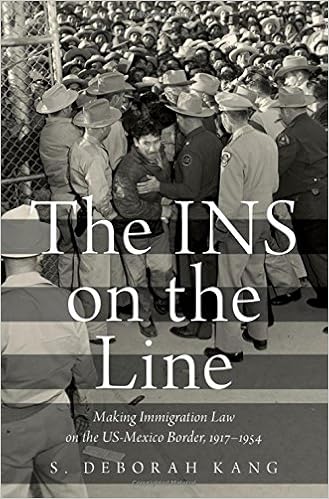
A timely release from Oxford University Press: The INS on the Line: Making Immigration Law on the US-Mexico Border, 1917-1954 (Dec. 2016), by S. Deborah Kang (California State University, San Marcos). A description from the Press:
For much of the twentieth century, Immigration and Naturalization Service (INS) officials recognized that the US-Mexico border region was different. Here, they confronted a set of political, social, and environmental obstacles that prevented them from replicating their achievements on Angel Island and Ellis Island, the most restrictive immigration stations in the nation. In response to these challenges, local INS officials resorted to the law, nullifying, modifying, and creating the nation's immigration laws and policies for the borderlands.

In The INS on the Line, S. Deborah Kang traces the ways in which the INS on the US-Mexico border made and remade the nation's immigration laws over the course of the twentieth century. Through a nuanced examination of the agency's legal innovations in the Southwest, Kang demonstrates that the agency defined itself not only as a law enforcement unit but also as a lawmaking body. In this role, the INS responded to the interests of local residents, businesses, politicians, and social organizations on both sides of the US-Mexico border as well as policymakers in Washington, DC. Given the sheer variety of local and federal demands, local immigration officials constructed a complex approach to border control, an approach that closed the line in the name of nativism and national security, opened it for the benefit of transnational economic and social concerns, and redefined it as a vast legal jurisdiction for the policing of undocumented immigrants.

The composite approach to border control developed by the INS continues to inform the daily operations of the nation's immigration agencies, American immigration law and policy, and conceptions of the US-Mexico border today.
A few blurbs:
"Kang's deeply researched book yields powerful insights about the importance of studying immigration law in action, shifting our focus from Congressional policy-makers in the nation's capital to low-level immigration officials on the nation's southwestern border with Mexico in the first half of the twentieth century. Short on resources and torn between competing interests, immigration officers used their most powerful weapon--administrative discretion--to devise procedures that ultimately became national policy. Want to understand what made today's militarized border possible? Read this book!"--Lucy E. Salyer
"The INS on the Line is a superb book. Kang provides an institutional history of the Immigration and Naturalization Service on the US-Mexico border that is engaging and deeply illuminating. She illustrates the myriad ways in which rank and file agency officials stationed in California, Arizona, and Texas not only implemented federal immigration law, but also helped craft the law itself, demonstrating that they did so not only to better reflect the complex realities of border life but also to better serve the agency's own interests. Though focused on the first half of the twentieth century, the book contains critical insights for our understanding of contemporary immigration policy. This timely book is a must-read for scholars interested in immigration policy, borderlands studies, and the American administrative state."--Cybelle Fox
More information is available here.

Tuesday, January 31, 2017

Law and Colonial Violence: An International Workshop

[We are moving this post up and adding a link to the finalized program, which we've just received.]

[We have the following announcement of Law and Colonial Violence: An International Workshop at to be held at Queen Mary University of London and sponsored by QMUL, Cambridge University, and the European University Institute, to be held on 14 February 2017.  The deadline for abstracts is 17 December 2016.]

Now more than ever, the relationship between colonial violence and law stands at the centre of public and scholarly attention. While some have sought to position law as a ‘limiting factor’ in restraining the violence of imperial rule, there is plenty of empirical evidence illustrating the degree to which jurists and the law itself have been deeply implicated in the creation and maintenance of empire, including its utility of violence. Growing academic interest in the connections between these two perspectives has been made evident by important new fields of inquiry. These include legal, social scientific, and historiographical debates on colonial violence in the ‘long’ nineteenth century, as well as more recent discussions regarding international criminal law since the end of the Cold War, turns to ‘history', ‘critical theory’, the ‘global’, or ‘postcolonial’ in legal and intellectual history, the laws of war in the post-9/11 epoch, and arguments regarding the ‘breakthroughs’ of human rights in the 1970s and 1990s - or, perhaps, (much) earlier.

In light of recent attempts to engage in interdisciplinary study of new discourses and methodological approaches, this international workshop co-organized by Queen Mary University of London (QMUL), the European University Institute (EUI), and the University of Cambridge seeks to examine the genealogy of this complex and frequently contested intersection of law in its broadest sense, imperial violence, and the growing force of internationalism from a truly global perspective by calling for papers that address these questions and themes.

This workshop will seek to bring together both graduate students and more advanced scholars working with a variety of historical, legal, intellectual, and theoretical methods to explore the relationship between law and imperial violence from roughly the 1800s up to the 1970s, when decolonization was reaching its end phase and the Additional Protocols were being signed. We particularly invite scholars working on those laws regulating policing and violence in an imperial context, such as emergency penal, or martial laws, the laws of war, and human rights.
Potential topics range from, but are not limited to, the implementation of colonial emergency laws at a local, regional or national level; law as a justifier or facilitator of violence; law as an instrument for limiting or ending colonial violence; the laws of war and human rights in colonial and postcolonial contexts; a conceptual or theoretical history of law, civilization, race, and colonial violence; indigenous resistance and the law; historical comparisons across time, geographical locations (metropole/periphery), and empires; the influence of empire on the drafting of new laws or declarations regulating warfare and imperial policing; and the problem of clashing or overlapping legal regimes in imperial contexts (e.g. emergency laws vs. human rights).

The workshop, which is organized by Jacob Ramsay Smith (QMUL), Joseph McQuade (Cambridge), and Boyd van Dijk (EUI/King's College), aims at bringing together scholars into a one-day intensive workshop at QMUL. It will feature a number of panels and a keynote lecture by Professor Dirk Moses, of the University of Sydney. Abstracts (350 words long) should be submitted to lawcolonialviolenceworkshop@gmail.com and are due December 17, 2016.

CFP: "Governance and Rights: Law, Religion, and Sexuality in Caribbean Literature and Culture"

Via H-Law, we have the following Call for Papers:
Governance and Rights. Law, Religion, and Sexuality in Caribbean Literature and Culture

Junior Research Conference: Society of Caribbean Research (Socare)

Venue: University of Salzburg

Organizers: Christopher F. Laferl, Ralph Poole, Philipp Seidel

Date: 23 – 25 November 2017

The Caribbean is distinguished for its great political and cultural diversity, which not only is discernable by various languages, but also by the multiplicity of religions, social norms and values, and legal systems. Although Latin America continues to be regarded as a Catholic continent, the situation in the Caribbean is more complex. On the one hand, the Catholic Church competes against traditional Protestant churches, on the other hand both are distinct from (syncretistic) Afro Caribbean religions as well as increasingly from evangelical Pentecostal churches. This religious and cultural mixture poses serious challenges to the state, the society, the legal system, but also to the arts and literature. The various types of governmental and legal systems largely date back to differing traditions of (previous) colonial powers. While the (former) British territories rely on the Anglo-Saxon Common Law, the other territories follow continental European legal systems. And yet, these orders only make up the outer framework within which the people of a state move and act. How individuals and/or various collectives actually live together and how their attitudes and behavior towards the state and other institutions are shaped, all this underlies a continuous process of negotiation that can take on multifarious forms.

Against this backdrop the focus of the junior scholar conference of the Society of Caribbean Research (Socare) lies on questions concerning governance and rights. Not only the (in)stable, democratic or authoritarian governments play an important role, but also the specific means of governing. Besides the actual political players, who justify their position and actions and take on responsibility, economic, social and religious institutions also have a great importance in matters of shaping the communal lives of their societies, especially when politics cannot offer effective solutions or when the success of their implementations remains questionable. Furthermore, what is at stake is the question in how far the principle of non-discrimination, which since the Enlightenment has been reclaimed for more and more areas of identity also on a supranational level, is being realized by the single states and in social practice. Especially with regard to observing the various non-discriminatory regulations there are still (or again?) great differences concerning gender, ethnicity, class, and sexuality, not least since several categories of identity are often in (open) conflict with one another.

The following questions may serve as framework for the conference’s topic:
  • How do modern life concepts that are characterized by a will to self-determination conform to current developments in Caribbean societies? In what ways do literature and other arts reflect these developments?
  • How are problems concerning discrimination, ostracism, suppression and violence being dealt with? What solutions are being offered and by whom?
  • How is sexuality, broadly understood as encompassing pre/extramarital sex, abortion, same-sex sexuality, sex trade, etc., being treated?
  • How do the creative artists deal with minority groups, what positions do they take on?
  • How do the various legal and belief systems react to the principle of non-discriminatory self-determination? In what ways to these systems affect different levels of society?
  • What influence do migratory processes have on these negotiations?
  • What significance do writers and artists play, and what location have they chosen to write/speak/produce from?
  • What is the function of hate speech and victimization in literary, musical, and other creative art forms?
We invite junior scholars from all areas and disciplines of Caribbean Studies to participate. Interdisciplinary contributions from legal and theological sciences are also most welcome. The contributions should not exceed the limit of 20 minutes.

Those interested should send a half-page abstract in either German, English, Spanish, or French along with a short bio to Philipp Seidel (philipp.seidel@sbg.ac.at ) by March 15, 2017. Please state the preferred language for your talk and what other languages you feel comfortable with. The conference’s languages will be chosen according to the selected contributions. The contributors will be informed in time.  
Contact Info:

Philipp Seidel

University of Salzburg

Dep. of Romance Studies

Erzabt-Klotz-Str. 1

A - 5020 Salzburg 
Contact Email:
philipp.seidel@sbg.ac.at