Legal governance of memory has played a central role in establishing hegemony of monumental history, and has forged national identities and integration processes in Europe and beyond. In this book, a range of contributors explore both the nature and role of legal engagement into historical memory in selected national law, European and international law. They also reflect on potential conflicts between legal governance, political pluralism, and fundamental rights, such as freedom of expression. In recent years, there have been numerous monumental commemoration practices and judicial trials about correlated events all over the world, and this is a prime opportunity to undertake an important global comparative scrutiny of memory laws. Against the background of mass re-writing of history in different parts of the world, this book revisits a fascinating subject of memory laws from the standpoint of comparative law and transitional justice.
Friday, January 26, 2018
An Essay Collection on "Law and Memory"
Published last fall by the Cambridge University Press is Law and Memory: Towards Legal Governance of History, edited by Uladzislau Belavusau, University of Amsterdam, and Aleksandra Gliszczynska-Grabias, Polish Academy of Sciences.


Thursday, January 25, 2018
The 14th Amendment at 150 at George Mason/Scalia
 [We have the following call for papers.]
The Institute for Justice's Center for Judicial Engagement and the Liberty & Law Center at Antonin Scalia Law School are pleased to announce a symposium to reflect on the 150th anniversary of the adoption of the U.S. Constitution's Fourteenth Amendment, ratified in July 1868. The day-long symposium will be held Friday, September 21, 2018.
This sesquicentennial symposium will focus on how the Fourteenth Amendment recalibrated the relationship between the American people and state and local governments; and how that relationship continues to change as courts apply, misapply, or fail to apply key provisions of the Fourteenth Amendment. In particular, the symposium will address the Fourteenth Amendment's legacy for individual rights and liberties.
We invite all interested scholars to submit proposals to present at the symposium. We will select papers that would be appropriate for any of four panels which will discuss current or emerging issues arising out of the Due Process Clause, the Equal Protection Clause, the Privileges or Immunities Clause (and analogous state constitution provisions), and the incorporation of the Bill of Rights; or research on the history and original meaning of any of those topics.
A roundtable workshop for selected papers will be hosted in June 2018 to discuss draft papers. Travel and hotel will be provided for the June roundtable and the September symposium. An honorarium will also be provided.
Paper Submission Procedure: Applicants should email their proposals and curriculum vitae to Sheldon Gilbert at sgilbert@ij.org no later than February 20 at 11:59 PM EST. Proposals should be no longer than one page.
Hart Publishing Sale
 Hart Publishing is offering, today only, a 25 percent off sale, including for books on its large legal history list.
Balancing book and family
Every
scholar faces a unique blend of personal responsibilities they must balance
alongside their research and writing lives. This post will focus on my
experience balancing parenthood while on the tenure track and writing my
book. It is my hope that some of the
advice that follows will apply beyond my experience, though I can imagine that
many of the LHB’s readers might have faced similar challenges. I also want to add that the difficulties academics
encounter in trying to balance work and family life are not much different than
any working parent or caregiver.
As a graduate
student who hoped to have kids, I often wondered and discussed the best timing.
Some of my friends had children at different points during graduate school,
while others waited for graduation or for tenure. I chose to wait until after I
started my job, but I don’t believe there is any such thing as perfect timing
(or that one can always choose the timing!).
I learned
I was pregnant during the first semester of my new job. I was nervous at first
to talk to my department chair about it. Auburn had allowed me to defer my
position by a year to accept my postdoc, so I figured they might not be
thrilled to learn that I would need some time off the next fall (I was due
about a week before the fall semester). When I finally approached my chair, he
immediately expressed his overwhelming excitement and support. I share this
detail—which I’ve told very few people—because I think there is often anxiety
about the unknown when adjusting to a new job or professional situation.
Department cultures vary, as do university policies for family leave.
Teaching
while pregnant is less than ideal, even in the smoothest of pregnancies, but I
had good support from my colleagues and my partner. I was also able to take a
semester of parental leave after having both of my summer babies (in 2011 and
2014). I believe the arrival of your
first child is always jarring, but my daughter Olivia’s arrival came with a
health scare and twelve days in the NICU.
I had made so many plans for how the first days of parenthood would go; the
reality shattered those expectations. I was in the hospital for less than
twenty-four hours after giving birth and spent the next two weeks sleeping in a
dingy Montgomery hotel when I wasn’t holding vigil next to my daughter’s NICU
bed. It was terrifying, but Olivia is now a thriving, healthy 6-year-old. She
taught me from day one that with kids, there is often no point to making plans
about how things “should” go.
Family
leave semesters create an interesting dynamic, even in the best of departments
with supportive colleagues like mine. Sometimes colleagues or friends who have
not had a family leave semester don’t necessarily understand what they entail. Sometimes they expect that you might be able
to do research or service obligations during those semesters. During my first
parental leave, I foolishly tried to make plans to do “a little bit of work”
during naptimes or after Olivia went to bed (ha!). Even if your child’s sleep
schedule allows for short windows of time, parents are often too busy with
other tasks or too tired from the baby’s schedule to get real thinking done. [Side
note: I absolutely understand that for many parents, real work has to be done
during these months, so it must be possible to function at some level!] As a
result of my expectations, I spent much of those few months worried about
work—what I should be doing, the writing/reading I should be accomplishing. In
my last post, I indicated how one way to balance it all involves forgiveness
when you fall short of your own high expectations. I may come back to that
point a few times in this post, too. Dwelling on the work I wasn’t doing robbed
me of some of the joys and precious moments with my new daughter. It was a hard
lesson but one I remembered when I took my second family leave semester after
my son’s arrival.
The
semester that I returned to teaching after my first family leave was one of my
most difficult semesters. I taught three classes, including two new preps that
required writing new lectures. I had an infant at home who required
near-constant attention (let’s face it, they all do!). Honestly, that time is a
blur for me now. I’m not sure how I managed to balance it all. I do remember
that I did virtually no writing or research that spring.
At Auburn,
the university’s policy is to allow for an extension of the tenure clock after
having a baby or any major life event. My chair thought I probably wouldn’t
need the extra time, but I figured it was better to be safe than sorry. I
applied for and received the extension after both of my family leave semesters.
I would highly recommend that anyone in
a similar situation find a trusted senior colleague or someone outside of your
department to ask about family leave policies and the possibility of extending
the tenure clock. Although I was not able to communicate the absence in
research productivity on my c.v., at least my tenure and promotion materials
reflected that I had two family leave semesters. I did end up needing one of
those two extensions to complete the requirements for tenure on time. It is
difficult to predict how the book publication process will go (more on that in
the next post), so it is always a good idea to arrange for extra time if you
can. More on my story after the jump
break…
Judge Seeks Research Assistant To Help Write Memoir
Via H-Law we have the following intriguing announcement:
Seeking research assistant to help judge write memoir
by Christian Burset
I have been asked to post the following announcement:
A judge in the Washington, DC area is looking for someone to assist him in writing his memoirs. The work would include helping to organize the judge’s papers and helping to structure his narrative. The assistant would likely begin by interviewing the judge, recording the interviews, and conducting independent research as needed to provide context. The work would be done in the evening or on weekends at the judge’s home.
The assistant should have experience or training in interviewing subjects of oral histories; some knowledge of law would be helpful. The assistant would be compensated by the hour. The first phase of the project would take at least five months, and possibly longer if the assistant is interested. The assistant should expect to work approximately 10 hours each week.
If interested, please send a CV or résumé to Christian Burset (christian.burset@nyu.edu), who will forward it to the judge.
Wednesday, January 24, 2018
Book Talk: Erbelding’s "Rescue Board"
This Monday, Monday, January 29, 2018, 4:00pm-5:30pm, in the Woodrow Wilson Center 6th Floor Moynihan Boardroom, the Washington History Seminar convenes for Rescue Board: The Untold Story of America’s Efforts to Save the Jews of Europe
US Holocaust Memorial Museum historian Rebecca Erbelding’s Rescue Board: The Untold Story of America's Efforts to Save the Jews of Europe, based on a decade of research, is the first (non-self-published) study of the War Refugee Board, created by FDR in January 1944 to save the lives of Jews and other persecuted minorities during the Holocaust. Though the WRB’s work has often been relegated to the end of larger tomes of American indifference, Erbelding argues that the WRB staff were passionate and creative, saved tens of thousands of lives, and should be an example for today.

CFP: European Narratives of Crisis
[We are moving this post up, because the deadline for submissions has been extended to February 4, 2018.]
[We have a call for papers for the conference European Narratives of Crisis, to be held May 17-18, 2018, at the University of Helsinki, Finland. It is hosted by the Centre of Excellence in Law, Identity and the European Narratives (EuroStorie).]
In his 1919 essay The Crisis of the Spirit Paul Valéry wrote: ”We civilizations now know ourselves mortal.” What the French philosopher captured was a prevalent mood of the post-war era: a sense of finitude not only of particular peoples but of European culture as a whole. In these years it was particularly the concept of crisis that became one of the central symbols to describe the sense of an acute turn, the loss of foundations, or even an irreversible demise.
However, as a political and cultural concept ’crisis’ is by no means neutral. It may be used as a device of political demagogy or a call for passiveness. As Foucault once put it, crisis may also imply a “heroization of the present” in order to elevate a particular historical moment into an absolute turning point in history. Historically speaking, crisis is an ”empty signifier” that is open to various interpretations and meanings. It has supported both optimist and pessimist narratives on the course of history, and provided several opportunities for active intervention on behalf of intellectuals, politicians and the like. In today’s Europe, the euro crisis and the so called refugee crisis have significantly strengthened political divisions; however, the moral, legal and institutional implications of these events are yet to be analyzed.
In this conference we explore the many sides of the concept of crisis in the 20th century European context. We seek to address the phenomenon of the crisis both as a concept and as a form of experience that tells us something of our relation to culture as a whole. We are interested in interventions that tackle this concept in relation to historical narratives, political institutions, legal culture, and social divisions. How do Europe and European history appear as they are viewed through the lens of the crisis? What political, moral, or ideological purposes does the concept of crisis serve?
[We have a call for papers for the conference European Narratives of Crisis, to be held May 17-18, 2018, at the University of Helsinki, Finland. It is hosted by the Centre of Excellence in Law, Identity and the European Narratives (EuroStorie).]
In his 1919 essay The Crisis of the Spirit Paul Valéry wrote: ”We civilizations now know ourselves mortal.” What the French philosopher captured was a prevalent mood of the post-war era: a sense of finitude not only of particular peoples but of European culture as a whole. In these years it was particularly the concept of crisis that became one of the central symbols to describe the sense of an acute turn, the loss of foundations, or even an irreversible demise.
However, as a political and cultural concept ’crisis’ is by no means neutral. It may be used as a device of political demagogy or a call for passiveness. As Foucault once put it, crisis may also imply a “heroization of the present” in order to elevate a particular historical moment into an absolute turning point in history. Historically speaking, crisis is an ”empty signifier” that is open to various interpretations and meanings. It has supported both optimist and pessimist narratives on the course of history, and provided several opportunities for active intervention on behalf of intellectuals, politicians and the like. In today’s Europe, the euro crisis and the so called refugee crisis have significantly strengthened political divisions; however, the moral, legal and institutional implications of these events are yet to be analyzed.
In this conference we explore the many sides of the concept of crisis in the 20th century European context. We seek to address the phenomenon of the crisis both as a concept and as a form of experience that tells us something of our relation to culture as a whole. We are interested in interventions that tackle this concept in relation to historical narratives, political institutions, legal culture, and social divisions. How do Europe and European history appear as they are viewed through the lens of the crisis? What political, moral, or ideological purposes does the concept of crisis serve?
Miniter on "My Ántonia" and Legal Thought
Paulette C. Miniter, UVA Law JD 2016, has published Willa Cather's My Ántonia and Legal Thought in the Late Nineteenth Century, in the Creighton Law Review 51 (2017): 119-168.
 |
| Willa Cather (NYPL) |
In the 1918 novel My Ántonia, Willa Cather offered an unusual portrait of the American experience. Cather’s method was to present a central female character through the eyes of a male narrator. The narrator, Jim Burden, is a Harvard-educated lawyer in New York for “one of the great Western railways.” Ántonia Shimerda is a friend from his childhood in Nebraska during the waning days of the frontier. Jim tells the story of how Ántonia, the daughter of poor Bohemian homesteaders, survives the suicide of her father and the disgrace of being an unwed mother to build a life on the land and thus bear out the “pioneer ideal.” Despite their disparate social statuses and divergent life paths, Jim sees Ántonia as the utmost symbol of “the country” and “conditions” of his youth.Update: The SSRN post of the article is here.
Breen and Strang Review Kaczorowski's "Fordham Law"
John M. Breen, Loyola University Chicago School of Law, and Lee J. Strang, University of Toledo College of Law, have posted The Thinness of Catholic Legal Education, a Review of Robert J. Kaczorowski, Fordham University Law School: A History, which is forthcoming in the University of St. Thomas Law Journal 15 (2018). The review draws upon some of the Professors Breen and Strang’s own research on Catholic legal education. They write:
I could not confirm my impressions without asking my senior colleagues to revisit battles they preferred to leave in the past. After two oral histories, I realized I could be either a good historian or a good colleague and chose the latter. I took the story through the deanship of the lay Catholic Paul R. Dean and then left the writing of Georgetown Law’s more recent past to others. Although I am listed as the author of the sections I wrote, the Georgetown University Law Center appears as the book's author on its title page.
I can’t speak for Professor Kaczorowski, but I found it very hard to address the comparable “thinning” of Catholic and Jesuit identity at Georgetown Law in The First 125 Years (1995). When I joined the law faculty thirty years ago this summer, many of my senior colleagues were lay Catholics who had either participated in or supported the wresting of control of the school from a Jesuit regent. My impression was that this generation originally believed that lay control would make Georgetown better without making it secular. Over the years, it seemed to me, they decided that although they had been right about the former, they had been wrong about the latter.In his recent book, Fordham University Law School: A History, Robert J. Kaczorowski has authored an informative and scholarly history of Fordham Law School.
In this Review of the book, we first briefly summarize the overall history that Kaczorowski conveys. It is the story of an urban law school founded in 1905 to serve the professional aspirations of the children of New York's Catholic immigrants - a school that rose from modest beginnings to be among the nation's finest, but then languished in mediocrity for decades due to the syphoning off of revenue by university administrators. This period of unfulfilled potential came to an end in the 1990s, when Fordham Law School returned to elite status.
After describing Kaczorowski's history, we then explain how the narrative Kaczorowski sets forth exemplifies the gradual attenuation of Catholic identity in Catholic legal education. Professor Kaczorowski's account of Fordham Law School provides evidence of this attenuation of Catholic identity in legal education over time, and is itself proof of the thinness of this identity in the present day. Thus, while Fordham Law School's Catholic and Jesuit identity feature prominently in the early chapters of Kaczorowski's book, by the end of the story, this identity is an afterthought - a passing descriptive attached as a kind of certification of continuity with the past. Although this loss of identity is part of the history of Fordham Law School, Kaczorowski's book does not address it directly, nor does it reflect upon the significance of this change.
I could not confirm my impressions without asking my senior colleagues to revisit battles they preferred to leave in the past. After two oral histories, I realized I could be either a good historian or a good colleague and chose the latter. I took the story through the deanship of the lay Catholic Paul R. Dean and then left the writing of Georgetown Law’s more recent past to others. Although I am listed as the author of the sections I wrote, the Georgetown University Law Center appears as the book's author on its title page.
Stewart on Fatimid Islamic law
 We missed this one back in 2015, but the paperback of Al-Qadi al-Numan’s Disagreement of the Jurists: A Manual of Islamic Legal Theory,
translated by Devin J. Stewart, Emory
University, came out in 2017 with NYU Press. It includes a foreword
by John Coughlin and John Sexton. From the publisher:
We missed this one back in 2015, but the paperback of Al-Qadi al-Numan’s Disagreement of the Jurists: A Manual of Islamic Legal Theory,
translated by Devin J. Stewart, Emory
University, came out in 2017 with NYU Press. It includes a foreword
by John Coughlin and John Sexton. From the publisher:A masterful overview of Islamic law and its diversity Al-Qadi al-Nu'man was the chief legal theorist and ideologue of the North African Fatimid dynasty in the tenth century. This translation makes available for the first time in English his major work on Islamic legal theory (usul al-fiqh), which presents a legal model in support of the Fatimid claim to legitimate rule.
Composed as part of a grand project to establish the theoretical bases of the official Fatimid legal school, Disagreements of the Jurists expounds a distinctly Shi'i system of hermeneutics. The work begins with a discussion of the historical causes of jurisprudential divergence in the first Islamic centuries and goes on to engage, point by point, with the specific interpretive methods of Sunni legal theory. The text thus preserves important passages from several Islamic legal theoretical works no longer extant, and in the process throws light on a critical stage in the development of Islamic legal theory that would otherwise be lost to history.
Praise for the book:
“This book will be useful especially to
those who are interested in the history of law and…the history of the
Fatimids.” -Speculum
"[Disagreements
of the Jurists] is very important for students of jurisprudence and
for reconstructing fiqh's
development.” -American Journal of Islamic Social Sciences
"Stewart has rendered al-Nu'man’s work
into intelligible and elegant English, in keeping with the goals of the Library
of Arabic Literature series to open up certain valuable and influential works
in the Arabic tradition to a wider reading public." -Journal of the
American Oriental Society
Further details about
the book are available here.
Johnston on Segregation and the DC Federal Courthouse (and Zasloff on DOJ and the Fair Housing Act)
James H. Johnston, a lawyer, writer, and lecturer in Washington D.C., has just published Segregation in the Federal Courthouse in Washington D.C. Before and After Brown v. Topeka Board in the Howard Law Journal. To borrow from the introduction of this thoroughly researched article:
Attempts to eliminate the [DC Bar] Association’s whites-only policy [including access to its library] began in 1950 and included seven proposed votes by members, two lawsuits trying to integrate the Bar, two lawsuits trying to block integration, three court of appeals opinions, one federal district court opinion, and several dead cats before integration was achieved in 1958. The judiciary hardly distinguished itself. All but one of the federal judges hearing the lawsuits held honorary memberships in the segregated Association. And, two legal titans involved in settling [African American lawyer Huver] Brown’s original complaint [seeking access to the library in 1939], Robert Jackson and E. Barrett Prettyman, revisited the constitutionality of segregation in the 1950s as Supreme Court justice and Court of Appeals judge in the school cases. Both seemed to forget the precedent set in the library case. Court of Appeals Judge Prettyman saw nothing wrong with segregated schools in Washington, D.C. Supreme Court Justice Jackson struggled with the same issue before joining a unanimous Court in the landmark desegregation case Brown v. Board of Education.Update: You may now read the article as it appears in volume 61:1 of the Howard Law Review, where it appears with Al Brophy's Black Power in a Prison Library and Jonathan Zasloff’s “Between Resistance and Embrace: American Realtors, the Justice Department and the Uncertain triumph of the Fair Housing Act, 1968-1978." Here is the abstract for Professor Zasloff's article:
Despite the historical consensus that the Fair Housing Act was ineffective and toothless, the first decade after the Act’s passage saw sharply reduced rates of discrimination. After demonstrating that such a significant drop could not have been the result of overall changing racial attitudes, this Article attempts to show that it resulted from the enforcement of the Act itself – especially the vigorous efforts of the Department of Justice. Not only did DOJ successfully sue hundreds of landlords and developers across the country (including the heretofore unknown New Yorker Donald J. Trump), but it focused its efforts on America’s real estate agents – a linchpin of the system of housing discrimination. These actions succeeded: this Article presents evidence from the realtors themselves and from fair housing advocates – who did not figure to be overly optimistic – that substantial changes in behavior resulted from aggressive litigation by federal civil rights law enforcement. The efforts were not a universal success, for by the end of the 1970’s discrimination rates remained far too high. And they did not alter patterns of segregation. But they represented a significant policy success. The Article concludes how the story of successful civil rights enforcement generates important theoretical implications in the psychology of law, theories of social norms, and the celebrated “Convergence Thesis” of American civil rights law.
Tuesday, January 23, 2018
CFP: Encounters, Rights, and Sovereignty in the Iberian Empires
[Via H-Law, we have the following announcement.]
The Call For Papers is now open for the International Conference “Encounters, Rights, and Sovereignty in the Iberian empires, 15th-19th centuries." Focused on the colonial encounters fostered by the Iberian empire-building processes and on the strategies developed to regulate the rights and lives of native and colonial populations, this conference welcomes proposals that privilege the comparisons and interactions between the Portuguese and Spanish colonizing dynamics, in a timeframe spanning from the early stages of the Iberian colonization to the first outbreaks of independence.
Topics may include, but are not limited to: Colonization models and empire-building strategies; Representations of native populations; Race relations and debates on race; Juridical regulations of colonial interactions; Colonial origins of human rights; Integration/ exclusion of native populations within colonial societies; Missionaries as political and cultural brokers; Active and passive dynamics of resistance; Political communication and circulation of information; Trade and commercial interactions; Portuguese and Spanish written cultures regarding colonial endeavours; Scales of power: centres versus peripheries; Violence and justice; Borders and frontiers. [More.]
The Call For Papers is now open for the International Conference “Encounters, Rights, and Sovereignty in the Iberian empires, 15th-19th centuries." Focused on the colonial encounters fostered by the Iberian empire-building processes and on the strategies developed to regulate the rights and lives of native and colonial populations, this conference welcomes proposals that privilege the comparisons and interactions between the Portuguese and Spanish colonizing dynamics, in a timeframe spanning from the early stages of the Iberian colonization to the first outbreaks of independence.
Topics may include, but are not limited to: Colonization models and empire-building strategies; Representations of native populations; Race relations and debates on race; Juridical regulations of colonial interactions; Colonial origins of human rights; Integration/ exclusion of native populations within colonial societies; Missionaries as political and cultural brokers; Active and passive dynamics of resistance; Political communication and circulation of information; Trade and commercial interactions; Portuguese and Spanish written cultures regarding colonial endeavours; Scales of power: centres versus peripheries; Violence and justice; Borders and frontiers. [More.]
Bowie to Join HLS Faculty
[From Harvard Law School News.]
Nikolas Bowie, a scholar of constitutional law, local government law, and legal history, will join the Harvard Law School faculty as an assistant professor in July. Bowie currently holds the Reginald Lewis Law Teaching Fellowship at HLS and is a Ph.D. candidate in history at Harvard University. Last year, he held the Berger-Howe Legal History Fellowship at HLS. His research focuses on the constitutional status of cities, corporations, and related institutions.
“Niko Bowie is a talented legal scholar and historian whose work has already deepened our understanding of the ways historical conceptions of the corporation have structured American constitutionalism, freedom of speech, local government law, and other important areas of law,” said John Manning, dean of Harvard Law School. “He will enrich our students with his broad range, his depth of insight, and the passion he brings to the study of law and the areas in which he will teach and write. We are thrilled that he is joining the Harvard Law School faculty.”
Bowie’s dissertation, “Corporate America: A History of Corporate Statehood Since 1629,” examines the relationship between corporations and constitutions from the seventeenth-century Massachusetts Bay Company to the present. The central theme is how Americans have understood corporations as forms of government that require democratic methods of political accountability. Later this year, the Law and History Review will publish an article derived from the dissertation about a 1978 referendum in which the city of Boston claimed the same First Amendment right as business corporations to spend millions of dollars influencing voters. [More.]
[Incidentally, we'd be very pleased to announce the hiring of other legal historians once it becomes public knowledge--if someone involved would let us know!]
Nikolas Bowie, a scholar of constitutional law, local government law, and legal history, will join the Harvard Law School faculty as an assistant professor in July. Bowie currently holds the Reginald Lewis Law Teaching Fellowship at HLS and is a Ph.D. candidate in history at Harvard University. Last year, he held the Berger-Howe Legal History Fellowship at HLS. His research focuses on the constitutional status of cities, corporations, and related institutions.
“Niko Bowie is a talented legal scholar and historian whose work has already deepened our understanding of the ways historical conceptions of the corporation have structured American constitutionalism, freedom of speech, local government law, and other important areas of law,” said John Manning, dean of Harvard Law School. “He will enrich our students with his broad range, his depth of insight, and the passion he brings to the study of law and the areas in which he will teach and write. We are thrilled that he is joining the Harvard Law School faculty.”
Bowie’s dissertation, “Corporate America: A History of Corporate Statehood Since 1629,” examines the relationship between corporations and constitutions from the seventeenth-century Massachusetts Bay Company to the present. The central theme is how Americans have understood corporations as forms of government that require democratic methods of political accountability. Later this year, the Law and History Review will publish an article derived from the dissertation about a 1978 referendum in which the city of Boston claimed the same First Amendment right as business corporations to spend millions of dollars influencing voters. [More.]
[Incidentally, we'd be very pleased to announce the hiring of other legal historians once it becomes public knowledge--if someone involved would let us know!]
AHA 2018: "Loyalties"
[We have the following Call for Papers for next year’s annual meeting of the American Historical Association. Deadline: Midnight PST on February 15, 2018. ]
"Loyalties": The 133rd Annual Meeting Theme and Call for Papers
Mary Beth Norton, Claire Bond Potter, and Brian W. Ogilvie,
Loyalty and disloyalty are forms of human attachment often associated with the history of politics. Yet loyalties function on multiple levels. Individually, or in groups, humans commit themselves to communities, loved ones, principles, a leader, a nation, a religion, an ideology, or an identity. Loyalties stabilize human society, undergird political and social hierarchies, promote courage and cowardice, disguise ethical lapses, and generate revolutions. The determination to maintain old loyalties or devise new ones can become a foundation for building nations, waging war, transforming and imagining new forms of human community, or defending institutions that maintain traditional ways of life.
Loyalties require communication, ritual, and imagery. They can be hegemonic or the outcome of powerful shifts in popular consciousness. Loyalties can also be disseminated through the propagation of ideas, or take the form of nostalgia, distracting from contemporary problems or complexities. Whether social, cultural, religious, economic, or political, loyalties can conceive a path to a utopian future, identifying those who are an impediment to that future as disloyal or as permanently loyal to an outsider group. Divided loyalties might also pose a problem: At what point, for example, can loyalty to party, faith, or community overwhelm loyalty to the nation?
We are interested in proposals that compare questions of conflicting or changing loyalties across time, space, and human experience—whether religious, ethnic, gendered, national, or otherwise—and how they have shaped trajectories of change. After a revolution, opponents of the new regime are often faced with a choice between swearing allegiance—thus betraying the values and leaders to whom they had promised loyalty—and imprisonment, exile, or execution. In contrast to such formal public dilemmas, loyalties that regulate private life can involve forms of expectation and obedience that are often unspoken, generationally specific, or resisted as archaic.
"Loyalties": The 133rd Annual Meeting Theme and Call for Papers
Mary Beth Norton, Claire Bond Potter, and Brian W. Ogilvie,
Loyalty and disloyalty are forms of human attachment often associated with the history of politics. Yet loyalties function on multiple levels. Individually, or in groups, humans commit themselves to communities, loved ones, principles, a leader, a nation, a religion, an ideology, or an identity. Loyalties stabilize human society, undergird political and social hierarchies, promote courage and cowardice, disguise ethical lapses, and generate revolutions. The determination to maintain old loyalties or devise new ones can become a foundation for building nations, waging war, transforming and imagining new forms of human community, or defending institutions that maintain traditional ways of life.
Loyalties require communication, ritual, and imagery. They can be hegemonic or the outcome of powerful shifts in popular consciousness. Loyalties can also be disseminated through the propagation of ideas, or take the form of nostalgia, distracting from contemporary problems or complexities. Whether social, cultural, religious, economic, or political, loyalties can conceive a path to a utopian future, identifying those who are an impediment to that future as disloyal or as permanently loyal to an outsider group. Divided loyalties might also pose a problem: At what point, for example, can loyalty to party, faith, or community overwhelm loyalty to the nation?
We are interested in proposals that compare questions of conflicting or changing loyalties across time, space, and human experience—whether religious, ethnic, gendered, national, or otherwise—and how they have shaped trajectories of change. After a revolution, opponents of the new regime are often faced with a choice between swearing allegiance—thus betraying the values and leaders to whom they had promised loyalty—and imprisonment, exile, or execution. In contrast to such formal public dilemmas, loyalties that regulate private life can involve forms of expectation and obedience that are often unspoken, generationally specific, or resisted as archaic.
Charles's "Armed in America"
Patrick J. Charles has published Armed in America: A History of Gun Rights from Colonial Militias to Concealed Carry with Prometheus Books:
This illuminating study traces the transformation of the right to arms from its inception in English and colonial American law to today's impassioned gun-control debate. As historian and legal scholar Patrick J. Charles shows, what the right to arms means to Americans, as well as what it legally protects, has changed drastically since its first appearance in the 1689 Declaration of Rights.The author will be discussing the book at the National Constitution Center on February 5.
Armed in America explores how and why the right to arms transformed at different points in history. The right was initially meant to serve as a parliamentary right of resistance, yet by the ratification of the Second Amendment in 1791 the right had become indispensably intertwined with civic republicanism. As the United States progressed into the 19th century the right continued to change--this time away from civic republicanism and towards the individual-right understanding that is known today, albeit with the important caveat that the right could be severely restricted by the government's police power.
Throughout the 20th century this understanding of the right remained the predominant view. But working behind the scenes was the beginnings of the gun-rights movement--a movement that was started in the early 20th century through the collective efforts of sporting magazine editors and was eventually commandeered by the National Rifle Association to become the gun-rights movement known today.
Readers looking to sort through the shrill rhetoric surrounding the current gun debate and arrive at an informed understanding of the legal and historical development of the right to arms will find this book to be an invaluable resource.
Monday, January 22, 2018
Schrader Reviews Harring's "Policing a Class Society"
 Stuart Schrader, a Fellow in Crime and Punishment at the Charles Warren Center for Studies in American History at Harvard University, has published a three-part review of Sidney L. Harring's Policing a Class Society: The Experience of American Cities, 1865–1915, 2nd ed. (Chicago: Haymarket Books, 2017) , in Legal Form: A Forum for Marxist Analysis of Law. The posts are here, here, and here. H/t: Patrick O'Donnell.
Chapman on Milton & early modern law
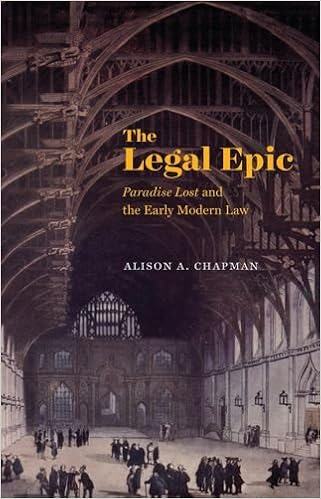 Alison A. Chapman,
University of Alabama at Birmingham, has published The Legal Epic: Paradise Lost and the Early Modern Law with the University of
Chicago Press. From the publisher:
Alison A. Chapman,
University of Alabama at Birmingham, has published The Legal Epic: Paradise Lost and the Early Modern Law with the University of
Chicago Press. From the publisher:The seventeenth century saw some of the most important jurisprudential changes in England’s history, yet the period has been largely overlooked in the rich field of literature and law. Helping to fill this gap, The Legal Epic is the first book to situate the great poet and polemicist John Milton at the center of late seventeenth-century legal history.
Alison A. Chapman argues that Milton’s Paradise Lost sits at the apex of the early modern period’s long fascination with law and judicial processes. Milton’s world saw law and religion as linked disciplines and thought therefore that in different ways, both law and religion should reflect the will of God. Throughout Paradise Lost, Milton invites his readers to judge actions using not only reason and conscience but also core principles of early modern jurisprudence. Law thus informs Milton’s attempt to “justify the ways of God to men” and points readers toward the types of legal justice that should prevail on earth.
Adding to the growing interest in the cultural history of law, The Legal Epic shows that England’s preeminent epic poem is also a sustained reflection on the role law plays in human society.
Praise for the book:
“This
is a terrific piece of scholarship. Chapman makes a very strong case for
Milton's intimate familiarity with English and Continental law; his commitment
to a natural law position that insisted upon the fundamental connection among
human law, right reason, and divine law; and the relevance of legal concepts
to Paradise Lost. The Legal Epic will
fundamentally change how we read Milton's poem.” –Debora K. Shuger
“Chapman’s
excellent study of Paradise Lost as a ‘legal epic’ raises the
bar. She defamiliarizes the poem by demonstrating just how much it is
interpenetrated by Milton’s self-confident and precise understanding of daily
legal practice. Urging us to remember that he was the son of a scrivener and the
brother of a judge, her book reveals a Milton whose profound sense of
contingency and God’s grace never obscures his imaginative engagement with the
intricacies of the law.” –Paul Stevens
“More
deeply than any other study, The Legal Epic illuminates the
ways Milton creatively employs and transforms the language and principles of
early modern law in Paradise Lost. Chapman persuasively shows
that understanding Milton’s use of legal language and concepts in relation to
theology is crucial to understanding his poetic theodicy. This
interdisciplinary book is a major contribution to Milton studies and to the
study of early modern literature and law. An outstanding achievement.” –David
Loewenstein
Further
details are available here.
Balancing a new job
Writing
today’s post, I am acutely aware of how often I failed in my struggle to
achieve balance in the various requirements of a new tenure-track job:
teaching, research, and service (and in some cases, outreach or
administration). So LHB readers, you might want to take any advice offered here
with a snicker or a grain of salt. I do hope that my struggles might result in
some useful insights for those of you facing a similar challenge.
I started
my job teaching at Auburn in the fall of 2010.
My first semester involved two large (200 students in each) sections of
World History I (from the dawn of time to the 18th century!) and a 13-student
graduate seminar in Southern History.
Prior to starting my position, my independent teaching experience
consisted of a 9-student summer U.S. survey and a 7-student senior writing
seminar in my research area, both at Duke.
To say I
was unprepared for what awaited me in my new job is an understatement. My first
semester was crushing—I was nervous, overwhelmed, out of my league. My research
and writing seemed like a distant memory. My manuscript was one final,
impossibly large task on my never-ending to-do list. I never forgot about it,
but I also never got around to doing much research or writing. Luckily Auburn
kept my service load pretty light. I was on one department committee, but it
didn’t require much time.
I have no
magic solution to the craziness of the first year of teaching. I do have a few
words of advice that I followed as best I could. Much of this advice still
applies to my regular challenges of balancing my workload.
My first
point could (and should!) be repeated in all of my posts on the struggle to
achieve any type of balance. First and foremost, be willing to forgive yourself
and let things go when you fall short of your expectations. Even the people who
seem the most on top of things sometimes—or often—miss the mark. Lawyers,
professors, and grad students are usually highly motivated people. But the
tenure-track asks a lot of new professors, and sometimes there just aren’t
enough hours in the day to do it all. Dwelling on what you have not managed to
accomplish or what you wish you had done does you no good. Forgiveness and
moving on are how I get through most of my days.
A strong
support system is another element that allowed me to adjust to the new faculty
workload. I was fortunate enough to start my job at the same time as another history
faculty member. We became fast friends. We spent many late nights in the office
together, and made plenty of fast food runs as we logged long hours to get the
lectures written, the reading done, and the emails answered. She has remained a
source of advice, encouragement, and commiseration over the years, as our
workloads have only gotten heavier.
If you
don’t make that kind of instant connection in your department—or even if you
do—finding people outside of your department is helpful, too. Look for
opportunities to mingle with other faculty and make new connections. Orientation,
college/school functions, or groups connected to particular hobbies or
interests can all help one meet faculty outside of your department. My partner
Kevin was also a big help with my home workload, as the dishes and laundry
piled up. He continues to provide enormous support, both with housework and
also listening and helping me sort out my challenges. Like many academics, I
now have family and friends spread all over the country. Regular phone calls to
friends and family members can be a huge help in coping with the stress of the
first year.
Here’s
some advice I wish I had followed: when you start teaching, less is more. Less
reading can still make for great discussion. Shorter writing assignments allow
for more quality feedback and focus on skill practice for your students. Keep lectures to outlines, unless you’re
teaching something completely outside of your comfort zone, as many of us do
sometimes. You don’t have to be great at all of it right away. Rome wasn’t
built in a day, and neither is an amazing teacher. There will be hiccups along
the way. Your best bet is to innovate and experiment a little at a time to see
what works best in your new job with a new population of students. For me, teaching is always about
experimenting and being open to adjustments.
Seek
advice from senior colleagues when you can. At Auburn, our department has a
strong tradition of sharing syllabi for ideas and regularly discussing teaching
issues as they arise. Finding a trusted colleague who has been there a while to
approach with questions is an invaluable asset. Our department does not have a
formal mentoring program for new faculty, but if possible, seek out these kinds
of opportunities to learn from others’ experiences and get to know the
department culture.
I have
read lots of advice about making time for research. This advice includes scheduling regular
research and writing time, getting up early to write, and prioritizing writing
before you begin you class prep and meetings.
I’ve never been great about this balance, but I continue to try. (More
on some of my strategies in the next post.) One of my goals for 2018 is to make
regular time every week for research and writing, even if it’s not a lot of
time. No guarantee that I’ll be able to make that a reality. But I do believe
that the best practice for balancing writing with a heavy teaching load is to
make it a regular part of your schedule. A bit more on this after the jump break.
Sunday, January 21, 2018
Sunday Book Review Roundup
In The New York Times is a review of the anthology A Time to Stir: Columbia '68, edited by Paul Cronin.
 Linda Gordon's The Second Coming of the KKK: The Ku Klux Klan of the 1920s and the American Political Tradition and Felix Harcourt's Ku Klux Kulture: America and the Klan in the 1920s are reviewed in an essay in The New Republic.
In the Los Angeles Review of Books is a review of Paraliterary: The Making of Bad Readers in Postwar America by Merve Emre. The new edition of Corey Robin's The Reactionary Mind: Conservatism from Edmund Burke to Donald Trump is also reviewed. And also on the site is a review of Samantha Barbas' Newsworthy: The Supreme Court Battle over Privacy and Press Freedom.
 A number of relevant interviews have been posted at the New Books Network. Susan Smith-Peter discusses her Imagining Russian Regions: Subnational Identity and Civil Society in Nineteenth-Century Russia. Gregory Laski speaks about his Untimely Democracy: The Politics of Progress after Slavery. Stephen Craft is interviewed about his American Justice in Taiwan: The 1957 Riots and Cold War Foreign Policy. Lisa Brooks introduces her Our Beloved Kin: A New History of King Philip’s War. Finally, Adam Mestyan discusses his Arab Patriotism: The Ideology and Culture of Power in Late Ottoman Egypt.
 In The Times Literary Supplement is a review of Maya Jasanoff's The Dawn Watch: Joseph Conrad in a Global World. Also reviewed is The Written World: The Power of Stories to Shape People, History, Civilization by Martin Puchner.
Gerard Magliocca's The Heart of the Constitution: How the Bill of Rights became the Bill of Rights is reviewed in The Washington Post. Also in the Post is a review of The Road Not Taken: Edward Lansdale and the American Tragedy in Vietnam by Max Boot.
Saturday, January 20, 2018
Weekend Roundup
- "On Sunday, Jan. 21 at 4:30 p.m., Greenwich Library partners with the Yale Alumni Association of Greenwich to bring Yale Professor Rohit De to Greenwich Library. De will discuss India’s Living Constitution. The event will be held in the Library’s Cole Auditorium.” H/t: Greenwich Sentinel.
- The Washington Post's "Made by History" section recently featured several commentaries on immigration policy, including a piece by Hidetaka Hirota (CUNY) on how "keeping the Irish poor out of America helped shape our restrictive immigration policies."
- The Historical Society of the DC Circuit has announced the opening, twenty years after his death, of its oral history of Charles R. Richey (1923-1997), a Nixon appointee, in 1971, to the US District Court for the District of Columbia. The Association of Trial Lawyers of America named him Outstanding Federal Trial Judge in 1979. According to the Historical Society website, “Poverty shaped him.... His parents were so poor that the best they could afford for Christmas was a used basketball. In his first year at Case Western Reserve Law School, he worked five jobs, including at a funeral home, to make ends meet. He only took courses whose books he could afford.” Judge Richey's oral history is available here.
- Michael Stolleis has posted an appreciation of Marie Theres Fögen, a Romanist and Byzantine legal historian who edited Rechtshistorisches Journal and directed the Max Planck Institute for European Legal History.
- Over at Concurring Opinions, Ronald K. L. Collins devotes one of his First Amendment News posts to legal history, including Leonard Levy, Murray Gurfein, and Gilbert Roe.
- On Monday, January 22, Georgetown Law’s Sheryll Cashin presents her book Loving: Interracial Intimacy in America and the Threat to White Supremacy, in the Washington History Seminar.

- C-SPAN will air two panels sponsored by the National History Center at the recently concludied annual meet of the American Historical Association, “History and Public Policy Centers” and “Documenting the History of the First Federal Congress.” Check here for listings.
- Stanford Law turns 125 this year. Here's news of the celebration.
- ICYMI: Another reason why we still love New Zealand: “I am not the first woman to multitask.” "Journey Back in Time at the Municipal Archives," with the New York Law Journal.
Friday, January 19, 2018
Malveaux on the Civil Rights Roots of the Modern Class Action Rule
Suzette M. Malveaux, Catholic University of America Columbus School of Law, has posted The Modern Class Action Rule: Its Civil Rights Roots and Relevance Today, which appears in the Kansas Law Review 66 (2017): 325-396:
The modern class action rule recently turned fifty years old — a golden anniversary. However, this milestone is marred by an increase in hate crimes, violence and discrimination. Ironically, the rule is marking its anniversary within a similarly tumultuous environment as its birth — the civil rights movement of the 1960’s. This irony calls into question whether this critical aggregation device is functioning as the drafters intended. This article makes three contributions.H/t: Legal Theory Blog
First, the article unearths the rule’s rich history, revealing how the rule was designed in 1966 to enable structural reform and broad injunctive relief in civil rights cases. The article tells the story of how the drafters were united in creating a rule that would enable litigants to respond effectively to the fierce resistance to desegregation following the seminal Brown v. Board of Education decision. They deliberately crafted a rule to address desegregation obstructionism.
Second, the article examines the seminal role the modern class action rule has played in the private enforcement of statutory and Constitutional civil rights. The article analyzes Supreme Court jurisprudence interpreting Rule 23(b)(2) over the course of the last fifty years, identifying three primary periods in which the pendulum has swung: from a heyday of liberal class certification for broad injunctive relief for newly created rights; to a heightened critique and retraction of class certification; to a complex gauntlet of contemporary barriers.
Finally, the article critiques modern class action jurisprudence and concludes that it fails to sufficiently fulfill the drafters’ intent of creating an efficient and just procedural mechanism for challenging systemic inequality. The article urges a contemporary judicial interpretation that honors Rule 23(b)(2)’s strong civil rights mission.
Lee on the "Natural Born Citizen"
Thomas H. Lee, Fordham University School of Law, has posted Natural Born Citizen, which appears in the American University Law Review 67 (2017): 327-411:
Article II of the U.S. Constitution states that a person must be a "natural born Citizen " to be eligible to be President. This Article surveys relevant evidence and explains what the phrase likely meant when the Constitution was adopted between 1787 and 1789. The phrase at the time encompassed three categories of persons: (1) persons born within the United States; (2) persons born outside of the United States to U.S. citizens in government service; and (3) persons born outside of the United States to U.S. citizen fathers who had resided in the United States but went abroad temporarily for a private purpose, like merchants who traveled on business. This definition corresponded with contemporaneous English law understandings of "natural born subjects," the natural law birthright principles of jus soli (the law of soil) and jus sanguinis (the law of blood or parentage), and the law of nations-the key jurisprudential sources consulted by Americans on matters of citizenship in the late eighteenth-century world order. This novel interpretation of the original meaning of "natural born Citizen" departs from the conventional wisdom that the phrase refers to a person who is a citizen under the U.S. naturalization statutes in effect at the person's birth, a view recently espoused by two former Solicitors General of the United States, Paul Clement and Neal Katyal. My interpretation also differs from the leading alternative view of the original meaning of the phrase, namely that it refers to persons born in the United States or outside of the United States to U.S. officials only. A brief conclusion explores the implications of the recovered original meaning of "natural born Citizen "for presidential eligibility today.Here’s Professor Lee’s chattier version, in the discursive style of Facebook:
It's taken me a couple of years, but it's finally done and published. Everything you ever wanted to know about why the US Constitution requires a “natural born Citizen” to be President. It starts with a monumental 14th century English statute with a Latin love-song title--“De Natis Ultra Mare”; John Jay's July 25,1787 letter to George Washington; Alex Hamilton's August 10, 1787 motion at the Constitutional Convention which Jimmy Madison vigorously seconded; a 1784 Maryland statute making the Marquis de Lafayette “and his male heirs forever” starting with George Washington Lafayette natural born citizens; the 1790 Naturalization Act--it's all in there, and more. There are convention debates about why we want immigrants, why we don't, foreign influence on the selection of the US President, and what it all means today. If you want to skip the first 85 pages, here is the last sentence: “Words, after all, are only as perfect as their creators, and so is our written Constitution.”
An Essay Collection on "Florida's Other Courts"
The University Press of Florida has published Florida's Other Courts: Unconventional Justice in the Sunshine State, edited by Robert M. Jarvis, professor of law at Nova Southeastern University.
Pushing past the conventional understanding of federal and state courts and the judicial system, this volume examines eight little-known Florida courts. Part 1 details general jurisdiction courts from 1513 to 1865 while part 2 profiles modern-era special jurisdiction courts.
TOC after the jump.Beginning with the state's colonial history, Florida's Other Courts challenges narratives that paint Spain's administration of its New World holdings as corrupt, inefficient, and tyrannical, using research into archival records scattered across Spain, Cuba, and other New World sites. Contributors to the volume also demonstrate how British authorities later molded the courts after their own justice system, introducing grand juries, jury trials, and the positions of chief justice and attorney general. Examining the changes instituted under General Andrew Jackson while Florida was a U.S. territory reveals a shift toward American sensibilities, though progress was slowed by clashes with Congress over funding and questions regarding the limits of self-rule. Under the Confederate Constitution, after the state seceded, the courts were in disarray and military commanders would even ignore court orders.
Today, Florida is still home to alternative forms of tribunals. Military courts have played an important role in the state's criminal justice system, but significant differences--from terminology to the role of the jury--exist between these courts and their civilian counterparts. Religious courts are also plentiful in the state, including Baptist, Jewish, Presbyterian, and Roman Catholic courts, which provide adherents with a forum for resolving business and marital disputes.
In a state that is so culturally diverse, mainstream courts often fail specific subgroups, especially racial minorities, leaving them no choice but to create their own dispute resolution processes. From 1950 to 1963, Miami was home to the Negro Municipal Court, which remains America's only all-black court. The Miccosukee and Seminole Indian tribes also have established their own judicial systems. While the Miccosukee court relies heavily on customary law and is closed to outsiders, the Seminole court has been designed to resemble the state courts, with trial and appellate judges, a court clerk, and a bar association.
Featuring extensive notes and an index of court cases, this volume offers a new and compelling look at the development of justice in Florida.
Professor of Legal History (Zurich)
[We have the following announcement.]
The University of Zurich invites applications for the position of Professor in Legal History (Succession Prof. Marcel Senn) starting fall term 2019 (1 August 2019).
The holder of the professorship will represent the academic discipline of Legal History (broadly conceived). The successful candidate will contribute to the delivery of high quality teaching on undergraduate and post-graduate programmes, and to engage in world-leading and internationally recognised research. A published research record of international distinction within the field of legal history is required. This will be demonstrated by an outstanding doctoral thesis and a habilitation thesis or equivalent research publications. Ideally, the research focus should be on early modern and/or modern European Legal History, with possible topics including Swiss, comparative or global legal history. Scholarly experience in a doctrinal legal discipline is not strictly required but highly appreciated. For applicants without a background in Swiss Law, a willingness to become familiar with it is expected.
The successful candidate will be expected to be an active contributor to the wider academic community through journal editorships, appointments to research councils and other public bodies, leadership of professional organisations, and fostering links with institutions beyond higher education. Depending on the candidate’s qualification aa full or extraordinary professorship could be awarded. For candidates who are still engaged in a habilitation project, an appointment as assistant professor with tenure track cis an option. the University of Zurich explicitly invites duly qualified junior researchers to submit their application.
As the University of Zurich aims to increase the percentage of women working in teaching and research positions, duly qualified women are encouraged to apply. Applicants whose native language is not German must be willing to familiarize themselves with the German language.
Applications should include a CV, a list of publications and presentations as well as a teaching portfolio to be sent by regular mail to the following address: University of Zurich, Faculty of Law, Dean's Office, Rämistrasse 74/2, CH-8001 Zurich
The closing date for applications is March 14th, 2018. Submission of publications and research papers may be requested at a later stage.
For further information please contact Prof. Dr. Andreas Thier (andreas.thier@uzh.ch).
Details regarding the job requirements are available [here].
The University of Zurich invites applications for the position of Professor in Legal History (Succession Prof. Marcel Senn) starting fall term 2019 (1 August 2019).
The holder of the professorship will represent the academic discipline of Legal History (broadly conceived). The successful candidate will contribute to the delivery of high quality teaching on undergraduate and post-graduate programmes, and to engage in world-leading and internationally recognised research. A published research record of international distinction within the field of legal history is required. This will be demonstrated by an outstanding doctoral thesis and a habilitation thesis or equivalent research publications. Ideally, the research focus should be on early modern and/or modern European Legal History, with possible topics including Swiss, comparative or global legal history. Scholarly experience in a doctrinal legal discipline is not strictly required but highly appreciated. For applicants without a background in Swiss Law, a willingness to become familiar with it is expected.
The successful candidate will be expected to be an active contributor to the wider academic community through journal editorships, appointments to research councils and other public bodies, leadership of professional organisations, and fostering links with institutions beyond higher education. Depending on the candidate’s qualification aa full or extraordinary professorship could be awarded. For candidates who are still engaged in a habilitation project, an appointment as assistant professor with tenure track cis an option. the University of Zurich explicitly invites duly qualified junior researchers to submit their application.
As the University of Zurich aims to increase the percentage of women working in teaching and research positions, duly qualified women are encouraged to apply. Applicants whose native language is not German must be willing to familiarize themselves with the German language.
Applications should include a CV, a list of publications and presentations as well as a teaching portfolio to be sent by regular mail to the following address: University of Zurich, Faculty of Law, Dean's Office, Rämistrasse 74/2, CH-8001 Zurich
The closing date for applications is March 14th, 2018. Submission of publications and research papers may be requested at a later stage.
For further information please contact Prof. Dr. Andreas Thier (andreas.thier@uzh.ch).
Details regarding the job requirements are available [here].
CFP: Monarchy and Modernity, 1500-1945
[We have the following Call. Deadline: 15 June 2018]
CALL FOR PAPERS
MONARCHY AND MODERNITY, 1500-1945
University of Cambridge
8-9 January, 2019
Europe’s past is overwhelmingly monarchical, yet the monarchies that remained in place at the end of the Second World War hardly resembled those that governed Europe at the end of the Middle Ages. Modernity transformed monarchy from a matter of fact into one of opinion, and enabled moving from a world where everything was sacred to one where all was profane. If words, then, remained the same – along with many of the families, their properties and places of residence – their meaning changed profoundly overtime and across countries. This is so much so that, along the centuries, European monarchy as an institution seems unrecognisable to any attentive observer. Even so, the present academic literature seldom measures the distance between monarchy’s various historical meanings and manifestations.
Read more after the jump.
 |
| credit |
CALL FOR PAPERS
MONARCHY AND MODERNITY, 1500-1945
University of Cambridge
8-9 January, 2019
Europe’s past is overwhelmingly monarchical, yet the monarchies that remained in place at the end of the Second World War hardly resembled those that governed Europe at the end of the Middle Ages. Modernity transformed monarchy from a matter of fact into one of opinion, and enabled moving from a world where everything was sacred to one where all was profane. If words, then, remained the same – along with many of the families, their properties and places of residence – their meaning changed profoundly overtime and across countries. This is so much so that, along the centuries, European monarchy as an institution seems unrecognisable to any attentive observer. Even so, the present academic literature seldom measures the distance between monarchy’s various historical meanings and manifestations.
Read more after the jump.
Thursday, January 18, 2018
Taft, Hughes and the Travails of Progressivism: An ICH Seminar
[Not to belabor the point, but the deadline for registering for this seminar, to be led by Your Humble Blogger and Jonathan Lurie, is this Saturday, January 20. Last chance!]
The Institute for Constitutional History is pleased to announce another seminar for advanced graduate students and junior faculty, “William Howard Taft and Charles Evans Hughes; the Travails and Contradictions of Progressivism within the Law: 1908-1941.”
The Institute for Constitutional History is pleased to announce another seminar for advanced graduate students and junior faculty, “William Howard Taft and Charles Evans Hughes; the Travails and Contradictions of Progressivism within the Law: 1908-1941.”
WHT (LC) Between them, Taft and Hughes served as Governor (H),
CEH (LC)
Governor General (T); Circuit Court Judge (T), Secretary of War (T), President (T), Supreme Court Justice (H), Nominee for the Presidency (H), Secretary of State (H), Chief Justice (T), Chief Justice (H), and this list is not complete. It indicates, however, the impressive scope of their accomplishments. In 1916, Taft had called himself a "progressive Conservative," while in 1935, the Taft's biographer noted of his successor that as Chief Justice, Hughes had "ruled against capital, against labor, against the farmer and for the farmer, against Congress and for Congress, against the president and for him." Hughes' biographer described him as "an old fashioned progressive." Alpheus Thomas Mason wrote that "Hughes's mind was singularly devoid of ideological content or commitment." How had progressivism been transformed during their careers? To what extent were both jurists "independent of rigid ideology?" This seminar seeks to explore these questions through books, articles, and discussion.


Bessler's "Celebrated Marquis"
John D. Bessler’s new book, The Celebrated Marquis: An Italian Noble and the Making of the Modern World (Carolina Academic Press), is now available for pre-order on Amazon.
During the Enlightenment, a now little-known Italian marquis, while in his mid-twenties as a member of a small Milanese salon, the Academy of Fists, wrote a book that was destined to change the world. Published anonymously in 1764 as Dei delitti e delle pene, and quickly translated into French and then into English as On Crimes and Punishments, the runaway bestseller argued against torture, capital punishment, and religious intolerance. Written by Cesare Beccaria (1738-1794), an economist and recent law graduate of the University of Pavia, On Crimes and Punishments sought clear and egalitarian laws, better public education, and milder punishments. Translated into all of the major European languages, Beccaria’s book led to the end of the Ancien Régime.

Praised by Voltaire and the French philosophes, Beccaria was toasted in Paris in 1766 for his literary achievement, and his book—though banned by the Inquisition and placed on the Catholic Church’s Index of Forbidden Books—was lauded by monarchs and revolutionaries alike. Among its admirers were the French Encyclopédistes; Prussia’s Frederick the Great; Russia’s enlightened czarina, Catherine II; members of the Habsburg dynasty; the English jurist Sir William Blackstone; the utilitarian penal reformer Jeremy Bentham; and American revolutionaries John Adams, Thomas Jefferson, and James Madison. On Crimes and Punishments, decrying tyranny and arbitrariness and advocating for equality of treatment under the law, helped to catalyze the American and French Revolutions. In 1774, on the cusp of the Revolutionary War, the Continental Congress explicitly hailed Beccaria as “the celebrated marquis.”
Called the “Italian Adam Smith” for his pioneering work as an economist in Milan, Cesare Beccaria—like his Italian mentor, Pietro Verri—wrote about pleasure and pain, economic theory, and maximizing people’s happiness. Once a household name throughout Europe and the Americas, Beccaria taught economics before the appearance of Smith’s The Wealth of Nations but died in obscurity after working for decades as a civil servant in Austria’s Habsburg Empire. As a public councilor, Beccaria pushed for social and economic justice, monetary and legal reform, conservation of natural resources, and even inspired France’s adoption of the metric system. In The Celebrated Marquis, award-winning author John Bessler tells the story of the history of economics and of how Beccaria’s ideas shaped the American Declaration of Independence, constitutions and laws around the globe, and the modern world in which we live.
Wednesday, January 17, 2018
Ernst on the Campaign for a Federal Legal Service
With so many of the preconditions of liberal democracy in the United States under attack from the Trump Administration and its enablers, I was moved to consider what my ongoing research into New Deal lawyers might say about one institutional defender of the rule of law, the American legal profession. The light I can shed falls mainly on lawyers in the federal government. Like all professionals, they risk having their assertions of authority dismissed as the self-serving claims of a narrow elite. Because they work within the state, they are also likely to be accused of harboring partisan motives or advancing a political ideology at odds with the will of the people.
 In an article published on-line today in the American Journal of Legal History, I tell what happened when New Dealers attempted to make their own notion of professional merit the principle for hiring and promotion in a “federal legal service.” Spoiler alert: They failed, which is why you probably never heard of the episode (unless you encountered it on two pages of Jerold Auerbach’s Unequal Justice). Because the politics of the late New Deal and World War II are not the politics of today, analogizing from the New Dealers’ campaign to our present predicament is not straightforward. That said, I has a few implications for today’s defenders of the professional authority of government lawyers. First, they ought to mobilize the legal profession as a whole by giving its members a stake in the process. Second, their notion of professional merit should be flexible enough to accommodate the variety of tasks government lawyers perform. Third, a strategy that requires the affirmative support of Congress presents obstacles more easily circumvented by proceeding agency by agency, within what Willard Hurst once called the executive “prerogative.”
The article is “In a Democracy We Should Distribute the Lawyers”: The Campaign for a Federal Legal Service, 1933-1945. Here is the abstract:
 In an article published on-line today in the American Journal of Legal History, I tell what happened when New Dealers attempted to make their own notion of professional merit the principle for hiring and promotion in a “federal legal service.” Spoiler alert: They failed, which is why you probably never heard of the episode (unless you encountered it on two pages of Jerold Auerbach’s Unequal Justice). Because the politics of the late New Deal and World War II are not the politics of today, analogizing from the New Dealers’ campaign to our present predicament is not straightforward. That said, I has a few implications for today’s defenders of the professional authority of government lawyers. First, they ought to mobilize the legal profession as a whole by giving its members a stake in the process. Second, their notion of professional merit should be flexible enough to accommodate the variety of tasks government lawyers perform. Third, a strategy that requires the affirmative support of Congress presents obstacles more easily circumvented by proceeding agency by agency, within what Willard Hurst once called the executive “prerogative.”
The article is “In a Democracy We Should Distribute the Lawyers”: The Campaign for a Federal Legal Service, 1933-1945. Here is the abstract:
To build its many unprecedented bureaucracies, the American New Deal heavily relied upon recent graduates of elite law schools, in a break with prior practice and to the increasing annoyance of congressmen and senators. To head off an attempt to entrust the selection of government lawyers to the Civil Service Commission, in January 1939, President Franklin D. Roosevelt appointed a committee, chaired by Stanley Reed and including two other Supreme Court Justices, Felix Frankfurter and Frank Murphy, to study the question. In April 1941, he accepted the recommendation of the lawyers on the “Reed Committee” and created the Board of Legal Examiners, headed by Solicitor General Francis Biddle (soon replaced by Charles Fahy) and managed during its first, crucial year by Herbert Wechsler, who was on leave from the Columbia Law School. As conceived especially by Frankfurter, the Board’s mission was to create an American counterpart to the British Civil Service, in which lawyers advanced to increasingly important posts throughout the executive branch. Although wartime conditions hampered the Board, it administered a national exam that provided greater access to government jobs than had the New Deal’s version of an “old boys network,” which drew heavily upon the law faculties of Harvard, Columbia, and Yale. Congressional hostility persisted, however, and was joined by the opposition of a powerful veterans’ lobby. The Board’s response to this pressure is instructive for a time when government lawyers and other professionals are being denounced as members of an anti-democratic Deep State.
Felix Frankfurter (LC)


CFP on Ottoman Law
[We were interpreted to see the following posting on H-Turk from Amir Toft, Research Scholar in Law and Islamic Law and Civilization Research Fellow at the Yale Law School.]
Dear Ottomanist Colleagues,
I would like to put together a panel on Ottoman law for one or more of the 2018 conferences listed [here.]. Depending on interest and feasibility, we can decide to submit versions to each one to fit the thematic or disciplinary focus. I will not say here exactly what I would like this panel to look like because that depends on the panel's composition. I will just mention my and a few possible thematic lines along which to run.
My research is generally interested in understanding how classical Islamic jurisprudence was received by Ottoman jurists and expressed through Ottoman legal institutions—in other words, how the law turns into legal system. My dissertation focuses on homicide in post-Süleymanic Istanbul. I look at court registers (and other archival material) but aso heavily at works of substantive and procedural Islamic law written by Ottoman (or Ottoman-era) jurists. Much of what I study, then, is less how Ottoman jurists practiced law so much as as what they said about their practice of law.
Possible themes for a panel include: 1) Ottoman criminal law; 2) Ottoman treatises on judicial practice, political sovereignty, and other legal matters; 3) comparative judicial practice between capital and provinces, between cities, between city and country, etc.; 4) state-employed versus state-independent jurists.
If you have something to present and are interested in putting a panel together, please write me at amir.toft@yale.edu. I look forward to hearing from you.
Best wishes,
Amir Toft
Dear Ottomanist Colleagues,
I would like to put together a panel on Ottoman law for one or more of the 2018 conferences listed [here.]. Depending on interest and feasibility, we can decide to submit versions to each one to fit the thematic or disciplinary focus. I will not say here exactly what I would like this panel to look like because that depends on the panel's composition. I will just mention my and a few possible thematic lines along which to run.
My research is generally interested in understanding how classical Islamic jurisprudence was received by Ottoman jurists and expressed through Ottoman legal institutions—in other words, how the law turns into legal system. My dissertation focuses on homicide in post-Süleymanic Istanbul. I look at court registers (and other archival material) but aso heavily at works of substantive and procedural Islamic law written by Ottoman (or Ottoman-era) jurists. Much of what I study, then, is less how Ottoman jurists practiced law so much as as what they said about their practice of law.
Possible themes for a panel include: 1) Ottoman criminal law; 2) Ottoman treatises on judicial practice, political sovereignty, and other legal matters; 3) comparative judicial practice between capital and provinces, between cities, between city and country, etc.; 4) state-employed versus state-independent jurists.
If you have something to present and are interested in putting a panel together, please write me at amir.toft@yale.edu. I look forward to hearing from you.
Best wishes,
Amir Toft
Finkelman's "Supreme Injustice"
Paul Finkelman, the new President of Gratz College, has published Supreme Injustice: Slavery in the Nation’s Highest Court, with the Harvard University Press:
“Paul Finkelman is by any account one of our leading historians of American slavery and the law. His incontrovertible and startling findings about the involvement of Justice Marshall in slave owning and selling, and Justice Story’s pro-slavery decision in Prigg v. Pennsylvania, are essential reading for anyone interested in American constitutional development in the antebellum era and its enduring influence on American law and society.”—Sanford Levinson, author of An Argument Open to All: Reading ‘The Federalist’ in the 21st Century
“Scholarly, hard-hitting and relevant. Finkelman’s book is a must-read for those who seek to understand the permeating influence of slavery in the development of antebellum law.”—R. Kent Newmyer, author of The Treason Trial of Aaron Burr: Law, Politics, and the Character Wars of the New Nation
Here are two endorsements:The three most important Supreme Court Justices before the Civil War—Chief Justices John Marshall and Roger B. Taney and Associate Justice Joseph Story—upheld the institution of slavery in ruling after ruling. These opinions cast a shadow over the Court and the legacies of these men, but historians have rarely delved deeply into the personal and political ideas and motivations they held. In Supreme Injustice, the distinguished legal historian Paul Finkelman establishes an authoritative account of each justice’s proslavery position, the reasoning behind his opposition to black freedom, and the incentives created by circumstances in his private life.
Finkelman uses census data and other sources to reveal that Justice Marshall aggressively bought and sold slaves throughout his lifetime—a fact that biographers have ignored. Justice Story never owned slaves and condemned slavery while riding circuit, and yet on the high court he remained silent on slave trade cases and ruled against blacks who sued for freedom. Although Justice Taney freed many of his own slaves, he zealously and consistently opposed black freedom, arguing in Dred Scott that free blacks had no Constitutional rights and that slave owners could move slaves into the Western territories. Finkelman situates this infamous holding within a solid record of support for slavery and hostility to free blacks.
Supreme Injustice boldly documents the entanglements that alienated three major justices from America’s founding ideals and embedded racism ever deeper in American civic life.
“Paul Finkelman is by any account one of our leading historians of American slavery and the law. His incontrovertible and startling findings about the involvement of Justice Marshall in slave owning and selling, and Justice Story’s pro-slavery decision in Prigg v. Pennsylvania, are essential reading for anyone interested in American constitutional development in the antebellum era and its enduring influence on American law and society.”—Sanford Levinson, author of An Argument Open to All: Reading ‘The Federalist’ in the 21st Century
“Scholarly, hard-hitting and relevant. Finkelman’s book is a must-read for those who seek to understand the permeating influence of slavery in the development of antebellum law.”—R. Kent Newmyer, author of The Treason Trial of Aaron Burr: Law, Politics, and the Character Wars of the New Nation
Subscribe to:
Posts (Atom)