This Constitution Day speech focuses on how the Constitution has been interpreted both to protect and to undermine the sovereignty of Indian nations. The good news is that both the text of the Constitution and the practice of the United States have recognized Indian nations as sovereigns who pre-existed the creation of the United States and who retain their inherent original sovereignty. The bad news is that the Constitution has often been interpreted by the Supreme Court to deny Indian nations protection for their property rights and their sovereignty. Most Americans are not aware of the history of interactions between the United States and Indian nations and most lawyers and law students never study the ways the Constitution treats Indian nations and their citizens differently from non-Indians. It is important for Americans to better understand the ways that the Constitution protects Indian nations from continued conquest and to understand the ways that the Supreme Court has interpreted the Constitution so as to deny equal rights to Indians and Indian nations. Limiting tribal sovereignty or harming tribal property without tribal consent is an act of conquest. It is an act that cannot be deemed consistent with our democratic values. Conquest is an historical fact that cannot be undone, but we can recognize that conquest was incomplete and that tribal sovereignty persists alongside that of the states and the federal government. The least we can do to honor the Constitution is to recognize the reality of conquest while committing not to do it ourselves. We can do that by consulting with Indian nations over matters that concern them; we can honor our treaty commitments. We can follow the lead of Chief Justice Marshall who lamented the fact of conquest and counseled the United States not to do it anymore.
Wednesday, September 12, 2018
Singer on Indian Nations and the Constitution
Joseph William Singer, Harvard Law School, has posted Indian Nations and the Constitution, which appeared in the Maine Law Review 20 (2018): 199-209:


Tuesday, September 11, 2018
Yale Legal History Forum: 2018-19 Schedule
The Yale Legal History Forum has announced its 2018-19 speaker schedule:
Natasha Wheatley | Princeton University (History)
Tuesday, October 23, Room 120
Legal Pluralism as Temporal Pluralism: Historical Rights, Legal Vitalism, and Non-Synchronous Sovereignty
Johann Chapoutot | Sorbonne University (History)
Thursday, November 29, Room 122
Law between “Recht” and “Gesetz’”: Studies on Nazi Normativity
Philippe Sands | UCL Faculty of Laws
Tuesday, January 15, Faculty Lounge, co-sponsored by the Center for Global Legal Challenges
William Ewald | University of Pennsylvania Law School (Law and Philosophy)
Tuesday, February 12, Faculty Lounge
H. Timothy Lovelace | Indiana University Maurer School of Law (Law and History)
Tuesday, March 5, Faculty Lounge
Miranda Johnson | University of Sydney (History)
Tuesday, April 9, Room 128
Madeleine Zelin | Columbia University (History and Chinese Studies)
Tuesday, April 16, Faculty Lounge
Sergei Antonov | Yale University (History)
Tuesday, September 18, Faculty Lounge
The Fracturing of Tsarist Russia: Criminal Upperworlds and the Great Trials of the 1870s
Brian R. Cheffins | University of Cambridge Faculty of Law
Thursday, September 20, 12:15 p.m., Room 128, co-sponsored by the Center for the Study of Corporate Law
The Public Company Transformed
Tuesday, September 18, Faculty Lounge
The Fracturing of Tsarist Russia: Criminal Upperworlds and the Great Trials of the 1870s
Brian R. Cheffins | University of Cambridge Faculty of Law
Thursday, September 20, 12:15 p.m., Room 128, co-sponsored by the Center for the Study of Corporate Law
The Public Company Transformed
Natasha Wheatley | Princeton University (History)
Tuesday, October 23, Room 120
Legal Pluralism as Temporal Pluralism: Historical Rights, Legal Vitalism, and Non-Synchronous Sovereignty
Johann Chapoutot | Sorbonne University (History)
Thursday, November 29, Room 122
Law between “Recht” and “Gesetz’”: Studies on Nazi Normativity
Philippe Sands | UCL Faculty of Laws
Tuesday, January 15, Faculty Lounge, co-sponsored by the Center for Global Legal Challenges
William Ewald | University of Pennsylvania Law School (Law and Philosophy)
Tuesday, February 12, Faculty Lounge
H. Timothy Lovelace | Indiana University Maurer School of Law (Law and History)
Tuesday, March 5, Faculty Lounge
Miranda Johnson | University of Sydney (History)
Tuesday, April 9, Room 128
Madeleine Zelin | Columbia University (History and Chinese Studies)
Tuesday, April 16, Faculty Lounge
Questions may be directed at this year’s Legal History Fellows, George Remisovsky (george.remisovsky@yale.edu) and Laura Savarese (laura.savarese@yale.edu).
Mayeri on Intersectionality and the Constitutionality of Family Status
Serena Mayeri, University of Pennsylvania Law School, has posted Intersectionality and the Constitution of Family Status, which appeared in Constitutional Commentary 32 (2017): 377-412:
Marital supremacy—the legal privileging of marriage—is, and always has been, deeply intertwined with inequalities of race, class, gender, and region. Many if not most of the plaintiffs who challenged legal discrimination based on family status in the 1960s and 1970s were impoverished women, men, and children of color who made constitutional equality claims. Yet the constitutional law of the family is largely silent about the status-based impact of laws that prefer marriage and disadvantage non-marital families. While some lower courts engaged with race-, sex-, and wealth-based discrimination arguments in family status cases, the Supreme Court largely avoided recognizing, much less crediting, their constitutional significance. Moreover, constitutional family status jurisprudence mostly overlooked claims to sexual autonomy, sex equality, and racial and economic justice arising from plaintiffs’ lived experience of intersecting status-based harms. The result is a constitutional family law canon that often obscures the social reality of legal regimes that elevate marriage at the expense of equality.
Minnesota Legal History Workshop
Here is the Speaker Schedule for the Legal History Workshop at the University of Minnesota for
Fall 2018. The workshop meets Thursdays, 4:05-6 p.m. in N202 Mondale Hall and is convened by Professor Susanna Blumenthal. A version with paper abstracts appears after the jump.
September 20
Edward B. Rugemer, Yale University
“The Consolidation of Slave Law in England’s Greater Caribbean: Jamaica and South Carolina from Slave Law and the Politics of Resistance in the Early Atlantic World (forthcoming, Harvard University Press, 2018)
September 27
Simon Stern, University of Toronto
“Homo Legis: The Making of the Reasonable Man”
October 4
Cynthia Nicoletti, University of Virginia
“The Disputed Legality of the Emancipation Proclamation, 1862-1865”
October 11
Elizabeth Kamali, Harvard Law School
“Tales of the Living Dead: Dealing with Doubt in Medieval English Criminal and Civil Law”
October 18
Martha Jones, Johns Hopkins University
“Roger Brooke Taney: Law, Memory, and the Persistence of the Past”
October 25
Sarah Igo, Vanderbilt University
“Sex, Secrets, and Social Research in the U.S. Age of Privacy,” from The Known Citizen: A History of Privacy in Modern America (Harvard University Press, 2018)
November 1
Andrew Wender Cohen, Syracuse University
“Anthony Comstock’s Gilded Age: Sex, Law, and the End of Reconstruction”
November 15
Dan Edelstein, Stanford University
“Natural Constitutionalism and American Rights” from On the Spirit of Rights (forthcoming, University of Chicago Press, 2018)
November 29
Colin Dayan, Vanderbilt University
“Guilty Things”
December 4
David Chang, University of Minnesota
“Indigenous Worlds in Life and Death: Colonial Carcerality, Hyper-Policing and Indigenous Geographies of Connection as Seen from Victoria, British Columbia in the 1860”
Fall 2018. The workshop meets Thursdays, 4:05-6 p.m. in N202 Mondale Hall and is convened by Professor Susanna Blumenthal. A version with paper abstracts appears after the jump.
September 20
Edward B. Rugemer, Yale University
“The Consolidation of Slave Law in England’s Greater Caribbean: Jamaica and South Carolina from Slave Law and the Politics of Resistance in the Early Atlantic World (forthcoming, Harvard University Press, 2018)
September 27
Simon Stern, University of Toronto
“Homo Legis: The Making of the Reasonable Man”
October 4
Cynthia Nicoletti, University of Virginia
“The Disputed Legality of the Emancipation Proclamation, 1862-1865”
October 11
Elizabeth Kamali, Harvard Law School
“Tales of the Living Dead: Dealing with Doubt in Medieval English Criminal and Civil Law”
October 18
Martha Jones, Johns Hopkins University
“Roger Brooke Taney: Law, Memory, and the Persistence of the Past”
October 25
Sarah Igo, Vanderbilt University
“Sex, Secrets, and Social Research in the U.S. Age of Privacy,” from The Known Citizen: A History of Privacy in Modern America (Harvard University Press, 2018)
November 1
Andrew Wender Cohen, Syracuse University
“Anthony Comstock’s Gilded Age: Sex, Law, and the End of Reconstruction”
November 15
Dan Edelstein, Stanford University
“Natural Constitutionalism and American Rights” from On the Spirit of Rights (forthcoming, University of Chicago Press, 2018)
November 29
Colin Dayan, Vanderbilt University
“Guilty Things”
December 4
David Chang, University of Minnesota
“Indigenous Worlds in Life and Death: Colonial Carcerality, Hyper-Policing and Indigenous Geographies of Connection as Seen from Victoria, British Columbia in the 1860”
Turner and friends on the history of crime & criminal justice
A Companion to the History of Crime and Criminal Justice was published by Policy Press in 2017. It is co-edited by Jo Turner, Paul Taylor, and Sharon Morley (all at the University of Chester), along with Karen Corteen (Liverpool John Moores University). From the publisher:
List of entries after the jump:This companion addresses the history of crime and punishment through entries by expert contributors that select and define the central vocabulary and terminology for the study of the history of crime and punishment. Organized alphabetically, with useful cross-references and bibliographies, it goes beyond mere definitions to offer rigorous critical analysis of the terms and their use within the field, both now and in the past. It will be essential to students, researchers, and teachers in the field.
Monday, September 10, 2018
Between Private and Public: A Celebration of Dirk Hartog
 Here's word of a conference celebrating Hendrik Hartog, Princeton University. The conference website is here.
Thank you, Laura Phillips Sawyer!
Once again, another terrific guest blogging stint has come to an end. We are sad to see Laura Phillips Sawyer go. We have rounded up her posts here for readers who may have missed them.
Please join us in thanking Professor Sawyer!
Please join us in thanking Professor Sawyer!
RG 26
From our friends at the Max Planck Institute for European Legal History we have news of the publication of Rechtsgeschichte - Legal History 26 (2018), edited by Thomas Duve and Stefan Vogenauer. “In addition to the print edition, the issue is available online in Open Access on the journal's website and will soon be searchable in the Internet Archive as well as in the Directory of Open Access Journals (DOAJ).”
The quite lengthy TOC is here.Kicking off this year's issue are two Research contributions that take up comparative perspectives as well as provide overviews of their respective topics: Within the context of Europe, Joachim Rückert traces the invention of national legal histories, and Tay-sheng Wang deals with the legal history of Taiwan as well as the question of the autonomy of the local civil law. The Focus section consists of three different topics concerning the broader history of the Iberian monarchies: At the centre of "Convivencias", we have contributions taking up legal-historical perspectives involving the coexistence of members from different cultures, religions and confessions. The second Focus brings together the research investigating the origins of the School of Salamanca and thereby draws attention to hitherto little known authors and texts. "The End of Empires" is the topic of the third Focus. The contributions span a broad spectrum: from the Spanish Empire to the Brazilian Empire and even to the Ottoman Empire. They attempt to emphasise the legal dimension of the history of empires, in particular, that of the 19th century. Book reviews on legal-historically relevant recent publications (in the variety of languages you have come to expect) regarding both the Focus topics just mentioned and much more have been assembled in the Critique section. Closing out the issue is Holger Knudsen's contribution in Marginalia, which is much more than a book review. Here, Knudsen takes the book "Helgoland" as the point of departure for an investigation of English colonial law-making.

Vanderbilt Legal History Colloquium: 2018-19 Schedule
The Vanderbilt Legal History Colloquium has released the schedule for academic year 2018-19:
Sept. 10, 2018
Professor Tamer el-Leithy, Johns Hopkins University
Oct. 22, 2018
Professor Karl Shoemaker, University of Wisconsin-Madison
Nov. 26, 2018
Professor Melissa Murray, New York University
Jan. 7, 2019
Professor John Witt, Yale University
Feb. 4, 2019
Professor Laura Edwards, Duke University
Feb. 18, 2019
Professor Lauren Benton, Vanderbilt University
March 11, 2019
Professor Georgy Kantor, Oxford University
April 1, 2019
Professor Natasha Wheatley, Princeton University
Sept. 10, 2018
Professor Tamer el-Leithy, Johns Hopkins University
September 21, 2018
Professor Nianshen Song, University of Maryland, Baltimore County
Oct. 22, 2018
Professor Karl Shoemaker, University of Wisconsin-Madison
November 12
Professor Noam Maggor, Queen Mary University
Nov. 26, 2018
Professor Melissa Murray, New York University
Jan. 7, 2019
Professor John Witt, Yale University
Feb. 4, 2019
Professor Laura Edwards, Duke University
Feb. 18, 2019
Professor Lauren Benton, Vanderbilt University
March 11, 2019
Professor Georgy Kantor, Oxford University
April 1, 2019
Professor Natasha Wheatley, Princeton University
Symposium: Rule of Law, the Hebrew Bible and Foreigners in the Americas
[We share the following announcement.]
Symposium
on Comparative Early Modern Legal History:
Arguing
for the Rule of Law:
Using
the Hebrew Bible and Caricatures of Foreigners in British and Spanish America
Date: Friday,
October 26, 2018
Location: Newberry
Library, Chicago
Organized by:
Jorge Cañizares-Esguerra (University of Texas, Austin) and Richard Ross
(University of Illinois, Urbana-Champaign)
How did settlers, imperial officials,
indigenous peoples, and Africans in the New World seek to demonstrate, or
disprove, that a polity respected the rule of law? (The phrase “rule of
law” is modern; but the core of the idea is not). Colonial rule invited
accusations of arbitrary government and systematic lawlessness. This
conference will focus on two common techniques used to assess whether a polity
respected the supremacy of law. First, controversialists asked whether
governance accorded with God’s expectations of justice as laid out in
Scripture, particularly the Hebrew Bible. Second, caricatures of other
societies could be held up to make one’s own appear lawful and just, or the
reverse. British American settlers applauded the civility of their law by
reference to the presumed barbarism of the Irish and Amerindians. They
saw liberty in their exploitive legal order by opposing it to the supposed
absolutism of the Spanish and French empires. Spanish settlers justified
their rule and derecho by contrasting them to the law of indigenous
polities and of their New World rivals. The conference will bring
together historians, law professors, and social scientists to think about the
complex debates about the rule of law in the English and Iberian Atlantic.
Jorge Cañizares-Esguerra (University of
Texas, Austin) and Richard Ross (University of Illinois, Urbana-Champaign)
organized “Arguing for the Rule of Law: Using the Hebrew Bible and Caricatures
of Foreigners in British and Spanish America.” The conference is an
offering of the Symposium on Comparative Early Modern Legal History, which
gathers every other year at the Newberry Library in Chicago in order to explore
a particular topic in the comparative legal history of the Atlantic world in
the period c.1492-1815. Funding has been provided by the University of
Illinois College of Law.
Attendance at the Symposium is free and open to the public. Those who
wish to attend should preregister by sending an email to Richard Ross at Rjross@illinois.edu.
Papers will be circulated electronically to all registrants several weeks
before the conference.
For information about the conference,
please consult our website at https://law.illinois.edu/faculty-research/specialty-programs/legal-history/
or contact Richard Ross at Rjross@illinois.edu
or at 217-244-7890.
Saturday, September 8, 2018
Weekend Roundup
- From Time magazine's website: a Labor Day op-ed by Caitlin Rosenthal (University of California, Berkeley) on the Emancipation Proclamation as "among the most important [labor regulations] in American history."
- This week in the Washington Post's "Made by History" section: Walter D. Kamphoefner (Texas A&M) on "chain migration"; Mary Ziegler (Florida State University) on how "Brett Kavanaugh could shatter the alliance between the GOP and the antiabortion movement"; Michael D. Breidenbach (Ave Maria University) on "why the right to privacy should exist even after someone dies," and more.
- Thursday was a historic day for same-sex rights in India, where the Supreme Court declared unconstitutional the "unnatural offences" provision of the Indian Penal Code (s.377). Great coverage of Navtej Singh Jauhar v. Union of India and the people behind it in the Indian Express, Scroll.in, and the Guardian (including photo highlights here). Here is a piece on how Indian legal academia influenced the judgment.
- Also on the Indian Penal Code via Georgetown's Berkley Center for Religion, Peace & World Affairs' forum: Neeti Nair (UVA) has this historical take on religion and the limits of free speech in India.
- Over at the Legal History Miscellany: Jane M. Card on visual representations of the police in Victorian England.
- From Mother Jones, "An Old Anti-Irish Law Is at the Heart of Trump’s Plan to Reshape Legal Immigration," citing work by legal historian Hidetaka Hirota (Waseda University).
- Update: Some last-minute ideas for teaching, as the new semester gets under way--here and here at South Asian Legal History Resources (MS).
Friday, September 7, 2018
Mawani on Oceans of Law
Renisa Mawani, University of British Columbia, has published Across Oceans of Law: The Komagata Maru and Jurisdiction in the Time of Empire with Duke University Press. From the publisher:
“Charting the 1914 voyage of the SS Komagata Maru and focusing on the sea, the ship, the manifest, the indigenous, and the fugitive, Renisa Mawani makes a compelling case against the European myth of the ‘free sea.’ Arguing for a new ‘ocean as method’ and foregrounding the co-emergence of maritime law and the policing of immigration, this book will rightly be seen as a legal and historical tour de force.” -Gaurav Desai
“This beautifully written and richly illustrated book provides a new global and oceanic history perspective on the journey of the Komagata Maru. Ranging across theories of law, time, and space, Renisa Mawani places an event limited in time and scale into some of the large questions and themes of history: migration, mobility, maritime jurisdiction, race, legal rights, and anticolonial radicalism.”-Clare Anderson
Further information is available here.
Praise for the book:In 1914 the British-built and Japanese-owned steamship Komagata Maru left Hong Kong for Vancouver carrying 376 Punjabi migrants. Chartered by railway contractor and purported rubber planter Gurdit Singh, the ship and its passengers were denied entry into Canada and two months later were deported to Calcutta. In Across Oceans of Law Renisa Mawani retells this well-known story of the Komagata Maru. Drawing on "oceans as method"—a mode of thinking and writing that repositions land and sea—Mawani examines the historical and conceptual stakes of situating histories of Indian migration within maritime worlds. Through close readings of the ship, the manifest, the trial, and the anticolonial writings of Singh and others, Mawani argues that the Komagata Maru's landing raised urgent questions regarding the jurisdictional tensions between the common law and admiralty law, and, ultimately, the legal status of the sea. By following the movements of a single ship and bringing oceans into sharper view, Mawani traces British imperial power through racial, temporal, and legal contests and offers a novel method of writing colonial legal history.
“Charting the 1914 voyage of the SS Komagata Maru and focusing on the sea, the ship, the manifest, the indigenous, and the fugitive, Renisa Mawani makes a compelling case against the European myth of the ‘free sea.’ Arguing for a new ‘ocean as method’ and foregrounding the co-emergence of maritime law and the policing of immigration, this book will rightly be seen as a legal and historical tour de force.” -Gaurav Desai
“This beautifully written and richly illustrated book provides a new global and oceanic history perspective on the journey of the Komagata Maru. Ranging across theories of law, time, and space, Renisa Mawani places an event limited in time and scale into some of the large questions and themes of history: migration, mobility, maritime jurisdiction, race, legal rights, and anticolonial radicalism.”-Clare Anderson
Further information is available here.
Thursday, September 6, 2018
Osgoode Society Legal History Workshop: Fall 2018 Schedule
Via the Canadian Legal History Blog, the Fall 2018 lineup for the Osgoode Society Legal History Workshop:
Wednesday September 19: Carolyn Strange, Australian National University: ‘Capital Punishment and Sex Crimes in Canada, 1867-1950’
Wednesday October 10: Virginia Torrie, University of Manitoba: ‘Federalism and Farm Debt during the Great Depression’
Wednesday October 24: Jim Phillips and Tom Collins, University of Toronto: ‘The Origin of the Division of Powers in the BNA Act’
Wednesday November 7: Ian Radforth, University of Toronto: ‘The Sad Story of the Minister's Daughter: A Botched Abortion in Victorian Toronto’
Wednesday November 21: Shelley Gavigan, Osgoode Hall Law School: "Settling In: Civil Justice on the Indigenous Plains, 1876-1886"
Wednesday December 5: Heidi Bohaker, University of Toronto: TBA
Wednesday September 19: Carolyn Strange, Australian National University: ‘Capital Punishment and Sex Crimes in Canada, 1867-1950’
Wednesday October 10: Virginia Torrie, University of Manitoba: ‘Federalism and Farm Debt during the Great Depression’
Wednesday October 24: Jim Phillips and Tom Collins, University of Toronto: ‘The Origin of the Division of Powers in the BNA Act’
Wednesday November 7: Ian Radforth, University of Toronto: ‘The Sad Story of the Minister's Daughter: A Botched Abortion in Victorian Toronto’
Wednesday November 21: Shelley Gavigan, Osgoode Hall Law School: "Settling In: Civil Justice on the Indigenous Plains, 1876-1886"
Wednesday December 5: Heidi Bohaker, University of Toronto: TBA
Stanford Center for Law and History Workshop: 2018-19 Schedule
The Stanford Center for Law and History has announced the lineup for its 2018-19 workshop:
September 25 – Catherine Baylin Duryea, Stanford History Department, They the People: Imposed Constitutionalism and Judicial Review in Afghanistan
October 23 – Alix Rogers, Stanford Center for Law and the Biosciences, The Civil War’s Tranformational Effect on the Legal Status of Human Remains
November 13 – Dylan Penningroth, UC Berkeley Law and History, Law for a Gospel Church: African American Religion and Civil Rights, 1865-1970
January 15 – Benjamin Hein, Stanford History Department, Germany’s GmbH: Securing the Liberal Order in an Age of Mass Migration, 1873-1892
February 5 – Elise Dermineur, Center for Advanced Study in the Behavioral Sciences at Stanford University, and Umea University, Debt and Bankruptcy in Pre-Industrial Europe
February 26 – Rowan Dorin, Stanford History Department, Reception or Resistance? Episcopal Lawmaking in Late Medieval Europe
April 9 – Reuel Schiller, UC Hastings College of the Law, The Surprising Origins of Deregulation: The New Left, the Counterculture, and the Demise of the New Deal Regulatory Order
April 30 – Kathryn Olivarius, Stanford History Department, Seasonal Gerrymandering: Yellow Fever, Statecraft, and Citizenship in Antebellum New Orleans
May 21 – Allyson Hobbs, Stanford History Department and Director of African and African American Studies, Far from Sanctuary: African American Travel & the Long Road to the Civil Rights Act of 1964
September 25 – Catherine Baylin Duryea, Stanford History Department, They the People: Imposed Constitutionalism and Judicial Review in Afghanistan
October 23 – Alix Rogers, Stanford Center for Law and the Biosciences, The Civil War’s Tranformational Effect on the Legal Status of Human Remains
November 13 – Dylan Penningroth, UC Berkeley Law and History, Law for a Gospel Church: African American Religion and Civil Rights, 1865-1970
January 15 – Benjamin Hein, Stanford History Department, Germany’s GmbH: Securing the Liberal Order in an Age of Mass Migration, 1873-1892
February 5 – Elise Dermineur, Center for Advanced Study in the Behavioral Sciences at Stanford University, and Umea University, Debt and Bankruptcy in Pre-Industrial Europe
February 26 – Rowan Dorin, Stanford History Department, Reception or Resistance? Episcopal Lawmaking in Late Medieval Europe
April 9 – Reuel Schiller, UC Hastings College of the Law, The Surprising Origins of Deregulation: The New Left, the Counterculture, and the Demise of the New Deal Regulatory Order
April 30 – Kathryn Olivarius, Stanford History Department, Seasonal Gerrymandering: Yellow Fever, Statecraft, and Citizenship in Antebellum New Orleans
May 21 – Allyson Hobbs, Stanford History Department and Director of African and African American Studies, Far from Sanctuary: African American Travel & the Long Road to the Civil Rights Act of 1964
Telman on Originalism and the Marshall Court
D. A. Jeremy Telman, Valparaiso University Law School, has posted John Marshall's Constitution: Distinguishing Originalism from Ipse Dixit in Constitutional Adjudication:
This Article is the first comprehensive treatment of the constitutional jurisprudence of the Marshall Court (1801–1835) from the perspective of originalism. Until recently, there seemed to be no need for such a study. Early originalists, who wrote in the late 1960s and early 1970s, assumed that constitutional adjudication had been originalist until at least the Lochner Era. With the move from intentionalism to textualism in the 1980s, originalists came to understand their movement as an innovation and a reaction against the perceived excesses of the Warren and Burger Courts. Originalists no longer claimed that originalist methodology informed nineteenth-century constitutional adjudication.H/t: Legal Theory Blog
Recently, however, originalists have revived earlier claims that constitutional adjudication in the United States has always been originalist. This Article maintains that such claims are doubly misleading. First, the Marshall Court invoked the Framers’ intentions but never undertook any investigation into those intentions. Second, this rhetorical intentionalism by no means predominated as the Marshall Court’s governing interpretive approach. Rather, that approach was eclectic. Historical reasoning, common law precedent, and ipse dixit pronouncements predominated in the constitutional adjudication of the Marshall Court and throughout the Early Republic.
Both contemporary originalism and contemporary non-originalism have much in common with the interpretive approach of the Marshall Court. All begin their inquiries with an examination of the constitutional text. However, the two core dogmas of contemporary originalism, which Larry Solum has described as 1) the fixation thesis and 2) the constraint principle, were rarely relevant to the Marshall Court’s inquiries. The constitutional text rarely provided clear constraints on the Court’s discretion because, to borrow language from New Originalists, their cases arose in the “zone of construction” where original meaning “runs out.” Justices chose among plausible arguments about the Constitution’s meaning. At key points, the Justices simply declared what the law was, not without justification, but also not based on evidence of the Framers’ intent or the original meaning of the constitutional text.
Wednesday, September 5, 2018
Two from Max Planck
[We have from our friends at the Max Planck Institute for European Legal History the following announcement of two new, open-access volumes in its series "Global Perspectives on Legal History."]
With Diritto: storia e comparazione. Nuovi propositi per un binomio antico, edited by Massimo Brutti and Alessandro Somma, the Max Planck Institute for European Legal History presents the newest publication in its Open Access book series Global Perspectives on Legal History.
With Diritto: storia e comparazione. Nuovi propositi per un binomio antico, edited by Massimo Brutti and Alessandro Somma, the Max Planck Institute for European Legal History presents the newest publication in its Open Access book series Global Perspectives on Legal History.
The second new volume in the series is edited by Benedetta Albani, Otto Danwerth and Thomas Duve: Normatividades e instituciones eclesiásticas en la Nueva España, siglos XVI-XIX, is the first of four planned books dealing with the contribution of ecclesiastical institutions to normative orders in early modern Ibero-America.In 25 contributions, both legal historians and comparative lawyers investigate the interrelationship of their fields of expertise as well as their current development. Thus, some contributions such as Sulla convergenza tra studio storico e comparazione giuridica (M. Brutti) or Comparazione giuridica, fine della storia e spoliticizzazione del dititto (A. Somma) concentrate on theoretical aspects, while others are dedicated to specific research topics, such as Rethinking eurocentrism. European Legacy and Western Colonialism (L. Nuzzo) or Quale storia del diritto? Vecchi e nuovi scenari narrativi tra comparazione e globalizzazione (E. Augusti). The result are diverse ideas on the meaning and future of two scientific disciplines, which are historically closely connected, have in the 20th century increasingly moved away from one another, and are now, given the opening of both disciplines to new methods and theories, not only enquiring about their relation to one another but also about their disciplinary identity. The multilingual volume contains mainly Italian, but also English and Spanish contributions.

Both volumes are available as usual on the website of the Max Planck Institute for European Legal History for PDF download and, in addition, in JSTOR and in the Internet Archive - always in Open Access.What significance did religious institutions and their actors have for the formation ofnormative orders in Mexico (New Spain) of the 16th to the 19th centuries? The volume takes up this little-researched question in the field of legal history. In fourteen Spanish-language, interdisciplinary papers, the authors examine the relationships between various types of religious normativity (such as canon law and moral theology), their local adaptations and links to global debates. They also deal with diocesan administration and sacramental dispensation, with indigenous and Afro-American actors in court, and with normative aspects of piety in cultural life until the 19th century. These research findings are relevant not only to legal history, but also to the history of the church and theology, social and cultural history, and ethnohistory.

Halberstam on Federalism in the US and Europe
Daniel Halberstam, University of Michigan Law School, has posted “A People for Certain Purposes”: On the History and Philosophy of Federalism(s) in the United States and Europe:
This brief guide to the philosophy of federalism provides an original analysis distinguishing the flurry of competing conceptual accounts of federalism in the United States and Europe. It draws out and critically examines the theories of sovereignty and federalism of James Madison, James Wilson, John C. Calhoun, Hans Kelsen, and Carl Schmitt, all with a view to understanding the kind of federation we have in the European Union today.
Barnes on Mozley v. Alston
An advance alert from Oxford Journal brings word of the posting of Judicial Intervention in Early Corporate Governance Disputes: Vice-Chancellor Shadwell’s Lost Judgment in Mozley v Alston (1847), by Victoria Barnes in the American Journal of Legal History:
Mozley v Alston is usually used in Anglo-American corporate law as an authority to demonstrate the premise that courts are reluctant to intervene in disputes between shareholders and directors. Using new archival sources, this article reinvestigates this case, its trajectory and its meaning as a legal precedent. Vice-Chancellor Shadwell’s judgment in the lawsuit, although never published in a printed law report, can be found in manuscript form in the National Archives in the United Kingdom. It, along with other documentation from the litigants and their solicitors, provides a new lens through which to view the case. Unlike the rule that we have today, Shadwell’s lost judgment shows that he supported judicial intervention in corporate governance disputes. Shadwell concurred with the arguments made by the shareholders’ counsel and agreed that the directors had abandoned their duties. He ordered that a court of equity should step in to assist the complainants. Despite the clarity of Shadwell’s ruling, it was ultimately overturned when the decision was appealed to Lord Chancellor Cottenham. This litigation, when placed in its original social and economic context, provides us greater insight into the role of counsel in shaping complaints, the views of the shareholders, directors, and managers as litigants, and the divisions and debates among members of the judiciary about modern company law.

Blackett on Fugitive Slaves
R. J. M. Blackett, Vanderbilt University, has published The Captive's Quest for Freedom: Fugitive Slaves, the 1850 Fugitive Slave Law, and the Politics of Slavery with Cambridge University Press. From the publisher:
"I don’t use the word 'magisterial' lightly, but it is exactly the right description for Richard J. M. Blackett’s The Captive’s Quest for Freedom: Fugitive Slaves, the 1850 Fugitive Slave Law, and the Politics of Slavery. There is no better, deeper, or more comprehensive discussion of the struggle of fugitive slaves in the antebellum era." -Steven Lubet
"The Captive’s Quest for Freedom is the most important, thorough, and revealing study ever written of fugitive slaves in American history. The book is timely; it demonstrates in depth the nature and meaning of America's first great refugee crisis and the explosive politics that followed in its wake. May the whole of our reading public finally understand the significance of the Fugitive Slave Act in 'our history and our heritage'. It resonates still as a watch warning in our own time." -David W. Blight
"Richard J. M. Blackett’s epic new history of the Fugitive Slave Law is both a brilliant analysis of the politics of disunion, and a compelling argument for the centrality of African American resistance to the great national unraveling of the 1850s. At the heart of the book, though, are the human beings whose decision to escape slavery prompted slaveholders to demand the Law in the first place, and whose determination to keep risking everything even after its passage pushed the United States towards a terrible and necessary reckoning." -Nicholas Guyatt
Further information is available here.
Praise for the book:This magisterial study, ten years in the making by one of the field's most distinguished historians, will be the first to explore the impact fugitive slaves had on the politics of the critical decade leading up to the Civil War. Through the close reading of diverse sources ranging from government documents to personal accounts, Richard J. M. Blackett traces the decisions of slaves to escape, the actions of those who assisted them, the many ways black communities responded to the capture of fugitive slaves, and how local laws either buttressed or undermined enforcement of the federal law. Every effort to enforce the law in northern communities produced levels of subversion that generated national debate so much so that, on the eve of secession, many in the South, looking back on the decade, could argue that the law had been effectively subverted by those individuals and states who assisted fleeing slaves.
"I don’t use the word 'magisterial' lightly, but it is exactly the right description for Richard J. M. Blackett’s The Captive’s Quest for Freedom: Fugitive Slaves, the 1850 Fugitive Slave Law, and the Politics of Slavery. There is no better, deeper, or more comprehensive discussion of the struggle of fugitive slaves in the antebellum era." -Steven Lubet
"The Captive’s Quest for Freedom is the most important, thorough, and revealing study ever written of fugitive slaves in American history. The book is timely; it demonstrates in depth the nature and meaning of America's first great refugee crisis and the explosive politics that followed in its wake. May the whole of our reading public finally understand the significance of the Fugitive Slave Act in 'our history and our heritage'. It resonates still as a watch warning in our own time." -David W. Blight
"Richard J. M. Blackett’s epic new history of the Fugitive Slave Law is both a brilliant analysis of the politics of disunion, and a compelling argument for the centrality of African American resistance to the great national unraveling of the 1850s. At the heart of the book, though, are the human beings whose decision to escape slavery prompted slaveholders to demand the Law in the first place, and whose determination to keep risking everything even after its passage pushed the United States towards a terrible and necessary reckoning." -Nicholas Guyatt
Further information is available here.
Tuesday, September 4, 2018
ASLH 2018: Register for the Pre-conference Workshop on Teaching Legal History
We have the following announcement:
Those attending the upcoming ASLH conference should consider joining us for the pre-conference workshop on teaching legal history at the conference hotel on November 8 from 11-4. Pre-register now for an interactive discussion on legal history curriculum for graduate and undergraduate students, as well as demonstrations of digital and hands-on pedagogies for your legal history classes. Space is limited, but lunch is provided for participants with sponsorship from University of Nebraska Lincoln, and the workshop will wrap up in time for the opening reception.
Pre-conference Workshop on Teaching Legal History
We invite 30 ASLH attendees to register for our pre-conference workshop on teaching legal history from 11-4 on Thursday, November 8 in the conference hotel. Participants will have an opportunity to share their own challenges and successes in dialogue with workshop facilitators on topics ranging from digital and creative pedagogies, to co-convened JD/graduate seminars, and undergraduate legal history curriculum building. Lunch is provided to all pre-registeredparticipants through the generous sponsorship of University of Nebraska Lincoln’s College of Arts & Sciences Instructional Improvement Fund.
The agenda is as follows:
11-12: Ari Bryen & Kimberly Welch, Building an Undergraduate Legal History Program
12-1: Lunch & Open Discussion on Teaching Experiences, Concerns, & Strategies
1-2: Katrina Jagodinsky, Digital Pedagogies for Legal History
2-3: Sally Hadden, “Small Teaching,” Big Impacts in the Legal History Classroom
3-4: Martha S Jones & Karen Tani, Teaching Legal History Seminars w/ Graduate and JD Students
Pre-Register for the workshop here.
Justice in Colonial British and Iberian America: An Essay Collection
We’ve received word of the publication of Justice in a New World: Negotiating Legal Intelligibility in British, Iberian, and Indigenous America (NYU Press, 2018), edited by Brian P. Owensby, University of Virginia, and Richard J. Ross, University of Illinois Law and History:
Here are some endorsements:As British and Iberian empires expanded across the New World, differing notions of justice and legality played out against one another among settlers and indigenous seeking to negotiate their relationship. In order for settlers and Natives to learn from, maneuver, resist, or accommodate each other, they had to grasp something of each other's legal ideas. This volume examines how Natives and settlers in both the British and Iberian New World empires used the other’s ideas of law and justice as a political, strategic, and moral resource. Settlers and indigenous people construed and misconstrued each other’s legal commitments while learning about them, never quite sure if they were on solid ground. Chapters explore the problem of “legal intelligibility”: How and to what extent did settler law and its associated notions of justice become intelligible—tactically, technically, and morally—to Natives, and vice versa? Ultimately, Justice in a New World offers a dual comparative study of how people in a colonial encounter struggled to make laws and codes of justice intelligible.

Justice in the New World is an exciting and timely collection of essays with thinkers who have been at the forefront of research on legal intelligibility in the Americas. The collection brings questions of justice, law, and legality into an imperial and comparative frame, with close attention paid to the differences in the Iberian and North American worlds."
—Michelle McKinley, University of Oregon School of Law, Author of Fractional Freedoms: Slavery, Intimacy, and Legal Mobilization in Colonial Lima
"The essays in this volume unsettle much of the conventional wisdom about the process of colonization, by revealing the staggering complexity of the law’s role in mediating relationships between settlers and indigenous people in the American colonies of Britain and Spain. The essays are richly researched and elegantly written, and they are bracketed by extraordinarily thoughtful introductory and concluding chapters. This book is essential reading for anyone interested in colonial or legal history."
—Stuart Banner, author of How the Indians Lost Their Land: Law and Power on the Frontier
"What could 'law' and 'justice' mean in the context of the European conquest and colonization of the Americas? The deeply researched essays in this volume examine illuminating cases where justice was a contested, ever-shifting concept as indigenous peoples and colonizers confronted one another in settings from Brazil and Peru to Florida, New England and Virginia. Featuring a distinguished roster of scholars, the book’s broadly comparative approach, as well as its insistence on foregrounding indigenous justice, will ensure that it is recognized as a landmark contribution to the burgeoning literature on law and colonialism."
—Allan Greer, McGill University
Edling on "An International Interpretation of the Constitution of the United States"
Currently un-gated in the August 2018 issue of Past & Present: Max Edling, "Peace Pact and Nation: An International Interpretation of the Constitution of the United States." Here's the abstract:
The origin of the United States Constitution is a perennial question in American historiography. In the last two decades a new ‘International’ interpretation has appeared that challenges an older ‘economic’ interpretation associated with Charles Beard and the so-called ‘Progressive’ tradition of historical analysis, which dominated scholarship for much of the twentieth century. The two interpretations assume different positions on what is known in American historiography as the ‘dual revolution’ thesis, i.e. the idea that the American founding was at the same time a struggle for home rule and a struggle over who should rule at home. Whereas the Progressive tradition has concentrated on the latter question, the International interpretation calls for renewed investigation of the former. The International interpretation presents the Constitution as a federal treaty that allowed thirteen newly independent and comparatively weak republics to maintain peace among themselves and to act in unison against competitors in the Atlantic marketplace and in the western borderlands of the continental interior. Whereas the Progressives identify the principal outcome of the founding to be the creation of a bourgeois state that faced inwards to make North America safe for capitalism, the Internationalists identify it as the creation of a stronger federal union that faced outward and allowed the United States to stand up to European powers and to conquer the North American continent. Yet despite the focus on the question of home rule, the Internationalist redefinition of the Constitution as a federal treaty also makes possible a fresh view on the old question of who should rule at home.
Read on here.
Monday, September 3, 2018
Bowie on Corporations' Right to Speak
Corporate Democracy: How Corporations Justified Their Right to Speak in 1970s Boston, by Nikolas Bowie, Harvard Law, is now available on-line in advance of its appearance in the hard copy Law and History Review:
In the early 1970s, the executives of the First National Bank of Boston spent hundreds of thousands of the bank's dollars on ads opposing statewide efforts to raise their personal income taxes. When frustrated Massachusetts legislators banned this sort of corporate spending, the executives sued, arguing that “corporations have the same First Amendment rights as individuals.” In First National Bank of Boston v. Bellotti, the Supreme Court held for the first time that the First Amendment protects all political speech, even ads paid for by a corporation. Surprisingly, the first corporation to take advantage of this decision was not the bank, but the city of Boston--a municipal corporation that spent nearly a million dollars on a new referendum in the fall of 1978.
This article discusses the history of the 1978 referendum, one pitting municipal corporations against business corporations. It argues that the referendum and the discourse surrounding it made it intuitive for Bostonians that all corporations, banks and cities, are representative institutions. Corporations can “speak” only by spending money, and the leaders of Boston and the bank justified spending other people's money by pointing to the internal elections that put them in office. But voters were skeptical of the argument that “corporate democracy” alone could guarantee that elected executives spoke with the consent of the people they purported to represent. The article offers a novel contribution to the historiography of modern business and politics: a legal history of how corporations--municipal and financial--became politicized in the wake of evolving First Amendment free-speech doctrine.
ASLH Workshop on Medieval Legal History
[We have the following announcement from the ASLH website, courtesy of Ada Maria Kuskowski, Penn History.]
Pre-Conference Workshop on Medieval Legal History, Thursday, November 8th, 2018
On Thursday November 8, immediately before the main conference begins, the American Society for Legal History (with the support of Vanderbilt University) is hosting a workshop on medieval legal history, broadly defined both chronologically and geographically. The workshop will consist of a range of paper presentations and discussions, as shown on the program below. Lunch will be made available to those attending.
The workshop will take place in the Conference Hotel and some of the papers will be pre-circulated, to facilitate discussion. Any one registered for the main conference is welcome to register the workshop, but space is limited to forty attendees. If you would like to register to attend, please register here.
12:00-1:00 pm – Daniel Smail (Harvard), “The Legal Ecology of Debt Collection”
1:00-1:15 Break
1:15-2:30 Paper-workshop session:
Ari Z. Bryen (Vanderbilt University), “The Judgment of the Provinces: Law, Culture, and Empire in the Roman East”
Geoffrey Koziol (Berkeley), “Learning to legislate: from the Carolingians to the Peace of God and beyond”
Comment: Caroline Humfress (St Andrews), William Caferro (Vanderbilt University)
2:30 – 2:45 break
2:45- 3:45 Alice Taylor (King’s College, London): “What does Scotland’s earliest legal tractate actually say (and what does it mean)?”
3:45-4:00 break
4:00- 5:45 Early-Career Scholar Panel
Jesse Abelman (Yeshiva University), ‘Violence and Jewish Courts in High Medieval Northern Europe’
Sara Ludin (Berkeley), ‘Protest, Veridiction, and Legal Speech Acts in Early German Reformation Litigation, 1529-1555’
Dana Lee (Princeton), ‘Early Debates on Excuses in Islamic Legal History: The Case of the Stolen Veil in Seventh Century Ta?if’
Charlotte Whatley (University of Wisconsin-Madison), ‘Kingship and Collusion: Extra-Legal Negotiation and Legal Fictions in the Age of Edward III’
Comment: Lena Saleymeh (Tel Aviv University).
5:45-5:50 Closing Remarks
Update: The title of Sara Ludin's paper is now correct.
Pre-Conference Workshop on Medieval Legal History, Thursday, November 8th, 2018
On Thursday November 8, immediately before the main conference begins, the American Society for Legal History (with the support of Vanderbilt University) is hosting a workshop on medieval legal history, broadly defined both chronologically and geographically. The workshop will consist of a range of paper presentations and discussions, as shown on the program below. Lunch will be made available to those attending.
The workshop will take place in the Conference Hotel and some of the papers will be pre-circulated, to facilitate discussion. Any one registered for the main conference is welcome to register the workshop, but space is limited to forty attendees. If you would like to register to attend, please register here.
12:00-1:00 pm – Daniel Smail (Harvard), “The Legal Ecology of Debt Collection”
1:00-1:15 Break
1:15-2:30 Paper-workshop session:
Ari Z. Bryen (Vanderbilt University), “The Judgment of the Provinces: Law, Culture, and Empire in the Roman East”
Geoffrey Koziol (Berkeley), “Learning to legislate: from the Carolingians to the Peace of God and beyond”
Comment: Caroline Humfress (St Andrews), William Caferro (Vanderbilt University)
2:30 – 2:45 break
2:45- 3:45 Alice Taylor (King’s College, London): “What does Scotland’s earliest legal tractate actually say (and what does it mean)?”
3:45-4:00 break
4:00- 5:45 Early-Career Scholar Panel
Jesse Abelman (Yeshiva University), ‘Violence and Jewish Courts in High Medieval Northern Europe’
Sara Ludin (Berkeley), ‘Protest, Veridiction, and Legal Speech Acts in Early German Reformation Litigation, 1529-1555’
Dana Lee (Princeton), ‘Early Debates on Excuses in Islamic Legal History: The Case of the Stolen Veil in Seventh Century Ta?if’
Charlotte Whatley (University of Wisconsin-Madison), ‘Kingship and Collusion: Extra-Legal Negotiation and Legal Fictions in the Age of Edward III’
Comment: Lena Saleymeh (Tel Aviv University).
5:45-5:50 Closing Remarks
Update: The title of Sara Ludin's paper is now correct.
Jus Gentium 3:1
Vol.3, issue 2 of Jus Gentium: Journal of International Legal History (July 2018) is out. Here is the Table of Contents:
ARTICLES
NOTES AND COMMENTS
DOCUMENTS AND OTHER EVIDENCE OF STATE PRACTICE
BOOK REVIEW
Further information is available here.
ARTICLES
- "Arbitration at Vienna: Recasting the History of International Dispute Resolution" by S. Harris
- "The Rising Generation of International Lawyers at St. Petersburg University: Zaremba and Spasovich" by V. I. Ivanenko
- "The Baltimore Incident and American Naval Expansion" by Mark W. Podvia
- "The 1917 Russian Revolution and International Law" by O. O. Merezhko
- "The Development of the Science of International Law at the Koretsky Institute of State and Law" by K. O. Savchuk and I. M.Protsenko
- "Currency Control, Exchange Contracts, and War: Boissevain v. Weil" by J. Anderson
- "Brown v. United States and Confiscation of Enemy Property" by IsaacSchaphorst
NOTES AND COMMENTS
- "Kronid Malyshev and the Renaissance of Private International Law" by V. I. Ivanenko
- "On Teaching the History of International Law" by W. E. Butler
- "The People as a Subject of International Law"by I. O. Kresina and O. V. Kresin
DOCUMENTS AND OTHER EVIDENCE OF STATE PRACTICE
- "Brief Calendar of International Practice for Spain and Portugal 1641 to 1818" by P. Macalister-Smith and J. Schwietzke
BOOK REVIEW
- Philippe Sands, Східно-західна вулция. Повернення до Львова 671 [East West Street: Return to Lviv] (2017) by T. R.Korotkyĭ and N. Pashkovskyĭ
Further information is available here.
Sunday, September 2, 2018
Sunday Book Review Roundup
Today we present one last roundup for the summer:
 In the Marginalia Review of Books is a review of Peter Webb's Imagining the Arabs: Arab Identity and the Rise of Islam.
At the Law and Politics Book Review is a review of Ballot Blocked: The Political Erosion of the Voting Rights Act by Jesse H. Rhodes.
In the London Review of Books Susan Pedersen reviews Diane Atkinson's Rise Up, Women! The Remarkable Lives of the Suffragettes and Jane Robinson's Hearts and Minds: The Untold Story of the Great Pilgrimage and How Women Won the Vote. Also reviewed in the LRB is Anshell Pfeffer's biography of Benjamin Netanyahu, Bibi: The Turbulent Life and Times of Benjamin Netanyahu.
Wendy Webster's Mixing It: Diversity in World War Two Britain is reviewed in The New Statesman.
Phillip Dray's The Fair Chase: The Epic Story of Hunting in America is reviewed in The New Republic.

At the Los Angeles Review of Books is a review of Inglorious Empire: What the British Did to India by Shashi Tharoor.
Julian Jackson's De Gaulle is reviewed in The Nation.
Finally, there have been multiple exciting reviews posted at the New Books Network. Phillip Thai speaks about his China's War on Smuggling: Law, Economic Life, and the Making of the Modern State, 1842–1965. Melani McAlister introduces her The Kingdom of God Has No Borders: A Global History of American Evangelicals. Sarah Igo discusses her The Known Citizen: A History of Privacy in Modern America. Ned Blackhawk speaks about his Indigenous Visions: Rediscovering the World of Franz Boas. Peter James Hudson discusses his Bankers and Empire: How Wall Street Colonized the Caribbean. Rupali Misha introduces her A Business of State: Commerce, Politics, and the Birth of the East India Company.
 In the Marginalia Review of Books is a review of Peter Webb's Imagining the Arabs: Arab Identity and the Rise of Islam.
At the Law and Politics Book Review is a review of Ballot Blocked: The Political Erosion of the Voting Rights Act by Jesse H. Rhodes.
In the London Review of Books Susan Pedersen reviews Diane Atkinson's Rise Up, Women! The Remarkable Lives of the Suffragettes and Jane Robinson's Hearts and Minds: The Untold Story of the Great Pilgrimage and How Women Won the Vote. Also reviewed in the LRB is Anshell Pfeffer's biography of Benjamin Netanyahu, Bibi: The Turbulent Life and Times of Benjamin Netanyahu.
Wendy Webster's Mixing It: Diversity in World War Two Britain is reviewed in The New Statesman.
Phillip Dray's The Fair Chase: The Epic Story of Hunting in America is reviewed in The New Republic.

At the Los Angeles Review of Books is a review of Inglorious Empire: What the British Did to India by Shashi Tharoor.
Julian Jackson's De Gaulle is reviewed in The Nation.
Finally, there have been multiple exciting reviews posted at the New Books Network. Phillip Thai speaks about his China's War on Smuggling: Law, Economic Life, and the Making of the Modern State, 1842–1965. Melani McAlister introduces her The Kingdom of God Has No Borders: A Global History of American Evangelicals. Sarah Igo discusses her The Known Citizen: A History of Privacy in Modern America. Ned Blackhawk speaks about his Indigenous Visions: Rediscovering the World of Franz Boas. Peter James Hudson discusses his Bankers and Empire: How Wall Street Colonized the Caribbean. Rupali Misha introduces her A Business of State: Commerce, Politics, and the Birth of the East India Company.
Saturday, September 1, 2018
Weekend Roundup
- In the New York Times, Serena Mayeri (Penn Law) on "How Abortion Rights Will Die a Death of 1,000 Cuts."
- From the Washington Post's "Made by History" Section: Bradley Hays (Union College) on what constrains the pardon power.
- From Gizmodo, "the story of the American inventor denied a patent because he was a slave," spotlighting research by Brian Frye (Kentucky Law School).
- From The Hub, the magazine of Johns Hopkins University), an interview with Martha Jones on Birthright Citizens.
Friday, August 31, 2018
Oliver on the Exclusionary Rule
Wesley Oliver, Duquesne Law School, has posted Prohibition's Anachronistic Exclusionary Rule, which appears in the DePaul Law Review 67 (2018): 473-526:
We know, with some degree of certainty, when an officer may search a trunk, but only the vaguest of rules govern an officer’s decision to shoot a man dead. The exclusionary rule has generated a very large number of search and seizure decisions, each of which define the limits on an officer’s authority. No similar mechanism has required courts to regularly pass on the use of force by officers, leaving the most serious acts by police comparatively unregulated. The decision of the Supreme Court in Mapp v. Ohio in 1961 – a time when force and even harassment were greater concerns than searches – explains this dichotomy. By borrowing a remedy that gained acceptance during Prohibition, the Court in Mapp created a mechanism to guard against the fears of the 1920s, not the concerns of the 1960s or the present day. Mapp’s critics have claimed that the exclusionary rule was never appropriate as it required courts to ignore relevant, reliable evidence of guilt. This article offers a more scathing indictment of Mapp. Mapp addressed a concern of earlier generations and ignored the pressing need for oversight of police force. The Watts Riots reveals that the Court had missed an important issue. Decades later, fires and looting in Ferguson reminded us of this fact.
Eslava, Fakhri, Nesiah and friends on Bandung
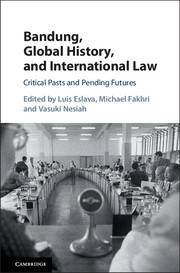
Bandung, Global History, and International Law: Critical Pasts and Pending Futures is out with Cambridge University Press. The volume is edited by Luis Eslava (University of Kent, Canterbury), Michael Fakhri (University of Oregon), and Vasuki Nesiah (New York University). From the publisher:
"This book is an incredibly rich tool to all those seeking to understand the paths towards the civilizational transitions needed to face the multiple crises of climate, food, poverty, and meaning. It should be of great interest to students and scholars in fields well beyond international law, including anthropology, geography, sociology, global studies, and cultural studies." -Arturo Escobar
Table of Contents after the jump:
Praise for the book:In 1955, a conference was held in Bandung, Indonesia that was attended by representatives from twenty-nine nations. Against the backdrop of crumbling European empires, Asian and African leaders forged new alliances and established anti-imperial principles for a new world order. The conference came to capture popular imaginations across the Global South and, as counterpoint to the dominant world order, it became both an act of collective imagination and a practical political project for decolonization that inspired a range of social movements, diplomatic efforts, institutional experiments and heterodox visions of the history and future of the world. In this book, leading international scholars explore what the spirit of Bandung has meant to people across the world over the past decades and what it means today. It analyzes Bandung's complicated and pivotal impact on global history, international law and, most of all, justice struggles after the end of formal colonialism.
"This book is an incredibly rich tool to all those seeking to understand the paths towards the civilizational transitions needed to face the multiple crises of climate, food, poverty, and meaning. It should be of great interest to students and scholars in fields well beyond international law, including anthropology, geography, sociology, global studies, and cultural studies." -Arturo Escobar
Table of Contents after the jump:
Thursday, August 30, 2018
Engstrom on Cars and Torts
Nora Freeman Engstrom, Stanford Law School, has posted When Cars Crash: The Automobile's Tort Law Legacy, which appears in the Wake Forest Law Review 53 (2018): 293-336:
Everyone understands that the invention of the automobile has had a profound effect on daily life in America. It has transformed our workplaces, altered our neighborhoods, and radically changed our environment. But cars have never been perfectly safe, and, as the years have passed, injuries and fatalities have mounted. This Article contends that, just as motor vehicles have remade our culture, these injuries and deaths — some 3.5 million fatalities and counting — have catalyzed fundamental changes in the contours, purposes, and limits of our law.
Mehrotra on Scheve and Stasavage's "Taxing the Rich"
Ajay K. Mehrotra, American Bar Foundation and Northwestern Pritzker School of Law, has posted Why Atlas Hasn't Shrugged: Review Essay, which appears in Florida Tax Review 21 (2018): 655-685:
Scholars, policy analysts, and lawmakers have long debated the relationship between steeply progressive taxes and economic prosperity. In their recent book, “Taxing the Rich: A History of Fiscal Fairness in the United States and Europe” Kenneth Scheve and David Stasavage take a step back to ask the broader, and perhaps more compelling, historical question: “When and why do countries tax the rich?” This essay reviews “Taxing the Rich.” It explores how the authors’ impressive comparative and historical analysis addresses why modern democracies have been able to tax the rich without negative consequences. Using a data set of tax laws and policies from twenty industrialized democracies across nearly two centuries, the authors persuasively document how “compensatory arguments” made during wartime have led to robust taxation of the wealthy. In addition to identifying the book’s important contributions to the existing literature, this review essay contends that Scheve and Stasavage have at times overlooked how historically-specific factors have also shaped steeply graduated taxes on the rich. They pay little attention, for example, to pre-war patterns of tax law and policy making that laid the groundwork for subsequent changes. Similarly, they discount the intensity of opposition to heavy taxes on the rich, even during wartime. And their story unabashedly embraces a strong form of technological determinism: it unfailingly accepts the conventional notion that wars are discrete events that can be easily disentangled from peacetime. In short, the authors have written an analytically rigorous account identifying the key variables behind the rise and fall of “soak-the-rich” taxation. Yet, the book’s analytical rigor in supporting its central claims comes with a price: the apparent trade off of simplifying the complexity of the past.

Center for the Study of Law & Society - Fall Speaker Series Line-up
The Center for the Study of Law & Society at Berkeley Law has posted the schedule for its Fall 2018 speaker series. Here are a few speakers likely to interest our audience:
- Monday, September 24 – Christopher Muller, Assistant Professor of Sociology, U.C. Berkeley. “Freedom and Convict Leasing in the Postbellum South”
- Monday, October 8 – Holly Brewer, Burke Chair of American History and Associate Professor, Department of History, University of Maryland. “’Most agreeable to the monarchy under which we live’: Slavery, Power, and the Restoration”
- Monday, October 15 – Justin Driver, Professor of Law, University of Chicago. The Schoolhouse Gate: Public Education, the Supreme Court, and the Battle for the American Mind (Pantheon, 2018)
- Monday, October 29 – Constance Backhouse, Professor of Law and Distinguished University Professor, University of Ottawa Faculty of Law. “Lessons from Legal History for the #MeToo Movement”
Wednesday, August 29, 2018
Hurst Summer Institute, 2019
[We have the following announcement. H/t: Joanna Grisinger]
Call for Applications: Hurst Summer Institute in Legal History: June 9-22, 2019. University of Wisconsin–Madison. Application Deadline: December 3, 2018
The American Society for Legal History and the Institute for Legal Studies at the University of Wisconsin Law School are pleased to invite applications for the tenth biennial Hurst Summer Institute in Legal History. The purpose of the Hurst Institute is to advance the approach to legal scholarship fostered by J. Willard Hurst in his teaching, mentoring, and scholarship. The Hurst Institute assists scholars from law, history, and other disciplines in pursuing research on the legal history of any part of the world.
The 2019 Hurst Institute will be led by [LHB's own!] Mitra Sharafi, Professor of Law and Legal Studies (with History affiliation) at University of Wisconsin–Madison. The two-week program features presentations by guest scholars, discussions of core readings in legal history, and analysis of the work of the participants in the Institute. The ASLH Hurst Selection Committee will select twelve Fellows to participate in this event.
Applicant Qualifications. Scholars in law, history and other disciplines pursuing research on legal history of any part of the world are eligible to apply. Preference will be given to applications from scholars at an early stage of their career (beginning faculty members, doctoral students who have completed or almost completed their dissertations, and J.D. graduates with appropriate backgrounds).
Fellowship Requirements. Fellows are expected to be in residence for the entire two-week term of the Institute, to participate in all program activities of the Institute, and to give an informal works-in-progress presentation in the second week of the Institute. Fellows are expected to engage with scholars from other fields and to foster an atmosphere of collegiality.
Fellowship Terms. The Institute for Legal Studies will pay for approved travel expenses and will provide a private room for each fellow at a hotel located on the University of Wisconsin-Madison campus. Most meals will be provided.
Application Process. (1) Submit the following materials in a single pdf file starting with your last name to ils@law.wisc.edu. Multiple attachments will not be accepted.
· Curriculum Vitae with your complete contact information.
· Statement of Purpose (maximum 500 words) describing your current work, specific research interests, and the broader perspectives on legal history that inform your work.
(2) Arrange to have two letters of recommendation sent electronically as a pdf files (these must be on institutional letterhead and signed) to ils@law.wisc.edu by the deadline.
Please note that late or incomplete applications will not be accepted.
Additional Information here. Questions: Contact ils@law.wisc.edu
Call for Applications: Hurst Summer Institute in Legal History: June 9-22, 2019. University of Wisconsin–Madison. Application Deadline: December 3, 2018
The American Society for Legal History and the Institute for Legal Studies at the University of Wisconsin Law School are pleased to invite applications for the tenth biennial Hurst Summer Institute in Legal History. The purpose of the Hurst Institute is to advance the approach to legal scholarship fostered by J. Willard Hurst in his teaching, mentoring, and scholarship. The Hurst Institute assists scholars from law, history, and other disciplines in pursuing research on the legal history of any part of the world.
The 2019 Hurst Institute will be led by [LHB's own!] Mitra Sharafi, Professor of Law and Legal Studies (with History affiliation) at University of Wisconsin–Madison. The two-week program features presentations by guest scholars, discussions of core readings in legal history, and analysis of the work of the participants in the Institute. The ASLH Hurst Selection Committee will select twelve Fellows to participate in this event.
Applicant Qualifications. Scholars in law, history and other disciplines pursuing research on legal history of any part of the world are eligible to apply. Preference will be given to applications from scholars at an early stage of their career (beginning faculty members, doctoral students who have completed or almost completed their dissertations, and J.D. graduates with appropriate backgrounds).
Fellowship Requirements. Fellows are expected to be in residence for the entire two-week term of the Institute, to participate in all program activities of the Institute, and to give an informal works-in-progress presentation in the second week of the Institute. Fellows are expected to engage with scholars from other fields and to foster an atmosphere of collegiality.
Fellowship Terms. The Institute for Legal Studies will pay for approved travel expenses and will provide a private room for each fellow at a hotel located on the University of Wisconsin-Madison campus. Most meals will be provided.
Application Process. (1) Submit the following materials in a single pdf file starting with your last name to ils@law.wisc.edu. Multiple attachments will not be accepted.
· Curriculum Vitae with your complete contact information.
· Statement of Purpose (maximum 500 words) describing your current work, specific research interests, and the broader perspectives on legal history that inform your work.
(2) Arrange to have two letters of recommendation sent electronically as a pdf files (these must be on institutional letterhead and signed) to ils@law.wisc.edu by the deadline.
Please note that late or incomplete applications will not be accepted.
Additional Information here. Questions: Contact ils@law.wisc.edu
Batlan on Gender and the Practice of Immigration Law
We believe we mentioned that Felice Batlan, Chicago-Kent Law, posted on The Docket an article, with links to primary and secondary sources, she wrote after spending day’s protesting the President’s “Muslim ban” at O’Hare Airport, but we now have an abstract for it. The article is Deja Vu and the Gendered Origins of the Practice of Immigration Law: The Immigrants’ Protective League, 1907-1940.
Donald Trump’s administration has provoked crisis after crisis regarding the United States’ immigration policy, laws, and their enforcement. This has drastically affected millions of immigrants in the U.S. and those hoping to immigrate. Stemming from this, immigration lawyers and immigrant advocacy organizations are challenging such policies and providing an extraordinary amount of direct pro bono legal services to immigrants in need. Yet the history of the practice of immigration law has been largely understudied. This article addresses this history by closely examining Chicago’s Immigrants’ Protective League between 1910 and 1940. The League provided free counsel to tens of thousands of poor immigrants facing a multitude of immigration-related legal issues during a time when Congress passed increasingly strict immigration laws often spawned by xenophobia and racism. The League, always headed by women social workers, created a robust model of immigration advocacy at a time when only a handful of women were professionally trained lawyers. A close and thick reading of the League’s archival documents, manifests how the events of Trump’s immigration policies have a long and painful history. U.S. immigration law and its enforcement have consistently been cruel, inhumane, arbitrary, and capricious. Told from the ground up and focusing upon the day-to-day problems that immigrants brought to the League, one dramatically sees how immigration laws and practices were like quicksand, thwarting the legitimate expectations of migrants, and, at times, leaving people in an endless legal limbo. The League, in response, participated in creating what would become the practice of immigration law, engaging, and quickly responding to changing laws, rules, policies, and the needs of migrants.
Franklin Research Grants
[We have the following announcement of the Franklin Research Grants.]
The American Philosophical Society invites scholars holding the Ph.D. to apply to its program of small grants that support the cost of research leading to publication in all areas of knowledge. The Franklin program is particularly designed to help meet the costs of travel to libraries and archives for research purposes; the purchase of microfilm, photocopies, or equivalent research materials; the costs associated with fieldwork; or laboratory research expenses.
Awards range from $1,000 to $6,000. Again there are two deadlines. The first is October 1, for work between February 2019 and January 2020 (including the opportunity to apply for the joint APS/British Academy Fellowship). The second is December 3, for work between April 2019 and January 2020.
For further details and application instructions, please visit [here] or contact Linda Musumeci, Director of Grants and Fellowships, at LMusumeci@amphilsoc.org or 215-440-3429.
The American Philosophical Society invites scholars holding the Ph.D. to apply to its program of small grants that support the cost of research leading to publication in all areas of knowledge. The Franklin program is particularly designed to help meet the costs of travel to libraries and archives for research purposes; the purchase of microfilm, photocopies, or equivalent research materials; the costs associated with fieldwork; or laboratory research expenses.
Awards range from $1,000 to $6,000. Again there are two deadlines. The first is October 1, for work between February 2019 and January 2020 (including the opportunity to apply for the joint APS/British Academy Fellowship). The second is December 3, for work between April 2019 and January 2020.
For further details and application instructions, please visit [here] or contact Linda Musumeci, Director of Grants and Fellowships, at LMusumeci@amphilsoc.org or 215-440-3429.
Ramaswamy on a philanthropist in Tamil country
Earlier this year, Sumathi Ramaswamy, Duke University, published "Giving Becomes Him: The posthumous fortune(s) of Pachaiyappa Mudaliar" in Modern Asian Studies (January 2018), 35-61. Here is the abstract:
This article explores the ways in which Pachaiyappa Mudaliar (1754?–1794) has been panegyrized as the quintessential benefactor of our times in Tamil prose, poetry, and pictures over the course of the past century and a half. In the bureaucratic and legal documents of the colonial state, he appears as a rapacious moneylender and behind-the-scenes wheeler-dealer, a member of that hated class of ‘Madras dubashes’, a ‘most diabolical race of men’. In contrast, Tamil memory work since at least the 1840s has differently recalled this shadowy eighteenth-century man as a selfless philanthropist whose vast wealth financed some of the earliest educational institutions in the Madras Presidency. I track the posthumous fate of Pachaiyappa's bequest to argue that even as the founding of the public trust and its educational philanthropy departed radically from his willed intentions, a new complex of living, dying, and giving for the sake of native education was put in place in the Tamil country in the age of colonial capital and pedagogic modernity.More information is available here.
Tuesday, August 28, 2018
Fernandez's Pierson v. Post: The Hunt for the Fox
Cambridge University Press still lists it as coming soon and not published until next month, but I've already spotted it on Google books, and I’m teaching the case for the 45th time (more or less) this afternoon, so I’m posting now anyway. That’s right, Pierson v. Post, The Hunt for the Fox: Law and Professionalization in American Legal Culture, by Angela Fernandez, University of Toronto Law, is or is almost out in the series Cambridge Historical Studies in American Law and Society:
"A new generation of legal historians now has its leading essayist. Fernandez explodes the 'cases in context' genre with essays ranging across literary, social and intellectual history. Sprightly, but with painstaking research and impressive learning, she discovers in a judge's witticisms fresh insights into how lawyers and law professors distance themselves from the strife from which they profit."
Daniel Ernst - Georgetown University, Washington, DC
"Fernandez' masterful book comprehensively reinterprets one of the great old chestnuts of American legal history. Her glittering prose and impressive research make this a must read for historians, lawyers and anyone seeking to understand how the law worked and what it has come to mean."
Gautham Rao - American University, Washington, DC
"In this splendid work of legal archaeology, Fernandez painstakingly reconstructs the strange career of Pierson v. Post, shining considerable light on the professional culture within which it has attained the status of a leading case. Deeply researched and beautifully crafted, this book is a major contribution to the field of legal history, prompting critical reflection on the ways and means by which conventional wisdom is constructed and reconstructed over time."
Susanna Blumenthal - University of Minnesota
Some endorsements:The 1805 New York foxhunting case Pierson v. Post has long been used in American property law classrooms to introduce law students to the concept of first possession by asking how one establishes possession of a wild animal. In this book, Professor Angela Fernandez retells the history of the famous fox case, from its origins as a squabble between two wealthy young men on the South Fork of Long Island through its appeal to the New York Supreme Court and entry into legal treatises, law school casebooks, and law journal articles, where it still occupies a central place. Professor Fernandez argues that the dissent is best understood as an example of legal solemn foolery. Yet it has been treated by legal professionals, the lawyers of its day, and subsequent legal academics in such a serious way, demonstrating how the solemn and the silly can occupy two sides of the same coin in American legal history.
"A new generation of legal historians now has its leading essayist. Fernandez explodes the 'cases in context' genre with essays ranging across literary, social and intellectual history. Sprightly, but with painstaking research and impressive learning, she discovers in a judge's witticisms fresh insights into how lawyers and law professors distance themselves from the strife from which they profit."
Daniel Ernst - Georgetown University, Washington, DC
"Fernandez' masterful book comprehensively reinterprets one of the great old chestnuts of American legal history. Her glittering prose and impressive research make this a must read for historians, lawyers and anyone seeking to understand how the law worked and what it has come to mean."
Gautham Rao - American University, Washington, DC
"In this splendid work of legal archaeology, Fernandez painstakingly reconstructs the strange career of Pierson v. Post, shining considerable light on the professional culture within which it has attained the status of a leading case. Deeply researched and beautifully crafted, this book is a major contribution to the field of legal history, prompting critical reflection on the ways and means by which conventional wisdom is constructed and reconstructed over time."
Susanna Blumenthal - University of Minnesota
Jan Lewis
We were very sorry to learn of the death of Jan Lewis, a historian of revolutionary America, dean of the Faculty of Arts and Sciences at Rutgers-Newark, and chair of chair of the American Historical Association's Committee on Women Historians.
From the announcement of Rutgers chancellor Nancy Cantor to the Rutgers-Newark community:
From the announcement of Rutgers chancellor Nancy Cantor to the Rutgers-Newark community:
It is with the most profound sadness that I share news of the loss of someone whose consistently thoughtful inquiry and deeply-held democratic values have so strengthened Rutgers University – Newark over the last four decades, as a dedicated scholar, teacher, mentor and academic leader, School of Arts and Sciences Dean Jan Lewis, who passed away today surrounded by her loving family. Jan was an academic to her core, embracing Rutgers-Newark and all of Rutgers thoroughly and vigorously right out of graduate school 41 years ago, engaging with historians far and wide with similar passion for explicating the complicated narrative of gender, race, and politics in colonial and early U.S. history, and never failing to extend that analysis to the vexing and the uplifting currents of contemporary times.
Jan touched so many of us that we all have our own stories to share, and yet I am sure there will be a theme that unites our experiences and I believe it will have something to do with the quiet but firm fealty with which she persisted in examining the world, holding it to high standards, but never failing to find some humor in our stumbles and to support us nonetheless. She was a brilliant historian who challenged orthodoxies about the fullness of our understanding of early America (and early American heroes), a teacher and mentor who supported her students through triumphs and challenges, a colleague who nurtured the next diverse generation of the professoriate, an academic leader who cultivated boundary-crossing scholars and scholarship across the full breadth of the arts, humanities, and sciences, and a friend whom you could always count on to tell it as it is, no sugar coating from Jan, even as she handed you the latest Donna Leon mystery to take your mind elsewhere, for a time. And, then, there were the pictures of those two beautiful granddaughters – her inspiration every day.
Thomas Jefferson, in encouraging a friend toward realizing his potential, once wrote, “above all things lose no occasion of exercising your dispositions to be grateful, to be generous, to be charitable, to be humane, to be true, just, firm, orderly, couragious [sic] etc. Consider every act of this kind as an exercise which will strengthen your moral faculties, & increase your worth.” Jan was among the pioneers in helping us understand the critical ways in which Jefferson, himself, fell far short of this ideal. Yet through her own insightful, incisive, and courageous work as a historian, as a teacher, mentor, and leader at Rutgers-Newark and beyond, and as spouse, parent, grandparent, and friend, she strived to model what living that kind of life could look like—to lose no occasion to be all that we can be for others.
Boston College Legal History Roundtable in fall 2018
[We share the following announcement.]
 In the fall of 2018, the Boston College Law School Legal
History Roundtable started its 17th successful year. The Roundtable draws on
Boston College Law School’s and Boston College’s strength and interest in legal
history. It offers an opportunity for Boston College faculty and faculty from
other area institutions, students, and members of the Boston College community
to meet and discuss a pre-circulated paper in legal history. Meeting several
times each semester, the Roundtable seeks to promote an informal, collegial
atmosphere of informed discussion.
In the fall of 2018, the Boston College Law School Legal
History Roundtable started its 17th successful year. The Roundtable draws on
Boston College Law School’s and Boston College’s strength and interest in legal
history. It offers an opportunity for Boston College faculty and faculty from
other area institutions, students, and members of the Boston College community
to meet and discuss a pre-circulated paper in legal history. Meeting several
times each semester, the Roundtable seeks to promote an informal, collegial
atmosphere of informed discussion.
In the fall of 2018, the Boston College Law School Legal
History Roundtable started its 17th successful year. The Roundtable draws on
Boston College Law School’s and Boston College’s strength and interest in legal
history. It offers an opportunity for Boston College faculty and faculty from
other area institutions, students, and members of the Boston College community
to meet and discuss a pre-circulated paper in legal history. Meeting several
times each semester, the Roundtable seeks to promote an informal, collegial
atmosphere of informed discussion.
For the 2018-2019 academic year, Professor Mary Sarah
Bilder, Professor Daniel R. Coquillette, Professor Frank Herrmann and Professor
Daniel Farbman are conveners.
The Roundtable usually meets several times during the
semester in the afternoon at 4:30 pm in the Library Conference Room of the
Boston College Law School Library. Refreshments are available beginning at 4:15
pm.*
In 2018-2019, our first Roundtable will be jointly sponsored
with the BC Law School Tax Policy Workshop and therefore meet at noon.
Papers will be available when appropriate before each
presentation.
For more information, please contact:
Joan Manna (617) 552-4344
For assistance with parking passes for non-BC faculty,
please also contact Joan.
THIS YEAR'S SCHEDULE after the jump.
Subscribe to:
Posts (Atom)