Friday, January 8, 2021

Kirkby on "Indian" Enfranchisement in Canada

Paradises Lost? The Constitutional Politics of “Indian” Enfranchisement in Canada, 1857–1900, by Coel Kirkby, University of Sydney Law School, is now available from the wesbite of the Osgoode Hall Law Journal.  Professor Kirkby writes that it is part of a forthcoming book, The Birth of the Native: Democracy and the Disenfranchisement in the British Empire.  Here is the abstract:

Enfranchisement was the legal process for an individual or community to end their legal status as “Indians” under the Indian Act. The Canadian government hoped it would break up bands before assimilating them into settler society. This article aims to excavate the untold story of this attempt to extinguish special “Indian” status in the nineteenth century. It first traces enfranchisement as part of a Victorian discourse of civilization and as a specific Canadian legal process for the assimilation of “Indian” subjects. It then uses new archival sources to tell the untold story of the politics of enfranchisement over the second half of the nineteenth century. The article concludes with the strange case of Doctor Oronhyatekha (aka Mr. Martin). His story is of one exceptional individual’s attempt to pursue an alter "Indian” enfranchisement can help us better appreciate what is at stake in contemporary questions of belonging within the agonistic relationships of the Canadian and Indigenous constitutional orders.

--Dan Ernst

Thursday, January 7, 2021

Lash on "Bill of Rights" Revisionism

Kurt T. Lash, University of Richmond School of Law, has posted The 1791 Amendments as the 'Bill of Rights,' Founding to Reconstruction (A Response to Revisionists):

Unlike the “Declaration of Rights” annexed to many state constitutions, the ten amendments added to the federal Constitution in 1791 have no formal title at all. It is only by cultural tradition that Americans refer to these provisions as our national “Bill of Rights.” Until recently, most scholars assumed that this tradition could be traced back to the moment of ratification. Over the last decade or so, however, a number of scholars have challenged this assumption. These “Bill of Rights revisionists” claim that Americans did not commonly refer to the first ten amendments as “the bill of rights” until the twentieth century. Prior to that, most Americans either did not believe they had a national bill of rights or they would have more likely pointed to the Declaration of Independence as the country’s “bill of rights” than to the 1791 amendments. If the revisionists are right, then a substantial portion of constitutional historical scholarship is shot through with historical error, in particular scholarship supporting the incorporation of the Bill of Rights as part of the Fourteenth Amendment.

This essay examines the historical record in order to determine whether the claims of the Bill of Rights revisionists are correct. It presents the results of an exhaustive investigation of political, legal and cultural references to the “bill of rights” from the time of the Founding to Reconstruction (and beyond). These references, most of which are presented here for the first time, suggest that the revisionist claims about the ten amendments are false. Long before the twentieth century, and decades before Reconstruction, Americans commonly referred to the first ten constitutional amendments as “the Bill of Rights.” Moreover, references to the 1791 amendments as the national bill of rights vastly outnumber historical references to the Declaration of Independence as a “bill of rights,” and indicate that nineteenth century Americans were not at all confused about the meaning and content of their national “Bill of Rights.” If any “revision” is in order, it is the need to (1) revisit and revise our understanding of the original theoretical role played by the Bill of Rights at the time of the Founding and (2) recognize the remarkably broad coalition of Americans who, by the time of Reconstruction and the Fourteenth Amendment, embraced an altogether different theory of the 1791 amendments.

--Dan Ernst

Lantigua on Spanish contributions to international law

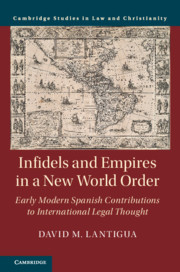
 David M. Lantigua (University of Notre Dame) has published Infidels and Empires in a New World Order: Early Modern Spanish Contributions to International Legal Thought with Cambridge University Press. From the publisher: 

Before international relations in the West, there were Christian-infidel relations. Infidels and Empires in a New World Order decenters the dominant story of international relations beginning with Westphalia in 1648 by looking a century earlier to the Spanish imperial debate at Valladolid addressing the conversion of native peoples of the Americas. In addition to telling this crucial yet overlooked story from the colonial margins of Western Europe, this book examines the Anglo-Iberian Atlantic to consider how the ambivalent status of the infidel other under natural law and the law of nations culminating at Valladolid shaped subsequent international relations in explicit but mostly obscure ways. From Hernán Cortés to Samuel Purchas, and Bartolomé de las Casas to New England Puritans, a host of unconventional colonial figures enter into conversation with Francisco de Vitoria, Hugo Grotius, and John Locke to reveal astonishing religious continuities and dissonances in early modern international legal thought with important implications for contemporary global society.

 Here's the Table of Contents:

1. Introduction. International relations beyond Westphalia

Part I. The New World Crucible of Infidel Rights:

2. Theocratic world order and religious wars

3. Spanish Dominicans and the 'affair of the Indies'

4. The politics of natural law at Valladolid, 1550–1551

Part II. God, Empires, and International Society:

5. From infidels to savages: empires of commerce and natural rights

6. The scholastic law of nations, native occupation, and human solidarity.

Further information is available here.

--Mitra Sharafi

Wednesday, January 6, 2021

Magliocca on Confederate Amnesty under the 14th Amendment

Gerard N. Magliocca, Indiana University Robert H. McKinney School of Law, has posted Amnesty and Section Three of the Fourteenth Amendment:

Jefferson Davis, 1885 (LC)
This Article is the first scholarly account of Section Three of the Fourteenth Amendment, which excluded many ex-Confederates from office unless a supermajority of Congress granted a waiver. Section Three was the first part of the Fourteenth Amendment applied by Congress--even before the Amendment was ratified. Section Three was the first part of the Fourteenth Amendment applied by the courts, with Chief Justice Chase's opinion in "Griffin's Case" setting the tone for future Fourteenth Amendment decisions that narrowed the text's scope. And Section Three was the part of the Amendment that received sustained attention in Congress when a broad amnesty was enacted in 1872 and Senator Charles Sumner tried (unsuccessful) to add a broad civil rights amendment to the amnesty bill.

The story of Section Three is a microcosm of the trajectory of the Fourteenth Amendment as a whole during Reconstruction. Radical aspirations were followed by judicial caution and vigorous enforcement by Congress, only to give way to exhaustion with the implacable anger of southern whites over the protests of the first Black Representatives in Congress. And in a final irony, the first man to claim the protection of Section Three (in 1868) was the last man to benefit from congressional relief under that provision (in 1978)--Jefferson Davis. Section Three is a constitutional failure that deserves closer scrutiny.
–Dan Ernst

Getzler and Pitts Are New AJLH Editors-in-Chief

[We have the following announcement.  DRE]

The American Journal of Legal History and Oxford University Press are delighted to announce the appointment of Prof. Yvonne Pitts and Prof. Joshua Getzler as Co-Editors-in-Chief, effective 1 January 2021.

Joshua Getzler is professor of law and legal history at the University of Oxford, and a fellow in law at St Hugh's College, Oxford. He trained in law and history in Australia, and then wrote a doctorate in legal and economic history at Oxford, resulting in his monograph A History of Water Rights at Common Law which was awarded the Peter Birks Prize for Outstanding Legal Scholarship in 2005.

Joshua works on the historical evolution of legal institutions of property, trust, fiduciaries, corporations, and charities, especially religious and welfare forms. He also studies the history of native title, and the jurisdiction and accountability of colonial, settler and imperial governments, principally in the eighteenth and early nineteenth centuries. Joshua has taught and researched at universities in Australia, USA and Israel. He serves on the council of the Selden Society for English legal history, the editorial boards of the Oxford Journal of Legal Studies and the Journal of Equity, and is co-editor of the OUP monograph series Oxford Legal History.

Yvonne Pitts
is an associate professor of history at Purdue University - West Lafayette specializing in the legal histories of sexual regulation, disability, property, and legal culture in the nineteenth and twentieth century United States. She is the author of Family, Law, and Inheritance in America: A Social and Legal History of Nineteenth Century Kentucky, which was awarded the American Society of Legal History's William Nelson Cromwell Book Prize in 2014. Her current research explores the U.S. military's system of licensing prostitutes and regulating sex work in Nashville, Tennessee during the American Civil War. She traces how regulatory practices around sexual danger, race relations, contagion, and the proper subjects of surveillance and legal discipline evolved in the context of a wartime military occupation. She is also working on a project examining the constitutional and legal understandings of the material texts and evidentiary practices in nineteenth century obscenity trials.

Joshua writes: "Under the vigorous editorial leadership of Alfred Brophy, Stefan Vogenauer, and Felice Batlan, the American Journal of Legal History stands out as a compelling publication, with every issue filled with erudition, originality, and thought-provoking discoveries. Stefan has described very well the growth of the journal to its current commanding form. The journal attracts great attention across North America, Britain, Europe, and the wider world. In a globalized society full of contention over justice and authority, livelihoods and identities, tradition and innovation, we need a vigorous and independent-minded legal history practice more than ever, to explore the shape of the past and its impact on the present. I am excited by the opportunity to carry forward and develop the mission of the AJLH, working closely with my co-editor Yvonne Pitts, the distinguished editorial board, the associate and review editors, and our OUP partners. We will strive to serve the legal-historical community by providing the best possible forum for scholarly work covering all periods and places."

Yvonne writes: "I am thrilled to have the opportunity to contribute to the field of legal history and work with diverse and international legal scholars as the co-editor of the American Journal of Legal History. The AJLH has a long tradition as a forum for highly respected, innovative legal historical scholarship across broad geographical, thematic, and temporal subfields. Under the able leadership of past editors Felice Batlan and Stephen Vogenauer, the AJLH has produced trenchant, influential research from early career and established scholars. I look forward to working with my co-editor Joshua Getzler to build on the AJLH's commitment to emerging questions and traditional themes in legal and constitutional history in local, national, and transnational contexts."

Oxford University Press would like to thank the outgoing editors, Prof. Stefan Vogenauer and Prof. Felice Batlan, for their skilled and dedicated work on AJLH. The AJLH was first published in 1957 and was the first English-language periodical in the field of legal history.

Tuesday, January 5, 2021

The French Civil Code at the Law Library of Congress

[We have the following announcement from the Law Library of Congress.  DRE]

On Thursday, January 28 at 2:00PM EST, join Foreign Legal Specialist, Nicolas Boring, for a new entry in our Foreign and Comparative Law Webinar Series. This entry in the series will discuss the French Civil Code. The French Civil Code, which Napoleon Bonaparte introduced in 1804, has had an enduring impact on the legal world, not just in France but throughout the world. Boring will discuss the Napoleonic Code’s history, evolutions and legacy in a new installment of the Law Library of Congress’ foreign and comparative law webinar series. This presentation will discuss not only French law, but also the Civil Code’s impact on other countries around the world, from Belgium to Haiti. To register, please visit [here.]

LHR 38:4

Law and History Review 38:4 is now online.

Bain Attwood, The Limits of the Law in Claiming Rights to Land in a Settler Colony: South Australia in the Early-to-Mid Nineteenth Century

Craig Hollander,  “The Citizen Complains”: Federal Compensation for Property Lost in the War of 1812

J.Y. Chua, The Strange Career of Gross Indecency: Race, Sex, and Law in Colonial Singapore

Luke Taylor, Speaking the Unspeakable: Buggery, Law, and Community Surveillance in New South Wales, 1788–1838

Mark Coen, “The Work of Some Irresponsible Women”: Jurors, Ghosts, and Embracery in the Irish Free State

Katherine Unterman, Trial Without Jury in Guam, USA

Joanna L. Grisinger,  “South Africa is the Mississippi of the world”: Anti-Apartheid Activism through Domestic Civil Rights Law

Lizzie Seal and Alexa Neale, Racializing Mercy: Capital Punishment and Race in Twentieth-Century England and Wales

Book Reviews 

Richard H. Helmholz, The Profession of Ecclesiastical Lawyers. Cambridge: Cambridge University Press, 2019. Pp. xvii, 232. $110.00 hardcover (ISBN 97811008499064).
Sarah B. White

Robin Chapman Stacey, Law and the Imagination in Medieval Wales. Philadelphia: University of Pennsylvania Press, 2018. Pp. viii, 335. $89.95 hardcover (ISBN 9780812250510).
Gwen Seabourne

Niamh Howlin, Juries in Ireland: Laypersons and Law in the Long Nineteenth Century. Dublin: Four Courts Press, 2017. Pp. x, 293. $74.50 hardcover (ISBN 9781846826214).
John MacMenamin

Yuko Miki, Frontiers of Citizenship: A Black and Indigenous History of Postcolonial Brazil. New York and Cambridge: Cambridge University Press, 2018. Pp. 292. $99.99 hardcover (ISBN 9781108417501).
Jean Hébrard

Faiz Ahmed, Afghanistan Rising: Islamic Law and Statecraft between the Ottoman and British Empires. Cambridge, MA: Harvard University Press, 2017. Pp. 448. $51.50 hardcover (ISBN 9780674971943).
Amir A. Toft

Timo Schaefer, Liberalism as Utopia: The Rise and Fall of Legal Rule in Post-Colonial Mexico, 1820-1900. New York: Cambridge University Press, 2019. Pp. 243. $105.00 hardcover (ISBN 9781107190733); $29.99 paper (ISBN 9781316640784); $24.00 ebook (ISBN 9781108122214)
Reuben Zahler

Andrew Ventimiglia, Copyrighting God: Ownership of the Sacred in American Religion. Cambridge: Cambridge University Press, 2019. Pp. viii + 247. $115.00 hardcover (ISBN 9781108420518); $34.99 paper (ISBN 9781108430371); $28.00 ebook (ISBN 9781108359481).
Robert Spoo

Rubén Nazario Velasco, La historia de los derrotados: americanización y romanticismo en Puerto Rico, 1898-1917. San Juan, Puerto Rico: Ediciones Laberinto, 2019. Pp. 295. $20.85 paper (ISBN 9781950414024).
Sam Erman

Joan Sangster, One Hundred Years of Struggle: The History of Women and the Vote in Canada. Vancouver and Toronto: UBC Press, 2018. Pp. 322 + vi. $27.95 CAN hardcover (ISBN 9780774835336); $22.95 CAN paper (ISBN 9780774835343); $27.95 CAN ebook (ISBN 9780774835367).
Lyndsay Campbell

Pendas on Nazi trials

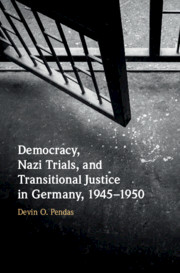
 Devin O. Pendas (Boston College) has published Democracy, Nazi Trials, and Transitional Justice in Germany, 1945-1950 with Cambridge University Press. From the publisher: 

Post-war Germany has been seen as a model of 'transitional justice' in action, where the prosecution of Nazis, most prominently in the Nuremberg Trials, helped promote a transition to democracy. However, this view forgets that Nazis were also prosecuted in what became East Germany, and the story in West Germany is more complicated than has been assumed. Revising received understanding of how transitional justice works, Devin O. Pendas examines Nazi trials between 1945 and 1950 to challenge assumptions about the political outcomes of prosecuting mass atrocities. In East Germany, where there were more trials and stricter sentences, and where they grasped a broad German complicity in Nazi crimes, the trials also helped to consolidate the emerging Stalinist dictatorship by legitimating a new police state. Meanwhile, opponents of Nazi prosecutions in West Germany embraced the language of fairness and due process, which helped de-radicalise the West German judiciary and promote democracy.

 Praise for the book:

"A vast literature insists that the transition from authoritarianism to democracy demands that a nation frankly reckon with its past crimes. Pendas's new book brilliantly challenges this view. In exploring Germany's half-hearted and vexed efforts to punish and purge former Nazis and 'fellow travelers', he demonstrates how the German nation achieved an important political success at the cost of a disturbing moral failure. His is a fine and singular achievement." - Lawrence Douglas

"Pendas has spun a powerful cautionary tale about transitional justice, a necessary corrective to the idea that liberal-legal trials in the aftermath of atrocity necessarily lead to democratization. As Pendas shows with his usual erudition, the very different political fates of West and East Germany undermine any such happy teleology. An absolute must-read - and will no doubt be read for years to come." - Kevin Jon Heller

"This is the definitive account of the 'Nuremberg interregnum' … In a tour de force, Pendas takes the reader from Nuremberg to Dachau, Lüneburg, and Waldheim, and to the many places where investigations never made it to trial. Combining a keen eye for detail with analytical rigour, Pendas reasserts historians' authority on transitional justice's potential and its limitations. This excellent book shows how unintended consequences and perennially irrational actors defy neat models and precise cost-benefit analyses." - Kim Christian Priemel

Further information is available here.

--Mitra Sharafi

Monday, January 4, 2021

ASLH Honorary Fellows

 [We have the following announcement.  DRE]

The Honors Committee of the American Society for Legal History solicits nominations of senior scholars for consideration for election as Honorary Fellows of the Society.  Election as Honorary Fellow is the highest honor the Society can confer.  It recognizes distinguished historians whose scholarship has shaped the broad discipline of legal history and influenced the work of others.  Honorary Fellows are the scholars we admire, whom we aspire to emulate, and on whose shoulders we stand.  The Society seeks to recognize scholars who are not simply distinguished in their fields, but who also have given back to the discipline and made their fields stronger by creating communities of scholars and scholarship and by helping other (often younger) scholars to stand on their shoulders.  In other words, scholars who are as committed to building a future for their fields as they are to studying the past.  Commensurate with the growing international reach of the Society, we seek nominations of senior scholars who, collectively, similarly encompass the wide scope of scholarship in legal history.

Nominations should be submitted to Bruce H. Mann, chair of the Honors Committee, by email (mann@law.harvard.edu) before January 22, 2021.  Each nomination should include a brief statement of why the nominee merits election.  A list of current and past honorary fellows is [here].

Virtual conference: Paper Empires

 [We share the following announcement for a virtual conference happening on 7-8 Jan. 2021. To register, e-mail Nandini Chatterjee: n.chatterjee@exeter.ac.uk]

The Forms of Law Project, in collaboration with the Colonialism Inside Out Project and hosted
by the University of Exeter’s Centre for Imperial and Global History, will be holding the online conference ‘Paper Empires: Layers of law in colonial South Asia and the Indian Ocean‘ on 7 and 8 January 2021.

Concept Note:

Anthropologists and historians have recently underscored the ways in which European colonialism created novel regimes of legality and record-keeping, associated with ambitious and exclusive state-centred claims to both truth and rights, while being constantly preoccupied with the spectre of forgery and corruption. However, the attention so far has been focussed on English/European-language records and the colonial institutions that produced, stored and deployed them. This focus has communicated a monolithic sense of power and normativity that unwittingly replicates the aspirations of colonial states. In addition, a more sociologically-inspired historiographical focus on colonial intermediaries as small cogs in the larger bureaucratic machinery tends to blur the underlying materiality and performative nature of record-keeping as such. Drawing on case studies from in and around South Asia, we propose instead that the law of empires was rooted in the highly localised, often multilingual, and fragmented bureaucracies that produced its records.

This conference brings together historians of pre-colonial Indian regimes with historians of British, Dutch and French colonialism in order to unearth genealogies of records in Bengali, Marathi, Persian, Sinhala and Tamil, besides French, Dutch and English, between the eighteenth and mid-twentieth centuries. In exploring that extended period, we place equal valence on subcontinental India and Sri Lanka, on European-ruled South Asia and indirectly controlled princely states, and on the search for sovereignty on water as much as land. While each paper deals with a specific mode of legal or institutional recording, our collective aim is to understand how indigenous regimes co-emerged and competed with incipient European Company-states, creating new forms and potentialities, and indeed, a whole gamut of novel record-making and -keeping strategies, in line with evolving ideas of legality.

In doing so, we engage the following questions:

How have not just documents but also legal concepts and state frameworks been translated? How were pre-existing forms displaced or repurposed by using seemingly traditional forms for novel purposes?

In what ways do these bureaucracies defy compartmentalisation in indigenous and colonial regimes? What do such co-constituted regimes tell us about power, empire, and law?

How did the materiality and ceremoniality of bureaucracies and records embody the processes of colonial law and generate the reality of colonial governance?

How does emphasizing the forms, concepts, and frameworks of law and bureaucracy change our understanding of the role of state agents and intermediaries?

How were the notions of law and language enacted in the everyday locality related to cosmopolitan cultures or vice versa? What commonalities or tensions existed between the specifics of mundane legal and bureaucratic acts versus the totalizing visions of colonial states?

How do these processes look different in different periods of colonial rule, from protracted transitions to high colonialism?

More after the jump: 

Conley on "Women Who Killed, London 1674-1913"

 Oxford University Press has published Debauched, Desperate, Deranged: Women Who Killed, London 1674-1913, by Carolyn A. Conley (University of Alabama at Birmingham). A description from the Press:

Contemporary studies have concluded that women are far less likely to kill than men and that when women do kill, they do so within the family. Debauched, Desperate, Deranged: Women Who Killed, London 1674-1913 examines the evolution of this pattern in the over 1400 trials in which women were prosecuted for homicide in London from the late seventeenth century until just before the First World War. Which deaths were considered homicides and in what circumstances women were culpable illustrates profound changes in the prevailing assumptions about women. The outcomes of trials and the portrayals of these women in the press illuminate changes in perceptions of women's status and their physical and mental limitations. Debauched, Desperate, Deranged breaks new ground in existing studies of gender and homicide, using a long time frame to discern which trends are brief anomalies and which represent significant change or continuity.

Debauched, Desperate, Deranged is the first empirical, quantitatively as well as qualitatively based study of women and homicide from the seventeenth century to the twentieth. It presents new and significant conclusions on changing incidence of maternal homicides and the remarkable constancy of spousal homicides.

More information is available here. H/t: New Books Network.

-- Karen Tani

Sunday, January 3, 2021

A Peek at the John Paul Stevens Papers

John Paul Stevens (LC)
Courtesy of The Docket, Ryan Reft, historian of the Modern United States in the Manuscript Division at the Library of Congress, provides a glimpse of the John Paul Stevens papers, pending the reopening of the Library of Congress sometime in the future (and not soon enough).  Chevron, NAACP. v. Claiborne Hardware Company, and more!

--Dan Ernst

Saturday, January 2, 2021

Weekend Roundup

  • The virtual substitute for the annual meeting of the American Historical Association includes the panel, Native Nations and Anglo-American Law, with Michael Leroy Oberg, SUNY-Geneseo; Daniel Mandell, Truman State University; Craig Yirush, University of California, Los Angeles; Zachary Conn, Yale University; and Julia Lewandoski, California State University, San Marcos.
  • The New York Times reports, in its story on the renovation of Penn Station, that the waiting area now includes “a photographic panel staged by the artist Stan Douglas nods to the station’s history, when throngs of sympathizers greeted Angelo Herndon, a persecuted labor organizer and champion of racial justice in 1934.”
  • ICYMI: The "brothel law" of La Crosse, Wisconsin (Racquet Press).  Michael Cannon on the FDA and Rosario Raspanti's tomato sauce, circa 1942 (Cato at Liberty). An appreciation of Edwin Horton, Jr., presiding judge in a trial of the Scottsboro Boys (The Chattanoogan).

Weekend Roundup is a weekly feature compiled by all the Legal History bloggers. 

Friday, January 1, 2021

Hoffman on Competition Law and Canadian Identity

C.P. Hoffman, FreeState Justice, has posted “The Mother of Combines”: Representations of the United States in Early Canadian Discourse on the Combines Problem and the Formation of Canadian National Identity, which is forthcoming in the Canadian Journal of Law & Society:

Nathaniel Clarke Wallace (wiki)

In late 1887, Canada was swept up in a fervor over the impact and scope of so-called “combines”, a blanket term used to cover price-fixing schemes, pool agreements, trusts, and other cartel and monopoly arrangements. The public debate that ensued ultimately led to the passage in 1889 of the Anti-Combines Act, the world’s first modern competition statute, enacted a year prior to the United States’ more famous Sherman Antitrust Act. But while in this case Canada acted before its neighbor to the south, the United States remained omnipresent in public and parliamentary debates on the combines problem. Canadian discourse referred to the United States in at least four ways during the combines debates: as a benchmark against which the Canadian economy and the combines problem should be judged; as a model for potential legal action, as a potential economic liberator through the power of free trade; and as the very source and propagator or the combines problem. Canadians thus alternately presented the United States as savior or devil, as paragon or antithesis. The result was a paradox of a sort: Canadians borrowed American ideas in order to avoid becoming American.
–Dan Ernst

Thursday, December 31, 2020

Eunice Hunton Carter, 1899-1970

[My annual exam in American Legal History also includes a biographical essay.  Previous years’ were on Stella Akin, the father-daughter duo Gaius and Jane Bolin, and others.  The subject of this year’s essay was Eunice Hunton Carter.  In writing it, I relied heavily upon Stephen L. Carter’s Invisible: The Forgotten Story of the Black Woman Lawyer Who Took Down America's Most Powerful Mobster (Henry Holt 2018).  Also, Carter appears, facing away from the camera, here.  DRE]
            
Eunice Hunton Carter (1899-1970) was born in Atlanta to Black middle-class parents.  Her father, William Hunton, was the grandson of a Virginia slave who purchased his freedom and moved to Canada, where William was born.  College-educated, he founded the “Colored Division” of the Young Men’s Christian Association and in that capacity traveled widely in the United States to create chapters that recruited local African Americans to the YMCA’s creed of “education, hard work, and Christian virtue.”  While founding a chapter in Norfolk, Virginia, he met and married Eunice’s mother, Addie Waites Hunton, who had been educated in the elite Boston Latin School.  The couple moved to Atlanta shortly before Eunice’s birth.  Both parents traveled, leaving Eunice and her younger brother Alpheaus in the care of a maid or family friends.  Addie gained a national reputation as a founder of Black women’s clubs and lecturer.  In a famous address, “Pure Motherhood the Basis for Race Integrity,” she argued that the most important duty of Black women was to tend to the family.  

The Huntons’ life was shattered in 1906 when a terrible race riot devastated Atlanta’s Black middle-class neighborhood.  Within months they moved to Brooklyn, New York.  Both parents continued to travel, in Addie’s case, for the Young Women’s Christian Association, the NAACP, and a group advocating world peace.  As before, Eunice and her brother the children usually roomed with other families.  Even William’s death in November 1916 did not slow down Addie’s clubwork.  Indeed, after the American entry into World War I, she spent 18 months in France bolstering the morale of Black troops stationed there.

Eunice was already on her way.  In 1917 she enrolled in Smith College, an elite and overwhelmingly White women’s college in Northampton, Massachusetts.  A society matron in the NAACP may have paid her tuition.  A government professor introduced her to Calvin Coolidge, at the time, governor of Massachusetts, who gave her advice and let her read in his well-stocked library as she worked on her thesis on state government.  The experience reinforced her lifelong attachment to the Republican Party, a family legacy.  In 1921, she graduated cum laude with both a bachelor’s and master’s degree.

Eunice spent one miserable academic year teaching at a Black college in the Deep South before returning to New York City, where was a substitute teacher and wrote short stories, some of which appeared in journals alongside works by Langston Hughes and other writers of the Harlem Renaissance.  Her mother helped her find jobs in various charitable and race organizations in Harlem.  Through one of her projects, a free dental clinic, she met Lisle Carter, an immigrant for the Caribbean island of Barbados, who owned the most profitable dental practice in Harlem.   They married in November 1924, and a year later their only child, Lisle Jr., was born.

Soon Eunice Carter was back at her social work jobs.  She helped her mother host an international “Pan-African Congress,” which brought to New York City people of African descent from around the world to discuss “the many problems of racial and social uplift.”  She also joined in several civil rights campaigns, such as protests of white-owned businesses that refused to hire African Americans.  But she wanted more.  As a child of eight, she had told a friend that she wanted to be a lawyer so she could “make sure the bad people went to jail.”  Starting in 1927, while still employed as a social worker and against her mother’s advice, she enrolled in the evening program at Fordham Law School, one of only three women in a class that would graduate 367.

Carter’s initial grades were well above average, but she had to take a year off, probably to care for her son, who may have been ill.   She graduated from Fordham Law School in 1932, the first Black woman to do so.  In May 1933, on her second try, she passed the New York bar exam.  The success came during an odd interlude, lasting into the winter of 1933-1934, during which she may have had a hysterectomy and battled depression.  

Carter attempted the practice of law but had few clients.  She wrote a few wills and represented a few misdemeanor defendants before magistrates sitting without a jury but spent more of her time as a supervisor for the Harlem Division of the Emergency Unemployment Relief Committee, which coordinated the distribution of cash, in-kind benefits, and public works jobs during the Depression.  She also was an unpaid assistant in the Harlem branch of the city’s Women’s Court, probably as an interviewer and counselor of the prostitutes whose arrests made up most of the docket.  Carter’s biographer called Women’s Courts “dark, fetid, grim chambers, loud and disorderly and presided over by bored, time-serving magistrates, many of whom . . . were thoroughly corrupt.”

She also campaigned for Republican political candidates.  When stumping in Harlem for a Black Republican candidate for the State Assembly in 1928, she was appalled by the dirty tricks of Tammany Hall Democrats, including a fake flyer that played upon the racial fears of the district’s White residents.  In that year she also worked for Herbert Hoover’s election as president but also protested that his handlers, seeing a chance to win the votes of White Southerners appalled by the selection of the Irish Catholic Al Smith to head the Democratic ticket, were ignoring Black Republicans and dealing only with the party’s “lily-white” Southern faction.  Even so, she gave a rousing speech on Hoover’s behalf in 1932, and when the Republicans needed a candidate to run for the state assembly seat encompassing Harlem in November 1934, she agreed.  Despite the endorsement of the nonpartisan Citizens Union, she lost.

The race made her known outside Harlem’s Black social elite and earned her the gratitude of the city’s Republican leaders, which they soon repaid.  In March 1934, Harlem residents, angered by what proved to be a false report of police brutality, attacked white-owned businesses in Harlem.  Three African Americans died, and hundreds were arrested.  The newly elected mayor, Fiorello La Guardia, a Progressive Republican who won with Black support (including Carter’s), appointed a biracial investigatory commission to investigate.  As its secretary, Carter became the public face of the commission, whose final report La Guardia deemed too critical of the racial biases of city officials to release to the public.

A still greater opportunity came a few months after her appointment.  An increase in mob-related violence forced the Tammany-approved District Attorney to appoint a special prosecutor to investigate organized crime in New York City.  Thomas E. Dewey, a graduate of the University of Michigan and Columbia Law School who served as U.S. Attorney for the Southern District of New York at the end of the Hoover administrator, got the job.  When assembling his staff of twenty lawyers, he told a local judge he wanted to hire a woman.  The judge recommended Carter, and Dewey appointed her on August 5, 1935.  

Dewey was intent on busting the mob’s most lucrative enterprises, including the “numbers racket,” an illegal lottery.  Carter was put to work examining tickets and found those favored by Harlem’s residents never won.  But she was also convinced that the mob ran Harlem’s brothels, a view that went against received wisdom but was consistent with her observation of the Women’s Court.  Prostitutes who paid their employers a weekly “bonding fee” invariably escaped jail time.  The same lawyer appeared on their behalf, and when he did, arresting officers mysteriously forgot material details.  Carter reasoned that the mob must have used bribed police officers and judges. She persuaded a reluctant Dewey to conduct raids that led to the conviction of a top mobster.  Carter never appeared in court, however.

In the fall of 1937, Dewey easily won election as District Attorney.  Upon taking office in January 1938, he appointed Carter Deputy Assistant District Attorney in charge of the largest division, Special Sessions, whose staff, consisting mostly of white male lawyers, prosecuted 14,000 misdemeanors a year.  Her annual salary of $6,500 (about $122,000 today) was more than Charles Hamilton Houston made from working for NAACP.  Newspaper profiles had her working until at least 7:00 and often 11:00 at night but also mentioned her attire and on at least one occasion photographed her cooking.

Other African American lawyers took notice.  Carter addressed the national meeting of the National Bar Association in 1938 and served on two standing committees, Resolutions and on Discriminatory Legislation.  Sadie Alexander congratulated her on conducting “actual trial work” before juries.  “I cannot say too much for the ability that you have shown as well as the diplomacy you must have exercised to have obtained such a position,” Alexander wrote.

In her public addresses she was something less than a thorough-going feminist.  She did announce, “I believe in the independence of women,” but she also told an audience at Howard University in 1937 that too few Black children “learned the habit of working” and that Black women had “to see that the path is broken in the right direction.”  In 1938 she told a group of Black women voters, “Never argue with a man.  I believe that I have quarreled with a man only six times in my life.  Always it resulted in disaster.”  She elaborated: “Women’s influence should be from behind the throne, not on it.”   And: “Women must never forget that men should dominate the race and that a race is only as strong as its men.  We must continue to inspire them.”

The advice jibed uneasily with her own personal life.  While Carter attended law school, her son Lisle, Jr., often lived in the home of his father’s brother in New Jersey.  Then, in February 1935, the nine-year-old boy was sent to live with his father’s family in Barbados.  It would be a year before Eunice would see him; thereafter she visited only annually.  When he turned 14, he returned to the United States, only to be sent to prep school in upstate New York.  By that time his parents were living separately.  Lisle, Sr.’s extramarital affairs were well-known in the community; Eunice contemplated leaving him for another man.  Still, they stayed married and would later live together until Lisle Sr.’s death in 1963.

Carter continued to campaign for Dewey whenever he sought elective office, such as his unsuccessful run for governor of New York in 1938 and for the Republican presidential nomination in 1940.  The latter bid included a whistle-stop campaign through Illinois, ending in a Chicago appearance in which Carter and other African Americans joined Dewey on the platform.  She supported Dewey in his successful gubernatorial bid in 1942, again in his quest for the Republican presidential nomination in 1944, and yet again in his presidential campaign against Harry S. Truman in 1948, notwithstanding the Democrats’ impressive civil rights platform.  Promotions or other preferments no longer followed, however.  Instead, Dewey’s successor as District Attorney demoted her (albeit at the same salary) to head the Adolescent Offender Bureau, where she implemented an innovative probation system for teenage offenders.  A judgeship she coveted went not to her but a Black male lawyer who started in the District Attorney’s office after she did.  

Carter thought she knew the problem: her brother.  Alphaeus Hunton had gotten a bachelor’s degree from Howard and a master’s degree from Harvard.  He then returned to Howard as an instructor of English and Romance Languages Department while pursuing and ultimately receiving a Ph.D. at New York University, with a dissertation, directed by a Marxist professor, on the politics of an English poet.  From at least 1933 onward, he met with Black communists, and he was a leader in John P. Davis’s National Negro Congress.  In 1943 he moved to New York to edit the journal of the Council on African Affairs, a group that turned up on the Attorney General’s List of Subversive Organizations.  For refusing to give the House Un-American Committee the records of another Communist Front group, he was imprisoned for six months in 1951.  After his release, he could find no employment and emigrated to Africa.  Although Carter had severed her ties with Alphaeus years earlier, she suspected, correctly, that the FBI had a substantial file on him and that it mentioned her and her connection to Dewey.

Carter left the District Attorney’s office in January 1945.  She attempted to practice law on her own but found leadership roles in Black women’s groups more interesting and remunerative.  Most of her new work had an international dimension, as when she represented the National Council of Negro Women at the organizational meeting of the United Nations in San Francisco.  She attended several overseas conferences as a representative of NGOs in the 1940s and 1950s.  “Each individual in this world has his own peculiar character and his own particular talent,” she said at one in 1951.  Democracies allowed the individual to “grow in character and in personality according to his own personal ability.”  Dictatorships, in contrast, forced him to “slave at tasks he would never choose for himself.”  They also denied women the chance to “choose and develop their individual beings in an atmosphere of freedom.”

Public Health, 1893-1939

PHS Dispensary No. 32 (LC)

[Longtime LHB readers will recall that for the exam in my legal history course I write an essay about some administrative regime I did not cover in class and ask students to compare it with ones we did.  The topics of previous essays include federal grazing policy, motor carrier regulation, meat inspection, and the US Commerce Court.  This year’s essay, on public health, follows.  DRE]

Although public health measures date from ancient times, “the science of public health is of very recent origins,” wrote Henry Bixby Hemenway, a lawyer and doctor, in his leading treatise on public health law, published in 1914,   For centuries, knowledge of the causes of disease was “crude and chaotic.”  During  the nineteenth century, however, doctors came to understand the true origins of infectious diseases and developed systematic methods to prevent them  And not a moment too soon:  Common knowledge might have sufficed when most Americans lived in rural areas, but by Hemenway’s day “a large proportion of the population is crowded within urban walls.”  Illnesses could devastate an entire region’s economy by incapacitating its workers.

Hemenway thought that too many still scoffed at preventive methods, believing they could protect themselves or count on courts to abate disease-creating nuisances as they arose.  They did not realize that “infectious diseases approach stealthily and work their injury before their presence is suspected.”  Now “specially trained executives” were a necessity, and public health administration had to be “recognized as a special profession.”  No government department touched “the life of every citizen” more closely, he maintained.  “An efficient service means an efficient community."

Already, some municipalities had met the challenge.  As the Wisconsin Supreme Court wrote in a 1909 decision, Milwaukee authorized its commissioner of health to “summarily abate nuisances of all kinds, destroy diseased or infected food, clothing, and other like articles, establish temporary hospitals in case of epidemics, and, in fine, to exercise very broad and autocratic powers in all matters relating to the conservation of the public health.”  Indeed, the commissioner’s power to act without a prior hearing or even notice “at times must trench closely upon despotic rule.”  But it could not be otherwise: “The public health cannot wait upon the slow processes of a legislative body or the leisurely deliberation of a court.  Executive boards or officers who can deal at once with the emergency under general principles laid down by the lawmaking body must exist if the public health is to be preserved in great cities.”

Unfortunately, public health officials owed their jobs to the political party that controlled of city government.  Indeed, just a few years earlier, Hemenway claimed, “a certain ward politician who was without any special training or education which fitted him for the place” ran Chicago’s public health department.   “Until the importance of the health positions is generally appreciated by the citizens they will be used, in many cases at least, as means whereby political favors can be repaid,” he warned.

Ideally, Hemenway wrote, a single administrator, “expert in the line of official duty,” should run a health department.  The administrator should, in turn, appoint subordinates, who should be experts, removable only for cause, and paid “an adequate salary, not by fees.” Departments should be organized to make every subordinate “definitely responsible for a definite portion of the work” and to assign at least one subordinate to “every point of danger.”  Subordinates should “give personal attention to individual items,” not the top administrator.
    
The judicial response to public health administration tended to focus on health officials’ power to act in emergencies without prior notice and a hearing.  As one court wrote, “The public health might suffer or be imperiled if action could be delayed until a protracted hearing could be brought to a termination.”  But the courts insisted that the affected parties could contest the health officials’ actions in lawsuits filed after the fact.  When the affected parties did in the nineteenth century, courts usually refused to treat health officials’ factual determinations as final and conclusive and instead tried them de novo.  Thus, in Miller v. Horton (1891), the Massachusetts Supreme Judicial Court, in an opinion by Oliver Wendell Holmes, Jr., upheld a trial judge’s determination, in a subsequent bench trial, that a horse destroyed by the Board of Health did not have glanders, an infectious bacterial disease, after all.  

In People ex rel. Copcutt v. Board of Health (1893), decided by the New York Court of Appeals, a board of health did give the owner of a wood mill a hearing before declaring his ponds a public nuisance, because of the sewage that seeped into them.  When the millowner sought damages for the board-ordered destruction of the dams that created the ponds, a trial judge upheld the board’s action, but only after making his own determination that the ponds were public nuisances.  The Court of Appeals affirmed, but in the process emphasized the need for de novo review after the fact.  The board of health “could obtain its information from any source and in any way,” the court noted.  If such factual determinations were “final and conclusive,” it continued, “the citizen would in many cases hold his property subject to the judgments of men holding ephemeral positions in municipal bodies and boards of health, frequently uneducated and generally unfitted to discharge grave judicial functions.”  The court then approvingly quoted a treatise writer: “where the public authorities abate a nuisance under authority of a city ordinance ‘they are subject to the same perils and liabilities as an individual.’”

After the turn of the twentieth century, appellate courts still required after-the-fact review of the emergency actions of boards of health, but some started to instruct trial courts to give public health officials the benefit of the doubt.  Valentine v. City of Englewood (1908) was a suit for wrongful imprisonment brought by the father of a girl quarantined for having scarlet fever.  New Jersey’s highest court agreed that the board of health’s determination was not final and conclusive, but it also instructed trial courts simply to determine whether the board had “reasonable and probable cause” for its factual determination.  Although some evidence suggested the girl did not have scarlet fever, the board of health had “acted with care, and not hastily, for it decided only after a conference between its own physician, a reputable physician of Englewood called in by the plaintiff, and a specialist from the city of New York.”  The appellate court therefore affirmed the trial court’s dismissal of the father’s lawsuit.

In contrast, in North American Cold Storage Company v. Chicago (1908), the U.S. Supreme Court seemingly held the line on de novo review of a public health official’s finding of fact.  Acting without a hearing, the Commissioner of Health of the City of Chicago had demanded that the complainant, the owner of a cold storage warehouse, turn over for destruction forty-seven barrels of poultry because, in the words of the Municipal Code, the poultry “had become putrid, decayed, poisonous, or infected in such a manner as to render it unsafe or unwholesome for human food.”  When the warehouseman refused, the city blocked all deliveries to or from his establishment.  The warehouseman sought an injunction against the blockade, the trial court dismissed his suit, and the warehouseman appealed to the U.S. Supreme Court.

Rufus Peckham wrote the Court’s opinion, from which only David Brewer dissented, without opinion.  Not surprisingly, Peckham, a dissenter in Jacobson and the author of the Court’s Lochner opinion, volunteered that Chicago’s total blockade of warehouse “would seem to have been arbitrary and wholly indefensible.”  The issue before the Court, however, was whether the lack of a hearing before the commissioner acted violated the warehouseman’s right to due process under the Fourteenth Amendment.  After quoting Holmes’s opinion in Miller, Peckham concluded it did not, but only because “the ex parte finding of the health officers as to the fact [of the poultry’s unwholesomeness] is not in any way binding” in a subsequent judicial proceeding.  “If a party cannot get his hearing in advance of the seizure and destruction, he has the right to have it afterward, which right may be claimed upon the trial in an action brought for the destruction of his property, and in that action those who destroyed it can only successfully defend if the jury shall find the fact of unwholesomeness.”

Yet Peckham rejected the warehouseman’s argument that he could only be denied a hearing if an emergency existed, that courts should determine whether one existed, and that none had existed in his case, because poultry in cold storage remained unchanged for up to three months.  Peckham countered that the Municipal Code left the existence of an emergency to “the reasonable discretion of the legislature,” which had delegated it to the commissioner.  Whether an emergency existed was not “a subject for review by the courts.”

Writing in 1914, Hemenway expected more judges to defer to the factual determinations of public health officials.  After all, he wrote, “the judge devotes his attention to law and its interpretation; it is not to be presumed that he knows the relative merits of different food preservatives.”  But he also thought judges would be tempted to intervene anyway if affected parties could not appeal an unfavorable order up the chain of command within a public health department.  To prevent the temptation from arising, Hemenway argued, health departments should provide for internal appeals from subordinates to superiors.

The administration of public health also was the subject of controversy at the federal level.  The first federal public health agency was the Marine Hospital Service, which ran hospitals for sailors in the nation’s seaports and was created within the Treasury Department.  Over time, the Service acquired other duties, including the administration of quarantines, inspecting immigrants, and preventing the interstate transmission of disease.  To recognize these functions, the agency was renamed the Public Health Service (PHS) in 1902.  Two years later, at the suggestion of President Theodore Roosevelt, the National Academy for the Advancement of Science (NAAS) created a committee to study how the PHS and other health-related agencies might be combined to “make a more efficient health machine in the Federal Government.”  TR backed the effort in his last message to Congress in December 1908.  “This nation cannot afford to lag behind in the worldwide battle now being waged by all civilized people with microscopic foes of mankind, nor ought we longer to ignore the reproach that this government takes more pains to protect the lives of hogs and of cattle than of human beings,” Roosevelt declared.

In 1910, with the support of TR’s successor, William Howard Taft, Oklahoma Senator Robert Owen introduced a bill to create a Department of Public Health.  Owen called health “a National Asset” and estimated the annual loss to the United States from preventable illness and death at $4 billion.  He considered the fight against preventable disease to be “a contest between intelligence and ignorance” and insisted that “all the authority, dignity and power of the general government must be put behind the truth.”  Irving Fisher, a Yale economist who chaired the NAAS committee, argued that the PHS would never get the resources it needed if it remained a mere bureau.  “As long as we have a Bureau of Health subordinate to a department of something else, health will always be regarded as subordinate to something else,” he maintained.  

To illustrate his point, Fisher referred to an earlier incident.  In March 1900, Joseph J. Kinyoun, a bacteriologist serving as Federal Quarantine Officer in San Francisco for the PHS’s predecessor, identified an outbreak of the bubonic plague and ordered a quarantine.  Outraged politicians complained the quarantine “inflicted incalculable injury upon the state, both in reputation and financially,” because it had resulted in the shunning of all things Californian.  The governor denied that the plague was ever in San Francisco and accused Kinyoun of injecting cadavers with plague bacilli to justify his fallacious findings and conducting a malicious conspiracy against the state.  The governor, it was said, mobilized “all the political machinery ... at his command to discredit Kinyoun and secure his removal.”  He dispatched a delegation of powerful businessmen to Washington to lobby the Secretary of the Treasury.  Although the head of Kinyoun’s Service warned that dismissing him would be “an abject surrender to the local political elements” and ruin the Service’s reputation, the Secretary removed Kinyoun from his post anyway.

Fisher, the allopathic doctors who dominated the American Medical Association, and other supporters probably anticipated smooth sailing for the Owen bill.  After all, Democrats and Republicans had each called for the improvement of he federal public health administration in the last presidential campaign.  Instead, as a journalist wrote, “a merry war among our medical brethren” broke out, as homeopaths, eclectics, osteopaths and other heterodox physicians warned that the allopaths would use the new department to make their practices the national standard and thereby create a “doctors trust.”  In reply, Fisher protested, “All that we are in favor of is ... to get the light of science on medicine.  We do not care where it comes from.”  But Congress, “amazed at the intensity and character of the opposition,” abandoned the bill and left PHS in the Treasury Department, where it remained until 1939.
    
PHS finally escaped the Treasury Department after the passage of the Reorganization Act of 1939.  President Franklin Delano Roosevelt had first asked for a law to enable him to reorganize the federal government in January 1937, but Congress refused, on the ground that it would delegate too much power to the president and limit its members’ influence over patronage appointments.  It passed a reorganization act in 1939 only because it put some agencies off limits and by its terms expired in two years.  The statute also allowed Congress to block the president’s reorganization plans by passing a Concurrent Resolution within sixty days.    

Reorganization Plan No. 1, which became effective in the summer of 1939, grouped various authorities, administrations, boards, and bureaus into three “superagencies”: the Federal Security Agency, the Federal Works Agency, and the Federal Loan Agency.

FDR put his proposal in a global context.  “In these days of ruthless attempts to destroy democratic governments,” he told Congress, “it is baldly asserted that democracies must always be weak in order to be democratic at all; and that, therefore, it will be easy to crush all free states out of existence.”  His proposed reorganization would enable “the people’s Government” to carry out “the people’s will” and “make democracy work. . . .  We are not free if our administration is weak.”  FDR’s critics saw it differently.  The Chicago Tribune warned that the reorganization would abet FDR’s continued transferal of “the resources of the country from private enterprise to political management” under “what the Germans call the Fueher.”  If FDR was not stopped, the result could only be “the absolutism which exists in Germany, Italy, and Russia."

Nolan on Winfield on Tort

Donal Nolan, University of Oxford Faculty of Law, has posted Professor Sir Percy Winfield (1878-1953), which appears in Scholars of Tort Law, ed. James Goudkamp and Donal Nolan (Hart 2019):

This chapter is concerned with Sir Percy Winfield, arguably the most influential scholar of the English law of tort in the relatively short history of the subject. The chapter is divided into three main parts. The first part (‘The Life’) consists of a short biography of Winfield. In the second part (‘The Work’), I discuss Winfield’s principal writings on tort law, their reception and their influence. And in the final part (‘The Scholar’), I seek to identify Winfield’s key characteristics as a scholar. I conclude that a number of reasons can be identified for the impact and endurance of Winfield’s writings on tort: his technical brilliance; his intellectual openness; his clear and attractive style; his prescience and forward-thinking approach; his thoroughgoing pragmatism; and a measure of good fortune. Underlying all of this, however, lay an even more basic foundation for his scholarly achievements, namely a profound and very broad knowledge of the common law and its history.
–Dan Ernst

Wednesday, December 30, 2020

Bowman on the Jenner Bill

Winston Bowman, Associate Historian, Federal Judicial Center, continues the FJC’s Spotlight on Judicial History series with a post on “The Jenner Bill”:

In 1956 and 1957, the Supreme Court of the United States issued a series of opinions vindicating the constitutional rights of American communists. Coming near the end of a sustained period of anxiety over the supposed influence of communist “subversives” in American political and cultural affairs, these rulings proved controversial. Perhaps the most forceful response to the decisions came in the form of legislation proposed by Indiana Senator William Jenner in 1957. The “Jenner Bill,” sometimes known as the “Jenner-Butler Bill,” would have revoked the Supreme Court’s appellate jurisdiction over five classes of cases involving the civil and criminal interdiction of subversive political activities. Although the bill ultimately failed, it provoked widespread discussion over the authority and independence of the Supreme Court and the balance of power between branches of government. [More.]
–Dan Ernst

Schorr on Nature as Norm in and Water Law in the British World

David Schorr, Tel Aviv University Buchmann Faculty of Law, has posted Nature Versus the Common Law: Nature as a Norm in the Water Law of the British World, which is forthcoming in Clio@Thémis 2021:

This article, written for a forthcoming issue of the journal Clio@Thémis on "Nature as a Norm", examines the water law of jurisdictions from across the "common law world" in the nineteenth and early twentieth centuries, a period in which increasingly intensive uses of water and watercourses around the world brought conflicts over water law into court with relative frequency. An issue that arose in a variety of contexts was the degree to which the rules of the common law of England with regard to water could or should be applied in territories characterized by environmental conditions that often differed radically from those found in England. A legal regime that seemed unremarkable in the home country often seemed a poor fit for the conditions of other, far-off lands, leading to friction between the law and the lived life of the colony and its natural environment.

The article explores some of the areas of water law in which courts around the common law world departed from the established rules of the common law in order to make the legal rules more appropriate, as they saw it, to the local environment. They did so consciously, explicitly granting nature normative force. It will also look at other courts and judges, ones that resisted this kind of normative claim, arguing that the law in new environments had to conform to the old common-law rules, regardless of what nature seemed to demand. Perhaps surprisingly, this discourse in far-flung jurisdictions about the potential legal force of local environmental conditions was at the same time a global one: Arguments were made not only about the differences between local and British nature, but also about the similarities between the natures of territories very distant and different from each other. Both types of environmental comparisons were seen to have normative significance.

--Dan Ernst