White Cartels, the Civil Rights Act of 1866, and the History of Jones v. Alfred H. Mayer Co. is a new article by Darrell A. H. Miller, University of Cincinnati College of Law. It is forthcoming in the Fordham Law Review. The paper is not posted, just the the abstract: In 2008, Jones v. Alfred H. Mayer Co. turns forty. In Jones, the Supreme Court held for he first time that Congress may use the Thirteenth Amendment, which abolished slavery, to prohibit private racial discrimination in the sale of property.
Jones temporarily awoke the Thirteenth Amendment and its enforcement legislation – the Civil Rights Act of 1866 – from a century-long slumber. Moreover, it recognized an economic reality: racial discrimination by private actors can be as debilitating as racial discrimination by public actors. In doing so, Jones veered away from three decades of civil rights doctrine: a doctrine that had focused primarily on the Fourteenth, rather than the Thirteenth Amendment, and on public actors, rather than on private actors. Further, by applying the Civil Rights Act of 1866 to private discrimination, Jones acknowledged the nineteenth-century roots of economic arguments that scholars use today to critique the relationship between private and public power.
Yet, despite its importance, Jones largely has been relegated to a squib in textbooks. Few scholars have attempted to analyze Jones in light of other, analogous types of discriminatory behavior by private groups – especially cartel behavior. And, unlike more famous civil rights cases, like Brown v. Board of Education, almost nothing is written about the people of Jones – the litigants, the lawyers, and the judges behind the caption.
This piece addresses that neglect. First, it ties together economic theories about racial discrimination with the history of the Civil Rights Act of 1866 and its subsequent interpretation in Jones. It explains how Congress’ exercise of Thirteenth Amendment power to govern private economic relationships during Reconstruction gave important, but unacknowledged, intellectual credence to the antitrust movements of the late nineteenth and early twentieth centuries. Second, it explores the human story behind Jones, tracking the narrative of the Joneses, their counsel, the judges, and their lives after the decision. Finally, it explains how Jones’ recognition of the interrelationship between public and private coercion can help scholars, lawmakers, and jurists define the contours of Thirteenth Amendment power.
Tuesday, September 23, 2008
Monday, September 22, 2008
How to get your legal history events listed on the Legal History Blog
We like to post about upcoming events in legal history. If you have a legal history workshop or if your university will be hosting a conference or lectures of interest to legal historians, you can e-mail Mary or Dan. Since different schools have different practices, we don't post about campus workshops unless we know you want us to.


Book talk this Wednesday, Middletown, CT
 For any readers at Wesleyan, and in the greater Middletown, CT area, I will be speaking at Broad Street Books this Wednesday, September 24, from 5:00 to 6:00 pm. The topic is my new book, Exporting American Dreams. Details here.
Volokh on Symbolic Expression and the Original Meaning of the First Amendment
Eugene Volokh, UCLA School of Law, has posted a new article, Symbolic Expression and the Original Meaning of the First Amendment. It is forthcoming in the Georgetown Law Journal. Here's the abstract:
People often argue that symbolic expression - especially flag burning - isn't really "speech" or "press," and that the Court's decisions protecting symbolic expression are thus illegitimate. But it turns out that the original meaning of the First Amendment likely includes symbolic expression. Speech restrictions of the Framing era routinely treated symbolic expression the same as literal "speech" and "press." Constitutional speech protections of that era did so as well, though the evidence on this is slimmer. And the drafting history of the phrase "the freedom of speech, or of the press," coupled with the views of leading commentators from the early 1800s, suggests that the First Amendment's text was understood as protecting "publishing," a term that at the time covered communication of symbolic expression and not just printing. Though the Court has never relied on this evidence, even originalists ought to accept the Court's bottom line conclusion that the First Amendment covers symbolic expression.
People often argue that symbolic expression - especially flag burning - isn't really "speech" or "press," and that the Court's decisions protecting symbolic expression are thus illegitimate. But it turns out that the original meaning of the First Amendment likely includes symbolic expression. Speech restrictions of the Framing era routinely treated symbolic expression the same as literal "speech" and "press." Constitutional speech protections of that era did so as well, though the evidence on this is slimmer. And the drafting history of the phrase "the freedom of speech, or of the press," coupled with the views of leading commentators from the early 1800s, suggests that the First Amendment's text was understood as protecting "publishing," a term that at the time covered communication of symbolic expression and not just printing. Though the Court has never relied on this evidence, even originalists ought to accept the Court's bottom line conclusion that the First Amendment covers symbolic expression.
Ramsey, A Historical Perspective on the Detention of Material Witnesses
In the Sweat Box: A Historical Perspective on the Detention of Material Witnesses has just been posted by Carolyn B. Ramsey, University of Colorado Law School. Beyond the article's particular focus on the history of criminal procedure, it also helps with the question of whether September 11 was a moment of transformation, or whether legal developments before and after 9/11 are better viewed as continuous, a topic explored elsewhere. Ramsey's article is forthcoming in the Ohio State Journal of Criminal Law (2009). Here's the abstract: After the September 11 terrorist attacks, the Justice Department detained scores of allegedly suspicious persons under a federal material witness statute - a tactic that provoked a great deal of controversy. Most critics assume that the abuse of material witness laws is a new development. Yet, rather than being transformed by the War on Terror, the detention of material witnesses is a coercive strategy that police officers across the nation have used since the nineteenth century to build cases against suspects. Fears of extraordinary violence or social breakdown played at most an indirect role in its advent and growth. Rather, it has long been used to obtain prosecution evidence in ordinary cases of murder, robbery, prostitution, and other street crimes. Historically, no stark divide between the innocent witness and the suspected criminal existed in the minds of the police. Indeed, material witness detention contributed to the rise of incommunicado interrogation and numbered among the tactics identified in the Wickersham Commission's expose of the third degree in 1931. This Essay demonstrates that the story of material witness detention is one of stasis, not of change. For more than a century, the field practices of police and magistrates have been unresponsive to reforms in statutory and constitutional law or to sporadic public pressure on behalf of detainees deemed to have knowledge of a crime. In telling such a story, this Essay seeks not to defend the Justice Department, but to suggest that intense scholarly focus on September 11 as a watershed in the history of criminal procedure obscures ways in which the gradual consolidation of governmental power over more than a century has fostered an increasingly coercive and secretive relationship between the individual and the police.
Carle on the Myth of Civil Rights Liberalism and the Thought of T. Thomas Fortune, 1880-1890
Debunking the Myth of Civil Rights Liberalism: Visions of Racial Justice in the Thought of T. Thomas Fortune, 1880-1890 is a new paper by Susan Carle, American University Washington College of Law. It is forthcoming in the Fordham Law Review (2009). Here's the abstract: 
In recent years, the supposed achievements of the American civil rights movement have come under attack as part of a critique of the ideology of legal liberalism. That critique argues that civil rights lawyers and other activists too greatly emphasized court-focused strategies aimed at achieving what would turn out to be pyrrhic "civil" rights victories - i.e., gains solely in "formal" equality in requirements enshrined in law as to how the state should treat its citizens. This critique of legal liberalism is well deserved insofar as it is aimed at a tendency within legal academia to extol the virtues of the American legal system, especially the U.S. Supreme Court's allegedly laudable protection of civil and political rights. But in this Article I argue such critiques of legal liberalism should not be allowed to bleed into evaluations of the goals of the civil rights movement itself, especially when taking a long view on the movement for racial justice.
I seek to promote taking such a long view of the movement for racial justice by evaluating the legal liberal critique of that movement in relation to an important early leader: T. Thomas Fortune, a law-educated militant journalist, public intellectual and organizer. In 1887, Fortune founded the Afro-American League, a national organization that was short-lived but nevertheless played an important historical role in the transmission of ideas to later groups including the Afro-American Council, the Niagara Movement, and the NAACP. Fortune's multi-dimensional view of the struggle for racial justice embraced a number of ideas we tend to see as distinct or even opposing today. Fortune supported reactive court battles and proactive legislative reform, establishment of equal civil and political rights and an ultimate goal of economic justice, intra-race self-help and interracial coalition politics aimed at eliminating poverty for all persons regardless of race. Examining Fortune's ideas helps remind us that the history of the civil rights movement was more complex and multidimensional than the contemporary legal-liberal gloss remembers today.

In recent years, the supposed achievements of the American civil rights movement have come under attack as part of a critique of the ideology of legal liberalism. That critique argues that civil rights lawyers and other activists too greatly emphasized court-focused strategies aimed at achieving what would turn out to be pyrrhic "civil" rights victories - i.e., gains solely in "formal" equality in requirements enshrined in law as to how the state should treat its citizens. This critique of legal liberalism is well deserved insofar as it is aimed at a tendency within legal academia to extol the virtues of the American legal system, especially the U.S. Supreme Court's allegedly laudable protection of civil and political rights. But in this Article I argue such critiques of legal liberalism should not be allowed to bleed into evaluations of the goals of the civil rights movement itself, especially when taking a long view on the movement for racial justice.
I seek to promote taking such a long view of the movement for racial justice by evaluating the legal liberal critique of that movement in relation to an important early leader: T. Thomas Fortune, a law-educated militant journalist, public intellectual and organizer. In 1887, Fortune founded the Afro-American League, a national organization that was short-lived but nevertheless played an important historical role in the transmission of ideas to later groups including the Afro-American Council, the Niagara Movement, and the NAACP. Fortune's multi-dimensional view of the struggle for racial justice embraced a number of ideas we tend to see as distinct or even opposing today. Fortune supported reactive court battles and proactive legislative reform, establishment of equal civil and political rights and an ultimate goal of economic justice, intra-race self-help and interracial coalition politics aimed at eliminating poverty for all persons regardless of race. Examining Fortune's ideas helps remind us that the history of the civil rights movement was more complex and multidimensional than the contemporary legal-liberal gloss remembers today.
Sunday, September 21, 2008
Reviewed: books on African American congressmen during Reconstruction and Mormon history
CAPITOL MEN: The Epic Story of Reconstruction Through the Lives of the First Black Congressmen by Philip Dray is reviewed in the Washington Post by Jabari Asim, who finds it "absorbing." Asim writes,


Most of Dray's Capitol men -- female representation, like female suffrage, was a thing of the future -- first came to public attention during the state conventions. Congress required a new constitution from each Confederate state before it could be re-admitted to the Union. The gatherings were "extraordinary events" and "the nation's first biracial experiment in governance," Dray writes. "Most of the whites present, including members of the press, were seeing and hearing for the first time the phenomenon of black men speaking their opinions freely." He observes that "black officeholders tended to be -- had to be -- exceptional individuals. . . . In general they brought an impressive degree of competence and dedication to their jobs, dispelling critics' claims that they possessed no aptitude for politics or statesmanship."Dray also details "what these men were up against":
both the violence (in the form of Klan campaigns, bloodthirsty rifle clubs and systematic rape of black women) and the political maneuverings, such as the dismantling of the Enforcement Acts, the Mississippi Plan and the capitulating North's increasing willingness to get on with the business of reconciliation, no matter what the cost.
Cont inue reading here.
 inue reading here.
Also in the Post, two books on Mormon history are reviewed by H.W. Brands: DEVIL'S GATE: Brigham Young and the Great Mormon Handcart Tragedy, by David Roberts; and MASSACRE AT MOUNTAIN MEADOWS: An American Tragedy by Ronald W. Walker, Richard E. Turley Jr. and Glen M. Leonard. Brands finds the latter work "riveting" and "even-handed." Of Devil's Gate, Brands writes,
The journey of the handcart travelers from Iowa to Utah becamea defining myth of Mormon history, the equivalent, as David Roberts observes, of the voyage of the Mayflower in American colonial history. Subsequent generations of Mormons took pride in their descent from handcart pioneers; as with the Mayflower, more than a few of the claims of lineage were spurious.
In the judgment of Roberts, who has written extensively about the American West and its peoples, the mythmaking has a sinister aspect, crossing the line into historical cover-up.

Read the rest here.
More on Gordon Reed, The Hemingses of Monticello
"The Hemingses of Monticello is a brilliant book," write Edmund S. Morgan and Marie Morgan in the New York Review of Books. "It marks the author," Annette Gordon Reed of New York Law School, "as one of the most astute, insightful, and forthright historians of this  generation." Gordon Reed's account of Sally Hemings, Thomas Jefferson and the life to those who lived at Monticello is drawn
 generation." Gordon Reed's account of Sally Hemings, Thomas Jefferson and the life to those who lived at Monticello is drawn
 from thousands of documents and the vast scholarship of the historians who preceded her. While praising her grasp of the sources, her legal acuity, her erudition, and the stylishness of her narrative, it remains to be said that her great achievement lies in telling this story. Because it is one of the stories that really matter.
Continue reading here.
Dan noted last Sunday's review of The Hemingses of Monticello in the Washington Post. Gordon-Reed is drawing a lot of press, including a profile in the Arts section of Saturday's New York Times by Patricia Cohen.
 Post. Gordon-Reed is drawing a lot of press, including a profile in the Arts section of Saturday's New York Times by Patricia Cohen.
 "'I wanted to tell the story of this family in a way not done before' so that readers can 'see slave people as individuals,'" Gordon Reed says in the NYT interview. "'Robert, James, Elizabeth and Sally are not concepts but people,' she added, referring to the Hemings family." Cohen notes that "Joseph Ellis, a Jefferson scholar who had been wary of the claims about Hemings before the DNA tests, called Ms. Gordon-Reed’s book 'the best study of a slave family ever written.'"
The story continues here.
"Rule and Discretion"
[The following is the fourth in a series of posts on Roscoe Pound and the administrative state. The series starts here.]
 Roscoe Pound’s “Justice According to Law,” published as a series of articles in the Columbia Law Review from December 1913 to January 1914, found an interested reader in the legal philosopher Morris R. Cohen. In an article published later in 1914, Cohen, Felix Frankfurter’s roommate during their years of graduate study at Harvard, praised Pound’s article, albeit faintly. By showing that “life demands of law two seemingly contradictory qualities, certainty or fixity and flexibility,” Cohen announced, Pound had left “little to be desired by the philosopher who wishes to orient himself in this matter.” Once such a philosopher considered “the purely logical aspect of the dialectic” of rule and discretion, however, it quickly became apparent that the “legalist’s dilemma, either a rigid rule without discretion on the part of the judge, or else arbitrary caprice, does not . . . exhaust all possibilities.” Upon careful examination, discretion proved not to be lawless, and rule and discretion, which Pound treated as antitheses, proved inseparable.
Professor Pound was not amused. “I have read your paper ‘Rule vs. Discretion’ in the Journal of Philosophy, Psychology and Scientific Methods for April with a great deal of interest,” he wrote to Cohen in May 1914. Were Cohen to consult “the lawyer’s experience of the layman’s mode of deciding cases” he would see the basis for Pound’s distinction between “rules of reason and arbitrary will.” After deploring arbitration for its adoption of “the line of least resistance by way of compromise,” Pound turned to the subject of these posts: Cohen, taken aback, sent copies of the correspondence to Frankfurter, who had joined the Harvard law faculty in 1913. In reply, Frankfurter conceded that commissions had their shortcomings but noted that judges had also succumbed to the “temptation to take short cuts.” People v. Stevens really was indefensible; still, it could not “touch for rawness the decision of the Supreme Court” in a recent case.
As for Pound, Frankfurter counseled patience and circumspection. “I see several indications of impatiences on his part with a good deal of administration, because, I believe, the facts haven’t fully been brought to his attention,” he explained to Cohen. “I prefer to work those things out in a non-contentious way, casually, as opportunity will amply present itself [in] the coming year.”
Frankfurter and Pound never settled their differences on the administrative state--“some of our hopes and faiths are different,” Frankfurter acknowledged--but they remained within haling distance of each other long after 1914, for both believed that, in Frankfurter’s words, “the personnel of these commissions is one of the most decisive things about them, and the personnel is pretty low.” With the coming of the New Deal, their breach would become obvious and irreparable.
[The series continues here.]
 Roscoe Pound’s “Justice According to Law,” published as a series of articles in the Columbia Law Review from December 1913 to January 1914, found an interested reader in the legal philosopher Morris R. Cohen. In an article published later in 1914, Cohen, Felix Frankfurter’s roommate during their years of graduate study at Harvard, praised Pound’s article, albeit faintly. By showing that “life demands of law two seemingly contradictory qualities, certainty or fixity and flexibility,” Cohen announced, Pound had left “little to be desired by the philosopher who wishes to orient himself in this matter.” Once such a philosopher considered “the purely logical aspect of the dialectic” of rule and discretion, however, it quickly became apparent that the “legalist’s dilemma, either a rigid rule without discretion on the part of the judge, or else arbitrary caprice, does not . . . exhaust all possibilities.” Upon careful examination, discretion proved not to be lawless, and rule and discretion, which Pound treated as antitheses, proved inseparable.
Professor Pound was not amused. “I have read your paper ‘Rule vs. Discretion’ in the Journal of Philosophy, Psychology and Scientific Methods for April with a great deal of interest,” he wrote to Cohen in May 1914. Were Cohen to consult “the lawyer’s experience of the layman’s mode of deciding cases” he would see the basis for Pound’s distinction between “rules of reason and arbitrary will.” After deploring arbitration for its adoption of “the line of least resistance by way of compromise,” Pound turned to the subject of these posts:
Unhappily our executive commissions are showing the same lay tendency. One case which may fairly be put as typical is worth referring to. Look at People v. Stephens, 203 N.Y. 7 [1911; sic: Stevens]. In this case, a public service company sought to issue securities which obviously under the facts found by the commission it had no right to issue. Instead of turning down the issue the commission authorized the issue of the improper securities conditioned upon a reduction of one hundred thousand dollars in the capital stock of the company. As a matter of fact, the capital stock had been watered something like two hundred and twenty-five thousand dollars and no possible rule of reason could be put behind authorizing one hundred and fifty-eight thousand dollars of improper securities conditioned upon a reduction of one hundred thousand of two hundred and twenty-five thousand inflated stock. . . . The case went to the Court of Appeals on the claim of the company that the whole issue should be unconditionally authorized based upon a technical construction of the statute. The court rightly rejected this construction and held that the issue should not be authorized at all. Any lawyer who has had experience before commissions knows exactly what happened. A strong argument was made on the construction of the statute and the commission made a feeble compromise with no principle behind it. It is the constant experience of this sort of thing leads lawyers to insist that matters which are not governed by rule be governed by a tangible sort of principle. It is the continual tendency of the lay judge to decide cases in just this way that has always made non-judicial tribunals intolerable.
 Cohen, taken aback, sent copies of the correspondence to Frankfurter, who had joined the Harvard law faculty in 1913. In reply, Frankfurter conceded that commissions had their shortcomings but noted that judges had also succumbed to the “temptation to take short cuts.” People v. Stevens really was indefensible; still, it could not “touch for rawness the decision of the Supreme Court” in a recent case.
As for Pound, Frankfurter counseled patience and circumspection. “I see several indications of impatiences on his part with a good deal of administration, because, I believe, the facts haven’t fully been brought to his attention,” he explained to Cohen. “I prefer to work those things out in a non-contentious way, casually, as opportunity will amply present itself [in] the coming year.”
Frankfurter and Pound never settled their differences on the administrative state--“some of our hopes and faiths are different,” Frankfurter acknowledged--but they remained within haling distance of each other long after 1914, for both believed that, in Frankfurter’s words, “the personnel of these commissions is one of the most decisive things about them, and the personnel is pretty low.” With the coming of the New Deal, their breach would become obvious and irreparable.
[The series continues here.]
Saturday, September 20, 2008
Alford on the Socratic Method and the Carnegie Foundation Report
 Ryan P. Alford, an attorney at Cleary Gottlieb Steen & Hamilton, has posted, How Do You Trim the Seamless Web? Considering the Unintended Consequences of Pedagogical Alterations, which is forthcoming in the University of Cincinnati Law Review. I'm sure there will be other attempts to put into a historical context the recommendations for legal education made by the Carnegie Foundation last year, but I doubt they'll be many that go back to Petrus Ramus's quarrel with Aristotle to do it. Here's the abstract:
The Socratic method is considered obsolete and unhelpful by many legal educators. Catalyzed by the latest report of the Carnegie Foundation on legal education, educational reformers are pushing for the reduction or elimination of its use. This paper presents a historical perspective on the importance of the Socratic method to the development of law and to its continuity across time. It highlights the importance of the method in imparting Aristotelian epistemology and scholastic modes of reasoning that are increasingly rare in society at large, but which are critical to the structure and spirit of the law. Accordingly, it is argued that it is impossible to predict with confidence that the end of the Socratic method would not critically impair our hermeneutic bridge to the era in which the foundational concepts of law were elaborated or even destroy our ability to understand their meaning.
Friday, September 19, 2008
"Executive Justice is an Evil"
 [The following is the third in a series of posts on Roscoe Pound and the administrative state. The series starts here.]
If Roscoe Pound executed an “about face” in his attack on the New Deal in 1938, then the early Pound must have been an enthusiastic advocate of “a large role for administrative agencies” (the words are David Wigdor’s). One imagines him almost as a John the Baptist for his successor as dean, James Landis, who in the same year as Pound’s report for the American Bar Association argued that the “administrative process” was a new and legitimate branch of government. It’s a hard image to reconcile with the Pound who exalted in the trained judge and was almost priggishly averse to lay involvement in the judicial process. For if in Pound’s day some administrators brought to their tasks specialized experience and expertise, many were patronage appointees who little understood the “taught legal tradition” that Pound counted on to safeguard liberty in the Anglo-American tradition. In fact, Pound considered what he variously called the recrudescence of “justice without law,” “the rise of personal government,” and the “growth of administrative law” cause for concern not celebration. “Executive justice is an evil,” he declared in 1907, albeit a necessary one until “the adjustment of human relations by our courts is brought into thorough accord with the moral sense of the public at large.” According to Pound, “The only way to check the onward march of executive justice” was for lawyers “to improve the output of judicial justice.”
In a series of addresses and articles--“Executive Justice” (1907); “Justice According to Law” (1913), “The Revival of Personal Government” (1917); “The Administrative Application of Standards” (1919); and “The Growth of Administrative Justice” (1924)--Pound fit the rise of administration into a cyclical interpretation of legal history as “a constant movement back and forth between wide judicial discretion on the one hand, and strict confinement of the magistrate by detailed rules upon the other hand.” When “justice according to law” became too rigid, a reversion to “justice without law” was required to “bring the administration of justice into touch with new moral ideas or changed social or political condition.” If the new discretionary powers were entrusted to executives, the result “has always been and will always be as crude and as variable as the personalities of the officials” involved. Fortunately, in time the new ideas became embodied in a”a new body of fixed rules.” Infused with “enough of current morality to preserve its life,” justice according to law resumes its proper, dominant place.
Pound saw his cycle at work during Tudor and Stuart England. The rigidities of the common law and its courts led to an enlargement of the Chancellor’s jurisdiction and the creation of Star Chamber and other prerogative courts. The common lawyers responded by abolishing some courts, making over Chancery “along common-law lines” and incorporating the valuable elements of Chancery’s and Star Chamber’s jurisprudence into the common law. “The common law survived and the sole permanent result of the reversion to justice without law was a liberalizing and modernizing of the law.”
Pound believed that the cycle was repeating itself in his day. Boards and commissions had multiplied; judicial control over “arbitrary executive action” had loosened; “summary administrative powers” had been unleashed. This was a reaction against an earlier, “everyday spectacle” of “law paralyzing administration. . . . Almost every important measure of police or administration [had] encountered an injunction.” Courts of equity even attempted to regulate grade crossings. These judges had been weighed down by “the old scholastic logic” and the “cumbrous, ineffective and unbusinesslike procedure” of their courts. For justice without law, the laity had turned to the executive. In 1907 Pound counted scores of statutes that gave “wide powers of dealing with the liberty or property of citizens to executive boards, to be exercised summarily, or upon such hearing as comports with lay notions of fair play”; ten years later he still saw “all manner of administrative tribunals, proceeding summarily upon principles yet to be defined” being created at the expense of the courts. “We seem for a time to be willing to throw over a large part of our hard won justice according to law,” Pound ventured, “in the hope that summary adjustment of human relations and summary administrative regulation of human conduct may give wider recognition and more effective security to the claims of the socially dependent to a larger and fuller life.”
Pound refused to join in such hyperbolic critics of administration as E.S.P. Haynes, who deplored The Decline of Liberty in England (1916), and William Guthrie, whose presidential address for the New York State Bar Association in 1924 was “a blast upon the trumpet to warn the people of the enemy that is upon our coasts.” The growth of administrative justice was not the product of “maternalism or paternalism, or a decay of the ancient faith, or a loss of fiber in the American public, or anything of that sort.” Yet it held perils for Anglo-American jurisprudence and required careful and determined efforts by the nation’s common lawyers.
A thoroughgoing advocate of administration might have overlooked or apologized for the crudeness of early independent commissions. “Lord knows I am pretty thoroughly aware of the dangers,” Felix Frankfurter wrote to his former roommate, the philosopher Morris Cohen, in 1914. “The biggest that I see is the inferior quality of men that we put on our commissions after such institutions become commonplace.” But commissions were still “in their pioneer stages”; they had “been at it all too short a time for us to get impatient with them.” The Interstate Commerce Commission, for example, showed that an agency could “be ‘mellowed by experience.’” Frankfurter thought that its efforts compared “very favorably in steadfastness, in dependability, in intellectual disinterestedness, with the work of any court dealing with a fluid branch of the law on such a multitudinous scale.”
Pound, in contrast, did not hesitate to reveal his impatience with the procedures and decisionmaking of administrative agencies. He called Local Government Board v. Arlidge (1915), in which the House of Lords upheld a refusal to disclose the report of a housing inspector declaring a building unfit for human habitation, “a startling decision in the cradle of our common law” and “a reversion to a primitive justice without law.” He wrote approvingly of judicial rebukes to public service commissioners who similarly acted upon secret reports. And to illustrate how administrative tribunals sought “only the line of least resistance” and to placate “immediate social interests” at the expense of “ultimate social interests and individual interests,” Pound provided his audiences with an ostensibly humorous rendition of Carroll v. Knickerbocker Ice Company (N.Y. 1916):
What, then, was to be done? Surely lawyers should avoid the example of the New York Court of Appeals in Ives v. South Buffalo Railroad Company (1911), which apparently considered the case’s “economic and sociological aspects . . . palpably irrelevant.” They should not simply “sound warning blasts and kick against the pricks.” Rather, “resolutely and intelligently,” they should use “the new economics and the social science of today” to renovate the common law. “We must have recourse to lawyers,” Pound declared, if “our crude experiments with lawless justice” were to give way to “a legal fixation and systematization.” Anticipating the argument of his Formative Era of American Law (1938), Pound announced that “the inventive, creative spirit of the founders of our American polity, of the great judges who made the feudal land law of England and a few institutions of the old law merchant into the law of nineteenth century America, is needed today. . . . It is for the lawyer to study the crudites and the defects that are involved in any evolution of this sort, to study the problems and the means of meeting them with the legal materials that are at hand, and to do the same job of creative, constructive, legal thinking and philosophic judicial decision that was done by Marshall and Kent, Story and Shaw, Gibson and Ruffin.”
As long as Pound thought the bar had enlisted in his cause he could regard the growth of administrative law with equanimity. When a series of events during the first years of Franklin D. Roosevelt’s administration convinced him that “the inner republic” of the bar was about to succumb to justice without law, he lost his balance. Before turning to those events, I’d like to take up a private exchange involving Morris Cohen, Felix Frankfurter and Pound in 1914 that vividly reveals Pound’s disdain for the lay administrator and the lay judge.
[The series continues here.]
 [The following is the third in a series of posts on Roscoe Pound and the administrative state. The series starts here.]
If Roscoe Pound executed an “about face” in his attack on the New Deal in 1938, then the early Pound must have been an enthusiastic advocate of “a large role for administrative agencies” (the words are David Wigdor’s). One imagines him almost as a John the Baptist for his successor as dean, James Landis, who in the same year as Pound’s report for the American Bar Association argued that the “administrative process” was a new and legitimate branch of government. It’s a hard image to reconcile with the Pound who exalted in the trained judge and was almost priggishly averse to lay involvement in the judicial process. For if in Pound’s day some administrators brought to their tasks specialized experience and expertise, many were patronage appointees who little understood the “taught legal tradition” that Pound counted on to safeguard liberty in the Anglo-American tradition. In fact, Pound considered what he variously called the recrudescence of “justice without law,” “the rise of personal government,” and the “growth of administrative law” cause for concern not celebration. “Executive justice is an evil,” he declared in 1907, albeit a necessary one until “the adjustment of human relations by our courts is brought into thorough accord with the moral sense of the public at large.” According to Pound, “The only way to check the onward march of executive justice” was for lawyers “to improve the output of judicial justice.”
In a series of addresses and articles--“Executive Justice” (1907); “Justice According to Law” (1913), “The Revival of Personal Government” (1917); “The Administrative Application of Standards” (1919); and “The Growth of Administrative Justice” (1924)--Pound fit the rise of administration into a cyclical interpretation of legal history as “a constant movement back and forth between wide judicial discretion on the one hand, and strict confinement of the magistrate by detailed rules upon the other hand.” When “justice according to law” became too rigid, a reversion to “justice without law” was required to “bring the administration of justice into touch with new moral ideas or changed social or political condition.” If the new discretionary powers were entrusted to executives, the result “has always been and will always be as crude and as variable as the personalities of the officials” involved. Fortunately, in time the new ideas became embodied in a”a new body of fixed rules.” Infused with “enough of current morality to preserve its life,” justice according to law resumes its proper, dominant place.
Pound saw his cycle at work during Tudor and Stuart England. The rigidities of the common law and its courts led to an enlargement of the Chancellor’s jurisdiction and the creation of Star Chamber and other prerogative courts. The common lawyers responded by abolishing some courts, making over Chancery “along common-law lines” and incorporating the valuable elements of Chancery’s and Star Chamber’s jurisprudence into the common law. “The common law survived and the sole permanent result of the reversion to justice without law was a liberalizing and modernizing of the law.”
Pound believed that the cycle was repeating itself in his day. Boards and commissions had multiplied; judicial control over “arbitrary executive action” had loosened; “summary administrative powers” had been unleashed. This was a reaction against an earlier, “everyday spectacle” of “law paralyzing administration. . . . Almost every important measure of police or administration [had] encountered an injunction.” Courts of equity even attempted to regulate grade crossings. These judges had been weighed down by “the old scholastic logic” and the “cumbrous, ineffective and unbusinesslike procedure” of their courts. For justice without law, the laity had turned to the executive. In 1907 Pound counted scores of statutes that gave “wide powers of dealing with the liberty or property of citizens to executive boards, to be exercised summarily, or upon such hearing as comports with lay notions of fair play”; ten years later he still saw “all manner of administrative tribunals, proceeding summarily upon principles yet to be defined” being created at the expense of the courts. “We seem for a time to be willing to throw over a large part of our hard won justice according to law,” Pound ventured, “in the hope that summary adjustment of human relations and summary administrative regulation of human conduct may give wider recognition and more effective security to the claims of the socially dependent to a larger and fuller life.”
Pound refused to join in such hyperbolic critics of administration as E.S.P. Haynes, who deplored The Decline of Liberty in England (1916), and William Guthrie, whose presidential address for the New York State Bar Association in 1924 was “a blast upon the trumpet to warn the people of the enemy that is upon our coasts.” The growth of administrative justice was not the product of “maternalism or paternalism, or a decay of the ancient faith, or a loss of fiber in the American public, or anything of that sort.” Yet it held perils for Anglo-American jurisprudence and required careful and determined efforts by the nation’s common lawyers.
A thoroughgoing advocate of administration might have overlooked or apologized for the crudeness of early independent commissions. “Lord knows I am pretty thoroughly aware of the dangers,” Felix Frankfurter wrote to his former roommate, the philosopher Morris Cohen, in 1914. “The biggest that I see is the inferior quality of men that we put on our commissions after such institutions become commonplace.” But commissions were still “in their pioneer stages”; they had “been at it all too short a time for us to get impatient with them.” The Interstate Commerce Commission, for example, showed that an agency could “be ‘mellowed by experience.’” Frankfurter thought that its efforts compared “very favorably in steadfastness, in dependability, in intellectual disinterestedness, with the work of any court dealing with a fluid branch of the law on such a multitudinous scale.”
Pound, in contrast, did not hesitate to reveal his impatience with the procedures and decisionmaking of administrative agencies. He called Local Government Board v. Arlidge (1915), in which the House of Lords upheld a refusal to disclose the report of a housing inspector declaring a building unfit for human habitation, “a startling decision in the cradle of our common law” and “a reversion to a primitive justice without law.” He wrote approvingly of judicial rebukes to public service commissioners who similarly acted upon secret reports. And to illustrate how administrative tribunals sought “only the line of least resistance” and to placate “immediate social interests” at the expense of “ultimate social interests and individual interests,” Pound provided his audiences with an ostensibly humorous rendition of Carroll v. Knickerbocker Ice Company (N.Y. 1916):
A few years ago an employee of the Knickerbocker Ice Company of New York came home one night in a very shaky condition, nervous, white in the face and shaky. His wife asked him what was the matter. He said that while they were putting ice in the basement of Hogan’s saloon, a three hundred pound block of ice fell on him, and he was very much shaken up. He did not get any better. His wife sent for a physician to whom he told the same story. They sent him to the hospital, where he died at one o’clock in the morning--of delirium tremens. His wife put in a claim for compensation before the Commission. The evidence there showed that during the day he had not been either upon the ice wagon or the water wagon. He was not on the outside laying in ice. He was on the inside of the saloon laying the foundation for the fatal attack that took him off that night. There was not an abrasion on his body. There wasn’t anything except his statement to his wife and to the doctor to show that there had been any accident. But the statute said that the Commission should not be governed by the technical rules of evidence, and it seemed to that Commission a technicality that there had to be any demonstration of connection between the employment and the injury. So in [a] laudable desire to distribute the economic surplus, the Commission held the Ice Company liable; and under the provisions of the statute it gave the New York Court of Appeals a great deal of trouble by a divided court to upset that award. Moreover, the court upset it under circumstances that will make it very easy to make such awards so that they will get by.For Pound the case brought to mind a sixteenth-century sergeant-at-law’s protest against the equity jurisprudence of his day as contrary to the Law of God. “God had given us a certain law in the scripture,” the common lawyer had complained, “but the chancellor gave us no law anywhere.” The sergeant-at-law, Pound dryly observed, “would thoroughly understand a modern industrial commission.”
What, then, was to be done? Surely lawyers should avoid the example of the New York Court of Appeals in Ives v. South Buffalo Railroad Company (1911), which apparently considered the case’s “economic and sociological aspects . . . palpably irrelevant.” They should not simply “sound warning blasts and kick against the pricks.” Rather, “resolutely and intelligently,” they should use “the new economics and the social science of today” to renovate the common law. “We must have recourse to lawyers,” Pound declared, if “our crude experiments with lawless justice” were to give way to “a legal fixation and systematization.” Anticipating the argument of his Formative Era of American Law (1938), Pound announced that “the inventive, creative spirit of the founders of our American polity, of the great judges who made the feudal land law of England and a few institutions of the old law merchant into the law of nineteenth century America, is needed today. . . . It is for the lawyer to study the crudites and the defects that are involved in any evolution of this sort, to study the problems and the means of meeting them with the legal materials that are at hand, and to do the same job of creative, constructive, legal thinking and philosophic judicial decision that was done by Marshall and Kent, Story and Shaw, Gibson and Ruffin.”
As long as Pound thought the bar had enlisted in his cause he could regard the growth of administrative law with equanimity. When a series of events during the first years of Franklin D. Roosevelt’s administration convinced him that “the inner republic” of the bar was about to succumb to justice without law, he lost his balance. Before turning to those events, I’d like to take up a private exchange involving Morris Cohen, Felix Frankfurter and Pound in 1914 that vividly reveals Pound’s disdain for the lay administrator and the lay judge.
[The series continues here.]
Braithwaite and Dinnen on Colonial Kiap
John Bradford Braithwaite, Australian National University, and Sinclair Dinnen, have posted Reinventing Policing Through the Prism of the Colonial Kiap. Here is the abstract:
Few institutions globalized more quickly to every nation on earth than the one Sir Robert Peel invented in 1829. The argument of this essay is that the transplantation involved has very often lacked contextual attunement to local conditions. Consequently, a great many nations have police that are promoters of tyranny, privilege and corruption rather than defenders of liberty. The particular argument of our contribution is that there has been excessive transplantation of urban policing models into societies where village life is more the norm. In this regard we suggest there is something to learn from pre-Peelian police in the first world and colonial policing in the third world.
Thursday, September 18, 2008
The History of Nebraska Law
The Ohio University Press announces the publication of the History of Nebraska Law, edited by Alan G. Gless, in the series, Law, Society, and Politics in the Midwest, which is edited by Paul Finkelman. According to the publisher, the book's fifteen essays cover "a range of significant legal issues in Nebraskan history, including water law, Native Americans, livestock production, and Roscoe Pound"--the last, a personal favorite!
Here is a fuller description of the contents by the publisher:
Here is a fuller description of the contents by the publisher:
In the aftermath of the Civil War, legislators in the Nebraska Territory grappled with the responsibility of forming a state government as well as with the larger issues of reconstructing the Union, protecting civil rights, and redefining federal-state relations. In the years that followed, Nebraskans coped with regional and national economic collapses. Nebraska women struggled for full recognition in the legal profession. Meyer v. Nebraska, a case involving a teacher in a one-room rural Nebraska schoolhouse, changed the course of American constitutional doctrine and remains one of the cornerstones of civil liberties law. And Roscoe Pound, a boy from Lincoln, went on to become one of the nation’s great legal philosophers.
Nebraska holds a prominent position in the field of Native American legal history, and the state’s original inhabitants have been at the center of many significant developments in federal Indian policy. Nebraska Indian legal history is replete with stories of failure and success, heartache and triumph, hardship and hope. These stories are more than a mere record of the past, of treaties broken or trials won—they are reminders of the ongoing and sometimes tense relations among the many peoples and nations that make up the heartland.
Much of Nebraska law reflects mainstream American law, yet Nebraskans also have been open to experiment and innovation. The state revamped the legislative process by establishing the nation’s only unicameral legislature and pioneered public employment collective bargaining and dispute resolution through its industrial relations commission and its relaxation of strict separation of powers. These seemingly contradictory trends, however, are but differing expressions of a single underlying principle inscribed in the state’s motto: “Equality Before the Law.”

Herrmann and Speer on Standing Mute and Guilt
Frank R. Herrmann, Boston College Law School, and Brownlow M. Speer, Committee for Public Counsel Services, have posted the paper, Standing Mute at Arrest as Evidence of Guilt: The 'Right to Silence' Under Attack, which is forthcoming in the American Journal of Criminal Law. Here is the abstract:
It is commonly understood that an arrested person has a right to remain silent and that the government may not use his or her silence to prove guilt at trial. Three Circuit Courts of Appeal, however, reject this understanding. They allow the prosecution to use an arrested person's pre-Miranda silence as direct evidence of guilt.
This article argues that those Circuits are wrong. The article, first, demonstrates the historical antiquity of the Common Law principle that a detained person has the right to stand mute. Though the right was limited by statutory incursion and in tension, at times, with the evidentiary principle of "tacit admissions" an arrested person's right to stand mute has never been so attenuated that a defendant's mere silence upon arrest can give rise to an inference of guilt.
Two of the Circuits that permit the use of post-arrest pre-Miranda silence to prove guilt neglect the distinction between the impeachment use of silence, which the Supreme Court has sanctioned, and the substantive use of silence. A third Circuit has confused the giving of Miranda warnings with the inception of the right to remain silent. Four other Circuits bar the prosecution from using post-arrest pre-Miranda silence to prove guilt. These courts correctly perceive that the right against self-incrimination protects a person at least from the moment he or she is detained.
Yale Law School Legal History Forum
Here is the fall line up for the Legal History Forum of the Yale Law School:
Tuesday, September 23
Jay M. Winter, Yale University, “From War Talk to Rights Talk: René Cassin, Human Rights, and the Two World Wars”
Tuesday, October 28
Christopher W. Schmidt, Chicago-Kent College of Law, “Explaining Massive Resistance: The Debate over Law and Social Change, 1954-1964”
Tuesday, November 18
Jed Shugerman, “The People's Courts: The Rise of Judicial Elections and Judicial Power in America”
Tuesday, September 23
Jay M. Winter, Yale University, “From War Talk to Rights Talk: René Cassin, Human Rights, and the Two World Wars”
Tuesday, October 28
Christopher W. Schmidt, Chicago-Kent College of Law, “Explaining Massive Resistance: The Debate over Law and Social Change, 1954-1964”
Tuesday, November 18
Jed Shugerman, “The People's Courts: The Rise of Judicial Elections and Judicial Power in America”
Harvard Law School Legal History Colloquium
Here, belatedly, is the fall line-up for the Legal History Colloquium at the Harvard Law School:
Thursday, September 11
Charles Donahue, Harvard Law School, "Law, Marriage, and Society in the Later Middles Ages"
Thursday, October 16
Kara Swanson, Harvard Law School, "The Bureaucracy of Genius: Private Rights and the Public Interest in the Nineteenth-Century U.S. Patent System"
Thursday, November6
Elizabeth Borgwardt, Washington University, "The Rise and the Rise of the 1948 'Nuremberg Principles'"
Thursday, September 11
Charles Donahue, Harvard Law School, "Law, Marriage, and Society in the Later Middles Ages"
Thursday, October 16
Kara Swanson, Harvard Law School, "The Bureaucracy of Genius: Private Rights and the Public Interest in the Nineteenth-Century U.S. Patent System"
Thursday, November6
Elizabeth Borgwardt, Washington University, "The Rise and the Rise of the 1948 'Nuremberg Principles'"
Wednesday, September 17, 2008
New web archive sheds light on landmark civil rights case
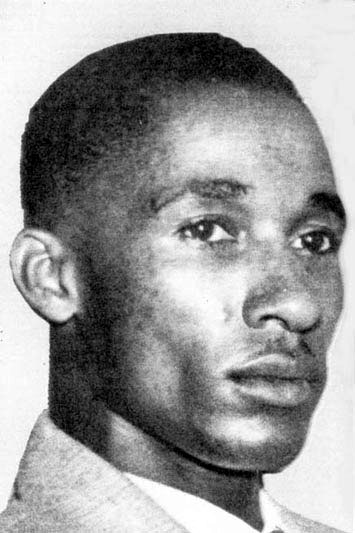
"Dear Mother," wrote Lloyd Gaines, on March 3, 1939. "I have come to Chicago hoping to make it possible to make my own way." It was the last contact Gaines, the plaintiff in the landmark civil rights case Missouri ex rel. Gaines v. Canada, would have with his family before his disappearance. He was twenty-eight years old, and three months after his Supreme Court victory he had traveled to Chicago in search of work. Whatever happened to him is one of the unsolved mysteries of the civil rights era.
Lloyd Gaines’ case resulted in a Supreme Court ruling invalidating a common practice at the time: states that denied admission to their law schools to African Americans would offer (often very limited) scholarships to African American students so that they could attend an out-of-state law school. The regime of "separate but equal" under Plessy v. Ferguson was still the law, but the Supreme Court ruled unanimously that Missouri had to provide equality within its own borders. The state responded by creating a new black law school. Whether the segregated school satisfied the equal protection clause was not then tested, because the plaintiff disappeared.
A digitalized copy of Gaines’ letter to his mother is now available in an amazing new digital archive on the University of Missouri website. The letter does not shed light on the Gaines mystery, but it illuminates the difficulties civil rights plaintiffs faced. Many, like Barbara Johns, the 16-year-old at the center of a student protest that led eventually to the Prince Edward County, Virgina case that became part of Brown v. Board of Education, were whisked away from home for their safety. Gaines found "hospitality and friendship" when hundreds turned out to hear him speak in Kansas City. But in spite of his new-found fame, there were no job prospects, and resources were dwindling. He was "still fighting and sacrificing – almost the ‘supreme sacrifice’ to see that [his case] is a complete and lasting success for thirteen million Negroes." But "sometimes," he wrote, "I wish I were just a plain, ordinary man whose name no one recognized." "Should I forget to write for a time," Gaines wrote in closing, "don’t worry about it I can look after myself ok." He was last seen in Chicago shortly thereafter, and was never heard from again.
In addition to family correspondence, the digital archive contains materials on Missouri law and policies at the time of the case, and University correspondence. There are also links to related secondary materials. The University of Missouri’s announcement is here. The digital archive home page is here. Hat tip to Paul Moorman, USC Law Library.
Cross-posted at Balkinization.
 the landmark civil rights case Missouri ex rel. Gaines v. Canada, would have with his family before his disappearance. He was twenty-eight years old, and three months after his Supreme Court victory he had traveled to Chicago in search of work. Whatever happened to him is one of the unsolved mysteries of the civil rights era.
Lloyd Gaines’ case resulted in a Supreme Court ruling invalidating a common practice at the time: states that denied admission to their law schools to African Americans would offer (often very limited) scholarships to African American students so that they could attend an out-of-state law school. The regime of "separate but equal" under Plessy v. Ferguson was still the law, but the Supreme Court ruled unanimously that Missouri had to provide equality within its own borders. The state responded by creating a new black law school. Whether the segregated school satisfied the equal protection clause was not then tested, because the plaintiff disappeared.
A digitalized copy of Gaines’ letter to his mother is now available in an amazing new digital archive on the University of Missouri website. The letter does not shed light on the Gaines mystery, but it illuminates the difficulties civil rights plaintiffs faced. Many, like Barbara Johns, the 16-year-old at the center of a student protest that led eventually to the Prince Edward County, Virgina case that became part of Brown v. Board of Education, were whisked away from home for their safety. Gaines found "hospitality and friendship" when hundreds turned out to hear him speak in Kansas City. But in spite of his new-found fame, there were no job prospects, and resources were dwindling. He was "still fighting and sacrificing – almost the ‘supreme sacrifice’ to see that [his case] is a complete and lasting success for thirteen million Negroes." But "sometimes," he wrote, "I wish I were just a plain, ordinary man whose name no one recognized." "Should I forget to write for a time," Gaines wrote in closing, "don’t worry about it I can look after myself ok." He was last seen in Chicago shortly thereafter, and was never heard from again.
In addition to family correspondence, the digital archive contains materials on Missouri law and policies at the time of the case, and University correspondence. There are also links to related secondary materials. The University of Missouri’s announcement is here. The digital archive home page is here. Hat tip to Paul Moorman, USC Law Library.
Cross-posted at Balkinization.
Young Man Pound
[The following is the second in a series of posts on Roscoe Pound and the administrative state. The series starts here. This post draws upon N.E.H. Hull’s Roscoe Pound and Karl Llewellyn, G. Edward White’s entry in the Dictionary of American Biography, and David Wigdor’s Roscoe Pound. The photograph of Pound, taken in 1909, is in the University of Nebraska’s Archives and is reproduced in Hull’s book.]
Law was not Roscoe Pound's first love, but it was his longest and deepest attachment. Pound was born in 1870 in Lincoln, Nebraska, the son of a judge and a former schoolteacher. “The Pound household was affluent and dedicated to learning,” the G. Edward White writes, and in young Roscoe it produced a hothouse child. Pound learned to read at three; at fourteen he entered the University of Nebraska, where he became fascinated with botany. Upon graduation he and his father tussled over his career: Judge Pound wanted his son to read law in his office, but he also permitted him to take graduate classes in botany. When his father offered to send Roscoe to the Harvard Law School, the son apparently accepted because of the opportunity it provided to study with Harvard’s botanists on the side. The case method captivated him, however, and although he completed a doctoral dissertation in botany after returning to Nebraska, the law ultimately prevailed. As a young lawyer he threw himself into organizing and defending the institutional pillars of the modern legal profession. He was among the founders of the Nebraska State Bar Association, helped draft its constitution, and served for six years as its secretary. He was a member and secretary of the state’s bar examining commission. He called for Nebraska’s judges to don the robe and deplored the persistence of lay judges in the state. (“J.P.,” he once joked, stood for “Judgment for plaintiff” whenever the defendant was wealthy enough to pay a justice of the peace’s court costs.) In 1901 he had the chance to display the “dignity, authority and eminence” of the judiciary when he was appointed to a commission charged with reducing a backlog of cases before the state supreme court. He was all of thirty years old.
Above all, Pound raised the scholarly standards of the state’s law school. He started teaching jurisprudence and Roman law as an instructor in 1895, joined the faculty in 1899, and became dean in 1903. All the while he was working out the principles of his “sociological jurisprudence,” a hybrid of recent German legal scholarship and the notion of “social control” developed by his Nebraska colleague, the sociologist E. A. Ross.
Pound’s big break came in 1906 when he addressed the annual meeting of the American Bar Association in St. Paul, Minnesota. His speech, “The Causes of Popular Dissatisfaction with the Administration of Justice,” was, as White writes, “a curious blend of traditional criticisms of the legal profession ... and prescient suggestions for reform.” It was also a sensation in its attack on the lawyer-run trial, in which masters of common-law pleading shape lawsuits to their liking and reduce the judge to “a mere umpire” who is “to decide the contest, as counsel present it, according to the rules of the game, not to search independently for truth and justice.” Pound’s heresies offended trial lawyers who refused to print his address as a pamphlet, but progressive lawyers in attendance, who believed that“socialized” courts required strong judges, knew they had found a champion. Northwestern’s law dean John Henry Wigmore declared Pound’s St. Paul address “The Spark That Kindled the White Flame of Progress” and a fierce attack on the “stout defenders of Things-As-They-Are.”
When, in 1907, Wigmore offered Pound a job and a reduced teaching load, the Nebraskan never looked back. Soon he published brilliant attacks on Lochner-era judging, “Mechanical Jurisprudence” and “Liberty of Contract.” When the University of Chicago offered Pound a better job, Northwestern tried to top it with the unheard-of salary of $7,500 (or roughly $176,000 today). Wigmore failed, but Pound was soon off to Harvard. In 1910 he accepted a chair at the Harvard Law School, and in 1916 he became its dean. As White aptly writes, “His rise was one of the most meteoric in the history of academic law.”
[This series of posts continues here.]
Law was not Roscoe Pound's first love, but it was his longest and deepest attachment. Pound was born in 1870 in Lincoln, Nebraska, the son of a judge and a former schoolteacher. “The Pound household was affluent and dedicated to learning,” the G. Edward White writes, and in young Roscoe it produced a hothouse child. Pound learned to read at three; at fourteen he entered the University of Nebraska, where he became fascinated with botany. Upon graduation he and his father tussled over his career: Judge Pound wanted his son to read law in his office, but he also permitted him to take graduate classes in botany. When his father offered to send Roscoe to the Harvard Law School, the son apparently accepted because of the opportunity it provided to study with Harvard’s botanists on the side. The case method captivated him, however, and although he completed a doctoral dissertation in botany after returning to Nebraska, the law ultimately prevailed. As a young lawyer he threw himself into organizing and defending the institutional pillars of the modern legal profession. He was among the founders of the Nebraska State Bar Association, helped draft its constitution, and served for six years as its secretary. He was a member and secretary of the state’s bar examining commission. He called for Nebraska’s judges to don the robe and deplored the persistence of lay judges in the state. (“J.P.,” he once joked, stood for “Judgment for plaintiff” whenever the defendant was wealthy enough to pay a justice of the peace’s court costs.) In 1901 he had the chance to display the “dignity, authority and eminence” of the judiciary when he was appointed to a commission charged with reducing a backlog of cases before the state supreme court. He was all of thirty years old.
Above all, Pound raised the scholarly standards of the state’s law school. He started teaching jurisprudence and Roman law as an instructor in 1895, joined the faculty in 1899, and became dean in 1903. All the while he was working out the principles of his “sociological jurisprudence,” a hybrid of recent German legal scholarship and the notion of “social control” developed by his Nebraska colleague, the sociologist E. A. Ross.
Pound’s big break came in 1906 when he addressed the annual meeting of the American Bar Association in St. Paul, Minnesota. His speech, “The Causes of Popular Dissatisfaction with the Administration of Justice,” was, as White writes, “a curious blend of traditional criticisms of the legal profession ... and prescient suggestions for reform.” It was also a sensation in its attack on the lawyer-run trial, in which masters of common-law pleading shape lawsuits to their liking and reduce the judge to “a mere umpire” who is “to decide the contest, as counsel present it, according to the rules of the game, not to search independently for truth and justice.” Pound’s heresies offended trial lawyers who refused to print his address as a pamphlet, but progressive lawyers in attendance, who believed that“socialized” courts required strong judges, knew they had found a champion. Northwestern’s law dean John Henry Wigmore declared Pound’s St. Paul address “The Spark That Kindled the White Flame of Progress” and a fierce attack on the “stout defenders of Things-As-They-Are.”
When, in 1907, Wigmore offered Pound a job and a reduced teaching load, the Nebraskan never looked back. Soon he published brilliant attacks on Lochner-era judging, “Mechanical Jurisprudence” and “Liberty of Contract.” When the University of Chicago offered Pound a better job, Northwestern tried to top it with the unheard-of salary of $7,500 (or roughly $176,000 today). Wigmore failed, but Pound was soon off to Harvard. In 1910 he accepted a chair at the Harvard Law School, and in 1916 he became its dean. As White aptly writes, “His rise was one of the most meteoric in the history of academic law.”
[This series of posts continues here.]
Rosen on the Trade-Mark Cases
Zvi S. Rosen, an associate at Fried, Frank, Harris, Shriver & Jacobson, has posted In Search of the Trade-Mark Cases, a unanimous decision of the U.S. Supreme Court written by Mr. Justice Samuel Miller, pictured at right. Here is the abstract:
Chronicling the tumultuous birth of federal trademark law in America from 1860 through 1882, In Search of the Trade-Mark Cases examines how understandings of the Treaty Power, Commerce Clause, and Intellectual Property clause shifted through that period. While focused on the Supreme Court's 1879 decision holding the federal trademark code unconstitutional, the history of the acts found unconstitutional and the acts enacted subsequent to the decision for trademarks are likewise examined. Among the discoveries this yields is a greater appreciation for the importance of international treaties in the development of American trademark law, and a clearer picture of how the Supreme Court arrived at its decision that trademarks were not "writings" for purposes of the Constitution.
Tuesday, September 16, 2008
Lanni on Social Norms in the Courts of Ancient Athens
Adriaan Lanni, Harvard Law School has posted the paper, Social Norms in the Courts of Ancient Athens, which is forthcoming in the peer-reviewed, open access Journal of Legal Analysis. It may profitably be read alongside Emily Kadens's "Order Within Law, Variety Within Custom: The Character of the Medieval Merchant Law," 5 Chicago Journal of International Law 39 (2004). Here is the abstract for Lanni's paper:
Ancient Athens was a remarkably peaceful and well-ordered society by both ancient and contemporary standards. Scholars typically attribute Athens' success to internalized norms and purely informal enforcement mechanisms. This article argues that the formal Athenian court system played a vital role in maintaining order by enforcing informal norms. This peculiar approach to norm enforcement compensated for apparent weaknesses in the state system of coercion. It mitigated the effects of under-enforcement in a private prosecution system by encouraging litigants to uncover and punish their opponents' past violations. Court enforcement of extra-statutory norms also permitted the Athenians to enforce a variety of social norms while maintaining the fictions of voluntary devotion to military and public service and of limited state interference in private conduct.

Monday, September 15, 2008
This week
Just a note of explanation: you may not hear much from me this week. I'm teaching an intensive course on Thurgood Marshall and Civil Rights History as a Distinguished Visitor at the University of Maryland School of Law, this week and the first full week of October. I will weigh in when I have a chance. In the meantime, thanks to Dan for his great posts!
Roscoe Pound and the Administrative State
To my left as I write this, Roscoe Pound looks down from an autographed portrait, academic robes, Phi Beta Kappa key, kindly countenance and all. The photograph was probably taken in the 1940s and was given to me by the legal historian Laura Kalman, who got it from her father, who had it signed by Pound. It's a cherished possession because of my affection and regard for Laura and for what her gift symbolizes about collegiality among legal historians in the United States. But  it is also a reminder of what can happen when a scholar identifies too closely with the ideas he espouses. For twenty years as dean of the Harvard Law School Pound interpret the applause that greeted his addresses as the bar's affirmation of his exalted vision of the lawyer in the American polity. Apparently he assumed the legal academe would follow his lead, but it set out on its own, taking his "sociological jurisprudence" in unexpected directions. By the time he stepped down from the deanship in 1936, Pound felt that not just his scholarly standing but the ideas he championed were in jeopardy. His writings during his long emeritus career--he died in 1964--were brittle, shrill, repetitive, and often otherworldly. G. Edward White said it well in the Dictionary of American Biography: in Pound one "confronts the paradox of a scholar who for a time can be said to have bestridden his profession like a colossus but who was so disinclined to probe beyond a certain point that one cannot find much of enduring value in his work. . . . His life is as much a tale of opportunities lost and reflections prematurely cut off as one of staggering achievements."
Many legal historians find themselves face to face with Pound at some point in their research. For legal historians of the American administrative state, he is an inescapable presence because of the harshly critical report he published as chairman of the American Bar Association's Special Committee on Administrative Law in 1938. Here is Michael Willrich's statement of the conventional view of Pound, from the afterword of his City of Courts:
The "narrative of Pound's 'about-face'" has other adherents. In Patterns of American Jurisprudence, Neil Duxbury wrote, "By the late 1930s, Roscoe Pound, once keen for the expansion of administrative powers, was rallying against what he termed the recrudescence of administrative absolutism." John Fabian Witt presents a somewhat hedged version in Patriots and Cosmopolitans. At an early stage of his career, Witt writes, Pound believed that "the conditions of the industrial age had exposed the limits of legal action in the common-law system and now cried out for the displacement of law by more efficient modes of modern administration." He approved of "administrative commissions on the Western European model," which "promised to substitute the new sociologically based economics Pound learned from [Edward Alsworth] Ross and [Richard] Ely for the classical and conservative economics of the Anglo-American common-law." He became "an inspiration for a rising generation of lawyers dedicated to increasing the capacity of the administrative state." Yet "there had always been a conservative streak running through Pound's thinking on administration and the common law"--which Witt identified as an aversion to radical departures that might "extinguish the individual altogether." As he aged, this streak grew stronger. After bitter battles with liberals on the Harvard law faculty, the death of his wife, and a sharp exchange with Karl Llewellyn, Pound felt bereft and upstaged. Craving attention, he found it by giving voice to his "lurking conservatism" in "a frontal assault on the administrative law being created by Roosevelt's New Deal."
Willrich saw "much truth" in the narrative of Pound's about-face, but he also thought it left out something "crucial": that Pound championed court reform "as a way to save the courts and the common law from the jurisdictional imperialism of the administrative state. Only by saving the courts could legal justice survive--and with it, its cherished protections for human freedom."
Like Willrich, I think the "about-face" narrative captures much truth about Pound's career--in particular, the reversal in what he symbolized for the legal wing of the American reform tradition. Like Willrich, too, I think that the narrative exaggerates Pound's enthusiasm for the administrative state in the early years of his career. His "conservatism"--really, an almost mystical faith in the common law--is quite apparent in his early writings on administrative agencies, and it erupted in a private exchange with the legal philosopher Morris Cohen in 1914. Such outbursts were infrequent as long as Pound thought the legal professoriat shared his commitment to a rejuvenated common law that could contain and discipline lay administrators, but by the latter half of 1937 he saw his ideas rejected and ridiculed and his opponents gaining power in New Deal America. The offer of the chairmanship of the ABA's committee on administrative law was a welcome opportunity to raise his standard and rally the bar to his side.
This is the first of a series of posts on Pound and the administrative state, which I intend to collect and publish with footnotes in some future venue. The next post follows Pound from his childhood to the time when he started writing on administration. Other posts will examine Pound's thinking about the administrative state in articles published between 1907 and 1924 and in his letter to Cohen. Concluding posts will take up Pound's chairmanship of the ABA's committee on administrative law in 1938, during which he eagerly played the provocateur but also disappointed the ABA's leaders.
The series continues here.
 it is also a reminder of what can happen when a scholar identifies too closely with the ideas he espouses. For twenty years as dean of the Harvard Law School Pound interpret the applause that greeted his addresses as the bar's affirmation of his exalted vision of the lawyer in the American polity. Apparently he assumed the legal academe would follow his lead, but it set out on its own, taking his "sociological jurisprudence" in unexpected directions. By the time he stepped down from the deanship in 1936, Pound felt that not just his scholarly standing but the ideas he championed were in jeopardy. His writings during his long emeritus career--he died in 1964--were brittle, shrill, repetitive, and often otherworldly. G. Edward White said it well in the Dictionary of American Biography: in Pound one "confronts the paradox of a scholar who for a time can be said to have bestridden his profession like a colossus but who was so disinclined to probe beyond a certain point that one cannot find much of enduring value in his work. . . . His life is as much a tale of opportunities lost and reflections prematurely cut off as one of staggering achievements."
Many legal historians find themselves face to face with Pound at some point in their research. For legal historians of the American administrative state, he is an inescapable presence because of the harshly critical report he published as chairman of the American Bar Association's Special Committee on Administrative Law in 1938. Here is Michael Willrich's statement of the conventional view of Pound, from the afterword of his City of Courts:
The familiar storyline is a narrative of betrayal, of one's own life's work and the people it inspired: Brilliant young iconoclast, the best legal mind of his progressive generation, stuns the legal world in 1906 by announcing--in a speech to the ossified American Bar Association, no less--that the individualistic justice of the common law has proved unsuited to urban-industrial society, creating widespread "popular dissatisfaction with the administration of justice." In the 1910s he launches a broad movement for sociological jurisprudence that transforms legal education, helps to elevate the weight of social interests in judicial decision making, and lays the intellectual foundation for legal realism and the administrative state. But just when those years of collective work were finally bearing fruit, in the New Deal and the Supreme Court's "Constitutional Revolution of 1937," the former progressive makes a stunning reversal and denounces the whole enterprise--his whole enterprise--as a dangerously relativistic, absolutist, un-American nightmare. The denouement of this narrative echoes the legal realists' own professed shock at Pound's so-called about-face. "The reader of Pound's earlier writings," wrote Judge Jerome Frank, "rubs his eyes" and wonders, "Can this be the same man?"One part of what Willrich has dubbed "the narrative of Pound's 'about-face'" is a reversal in his views about administrative agencies. In The Transformation of American Law, 1870-1960, Morton Horwitz wrote that Pound "spoke enthusiastically of the rise of administration" as late as 1924, when he published "The Growth of Administrative Justice." In that address, Pound "expressed the optimistic and experimental mindset characteristic of his great postwar writing," Horwitz wrote. "Administrative regulation was not bureaucratic or standardized justice but a superior form of justice in the individual case. What a far cry from Pound's later invocation of the judicial model as the only legitimate expression of the rule of law!"
The "narrative of Pound's 'about-face'" has other adherents. In Patterns of American Jurisprudence, Neil Duxbury wrote, "By the late 1930s, Roscoe Pound, once keen for the expansion of administrative powers, was rallying against what he termed the recrudescence of administrative absolutism." John Fabian Witt presents a somewhat hedged version in Patriots and Cosmopolitans. At an early stage of his career, Witt writes, Pound believed that "the conditions of the industrial age had exposed the limits of legal action in the common-law system and now cried out for the displacement of law by more efficient modes of modern administration." He approved of "administrative commissions on the Western European model," which "promised to substitute the new sociologically based economics Pound learned from [Edward Alsworth] Ross and [Richard] Ely for the classical and conservative economics of the Anglo-American common-law." He became "an inspiration for a rising generation of lawyers dedicated to increasing the capacity of the administrative state." Yet "there had always been a conservative streak running through Pound's thinking on administration and the common law"--which Witt identified as an aversion to radical departures that might "extinguish the individual altogether." As he aged, this streak grew stronger. After bitter battles with liberals on the Harvard law faculty, the death of his wife, and a sharp exchange with Karl Llewellyn, Pound felt bereft and upstaged. Craving attention, he found it by giving voice to his "lurking conservatism" in "a frontal assault on the administrative law being created by Roosevelt's New Deal."
Willrich saw "much truth" in the narrative of Pound's about-face, but he also thought it left out something "crucial": that Pound championed court reform "as a way to save the courts and the common law from the jurisdictional imperialism of the administrative state. Only by saving the courts could legal justice survive--and with it, its cherished protections for human freedom."
Like Willrich, I think the "about-face" narrative captures much truth about Pound's career--in particular, the reversal in what he symbolized for the legal wing of the American reform tradition. Like Willrich, too, I think that the narrative exaggerates Pound's enthusiasm for the administrative state in the early years of his career. His "conservatism"--really, an almost mystical faith in the common law--is quite apparent in his early writings on administrative agencies, and it erupted in a private exchange with the legal philosopher Morris Cohen in 1914. Such outbursts were infrequent as long as Pound thought the legal professoriat shared his commitment to a rejuvenated common law that could contain and discipline lay administrators, but by the latter half of 1937 he saw his ideas rejected and ridiculed and his opponents gaining power in New Deal America. The offer of the chairmanship of the ABA's committee on administrative law was a welcome opportunity to raise his standard and rally the bar to his side.
This is the first of a series of posts on Pound and the administrative state, which I intend to collect and publish with footnotes in some future venue. The next post follows Pound from his childhood to the time when he started writing on administration. Other posts will examine Pound's thinking about the administrative state in articles published between 1907 and 1924 and in his letter to Cohen. Concluding posts will take up Pound's chairmanship of the ABA's committee on administrative law in 1938, during which he eagerly played the provocateur but also disappointed the ABA's leaders.
The series continues here.
Indiana Legal History
The Indiana Supreme Court sponsors a remarkable Legal History Lecture Series. "Why It Mattered That Lincoln Was a Lawyer: Abraham Lincoln, the Law & Civic Education," a free CLE-approved program will take place on October 3, 2008. Other programs archived on the court's website include “221 Years of Unsettled Borders: Indiana and the Northwest Ordinance," “Hoosier Justice at Nuremberg,” Slavery and The Indiana Supreme Court: For and Against?" (delivered by Paul Finkelman), and "'Three Generations of Imbeciles are Enough': Reflections on 100 Years of Eugenics in Indiana." More here.
Sunday, September 14, 2008
Gordon-Reed's Latest Reviewed
 Mary is more systematic than I about surveying the book reviews, but I didn't want the appreciative notice in the Washington Post of Annette Gordon-Reed's latest, The Hemingses of Monticello: An American Family, go unacknowledged here. The cover review, by Fergus M. Bordewich, commences:
Thomas Jefferson's contradictions have long baffled historians. His clarion assertion of human equality in the Declaration of Independence became the battle cry of the abolitionist movement. Yet he lived on the fruits of slave labor and never risked political capital (or his own comfort) to oppose the institution of slavery. He regarded blacks as odorous, intellectually inferior and incapable of creating art. Yet, as Annette Gordon-Reed convincingly argues in this monumental and original book, he cohabited for more than 30 years with an African American woman with whom he conceived seven children.More here
Liberating the woman known to Jefferson's smirking enemies as "dusky Sally" from the lumber room of scandal and legend, Gordon-Reed leads her into the daylight of a country where slaves and masters met on intimate terms. In so doing, Gordon-Reed also shines an uncompromisingly fresh but not unsympathetic light on the most elusive of the Founding Fathers.
The Crosskey and Fulton Lectures at the University of Chicago
I recently discovered a list of the Crosskey and Fulton lectures in legal history at the University of Chicago Law School, here. Downloads are available for the two most recent Fulton Lectures: Christine Desan's "From the Mercantilist World to Market-Based Liberalism: Money as a Constitutional Medium" (2007) and Gerhard Casper's "Forswearing Allegiance" (2008).
Saturday, September 13, 2008
Ramsey on the Detention of Material Witnesses
Carolyn B. Ramsey, University of Colorado Law School, has posted In the Sweat Box: A Historical Perspective on the Detention of Material Witnesses, which is also forthcoming in the Ohio State Journal of Criminal Law. It commences with a vivid account of the detention of a laundry-wagon driver named Oscar Thompson by Chicago police in 1902. Here is the abstract:
After the September 11 terrorist attacks, the Justice Department detained scores of allegedly suspicious persons under a federal material witness statute - a tactic that provoked a great deal of controversy. Most critics assume that the abuse of material witness laws is a new development. Yet, rather than being transformed by the War on Terror, the detention of material witnesses is a coercive strategy that police officers across the nation have used since the nineteenth century to build cases against suspects. Fears of extraordinary violence or social breakdown played at most an indirect role in its advent and growth. Rather, it has long been used to obtain prosecution evidence in ordinary cases of murder, robbery, prostitution, and other street crimes. Historically, no stark divide between the innocent witness and the suspected criminal existed in the minds of the police. Indeed, material witness detention contributed to the rise of incommunicado interrogation and numbered among the tactics identified in the Wickersham Commission's expose of the third degree in 1931.
This Essay demonstrates that the story of material witness detention is one of stasis, not of change. For more than a century, the field practices of police and magistrates have been unresponsive to reforms in statutory and constitutional law or to sporadic public pressure on behalf of detainees deemed to have knowledge of a crime. In telling such a story, this Essay seeks not to defend the Justice Department, but to suggest that intense scholarly focus on September 11 as a watershed in the history of criminal procedure obscures ways in which the gradual consolidation of governmental power over more than a century has fostered an increasingly coercive and secretive relationship between the individual and the police.
Friday, September 12, 2008
McMahon on Community Property and American Tax Policy
Stephanie Hunter McMahon, University of Cincinnati College of Law, has posted the paper To Save State Residents: States' Use of Community Property for Federal Tax Reduction, 1939-1947. (It can be profitably read alongside a classic by Carolyn C. Jones, "Split Income and Separate Spheres: Tax Law and Gender Roles in the 1940s," 6 Law and History Review 259 (1988).) Here is the abstract for McMahon's paper, illustrated with portraits of C.C. and Pearl Harmon, who figure in one of her cases:
This essay analyzes the forces that led five common law states to adopt community property regimes between 1939 and 1947. Focusing on Oklahoma, the first state to switch, this article traces these laws from initial proposals through their repeal after Congress enacted nationalized income-splitting in 1948. Earlier studies have focused on the impact of these laws, primarily on wives as secondary earners within families, and not on their development. From the various political and social forces precipitating this trend, this study explores the actual reasons states adopted these regimes and shows that an economic goal, namely reducing married couples' federal income taxes, drove state legislatures. Thus, while examining state legislative processes, this paper shows the goal of federal tax reduction led to changes in an entirely separate area of state law. This analysis also provides a new perspective on the American federal system, illustrating the complex and reciprocal relationship between state and federal laws and incentives. While initially states altered their domestic laws to give their residents a benefit under the federal tax code, using the federal system to win benefits for their residents vis-a-vis those of other states, these state-law changes ultimately induced the federal government to adopt a uniform national policy on income-splitting.


Iyer and Mauer on Property in American-Occupied Phillippines
 The Cost of Property Rights: Establishing Institutions on the Philippine Frontier under American Rule, 1898-1918, is a new paper by Lakshmi Iyer and Noel Mauer of the Harvard Business School. Here is the abstract:
 We examine three reforms to property rights introduced by the United States in the Philippines in the early 20th century: the redistribution of large estates to their tenants, the creation of a system of secure land titles, and a homestead program to encourage cultivation of public lands. During the first phase of American occupation (1898-1918), we find that the progress of implementing these reforms was very slow. As a consequence, tenure insecurity increased over this period, and the distribution of farm sizes remained extremely unequal. We identify two primary causes for the slow progress of reform: first, the high cost of implementing these programs was a major factor in reducing take-up. On the other hand, the government was reluctant to evict delinquent or informal cultivators, especially on public lands. This reduced the costs of tenure insecurity. Political constraints prevented the government from subsidizing land reforms to a greater degree.
Institute for Historical Studies, University of Texas -Austin
The Institute for Historical Studies at the University of Texas-Austin announces its 2008-09 calender of events, the first of two years devoted to the theme of Global Borders, as well as its program of fellowships (which provide full salary replacement). For more information contact Julie Hardwick, Associate Professor & Director of the Institute for Historical Studies, at historyinstitute@austin.utexas.edu.
Gross, What Blood Won't Tell: A History of Race on Trial in America
What Blood Won't Tell: A History of Race on Trial in America by Ariela J. Gross, USC, has just been published by Harvard University Press. Here's the book descrip tion:
tion:
The blurbs:
And Publishers Weekly's review:
 tion:
tion:Is race something we know when we see it? In 1857, Alexina Morrison, a slave in Louisiana, ran away from her master and surrendered herself to the parish jail for protection. Blue-eyed and blond, Morrison successfully convinced white society that she was one of them. When she sued for her freedom, witnesses assured the jury that she was white, and that they would have known if she had a drop of African blood. Morrison’s court trial—and many others over the last 150 years—involved high stakes: freedom, property, and civil rights. And they all turned on the question of racial identity.
Over the past two centuries, individuals and groups (among them Mexican Americans, Indians, Asian immigrants, and Melungeons) have fought to establish their whiteness in order to lay claim to full citizenship in local courtrooms, administrative and legislative hearings, and the U.S. Supreme Court. Like Morrison’s case, these trials have often turned less on legal definitions of race as percentages of blood or ancestry than on the way people presented themselves to society and demonstrated their moral and civic character.
Unearthing the legal history of racial identity, Ariela Gross’s book examines the paradoxical and often circular relationship of race and the perceived capacity for citizenship in American society. This book reminds us that the imaginary connection between racial identity and fitness for citizenship remains potent today and continues to impede racial justice and equality.
The blurbs:
What Blood Won't Tell brings us at long last a brilliant analysis of the changing meanings of race in American law from the colonial era to the present. It will be indispensable for any informed discussions of a subject that lies at the very core of both American history and identity. --David Brion Davis, author of Inhuman Bondage: The Rise and Fall of Slavery in the New World
This exquisite inquiry into the complex and shifting ways in which the 'black-white' divide has been marked over the last three centuries excavates the deep roots of racial identification.--Patricia J. Williams, author of The Alchemy of Race and Rights
And Publishers Weekly's review:
Through a close reading of racial identity trials in America, this book offers an eloquent contribution to ongoing debates over affirmative action, identity politics and the construction of a "colorblind" society. Historian Gross argues that racial identity trials--court cases in which outcomes turned on determining a person's "race" and their concomitant rights and privileges--provides an excellent basis for viewing the construction of "whiteness" and assessing the volatile category of race in American society. The author rigorously examines select cases including the outcomes of suits for freedom by onetime slaves like Abby Guy, who in 1857 convinced an all-white male jury that she was white and thus deserving of freedom. Upsetting the familiar notion of the "one-drop rule" in determining racial identity, Gross shows that in such cases the notion of what constituted race was itself as much in play as whether a particular individual could be identified (through some unstable combination of expert and "common sense" opinion) as one race or another. The social "performance" of identity is key, and enduringly so, as Gross periodically underscores by reference to various modern debates and trends. (starred review)
Read the introduction here.
Three from Siegel on the history of Landlord-Tenant Law, Perpetuities and Politics
Stephen A. Siegel, DePaul University College of Law, has posted three papers spanning of number of years. The first is The Conscientious Congressman's Guide to the Electoral Count Act of 1887, which appeared in the Florida Law Review (2004). Here's the abstract:
The third article is Is the Modern Lease a Contract or a Conveyance? - A Historical Inquiry, Journal of Urban Law, (1975). Here's the abstract:
Electoral vote counting is the oldest activity of the national government and among the oldest questions of constitutional law. Yet, it is one of the least understood aspects of our constitutional order. The Electoral Count Act of 1887, which governs Congress's electoral vote counting process, lies at the heart of this confusion. During the 2000 presidential election dispute, for example, politicians, lawyers, commentators, and Supreme Court justices seemed prone to misstate or misinterpret the provisions of the law, even those that were clear to the generation that wrote it. The purpose of this Article is to explain the provisions of the Electoral Count Act of 1887 as it was understood by the Congresses that debated and enacted it. This article explicates the Electoral Count Act through a comprehensive exploration of its legislative history, the history and theory of electoral vote counting, and the legal and political assumptions of the Congresses that framed it. This Article also develops its understanding of the ECA by analyzing the interplay between theJohn Chipman Gray, Legal Formalism, and the Transformation of Perpetuities Law appeared in the University of Miami Law Review (1982). Here's the abstract:
Act's various substantive sections and between the its substantive and procedural provisions.
This article provides a revised history of the development of future interests in English and American law that ties their development into social policy rather than abstract concepts of medieval law. The social policy involves the judiciary's centuries long struggle to prevent large landholders from controlling their wealth long after their death. The judiciary's goal was to prevent the aristocracy and landed elite from tying their extensive holdings to their families in perpetuity. The article depicts the common law's famous Rule Against Perpetuities as only the most recent attempt to accomplish this goal and shows it really was more generous to dead hand control than previous common law limitations. This article also shows how the current image of future interest law is a product of the successful effort of legal scholars in England and America to reshape the corpus of future interest law according to the tenets of
legal formalism the late-nineteenth century's dominant jurisprudence. John Chipman Gray's classic treatise, The Rule Against Perpetuities, was most influential book in this effort. Finally, this article portrays current controversy in American property law as the product of the current movement away from formalism to a jurisprudence of functionalism and pragmatism. The disputes discussed include the reform of perpetuities law, the cy pres doctrine, and the interpretation of deeds.
The third article is Is the Modern Lease a Contract or a Conveyance? - A Historical Inquiry, Journal of Urban Law, (1975). Here's the abstract:
This article presents a revisionist history of English and American landlord-tenant law. Most legal scholars say that until a current wave of reform, landlord-tenant law was premised on feudal property law. They also say that landlord-tenant law would serve society better if its conceptual basis was shifted from feudal property to modern contract law. This article says that landlord-tenant law, even before the late-twentieth century reforms, was based on contract law - and that was the problem with it. The article shows that until the mid-twentieth century, contract law was itself harsh and illiberal. It was only in the mid-twentieth century that contract law was itself reformed to make it more consumer friendly. It was only after the recent reform of contract law that landlord-tenant law began to look harsh and outdated. In fact, until the twentieth-century reform of contract law, it was landlord-tenant law's few property-based doctrines that offered tenant's any protection from overreaching landlords. In addition, this article shows that the current movement to reform landlord-tenant law involves an infusion of the new consumer-oriented contract doctrines into landlord-tenant law. Rather than shifting basis of landlord-tenant law away from property law, this infusion merely updates the perennial contractual basis of leasing law.
Klerman on The Emergence of English Commercial Law: Analysis Inspired by Ottoman Experience
The Emergence of English Commercial Law: Analysis Inspired by Ottoman Experience is a new paper by Daniel Klerman, University of Southern California Law School. Here's the abstract: Thirteenth-century England was a commercial backwater whose trade was dominated by foreigners. To accommodate and encourage foreign merchants, England modified its legal system by creating legal institutions which were available to both domestic and foreign traders. Among the most important of these institutions were streamlined debt collection procedures and mixed juries composed of both Englishmen and foreigners. By introducing institutions which treated locals and foreigners equally, England created a level playing field which enabled English merchants to become increasingly prominent in the later Middle Ages. England's ability to modernize its law was facilitated by the secular nature of English law, the representation of merchants in Parliament, and legal pluralism. Medieval England contrasts sharply with the early modern Ottoman Empire. The latter created special institutions for foreign merchants, which eventually put Ottoman Muslims at a competitive disadvantage
Thursday, September 11, 2008
Mehrotra and Shreve on Governors, Fiscal Federalism, and the Political Economy of Twentieth-Century Tax Policy
'To Lay and Collect': Governors, Fiscal Federalism, and the Political Economy of Twentieth-Century Tax Policy is a new essay by Ajay K. Mehrotra, Indiana University School of Law-Bloomington and David Shreve. It appears in A L EGACY OF INNOVATION: GOVERNORS AND PUBLIC POLICY, ed., Ethan G. Sribnick (University of Pennsylvania Press, 2008). Here's the abstract:
Throughout the twentieth century, state governments and the individuals who have led them have played a vital role in the development of American tax policy. As the political leaders of our country's "laboratories" of democracy, state executives have helped forge fiscal policies that have not only spread from state to state but have also been emulated by national lawmakers. At the same time, governors have been constrained in their ability to shape tax reform by broad structural forces and the American federal system of governance. This chapter contends that two broad trends help explain the tax policy choices made by state executives over the course of the twentieth century. First, governors, along with other state policy makers, often had to balance concerns for equity and expediency in choosing tax vehicles. Second, the tax policy decisions of states and governors were limited and shaped by the institutional constraints of fiscal federalism. These dynamics in and of themselves, however, do not explain the history of American governors and taxation. To understand the system of taxation that states developed over time, it is also necessary to consider these themes in the context of the broad historical forces and critical events that shaped the American past. The new demands placed on state government by urbanization and industrialization, the crisis of the Great Depression, the growth of an expansive federal government, the mobilization of World War II, the prosperity of the 1950s and 1960s, and the economic downturn of the 1970s all affected the calculus of equity and expediency, the dynamics of fiscal federalism, and the tax structures that ultimately emerged.
 EGACY OF INNOVATION: GOVERNORS AND PUBLIC POLICY, ed., Ethan G. Sribnick (University of Pennsylvania Press, 2008). Here's the abstract:
Throughout the twentieth century, state governments and the individuals who have led them have played a vital role in the development of American tax policy. As the political leaders of our country's "laboratories" of democracy, state executives have helped forge fiscal policies that have not only spread from state to state but have also been emulated by national lawmakers. At the same time, governors have been constrained in their ability to shape tax reform by broad structural forces and the American federal system of governance. This chapter contends that two broad trends help explain the tax policy choices made by state executives over the course of the twentieth century. First, governors, along with other state policy makers, often had to balance concerns for equity and expediency in choosing tax vehicles. Second, the tax policy decisions of states and governors were limited and shaped by the institutional constraints of fiscal federalism. These dynamics in and of themselves, however, do not explain the history of American governors and taxation. To understand the system of taxation that states developed over time, it is also necessary to consider these themes in the context of the broad historical forces and critical events that shaped the American past. The new demands placed on state government by urbanization and industrialization, the crisis of the Great Depression, the growth of an expansive federal government, the mobilization of World War II, the prosperity of the 1950s and 1960s, and the economic downturn of the 1970s all affected the calculus of equity and expediency, the dynamics of fiscal federalism, and the tax structures that ultimately emerged.
Wednesday, September 10, 2008
“We hold these truths to be sacred and undeniable": Jefferson and his Editors
Having Thomas Jefferson's first draft of the Declaration of Independence edited, first by a committee of five, and then by Congress, surely improved the final text. Pauline Maier has called it “a n act of group editing that has to be one of the great marvels of history,” but for Jefferson, its author, it was “one of the more painful ordeals" of his career.
 n act of group editing that has to be one of the great marvels of history,” but for Jefferson, its author, it was “one of the more painful ordeals" of his career.
Douglas E. Abrams, University of Missouri School of Law, takes up this story in a short essay, America's Founding Editors. It appeared in Precedent (Summer 2008). Here's the abstract:
This article treats the editing that the Second Continental Congress did on Thomas Jefferson's draft of the Declaration of Independence. The superb editing helped make Jefferson an American icon, but Jefferson resented the editing for the rest of his life.
Professor Abrams authors a column, Writing it Right, in Precedent, The Missouri Bar's quarterly magazine. In a variety of contexts, the column stresses the fundamentals of quality legal writing - precision, conciseness, simplicity and clarity.
University of Minnesota Legal History Workshop
University of Minnesota
Program in Law and History
Legal History Workshop
Fall 2008 Schedule of Speakers
September 18
Douglas Baynton, History, University of Iowa
Title: Defectives in the Land: Disability and American Immigration Law, 1882-1924.
September 25
Amalia D. Kessler, Law, Stanford University
Title: Deciding Against Conciliation: The Nineteenth-Century Rejection of a European Transplant and the Rise of a Distinctively American Ideal of Adversarial Adjudication
October 2
Jennifer Mnookin, Law, UCLA
Title: Machineries of Truth: X-Rays and Experts in the American Courtroom.
October 16
Adriaan Lanni, Law, Harvard University
Title: Social Norms in the Ancient Athenian Courts
October 30
Daniel Smail, History, Harvard University
Title: Goods and Debts in Late Medieval Mediterranean Europe
November 6
Rebecca J. Scott, History and Law, University of Michigan
Title: Rosalie of the Poulard nation (co-authored with Jean Hebrard)
November 20
Deborah Malamud, Law, New York University
Title: Letting in the Company: White-Collar Unionization in the Long New Deal
December 4
Nicholas Parrillo, Law, Yale University
Title: The Rise of Non-Profit Government in America: The Case of Tax Collection
If you would like to be added to the email list for announcements, please contact Susanna Blumenthal at blume047@umn.edu. More information about workshops and the program in Law and History at Minnesota is here.
Program in Law and History
Legal History Workshop
Fall 2008 Schedule of Speakers
September 18
Douglas Baynton, History, University of Iowa
Title: Defectives in the Land: Disability and American Immigration Law, 1882-1924.
September 25
Amalia D. Kessler, Law, Stanford University
Title: Deciding Against Conciliation: The Nineteenth-Century Rejection of a European Transplant and the Rise of a Distinctively American Ideal of Adversarial Adjudication
October 2
Jennifer Mnookin, Law, UCLA
Title: Machineries of Truth: X-Rays and Experts in the American Courtroom.
October 16
Adriaan Lanni, Law, Harvard University
Title: Social Norms in the Ancient Athenian Courts
October 30
Daniel Smail, History, Harvard University
Title: Goods and Debts in Late Medieval Mediterranean Europe
November 6
Rebecca J. Scott, History and Law, University of Michigan
Title: Rosalie of the Poulard nation (co-authored with Jean Hebrard)
November 20
Deborah Malamud, Law, New York University
Title: Letting in the Company: White-Collar Unionization in the Long New Deal
December 4
Nicholas Parrillo, Law, Yale University
Title: The Rise of Non-Profit Government in America: The Case of Tax Collection
If you would like to be added to the email list for announcements, please contact Susanna Blumenthal at blume047@umn.edu. More information about workshops and the program in Law and History at Minnesota is here.
Subscribe to:
Posts (Atom)