Tuesday, April 21, 2009
Dudziak Observed: Law, War and the History of Time
Mary has earlier posted on her paper Law, War and the History of Time. David Schraub, a student at the University of Chicago Law School, reports on her presentation of the paper to Chicago's American Legal History Workshop on the Chicago Law Faculty Blog, which is to say, here.


Monday, April 20, 2009
Charlie Rose's Interviews of Gordon-Reed
 In light of Annette Gordon-Reed's tremendous accomplishments, LHB readers might be interested in these interviews of the professor of law and history by Charlie Rose.
Originalism is Bunk, Says Berman
Mitchell Berman, University of Texas, has published Originalism is Bunk, 84 New York University Law Review 1 (2009). The article endeavors to "catalogue and critically assess the varied arguments proferred in originalism's defense." From the abstract:
Originalism is “hard” when grounded on reasons that purport to render it (in some sense) inescapably true; it is “soft” when predicated on contingent and contestable weighings of its costs and benefits relative to other interpretive approaches. That is, hard arguments seek to show that originalism reflects some sort of conceptual truth or follows logically from premises the interlocutor already can be expected to accept; soft arguments aim to persuade others to revise their judgments of value or their empirical or predictive assessments. The most common hard arguments contend that originalism is entailed either by intentionalism or by binding constitutionalism. Soft arguments claim that originalist interpretation best serves diverse values like democracy and the rule of law. I seek to show that the hard arguments for originalism are false and that the soft arguments are implausible.
The upshot is not that constitutional interpretation should disregard framers’ intentions, ratifiers’ understandings, or original public meanings. Of course we should care about these things. But originalism is a demanding thesis. We can take the original character of the Constitution seriously without treating it as dispositive. That original intents and meanings matter is not enough to render originalism true.
Zellmer on Boom and Bust on the Great Plains
Boom and Bust on the Great Plains: Déjà Vu All Over Again is a review essay by Sandra B. Zellmer, University of Nebraska at Lincoln College of Law. It appeared in the Creighton Law Review (2008). Here's the abstract:
 Sandra B. Zellmer, University of Nebraska at Lincoln College of Law. It appeared in the Creighton Law Review (2008). Here's the abstract:
Two important and timely books provide a portrait of the “boom and bust” cycles that have plagued the Great Plains since European settlement: Tim Egan, The Worst Hard Time: The Untold Story of Those Who Survived the Great American Dust Bowl, and William Ashworth, Ogallala Blue: Water and Life on the High Plains. This paper reviews the two books, situating their stories within the context of American law governing western settlement, agriculture, and soi l and water management. In the wake of the Dust Bowl, federal, state, and local laws began to promote more sustainable farming practices to control soil erosion. However, the post-World War II reliance on groundwater pumping to irrigate bigger and better crops in the Great Plains region has begun to unravel some of these conservation gains, and the law has been slow to respond to the environmental and socio-economic problems posed by groundwater overdraft. The latest economic boom - ethanol production - may have dramatic implications for the Great Plains and its human and natural communities. The lessons detailed in these two books indicate that, absent an increased commitment to stewardship and sustainable practices, both at the pump and on the farm, the nation’s increased reliance on biofuels, particularly corn-based ethanol, may raise the specter of another “boom and bust” for Great Plains soil and water resources.
l and water management. In the wake of the Dust Bowl, federal, state, and local laws began to promote more sustainable farming practices to control soil erosion. However, the post-World War II reliance on groundwater pumping to irrigate bigger and better crops in the Great Plains region has begun to unravel some of these conservation gains, and the law has been slow to respond to the environmental and socio-economic problems posed by groundwater overdraft. The latest economic boom - ethanol production - may have dramatic implications for the Great Plains and its human and natural communities. The lessons detailed in these two books indicate that, absent an increased commitment to stewardship and sustainable practices, both at the pump and on the farm, the nation’s increased reliance on biofuels, particularly corn-based ethanol, may raise the specter of another “boom and bust” for Great Plains soil and water resources.
Treanor, Against Textualism
Against Textualism has just been posted by Dean William Michael Treanor, Fordham University School of Law. It is forthcoming in the Northwestern University Law Review, (2009). Here's the abstract:
Modern textualists have assumed that careful attention to constitutional text is the key to the recovery of the Constitution's original public meaning. This Article challenges that assumption by showing the importance of nontextual factors in early constitutional interpretation. The Founding generation consistently relied on structural concerns, policy, ratifiers’ and drafters’ intent, and broad principles of government. To exclude such nontextual factors from constitutional interpretation is to depart from original public meaning because the Founders gave these factors great weight in ascertaining meaning. Moreover, for a modern judge seeking to apply original public meaning, the threshold question is not simply; "How did the Founding generation think the Constitution should be interpreted?"; rather, it should be: “How did the Founding generation think courts should interpret the Constitution?” The early caselaw shows that courts aggressively used the federal Constitution and state constitutions to protect the power and autonomy of courts and juries; federal courts also closely circumscribed state powers when they appeared to violate the federal Constitution or implicated federal powers or other states. Outside of these areas, courts were wholly deferential. This caselaw indicates, then, that, for a modern court, recovering original meaning necessitates a central focus on structural concerns - protecting juries, courts, and the national government - rather than text.
More Audio on the Web
 Looking (unsuccessfully*) for an image of Louis Jaffe to illustrate my lecture tomorrow, I stumbled onto the "Past Speakers" page of the Harvard Law School Forum. Most entries lack of audio but some have downloadable files that I've been able to play on RealPlayer. (Pauli Murray comes through loud and clear.) Here's a sample of what you'll find if you scroll down the page:
Date: February 18, 1966
Title: "Women - Dare We Not Discriminate?"
Panel: Betty Friedan - Author, The Feminine Mystique
Mary I. Bunting - President, Radcliffe College
Pauli Murray - Lawyer; Author, Jane Crow and the Law
Moderator: Professor Albert Sacks
Date: April 25, 1984
Title: "The ERA - Is There a Future?"
Speaker: Phyllis Schlafly
Introduction: Sylvia Law - Visiting Professor of Law, Harvard
Date: April 29, 1960 (3:00 p.m.)
Speaker: Walter P. Reuther - President, UAW; Vice-President, AFL-CIO
Moderator: John P. Dawson - Professor, Harvard Law School
Date: March 30, 1962
Speaker: James Hoffa - President, International Brotherhood of Teamsters
Panelists: John T. Dunlop - Chairman, Department of Economics, Harvard
John R. Meyer - Professor of Economics, Harvard
Moderator: Derek C. Bok - Professor, Harvard Law School
Date: April 28, 1961
Title: "The First Hundred Days"
Speaker: Barry Goldwater
Panel: Mark DeWolfe Howe - Professor, Harvard Law School
Seymour E. Harris - Professor of Economics, Harvard
Harold J. Berman - Professor, Harvard Law School
Moderator: Robert Baucher - Professor, Harvard Law School
Date: May 1, 1961
Title: "Unrest Within the Democratic Party"
Speaker: Eleanor Roosevelt
Panel: Patrick McDonough - President, Boston City Council
Robert C. Wood - Professor of Political Science, M.I.T.
Moderator: Erwin N. Griswold - Dean, Harvard Law School
Date: October 24, 1962
Title: "The Future of Integration"
Speaker: Rev. Martin Luther King, Jr.
Panel: Mark DeWolfe Howe - Professor, Harvard Law School
Paul M. Bator - Professor of Law, Harvard Law School
Moderator: Paul A. Freund - Professor, Harvard Law School
 *Update: Thanks to David Warrington, I had my image of Louis Jaffe in time for class. Here he is (left), with Paul Freund (center) and "Feller" (left). I assume the Feller in question is Abe, not Bob. The caption is "Three graduate students"--that is, at the Harvard Law School. It is dated 1931-32.
Image credit.
Sunday, April 19, 2009
Erotica, Wikipedia, and the garden in the book reviews
Another high profile review for Donna Dennis, LICENTIOUS GOTHAM: Erotic Publishing and Its Prosecution in Nineteenth-Century New York, this time from Michael Dirda in the Washington Post. He notes that Dennis, in part, "aims to reconstruct 'the meaning of obscenity' during that time and repeatedly shows how prohibitions 'promoted, as much as suppressed, the proliferation of sexual representations.'"

Publishing and Its Prosecution in Nineteenth-Century New York, this time from Michael Dirda in the Washington Post. He notes that Dennis, in part, "aims to reconstruct 'the meaning of obscenity' during that time and repeatedly shows how prohibitions 'promoted, as much as suppressed, the proliferation of sexual representations.'"
The history of Wikipedia is taken up in a Salon interview with Andrew Lih, author of The Wikipedia Revolution: How a Bunch of Nobodies Created the World's Greatest Encyclopedia. In the book, "Lih traces the advancement of all open-source software from the dimly lit halls of university philosophy departments to the cubicles of computer programming companies to the form it takes today."
But as the daffodils reign in my garden this morning, and the tulips wait their turn, it seems to be the time of the year for reviews of garden books. And when a legal historian cannot be found in the archives or in the middle of a manuscript, she can often be found tending a garden.

In Books & Culture, Gardening and Governing: Nature and culture among the roses by Alan Jacobs takes up Tim Richardson, The Arcadian Friends: Inventing the English Landscape Garden. Drawing upon references to gardening in Shakespeare's Richard II, Jacobs writes:
Gardening marks, as clearly as any activity, the joining of nature and culture. The gardener makes nothing, but rather gathers what God has made and shapes it into new and pleasing forms. The well-designed garden shows nature more clearly and beautifully than nature can show itself. And this can be a model of politics: people left to their own devices can run riot, make themselves and their environment "ruin'd" and "disorder'd"; properly governed, though, they can flourish, they can become their best selves and make the most of their environment.
But the governor's hand, like the gardener's, can fall too heavy. If we grant that Richard has been careless and thoughtless, has failed to govern, has allowed weeds to overwhelm "our sea-walled garden," we may also suspect this gardener, who is quick to appoint an "executioner" and is perhaps overly enamored with "evenness" in his realm. We need governors as we need gardeners; but not all forms of government are equally wise or equally beautiful.

Continue reading here.
Also in Books & Culture, Gardens: An Essay on the Human Condition by Robert Pogue Harrison and Heirloom: Notes from an Accidental Tomato Farmer by Tim Stark, are reviewed by Nate Jones.
The Common Law: Holmes' Own Annotations On-Line
 There's cause for celebration for fans of Oliver Wendell Holmes, Jr., and his great work of legal scholarship, The Common Law, judging from a post by David Warrington, Special Collections Librarian at the Harvard Law School, on the Law Library's Blog. First, the copy of Holmes's Common Law, annotated in his own hand, that has long resided in the Harvard Law School Library is now mounted on-line, in a format that permits one to magnify the justice's often-difficult handwriting. Second copy annotated in Holmes hand has also turned up in Harvard University's Houghton Library. Warrington speculates that the "second copy was kept at [Holmes's] home on Beacon Street or at his Beverley Farms summer house."
Photo credit.
Brauneis Analyzes the Transformation of Originality
Robert Brauneis, George Washington University, has posted The Transformation of Originality in the Progressive-Era Debate Over Copyright in News.
From the abstract:
From the abstract:
This article argues that the rise of creativity-based originality in copyright law has strong ties to a previously little-examined episode in copyright history: the debate over legal protection for news in the last decades of the nineteenth century. Until the 1880s, the American news industry remained in a pre-copyright era, and played no part in copyright discourse. Newspaper editors followed a widespread custom of freely copying text from other newspapers. That custom was acknowledged and encouraged by a massive government subsidy in the form of free postage for newspaper copies that were being exchanged between editors. Newspaper owners never registered their papers before publication, and thus forsook copyright protection for them.
In the middle decades of 1800s, however, technological changes, foremost among them the introduction of the telegraph, radically changed the structure of the news industry. The telegraph provided newspapers with an opportunity to invest in more timely news; yet together with improvements in typesetting, printing, and transportation technology, it also created an appropriability problem. It shrank the lead-time advantage that newspapers traditionally had relied upon to realize the value of their investment in news, and also exposed them to competition from which they had previously been geographically isolated. At the same time, the new communications technologies led to the emergence of companies and large associations that dominated markets, often with the aid of anticompetitive practices. Prominent among these were the news industry organizations of the Associated Press and the Western Union.
Within this context, the Associated Press, Western Union and others began in the 1880s to press for legal protection of news reports, in both legislative and judicial arenas. Opposition to those efforts led to the first prominent articulations of the notion that facts are not created by authors, and are therefore not copyrightable subject matter. Paradoxically, that notion was then reinforced by proponents of legal protection for news, when they resolved to seek that protection outside of statutory copyright, in common law misappropriation, and made the tactical decision to argue that news was not copyrightable in order to avoid copyright preemption of their common law claims.
Saturday, April 18, 2009
Lusignan on Sucession in Vermont and elsewhere
With secession in the news lately, a new paper by Brian M. Lusignan, JD candidate at Vermont Law School, is unexpectedly timely. Focusing especially on the secessionist movement in Vermont, the paper is: One of These Things is Not Like the Others?: A Comparative Analysis of Secessionist Movements in Vermont, Quebec, Hawai'i and Kosovo. Here's the abstract:
Despite a widespread belief that support for secession is limited to society’s radical fringe, modern secessionist movements remain surprisingly legitimate. In Vermont, several well-organized secessionist groups draw on the state’s history as an independent republic to justify the state’s withdrawal from the United States. Nationwide, popular support for secession is surprisingly strong. And internationally, the right of “peoples” to self-determination is well-entrenched but riddled with complexities. This article describes the intersections between Vermont’s modern secessionists, its independent history, and the international right to self-determination. The article focuses on the potential international legitimacy of Vermont secession. Part I provides an overview of the development and claims of modern Vermont secessionist movements. Part II gives a short history of Vermont independence, focusing on how this history has been misinterpreted by modern secessionists. Part III outlines the international right of peoples to self-determination, demonstrates the nebulous and confusing nature of the right, and ultimately shows that Vermont secessionists cannot invoke it. Part IV describes the right of self-determination as applied to Hawai’i and Kosovo, and uses these points of reference to illuminate the relative weakness of Vermont secessionists’ claims and the complexities inherent in the right to self-determination. The article concludes by suggesting that Vermont’s independent tradition is best honored by offering modern secessionists respect and engaging them in serious debate.
Despite a widespread belief that support for secession is limited to society’s radical fringe, modern secessionist movements remain surprisingly legitimate. In Vermont, several well-organized secessionist groups draw on the state’s history as an independent republic to justify the state’s withdrawal from the United States. Nationwide, popular support for secession is surprisingly strong. And internationally, the right of “peoples” to self-determination is well-entrenched but riddled with complexities. This article describes the intersections between Vermont’s modern secessionists, its independent history, and the international right to self-determination. The article focuses on the potential international legitimacy of Vermont secession. Part I provides an overview of the development and claims of modern Vermont secessionist movements. Part II gives a short history of Vermont independence, focusing on how this history has been misinterpreted by modern secessionists. Part III outlines the international right of peoples to self-determination, demonstrates the nebulous and confusing nature of the right, and ultimately shows that Vermont secessionists cannot invoke it. Part IV describes the right of self-determination as applied to Hawai’i and Kosovo, and uses these points of reference to illuminate the relative weakness of Vermont secessionists’ claims and the complexities inherent in the right to self-determination. The article concludes by suggesting that Vermont’s independent tradition is best honored by offering modern secessionists respect and engaging them in serious debate.
Mossoff on the Sewing Machine Patent Thicket
On Friday, at the DC Area Legal History Roundtable, I heard Adam Mossoff, George Mason University School of Law, present his paper, A Stitch in Time: The Rise and Fall of the Sewing Machine Patent Thicket, which he had earlier posted on SSRN. It's a very interesting use of a well-researched historical case study, the litigation and resulting "patent pool,"to address a contemporary debate among property theorists. Here is the abstract:
Scholarly interest in how anticommons theory applies to patents has skyrocketed since Professor Michael Heller first proposed a decade ago that excessively fragmented interests in land can frustrate its commercial development. There is now a vigorous debate on whether anticommons exist in patent law, and, if so, whether these patent thickets impede innovation in patented products. As Professor Heller writes in his recently published book, The Gridlock Economy, "the empirical studies that prove - or disprove - our theory remain inconclusive."
This article contributes to this debate by analyzing the rise and fall of the first patent thicket in American history: the Sewing Machine War of the 1850s. The invention of the sewing machine in the antebellum era represents many firsts in the American legal system - the first patent thicket, the first "patent troll," and the first patent pool. Significantly, this case study verifies that patent thickets exist and that they can frustrate commercial development of new products. But it also challenges widely held assumptions in the patent thicket literature. Many scholars believe that this is largely a modern problem arising from a host of allegedly new issues in the patent system, such as incremental high-tech innovation, excessive litigation, and the rise of "patent trolls." Yet the sewing machine patent thicket exhibited all of these phenomena, revealing that patent thickets have long existed within the historically successful American patent system. The denouement of the sewing machine patent thicket in the Sewing Machine Combination of 1856, the first privately formed patent pool, further challenges the widely held belief that patent thickets are best solved through new statutes, regulations or court decisions that limit property rights in patents. To the contrary, the Sewing Machine Combination was formed against the backdrop of the strong protection of property rights in patents in the antebellum era. Thus, the story of the invention of the sewing machine is a striking account of early American technological, commercial and legal ingenuity, which heralds important empirical lessons for how patent thicket theory is understood and applied today.

Help Out AALT!
We post the following communication from Jonathan Rose, Sandra Day O'Connor College of Law, Arizona State University, regarding the Anglo-American Legal Tradition (AALT) website created by Robert Palmer, University of Houston:
For those who work in English Legal History, one of greatest and most important research aids has been the University of Houston Law School O'Quinn Library AALT Website developed by Professor Robert Palmer, which has been photographing images of the National Archives-Public Record Office plea rolls. That online resource provides access to nearly 4,000,000 frames of content. The resources that have supported this project will be exhausted after the Summer of 2009. The O’Quinn Law Library is thus preparing an NEH grant. Success in receiving the grant would be greatly aided by user input. Thus, it would be greatly appreciated if users could provide that to Professor Palmer. More details and instructions are available here. Thank you for your time and effort.

Friday, April 17, 2009
Live Blogging the Thirteenth Amendment Conference
An earlier post gave the announcement for the conference "Slavery, Abolition, and Human Rights: Interdisciplinary Perspectives on the Thirteenth Amendment", sponsored by the University of Chicago and the Loyola University of Chicago Law School. It is now underway, with live reports from students at the University of Chicago Law School who are in attendance, over at the University of Chicago's law faculty blog.
When Does the Supreme Court Acknowledge Out-of-Court Developments?

What do Brown v. Board of Education, West Virginia State Board of Education v. Barnette, and Lawrence v. Texas have in common? All three rulings expanded constitutional freedoms by invalidating a state law or local practice. In each instance, the Justices faced the prospect of overruling a much criticized opinion, which they did more or less in vindicating a pro-rights position. Where they diverged dramatically is in the extent to which decision makers proved willing to acknowledge that external events helped alter their jurisprudence.
Imagine a sliding scale measuring the transparency of a jurist's treatment of how cultural change impacts doctrinal content. Lawrence is most open about out-of-court factors causing "serious erosion" of controlling precedent. Justice Kennedy discusses two types of influences: (1) the actual practice of enforcement of anti-sodomy laws, which imposes a "stigma" and "carries with it the other collateral consequences always following a conviction, such as notations on job application forms, to mention but one example"; and (2) "substantial, and continuing criticism, disapproving of [Bowers v. Hardwick's] reasoning in all respects," from academic objections to disapproval by state courts, international courts, and foreign nations.
Barnette comes next, as the published decision, too, contains references to academic objections to Gobitis and the collateral legal consequences faced by the Jehovah's Witnesses. But the Court was originally poised to go further. Early drafts repeatedly referenced the "responsible statements of the Department of Justice," "psycopathic patriotism" unleashed by Gobitis, the drawbacks of the "flag salute movement," and the Nazi persecution of Jehovah's Witnesses abroad. Jackson eventually acceded to the concerns of his law clerk and Harlan Fiske Stone that these statements were unseemly or violated the canons governing judicial craft. Instead, Jackson gutted Gobitis largely by disagreeing with its reasoning point by point.
On this scale, Brown, perhaps the decision in which the average citizen most expects to find a resounding recitation of the degradation inflicted by the law, proves least willing to confront the social world directly. The only changed circumstance discussed at any length is not altered moral views on segregation or systemic harms exacerbated by the courts, but rather the evolving importance of public education. That social fact is cited to avoid a strong originalist methodology as well as to distinguish Plessy v. Ferguson but not overrule it outright. Even before the Justices could agree to end racial segregation in schools, they were united against inflaming the people's passions unnecessarily.
This raises questions that the study of history can help answer. First, under what circumstances do judges feel free, or even under some pressure, to acknowledge out-of-court developments? On this view, the Supreme Court may have felt most confident that it was jumping on the bandwagon in Lawrence, but was most reticent in Brown. But were the Justices responding to elites or broader attitudes? To what extent did it matter that they were dealing with race, religion, or sexual orientation?
Second, how much of the difference in presentation is due to changing norms of judicial writing? According to this way of thinking, the legal process school still constrained how legal outcomes were explained in the mid-twentieth century but by 2003 we had not only all become realists, many of us had become social scientists as well. Do changes in presentation reflect a relaxed orientation on the part of jurists or an accommodation of what consumers of judicial opinions expect?
Third, the Supreme Court's portrayal of its own work may reveal competing, equally plausible models of representative democracy. Brown contemplates judicial participation in constitutional lawmaking, but arguably treats reason as something ideally practiced according to relatively self-contained precepts; denying extrajudicial influences preserves some notion of integrity. Lawrence, and to a lesser extent Barnette, may represent a more unruly approach, in which "public reason" is achieved in a complicated dance involving institutions interacting with broader social forces. If so, such a model may be less pretty or intrinsically coherent, but its virtues may lie in the mediation of historical complexities as forthrightly as possible.
Photo credit.
Rosser on Customary Tribal Law
Ezra Rosser, American University-Washington College of Law, has posted the paper Customary Law: The Way Things Were, Codified, which is forthcoming in Tribal Law Journal, 8 (2008). Here is the abstract:
Image Credit: Cherokee Nation Judicial BranchFrequently referred to as “customary law,” the unique traditions and customs of different Native American tribes are cited by their tribal courts as authoritative and binding law. The recent use of customary law as a mechanism for deciding individual cases is not uniform among tribal court systems as it differs depending upon which tribe’s judges are working to place custom into contemporary judicial analysis. Understanding the present role of customary law in tribal law requires first understanding the nature of customary law and then understanding how it is being used. The effect of customary law is dependent upon the place it has in relation to other sources of law from tribal statutes to state common-law. Furthermore, the differing treatment afforded customary law by separate tribal court systems in many ways is a reflection of the degrees of proof required by different courts to establish what is or is not a tribal custom.

Thursday, April 16, 2009
Hurst Summer Institute Fellows and Program Announced.
 The J. Willard Hurst Summer Institute in Legal History is a biennial event sponsored by the Institute for Legal Studies of the University of Wisconsin in conjunction with the American Society for Legal History. Each Hurst Institute is organized and chaired by a well-known legal historian and includes visiting senior scholars who lead specialized sessions. This year's fellows, teachers, and program, here.
Hat tip: H-Law
The Law Clerk's Memo to Robert Jackson in Barnette

One of the more fascinating documents in Robert Jackson's files on West Virginia State Board of Education v. Barnette is an undated memo from "JFC"—Jackson's first law clerk brought over from the Department of Justice, John F. Costelloe.
One idea suggested by Costelloe involves when courts ought to permit an individual a First Amendment exemption from an otherwise valid law. Costelloe wonders how to protect rights without interfering with the "many items of school discipline which will inevitably offend the tastes of students"—a concern that bedevils jurists to this day. He proposes a kind of "substantial difference" test: "a minimal requirement for refusal to salute the flag in a public school should be a showing of difference in political, ethical, or religious opinion to a degree which may fairly be called substantial." Given his mention of political and ethical objections, Costelloe envisions an approach that could be adopted in contexts beyond the flag salute. Jackson apparently resisted this suggestion and finessed the standard.
Another set of comments establishes that some members of the Supreme Court and their clerks were aware of, and found important, certain extrajudicial events and perspectives. First, Costelloe advises Jackson that it is possible to describe the persecution of the Jehovah's Witnesses as a perversion of Gobitis, and not in any way sponsored by the Court: "Because lawless mobs may have misunderstood its meaning is not in itself a reason to change it." This comment echoes one separately made by Chief Justice Harlan Fiske Stone. But notice that these criticisms help to explain why the final opinion downplays the extent of the persecution, but they do not disprove that out-of-court events affected the Justices' thinking. Nor do the changes to the text alter the likelihood that Jackson himself believed that Gobitis bore some responsibility for certain anti-democratic attitudes and behavior.
Second, Costelloe refers to the "June 16, 1940 radio address [in which] Solicitor General Biddle said that the Attorney General had ordered that an investigation be commenced." A reference in the opinion to this speech was later deleted.
Third, Costelloe endorses Jackson's plan to cite to the article by Victor Rotnem and F.G. Folsom, Jr., two lawyers from the Civil Rights Division of the Department of Justice—which I have called an unofficial amicus brief. Costelloe notes that the article "contains many statements of opinion quite inapposite to a formal report by a governmental agency or statement by a governmental opinion speaking in that capacity," and that it is therefore "intended more for advocacy than for exposition." Even so, he concludes: "I should think that it would be desirable to indicate the position of these gentlemen in the Department of Justice." Though Jackson and others likely read and considered DOJ's extrajudicial appeal, this reference was excised from the opinion before publication.
Fourth, the law clerk "think[s] it would be well to work into the opinion rather exhaustive references to the secondary materials on the Gobitis case. The list of Gobitis haters begins with Powell, . . . and continues until we reach the anonymous student notes. Their practical unanimity is, I think, of some significance and possibly of some help." These out-of-court writings make the final cut. Why cobble together all of these sources unless you are trying to suggest one consensus has rapidly eroded and another has emerged—supported by thoughtful Americans, including members of the Executive Branch?
Inspect this and related documents at the Library of Congress's Manuscript Reading Room.
Wednesday, April 15, 2009
Pound on the Socratic Method
 During a recent trip to the Harvard Law School Library, I had the opportunity, thanks to the thoughtfulness of Special Collections Librarian David Warrington, to read "The Harvard Law School Deanship of Roscoe Pound, 1916-1936" (1999), a thoroughly researched paper written by then third-year HLS student James F. Clark for a seminar directed by Daniel R. Coquillete. I was struck by one of Mr. Clark's quotations, a letter from Pound to John H. Rowell, dated April 11, 1934, in which the Harvard law dean defends the Socratic method. Without endorsing Pound's (gendered) pedagogy, I thought I'd reproduce the quote as a revealing window on what the Socratic teachers of the early twentieth century thought they were about.
Pound writes that "one who is to practise law absolutely must" be able to
stand up manfully to judges who are often tired and impatient, sometimes fussy and nervous, and, unhappily, sometimes tyrannical, and make one's points respectfully and firmly and assuredly in the face of a pretty severe fire of questions. Our classroom exercises, if the student takes them aright, are the best preparation in the world for this. Nerves and sensitiveness have no place in the forum. The sooner the law student stops thinking about himself and comes to think about the concrete questions of law presented to him the better.

Contested Citizenships
Contested Citizenships (May 7-8, 2009) calls attention to those "in-between" categories of citizenship and alienage: the second-class; the refugee; the "foreign national;" the detainee; the undocumented worker; and the asylum seeker. These administrative and ascriptive categories have been created to deal with the multiple statuses of membership in democratic societies. Sponsored by the Wayne Morse Center for Law & Politics and the University of Oregon Law School, "Contested Citizenships" critically examines the history, policy, and politics of these categories.
On May 7, 4:30 p.m., Leti Volpp will give a public address titled, "Immigration, Citizenship, and the Concept of Space," and Linda Bosniak will offer comments afterward. All events will be held at the University of Oregon Law School.
Featured presenters include:
Linda Bosniak, Rutgers University
Jennifer Erickson, University of Oregon-Anthropology
Mary Fan, American University
Leonard Feldman, University of Oregon-Political Science
Lynn Fujiwara, UO-Women's and Gender Studies
Daniel HoSang, UO-Political Science and Ethnic Studies
Liisa Malkki, Stanford University-Anthropology
Michelle McKinley, UO Law School
Peggy Pascoe, UO-History
Richard Warren Perry, San José State University
Veta Schlimgen, UO-History
Carol Silverman, UO-Anthropology
Juliet Stumpf, Lewis and Clark
Dan Tichenor, UO-Political Science
Robert L. Tsai, American University
Rose Cuison Villazor, Southern Methodist University
Leti Volpp, Boalt Hall-UC Berkeley
Diana Yoon, University of Massachusetts Amherst
The full schedule of events can be found here. Biographies of participants are here.
On May 7, 4:30 p.m., Leti Volpp will give a public address titled, "Immigration, Citizenship, and the Concept of Space," and Linda Bosniak will offer comments afterward. All events will be held at the University of Oregon Law School.
Featured presenters include:
Linda Bosniak, Rutgers University
Jennifer Erickson, University of Oregon-Anthropology
Mary Fan, American University
Leonard Feldman, University of Oregon-Political Science
Lynn Fujiwara, UO-Women's and Gender Studies
Daniel HoSang, UO-Political Science and Ethnic Studies
Liisa Malkki, Stanford University-Anthropology
Michelle McKinley, UO Law School
Peggy Pascoe, UO-History
Richard Warren Perry, San José State University
Veta Schlimgen, UO-History
Carol Silverman, UO-Anthropology
Juliet Stumpf, Lewis and Clark
Dan Tichenor, UO-Political Science
Robert L. Tsai, American University
Rose Cuison Villazor, Southern Methodist University
Leti Volpp, Boalt Hall-UC Berkeley
Diana Yoon, University of Massachusetts Amherst
The full schedule of events can be found here. Biographies of participants are here.
Tuesday, April 14, 2009

Stein on Legal Education from Edward I to Langdell
The Path of Legal Education from Edward I to Langdell: A History of Insu lar Reaction by Ralph Michael Stein, Pace Law School, is an earlier article just posted on SSRN. It was published in the Chicago-Kent Law Review (1981). Here's the abstract:
 lar Reaction by Ralph Michael Stein, Pace Law School, is an earlier article just posted on SSRN. It was published in the Chicago-Kent Law Review (1981). Here's the abstract:
This article presents an analytic overview of key aspects in the history of legal education in England and the United States from the time of Edward I to the end of the last century. The response of lawyers and legal educators to the perceived need to protect the profession from a variety of ills and plagues is explored.
How 'historic' was the 2008 election?
A Forum on the 2008 Presidential Election is featured in Perspectives on History, a publication of the American Historical Association, and posted on-line at the Association's blog, AHA Today:
Introductory Remarks
Eric Foner gives the introductory remarks, noting the need for “long historical perspective,” and introduces each panelist.
A Remarkable Election
Jacqueline Jones thinks most of us can admit “that this election was truly remarkable” and focuses her talk on the “idea of race” and how it factored in.
Election 2008: How ‘Historic’ Was It?
David Levering Lewis looks at the 2008 election through three lenses: “the global; the racial; the catastrophic.”
What Makes an Election Historic…And Has That Happened In 2008?
Julian E. Zelizer considers the 2008 election by asking three questions: Did something happen that we have not seen before? Has the election helped to create a genuine opportunity for change to occur? And, is it historic?
Kahan on the Origins of Shareholder Liability for Corporate Torts
Daniel R. Kahan, a student at the Georgetown University Law Center, has posted Shareholder Liability for Corporate Torts: A Historical Perspective, which will appear as a note in the Georgetown Law Journal 97 (2009). Here is the abstract:
From toxic torts to poison pills, no corporate undertaking is unaffected by the workings of one of corporate law's bedrock principles: limited liability. But in the past forty years, critics of the doctrine's application to corporate torts have argued forcefully that limited liability creates negative externalities, encouraging harmful (and sometimes tortious) corporate behavior. Grotesque accidents, mass torts, environmental abuses, accounting frauds, and other instances of corporate wrongdoing sparked the debate, and each new scandal breathes wind into its embers. Two of the most prominent critics premise their case for unlimited liability on the claim that, historically, the doctrine was meant to protect shareholders from corporate contract liability and claims brought by voluntary creditors, but not from tort liability and involuntary creditors. Believing that the doctrine has little normative or historical justification, several critics have suggested reforms aimed at eliminating limited liability in the case of corporate torts.
This Note questions that historical premise and supplies its own historical narrative to explain the origin of the rule. This Note explains how limited liability's application to corporate torts finds its origins not in the complacent or confounding application of contract principles, but instead in attempts by judges to distinguish contract and tort liability. In so doing, judges conferred benefits upon contract claimants that were denied to tort claimants. This Note argues that the rule stems from discrimination, not equivocation. In developing a new historical narrative, the Note aims to challenge the orthodox assumptions underlying the consensus position in the larger normative debate.
Monday, April 13, 2009
Preyer Award Announcement
David T. Konig of Washington University in St. Louis, as chair of the American Society for Legal History's Preyer Committee for 2009, makes the following announcemnt:
 Named after the late Kathryn T. Preyer, a distinguished historian of the law of early America known for her generosity to young legal historians, the program of Kathryn T. Preyer Scholars is designed to help legal historians at the beginning of their careers. At the annual meeting of the Society two younger legal historians designated Kathryn T. Preyer Scholars will present what would normally be their first papers to the Society. (Whether there is a Kathryn T. Preyer Memorial Panel at the meeting, as there was this year, or whether the Preyer Scholars present their papers as part of other panel depends on the subject-matter of the winning papers and on what is on the rest of the program.) The generosity of Professor Preyer's friends and family has enabled the Society to offer a small honorarium to the Preyer Scholars and to reimburse, in some measure or entirely, their costs of attending the meeting. The competition for Preyer Scholars is organized by the Society's Kathryn T. Preyer Memorial Committee.
In 2008, the Preyer Memorial Committee chose two Preyer Scholars: Cynthia Nicoletti (University of Virginia), for her paper “The American Civil War as a Trial by Battle,” and Joshua Stein (UCLA), for his paper “A Right to Violence: The Meaning of ‘Public’ in Nineteenth-Century American Law Treatises and the Jurisprudence of Violence.” The Preyer Scholars presented their papers at a special panel at the annual meeting, chaired by Laura Kalman, with Michael Grossberg (University of Indiana) and Ariela Gross (University of Southern California) serving as commentators.
Information about this year's competition may be found with the call for papers for the Dallas meeting, here.
Ht tip: H-Law.
 Named after the late Kathryn T. Preyer, a distinguished historian of the law of early America known for her generosity to young legal historians, the program of Kathryn T. Preyer Scholars is designed to help legal historians at the beginning of their careers. At the annual meeting of the Society two younger legal historians designated Kathryn T. Preyer Scholars will present what would normally be their first papers to the Society. (Whether there is a Kathryn T. Preyer Memorial Panel at the meeting, as there was this year, or whether the Preyer Scholars present their papers as part of other panel depends on the subject-matter of the winning papers and on what is on the rest of the program.) The generosity of Professor Preyer's friends and family has enabled the Society to offer a small honorarium to the Preyer Scholars and to reimburse, in some measure or entirely, their costs of attending the meeting. The competition for Preyer Scholars is organized by the Society's Kathryn T. Preyer Memorial Committee.
In 2008, the Preyer Memorial Committee chose two Preyer Scholars: Cynthia Nicoletti (University of Virginia), for her paper “The American Civil War as a Trial by Battle,” and Joshua Stein (UCLA), for his paper “A Right to Violence: The Meaning of ‘Public’ in Nineteenth-Century American Law Treatises and the Jurisprudence of Violence.” The Preyer Scholars presented their papers at a special panel at the annual meeting, chaired by Laura Kalman, with Michael Grossberg (University of Indiana) and Ariela Gross (University of Southern California) serving as commentators.
Information about this year's competition may be found with the call for papers for the Dallas meeting, here.
Ht tip: H-Law.
Brown on Yick Wo and the Constitutional Regulation of Criminal Law
Yick Wo and the Constitutional Regulation of Criminal Law is a recent essay by Darryl K. Brown, University of Virginia School of Law. It appeared in the University of Illinois Law Review (2008). Here's the abstract: There is no constitutional law of criminal law per se, yet there are a number of constitutional boundaries dividing what legislatures can criminalize and what they cannot. This short comment, prompted by Jack Chin's new revisionist history of Yick Wo v. Hopkins, describes what Yick Wo represents about the constitutional regulation of substantive criminal law. The Supreme Court's protection of property rights under Lochner-era due process doctrine demonstrates one of the doctrines by which the Court indirectly regulated legislatures' substantive crime definition. Due process review of property and contract interests provided the first significant constraint on legislative definition of substantive criminal law which, roughly until the time of Yick Wo, was almost completely unconstrained by courts. The Court employed substantive due process doctrine in a variety of ways to strike down legislative crime definition, such as distinguishing between livelihoods that were not inherently lawful callings and those like Yick Wo's laundry, which was a business harmless in itself and useful to the community and thereby in a protected sphere less subject to criminalization or other regulation. But parameters were always drawn incidentally to the regulation's criminal form; criminal law's reach is, as a matter of constitutional law, co-extensive with legislatures' general regulatory authority. And even with the demise of Lochner-era jurisprudence and the rise of a range of other constitutional doctrines, that has been the case in the 120 years since Yick Wo.
SSRN is back on-line
If you've been unable to access working papers mentioned on the blog, you can try again. SSRN is back on-line. The Legal History listings are here.
Stanton reviews Bon Tempo, Americans at the Gate: The United States and Refugees during the Cold War
Americans at the Gate: The United States and Refugees during the Cold War by Carl J. Bon Tempo (Princeton, NJ: Princeton University Press, 2008) is reviewe d for the Law and Politics Book Review by Samuel S. Stanton, Jr., Associate Professor of Political Science, Department of Political Science, Grove City College. Stanton writes:
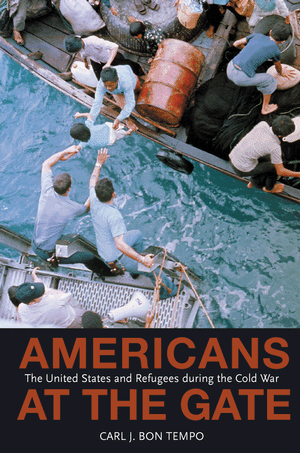 d for the Law and Politics Book Review by Samuel S. Stanton, Jr., Associate Professor of Political Science, Department of Political Science, Grove City College. Stanton writes:
 Carl J. Bon Tempo’s work is designed to examine the intermingled domestic and international contexts of US refugee policy during the Cold War and into the post Cold War eras. This design is carried out by examining the existing state of US refugee policy entering the Cold War and highlighting different periods of the Cold War era. Included in this work are three distinct case studies regarding refugees admitted into the US; Hungarians in the 1950s, Cubans in the 1960s, and Indochinese in the 1970s and 1980s. Bon Tempo carefully considers domestic sources of policy and international political realities that have been important to the shaping of US refugee policy....
Bon Tempo presents a lengthy exposition of President Truman’s 1946 proposal to accept European refugees outside of the normal quotas leading to the 1948 Displaced Persons Act. Particularly important for students and researchers to note is that the acceptance was not without limiting criteria – often based on political decisions about the quality of the regime from which the refugees were fleeing. The Displaced Persons Act of 1948 led to the entry of over 400,000 European refugees into the US prior to the closure of the displaced persons program in 1952 (p.25). Bon Tempo explains in detail the early 1950s cultural issues that led to legislation from a primarily restrictionist stance. Led by politicians such as Senator McCarran (D-NV) much of the immigration and refugee related policy was fed by disapproval of New Deal and Fair Deal liberalism and [*222] growing anticommunism associated with this point of view. The fight between proponents of progressive refugee policy and restrictionists led to the passage over Truman’s veto of the McCarran-Walter Act, which was just as restrictive as immigration laws of the 1920s, and to Truman’s Emergency Migration Program – which proposed to admit 300,000 Europeans, including 21,000 “religious and political refugees from communism in eastern Europe” (p.33). This section of the work is Bon Tempo’s strongest written treatment of pre-Cold War policy and serves to build the point of departure for his primary focus, which is refugee policy during the Cold War.
Bon Tempo’s examination of the 1950s era Refugee Relief Program and the 1953 Refugee Relief Act is interesting for two primary reasons. One, it does a quality job of explaining the anxiety of the US population over communist infiltration of the country by immigrants and refugees. Two, it highlights that the primary concern of refugee policy was not political persecution, but overcrowding of Western Europe during a period of economic hardship and redevelopment following WWII. The explanation of the provisions and requirements of the Refugee Relief Act (RRA) are accurate, but Bon Tempo’s examination does not offer a glimpse at how refugee is defined within this act, nor of how this obvious attempt at simply resettling Europeans in need of homes and jobs would meet a standard of refugee resettlement. It is however, an accurate history of the RRA....
Indeed, the case studies of Hungarian (Chapter 3), Cuban (Chapter 5), and Indochinese refugees (Chapter 6) are wonderful illustrations of the interplay of domestic attitudes and foreign policy concerns in the practices regarding refugee admissions into the US. Bon Tempo argues that refugees are admitted historically only on consideration of [*223] foreign policy issues, and that getting the American public to accept the influx is done only if necessary to allay domestic fears. The domestic fears are based on the current social climate when the refugee influx occurs. While refugee policy is usually designed to allay security fears, speed of entry can be used but requires massive public relations efforts on the part of the government (as noted in both the case study of Hungarian refugees and Cuban refugees).
The rest is here.
Sunday, April 12, 2009
Another View
Dear Mr. President
Langston Hughes
—People's Voice (July 3, 1943), p. 23
Langston Hughes
President Roosevelt, you
Are our Commander in Chief.
As such, I appeal
To you for relief.
Respectfully, sir,
I await your reply
As I train here to fight,
Perhaps to die.
I am a soldier
Down in Alabam
Wearing the uniform
Of Uncle Sam.
But when I get on the bus
I have to ride in the back.
Rear seats only
For a man who's black.
When I get on the train,
It's the Jim Crow car—
That don't seem to jibe
With what we're fighting for.
Mr. President, sir,
I don't understand
Democracy that
Forgets the black man.
Respectfully, therefore,
I call your attention
To these Jim Crow laws
Your speeches don't mention.
I ask why YOUR soldiers
Must ride in the back,
Segregated—
Because we are black?
I train to fight,
Perhaps to die.
Urgently, sir,
I await your reply.
—People's Voice (July 3, 1943), p. 23
Sunday book review round-up
A quick note about recent reviews in the press: 

Thomas Sugrue reviews Traitor to His Class: The Privileged Life and Radical Presidency of Franklin Delano Roosevelt by H.W. Brands and Nothing to Fear: FDR's Inner Circle and the Hundred Days That Created Modern America by Adam Cohen in The Nation.
Also in The Nati on, Equal: Women Reshape American Law by Fred Strebeigh is reviewed by Michael O'Donnell. Hat tip.
 on, Equal: Women Reshape American Law by Fred Strebeigh is reviewed by Michael O'Donnell. Hat tip.
A four volume work, From Eve to Dawn: A History of Women in the World, by Marilyn French, is reviewed by Hilary Mantel for the New York Review of Books.
Also reviewed in the NYRB is A Constitution of Many Minds: Why the Founding Document Doesn't Mean What It Meant Before by Cass R. Sunstein, taken up by Ronald Dworkin.
PLAIN, HONEST MEN: The Making of the American Constitution by Richard Beeman, is reviewed by Walter Isaacson in the New York Times.
The Problem of Punishment
"The Problem of Punishment: Race, Inequality and Justice" is a multi-disciplinary conference sponsored by the Carter G. Woodson Institute for African-American and African Studies at the University of Virginia on April 16-17. The conference is free and open to the public.
The conference has been organized by members of Virginia's departments of English, History and Politics. The organizers explain that it "will examine the historical, political, economic, and socio-cultural roots, as well as the myriad implications of the rise in incarceration in the United States." They continue:
The conference has been organized by members of Virginia's departments of English, History and Politics. The organizers explain that it "will examine the historical, political, economic, and socio-cultural roots, as well as the myriad implications of the rise in incarceration in the United States." They continue:
The aim of this symposium, therefore, is to promote a serious, informed dialogue that will contribute to a growing national debate on the growth of the carceral state. We envision an intimate symposium featuring experts across the disciplines as well as policy practitioners. We will convene on the first day of the symposium with two panels focusing specifically on exploring the causes of the growth of the carceral state and growing racial disparities within it. The opening panel will consider the theoretical and historical foundations of rising imprisonment and shifting policy choices. The second will explore the politics of punishment and race. Following this session Angela Davis (author most recently of Abolition Democracy: Beyond Prisons, Torture, and Empire and Are Prisons Obsolete?) will deliver a keynote address. On Friday, April 17, we will shift our attention to research that evaluates the consequences and implications of the rise in imprisonment. In these three panels, scholars will focus on the myriad implications of rising prison rates for forms of economic, social, and political exclusion in the United States.The keynote speaker is Anglea Y. Davis, Professor Emerita at the University of California, Santa Cruz.
Saturday, April 11, 2009
Urban Legal History
 Over at PropertyProf Blog, Steve Clowney, University of Kentucky College of Law, reports on his seminar on Urban Legal History, which had students research various topics in the history of Lexington, Kentucky. It was inspired by one taught by Robert Ellickson at the Yale Law School. More and a link to Professor Ellickson's syllabus here.
Bernstein Webcasted: The Constitution as Exploding Cigar
 The address of Richard B. Bernstein, distinguished adjunct professor at the New York Law School, entitled "The Constitution as Exploding Cigar," delivered at the Oklahoma City University College of Law on April 2, is webcasted, here. The address is based on his forthcoming book, The Founding Fathers Re-Considered, to be published by Oxford University Press.
Friday, April 10, 2009
What Caused the Supreme Court to Change its Mind on the Flag Salute?
 The question of causation is notoriously difficult to assess, in law as in history. The legal system's goals of fashioning incentives just-so and compensating injured parties demand that participants assign responsibility. Judges and juries identify the "proximate cause" or "motivating factor" because, in a sense, they must. In history, no normative enterprise need constrain one's investigation of cause and effect. Often, one can be satisfied by merely showing that some underappreciated factor had a part in human affairs.
When it comes to constitutional history, pressing a bit harder on the relationships among causal factors can yield insights as to how the political order operates. We might wish to know the relative power political and legal actors have in practice, the social conditions under which an influence on the law can be exerted, and the tools available for acts of constitutional meaning-making and transformation.
A fascinating case study can be found in the U.S. Supreme Court's switch on the constitutionality of the coerced flag salute in the early 1940s. As America geared up for war, the Justices originally held in Minersville School District v. Gobitis that national unity counseled against recognizing a First Amendment right to refuse to salute the American flag. Three years later, the High Court abruptly reversed course, concluding in the famous Barnette case that respect for pluralism and individuality favored vindicating the Jehovah Witnesses' claim.
What best explains the sudden change? Two of the stronger explanations for the switch involve the wave of terror against Jehovah's Witnesses after the first ruling, vividly documented by Shawn Francis Peters; and changes in the Court's personnel in the intervening years (as analyzed in numerous judicial biographies).
In Reconsidering Gobitis: An Exercise in Presidential Leadership, which is hot off the presses, I offer an alternative account: the extra-judicial words and deeds of the Roosevelt administration played a significant role in the Supreme Court's turnabout. These actions signaled that the right of conscience was a presidential priority and framed such a right as the legacy of a just war. No brief was filed by the United States government in either lawsuit, but archival documents show that Robert Jackson kept FDR apprised of developments in Barnette. Department of Justice lawyers authored an article laying the extra-legal violence against the Jehovah's Witnesses squarely at the feet of the Supreme Court, urging the Justices to undo the damage by reversing themselves, and suggesting that such a corrective would implement the president's agenda, "The Four Freedoms." Speeches by key aides emphasized religious liberty and conscience, all while denying public support to Gobitis; these speeches were prominently quoted by the litigants. Finally, Robert Jackson's early drafts of Barnette suggest that the Justices and law clerks were aware of these executive branch efforts, though most of these references were later excised or downplayed during the opinion writing process, effectuating an erasure of presidential action.
Who has the better of the historical argument? What lessons can be drawn if we view this sequence of events as a sophisticated exercise in what Keith Whittington calls "political construction" of the Constitution?
Thursday, April 9, 2009
Goluboff and Gordon-Reed win Guggenheim Fellowships
The 2009 John Simon Guggenheim Memorial Foundation Fellowships have just been announced, and it is a good year for legal historians. Awards go to:
Risa L. Goluboff, Professor of Law and History and Caddell & Chapman Research Professor, University of Virginia Law School, for her project Vagrancy law in the 1960s.
Annette Gordon-Reed, Professor of Law, New York Law School; Professor of History, Rutgers University, for her project Monticello legacies in the "New Age."
One more law professor received a Guggenheim: Jeannie Suk, Assistant Professor of Law, Harvard Law School, for The legal construction of trauma.
And a Guggenheim was awarded to a friend of legal history, Mae M. Ngai, Professor of History and Lung Family Professor of Asian American Studies, Columbia University, for The Chinese mining diaspora, 1848-1908.
Risa L. Goluboff, Professor of Law and History and Caddell & Chapman Research Professor, University of Virginia Law School, for her project Vagrancy law in the 1960s.
Annette Gordon-Reed, Professor of Law, New York Law School; Professor of History, Rutgers University, for her project Monticello legacies in the "New Age."
One more law professor received a Guggenheim: Jeannie Suk, Assistant Professor of Law, Harvard Law School, for The legal construction of trauma.
And a Guggenheim was awarded to a friend of legal history, Mae M. Ngai, Professor of History and Lung Family Professor of Asian American Studies, Columbia University, for The Chinese mining diaspora, 1848-1908.
SSRN will be down this weekend
This announcement has been sent out by the Social Science Research Network:
Most working papers on the Legal History Blog are posted on SSRN. For that reason, if you're hoping to read something over the weekend, best to download it now.
IMPORTANT: The SSRN website will be unavailable from approximately 6:00 p.m. EDT Friday, April 10 to 7:00 a.m. EDT on Monday, April 13 because we are upgrading our database to allow for broader international content. If you have any questions, please email authorsupport@ssrn.com.
Most working papers on the Legal History Blog are posted on SSRN. For that reason, if you're hoping to read something over the weekend, best to download it now.
Smythe, A Schumpeterian View of the Great Merger Movement in U.S. Manufacturing
A Schumpeterian View of the Great Merger Movement in American Manufacturing is a new paper by Donald J. Smythe, California Western School of Law. It is forthcoming in Cliometrica (July 2010). Here's the abstract: This paper offers a Schumpeterian view of the Great Merger Movement in the American manufacturing industries, which occurred from 1895-1904. From this perspective, the Great Merger Movement was a response to competitive pressures associated with a number of significant technological innovations which occurred at the end of the nineteenth century. Because the implementation of these innovations required large capital investments, and because the returns to the investments would have been highly uncertain if they had been made competitively, firms at the turn of the twentieth century sought to restrain competition. Since the uncertainty precluded cooperating at arms length, cooperation was internalized through horizontal consolidations. The consolidations in turn increased the size of the capital investments undertaken to implement the technological innovations. The theory is supported with historical evidence about the technological environment and industrial conditions at the turn of the twentieth century, and an econometric model is tested using data from the Twelfth and Thirteenth Censuses of Manufactures.
Chen on Legal Thought in the PRC
Albert H.Y. Chen, Faculty of Law, University of Hong Kong, has posted Legal Thought and Legal Development in the People's Republic of China 1949-2008. Here is the abstract:
- The People's Republic of China has experienced a chequered legal history. Modern Chinese law has been marked by radical discontinuities with the past. The Chinese dynastic empires used to have elaborate legal codes and highly developed bureaucracies for administration, but as imperial rule came to an end with the 1911 Revolution, Chinese law entered an era of doubt about its own past, uncertainty and attempts in Westernization, modernization and reconstruction, first by drawing inspiration from Continental Europe and Japan in the Republican era, and then from the Soviet Union. After a brief attempt in the mid 1950s to establish a new socialist legality modeled on that practiced by the Soviet Union, China saw two decades of deteriorating standards of legality ending in total lawlessness in the Cultural Revolution era of 1966-1976.
In 1978, the Dengist era of "reform and opening" began. The last thirty years have seen not only rapid economic development in China, but also significant efforts in the reconstruction and development of its legal system. These efforts were guided by and reflected a new and continuously deepening understanding of the value of law and legal institutions and of the Rule of Law on the part of the scholarly and governing elites of China which has also spread and penetrated among the populace, civil society and the mass media. It is the purpose of this paper to examine the history of legal thought in the PRC, and to review how such thought has produced "an event of epic historic proportions".
This paper is divided into the following parts. Part I divides the legal history of the PRC into several periods, and describes the legal thought of each period. Part II reviews major legal developments in China, including both the making of laws and the building of legal institutions. Part III reflects on the characteristics and achievements of the Chinese project of legal development in the last three decades as well as its limitations. Finally, part IV offers a few concluding remarks.
Law of the Land: Virginia and America
The Supreme Court of Virginia Historical Commission and the Library of Virginia invite proposals for a needs-and-opportunities symposium on the legal history and culture of Virginia and the United States to be held at the Library of Virginia on Friday and Saturday, 12 and 13 March 2010. The symposium will be the first event in The Law of the Land: Virginia and America, which will feature a major exhibition and other public programs beginning in 2012.
 The Program Committee welcomes submissions for individual papers or for session proposals emphasizing needs-and-opportunities and new scholarship that treat large and important topics such as (but not limited to) the origins of American legal culture, the influence of Virginia on American legal culture, the common law, state constitutional law, federalism and state's rights, courts and jurisprudence, criminal law, commercial law, labor law, environmental law, legal education, law and gender, and the law and slavery, segregation, and race.
Attendance is limited to 250. Please send proposals and a brief CV by e-mail to the Program Committee before 1 May 2009, addressed to brent.tarter@lva.virginia.gov
Image credit.
 The Program Committee welcomes submissions for individual papers or for session proposals emphasizing needs-and-opportunities and new scholarship that treat large and important topics such as (but not limited to) the origins of American legal culture, the influence of Virginia on American legal culture, the common law, state constitutional law, federalism and state's rights, courts and jurisprudence, criminal law, commercial law, labor law, environmental law, legal education, law and gender, and the law and slavery, segregation, and race.
Attendance is limited to 250. Please send proposals and a brief CV by e-mail to the Program Committee before 1 May 2009, addressed to brent.tarter@lva.virginia.gov
Image credit.
Wednesday, April 8, 2009
Now on SSRN: Law, War, and the History of Time
My new paper, Law, War, and the History of Time, is now available on SSRN. It is very much a work-in-progress, and I would appreciate any feedback. Here's the abstract:

Assumptions about time are an aspect of the basic architecture of our thinking about law and war. Time is thought to be linear and episodic, moving from one kind of time (peacetime) to another kind of time (wartime) in sequence. Law is affected by what time it is, with a pendulum swinging from greater government power and lesser rights during wartime, to the opposite in peacetime. Drawing upon works on the history of time, this paper argues that our conception of "wartime" is culturally constructed and historically contingent. This understanding of war and time is also in tension with the practice of war in 20th century U.S. history.
The paper turns to World War II, which is thought of as a traditional war, with clear temporal limits. But this war is harder to place in time than is generally assumed, as the different legal endings to the war span over a period of seven years. The fuzziness in the war's timing affects scholarship on rights and war, as scholars who believe themselves to be writing about the same wartime are not always studying the same years.
The difficulty in confining World War II in time is an illustration of a broader feature of the twentieth century: wartimes bleed into each other, and it is hard to find peace on the twentieth century American timeline. Meanwhile, as all twentieth century wars occurred outside U.S. borders, a feature of American military strategy has sometimes been to increase the engagement of the American people in a war, and at other times to insulate them. Isolation from war enabled the nation to participate in war without most citizens perceiving themselves to be in a wartime. The essay closes with a discussion of the way anxiety about temporality surfaces in contemporary cases relating to Guantanamo detainees.
The paper is part of a larger project that places war at the center of 20th century U.S. law and politics, rather than viewing war as something that had an episodic impact.
The paper turns to World War II, which is thought of as a traditional war, with clear temporal limits. But this war is harder to place in time than is generally assumed, as the different legal endings to the war span over a period of seven years. The fuzziness in the war's timing affects scholarship on rights and war, as scholars who believe themselves to be writing about the same wartime are not always studying the same years.
The difficulty in confining World War II in time is an illustration of a broader feature of the twentieth century: wartimes bleed into each other, and it is hard to find peace on the twentieth century American timeline. Meanwhile, as all twentieth century wars occurred outside U.S. borders, a feature of American military strategy has sometimes been to increase the engagement of the American people in a war, and at other times to insulate them. Isolation from war enabled the nation to participate in war without most citizens perceiving themselves to be in a wartime. The essay closes with a discussion of the way anxiety about temporality surfaces in contemporary cases relating to Guantanamo detainees.
The paper is part of a larger project that places war at the center of 20th century U.S. law and politics, rather than viewing war as something that had an episodic impact.
150th Anniversary of John Brown's Raid: A Conference

John Brown has long fascinated scholars, artists, activists, and politicians. The Harpers Ferry National Historical Park, along with other partners, is hosting a multidisciplinary academic symposium on John Brown and his 1859 raid on Harpers Ferry. The conference will be held at the Stephen T. Mather Training Center in Harpers Ferry, West Virginia. This gathering, which will take place October 14-17, 2009, hopes to stimulate new and diverse academic research, scholarship, and debate.
One of the neat opportunities will be to hike the path the raiders took from Kennedy Farm to Harper's Ferry. Brian McGinty, author of Lincoln and the Court, will give a lecture on Brown's trial at the Charlestown, West Virginia courthouse.
The call for papers is now closed, but details on attending the conference can be found here. Plenary speakers include David Blight, Spencer Crew, and Paul Finkelman. A full list of presenters will be added.
Image credit: Western Reserve Historical Society
W.E.B. DuBois papers to be digitized
The W.E.B. Du Bois Papers at the University of Massachusetts, Amherst, are being d igitized over the next two years, the Boston Globe reports. Hat tip. The collection includes "
 igitized over the next two years, the Boston Globe reports. Hat tip. The collection includes "
 more than 100,000 documents,...an array of diaries, photographs, and personal correspondence of the pioneering black scholar and civil rights activist....The papers, which include speeches and unpublished essays and other writings, will be converted to digital form and posted on the Internet in a two-year, $200,000 effort, the library announced [April 3]. The project will allow unprecedented access to the extensive collection, recognized as the leading Du Bois anthology in the world.
The Finding Aid and other Du Bois resources can be accessed here.
LaCroix on "The Founder's Fiction"
Alison L. LaCroix, University of Chicago Law School, has published an essay, entitled The Founders Fiction, in a special issue of the on-line journal Common-Place devoted to the topic Who Reads an Early American Book? Here's her abstract:
Hat tip.Does literature matter for politics and law? In the eighteenth century, the answer to this question was a resounding affirmative. In the twenty-first century, historically minded scholars and students of constitutional law must include literary works as among the inputs that shaped the American founders' ideas about government and society. The founders were voracious readers -- not only of theoretical tracts, but also of novels, such as Laurence Sterne's Tristram Shandy and Oliver Goldsmith's Vicar of Wakefield. Reading those novels today can offer insights into early American thought, giving us a sense of the cultural milieu in which the members of the founding generation operated as well as a broader array of primary sources for understanding what their ideas meant to them. In an essay for Common-place, an online journal of early American history and culture, I argue that "[i]n order to begin to answer the lawyer’s question of what the founders thought about a given issue, we need first to answer the historian’s question of how personal stories, beliefs, and external social and political conditions combined to create those thoughts."


Subscribe to:
Posts (Atom)