Thursday, March 22, 2012

Colucci on McMahon on Nixon's Court

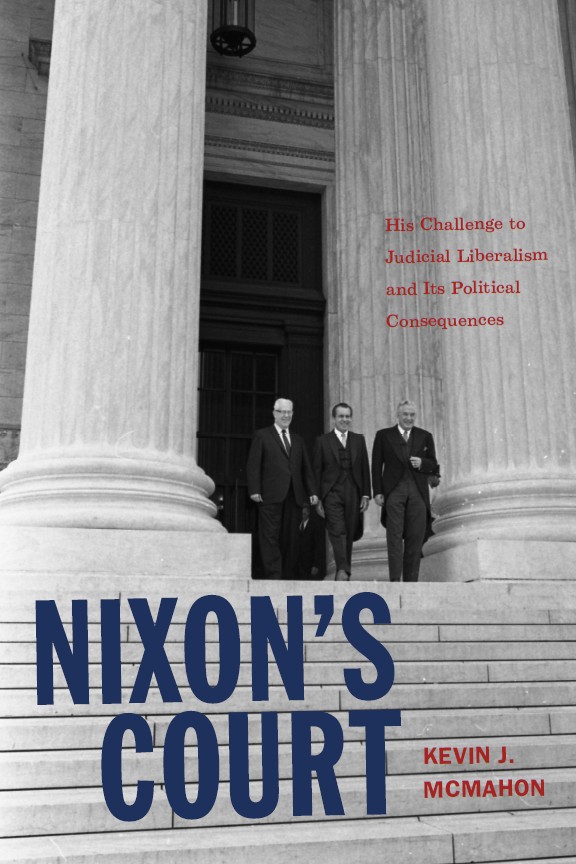
NIXON’S COURT: HIS CHALLENGE TO JUDICIAL LIBERALISM AND ITS POLITICAL CONSEQUENCES, by Kevin J. McMahon (Chicago: University of Chicago Press, 2011)  is reviewed by Frank J. Colucci, Department of History and Political Science, Purdue University Calumet on the Law and Politics Book Review.  Colucci begins:
In Nixon’s Court, presidential scholar Kevin J. McMahon offers a persuasive revisionist account of the judicial legacy of Richard Nixon. Critics argue that Nixon waged a jurisprudential “counter-revolution” against the Warren Court that eventually “failed” (Dworkin 1972; Blasi 1983). Using archival records, McMahon argues that the judicial nominations and legal actions Nixon undertook during his first term were driven by “politics far more than ideology” (p.6).

Rather than total revolt against the Warren Court, McMahon posits, Nixon engaged in a limited, opportunistic strategy. He publicly opposed judicial decisions in a few politically potent areas –busing for school desegregation and crime – and put political symbolism over ideology when selecting Supreme Court nominees. Nixon did this seeking to expand his Republican base with two components of the New Deal Democratic coalition: southerners and working-class, often Catholic voters in the urban North. But even in the areas of school desegregation and crime he made little attempt to overturn Warren-era precedents or to refuse to enforce Supreme Court’s decisions. He even benefitted from public perception and backlash against the Court. Based on his re-election in 1972 and later decisions concerning crime and busing, McMahon concludes, “on the issues Nixon most cared about” he essentially got what he wanted (p.252).

McMahon situates Nixon’s approach to the courts within the context of his narrow victory in 1968 and the re-election battle he expected in 1972. Facing Democrat Hubert H. Humphrey and the independent candidacy of Alabama Gov. George C. Wallace, Nixon needed to construct an electoral majority by adding disaffected Democrats without losing his GOP base. 

Read the rest here.

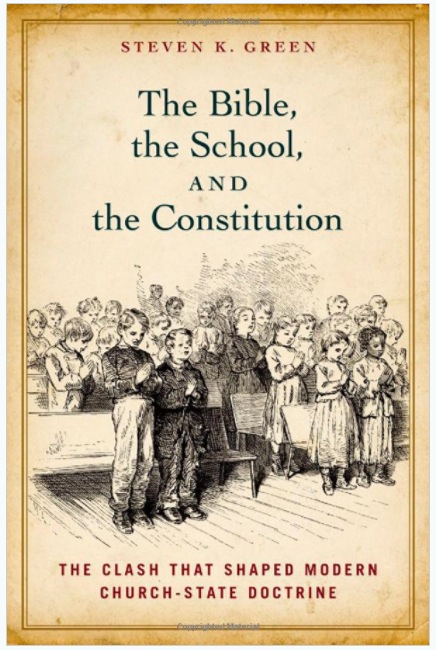
Green, The Bible, the School, and the Constitution

The Bible, the School, and the Constitution: The Clash that Shaped Modern Church-State Doctrine, by Steven K. Green, the Frank H. Paulus Professor of Law and director of the Center for Religion, Law and Democracy at Willamette University, has just been published by Oxford University Press.  Here's the book description:
Few constitutional issues have been as contentious in modern times as those concerning school prayer and the public funding of religious schools. But as Steven K. Green reveals in The Bible, the School, and the Constitution, this debate actually reached its apogee just after the Civil War, between 1863 and 1876. Green shows that controversy over Bible reading in public schools, commonly called "the School Question," captured national attention to an unprecedented degree.

Public education during the nineteenth century faced many competing pressures, including a widespread belief that schooling required a moral if not religious basis, a belief among many Protestants that Catholic immigration presented a threat to Protestant culture and to republican values, the need to accommodate increasing religious pluralism in the schools, and evolving understandings of constitutional principles. The School Question provided Americans with the opportunity to address and articulate these pressures, and to engage in a grand-and sometimes not so grand-public debate over the meaning of separation of church and state. Green demonstrates that the modern Supreme Court's decisions on school funding and Bible reading did not create new legal doctrines or abolish dominant practices, but built on legal concepts and educational trends that had been developing since the early nineteenth century. He also shows that while public reaction to a growing Catholic presence was a leading factor in this development, it was but one element in the rise of the legal doctrines the high court would embrace in the mid-twentieth century.

Rarely in the nation's history have people from such various walks of life-Protestants and Catholics, skeptics and theocrats, nativists and immigrants, educators and politicians-been able to participate in a national discussion over the meaning of a constitutional principle. The debates of this period laid the foundation for constitutional arguments that still rage today.
And the endorsements:
 "This is a long overdue history of the origins of secular public education. Green's carefully researched discussion of the relationship between separation of church and state and public education is a powerful answer to scholars and jurists who have made ideologically-based and historically shaky arguments in favor of state supported religious exercise in the public schools. Green's work reminds us of the importance of Jefferson's notion of a 'wall of separation' between the state and religion."
---Paul Finkelman, President William McKinley Professor of Law and Public Policy, Albany Law School

"Steven K. Green has rapidly emerged as the leading historian of nineteenth-century church-state relations in America. Here he shows, in bold and brilliant colors, how the soaring debates over religion and education in the aftermath of the Civil War still shape our law and culture today, for better and worse. Deeply researched, smoothly written, and highly original, this book is a must-read for anyone who values religious liberty."
---John Witte, Jr., Director of the Center for the Study of Law and Religion, Emory University

"The Bible, the School, and the Constitution is an essential reinterpretation of the 'School Question' and its implications for church-state jurisprudence in American history. Repudiating recent accounts that attribute the emergence of 'secular' norms to anti-Catholic animus, Steven K. Green identifies a far more diverse set of motivations that converged to restrict religious practices in public schools along with public funding for religiously affiliated schools. In the process, Green implicitly defends these norms as constitutionally sound solutions for a diverse society."
--Tisa Wenger, author of We Have a Religion: The 1920s Pueblo Indian Dance Controversy and American Religious Freedom

Wednesday, March 21, 2012

Wood Reviews White's Law in American History

The eminent historian, Gordon Wood (Brown--history, emeritus), has published a review of Ted White's new book, Law in American History, Volume 1, in The New Republic. The review, entitled "The Dream of Law," is available online to subscribers.  Woods' review begins with high praise for White.  He is "one of America’s most eminent legal historians," having "written fifteen books, many of which have won awards and honors." Such a "wide-ranging body of legal scholarship," Woods writes, "has amply prepared White for what promises to be his magnum opus, a multi-volume work called Law in American History." 

Woods then proceeds to take issue with several features of White's first volume.  Woods criticizes, among other things, White's preoccupation with historical "contingency" and "issues of race, class, and gender."  Woods dismisses the series of hypotheticals posed in White's work as "counterfactual history with vengeance." And he questions White's failure to consider legal issues in the colonial period that, in Wood's estimation, are too important to ignore.  Moreover, Woods describes White's affirmation of readers' "different perspectives [on history], neither wrong or right," as "sad." Wood's review reflects profound differences of opinion among historians about what should count as history and about how historians should approach their craft.  For that reason, it is well worth a read.


Ted White Q&A: Law in American History in the Scholarly Market

Ted White's most recent book, Law in American History, Volume I, is the point of departure for new questions for him about his work and how it fits with related scholarship.

Q: Although Law in American History, Volume I, makes unique contributions, you also cover some ground that has been covered by other works, particularly Lawrence Friedman's A History of American Law and Kermit Hall's The Magic Mirror. How would you describe the differences in approach between those volumes and yours? Did you (or the publisher) anticipate your volumes as "competitors" to those of Friedman and Hall?
 
A: When I first agreed to do a "history of American law," the scholarship I had produced at the time suggested that I would be unlikely to embrace the approach to law and legal institutions that had become influential among social historians in the 1960s and 1970s, which Lawrence Friedman famously described as law's containing "nothing autonomous," and being "a mirror of society." I believe that the publisher may have anticipated my producing a volume that was self-consciously "competitive" with Friedman's. But by the mid-1990s I had written Tort Law in America and The Marshall Court and Cultural Change, and I had come to the view that the relationship between law and its historical context was reciprocal and complex, and that neither conceiving of legal discourse as wholly "autonomous," nor thinking of legal developments as "mirroring" trends in the larger culture, were satisfactory ways of describing that relationship.

              The principal analytical move that I decided to make in this volume was to try to capture the complex reciprocal relationship between law and its historical context by centering my narrative first on themes that helped to centrally define American culture at periods in its history, and then to examine the way in which law interacted with those themes. I felt that by "taking history first and fitting law around it," so to speak, I would be able to emphasize that the defining characteristics of American law and legal institutions at any point in their history need to be historicized, and at the same time the central role of law in contributing to the major themes of American history needs to be understood.

And here is a related question.

Q: In general, you seem to have chosen to write on topics that have previously been covered a fair amount by other scholars--the Marshall Court, Earl Warren, Justice Oliver Wendell Holmes, sociological jurisprudence, legal realism, process theory, critical legal studies, and even Alger Hiss and baseball. Many historians seek to make a contribution by writing on something that hasn't been covered much in the literature. Was your choice to take up relatively familiar topics a conscious one?

A: That question is a fair way of describing my scholarly orientation. Although my work has sometimes resulted in my writing on quite obscure topics (western lands cases decided by the Supreme Court of the United States in the early nineteenth century or the internal deliberative protocols employed by the Supreme Court of the United States for much of its early history), I have generally been interested in trying to take a fresh look at topics that have been regularly studied because they have successively been deemed important (I am neither the first person nor the last to write on Earl Warren, Justice Oliver Wendell Holmes, the Marshall Court, or Alger Hiss). That has certainly been the case in this volume. Every one of my chapters takes up topics that numerous American historians have addressed, and some of them involve topics (American independence from the British Empire, the framing of the Constitution, slavery) that would be taken up in any survey of American history, including legal history. I am of the view that the continuing perceived importance of certain topics, or the lives of certain figures, means that they are attractive subjects for continuous scholarly reconsideration, and that such reconsideration is a way in which we try to make sense of our current experience.

Hibbitts reviews Hawke, Elite Competition and Written Law in Ancient Greece

We have a backlog of H-Law reviews that we've been meaning to spotlight, starting with Bernard Hibbitts's review of Jason Hawke, Writing Authority: Elite Competition and Written Law in Early Greece (Northern Illinois University Press)

Here's an excerpt from the review:
Why did the Greeks start writing laws in the mid-seventh century BCE? Offering answers to this old chestnut of a question has become something of a cottage industry in the past few years . . . . Now comes Jason Hawke, an assistant professor in the History Department of Roanoake College, with his own take.
Specifically, Hawke
argu[es] that law-writing was actually a device used by elites to manage changing circumstances of competition among themselves in conditions where intra-elite social consensus founded on traditional values was coming apart under the influence of expanding population, commerce, and increasing social strife. Law-writing was not aimed primarily downward against the demos. Nor was it aimed upward against the elite. Instead it was part of lateral reordering of elite power relationships aimed at ensuring (however unsuccessfully, perhaps) that power was not overly concentrated in the hands of a few elite families or individuals.
Read more from Hibbitts (University of Pittsburgh School of Law) here.

Tuesday, March 20, 2012

Legal History in the News: The Importance of Wickard

Today's New York Times has a great piece about the importance of Wickard v. Filburn (1942) for current legal challenges to the Obama administration's health care reform legislation. Here's a taste:
If the Obama administration persuades the Supreme Court to uphold its health care overhaul law, it will be in large part thanks to a 70-year-old precedent involving an Ohio farmer named Roscoe C. Filburn.

Mr. Filburn sued to overturn a 1938 federal law that told him how much wheat he could grow on his family farm and made him pay a penalty for every extra bushel.

The 1942 decision against him, Wickard v. Filburn, is the basis for the Supreme Court’s modern understanding of the scope of federal power. It is the contested ground on which the health care case has been fought in the lower courts and in the parties’ briefs. And it is likely to be crucial to the votes of Justices Anthony M. Kennedy and Antonin Scalia, who are widely seen as open to persuasion by either side.

“Wickard has become so foundational for generations of lawyers that any plausible understanding of the commerce power must come to terms with it,” said Bradley W. Joondeph, a law professor at Santa Clara University.

Both supporters and opponents of the health care law say the decision helps their side, and for three days starting next Monday, it will be at the center of the arguments before the Supreme Court about the law’s constitutionality.
Read on here.

Bach, "Mobilization and Poverty Law"

image credit
New from Wendy Bach (University of Tennessee College of Law): "Mobilization and Poverty Law: Searching for Participatory Democracy Amongst the Ashes of the War on Poverty." Here's the abstract:
In 1964, at the height of the Civil Rights Movement, the federal government launched Community Action, a program that was to be designed and implemented with the maximum feasible participation of the poor. Today in governance theory, we are told once again that participation by affected communities in the mechanisms of governance have the ability to deepen democracy – to yield better policy and to engage new voices in the mechanisms of democracy. Enclosed for your review is Mobilization and Poverty Law: Searching for Participatory Democracy Amongst the Ashes of The War on Poverty, an article that turns to history to explore a question central to both governance theory and community lawyering: Do the participatory democracy mechanisms of new governance theory have the ability, or can they be wielded by advocates and poor communities, to render poverty more responsive to community needs? To answer this question, Mobilization and Poverty Law provides a detailed chronicle of the creation and implementation of Community Action and maximum feasible participation and highlights the extraordinary story of its implementation in Durham, North Carolina. The article offers a definition against which to measure whether participation was “robust” and concludes that three factors were crucial in realizing robust participation: 1. the existence of the statutory participatory mandate; 2. the flexibility wielded by administrators in implementing the mandate; and 3. the choice by the agency to fund autonomous, community-controlled groups as a mechanism to realize robust participation. The article ends with two primary conclusions, one directed at new governance and the second directed at those invested in community lawyering. For new governance, the history suggests that participatory structures, as currently constituted, are likely to lead to little more than tokenism. For advocates committed to support the efforts of communities to build and wield political power, however, the article offers a more hopeful suggestion. Embracing what Scott Cummings has termed “constrained legalism,” the article suggests that advocates might take a page from history and, like our predecessors, seek to create, out of the tokenistic nods to participatory governance in current policy, programs and structures that might yield both robust participation and poverty policy that, in the eyes of poor communities, actually meets their needs. 
Hat tip: Poverty Law

Monday, March 19, 2012

Snyder and Barrett on Rehnquist's Lost Letter

Brad Snyder, University of Wisconsin Law School, and John Q. Barrett, St. John's University School of Law, have posted Rehnquist's Missing Letter: A Former Law Clerk's 1955 Thoughts on Justice Jackson and Brown, which will appear in the Boston College Law Review 53 (2012).  Here is the abstract:    
"I think that Plessy v. Ferguson was right and should be reaffirmed." That's what Supreme Court law clerk William H. Rehnquist wrote privately in December 1952 to his boss, Justice Robert H. Jackson. When the memorandum was made public in 1971 and Rehnquist's Supreme Court confirmation hung in the balance, he claimed that the memorandum reflected Jackson's views, not Rehnquist's. Rehnquist was confirmed, but his explanation triggered charges that he had lied and smeared the memory of one of the Court's most revered justices. This Essay analyzes a newly discovered document, a letter Rehnquist wrote to Justice Felix Frankfurter in 1955, criticizing Jackson, that reveals what Rehnquist thought about Jackson shortly after Brown and the Justice's death. The 1955 letter was not known during Rehnquist's 1971 or 1986 confirmation hearings. It is also currently missing and may have been stolen from Frankfurter's Papers at the Library of Congress. This Essay argues that Rehnquist's 1955 letter represents his disappointment with Brown and the beginning of his outspoken criticism of the Warren Court. The letter, this Essay contends, says less about how Rehnquist felt about Jackson and more about Rehnquist's disappointment over his Justice's role in the most important Supreme Court decision of the twentieth century.
Update: Adam Liptak's column in the New York Times on the Snyder-Barrett find is here.

Keller to Lecture on the Obama Administration

At 4:30 this Wednesday, a great historian of American politics brings his perspective to bear on the first years of the Obama administration.  The event at Boston College is free and open to the public.  More information is here.

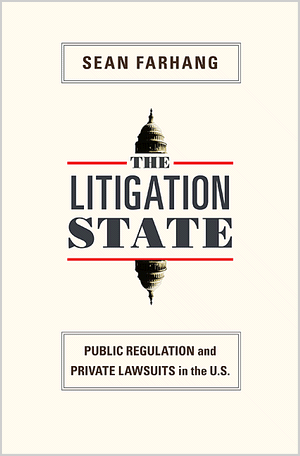
Marshall reviews Farhang, "The Litigation State"

The Law & Politics Book Review has released a review of The Litigation State: Public Regulation and Private Lawsuits in the United States (Princeton University Press), by political scientist Sean Farhang.

Reviewer Anna-Maria Marshall (University of Illinois, Urbana-Champaign) introduces the book as follows:
In his fascinating book, Sean Farhang asks a big question – what is the role of the civil litigation system in the American regulatory state? Politicians from both ends of the ideological spectrum frequently bemoan the fact that the United States is a litigious society, but in those debates, they rarely admit that private lawsuits are sometimes the only way for people to claim the rights granted to them by law. Other political systems relegate law enforcement primarily to command and control agencies, yet American skepticism about bureaucracy and regulation renders such enforcement regimes politically controversial. Thus, in many realms of regulation, Congress makes ordinary citizens “private attorneys general,” authorizing them to implement the law when and where they see fit. Farhang’s analysis seeks to explain the institutional context that gives rise to these enforcement mechanisms.
Read on here.

Sunday, March 18, 2012

"Flagrant Conduct," "Cosmic Constitutional Theory," and More: This Week in the Book Pages

A must-read item this week is David Oshinky's review, for the New York Times, of Flagrant Conduct: The Story of Lawrence v. Texas: How a Bedroom Arrest Decriminalized Gay Americans (W. W. Norton & Co.), by law professor Dale Carpenter. Oshinsky describes the book as "a stirring and richly detailed account of Lawrence v. Texas," which "turns conventional wisdom about Lawrence on its head." The rest is here.

Also reviewed in the NYT:
  • Cosmic Constitutional Theory: Why Americans Are Losing Their Inalienable Right to Self-Governance (Oxford University Press), by the Honorable J. Harvie Wilkinson III . Reviewer Jeffrey Rosen characterizes the book, here, as at once "modest," "invaluable," "unusual," and "inspiring." "For law students and citizens who are frustrated with the way that all the constitutional methodologies fail, in practice, to deliver on their promise of helping judges separate their political views and judicial decisions, Wilkinson’s primer offers a diagnosis of the problem and a self-effacing solution."
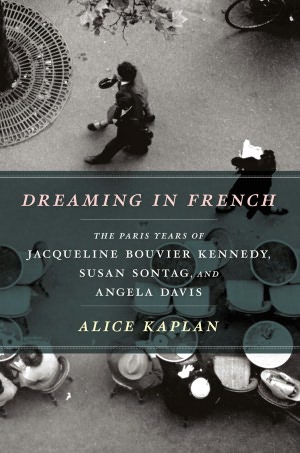
A second item that I highly recommend comes from the book pages of the Nation, where Alice Kaplan adapts material from her new book Dreaming in French: The Paris Years of Jacqueline Bouvier Kennedy, Susan Sontag, and Angela Davis (University of Chicago Press). Here's a taste:
[A] phenomenon as powerful and versatile as the American romance with France has played a vital role in Davis’s story, as it has for women as radically different as Jacqueline Bouvier and Susan Sontag. All three were transformed by studying in France in such a way that they would, in turn, transform the cultural and political life of the United States.
Read on here.

This week in the New Republic: The Book: a favorable review of Autumn in the Heavenly Kingdom: China, the West and the Epic Story of the Taiping Civil War (Alfred A. Knopf), an "engrossing new book" by Stephen R. Platt (mentioned in our Feb. 12 round-up, here), and a much less favorable review of The Swing Vote: The Untapped Power of Independents (St. Martin’s), by Linda Killian (the book "adds nothing of value to our understanding of independents in general and of swing voters in particular").

The Wall Street Journal covers Fatal Self-Deception: Slaveholding Paternalism in the South (Cambridge University Press), by Eugene D. Genovese and Elizabeth Fox-Genovese. "Taken together [with The Mind of the Master Class (2005) and Slavery in White and Black (2008)]," writes reviewer Fergus Bordewich, "the books represent a magisterial effort to place proslavery thought and sentiment within the realm of serious intellectual history. Avoiding polemics, the authors generally portray slave owners as honorable, pious and emotionally entangled with their human property to the point of self-delusion."

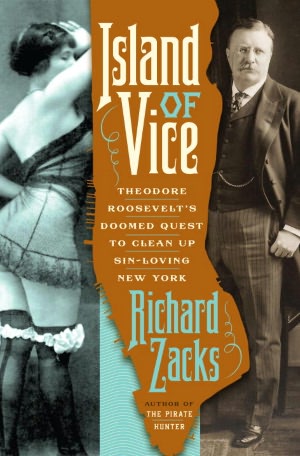
Also reviewed in the WSJ: David Dorsen's Henry Friendly: Greatest Judge of His Era (Harvard University Press) (here), which we mentioned just the other day (here); Island of Vice: Theodore Roosevelt's Doomed Quest to Clean Up Sin-Loving New York (Doubleday), by Richard Zacks (here); Rogues and Redeemers: When Politics Was King in Irish Boston (Crown), by Gerard O'Neill (here); and Reagan and Thatcher: The Difficult Relationship (W. W. Norton & Co.), by Richard Aldous (here).

A new issue of the London Review of Books is out. It covers modern British art, Greek democracy, Medieval grammar, French children, Hollywood rebels, and much more.


Last, we predicted that this book would grab headlines, and it has: the Los Angeles Times reviews (here) Tinderbox: How the West Sparked the AIDS Epidemic and the How the World Can Finally Overcome It (Penguin Press), by Craig Timberg and Daniel Halperin. More, from NPR, is here.


Saturday, March 17, 2012

New Release: Ghachem, "The Old Regime and the Haitian Revolution"

Malick W. Ghachem, University of Maine School of Law, has just published The Old Regime and the Haitian Revolution, with Cambridge University Press.  Here is the publisher's description:
The Haitian Revolution (1789–1804) was an epochal event that galvanized slaves and terrified planters throughout the Atlantic world. Rather than view this tumultuous period solely as a radical rupture with slavery, Malick W. Ghachem's innovative study shows that emancipation in Haiti was also a long-term product of its colonial legal history.  The key to this interpretation lies in the Code Noir, the law that regulated master-slave relations in the French empire.  The Code's rules for the freeing and punishment of slaves were at the center of intense eighteenth-century debates over the threats that masters -- not just freedmen and slaves -- posed to the plantation order.  Ghachem takes us deep into this volatile colonial past, digging beyond the letter of the law and vividly re-enacting such episodes as the extraordinary prosecution of a master for torturing and killing his slaves. This book brings us face-to-face with the revolutionary invocation of Old Regime law by administrators seeking stability, but also by free people of color and slaves demanding citizenship and an end to brutality. The result is a subtle yet dramatic portrait of the strategic stakes of colonial governance in the land that would become Haiti.
 And here are the blurbs:

"This book will have a major impact on our understanding of the single most important turning point in the history of New World slavery. A revolutionary study of revolution, this beautifully written and deeply researched work shows that the 'rupture narrative' has obscured critical aspects of continuity and the ways in which laws governing master-slave relations provided a changing framework for action in the slaves' quest for freedom."
-- David Brion Davis, Sterling Professor of History Emeritus and Director Emeritus of Yale's Gilder Lehrman Center for the Study of Slavery, Resistance, and Abolition

"The Old Regime and the Haitian Revolution offers a sweeping and lucid analysis of the making and unmaking of slavery and colonial law in Haiti. Ghachem brings together insightful analysis of juridical and political debates with riveting stories of how the enslaved and free people of Saint-Domingue sought to use law in pursuit of liberty. This brilliantly crafted book is a vital contribution to our understanding of law, empire, and revolution in the French Atlantic."

-- Laurent Dubois, author of Haiti: The Aftershocks of History

"Malick Ghachem's new book is a major contribution to our understanding of colonial Saint-Domingue and the Haitian Revolution. Ghachem argues that reforms meant to limit the abuses of slavery did more to weaken the institution than the criticisms of abolitionists, and he points out surprising continuities between the colonial regime and the new laws laid down by Toussaint Louverture and his successors. No one interested in the struggle against slavery during the revolutionary era can ignore his contribution."

-- Jeremy D. Popkin, T. Marshall Hahn, Jr, Professor of History, University of Kentucky

Nelson, "A Critical Guide to Erie . . ."

Caleb Nelson, University of Virginia School of Law, has posted A Critical Guide to Erie Railroad Co. v. Tompkins, which appears in William & Mary Law Review 54 (2012). Here is the abstract:
Library of Congress
This paper--part of William & Mary's recent symposium on "Law Without a Lawmaker"-- tries to provide a concise but comprehensive analysis of Justice Brandeis's various arguments in Erie. Consistent with much of the new learning about Erie, the paper concludes that Justice Brandeis's historical argument is wrong, that his constitutional argument is highly suspect, and that even his practical arguments are less clear-cut than he suggested. The paper does not claim that anything in written federal law FORECLOSES the conclusion that Justice Brandeis reached in Erie. But the paper argues that nothing in written federal law COMPELS that conclusion either. Ironically, the Erie doctrine probably is best characterized as what modern lawyers call "federal common law."
Hat tip: Legal Theory Blog

Friday, March 16, 2012

Born in the USA: The Politics of Birthright Citizenship in Historical Perspective

Here is the schedule for what promises to be a world-class conference, Born in the USA: The Politics of Birthright Citizenship in Historical Perspective, to be held March 29-30, 2012, at the University of Maryland, College Park, MD.  The conference is free, and no registration is required.  Attendees are requested to park in a visitor lot or arrive via metro (free shuttle buses run regularly from the College Park metro to campus).

SESSION 1: Thursday, March 29, 7:00 pm, Ulrich Recital Hall, Tawes
Keynote Address by Eric Foner (Columbia University History Department)
"The Civil War, Reconstruction, and the Origins of Birthright Citizenship"

Introduction by Wallace Loh, President, University of Maryland

** A reception jointly sponsored by the Center and the Race, Law, and Literature
conference (Department of English) will precede the keynote address beginning at 5:30 in
the first floor lobby of Tawes Hall

SESSION 2: Friday, March 30, 2012, 9:30 a.m.-11:30 a.m.
Session 2A: Origins
Van Munching Hall Room 1330
This session will explore the common law and Civil War Era origins and politics of the Fourteenth Amendment's citizenship clause.

   Chair: Holly Brewer (University of Maryland History Department)
   Panelists:
   Peter Schuck (Yale Law School)
   Garrett Epps (University of Baltimore Law School)
   William Novak (University of Michigan Law School)

   Commentator: Mark Graber (University of Maryland Francis King Carey School of Law)

Session 2B: Birthright Citizenship in Comparative Perspective
Van Munching Hall Room 1333

This session will place birthright citizenship in global perspective and compare it with other systems of citizenship elsewhere in the world.

   Chair: Daryle Williams (University of Maryland History Department)

   Panelists:
   David Abraham (University of Miami Law School)
   Patrick Weil (Yale Law School)
   Marley Weiss (University of Maryland Francis King Carey School of Law)

   Commentator: James F. Hollifield (SMU, Department of Political Science)

LUNCH BREAK: 11:30-1:00

SESSION 3: Friday, March 30, 2012, 1:00pm-3:00 pm
Session 3A: Explicating Birthright Citizenship
Van Munching Hall Room 1330

This session will explore the post-Fourteenth Amendment birthright citizenship debates and legal decisions involving Chinese immigrants, Native Americans, and residents of Puerto Rico and the Philippines after the Spanish American War.

   Chair: Julie Greene (University of Maryland History Department)

   Panelists:
   Mae Ngai (Columbia University History Department)
   Christina Burnett (Columbia Law School)
   Rebecca Tsosie (Arizona State Law School)

   Commentator: Heather Cox Richardson (Boston College History Department)

Session 3B: What difference did Birthright Citizenship make?
Van Munching Hall Room 1333
This session explores the practical effects birthright citizenship has had on the history of the United States.

   Chair: Sonya Michel (University of Maryland History Department)

   Panelists:
   Gary Gerstle (Vanderbilt University History Department)
   Linda Kerber (University of Iowa History Department)
   Linda Bosniak (Rutgers Law School)

   Commentator: Aristede Zolberg (The New School)

SESSION 4: Friday, March 30, 2012, 3:15pm-5:15 pm
Birthright Citizenship in Contemporary American Politics
Van Munching Hall Room 1330

This panel will explore the current debate over birthright citizenship, state and federal efforts to regulate it, and recent proposals to amend the Constitution's birthright citizenship clause.

   Chair: Michael Ross (University of Maryland History Department)

   Panelists:
   Walter Dellinger (O'Melveny & Meyers; Duke Law School)
   David Gutierrez (UCSD History Department)
   Marc Lacey (Journalist, New York Times)

   Commentator: Tamar Jacoby (President & CEO, ImmigrationWorksUSA)

For more information please see the conference website:
On the LHB Facebook Page: Gender, Sexuality, and Legal History


This past week on the Facebook page we offered some suggestions for sites for legal history from across the web including In Custodia Legis, the blog of the law librarians of Congress, and The Canadian Legal History Blog. 

Coming up this next week on the Facebook page, we’ll have links to posts on gender, sexuality, and legal history.  To start things off: a review essay by former guest blogger, Felicia Kornbluh, on “queer legal history.”

McDougall's "Bigamy and Christian Identity in Late Medieval Champagne"

Sara McDougall, a historian at the John Jay College of Criminal Justice, City University of New York, has just published Bigamy and Christian Identity in Late Medieval Champagne with the University of Pennsylvania Press, which writes:
The institution of marriage is commonly thought to have fallen into crisis in late medieval northern France. While prior scholarship has identified the pervasiveness of clandestine marriage as the cause, Sara McDougall contends that the pressure came overwhelmingly from the prevalence of remarriage in violation of the Christian ban on divorce, a practice we might call "bigamy." Throughout the fifteenth century in Christian Europe, husbands and wives married to absent or distant spouses found new spouses to wed. In the church courts of northern France, many of the individuals so married were criminally prosecuted.

In Bigamy and Christian Identity in Late Medieval Champagne, McDougall traces the history of this conflict in the diocese of Troyes and places it in the larger context of Christian theology and culture. Multiple marriage was both inevitable and repugnant in a Christian world that forbade divorce and associated bigamy with the unchristian practices of Islam or Judaism. The prevalence of bigamy might seem to suggest a failure of Christianization in late medieval northern France, but careful study of the sources shows otherwise: Clergy and laity alike valued marriage highly. Indeed, some members of the laity placed such a high value on the institution that they were willing to risk criminal punishment by entering into illegal remarriage. The risk was great: the Bishop of Troyes's judicial court prosecuted bigamy with unprecedented severity, although this prosecution broke down along gender lines. The court treated male bigamy, and only male bigamy, as a grave crime, while female bigamy was almost completely excluded from harsh punishment. As this suggests, the Church was primarily concerned with imposing a high standard on men as heads of Christian households, responsible for their own behavior and also that of their wives.
“This is an excellent book,” blurbs Shannon McSheffrey of Concordia University.  “McDougall makes a persuasive argument that understanding the prosecution of bigamy in fifteenth-century Troyes entails some fairly radical changes in how we see late medieval marriage and the place of Christianity in late medieval culture.”

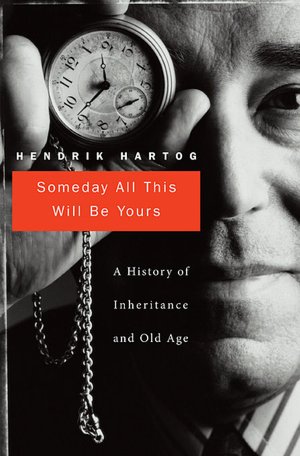
Mayeri on Hartog, "Someday All This Will Be Yours"

Writing for Jotwell, Serena Mayeri (University of Pennsylvania) has reviewed Someday All This Will Be Yours: A History of Inheritance and Old Age (Harvard University Press, 2012), by Hendrik Hartog. Here's the first paragraph:
Modern medicine, the rise of the welfare state, and profound cultural shifts have transformed old age in the industrialized world. Or have they? Hendrik Hartog’s history of inheritance disputes from 1850 to 1950 excavates a world both familiar and foreign.  Then, older people who dreaded loneliness and destitution promised generous bequests of property in exchange for care and solicitude from younger adults. In turn, younger adults sacrificed opportunities—independence, mobility, marriage, fortune-seeking—to remain close to home and to provide arduous and intimate care in the hope of recompense, often in the form of real estate.
Read on here.

Thursday, March 15, 2012

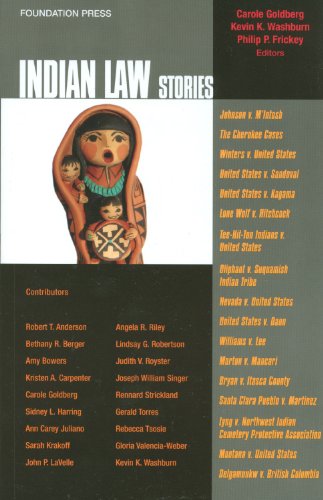
Bowers and Carpenter on The Story of Lyng v. Northwest Indian Cemetery Protective Association

Challenging the Narrative of Conquest: The Story of Lyng v. Northwest Indian Cemetery Protective Association has just been posted on SSRN by Amy Bowers and Kristen A. Carpenter, University of Colorado Law School.  It appears in INDIAN LAW STORIES, Carole Goldberg, Kevin K. Washburn, Philip P. Frickey, eds., Foundation Press, 2011.  Here's the abstract:
In Lyng v. Northwest Indian Cemetery Protection Association (1988), the Supreme Court held that it would not violate the Free Exercise Clause for the U.S. Forest Service to build a road through the “High Country,” an area that is sacred to Yurok, Karuk, and Tolowa Indians living in Northern California and Southern Oregon. Unable to show “coercion” of their religious beliefs, the Indian plaintiffs could not rely on the First Amendment to protect their interests in aboriginal territory now owned by the United States. As Justice O’Connor wrote: ‘‘Whatever rights the Indians may have to the use of the area, those rights do not divest the Government of its right to use what is, after all, its land.’’ Scholars have criticized the case as narrowing individual Free Exercise rights and expanding the government’s property rights, to the detriment of religious freedoms. While Lyng deserves this notoriety, an exclusive focus on defects in the holdings obscures other important dimensions of the case. In particular, the Supreme Court’s opinion comes close to silencing altogether the Indians’ perspective on their sacred High Country. Law and religion scholarship, with few exceptions, also ignores tribal voices both on the religious practices and advocacy strategies that were so key to the Lyng case and its aftermath. Indeed, the Forest Service road was never built and the tribes continue to practice their religions in the High Country.

This article offers a tribally-centered version of Lyng, one that is rarely told, at least outside of tribal communities. Based on interviews with tribal members who participated in the case, as well as interdisciplinary research into the anthropology and religion literature, this is a story of cultural revival fueled by the Indian way of life. It is a story of a community forced to defend itself against the assimilationist agenda of the federal government — and developing a contemporary political identity in the process. It is a story of the inextricable relationship between Indian people and lands, in which the Tribes’ attachment to their sacred sites ultimately triumphed over the Supreme Court’s narrow application of religion and property laws. In the final analysis, we argue, the Indian story of religious and cultural persistence has prevailed over Lyng’s ostensible narrative of conquest. Today, as Lyng’s doctrinal legacy threatens to undermine advances made under the Religious Freedom Restoration Act of 1993, the broader story told here is potentially revealing for everyone concerned with religious liberties in the United States.

Theory and Method in Legal History: A Symposium

Via Al Brophy at the Faculty Lounge, we've learned of the UC Irvine Law Review's recent symposium issue on Theory and Method in Legal History. The collection of legal historians represented here is truly extraordinary. Here are the articles, cribbed directly from Al's post:
Catherine L. Fisk and Robert W. Gordon, Foreword: “Law As . . .”: Theory and Method in Legal History

Steven Wilf, Law/Text/Past
Laura F. Edwards,The Peace: The Meaning and Production of Law in the Post-Revolutionary United States
Kunal M. Parker, Law “In” and “As” History: The Common Law in the American Polity 1790‒1900 
Roger Berkowitz, From Justice to Justification: An Alternative Genealogy of Positive Law
Marianne Constable, Law as Claim to Justice: Legal History and Legal Speech Acts
Christopher W. Schmidt, Conceptions of Law in the Civil Rights Movement
Norman W. Spaulding, The Historical Consciousness of the Resistant Subject
Barbara Young Welke, Owning Hazard, A Tragedy
Peter Goodrich, Specters of Law: Why the History of the Legal Spectacle Has Not Been Written
Shai J. Lavi, Enchanting a Disenchanted Law: On Jewish Ritual and Secular History in Nineteenth-Century Germany
Assaf Likhovski, Chasing Ghosts: On Writing Cultural Histories of Tax Law
John Fabian Witt, The Dismal History of the Laws of War
Paul Frymer, Building an American Empire: Territorial Expansion in the Antebellum Era 
Mariana Valverde, “The Honour of the Crown is at Stake”: Aboriginal Land Claims Litigation and the Epistemology of Sovereignty
Roy Kreitner, Money in the 1890s: The Circulation of Politics, Economics, and Law
Ritu Birla, Law as Economy: Convention, Corporation, Currency
Christopher Tomlins and John Comaroff, “Law As . . .”: Theory and Practice in Legal History

Tomiko Brown-Nagin wins the Bancroft!

photo credit
We are very proud to announce this great news via the New York Times:
The Bancroft Prize, one of the most prestigious annual honors for historians, has been awarded to three scholars for books published last year.

The winners are Anne F. Hyde for “Empires, Nations and Families: A History of the North American West, 1800-1860” (University of Nebraska Press); Daniel T. Rodgers for “Age of Fracture,” an intellectual history of 1970s and 80s America (Belknap Press/Harvard University Press); and Tomiko Brown-Nagin for “Courage to Dissent: Atlanta and the Long History of the Civil Rights Movement” (Oxford University Press).

The prize, which was established in 1948 by the trustees of Columbia University and named for the 19th-century American historian George Bancroft, includes a $10,000 award.
Readers of course know Tomiko well from her thoughtful posts, including the current series of Q&A with Ted White.  We posted about the Courage to Dissent here and here, and Tomiko's own book-related posts are here, here and here.  Congratulations to Tomiko!

Update: UVa's press release is here, HLS's is here

Lindseth Delivers Daimler Lecture on Europe and the Nation State

This semester Peter L. Lindseth, the Olimpiad S. Ioffe Professor of International and Comparative Law at the University of Connecticut School of Law, is the Daimler Fellow at the American Academy in Berlin.  On February 8 he delivered the Daimler Lecture at the Academy, entitled "Power and Legitimacy: Europe and the Nation State."  Professor Lindseth reports that his lecture starts with an overview of his interpretation of “the relationship between democracy and administration in the North Atlantic world in the nineteenth and twentieth centuries.  It then turns to the question of European integration as a concrete example of that relationship.  On the basis of this legal-historical and political-theoretical discussion (the latter including a detour through Lincoln's notion of democracy as ‘government of, by, and for the people’ from the Gettysburg Address)," he concludes with "some thoughts on the Eurozone crisis.”

The link to the Academy’s summary of the lecture and to a recording of the lecture itself is here.

Wednesday, March 14, 2012

Wriggins, "Is the Health Insurance Individual Mandate 'Unprecedented?'"

image credit
New from Jennifer Wriggins (University of Maine): "Is the Health Insurance Individual Mandate 'Unprecedented?': The Case of Auto Insurance Mandates." The article is available here, on SSRN. Here's the abstract:
Opponents of the Patient Protection and Affordable Care Act of 2010 assert that the ‘individual mandate’ is unprecedented, not just in the narrow and obvious sense that the federal government has never before required people to have health insurance, but in a much broader sense as well. They claim government even at the state level has never before required people to insure themselves. This article examines the assertion that the mandate is an unprecedented outlier and a sharp departure from all past government policies. This article finds that the laws in many states require drivers to purchase insurance coverage for their own injuries, that several states’ laws require drivers to buy coverage for their own medical expenses, and that liability insurance mandates protect careless drivers along with their victims. These long-standing individual insurance mandates have been overlooked by both sides in the current debate. As requirements for people to insure themselves, they are clear, powerful precedents for the health insurance individual mandate. If forced to admit that these laws exist, opponents may then claim that driving is a pure choice: If people object to state auto insurance laws, they can simply opt out and choose not to drive, while there is no opt-out from the individual health insurance mandate. The article argues that ‘driving as a pure choice’ is largely illusory and not a sufficient basis on which to argue that these precedents are irrelevant.

Finally, the article turns to the forgotten history of auto insurance mandates, drawing lessons from that history for today’s debate. The history shows first that, leaving aside the Commerce Clause arguments which by definition only apply to the federal government, the arguments used to resist auto insurance mandates were strikingly similar to arguments used to oppose the health insurance individual mandate. Second, courts have consistently recognized a link between insurance and the public welfare justifying regulation in the auto context. Third, governments have recognized for decades that the auto insurance market must be regulated to provide a socially optimal level of coverage, as seen in the U.S. Supreme Court’s 1951 decision upholding a California market regulation law. Finally, state governments have long required people to purchase insurance for themselves from private sellers. The health insurance individual mandate is not different in kind from auto insurance individual mandates but rather extends the idea of insurance mandates to an even more important context.

Ted White Q&A: On Judicial Biography and "Great Man" History (or Not)?

Ted White is perhaps best known as a biographer of esteemed jurists--Marshall, Holmes and Warren.  His book, The American Judicial Tradition: Profiles of Leading American Judges, also is an important contribution to the genres of judicial biography and jurisprudence. Ted's biographical work prompts two questions, one critical of the enterprise and one descriptive. 

When I originally introduced Ted's new book, Law in American History: Volume One, one commentator, a practicing lawyer, responded:
Q: White's bio­graph­i­cal approach to his­tory could eas­ily fall into “great man” his­to­ri­og­ra­phy, despite White’s asser­tion that he advances no such “‘great man’ the­ory” (White 6). But he seeks less to glo­rify indi­vid­ual judges than to use them as a means of “reflect[ing] the gov­ern­ing social and intel­lec­tual assump­tions of var­i­ous peri­ods of American his­tory.

Here is Ted's reply:
A: When I wrote the first edition of The American Judicial Tradition I was conscious of a division in historical literature between "idealist" and "materialist" approaches, as well as criticism of a "great man approach" to history, thought to privilege elites and to give an overly weighted causal status to the actions and beliefs of visible individuals. I didn't want the book to be thought "idealist" or subscribing to a "great man" approach. Nor did I want to write admiring essays on my judicial subjects. I wanted to show why the judges I had chosen had been historically important, but not necessarily to emphasize the intrinsic worth of their contributions. Above all, I wanted to emphasize the human dimensions of my subjects--their personalities and judicial styles as well as their ideas--and to present them as historical figures in an evolving "judicial tradition." I meant "tradition" in the sense of a role that American appellate judges have regularly assumed. I did not mean it the sense of reverence for the past or in the sense of law transcending time.
 Although I have devoted a good deal of my scholarship to the analysis of ideas, legal and otherwise, I believe that there is a sharp distinction between "taking ideas seriously" and endorsing, even implicitly, the ideas one discusses. My goal is to try to recover the ideas that past actors deemed important as part as recovering the way in which the experienced their worlds.
Courtesy Smith College
The second inquiry arises from my own interest in judicial biography. I have begun an effort to add a "grande dame" to the jurists who are a part of the American judicial tradition, and thereby, expand the tradition's scope and character. My exploration of the life and work of Judge Constance Baker Motley (left) is well underway, and already, I find myself swamped with material.  Motley is an alluring subject for legal and judicial biography owing to her three-stage and pioneering career, which produced many records. The judge presided over 2,500 cases while a judge on the federal district court in the Southern District of New York and handled hundreds of cases during her decades-long career as a litigator in the federal courts. What's more, Motley served as Manhattan Borough President and in the New York State Senate. Already drowning in data, I haven't even scratched the surface of  archival material related to the Motley; much more is available. In order to get a handle on all of these sources, I've begun four essential tasks:  creating an organizational scheme and filing system for the research materials; narrowing the scope of the project; defining research questions; and discerning the categories and tools of analysis appropriate to answering the questions posed. I turned to Ted for insights about how he approached some of these tasks.
Q: You have written a number of judicial biographies, all successfully. How did you determine the approach you'd take in writing about  the jurists you chose to study? What factors influenced your decision making about which cases and events to cover?
 A: I think the first point to recognize about judicial subjects for biographies is that in almost all cases the implicit rationale for writing about the subject is that he or she was a judge and made contributions in that capacity. A few judges have dimensions of their careers that make them visible in other respects. Holmes was a legal scholar, the son of a well known writer, a participant in the Civil War, and a contributor to various correspondences (none of which were published during his lifetime). Warren was governor of California and a candidate for the Vice-Presidency. Several others held offices in the government before being appointed, but only very rarely were they highly visible in those capacities. So in the great bulk of cases one needs to start a judicial biography by recognizing that the implicit case for the subject's importance will be centered in a judicial career.
This creates several problems at the outset. I once said in a talk to a group of U.S. courts of appeals judges about judicial biography that a prospective biographer needed to recognize that for most of his or her subject's life, "the judge went to court. The judge heard cases. The judge conferred in the decision of those cases. The judge wrote opinions. The judge went home. How many readers care to hear about that?" It is not going to be life details, in most instances, that makes a judge potentially interesting. It is going to be the subject's work as a judge. So one needs to think about, from the outset, what makes the judicial career of a judge interesting, and how can I convey that to readers?

Even if one's subject might have the promise of being interesting in his or her human dimensions--a potentially remarkable personality or character--there is the problem of acquiring evidence to flesh out those dimensions of a judge's life and career. With both Holmes and Warren I ran up against the practice of confidentiality that affects any efforts to write about judges. Unless a judge consciously makes internal court papers publicly available--extremely unlikely, given the ethos of the judicial profession--a biographer (even, in my instance, a former law clerk to the judge) is just not going to be privy to documents detailing the internal deliberations of courts on which judges serve. Nor is the biographer likely to come upon documents that help identify a judge's motivation in making a decision or choosing an approach in an opinion. Sometimes the occasional letter or internal memorandum surfaces that helps provide some evidence. But that appearance tends to be so scattered that one worries about its causal weight.
Some judicial biographers try to compensate for the paucity of such documents by interviewing law clerks and other persons who were closely connected to a judge's career. I have written (some years ago in the Law Library Journal) about the use of interviews and oral histories. On the whole, I am skeptical about their explanatory value, because one needs to filter out the perspectives of the people being interviewed and somehow control for variations in perspectives. In addition, an effective interview requires that the interviewer either "know," or at least have a hypothesis about, the topics of the interview, and typically biographers don't reach that level of understanding about their subjects until rather late in a biographical project, when the contributions of oral histories may be less important. Nonetheless some oral histories can be extremely valuable reading--I used two of those sources extensively in writing about Warren, and used Katie Louchheim's interviews with some of Holmes's law clerks in writing about Holmes.
So one often falls back on a judge's written product and how it fits into the judge's "life and times." Some judges do a fair amount of extrajudicial writing, which I think is typically very revealing (even if sometimes highly ceremonial). Sometimes judges have relationships with other judges that are worth exploring--Holmes and Taft, Holmes and McKenna, Holmes and Fuller, Holmes and Brandeis; Warren and Frankfurter, Warren and Brennan, Warren and Fortas, Warren and Douglas. The relationships, especially if they change over time (Warren and Frankfurter being a visible example) can be treated as proxies for the state of a judge's approach to judging at particular points in the judge's career.
I could say a lot more, but I'll stop by quickly addressing "cases" and "events" in a judicial career. Each judicial career is unique in some respects, and a primary task for a biographer is to convey that uniqueness. Some cases capture that uniqueness; many do not because of the collegial nature of appellate judging and the constrained nature of district court judging (district court judges, on the whole, need to follow precedent or they take the chance of being reversed on appeal). I wouldn't automatically start by emphasizing a judge's "visible" cases--I would search for "revealing" cases. That search comes from reading and thinking about the judge's opinions as a whole and trying to note identifiable tendencies.

As for "events," in many cases they involve judicial decisions. But sometimes they have independent significance in a general portrait of a judge, and can be quite revealing. Marshall's decisions to draft the writ of error for one side in a case in which he publicly recused himself, or to write anonymous pamphlets responding to pamphlet criticism of decisions he authored. Holmes's writing his diary of the Civil War after he had mustered out. Warren's decision to begin his memoirs with a satiric portrait of Dwight D. Eisenhower. Douglas's successive retelling of incidents in his life in a way that the incidents were less accurately rendered in successive versions.

One needs, in my view, to search for those revealing and idiosyncratic opinions and incidents in a judicial career, rather than emphasizing what others may have thought important.
Readers also will find invaluable commentary about the strengths and limitations of biography for legal historians among these sources: Melvin Urofsky, Beyond the Bottom Line: The Value of Judicial Biography, Journal of Supreme Court History, Vol. 23, Issue 2 (Dec. 1998); "Judging and Personality: What Does a Judge’s Biography Tell Us?," an NYU Forum convened in April, 2010 that featured Joan Biskupic, Jeffrey Rosen, Norman Dorsen, and Barry Friedman; and the New York University Law Review's special issue on Judicial Biography, 70 N.Y.U. L. Rev __ (June 1995).  Of particular note are Judge Posner's takedown of the genre, aptly and simply entitled, "Judicial Biography," 70 N.Y.U. L. Rev. 502, and “The Contracted” Biographies and other Obstacles to “Truth,” 70 N.Y.U. L. Rev. 730, a transcript of a conversation among Gerald Gunther, Barbara Allen Babcock, Morton J. Horwitz, Dennis J. Hutchinson and William E. Nelson. Therein we learn from William Nelson that "Judge Posner is wrong about judges in general!" Also see "Biographies of Titans," 70 N.Y.U. L. Rev. 677, by Ted White, Sarah Barringer Gordon, John T. Noonan, Jr., John Phillip Reid and William E. Nelson.

Ted White Q&A: Orginalism and the Charles River Bridge Case

The exchange between Ted White and Al Brophy on The Marshall Court and Cultural Change has given rise to yet more questions and comments. A frequent blog commentator, Shag from Brookline, posted a question for Ted White in the comments. Shag wondered:                                                

Q: Does the Taney Court's Charles River Bridge case decision square with originalism? (I understand that some scholars consider that CJ Taney's opinion in Dred Scott was an early Court example of originalism.)

Here's Ted's response.

A: I can't think of any scholars who have taken the position (in print) that Taney's opinion in the Charles River Bridge case was an "early example of orginalism." Portions of Taney's opinion in Dred Scott might qualify, at least insofar as he tried to ground the conclusion that African-American slaves or their descendants could not bring suit in the federal courts because African-Americans were thought of as holding "a degraded status" during the framing period, so that the privileges and immunities of "citizens of the United States" in Article IV of the Constitution did not apply to them. But the Charles River Bridge case, by the time it was eventually decided by the Court, was about whether the Contracts Clause of the Constitution implicitly contained the common law principle that a legislature could not take property from A and give it to B without compensation. That was not an "originalist" reading of the Contracts Clause; it was a reading that had been supplied by some early nineteenth-century Contracts Clause decisions of the Court and some commentators, notably Joseph Story, and it rested on something like natural law, "first principles of free republican governments." Taney's opinion rejected that reading, not because of the "original understanding" of the Contracts Clause but on two other grounds: first, contracts should be strictly construed (offered as a common law principle of interpretation), and, second, "improvements" in transportation would be impeded if the franchisees of legislatures could prevent any subsequent competition in a transportation sector, even if such competition was welcomed by subsequent legislatures allegedly representing the public as a whole.

Tuesday, March 13, 2012

Morris Cohen Student Essay Contest

Photo credit
The Legal History and Rare Books Section of the American Association of Law Libraries announces the fourth annual Morris Cohen Student Essay contest. The competition is named in honor of Morris L. Cohen, late Professor Emeritus of Law at Yale Law School. Professor Cohen was a scholar in the fields of legal research, rare books, and historical bibliography. Essays may be on any topic related to legal history, rare law books, or legal archives. Full- and part-time students currently enrolled in accredited graduate programs in library science, law, history, or related fields are encouraged to enter the competition; membership in AALL is not required. The winner will receive a $500.00 prize from Cengage Learning and up to $1,000 for expenses associated with attendance at this year’s AALL Annual Meeting in Boston. The runner-up will have the opportunity to publish the second-place essay in LH&RB's online scholarly journal Unbound: An Annual Review of Legal History and Rare Books. Entries must be submitted by 11:59 p.m., April 15, 2011.

The entry form and instructions are available at the LH&RB website. Please direct questions to Robert Mead or to Marguerite Most.