Saturday, November 16, 2013

Weekend Roundup

  • "What does it mean to lose your citizenship?" Linda Kerber (University of Iowa) asks, in a recent piece in Dissent. "That is what the Dominican Republic has just done, depriving tens of thousands—some estimates run to hundreds of thousands—of their DR nationality, making them stateless in the country of their birth." Read on here. (Hat tip: Mary Dudziak, via twitter)
  • From the Junto: "Some Reflections of a First Time TA, Or, How I Stopped Hating Finance and Learned to Love the Business Major."
  • The Mellon Foundation has funded a new urban humanities initiative, to bring humanities departments and architecture schools in closer conversation. Might legal historians get involved in some way?
    • How to Handle Your Inevitable Rejection: The Vitae Primer - See more at: https://chroniclevitae.com/news/153-how-to-handle-your-inevitable-rejection-the-vitae-primer?cid=VTKT1#sthash.7YP7o3vC.dpuf
       From Vitae, a service of the Chronicle of Higher Education: how to handle the inevitable rejection that comes with job-hunting season.
      How to Handle Your Inevitable Rejection
      How to Handle Your Inevitable Rejection: The Vitae Primer - See more at: https://chroniclevitae.com/news/153-how-to-handle-your-inevitable-rejection-the-vitae-primer?cid=VTKT1#sthash.7YP7o3vC.dpuf
    • Why are people setting fire to libraries? Books&Ideas.net has posted an essay on "social violence and written culture."
      • "A century ago . . . pundits [also] talked about a flight from the humanities toward the hard sciences." Read on at Inside Higher Ed. (Hat tip: Mary Dudziak, via twitter)
      • Via the Chronicle of Higher Education: advice for those just starting out in a Ph.D. program.
      Weekend Roundup is a weekly feature compiled by all the Legal History bloggers.

      Friday, November 15, 2013

      Reinstein on Congress, the President, and the Recognition Power

      Robert Reinstein, Temple University James E. Beasley School of Law, has posted Is the President’s Recognition Power Exclusive? which is forthcoming in the Temple Law Review.  Here is the abstract:
      The power of the United States government to recognize foreign states and governments is much broader than the authority merely to place a symbolic stamp of legitimacy on that state or government. Recognition allows foreign governments to establish diplomatic relations with the United States and also confers other substantial benefits on those governments. Despite its importance to foreign relations, the recognition power was not enumerated in the United States Constitution or discussed in the Constitutional Convention or ratification debates.

      A recent decision of the Court of Appeals for the District of Columbia Circuit, Zivotofsky ex rel. Zivotofsky v. Secretary of State, is the first to hold, in the context of a conflict between an act of Congress and an executive decision, that the recognition of foreign states and governments is an exclusive executive power. A seemingly innocuous passport statute created a conflict between executive and congressional policies over a controversial, and as yet unresolved, political issue: the status of Jerusalem. The court relied on post-ratification history which, it concluded, established that Presidents consistently claimed, and Congress consistently acknowledged, that the recognition power was exclusively an executive prerogative. The passport statute was held to unconstitutionally infringe on the Executive’s recognition power.

      This Article provides the first in-depth analysis of the historical relationship of the executive and legislative branches to the recognition power in nearly a century. The Article examines in detail the post-ratification recognition events discussed by the Court of Appeals, beginning with the decisions of the Washington administration during the Neutrality Crisis in 1792-93. The Article also examines events not addressed by the Court of Appeals, most significantly early congressional acts of recognition and the 1979 Taiwan Relations Act.

      The Article concludes that post-ratification history establishes an authority in the President to recognize foreign states and governments but provides little support for any claim of an exclusive recognition power. However, post-ratification history is not by itself dispositive and the legal importance of the history is examined through the lens of certain fundamental questions, including the significance of presidential and congressional inactions, acquiescence and acknowledgement. The Article analyzes these questions through constitutional doctrine and normative values, ultimately concluding that the constitutional text, original understanding, structure, and post-ratification evidence do not support an exclusive recognition power in the Executive. The President’s recognition power is subject to the legislative control of Congress.

      Tamura on a Japanese American Resister in the Camps

      Eileen H. Tamura, College of Education, University of Hawai'i Manoa, has published In Defense of Justice: Joseph Kurihara and the Japanese American Struggle for Equality (Urbana: University of Illinois Press, 2013).  (It is available here, via Project Muse.)  Here is the press’s description:
      As a leading dissident in the World War II concentration camps for Japanese Americans, the controversial figure Joseph Yoshisuke Kurihara stands out as an icon of Japanese American resistance. In this astute biography, Kurihara's life provides a window into the history of Japanese Americans during the first half of the twentieth century. Born in Hawai'i to Japanese parents who immigrated to work on the sugar plantations, Kurihara Kurihara was transformed by the forced removal and incarceration of ethnic Japanese during World War II. As an inmate at Manzanar in California, Kurihara became one of the leaders of a dissident group within the camp and was implicated in the Manzanar incident, a serious civil disturbance that erupted on December 6, 1942. In 1945, after three years and seven months of incarceration, he renounced his U.S. citizenship and boarded a ship for Japan, never to return to the United States. Shedding light on the turmoil within the camps as well as the sensitive and formerly unspoken issue of citizenship renunciation among Japanese Americans, In Defense of Justice explores one man's struggles with the complexities of loyalty and resistance.

      Hernández on the Abusive Detention of Immigrants, 1933

      Via H-Law, we have word of a session of the Boston Immigration and Urban History Seminar to be held at the Massachusetts Historical Society, 1154 Boylston Street, Boston, on Tuesday, November 26, commencing at 5:15 p.m.  David Hernández, Mount Holyoke College, will speak on "'A Place Reeking with Rottenness': The 'Corpus Christi Situation' (1933) and Legacies of Abusive Immigrant Detention."
       In July 1933, an internal investigation of the Immigration Service in Texas exposed allegations of violence, sexual abuse, extortion, and coerced testimonies taking place at the private immigrant detention facility run by Julia and Olivia Valente. The "Corpus Christi Situation," as it was also known, included collusion with Immigration Service officers as well as sexual impropriety and legal deception. The Valente Detention Home is a scandalous example of detainee abuse at the hands of immigration authorities and their surrogates. It is more importantly part of a legacy of detainee abuse--from denial of legal rights and poor conditions of incarceration to violence, sexual abuse, and death that is widespread in immigrant facilities today. The case of the Valente Detention Home thus provides the operating terms for understanding contemporary detention practices, in particular, the use of private and nonfederal facilities and management for detaining immigrants.
      Daniel Kanstroom, Boston College Law School, will provide a comment.  An  RSVP required, to seminars@masshist.orgmailto:seminars@masshist.org.  Each seminar in this series “consists of a discussion of a pre-circulated paper provided to our subscribers. (Papers will be available at the MHS on the day of the event for those who choose not to subscribe.)  Afterwards the Society will provide a light buffet supper. In case of inclement weather, please phone 617-536-1608 for information.”

      Baldy Fellowships in Interdisciplinary Legal Studies 2014-15

      The Baldy Center for Law & Social Policy at the State University of New York at Buffalo has announced that it will award several fellowships for the academic year 2014-15 "to scholars pursuing important topics in law, legal institutions, and social policy." The Center invites applications "from junior and senior scholars from law, the humanities, and the social sciences." Here's more:
      Fellows are expected to participate regularly in Baldy Center events, but otherwise have no obligations beyond vigorously pursuing their research. Fellows receive standard university research privileges (access to university libraries, high-speed Internet, office space, computer equipment, phone, website space, working paper series,etc.) and are encouraged to develop collaborative research projects with SUNY Buffalo faculty members where appropriate. Those who wish to teach a course to aid their research or gain teaching experience can be accommodated on a case-by-case basis.

      Post-Doctoral Fellowships are available to individuals who have completed the PhD or JD but have not yet begun a tenure track appointment. Post-Doctoral Fellows will receive a stipend of $40,000 and may apply for up to $2000 in professional travel support.

      Mid-Career and Senior Fellowships are available to established scholars who wish to work at the Center, typically during a sabbatical or research leave. Awardees will receive a living expense allowance of $1,500 per month during the period of their residence.

      Application materials include:
      (1) a description of the planned research (question, conceptual framework, method, possible findings,importance to the field),
      (2) a complete academic and professional resume,
      (3) an academic writing sample,
      (4) the names and contact information of three academic references, and
      (5) if mid-career or senior fellow, the time period during which applicant would work at the Center. Applications are due no later than February 3, 2014. (Apply by clicking the button below). For further information, see our answers to frequently asked questions. Additional questions about the Baldy Fellows Program should be addressed to Assistant Director Laura Wirth, baldyassistantdirector@gmail.com or (716) 645-2581.

      The Baldy Center for Law & Social Policy is an endowed, internationally recognized institute that advances interdisciplinary research on law, legal institutions, and social policy at the State University of New York at Buffalo. More than 150 faculty members from numerous SUNY Buffalo departments participate in Baldy Center research, conferences,consortia, and publications. The Center maintains cooperative ties to other research centers and hosts distinguished scholars from around the world as visitors, fellows, speakers, and conference participants. 
      Hat tip: Mary Dudziak, via Twitter

      Thursday, November 14, 2013

      The Feminine Mystique at 50

      On Tuesday, November 19, 2013, at 4:15 PM, in the Knafel Center (formerly Radcliffe Gymnasium), 10 Garden Street, Cambridge, MA 02138, the Radcliffe Institute for Advanced Study will host Fifty Years after The Feminine Mystique: What's Changed at Home and at Work?  According to the announcement:
      Two notable scholars will look back at Betty Friedan's The Feminine Mystique and consider whether movement toward equality has persisted or stalled since the book was published in 1963. What has changed in roles at home and at work? How has law figured in the balance? Do we have new mystiques today?

      The Schlesinger Library on the History of Women in America at the Radcliffe Institute for Advanced Study, which houses the extensive papers of Betty Friedan and the records of the National Organization for Women, is sponsoring this event to mark the 50th anniversary of the publication of The Feminine Mystique.
      Speakers:

      Stephanie Coontz teaches at the Evergreen State College in Olympia, Washington, and serves as the director of research and public education at the Council on Contemporary Families, a nonpartisan association of family researchers and practitioners. Her most recent book is A Strange Stirring: The Feminine Mystique and American Women at the Dawn of the 1960s.

      Ariela Dubler
      , the George Welwood Murray Professor of Legal History at Columbia Law School, writes and teaches in the areas of constitutional law, family law, and legal history. She is currently writing a book, "The Parental Difficulty," about the ways that the law has contributed to our understandings of mothers' and fathers' roles at home and at work.

      Nancy F. Cott,
      the Pforzheimer Family Foundation Director of the Schlesinger Library and the Jonathan Trumbull Professor of History at Harvard, will introduce the event and the panelists.

      An exhibit of selected items from the Friedan papers will be on view in the library during a reception following the speakers' panel. The exhibit, It Changed My Life: The Feminine Mystique at Fifty, emphasizes the writing and reception of The Feminine Mystique, and it also honors the 50th anniversary of the 1963 Report of the President's Commission on the Status of Women.

      This event is free and open to the public. More information here.

      Colley to Lecture on "Written Constitutions and British Worlds"

      On Monday, November 18, 2013, at 4:00 p.m, the Washington History Seminar continues with Linda Colley, Princeton University, speaking on “WordPower: Written Constitutions and British Worlds”:
      The proliferation of new written constitutions after 1787 presented British governments with both opportunities and challenges. By way of its empire and international heft -- and increasingly in order to compete with the United States - the United Kingdom came to draft and influence more constitutions in more parts of the world than any other power. But its official classes have always resisted the introduction of a written constitution in the UK itself. Other peoples might need their political systems set down in writing, it was often argued. Britain did not: and its uncodified constitution was thus a demonstration of its distinctiveness. In this presentation, Linda Colley will explore these trends and tensions over time, and discuss how far writing a constitution might now usefully reconfigure the UK.
      Linda Colley is Shelby M.C. Davis 1958 Professor of History at Princeton University and a Fellow of the British Academy. Her books include Britons: Forging the Nation 1707-1837 (1992) which won the Wolfson prize; Captives: Britain, Empire and the World, 1600-1850 (2002); and The Ordeal of Elizabeth Marsh: A Woman in Global History, named by the New York Times as one of the ten best books of 2007.

      The seminar will take place at the Woodrow Wilson Center, 6th Floor, Moynihan Boardroom, Ronald Reagan Building, Federal Triangle Metro Stop.  Reservations requested because of limited seating: mbarber@historians.org or 202-450-3209.  A photo ID required for admittance to the building.

      The seminar, which meets weekly during the academic year, is sponsored jointly by the National History Center of the American Historical Association and the Wilson Center, with support from the Society for Historians of American Foreign Relations.  Schedule, webcasts and podcasts here.

      Cromwell Research Grants Announced

      Via H-Law, we have word of the eight recipients of research grants awarded by the William Nelson Cromwell Foundation in conjunction with a committee of the American Society for Legal History.  They are:

      Michael Caires, PhD Candidate, History, Univ. of Virginia, "The Greenback Union: Creating the American Monetary Union in the Civil War and Reconstruction"

      Sara Damiano, PhD Candidate, History, Johns Hopkins University, "Gender, Law, and the Culture of Credit in New England, 1730-1790"

      Matthew Axtell, JD, Univ. of Virginia; PhD Candidate, History, Princeton University, “American Steamboat Gothic: Commercial Law, Mercantile Property, and Slavery's Liquidation in the Inland River West, 1818-1868"

      Jeremy Kessler, JD, Yale University; PhD candidate, History, Yale, "The Civil Libertarian State: Conscription and Conscientious Objection in American Law, 1917-1973"

      Sarah Seo, JD, Columbia University; PhD Candidate, History, Princeton University, "The Fourth Amendment, Cars, and Freedom in Twentieth-Century America"

      Michael Schoeppner
      , PhD, Univ. of Florida; former ACLS post-doctoral fellow, California Institute of Technology; Visiting Assistant Prof. of History, University of Maine, “Moral Contagions: Black Atlantic Sailors, Citizenship, and Quarantine in the Antebellum South"

      Jameson R. Sweet, PhD Candidate, History, Univ. of Minnesota, "The Mixed-Blood Moment: Land, Indian Law, and Race among Dakota Mixed-Bloods in Nineteenth-Century Minnesota"

      Kellen Funk, Joint candidate for the JD, Yale University, and PhD, Princeton University, "The Lawyers' Code: The Transformation of Legal Practice in Nineteenth-Century America"

      Rights and Rites in Medieval English Law

      [We are very grateful to Ryan Greenwood, the 2013/14 Rare Book Fellow at the Lilllian Goldman Law Library, Yale Law School, for this report on a session at the recently concluded ASLH meeting.]

      One of the excellent, though somewhat lower-profile sessions at the recent conference of the American Society for Legal History was “Rights and Rites in Medieval English Law,” which drew together promising new work in medieval English legal history.

      Thomas McSweeney, College of William and Mary, presented "The King's Courts and the King's Soul: Pardoning as Almsgiving in Medieval England," a thirteenth-century case study involving a wealthy widow's amercement, or fine, and subsequent royal pardon.  McSweeney offered a compelling argument that the widow Sibilla was pardoned because of her role in a familiar set piece of the medieval moral economy: the act of giving alms to the poor (pauperes), and the corresponding spiritual benefits which accrued to the giver for doing so.  The material beneficiary, blighted by poverty on earth but preferred spiritually to the rich, would in return for alms pray for the soul of the wealthy donor, if not also the heirs.  Pardons of this kind from monarchs were not uncommon, McSweeney argued; and although Sibilla was rich, as a widow she was classed on a Biblical typology among the powerless, and so was a candidate for King Henry's alms and pardon.  A key legal question was why royal justices would yield to the king's personal interests and grant pardons as alms, during a period in which justices began to recognize a first allegiance to the law, as an impersonal body of rules, rather than to the personal lawgiving capacities or prerogatives of their monarch.  In closing, McSweeney indicated that Sibilla's case may show some of the complexity of royal justice during a long period of transition.

      Joshua Tate, Southern Methodist University, gave his paper, "Episcopal Power and Royal Jurisdiction in Angevin England," which tied in well with another aspect of royal justice in a complex and tumultuous period.  Tate presented entries in a bishop's register as evidence of King John's broad intervention in cases of patrons' rights to present candidates for ecclesiastical benefices.  Bishops, although they had ample backing in canon law and the procedural rules to claim authority in disputes over patrons' rights, largely capitulated to John's efforts to enforce royal prerogative in judging the disputes, and saw the king intervene actively and to some extent personally in them.  In the diocese of Lincoln, Tate noted a drop in cases involving patronage disputes by the end of John's reign, and increased ambiguity over whether the bishop had made an inquisition of the candidate, and to whom the advowson, or right of presentation, belonged.  Tate's evidence was consistent with the thesis that some bishops had ceded powers to John in this regard, and to new mechanisms of royal justice.  Lincoln was also a particularly good case study, since a creature of John, Hugh of Wells, had been installed there as bishop, succeeding a saintly predecessor more disposed to uphold ecclesiastical rights and procedure. 

      Ryan Rowberry, Georgia State University, in "Purging Pluralist Judges in the King's Courts: Dissemination and Enforcement of Pope John XXII's Execrabilis (1317) in England," gave an interesting account of a key shift in medieval English legal history.  Like Tate, Rowberry threw into relief new legislation and practice that led to changes in the administration of English law, here in the fourteenth century.  Rowberry explained why royal justices may have in part transitioned, in the first quarter of the fourteenth century, from clerics to laymen, arguing that the reform-minded Pope John XXII's 1317 decree, Execrabilis, helped motivate the change.  The decree forbade the holding of a plurality of benefices, a common practice which gave the absentee holder the revenue of each of a series of church properties.  Rowberry offered the careers of two wealthy royal justices, who resigned at least some of their benefices after 1317, as evidence: though their religious and secular patrons continued to support them, and were surely interested to see them in influential judicial positions, the surrender of some benefices may well reflect the impact of Execrabilis relatively quickly after its promulgation, and may have contributed to the exit of clerical judges from royal courts. 

      Charles Donohue, Jr., Harvard University, offered comment and critique focusing on the details of the evidence and recommended, in a typical plea among medievalists, that wider examination of the historical sources might be useful before any broad conclusions should be drawn.  He suggested that Sibilla may have been pardoned because an earlier settlement of her case was botched through no fault of her own, and that the differences in the register of Hugh of Wells might be explained by the different scribes as much as the politics surrounding the entry of new candidates for office.  In response to Rowberry's paper, he noted that clerics could still receive pensions as justices, and that the decisive moment in a longer period of transition between clerical and lay justices may have been the 1340s.  But these possibilities were open to further consideration as well, and Donohue played devil's advocate to papers whose merits he happily conceded, particularly for the value of their new approaches, and the headway they made on important issues. 
          
      Sara McDougall, CUNY/John Jay College of Criminal Justice, chaired the panel and generously guided a very good, thought-provoking discussion.

      CFP: White Collar Crime in History

      [We have the following Call for Papers for a conference on Shady Business: White Collar Crime in History at the German Historical Institute, Washington, DC, September 18-20, 2014.  The conveners are Edward Balleisen (History Department /Kenan Institute for Ethics, Duke University), Hartmut Berghoff (German Historical Institute, Washington, DC), and Christopher McKenna (Said Business School, University of Oxford).]

      Daniel Defoe observed in the early 18th century that "[e]very degree of business" has "its invitation to do evil." Today, hardly a day passes without the media reporting on new allegations and legal proceedings relating to supposed professional misconduct on the part of corporate executives. The large-scale deployment of police and public prosecutors to conduct searches of company headquarters; judicial bodies cooperating transnationally to expose criminal practices; media reports on the arrest of managers and court proceedings that echo around the globe: all of these things are presently the order of the day.

      After the big scandals of the early 2000s (Enron, WorldCom, Parmalat), the laws against economic crimes were tightened considerably and offenses were prosecuted more aggressively, at least in some economic sectors. The US led this trend and also claimed a global jurisdiction in many cases. Other countries followed this effort to punish white-collar crime more severely. Breaking the rules can now result in draconian punishments-up to the point of endangering the very existence of the companies implicated or threatening the livelihood of the involved persons. Despite this threat, some people and companies still take on the risk of committing such crimes. This raises many questions. What economic, company-related, and social conditions encourage this behavior? What accounts for the apparent increase of white collar crime in some areas and its decline in others?  What background information sheds light on it? What motivates those who engage in such crimes?

      Wednesday, November 13, 2013

      New ASLH Initiatives To Support Early Career Scholars

      At this past meeting of the American Society for Legal History, the Board approved a series of measures aimed at supporting early career scholars. Guest blogger Sally Gordon (of our occasional advice column Ms. Peppercorn Considers) has put together the following update, which includes information on how to apply for funding for future projects of this nature:
      Notes from the ASLH Meeting, Miami, 7 – 10 November.

      At the annual meeting of the Society, the Board approved several grants to new initiatives as well as ongoing projects. The Committee on Projects and Proposals recommended several proposals to the Executive Committee and the Board, which meets annually on the Thursday evening before the start of the conference.

      The Society is particularly interested in programs that promote the work of junior scholars. Examples of activities funded by the board this year include:


      1. A pre-conference program for graduate students on Thursday before the 2014 conference (to be held in Denver, November 6 – 9), organized by John Wertheimer of Davidson College.

      2. A two-day conference to be held at the University of Minnesota in June, 2014, on the Law of the Child, 1400-2000. The conference website and call for papers can be found here. The conference will be cosponsored by a consortium that includes the University of Minnesota Law School and History Department, University of Michigan Law School, University of Illinois Law School, Indiana University Maurer School of Law, University of Chicago Law School, and University of Pennsylvania Law School.

      3. Financial support for graduate student/foreign scholar/independent scholar travel to the 2014 annual meeting.

      4. Funding for a second “Workshop on ‘Underexplored’ Areas of Legal History before the 2014 Annual Meeting in Denver

      5. Support for travel and other expenses related to a May, 2014 workshop to be held in Chicago where the editors of a new edition of Blackstone’s Commentaries on the Laws of England will hold an editorial conference.

      6. The History of the Society Committee received support for filming and transcribing oral histories.

      More information will be posted on the ASLH website shortly.

      Members of the Society may apply for funding for future projects, which will be acted on at the November 2014 meeting. Applications should be submitted by September 1st. The application form will be available on the Society's website soon. If you need an application form immediately you may either contact the ASLH Treasurer, Craig Klafter or Rayman Solomon.

      Researching State Legislative Records: The Biggest Obstacle in American Legal History

      The biggest obstacle to writing American legal history, in my view, is the dearth and inaccessibility of records of state legislative deliberations.  Certainly before the twentieth century, and arguably up to the present day, the bulk of American governance has been at the state level, and yet for the entirety of the 1800s and most of the 1900s, there are no records at all of the floor debates in nearly all the state legislatures, nor are the records much more substantial when it comes to other legislative proceedings, such as committee deliberations and reports.  Congress has the Annals, the Register of Debates, the Globe, and the Record, not to mention the Serial Set and shelves of published hearings; the British Parliament has Hansard and the Parliamentary Papers; but New York, Massachusetts, Illinois, Virginia, California, Texas, and nearly all the other states -- from the 1800s up till about the 1960s -- have nothing remotely equivalent.  And what they do have isn’t digitized or, if digitized, isn’t typically assembled in convenient online repositories like ProQuest Congressional. 

      In this post, I will discuss the sources that do exist for state legislative history in the period circa 1789-1960 and strategies for using these important but challenging sources:
       

      Reid Book Award to Witt, "Lincoln's Code"

      Via H-Law, we have more awards news: the winner of the 2013 John Phillip Reid Book Award for the best book in Anglo-American legal history by a senior scholar went to John Fabian Witt (Yale Law School) for Lincoln’s Code: The Laws of War in American History. Earlier this year the book received the 2013 Bancroft Prize.

      The citation reads as follows:
      John Fabian Witt’s broadly resonant and illuminating Lincoln’s Code: The Laws of War in American History demonstrates that Americans’ efforts to balance the competing goals of justice and humanitarianism are historically enmeshed with the struggle over slavery. Integrating comprehensive synthesis with careful archival research, Witt challenges reigning assumptions about the laws of war in American history. Slavery’s defenders used humanitarian laws of war to justify human bondage, Witt reveals, while Lincoln’s pursuit of justice led him to rewrite them to justify total war in the name of military necessity, fully realized in the devastation of the Civil War as well as in slavery’s end. Witt shows how Francis Lieber’s resulting Code, designed to legitimate the war on slavery, shaped the international law of armed conflict for generations to come, including by authorizing while also containing America’s imperial turn. The book is notable for advancing public understanding in addition to historical scholarship. Relevant and readable, it seeks to sweep away the “dangerous fictions” that have informed contemporary debate. In their place, it offers “ugly complexities” that might serve as a “useful source of moral engagement” in future conflicts. Witt’s book captures the complications and tensions inherent in setting boundaries to violence while, at the same time, insisting upon the need to grapple with these vexing moral and legal questions.
      The members of this year's John Phillip Reid Book Award Committee were:
      Sophia Z. Lee, University of Pennsylvania (Chair)
      Catharine MacMillan, Queen Mary School of Law
      Richard Ross, University of Illinois 
      Laura Weinrib, University of Chicago
      Steven Wilf, University of Connecticut
      Congratulations to John Witt!

      Hirota Wins Cromwell Dissertation Prize

      Via H-Law we have word that the William Nelson Cromwell Foundation, acting in conjunction with the American Society for Legal History, has awarded its prize for the best dissertation written in 2012 to Hidetaka Hirota, for “Nativism, Citizenship, and the Deportation of Paupers in Massachusetts, 1837-1883.”  Here is the citation:
      In this strikingly original transnational history, Hidaka Hirota debunks the popular myth that the United States once welcomed with open borders the world’s “huddled masses.” Blending political, legal, social, and cultural history, Hirota’s artful narrative analyzes the evolution of Massachusetts’ pauper deportation laws to demonstrate how state governments actively restricted immigration long before the Chinese Exclusion Act and other federal measures.  In the process, he provides illuminating insights into the origins of anti-Irish prejudice, the contours of nativist Know-Nothing politics, and changing conceptions of citizenship during the Civil War Era.  In recreating the migration experience of paupers from Ireland, their expulsion from the United States, and their post-deportation experiences back home, Hirota places the Massachusetts story within a wider system of pauper restriction and forcible removal operating in the Atlantic World.
      The members of the Cromwell Prize Subcommittee: Dissertation Prize were
      Christian G. Fritz, University of New Mexico (Chair)
      Joanna L. Grisinger, Northwestern University
      Maeva Marcus, Institute for Constitutional History, New York Historical Society, and George Washington University Law School
      Michael Ross, University of Maryland

      Tuesday, November 12, 2013

      Up in Arms: The Second Amendment in the Modern Republic

      [We were alerted to this symposium by Legal Scholarship Blog.  While we're at it, we'll note the publication of The Second Amendment on Trial: Critical Essays on District of Columbia v. Heller, ed. Saul Cornell and Nathan Kozuskanich (Amherst: University of Massachusetts Press, 2013), even though its authors and editors apparently have had nothing to do with the Connecticut Law Review's symposium.  The volume "brings together some of the best scholarship on the Heller case, with essays by legal scholars and historians representing a range of ideological viewpoints and applying different interpretive frameworks,” including, in addition to the editors, Nelson Lund, Joyce Lee Malcolm, Jack Rakove, Reva B. Siegel, Cass R. Sunstein, Kevin M. Sweeney, and J. Harvie Wilkinson III.]


      “A well-regulated Militia, being necessary to the security of a free State, the right of the people to keep and bear Arms, shall not be infringed.”
      — U.S. Const. amend. II

      At the time this language was ratified in 1791, it was relatively uncontroversial. Over two centuries later, however, the debate over the regulation of firearms is in full force in our halls of government. The Supreme Court in 2008 sought to define the scope of gun rights in its landmark Heller decision by looking to the original intent of its drafters, but since that time recent tragedies across the nation have breathed new life into this issue as courts and elected officials struggle with the various competing policy considerations in an effort to set forth a workable solution that protects the rights of law-abiding individuals while simultaneously protecting the public at large.

      Volume 46 of the Connecticut Law Review is proud to present its 2013 Symposium, Up in Arms: The Second Amendment in the Modern Republic, on November 15. Esteemed scholars and practitioners from across the country will explore the history of the Second Amendment, current legal trends in the area of gun rights, recent legislative initiatives, litigation of gun control cases, the intersection with mental health concerns, and other facets of the larger discussion. By bringing leading voices together on this timely matter, the Connecticut Law Review hopes that a robust exchange of ideas will encourage policymakers everywhere to engage in a meaningful dialogue over where to go from the senseless events of recent years.

      Keynote Address: Richard M. Aborn, President of the Citizens Crime Commission of New York City

      Distinguished Participants:
      Madelon Baranoski PhD, MSN, Yale University School of Medicine, Law and Psychiatry Division
      Josh Blackman, South Texas College of Law
      J. Richard Broughton, University of Detroit Mercy School of Law
      Clayton E. Cramer, College of Western Idaho
      Linda Frisman PhD, University of Connecticut School of Social Work
      David T. Hardy, attorney and author
      Peter Kochenburger, University of Connecticut School of Law
      Patrick A. Luff, Sandra Day O’Connor College of Law, Arizona State University
      George A. Mocsary, Southern Illinois Univerisity School of Law
      Michael A. Norko MD, MAR, Yale University School of Medicine, Law and Psychiatry Division; Director of Forensic Services, CT Department of Mental Health and Addiction Services
      Michael P. O’Shea, Oklahoma City University School of Law
      Maura Murphy-Osborne, Assistant Attorney General, CT Office of the Attorney General
      Mary Margaret “Meg” Penrose, Texas A&M University School of Law
      Fredrick Vars, University of Alabama School of Law

      Please join us November 15 in this important conversation.

      General questions should be directed to (860) 570-5331. If you require reasonable accommodations for a disability, please contact Jane Thierfeld Brown at (860) 570-5132 at least two weeks in advance.

      Australian and New Zealand Legal History Conference 2013

      [In the program of the ASLH's annual meeting, we spotted the following announcement of the Australian New Zealand Law and History Conference for 2013, to take place November 25-27 at the University of Otago, in Dunedin, Aotearoa/New Zealand.  Its theme is “People, Power and Place.”  According to the announcement, all are welcome!]


      With the generous support of the New Zealand Law Foundation, this conference provides an opportunity to come together, share and be inspired about global, international comparative, national and local ideas of the role of law in configuring historical understandings of people, power and place. This will be an exciting and notable interdisciplinary conference for all persons interested in the connections between law and history. A must attend event in the special place of Dunedin – home to Aotearoa New Zealand’s oldest university, the University of Otago, the stunning new Toitu- Otago Settlers Museum, and the much loved Hocken Collections. The University of Otago Faculty of Law and Department of History & Art History look forward to hosting you in November 2013.

      We are excited and honoured to confirm our following keynote speakers:

      Professor Lauren Benton, Affiliate Professor of Law, Professor of History and Dean of Graduate School of Arts and Science at New York University: “Modalities of British Protection in the Early Nineteenth Century World”

      The Hon Justice Stephen Kós, High Court, Wellington: “The enduring constitutional significance of Fitzgerald v Muldoon [1976] 2 NZLR 615 (NZHC)”

      Chief Judge Wilson Isaac, Chief Judge of the Maori Land Court and Chairperson of the Waitangi Tribunal, Aotearoa New Zealand: “Exploring the past, present and future of New Zealand’s two unique legal institutions: the Maori Land Court and the Waitangi Tribunal”

      Professor Tony Ballantyne, Professor of History, Dean of the Department of History and Art History, and Director of the Research Centre for Colonial Cultures at the University of Otago, Aotearoa New Zealand: “‘Waste’ and ‘Improvement’: People, Power and Place in Colonial Otago”

      Professor Jeremy Finn, Professor of Law at the University of Canterbury, Aotearoa New Zealand: “Lawyers, ‘Place’ and Power”

      Dr Lisa Ford, Senior Lecturer, School of Humanities, University of New South Wales, Australia: “Commissioning Global Order: Commissions of Enquiry and the Reconstitution of the British Empire, 1800-1840"

      Dr Mark Hickford, Legal Advisor, Prime Minister's Policy Advisory Group, Department of the Prime Minister and Cabinet; Crown Counsel at the Crown Law Office: “An Empire of Variations: Problems of Settlement and the Property Rights of Indigenous Populations”

      Exchange Panels at ASLH

      One very interesting feature of the program at the just-concluded annual meeting of the American Society for Legal History was the inclusion of more "exchange panels" from the ASLH's counterparts in other countries and regions.  The Israeli History and Law Association panel was "The Americans Are Coming: On Americans' Involvement with Post-Independence Israeli Legislation."  The Australia and New Zealand Law and History Society panel was "Meetings and Encounters: Papers from the Australia New Zealand Society for Law and History."  The European Society for Comparative Legal History panel was "Entangled Legal Histories: Following Threads between Europe and the United States."  We'll update with summaries when and if they are submitted.

      Cromwell Article Prize to Justin Driver


      Here's another award from this year's ASLH meeting: The Cromwell Article Prize, given by the William Nelson Cromwell Foundation for "the best article in American legal history published by an early career scholar." This year's award went to Justin Driver (University of Texas, Austin) for “The Constitutional Conservatism of the Warren Court." The article appeared in Volume 100 of the California Law Review (2012). The citation reads:
      During deliberations committee members repeatedly praised the beauty of language and sweep of interpretation in Driver’s reassessment of the Warren Court.  The article presented in broad and persuasive terms the counter-intuitive principle that the Warren Court was not so much radically liberal as it was – in many instances – conservative.  We were impressed with Driver’s contextualization of Warren Court decisions that highlights their unexpected conservatism, his emphasis of the operation of historical contingency in the development of Supreme Court jurisprudence, and his complication of the longstanding binary interpretation of the Warren Court.  He highlights how these historical misperceptions continue to inform contemporary attitudes towards the possibilities of constitutional interpretation and perhaps falsely limit approaches to argumentation before the Supreme Court.  Finally, he offers a programmatic sort of inspiration for what the Supreme Court can actually achieve given cultural and legal limitations.  “The Constitutional Conservatism of the Warren Court” has particular value in its sophisticated approach towards the applications of history.  This is not an attempt to ascertain some sort of original meaning of legislation or jurisprudence; nor does it simply mobilize historical “facts” in service of a contemporary interpretation or agenda.  Rather, the article serves as an extended meditation on historical contingency, on the relative significance of choice and chance in history, and brilliantly achieves one of the greatest contributions the study of history can offer:  the elucidation of the nature and extent of our own choices.
      Hat tip: H-Law
      The members of the Cromwell Article Prize Committee were:
      Alfred Brophy, University of North Carolina School of Law (Chair)
      Mary Sarah Bilder, Boston College
      Daniel W. Hamilton, University of Illinois 
      Kristin A. Olbertson, Alma College
       Congratulations to Justin Driver!

      Weinrib Wins Surrency Prize

      Via H-Law, we have the citation for the ASLH’s 2013 Surrency Prize, which was awarded to Laura M. Weinrib, University of Chicago Law School, for her essay, “The Sex Side of Civil Liberties: United States v. Dennett and the Changing Face of Free Speech,” which appeared was a cowinner of the Preyer Award in 2007 and appeared in Law and History Review 30 (2012): 325-386.  Here is the citation:
      Mary Ware Dennett, 1913 (Credit: LC)
      "The Changing Face of Free Speech” uses the ACLU deliberations and litigation around the 1930 case of U.S. v. Dennett, involving Post Office censorship of birth control literature and materials, to open a window and shine a bright light on a variety of key issues beyond the evolution of American free-speech doctrine.  Marshaling a broad range of primary and secondary sources, and writing with both verve and empathetic respect, Weinrib captures and explicates the tension between what we would today call “social democracy” and “social liberalism.”  Weinrib shows the reader how – in a manner redolent of contemporary rights conflicts—very political commitments to social and economic transformation were themselves transformed, with and without intent and through sincere concerns with liberty and freedom, into political and cultural commitments to free expression and individual self-development. This shift in commitments changed not just the ACLU and its legal engagements but rather, alas, much of the agenda of progressive America to this very day.
      The prize, named in honor of Erwin C. Surrency, a founding member and first president of the American Society for Legal History, is awarded for the best article published in Law and History Review the previous year.

      Monday, November 11, 2013

      Sir John Baker Wins Sutherland Prize

      Sir John H. Baker (wikimedia)
      Via H-Law, we have news of that the winner of the American Society for Legal History’s 2013 Sutherland Prize is Sir John Baker, “Deeds Speak Louder Than Words: Covenants and the Law of Proof, 1290-1321,” in Laws, Lawyers and Texts: Studies in Medieval Legal History in Honour of Paul Brand, ed. Susanne Jenks, Jonathan Rose and Christopher Whittick (2012).  The prize, named in honor of the late Donald W. Sutherland, a distinguished historian of the law of medieval England and a mentor of many students, is awarded annually to the person or persons who wrote the best article on English legal history published in the previous year.

      Murphy Award to Hidetaka Hirota and Laura Weinrib

      Among the prizes awarded at the annual meeting of the ASLH was the Paul Murphy Award, which "support[s] the completion of a book on the history of civil liberties that addresses any topic or any time in American history." This is the second and final year in which the award will be given.  (The first Murphy award went to Sam Lebovic for Beyond the First Amendment: The Problem of Press Freedom in the American Century.)

      About the award:
      The award honors Paul L. Murphy (1923-1997), who spent much of his career at the University of Minnesota where he rose to the rank of Regent's Professor of History and American Studies. At the time of his death, he was in the second year of his term as president of the ASLH. During his tenure at Minnesota he became one of the nation's leading constitutional historians and a mentor to generations of undergraduate and graduate students. Among his most important books were: The Meaning of Freedom of Speech: First Amendment Freedoms from Wilson to FDR (1972); World War I and the Origin of Civil Liberties in the United States (1979); and Historic Background of the Bill of Rights, Vol. 1 (1990). In addition, civil liberties played a fundamental role in the argument he developed in what was likely his most influential book, The Constitution in Crisis Times 1918-1969 (The New American Nation Series, 1972). Murphy's commitment to civil liberties and his passion for the subject was evident in his deeds as well as his words. He was an ardent and committed member of the American Civil Liberties Union throughout his life. For additional information on Murphy please see the tribute to him in the Law and History Review, 16 (Spring 1998), ix-xi. 
      This year the prize was awarded to two recipients: Hidetaka Hirota and Laura Weinrib. Hirota recently received his Ph.D. from Boston College and currently has a Society of Fellows in the Humanities post-doc position at Columbia University. Weinrib is an assistant professor at the University of Chicago Law School.   The award citations are as follows:

      Hidetaka Hirota (credit)
      In Expelling the Poor: Atlantic Seaboard States and the Origins of American Immigration Policy, Hidetaka Hirota uncovers a history of the violation of civil liberties in American immigration policy in the nineteenth century. He locates the roots of U.S. immigration restriction in nativism and economics of nineteenth century New York and Massachusetts. These states prohibited the landing of foreigners who were poor.  Driven by anti-Irish sentiment, Massachusetts went beyond exclusion, and deported indigents. Although these policies applied to foreigners, the state also deported some U.S. citizens of Irish descent.  Anti-Irish deportation policies in the northeast, he argues, helped lay the foundation for later restrictions on Chinese immigration. Hirota examines this history through extensive and ambitious archival research using the archives of asylums and almshouses in the US and immigration papers in the Public Records Office of Northern Ireland and other archives  This is a transnational history, following paupers deported first by American states, and then by Britain, only to find themselves threatened again with deportation from Ireland. His beautifully written narrative tells the stories of individual American citizens wrongfully deported because of poverty or disability. This compelling and ambitious work sheds new light on the meanings of citizenship and the nature of rights in nineteenth century America.

      Laura Weinrib (credit)
      Laura Weinrib’s book project, The Taming of Free Speech, promises to enrich and complicate our understanding of the contested meaning of free speech after World War I through the 1930s. Weinrib reveals how a freedom originally rooted in a commitment to protecting labor radicalism and worker agitation became a value-neutral shield against government infringement of individual rights.  Paying particular attention to the early records of the American Civil Liberties Union and its predecessors, Weinrib uncovers conflicts, compromises, and unexpected convergences between state-centered progressive reformers and conservative legalists who contested the meaning of free speech in the 1920s and 1930s. Weinrib foregrounds the role of New Deal federal labor policy in divorcing the civil liberties agenda from redistributive goals and recasting free speech as a right enforceable in court and accessible to proponents of all political persuasions. Weinrib’s insightful and deeply researched study promises to be a brilliant contribution to the history of civil liberties. 
       
      Mary L. Dudziak, Chair, Emory University
      Robert Kaczorowski, Fordham University
      Serena Mayeri, University of Pennsylvania
      David Rabban, University of Texas, Austin

      Congratulations to Hidetaka Hirota and Laura Weinrib!

      Yoo on Lincoln at War

      John Yoo, University of California at Berkeley School of Law, has posted Lincoln at War, which is forthcoming in the Vermont Law Review 38 (2013).  Here is the abstract:    
      Credit: LC
      This year presents an opportune moment to reexamine President Abraham Lincoln’s approach to executive power. This year’s 150th Civil War anniversaries are inextricably tied to Lincoln’s exercise of his office. The Emancipation Proclamation and the Gettysburg Address drew deeply on Lincoln’s broad vision of the President’s commander-in-chief and executive powers in wartime. A century-and-a-half later, our political system continues to struggle over the constitutional questions that vexed Lincoln. Just as Lincoln had to navigate conflicts between the executive and legislative powers to win the Civil War, President Obama and his immediate predecessors have confronted the same questions in fighting a very different conflict today.

      Lincoln laid the foundations of his Presidency on a vigorous and dynamic view of his right to advance an alternative vision of the Constitution. If Lincoln and the Republican Party had accepted the supremacy of the judiciary’s interpretation of the Constitution, Dred Scott would have foreclosed their core position that the federal government should stop the spread of slavery. Likewise, Lincoln’s Presidency could not have achieved its successes without a proactive exercise of his constitutional powers. A passive attitude that conceded to Congress the leading role in setting policy, or one that waited on the Supreme Court to decide matters, would have led to a sundered nation or military disaster. Lincoln became America’s savior because he preserved the Union, freed the slaves, and launched a new birth of freedom. He set in motion a political, social, and economic revolution, but one that had the conservative goal of restoring the nation’s constitutional system of government. He could have achieved none of this without a broad vision of his office.

      ASLH Roundup: Environmental Legal History

      Over at Environment, Law, and History, David Schorr has posted a report of the environment-related papers he was able to see.

      If you're aware of other ASLH coverage on the web, send it our way! In the meantime, we'll keep posting about awards & fellowships (check out recent awards posts here and here).

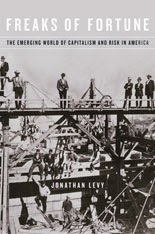
      Cromwell Book Award to Levy for "Freaks of Fortune"

      At last week's annual meeting of the American Society for Legal History, it was announced that the book prize annually awarded by the William Nelson Cromwell Foundation in consultation with a committee of the ASLH went to Jonathan Levy, Princeton University, for Freaks of Fortune: The Emerging World of Capitalism and Risk in America (Harvard University Press, 2012).  The citation reads as follows:
      In this beautifully written, thoroughly researched, and consistently engaging book, Jonathan Levy brilliantly illuminates an abiding concern of American legal historians, the rise of liberal individualism, by treating the nineteenth-century United States as an era in the history of risk.  In Freaks of Fortune, “the release of individual creative energy” that James Willard Hurst identified as a fundamental goal of the age becomes the freeing of individuals to run their own risks.  With Levy’s help, we now see that one of “the conditions of freedom in the nineteenth-century United States” was the ability of individuals to offload their risks onto newly created systems of insurance and finance.  With a wonderful balance of analysis and detail, Levy reveals, as he puts it, “the crucial role of the law in setting the working rules of risk.”  Law allocated the risk of workplace injury to employees and declared when rebellion by seaborne slaves became an insurable peril.  It allowed financial intermediaries to funnel the savings of freedmen and -women to a transcontinental railroad and to package homesteaders’ mortgages into bonds for public sale.  It legitimated futures trading and ultimately set limits on what financiers could do with “other people’s money.”  This stunning book opens new fields of inquiry for legal historians and provides an invaluable perspective on current struggles to reconcile law and financial risk.
      In commenting on Matthew Axtell's paper at the Preyer Award panel, Barbara Welke also noted the importance of Levy's book for legal historians.

      Citron on Stevens as "The Last Common Law Justice"

      Rodger D. Citron (Touro College - Jacob D. Fuchsberg Law Center) has posted "The Last Common Law Justice: The Personal Jurisdiction Jurisprudence of Justice John Paul Stevens." It appeared in the Volume 88 of the University of Detroit Mercy Law Review (2011). Here's the abstract:
      When Justice John Paul Stevens announced his retirement from the Supreme Court in April 2010, the news was accompanied by the inevitable counting of votes on the Supreme Court. The conventional wisdom was that Stevens's retirement meant the departure of the most senior liberal Justice from the Court and that his successor would not substantially change the political orientation of the conservative Court led by Chief Justice John Roberts. The focus on the political implications of Stevens's retirement obscured a significant aspect of his retirement: the loss of the Supreme Court's preeminent common law lawyer.
      The full article is available here, at SSRN. (Hat tip: Legal Theory Blog)

      Sunday, November 10, 2013

      Preyer Award to Matthew Axtell, Elizabeth Papp Kamali

      We're just back from the annual meeting of the American Society for Legal History and delighted to begin announcing the winners of the annual prizes and fellowship awards. I'll start with one of my favorites: the Kathryn T. Preyer Scholar Award.

      About the award:
      Named after the late Kathryn T. Preyer, a distinguished historian of the law of early America known for her generosity to young legal historians, the program of Kathryn T. Preyer Scholars is designed to help legal historians at the beginning of their careers. At the annual meeting of the Society two younger legal historians designated Kathryn T. Preyer Scholars will present what would normally be their first papers to the Society
      This year's winners are Matthew A. Axtell, for the paper "Customs of the River: Governing the Commons within a Nineteenth-Century Steamboat Economy," and Elizabeth Papp Kamali, for the paper "A Felonious State of Mind: Felony and Mens Rea in Medieval England."

      Matthew A. Axtell is a Samuel I. Golieb Fellow in Legal History at New York University School of Law and a Ph.D. candidate at Princeton University. He received his J.D. from University of Virginia School of Law in 2002. He is currently working on a dissertation titled "American Steamboat Gothic: Law, Commerce, and Collective Action in the U.S. Aquatic West, 1818-1868" (Hendrik Hartog, Chair).

      Elizabeth Papp Kamali is a Ph.D. candidate at the University of Michigan. She received her J.D. from Harvard Law School in 2007. She is working on a dissertation titled "A Felonious State of Mind: Mens Rea in 13th- and 14th-Century England" (Thomas A. Green and Charles Donahue, Jr., co-chairs).

      Axtell and Kamali presented their papers on Friday at the Kathryn T. Preyer Prize Panel and received generous comments from Barbara Welke (University of Minnesota) and Karl Shoemaker (University of Wisconsin). Gautham Rao (American University) chaired the panel.

      The 2013 competition for Preyer Scholars was organized by the Society's Kathryn T. Preyer Memorial Committee:
      Gautham Rao, Chair, American University
      Sally Hadden, Western Michigan University
      Christopher W. Schmidt, Chicago-Kent College of Law
      Michael A. Schoeppner, California Institute of Technology
      Karen Tani, University of California, Berkeley
      Congratulations to the winners!

      Sunday Book Roundup

      Here's some light reading for all those who are making their way back home from the ASLH Conference.
      • Also, for those of you keeping up with the JFK anniversary, Salon has responded to the many stories and book reviews about JFK in a piece here.

      Saturday, November 9, 2013

      Weekend Roundup

      • The Law and History Review is kind of a big deal, according to Google Scholar.
      •  From History News Network: "the best of web commentary" on Veterans Day.
      • Via the the Canadian Legal History Blog (which is now on twitter): an announcement that Shared Paths: Western’s Journal of Interdisciplinary History is currently accepting submissions from Graduate and Professional students for its inaugural issue.
      Weekend Roundup is a weekly feature compiled by all the Legal History bloggers.

      Friday, November 8, 2013

      New Release: Wilson, "The Street Politics of Abortion"

      New from Stanford University Press: The Street Politics of Abortion: Speech, Violence, and America's Culture Wars, by Joshua C. Wilson (University of Denver). The Press explains:
      The U.S. Supreme Court decision in Roe v. Wade stands as a historic victory for abortion-rights activists. But rather than serving as the coda to what had been a comparatively low-profile social conflict, the decision mobilized a wave of anti-abortion protests and ignited a heated struggle that continues to this day. 
      Picking up the story in the contentious decades that followed Roe, The Street Politics of Abortion is the first book to consider the rise and fall of clinic-front protests through the 1980s and 1990s, the most visible and contentious period in U.S. reproductive politics. Joshua Wilson considers how street level protests lead to three seminal Court decisions—Planned Parenthood v. Williams, Schenck v. Pro-Choice Network of Western N.Y., and Hill v. Colorado. The eventual demise of street protests via these cases taught anti-abortion activists the value of incremental institutional strategies that could produce concrete policy gains without drawing the public's attention. Activists on both sides ultimately moved—often literally—from the streets to fight in state legislative halls and courtrooms.
      At its core, the story of clinic-front protests is the story of the Christian Right's mercurial assent as a force in American politics. As the conflict moved from the street, to the courts, and eventually to legislative halls, the competing sides came to rely on a network of lawyers and professionals to champion their causes. New Christian Right institutions—including Pat Robertson's American Center for Law and Justice and the Regent University Law School, and Jerry Falwell's Liberty University School of Law—trained elite activists for their "front line" battles in government. Wilson demonstrates how the abortion-rights movement, despite its initial success with Roe, has since faced continuous challenges and difficulties, while the anti-abortion movement continues to gain strength in spite of its losses.

      Vandevelde on the History of International Investment Agreements

      Kenneth J. Vandevelde, Thomas Jefferson School of Law, has posted A Brief History of International Investment Agreements, which appeared in the U.C. Davis Journal of International Law & Policy 12 (2005): 157.  Here is the abstract:    
      One of the most remarkable phenomena in international law during the past fifteen years has been the extraordinary increase in the number of agreements concluded relating to the protection or liberalization of foreign investment. More than 2500 such agreements now exist, with the great majority having been concluded since 1990. This number includes almost 2400 bilateral investment treaties (BITs) as well as more than 200 trade agreements that contain investment provisions. Although the number of agreements has accelerated remarkably in recent years, international agreements relating to investment have a long history. Provisions relating to the protection of property abroad may be found in international agreements dating back to the late Eighteenth Century.

      This essay traces the history of these international investment agreements. It finds that the history thus far comprises three separate eras. The first, the Colonial Era, began in the late Eighteenth Century and continued until the end of the Second World War. The second, the Post-Colonial Era, began with the end of the war and continued until approximately 1990, with the collapse of the Soviet Union. The third, the Global Era, began in approximately 1990 and continues until the present.

      Thursday, November 7, 2013

      Law, Order, and Trade in Medieval English Towns

      Charles Angelucci, Harvard University, Department of Economics, and Simone Meraglia, University of Toulouse 1 - Toulouse School of Economics (TSE); New York University (NYU), have posted Trade, Self-Governance, and the Provision of Law and Order, with an Application to Medieval English Chartered Towns.  Here is the abstract:    
      We build a model to investigate the interaction between trade, the supply of law and order, and the nature of governing political institutions. To supply law and order necessary for a representative merchant to create wealth, a ruler (i) appoints officials capable of coercion and (ii) introduces a system of taxation. When potential gains from trade are important, the demand for law and order is high but appointing numerous officials capable of coercion may pave the way to arbitrary and distortive expropriation. Delegating the task of appointing officials to the better-informed merchant lowers the cost of sustaining good market institutions, but exacerbates the latter's temptation to escape taxation. When gains from trade are instead low delegation never occurs. Our theory provides a rationale for the case of post-Norman Conquest England (1066-1307) where, in parallel with the rise of trade, kings increasingly give in to the citizens' desire of self-governance by granting Charters of Liberties.

      Gerber on Colonial Rhode Island's "Lively Experiment"

      Scott D. Gerber, Ohio Northern University Pettit College of Law, has posted Law and the Lively Experiment in Colonial Rhode Island, which is forthcoming in the British Journal of American Legal Studies 453 2 (2013): 453.  Here is the abstract:

      Historians of the law of colonial America long have appreciated that each colony must be examined individually. For example, George Lee Haskins wrote in the Preface to his classic book Law and Authority in Early Massachusetts (1960) that “it is essential that the character and growth of the several colonial legal systems be studied individually and be separately described,” and Richard B. Morris opined in the Foreword to George Athan Billias’s groundbreaking collection Law & Authority in Colonial America (1965) that “no monolithic interpretation will suffice to explain the course and reception of the law in America — whether we are dealing with seventeenth-century seaboard colonies as disparate as Puritan Massachusetts and the plantation colonies of Maryland and Virginia, or the later western territories.”

      The instant article — the first in a series of case studies on law and the animating principles of each of the original British American colonies — explores the relationship between the animating principle of colonial Rhode Island and the colony’s laws. A perusal of the compacts of Rhode Island’s original four towns, of the Patent for Providence Plantations of 1643/4, and of the Charter of Rhode Island and Providence Plantations of 1663 leaves no doubt about the colony’s foundational commitment to religious liberty. However, an investigation of the legal history of colonial Rhode Island reveals a number of inconsistencies in the implementation of that animating principle, especially with respect to the law’s treatment of Catholics, Jews, and Quakers. The article concludes by reconciling those inconsistencies through a famous parable authored by Rhode Island’s founder, Roger Williams.

      See You in Miami

      Your Legal History Bloggers will be in transit today and in the flesh at the annual meeting of the American Society for Legal History for the remainder of the week.  Please do say hello if you see us there; we're always interested in suggestions for the Blog.  We've banked some posts for while we're away, but we may be delayed in responding to your emails.  Finally, although I am not myself a Twitter fiend, I'm sure some of us will be checking to see how we're experiencing the meeting in real time.  #ASLH2013