Thursday, August 14, 2014

Gordon on the First Justice Marshall and the Chinese Cases

James Wice Gordon, Western New England University School of Law, has posted Was the First Justice Harlan Anti-Chinese? which appears in the Western New England Law Review 36 (2014): 287-370.  Here is the abstract:
John Marshall Harlan (LC)
The first Justice John Marshall Harlan has long been recognized as a defender of Black civil rights. Yet some scholars challenge Harlan’s egalitarian reputation by arguing that he was anti-Chinese. In this Article, the Author discusses the evidence which has been offered to support the claim that Harlan was anti-Chinese and offers additional evidence never before presented to argue against this hypothesis. Harlan’s critics have assembled some evidence in a way that suggests Harlan had an anti-Chinese bias. The Author suggests that the evidence is ambiguous and that it can be assembled to produce a different picture from the one Harlan’s critics create. The Author also argues that Harlan’s critics give insufficient weight to the fact that, sitting as a judge, Harlan was often constrained in his decision-making by stare decisis and his conception of the judicial role. The issues presented by the Chinese cases should be viewed in the context of their time and understood not as abstract statements of the Justices’ personal beliefs but as a series of discrete judicial problems presented to the Court for decision. When one examines both the context and the details of the cases, the picture of Harlan that emerges is more nuanced than his critics have suggested.

Ross and Stern on Notions of Legal Pluralism in Early Modern Europe

Richard J. Ross, University of Illinois College of Law and Department of History, and Philip J. Stern, Duke University History Department, have posted Reconstructing Early Modern Notions of Legal Pluralism, which appeared in Legal Pluralism and Empires, 1500-1850, ed. Lauren Benton and Richard J. Ross (New York: New York University Press, 2013), 109-41.  Here is the abstract:
Legal pluralism occurs when two or more legal orders exert control within a given territory or over a particular social group and yet are not part of a single hierarchical “system” under a coordinating authority. Most historical scholarship on legal pluralism concentrates on its shifting structures in local contexts and on its political and economic implications. By contrast, our essay probes historical actors’ uses of political and religious thought to justify or undermine plural legal regimes in the late sixteenth through early eighteenth centuries. Historians of early modern political thought preoccupied with the rise of the modern state have lavished attention on ‘centralizing’ discourses, particularly theorists such as Bodin, Hobbes, and Pufendorf represented as champions of sovereignty. Against this tendency, we emphasize how ideological support for plural legal orders could be found in a wide range of intellectual projects. These ranged from debates over the right of resistance and the divine right of rulers, through historical work on the ancient Jewish commonwealth and theological disputes over which precepts “bound conscience,” and finally to writings on political economy and the place of family.

Social scientific and jurisprudential work on legal pluralism has focused a set of canonical problems. Should we focus on jurisdictional or normative accounts of pluralism? How can we distinguish the “legal” from the “non-legal,” a dispute that centers on whether to include in pluralist models the norms of families and civil society organizations? How can we model the complex dialectic relation of state and nonstate systems of order? To the extent that this work relies on a historical account spanning the sixteenth through eighteenth centuries, it assumes that a once rich medieval legal pluralism withered as European statebuilding consolidated crown control of law with the ideological support of theories of sovereignty. The intellectual foundation for — if not the practice of — legal centralism arose in this period. The frequent invocation of Bodin, Suarez, Grotius, Hobbes, and Pufendorf as the founding theorists of sovereignty and legal centralism creates the impression that pluralistic thinking was impoverished or on the wane. The central ambition of our article is to provide an alternative historical genealogy for legal scholars of pluralism. Workaday legal pluralism did not struggle against a predominantly hostile intellectual climate. Many discourses supported pluralism. And the most emphatic theorists of a powerful singular sovereign were often responding to intellectual projects that valorized pluralism.

Wednesday, August 13, 2014

Call for Submissions: The Socio-Legal Review

The Socio-Legal Review welcomes contributions for its eleventh volume to be released in 2015.

The Socio-Legal Review (SLR) is a student-edited, peer-reviewed interdisciplinary journal published by the Law and Society Committee of the National Law School of India University, Bangalore. SLR aims to be a forum that involves, promotes and engages students and scholars to express and share their ideas and opinions on themes and methodologies relating to the interface of law and society. The Journal thus features guest articles by eminent scholars as well as student essays, providing an interface for the two communities to interact. From 2012, SLR has become a biannual publication from an annual publication.

The Journal subscribes to an expansive view on the interpretation of "law and society" thereby keeping its criteria for contributions simply that of high academic merit, as long as there is a perceivable link. This would include not just writing about the role played by law in social change, or the role played by social dynamics in the formulation and implementation of law, but also writing that simply takes cognizance of legal institutions/institutions of governance/administration, power structures in social commentary, and so on. Through this effort, the Journal also hopes to fill the lacunae relating to academic debate on socio-legal matters among law students.

SLR has been listed in the Directory of Open Access Journals and has been uploaded on Westlaw and HeinOnline. It was supported by the Modern Law Review for three years since its inception.

[Submission guidelines after the jump.]

Call for Applications: UC Irvine Seeks To Hire Assistant Prof. in 20th-C. U.S. History

Via H-Law, we have the following job posting:
The History Department at the University of California, Irvine, seeks to hire a tenure-track assistant professor in 20th-century United States history whose research focuses on political economy, intellectual history, and/or legal history. We are especially interested in applicants who complement our departmental strengths in gender, transnational, race/ethnicity, and world history. We will give priority to applicants who can contribute both to our graduate program and to all levels of our undergraduate curriculum.

Candidates should submit a letter of application that describes research and teaching interests; a statement addressing how past and/or potential contributions to diversity, equity and inclusion will advance UC Irvine's commitment to inclusive excellence; a current CV; a writing sample not to exceed 50 pages; and 3 letters of recommendation. Applications should be submitted electronically at: https://recruit.ap.uci.edu/apply/JPF02425.
To ensure full consideration, applications need to be submitted by October 1, 2014.

Direct questions about the electronic submission procedure to Marcus Kanda (mhkanda@uci.edu) and any other questions about the search to Search Committee chair, David Igler (digler@uci.edu).

The University of California, Irvine is an Equal Opportunity/Affirmative Action Employer advancing inclusive excellence. All qualified applicants will receive consideration for employment without regard to race, color, religion, sex, national origin, disability, age, protected veteran status, or other protected categories covered by the UC nondiscrimination policy.

To learn more about the Department, visit our website at http://www.humanities.uci.edu/history/.

New Release: Friedman, "Citizenship in Cold War America"

New from the University of Massachusetts Press: Citizenship in Cold War America: The National Security State and the Possibilities of Dissent, by Andrea Friedman (Washington University, St. Louis). The Press explains:
In the wake of 9/11, many Americans have deplored the dangers to liberty posed by a growing surveillance state. In this book, Andrea Friedman moves beyond the standard security/liberty dichotomy, weaving together often forgotten episodes of early Cold War history to reveal how the obsession with national security enabled dissent and fostered new imaginings of democracy.

The stories told here capture a wide-ranging debate about the workings of the national security state and the meaning of American citizenship. Some of the participants in this debate—women like war bride Ellen Knauff and Pentagon employee Annie Lee Moss—were able to make their own experiences compelling examples of the threats posed by the national security regime. Others, such as Ruth Reynolds and Lolita Lebrón, who advocated an end to American empire in Puerto Rico, or the psychiatrist Fredric Wertham, who sought to change the very definition of national security, were less successful. Together, however, they exposed the gap between democratic ideals and government policies.

Friedman traverses immigration law and loyalty boards, popular culture and theoretical treatises, U.S. court-rooms and Puerto Rican jails, to demonstrate how Cold War repression made visible in new ways the unevenness and limitations of American citizenship. Highlighting the ways that race and gender shaped critiques and defenses of the national security regime, she offers new insight into the contradictions of Cold War political culture.
Reviewer Laura McEnaney writes:
"This is a very polished, well-argued book that draws on a deep reservoir of archival materials. . . . The marvelous diversity of the case studies reinforces the main theme, which is that the Cold War consensus was not as solid as we have thought—or have been led to believe by previous scholarship. . . . Friedman’s manuscript is a rumination on cold war citizenship, but it leads us to reconsider all moments in American history—well beyond her chronology here—in which citizenship was contested (and when wasn’t it, frankly?). The episodes Friedman uncovers are absolutely crucial civics lessons that should enter the mainstream of our teaching on the postwar/cold war years."
More information, including the TOC, is available here.

Tuesday, August 12, 2014

Desai, "What a History of Tax Withholding Tells Us About the Relationship between Statutes and Constitutional Law"

Anuj C. Desai (University of Wisconsin Law School) has posted "What a History of Tax Withholding Tells Us About the Relationship between Statutes and Constitutional Law," Northwestern University Law Review, Vol. 108, No. 3 (2014). Here's the abstract:
In this Article, I explain what a seemingly obscure statute, the Current Tax Payment Act of 1943, can tell us about the relationship between statutes and constitutional law. I use William Eskridge and John Ferejohn’s notion of a “superstatute” as a lens through which to view this relationship. A “superstatute,” in Eskridge and Ferejohn’s conception, is a statute that has small “c” constitutional emanations, emanations that both affect interpretations of the large “C” Constitution and are entrenched against subsequent legislative change. To better understand the precise contours of the notion of a superstatute, I look at the Current Tax Payment Act of 1943, which instituted the system of federal tax withholding for wage income. I describe the history of federal income tax withholding leading up to the passage of that Act, explaining in turn how that history sheds light on the underlying notion of a superstatute.
Full text is available here.
 

Kawaguchi's Readings on Dodge v. Ford Motor Company

Credit: LC
Linda Kawaguchi, Chapman University Fowler School of Law, has posted the introduction to a collection of readings on Dodge v. Ford Motor Company that appear in the Chapman Law Review 17 (2014).  Her introduction commences:
Original documents in historic cases provide a uniquely valuable perspective on the cases themselves and the surrounding circumstances and history that contribute to the development of legal principles. Understanding that access to historical materials can be difficult, the Chapman Law Review has endeavored to collect source documents regarding the case of Dodge v. Ford Motor Co. After a short introduction to this compilation, including a discussion of research methodologies, several key historical documents are reproduced . . . .

Monday, August 11, 2014

Duve on German Legal History

Thomas Duve, Max Planck Institute for European Legal History, has posted German Legal History: National Traditions and Transnational Perspectives, which is to appear in Rechtsgeschichte–Legal History 22 (2014).  Here is the abstract:   
In this article, I review select institutional and analytical traditions of Legal History in 20th century Germany, in order to put forth some recommendations for the future development of our discipline. A careful examination of the evolution of Legal History in Germany in the last twenty-five years, in particular, reveals radical transformations in the research framework: within the study of law, there has been a shift in the internal reference points for Legal History. While the discipline is opening up to new understandings of law and to its neighboring disciplines, its institutional position at the law departments has become precarious. Research funding is being allocated in new ways and the German academic system is witnessing ever more internal differentiation. Internationally, German contributions and analytic traditions are receiving less attention and are being marginalized as new regions enter into a global dialogue on law and its history. The German tradition of research in Legal History had for long been setting benchmarks internationally; now it has to reflect upon and react to new global knowledge systems that have emerged in light of the digital revolution and the transnationalization of legal and academic systems. If legal historians in Germany accept the challenge these changing conditions pose, thrilling new intellectual and also institutional opportunities emerge. Especially the transnationalization of law and the need for a transnational legal scholarship offers fascinating perspectives for Legal History
Hat tip: Juris Diversitas

New Release: Shulman, "The Constitutional Parent"

New from Yale University Press: The Constitutional Parent: Rights, Responsibilities, and the Enfranchisement of the Child (2014), by Jeffrey Shulman (Georgetown University Law Center). Here's a description from the Press:
In this bold and timely work, law professor Jeffrey Shulman argues that the United States Constitution does not protect a fundamental right to parent. Based on a rigorous reconsideration of the historical record, Shulman challenges the notion, held by academics and the general public alike, that parental rights have a long-standing legal pedigree. What is deeply rooted in our legal tradition and social conscience, Shulman demonstrates, is the idea that the state entrusts parents with custody of the child, and it does so only as long as parents meet their fiduciary duty to serve the developmental needs of the child.

Shulman’s illuminating account of American legal history is of more than academic interest.  If once again we treat parenting as a delegated responsibility—as a sacred trust, not a sacred right—we will not all reach the same legal prescriptions, but we might be more willing to consider how time-honored principles of family law can effectively accommodate the evolving interests of parent, child, and state. 
A few blurbs:
"This book is a watershed moment in the trajectory of scholarship on parents’ rights, and the state’s obligations, over and toward the education and well-being of children.  It is a brilliant book in several respects: it is at once rigorous and intellectual, but also passionate, intense, and central to the well-being of our polity."—Robin West

"The Constitutional Parent combines rich historical and normative analysis in novel ways to mount a compelling critique of prevailing assumptions about parental entitlement to control children's lives. It is a fascinating read."—James Dwyer
Excerpts of the book, along with the TOC, are available here.

Sunday, August 10, 2014

Sunday Book Roundup

To follow up on last week's post, here's a few more posts on the Nixon tapes, all at The Daily Beast. There's an interview with Ken Hughes, author of Chasing Shadows: The Nixon Tapes, the Chennault Affair, and the Origins of Watergate (University of Virginia Press). White House counsel and author of The Nixon Defense (Viking Adult), John Dean is interviewed, as well. And, Douglas Brinkley talks to The Daily Beast  about The Nixon Tapes: 1971-1972 (Houghton Mifflin Harcourt), which he co-edited with Luke Nichter. 

The New York Times follows up on the debates inspired by Rick Perlstein's The Invisible Bridge (Simon & Schuster), which was also heavily covered in the reviews last week.

Suspicion Nation: The Inside Story of the Trayvon Martin Injustice and Why We Continue to Repeat It (Counterpoint) by Lisa Bloom is reviewed in the Los Angeles Review of Books.
"In Suspicion Nation, best-selling author Lisa Bloom has written two books and put them under one cover. The first book is a dissection of the Trayvon Martin case with a highly critical analysis of the prosecution’s presentation in People v. George Zimmerman. The second book is Bloom’s thoughts on hot-button issues, from gun control to the role of race in our criminal justice system. While Bloom may have intended for her examination of the Zimmerman prosecution to be the primary focus of her book, she really just uses it as a vehicle to share her opinions on a wider range of issues confronting the legal system today."

 Up on H-Net is a review of Robert B. Rakove's Kennedy, Johnson, and the Nonaligned World (Cambridge University Press).
"The central historical problem that Robert B. Rakove sets out to solve in Kennedy, Johnson, and the Nonaligned World is how to explain the remarkable transformation in the relationship between the United States and much of the postcolonial world over the course of the 1960s."
Also on H-Net is a review of The State Trial of Doctor Henry Sacheverell (Wiley-Blackwell) by Brian Cowan, and a review of Noriko Aso's Public Properties: Museums in Imperial Japan (Duke University Press).

Gavin Wright's Sharing the Prize: The Economics of the Civil Rights Revolution in the American South (Belknap Press) is reviewed on HNN.
"Granting that the movement was “a moral and legal revolution,” (2) Wright asks the provocative and important question whether it can be declared an economic one as well. Now that enough time has passed to allow for both sufficient historical distance and the accumulation of enough relevant data, he is able to argue convincingly that the “record shows strong gains…for African Americans in the South—relative to earlier levels, relative to southern whites, and relative to national standards.” (26) To those who do not specialize in economic analysis or the history of the Civil Rights Movement, this point might seem fairly obvious: It would seem difficult to argue that blacks’ economic situation has not improved since the days of Jim Crow. But to emphasize that point is to commit the fallacy–so often warned against by economists–of confusing correlation with causation. The fact that African Americans have enjoyed economic improvement since segregation does not necessarily mean that they have done so because ofthe Civil Rights Movement.
But Wright believes that the movement was the primary catalyst for these changes, and one of the major purposes of his book is to contest two alternative explanations for this improvement."
The Federal Lawyer has a couple of reviews to note as well. Nicholas R. Parrillo's Against the Profit Motive: The Salary Revolution in American Government, 1780-1940 (Yale University Press) is reviewed online, here. There's more of the publication's reviews available here, including The Forgotten Presidents: Their Untold Constitutional Legacy by Michael J. Gerhardt (Oxford University Press).

Saturday, August 9, 2014

Tomlins on the Law of Slavery in Virginia, 1829-1832

Christopher Lawrence Tomlins, University of California, Berkeley, Jurisprudence and Social Policy Program, has posted Revulsions of Capital: The Political Law of Slavery in the Epoch of the Turner Rebellion, Virginia 1829-1832.  Here is the abstract:
This paper continues the pattern of work I have been pursuing on the Turner Rebellion, a slave rebellion that took place in Virginia in August 1831. During the past two years I have been engaged in preliminary explorations of different aspects of the rebellion that have resulted in a series of working papers, written to teach myself what I don’t know, and what I should. This paper was written for the same purpose; it differs from prior papers in stepping back from the rebellion itself in order to situate it in Virginia’s constitutional history, and in regard to the debate over gradual emancipation that broke out in its aftermath. Essentially, Virginia in the epoch of the Turner Rebellion is a state divided largely on east-west lines. Slavery dominates east of the Blue Ridge in the long-settled Tidewater and Piedmont; the west (particularly the Trans-Allegheny region that would eventually become the state of West Virginia) is much more recently settled and largely slave-free. This division, together with less marked local slaveholder/non-slaveholder and freeholder/non-freeholder distinctions in the east of the state, largely determines the substance and structure of Virginia’s politics. I consider two “phases” of Virginia’s politics: (1) the Constitutional Convention of 1829-1830, in which Eastern and Western delegates fought over the replacement of county-based apportionment and suffrage that privileged freehold in land by white basis apportionment and white manhood suffrage, and (2) the emancipation debate that took place in 1831-32 during the first session of the state legislature to meet following the Turner Rebellion. I also consider the analysis of the emancipation debate written in 1832 by the William & Mary professor of “political law” Thomas Roderick Dew, Review of the Debate in the Virginia Legislature of 1831 and 1832. I argue that out of the deep divisions exposed by the constitutional and legislative debates there emerged a new political and economic equilibrium, confirmed in Dew’s analysis, and centered not, as before, upon propertied hierarchy but upon property’s commodification, notably commodified labor. In the case of self-possessed white labor, commodification meant increased circulation. The same was true of enslaved labor, with the important qualification that slaves had no control over how far they were circulated. Slavery became transactional – the price of subsistence. Their commodification meant slaves were no longer harnessed to custom (in the shape of common law property claims), or to positive municipal law, or to paternal stewardship, but instead represented a capital investment on which the master-creditor might realize returns either through work, or, just as rationally, sale into the interstate slave trade. The paper concludes with a short analysis of Virginia’s contribution to that trade before and after the Turner Rebellion.

Weekend Roundup

    • Via The Junto: Advice on running social media feeds for historical organizations and history departments. (Takeaway: your department should really be tweeting about your accomplishments!)
    • Have you registered for ASLH 2014 in Denver yet?  (Hotel information will be sent to registrants automatically upon completing the registration process.  If  the hotel's website claims it is fully booked, try calling.)  The opening reception is in the Colorado Supreme Court from 4-6pm on Thursday, November 6.
    Weekend Roundup is a weekly feature compiled by all the Legal History bloggers.

    Friday, August 8, 2014

    Salmon P. Chase and the Republican Constitution

    Salmon P. Chase (LC)
    On December 5-6, 2014, the Center for the Constitution at the Georgetown University Law Center will host a lecture and symposium to commemorate the 150th anniversary of Salmon P. Chase’s appointment as Chief Justice of the United States.  The Center’s inaugural Distinguished Lecture, “Freedom National, Slavery Local: The Antislavery Constitutionalism of Salmon P. Chase,” will be delivered on December 5 by James Oakes, Distinguished Professor of History at the Graduate Center of the City University of New York.  The lecture is co-sponsored of the Supreme Court Historical Society and is open to its members and the general public.  (Details to follow, here and, next month, on the SCHS's website.)  The colloquium, “Salmon P. Chase and the Republican Constitution,” is by invitation only and will be held on December 6.  Its four sessions will address the following topics:
    1. Chase, The Antislavery Lawyer, covering his constitutional challenges to the  Fugitive Slave Act in the In re Matilda and Jones v. Van Zandt cases;
    2. Chase, The Antislavery Political Organizer, covering his role in founding and developing the constitutional platforms of the Free soil, Liberty and Republican parties;
    3. Chase, The Antislavery Public Official, discussing his contributions as a U.S. Senator from Ohio, Governor of Ohio, and Treasury Secretary in Lincoln’s cabinet;
    4. Chase, The Reconstruction Chief Justice, discussing some of his decisions, such as Texas v. White and the Legal Tender Cases, as well as his dissenting vote in Bradwell v. Illinois and his role in presiding over the impeachment trial of President Andrew Johnson.

    Vandevelde's History of Thomas Jefferson School of Law

    As the writer of about two thirds of a history of the Georgetown University Law Center, I’m always
    Mirror, Mirror, off the Wall?
    interested when other scholars take on the history of their own institutions.  Now comes Kenneth J. Vandevelde, who has posted Chapter 2 of his History of the Thomas Jefferson School of Law (California Press, 2013).  Here is the abstract:
    A History of the Thomas Jefferson School of Law is the story of the radical transformation of a San Diego law school during the final decades of the twentieth century, a story that is told in the context of larger changes occurring in American legal education in those years. The author served as dean of the law school from 1994 to 2005.

    The Thomas Jefferson School of Law was founded in 1969 as the San Diego branch campus of Western State University College of Law (WSU), a for-profit, non-ABA-accredited Orange County law school that primarily served part-time evening students. The law school was proud of educating working adults and produced some outstanding alumni, but its attrition rates ranged between 50 and 75 percent and its pass rate on the California bar exam sometimes fell below 25 percent.

    In a half dozen years during the 1990s, the law school experienced a rebirth. It separated from WSU, adopted a new name, became the first for-profit law school to gain ABA accreditation, and became the first and only ABA-approved law school to convert from a for-profit to a nonprofit institution. Admissions applications soared more than ten-fold, resulting in a nationally based student body second in California only to Stanford’s for its geographic diversity. The law school’s academic dismissal rate dropped to around 5 percent and its California bar pass rate climbed above 75 percent. The law school was ranked 5th in the nation for the quality of academic life and 55th among law schools worldwide for the number of its faculty publications downloaded from SSRN. Its legal writing program was ranked in the top 20 nationally.

    Chapter Two of the book, posted here for free download on SSRN, offers a very candid portrayal of the law school in its early history, capturing the culture of a new state-accredited, part-time law school in Southern California in the early 1970s struggling to bolster its academic program, its reputation, and its revenue. Later chapters describe the impact of rapidly declining applications for admission to law schools nationally during the 1980s, the historic challenges to the ABA’s accreditation standards, WSU’s disastrous application for ABA approval in the late 1980s, and the renaissance on the San Diego campus that began in the early 1990s, culminating in a complete transformation of the institution in less than a decade.

    The published version of the book contains approximately 80 photographs depicting key individuals, places and events in the history of the law school.

    Thursday, August 7, 2014

    Lawson Reviews Hamburger; Roberts Reviews Ernst

    Gary Lawson, Boston University School of Law, has posted a review of Philip Hamburger’s Is Administrative Law Unlawful?, The Return of the King: The Unsavory Origins of Administrative Law, which is forthcoming in the Texas Law Review.  Here is the abstract:
    Philip Hamburger’s Is Administrative Law Unlawful? is a truly brilliant and important book. In a prodigious feat of scholarship, Professor Hamburger uncovers the British and civil law antecedents of modern American administrative law, showing that contemporary administrative law “is really just the most recent manifestation of a recurring problem.” That problem is the problem of power: its temptations, its dangers, and its tendency to corrupt. Administrative law, far from being a distinctive product of modernity, is thus the “contemporary expression of the old tendency toward absolute power – toward consolidated power outside and above the law.” It represents precisely the forms of governmental action that constitutionalism – both in general and as specifically manifested in the United States Constitution – was designed to prevent. Accordingly, virtually every aspect of modern administrative law directly challenges the Constitution.

    This extraordinary book will be immensely valuable to anyone interested in public law. My comments here concern two relatively minor points that call for more clarification. First, Professor Hamburger does not clearly identify what it means for administrative law to be “unlawful.” Does that mean “in violation of the written Constitution”? “In violation of unwritten constitutional norms?” In violation of natural law”? There is evidence that Professor Hamburger means something more than the former, but it is not clear what more is intended. In order to gauge the real status of administrative law, we must have a more direct conception of law than Professor Hamburger provides.

    Second, much of Professor Hamburger’s historical and constitutional analysis focuses on the subdelegation of legislative authority. While his discussion contains numerous profound insights, including some that require correction in my own prior scholarship on the subject, it does not discuss how to distinguish interpretation by judicial and executive actors from lawmaking by those actors. Presumably, the prohibition on subdelegation of legislative authority prohibits only the latter. Figuring out where interpretation ends and lawmaking begins is one of the most difficult questions in all of jurisprudence, and I am not convinced that Professor Hamburger can successfully perform an end-run around it.

    But these are modest nitpicks about a path-breaking work that should keep people of all different persuasions engaged and occupied for quite some time.
    And Alasdair S. Roberts, Suffolk University Law School, has posted his review, forthcoming in Public Administration Review, of my Tocqueville's Nightmare:
    Modern introductions to administrative law can be dry and technical, because they must account for decades of modern statute and case law. By contrast, Tocqueville's Nightmare illustrates why it all matters. It shows vividly what was perceived to be at stake as the United States entered the age of regulation, and describes the fundamental ways in which law was adjusted to meet the new realities of government.

    Foreign Relations History Online

    Years in the making, the website of the Society for Historians of American Foreign Relations (SHAFR) is now on line, with many resources of interest to legal historians.  For example, its news feed recently included the post was Human Rights Activism and the End of the Cold War: A Transnational History of the Helsinki Network.

    OAH Awards and Prizes: Oct. 1 Deadline

    Have you recently completed a dissertation or published a book? Consider applying for one of the Organization of American Historians' many awards. Here are the ones with the nearest deadline (October 1, 2014):
    A full list of OAH awards and prizes is available here.

    Wednesday, August 6, 2014

    The Charles W. McCurdy Legal History Fellowship

    Charles W. McCurdy
    [As a long-time admirer of Professor McCurdy, I’m very pleased to have received the following email from University of Virginia’s Risa Goluboff and Brian Balogh announcing the Charles W. McCurdy Legal History Fellowship.]

    Beginning in the 2015-2016 academic year, the Miller Center at the University of Virginia will join with the University of Virginia Law School to create the Charles W. McCurdy Legal History Fellowship. The fellowship supports completion of exceptional dissertations in legal and constitutional history and that connect with the Miller Center's mission. The application deadline for the fellowship will be February 2nd, 2015. . . .

    [S]ince 2000, the Miller Center fellowship program has helped launch the careers of more than 134 scholars whose dissertations employ history to shed light on American politics, public policy, foreign relations, science and technology policy, the impact of global affairs on the United States, and media and politics.  In addition to funding these scholars, the Miller Center provides training to allow them to market their scholarship for broader audiences, and pairs them with a “dream mentor”—a senior scholar in the fellow’s field who provides critical guidance during their fellowship year.

    Eighty former fellows now teach at major universities, with seventy of them holding tenure or tenure-track positions. Fellows have published 50 books with major presses, and they regularly place op-eds related to their research in the New York Times, Wall Street Journal, Washington Post, and other media. You can read more about the fellowship program and the achievements of its alumni on our website.

    For many years, the University of Virginia has maintained a nationally renowned Legal History Program. With numerous eminent faculty in the Law School, the Miller Center, and the Corcoran Department of History, legal history scholarship at the University is both deep and wide. In addition to numerous scholars of the legal history of the United States, faculty are also expert in the legal histories of Britain, China, Mexico, the Ottoman Empire, and ancient Rome and Greece. This vibrant community of scholars supports a Legal History Workshop in which prominent legal historians from other institutions present their work, a legal history writing group in which faculty and students support each other’s writing, and a joint JD/MA in history program. More information on legal history at the University of Virginia is available [here].

    The McCurdy Legal History Fellow will receive a $32,000 stipend during the fellowship year.  The Legal History Fellow will be in residence at the Law School, where he or she will spend the majority of her/his time on dissertation research. The Fellow will also help coordinate the Legal History Workshop and have the opportunity to present her or his own work there. Each legal history fellow will be paired with a “dream mentor” and will attend the annual spring fellowship conference at the Miller Center.  They will also be trained in bringing their scholarship to bear on public debates and formally present their scholarly work.

    The McCurdy Fellow will benefit from the unique opportunity created by the synergies between the Law School and the Miller Center at the University of Virginia.

    Axtell to Serve as Supreme Court Fellow

    [We are pleased to have received the following press release from the Public Information Office of the Supreme Court of the United States.]

    Matthew A. Axtell has been selected as the 2014-2015 Supreme Court Fellow assigned to the Federal Judicial Center. He comes to the Supreme Court Fellows Program from the New York University School of Law, where he served as the Samuel I. Golieb Fellow in Legal History for the 2013-2014 academic year.

    The Supreme Court Fellows Program was created in 1973 by the late Chief Justice Warren E. Burger to provide promising individuals with a first-hand understanding of the federal government, in particular, the judicial branch. In the words of Chief Justice John G. Roberts, Jr., the program offers “a unique opportunity for exceptional individuals to contribute to the administration of justice at the national level.”

    Each year fellows work with top officials in the judicial branch of government. With assignments at the Supreme Court, the Federal Judicial Center, the Administrative Office of the U. S. Courts, and the U. S. Sentencing Commission, fellows have been involved in various projects examining the federal judicial process and seeking, proposing, and implementing solutions to problems in the administration of justice.

    Axtell will spend his fellowship year in the History Division of the Federal Judicial Center. His fellowship begins in the fall.

    Following law school, Axtell worked as an assistant counsel for environmental law for the U.S. Army Corps of Engineers and then as an environmental law associate for Vinson & Elkins LLP in Washington, D.C. Axtell is currently a doctoral candidate in Princeton University’s history department, focusing primarily on how legal concepts and actors have shaped, and been shaped by, markets, property relations, geography, and economic reasoning. He has published widely on issues of environmental law and American legal history and is the recipient of various research fellowships and grants including those from the Harvard Business School, the Smithsonian Institution, the Kentucky Historical Society, the Filson Historical Society, Indiana University, and the Institute for New Economic Thinking. In 2013, Axtell was named a William Nelson Cromwell Fellow by the American Society for Legal History and a Kathryn T. Preyer Scholar.

    Axtell earned a B.A. in history, with highest honors, from the University of California at Berkeley in 1998, a J.D. from the University of Virginia School of Law in 2002, where he won the Traynor Price for Best Writing, and an M.A. in history from Princeton University, with distinction, in 2010.

    The Supreme Court Fellows are selected by a commission composed of nine members selected by the Chief Justice of the United States.

    Lamoreaux Revisits American Exceptionalism in Corporate Governance

    [Via the HLS Forum on Corporate Governance and Financial Regulation, we have word of the latest working paper by Naomi R. Lamoreaux, Stanley B. Resor Professor of Economics and History, Yale University, entitled Revisiting American Exceptionalism: Democracy and the Regulation of Corporate Governance in Nineteenth-Century Pennsylvania.]

    The legal rules governing businesses’ organizational choices have varied across nations along two main dimensions: the number of different forms that firms could adopt; and the extent to which firms had the contractual freedom to modify the available forms to suit their needs. Until the last quarter of the twentieth century, businesses in the U.S. had a narrower range of forms from which to choose than their counterparts in most other countries and also much less ability to modify the basic forms contractually. In the recent NBER Working Paper, Revisiting American Exceptionalism: Democracy and the Regulation of Corporate Governance in Nineteenth-Century Pennsylvania, I explore the exceptional character of the U.S. legal rules by focusing on the different structure of U.S. and British general incorporation laws.  More.

    Dudziak on Legal History as Foreign Relations History

    Mary L. Dudziak, Emory University School of Law, has posted Legal History as Foreign Relations History, which appears in Explaining the History of American Foreign Relations, 3rd ed., Michael J. Hogan, Thomas G. Patterson, and Frank Costigliola, eds. (Cambridge University Press, forthcoming).  Here is the abstract:
    This paper is for a leading work on the methodologies of foreign relations history. Traditionally, diplomatic historians have been skeptical about law as a causal force in international relations, and have often ignored it. Challenging that assumption, this essay shows that law is already present in aspects of foreign relations history scholarship. Using human rights as an example, I explore the way periodization of legal histories is tied to assumptions and arguments about causality. I illustrate the way law has worked as a tool in international affairs, and the way law makes an indelible mark, or acts as a legitimizing force, affecting what historical actors imagine to be possible. Drawing from Robert Gordon’s influential work on the methodology of legal history, the essay shows the way law can help to constitute the social and political context within which international affairs are conducted. I argue that the presence of law and lawyers in the history of U.S. foreign relations is too central to be ignored.

    For a scholar without legal training, taking up law-related topics can pose special challenges. This essay ends with a Legal History Survival Guide that includes advice about how to get started and how to avoid mistakes.

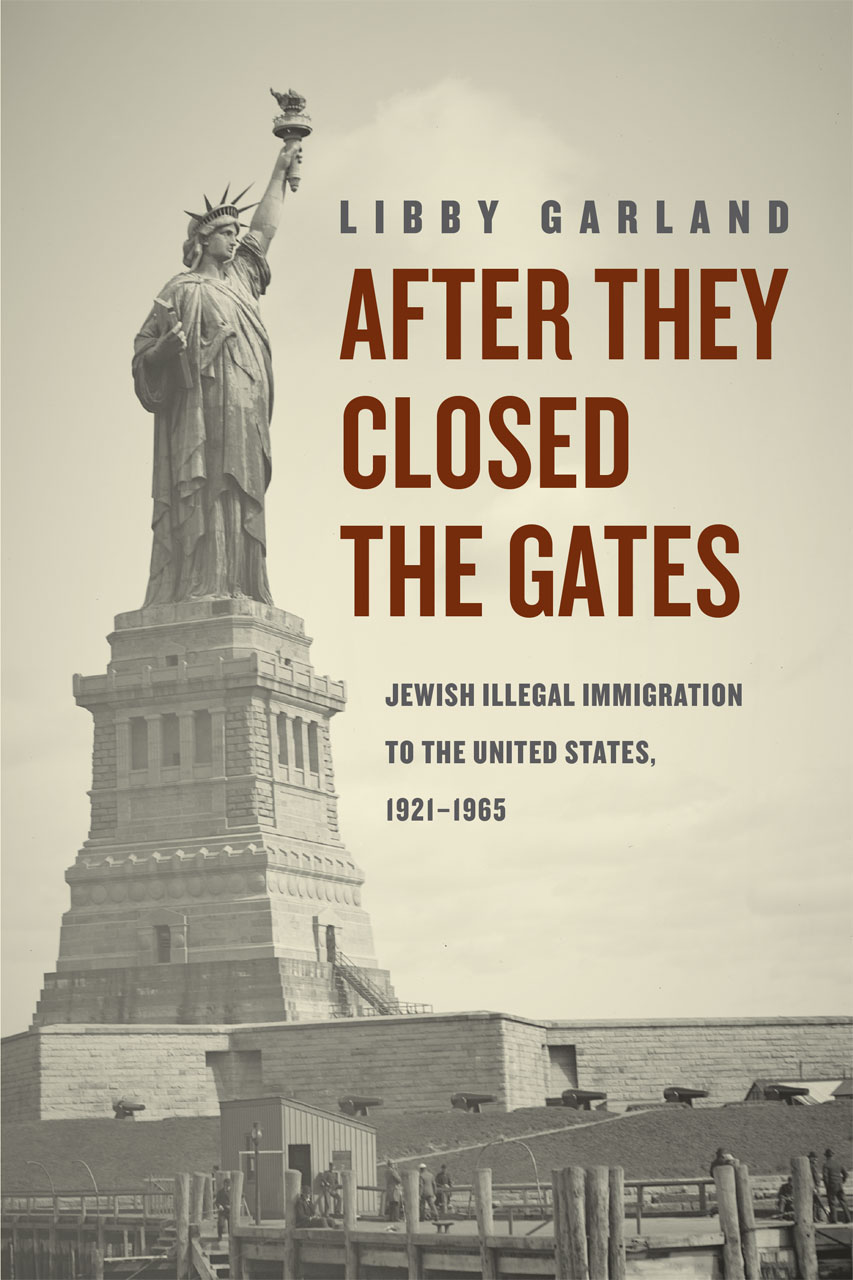
    New Release: Garland on "Jewish Illegal Immigration to the United States, 1921-1965"

    New from the University of Chicago Press: After They Closed the Gates: Jewish Illegal Immigration to the United States, 1921-1965 (2014), by Libby Garland (Kingsborough Community College, The City University of New York). A description from the Press:
    In 1921 and 1924, the United States passed laws to sharply reduce the influx of immigrants into the country. By allocating only small quotas to the nations of southern and eastern Europe, and banning almost all immigration from Asia, the new laws were supposed to stem the tide of foreigners considered especially inferior and dangerous. However, immigrants continued to come, sailing into the port of New York with fake passports, or from Cuba to Florida, hidden in the holds of boats loaded with contraband liquor. Jews, one of the main targets of the quota laws, figured prominently in the new international underworld of illegal immigration. However, they ultimately managed to escape permanent association with the identity of the “illegal alien” in a way that other groups, such as Mexicans, thus far, have not.

    In After They Closed the Gates, Libby Garland tells the untold stories of the Jewish migrants and smugglers involved in that underworld, showing how such stories contributed to growing national anxieties about illegal immigration. Garland also helps us understand how Jews were linked to, and then unlinked from, the specter of illegal immigration. By tracing this complex history, Garland offers compelling insights into the contingent nature of citizenship, belonging, and Americanness.
    A few blurbs:
    “In charting the rise and fall of Jewish ‘illegal aliens’ in US history, Libby Garland also explores in absorbing detail the real-life effects of immigration law on the many migrants it targets. After They Closed the Gates is a marvelous, important, and timely book.” --Thomas A. Guglielm
    “Meticulously researched and provocatively argued, Garland reveals the previously unexplored arena of Jewish illegal immigration to the U.S. after the Quota Acts of the 1920s.  She introduces us to the complicated world of Jewish migrant ‘lawbreakers’ traveling under false documents, in circuitous routes, or through surreptitious entry, Jewish and Gentile smugglers trying to make money out of misfortune, and Jewish lawyers and aid organizations walking a fine line between supporting coethnics in need and drawing anti-immigrant ire that questioned their essential Americanness.  A masterful, path-breaking work of fine scholarship.” -- George Sánchez
    More information is available here.

    Tuesday, August 5, 2014

    Dedek, "Stating Boundaries: The Law, Disciplined"

    Helge Dedek (McGill University/Institute of Comparative Law) has posted "Stating Boundaries: The Law, Disciplined." Dedek describes the paper as "a draft version of an introductory chapter to the collection" Stateless Law: Evolving Boundaries of a Discipline, Helge Dedek & Shauna Van Praagh eds. (Aldershot: Ashgate, forthcoming). The book is "about the challenge that contemplating law without the state – stateless law – poses to the law as a university discipline – law as it is studied and taught by academics in the institutional context of higher education." Here's the abstract:
    When we reflect on the traditionally disputed ‘disciplinarity’ of law, its intrinsic connection to the nation-state and the possible inevitability of interdisciplinarity for legal scholarship and education, the obvious first question we have to address is: what is a discipline?

    Drawing insight from the history of the concept of ‘discipline’, the paper reflects on the formation process of law as a modern academic discipline. In particular, it focuses on the ‘self-disciplining’ efforts of legal study in the late eighteenth and nineteenth century to simultaneously please three masters: the university, the regulatory state, and the legal profession. Through the framing device of three inaugural lectures on the study of law – by Blackstone and Dicey in England, and von Liszt in Germany – it sheds light on various institutional dynamics of discipline formation: first, the rise of ‘legal science’, fueled by the changing demands of academia, but deployed also as an argument to placate the profession; second, the related turn away from natural law and towards positivism, which demarcated law from the discipline of philosophy, but spoke as well to the interests of the nation-state; and third, the ‘disciplining’ of legal education through the inculcation of external requirements imposed by state and professional standards.

    These instrumentalist pressures remain apparent to this day, to varying degrees across jurisdictions and institutions. However, with the nation-state as dominant intellectual point of reference now in decline, the factors determining the traditional self-definition of law as a university discipline have to be studied, understood, and re-assessed.
    Full text is available here.

    Hat tip: Legal Theory Blog

    Monday, August 4, 2014

    LOC Announces Indigenous Law Portal

    The helpful folks at the Library of Congress have created an Indigenous Law Portal to assist researchers interested in Indian Law and Native American history. Here's an excerpt from the announcement:
    Indigenous law materials can be difficult to locate for a variety of reasons. Tribal laws are usually maintained by individual tribes or groups of tribal peoples who may or may not have the resources to make them available in electronic format, or they may only be passed on through oral tradition. In some cases tribal legal materials are available electronically, but they may not be available freely on the Web, or the tribe may want to restrict outside access to the materials. However, through our research, we have found many tribes compile their laws and ordinances into a code, and they often provide a digital version of their most recent code and constitution online. In the Law Library, we already have digitized copies of historic American Indian constitutions from our collection and other legal materials available on our website. It makes sense to bring all these materials together in one place.
    Read on here.

    Journal of Supreme Court History: July 2014 Issue

    The July 2014 issue of the Journal of Supreme Court History is now available online. Here's the TOC:
    Introduction
    Melvin I. Urofsky

    Articles

    A Better Story in Prigg v. Pennsylvania?
    H. Robert Baker

    Judicial Modesty in the Wartime Context: Roosevelt v. Meyer (1863) 
    Dawinder S. Sidhu

    Doing Brandeis Justice: the Development of the Liebmann Dissent
    Jessie Steffan

    Debunking Douglas: The Case Against Writing Both Majority and Minority Opinions
    Craig Alan Smith

    Supreme Court Messenger, 1977 Term
    Thomas G. Snow

    Afterword: A Short History of the Messenger Position at the Supreme Court
    Matthew Hofstedt

    The Burger Court and the Conflict Over the Rational Basis Test: The Untold Story of Massachusetts Board of Retirement v. Murgia.
    Earl M. Maltz

    Judicial Bookshelf
    D. Grier Stephenson, Jr.

    Sunday, August 3, 2014

    Sunday Book Roundup

    Since the book's release we've noted several reviews of Bruce Ackerman's We the People: Vol. 3: The Civil Rights Revolution (Harvard University Press). This week you can listen to Professor Ackerman discuss the book over at New Books in Law.

    Richard A. Epstein's The Classical Liberal Constitution: The Uncertain Quest for Limited Government (Harvard University Press) is reviewed in the Los Angeles Review of Books.
    "Beware of scholars claiming the one true path by positioning themselves between two other positions deemed extreme or misguided. In his new book, The Classical Liberal Constitution: The Uncertain Quest for Limited Government, Richard A. Epstein, Laurence A. Tisch Professor of Law at New York University School of Law, rejects both the conservative “originalist” and the liberal “living Constitution” interpretations of the US Constitution, in favor of “classical liberal theory.” Epstein prides himself on pursuing an “unorthodox path” and for going “against the grain of modern Supreme Court jurisprudence and much of the legal scholarship that has grown up around that body of work.”"
    The Federal Lawyer has a new online review of The Law in Nazi Germany: Ideology, Opportunism, and the Perversion of Justice edited by Alan E. Steinweis and Robert D. Rachlin (Berghahn Books).

    Two new reviews of books about marriage are up. On H-Net, Clare Virginia Eby's Until Choice Do Us Part: Marriage Reform in the Progressive Era (University of Chicago Press) is reviewed. Then, The New York Times has a review of Marriage Markets: How Inequality is Remaking the American Family by family law professors June Carbone and Naomi Cahn (Oxford University Press). Of Eby's book, reviewer Brent Ruswick writes,
    "This thoughtful, complex work examines couples Eby identifies as progressive marriage reformers, spouses who “believed intimate individual decisions could usher in broad social change” and sought to educate the public about marriage reform through the stories they penned and lived (p. 3). Readers with an interest in the Progressive Era, family studies, and American literature are sure to find value in Eby’s deft analysis of reformers whose provocative and messy writings about marriage were only exceeded by their actual marriages." 
    My Notorious Life (Scribner) by Kate Manning is a "historical novel loosely based on a 19th-century midwife named Ann Lohman, who was harassed for performing abortions in New York." The Washington Post interviewed Manning about American attitudes on reproductive rights over time, and you can find her responses here. (You can find an older review of the book here.) Here's the beginning of her response to a question about the Hobby Lobby decision.
    "In “My Notorious Life,” a midwife-abortionist is put on trial. For that scene, I borrowed dialogue directly from actual transcripts of a real-life 1870s trial. The midwife and a woman coerced into testifying against her were the only women in the courtroom. The other witnesses were all men. The journalists who put the story in the sensationalized headlines were all men. Women did not then have the vote, couldn’t own property or keep their own money."
    This weekend the reviewers are all talking about Rick Perlstein's The Invisible Bridge: The Fall of Nixon and the Rise of Reagan (Simon & Schuster). There is an interview with Perlstein in Salon, a review in The New York Times, a review in the Los Angeles Times, a review in the New Republic, and yet another review in The Washington Post. For the Post, H.W. Brands writes,
    "Perlstein identifies certain themes. “This is a book about how Ronald Reagan came within a hairs-breadth of becoming the 1976 Republican nominee for president,” he writes. Readers might wonder at this choice of topic, since not only did Reagan not win the Republican nomination, but the Republican nominee, Gerald Ford, lost to Democrat Jimmy Carter. “This book is also a sort of biography of Ronald Reagan,” Perlstein continues. Again a bit curious, given that the book stops well before Reagan achieves the only thing that makes him interesting to biographers or anyone else: the presidency. Perlstein’s broadest theme resolves the puzzle, partly. He describes a shift in the American mood roughly coincident with the bicentennial celebrations of July 4, 1976 — from the disillusionment of the immediate post-Vietnam, post-Watergate years to a reaffirmation of belief in the country’s abiding values. “This book is about how that shift in national sentiment took place,” Perlstein writes."
    With this summer marking the 40th anniversary of Nixon's resignation, there's an excerpt of Chasing Shadows: The Nixon Tapes, the Chennault Affair, and the Origins of Watergate by Ken Hughes (University of Virginia Press) in Salon. In The Washington Post there is a double review of Chasing Shadows and The Nixon Tapes: 1971-1972 edited an annotated by Douglas Brinkley and Luke A. Nichter (Haughton Mifflin Harcourt). And the Los Angeles Times has a review of John Dean's The Nixon Defense: What He Knew and When He Knew It (Viking Adult).


    Saturday, August 2, 2014

    Weekend Roundup

    • Over at JOTWELL, legal historian Elizabeth Dale praises Kim D. Chanbonpin’s “Truth Stories: Credibility Determinations at the Illinois Torture Inquiry and Relief Commission.”
    Weekend Roundup is a weekly feature compiled by all the Legal History bloggers.

    Friday, August 1, 2014

    Crump and Brophy on Cornelius Sinclair's Odyssey

    Judson E. Crump and Alfred L. Brophy, University of North Carolina School of Law, has posted Cornelius Sinclair's Odyssey: Freedom, Slavery, and Freedom Again in the Old South.  Here is the abstract:
    In August 1825 several free, young black people were enticed onto a ship in the Delaware River along the Philadelphia waterfront. Thus began their descent to the heart of the old South. They were kidnapped and held aboard a ship destined for a stop somewhere near Cape Henlopen, Delaware. Some days later they were carried by wagon to Maryland’s eastern shore and another ship took them further south. They walked across Georgia and into Alabama. One young man, Cornelius Sinclair, was sold in Tuscaloosa. He was a free person converted into a slave. But that was not the end.

    Those who survived were then taken to Mississippi, where a slave-owner realized that they were probably free. The slave-owner contacted the Mayor of Philadelphia to verify the story of kidnapping and eventually most of those held in Mississippi were sent back to Philadelphia. Then the mayor set about rescuing Sinclair, too. In Tuscaloosa, a local minister helped Sinclair by filing a lawsuit to ask for his freedom. A judge, who would later, as governor of Alabama, seek to imprison abolitionists for spreading antislavery literature, presided over the trial that freed Sinclair. The newly freed Sinclair made a trip even further south, to New Orleans, and eventually back to Philadelphia where he faced down the men who had kidnapped him.

    Sinclair's story is one of epic proportions. It is a nineteenth century version of the Odyssey. And while Cornelius' journey home took fewer years than Odysseus' journey, Sinclair traveled farther. Some of the other kidnapped people made it home as well; one died along the way. Others never returned. But this story is one of the dark evil in human hearts and also of the triumph, even if in greatly circumscribed fashion, of the rule of law. It is a story of a most unexpected turn in a legal system dedicated to the maintenance of the system of slavery.

    While there has been some previous discussion of Sinclair’s case, that story has been told only briefly and exclusively from the perspective of the anti-slavery press and the records in Philadelphia. This is the first time that the Tuscaloosa part of the story has been told. And in this case study one can see the difficulty that southern jurists, slave-owners, and litigants had in dealing with the central tendency of the slave law in contrast with considerations of humanity and justice.

    Wilkes on Habeas Petitions in the Reign of James I

    Donald E. Wilkes, Jr., University of Georgia Law School, has posted Habeas Corpus Proceedings in the High Court of Parliament in the Reign of James I, 1603-1625, which appears in the American Journal of Legal History 54 (2014): 200-63.  Here is the abstract:
    English parliamentary habeas corpus proceedings have been neglected by scholars. This Article ends that neglect. This Article focuses on the parliamentary habeas corpus proceedings that occurred in the reign of King James. The Article corrects several misunderstandings relating to the history of the writ of habeas corpus in England and to the history of the English Parliament (which in the seventeenth century commonly was referred to as the High Court of Parliament).

    Part I of the Article provides answers to questions concerning the historical background and context of the parliamentary habeas corpus proceedings in the High Court of Parliament during James I's reign. What was the origin and significance of the term High Court of Parliament? What was the parliamentary privilege of freedom from arrest, the violation of which could lead to the granting of habeas corpus relief by the House of Lords or the House of Commons? What was the civil arrest system in effect in seventeenth century Englanda system which made it likely that from time to time the parliamentary privilege from arrest would be violated and the parliamentary habeas remedy thereupon invoked? What other remedies, apart from habeas corpus, were available to deal with infringements of the parliamentary arrest privilege? And what were the contours of the parliamentary habeas corpus remedy itself, which appears not to have been successfully invoked prior to the reign of James I?

    Parts II and III conclusively demonstrate that in the reign of James I the High Court of Parliament at times functioned as the High Habeas Court of Parliament. Part II provides an in-depth account of the habeas corpus proceedings in the House of Lords in the reign of James I, while Part III does the same for the habeas corpus proceedings in the House of Commons during the reign.

    The Article concludes with a detailed discussion of the three major changes this work mandates in our understanding of English legal history.

    Thursday, July 31, 2014

    Gordon, "The Forgotten Nuremberg Hate Speech Case"

    Gregory S. Gordon (University of North Dakota - School of Law) has posted "The Forgotten Nuremberg Hate Speech Case: Otto Dietrich and the Future of Persecution Law." The article appears in Volume 75 of the Ohio State Law Journal (2014). Here's the abstract:
    Among international jurists, the conventional wisdom is that atrocity speech law sprang fully formed from two judgments issued by the International Military Tribunal at Nuremberg (IMT): the crimes against humanity conviction of Nazi newspaper editor Julius Streicher, and the acquittal on the same charge of Third Reich Radio Division Chief Hans Fritzsche. But the exclusive focus on the IMT judgments as the founding texts of atrocity speech law is misplaced. Not long after Streicher and Fritzsche, and in the same courtroom, the United States Nuremberg Military Tribunal (NMT) in the Ministries Case, issued an equally significant crimes against humanity judgment against Reich Press Chief Otto Dietrich, who was convicted despite the fact that the charged language did not directly call for violence. So why is the Dietrich judgment, a relatively obscure holding, issued sixty-five years ago, so significant today, after the development of a substantial body of ad hoc tribunal jurisprudence on atrocity speech? It is because the seemingly antithetical holdings in Streicher and Fritzsche are more than just the subject of academic discourse. The next generation of atrocity speech decisions, it turns out, is at loggerheads about the relationship between hate speech and persecution as a crime against humanity. Trial chambers for the International Criminal Tribunal for Rwanda (ICTR) have found that hate speech, standing alone, can be the basis for charges of crimes against humanity (persecution). A trial chamber for the International Criminal Tribunal for the former Yugoslavia has reached the opposite conclusion. And surprisingly, these judicial decisions, like the academic commentary, have completely ignored the Dietrich judgment. This Article fills in this significant gap in the judicial and academic literature by historically situating Dietrich, elucidating its holding and relationship to the IMT and ad hoc tribunal decisions, explaining its significance for current and future hate speech cases (including those in Kenya, Burma and Sudan) and offering an explanation for why it has lain in obscurity for over six decades. The Article concludes that judicial reliance on the Dietrich judgment would extricate the law from the Streicher-Fritzsche jurisprudential gridlock and permit development of doctrine that is more coherent and human rights-oriented. It would also help illuminate an important but long overlooked chapter in legal history.
    The full article is available here.

    Hat tip: Legal Theory Blog

    Wednesday, July 30, 2014

    Iowa Law Review Symposium on Gideon v. Wainwright

    The Iowa Law Review has posted all of the articles stemming from its November 2013 Symposium on the 50th anniversary of Gideon v. Wainwright.  Several may be of special interest to legal historians:
    Lawrence Herman, Gideon and the Golden Thread

    Jerold H. Israel, Gideon v. Wainwright – From a 1963 Perspective

    Bruce R. Jacob, The Gideon Trials

    Sara Mayeaux, Ineffective Assistance of Counsel Before Powell v. Alabama: Lessons from History for the Future of the Right to Counsel

    New Release: Doern, et al., "Rules and Unruliness: Canadian Regulatory Democracy, Governance, Capitalism, and Welfarism"

    New from McGill-Queen's University Press: Rules and Unruliness: Canadian Regulatory Democracy, Governance, Capitalism, and Welfarism, by G. Bruce Doern (Carleton University/University of Exeter), Michael J. Prince (University of Victoria), and Richard Schultz (McGill University). Here's a description from the Press:
    A critical examination of Canadian regulatory governance and politics over the past fifty years, Rules and Unruliness builds on the theory and practice of rule-making to show why government "unruliness" - the inability to form rules and implement structures for compliance - is endemic and increasing.

    Analyzing regulatory politics and governance in Canada from the beginning of Pierre Trudeau's era to Stephen Harper's government, the authors present a compelling argument that current regulation of the economy, business, and markets are no longer adequate to protect Canadians. They examine rules embedded in public spending programs and rules regarding political parties and parliamentary government. They also look at regulatory capitalism to elucidate how Canada and most other advanced economies can be characterized by co-governance and co-regulation between governments, corporations, and business interest groups.

    Bringing together literature on public policy, regulation, and democracy, Rules and Unruliness is the first major study to show how and why increasing unruliness affects not only the regulation of economic affairs, but also the social welfare state, law and order, parliamentary democracy, and the changing face of global capitalism.
    More information, including the TOC, is available here.

    Tuesday, July 29, 2014

    CFP: The British Legal History Conference 2015

    The British Legal History Conference 2015 has issued the following Call for Papers:
    Conference Venue:

    School of Law, University of Reading
    Reading, United Kingdom

    Details:

    The twenty-second British Legal History Conference will be held at the University of Reading between 8 and 11 July 2015. The conference theme is "Law: Challenges to Authority and the Recognition of Rights". The deadline for the submission of paper proposals is 30 September 2014.

    We welcome proposals which explore challenges of various types, and which are concerned with any period of history. However, proposals concerned with Magna Carta, and especially with its impact beyond the UK, are particularly welcome.

    In addition to all of the usual attractions of the main conference programme, we will be offering a special session for postgraduate and early career researchers. To celebrate the 800th anniversary of Magna Carta we are also hoping to organise an optional trip to Runnymede.

    Conference Organisers: Prof Catharine MacMillan and Dr Charlotte Smith

    Conference Email Address: BLHC2015@reading.ac.uk
    Hat tip:  Environment, Law, and History Blog

    Johnson, "Law and the History of Corporate Responsibility: Corporate Governance"

    Lyman Johnson (Washington and Lee University - School of Law; University of St. Thomas, St. Paul/Minneapolis, MN - School of Law) has posted "Law and the History of Corporate Responsibility: Corporate Governance." The article appears in Volume 10 of the University of St. Thomas Law Journal (2014). Here's the abstract:
    This article is one part of a multi-article project on the role of law in the history of corporate responsibility in the United States. Key background material for the project is set forth in the introduction to an earlier article addressing corporate personhood. This paper deals with corporate governance while other articles address corporate purpose and corporate regulation.
    Corporate responsibility concerns associated with corporate personhood, corporate purpose, and corporate regulation all ultimately relate to a far more basic issue: corporate governance. As the commercial demands of nineteenth century industrialization led to substantial displacement of the partnership form of business enterprise by large corporations with dispersed shareholders, control of these corporations - i.e., their governance - centered in the hands of senior managers, not investors themselves. This phenomenon of “separation of ownership from control” is quite different than in the typical partnership and was seminally described by Adolf Berle and Gardiner Means in their 1932 book, The Modern Corporation and Private Property. It has continued to occupy center stage in corporate law for the past eighty years.

    From a legal history vantage point on corporate responsibility, the stupendous rise in commercial significance of the corporation in the nineteenth century corresponded to the precipitous decline of a regulatory approach to corporations under state corporate law, and instead, the twentieth century “outsourcing” of such regulation to an array of other legal regimes ostensibly designed to protect both investor and noninvestor groups. This meant that corporate law itself developed in such a way as to loosen, not tighten, most constraints on those who govern public corporations. The thesis of this article, developed in Parts I and II, is that corporate governance, both as a body of law and as a field of academic study, has historically had little to say on the important subject of corporate responsibility. Instead, the quest for greater responsibility in the United States largely has come from “external” legal regulation and from ongoing shifts in business and social norms. Recently, corporate law’s long and unsustainable neglect of corporate responsibility concerns has led to the emergence of a new type of business corporation, the “benefit corporation.” Benefit corporations expressly permit the directors to advance both investor and noninvestor interests, in aid of pursuing a larger public benefit. The implications of this development for governance of the regular business corporations are unknown. One potential adverse outcome is the “ghettoization” of corporate responsibility within benefit corporations, leading to even less serious attention to such concerns in the traditional business corporation.
    Read on here.

    Hat tip: Legal Theory Blog