Sunday, December 20, 2020

Glossae 17

[Volume 17 (2020) of GLOSSAE: The European Journal of Legal History, is now online.  We list the articles below.  Miscellany, book reviews and news appear here.  DRE]

An introduction to the birth of criminal positivism in Europe and Latin America at the end of the 19th century: rise and resistance, pp. 1-21
Yves Cartuyvels, Aniceto Masferrer

The Theory of Social Defence and the Italian Positive School of Criminal Law, pp. 22-46
Michele Pifferi

Bernardino Alimena and Emanuele Carnevale: The third school of criminal law searching for a compromise, pp. 47-82
Stefano Vinci

Argentina’s Participation in the International Penal and Penitentiary Congress (1872-1950), pp. 83-118
Esteban González, Jorge Núñez

About the concept of the ‘dangerous individual’ in turn-of-the-century penal reform: Debates on recidivism, état dangereux, indeterminate sentencing, and civil liberty in the International Union of Penal Law, 1889-1914, pp. 119-149
Richard F. Wetzell

Zweckgedanke, Social Defence and Transnational Criminal Law: Franz von Liszt and the Network of Positivist Criminology (1871-1918), pp. 150-175
Karl Härter

Adolphe Prins and social defence in Belgium: The reform in the service of maintaining social order, pp. 176-210
Yves Cartuyvels

Gerhardus Antonius van Hamel (1842-1917) and the new horizons of criminal justice under penal positivism, pp. 211-232
John A.E. Vervaele

Echoes of Karl Binding and Franz von Liszt? The Discussion between the ‘Classical School’ and the ‘Positivist School’ in Austria, pp. 233-258
Martin P. Schennach
 
Toward New Horizons: Penal Positivism and Swiss Criminal Law Reform in the late 19th and early 20th Centuries, pp. 259-276
Urs Germann

The hybrid construction of a European form of penal thinking. From Italian positivism to the birth of French criminology Reception, resistance and appropriation, pp. 277-302
Martine Kaluszynski

The reception of the positivist school in the Spanish criminal doctrine (1885-1899), pp. 303-352
Aniceto Masferrer

Pedro Dorado Montero: A Transitioning Figure, pp. 353-395
José Franco-Chasán

A frantic mayfly at the turn of the century: The positivist movement and Portuguese criminal law, pp. 396-439
Pedro Caeiro, Frederico de Lacerda da Costa Pinto

Reception of social defense in the RSFSR and the USSR, pp. 440-468
Maria Filatova, Tatiana Alekseeva

Ascension and decline of positivism in Argentina, pp. 469-485
Enrique Roldán Cañizares, Matías J. Rosso

The Italian Scuola Positiva in Brazil between the nineteenth and twentieth centuries: the problematic issue of “influence”, pp. 486-516
Ricardo Sontag           

Saturday, December 19, 2020

Weekend Roundup

  • In the New Republic: Gabriel Rosenberg and Jan Dutkiewicz on the place where the meat industry meets anti-bestiality laws, past and present.
  • Catch this virtual event with Ashley Rubin on her forthcoming book, The Deviant Prison: Philadelphia's Eastern State Penitentiary and the Origins of America's Modern Penal System, 1829-1913: Jan.5 at 6-7pm EST. 
  • The Wiener Library for the Study of the Nazi Era and the Holocaust, at the Sourasky Central Library, Tel Aviv University, has put some of its collections online, including prosecutions for distributing the Protocols of the Elders of Zion and the Nazi Justice Collection, which "contains information on the judiciary in Nazi Germany and hundreds of trial transcripts."  H/t: JQB
  • Brittany Nichole Adams, Special Collections, Digitization, and Archival Services Librarian, Northwestern University is profiled in the Bright Young Librarians series at FineBooks and Collections.
  • ICYMI:  University of Mississippi fires Garrett Felber, a tenure-track assistant professor in the Arch Dalrymple III Department of History, who has studied the American carceral state. (Mississippi Free Press).  Greg Melleuish on Constitutional History in Australia (Telos Press Podcast).
Weekend Roundup is a weekly feature compiled by all the Legal History bloggers.

Friday, December 18, 2020

Fishman on Trollope's Lawyers

James Fishman, Pace University School of Law, has posted A Random Stroll Amongst Anthony Trollope’s Lawyers:

Anthony Trollope (1815-1882) resides in the pantheon of nineteenth century English literature. Overcoming a miserable childhood, he became an official with the post office and is credited with introducing the familiar red mailbox. While working full time in his postal position until 1867, he still managed to publish 47 novels, travel books, biographies, short stories, collections of essays, and articles on various topics. Trollope has been described as the novelist of the ordinary for his realistic description of English society.

Law and legal issues flow through Trollope’s fiction. The legal system held a special importance to him as the skeleton upholding the social and political framework of the country. Over one hundred lawyers appear in his work and eleven of his novels feature trials or hearings. The law intrigued and exasperated him. Along with the lawyers and legal issues he depicts are ideas of the law and legal system that are part of elaborate philosophical and jurisprudential traditions, which he recognized.

This article examines Trollope’s changing attitude toward lawyers. It describes the structure of the Bar in terms of class, status and reputation. Trollope believed the legal system should ensure justice, and those who labored in the law should be the vehicle of that pursuit. Justice for Trollope was the meting out of rewards and punishments as the consequence of a right or wrong decision. However, the law, as he depicted it, was often an impediment to this process, and lawyers were unreliable guides.

Initially Trollope portrayed lawyers critically as caricatures as evinced by such names as Alwinde, O’Blather, Slow & Bidewhile, Haphazard, and Chaffanbrass. He was outraged that barristers (lawyers who appear in court) put loyalty to their clients ahead of the search for truth and justice. The adversary system was flawed as the enactment of laws in accord with the laws of nature assumes an inbuilt moral compass in humans that contains self-evident truths of right and wrong. Trollope felt there was no reason why a right-minded person could not intuitively recognize the truth, so criminal law’s adversary system was unnecessary. The legal system sought not the discovery of the truth but was more interested in aiding the guilty defendant to escape punishment. Another grievance was that cross examination in a trial submitted honest witnesses to torture and distracted them from testifying as to the truth.

As he matured as a writer and achieved success, Trollope’s understanding and appreciation of the legal profession changed. He met and become friends with leaders of the Bar, and they influenced his descriptions of lawyers, who became realistic and often admirable human beings. Beyond the legal problems of its characters, Trollope’s later novels incorporated the social, political, and jurisprudential issues of the times and engaged the Victorian legal culture in a broader sense of history, traditions, continuity and change.

Trollope’s attention to the faults of the adversary system had its source in principles of natural law, which posited that God-given universal axioms of right and wrong gave individual guidance or a map for reaching the right result in a legal controversy. Natural law principles were challenged during the Victorian era by positivist notions that law is what the statute books say, and legislators enact. These divisions lurk in the background of his later portraits of lawyers and the legal system. In his later period Trollope created a realistic characterization of the legal profession at the time that offered universal insights into human nature.

--Dan Ernst

Quiroga-Villamarín on the Material Turn in the History of International Law

Gated, but very interesting: Beyond Texts? Towards a Material Turn in the Theory and History of International Law, by Daniel Ricardo Quiroga-Villamarín, in the Journal of the History of International Law, from a master’s thesis on Shipping Containers, Materiality, and Legal History:

While the history of international law has been mainly dominated by intellectual history, the neighboring humanities and social sciences have witnessed a ‘material turn.’ Influenced by the new materialisms, historians, sociologists, and anthropologists have highlighted the role of objects and nonhuman infrastructures in the making of the social. Law, however, has been conspicuously absent from these discussions. Only until recently, things began to be studied as instruments of – global – regulation. In this article, I trace an intellectual history of the intellectual history of international law, contextualizing it since its inception in the so-called ‘Cambridge School’ to its spread into the legal field via the Critical Legal Studies movement and its final import into international law in the last two decades. I conclude arguing that international legal historians can depart from the ‘well-worn paths’ of intellectual and conceptual history to engage with the materiality (past, present, and future) of global governance.
–Dan Ernst

Thursday, December 17, 2020

Female Imprimatur: Women in the Lawbook Trade.

[We have the following announcement of an online exhibit at Boston College Law School.  DRE]

Female Imprimatur: Women in the Lawbook Trade.  This exhibit was inspired by the 100th anniversary in August 2020 of the ratification of the 19th Amendment, which granted suffrage to some—though certainly not all—American women. In the summer before the anniversary, Rare Books Curator Laurel Davis, Professor Mary Bilder, and Associate Law Librarian Helen Lacouture went digging into our special collections to find lawbooks with imprints featuring women printers and booksellers.   

More.

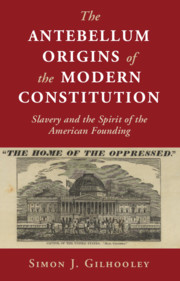
Gilhooley on slavery and the Constitution

Simon J. Gilhooley (Bard College) has published The Antebellum Origins of the Modern Constitution: Slavery and the Spirit of the American Founding in the series Cambridge Studies on the American Constitution, edited by Maeva Marcus, George Washington University; Melvin I. Urofsky, Virginia Commonwealth University; Mark Tushnet, Harvard Law School; Keith Whittington, Princeton University. From the publisher: 

This book argues that conflicts over slavery and abolition in the early American Republic generated a mode of constitutional interpretation that remains powerful today: the belief that the historical spirit of founding holds authority over the current moment. Simon J. Gilhooley traces how debates around the existence of slavery in the District of Columbia gave rise to the articulation of this constitutional interpretation, which constrained the radical potential of the constitutional text. To reconstruct the origins of this interpretation, Gilhooley draws on rich sources that include historical newspapers, pamphlets, and congressional debates. Examining free black activism in the North, Abolitionism in the 1830s, and the evolution of pro-slavery thought, this book shows how in navigating the existence of slavery in the District and the fundamental constitutional issue of the enslaved's personhood, Antebellum opponents of abolition came to promote an enduring but constraining constitutional imaginary.

Praise for the book: 

"Gilhooley gives us a new and profoundly original account of the roots, during the era of slavery, of today's battles over constitutional interpretation. In the process, he reconceives the political legacy of the 1820s and 1830s, scrambles our contemporary assumptions about the ideological meaning of the different theories of the Constitution, and thoroughly dissects the American worship of the founders. This is a terrific book and one to be returned to again and again." -Aziz Rana

"This book is convincing and profound: a real tour de force. Gilhooley is immensely clarifying on points of history, political theory, and legal/constitutional development precisely because he integrates them. His argument that originalism emerged as a response to the exigencies of antebellum debates will be a touchstone for a very long time." -David Waldstreicher

Further information is available here.

--Mitra Sharafi

Wednesday, December 16, 2020

CFP: Legal History and Mass Migration

[We have the following call for papers.  DRE]

Legal Response to Mass Migration Between the 19th Century and the WWII 

Confronted with mass migration, since the mid-19th century Western legal culture was forced to face migrants not just as a sum of individuals, but as a phenomenon demanding new legal concepts and mechanisms appropriate to govern and regulate groups and collective subjects. European migrants moving towards colonies and the East led to a reconceptualization of traditional international law doctrines on state sovereignty in order to de-territorialize Western citizens who occurred to be in the Eastern countries, freeing them from the imperium of the local authority and entrusting them to their own consular courts. Whereas immigration into Western countries led to the adoption of protective legal strategies and exclusion mechanisms to bar the dangerous others, emigration of European citizens towards colonized regions and Eastern countries prompted the elaboration of exceptional safeguards and privileges for ‘civilizing’ migrants. The new challenges of mobility led jurists and legislators to reshape the peculiarity of ius migrandi through terminological as well as conceptual revisions (e.g. the notions of citizenship, sovereignty, territorial state, undesirable and dangerous alien), the elaboration of new disciplines such as international labor law and international migration law, and the creation of special administrative bodies or jurisdictions (e.g. immigration officers; board of inspectors; consular courts; inspectors of emigration; arbitral commissions for emigration).

The Legal History and Mass Migration project (PRIN 2017) invites proposals for papers relating to the theme of the juridical response to mass migration between the mid-19th century and WWII. Papers can be based on different methodologies and may refer to a broad variety of subjects, including, by way of example:

  • application of methodologies such as global legal history, comparative legal history, critical analysis of law to the study of migration issues;
  • relationship between local rules and international migration law;
  • tensions between human rights’ recognition and border control policies;
  • non-Western legal approaches to migration issues;
  • construction of legal discourses, theories, justifications to support, contrast, govern, or limit mass migration;
  • models of citizenship and integration or exclusion of alien immigrants in different countries;
  • role of case law and/or resort to special tribunals with jurisdiction in migration issues as means of departing from ordinary rules and constitutional protections;
  • institutional and informal mechanisms (such as ‘soft law’, role of unions or charitable institutions, nets of assistance of national citizens abroad etc.) adopted to deal with mass migration problems in different countries of both departure and destination;
  • impact of mass migration on national and international labour law;
  • racial paradigms and immigration laws;
  • local/global economic impact of migration and its legal regulation;
  • exploitation of criminal law concepts, discourses, practices to stir the public conviction about the social danger of mass migration

Proposals for papers are due by 30 March 2021 and should be submitted by e-mail at legalhistoryandmassmigration@gmail.com in Word format, following this order: (a) author(s); (b) affiliation; (c) e-mail address; (d) title of abstract; (e) body of abstract (apx 350 words).  Accepted papers will be presented at an international conference which will be held at the University of Naples in December 2021.  

Support for selected participants: funding for travel expenses and accommodation may be available. Please indicate with your paper proposal if you would like to be considered for a support, and if so, your expected expenses. All funding decisions will be made independently of paper acceptance.
Papers and pre-circulation: Please note that the conference panels will be structured around a short summary of speakers’ pre-circulated papers, followed by more extended discussion. It is our intention that accepted speakers will submit papers of no more than 4,000 words for circulation by Friday 22 October 2021.

For general inquiries, please email: info@legalhistoryandmassmigration.com

Conference Committee: Luigi Nuzzo (University of Salento), Michele Pifferi (University of Ferrara), Giuseppe Speciale (University of Catania), Cristina Vano (University of Naples Federico II).

Cox & Rodríguez, "The President and Immigration Law"

Oxford University Press has released The President and Immigration Law, by Adam B. Cox (New York University School of Law) and Cristina M. Rodríguez (Yale Law School). A description from the Press:

Who controls American immigration policy? The biggest immigration controversies of the last decade have all involved policies produced by the President — policies such as President Obama's decision to protect Dreamers from deportation and President Trump's proclamation banning immigrants from several majority-Muslim nations. While critics of these policies have been separated by a vast ideological chasm, their broadsides have embodied the same widely shared belief: that Congress, not the President, ought to dictate who may come to the United States and who will be forced to leave.

This belief is a myth. In The President and Immigration Law, Adam B. Cox and Cristina M. Rodríguez chronicle the untold story of how, over the course of two centuries, the President became our immigration policymaker-in-chief. Diving deep into the history of American immigration policy — from founding-era disputes over deporting sympathizers with France to contemporary debates about asylum-seekers at the Southern border — they show how migration crises, real or imagined, have empowered presidents. Far more importantly, they also uncover how the Executive's ordinary power to decide when to enforce the law, and against whom, has become an extraordinarily powerful vehicle for making immigration policy.

This pathbreaking account helps us understand how the United States has come to run an enormous shadow immigration system-one in which nearly half of all noncitizens in the country are living in violation of the law. It also provides a blueprint for reform, one that accepts rather than laments the role the President plays in shaping the national community, while also outlining strategies to curb the abuse of law enforcement authority in immigration and beyond.

More information is available here. A New Books Network interview with the authors is available here.

-- Karen Tani

Tuesday, December 15, 2020

ASLH Announces New Fellowship

 [We have the following announcement.  DRE]

The American Society for Legal History has established the Herbert A. Johnson Fellowship, made possible by a generous gift from Jane and Harry Scheiber. The fellowship will be awarded to an early career scholar who works on the legal history of North America and is selected to attend the annual Student Research Colloquium. The new fellowship honors the prolific legal and constitutional historian Herbert Johnson, distinguished professor emeritus at the University of South Carolina and past president of the ASLH from 1973 to 1975.

In noting the significance of the fellowship, ASLH President Lauren Benton explained, “The Student Research Colloquium has been a wonderful addition to our annual meeting, bringing eight early career scholars each year for a full day of scholarly interchange and collegial engagement. The fellowship helps to lay a permanent foundation for this vital resource for the newest members of our field.”

Benton went on to praise Jane and Harry Scheiber for their vision in establishing the fellowship. “The Scheibers’ generous support of early career scholars and their choice to honor Herb Johnson beautifully advance the ASLH mission of promoting the future of legal history while celebrating the contributions of our most distinguished scholars.”

The Herbert A. Johnson Fellowship will be awarded for the first time in 2021. The ASLH continues to work to create other named fellowships in order to fully endow the Student Research Colloquium, adding to a similar effort to endow named fellowships for the Hurst Summer Institute.

A retrospective on the new AJLH

 [We share the following thoughts from Stefan Vogenauer, Max Planck Institute for European

Legal History, Frankfurt.]

Looking back at the first five years of the new American Journal of Legal History (2016-2020)

The American Journal of Legal History (AJLH) was founded in 1957 and was the first English-language periodical in the field. When it was relaunched as an Oxford University Press (OUP) journal in early 2016, Stefan Vogenauer (Max Planck Institute for European Legal History, Frankfurt) was appointed as a co-editor. He shared the task with Al Brophy (University of North Carolina School of Law, Chapel Hill; later University of Alabama School of Law). As part of the relaunch, the Editorial Office was established at the Frankfurt Max Planck. In 2019, Al handed over to Felice Batlan (IIT Chicago-Kent College of Law in Chicago) in 2019.

The relaunch involved a major reorientation of the journal. While retaining its traditional focus on the legal history of the United States, it now aimed to reflect the recent enormous broadening of the intellectual horizon of the discipline and include a substantial number of contributions of a comparative, international or transnational nature.

Moreover, the design of the journal was overhauled, with a new cover and a revamped page layout. The editorial process was professionalised: an Editorial Board was established, a Managing Editor (Donal Coffey, since 2019: Victoria Barnes) and book review editors were appointed. New author guidelines had to be drafted, and a state of the art double-blind peer review process was introduced. The publishers created an attractive journal website, making all articles since 1957 available online and offering an advance access function.

The Frankfurt Editorial Office not only handled the peer review process, it also provided linguistic editing of articles written by non-native speakers and style guiding (‘blue booking’ and ‘OSCOLAing’) of all manuscripts. Many members of the Institute were involved in various roles: Ben Kamis, Anselm Küsters, Amber Maggio, Niels Pepels, Christina Pössel, Philipp Schmitt, James Thompson and Emily Whewell. The team took pride in seeing through 21 quarterly issues overall, without missing a single deadline for submission to the publishers, and in consistently beating the OUP journal average for the speed of the review and production processes.

After five years, the relaunch was considered to have been completed, so Felice and Stefan Vogenauer will hand over to a new team of editors who will be announced shortly. Beginning with issue 2 of 2021, the editorial process will be dealt with in-house by OUP. 

--posted by Mitra Sharafi

Monday, December 14, 2020

Happold on the Magna Carta Myth

Matthew Happold, Université du Luxembourg, has posted Magna Carta Past and Present: A Speech given to the Oxford University Society of Luxembourg, 10 September 2015:

LC
A speech given to the Oxford University Society of Luxembourg to celebrate the 800th anniversary of Magna Carta.  Looking at Magna Carta - how it came about, what it was, what it achieved, and what it came to represent - it argues that the myth of Magna Carta has been much more powerful than the reality. It concludes that invocations of Magna Carta can be double-edged. One the one hand, they extol the rule of law, but on the other they eulogize English exceptionalism. So it is no surprise that the British Government has seen no contradiction in celebrating 800 years of Magna Carta whilst exploring the possibility of denouncing the European Convention on Human Rights in favour of a British Bill of rights and responsibilities.
--Dan Ernst

Pfander on Common Law Qualified Immunity

James E. Pfander, Northwestern University School of Law, has posted Zones of Discretion at Common Law:

Scott Keller argues in an important forthcoming article that the common law recognized forms of qualified immunity. This reply suggests that Keller’s authorities comprise a body of administrative law, rather than a body of qualified immunity law. Many of the doctrines Keller identifies operate much the way Chief Justice Marshall’s account of judicial review operated in Marbury v. Madison. Marshall acknowledged that matters lawfully assigned to the discretion of the executive branch were beyond the scope of judicial review. But where an official’s lawful discretion ended, and legal boundaries were transgressed, the common law was available (indeed obliged according to Marshall) to supply a remedy. In much of what Keller points to, common law courts were acknowledging that executive officials enjoyed zones of lawful discretion. But the common law did not confer immunity when those boundaries were transgressed. 
--Dan Ernst

Sunday, December 13, 2020

Anne Fleming Tributes

Several tributes to my Georgetown Law colleague Anne Fleming have been launched or otherwise transpired since her death on the eve of the present academic year.  I know of four.  The first is a joint effort of the American Society for Legal History (ASLH) and the Business History Conference (BHC), the Anne Fleming Article Prize.  As the BHC explains:

The sudden and unexpected death of Anne Fleming in August 2020 was a tragic loss to academia. Anne's work was at the interface of legal and business history. The central concerns in Anne’s work related to poverty, economic justice, finance and banking, debt, consumer protection, bankruptcy, and other questions of financial equity.  

The prize is awarded every other year to the author or authors of the best article published in the previous two years in either Law and History Review or Enterprise and Society on the relation of law and business/economy in any region or historical period. It is awarded on the recommendation of the editors of the Law and History Review (the official journal of ASLH) and Enterprise and Society (the official journal of Business History Conference). No submission is necessary. The prize will be awarded in 2022, for work published in 2020 and 2021. The prize is for the amount of $250.

Second, at this year's virtual annual meeting of the ASLH, Laura Kalman, a past president of the Society, noted Professor Fleming's passing at a session devoted to Kathryn T. Preyer Scholars.  Professor Fleming was herself a Preyer Scholar, and she was serving on the selection committee when she died.  “She became the anchor of our committee,” Professor Kalman said.  “She would circulate spread sheets to organize us at the beginning of our deliberations, she was incisive, and she modeled good humor. . . . She combined excellence with humanity, and we join everyone who mourns her premature loss.”

The last two tributes involve Georgetown Law.  The editors and staff of the Georgetown Law Journal have dedicated Volume 109 to Professor Fleming's memory.  I contributed a tribute.  Finally, Dean William M. Treanor has announced that a set of four-year research professorships for recently tenured scholars has been renamed the Anne Fleming Research Professorships.

--Dan Ernst

Saturday, December 12, 2020

The Life & Legacy of John Jay

[We have the following announcement.  DRE]

John Jay (NYPL)
The John Jay Papers Project, Columbia University Libraries, and Columbia University's Office of the Provost are proud to present In Service to the New Nation: The Life & Legacy of John Jay, a  two-day virtual conference (January 22-23, 2021) celebrating the near completion of the Project's seven-volume series The Selected Papers of John Jay.

The conference events are free and open to the public. To attend the events, attendees will need to register beforehand.  For registration information and the full conference program visit In Service to the New Nation: The Life & Legacy of John Jay

Joanne Freeman
, Class of 1954 Professor of American History and American Studies at Yale University, will deliver the keynote address "Life in an Age of Conflicts and Extremes." The keynote address will be held via Zoom Webinar on Friday, January 22, 6:00-7:30 PM EST.

There will then be four panel sessions to be held via Zoom Webinar on Saturday, January 23, 10:30 am-5:30 PM EST.

Panel 1: Diplomacy and Politics (10:40 am – 12:00 pm)
Chair, Mary A. Y. Gallagher (John Jay Papers)

Kings College and the Foundations of John Jay’s Diplomacy
Benjamin C. Lyons (Columbia University)

John Jay’s 1788 “Address to the People of the State of New York” and the Dynamics of the Ratification Debate: A New Look
Todd Estes (Oakland University)

Two Treaties, Two Diplomats, and Two Scholarly Editions: John Jay, Thomas Pinckney, and the Art and Practice of Scholarly Editorial Collaboration
Constance B. Schulz (Pinckney Papers, University of South Carolina)

Panel 2: Family, Slavery, and Abolition (1:00 – 2:20 pm)
Chair, Elizabeth M. Nuxoll, (John Jay Papers)

Mastering Paradox: John Jay, Slavery, and Nation Building
David N. Gellman (DePauw University)

John Jay and the Intimate Politics of Slavery and Antislavery
Sarah Gronningsater (University of Pennsylvania)

“One of them married Colonel Stuyvesandt, another of them married my grandfather”: John Jay, Genealogy, and the Shape of a New Nation
Karin Wulf (Omohundro Institute of Early American History and Culture, College of William & Mary)

Panel 3: Navigating Networks and Publics (2:30 – 4:05 pm)
Chair, Herbert Sloan (Barnard College)

John Jay and the Press
Sara Georgini (Adams Papers, Massachusetts Historical Society)

Investing in Social Networking in Sarah Livingston Jay’s New York
Alisa Wade (California State University, Chico)

John Jay in Voluntary America
Jonathan Den Hartog (Samford University)

Did the Man Make the Robe? John Jay Dressed for the Court
Claire Jerry (Smithsonian National Museum of American History)
Bethanee Bemis (Smithsonian National Museum of American History)

Panel 4: Roundtable on The Future of Documentary Editing & the Founding Era (4:15 – 5:20 pm)
Chair, R. Darrell Meadows (National Historical Publications and Records Commission)

Sara Martin (Adams Papers, Massachusetts Historical Society)

Holly C. Shulman (Dolley Madison Digital Edition)

Jennifer E. Steenshorne (John Jay Papers)

Jennifer Stertzer (Washington Papers, Center for Digital Editing)

Weekend Roundup

  • The African American History Collection of the William L. Clements Library at the University of Michigan relating to slavery, abolition movements, and various aspects of African American life, largely dating between 1781 and 1865, is now online. 
  • William O. Douglas (LC)
    We are grateful to John Q. Barrett for bringing to our attention this quite arresting interview of William O. Douglas from 1966, which we understand he found here.

  Weekend Roundup is a weekly feature compiled by all the Legal History bloggers.

Friday, December 11, 2020

Two Jobs at Nova Southeastern

[We have the following announcement.  DRE] 

The Department of Humanities and Politics at Nova Southeastern University has two job searches that might be of interest to the readers of the Legal History Blog (or their soon to finish/job searching graduate students).  We are currently conducting searches for:

HISTORY [Faculty (Rank TBD) - History - 994606]:  Ability to teach undergraduate and graduate courses History and related disciplines such as National Security Affairs and International Studies.  Record of teaching and research in U.S. history with an emphasis on one or more of the following: a) intelligence and espionage; b) domestic security; c) civil liberties and the law.  Secondary focus on the Atlantic World or the Middle East or Africa a plus.  Prior college-level teaching experience required.  Doctoral Degree in History or Security Studies or related discipline required.  The teaching load will be a combination of eight undergraduate/graduate course sections per year (4x4) in various formats as necessary (on campus days, on-campus evenings, off-campus, online, etc.).

LEGAL STUDIES [Legal Studies Faculty (Rank TBD) --998184]: Ability to teach undergraduate and graduate courses in Legal Studies and related disciplines.  Record of teaching and research in legal studies with an emphasis on one or more of the following: civil liberties; constitutional history; environmental law.  Ability to teach courses in other disciplines housed in the Department of Humanities and Politics a plus.  Prior college-level teaching experience required.  Doctoral Degree in History, Political Science, or Philosophy -- or Juris Doctor (JD) with a master’s degree in history, political science or philosophy -- required.  The teaching load will be a combination of eight undergraduate/graduate course sections per year (4x4) in various formats as necessary (on campus days, on-campus evenings, off-campus, online, etc.).

Both searches are ongoing and will continue until filled.  Initial review of applications will begin immediately.

CFP: Congress & History

[Word has reached us of a call for the 2021 Congress & History Conference in the guise of the following open letter, dated December 8, from Burdett Loomis, University of Kansas.  The organizers tell us that the legal historian Maggie Blackhawk is among the organizers.  DRE.  H/t: JC]

West Front of Capitol, July 1861 (LC)
I'm delighted to say that Steven Smith (Washington University at St. Louis) and I will be host, via Zoom, 2021 Congress & History Conference. The conference will be held June 10-11. We welcome submissions – either individual papers or full panels -- on both contemporary and historical topics from all methodological perspectives. These topics could include legislative representation (including those focused on race or gender), legislative procedure, impeachment, congressional committees, parties, etc. Moreover, we enthusiastically encourage scholars whose work touches on Congress, legislatures, and legislation to consider applying, even if you do not consider yourself a “congressional scholar.” Likewise, we hope that historians and constitutional law scholars whose work relates to Congress and legislation will apply. We especially want to encourage junior scholars (faculty and graduate students) and first-time attendees. This small (~50 person) conference is a wonderful way to receive constructive feedback on your work and get to know the broad community of scholars working on legislative politics. We particularly seek scholars from and working on historically under-represented groups to make paper or panel proposals. In addition, the conference will have a poster session for graduate students to present their work, with an award for the best poster. The application deadline for all proposals and offers to serve as a discussant is January 20, 2021.

Here's a link to the application form.  Please submit the form and send a backup copy to me (bloomis@ku.edu), to be shared with Steve. Getting the word out about this excellent, small conference is important, especially beyond the traditional group of legislative scholars. Please circulate this to colleagues and graduate students who may not have received it and post this on list-serves that you may be a part of. Please don't hesitate to contact me (bloomis@ku.edu) or Steven (smith@wustl) if you have any questions. 

Although I’d love to host you all at KU’s Dole Institute of Politics in June, I’m afraid, for this year, we’ll have to keep our distance. Still, last year’s conference was a success via Zoom, and I’m sure this one will be as well. If you’d like to see the kinds of papers that have been presented at recent conferences, you can go to https://congressandhistory.mit.edu/past-conferences These programs are illustrative, and we certainly hope to broaden the scope of work in 2021.

Martin's "Cherokee Supreme Court"

 J. Matthew Martin, an Administrative Law Judge with the Social Security Administration who for over a decade served as Associate Judge of the Cherokee Court, the Tribal Court for the Eastern Band of Cherokee Indians, has published The Cherokee Supreme Court with Carolina Academic Press.

The first legal history of the first tribal court upends long-held misconceptions about the origins of Westernized tribal jurisprudence. This book demonstrates how the Cherokee people—prior to their removal on the Trail of Tears—used their judicial system as an external exemplar of American legal values, while simultaneously deploying it as a bulwark for tribal culture and tradition in the face of massive societal pressure and change.

Extensive case studies document the Cherokee Nation's exercise of both criminal and civil jurisdiction over American citizens, the roles of women and language in the Supreme Court, and how the courts were used to regulate the slave trade among the Cherokees. Although long-known for its historical value, the legal significance of the Cherokee Supreme Court has not been explored until now.
–Dan Ernst

Thursday, December 10, 2020

Legal Histories and Historians in Socialist East Central Europe

Socialism and Legal History: The Histories and Historians of Law in Socialist East Central Europe, edited by Ville Erkkilä and Hans-Peter Haferkamp has been published in the series Routledge Research in Legal History:

This book focuses on the way in which legal historians and legal scientists used the past to legitimize, challenge, explain and familiarize the socialist legal orders, which were backed by dictatorial governments.  The volume studies legal historians and legal histories written in Eastern European countries during the socialist era after the Second World War. The book investigates whether there was a unified form of socialist legal historiography, and if so, what can be said of its common features. The individual chapters of this volume concentrate on the regimes that situate between the Russian, and later Soviet, legal culture and the area covered by the German Civil Code. Hence, the geographical focus of the book is on East Germany, Russia, the Baltic states, Poland and Hungary. The approach is transnational, focusing on the interaction and intertwinement of the then hegemonic communist ideology and the ideas of law and justice, as they appeared in the writings of legal historians of the socialist legal orders. Such an angle enables concentration on the dynamics between politics and law as well as identities and legal history.
Studying the socialist interpretations of legal history reveals the ways in which the 20th century legal scholars, situated between legal renewal and political guidance gave legitimacy to, struggled to come to terms with, and sketched the future of the socialist legal orders. The book will be a valuable resource for academics and researchers working in the areas of Legal History, Jurisprudence and Philosophy of Law and European Studies.

About the editors: Ville Erkkilä is a Postdoctoral Researcher at the Center for European Studies, University of Helsinki, Finland. Hans-Peter Haferkamp is Full Professor of Private Law and History of German Law. He is the Director of the Institute of Modern History of Private Law, German and Rhenish Legal History, University of Cologne.

TOC after the jump.

--Dan Ernst

Park on Self-Deportation in the United States

My Georgetown Law colleague K-Sue Park has posted Self-Deportation Nation, which appeared in the Harvard Law Review (132 (2019): 1878-1941:

“Self-deportation” is a concept to explain the removal strategy of making life so unbearable for a group that its members will leave a place. The term is strongly associated with recent state and municipal attempts to “attack every aspect of an illegal alien’s life,” including the ability to find employment and housing, drive a vehicle, make contracts, and attend school. However, self-deportation has a longer history, one that predates and made possible the establishment of the United States. As this Article shows, American colonists pursued this indirect approach to remove native peoples as a prerequisite for establishing and growing their settlements. The new nation then adopted this approach to Indian removal and debated using self-deportation to remove freed slaves; later, states and municipalities embraced self-deportation to keep blacks out of their jurisdictions and drive out the Chinese. After the creation of the individual deportation system, the logic of self-deportation began to work through the threat of direct deportation. This threat burgeoned with Congress’s expansion of the grounds of deportability during the twentieth century and affects the lives of an estimated 22 million unauthorized persons in the United States today.

This Article examines the mechanics of self-deportation and tracks the policy’s development through its application to groups unwanted as members of the American polity. The approach works through a delegation of power to public and private entities who create subordinating conditions for a targeted group. Governments have long used preemption as a tool to limit the power they cede to these entities. In the United States, this pattern of preemption establishes federal supremacy in the arena of removal: Cyclically, courts have struck down state and municipal attempts to adopt independent self-deportation regimes, and each time, the executive and legislative branches have responded by building up the direct deportation system. The history of self-deportation shows that the specific property interests driving this approach to removal shifted after abolition, from taking control of lands to controlling labor by placing conditions upon presence.

This Article identifies subordination as a primary mode of regulating migration in America, which direct deportations both supplement and fuel. It highlights the role that this approach to removal has played in producing the landscape of uneven racial distributions of power and property that is the present context in which it works. It shows that recognizing self-deportation and its relationship to the direct deportation system is critical for understanding the dynamics of immigration law and policy as a whole.
--Dan Ernst

Bristow on the Jackson State shootings

 Nancy K. Bristow (University of Puget Sound) has published Steeped in the Blood of Racism: Black Power, Law and Order, and the 1970 Shootings at Jackson State College with Oxford University Press. From the publisher: 

Minutes after midnight on May 15, 1970, white members of the Jackson city police and the Mississippi Highway Patrol opened fire on young people in front of a women's dormitory at Jackson State College, a historically black college in Jackson, Mississippi, discharging "buckshot, rifle slugs, a submachine gun, carbines with military ammunition, and two 30.06 rifles loaded with armor-piercing bullets." Twenty-eight seconds later two young people lay dead, another 12 injured. Taking place just ten days after the killings at Kent State, the attack at Jackson State never garnered the same level of national attention and was chronically misunderstood as similar in cause. This book reclaims this story and situates it in the broader history of the struggle for African American freedom in the civil rights and black power eras.

The book explores the essential role of white supremacy in causing the shootings and shaping the aftermath. By 1970, even historically conservative campuses such as Jackson State, where an all-white Board of Trustees of Institutions of Higher Learning had long exercised its power to control student behavior, were beginning to feel the impact of the movements for African American freedom. Though most of the students at Jackson State remained focused not on activism but their educations, racial consciousness was taking hold. It was this campus police attacked. Acting on racial animus and with impunity, the shootings reflected both traditional patterns of repression and the new logic and rhetoric of "law and order," with its thinly veiled racial coding.

In the aftermath, the victims and their survivors struggled unsuccessfully to find justice. Despite multiple investigative commissions, two grand juries and a civil suit brought by students and the families of the dead, the law and order narrative proved too powerful. No officers were charged, no restitution was paid, and no apologies were offered. The shootings were soon largely forgotten except among the local African American community, the injured victimized once more by historical amnesia born of the unwillingness to acknowledge the essential role of race in causing the violence.

Praise for the book:

 "Steeped in the Blood of Racism is a luminous revelation. Nancy K. Bristow's groundbreaking book represents a remarkable and long overdue history of the Jackson State shootings and their critical importance to the way we understand the Black Power era and our own. A must read." - Peniel E. Joseph

"In this meticulous reconstruction of the May 15, 1970 shooting at Jackson State University in Mississippi, Nancy Bristow offers a compelling account of the events of that day and their subsequent erasure from American national memory. Mischaracterized as another 'Kent State' or dismissed through a dangerous law and order narrative, the shootings at Jackson State were instead part of a much longer history of white supremacist violence directed at the black community. Steeped in the Blood of Racism is an important book that demonstrates why this shooting has been so easily forgotten and why it is so important that it be remembered." - Renee Romano

"Finally we have an honest, deeply researched, searing account of the police killings of two Black students at Jackson State. Yes, Mississippi Goddamn! But sadly, the impunity of law enforcement for antiblack violence remains a nationwide crisis." - Martha Biondi

Further information is available here. You can also read the author's blogpost about the book on the OUP website here.

--Mitra Sharafi

Wednesday, December 9, 2020

Lian's "Stereoscopic Law"

Alexander Lian has just published Stereoscopic Law: Oliver Wendell Holmes and Legal Education (Cambridge University Press):

In this unique book, Alexander Lian, a practicing commercial litigator, advances the thesis that the most famous article in American jurisprudence, Oliver Wendell Holmes's “The Path of the Law,” presents Holmes's leading ideas on legal education. Through meticulous analysis, Lian explores Holmes's fundamental ideas on law and its study. He puts “The Path of the Law” within the trajectory of Holmes's jurisprudence, from earliest scholarship to The Common Law to the occasional pieces Holmes wrote or delivered after joining the U.S. Supreme Court. Lian takes a close look at the reactions “The Path of the Law” has evoked, both positive and negative, and restates the essay's core teachings for today's legal educators. Lian convincingly shows that Holmes's “theory of legal study” broke down artificial barriers between theory and practice. For contemporary legal educators, Stereoscopic Law reformulates Holmes's fundamental message that the law must been seen and taught three-dimensionally.

Some endorsements:

The Path of the Law has attracted and puzzled scholars for a very long time. Just what is it about?  Alexander Lian has an answer: It is about legal education broadly understood. He demonstrates this proposition by carefully situating the piece in Holmes' many publications and in the thought of others of his time and acquaintance. The result is always interesting, somehow both analytically precise and neither hurried nor dense. Read the book slowly and enjoy it. Whether in the end one agrees with Lian's conclusion, one cannot fail to come away with a better understanding of Holmes, his times and the problems of becoming educated in law. 
John Henry Schlegel, Floyd H. and Hilda L. Hurst Faculty Scholar, University at Buffalo School of Law

In this carefully researched, engagingly written, and highly original book, Alexander Lian draws on the voluminous scholarship on Holmes and the experience of a practicing attorney, who is trained in American intellectual history, to formulate a compelling theoretical foundation for legal education and legal practice rooted in Holmes's writings. 
Bruce Kimball, co-author of The Intellectual Sword: Harvard Law School, the Second Century

Alexander Lian brings a key insight to our understanding of Holmes's famed Path of the Law article: Holmes presented it as a guide to law students in their study of law rather than as a commentary on the practice of law. Building on this insight, Lian offers an original, enlightening, and comprehensive reinterpretation of Holmes. Most important, we must not forget that Holmes approached his audience as a lawyer and judge, not as a legal academic. As such, Holmes presented the law in three dimensions, not as a flat or two-dimensional series of rules, but as a deeply historical enterprise. 
Stephen M. Feldman, Jerry H. Housel/Carl F. Arnold Distinguished Professor of Law, University of Wyoming

 Alexander Lian's new book about Oliver Wendell Holmes is a magnificent achievement. A major contribution to the Holmes literature, Stereoscopic Law looks at its subject in an original, revealing way: both with a wide angle and a zoom lens. With Holmes's famous lecture "The Path of the Law" as a springboard, Lian explores and probes Holmes's thinking as a matter of legal philosophy as well as Holmes's biographical and intellectual development. Stereoscopic Law, written accessibly and provocatively, is sure to push Holmes studies in a new, fruitful direction. It should be read and pondered by anyone interested in the history of ideas and the life of the mind. 
Daniel J. Kornstein, lawyer and author of The Second Greatest American

--Dan Ernst

Clio@Themis: The Relaunch

We are grateful to David Sugarman for word that Clio @ Themis, the on-line review of legal history, has a new website, which makes current and previously published articles more accessible. From the website:

Founded in 2009 at the initiative of several researchers from the Centre national de la recherche scientifique, joined by a number of University lecturers, Clio@Themis contributes to the development of debates and scientific exchanges with regard to the history of law. Its creation in France is based on enlargement and enrichment of the traditional perspectives of the legal history. Indeed, the history of law, through more and more varied types of research, concerns now all periods, from Antiquity to the beginning of the 21th century. This broadening of perspectives is not only in a chronological context, but also a geographical one: today, the subject of the history of law is necessarily European, comparative, and reacts to the phenomena of legal globalisation.

As a consequence, far from keeping legal history locked in a complacent study of the past, this journal aims to be an instrument for the critical understanding of the present. It does not intend to separate legal phenomena from social phenomena. In addition to questions about socio-economic factors in the production and reception of the law, it is increasingly important to consider reflections on judicial culture, the formation and circulation of ideas and judicial concepts, practices and representation.

History, Law, Society: these three ideas express, without any doctrinal constraint, our usage of historical method, our focus on legal subjects and our embrace of social science in the broadest sense.
–Dan Ernst

Rogers's "Workers against the City"

Donald W. Rogers, a lecturer in the Department of History at Central Connecticut State University, has published Workers against the City: The Fight for Free Speech in Hague v. CIO (University of Illinois Press, 2020):

The 1939 U.S. Supreme Court decision Hague v. CIO constitutionalized the fundamental right of Americans, including labor organizers, to assemble and speak in public places. Donald W. Rogers eschews the prevailing view of the case as simply a morality play pitting Jersey City, New Jersey, political boss Frank Hague against the Committee for Industrial Organization (CIO) and allied civil libertarians. Instead, he utilizes untapped archives and evidence to review Hague's story from street and media battles to district court and Supreme Court deliberations, illuminating trial proceedings from both worker and city perspectives for the first time. His analysis reveals how transformative New Deal-era developments in municipal governance, union organizing, labor politics and constitutional law dominated the conflict, and how assembly and speech rights changed according to judges' reaction to this historical situation.

Clear-eyed and comprehensive, Workers against the City revises the view of a milestone case that continues to affect Americans' constitutional rights today.

Here is an endorsement:

"Skillfully blending the histories of American civil liberties, organized labor, and urban politics, Rogers shows us how a complex set of forces has shaped and limited the rights of modern Americans to assemble and speak their minds in public."--James J. Connolly, author of An Elusive Unity: Urban Democracy and Machine Politics in Industrializing America
–Dan Ernst

Tuesday, December 8, 2020

Giovanopoulou on Pragmatic Liberalism and US Foreign Policy

Afroditi Giovanopoulou, a doctoral candidate, Columbia University, has posted Pragmatic Legalism: Revisiting America's Order after World War II, which is forthcoming in the Harvard International Law Journal 62 (2021):

How should we think about the role of law in the making of American foreign policy? Scholarly accounts typically emphasize that the United States led the way for the establishment of a legalized international order at the end of World War II, centered around the norms of international human rights and those of the law of war. More recently, historians have argued that, in fact, a much more skeptical attitude towards international law prevailed in the postwar period. This was in large part due to the reigning influence of international relations realism in the postwar foreign policy establishment. This article argues that postwar foreign policy was defined neither by an unyielding fidelity to a norms-based international order nor enduring realist dismissal of this project. Rather, what defined the postwar period was an eclectic, variegated and situational approach to law and regulation: a mode of “pragmatic” legalism. Pragmatic legalism consciously developed as a reaction to the legal sensibilities of prewar foreign policy makers, who promoted the codification of international norms and the judicial resolution of international disputes. It also developed as a result of larger transformations in American legal thought, notably the rise of sociological jurisprudence and legal realism. Uncovering the history of pragmatic legalism produces significant consequences for how we understand the past and present of American foreign policy. It suggests that there was not a singular law-centric mode that prevailed among American foreign policy makers over the course of the twentieth century, as has been frequently assumed. The vocabulary of pragmatic legalism also shows the breadth of alternative possibilities for lawyers anxious for ways forward today. Today, a legal approach reminiscent of the tradition of international relations realism is vying to displace the previously moralizing language of American foreign policy. Neither of these two competing modes- moralizing internationalism or skeptical disengagement- is the inevitable future of American foreign policy, or American legal internationalism more broadly.

--Dan Ernst

Games on massacres and empire

Alison Games (Georgetown University) has published Inventing the English Massacre: Amboyna in History and Memory with Oxford University Press.

From the publisher: 

My Lai, Wounded Knee, Sandy Hook: the place names evoke grief and horror, each the site of a massacre. Massacres-the mass slaughter of people-might seem as old as time, but the word itself is not. It worked its way into the English language in the late sixteenth century, and ultimately came to signify a specific type of death, one characterized by cruelty, intimacy, and treachery. How that happened is the story of yet another place, Amboyna, an island in the Indonesian archipelago where English and Dutch merchants fought over the spice trade. There a conspiracy trial featuring English, Japanese, and Indo-Portuguese plotters took place in 1623 and led to the beheading of more than a dozen men in a public execution.

Inventing the English Massacre shows how the English East India Company transformed that conspiracy into a massacre through printed works, both books and images, which ensured the story's tenacity over four centuries. By the eighteenth century, the story emerged as a familiar and shared cultural touchstone and a term that needed no further explanation. By the nineteenth century, the Amboyna Massacre became the linchpin of the British empire, an event that historians argued well into the twentieth century had changed the course of history and explained why the British had a stronghold in India. The broad familiarity with the incident and the Amboyna Massacre's position as an early and formative violent event turned the episode into the first English massacre.

Drawing on archival documents in Dutch, French, and English, Alison Games masterfully recovers the history, ramifications, and afterlives of this event, which shaped the meaning of subsequent acts of violence and made intimacy, treachery, and cruelty indelibly connected with massacres.

Praise for the book:

 "In vivid prose, Alison Games has unpacked an event on the Indonesian island of Ambon known as a 'massacre' in the British historical imagination. Filled with memorable characters, her book is both a necessary reminder of why this center of the international clove trade mattered so much in the early seventeenth century and also a meditation on historical meaning and memory. Games compels us to think anew about how our act of telling and retelling stories reveals as much about the historian as about the past." - Peter C. Mancall

"Masterfully researched, rigorously argued, and utterly riveting, Inventing the English Massacre reveals the power a single word can have over our perception of both the past and present, suggesting that sometimes the most powerful part of a whodunnit is not in fact the crime itself but its many afterlives. Deliberately and brilliantly never resolving what actually happened at Amboyna in 1623 (or was it 1622 or 1624?), Games sleuths out a far greater mystery: the invention of the idea of the first English colonial 'massacre,' one which shaped not only Anglo-Dutch relations across the seventeenth century but the stories the British Empire would tell about itself for generations to follow." - Philip Stern

"Alison Games brings her considerable talents not only to the complex and confused events in seventeenth-century Indonesia but also to the long conversation that these events spawned. She masterfully reveals how a judicial murder (the result of an alleged conspiracy) became a symbol of Dutch perfidy, making the case that the discourse around Amboyna shaped the British conceptualization of its empire. This smart book is beautifully written, conveying a nuanced understanding of an elusive but fascinating history. A story that seems at first glance to be striking but minor becomes in Games's deft hands a rumination on violence, self-image, history, and memory. Brava to the author for this tour de force of global, imperial and British history." - Carla Pestana

"Inventing the English Massacre confirms Alison Games's place as an indispensible and extraordinarily versatile chronicler of the early modern English empire. Elegantly conceived and meticulously researched, the book offers an entirely fresh perspective on a long misunderstood episode in imperial history. By investigating not only what happened in 1623 in Ambon, when English and Dutch spice traders bloodily collided, but what later generations thought had happened, Games brilliantly connects the intrigue, violence, and sheer confusion of European competition in seventeenth-century southeast Asia to the myth-making of British imperialists well into the twentieth." - Maya Jasanoff

Further information is available here.

--Mitra Sharafi

Haan, "Corporate Governance and the Feminization of Capital"

Sarah Haan (Washington and Lee) has posted "Corporate Governance and the Feminization of Capital." Here's the abstract:

Between 1900 and 1956, women increased from a small proportion of public company stockholders in the U.S. to the majority. In fact, by the 1929 stock market crash, women stockholders outnumbered men at some of America’s largest and most influential public companies, including AT&T, General Electric, and the Pennsylvania Railroad. This Article makes an original contribution to corporate law, business history, women’s history, socio-economics, and the study of capitalism by synthesizing information from a range of historical sources to reveal a forgotten and overlooked narrative of history, the feminization of capital—the transformation of American public company stockholders from majority-male to majority-female in the first half of the twentieth century, before the rise of institutional investing obscured the gender politics of corporate control.

Corporate law scholarship has never before acknowledged that the early decades of the twentieth century, a transformational era in corporate law and theory, coincided with a major change in the gender of the stockholder class. Scholars have not considered the possibility that the sex of common stockholders, which was being tracked internally at companies, disclosed in annual reports, and publicly reported in the financial press, might have influenced business leaders’ views about corporate organization and governance. This Article considers the implications of this history for some of the most important ideas in corporate law theory, including the “separation of ownership and control,” shareholder “passivity,” stakeholderism, and board representation. It argues that early-twentieth-century gender politics helped shape foundational ideas of corporate governance theory, especially ideas concerning the role of shareholders. Outlining a research agenda where history intersects with corporate law’s most vital present-day problems, the Article lays out the evidence and invites the corporate law discipline to begin a conversation about gender, power, and the evolution of corporate law.
The full article is available here.

-- Karen Tani

Monday, December 7, 2020

Cromwell Article Prize to Brady

We have word that the William Nelson Cromwell Article Prize, awarded by the trustees of the William Nelson Cromwell Foundation on the recommendation of the Advisory Committee on the Cromwell Prizes of the American Society for Legal History, has gone to Maureen E. Brady, Harvard Law School, for “The Forgotten History of Metes and Bounds,” Yale Law Journal 128 (2020): 872-1173.   From the recommendation of the ASLH committee:

…The subject of the article would not seem promising. … Though regarded by historians as a relic deserving only antiquarian interest, in Brady’s hands it commands our attention as a vital legal tool that enabled communities to use the law to impose order on an uncharted terrain through the creation of property rights.  It has long been a commonplace that recording boundaries and conferring title create rights in property, but Brady’s article gives new meaning to the practice.  Her mastery of seemingly arcane procedures and the legal rights they created reveals the many ways that the law of metes and bounds provided a supple and flexible means of securing the property rights that served the social and economic ordering necessary to foster communities bound together by law.  …

The ability to focus on apparently strange or insignificant aspects of a lost world and use them to cast light and provide surprising insights is the mark of a more mature scholar, but it is readily evident in this article.  Brady’s compelling argument is based on an exacting and concentrated study of the documents generated by the process of determining and enforcing metes and bounds.  Her analysis original and her noteworthy.  More than the other articles, it shows a real historical flair in terms of both the research and the presentation.  It does more than just marshal the past to make a point in the present—although, of course, that is what we expect of law review articles.  Rather, [it] is great history, excavating a past that that was lying in plain sight, but that no one had really bothered to explore.  She walks us through that world and its logic, which does not appear very logical to us today; by scrupulously reconstructing the way that these documents were created and used, she brings to life communal practices and legal activity in a world that we have lost.  Hence the humor, which she deploys masterfully.  Then she shows why that history is important today, recasting basic assumptions and opening up new ways of thinking about contemporary problems.
–Dan Ernst

Cromwell Dissertation Prize to Tycko

We have word that the William Nelson Cromwell Dissertation Prize, awarded by the trustees of the William Nelson Cromwell Foundation on the recommendation of the Advisory Committee on the Cromwell Prizes of the American Society for Legal History, has gone to Dr. Sonia Tycko, Oxford University,  for “Captured Consent: Bound Freedom of Contract in Early Modern England and English America.”  From the recommendation of the ASLH committee:

In an extraordinarily creative and imaginative dissertation, "Captured Consent: Bound Service and Freedom of Contract in Early Modern England and English America," Sonia Tycko explores the repeated appearance of consent as part of the meaning of compulsory service in the early modern period. … Tycko forces us to reconsider the very foundations of consent and contract and makes a signal contribution to the historiography on contract, labor, and freedom. Tycko also offers nuanced readings of an impressive array of primary sources and reveals the social realities against which a vocabulary about contract arose in particular labor relationships, from indentured servitude to military impressment to kidnapping. She mines documents that others might skim and brings to the surface the way in which the very words betray underlying power dynamics. The important transatlantic lens persuasively establishes her argument as part of larger seventeenth-century English assumptions, in Great Britain and the British colonies. This dissertation rewards the reader on every page-and, impressively, becomes even more interesting on rereading. Tycko's dissertation serves as a model of the well-crafted and carefully executed dissertation in legal history.
–Dan Ernst

Vats, "The Color of Creatorship"

Stanford University Press has released The Color of Creatorship: Intellectual Property, Race, and the Making of Americans, by Anjali Vats (Boston College). A description from the Press:

The Color of Creatorship examines how copyright, trademark, and patent discourses work together to form American ideals around race, citizenship, and property.

Working through key moments in intellectual property history since 1790, Anjali Vats reveals that even as they have seemingly evolved, American understandings of who is a creator and who is an infringer have remained remarkably racially conservative and consistent over time. Vats examines archival, legal, political, and popular culture texts to demonstrate how intellectual properties developed alongside definitions of the "good citizen," "bad citizen," and intellectual labor in racialized ways. Offering readers a theory of critical race intellectual property, Vats historicizes the figure of the citizen-creator, the white male maker who was incorporated into the national ideology as a key contributor to the nation's moral and economic development. She also traces the emergence of racial panics around infringement, arguing that the post-racial creator exists in opposition to the figure of the hyper-racial infringer, a national enemy who is the opposite of the hardworking, innovative American creator.

The Color of Creatorship contributes to a rapidly-developing conversation in critical race intellectual property. Vats argues that once anti-racist activists grapple with the underlying racial structures of intellectual property law, they can better advocate for strategies that resist the underlying drivers of racially disparate copyright, patent, and trademark policy.

Advance praise:

"Building on the work of racial justice and intellectual property pioneers, Anjali Vats elevates the conversation to important new registers, including concerns of equitable distribution and post-racial identity claims. Vats shows how IP and contested citizenship have evolved to embed centuries of systemic racial injustices, reaching into the past to imagine a new and exciting future for creatorship." —Jessica Silbey, Northeastern University

"American law defined black human beings as chattel, deprived Asian Americans the right to own property, and justified the appropriation of Native lands. Anjali Vats's riveting book reveals how intellectual property is rife with racial bias and actively creates racialized notions of citizenship and humanity. From the Marvin Gaye plagiarism suit to Prince's radical protest against copyright as modern slavery, Vats explores the racial biases that underlie rhetoric around ingenuity, citizenship, property, and the public domain. A tour de force." —Madhavi Sunder

More information is available here.

H/t: New Books Network, where you can find an interview with the author. 

-- Karen Tani