Showing posts with label West. Show all posts

Thursday, September 24, 2026

Ablavsky on Original Understandings of the U.S. Territories

Gregory Ablavsky, Stanford Law School, has posted Original Understandings of the U.S. Territories:

Recently, judges and scholars alike have given renewed attention to the constitutional and legal status of the U.S. territories, including Founding-era understandings of territorial status. This essay seeks to reconstruct early American debates on this question by making two interventions. First, in place of the topics that have most interested present-day commentators-the application of the Constitution or federal power to acquire territory-I focus on the most significant and durable constitutional disagreement of the era: did the territories enjoy rights to self-government outside federal authority? In other words, in nineteenth-century terms, were the territories "sovereign"? Second, it traces a persistent divide between Federalist and Republican (later Whig/Democratic) views on this question that was never fully settled. In its recent decisions confronting territorial status, however, the Court has vacillated between these two inconsistent positions, offering conflicting responses that I read as an effort to pick out whichever answer avoids grappling with thorny jurisprudential problems. Originalists have similarly invoked them offhandedly to blunt the challenge that territorial practice presents to formalist visions of the separation of powers. In my view, to settle these hard questions today, we will likely have to decide the legal, rather than historical, question of which of these historical understandings we think was correct. 

--Dan Ernst 

Wednesday, October 29, 2025

Basile on the Splintering of American Public Law

Marco Basile, Boston College Law School, has published The Splintering of American Public Law in the University of Chicago Law Review:

Constitutional tradition has never mattered more for arguing about what the Constitution means. Yet the very idea of a constitutional tradition presents a shape-shifting target. Rather than an entirely distinct body of law, early U.S. constitutional law mixed and blurred with the law of nations in a broader category of “public law” that, unlike other forms of law, sought to govern the sovereign state itself through not only legal institutions but also political structures and actors outside courts.

This Article argues that U.S. constitutional law and international law diverged after the Civil War when courts came to apply them differently against the state as the United States consolidated a continental nation-state. On the one hand, the Supreme Court came to assert authority over constitutional law more aggressively in the context of gutting Reconstruction in the South. On the other, the Court stepped back from international law in deference to Congress as the United States conquered territories and peoples in the West. The simultaneous rise of judicial supremacy as to constitutional law and of judicial deference as to international law recast constitutional law as more legal than political and international law as more political than legal. As their modes of implementation diverged, their shared features became obscured.

By recovering the earlier understanding of public law, this Article challenges how we construct constitutional traditions from a past that did not categorize public law in the precise ways we do today. By integrating the legal histories of western expansion and the gutting of Reconstruction, it shows that regressive policies after the Civil War were enabled not only by judicial supremacy, as new scholarship emphasizes, but also by judicial deference--underscoring that the causes transcended the role of courts. And by showing that the earlier understanding of public law retreated for contingent reasons that obscured, rather than erased, constitutional and international laws’ shared features, the Article ultimately invites readers to reimagine public law in a more integrated way today.

--Dan Ernst

Tuesday, August 26, 2025

Sheehan on Charles Fahy's New Mexican Murder Case

Charles J. Sheehan has published Only the Moon to Shed Light on What Occurred: Charles Fahy and Frontier Justice in New Mexico in the Journal of the Southwest 67:1 (Spring 2025): 134-163: 

The tale had the homeliest beginning. One night of bitter cold in northern New Mexico three companions settled into a horse-drawn sleigh. The trail through the Tusas Mountains lay under deep, new snow. Under moonlit skies they made their way westward from Tres Piedras toward warm hearths in Tusas, 9 miles distant, but just two travelers arrived. At dawn on January 23, 1929, the postman on his route from Tusas to Tres Piedras came upon the frozen body of Miguel Sánchez. In New Mexico and far beyond, that lonely night began a path of greater rights for men and women at the mercy of powerful systems and institutions.

--Dan Ernst 

Friday, January 3, 2025

Michigan Legal History Workshop

[Our friends at Michigan Law have sent us the lineup in its Legal History Workshop in the upcoming semester.  DRE]

February 5.  Session 3. Naomi Lamoreaux & Rebecca Eisenberg, University of Michigan Law Schoo
l

What Administrative Agencies Can Do that Courts Cannot: Lessons from the Patent Office’s Handling of Interferences, 1836-1940

February 12.  Session 4. Heather Menefee, Northwestern University, Department of History

From “Loyal” to “Legitimate”: Racial Definitions of Political Identity during Dakota Tribal Reorganization, 1886-1999

February 19.  Session 5. Sanne Ravensbergen, University of Michigan, Department of History

The Hybrid Uniform of the Jaksa: Prosecutors in Nineteenth-Century Colonial Indonesia

February 26. Session 6. Aaron Hall, University of Minnesota, Department of History

The First Constitutional Lesson: Learning to Follow the Founding in Antebellum America

March 12.  Session 7. Beth Lew-Williams, Princeton University, Department of History

“John Doe Chinaman:” Law and Race in the American West

March 19.  Session 8. Nathan Perl-Rosenthal, University of Southern California, Department of History

Maritime Prize Law and the Making and Unmaking of Empires, ca. 1689-1916

March 26.  Session 9. Megan Ming Francis, University of Washington, Department of Political Science

The Price of Civil Rights: Philanthropy and Legal Mobilization

April 2. Session 10. Justene Hill Edwards, University of Virginia, Department of History

Finances of the Freedmen: The Expansion and Plunder of the Freedman’s Bank, 1866-1867

April 9.  Session 11. Ivón Padilla-Rodriguez, University of Illinois, Chicago, Department of History

"In Consideration of Humanity:" Policing Mexican Child Refugees in the Early Twentieth Century United States

April 16.  Session 12. Sara Mayeux, Vanderbilt University, Law School

“Drug Money” in Legal, Political, and Cultural History

Wednesday, October 11, 2023

A Symposium on Thind

For a limited time, the University of California Press is providing ungated access to One Century After Thind, a special issue of Ethnic Studies Review.  Here’s the TOC:

One Century After Thind: An Introduction
Soniya Munshi, Linta Varghese

“Gilded Cages”: Race, Labor, Citizenship, and the Fabrication of the “Hindu” in the American West
Amrit Deol

The Afterlives of Thind: Denaturalizations and the Changing Legal Definitions of Whiteness
Janna E. Haider

Doctorji the Divorcé: Understanding Bhagat Singh Thind Through His Marriage to Inez Buelen
Philip Deslippe

US v. Thind and the Rhetorical Labors of “Where Are You From?”
Andrew Parayil Boge

Thind and Belonging across the Edges of Time
Stanley Thangaraj

Remembering Thind
Sherally Munshi

Caste-ing White Supremacy: Thind, Cisco, and the Politics of Belonging
Falu Bakrania

On Brown Blood: Race, Caste, and the Bhagat Singh Thind Case
Arjun Shankar

South Asian and Indigenous Experiences at the US–Mexico Border: From US v. Thind to the War on Terror
Soham Patel

Wednesday, July 5, 2023

John Wunder (1945-2023)

John Wunder (credit)

We noted the passing of John R. Wunder late last month and now have an obituary, courtesy of the University of Nebraska, where he was professor emeritus of history.  We recall him from his many appearances at the American Society for Legal History as an important, prolific, but approachable legal historian of the Great Plains and the American West and their indigenous peoples.  His publications include Inferior Courts, Superior Justice: A History of the Justices of the Peace on the Northwest Frontier, 1853-1889 (1979); “Retained by the People”: A History of American Indians and the Bill of Rights (1994), and Gold Mountain Turned to Dust: Essays on the Legal History of the Chinese in the Nineteenth-Century American West (2018); and the edited collections Native American Sovereignty (1996); Americans View Their Dust Bowl Experience (1999); The Nebraska-Kansas Act of 1854 (2008); and Echo of its Time: The History of the Federal District Court of Nebraska, 1867-1933 (2019).

On Twitter, his students have remembered him as “wise, encouraging,  kind and generous” and “a source of so much goodness in the world.”

--Dan Ernst

Monday, March 20, 2023

Gordon on Slavery in California

Sarah Barringer Gordon, University of Pennsylvania, has posted Unlikely Freedom: Slavery, Race, and Law in Antebellum California:

Slavery in a free state, such as California, was far more common than we have recognized -- its place in history has long been underestimated.

This article tells the story of a key freedom suit in Los Angeles in 1856. Fourteen women and children were freed at the conclusion of the case -- but by default, rather than a formal decision. Their slaveholder fled, abandoning his claim. Yet this case changed lives, especially those whose freedom was achieved. Others also took their freedom when they learned of the outcome in this case.

But the law of slavery in California supported white slaveholders, and the emancipation of all those held in slavery by the state's largest slaveholder was unpopular among southern California's proslavery Democrats. The women and children involved in the case included a remarkable midwife, healer, and philanthropist -- Biddy Mason, whose life and achievements were essential to the growth of Los Angeles, especially its free Black community. At her death in 1891, Mason was renowned and beloved, her capacity to give matched by her own success.

Recovering this story of freedom in California highlights the slaveholding of white migrants, particularly in San Bernardino, the Latter-day Saints' colony , where Biddy, her family, and many others labored in slavery. California's Supreme Court established a strong proslavery jurisprudence -- but a local judge in Los Angeles had presided over a case that ended in emancipation. The judge was widely criticized, and his work in the case has not been studied. Yet the result changed Los Angeles and undermined slavery in its most prosperous farm community, San Bernardino.
--Dan Ernst

Thursday, December 22, 2022

California Supreme Court Historical Society Review

The latest issue of the California Supreme Court Historical Society Review (Fall/Winter 2022) is out.  We borrow from a communication from its editors:

“The Supreme Court Case That Dared Not Speak Its Name,” by L.A. attorney Bob Wolfe, documents the little-known story of ONE v. Olesin (1958). One Magazine, whose offices were in L.A., was the first openly gay magazine in the nation, and the subject of the high court’s summary reversal of the obscenity charges filed against it. The court’s action is now regarded as pivotal in the eventual legal recognition of LGBTQ rights."

"The 1944 Port Chicago Mutiny and the Legacy of Racism in the U.S. Military” by John S. Caragozian is “an  mutiny by African-American Navy personnel. The workers, at the naval base near Marin, California, were assigned to load huge shipments of live explosives without training, and feared deadly accidents. Indeed, the massive explosion that occurred on July 17 killed 320 men, wounded an additional 390 and destroyed the pier, the cargo ship Bryan, railroad locomotives and buildings. The subsequent court martial and conviction of 50 sailors who resisted orders to go back to work resulted in lengthy prison sentences for the men. L.A. author John Caragozian sees the incident as another example of the U.S. military’s legacy of racism.”

“Chief Justice Cantil-Sakauye’s Mission to Bring Order From Chaos” by David A. Carrillo, is “an appraisal of California's retiring Justice Tani Cantil-Sakauye's tenure and a profile of the state's new chief justice, Patricia Guerrero.”  It is followed by Jake Dear, “Personal Reflections About Working for and With Chief Justice Tani Cantil-Sakauye.”

Other contributions include “A Glimpse Into the Private Life of the Late Chief Justice Rose Bird” by the Honorable Robert C. Vanderet; “Expanding Justice for All: The Supreme Court of California in Times of Change” by Marie Silva, and “Public Defenders: The Antidote to Communism,” which is the Honorable Maria E. Stratton’s review of Sara Mayeux’s Free Justice: A History of the Public Defender in Twentieth.Century America.

--Dan Ernst

Sunday, November 20, 2022

NCC Podcast: The Battle for the American West

The "We the People" series of the National Constitution Center has a new podcast: The Battle for the American West:

For Native American Heritage Month, the National Constitution Center presents a discussion with historians H.W. Brands, author of The Last Campaign: Sherman, Geronimo and the War for America; Lori Daggar, author of Cultivating Empire: Capitalism, Philanthropy, and the Negotiation of American Imperialism in Indian Country; and Lindsay Robertson, author of Conquest by Law: How the Discovery of America Dispossessed Indigenous Peoples of Their Lands, for a historical overview of U.S. westward expansion, manifest destiny, and the impact on native peoples and tribes. Jeffrey Rosen, president and CEO of the National Constitution Center, moderates.

--Dan Ernst

Wednesday, August 3, 2022

California Legal History: The CSCHS Review

 [Like us, you may not have been aware that some years back the newsletter of the California Supreme Court Historical Society was reestablished as the bi-annual CSCHS Review, to explore “California's legal history in the broadest sense. Our authors are academics, judges and attorneys. Here is an update from Molly Selvin.  DRE.]

Our articles represent important new research. For example, the exploration by attorney Bob Wolfe of the litigation surrounding the 1915 release of Birth of a Nation, D. W. Griffith’s incendiary portrayal of post-Civil War America. The film’s racist depiction of African Americans has been appropriately condemned. Less well known is the long struggle Wolfe recounts, by lawyers representing the newly formed NAACP around California as well as by some local government leaders, to halt showings of the film. Wolfe also meticulously documents the film’s role in stoking renewed interest in the Ku Klux Klan; membership in the group swelled during the 1920s, including thousands of California residents as well as many elected officials and law enforcement officers.

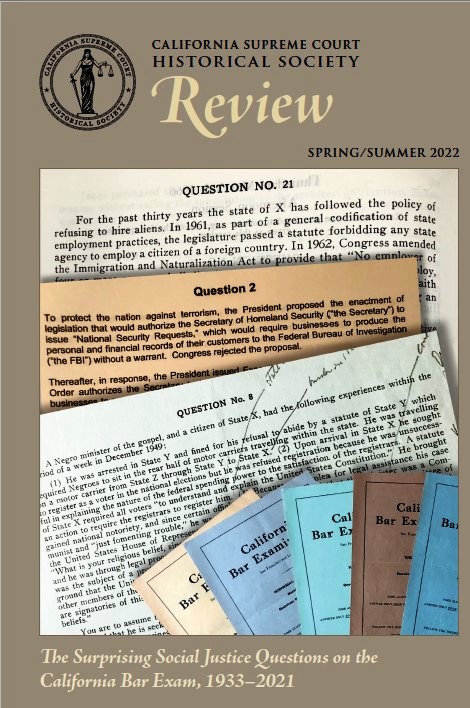
In our current issue, attorney Colleen Regan and I detail how California’s bar examination questions, to our surprise, tracked some of the twentieth century’s most pressing political and policy issues. In addition to asking prospective lawyers to untangle hypothetical negligence, contract and inheritance disputes, the California bar exam, from 1933-2021 often presented questions involving racial and gender equality, free speech, association, and religious expression — issues that generated fierce national debate and often violence. In addition to demonstrating the basic competencies necessary to practice law, we conclude that bar examiners in past decades included these social justice questions because they believed that lawyers had a responsibility to think broadly about equity and civil rights — issues newly resonant, particularly in the post–World War II years.

Monday, March 15, 2021

Cummings on Lawyers and the Struggle for LA

Scott L. Cummings, UCLA Law, has published An Equal Place: Lawyers in the Struggle for Los Angeles (Oxford University Press, 2020):

An Equal Place
is a monumental study of the role of lawyers in the movement to challenge economic inequality in one of America's most unequal cities: Los Angeles. Breaking with the traditional focus on national civil rights history, the book turns to the stories of contemporary lawyers, on the front lines and behind the scenes, who use law to reshape the meaning of low-wage work in the local economy.

Covering a transformative period of L.A. history, from the 1992 riots to the 2008 recession, Scott Cummings presents an unflinching account of five pivotal campaigns in which lawyers ally with local movements to challenge the abuses of garment sweatshops, the criminalization of day labor, the gentrification of downtown retail, the incursion of Wal-Mart groceries, and the misclassification of port truck drivers.

Through these campaigns, lawyers and activists define the city as a space for redefining work in vital industries transformed by deindustrialization, outsourcing, and immigration. Organizing arises outside of traditional labor law, powered by community-labor and racial justice groups using levers of local government to ultimately change the nature of labor law itself. 
Cummings shows that sophisticated legal strategy — engaging yet extending beyond courts, in which lawyers are equal partners in social movements — is an indispensable part of the effort to make L.A. a more equal place. Challenging accounts of lawyers' negative impact on movements, Cummings argues that the L.A. campaigns have achieved meaningful reform, while strengthening the position of workers in local politics, through legal innovation. Dissecting the reasons for failure alongside the conditions for success, this groundbreaking book illuminates the crucial role of lawyers in forging a new model of city-building for the twenty-first century.

--Dan Ernst

Thursday, February 25, 2021

CSCHS Research Travel Grant in California Legal History

[We have the following announcement.  DRE]

The CSCHS Research Travel Grant in California Legal History
.  The California Supreme Court Historical Society has established a Research Travel Grant to defray the expenses of graduate students and law students at accredited U.S. universities and law schools who are researching California legal history for the purpose of preparing an article or other paper.

This grant was funded by the generosity of California Supreme Court Justice Kathryn Mickle Werdegar (Ret.) and David M. Werdegar, M.D., in honor of Selma Moidel Smith, Editor-in-Chief of California Legal History. Additional donations are welcome to ensure the continuation of this grant program.

Thursday, November 12, 2020

Assistant to the Executive Director at NJCHS

[We have the following job announcement.  DRE]

Assistant to the Executive Director for the Ninth Judicial Circuit Historical Society

The Ninth Judicial Circuit Historical Society (NJCHS) is seeking an Assistant to work in close partnership with the Executive Director promoting awareness of the important role that the judicial system plays in our society. The successful candidate will bring their creativity, attention to detail, and passion to the work of the Society by designing outreach and other materials, helping build and support events, supporting educational and member outreach, and performing administrative tasks and other projects as needed. 

What is the NJCHS?  The NJCHS is a 501(c)(3) whose mission is to preserve and promote the vibrant history of the law in the Ninth Circuit, and to raise awareness of the important role that the judicial system plays in our society. We accomplish our mission through an ambitious schedule of programming, exhibits, oral histories, and publication of our journal, Western Legal History. More information about the Society is available on our website.

Responsibilities include (but are not limited to):

Communications Support

  • Design newsletters to send to members
  • Maintain WordPress website including creating and supporting webpages for key events, programs, and fundraising initiatives
  • Design, create and/or update PowerPoint presentations for Board Meetings and/or events
  • Assist in designing print and digital media such as flyers, T-shirts, posters, and announcement materials
  • Maintain membership database (Little Green Light) updating and tracking memberships and sending monthly renewal letters

Administrative Support

  • Help coordinate tracking and reporting of payments, sponsorships, and membership dues
  • Maintain accounts payable/receivable along with depositing and tracking checks
  • Supervise all bank accounts including credit card account and responsible for reviewing and compiling monthly bank statements
  • Maintain Stripe account and coordinate integration throughout all platforms
  • Track project budgets for special events such as our Annual Gala
  • Manage incoming and outgoing mail

Special Events

  •  Support registration and logistical support related to special events
  • Run Zoom webinars for virtual events including practice sessions
  • Liaison with other organizations and teams to coordinate co-sponsored events

Qualifications

  • You have 1-2 years of experience in an administrative and/or project coordination role
  • Strong written and verbal communication skill
  • Experience with a variety of technology systems, and ability to troubleshoot and research solutions when needed
  • Experience working in Google Suite, Zoom, Excel, WordPress and Mailchimp
  • Familiarity with basic graphic design
  • Working with nonprofits, foundations, and/or government agencies is a plus
  • Experience working with a CRM system (Salesforce, LGL etc.) is a plus 

Personal Qualities

  • The NJCHS has a very small staff, so you are highly organized, a team player, flexible, and thrive in a fast-paced work environment where you have real responsibility in a supportive environment
  • You are an effective communicator and a proactive problem solver  
  • Familiarity with the role of the judiciary a plus

Position Details

  • Start date: January 2021
  • This can be either a full-time position or part time position. While we are currently working remotely, successful candidates are expected to be available for in-person work in the San Francisco Bay Area post-Covid.
  • Salary commensurate with experience 

To Apply

If this sounds like a perfect fit for your expertise and interest, please email executivedirector@njchs.org and include a personalized cover letter and your resume. Please include Assistant to the Director in the subject line of the email.

Tuesday, September 15, 2020

Haksgaard on the Homestead Rights of Deserted Wives

Hannah Haksgaard, University of South Dakota Knudson School of Law, has posted The Homesteading Rights of Deserted Wives: A History, which is forthcoming in the Nebraska Law Review:
Mrs. Faro Caudill, Ironing (NYPL)
During the late nineteenth and early twentieth centuries, the federal government of the United States distributed 270 million acres of land to homesteaders. The federal land-grant legislation allowed single women, but not married women, to partake in homesteading. Existing in a “legal netherworld” between single and married, deserted wives did not have clear rights under the federal legislation, much like deserted wives did not have clear rights in American marital law. During the homesteading period, many deserted wives litigated claims in front of the Department of the Interior, arguing they had the right to homestead. This is the first article to collect and analyze the administrative decisions regarding the homesteading rights of deserted wives, offering a unique view of American marriage. After documenting the history of homesteading rights of deserted wives, this Article explores how these unique administrative decisions adopted or rejected the prevailing marital norms in America and how understanding these administrative decisions can aid in our understanding of marriage in American history.
–Dan Ernst

Monday, May 18, 2020

Federal Grazing Policy, 1891-1950

Harold Ickes (center); Edward Taylor (left) LC
[Longtime LHB readers will recall that for the exam in my legal history course I write an essay about some regulatory regime I did not cover in class and ask students to compare it with the ones we did.  The topics of previous essays include motor carrier regulation, meat inspection, and the US Commerce Court.  This year’s essay, on federal grazing policy, follows.  Dan Ernst.]

The federal government once owned all the land in the continental United States, except for the original thirteen colonies and Texas. It disposed of most of the land in the East and Midwest through land sales, overseen by the General Land Office (GLO), an agency within the Department of the Interior.  After the passage of the Homestead Act of 1862, Americans could obtain title to 160 acres by paying a small fee, making some improvements, and residing on the “homestead” for five years.  By the 1890s, most fertile land was in private hands, but most of the land west of the 100th meridian, a line running from North Dakota through Texas, had too little rainfall for crops without irrigation and remained in the public domain.  The land was chiefly valuable for grazing, principally beef cattle, run by stockmen in specific ranges, and sheep, herded over great distances.  Aside from scattered homesteads (ultimately expanded to 640 acres for ranches), use of the public domain was unregulated, as the GLO’s mission was to distribute land and not to plan its wise use.  Range wars between large and small cattle operators and between cattle stockmen and sheep herders abounded.  The latter conflicts were particularly intense, because sheep left grass too short for cattle to graze upon, and cattle refused to graze where sheep were pasturing.  Cattlemen referred to sheep as “hoofed locusts,” yet, as Farrington Carpenter, a Colorado stockman who will play a large role in our story, once complained, “We had no way of keeping a sheep man off a cow range.”

Friday, March 6, 2020

Craig's "Stringfellow Acid Pits"

We received word the other day of another addition to the shelf of book-length case studies on environmental law (ours includes Duncan Maysille’s Ducktown Smoke and William Buzbee’s Fighting Westway).  It is Stringfellow Acid Pits: The Toxic and Legal Legacy (University of Michigan Press, 2020) by Brian Craig, a lawyer in Logan, Utah and a full-time adjunct faculty member in the School of Legal Studies at Purdue University Global.
Stringfellow Acid Pits tells the story of one of the most toxic places in the United States, and of an epic legal battle waged to clean up the site and hold those responsible accountable. In 1955, California officials approached rock quarry owner James Stringfellow about using his land in Riverside County, east of Los Angeles, as a hazardous dump site. Officials claimed it was a natural waste disposal site because of the impermeable rocks that underlay the surface. They were gravely mistaken. Over 33 million gallons of industrial chemicals from more than a dozen of the nation’s most prominent companies poured into the site’s unlined ponds. In the 1960s and 1970s, heavy rains forced surges of chemical-laden water into Pyrite Creek and the nearby town of Glen Avon. Children played in the froth, making fake beards with the chemical foam. The liquid waste contaminated the groundwater, threatening the drinking water for hundreds of thousands of California residents. Penny Newman, a special education teacher and mother, led a grassroots army of so-called “hysterical housewives” who demanded answers and fought to clean up the toxic dump.

The ensuing three-decade legal saga involved more than 1,000 lawyers, 4,000 plaintiffs, and nearly 200 defendants, and led to the longest civil trial in California history. The author unveils the environmental and legal history surrounding the Stringfellow Acid Pits through meticulous research based on personal interviews, court records, EPA documents, and other documents. The contamination at the Stringfellow site will linger for hundreds of years. The legal fight has had an equally indelible influence, shaping environmental law, toxic torts, appellate procedure, takings law, and insurance coverage, into the present day.
--Dan Ernst

Saturday, January 25, 2020

Weekend Roundup

  • With the help of Michael J. Wishnie and his clinic students at Yale Law School, a powerhouse group of legal historians has submitted an amicus brief to the U.S. Supreme Court in Department of Homeland Security v. Thuraissigiam. Signers include Lauren Benton, Barbara Aronstein Black, Paul Brand, Kevin Costello, Christine Desan, Lisa Ford, Eric Freedman, Robert Gordon, Thomas Green, Paul Halliday, Hendrik Hartog, Elizabeth Papp Kamali, Stanley Katz, David Lieberman, Michael Lobban, Bernadette Meyler, Eben Moglen, Hannah Weiss Muller, James Oldham, Wilfred Priest, Jonathan Rose, David J. Seipp, and John Fabian Witt.  
  • The Ipse Dixit podcast has posted an episode on antitrust history, featuring Christopher L. Sagers (Cleveland-Marshall School of Law).  
  • HNN's interview of Chilton Varner, the president of the Supreme Court Historical Society, is here.
  • Martti Koskenniemi presents "What is the History of International Law a History of?" to the  EuroStorie research seminar at the University of Helsinki on January 31.  More.
  • Via HNN, here is a report on an American Historical Association panel on the history of presidential misconduct, with Kathryn Olmstead, Kevin M. Kruse, Jeremi Suri, and James M. Banner, Jr., based on the book, Presidential Misconduct: From George Washington to Today, ed. Banner (New Press, 2019). 
  • Andrew Delbanco, the author of The War before the War: Fugitive Slaves and the Struggle for America’s Soul from the Revolution to the Civil War, speaks at the FDR Presidential Library at 2:00 p.m. on Sunday, February 9, 2020.
  • A response to Guest blogger David S. Schwartz's guest blogposts here in December--by Michael Ramsey on the Originalism Blog here, with a response to the response by David Schwartz here.
Weekend Roundup is a weekly feature compiled by all the Legal History bloggers.

Thursday, October 31, 2019

WLH 30:1-2: Woman Suffrage in the US West

Western Legal History 30:1-2 (2019), is a symposium issue on woman suffrage in the American West, with an overview, “How the Woman’s Vote was Won in the West,” by Rebecca  J.  Mead and contributions on Alaska, Arizona, California, Idaho, Montana, Nevada, Oregon, Washington, and Wyoming.  Also: book reviews.  The issue is available here.

–Dan Ernst

Monday, June 10, 2019

Ablavsky on Administrative Constitutionalism in the Northwest Territory

Gregory Ablavsky, Stanford Law School, has posted Administrative Constitutionalism in the Northwest Territory, which is forthcoming in the University of Pennsylvania Law Review:
Map of Part of the Northwest Territory, 1796 (NYPL)
Both critics and proponents of administrative law’s constitutional pedigree have posited a constitutional “hole” surrounding administration at the time of the Constitution’s drafting. Challenging this account, this Essay examines the Northwest Ordinance and the territorial government it established as a progenitor of what later became known as the administrative state. The statute empowered unelected, federally appointed officials outside the Article III judiciary to exercise legislative and judicial authority over U.S. citizens. This constitutional history underscores that the creation of the United States did not simply repudiate British imperial models in favor of concepts of popular sovereignty and equal footing. Rather, in the territories, the new federal government chose to reconstruct colonial structures of governance over its own citizens, a process that reopened pre-revolutionary debates. This Essay traces two particularly intense constitutional controversies in the Northwest Territory in the 1790s that both had strong prewar echoes: contests over the relationship between civil and military authority, and fights over the territories’ legal status within the new constitutional order. Both debates, I argue, were litigated within the early American territorial analog of the administrative state, but neither achieved any definitive resolution. Rather, the temporary nature of territorial status allowed the new nation to evade the tensions between territorial governance and the Revolution’s purported republican principles, deferring this challenge to future generations.

Wednesday, February 27, 2019

Research Travel Grants in California Legal History

[We have word from the California Supreme Court Historical Society of its program of Research Travel Grants in California Legal History.]

The California Supreme Court Historical Society (“the Society”) has established a Research Travel Grant, funded by the generosity of California Supreme Court Justice Kathryn Mickle Werdegar (Ret.) and David M. Werdegar, M.D., in honor of Selma Moidel Smith, Editor-in-Chief of California Legal History.

Pursuant to this grant, the Society will defray the expenses of graduate students and law students at accredited U.S. universities and law schools who are researching California legal history for purposes of preparing an article or other paper on that subject and need to travel to access archival materials related thereto. It is expected that most travel will be to or within California, but exceptions will be made in the case of relevant archival materials in other locations. The Society will award individual grants to be used to defray the cost of travel and/or accommodation in amounts typically no more than $700 per project, with a maximum of $1,000 in special cases.  Grants will be awarded on a rolling basis until such time as the fund for the grant is exhausted.

Grant applications must include the following information:

(1) A brief description of the project that necessitates the travel. This description must identify the specific archival collection or collections that the grantee wishes to access;

(2) An itemized estimate of the expenses associated with the research trip, which reflect economical choices of travel and accommodation;

(3) A statement whether the applicant intends to enter the resulting paper in the Society’s Selma Moidel Smith Student Writing Competition in California Legal History;

(4) A copy of the applicant’s curriculum vitae; and

(5) A brief letter of recommendation from a person familiar with the applicant’s scholarly work.

Applicants should send materials by e-mail or conventional mail to:

Professor Reuel Schiller
University of California
Hastings College of the Law
200 McAllister Street
San Francisco, CA 94706
schiller@uchastings.edu

Grant applications will be expeditiously reviewed by a three-person review committee of faculty from differing institutions and must be approved by a unanimous vote.  Applicants are encouraged to enter the Society’s Selma Moidel Smith Student Writing Competition in California Legal History and are also advised that publishable works resulting from this grant will be considered for inclusion in the Society’s annual journal, California Legal History.