Showing posts with label law and medicine; history of science; psychiatry; history of the professions. Show all posts

Monday, June 17, 2019

Helmholz on "The Profession of Ecclesiastical Lawyers"

New from Cambridge University Press: The Profession of Ecclesiastical Lawyers: An Historical Introduction, by R. H. Helmholz (University of Chicago). A description from the Press:
Historians of the English legal profession have written comparatively little about the lawyers who served in the courts of the Church. This volume fills a gap; it investigates the law by which they were governed and discusses their careers in legal practice. Using sources drawn from the Roman and canon laws and also from manuscripts found in local archives, R. H. Helmholz brings together previously published work and new evidence about the professional careers of these men. His book covers the careers of many lesser known ecclesiastical lawyers, dealing with their education in law, their reaction to the coming of the Reformation, and their relationship with English common lawyers on the eve of the Civil War. Making connections with the European ius commune, this volume will be of special interest to English and Continental legal historians, as well as to students of the relationship between law and religion.
A few blurbs:
‘This valuable book by one of our most eminent legal historians is the product of fifty years engagement with the history of the Church courts in England. It not only provides new insights into the careers of eighteen very different ecclesiastical lawyers over seven centuries but also (in the first half) prepares the way with an accessible and authoritative history of their profession.' -- John H. Baker 
‘The Profession of Ecclesiastical Lawyers: An Historical Introduction is an important contribution to the literature on the history of the legal profession by the leading scholar of canon law. It combines a thorough and insightful analysis of the development, education, and regulation of a somewhat neglected segment of the English legal profession with a view of the profession through the activities of its practitioners.' -- Jonathan Rose
More information, including the TOC, is available here.

-- Karen Tani

Friday, May 10, 2019

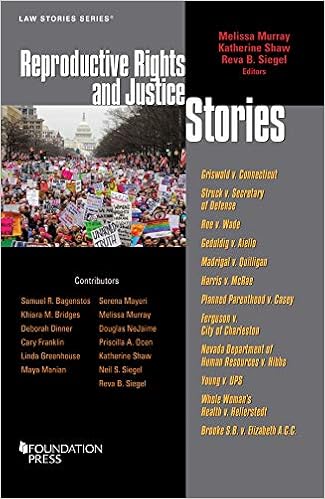
Murray, Shaw, & Seigel, eds., "Reproductive Rights and Justice Stories"

New from Foundation Press, in the "Law Stories" Series, Reproductive Rights and Justice Stories, edited by Melissa Murray (NYU Law), Katherine Shaw (Benjamin N. Cardozo School of Law), and Reva B. Siegel (Yale Law School). A description from the Press:
This book tells the movement and litigation stories behind important reproductive rights and justice cases. The twelve chapters span topics including contraception, abortion, pregnancy, and assisted reproductive technologies, telling the stories of these cases using a wide-lens perspective that illuminates the complex ways law is debated and forged―in social movements, in representative government, and in courts. Some of the chapters shed new light on cases that are very much part of the constitutional law canon―Griswold v. Connecticut, Roe v. Wade, Planned Parenthood v. Casey, Nevada Department of Human Resources v. Hibbs. Others introduce the reader to new cases from state and lower federal courts that illuminate paths not taken in the law. 
Reading the cases together highlights the lived horizon in which individuals have encountered and struggled with questions of reproductive rights and justice at different eras in our nation’s history―and so reveals the many faces of law and legal change. The volume is being published at a critical and perhaps pivotal moment for this area of law. The changing composition of the Supreme Court, increased executive and legislative action, and shifting political interests have all pushed issues of reproductive rights and justice to the forefront of contemporary discourse. The volume is suited to a wide range of law school courses, including constitutional law, family law, employment law, and reproductive rights and justice; it could also be assigned in undergraduate or graduate courses on history, gender studies, and reproductive rights and justice.
All of the editors have contributed solo- or co-authored essays. The other contributors are: Samuel R. Bagenstos (University of Michigan Law); Khiara M. Bridges (Boston University School of Law); Deborah Dinner (Emory Law); Cary Franklin (University of Texas at Austin School of Law); Linda Greenhouse (New York Times/Yale Law School); Maya Manian (University of San Francisco School of Law); Serena Mayeri (University of Pennsylvania School of Law); Douglas NeJaime (Yale Law School); Priscilla A. Ocen (Loyola Law School, Los Angeles); Neil S. Siegel (Duke Law).

It looks like some of the essays are available on SSRN. For example, here is Reva Siegel and Linda Greenhouse's chapter on "The Unfinished Story of Roe v. Wade."

Monday, April 29, 2019

"A Dangerous Idea" at the National Constitution Center

A Dangerous Idea, a session on the history of eugenics in the United States, will be held at the National Constitution Center in Philadelphia on May 2, 2019 from 06:30 PM until 08:00 PM. 
Exactly 92 years after the infamous Buck v. Bell decision, the Center presents a partial screening of “A Dangerous Idea: Eugenics, Genetics and the American Dream”—an award-winning documentary exploring the legal history of the eugenics movement in the United States. Following the screening, the film’s executive producer, writer, and attorney Andrew Kimbrell, acclaimed author and journalist Daniel Okrent, and law and bioethics scholars Paul Lombardo and Dorothy Roberts discuss the dark history of eugenics and the Constitution. CLE credit available. A DVD signing with Andrew Kimbrell and book signing with Daniel Okrent will follow the program.
H/t: Main Line Today. --Dan Ernst

Friday, March 2, 2018

Vaughn on Blumenthal's Law and the Modern Mind

Lea Vaughn, University of Washington School of Law has published a review essay of Susanna Blumenthal's Law and the Modern Mind (2016) in the Journal of Legal Education 65:1 (autumn 2017). From the piece:
This review essay will proceed in three parts followed by a conclusion that assesses the success and contribution of [Susanna Blumenthal's] work. The first section sketches her approach to legal history and her point of view. Professor Blumenthal takes on the monumental task of challenging the received wisdom of legal historians such as Willard Hurst. Second, this review will paint a condensed portrait of Blumenthal’s methodology. Her book and its underlying analysis draw on a breathtaking base of source materials: Hundreds of cases, treatises, and biographical notes are woven into her observations. The careful depiction and analysis of these materials is central to establishing her thesis: that the traditional account of the development of American law, as a unitary response to wealth accumulation and the growth of the industrial society, paints a false portrait of unanimity of opinion. Rather, she argues, jurists were faced with competing accounts of the mind and legal responsibility; more often than not they chose pragmatically among these accounts, so it is overly simplistic to characterize American legal developments as a unitary or linear march of progress. Importantly, in contrast to the usual approaches in the legal history literature that focus on criminal law, Blumenthal turns her attention to cases in the areas of wills, family law, contracts (particularly insurance contracts), and torts. Finally, the third part of this review will outline what is one of the most powerful, and, in my mind, important contributions of her book—an in-depth analysis of the intersection of law and medicine in the period under study. This analysis, as I will note, can be brought to bear on modern conversations involving law, genetics, and neuroscience. Some lessons about the use of science in law that emerge from her study are worth repeating.
The review essay is available here.