Showing posts with label sexual assault. Show all posts

Monday, April 13, 2026

Lake on Men's Suits for Sexual Misconduct Defamation

Jessica Lake, Melbourne Law School, has published Professional authority and institutional integrity: men's suits for sexual misconduct defamation in nineteenth-century America, open access, in the American Journal of Legal History:

Since the #MeToo movement, prominent men accused of sexual misconduct have frequently brought defamation claims against their accusers and media companies that have published the allegations. This trend has generated a wealth of debate and scholarship, but little research has placed such cases within a historical context. This article seeks to fill this gap in legal history by examining men’s sexual misconduct defamation claims in the nineteenth-century United States. By analysing numerous court records and connecting them with shifts in work patterns and models of masculinity, it argues that men’s claims for sexual misconduct defamation were increasingly connected to the rise of the professions during the nineteenth century. Whereas ideas of ‘male fortitude’ in the face of sexual accusations were central to judicial adjudication of rural men’s claims—particularly farmers—courts took the vindication of the sexual reputations of urban, professional men more seriously. Such scandals had the capacity not just to insult or wound individual feelings or threaten bonds of community or kin, but they could imperil respect for the emerging professions and undermine the authority of social institutions. Scandals involving professors could erode the repute of universities, reports about doctors could undermine respect for medicine, rumours about lawyers could breed distrust of the courts, and news articles about teachers could threaten the education system. Defamation cases show that men’s sexual transgressions mattered most when they questioned the authority of professional expertise and republican projects of other men.

--Dan Ernst

Wednesday, March 20, 2024

Tani on the History of the Tort of "Wrongful LIfe"

Last year, I had the privilege of participating in the Clifford Symposium at DePaul College of Law -- an annual convening of torts scholars. The symposium theme in 2023 was "new torts." The published versions of the symposium papers are now available. My contribution is titled "When a Wrong Creates a Life: Tort Responses to Children Born From Institutional Sexual Violence." Much of the article draws on history, so I'm noting it here. Here's the abstract:

Today, the paradigm case of “wrongful life” involves a claim on behalf of a child—typically, a disabled child—who would not exist but for an act of negligent reproductive healthcare. Framed in this way, the tort of “wrongful life” is controversial, and rightfully so. This Article, part of a symposium on “new torts,” reminds readers that one of the nation’s earliest reported “wrongful life” cases arose from a very different set of facts: Williams v. State, filed in 1963 in New York City, stemmed from the alleged rape and impregnation of a patient at a large, state-run psychiatric hospital; through a guardian, the resulting child sought monetary compensation from the state for the disadvantages that flowed from these circumstances. Importantly, the lower court that initially considered this claim found it within the bounds of what tort law could and should provide. But a different interpretation prevailed at the appellate level, and, for historically contingent reasons, Williams v. State largely disappeared from view. Instead, cases from the medical negligence context came to dominate judicial discussions—and rejections—of the seemingly “new tort” of “wrongful life.” This Article urges a reconsideration of Williams v. State and the sub-set of “wrongful life” cases that it represents—namely, cases involving (1) nonconsensual intercourse and impregnation in an institutional setting, resulting in a child, and (2) an institutional defendant that arguably violated a duty of care by allowing this sequence of events to occur. Such reconsideration is warranted for several reasons, including evidence that such incidents continue to occur in institutional settings (nursing homes, residential treatment facilities, prisons, etc.); post-Dobbs changes to state-level abortion laws, which will increase the number of pregnancies that lead to live births; and theoretical and doctrinal developments within tort law itself. 

The full article is available here. Other legal-historical contributions to this symposium include Molly Brady on "cottages as public nuisances" (previously noted here) and Kenneth S. Abraham & G. Edward White on "How an Old Tort Became New: The Case of Offensive Battery."

-- Karen Tani

Thursday, August 24, 2023

Legal History in the "The Oxford Handbook of Feminism and Law in the United States"

Oxford University Press has published The Oxford Handbook of Feminism and Law in the United States, edited by Deborah Brake (University of Pittsburgh School of Law), Martha Chamallas (Moritz College of Law - the Ohio State University), and Verna Williams (University of Cincinnati College of Law). A number of the chapters may interest readers of the blog. Here's an overview from the Press:

Combining analyses of feminist legal theory, legal doctrine, and feminist social movements, The Oxford Handbook of Feminism and Law in the United States offers a comprehensive overview of U.S. legal feminism. Contributions by leading feminist thinkers trace the impacts of legal feminism on legal claims and defenses and demonstrate how feminism has altered and transformed understandings of basic legal concepts, from sexual harassment and gender equity in sports to new conceptions of consent and motherhood. Its chapters connect legal feminism to adjacent intellectual discourses, such as masculinities theory and queer theory, and scrutinize criticisms and backlash to feminism from all sides of the political spectrum. Its examination of the prominent brands of feminist legal theory shows the links and divergences among feminist scholars, highlighting the continued relevance of established theories (liberal, dominance, and relational feminism) and the increased importance of new intersectional, sex-positive, and postmodern approaches. Unique in its triple focus on theory, doctrine, and social movements, the Handbook recounts the history of activist struggles to pass the Equal Right Amendment, the Anti-Rape and Battered Movements of the 1970s, the contemporary movements for reproductive justice and against campus sexual assault, as well as the #MeToo movement. The emphasis on theory and feminist practice animates discussions of feminist legal pedagogy and feminist influences on judges and judicial decision making. Chapters on emerging areas of law ripe for feminist analysis explore foundational subjects such as contracts, tax, and tort law, and imagine feminist and social justice approaches to digital privacy and intellectual property law, environmental law, and immigration law. The Handbook provides a broad picture of the intellectual landscape and allows both new and established scholars to gain an in-depth understanding of the full range of feminist influence on U.S. law.

A selection of chapters of possible interest:

Tracy A Thomas, "The Long History of Feminist Legal Theory"

Julie Suk, "The Equal Rights Amendment, Then and Now" 

Leigh Goodmark, "The Anti-Rape and Battered Women’s Movements of the 1970s and 1980s"

Mary Ziegler, "From Reproductive Rights to Reproductive Justice: Abortion in Constitutional Law and Politics" 

Deborah Widiss, "Pregnancy and Work: 50 Years of Legal Theory, Litigation, and Legislation"

Melissa Murray and Hilarie Meyers, "Constitutionalizing Reproductive Rights (and Justice)" 

h/t Legal Theory Blog

-- Karen Tani

Wednesday, March 1, 2023

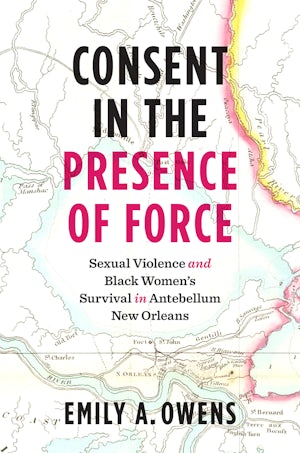
Owens, "Consent in the Presence of Force Sexual Violence and Black Women's Survival in Antebellum New Orleans"

The University of North Carolina press has published Consent in the Presence of Force
Sexual Violence and Black Women's Survival in Antebellum New Orleans
(2022), by Emily A. Owens (Brown University). A description from the Press: 

In histories of enslavement and in Black women's history, coercion looms large in any discussion of sex and sexuality. At a time when sexual violence against Black women was virtually unregulated—even normalized—a vast economy developed specifically to sell the sexual labor of Black women. In this vividly rendered book, Emily A. Owens wrestles with the question of why white men paid notoriously high prices to gain sexual access to the bodies of enslaved women to whom they already had legal and social access.

Owens centers the survival strategies and intellectual labor of Black women enslaved in New Orleans to unravel the culture of violence they endured, in which slaveholders obscured "the presence of force" with arrangements that included gifts and money. Owens's storytelling highlights that the classic formulation of rape law that requires "the presence of force" and "the absence of consent" to denote a crime was in fact a key legal fixture that packaged predation as pleasure and produced, rather than prevented, violence against Black women. Owens dramatically reorients our understanding of enslaved women's lives as well as of the nature of violence in the entire venture of racial slavery in the U.S. South. Unsettling the idea that consent is necessarily incompatible with structural and interpersonal violence, this history shows that when sex is understood as a transaction, women are imagined as responsible for their own violation.

Advance praise:

"In Consent in the Presence of Force, Owens exactingly demonstrates the gaping and lingering question in the historiography of gender and slavery—how do we read sexual relations between enslaved women and white men beyond the failing dichotomy of consent and coercion? This question has been raised, theorized, and analyzed without a satisfying resolution that approximates the actual legal, social, and affective conditions of female-gendered enslavement. Owens offers completely new ways to account for Black women's subtle, but not less violent, vulnerability to sexual danger in the antebellum South."—Marisa J. Fuentes

"A necessary and highly anticipated work that dramatically upends current conceptions of sexual violence. Owens has given us a book that both crucially advances the historical literature and supersedes that historiography with broader scholarly and political reverberations."—Sarah Haley

More information is available here. An interview with Professor Owens about the book is available here, at New Books Network.

-- Karen Tani

Saturday, January 14, 2023

Weekend Roundup

  • Two law schools have recently noted publications by legal historians: NYU Law has a notice of Noah Rosenblum’s Columbia Law Review article, “The Antifascist Roots of Presidential Administration,” and Georgetown Law notes Brad Snyder’s Democratic Justice: Felix Frankfurter, the Supreme Court, and the Making of the Liberal Establishment." 
  • On Wednesday, January 18, at 6 p.m., the Virginia Museum of History and Culture and the John Marshall Center for Constitutional History and Civics will host three former Solicitors General (Clement, Verrilli, and Francisco) in conversation “on the U.S. Supreme Court’s history and founding under the leadership of the country’s first Chief Justice, John Marshall, as well as drawing comparisons between then and now” (More.)
  • The National Constitution Center has posted The History of the Speaker of the House, a discussion, moderated by Jeffrey Rosen, by Matthew Green and Josh Chafetz.  They discuss “the role and the history of this powerful constitutional office” and “some of the most notable Speakers throughout history, from Henry Clay to Joe Cannon to Nancy Pelosi,
  • Until January 31, the most-read essays of 2022 from Labor, the journal of the Labor and Working-Class history Association, are available open access.  Most are from a symposium on sexual harassment.
  • The Supreme Court Historical Society is hosting a virtual conversation with the Honorable M. Margaret McKeown about her book, Citizen Justice: The Environmental Legacy of William O. Douglas, at 7:00 p.m. (ET) on January 25, 2023
  • ICYMI: be sure to check out The Steelyard, Hansard Merchants, and a “Misliving” Singlewoman in Late Medieval London, by Sara M. Butler, over at Legal History Miscellany.
  • We were very impressed by and grateful for the career of Elizabeth Pugh, who, after a 44-year career in government service, has recently retired as general counsel of the Library of Congress (LAW360 Pulse).
Weekend Roundup is a weekly feature compiled by all the Legal History blogger.

Tuesday, August 3, 2021

Stern, "The NAACP's Rape Docket and the Origins of Criminal Procedure"

Scott W. Stern (independent scholar) has posted "The NAACP's Rape Docket and the Origins of Criminal Procedure," which appears in the University of Pennsylvania Journal of Law and Social Change (2021). Here's the abstract:

This Article provides the definitive account of the surprisingly voluminous docket of rape cases argued by the National Association for the Advancement of Colored People (NAACP). It argues, for the first time, that the NAACP’s rape docket was central to the development of modern criminal procedure — to the establishment of the right to counsel, the right to remain silent, the right to a trial free from mob violence or influence, the right to not have a coerced confession used against you, and the right to a jury of your peers selected without discrimination. Drawing on original archival research, this Article demonstrates that all of these rights have their origins in the hundreds of cases argued by the NAACP on behalf of Black men accused of sexual assault by white women.

This Article also argues that these cases were central to the development of the NAACP’s legal department, the relationships between local branches and the national office, and the careers of the famous civil rights attorneys — from Charles Hamilton Houston to Jack Greenberg — who rose to national prominence with the NAACP. Thus, these cases were central to the development of civil rights litigation itself. Indeed, the first significant Supreme Court case argued for the NAACP by a Black attorney was an interracial rape case. The first Supreme Court case ever argued by a Black woman, Constance Baker Motley, was an interracial rape case. The first case that Thurgood Marshall ever argued before the Supreme Court was an interracial rape case. Several scholars have noted how individual rape cases were pivotal in the careers of individual NAACP lawyers, but no scholar has argued that these cases together constituted a significant docket that was pivotal to nearly all of their careers.

Finally, this Article examines cases in which the NAACP advocated for Black women who accused white men of sexual assault. Throughout its history, the national office of the NAACP advocated for Black female rape survivors only rarely. In contrast, the local branches of the Association did advocate for dozens of Black women who had been raped by white men, often pushing the police to investigate, the prosecutors to bring charges, and sometimes even hiring their own attorneys to aid in prosecutions. Yet at no point did NAACP attorneys ever challenge the rape laws that placed punitively high demands on assault survivors and impeded countless prosecutions. This was largely because NAACP attorneys embraced the very politics of respectability that justified sexist rape laws; indeed, NAACP attorneys capitalized on the gendered aspects of these laws in their representation of Black men accused of rape. Many Black women throughout the decades demanded the NAACP engage more often in anti-rape work — demands that usually met with deaf ears. Had the NAACP acceded to these demands and pushed for a criminal procedure focused not just on protecting rape suspects but also on protecting rape survivors, the greater protections for these survivors that are written into modern rape laws could have come about much sooner.

The full article is available here.

-- Karen Tani

Saturday, March 14, 2020

Weekend Roundup

  • The Organization of American Historians has cancelled its annual meeting. But you can still skim the excellent program that the organizers put together. Margot Canaday (Princeton University) and Craig Steven Wilder (MIT) co-chaired the program committee. AND, if you were scheduled to present, check out this invitation (via Twitter) from The Docket (the online companion to the Law & History Review): "We’re sad about all that awesome #legalhistory scholarship that was going to be at #OAH20 and we’d like to be of service. The Docket will publish abstracts, full papers, etc. for any law, policy, or politics related OAH panel!" 
  • For those who have moved to online teaching, Twitter is filled with good resources right now. For example, Aimi Hamraie (Vanderbilt University) tweeted out an excellent guide to "accessible teaching in the time of COVID-19," tapping into some hard-won wisdom from "disabled culture and community." 
  • The Library of Congress may be closed to the public, but we believe its “crowdsourcing initiative By the People” continues.  The newest campaign to enlist the public’s help in making "digital collection items more searchable and accessible online is Herencia: Centuries of Spanish Legal Documents includes thousands of pages of historical documents in Spanish, Latin and Catalan."
  • ICYMI: An exhibit at the Lombard Historical Society on “the first woman to ever vote in an Illinois municipal election, an attorney named Ellen Martin.”  Patti Smith’s blurb of Ralph Nader’s cookbook: “A wonderful blend of consumer protection and consumer pleasure.” H/t: JLG
  • And if you can face it: Duke University Press has put together this Navigating the Threat of Pandemics collection--free to read online until June 1 (books) and Oct.1 (articles). LHB readers may appreciate this one especially.
Weekend Roundup is a weekly feature compiled by all the Legal History bloggers. 

Friday, February 1, 2019

Welcome, Elizabeth Thornberry!

We are excited to introduce our guest blogger for February 2019. Elizabeth Thornberry is Assistant Professor of History at Johns Hopkins University.

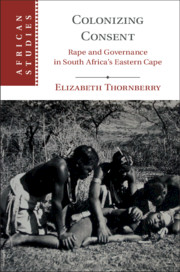
Elizabeth ThornberryProfessor Thornberry is a historian of South Africa. Her work spans the history of gender, sexuality, empire, and law in Southern Africa and across the continent. Her first book, Colonizing Consent: Rape and Governance in South Africa's Eastern Cape was published recently by Cambridge University Press (we noted it here).

After doing a BA at Harvard and a Master's degree at Oxford, Professor Thornberry obtained a PhD in History at Stanford. She taught at Hobart and William Smith Colleges from 2011-16 and has been a member of the History department at Johns Hopkins since 2016. Prof. Thornberry was a visiting scholar at the Centre for Law and Society at the University of Cape Town in 2013. In 2018-19, she is a Davis Center fellow at Princeton's History department.

Prof. Thornberry has published articles on sexual and domestic violence, virginity testing, forced marriage, and custom in journals including the Journal of Southern African Studies and the African Studies Review. With Richard Roberts and Emily Burrill, she is co-editor of the volume, Domestic Violence and the Law in Colonial and Postcolonial Africa (Ohio University Press, 2010). Elizabeth Thornberry is currently working on her second book, whose provisional title is Imagining African Law: Black Intellectuals and the Politics of Custom in South Africa, 1880-1927. 

For further information on Prof. Thornberry's research, see her faculty profile here.

Monday, January 14, 2019

Thornberry on Rape in South Africa

Out this month with Cambridge University Press is Colonizing Consent: Rape and Governance in South Africa's Eastern Cape by Elizabeth Thornberry, Johns Hopkins University. From the publisher: 
Colonizing ConsentElizabeth Thornberry uses historical evidence to shed light on South Africa's contemporary epidemic of sexual violence. Drawing on over a thousand cases from a diverse set of courts, Thornberry reconstructs the history of rape in South Africa's Eastern Cape, from the precolonial era to the triumph of legal and sexual segregation, and digs deep into questions of conceptions of sexual consent. Through this process, Thornberry also demonstrates the political stakes of disputes over sexual consent, and the ways in which debates over the regulation of sexuality shaped both white and black politics in this period. From customary authority to missionary Christianity and humanitarian liberalism to segregationism, political claims implied theories of sexual consent, and enabled distinctive claims to control female sexuality. The political history of rape illuminates not only South Africa's contemporary crisis of sexual violence, but the entangled histories of law, sexuality, and politics across the globe.
Here is the Table of Contents:

  • Introduction: writing the history of rape
  • 1. Custom and consent in Xhosaland
  • 2. Sex and spiritual power
  • 3. Liberalism and the colonial law of sexual violence
  • 4. Rape and racial boundaries
  • 5. Navigating the politics of consent
  • Conclusion: rape and the postcolony.
Further information is available here.