Tuesday, January 18, 2011

Ahonen reviews Bessel & Haake, "Removing Peoples"

Over at H-Net, you can find a review of Removing Peoples: Forced Removal in the Modern World (London: Oxford University Press, 2009), edited by Richard Bessel (University of York) and Claudia B. Haake (La Trobe University).

According to reviewer Pertti Ahonen (University of Edinburgh), the volume "sets out to provide broad, comparative perspectives on the study of forced migrations in the modern era" ("defined here as the period from roughly the early 19th century onwards"). The editors aim "to bring together . . . instances of forced population movements that have often been treated as distinct entities in the existing literature," as well as "to transcend the categories ‘ethnic cleansing’ and ‘genocide’ that have dominated much of the relevant historiography."

"This is an ambitious agenda," Ahonen writes, "which the volume pursues through seventeen chapters that cover a wide range of topics, both geographically and temporally, stretching from forced relocations of Native Americans in the early 19th century United States to anti-guerrilla military campaigns in the so-called Third World during the Cold War."

For more on the strengths and limitations of the volume, including commentary on particular contributions, check out the full review (available here).

Hat tip: bookforum

Short on the Paranoid Style in Regulatory Reform

My Georgetown Law colleague Jodi L. Short has posted The Paranoid Style in Regulatory Reform. Here is the abstract:
The U.S. administrative state has been involved in a decades-long regulatory reform project encompassing both a shift away from what have been characterized as “command-and-control” approaches to regulation and toward approaches that are more market-oriented, managerial, participatory and self-regulatory in their orientation. Through a content analysis of the nearly 1,400 law review articles that comprise the legal critique of regulation between 1980 and 2005, I show that the most salient critiques of regulation concern neither its cost nor its inefficiency, as many have assumed. Instead, they express a deep-seated anxiety about the fundamentally coercive nature of administrative government. In addition, I demonstrate that “voluntary” or “self-regulation” approaches that enlist regulated entities and citizens to perform core governmental functions like standard-setting, monitoring and enforcement emerged from the reform debate with particular prominence. Using both statistical and interpretive inference, I argue that framing regulation as a problem of coercive state power created a logic of governance uniquely suited to self-regulatory solutions that promised non-coercive ways of governing. After presenting my empirical analysis, I situate the coercive state rhetoric of late-twentieth-century regulatory reform in broader historical context, highlighting its continuities and discontinuities with the coercive state rhetoric that has infused debates about expanded federal governance throughout U.S. history: at the founding, during the New Deal, and in the postwar period. I argue that proponents of government regulation must recognize and engage this deep-seated anxiety about state coercion. Before a convincing and durable case can be made for any particular regulatory policy, a case must be made for the state.

Monday, January 17, 2011

Brown-Nagin, Courage to Dissent: Atlanta and the Long History of the Civil Rights Movement

2011 promises to be a blockbuster year in legal history-related books.  Published just this month is Tomiko Brown-Nagin's important new book, Courage to Dissent: Atlanta and the Long History of the Civil Rights Movement.  Hat tip to Al Brophy.  Here's the book description:
The Civil Rights movement that emerged in the United States after World War II was a reaction against centuries of racial discrimination. In this sweeping history of the Civil Rights movement in Atlanta--the South's largest and most economically important city--from the 1940s through 1980, Tomiko Brown-Nagin shows that the movement featured a vast array of activists and many sophisticated approaches to activism. Long before "black power" emerged and gave black dissent from the mainstream civil rights agenda a new name, African Americans in Atlanta debated the meaning of equality and the steps necessary to obtain social and economic justice.

This groundbreaking book uncovers the activism of visionaries-both well-known legal figures and unsung citizens-from across the ideological spectrum who sought something different from, or more complicated than, "integration." Local activists often played leading roles in carrying out the integrationist agenda of the NAACP, but some also pursued goals that differed markedly from those of the venerable civil rights organization. Brown-Nagin discusses debates over politics, housing, public accommodations, and schools. She documents how the bruising battle over school desegregation in the 1970s, which featured opposing camps of African Americans, had its roots in the years before Brown v. Board of Education .

Exploring the complex interplay between the local and national, between lawyers and communities, between elites and grassroots, and between middle-class and working-class African Americans,Courage to Dissent tells gripping stories about the long struggle for equality that speak to the nation's current urban crisis. This remarkable book will transform our understanding of the Civil Rights era. 
 And the blurbs:
"Courage to Dissent is a magnificent achievement, brilliantly analyzing significant tensions within the civil rights movement: between different classes, generations, local and national actors, proponents of direct action and litigation, clients and lawyers. Elegantly written, prodigiously researched, and compellingly argued, Brown-Nagin has made an extraordinary contribution."--Michael J. Klarman, Harvard Law School, and winner of the 2005 Bancroft Prize for From Jim Crow to Civil Rights
 
"In an excellent work, Professor Brown-Nagin shines a welcome spotlight on unsung 'movement lawyers' like Donald Hollowell, Howard Moore, Jr., and Len Holt--legal warriors and allies of civil rights activists whose courage and skill have gone unrecognized. In the process, she reminds us of the possibility of nobility in the law and the legal profession."--Julian Bond, Chairman of the National Association for the Advancement of Colored People, 1998-2010

"In her magisterial account of the Civil Rights movement in Atlanta, Tomiko Brown-Nagin shows that it was not just elites working at the national level who had the power to change the course of history. Rather, the grassroots, composed of thousands of ordinary citizens, was crucial. Working together involved lots of conflict; yet, Brown-Nagin opens the door on a truly amazing synergy that ushered in a long overdue revolution. Courage to Dissent is a masterpiece of rigorous scholarship, careful analysis and good old-fashioned story-telling."--Lani Guinier, Professor of Law, Harvard University

"This is an absolutely compelling study of the tangled history of civil rights in Atlanta following World War II (and especially Brown v. Board of Education ). No one interested in the actual operation of our fragmented legal system can ignore it, not to mention anyone interested in finding out more about the remarkable cast of characters who contended with one another in trying to shape the future of the South's most important city."--Sanford Levinson, Professor of Law and Government, University of Texas
Here's the table of contents.

Brown-Nagin is Justice Thurgood Marshall Distinguished Professor of Law and Professor of History at the University of Virginia, and an upcoming guest blogger on the Legal History Blog.

Sunday, January 16, 2011

War, Politics, Passports, and Haiti in the Book Reviews

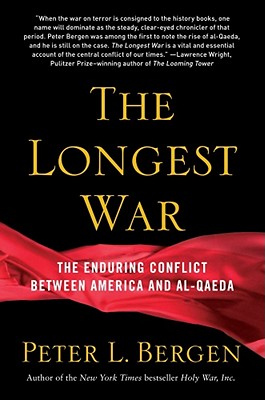
THE LONGEST WAR:  The Enduring Conflict Between America and Al-Qaeda by Peter L. Bergen is "a history of our time," writes Thomas E. Ricks in the New York Times, and the first book "to credibly cover the global sweep of events over the last 10 years, exploring not just American views but also Al Qaeda’s."   When it comes to 9/11, the author "relates the events...through the eyes of the intelligence specialists in the American government who had been studying Al Qaeda for years."

The Passport In America: The History of a Document by Craig Robertson is taken up in The New Republic/The Book.  According to Michael Idov, the book "traces the relatively fast and remarkably recent evolution of the American passport from an exotic exception to a common and standardized shorthand for identity itself. Robertson locates this transformation between the 1880s and 1930s."

Also in the New York Times, a review of Haiti Noir, an anthology about Haiti before and after last year's earthquake, edited by Edwidge Danticat.

The Black History of the White House by Clarence Lusane is reviewed in the San Francisco Chronicle.  The book begins by noting that "more than one in four U.S. presidents were involved in human trafficking and slavery."

In the Los Angeles Times, My Father at 100: A Memoir by Ron Reagan, and Revival: The Struggle for Survival Inside the Obama White House by Richard Wolffe.

Saturday, January 15, 2011

Kay Mills has died

Kay Mills
Journalist and biographer Kay Mills, 69, died of a heart attack this week in Santa Monica, California.  Mills will be best known to LHB readers as the author of the first full-length biography of civil rights legend Fanny Lou Hamer. This Little Light of Mine:  The Life of Fannie Lou Hamer is a riveting account of Hamer's life as a sharecropper in Mississippi and the path that led her to capture the nation's attention during the 1964 Democratic National Convention.  The Mississippi Freedom Democratic Party challenged the regular Mississippi delegation, since African Americans in the state were disenfranchised. "If the Freedom Democratic Party is not seated now, I question America," Hamer said in powerful, televised testimony. "Is this America? The land of the free and the home of the brave? Where we have to sleep with our telephones off the hook, because our lives be threatened daily." As a compromise measure the Democratic Party leadership offered the MFDP delegation two seats, which they refused. Hamer said: "We didn't come for no two seats when all of us is tired."

Mills' book was awarded the 1993-94 Julia Spruill Book prize for the best book on Southern women's history from the Southern Associaiton of Women's Historians.  A pioneering journalist once denied a job when an editor asked "what would you do if someone you were covering ducked into the men's room?" Mills was also the author of Something Better for My Children: How Head Start Has Changed the Lives of Millions of Children and Changing Channels: The Civil Rights Case that Transformed Television and other works.  More about Mills and her work is here.

Kay Mills was also my neighbor for a number of years when I first moved to Santa Monica to teach at USC.  Meeting her was an immediate affirmation that intellectual life in Southern California is not a non-sequiter, and that vibrant writers and ideas are to be found outside the academy, and sometimes right down the street.  She will be missed.

Weekend Roundup

  • "Over the past 10 years, numerous research universities' strategic plans have called for increased interdisciplinary work," writes Myra Strober (Graduate School of Business, Stanford University), "Nonetheless, there is little evidence that it is happening." How do we explain this? And what ought universities do about it? Read Strober's full column here, at the Chronicle of Higher Ed.
  • From NPR, a brief history of the House speaker's gavel, in commemoration of its passing from one speaker to the next. ("We have accounts where he's gaveling away furiously and the head flies off and lands one or two rows down the rostrum among the reading clerks" . . . .) (image credit)
  • Over at In Custodia Legis, the blog of the law librarians of Congress, Senior Foreign Law Specialist Nicole Atwill has written a short post about slavery in the French Colonies and Le Code Noir (the Black Code) of 1685. You can read it here.
  • What belongs in Australia's new National Curriculum? Intellectual history, Bruce Buchan (Griffith University) answers, the kind found in recent studies of law and empire.

Masur on Reconstuction-Era Washington at the Wilson Center

The United States Studies Program of the Woodrow Wilson International Center for Scholars has announced a book discussion on An Example for all the Land: Emancipation and the Struggle over Equality in Washington, DC. Panelists will be the author, Kate Masur, Associate Professor of History, Northwestern University, and commentators Adam Rothman, Associate Professor of History, Georgetown University; Maurice Jackson, Associate Professor of History, Georgetown University; and (legislative schedule permitting) Jamin Raskin, Maryland State Senator and Professor of Law, American University Washington College of Law. The session will be held on Thursday, January 20, 2010, 3:00pm – 5:00 p.m., in the Fifth Floor Conference Room of the Woodrow Wilson Center, 1300 Pennsylvania Avenue N.W., Washington, D.C. The Center requests RSVPs (acceptances only) to this free public event to usstudies@wilsoncenter.org.

Says the Wilson Center:
In An Example for All the Land, Kate Masur offers a critical study of Washington during Reconstruction. Slavery’s demise spurred a national debate over the distribution of rights across racial lines. Masur follows this debate as it plays out in Washington, recounting how the capital became the nation’s vanguard of racial equality, and later – the political opposition sparked by this transformation. She reveals Washington as a laboratory for social policy during a pivotal era, and brings the question of equality to the forefront of Reconstruction scholarship.
Among the blurbs on the book from the University of North Carolina Press’s website are the following:
"An Example for all the Land, clearly argued and deeply researched, represents a significant breakthrough in the crowded field of Reconstruction scholarship. Showing how Washington, D.C. became a laboratory for political experimentation, Masur reveals important new facets to the process of emancipation, the fight for racial justice, and the reconstruction of democracy for all Americans."
--Laura F. Edwards, author of The People and Their Peace: Legal Culture and the Transformation of Inequality in the Post-Revolutionary South

"The constriction of citizenship rights in the nation's capital is a story little told but rich with both symbolic and practical meaning. Masur's intriguing history of Reconstruction in the District is justified and fruitful."
--Jane Dailey, University of Chicago

Friday, January 14, 2011

Lepore on the Constitution and Its Worshippers

The most recent issue of the New Yorker features an essay by Jill Lepore (Harvard University) on "The Constitution and Its Worshippers."

Lepore includes interesting anecdotes from the Constitution's life: Benjamin Franklin's tepid approval (he consented to it because he "expect[ed] no better," and because he was "not sure, that it is not the best”); the original document's journeys via Model T and armored truck; the enduring popularity of the "pocket" version. She also sprinkles the essay with observations about why Americans continue to venerate the Constitution, do battle over its meaning, and accuse others of knowing nothing about it.

I found the last paragraph particularly striking:
The Constitution is ink on parchment. It is forty-four hundred words. And it is, too, the accreted set of meanings that have been made of those words, the amendments, the failed amendments, the struggles, the debates—the course of events—over more than two centuries. It is not easy, but it is everyone’s. It is the rule of law, the opinions of the Court, the stripes on William Grimes’s back, a shrine in the National Archives, a sign carried on the Washington Mall, and the noise all of us make when we disagree. If the Constitution is a fiddle, it is also all the music that has ever been played on it. Some of that music is beautiful; much of it is humdrum; some of it sounds like hell.
You can read the full article here.

Thursday, January 13, 2011

West on Tom Paine's Constitution

Tom Paine's Constitution has just been posted by Robin L. West, Georgetown University Law Center.  It appeared in the Virginia Law Review, Vol. 89, 2003.  Here's the abstract:
In Common Sense, our brief for the American Revolution, the pamphleteer Tom Paine famously declared that "in America the law is king." What, precisely, is the "law" that Paine declared to have dethroned the king? Does the phrase, penned by the advocate not only of our revolution but also of the rights of man everywhere, presage our modern practice of rights-based constitutionalism? This reading – in America, constitutional law is king – might also make Paine an early friend of judicial review, as he was unquestionably also a friend of United States constitutionalism, both federal and state. Paine’s manifesto can thus be read as having foreseen the unfolding of our modern court-centered constitutional consciousness. This Article argues that this is an attractive but untenable reading of Paine’s philosophy and offers evidence that Paine’s conception of the Constitution and law itself diverge crucially from dominant understandings. The Article then asks how modern constitutional practices might be different if Justice Marshall had enforced Paine’s conception of the Constitution in Marbury and McCulloch, and concludes with some thoughts on what we have lost by turning away from Paine’s constitutional vision.

Tushnet on Harry Kalven and Kenneth Karst

Mark Tushnet, Harvard Law School, has posted a new essay, Harry Kalven and Kenneth Karst in the Supreme Court Review: Reflections after Fifty Years.  Here's the abstract:
This Essay, written for the fiftieth anniversary volume of the Supreme Court Review, examines two articles in the initial volume, Harry Kalven’s on the law of obscenity and Kenneth Karst’s on legislative facts in constitutional adjudication. Both articles exhibit a scholarly temperament of engaged detachment. Unlike much recent work in constitutional law, the articles are entirely doctrinal – and not the worse for that. The articles show that the questions that scholars today regard as deep were already reasonably well understood fifty years ago. The Essay concludes by speculating that the rise of “constitutional theory” explains the disappearance of the sensibility Kalven and Karst exhibited. That rise may have conduced to characterization of those who disagreed with the writer’s preferred constitutional theory as either fools or knaves: fools, because they lacked the intellectual capacity to understand the compelling logic of the arguments supporting the theory, or knaves, because, knowing that the theory was the best one available, they willfully disregarded it in the service of their personal projects. The ideas that the constitutional questions the Supreme Court deals with are genuinely difficult and that the Justices, people of varying intellectual ability, can reasonably disagree over those questions are almost completely absent from today’s constitutional discourse – and those who try to advance those ideas are dismissed as naïve (fools) or as pursuing a concealed political agenda (knaves).

Maxwell reviews Schmidtz & Brennan, A Brief History of Liberty

The Law & Politics Book Review has posted a review of A Brief History of Liberty (Malden, MA: Wiley-Blackwell Publishing, 2010), by David Schmidtz (University of Arizona) and Jason Brennan (Brown University).

Reviewer Lida Maxwell (Department of Political Science, Trinity College), introduces the book as follows:
In A BRIEF HISTORY OF LIBERTY, the philosophers David Schmidtz and Jason Brennan seek to offer a brief “history of liberty, not a history of theorizing about liberty” for a general readership (p.1). By this, Schmidtz and Brennan mean that they want to tell a story about how liberty arose on the ground and, from telling this story, teach us something about how we should understand the conditions and problems of liberty today. The authors admit at the outset that they are telling “a story of liberty” (my emphasis, p.18) and not the story of liberty. Their story, as they make clear, is a story of the rise of negative liberty, which they define as individual liberty, secured by the rule of law and property rights: “The point of negative liberty has less to do with what liberty guarantees and more to do with what liberty gives people the chance to do for themselves” (p.9). Yet they also want to make the case that securing negative liberty encourages the development of positive liberty, which they understand as the development of the capacities to live a good life through having meaningful choices about what kind of life to live. Securing negative liberty, they suggest, “has a history of enabling people to achieve positive freedom. That is to say, in (negatively) free countries, people generally have more real choice” insofar as they have “options together with the capacities to exercise these options successfully” (p.17).
In Maxwell's view, this volume "may be appropriate to use in an undergraduate upper level course on theories of freedom" or "as one exemplar of a liberal view of liberty, again in an undergraduate course."

You can access the full review here. You can find another review, written from the philosopher's perspective, here.

Wednesday, January 12, 2011

The Haiti Legal Patrimony Project

The Law Library Microform Consortium has undertaken a project to help rebuild Haiti’s law libraries after the devastating earthquake that hit the country a year ago today. Member libraries are working to build a digital law library from libraries around the world. They have created a Master Title List consisting of a constitutional section, a legislative and administrative section, a judicial section, general treatises, U.S. documents and treatises, and multi-jurisdiction titles. Law librarians are helping by checking their own libraries for titles.

You can find more information about the project here.

Hat tip: Shane Landrum

Dubber on The Legality Principle in American and German Criminal Law

The Legality Principle in American and German Criminal Law: An Essay in Comparative Legal History has just been posted by Markus D. Dubber, University of Toronto - Faculty of Law.  The abstract is too short, so here are the first two paragraphs:
This paper begins by briefly recounting the (non-)history of the principle of legality in American criminal law. This account of an absence of lawness is complemented by an account of the presence of policeness, the history of American penality being presented within the framework of the relationship and tension between law and police as two fundamental modes of governance. The predominant history of American penality turns out to be the history of American penal police, rather than of penal law, as the state’s power to punish is conceptualized as an instance of the state’s power to police.

The short history of the non-legality of American penality is then transformed, and expanded, into an exploration of the potential of comparative legal history as a tool of critical analysis of law, outlining the contours of a cross-temporal and cross-systemic analysis of the principle of legality, with the history of the principle of legality in German criminal law as a point of comparison.

In Memoriam: A.W. Brian Simpson (1933-2011)

The University of Michigan Law School's website is reporting the death of the great English legal historian Alfred William Brian Simpson at his home in Kent on January 10, 2011. Professor Simpson taught at the University of Kent, the University of Cambridge and, in the United States, at the University of Chicago's and the University of Michigan's law schools. Michigan's webpage provides an introduction to his scholarly achievements, which included election to the American Academy of Arts and Sciences. This montage of the last class he taught at Michigan, student comments on the course ("seriously, I couldn't love awbs more if I tried"), and the fact that he had his own fan club on Facebook suggest how warmly law students responded to his teaching.

Hat tip: Leiter

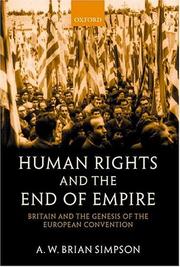
Update: I was so sorry to hear this news. Thanks to Dan for posting. I wanted to add that for anyone with an interest in human rights, or in transnational history, or simply in great works of legal history, Simpson's book Human Rights and the End of Empire: Britain and the Genesis of the European Convention is a must read. I only had an opportunity to meet Prof. Simpson once. I was doing a workshop at Michigan, and he was my commentator. He was as warm and kind as he was brilliant. His students and colleagues are fortunate to have had such a presence among them. MLD

A further update: Here is a link to a podcast of Professor Simpson 2008 lecture "Detention without Trial in Wartime Britain," delivered at the Aspen Institute, for the Foundation for Law, Justice and Society, "an independent institution affiliated with the Centre for Socio-Legal Studies at the University of Oxford." As the synopsis has it, the lecture is "an account of the response of the courts to detention without trial during World War II, in which they largely abandoned any role in protecting civil liberty." Simpson further argued that "the European Human Rights Act of 1998 has radically altered this position, though the inherent problems involved when regular courts monitor the activities of security services in times of crisis persist today. DRE

A New Essay Collection on the Thirteenth Amendment

Here's a book announcement for a new collection of essays, The Promises of Liberty: The History and Contemporary Relevance of the Thirteenth Amendment (Columbia University Press 2010).
In these original essays, America's leading historians and legal scholars reassess the ratification of the Thirteenth Amendment and its relevance to issues of liberty, justice, and equality. The Thirteenth Amendment abolished slavery in the United States, reasserting the radical, egalitarian dimensions of the Constitution. It also laid the foundations for future civil rights and social justice legislation. Yet subsequent reinterpretation and misappropriation have curbed more substantive change. With constitutional jurisprudence undergoing a revival, The Promises of Liberty provides a full portrait of the Thirteenth Amendment and its potential for ensuring liberty.

The collection begins with Pulitzer Prize-winning historian David Brion Davis, who discusses the failure of the Thirteenth Amendment to achieve its framers' objectives. The next piece, by Alexander Tsesis, provides a detailed account of the Amendment's revolutionary character. James M. McPherson, another Pulitzer recipient, recounts the influence of abolitionists on the ratification process, and Paul Finkelman focuses on who freed the slaves and President Lincoln's commitment to ending slavery. Michael Vorenberg revisits the nineteenth century's understanding of freedom and citizenship and the Amendment's surprisingly small role in the Reconstruction and post-Reconstruction periods. William M. Wiecek shows how the Supreme Court's narrow interpretation once rendered the guarantee of freedom nearly illusory, and the collection's third Pulitzer Prize winner, David M. Oshinsky, explains how peonage undermined the prohibition against compulsory service.

Subsequent essays relate the Thirteenth Amendment to congressional authority, hate crimes legislation, the labor movement, and immigrant rights. These chapters analyze unique features of the amendment along with its elusive meanings and affirm its power to reform criminal and immigration law, affirmative action policies, and the protection of civil liberties.
Here are some blurbs:
"The Thirteenth Amendment freeing the slaves was a landmark not only for the Constitution but for American society. Yet its enforcement and application, beyond the simple fact of emancipation, remain a source of both inspiration and disappointment. In this impressive collection of essays, a stellar group of historians and legal scholars address the Amendment's origins and early applications and the tantalizing though frustrated idea that its promise of equality remains to be fulfilled. From the vantage point of history and the law alike, The Promises of Liberty enables an understanding of why the Thirteenth Amendment mattered and why its complex legacy is so challenging to assess." — Jack Rakove, Stanford University, author of The Annotated U.S. Constitution and Declaration of Independence and Revolutionaries: A New History of the Invention of America

"Alexander Tsesis has edited a fascinating collection of essays from experts who explain why the Thirteenth Amendment did not fulfill the promises of liberty during Reconstruction and afterward. He provides the most extensive scholarly discussion of the history of the Amendment published in decades. Essays on the application of the Thirteenth Amendment to today's controversies are enlightening and provocative." — Mary Frances Berry, University of Pennsylvania

"These provocative and learned essays restore the Thirteenth Amendment to a central place in the long history of citizenship and freedom in the United States. They demonstrate its continuing relevance to overcoming inequalities in today's society." — Eric Foner, Columbia University, author of The Fiery Trial: Abraham Lincoln and American Slavery

Tuesday, January 11, 2011

Cott on the History of Marriage Laws

Nancy Cott has an article, “No Objections: What History Tells Us About Gay Marriage,” on the history of marriage laws in the latest issue of the Boston Review. Cott writes:

Opponents of equal marriage rights for same-sex couples say that marriage has always been between a man and a woman and must remain so. They argue from “tradition.” Counter to their claims is an argument from history—a history of change over time.

Many features of marriage that were once considered essential have been remade, often in the face of strong resistance, by courts and legislatures. Economic and social changes have led to increasing legal equality for the marriage partners, gender-neutrality of spousal roles, and control of marital role-definition by spouses themselves rather than by state prescription. Yet marriage itself has lasted, despite these dramatic changes. Not only that: it retains vast appeal.

Read the rest of the article here.

Westbrook reviews Rodgers, "The Age of Fracture"

Earlier Dan posted this announcement, about an upcoming (January 12) Book Discussion on The Age of Fracture (Harvard University Press, 2011). It features author Daniel T. Rodgers (Princeton University) and commentators John Judis (The New Republic) and Michael Kimmage (Catholic University).

Now we have this review, by historian Robert Westbrook (University of Rochester). Here are the opening paragraphs:
In The Communist Manifesto, Karl Marx and Friedrich Engels offered one of history's best-known characterizations of modernity. In the "bourgeois epoch," they said, "all fixed, fast-frozen relations, with their train of ancient and venerable prejudices and opinions, are swept away, all new-formed ones become antiquated before they can ossify. All that is solid melts into air, all that is holy is profaned."

This formulation was an exaggeration—it appeared in a manifesto, after all. But unlike Marx and Engels's hope for a communist future, their insights into modernity remain perspicacious. Capitalism is still very much with us, communist prospects have never been dimmer, but the ground of modernity continues as it did in 1848 to shift and shake under our feet.

Since Marx's day, artists and intellectuals have sought to meet the challenge of modernity by remaking our conceptual categories so that they might better capture and embrace—or resist—this fluidity, this profane melting of shared experience. And at times, this project has taken on an accelerated pace and urgency. The last generation has proved one of those times, not least in the United States.

That, at any rate, is the claim of Princeton University historian Daniel T. Rodgers in Age of Fracture, and he makes a compelling case for it. . . . .
Westbrook goes on to describe Rodgers's "series of penetrating soundings into the social thought of the end of the twentieth century." He also gives us a sense of some of the "big books" that are Rodgers's fodder:
Alvin Toffler's Future Shock (1970), John Rawls's A Theory of Justice (1971), Clifford Geertz's The Interpretation of Cultures (1973), Robert Nozick's Anarchy, State and Utopia (1974), Michel Foucault's Discipline and Punish (1977), William Julius Wilson's The Declining Significance of Race (1978), George Gilder's Wealth and Poverty (1981), Michael Walzer's Spheres of Justice (1983), Charles Murray's Losing Ground (1984), Allan Bloom's The Closing of the American Mind (1987), Judith Butler's Gender Trouble (1990), and Francis Fukuyama's The End of History (1992).
Westbrook concludes the review by comparing Rodgers's outlook to that of Rutgers historian James Livingston (author of The World Turned Inside Out (2009)). Whereas Livingston regards "the age of fracture" with "exhilarati[on]," Westbrook opines, Rodgers appears "unsettled."

Read the full review here.
(Hat tip: Bookforum)

UPDATE: Rodgers also talked about the book during a recent panel at the AHA. The panel, which also featured historians Doug Rossinow and Kim Phillips-Fein, was about how to make sense of the 1980s as a historical period.
Jeremi Suri moderated; Michael Kazin commented. You can view C-SPAN's recording of the conversation here. (Hat tip: LHB reader Adam G.)

Monday, January 10, 2011

Texas History Department Launches "Not Even Past"

[Via H-Law, we have the following announcement of the University of Texas History Department virtual bridge to a public interested in things historical. Not Even Past is well worth checking out. The production values are quite good, and it is, in effect, a challenge to any academic inclined simply to kvetch about popular history. I also suspect it's a way to build a constituency for academic history that might prove helpful when state legislators turn to budget cutting. Check out especially, among the "virtual courses," H.W. Brand's "The Essence of Leadership: Ben Franklin, Andrew Jackson, FDR." It is a series of three virtual chats, each based on one of Brand's books.]

The History Department at UT Austin is launching an informative, interactive history web site today, January 10. Not Even Past provides current historical writing to a popular audience. For history buffs who want reading recommendations and short, interesting, digestible stories every day, the website offers a meaningful, dynamic, and ongoing conversation about History in the form of text, audio, and video histories on subjects that span the globe. The site is designed for anyone who is interested in history, from an avid reader of history to a history film aficionado.

The content and "picks" are written by the department's 60-person faculty with additional input from the graduate students. Notevenpast.org is rich with book and film recommendations, video interviews, podcasts, online commentary, and even virtual classes (free) every semester. You can learn from exceptional faculty and dialog with other history aficionados and Texas Exes, enrolled globally.

The History Department's new site is one-of-a-kind -- no other university or institution offers a similar resource. Not Even Past will be identified with the individuals in the History Department at UT, giving readers a personalized experience of great history writing as well as promoting the strengths of the department and the University of Texas. Not Even Past also differs from other History department sites in its stylish visual design and its cutting-edge user-friendly functionality.

Joan Neuberger, Editor
George Christian, Assistant Editor, Features Editor

At launch today the website has six major features

MAIN FEATURE:
This section will focus on a recent book by a UT faculty member. The January edition showcases Jacqueline Jones' "Saving Savannah: The City and the Civil War" and includes a short video interview with the author; a text discussion of the book; a live chat with the author; an on-going book club discussion; suggestions for related reading; a podcast of an excerpt from the book.

READ AND WATCH:
Learn what the department's exceptional historians and their graduate students are reading, and which books and history films they recommend. Scan written and video reviews of books by category: Featured Reads, United States, Europe, Latin America, Africa, Asia, Middle East, and Transnational. With one click, add your comments, or instantly order books/films that you want. The home page will link to book recommendations chosen by our faculty and graduate students and one featured video book discussion; the January edition will have a video of George Forgie discussing books on the Civil War. The home page will link to discussions of current and classic historical films. In January, Frank Guridy will discuss two films about Cuba and Madeline Hsu writes about Wayne Wang's Chan is Missing.

DISCOVER:
Discover fascinating, little-known, or rarely-viewed images and texts ... from collections at UT Austin and around the world. Learn what each of these jewels teaches us about history. In January, Erika Bsumek writes about a Navajo rug in our Fine Arts library collection; Martha Newman writes about work and religion in 12-century France. David Crew will contribute a piece of wedding photographs taken in Jewish ghettos under Nazi rule.

LISTEN:
Beef up your podcast library with special global interviews and excerpts from campus history conferences and classes. Enjoy daily history FACT CHECKS and myth busting. Learn more Texas history. Access NEP for stories from Texas' past: oral histories, photo essays, and great books. This section will feature oral histories and interviews and will link to all our podcasts. The January edition will include oral histories from recent India and Pakistan and an article on LBJ's Vietnam policy, with an audio of his phone conversations.

TEXAS:
Texas history of all kinds. January will include an excerpt from Emilio Zamora's new book on Mexican-Americans in Texas during WWII, and a photo essay by Bob Abzug on Jewish cemeteries and synagogues in Texas.

In addition to extensive comment and history chat areas throughout NEP, take any of the three virtual courses offered each semester (no tests!). Learn from outstanding award-winning faculty and share your thoughts and questions with other history buffs and Texas Exes ... enrolled globally. Register on the site to be eligible for free autographed books by UT Austin History faculty. A scrolling ticker across the home page will post daily twitter feed updates and a feature we call "The Fact Checker" which will offer links to short articles correcting historical myths and common historical misconceptions.

Price on Federalization of the Mosquito: Structural Innovation in the New Deal Administrative State

Federalization of the Mosquito: Structural Innovation in the New Deal Administrative State has just been posted by Polly J. Price, Emory University School of Law.  It appeared in the Emory Law Journal, Vol. 60, 2010.  Here's the abstract:
Malaria was a significant problem in the southern United States during the early decades of the twentieth century. Part of President Franklin D. Roosevelt’s New Deal focused on economic development of the South, with improvement of public health in that region as an integral part. This Article is a case study of increased federal public health efforts during the New Deal and World War II eras, which replaced some traditionally state and local areas of control. Efforts to "federalize" the mosquito encountered significant limitations, and never accomplished primary federal responsibility for the eradication of malaria. One federal agency in particular - the Office of Malaria Control in War Areas - institutionalized the federal response to malaria in the South during World War II. This assertion of wartime jurisdiction maintained only nominally the primacy of state authority.

The New Deal administrative state saw structural experimentation and innovation at a grand level; this Article’s study of federal efforts to combat malaria in the southern United States provides a good example. In one decade, federal efforts ranged from Works Progress Administration employment, experiments with scientific expertise within the Tennessee Valley Authority, federal intervention in civilian areas as a war strength rationale, and malaria control by federal appropriation. The most significant step resulted from reorganization of the New Deal administrative state under the Federal Security Agency, an independent agency of the U.S. government established pursuant to the Reorganization Act of 1939.

From a federalization perspective, a critical point is that the federal government initiated a malaria eradication effort with broad jurisdiction that helped reshape public perception of the federal government’s responsibilities. It did so under a "national security" mandate that blurred the distinction between domestic and international security, with an effect on the federal government’s regulatory power. But the federal government then withdrew from this wartime assertion of jurisdiction, leaving public health federalism largely unchanged.
Image source.

The Challenges of International Legal History: Reflections from the AHA

Legal historians had a range of interesting panels to choose from at the AHA conference in Boston this past weekend. I attended several panels that addressed the meaning, practice, and implications of international and transnational history, and the particular challenges of researching, writing, and publishing beyond the traditional borders of national histories.

As William Hitchcock, Professor of History at the University of Virginia, noted in introducing a roundtable on publishing in international history, legal historians, like scholars in so many other fields, now have excellent examples of work that helped to internationalize the study of legal history, and that have posed significant challenges to several traditional areas of historical inquiry. Hitchcock pointed to Paul Halliday, Habeus Corpus: From England to Empire(see Steve Vladeck’s series of posts on Halliday’s book here), Liz Borgwardt, A New Deal for the World: America’s Vision for Human Rights, and Mary Dudziak, Cold War Civil Rights: Race and the Image of American Democracy. These authors and others certainly encouraged me to begin to think more globally about American legal history and convinced me that there is still a great deal more to study about the implications of American law for the world, and world history for American law.

But as panelists noted this weekend, scholars working on international histories face some particular challenges. For example, commenting on a panel concerning non-state actors in the practice of foreign policy, Erez Manela, Professor of History at Harvard, suggested that because scholars studying international institutions are “not working in well-established modes,” they do not necessarily have a “built-in audience.” As international historians advance new concerns and insist upon new avenues of study, he suggested, they have to work to clearly define the stakes of their projects to connect with the familiar concerns of national histories—immigration history, state-to-state diplomacy, and the Cold War, for example. Though Manela directed his comments to the study of NGOs, his suggestions seem to apply to many areas of international and transnational inquiry.

The reasons for this are both intellectual and practical. As Susan Ferber, Executive Editor for History at Oxford University Press and Kathleen McDermott, Executive Editor for History at Harvard University Press, explained, publishers need to be able to identify the core constituencies for new work. International and transnational histories may be cutting edge and spark an editor’s interest, but ultimately, publishers need to know the stakes of a project for well-defined areas of study, which often means placing a work in a national category or categories. Some in the audience seemed disheartened by the fact that publishers’ category codes have not evolved to reflect the new terrain of international history. But Ferber and McDermott’s broader point seemed to be that publishers want original work driven by clearly defined questions to which the author provides meaningful answers.

In many cases, the innovative challenges to well-defined fields and long-standing narratives come from scholars doing international work, but not always. Whether a work is international or national in scope, within a well-defined field or on an uncharted path, the marks of good scholarship are the same: What is the original contribution? To whom does it matter? And why should we care? The answers to these questions should not rely on labeling the work “transnational” “international” or “global,” particularly given the proliferation of scholarship that can make such a claim. As Mark Bradley, Professor of History at the University of Chicago and co-editor of the series The United States in the World added, whether a project is international in scope or not, it still takes a “rich historical imagination” to make a substantial contribution to the study of history, and to get an editor’s attention.

Reflecting on some of the comments on international history at this weekend’s AHA, I wondered about the specific challenges that legal historians face when doing international and transnational work. In my own research on law in the Philippines in the early twentieth century, I have to reconcile and account for various legal traditions, institutional forms, jurisprudential disagreements and overlapping codes. I’ve found that in many cases I can answer the more technical questions with further research. The more difficult issues, it seems to me, are those that concern some of the enduring questions in the study of American legal history. International and transnational legal histories push us to think about the relationship between law and society in new ways, either because we have embraced geographic and cultural difference, expanded our understandings of legal agents and modes of exchange, or as in the case of global institutions, because our traditional definitions and understandings of “law” and “society” do not quite fit the nature of international legal institutions and aspirational international agreements.

I am interested in what others think. What other challenges have those working on transnational or international legal histories encountered? Does the international turn look different to non-U.S. scholars? Do those who have published international histories have suggestions or thoughts?

Tomlins on the Lessons of History

The December 2010 issue of Perspectives on History (the monthly newsmagazine of the AHA) is now open to non-subscribers. As usual, it includes lots of useful announcements and professional advice (e.g., "Job Market Etiquette," by Katharine Hijar). I like to spotlight the "Art of History" column, which never fails to make me re-think just what it is I'm doing as an historian. This month's column is by former guest blogger Chris Tomlins (UC Irvine). He writes about "the lessons of history" -- by which he does not mean (to use examples from his own work) "lessons about the centrality of ideas of freedom and unfreedom to American civic identity" or "about the cruelties of laws, customs, and institutions that deprive men and women of freedom’s substance." These "are lessons the way metaphors are lessons." Instead, he seeks lessons about the relationship between past, present, and future.

A summary cannot do justice to the piece, but to give a brief glimpse, Tomlins opens by outlining the conceptions of history that historians today have to offer. Borrowing from Nietzsche, he locates three: narrative history, "history as science" (or "simple accumulation" of knowledge about the past), and "complex accumulation" (treating all past phenomena as radically underdetermined). These are different, yet all "begin by putting the past in its place." Tomlins devotes the rest of the column, which you can read here, to his own ruminations on the relationship between "the past’s 'true image' and its creation" in the present.

Sunday, January 9, 2011

Reviewed: Chemerinskly, The Conservative Assault on the Constitution

Erwin Chemerinsky, constitutional scholar and Dean of the new law school at U.C. Irvine has a new book on Supreme Court history:  The Conservative Assault on the Constitution.  Tim Rutten at the Los Angeles Times finds it  "urgent" and "admirably lucid."  Chemerinsky dates the rise of legal conservatism from Richard Nixon's presidency.  It is in part a first-person account, as he builds into the story his own experiences arguing before the Supreme Court. Rutten writes:
Chemerinsky believes that our political conversation's false choice between judicial activism and neutral or "strict construction" judging has obscured the Supreme Court's authoritarian drift. The Constitution, he argues, requires interpretation — and has since the earliest days of the Republic, when the Framers still were engaged in national government — and interpretation is inherently an active process.

"The difference between liberals and conservatives," he writes, "is not in their willingness to overrule precedent or in their degree of deference to popularly elected officials or to make momentous decisions affecting society. The divergence is entirely about when they want the court to do this and for what purpose. The other difference is in their rhetoric; conservatives continue to rail against judicial activism and profess judicial restraint even though they are every bit as willing to be activist as liberals."
 Not so fast, writes Eric Posner, reviewing Chemerinsky in The Book (The New Republic).  "Erwin Chemerinsky usefully tells the story" of the rise of judicial conservatism since Richard Nixon's presidency, he writes, and he finds it "basically correct," though he has quibbles.  But Posner, a leading legal conservative, emphasizes:
The jurisprudential reaction to the Warren Court that Chemerinsky describes did not come out of thin air. Conservatives believe that Chemerinsky’s beloved Warren Court staged a liberal assault on the Constitution, which the Rehnquist and Roberts Courts have only begun to repair. The Warren Court sent the Constitution into exile, and only today is the Court in the process of escorting it home. These conservatives point out that the Constitution, as it was originally understood, never recognized a right to abortion, a right to use contraception, a right to attend a desegregated school. The various protections in the Bill of Rights did not apply to the states; the Warren Court invented the idea that states had to comply with the Bill of Rights, and so all the criminal protections it recognized are tainted as well. Some conservatives go further, arguing that New Deal-era opinions expanding the power of the national government to regulate the economy violate the original understanding of the Constitution. Far from assaulting the Constitution, conservative justices are rehabilitating a wounded document that has been distorted by liberal justices who have implemented their ideological preferences.
Much more from Posner is here.

Also on-line, a SCOTUS Blog interview with Chemerinsky about the book, and an interview on "Legally Speaking," co-sponsored by U.C. Hastings and California Lawyer.

Saturday, January 8, 2011

Weekend Roundup

  • The Historical Society has put together a post on the state of the history job market ("bleak," again). Lots of good links to related articles.
  • In honor of Thursday's reading of the U.S. Constitution on the floor of the House of Representatives, the New York Times has posted an annotated guide to the founding document, focusing on "the clauses most revered, and disputed, by advocates on either side of the political spectrum." You can find it here.
  • Jack Balkin (Yale Law School) has posted an interview he conducted with Reva Siegel and Linda Greenhouse about their recent book, Before Roe v. Wade: Voices that Shaped the Abortion Debate Before The Supreme Court's Ruling. (We've mentioned the book previously, here and here.)
  • AHA executive director Jim Grossman addresses "historical malpractice" in textbook writing. Read his views on the controversial Our Virginia: Past and Present (Five Ponds Press, 2010) here.
  • UpdateThe 2010 Cliopatria awards for the best in history blogging have been announced.  I especially recommend the winner for best group blog:  U.S. Intellectual History.  (The "I" here is MLD.)

Law & Society at German Studies

[Here's a Call for Papers for the 2011 annual meeting of the German Studies Association.]

For the 2011 German Studies Association meeting in Louisville, Kentucky, we will be convening a series of panels on the role of law in society and the economy. We construe our theme very broadly: papers might be about the law alone, about the legal implications of an economic episode, or about the cultural construction of law. We envisage a broad set of topics, from the development of specific legal practices and cultures in Germany to the function of law in wider cultural fields; from theories of law and the emergence of the so-called Rechtsstaat to the development of business law and legal integration in the nineteenth century. From the philosophy of law to the legal cultures and literatures that extend from medieval to modern periods, these panels are intended to foster an extended conversation on the law across humanities and social science disciplines.

We encourage submissions from scholars in all aspects of the law and the social sciences from various backgrounds, and are especially interested in both methodological and temporal breadth. The deadline for submissions is 28 January 2011, and should be in the form of an abstract for proposed paper and/or entire panel (150-200 words).

We encourage submission of individual papers. Whereas, the GSA prefers complete panels, we hope to combine papers sent to us into complete panels, and send them along to the GSA organizers.

Please submit abstracts both to the organizers [named below] and to the GSA

For queries and submissions, please contact:
Timothy Guinnane timothy.guinnane[at]yale.edu
Sace Elder seelder[at]eiu.edu

Hat tip: H-Law

Friday, January 7, 2011

Havens reviews Pole on Representation and the Jury in Anglo-American Legal History

The Law & Politics Book Review has posted a review of Contract and Consent: Representation and the Jury in Anglo-American Legal History (University of Virginia Press, 2010), a series of essays by the late J. R. Pole. Pole was the Rhodes Professor Emeritus of American History and Institutions at St. Catherine’s College, University of Oxford.

From reviewer Lauren Havens:
Pole argues that to better understand the development of American law, one should forget the idea of the separation of powers that we so often believe to be critical in law and the American government. While today we may take a separation of powers for granted, that separation did not come about easily or naturally. The concept of a separation of powers did not emerge in American government until after much of the law governing the colonies was already in place, and Pole wants the reader to understand how American law came into being through the intermingling of English common law with colonists’ experience. In the first part of the book, Pole focuses on the interaction between contracts, as between the governing ruler and those being governed, and the consent required to sustain that mode of government. The second part of the book comprises independent essays in which Pole discusses other legal themes important in the transition of the American colonies from being subjects of Britain to being a self-governing nation.
You can read the rest of the review here.

Image credit

Kadens on Bankruptcy Fraud in 18th-Century England

Emily Kadens, University of Texas School of Law, has posted The Pitkin Affair: A Study of Fraud in Early English Bankruptcy, which was published in the American Bankruptcy Law Journal 84 (2010). Here is the abstract:
In 1705, two London merchants, Thomas Brerewood and Thomas Pitkin, attempted to pull off a massive bankruptcy fraud. Although the conspirators were quickly caught, unraveling the scam required three large insolvencies and four acts of Parliament over the course of more than forty years. Along the way, the Pitkin Affair and its aftereffects would test and expand the boundaries of then-existing bankruptcy law. This article presents the story of the Pitkin Affair as a parable to remind us that the current scandals with which we are confronted are not new. Neither are the reactions of the parties caught in the middle of the resulting financial catastrophe. Most lied; some cheated; and many could not let go of their sense of injustice and accept that their own misjudgment, and even greed, had also contributed to their losses.

Thursday, January 6, 2011

Kolsky and Giunchi on Law in Colonial India

The current issue of the Journal of Asian Studies contains two articles on law in colonial India. The titles and abstracts follow:

Elizabeth Kolsky, “The Rule of Colonial Indifference: Rape on Trial in Early Colonial India, 1805-1807.”

This article explores the history of intraracial (Indian-on-Indian) rape in early colonial India. Though at times uneven and unpredictable in their rulings, British judges created a set of evidentiary requirements and a body of legal decisions that were as harsh on rape victims as the precolonial Islamic system was presumed to be. Despite the colonial promise of a more modern and humane criminal law, the gradual displacement of Islamic law did little to widen rape victims' path to legal remedy. English common law presumptions about the frequency of false charges and a suspicion of women's claims combined with a colonial insistence on the peculiarity of Indian culture to make it difficult for victims of rape to prevail in court. The colonial legal treatment of the "unsensational" crime of rape was rather unsensational. It largely reflected contemporary trends in England, which raises the important question of what was distinctively colonial about it.

Elisa Giunchi, “The Reinvention of Shari’a under the British Raj: In Search of Authenticity and Certainty.”

Influenced by Orientalist assumptions and Utilitarian ideals, and needing to enforce a system of adjudication that responded to their interests, the East India Company's officers selected among varied religious texts a set of norms and tried to apply them consistently. The decision to rely on texts rather than practice, the choice of certain precepts at the expense of others, and their rigid application ran counter to the traditional administration of justice, which had been fluid, contextual, and plural. They also distorted the meaning of Hanafi fiḳh, turning what had been an instrument of legitimation, a moral reference, and a source of social standing into a system of organized dispute settlement. The emphasis on religious textual sources and the attempt to use them as a basis for codification coincided with the idea, which gained ground in the nineteenth century among Muslim reformist movements, that political weakness could be countered by returning to a pristine scripturalist Islam, focused on its legal aspects and seen as a systematic doctrine devoid of ambiguities. These ideas can be also found in the Islamist thought that subsequently spread among urban reformist movements and in legal reforms adopted in Pakistan. A review of case studies, however, suggests that the flexibility and contextuality that characterized the enforcement of Islamic law in precolonial Islam is still to be found in legal practice.

For more on law in colonial India see the forum on personal law in colonial India in the current issue of the Law and History Review, and recent posts here, and here.

More on Lynching: Campney reviews Harper, "White Man's Heaven"

Coming on the heels of Clara's thoughtful post on the Bald Knobbers and new work on the history of lynching in America, we have this review from H-Law: "Who is 'Entrenched in a Southern Mindset'? Anti-Black Lynchings and Expulsions in the Southern Ozarks," by Brent Campney (University of Texas-Pan American). It reviews Kimberly Harper, White Man's Heaven: The Lynching and Expulsion of Blacks in the Southern Ozarks, 1894-1909 (Fayetteville: University of Arkansas Press, 2010).

Campney opens the review with the following summary:

Between 1894 and 1909, white residents of the Southern Ozarks repeatedly shattered and scattered the regional black population through the use of racist violence. One after another, those in Monett, Pierce City, Joplin, and Springfield, Missouri, and in Harrison Arkansas, employed mob violence (usually lynching) which terminated in the mass--and often permanent--expulsion of entire black communities. In White Man’s Heaven, historian Kimberly Harper weaves these interconnected episodes into a single narrative aimed at explaining the “regional experience” of anti-black racism and violence (p. xviii).

Organized chronologically and by community, White Man’s Heaven is part of a trend toward examining so-called sundown towns (all-white or nearly all-white towns which actively, often violently, discouraged black settlement), as exemplified by the work of George C. Wright, in Racial Violence in Kentucky, 1865-1940: Lynchings, Mob Rule, and ‘Legal Lynchings,’ (1990) and, more recently, James W. Loewen, in Sundown Towns: A Hidden Dimension of American Racism (2005), and Elliot Jaspin, in Buried in the Bitter Waters: The Hidden History of Racial Cleansing in America (2007). “The expulsion of African Americans remains an understudied aspect in the extensive literature of racial violence,” Harper rightly notes. “Expulsion was one of the most extreme forms of social control as African Americans were forced to leave behind everything they had worked for” (p. xxiv).

Harper contributes significantly to the history of race relations, demography, and mob violence in the Ozarks. After reviewing economic development and settlement patterns in each community, she provides comprehensive accounts of the violence which engulfed each, exploring the alleged black criminality which provoked white fury, analyzing the lynchings and expulsions which followed, and documenting popular support for this violence among whites. In addition, the author documents the usually fruitless efforts of black victims to pursue legal justice through the courts. Certainly, she has produced a work which will be of value to anyone interested in the nature of white supremacy and racist violence in this region or in the Border South or Midwest more generally.

The rest of the review (available here) discusses "several problems" that Campney believes "limit considerably" the book's "broader theoretical and methodological value."

Kenneth Jackson to Inaugurate Hands Lecture

Kenneth T. Jackson, the Jacques Barzun Professor of History and the Social Sciences and Director of the Herbert H. Lehman Center for American History at Columbia University, will deliver the inaugural Hands Lecture, sponsored by the Second Circuit Judicial Council Committee on History, Commemorative Events and Civic Education. He will deliver it on Friday, January 21, 2011 at 4:00 p.m. at the Daniel Patrick Moynihan United States Courthouse, 500 Pearl Street, Ceremonial Courtroom, New York, New York 10007. The public is invited to attend. RSVP by January 10, 2011 to special_events@ca2.uscourts.gov

Hat tip: H-Law

Wednesday, January 5, 2011

Rogers on the Black Campus Moverment at the Library of Congress

Ibram Rogers, a Jameson Fellow at the Library of Congress, will deliver the lecture “The Black Campus Movement and the Racial Reformation of Higher Education, 1965-72," at 12:00 PM in the Whittall Pavilion of the Thomas Jefferson Building of the Library of Congress. Here is the abstract:
Hundreds of thousands of black students, aided on some campuses by white and Latino students, demanded and protested for a relevant learning experience. At upwards of 1,000 traditionally white and historically black colleges and universities in the United States, black campus activists initiated a range of campus reforms, including the addition of more black students, faculty, administrators, and coaches, and the establishment of black cultural centers and Black Studies courses and programs. Their ultimate aim was to diversify and thus transform higher education. This Black Campus Movement of the late 1960s and early 1970s is the subject of this presentation.