Monday, March 7, 2022

ASLH invites submissions for Kathryn T. Preyer Scholars award

The American Society for Legal History seeks submissions for the Kathyrn T. Preyer Scholars Award:

Named after the late Kathryn T. Preyer, a distinguished historian of the law of early America known for her generosity to early career legal historians, the program of Kathryn T. Preyer Scholars is designed to help legal historians at the beginning of their careers. At the annual meeting of the Society two early career legal historians designated Kathryn T. Preyer Scholars will present what would normally be their first papers to the Society. The generosity of Professor Preyer’s friends and family has enabled the Society to offer a small honorarium to the Preyer Scholars and to reimburse, in some measure or entirely, their costs of attending the meeting. The competition for Preyer Scholars is organized by the Society’s Kathryn T. Preyer Memorial Committee.

Submissions are welcome on any topic in legal, institutional and/or constitutional history. Early career scholars, including those pursuing graduate or law degrees, those who have completed their terminal degree within the previous year, and those independent scholars at a comparable stage, are eligible to apply. At the annual meeting of the Society two early career legal historians designated Kathryn T. Preyer Scholars will present what would normally be their first papers to the Society. While papers simultaneously submitted to the ASLH Program committee are eligible, Preyer Award winners must present their paper as part of the Preyer panel and will be removed from any other panel.

Submissions should consist of a single MS Word document consisting of a complete curriculum vitae, contact information, and a complete draft of the paper to be presented. Papers should not exceed 50 pages (12-point font, double-spaced). In past competitions, the Committee has given preference to draft articles and essays, though the Committee will also consider shorter conference papers, as one of the criteria for selection will be the suitability of the paper for reduction to a twenty-minute oral presentation. The deadline for submission is April 1, 2022.

The two Kathryn T. Preyer Scholars will receive a $500 cash award and reimbursement of expenses up to $750 for travel, hotels, and meals. Each will present the paper that s/he submitted to the competition at the Society’s annual meeting. The Society’s journal, Law and History Review, has published several past winners of the Preyer competition, though it is under no obligation to do so.

Please send submissions by April 1, 2022 to Elizabeth Katz, Chair, Preyer Award Committee at preyeraward@aslh.net. She will forward them to other committee members.

Please note that for the 2022 competition, otherwise eligible scholars who presented at the 2021 meeting in New Orleans will remain eligible for this year’s Preyer award.

-- Karen Tani

Lapidus Fellowship for the Study of Rare Early American Legal Texts

We have the following announcement.  DRE]

credit
The William & Mary Law School and the Omohundro Institute of Early American History & Culture (OI) are pleased to offer a one-month visiting fellowship for scholars—from advanced graduate students to senior scholars—with strong interests in early American legal history. Fellows must make use of some of the resources included in the collection of rare books donated to the Wolf Law Library at W&M by Sid Lapidus as part of the exhibition “British and Colonial Antecedents of American Liberties” (October 1, 2019 through March 15, 2020). A full listing of those books can be found here.  

In addition to access to the rare book collection and proximity to a number of other Virginia research institutions—including the St. George Tucker collection and other items in Special Collections at W&M’s Swem Library, the Rockefeller Library at Colonial Williamsburg, the Library of Virginia, and the Virginia Museum of History and Culture—the fellowship provides the opportunity to experience the OI’s editorial expertise and intellectual community of early Americanists and the archive expertise of the Wolf Law Library staff.

Fellowships carry a stipend of $2,500. Fellows are expected to make their own travel and lodging arrangements for a research period in Williamsburg that lasts between one and four weeks as the scholar deems necessary. While fellows are not required to use their fellowship funds during the summer months, they are encouraged to do so if they intend to stay in Williamsburg for a prolonged period. Modest housing on the campus of W&M is available during the months of June and July at below-market rates.  More.

Sunday, March 6, 2022

Bilder to Discuss "Female Genius"

Tuesday, March 8, from 1-2 PM EST on the YouTube channel of the National Archives, Mary Sarah Bilder, Boston College Law School, joins Martha S. Jones, Johns Hopkins University, in conversation about her book Female Genius: Eliza Harriot and George Washington at the Dawn of the Constitution.

Mary Sarah Bilder looks to the 1780s—the age of the Constitution—to investigate the rise of a radical new idea in the English-speaking world: female genius. English-born Eliza Harriot Barons O’Connor delivered a University of Pennsylvania lecture attended by George Washington as he and other Constitutional Convention delegates gathered in Philadelphia. As the first such public female lecturer, her courageous performance likely inspired the gender-neutral language of the Constitution. Female Genius reconstructs Eliza Harriot’s transatlantic life, paying particular attention to her lectures and to the academies she founded, inspiring countless young American women to consider a college education and a role in the political forum. By 1792 Harriot’s struggles reflected the larger backlash faced by women and people of color as new written constitutions provided the political and legal tools for exclusion based on sex, gender, and race.

--Dan Ernst

Saturday, March 5, 2022

Weekend Roundup

  • The American Historical Review has announced the launch of a new podcast, History in Focus.
  • ICYMI: Tomiko Brown-Nagin, Harvard University, on Constance Baker Motley’s lessons for Ketanji Brown Jackson (Politico).

Weekend Roundup is a weekly feature compiled by all the Legal History bloggers.

Friday, March 4, 2022

Water, Law and Property in Colonial India

[We have the following announcement.  DRE]

Next in the Asian Legal History Seminar Series, co-organized by the Hong Kong University Faculty of Law and Department of Law: Freedom of the Fish: Water, Law and Property in Colonial India,  Friday 11 March 2022, 12:00 - 1:30pm.  The speaker is Dr. Devika Shankar, Department of History, HKU.  The respondent is Dr. Joshua Ehrlich, University of Macau.  All are welcome but registration is required

For sign up please scan QR code or use [this link].  The conveners of the seminar are Dr. Michael Ng, Faculty of Law, and Dr. Alastair McClure, Department of History. Enquiries: amcclure@hku.hk or michaeln@hku.hk

Book Launch: Sellar's Select Essays on Scottish Legal History

[We have word of the following book launch.  DRE]

On Friday, March 18, 2022, from 15:00-17:15, the Edinburgh Centre for Private Law presents an event to celebrate the launch of Continuity, Influences and Integration in Scottish Legal History: Select Essays of David Sellar, edited by Hector L. MacQueen. 

The speakers include Dick Helmholz (Ruth Wyatt Rosenson Distinguished Service Professor of Law, University of Chicago); Caroline Humfress (Professor in Medieval History, University of St Andrews); Alice Taylor (Professor of Medieval History at King’s College London); Hector MacQueen (Emeritus Professor of Private Law, University of Edinburgh); Gwen Seabourne (Professor of Legal History, University of Bristol); Tom Green (Lecturer, University of Aberdeen); Alexandra Braun (Lord President Reid Professor of Law, University of Edinburgh); Stephanie Dropuljic (Lecturer, University of Exeter); Remco van Rhee (Professor of European Legal History and Comparative Civil Procedure, Maastricht University). 

Programme
1500 - Introduction - Hector MacQueen
1515 - Celtic law - Alice Taylor1530 - Canon law - Dick Helmholz
1545 - English law - Gwen Seabourne
1600 - Break
1615 - Roman law - Caroline Humfress
1630 - Marriage - Tom Green
1645 - Criminal law - Stephanie Dropuljic
1700 - Succession - Alexandra Braun
1715 - Concluding words - Remco van Rhee

The book is available on the Edinburgh University Press website.  This event is free and open to all but registration is required [here].

Thursday, March 3, 2022

Ford Cole on Race and International Investment law

New over at the University of Chicago Law Review Online: Race and the History of International Investment Law, by Felipe Ford Cole, Sharswood Fellow at the University of Pennsylvania Carey Law School:

Over the last decade, new contributions to the history of international investment law (IIL) have begun to redefine the field’s origins. Where a progressive narrative of steadily improving legal responses to the travails of moving and protecting investments around the world once stood, a more sober story of the continuities of gunboat diplomacy, resort to force, and asymmetries of power is emerging. The scholars behind the new histories of IIL, drawing on earlier critiques of similarly Whiggish narratives in international law, aim to establish a new, more nuanced relation between IIL and its history. Many challenges lie ahead in the venture into the massive tangle of previously underexplored historical events, sources, and theories. No challenge will prove as fraught as reconciling the contemporary normative ends of IIL with those behind its emergence in the late nineteenth century and early twentieth century. For most IIL scholars and practitioners today, the normative goal of IIL is the peaceful expansion of investment for the benefit of societies and investors alike. For the jurists and diplomats that shaped the core IIL doctrines in the nineteenth and early twentieth centuries, however, the goal was securing the property of investors from “civilized” races in a world of “uncivilized” races. These incongruent ends are hardly unusual for a modern body of law, but in the case of IIL, the full influence of theories of racial hierarchy is not entirely understood.
–Dan Ernst

Wednesday, March 2, 2022

Swanson on the Tulsa Race Massacre as a Property Lesson

Kara W. Swanson, Northeastern University School of Law, has posted The Tulsa Race Massacre of 1921: A Lesson in the Law of Trespass, which is forthcoming in the Connecticut Law Review:

Ruins after the Race Riot (LC)
Since 1921, Black Tulsans have been looking to law and lawyers to address harms suffered
during the Tulsa Race Massacre, largely unsuccessfully. Lawyers can translate stories into the language of law to seek remedies in court. This starting panel, though, is not about redress, as important as that topic is, but rather about the startling lack of recognition of the Massacre, that is, the seemingly impossible feat of forgetting the racially motivated wholesale destruction of a community. Dr. Scott Ellsworth, my fellow panelist and author of the first scholarly history of the Massacre, has described the ways in which that forgetting was encouraged and perpetuated.

There have been many layers to this forgetting over the last one hundred years. As a historian, I am particularly struck by the deliberate efforts of white Tulsa to destroy and lose the documentary evidence of the event, efforts that Ellsworth encountered in his research, from pages sliced out of surviving copies of a local white-owned newspaper to hide its editorial incitement to anti-Black violence to files and boxes of photographs that disappeared from government offices. The silence may have begun in Tulsa, but it has also been enacted throughout Oklahoma and in every state. In social studies classes, in history textbooks, in popular books, the Tulsa Race Massacre, perhaps the most extensive racially motivated destruction of a community in the 20th century United States, has been simply absent, even as the survivors and their descendants remembered.

--Dan Ernst

Tuesday, March 1, 2022

"MacArthur-style ‘genius grant’ for history" awarded to Welch and others

Congratulations to Kimberly Welch (Vanderbilt University) and the eight other winners of "a new MacArthur-style ‘genius grant’ for history." As the Washington Post reports, the Dan David Prize is for "early and midcareer researchers and artists studying the human past." The backstory:

Dan David was a Romanian Jewish immigrant to Israel who made a fortune on photo booths all over the world. When he started the prize in 2001, there were three winners per year, but each year focused on a different discipline . . . .

David died in 2011, and his son took over the foundation that awards the prize. Over time, it became more of a “lifetime achievement award,” Ariel David told The Washington Post. Plus, “I felt that the prize could use more focus in a sense that, with it changing fields every year, it took out the focus and identity and impact of the prize.”

. . .

They zeroed in on history for many reasons, David said. For one, his father loved the subject. The field also is under threat. . . .

“This prize isn’t going to save history,” he said, “but in our little way, we want to leverage the prize to highlight to the general public the importance of historical research.”

 Read on here. (H/t Joanna Grisinger)

-- Karen Tani

At the Bancroft: The Japanese-American Incarceration

Manzanar (LC)
The Bancroft Library of the University of California, Berkeley has opened the exhibit, Uprooted: The Incarceration of Japanese Americans, “The exhibit draws on Bancroft’s voluminous primary resources, which are part of one of the world’s most comprehensive collections on the incarceration of Japanese Americans. . . . A large portion of the exhibit documents life in the camps, from Dorothea Lange’s melancholic photos to a video narrated by the incarcerated. The testimonies are drawn from narrators who recorded their personal histories through the Oral History Center.”

Monday, February 28, 2022

Bray and Miller on Christianity and Equity

Samuel L. Bray and Paul B. Miller, Notre Dame Law School, have posted Christianity and Equity, which is forthcoming in Oxford Handbook of Christianity and Law:

In this chapter for the Oxford Handbook of Christianity and Law, we survey the line of development of equity from Aristotle to the chancellors of the English Court of Chancery. In between, we trace equity through Roman law, the New Testament, scholastic theology, canon law, and the Magisterial Reformation. We conclude by noting ways in which contemporary law still bears the imprint, even if faint, of classical and Christian sources of the equity tradition.

--Dan Ernst

Sunday, February 27, 2022

Podcast: Legal History from a European Perspective

We are pleased to learn of a new podcast, Legal History from a European Perspective, which is available on all major platforms.
The series of podcasts recorded by Emanuele Conte for his Legal History class has been enriched and improved thanks to the collaborative work of the research group of legal historians based at St. Andrews University, led by John Hudson and including Matthew McHaffie, Sarah White, Attilio Stella, William Eves, Andrew Cecchinato, David De Concilio, Dan Armstrong, and Kim Tao Le.

We believe that the study of legal history can be a powerful instrument in educating the critical senses of both students of history and students of law. That is why this course gives the points of view of the participants about many legal historical problems ranging from late Antiquity to the 19th Century. Some teachers may disagree with our choices, or with our views, and this can help to develop a critical attitude in the students. You can agree or (still better) disagree with the content of the podcasts. You may think that some crucial topics have been neglected or superficially treated. Your students may also remark that some passages are not clear enough, or contradict books and articles which they have read. This should encourage debates and discussions in class.

The collection is meant to be open to external collaboration, as a work in permanent progress. Teachers and students wanting to suggest more podcasts, topics to deal with, issues to be clarified, and discussions of specific points to be added to the collection can write to emanueleconte@gmail.com.

--Dan Ernst

Saturday, February 26, 2022

Weekend Roundup

  • Registration for the British Legal History Conference 2022 is now open.
  • “The British Library’s Burmese collection holds some of the earliest extant dhammasattha manuscripts in the world. The dhammasattha, or “treatise on the law” is a genre of Buddhist literature prevalent in mainland Southeast Asia, written in Pali and in a range of vernacular languages including Burmese, Arakanese, Mon, Shan, Thai, Lao and Khmer.”  More.
  • Two "SCOTUS Scoops": Clare Cushman on John Francis Nicholas Wilkinson: Remarkable Law Librarian (SCHS), and Todd C. Peppers on Justice Hugo L. Black, His Chambers Staff, and the Ku Klux Klan Controversy of 1937 (SCHS).
  • ICYMI: The University of Mississippi opposes a CRT ban (Mississippi Free Press). Deschutes County [Oregon] Circuit Court honors Black History Month (ktvz.com).
Weekend Roundup is a weekly feature compiled by all the Legal History bloggers.

Friday, February 25, 2022

A CFP for Slavery: Past, Present & Future

 [We have the following CFP.  DRE]

Slavery Past, Present & Future: 6th Global Meeting, July 11-13, 2022.  To be held in person at Webster Leiden Campus-Webster University USA, The Netherlands.

Slavery (the treatment of humans as chattel) and enslavement through conquest, birth, gender, race, ethnicity, kinship, and exploitation of indebtedness have been an intrinsic part of human societies.  Slavery and a variety of other forms of exploitation existed in ancient societies across the world, and in many other states and territories.  The Transatlantic Slave Trade furnished at least 10 million Africans for slavery throughout the Americas.   Controversial and contested estimates indicate that up to 40 million people worldwide are enslaved today.  This modern re-emergence of slavery into public view, following legal abolition of the trans-Atlantic slave trade over two hundred years ago, is said to be linked to the deepening interconnectedness of countries in the global economy, overpopulation, and the economic and other vulnerabilities of individual victims and communities.

But should we think of these people as enslaved? And if so, is slavery an inevitable part of the human condition? Like 'consumers' of past eras, such as early industrialization, are we dependent on the exploitation of others? What does the persistence and mutations of different forms of exploitation mean in the context of abolition and recognition of universal individual and collective human rights?  

The varieties of contemporary forms of exploitation appear to be endless. This interdisciplinary conference will facilitate a multidisciplinary exploration of slavery in all its dimensions.  
In keeping with previous meetings, the format of the Slavery Past, Present and Future Conference this year will be plenary. We intend to hold the meetings in person and expect those who register to attend all the sessions in order to facilitate a genuine cross-fertilization of ideas across identities, disciplines, and subject areas.

Please note in case of COVID -19 restricting mobility and participation,  we will pivot to online in the event that travel restrictions require it  (in which case, the registration fee would be lowered/partially refunded).

Tentative Schedule:

11th July Monday, 2022: Experiential component focusing on Slavery foot print of the Dutch. Museum visit and walking tour in Amsterdam
https://www.rijksmuseum.nl/en/whats-on/guided-tours/rijksmuseum-and-slavery

12th July Tuesday 2022: Conference Proceedings followed by a Borrel (wine and cheese reception)

13th July Wednesday 2022: Conference Proceedings, conference ends 3:00 p.m.

Zhang and Morley on Business Corporations and the Modern State

Taisu Zhang, Yale Law School, and John Morley, Yale Law School and the European Corporate Governance Institute, have posted The Modern State and the Rise of the Business Corporation:

This article argues that the rise of the modern state was a necessary condition for the rise of the business corporation. A typical business corporation pools together a large number of strangers to share ownership of residual claims in a single enterprise with guarantees of asset partitioning. We show that this arrangement requires the support of a powerful state with the geographical reach, coercive force, administrative power, and legal capacity necessary to enforce the law uniformly among the corporation’s various owners. Other historical forms of rule enforcement—customary law or commercial networks like the Law Merchant—are theoretically able to support many forms of property rights and contractual relations, but not the business corporation. Strangers cannot cooperate on the scale and legal complexity of a typical corporation without a functionally modern state and legal apparatus to enforce the terms of their bargain. In contrast, social acquaintances operating within a closely-knit community could, in theory, enforce corporate charters without state assistance, but will generally not want to do so due to the institutional costs of asset partitioning in such communities.

We show that this hypothesis is consistent with the experiences of six historical societies: late Imperial China, the 19th century Ottoman Empire, the early United States, early modern England, the late medieval Italian city states, and ancient Rome. We focus especially on the experience of late Imperial China, which adopted a modern corporation statute in response to societal demand, but failed to see much growth in the use of the corporate form until the state developed the capacity and institutions necessary to uniformly enforce the new law. Our thesis complicates existing historical accounts of the rise of the corporation, which tend to emphasize the importance of economic factors over political and legal factors and view the state as a source of expropriation and threat rather than support. Our thesis has extensive implications for the way we understand corporations, private law, states, and the nature of modernity.

--Dan Ernst

Thursday, February 24, 2022

Morris L. Cohen Student Essay Competition

[We have the following announcement of the Twelfth Annual Morris L. Cohen Student Essay Competition.  DRE.]

The Legal History and Rare Books (LH&RB) Section of the American Association of Law Libraries (AALL), in cooperation with Gale, a Cengage company, announces the Twelfth Annual Morris L. Cohen Student Essay Competition. The competition is named in honor of Morris L. Cohen, late Professor Emeritus of Law at Yale Law School.

The competition is designed to encourage scholarship and to acquaint students with the AALL and law librarianship, and is open to students currently enrolled in accredited graduate programs in library science, law, history, and related fields. Essays may be on any topic related to legal history, rare law books, or legal archives. The winner will receive a $500.00 prize from Gale, a Cengage company, and will be invited to present their paper to AALL members via webinar.

Winning and runner-up entries will be invited to submit their entries to UNBOUND: A Review of Legal History and Rare Books, the official journal of LH&RB. Past winning essays have gone on to be accepted by journals such as N.Y.U. Law Review, American Journal of Legal History, University of South Florida Law Review, William & Mary Journal of Women and the Law, the Yale Journal of Law & the Humanities, and French Historical Review.

The entry form and instructions are available at the LH&RB website. Entries must be submitted by 11:59 p.m., May 16, 2022 (EDT).

Daston to Lecture on Rules and Exceptions

 [We have the following announcement.  DRE]

The 2021-22 Cotterrell Lecture in Sociological Jurisprudence, "Rules and Exceptions: Casuistry,
Equity, and Prerogative," will be delivered by Professor Lorraine Daston on Monday, March 14, 2022, 4:00 PM - 5:30 PM.  Register here.  

The 2021-22 Cotterrell Lecture in Sociological Jurisprudence will be delivered by Professor Lorraine Daston. Professor Daston is Director Emerita of Max Planck Institute for the History of Science, and Professor at the Committee on Social Thought at the University of Chicago. The event is chaired by Professor Maksymilian Del Mar.

No rule evades its exceptions, and institutions have evolved over time in order to bend the rule as necessary without breaking it. In early modern Europe, three such institutions came under increasingly critical scrutiny: casuistry in moral theology, equity in law, and royal prerogative in politics. Exceptions by no means disappeared, but they became morally, philosophically, and even theologically disreputable. A new ideal of the rule emerged, one that prized uniformity and predictability in the generality of cases over fairness and justice in the individual case – a tension still very much with us.
About the Speaker.  Lorraine Daston has published on a wide range of topics in the history of science, including the history of probability and statistics, wonders in early modern science, the emergence of the scientific fact, scientific models, objects of scientific inquiry, the moral authority of nature, and the history of scientific objectivity. Recent books include Gegen die Natur (2018; English edition Against Nature, 2019) as well as Science in the Archives (2017) and (with Paul Erikson et al.) How Reason Almost Lost Its Mind: The Strange Career of Cold War Rationality (2014), the latter two both products of MPIWG Working Groups.

Her current projects include a history of rules, the meaning of modernity in the history of science, international governance in science since the late nineteenth century, and the relationship between moral and natural orders.  She is the recipient of the Pfizer Prize and Sarton Medal of the History of Science Society, the Schelling Prize of the Bavarian Academy of Sciences, the Lichtenberg Medal of the Göttingen Academy of Sciences, the Luhmann Prize of the University of Bielefeld, and honorary doctorates from Princeton University and the Hebrew University. In 2018 she was awarded the Dan David Prize in the History of Science. In addition to directing Department II of the MPIWG, she is a regular Visiting Professor in the Committee on Social Thought at the University of Chicago and Permanent Fellow of the Wissenschaftskolleg zu Berlin.

Wednesday, February 23, 2022

Stahr to Lecture on "Lincoln's Vital Rival"

The Supreme Court Historical Society has announced Salmon P. Chase: Lincoln’s Vital Rival, a lecture by Walter Stahr, a lawyer and biographer of John Jay and Edwin Stanton, in March 8, 2022, at 12:00 p.m. EST.  The event, which will take place over Zoom, is free and open to all, although advance registration is required.

Salmon P. Chase is best remembered as a rival of Lincoln’s for the Republican nomination in 1860—but there would not have been a national Republican Party, and Lincoln could not have won the presidency, were it not for the vital groundwork Chase laid over the previous two decades. Starting in the early 1840s, long before Lincoln was speaking out against slavery, Chase was forming and leading antislavery parties. He represented fugitive slaves so often in his law practice that he was known as the attorney general for runaway negroes. He strengthened his national reputation, as a progressive and an antislavery leader, first as federal senator (from 1849 through 1855) and then as Ohio’s governor (from 1856 through early 1861).

Drawing on previously overlooked sources, Walter Stahr sheds new light on a complex and fascinating political figure, as well as on the pivotal events in the years before, during and right after the Civil War.
–Dan Ernst

Comparing Early Modern Colonial Laws

[We have the following announcement of the “launch seminar” of the CoCoLaw (Comparing Early Modern Colonial Laws) Project, which “aims to provide a comparative analysis of how early modern colonial laws of England, the Netherlands, Spain, and Portugal were structured.”  DRE]

CoCoLaw Launch Seminar on Tuesday 22 March 2022  

Both present and digital participants are welcome. The Seminar will also be streamed online via Zoom. Keynote speakers: Annemieke Romein, Mariana Dias Paes. [Register here.]

PROGRAMME

11.00 Welcoming words - Jaakko Husa, University of Helsinki Vice-Dean of the Faculty of Law Professor of Law and Globalization

11.15 Project Launch - Heikki Pihlajamäki, University of Helsinki Academy Professor, Professor of Comparative Legal History

11.30 Global Legal History on the Ground: a perspective from African Archives
Mariana Dias Paes, Max Planck Institute for Legal History and Legal Theory

12:30 Lunch

14:00 Legal History and Early Modern Dutch Colonial Empire: Historiographical and Methodological Questions
Henri Hannula, University of Helsinki

14:30 Dealing with colonial complexity: the relevance of 'Policey' law to the emergence of modern law
Nathaly Mancilla-Órdenes, University of Helsinki

15:00 Coffee break

15:30 Early Modern Ordinances meet Digital Humanities: An Exploration of the Use of Taxonomies and Automatic Metadating
Annemieke Romein, Huygens Institute for the History of the Netherlands

16:30 Global circulation of legal books within the Iberian Empires: sources and materials
Airton Ribeiro da Silva Jr., University of Helsinki

17:00 Law and Police in the Early Modern Overseas Empires of Spain, Portugal, and the Dutch Republic: A Comparative Framework
Heikki Pihlajamäki, University of Helsinki

17:30 Concluding discussion

Tuesday, February 22, 2022

JSCH 46:3

The Journal of Supreme Court History 46:3 (November 2021) is now available online.  Here’s the TOC:

Introduction
Timothy S. Huebner

Arthur A. Thomas: A Hero of a Valet
Todd C. Peppers

Louis D. Brandeis and the Death of Samuel D. Warren
Peter Scott Campbell

Brown v. Board of Education
and the Politics That Created a Constitutional Icon
Jeffrey Hockett

Trop v. Dulles: How Earl Warren's Contradicting Legal Opinions Secured Trop's Victory
Courtney Christensen

The Judicial Bookshelf
Donald Grier Stephenson, Jr.

--Dan Ernst

Brewer's "Creating a Common Law of Slavery"

It’s online and Open Access in Law and History Review: Creating a Common Law of Slavery for England and its New World Empire, by Holly Brewer:

The current historical consensus is that English common law was somewhat confused, but that coerced servitude was legal in England before 1772, and certainly in its empire, where English law on slavery did not reach, because it was “beyond the line” of English justice. The common law is characterized by an effort to see continuity and consistency, and historians (despite our natural desire to track change) often look for those patterns too. Such efforts to provide a consistent overview of an England that was free and colonies that created slavery on their own—have obscured the vibrant struggle over slavery within the English judicial system—the common law—over more than a century. Not only did the common law on slavery change profoundly during the seventeenth and eighteenth centuries: the common law became an instrument of crown policy. It did so within a federal empire, wherein colonial legal norms had to adhere, in crucial ways, to that common law. English high court judges thus provided the legal foundation for an imperial common law of slavery that allowed people to be deemed absolute property. That definition of people as property was closely connected to absolutism, both in theory and practice. In theory the absolute power of kings over subjects was connected to that of masters over slaves. In practice, the crown's use of the courts to create laws without parliamentary consent (to bypass parliament) also increased crown revenue and thus their independence from parliamentary control. These powerful legal mechanisms made it possible to “recover” enslaved people as assets for debts, a legal definition that was essential for a market in people to function successfully. This history reveals the absolutist character of early capitalism, and the extent to which the character of capitalist development depends on the legal rules that define markets and justice.

--Dan Ernst

Monday, February 21, 2022

Special Issue Celebrating the Mound City Bar Association Centennial

Volume 67, Issue 1, of the Journal of Law & Policy celebrates the centennial of St. Louis's Mound City Bar Association, one of the first Black bar associations in the United States:

In 2022, the Mound City Bar Association in St. Louis, one of the first Black bar associations in the country, celebrates its 100th anniversary. In this volume of the Washington University Journal of Law & Policy, distinguished authors look back at a century of contributions of Mound City Bar Association lawyers, judges, and allies, documenting their efforts to eliminate racial discrimination and break down barriers to equal justice. The volume is a testament to the work of countless individuals in the fight for civil rights since the beginning of the association in 1922. The authors also anticipate and examine the challenges ahead and the work yet to be done to achieve equal justice for all in our city, the region, and the country in the years to come.

 The full issue is available here. (h/t Elizabeth Katz)

-- Karen Tani

Matthiesen, "Reproduction Reconceived: Family Making and the Limits of Choice After Roe v. Wade"

 The University of California Press has published Reproduction Reconceived: Family Making and the Limits of Choice After Roe v. Wade (2021), by Sara Matthiesen (George Washington University). A description from the Press: 

The landmark case Roe v. Wade redefined family: it is now commonplace for Americans to treat having children as a choice. But the historic decision also coincided with widening inequality, an ongoing trend that continues to make choice more myth than reality. In this new and timely history, Matthiesen shows how the effects of incarceration, for-profit healthcare, disease, and poverty have been worsened by state neglect, forcing most to work harder to maintain a family.

Praise from reviewers:

"Amid debates over whether childcare qualifies as 'infrastructure,' Reproduction Reconceived intervenes with a call to radically reframe reproduction, family, motherhood, and caregiving as public goods, rather than as private obligations. Compellingly argued and compulsively readable, it makes clear why public support for families and caregiving has never been more urgent or necessary. It is required reading for anyone trying to make sense of our current moment."—Melissa Murray

"As contemporary events continue to focus our attention on what the United States would be like without access to legal abortion, Matthiesen asks us to consider that by making pregnancy and childbirth into a 'choice,' Roe v. Wade opened the door to brutal and devastating state neglect of the survival and well-being of children, pregnant people, and all their kin and caregivers."—Laura Briggs

More information is available here. (H/t: New Books Network)

-- Karen Tani

Sunday, February 20, 2022

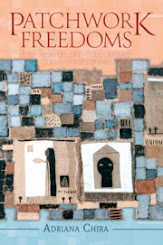
Chira's "Patchwork Freedoms"

Adriana Chira, Emory University, has published Patchwork Freedoms: Law, Slavery, and Race beyond Cuba's Plantations (Cambridge University Press)

In nineteenth-century Santiago de Cuba, the island of Cuba's radical cradle, Afro-descendant peasants forged freedom and devised their own formative path to emancipation. Drawing on understudied archives, this pathbreaking work unearths a new history of Black rural geography and popular legalism, and offers a new framework for thinking about nineteenth-century Black freedom. Santiago de Cuba's Afro-descendant peasantries did not rely on liberal-abolitionist ideologies as a primary reference point in their struggle for rights. Instead, they negotiated their freedom and land piecemeal, through colonial legal frameworks that allowed for local custom and manumission. While gradually wearing down the institution of slavery through litigation and self-purchase, they reimagined colonial racial systems before Cuba's intellectuals had their say. Long before residents of Cuba protested for national independence and island-wide emancipation in 1868, it was Santiago's Afro-descendant peasants who, gradually and invisibly, laid the groundwork for emancipation.
Here are some endorsements:
'In this meticulously researched and beautifully written book, Chira shows that freedom for African descended peasants in places like Santiago, Cuba was not an abstraction, but rather a protracted process of claims-making negotiated with local legal institutions. Bringing together legal, political, social and economic history, Patchwork Freedoms will prove indispensable to all who want to understand the key role of manumission in slavery and emancipation.'

Ariela J. Gross - co-author of Becoming Free, Becoming Black: Race, Freedom and Law in Cuba, Virginia and Louisiana

'This fascinating study sets out to change our understanding of bondage and emancipation. It places land ownership at the center of racial dynamics, demonstrates the need to study the local to understand the global, and contributes greatly to our comprehension of why Eastern Cuba became so essential to both Cuban independence and the Cuban revolution.'

Tamar Herzog - Monroe Gutman Professor of Latin American Affairs, Harvard University

'Patchwork Freedoms examines the ways in which Santiago’s quasi-freed population negotiated the terms of their emancipation and autonomy by shaping locally grounded notions of custom. Chira shows how Santiago’s black population articulated a legal vernacular of freedom, self-purchase, and social mobility in the absence of laws on the books, rendering custom a malleable and resilient category. This is a superbly researched book that will define the field of quasi emancipation and the customary laws of slavery for decades to come.'

Michelle A. McKinley - University of Oregon School of Law

'This is a powerful history of claims-making and political identity formation among enslaved and free people of African descent in a key region of the Atlantic world. Digging into the soil of eastern Cuba, Chira deftly upturns superficial narratives about the emancipatory nature of liberalism in the nineteenth century. In this book, legal and political freedoms do not just happen: they are won, piecemeal, by people with deep and complex attachments to the land they worked, the island and empire they inhabited, and to one another.'

Bianca Premo - author of The Enlightenment on Trial: Ordinary Litigants and Colonialism in the Spanish Empire

--Dan Ernst

Saturday, February 19, 2022

Weekend Roundup

  • Mark Tushnet, author of the Holmes Devise history of the Hughes Court, discusses it and other topics on the Supreme Myths podcast.
  • Tomiko Brown-Nagin, Sheryll Cashin, Evelyn Brooks Higginbotham, and Kenneth Mack discuss Constance Baker Motley (Harvard Law Today). Brown-Nagin also discusses her work on Motley on NPR's Fresh Air, here.
  • The National Underground Railroad Freedom Center, Cincinnati, Ohio, has an exhibit honoring Macon Bolling Allen, “the first African American licensed to practice law in the United States.” (More.)
  • Harriet S. Shapiro, the first female in Solicitor General’s Office has died.  The NYT obituary is here; her oral history conducted under the auspices of the Historical Society of the District of Columbia Circuit is here.
  • Many historical organizations have joined the American Historical Association’s February 9 statement condemning former President Donald J. Trump and his administration's reported extensive and repeated violations of the Presidential Records Act of 1978.  (But wait, there's more.)
  Weekend Roundup is a weekly feature compiled by all the Legal History bloggers.

Friday, February 18, 2022

Haksgaard on Unmarried Women and the Homestead Act

Hannah Haksgaard, University of South Dakota Knudson School of Law, has posted Including Unmarried Women in the Homestead Act of 1862, which is forthcoming in volume 67 of the Wayne Law Review:

South Dakota Homesteader (LC)
When Congress passed the Homestead Act of 1862 it decided to distribute land to single, unmarried women. Most Congressional members who supported including unmarried women did so because women were a necessary part of empire building—women were expected to marry, bear children, and engage in building permanent communities. Few Congressional members cared about women’s equality or the progressive goals of the women’s rights movements, although some Congressional members thought women would be incapable of successfully homesteading. This article presents the fascinating history of including unmarried women in the Homestead Act of 1862 by conducting an intensive study of the act’s statutory history, beginning in 1843. Building on the work of historians, this article analyzes how the lived experiences of female homesteaders matched up with the expectations of the Congressional members who included them, on such topics as women’s willingness and ability to homestead, women’s equality, and women’s role in marriage and reproduction. Throughout, this article explores how this statutory history can influence our understanding of antebellum unmarried women’s rights.

--Dan Ernst

Thursday, February 17, 2022

Legal history panel at "The Disability Frame" symposium

This Friday and Saturday (February 18-19, 2022), the University of Pennsylvania Law Review is hosting a law review symposium on "The Disability Frame: Opportunities, Costs, and Constraints in the Broad Struggle for Inclusion." The first panel may be of interest to readers of the blog. It places "the disability frame" in historical perspective. Panelists are Rabia Belt (Stanford Law School), Nate Holdren (Drake University), and Karen Tani (University of Pennsylvania). Leah Samples (Ph.D. candidate, University of Pennsylvania) will comment. Advance registration (free) is required.  The full program is available here.

-- Karen Tani

Wednesday, February 16, 2022

Georgetown Legal History Colloquium

[We have the following announcement.  DRE]

The Georgetown Legal History Colloquium is pleased to announce its spring 2022 workshops. 

On Friday, February 18, we welcome Amanda Frost from American University. We will be discussing Seizing Citizenship: Lydia Hamilton Smith, Thaddeus Stevens, and the Pathway to Citizenship in Antebellum America, a draft chapter from Professor Frost's book-in-progress on the history of birthright citizenship in the United States.

The session will be online from 3:30-5:00 EST. If you would like to join us, please register in advance using this link (or paste this web address into your browser: https://georgetown.zoom.us/meeting/register/tJYvd-ChqDsqGd2LD3_cEAuAAgn-b72nBPMU). You will receive a Zoom link for the event after you register. To receive Professor Frost's paper, please email Kevin Arlyck (kevin.arlyck@georgetown.edu) or K-Sue Park (KSue.Park@georgetown.edu).

We plan to hold subsequent sessions in person, on the Georgetown University Law Center campus. On Monday, March 21, Rabia Belt from Stanford University will present. Shaun Ossei-Owusu from the University of Pennsylvania will join us on Friday, April 29. We look forward to seeing you!

Tuesday, February 15, 2022

NCC Podcast on First Amendment History

[We have the following announcement of a podcast from the National Constitution Center.  DRE.]

The National Constitution Center is launching a multi-year initiative exploring the history and meaning of the First Amendment, anchored by the magnificent 50-ton First Amendment tablet newly installed at the Center overlooking Independence Mall. The giant tablet was previously engraved, fabricated and erected in 2007 at the Newseum in Washington, D.C. After the Newseum closed in 2019, the Freedom Forum donated the tablet to the Center.

In conjunction with the initiative, Jeffrey Rosen is joined by First Amendment experts Robert Post and Keith Whittington to discuss the origins of the First Amendment, its importance in American society, and several of the most important Supreme Court cases centering around free speech. Robert Post is a Sterling Professor of Law at Yale Law School and author of Citizens Divided: A Constitutional Theory of Campaign Finance Reform. Keith Whittington is the William Nelson Cromwell Professor of Politics at Princeton University and the author of Speak Freely: Why Universities Must Defend Free Speech.

Monday, February 14, 2022

de Brouwer on Belgian Lawyers under German Occupation

We have it that on February 18, at 12:00 (we assume Madrid time), the next session of the Colloquium on the History of Law of the faculty of law at the Universidad Autónoma de Madrid will take place.  Jérome de Brouwer, Université Libre de Bruxelles, will present "'Tout pour l'honneur': Belgian Lawyers under German occupation (1914-1918)."  The session will take place via Zoom: ID Zoom: 829 1079 8716 | Access code: 609743.

Sunday, February 13, 2022

Creating a Successful Conference Proposal

[We have the following announcement.  DRE]

The Program Committee of the American Society for Legal History has prepared a tip sheet, Creating a Successful Conference Proposal, designed to help people who wish to propose panels for the group’s 2022 annual meeting.  The submission deadline for proposals is March 18, as described in the call for papers.

Saturday, February 12, 2022

Weekend Roundup

  • The Historical Society of the New York Courts has published online and ungated History of New York County Bench and Bar by Vincent Chang, Julie Gick, Amani Harris, Debra James, Craig Landy, Andrea Masley, Zoe Petiteau, Jon Ritter, Adrian Untermyer, Jordan Wappler, and John Werner.  Its Editor-in-Chief is Adrian Untermyer.
  • The official launch of the Slavery, Law, and Power Project of the University of Maryland Libraries is Tuesday, February 15, 2022, 2:00PM - 3:30PM EST, via Zoom.  Holly Brewer presents.  “This project brings renewed attention to imperial policymaking and its pivotal role in the development of slavery and racial ideologies. It explores how those interacted with local politics and policies in different colonies throughout the British Empire during the seventeenth and eighteenth centuries.”
  • The Cornell University Libraries announces the opening of its Samuel J. May Anti-Slavery Collection, including a digitized pamphlet collection and digitized manuscripts. 
  •  On March 22, Montana State University hosts a panel discussion to celebrate the 50th anniversary of Montana’s Constitutional Convention of 1972.  One of the moderators: Sarah Vowell.  (More.)
  • "Plotting a land grab: A newly decoded map reveals that the famous American explorer William Clark planned the theft of 10.5 million acres of Indigenous land," by Tom Almeroth-Williams (University of Cambridge).
  • ICYMI: tu quoque, JFK: "The 1960 certificates that the false Trump electors say justify their gambit" (Politico).  Joseph Fishkin and William E. Forbath on How Progressives Can Take Back the Constitution (The Atlantic). Eunice Hunton Carter spotlighted at Bexley library event (Columbus Dispatch).  Remembering Isaac C. Hunt, Jr. (1937-2017), SEC Commissioner (SECHS).  "UNC Libraries Utilize Machine Learning to Uncover Racist Laws in South’s History" (ANH).

 Weekend Roundup is a weekly feature compiled by all the Legal History bloggers.

Friday, February 11, 2022

JPH 34:1

The Journal of Policy History 34:1 (January 2022) is available online.

New Policy Elites and the Affordable Care Act: The Making of Long-Term Insiders
William Genieys, Mohammad-Said Darviche, Brent Epperson
 
Race, Post-Reconstruction Politics, and the Birth of Federal Support for Black Colleges
Deondra Rose

Clandestine Networks and Closeted Bureaucrats: AIDS and the Forming of a Gay Policy Network in California
Stephen Colbrook

The Politics of Clemency in the Early American Presidency: Power Inherited, Power Refashioned
Bradley D. Hays

Critical Perspective

Understanding the Controversy: The Kerner Commission, The Harvest of American Racism, and the Dynamics of Incorporating Social Science with Public Policy
Rick Loessberg

--Dan Ernst

Thursday, February 10, 2022

Perry's "Law in American Meetinghouses"

Jeffrey Thomas Perry, Tusculum University, has published Law in American Meetinghouses
Church Discipline and Civil Authority in Kentucky, 1780–1845
(Johns Hopkins University Press):

Most Americans today would not think of their local church as a site for arbitration and would probably be hesitant to bring their property disputes, moral failings, or personal squabbles to their kin and neighbors for judgment. But from the Revolutionary Era through the mid-nineteenth century, many Protestants imbued local churches with immense authority. Through their ritual practice of discipline, churches insisted that brethren refrain from suing each other before "infidels" at local courts and claimed jurisdiction over a range of disputes: not only moral issues such as swearing, drunkenness, and adultery but also matters more typically considered to be under the purview of common law and courts of equity, including disputes over trespass, land, probate, slave warranty, and theft.

In Law in American Meetinghouses, Jeffrey Thomas Perry explores the ways that ordinary Americans—Black and white, enslaved and free—understood and created law in their local communities, uncovering a vibrant marketplace of authority in which church meetinghouses played a central role in maintaining their neighborhoods' social peace. Churches were once prominent sites for the creation of local law and in this period were a primary arena in which civil and religious authority collided and shaped one another. When church discipline failed, the wronged parties often pushed back, and their responses highlight the various forces that ultimately hindered that venue's ability to effectively arbitrate disputes between members. Relying primarily on a deep reading of church records and civil case files, Perry examines how legal transformations, an expanding market economy, and religious controversy led churchgoers to reimagine their congregations' authority. By the 1830s, unable to resolve doctrinal quibbles within the fellowship, church factions turned to state courts to secure control over their meetinghouses, often demanding that judges wade into messy ecclesiastical disputes.

Tracking changes in disciplinary rigor in Kentucky Baptist churches from that state's frontier period through 1845, and looking beyond statutes and court decrees, Law in American Meetinghouses is a fresh take on church-state relations. Ultimately, it highlights an oft-forgotten way that Americans subtly repositioned religious institutions alongside state authority.

An interview of Professor Perry about his book is here.

--Dan Ernst

Wednesday, February 9, 2022

Cohen, "The Rise and Fall and Rise Again of Informal Justice and the Death of ADR"

Amy J. Cohen (Temple University School of Law) has posted "The Rise and Fall and Rise Again of Informal Justice and the Death of ADR," which is forthcoming in the Connecticut Law Review. The abstract:

Today, the field of alternative dispute resolution (ADR) is often conceptualized and taught as an apolitical, institutional practice designed to enhance the effective and efficient settlement of legal disputes. But this was not always the case. In the 1970s, scholars imagined mediation as a technique of social and political transformation: a practice that might enable people to resolve disputes without reproducing the inequalities that shaped the society in which they lived. That view of ADR has largely disappeared from the American legal academy. But, as this Article shows, it has not disappeared entirely. Outside the legal academy, prison and police abolitionists are turning to the tools of dispute resolution as an important mechanism of social change. This Article embeds today’s movement for transformative justice in a longer genealogy of informal justice, and it revitalizes a sociolegal perspective that uses micro-level conflict as a critical framework through which to analyze macro-level transformations. The Article ventures that this sociolegal perspective can help respond to the disciplinary crisis that currently faces the field of ADR in American legal education, revealing ADR as a powerful tool for thinking through both the mechanisms and the difficulties of emancipating social and political change.

The full article is available here, at SSRN.

-- Karen Tani

CFP: The Search for Humanity after Atrocity

Call for Papers: The Search for Humanity after Atrocity: A Conference for Engaged Scholars and Informed Practitioners, October 16-17, 2022, Kean University, Union, NJ

The Holocaust and Genocide Studies Program at Kean University is pleased to invite presentation submissions for the conference "The Search for Humanity after Atrocity" to be held at Kean University in Union, NJ, on October 16-17, 2022. *Our intention is to have an in person conference with the understanding that the need may arise to shift to a virtual format depending on the current status of the Covid-19 pandemic.* The conference is an opportunity for scholars, especially at early stages of their careers, and NGO and other non-profit  practitioners to compare and reflect, in a spirit of reciprocity, on the search for post-atrocity humanity or at least order and stability, if not reconciliation, with an emphasis on victims' perspectives. The conference will culminate with proposals designed for enactment. The conference invites participants to submit abstracts addressing one or more of the following themes:

Collective memory: How do societies, and social groups within a society, remember or seek to forget atrocities in official and unofficial ways? How do societies, and social groups within a society, reinterpret atrocity over time? How do these memory modalities help or hurt the search for humanity after atrocity?

Civil Society-State Relationship
: What is the role of civil society, particularly in relationship with the state, to promote a post-atrocity social order or, broadly, humanity? What structural conditions enable civil society to play a role vis-à-vis government?

Lingering Adversarial Relationships
: How do survivors and perpetrators find ways to participate in public life after atrocity? How does living through atrocity inform survivors' intra- and inter-relationships? How do survivors manage relationships with known perpetrators particularly when perpetrator accountability is absent or compromised? When do survivors' testimonies help and when do they hurt the chances for post-atrocity humanity or stability?

Strategies for Mending Relationships: When has geographical partition worked? When and why is past wrongdoing deflected, acknowledged, suppressed, or confronted? How effective is education as a preventative measure? When do social media encourage or discourage favorable post-conflict trajectories? How is resource revitalization reimagined in the wake of environmental depletion? Are restorative/transitional justice and other peacemaking schemes effective?

The Arts, Memorials, and Material Culture: Are music, architecture, storytelling and other forms of artistic expression redemptive? Do these particular fields have the ability to help survivors and/or the broader community seek humanity after atrocity? How does commemoration of victims inform the direction of the search for humanity after atrocity?

Submitting your abstract:

  1. Group presentations that combine scholars and practitioners by topic will receive priority consideration.
  2. Presentations that explore concepts and practices from victims' perspectives will also receive priority consideration.
  3. Proposals that include models of enactment will additionally receive priority consideration. Examples are: open-source, interactive database of artifacts and interviews for use by survivors, educators, researchers, and practitioners; restorative and transitional justice projects; a published volume of essays by and for policymakers,  practitioners, and engaged scholars; special issues of academic and not-for-profit  journals for scholars and practitioners; and a website, a digital newsletter, and social media platforms for sustaining and increasing a network of concerned policymakers and engaged scholars in common search for humanity after atrocity.
  4. Complete the following Google Form to submit your abstract by March 31, 2022: Abstract Submission Form
  5. We will notify all submitters of the program committee's decisions no later than April 15, 2022.
  6. For details about the conference, visit the conference website. The conference is sponsored and hosted by Master of Arts in Holocaust and Genocide Studies at Kean University. It is cosponsored by The Jimmy and Rosalynn Carter School for Peace & Conflict Resolution, George Mason University; Ouachita Baptist University, Arkadelphia, Arkansas; College of Public Affairs, University Baltimore (in formation)

Tuesday, February 8, 2022

In Search of ASLH Panelists: An Update

Herewith, we revive a prior practice of inviting scholars seeking others for panelists for this November's annual meeting of the American Society for Legal History to post "in search of" notices as a comment here.  We'll occasionally move this post to the top of the feed, and expect to leave the comment function on through the submission deadline of Friday, March 18.  (The submission deadline for proposals for preconference workshops is February 18.)

[Update: when we first posted, we did not realize that Graduate Student Outreach (GSO) Committee of the ASLH had also been asked to maintain a shared spreadsheet with which students and others could identify others seeking to propose panels for November's ASLH meeting in Chicago.   Please feel free to post a comment to this post, to express your interest on the GSO Committee's spreadsheet, or both.]

--Dan Ernst

Brown-Nagin to Discuss "Civil Rights Queen"

Tomiko Brown-Nagin, dean of the Radcliffe Institute for Advanced Study, Daniel P.S. Paul Professor of Constitutional Law, and Professor of History at Harvard University has recently published Civil Rights Queen: Constance Baker Motley and the Struggle for Equality (Penguin RandomHouse).  On Monday, February 14 at 4:00 pm ET, she will present the book to the Washington History Seminar as part of a Zoom webinar, which is open to the public on a first-come, first-served basis.  Register here.

We’re told that the space fills up very quickly, and if you are unable to connect you watch on the Facebook page of the National History Center or the website of the Wilson Center website.  A recording will be posted on the National History Center's YouTube Channel.  Commentators are Timothy Lovelace, John Hope Franklin Research Scholar and Professor of Law at Duke University, and Risa Goluboff, Arnold H. Leon Professor of Law, Professor of History, and Dean of the University of Virginia Law School.

From the Washington History Center’s announcement:

In her new book, Civil Rights Queen, Tomiko Brown-Nagin examines the life and work of pathbreaking lawyer, politician and judge, Constance Baker Motley. The counterpart to Thurgood Marshall—”Mr. Civil Rights”—Motley litigated hundreds of cases that remade American law and society, including Brown v. Board of Education. She also desegregated flagship public universities in Florida, Georgia, and Mississippi, and represented Dr. Martin Luther King, Jr., and the Birmingham Children’s Marchers—helping rescue the pivotal campaign that gave rise to the Civil Rights Act of 1964. Then, as the first black woman federal judge, Motley decided landmark cases that, among other things, implemented the Civil Rights Act. Yet she is not nearly as well known today as her impact on public life would suggest. Brown-Nagin argues that Motley’s gender, and scholars’ tendency to divide the civil rights movement into discrete and antagonistic legal and direct-action wings, help explain why. Looking at the civil rights movement and the legal profession through a woman’s eyes, Brown-Nagin explores themes such as law versus politics as pathways to reform, diversity in the Black experience, identity and judging, and the “price of the ticket” when outsiders become insiders in the power structure.

--Dan Ernst