Showing posts with label history of finance. Show all posts

Thursday, March 26, 2026

AJLH 64:4

We're a bit late in noticing it, but the American Journal of Legal History 64:4 has been published: 

Mr Locke’s enclosure: the uncommon law of property in the Second Treatise
Hannah Carrese

John Locke, famously, told a property origin story. This article tells a property theory origin story, asking how Locke’s property theory, which omits common rights, emerged from a common law of property that centred them—and showing how this omission influenced the colonial American law that Locke drafted. Locke was silent on or rejected the common law of property, which recognized common rights and defences against privatization of commons through enclosure. Instead, Locke adopted law reform arguments lauding enclosure because it improved waste land. Locke’s property theory therefore attempts to improve the common law of property by orienting it around private rather than common property. He asks a question about the origin of property absent from common law: how do we create private rights to common land? He takes ‘waste’ to have purely negative connotations, avoiding the neutral meanings of that word at common law. And he stipulates that enclosure of English commons requires only tacit consent of commoners, excluding common law defences against enclosure. Locke’s is an equal opportunity enclosure. His spoilage principle and plan to reform Virginia’s land laws sought to benefit the poor by preventing vast enclosures and rural depopulation. However, he theorized a clean chain of title, absent in common law, which could prevent messy disputes over wealthy estates. This article shows the common law background from which Locke departed, thus deepening understanding of both our private property regime, often justified by Locke’s property theory, and a sometimes-overlooked alternative to it, the common law of property.
The laws of ‘an old and settled society’? The law of contract in New South Wales 1815–1850
Warren Swain

The history of contract law in New South Wales in the decades after the closure of the Court of Civil Jurisdiction in 1814 has not received much attention from legal historians. This is an important omission. At the heart of this story is a simple but critical inquiry: the way in which the law of contract in the colony mirrored or diverged from the law of contract that applied back in London. This was rarely a matter that judges addressed explicitly. Piecing together the relationship is an exercise in reconstruction. This can only be done by examining the body of case law. The creation of the Australasian Colonial Legal History Library, combined with readily searchable newspaper reports, has made this easier. The evidence in the mid-nineteenth century is still sometimes sketchy. Context is relevant. The colony moved from a quasi-military penal colony to a significant hub of commercial activity. The period also saw a shift in the legal system as the old informal systems evolved into a much more legalistic one. For the most part, New South Wales contract law was aligned with that in England. Some issues, like the desertion of sailors demanded local solutions. There are other examples in which well-established English contract doctrine did not necessarily fit very well with the conditions of the colony.
Who is a central bank for? The founding and legal design of the Bank of Canada
Dan Rohde

The Bank of Canada is an independent Crown corporation that sees its primary responsibility to be promoting Canada’s economic welfare by maintaining low and stable inflation. When it was first created in 1934, however, the Bank was a radically different institution—a privately owned corporation primarily meant to anchor Canada’s economy globally and manage foreign exchange. Not only was the Bank not tasked with managing inflation, but key policymakers behind its founding thought doing so would be a severe mistake. This article offers the first legal history of the Bank’s founding. It maps the enormous public debate that accompanied the creation of the Bank and the various, often contradictory visions expressed for it. The article labels these five visions: a Bankers’ Bank, a Government Bank, an Imperial Bank, an Economists’ Bank, and a Bank of the People. The article then looks at the original legal design of the Bank and argues that it largely fit the Imperial Bank model. Charting this history helps us better understand this vital organ of Canadian government, and has the potential to upset many of our accepted, contemporary notions of central banking.

--Dan Ernst 

Monday, January 26, 2026

Menand on the Unitary Executive and the Fed

Lev Menand, Columbia Law School, has posted The Unitary Executive and the Federal Reserve:

The Supreme Court may soon embrace an interpretation of the Constitution that would significantly expand the power of the President over federal administrators and invalidate key provisions in dozens of federal statutes. A critical question is whether this interpretation—known as Unitary Executive Theory (UET)—would also render unconstitutional Central Bank Independence (CBI), an arrangement where a country’s monetary policy is formulated by a semi-autonomous body of experts insulated from partisan political pressure. Several justices have suggested that it would not, and a growing scholarly literature has proposed ways for the Court to distinguish the country’s central banking apparatus from the rest of the administrative state. This Article examines these proposals and concludes that none are tenable. It then explains why UET is fundamentally inconsistent with CBI: the Federal Reserve’s independence from the President reflects a wholly different, and incompatible, approach to the separation of powers. It further suggests that since the regulation of money and banking is one of the most important functions of the modern state, this conflict is arguably sufficient, standing alone, to reject UET. Relatedly, if the Court wishes to preserve statutory limits on the President’s power to remove Federal Reserve officials without repudiating UET outright, it has only one viable option: stare decisis.

--Dan Ernst 

Friday, December 19, 2025

Ellias and Lalafaryan on the Global Law of Debt

Jared A. Ellias, Harvard Law School, and Narine Lalafaryan, University of Cambridge, have posted The Global Law of Debt: 

Corporate debt financing and the restructuring of large corporations are now governed by what this Article calls the “global law of debt,” a transnational system shaped more by law firms, investment banks, and investors in New York and London than by national laws or court decisions. Large companies can now optimize governing law on a transaction-by-transaction basis, for example by borrowing in New York and then restructuring that debt in the United Kingdom, or by borrowing in London through English-law governed contracts with New York-law interpretation for select provisions.  This Article provides the first account of this development, tracing its origins to the 1960s, when New York and London debt professionals expanded into each other’s markets, creating an entangled system that fostered mutual learning and competition.  In 1978, Congress enacted a new bankruptcy law that gave American lawyers and investors corporate restructuring expertise that they later exported abroad.  In the post-pandemic era, London emerged as a global restructuring hub rivaling the United States.  These developments have produced a robust global debt market, but they have also unsettled long-standing assumptions about the rights of creditors as Chapter 11’s primacy fades and controversial American innovations that erode creditor protections proliferate globally.

--Dan Ernst 

Tuesday, June 24, 2025

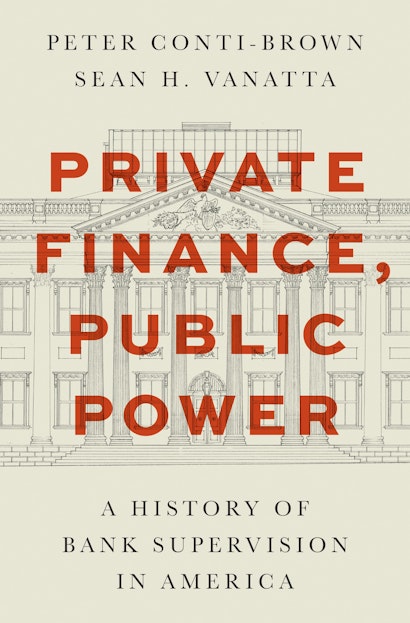
Brown & Vanatta, "Private Finance, Public Power: A History of Bank Supervision in America"

New from Princeton University Press: Private Finance, Public Power: A History of Bank Supervision in America (2025), by Peter Conti-Brown (Wharton School at the University of Pennsylvania) and Sean H. Vanatta (University of Glasgow). A description from the Press: 


Banks in America are private institutions with private shareholders, boards of directors, profit motives, customers, and competitors. And yet the public plays a key role in deciding what risks are taken as well as how, when, and to what end. Public-private negotiations over financial governance has evolved into an essential ecosystem of banking risk management. In Private Finance, Public Power, Peter Conti-Brown and Sean Vanatta offer a new history of finance and public policy in the United States by examining the idiosyncratic way the nation manages financial risk across the public-private divide. Covering two centuries, from the founding of the Republic to the early 1980s, Conti-Brown and Vanatta describe the often-contested, sometimes chaotic, engagement of bankers, politicians, bureaucrats, and others in the overlapping spaces of the public-private system of bank supervision.

Conti-Brown and Vanatta trace the different supervisory frameworks that evolved over time, from the imposition of private liability on bank shareholders to the development of the central bank to the creation of federal deposit insurance. Negotiations took place at federal and state levels, but, over time, the federal government assumed most of the responsibility for managing financial risk. Moreover, federal supervisory officials began to undertake more varied tasks, including monitoring racial discrimination and managing financial concentration. Conti-Brown and Vanatta introduce a diverse cast of characters—bankers, politicians, bureaucrats, and others—and show how they navigated two hundred years of financial panics, scandals, and crises to build the system that structures modern America’s banking system.

A sampling of advance praise:
“Conti-Brown and Vanatta have written a brilliant history of the murky realm of banking supervision. Recovering over two centuries of intense conflict and negotiations over risk within America’s banking system, the authors explain how the federal government readily absorbed the vital responsibility of managing financial risk. This sweeping history is a must-read for anyone interested in understanding the origins of our modern financial system.”—Julian Zelizer
 
“Supervision is the backbone of bank oversight in the United States and around the world. In their landmark book, Private Finance, Public Power, Conti-Brown and Vanatta pull away the curtain of opacity that has long shielded bank supervision from public view. They reveal supervision to be a constantly evolving set of relationships and practices that shape private risk-taking and public administration. In the process, they provide important new insights into a host of contemporary debates on matters ranging from how best to promote the health of the financial system to the dangers and benefits of regulatory discretion. It is required reading for everyone who wants to understand how best to promote financial stability, state capacity and the way public and private actors have cocreated today’s financial system.”—Kathryn Judge 
On June 10, the Brookings Institution in Washington, D.C., hosted a book launch conference, "The History of Bank Supervision in America and the Road Ahead," featuring legal historians Naomi Lamoreaux and Ed Balleisen, as well as legal academics, financial industry lawyers, journalists, and former supervisors. A video recording of the conference is available here.
 
-- Karen Tani

Thursday, May 22, 2025

Daniel on the Birth of Municipal Bankruptcy Law

Josiah M. Daniel III, Vinson & Elkins and UT Austin, has posted The Historiographical Problem of Municipal Bankruptcy Law:

This is the first archivally researched history of the genesis of municipal bankruptcy law, 1933-1938. It also compares the historical method with law and economics (L&E) for finding and telling the story.

Congressman Hatton Sumners, Judiciary Committee chair, was the key actor. The legislative process was a laboratory for new forms of relief under the Bankruptcy Clause of the Constitution, seeking to relieve the insolvency experienced during the Depression by irrigation districts in “the Valley” of Texas, new towns in Florida, and elsewhere across the nation that could not collect taxes and pay their municipal bonds. State governments were helpless; the Constitution’s Contract Clause forbade “impairing the Obligation of Contracts,” and voluntary, private restructuring agreements were frustrated by the “holdout problem.”

From a variety of models, it was composition with creditors that succeeded politically. Congress from 1933 to 1937 amended the Bankruptcy Act of 1898 by enacting the First and Second Municipal Bankruptcy Acts—known as Chapter IX—based on composition. L&E scholars credit this to freshman Florida congressman Mark Wilcox who worked in conjunction with a bondholders’ group. But it was Sumners who determined that the composition model was constitutional and politically most feasible. He navigated through opposition that insisted “bankruptcy” required turnover of the debtor’s assets in exchange for a discharge and that such legislation would destroy the municipal credit market. Municipal bankruptcy did leave all assets in the debtor’s hands and granted a discharge, and the credit market survived. And relevantly to a key issue in reorganizational bankruptcy today, Sumners crafted the first, and still the only, statutory injunctive relief applicable in the bankruptcy case of an artificial entity for the protection of nondebtor third parties—here, all officers and inhabitants of a municipal debtor—against creditors’ collection efforts.

Municipal bankruptcy became a New Deal agenda item, and Franklin Roosevelt helped push the legislation to enactment in the spring of 1934. The Supreme Court invalidated the first act in the 1936 Ashton case, but Justice Cardozo dissented and outlined small changes that Sumners and Congress utilized in enacting the second act in 1937. Then Sumners led the oral arguments in 1938’s Bekins case that sustained it.

Municipal bankruptcy law succeeded in effectuating municipal-bond restructuring agreements, and its essence lives in today’s Bankruptcy Code as Chapter 9, providing discharge of unpayable debt and more commonly furnishing the platform upon which towns and taxing districts negotiate such deals. Chapter IX worked in the past, and Chapter 9 works today. Sumners, not Wilcox, was primarily responsible for the legislation. Nothing was assured; the story demonstrates change over time, with Sumners the key actor. And the project of finding and interpreting the genesis of municipal bankruptcy is one for legal history, not for L&E, the author argues.
--Dan Ernst

Thursday, March 6, 2025

Desan on the US History of Public Banking

Christine A. Desan, Harvard Law School, has posted Public Banking in the United States: Historical Lessons for Today, which is forthcoming in the Williamette Law Review:

This article reviews the long history of American public banking from its start in colonial Pennsylvania to current state-level initiatives.  That history includes banks owned exclusively or in part by states – every one of the original 13 states owned stock in some of the banks it chartered.  States also conditioned charters to private investors on activities conducive to the public welfare and imposed significant taxes on bank capital.  Public ownership declined over the 19th century for several reasons, including the development of legal doctrines that enlarged corporate autonomy and their privileges as business entities, as well as the rise of profits available to banks as commercial actors.  There is a strong case for returning to public banks.  At the economic level, private retail banking lends according to criteria overly narrow to reach all deserving borrowers, particularly those whose wealth accumulation has been limited by past discrimination.  At the ethical level, a return to public banking comports with the way money is created. That operation is pervasively supported by public authority, a reality that public banking would make more transparent.

--Dan Ernst

Monday, June 5, 2023

Vanatta on Bank Supervisors and the Revolving Door

Sean Vanatta, University of Glasgow, has posted Revolving Door Governance: Bank Supervisors in the United States, 1863-1933:

Daniel R. Crissinger (LC)
Federal bank supervision began in the United States with the enactment of the National Bank Act in 1863. From that point until the banking crises of the 1930s, the leaders of the US supervisory agencies—the Comptroller of the Currency (1863) and the Federal Reserve (1913)—recognized that bank supervisory work was often a stepping-stone to future careers in banking. As Comptroller D. R. Crissinger wrote in 1922, “The best testimony to the high quality and character of the examining force is found in the fact that the bureau has constant difficulty in retaining the services of its skilled examiners because their special qualifications constantly appeal to the best banks, which are continually drafting them away from the bureau at greatly advanced compensation.” Certainly, as Crissinger recognized, this constituted a loss for supervisory agencies, and Comptrollers and Fed officials used the constant drain of experienced examiners to lobby for better supervisory compensation. Yet, as this paper demonstrates, supervisory leaders also understood this process as a net gain for the banking system, which in the nineteenth and early-twentieth century United States had a proliferation of small, unit banks but few well-trained bankers. Indeed, Comptrollers of the Currency often followed the same path, moving from government service into the management of banks they supervised. Ultimately, the paper argues that US financial supervisors practiced “revolving door governance,” where bank supervisors were able to recruit competent staff at low pay on the promise of future banking careers. Examiners, in turn, brought their knowledge and expertise into the banking system. In this way, the paper suggest that the revolving door in early US financial governance is more akin to regulatory schooling than regulatory capture, thought the lines between legitimate transit and unseemly corruption always remained thin and porous.
–Dan Ernst

Wednesday, December 21, 2022

CFP: Global Correspondent Banking 1870–2000

[We have the following announcement.   DRE]

The global payments system represents the underlying plumbing of globalisation, determining the efficiency and security of cross-border payments for goods and services. Despite its fundamental importance surprisingly little is known about the evolution of this system, especially the dynamics of the network of bilateral bank relationships used for cross-border settlements across the past 150 years.

The European Research Council funded "Global Correspondent Banking 1870–2000" project would like to invite proposals from researchers at all levels for a conference on the evolution of the global payments system during the 19th and 20th centuries. Topics may include, but are not limited to:

  • Correspondent banking, international banking networks and the development of the global payments system
  • The changing shape, patterns and dynamics of international banking networks, and the impact of financial crises, world events and regulatory changes
  • Banking technologies and the 'plumbing' of the international payments system, e.g. bills of exchange, ICT innovation
  • Bank internationalisation strategies

The conference will be held at St Hilda's College, Oxford University on Thursday 23rd and Friday 24th March 2023.

Submission details: Proposed titles and paper abstracts of c. 300 words, along with a short biography of the author, should be submitted to glocobank@history.ox.ac.uk by Monday 2 January 2023. Participants will be notified in early January if their proposal has been accepted.

Conference organisers: Professor Catherine R. Schenk; Dr Marco Molteni; Dr Alena Pivavarava | GloCoBank Project

About GloCoBank: "Global Correspondent Banking 1870–2000" (GloCoBank) is a 5-year research project funded by the European Research Council (ERC) which seeks to identify and analyse the international network of correspondent banking relationships across the 20th century.

Thursday, December 1, 2022

Vanatta on the Financialization of Public Pensions

Sean Vanatta, University of Glasgow has posted The Financialization of U.S. Public Pensions, 1945-1974:

This article examines a major transformation public employee pension investment in the United States, from investing public funds in public infrastructure in the 1940s and 1950s, to investing public funds in private securities—corporate bonds, stocks, and mortgages—in the 1960s and 1970s. Three factors drove this change. First, in the adjacent field of professional asset management, motivated financial elites orchestrated a shift in state-level trust law, from legally-sanctioned investment lists, which encouraged amateur investment and safety, to the “prudent man rule,” framed by professional risk-taking and discretion. Second, declining municipal bond yields during World War II led public pension managers to gradually reconceptualize the political goals of pension investment, from balancing retiree returns against low-cost public infrastructure, to maximizing public employee benefits at minimal taxpayer cost by achieving maximum returns in financial markets. Professional asset managers, who joined pension policy networks in the 1950s, encouraged this change. Third, when state and local governments liberalized investment rules to allow public investments in private securities, public officials hired these same asset managers to make these investments. These relationships created new channels for ideology and influence to move from financial elites to state policymakers, through which financial elites continuously pushed for further liberalization. Ultimately, this article argues, financialization was not the product of a radical break or crisis in the 1970s, but was a continuous process in the post-World War II era, one initially pursued by state and local government officials in service of welfare liberalism.

--Dan Erns

Monday, October 10, 2022

Rector, "Toxic Debt: An Environmental Justice History of Detroit"

We missed this April 2022 release from the University of North Carolina Press: Toxic Debt: An Environmental Justice History of Detroit, by Josiah Rector (University of Houston). A description from the Press:

From the mid-nineteenth until the mid-twentieth century, environmentally unregulated industrial capitalism produced outsized environmental risks for poor and working-class Detroiters, made all the worse for African Americans by housing and job discrimination. Then as the auto industry abandoned Detroit, the banking and real estate industries turned those risks into disasters with predatory loans to African American homebuyers, and to an increasingly indebted city government. Following years of cuts in welfare assistance to poor families and a devastating subprime mortgage meltdown, the state of Michigan used municipal debt to justify suspending democracy in majority-Black cities. In Detroit and Flint, austerity policies imposed under emergency financial management deprived hundreds of thousands of people of clean water, with lethal consequences that most recently exacerbated the spread of COVID-19.

Toxic Debt is not only a book about racism, capitalism, and the making of these environmental disasters. It is also a history of Detroit's environmental justice movement, which emerged from over a century of battles over public health in the city and involved radical auto workers, ecofeminists, and working-class women fighting for clean water. Linking the histories of urban political economy, the environment, and social movements, Toxic Debt lucidly narrates the story of debt, environmental disaster, and resistance in Detroit.

A sample of the advance praise:

“Josiah Rector’s history of environmental justice in Detroit is breathtaking in its ambition and scope. Integrating environmental justice, urban history, and political economy, Rector lays out how environmental inequality came to be, as a confluence of white segregationists working with capitalists in industry, finance, and real estate at the expense of workers and communities. This dazzling debut is extensively researched, innovative, and a must-read for those interested in environmental justice, labor history, and contemporary problems that continue to land particularly hard on Black, Brown, and poor bodies and communities in Detroit and beyond.”—Julie Sze

More information is available here.

-- Karen Tani

Thursday, March 31, 2022

CFP: "Varieties of supervision: The surveillance of banks in a long-term perspective, 19th – early 21st century"

We have the following Call for Papers:
International conference, Paris, 26-27 January 2023

Varieties of supervision: The surveillance of banks in a long-term perspective, 19th – early 21st century

Since the global financial crisis of 2008, the history of banking regulation and supervision has experienced a revival of scholarly interest. Regulation, understood as the general framework defining the rules for banking activities, has attracted more attention than the practices of supervision. Nevertheless, supervisory histories continue to multiply. Scholars have widely examined the history of banking supervision in a national perspective and in an international perspective. The field now extends to colonial areas. But this historiography of banking supervision has several shortcomings. First, the literature has devoted more attention to the supervision of banks by government authorities, which could be described as “external” control, than to forms of control exerted by the banking sector, which could be labelled “internal” control, such as inspection and audit services, accounting practices, and proprietary risk models. Further, the literature more often deals with the second half of the 20th century than with the 19th century. The conference will aim to extend the scholarship on banking supervision by examining new actors, new periods, and by scrutinizing the practices more than the rules of control. In doing so, it aims to resituate the history of banking supervision in a broader history and thereby cast new light on the concept of “regulation”.

The conference aims to explore five main research avenues:

- Why supervise banks? What have been the purposes and objectives of banking control over the last two centuries, and what have been the historical factors for its development or evolution? In particular, we can question the role of crises, which were neither necessary (United States) nor sufficient (France) for the establishment of banking supervisory systems; the embeddedness of the various forms of banking control in national political, legal, economic and social structures; the influence exerted by other countries or other economic sectors than the financial sector; the role of wars and of monetary regimes.

- Which institutions have been in charge of banking control? This research avenue raises four questions: first, that of the necessity (or not) of the formalization of control, and the degree of formalization; second, that of the arbitration between hierarchical authority and self-regulation of the banking profession; third, that of the allocation of the supervisory authority to single or multiple institutions and to the central bank; fourth, that of the internal organization of these institutions.

- Control practices. In particular, we are interested in the words, procedures and human dimension of control. For example, the conference will reflect on the organization of information systems within banking institutions and networks (including the role of technology), and on the role of accounting, whose heterogeneity and complexity have made fraud and risk difficult to prevent and assess.

- Actors and stakeholders (individual and collective, private and public). The conference will aim to widen the actors responsible for control beyond the “external” public controllers usually considered – that is to say, the authorities – to also include the actors in charge of the “internal” control (for example, in banks’ own inspection services), as well as accountants, auditing companies, bankers’ associations, and rating agencies. Who were these actors? What was their expertise? What type of control have they exercised over banks? How were they organized? What was their vision of control? Biographical and prosopographical studies, analyses of actors’ networks or discourses shedding light on the social and political conditions for the evolution of the regulatory culture, from laissez-faire to state intervention, will be particularly welcome.

- The effectiveness and efficiency of control. This question refers both to fraud and control failures (from the controllers’ point of view), and to the cost and resources of supervisory systems. This question also invites us to re-examine the objectives of control and its place in the political economy of regulation: is the aim of banking control to preserve the stability or respectability of a bank or a financial centre? To ensure the compliance with a rule? To protect a profession? Or to defend the general interest (or specific interests, like bank shareholders, noteholders, managers, or depositors)? How have these goals evolved over time?

The conference will combine approaches from different disciplines (history, economics, sociology, law, management sciences, political science) and testimonials from actors involved in banking supervision. Innovative papers, particularly those filling the historiographical gaps mentioned above (internal control; 19th and first half of the 20th centuries; biographical and prosopographical studies), will be particularly welcome. The conference will also welcome contributions adopting a comparative perspective (for instance, between countries or between banks), analyses looking at the intersection of discourses and practices, or the circulation of people and techniques. We will be particularly interested in the varieties of scales (local, national, international) and levels of analysis (micro and macro) and in case studies linking “external” and “internal” control.

The conference will be held in French and English.

Paper proposals (approximately 600 words), accompanied by a short CV, should be sent by 31 May, 2022, to:


Participants will be asked to send preliminary papers (or extended abstracts) by November 2022.

Scientific committee:

Edoardo Altamura (Graduate Institute, Geneva)

Alexis Drach (University of Paris 8, IDHES UMR 8533 CNRS)

Thibaud Giddey (University of Oxford)

Michel Margairaz (University Paris 1 Panthéon-Sorbonne, IDHES UMR 8533 CNRS)

Jean-Luc Mastin (University Paris 8, IDHES UMR 8533 CNRS)

Olivier Feiertag (University Paris 1 Panthéon-Sorbonne, IDHES UMR 8533 CNRS)

Béatrice Touchelay (University of Lille, IRHiS UMR 8529 CNRS)

Sean Vanatta (University of Glasgow)

[Note: Original footnotes have been removed for ease of posting]

Thursday, March 3, 2022

Ford Cole on Race and International Investment law

New over at the University of Chicago Law Review Online: Race and the History of International Investment Law, by Felipe Ford Cole, Sharswood Fellow at the University of Pennsylvania Carey Law School:

Over the last decade, new contributions to the history of international investment law (IIL) have begun to redefine the field’s origins. Where a progressive narrative of steadily improving legal responses to the travails of moving and protecting investments around the world once stood, a more sober story of the continuities of gunboat diplomacy, resort to force, and asymmetries of power is emerging. The scholars behind the new histories of IIL, drawing on earlier critiques of similarly Whiggish narratives in international law, aim to establish a new, more nuanced relation between IIL and its history. Many challenges lie ahead in the venture into the massive tangle of previously underexplored historical events, sources, and theories. No challenge will prove as fraught as reconciling the contemporary normative ends of IIL with those behind its emergence in the late nineteenth century and early twentieth century. For most IIL scholars and practitioners today, the normative goal of IIL is the peaceful expansion of investment for the benefit of societies and investors alike. For the jurists and diplomats that shaped the core IIL doctrines in the nineteenth and early twentieth centuries, however, the goal was securing the property of investors from “civilized” races in a world of “uncivilized” races. These incongruent ends are hardly unusual for a modern body of law, but in the case of IIL, the full influence of theories of racial hierarchy is not entirely understood.
–Dan Ernst

Saturday, August 21, 2021

Weekend Roundup

  • Kyle Volk, University of Montana, discusses prohibition in the 1850s on the podcast, Unsung History, hosted by Kelly Therese Pollock. 
  • ICYMI: The medievalist Susan Reynolds has died (The Guardian).  Akhil Reed Amar’s The Words That Made Us: America’s Constitutional Conversation, 1760-1840, is reviewed in the Roanoke Times.
  • The fall 2021 line-up in the Washington History Seminar is out.  Presenters include: Mia Bay, Traveling Black: A Story of Race and Resistance; Elizabeth Shermer, Indentured Students: How Government-Guaranteed Loans Left Generations Drowning in College Debt; Mark Bradley and [LHB Founder] Mary Dudziak, Making the Forever War: Marilyn B. Young on the Culture and Politics of American Militarism; Thomas Guglielmo, Divisions: A New History of Racism and Resistance in America’s World War II Military; Linda Colley, The Gun, the Ship, and the Pen: Warfare, Constitutions, and the Making of the Modern World; Kate Larson, Walk with Me: A Biography of Fannie Lou Hamer; and Caley Horan, Insurance Era: Risk, Governance, and the Privatization of Security in Postwar America.
  • And, in Second Amendment news, according to Judge Richard Gardiner of the Fairfax County [Virginia] Circuit Court, “going armed” in the 1328 English Statute of Northampton did not mean "packing heat."  It meant "wearing armor."  More.

Weekend Roundup is a weekly feature compiled by all the Legal History bloggers.

Monday, August 16, 2021

Teixeira, "The Legal History of the European Banking Union"

We missed this December 2020 release from Hart Publishing, but thanks to New Books Network, received word of it recently: The Legal History of the European Banking Union: How European Law Led to the Supranational Integration of the Single Financial Market, by Pedro Gustavo Teixeira (European Central Bank / Institute for Law and Finance of the Goethe University, Frankfurt am Main). A description from the Press:

How was the Banking Union, the most advanced legal and institutional integration in the single market, created? How does European law impact European integration?

To answer these questions, this book provides a sweeping account of the evolution of European law. It identifies five integration periods of the single financial market, intertwined with the development of global finance, from its origins, through its expansion and crisis, to the Banking Union. Each period is defined by innovations to deepen integration, such as the single passport for financial services, soft governance and comitology, agencies, or a single rulebook.

Providing a far-reaching explanation of the legal and institutional rationality of the European Banking Union, this book demonstrates that the Banking Union is not an accident of history or simply the product of the existential crisis of the Monetary Union. It has deep roots in the evolutionary process of European law and its drive towards supranational integration.

More information is available here.

-- Karen Tani

Wednesday, April 21, 2021

Barnes on Fleming on Law and Consumer Finance

Victoria Barnes has published Anne Fleming’s History of Law and Consumer Finance in Enterprise & Society.  The essay is available online and open access.  It commences:

This review article does not set out to retell the story of Anne Fleming’s life in a chronological fashion, but rather it engages intellectually with the themes in Anne’s scholarship. Anne’s passing means that her thoughts, guidance, and encouragement are lost to the scholarly communities of which she was a part. Over the course of her career, Anne offered sage advice, she helped others to develop their work, and she supported them wherever she could.1 Now, there will no longer be that voice in the conference room, the office, or the lecture hall. We will not know how her presence would have influenced the field in the years to come and how her engagement with other scholars would have shaped them. So I write to gather together the ideas within Anne’s work, hoping to provide a fuller set of insights than can be gleaned by reading pieces of her scholarship individually. This integrated and coordinated view is the sort of comprehensive thinking that she would have given in her interactions.
–Dan Ernst

Friday, February 19, 2021

Conti-Brown and Feinstein on Financial Legislation, 1913-2020

Peter Conti-Brown and Brian D. Feinstein, University of Pennsylvania, on The Contingent Origins of Financial Legislation:

Courts and scholars often view major financial legislation warily. One popular theory holds that Congress only legislates in this area when pushed by opportunistic activists in response to crises that neither activists nor legislators understand. Another account contends that financial legislation is the well-designed product of deeply entrenched schemes by special interest groups that control the process with limited input from others. Further, the Supreme Court’s application of antinovelty doctrine—which counsels that governmental structures without historical precedent are constitutionally suspect—sends a strong signal that creative solutions to these problems will be viewed with judicial skepticism.

This Article challenges the prevailing scholarly theories of financial legislation and reveals as irredeemably flawed the Court’s related assumptions about legislative processes. This reassessment is based on historical analysis of seven watershed events in American legal and financial history, grounding important moments more firmly in their political contexts. From the Federal Reserve Act of 1913 to the CARES Act of 2020, we uncover neither a pattern of responding to crises nor a logic of grand design at the frontier of congressional authority. Instead, the sweep of history reveals reactions to unpredictable events, policy entrepreneurs with proposals that change substantially during the course of the legislative process, and temporary legislative coalitions that respond to perceived problems in largely ad hoc ways. The result is a flourishing of congressional experimentation at every turn. Temporary coalitions and historical contingencies are the primary themes in financial lawmaking. Novel legislative experiments are not the exception, but the rule.

That insight exposes the impracticality and incoherence of the ascendant antinovelty doctrine. Judicial insensitivity to the ubiquity of unpredictability and experimentation in legislative design risks curtailing Congress’s legitimate and constitutional powers to shape the financial system in a democratically accountable way.
–Dan Ernst

Monday, May 11, 2020

American Predatory Lending and the Global Financial Crisis

American Predatory Lending and the Global Financial Crisis, a website with data visualizations, oral histories, and policy analyses, is now live, under the rubric of the Bass Connections project within Duke University.  It is the creation of a multidisciplinary team, including fifteen Duke and two University of North Carolina students under the leadership of Edward Balleisen, Professor of History and Public Policy andVice Provost for Interdisciplinary Studies; Lee Reiners, Director of the Global Financial Markets Center at Duke Law School; Joseph Smith, former North Carolina Commissioner of Banks, and Debbie Goldstein, Director of the Duke North Carolina Forum.

--Dan Ernst

Friday, March 20, 2020

Glass and Vanatta on New York State Pensions and "Fiscal Mutualism"

Michael Glass, Princeton University Department of History, and Sean Vanatta, New York University Gallatin School, have posted The Frail Bonds of Liberalism: Pensions, Schools, and the Unraveling of Fiscal Mutualism in Midcentury New York:
Between 1940 and 1965, state-level officials changed the relationship between two pillars of the postwar social contract: secure retirement and modern public schools. In the early twentieth century, state pension managers, following a prevailing investment regime we call “fiscal mutualism,” funneled the savings of government workers into government securities. Through direct participation in financial markets, pension officials lowered borrowing costs for local governments and helped lay the infrastructural foundation of modern America. Yet by the 1960s, pension managers had completely abandoned this investment regime. We document this transformation through a close examination of New York State’s pension fund. Throughout the 1950s, the comptrollers who managed the New York State Employee Retirement System (NYSERS), the nation’s largest state pension, underwrote the boom in suburban school construction by purchasing the municipal bonds of local school districts. However, in response to changes in national political economy, along with evolving norms of “fiduciary duty,” New York Comptroller Arthur Levitt, Sr., sought to deregulate the pension’s investment powers. Following significant regulatory changes, Levitt steadily disinvested from municipal bond holdings in favor of higher-yielding corporate securities. Pension deregulation thereby secured higher returns for state retirees, but it also forced local school districts to confront municipal bond markets without the backstop of fiscal mutualism. As school budgets, and the property taxes supporting them, became freighted with expensive interest payments, tax revolts became a permanent response to liberalism’s fiscal volatility. These transformations, we argue, stemmed from postwar liberalism’s dependence on financial markets to deliver retirement security, public education, and other social benefits. This underlying dependence on finance foreclosed more ambitious policy alternatives and ceded inordinate power to private actors, who prioritized profits over social welfare provision.
--Dan Ernst

Thursday, October 10, 2019

Chabot on the Constitution and the Sinking Fund Commission

Christine Kexel Chabot, Loyola University Chicago School of Law, has posted Is the Federal Reserve Constitutional? An Originalist Argument for Independent Agencies:
The President’s inability to control the Federal Reserve’s monetary policy decisions raises significant constitutional concerns. The Federal Reserve’s Federal Open Market Committee executes critical statutory mandates when it buys or sells U.S. securities in order to expand or contract the money supply, and yet the Committee’s twelve voting members check one another instead of answering directly to the President. The President cannot remove Committee members who refuse to carry out his monetary policy directives. Seven of the Committee’s twelve voting members are Federal Reserve governors who enjoy for-cause protections from removal by the President. Congress delegated power to supervise and remove the remaining five voting members, who are presidents of regional Federal Reserve banks, to the governors rather than the President. Further, the President has no say in the appointment of regional bank presidents to the Committee. While the Committee’s independence and appointments process would likely pass muster under current precedent, a growing chorus of originalists have argued that the Constitution requires greater executive control and a more expansive application of Article II’s Appointments Clause requirements.

This paper demonstrates that existing originalist accounts are incomplete. They do not account for the structural independence of an obscure agency known as the Sinking Fund Commission. This Commission was proposed by Alexander Hamilton, passed into law by the First Congress, and signed into law by President George Washington. One would expect all of these actors to have a clear grasp on the original public meaning of the Constitution, as well as a strong dedication to the structural commitments established therein. Their decisions to form a Sinking Fund Commission with multiple members to check one another — and to include the Vice President and Chief Justice as Commissioners who cannot be replaced or removed by the President — belie the notion that an independent agency structure violates the newly minted Constitution. The Sinking Fund Commission directed open market purchases of U.S. securities pursuant to a statutory mandate. It provides a direct historical analogue to the Federal Open Market Committee’s independent purchases of U.S. securities pursuant to a statutory mandate. This analysis shows that the structure of the Open Market Committee is not a novel invention of the twentieth century. Rather, the independence stemming from the Committee’s multi-headed structure and protections from removal has an impeccable originalist provenance which dates all the way back to Alexander Hamilton and First Congress.
--Dan Ernst

Friday, January 18, 2019

Siddiqi on insolvents in Bombay

Asiya Siddiqi, University of Mumbai, published Bombay's People, 1860-98: Insolvents in the City with Oxford University Press in 2018. From the publisher: 

Bombay’s People, 1860–98Caught in the web of global economic fluctuations, Bombay experienced a cataclysmic financial crisis in the 1860s. Before the crash the city’s economy was heavily dependent on the trade in cotton. By 1865 the price of cotton plummeted, and with it the fortunes of Bombay’s people. Even people not directly involved in the cotton trade were affected. Thousands declared themselves insolvent and sought the protection of the Bombay High Court. Drawing on almost twenty thousand petitions of insolvents, Asiya Siddiqi explores a crucial phase of transformations in Indian economy and society.  
Situating her study in the early colonial period of constant negotiations between local, colonial, and global relationships, Siddiqi maps patterns of income, literacy levels, and connections between religion and occupation. She not only analyses the finances of the wealthy and the powerful but also of working people, including women insolvents—a majority of whom were courtesans and dancing and singing girls. From this scrutiny is revealed the workings of the complex and dynamic financial relationships among Bombay’s people in the late nineteenth century. 
Here is the Table of Contents: 

  • 1. Business and Social Relationships in Nineteenth-Century Bombay 
  • 2. The Bigger Merchants 
  • 3. Reading the Records: Literacy and Social–Occupational Stratification 
  • 4. Religion and Occupation 
  • 5. Insolvent Women 
  • 6. Ayesha’s World: A Butcher’s Family in Nineteenth-Century Bombay 
Further information is available here.