Sunday, August 4, 2013

Sunday Book Review Roundup

This week Johnathan Yardley reviews JFK’s Last Hundred Days: The Transformation of a Man and the Emergence of a Great President (Penguin) by Thurston Clarke in the Washington Post.

Cass Sunstein has a review of Elizabeth Dunn and Michael Norton's Happy Money: The Science of Smarter Spending (Simon & Schuster) in the New Republic. He writes:
"Dunn and Norton offer five general principles. Of these, the preference for experiences over commodities may be the most important. Strikingly, people who move to new homes do not show even small increases in overall happiness. Harvard students care a lot about getting into the most beautiful and well-located of Harvard’s houses, but the evidence suggests that the students’ happiness is utterly unaffected by where they end up. By contrast, trips, movies, and sporting events can have a real impact on people’s subjective experience."
In the New York Times, Balance (Simon & Schuster) by Glenn Hubbard and Tim Kane, is reviewed. Here's an excerpt from the piece:
"Of all the proponents of human agency against the constraints of geography, culture and historical experience, economists are the most incisive. They obey scientific rigor rather than mere civilizational tendencies. And while the laws of economics yield a determinism all their own, adherence to such laws and the limits they impose, Glenn Hubbard and Tim Kane suggest, will allow any state or people to avoid tragic outcomes, regardless of geographical or other limitations."
H-Net has posted two reviews of books about WWII: P. M. H. Bell's Twelve Turning Points of the Second World War (Yale University Press) here, and Norman Stone's World War Two: A Short History  (Basic) here.


Lastly, readers might want to take a look at a review of a volume edited by Paul L. Tractenberg, Courting Justice: 10 New Jersey Cases That Shook the Nation (Rutgers University Press).

Saturday, August 3, 2013

Publishing Puzzles in Legal History


It is great to be involved in the blog.  Thanks to Karen for including me! 

I have been following the debate over electronic publication (or “embargo”) of history dissertations, with accompanying concerns about pirating of ideas and research.  

Questions of protecting our original research, publication, and how best to publicize our work, are particularly complex in the enterprise of legal history.  By definition, we operate in multiple fields simultaneously.  This affects all aspects of our work, but none more completely than how best to reach audiences for our scholarship (not to mention to get tenure).  I have been involved in books, articles in history journals, and most recently in an article for a law review, and have found myself wondering in each case how the venue affects the readership.  I still believe that the book is the central form of scholarly achievement for most in our field, and am very much enjoying being a book series editor in legal history, but the virtues of other forms of publication loom large, for practical reasons as well as for those of scholarship.

For legal historians based in law schools, deans and many colleagues may equate success with law review publication.  I have even been told by some that their deans have actively discouraged books, while touting law review articles as the safest track to tenure.  And some noted legal historians have made careers primarily on the strength of such articles.  Among graduate students in joint degree programs, by contrast, I have noticed a habit of downplaying the intellectual worth of law reviews.  From my perspective, this is unwarranted, in large part because law remains the field where student-run publications actually dominate the market.   We can all think of superb legal history research that has been published in law reviews.  Remember Bob Gordon’s Critical Legal Histories? 

A key question about publishing in law reviews, however, remains the one I began with:  audience.  Does legal history in law reviews languish in relative obscurity compared with non-legal journals and books?  Do journals that are not explicitly targeted at historians actually get read by those we hope to reach?

Weekend Roundup

  • The Times Colonist recently published the story Royal B.C. Museum Protects Court Documents Full of History and Great Stories.  These include “60 boxes of bound volumes and other items . . . largely from the B.C. Court of Appeal, which first sat in 1910, but some are from its predecessor, the Supreme Court of B.C. — then also known as the Full Court.”  These include “a number of ‘cause’ books included in the material, heavy volumes that contain summaries of cases and were once toted from place to place by judges.” 
  • David Beito (credit)
    From the National Review: The New Deal Witch Hunt. "Federal targeting and intimidation of conservatives is nothing new," writes David T. Beito (University of Alabama).
Weekend Roundup is a weekly feature compiled by all the Legal History bloggers.

Friday, August 2, 2013

Webster Williams on Justice Ginsburg's Equal Protection Clause

My Georgetown colleague Wendy Webster Williams has posted Ruth Bader Ginsburg's Equal Protection Clause: 1970-80, which appears in Columbia Journal of Gender and Law 25 (2013): 41-49.  Here is the abstract:
Credit: Columbia Law School
Professor Ruth Bader Ginsburg of Columbia Law School was the leading Supreme Court litigator for gender equality in the crucial decade, 1970-80. In addition to teaching her classes, producing academic articles, and co-authoring the first casebook on sex discrimination and the law, she worked on some sixty cases (depending on how one counts), including over two dozen cases in the Supreme Court. Rumor has it she did not sleep for ten years; her prodigious output gives the rumor some credence. Her impact on the law during that critical decade earned her the title "the Thurgood Marshall of the women's movement" and secured her place in history-even before she became a federal appellate judge and Supreme Court justice.

The author devotes her allotted space to two, intimately intertwined, topics: first, Ruth Ginsburg and the Supreme Court's standard of review in sex discrimination cases, and second, the substance of Ruth Ginsburg's concept of gender equality in law.

Religious Toleration: The View from Rhode Island

[We have the following conference announcement:]

The Spectacle of Toleration: Learning from the Lively Experiment [is a] conference planned for October 3 – 6, 2013, in Newport and Providence, Rhode Island, organized by the Newport Historical Society, the Rhode Island Historical Society, the Pell Center for International Relations and Public Policy, Salve Regina University, the George Washington Institute for Religious Freedom, the John Carter Brown Library, and Brown University to mark the 350th anniversary of the 1663 Rhode Island Charter.

What is religious toleration? What are its functions, effects, and limits in society? How has it manifested (or not) around the world in human history?

The 1663 Rhode Island Charter stipulated that no person “shall bee any wise molested, punished, disquieted, or called in question, for any differences in opinione in matters of religion.” This charter famously ignited the “lively experiment” that both reflected and shaped religious and political developments in the early modern world and has continued to influence global conversations about the role of toleration and religious freedom. The 350th anniversary of this charter provides a timely point of entry into a thoughtful consideration of a far larger set of questions about religious freedom in particular historical and present day contexts.

Thursday, August 1, 2013

Lebovic on "The World War II Origins of the Fulbright Program and the Foundations of American Cultural Globalism, 1945–1950"

credit
The latest issue of Diplomatic History includes an article by Sam Lebovic, an assistant professor at George Mason University and last year's winner of the ASLH's Paul Murphy Prize. The article is titled "From War Junk to Educational Exchange: The World War II Origins of the Fulbright Program and the Foundations of American Cultural Globalism, 1945–1950." Journal content is normally available only to subscribers, but for a limited time the publisher is providing open access to this piece. Here's the first paragraph:
This article uses a close history of the early years of the Fulbright program to explore the emergence of the global cultural program of the postwar U.S. state. While the Fulbright program has commonly been seen as either an exceptional example of U.S. global benevolence, or as part and parcel of the Cold War cultural offensive, I argue that the program emerged from a unique moment of cultural globalism in the liminal period between the end of World War II and the onset of the Cold War. Tracing the history of the exchange program to its curious origins in the foreign disposal of military surplus material, I show how both the practice and ideology of liberal educational exchange emerged from the global conflict with fascism, and reveal the nationalist assumptions and power-politics that underpinned the first U.S. state attempt to create a global flow of culture.
Lebovic has also blogged about this topic here, at the Oxford University Press blog.

Blumm on Schorr on "The Colorado Doctrine"

Michael C. Blumm, Lewis & Clark Law School, has posted Antimonopoly and the Radical Lockean Origins of Western Water Law.  Here is the abstract:
This review of David Schorr's book, The Colorado Doctrine: Water Rights, Corporations, and Distributive Justice on the American Frontier, maintains that the book is a therapeutic corrective to the standard history of the origins of western water law as celebration of economic efficiency and wealth maximization. Schorr's account convincingly contends that the roots of prior appropriation water law -- the "Colorado Doctrine" -- lie in distributional justice concerns, not in the supposed efficiency advantages of private property over common property. The goals of the founders of the Colorado doctrine, according to Schorr, were to advance Radical Lockean principles such as widespread distribution of water to current settlers and avoiding monopolization of the resource by large landowners and corporate speculators. The book explains how western water law doctrines like the abolition of riparian rights, beneficial use as the basis and measure of water rights, the sufficiency principle, the no-injury rule limiting the transferability of rights, and public ownership of water all served these Radical Lockean goals. Schorr generally downplays the significance of temporal priority, thought by many to be the hallmark of western water law, and he explains the early Colorado courts surprising and consistent favoring of small-scale farmers over large-scale corporations like ditch companies.

Schorr also attempts to draw lessons from his careful and detailed history of the rise of prior appropriation law for contemporary concerns like allocating the burdens of climate-change pollution control. Although he overlooks a few matters -- like the motive underlying the rejection of riparian rights as an anti-federal government doctrine and the failure of the founders of the Colorado doctrine to grant limited terms instead of perpetual rights in water -- and his assumption that public property will inevitably be distributed to the wealthy and the well-organized might be questioned -- this book is law and history at its finest and should be read by all serious natural resources and property law teachers and scholars.

Welcome, Sally Gordon!

We are delighted to announce that Sarah Barringer Gordon will join us as a guest blogger for the month of August. She hails from the University of Pennsylvania, where she is the Arlin M. Adams Professor of Constitutional Law and Professor of History. She received her Ph.D. from Princeton University, her J.D. from Yale Law School, and her M.A.R. (ethics) from Yale Divinity School.

Photo Credit
Professor Gordon is the author of The Mormon Question: Polygamy and Constitutional Conflict in Nineteenth-Century America (University of North Carolina Press, 2002), and The Spirit of the Law: Religious Voices and the Constitution in Modern America (Harvard University Press, 2010). Her work has also appeared in the Cambridge History of American Law (Cambridge University Press, 2008), the Journal of American History, the Yale Journal of Law & the Humanities, and American Quarterly, among other outlets. We are looking forward to hearing about her current book project, which explores the connections between religion and property across American national history. 

Her service to the profession is equally impressive. She is co-editor (with Holly Brewer) of Studies in Legal History, the book series of the American Society for Legal History. She is also on the board of the William Nelson Cromwell Foundation, the editorial board of the Law & History Review, and the advisory board of the National Constitution Center. In 2012, she was appointed a Distinguished Lecturer for the Organization of American Historians. At Penn, she directs the J.D./Ph.D. program in American Legal History and helps run the Legal History Consortium.

Welcome, Sally Gordon! 

Wednesday, July 31, 2013

Balkin, "The New Originalism and the Uses of History"

Jack M. Balkin (Yale Law School) has posted "The New Originalism and the Uses of History." It is forthcoming in the Fordham Law Review. The abstract reads:
Central to the New Originalism is the distinction between constitutional interpretation and constitutional construction. Interpretation tries to figure out the Constitution's original communicative content, while construction builds out doctrines, institutions and practices over time. Most of the work of constitutional lawyers and judges is constitutional construction.

The distinction between interpretation and construction has important consequences for constitutional theory. In particular, it has important consequences for longstanding debates about how lawyers use history and should use history.

First, construction, not interpretation, is the central case of constitutional argument, and most historical argument occurs in the construction zone.

Second, although people often associate historical argument with originalist argument, the actual practices of lawyers and judges demonstrate that non-adoption history is as important as adoption history to constitutional construction.

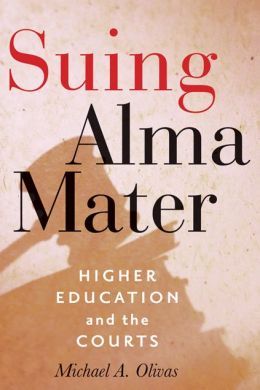
New Release: Olivas, "Suing Alma Mater"

New from the Johns Hopkins University Press: Suing Alma Mater: Higher Education and the Courts, by Michael A. Olivas (University of Houston Law Center). Here's a description from the Press:
Although much has been written about U.S. Supreme Court decisions involving higher education, little has been said about the foundational case law and litigation patterns emerging from the lower courts. As universities become increasingly legislated, regulated, and litigious, campuses have become testing grounds for a host of constitutional challenges. From faculty and student free speech to race- or religion-based admissions policies, Suing Alma Mater describes the key issues at play in higher education law.

Eminent legal scholar Michael A. Olivas considers higher education litigation in the latter half of the twentieth century and the rise of "purposive organizations," like the American Civil Liberties Union and the Alliance Defense Fund (now known as the Alliance Defending Freedom), that exist to advance litigation. He reviews more than 120 college cases brought before the Supreme Court in the past fifty years and then discusses six key cases in depth. Suing Alma Mater provides a clear-eyed perspective on the legal issues facing higher education today.
A Q&A with the author is available here, at Inside Higher Ed.

Boyd on "Zoning for Apartments"

Marie Boyd (University of South Carolina School of Law) has posted "Zoning for Apartments: A Study of the Role of Law in the Control of Apartment Houses in New Haven, Connecticut 1912-1932." The article is forthcoming in Volume 33 of the Pace Law Review. Here's the abstract:
This article seeks to contribute to the legal and policy debates over zoning by providing a more detailed examination of the impact of apartments on both pre-zoning land use patterns and the zoning process during the formative initial stages of zoning in the United States than has been provided in the literature to date. Specifically, this Article analyzes the impact of apartments on both pre-zoning land use patterns and the zoning process in New Haven, Connecticut. It focuses on the period beginning with the selection of New Haven’s first Zoning Commission in 1922, and concluding with the passage of New Haven’s first zoning ordinance in 1926. Through this detailed historical account of the realities of zoning, this Article demonstrates how — due to delays in the enactment of zoning — New Haven’s first zoning ordinance, rather than shaping the future growth of the regulated area, was instead shaped by existing land use patterns and political considerations.
The full article is available here, at SSRN.

Tuesday, July 30, 2013

Hyde on Law and Architecture in Prerevolutionary Cuba

Timothy Hyde, an Associate Professor of Architecture in Harvard University’s Graduate School of Design, has just published Constitutional Modernism: How Architecture, Law, and Urbanism Shaped the Premises of Civil Society in Cuba.  The publisher, the University of Minnesota Press, explains:
Constitutional Modernism explores architecture, planning, and law as cultural forces, analyzing the complex entanglements between these disciplines in the Cuban Republic. Timothy Hyde reveals how architects joined with other professionals and intellectuals in efforts to establish a stable civil society, from the promulgation of a new Cuban Constitution in 1940 up until the Cuban Revolution.
Roberto González Echevarría, Yale University, blurbs:
This is a major book on Cuba. It is the best history of modern Havana ever written, unlikely to be surpassed. Timothy Hyde is a thorough, scrupulous historian with a sophisticated grasp of architectural history and theory, as well as of the political and artistic history of Cuba. He chronicles in dramatic detail the vigorous debates around the question of cubanidad that led to the proclamation of the 1940 constitution, and to the formulation and execution of plans for the development of Havana: its plazas, boulevards, public buildings, and monuments. These deliberations, which included prominent intellectuals such as Fernando Ortiz and Jorge Mañach, came to an end with the advent of Castro’s regime.

New Release: Murphy, "Citizenship and the Origins of Women's History in the United States"

New from the University of Pennsylvania Press: Citizenship and the Origins of Women's History in the United States, by Teresa Anne Murphy (George Washington University). Here's a description from the Press:

Women's history emerged as a genre in the waning years of the eighteenth century, a period during which concepts of nationhood and a sense of belonging expanded throughout European nations and the young American republic. Early women's histories had criticized the economic practices, intellectual abilities, and political behavior of women while emphasizing the importance of female domesticity in national development. These histories had created a narrative of exclusion that legitimated the variety of citizenship considered suitable for women, which they argued should be constructed in a very different way from that of men: women's relationship to the nation should be considered in terms of their participation in civil society and the domestic realm. But the throes of the Revolution and the emergence of the first woman's rights movement challenged the dominance of that narrative and complicated the history writers' interpretation of women's history and the idea of domestic citizenship.

In Citizenship and the Origins of Women's History in the United States, Teresa Anne Murphy traces the evolution of women's history from the late eighteenth century to the time of the Civil War, demonstrating that competing ideas of women's citizenship had a central role in the ways those histories were constructed. This intellectual history examines the concept of domestic citizenship that was promoted in the popular writing of Sarah Josepha Hale and Elizabeth Ellet and follows the threads that link them to later history writers, such as Lydia Maria Child and Carolyn Dall, who challenged those narratives and laid the groundwork for advancing a more progressive woman's rights agenda. As woman's rights activists recognized, citizenship encompassed activities that ranged far beyond specific legal rights for women to their broader terms of inclusion in society, the economy, and government. Citizenship and the Origins of Women's History in the United States demonstrates that citizenship is at the heart of women's history and, consequently, that women's history is the history of nations.
A few blurbs:
"Teresa Anne Murphy's fascinating and important book not only reshapes our understanding of the field of women's history but is a valuable contribution to the historical literature on the political, civil, and intellectual status of women in the revolution and early republic."—Carol Faulkner, Syracuse University

"This thoughtful and stimulating intellectual history takes a fresh look at history writing by and about women between the American Revolution and Civil War. It makes an original and distinctive contribution by connecting changing narratives about women's history to larger debates about the nature of women's citizenship."—Anne M. Boylan, University of Delaware
More information, including an excerpt and the table of contents, is available here.

Epps on the Retreat Rule

In the aftermath of the Zimmerman acquittal, Garrett Epps, University of Baltimore School of Law, thought to post from his backlist, Any Which Way But Loose: Interpretive Strategies and Attitudes Toward Violence in the Evolution of the Anglo-American 'Retreat Rule,’ which appeared in Law and Contemporary Problems 55 (1992): 303-31.  Here is the abstract:
This note elaborates upon this difference of opinion as it relates to the issue of retreat and self-defense. Of the two perspectives, I am more in agreement with Professor Horowitz. The law could profitably use finer distinctions, and the line between justification and excuse would be far more useful if it were clearer. To explore the issues raised by the question of retreat, this note will examine the evolution of the "retreat rule," from its origins in the medieval common law of England through contemporary applications of it and its twin in the decisions of American courts. For the sake of focus, the inquiry will center purely on the issue of the duty to retreat. Equally important questions -- such as the possibility of an exception to the duty when a person is attacked in his or her dwelling, and the extremely controversial "co-tenant" exception to this "castle doctrine" -- will of necessity be slighted in the present inquiry.

Part II will discuss the historical roots of the retreat rule as formulated in the common law of England. Part III will show how the rule was modified in the United States during the nineteenth century, drawing on leading cases to illustrate the roots of the American rule of "no retreat." Part IV will particularize the interpretive strategies American courts have evolved in their application of the new American jurisprudence, then illustrate these strategies by analyzing selected cases in three court systems: the United States Supreme Court, which adopted the "no retreat" rule in 1895 but has been ambivalent in its subsequent applications of the rule; Alabama, which adopted the retreat rule from the common law in 1847 and has remained officially faithful to it ever since, elaborating upon its meaning in an unusually rich jurisprudence; and Illinois, which in 1902 followed the lead of the Supreme Court in adopting the American rule of "no retreat" and has consistently been counted as a "no retreat" jurisdiction ever since. The conclusion will tentatively suggest specific reforms to contemporary jurisprudence of retreat and self-defense.

Monday, July 29, 2013

Fede on Mississippi Supreme Court Judge Joshua G. Clarke

Andrew Fede has published "Judging Against the Grain? Reading Mississippi Supreme Court Judge Joshua G. Clarke's Views on Slavery Law in Context" in the May 2013 issue of the FHC Annals, the Journal of the Florida Conference of Historians.  That issue also includes an article by J. Calvitt Clarke, III, a descendent of Judge Clarke and a history professor emeritus at Jacksonville University.  Here is an abstract of Fede's article:
This article reviews Mississippi Supreme Court Judge Joshua G. Clarke's one signed slavery law opinion, State v. Jones (1821)(affirming defendant's conviction for murdering a slave), and the Court's unsigned opinion in Harry v. Decker and Hopkins (1818)(affirming freedom judgment in favor of enslaved petitioners), which the author contends that Clarke wrote.  According to the article, these opinions stand out because they were not typical of the dominant trend in the antebellum Southern common law of slavery.

The article summarizes Clarke's biography, about which little evidence is available.  Clarke moved from Pennsylvania to the Mississippi territory.  By 1804 he was practicing law in the territory.  He served in the territorial legislature and in the state's first constitutional convention before the legislature elected him in 1818 to serve on the first Mississippi Supreme Court.

The Jones and Harry opinions echo, without citation, Lord Mansfield's words in Somerset v. Stewart, suggesting that slavery was contrary to the common law and that it thus required statutory support.  In Jones, Clarke extended this view to assert that enslaved people retained all of their common law rights that statutes did not explicitly deny to them.  Clarke died in 1828.  Fede contends that there is not enough evidence to establish whether he would have consistently extended this jurisprudence to other slavery law issues and cases. 

Nevertheless, the article concludes that the Jones and Harry opinions express views that were contrary to the principles that emerge from the antebellum Southern cases denying to slaves the common law's equal protection, even when the legislatures had not done so, and denying to slaves freedom judgments, even when there was clear evidence that their owners intended to free them.

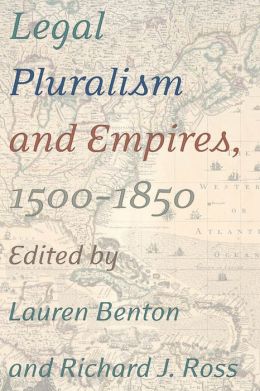
New Release: Benton & Ross, eds., "Legal Pluralism and Empires, 1500-1850"

New from New York University Press: Legal Pluralism and Empires, 1500-1850, edited by Lauren Benton (New York University) and Richard J. Ross (University of Illinois). Here's a description from the Press:
This wide-ranging volume advances our understanding of law and empire in the early modern world. Distinguished contributors expose new dimensions of legal pluralism in the British, French, Spanish, Portuguese, and Ottoman empires. In-depth analyses probe such topics as the shifting legal privileges of corporations, the intertwining of religious and legal thought, and the effects of clashing legal authorities on sovereignty and subjecthood. Case studies show how a variety of individuals engage with the law and shape the contours of imperial rule.

The volume reaches from Peru to New Zealand to Europe to capture the varieties and continuities of legal pluralism and to probe the analytic power of the concept of legal pluralism in the comparative study of empires. For legal scholars, social scientists, and historians, Legal Pluralism and Empires, 1500-1850 maps new approaches to the study of empires and the global history of law.
The blurbs:
"This volume collects thoughtful and provocative essays on the legal complexities of empire, a subject that has been at the forefront of legal history in recent years. Whether one is interested in close studies of individual places or more wide-ranging explorations of the nature of legal pluralism in imperial contexts, this is the state of the art." -- Stuart Banner, Norman Abrams Professor of Law, UCLA

"Legal pluralism has rapidly become one of the most fertile concepts among early modern historians. The richly documented and subtly argued essays in this collection amply exhibit its power to illuminate and complexify understandings of a variety of empires: Ottoman, British, French, and Spanish. As both a compendium of cutting-edge work and a blueprint for future research, the volume should inspire historians of other empires and other periods to add legal pluralism to their analytical armory." -- David Armitage, Harvard University

"Historians of law and historians of empire alike will derive new insights from this impressive collection of discerning synthetic essays and rich case studies of the diversity of legal systems as European empires (including the Ottomans) claimed sovereignty over territories and peoples around the world. These scholars offer methodological and conceptual models that will push the field forward in new directions." -- Sarah Chambers, University of Minnesota
The Introduction and Table of Contents are available here.  

Pirates!

Patricia O’Brien, Kislak Fellow at the Library of Congress’s Kluge Center and a Visiting Associate Professor at Georgetown University, will be lecturing on English Colonialism and Piracy from the Atlantic to the Pacific from 12:00 – 1:00 p.m., Room 113, Thomas Jefferson Building, Library of Congress on August 1.

Sunday, July 28, 2013

Sunday Book Review Roundup

The New York Times discusses two books about FDR (Lynn Olson's Those Angry Days (Random House) & Susan Dunn's 1940 (Yale University Press)) in a review by Jacob Heilbrun. Other books reviewed in the NYT include Michael Fullilove's Rendezvous with Destiny (Ferrar, Straus, and Giroux) here, and few books on slaveholders including Mac Griswold's The Manor: Three Centuries at a Slave Plantation on Long Island (Ferrar, Straus, and Giroux) here.

H-Net has posted a review of the edited volume British Abolitionism and the Question of Moral Progress in History (University of South Carolina Press).

And if you've missed it, check out 
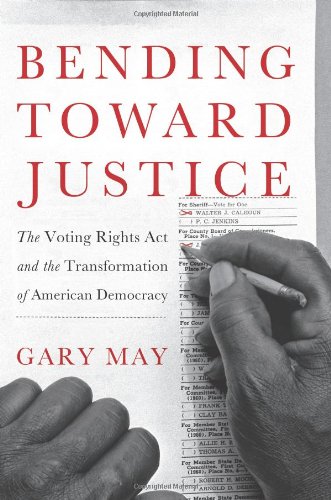
former Justice John Paul Stevens's review of Gary May's Bending Toward Justice: The Voting Rights Act and the Transformation of American Democracy (Basic Books) in the New York Review of Books. Commentary on his commentary can be found here.


Lastly, the New Books in History podcast discusses H. Paul Thompson Jr.'s A Most Stirring and Significant Episode: Religion and the Rise and Fall of Prohibition in Black Atlanta, 1865-1887 (Northern Illinois University Press).

Saturday, July 27, 2013

Weekend Roundup

Weekend Roundup is a weekly feature compiled by all the Legal History bloggers.

Friday, July 26, 2013

Krishnan et al. on Access to Justice in India

Jayanth K. Krishnan, Indiana University Maurer School of Law, et al., have posted Grappling at the Grassroots:  Access to Justice in India's Lower Tier, which is forthcoming in volume 27 of the Harvard Human Rights Journal (2014).  Here is the abstract:    
From 2010 to 2012, a team of academic and civil society researchers conducted extensive ethnographies of litigants, judges, lawyers, and courtroom personnel within multiple districts in three states: Maharashtra, Gujarat, and Himachal Pradesh. This Article provides an in-depth account of the everyday struggles these actors face in the pursuit of their respective objectives. The findings illustrate a complex matrix of variables — including infrastructure, staffing, judicial training and legal awareness, costs and continuances, gender and caste discrimination, power imbalances, intimidation and corruption, miscellaneous delays, and challenges with specialized forums — impact access to justice in the lower tier. 

The results of this study offer competing yet complementary narratives. On one hand, there is immense despair, frustration, and anger among the various sets of respondents about the current state of the lower tier. At the same time, however, there is great hope and optimism among individuals who work in the judicial sphere, as well as litigants desperately seeking to gain relief from long-endured grievances, toward what the lower tier can offer. Indeed, if the lower tier is empowered with greater resources and certain perverse aspects of the legal system can be reformed, it has vast potential to promote social change that advances the socioeconomic status of India’s most disadvantaged groups.

Cavanagh on History and Aboriginal Title

Edward Cavanagh, University of Ottawa and University of the Witwatersrand, has posted Land Rights that Come with Cut-Off Dates: A Comparative Reflection on Restitution, Aboriginal Title, and Historical Injustice.  Here is the abstract:
The doctrine of aboriginal title allows for a distinct form of redress, empowering communities to use the judiciary to take action against the state for foundational acts of historical dispossession. It has not taken root in South Africa, yet in other former settler colonies of the British Empire, it remains important to this day. This article interrogates history and law to explain why this is the case. Such an approach allows for a critical reflection on the system of land restitution that developed in South Africa instead of aboriginal title. by exploring the past and present realities of ‘dispossession’ in South Africa, this article discredits the inclusion of cut-off dates in the Restitution of Land Rights Act. These dates have discriminated between claimant communities irrationally and insensitively – even racially. History should not be mobilised in statute law to obstruct the pathway to redress. It should, instead, be used positively to restore the rights of those formerly dispossessed, and to preserve the rights of those facing dispossessions pending, in South Africa.

Thursday, July 25, 2013

Axtell on Riverine Governance in Antebellum America

Moonrise on the Ohio (LC)
Matthew Axtell, a doctoral candidate at Princeton and, in the year ahead, a Golieb Fellow at NYU Law, has posted Customs of the River: Governing the Commons within a Nineteenth-Century Steamboat Economy.  Here is the abstract:
This paper uncovers a lost world indigenous to the legal history of the United States, a place where law was "used" as an instrument not in a way familiar to readers of Willard Hurst, as a means to identify natural resources as private property to be allocated for exploitation by the highest bidder, but instead as a means to preserve landscapes as common property sustainably enjoyed by a multiplicity of actors for commercial ends. Focusing upon a single suit brought in 1854 to assign liability for a steamboat collision, where the issue became whether pilots followed the "customs of the river" at a particular bend in the Ohio River, the paper relates how through the "customs of the river" inquiry, Jacksonian judges in the 1830s and 1840s permitted a wild, unimproved river to speak at trial in order to keep American environments open to the "disorganized public" as a whole. By the 1850s, pressed by insurers seeking standardized commercial rules of the road, federal administrators promoted a more uniform, state-managed vision. To maintain the river’s status as a "common highway" with the "customs" inquiry now out of fashion, Humphrey Leavitt, the Jacksonian judge in this case, eventually developed new rules that shared the costs of navigation between private actors in a way that maintained the Ohio River as a privately-ordered common space.

Nicola on Critical [EU] Legal Histories

Fernanda Nicola, American University Washington College of Law, has posted Introduction: Critical Legal Histories in EU Law, which will appear in the American University International Law Review.  Here is the abstract:
This essay introduces a collection of articles spurred by the New Historians of EU law. These scholars offer a new way to reflect, in an interdisciplinary manner, on what EU law scholarship has accomplished until now and how it has shaped our shared European legal culture. Among the goals attained by the New Historians, there is a commitment to better understand how legal change has occurred in EU law through critical legal histories of understudied everyday practices. The aim is to offer new and multiple narratives to shed light on Europe’s past with implications for its future.

Civil Rights Act of 1964 Research Grant and Call for Papers

Via H-Law, we have the following announcement:
Civil Rights Act of 1964 Research Grant and Call for Papers
The Center for the Study of Southern Culture (CSSC) and the Southern Foodways Alliance at the University of Mississippi announce a $1,000 research grant to catalyze scholarship on the Civil Rights Act of 1964 and the desegregation of Southern restaurants. The grant of $1,000 is payable in two parts: $500 upon assignment and $500 on the delivery by March 3, 2014, of a scholarly article based on the completed research. The article will undergo the peer-review process, and the Center for the Study of Southern Culture will have first publication rights for the article—planned for the 50th anniversary of the Civil Rights Act—after which the scholar may use it as he or she desires.

Wednesday, July 24, 2013

Call for Submissions: Liberty Legacy Foundation Award

Via H-Law, we have the following call for submissions:
SUBMISSION DEADLINE: OCTOBER 1, 2013
Inspired by OAH President Darlene Clark Hine’s call in her 2002 OAH presidential address for more research on the origins of the civil rights movement in the period before 1954, the Liberty Legacy Foundation Award is given annually by the Organization of American Historians to the author of the best book by a historian on the civil rights struggle from the beginnings of the nation to the present.
Each entry must be published during the period January 1, 2013 through December 31, 2013.
The award will be presented at the 2014 OAH Annual Meeting in Atlanta, Georgia, April 10–13.
Submission Procedures
One copy of each entry, clearly labeled “2014 Liberty Legacy Foundation Award Entry,” must be mailed directly to the committee members listed below. Each committee member must receive all submissions by October 1, 2013.
Bound page proofs may be used for books to be published after October 1, 2013 and before January 1, 2014. If a bound page proof is submitted, a bound copy of the book must be received no later than January 7, 2014. 

Chadwick on Prisoners, Spies and Deserters in WW1

Elizabeth Chadwick, Nottingham Law School, has posted The Second Death of Ilya Pavlovitch Bjuscheff: The Legal Position of Prisoners, Spies and Deserters During World War 1, which first appeared in Revue de Droit Militaire et de Droit de la Guerre 36 (1997): and was republished in the Nottingham Law Journal 13 (2004): 1-19.  Here is the abstract:    
The article is a legal analysis of Zweig’s fictionalised account, published in 1927, of a true story which occurred in German occupied territory during World War 1. 'The Case of Sergeant Grischa' concerns a Russian prisoner of war who escapes his labour camp, is recaptured wearing the clothes of a dead German soldier, and subsequently tried and executed as a spy by German occupying forces, even though his true identity, status, and purpose in escape were by then known. In this examination, the very limits of law during ideological, industrialised warfare are illustrated by means of the repercussions on one man, who essentially is left alone to struggle against the breach of known, ‘civilised’ rules of warfare regarding the treatment of prisoners, spies and deserters.

The article considers Grischa’s case through the lens of the international laws of armed conflict in force at the time. First, the origin and evolution in the 19th and early 20th centuries of what is today known as the International Humanitarian Law of Armed Conflict are introduced, after which specific provisions of the Hague Conventions 1899 and 1907, and Geneva Conventions 1864 and 1906, as they applied to prisoners of war, are outlined. The customs and usages of war found in contemporaneous military manuals supply additional details regarding the acceptable treatment of spies and deserters, while the laws governing enemy occupied territory – on which Grischa was initially imprisoned, escaped, recaptured, tried and executed – form the backdrop. Most troublesome is the human element, as a high degree of ideological and socio-economic rivalry existed not only between the main German officers in charge of Grischa’s case, but between the enemy belligerents.

Tuesday, July 23, 2013

Two Foundational Texts in Modern Criminal Law

William Blackstone
Just up on SSRN are prepublication drafts of two chapters in the forthcoming Foundational Texts in Modern Criminal Law, ed. Markus Dubber (Oxford University Press).  Simon Stern, University of Toronto Faculty of Law, has posted William Blackstone, Commentaries on the Laws of England, Vol. 4 (1769):
This book chapter discusses the fourth volume of Blackstone's Commentaries (1769), asking what contribution this volume makes to English criminal law. Issues addressed include the general structure of Blackstone's discussion, the relation between Blackstone's treatment and those of his precursors (especially Sir Matthew Hale and William Hawkins), the historical and literary range of Blackstone's references, the nature of his legal reform agenda, and his conception of the book's audience.
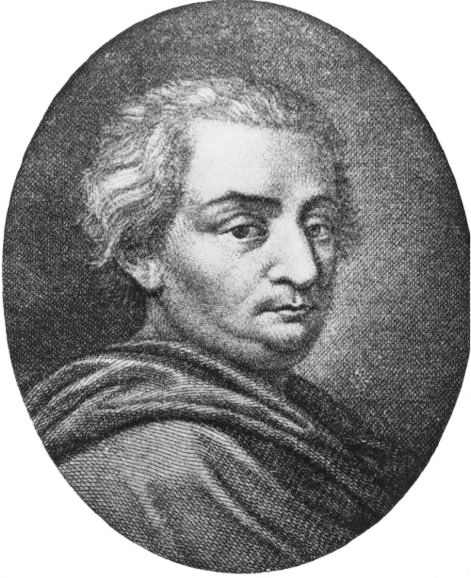
Bernard E. Harcourt, University of Chicago Law School, has posted Beccaria's 'On Crimes and Punishments': A Mirror on the History of the Foundations of Modern Criminal Law:
Cesare Beccaria
Beccaria’s treatise "On Crimes and Punishments" (1764) has become a placeholder for the classical school of thought in criminology, for deterrence-based public policy, for death penalty abolitionism, and for liberal ideals of legality and the rule of law. A source of inspiration for Bentham and Blackstone, an object of praise for Voltaire and the Philosophies, a target of pointed critiques by Kant and Hegel, the subject of a genealogy by Foucault, the object of derision by the Physiocrats, rehabilitated and appropriated by the Chicago School of law and economics — these ricochets and reflections on Beccaria’s treatise reveal multiple dimensions of Beccaria’s work and provide an outline of a history of the foundations of modern criminal law. In becoming a classic text that has been so widely and varyingly cited, though perhaps little read today, "On Crimes and Punishments" may be used as a mirror on the key projects over the past two centuries and a half in the domain of penal law and punishment theory — and this essay hopes to contribute, in a small way, to such an endeavor. In the end, we may learn as much about those who have appropriated and used Beccaria than we would about Beccaria himself — perhaps more.

Dale reviews Valverde, "Everyday Law on the Street"

From JOTWELL's Legal History Section, we have a short review of Mariana Valverde, Everyday Law on the Street: City Governance in an Age of Diversity (University of Chicago Press, 2012). Reviewer Elizabeth Dale (University of Florida) begins by recounting her own early obsession with Jane Jacobs's Death and Life of Great American Cities (1961). Here's a snippet from further on:
I started reading Mariana Valverde’s recent book, Everyday Law on the Street: City Governance in an Age of Diversity (2012), a study of street-level urban governance in Toronto, because it promised a law and society alternative to Jacobs’ work. But while I came, so to speak, for the law and society recasting of Jacobs, I stayed for the reminders her work offers legal historians.
The full review is available here.

Monday, July 22, 2013

Orgard on Loyalty Oaths in Liberal Democracies

Liav Orgad, Interdisciplinary Center (IDC) Herzliyah-Radzyner School of Law, has posted Liberalism, Allegiance, and Obedience: The Inappropriateness of Loyalty Oaths in a Liberal Democracy, which is forthcoming in the Canadian Journal of Law and Jurisprudence (2014).  Here is the abstract:
The Article examines the wisdom of loyalty oaths as a legal institution in contemporary liberal democracies. First, using comparative analysis the Article highlights the growing global interest in loyalty oaths. Second, based upon historical evidence the Article explores the functions of loyalty oaths and assesses their role. Third, through using legal analysis the Article challenges the validity of loyalty oaths and identifies three fundamental concerns related to their content and form: the rule of law, freedom of conscience, and equality.

The Article reveals liberal concerns associated with the added value of the duty of "loyalty to the law" (allegiance), as distinct from the duty to "obey the law" (obedience). It presents an ongoing tension between loyalty and liberalism and argues that the more loyalty liberal democracies demand, the less liberal they become. The Article concludes that loyalty oaths yield high costs but have low benefits and suggests that liberal states should abandon them as a legal institution.

John Marshall Harlan, Con Law Prof

Brian L. Frye, Kentucky Law, Josh Blackman, South Texas Law, and Michael McCloskey, the Harlan Institute for Constitutional Studies, have published two items relating to the first Justice John Marshall Harlan in the George Washington Law Review.  The first is “the complete, annotated lecture notes” of Harlan's constitutional law lectures from 1897-98.  Professor Blackman tells us that “Harlan taught the Constitution by clause, so it is very easy to find his views on a particular topic.”  The trio have also published an analysis as Justice John Marshall Harlan Professor of Law:
Credit: LC
From 1889 to 1910, while serving on the United States Supreme Court, the first Justice John Marshall Harlan taught at the Columbian College of Law, which became the George Washington University School of Law. For two decades, he primarily taught working-class evening students, in classes as diverse as property, torts, conflicts of law, jurisprudence, domestic relations, commercial law, evidence — and most significantly — constitutional law.

Harlan’s lectures on constitutional law would have been lost to history, but for the enterprising initiative — and remarkable note-taking — of one of Harlan’s students, George Johannes. During the 1897-98 academic year, George Johannes and a classmate transcribed verbatim the twenty-seven lectures Justice Harlan delivered on constitutional law. In 1955, Johannes sent the transcripts to the second Justice Harlan. The papers were ultimately deposited in the Library of Congress. Though much attention has been given to the life and jurisprudence of Justice Harlan, his lectures have been largely ignored.

Harlan’s lectures are a treasure trove of insights into his jurisprudence, as well as the state of constitutional law at the turn of the 20th century. They provide the unique opportunity to listen in as one of our greatest Justices lectures on the precipice of a constitutional revolution that he helped create. In this article, we use the lectures to paint a picture of who Justice Harlan was, what he believed, how he sought to impart that knowledge to the future lawyers of America, and how he predicted many of the changes in constitutional law that occurred during the 20th century.
Finally on Professor Blackman's blog you may find Harlan's con law exam from 1899.

Symposium on Weiner's "Rule of the Clan"

This week Concurring Opinions will be hosting a symposium on the former LHB Guest Blogger Mark Weiner’s book The Rule of the Clan.  As Mark writes, “participants are an intellectually diverse, international group”:

Prof. Mark Fenster, Levin Colleiner's ty of San Andrés School of Law, Argentina

Dr. Arnold Kling, Adjunct Scholar, Cato Institute.

Dr. Jan-Christoph Marschelke, Managing Director, Global Systems and Intercultural Competence Program (GSiK), University of Würzburg, Germany,

Prof. Tim Murphy, Universiti Utara Malaysia (University of North Malaysia).

Prof. Abdullah Saeed, Sultan of Oman Professor of Arab and Islamic Studies, University of Melbourne, Australia

Dr. Doyle R. Quiggle, Jr., author of "Ibn Tufayl's Hayy Ibn Yaqdan in New England: A Spanish-Islamic Tale in Cotton Mather's Christian Philosopher?"

Prof. Jeanne Schroeder, Cardozo School of Law

Prof. Kevin Stack, Associate Dean for Research, Vanderbilt School of Law

Hulsebosch on "The Origin and Nature of Colonial Grievances"

No version is available on the web, but be on the lookout for The American Revolution (II): The Origin and Nature of Colonial Grievances, an essay by Daniel J. Hulsebosch, NYU School of Law, forthcoming this year in The Oxford History of the British Empire: The American Colonies in the British Empire, 1607-1776, ed. Stephen Foster.  Here is the abstract:    
Colonial grievances were not new in July 1776 but rather were as old as the British Empire and a constant feature of imperial governance. The continuous stream of grievances was not, however, evidence that “the spirit of the colonies demanded freedom from the beginning.” Paradoxically, grievances helped make the Empire work. They facilitated imperial development for two reasons. First, people lodging grievances could rely on a communication network for processing them, a system that helped integrate the many different subjects and places in the empire. Second, from the colonial perspective, the imperial grievance system had a safety valve: war. When the empire was at war, metropolitan policy-makers and local governors were more willing to compromise with provincial interests and acceded to claims that had been or threatened to become the source of grievances. The two together – the imperial grievance system and the leverage enjoyed by colonists during war – generated the sense throughout North America that the imperial constitution was a flexible set of institutions responsive to provincial claims and yet also efficient enough to facilitate common projects, like carrying out transatlantic commerce and waging war. The imperial constitution, with the grievance system at its core, provided the possibility for change that is essential to any workable constitution.

By the middle of the 1770s, however, the grievance network no longer performed effectively. A system that for over a century helped bind the North American colonies to the empire suddenly, after an unusually long and stable period of peace, fragmented and became an instrument of rebellion. Only then, in the Declaration of Independence, were the many and sometimes inconsistent colonial grievances compiled into a “history of repeated injuries and usurpations, all having in direct object the establishment of an absolute Tyranny over these States.” These grievances were irremediable and flowed outside the imperial constitution. The genre to which they now belonged was the international declaration of war.

Sunday, July 21, 2013

Brophy on the Nat Turner Trials

Alfred L. Brophy, University of North Carolina at Chapel Hill School of Law, has posted The Nat Turner Trials, which appears in North Carolina Law Review 91 (2013).  Here is the abstract:    
credit
“The Nat Turner Trials” locates the trials of slaves in the wake of the Nat Turner rebellion in the context of common, and statutory, law and extra-legal responses to slavery in Virginia and North Carolina during the early 1830s. The Article shows how trials were part of the whole system of slavery, held together by norms of white supremacy promulgated in the press, the pulpit, and on plantations. Decisions from local courts to appellate courts gave broad power to slave owners to control enslaved people. There was little done in defense of slaves, though in some ways the states’ criminal procedure statutes and the actions of some slave owners and defense lawyers may have helped to limit the number of convictions.

The article is framed by two cases in North Carolina — one in 1830 of a white man who attacked a slave in his custody and was freed from punishment and another in 1834 of a slave who killed his overseer and was found guilty of manslaughter rather than premeditated murder. Sandwiched between those two cases was the Nat Turner rebellion in neighboring Virginia during August of 1831. The trials of those accused of rebellion and conspiracy, along with the vigilante violence that accompanied the rebellion, further illustrate the ways the legal system functioned to support slavery and order.

The article highlights how trials of slaves in the wake of the Nat Turner rebellion worked to re-establish order and to mete out punishment. It also reveals how lawyers for the slaves labored — largely unsuccessfully — to free those most obviously not guilty. Those lawyers were committed to the re-establishment of order; all of the key lawyers had participated in the militia response to the rebellion. Yet the defense lawyers still tried to limit convictions, and they succeeded to some extent.

The trials worked in conjunction with — and sometimes in opposition to — the extra-legal violence that accompanied the repression of the rebellion. The trials reveal, as did the two Supreme Court of North Carolina cases that bookend this Article, the conflicts within the community, as some emphasized the power of slave owners to treat slaves as they wished, while others emphasized the subjection of everyone, including owners of slaves, to the rule of law. The court struggled in part with trying to keep the community from taking vigilante action. It also acted to punish the rebels and stopping further rebellion.

The trials tell compact, linear stories about why someone is being punished (or not). The trials are obscure, but collectively they tell a powerful story about the role of law in American history as a vehicle for establishing order.

Sunday Book Review Roundup

This week readers can find two reviews of Maury Klein's Call to Arms (Bloomsbury Press), one in the Wall Street Journal and a second in the Washington Post. Here's an excerpt of Johnathan Yardley's take in the Post:
"The story of how America became the “great arsenal of democracy” is the subject of “A Call to Arms,” and I can’t imagine it being told more thoroughly, authoritatively or definitively. "
This week's New York Times reviews Mason B. Williams's City of Ambition (W.W. Norton & Co.) For those looking for audio options, the NYT book review podcast discusses the book here. Edward Glaeser summarizes the book:
"But, as Mason B. Williams’s fascinating new book “City of Ambition: FDR, La Guardia, and the Making of Modern New York” reminds us, La Guardia’s success rested to a large degree on Franklin Roose­velt’s decision to “channel the resources of the federal government through the agencies of America’s cities and counties.”"
Fiona Rieds reviews Panikos Panayi's Prisoners of Britain (Manchester University Press), a social history of Britain's German prisoners during the First World War. 

And the New Yorker has two slightly different contributions to this week's Sunday roundup: an article discussing Eudora Welty's 1963 New Yorker essay "Where is the Voice Coming From?" (about Medgar Evers' murderer); as well as a few bits of legally related book chat.

Saturday, July 20, 2013

Blumm and Wigington on the Oregon and California Forest Lands

Michael C. Blumm and Tim Wigington, Lewis & Clark Law School, have posted The Past as Prologue to the Present: Managing the Oregon and California Forest Lands, which is to appear in the Oregon State Bar Bulletin (July 2013).  Here is the abstract:
credit
This article is a brief review of the convoluted history of what are known as the Oregon and California forest lands, federal lands that were once the subject of a 19th century federal railroad grant, then became the focus of widespread land fraud and official corruption, which led to the Supreme Court halting land sales and Congress taking back the lands, situated in eighteen Oregon counties. Federal management of the lands in the 20th century emphasized timber harvesting, and this dominant use of the lands led to environmental lawsuits and the Endangered Species Act listing of the northern spotted owl in the early 1990s. Since 1994, the lands have been governed by the Northwest Forest Plan, which drastically limited federal timber harvests and associated local county revenues, which were based on those harvests. Several counties in southern Oregon now face public service crises, as their local tax base is insufficient to provide emergency services like fire and police.

In this short version of a larger study -- written for the local bar -- we propose a solution to the funding crisis in southern Oregon that does not involve scuttling the Northwest Forest Plan and returning the lands to dominant timber use. Increasing timber harvests to fund county governments is the subject of a bill co-sponsoring by several Oregon Congressmen, and we explain why this approach would be short-sighted and environmentally unsatisfactory.

Friday, July 19, 2013

Hoffman on the Canadian Anti-Combines Act, 1889

Charles Paul Hoffman, a Doctor of Civil Law candidate at McGill Law, has posted A Reappraisal of the Canadian Anti-Combines Act of 1889, which is forthcoming in the Queen's Law Journal.  Here is the abstract:    
Nathaniel Clarke Wallace
In 1889, in response to growing concern about the role of cartels and other "combines" in the economy, the Canadian parliament passed the Anti-Combines Act, the world’s first modern competition statute. A tentative first step, the Act made it a misdemeanour to enter into agreements that were previously unenforceable under the contract law restraint of trade doctrine. The Act, however, was not a success, with only a single prosecution (which resulted in acquittal) brought under it prior to its amendment in 1900. Since that time, it has been broadly criticized in the academic literature, with critics alleging three reasons for its failure: that it extended only to conduct already "unlawful" under the restraint of trade doctrine; that it criminalized only conduct already indictable under the crime of conspiracy; and that it was an intentional failure, a "political sham". Each of these critiques, however, is built on a flawed understanding of the restraint of trade doctrine, reading back into the law in 1889 two House of Lords’ decisions from the 1890s, Mogul Steamship v McGregor, Gow (1892) and Nordenfelt v Maxim Nordenfelt Guns & Ammunition (1894), which made it substantially more difficult to prove agreements were unreasonable vis-a-vis the public interest. Though the Act would not have been the panacea intended by its chief sponsor, Nathaniel Clarke Wallace [above], it would have been a useful tool against the most pernicious of combine agreements, had the law remained as it was at the time of enactment. The Anti-Combines Act should thus be remembered not for its failure, but as a Canadian legislative innovation hampered by judicial decisions rendered in Westminster.

Boston, 1767

Recently discovered in Harvard’s Houghton Library are eight subscription sheets, dated October 28, 1767, containing more than 650 signatures of Bostonians pledging to participate in the boycott of British imports.  The Harvard Gazette story here.  Hat tip: David Warrington.

McCoy, "The Making of the U.S. Surveillance State"

Looking for a historian's perspective on the recent NSA surveillance disclosures? Head to the History News Network for Alfred W. McCoy's take on "The Making of the U.S. Surveillance State, 1898-2020." Here's the first paragraph:
Alfred W. McCoy (UW-Madison)
The American surveillance state is now an omnipresent reality, but its deep history is little known and its future little grasped. Edward Snowden’s leaked documents reveal that, in a post-9/11 state of war, the National Security Agency (NSA) was able to create a surveillance system that could secretly monitor the private communications of almost every American in the name of fighting foreign terrorists. The technology used is state of the art; the impulse, it turns out, is nothing new. For well over a century, what might be called “surveillance blowback” from America’s wars has ensured the creation of an ever more massive and omnipresent internal security and surveillance apparatus. Its future (though not ours) looks bright indeed.
Read on here.

Smith on the Regulation of Prostitution in New Orleans

Simon Stern has drawn our attention to the following (gated) article: Elizabeth Parish Smith, “In a Bar Room Called the ‘Fifteen Amendment’”: Reconstruction and the Women of New Orleans’s Demimonde, South Atlantic Quarterly 112 (2013): 473-479.  Here is the abstract:
This essay examines the experiences of three women—one Creole, one black, one white—in New Orleans’s Reconstruction-era demimonde. Enacted just months after the end of the Civil War and surviving in various forms for fifty-two years, a regulatory system governed the sex trade in this, the largest and most cosmopolitan city of the former Confederacy. Postwar regulation made no racial distinctions among women in the trade, and prostitutes’ lives were thus often remarkably similar. Women worked and resided in the same parts of town, even on the same notorious block; faced similarly explosive, dangerous bursts of violence; and exploited the physical intimacy of their work to steal from clients.

In large measure due to their similar legal treatment under regulation, many prostitutes shared W. E. B. Du Bois’s common “economic condition and destiny” across racial lines. Nevertheless, Du Bois uses prostitution in Black Reconstruction as a rhetorical device representing capitalism’s moral corruption, not as a practice affecting real women’s lives. Reading the experiences of three New Orleans prostitutes against the larger racial and economic politics of the period allows us to see how some of the most radical and far-reaching changes of Reconstruction occurred among women living at the law’s edges.

Thursday, July 18, 2013

Littleton-Griswold Grant Recipients Announced

The American Historical Association has announced this year’s recipients of the Littleton-Griswold Grants, which are awarded “to support research in US legal history and in the general field of law and society”:

Heather Lee, Brown University, for “The Right to Enter: Chinese Restaurant Owners, U.S. Immigration Laws, and the Federal Courts, 1894-1945.”

Sara Damiano, Johns Hopkins University, for “Gender, Law, and the Culture of Credit in New England, 1730-1790.”

Moira Gillis, University of Oxford, for “The Evolution of the Colonial American Corporation under the Stuart and Hanoverian Crowns: 1606-1763.”

Ryan Johnson, University of Minnesota
, for “Enemies of the State: Knowing, Producing, and Policing Anarchism in the Making of the Modern American National Security State, 1901-1921.”

Michael Schoeppner, California Institute of Technology
, for “The Moral Contagion of Liberty: Black Atlantic Sailors, Citizenship, and Quarantine in the Antebellum United States.”