Showing posts with label Privacy. Show all posts

Saturday, October 4, 2025

Weekend Roundup

  • John W. Cairns, professor of Civil Law at the University of Edinburgh, will deliver this year’s Eason-Weinmann Lecture on International and Comparative Law at Tulane Law School on November 20, 2025, at 5 p.m. in the Wendell H. Gauthier Moot Court Room 110.  Professor Cairns’s lecture, "The Civil Code of the State of Louisiana: Context and Contents," will kick off a conference on the bicentennial of the Louisiana Civil Code.  
  • A notice and recording of Richard Primus's discussion with Noah Feldman of Professor Primus's book, The Oldest Constitutional Question, at HLS on September 25 (Harvard Law Today). 
  • UVA Law's notice of G. Edward White's Robert H. Jackson: A Life in Judgment (Oxford University Press). 
  • "Jamie Raskin (D-MD), former Federal Judge Michael Luttig, and Baltimore University Law Professor Kimberly Wehle discuss the history of the U.S. Constitution at an event hosted by George Washington's Mount Vernon" (C-SPAN).  
  • My Georgetown Law colleague John Mikhail lectured on anti-slavery and the Constitution on September 17 as part of Ithaca College’s observance of Constitution Day (Ithacan).  DRE. 
  • Last month, Nancy Cott, Harvard University, spoke on “Doctors, Lawyers, and Feminists on the Road to Roe v. Wade" at Vanderbilt Law (Vanderbilt)
  • Kurt Lash discusses constitutional debates over slavery before the Civil War (NCC). 
  • One of the Drinan Visiting Professors are at the Boston College Law School is Rebecca Horwitz-Willis, a recipient of the Kathryn T. Preyer Award from the American Society of Legal History (BC Law).

  • The Organization of American Historians is sponsoring two webinars on immigration in October.  The first, on denaturalization, will take place at 6pm ET on October 14.  Register here.  The second, on U.S. deportation policies from the Alien Friends Act of 1798 to today, will take place at 6pm ET on October 30.  Register here.  Both webinars are co-sponsored by the Immigration and Ethnic History Society.   
  • The October 2025 issue of the newsletter of the Historical Society of the DC Circuit is now available.  
  • We ought to have noticed sooner Time Immemorial, the podcast of the Osgoode Hall Society for Canadian Legal History. 
  • ICYMI: (Before the government shutdown), visitors to the National Archives react to seeing the entire Constitution (WaPo).  Jillian Foley on America’s Privacy Policy (HNN).  Douglas M. Charles, Penn State, on history repeating itself at the FBI (The Conversation).
Weekend Roundup is a weekly feature compiled by all the Legal History bloggers. 

Saturday, March 22, 2025

Weekend Roundup

  • Penn Carey Law’s notice of Dean Sophia Lee's recent article on "the evolution of Fourth Amendment privacy from weak pre-Reconstruction protections through its development over the years, culminating in Boyd v. United States."
  • A Q&A with Felicia Kornbluh and LHB Guest Blogger Jill Hasday on Professor Hasday’s new book We the Men in Ms. Magazine.  Her post on OUPblog is here.
  • The League of Women Voters of Pullman and Whitman County will host the virtual event, “History of Disability Rights” on 7-8:30 p.m. March 31 over Zoom (Lewiston Tribune).
  • James E Hurford reviews The Legal History of the Church of England: From the Reformation to the Present, by Norman Doe and Stephen Coleman (Law Society Gazette).
  • Stephen B. Presser review Jonathan Gienapp's Against Constitutional Originalism for the Federalist Society.

 Weekend Roundup is a weekly feature compiled by all the Legal History bloggers.

Monday, December 9, 2024

Lee on Privacy's Redeemer Origins

Sophia Z. Lee, University of Pennsylvania Carey Law School, has posted The Reconciliation Roots of Fourth Amendment Privacy, which appears in the University of Chicago Law Review:

The Roberts Court has made protecting “the privacies of life” a catchphrase of Fourth Amendment law in the digital era. The time is thus ripe for revisiting the doctrinal and political roots of this newly influential quote from the Court’s 1886 decision Boyd v. United States. Existing scholarship views Boyd and its paean to privacy as an opening salvo in the Supreme Court’s turn-of-the-twentieth-century deregulatory jurisprudence (often associated with the Court’s most famous substantive due process decision, Lochner v. New York). Scholars also assume Boyd’s emphasis on privacy was in keeping with the Founders’ view of the Fourth Amendment.

This Article makes a novel argument that Boyd and its elevation of protecting the “privacies of life” to an animating principle of the Fourth Amendment was instead a product of Reconstruction and its dismantlement. Doctrinally, the Article argues that legal actors did not commonly associate the Fourth Amendment with something they called “privacy” until after the Civil War. This association, along with Boyd’s other core doctrinal elements, was instead established during Reconstruction. Further, these Fourth Amendment innovations were pioneered in Congress, not the federal courts. Politically, the Article argues that Boyd’s innovations did not arise in response to growing federal economic regulation. Instead, the idea that the Fourth Amendment protected the privacies of life was fed by white Americans’ commitment to preserving racial hierarchy after the Civil War. Shared by moderate Republicans and Democrats, this embrace of Fourth Amendment privacy built an anodyne bridge between otherwise fierce political foes. In other words, Fourth Amendment privacy was produced by and helped secure Reconciliation—the process through which white Americans North and South, Democrat and Republican came together to limit Reconstruction, preserve white supremacy, and pave the way for the violent disenfranchisement of newly freed Black men.

The Article is primarily a work of legal history; it concludes, however, by considering the divergent doctrinal implications of resituating Boyd and Fourth Amendment privacy in the politics of Reconciliation. Doing so supports the Roberts Court’s recent Fourth Amendment decisions without undermining scholars who contend that the Fourth Amendment protected what we today call privacy from the start. At the same time, this history poses a problem for Justice Neil Gorsuch and other libertarians who use the modern administrative state’s connections to Jim Crow-era white supremacy to undermine its legitimacy. This Article shows that the very libertarian tradition championed by these skeptics of the administrative state suffers the same tainted roots. Critical scholars, for their part, document how constitutional privacy doctrines provide limited protection to marginalized communities. This Article’s history could support their reparative case for more robust Fourth Amendment protections.
--Dan Ernst

Monday, February 27, 2023

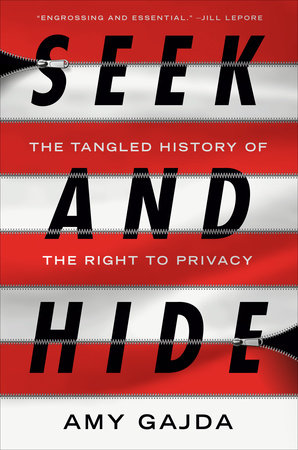
Gajda, "Seek and Hide: The Tangled History of the Right to Privacy"

We missed this book when it came out last year: Amy Gajda (Tulane Law School), Seek and Hide: The Tangled History of the Right to Privacy (Viking, 2022). A description from the Press:

Should everyone have privacy in their personal lives? Can privacy exist in a public place? Is there a right to be left alone even in the United States? You may be startled to realize that the original framers were sensitive to the importance of   privacy interests relating to sexuality and intimate life, but mostly just for powerful and privileged (and usually white) men. 

The battle between an individual’s right to privacy and the public’s right to know has been fought for centuries. The founders demanded privacy for all the wrong press-quashing reasons. Supreme Court jus­tice Louis Brandeis famously promoted First Amend­ment freedoms but argued strongly for privacy too; and presidents from Thomas Jefferson through Don­ald Trump confidently hid behind privacy despite intense public interest in their lives.  
 
Today privacy seems simultaneously under siege and surging. And that’s doubly dangerous, as legal expert Amy Gajda argues. Too little privacy leaves ordinary people vulnerable to those who deal in and publish soul-crushing secrets. Too much means the famous and infamous can cloak themselves in secrecy and dodge accountability.
Seek and Hide carries us from the very start, when privacy concepts first entered American law and society, to now, when the law al­lows a Silicon Valley titan to destroy a media site like Gawker out of spite. Muckraker Upton Sinclair, like Nellie Bly before him, pushed the envelope of privacy and propriety and then became a privacy advocate when journalists used the same techniques against him.  By the early 2000s we were on our way to today’s full-blown crisis in the digital age, worrying that smartphones, webcams, basement publishers, and the forever internet had erased the right to privacy completely.
Praise from reviewers:

“For anyone who mistakenly believes that the debate about press freedom and privacy is a twenty-first-century problem, Amy Gajda’s Seek and Hide is a reminder that ‘gotcha’ journalism, political sex scandals, and hand-wringing over new technologies date back to the Founding Era. In this gorgeously written, rollicking account of a very complicated, very Ameri­can history of the smackdown between privacy versus the right to know, Gajda offers indispensable and timely context for contemporary debates about the boundaries of both. Ultimately Seek and Hide also serves as a bracing reminder that the laws of privacy and politics are often shaped by self-interested parties with the most to gain and the most to hide.” -- Dahlia Lithwick 

“A magnificent book that shows us that the tension between the right to privacy and freedom of expres­sion is as old as this country yet as recent as social media and doorbell cameras. At a time when we all must be concerned about what it all means for each of us, Amy Gajda has written the definitive book about privacy and the right to know.”— Erwin Chemerinsky

An excerpt is available here, via the American Bar Association. An interview with Professor Gadja is available here, at New Books Network.

-- Karen Tani

Wednesday, December 14, 2022

A Book Launch and Celebration for Lawrence Friedman

[We have the following announcement from Stanford Law School.  DRE.]

We are excited to announce two upcoming book talks hosted by Stanford Law School and the Stanford
Center for Law and History in honor of Professor Lawrence Friedman, to be held on Friday, January 13, 2023.

Please join us in celebrating the pioneering and broad-ranging scholarship of Lawrence Friedman, the Marion Rice Kirkwood Professor of Law, Emeritus at Stanford Law School. A leading founder and champion of the law-and-society movement, Friedman has made an indelible impact on the nature of legal scholarship and teaching, not only in the United States, but also throughout the world. Closer to home, he has left an enormous mark on Stanford Law, such that generations of colleague and students have come to associate him with the very best of SLS—brilliant scholarship and teaching, combined with true menschlichkeit.

The event will consist of two separate panels, each focused on a different, recent book published by Friedman—The Walled Garden: Law and Privacy in Modern Society (co-authored with Joanna Grossman) and Personal Identity in the Modern World. Leading commentators from Stanford and elsewhere will offer their reflections on these books, allowing time for Friedman to respond and to engage with members of the audience.  To register and get event details, please visit this link.

Tuesday, March 24, 2020

Kerr on Decryption, the 5th Amendment and the Burr Trial

Orin S. Kerr, University of California, Berkeley School of Law, has posted Decryption Originalism: The Lessons of Burr, which is forthcoming in the Harvard Law Review:
Aaron Burr (LC)
The Supreme Court is likely to rule soon on how the Fifth Amendment privilege against self-incrimination applies to compelled decryption of a digital device. When the Court rules, the original understanding of the Fifth Amendment may control the outcome. This Article details an extraordinary case that illuminates the original understanding of the privilege and its application to compelled decryption. During the 1807 treason trial of Aaron Burr, with Chief Justice John Marshall presiding, the government asked Burr’s private secretary if he knew the cipher to an encrypted letter Burr had sent to a co-conspirator. Burr’s secretary pled the Fifth, leading to an extensive debate on the meaning of the privilege and an opinion from the Chief Justice.

The Burr dispute presents a remarkable opportunity to unearth the original understanding of the Fifth Amendment and its application to surprisingly modern facts. The lawyers in Burr were celebrated and experienced advocates. The Chief Justice allowed them to argue the Fifth Amendment question in exhaustive detail. And an attorney recorded the entire argument in shorthand, including dozens of legal citations to the specific pages of the authorities the lawyers invoked. The rich materials allow us to reconstruct for the first time precisely how the privilege was understood by leading lawyers and Chief Justice John Marshall soon after the Fifth Amendment’s ratification. The Article presents that reconstruction, and it concludes by applying Burr’s lessons to the modern problem of compelled decryption of digital devices such as cell phones and computers.
--Dan Ernst

Wednesday, January 22, 2020

Goldenfein, "Monitoring Laws: Profiling and Identity in the World State"

Cambridge University Press recently released Monitoring Laws: Profiling and Identity in the World State (Nov. 2019), by Jake Goldenfein (Cornell University). A description from the Press:
Our world and the people within it are increasingly interpreted and classified by automated systems. At the same time, automated classifications influence what happens in the physical world. These entanglements change what it means to interact with governance, and shift what elements of our identity are knowable and meaningful. In this cyber-physical world, or 'world state', what is the role for law? Specifically, how should law address the claim that computational systems know us better than we know ourselves? Monitoring Laws traces the history of government profiling from the invention of photography through to emerging applications of computer vision for personality and behavioral analysis. It asks what dimensions of profiling have provoked legal intervention in the past, and what is different about contemporary profiling that requires updating our legal tools. This work should be read by anyone interested in how computation is changing society and governance, and what it is about people that law should protect in a computational world.
A sample of some advance praise:
'How thrilling it is to read a work that stretches ideas of what legal thought and practice have been, and what they might yet become. Monitoring Laws is such a book. In captivating, pellucid prose, Jake Goldenfein retells the story of two centuries of profiling practice - from photography to neural nets, from dossiers to data analytics - and the legal, representational and relational thinking imbricated therein. Throughout, Goldenfein shows, legal notions of identity have been modulated, challenged and reworked along with developments in surveillance technology. And those notions may yet still be, he shows, by thinking juridically with data, rather than through, against, or in spite of our contemporary informational existence. To the broad range of readers likely to find this book of interest, Goldenfein urges paying close attention to how the world and we who live here are being structured and actioned informationally, and extending our thinking about legal subjects accordingly. And once one does attend to this book’s thoughtful refiguring of the stakes of digital surveillance, it is indeed hard to look away.' -- Fleur Johns
More information is available here.

-- Karen Tani

Saturday, October 19, 2019

Weekend Roundup

  • The Legal History Society of Nigeria has held its first  conference, “Does Legal History Matter?”  More.  
  • William Herbert Johnson, the first African American graduate of Syracuse Law, to be posthumously admitted to the New York State Bar.  More.
  • "A new project is digitizing [US Supreme Court] justices’ behind-the-scenes scribbles, allowing the public a view as the nation’s most powerful jurists decided landmarks of American law" (WSJ).
  • The Akron Beacon Journal revisits the debate from 1946 between Erwin D. Canham, editor of the Christian Science Monitor, and Morris Ernst on the question “Is the American Press Really Free?”
  • Habermas at 90, a conference at Boston College without Habermas (but with Frank Michelman), on Monday, October 21.
 Weekend Roundup is a weekly feature compiled by all the Legal History bloggers. 

Saturday, January 19, 2019

Weekend Roundup

  • Here’s the amicus brief filed in November 2018 in Chicago v. Whitaker, a sanctuary cities case, by legal historians at the Stanford Law School and Princeton University in defense of we explain that nationwide injunctions.  "History is a notoriously difficult subject."  H/t: Andrew Zimmerman
  •  “With interviews completed of more than 40 women law professors . . . , the Women in Legal Education Oral History Project is seeking additional subjects in order to capture the voices of the first true generation of women professors.”  H/t: Karen Sloan on Law.com
  • Harvard Law Today has posted a Q&A with Christine Desan, the Leo Gottlieb Professor of Law at Harvard Law School, on the conference, “Money as a Democratic Medium,” held at HLS on December 14 and 15, 2018.  The event challenged “a diverse group of lawyers, economists, and scholars . . . to re-examine the history of money in America, and to redefine its future.”
  • The Call for Proposals for the 134th Annual Meeting of the American Historical Association is here.  Deadline for submissions is February 15, 2019.
  • ICYMI: The Rochester Democrat & Chronicle on the landmark commercial likeness case of Abigail Roberson (on which see also Samantha Barbas's Laws of Image).
Weekend Roundup is a weekly feature compiled by all the Legal History bloggers.

Monday, January 7, 2019

Christopher on the Oral Arguments in Roe v. Wade

Catherine Martin Christopher, Texas Tech University School of Law, has posted Nevertheless She Persisted: Comparing Roe v. Wade's Two Oral Arguments, which appears in the Seton Hall Law Review 307 49 (2018): 307-52:
There is a longstanding and popular sentiment in the legal profession that oral arguments do not really matter; rather, everything rides on the written briefs. This Article takes that old adage head on, and does so through analysis of one of the most controversial cases ever decided by the United States Supreme Court: Roe v. Wade. It is a little-known fact that Roe was argued before the Court not once, but twice, which presents a unique opportunity to consider the place and power of oral arguments in Supreme Court jurisprudence.

This Article offers a comprehensive analysis and critique of the two oral arguments in Roe. The Article first analyzes the oral arguments pragmatically, undertaking a scholarly investigation of the arguments to investigate their impact on the majority opinion. Next, the Article proceeds theoretically, engaging in a feminist legal theory analysis to assess how the Roe arguments were both a product of their time and shaped feminist legal theory going forward.
H/t: Legal Theory Blog

Friday, December 21, 2018

Robinson's "Reckless Disregard"

We recently learned of the publication of Reckless Disregard: St. Amant v. Thompson and the Transformation of Libel Law (LSU Press), by Eric P. Robinson, assistant professor at the School of Journalism and Mass Communications at the University of South Carolina:
In the years following the landmark United States Supreme Court decision on libel law in New York Times v. Sullivan, the court ruled on a number of additional cases that continued to shape the standards of protected speech. As part of this key series of judgments, the justices explored the contours of the Sullivan ruling and established the definition of “reckless disregard” as it pertains to “actual malice” in the case of St. Amant v. Thompson. While an array of scholarly and legal literature examines Sullivan and some subsequent cases, the St. Amant case—once called “the most important of the recent Supreme Court libel decisions”—has not received the attention it warrants. Eric P. Robinson’s Reckless Disregard corrects this omission with a thorough analysis of the case and its ramifications.

The history of St. Amant v. Thompson begins with the contentious 1962 U.S. Senate primary election in Louisiana, between incumbent Russell Long and businessman Philemon “Phil” A. St. Amant. The initial lawsuit stemmed from a televised campaign address in which St. Amant attempted to demonstrate Long’s alleged connections with organized crime and corrupt union officials. Although St. Amant’s claims had no effect on the outcome of the election, a little-noticed statement he made during the address—that money had “passed hands” between Baton Rouge Teamsters leader Ed Partin and East Baton Rouge Parish deputy sheriff Herman A. Thompson—led to a defamation lawsuit that ultimately passed through the legal system to the Supreme Court.

A decisive step in the journey toward the robust protections that American courts provide to comments about public officials, public figures, and matters of public interest, St. Amant v. Thompson serves as a significant development in modern American defamation law. Robinson’s study deftly examines the background of the legal proceedings as well as their social and political context. His analysis of how the Supreme Court ruled in this case reveals the justices’ internal deliberations, shedding new light on a judgment that forever changed American libel law.

Wednesday, December 12, 2018

Washington History Seminar Spring 2019 Schedule

The Spring 2019 schedule for the Washington History Seminar is out:

January 14      Panel Discussion: Joshua Shifrinson on Rising Titans, Falling Giant: How Great Powers Exploit Power Shifts; Joseph Parent and Paul MacDonald on Twilight of the Titans: Great Power Decline and Retrenchment; David Edelstein on Over the Horizon: Time, Uncertainty, and the Rise of Great Powers; Stacie Goddard on When Right Makes Might: Rising Powers and World Order

January 28      Derek Leebaert on Grand Improvisation: America Confronts the British Superpower, 1945-1957

February 4      Kathleen Day on Bankers, Bailouts, and the Struggle to Tame Wall Street

February 12*   Fitzhugh Brundage on Civilizing Torture: An American Tradition

February 25     Kate Lemay on Triumph of the Dead: American WWII Cemeteries, Monuments, and Diplomacy in France

March 4           Stephan Kieninger on The Diplomacy of Détente: Cooperative Security from Schmidt to Shultz

March 11         Ngoei Wen-Qing on The Arc of Containment: Britain, the United States, and Anticommunism in Southeast Asia

March 18         Devin Fergus on Land of the Fee: Hidden Costs and the Decline of the American Middle Class 

March 25         Gail Hershatter on Women and China’s Revolution

April 1             Sarah Igo on The Known Citizen: A History of Privacy in Modern America

April 4*            Robert Jervis on How Statesmen Thing: The Psychology of International Politics

April 8             Jennifer Miller on Cold War Democracy: The United States and Japan

April 15           Daniel Immerwahr on How to Hide an Empire: A History of the Greater United States

April 22           Felix Boecking on No Great Wall: Trade, Tariffs, and Nationalism in Republican China, 1927-1945

April 29           Konrad Jarausch on Broken Lives: How Ordinary Germans Experience the Twentieth Century

May 6             Piotr Kosicki on Catholics on the Barricades: Poland, France and Revolution, 1891-1956

May 13           Joanne Freeman on The Field of Blood: Violence in Congress and the Road to Civil War

*event does not take place on Monday

Friday, December 7, 2018

Barbas's "Confidential, Confidential"

Samantha Barbas, Buffalo Law, the author of et al. Newsworthy: The Supreme Court Battle Over Privacy and Press Freedom (Stanford University Press, 2017), and The Laws of Image: Privacy and Publicity in America (Stanford University Press, 2015, has published Confidential Confidential:The Inside Story of Hollywood's Notorious Scandal Magazine (Chicago Review Press):

Confidential Confidential presents a thoroughly researched history of America's first celebrity gossip magazine and the legal disputes that led to its demise.

With an extensive network of informants, Confidential Magazine soiled celebrities' pristine reputations by publishing the stars' scandalous secrets including extramarital affairs, drug use and taboo sexual practices in lewd detail. By 1955, Confidential was the bestselling publication on American newsstands, forcing many to question the scope of freedom of the press and society's moral obligation to censor indecent content. Ultimately, a slew of libel and obscenity lawsuits against the magazine - concluding in an infamous 1957, star-studded Los Angeles trial – led to Confidential's downfall.

Confidential Confidential provides readers an insider's view on how the magazine obtained its juicy stories and established the foundation for such future gossip publications as People, the National Enquirer and TMZ. Confidential's legacy endures in our ongoing obsession with sensationalism, gossip, and celebrity scandal.

Tuesday, June 5, 2018

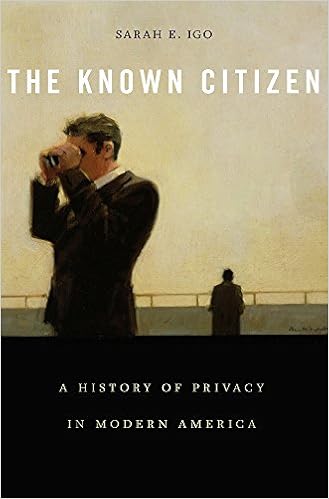
Igo, "The Known Citizen: A History of Privacy in Modern America"

New from Harvard University Press: The Known Citizen: A History of Privacy in Modern America (May 2018), by Sarah E. Igo (Vanderbilt). A description from the Press:
Every day, Americans make decisions about their privacy: what to share and when, how much to expose and to whom. Securing the boundary between one’s private affairs and public identity has become a central task of citizenship. How did privacy come to loom so large in American life? Sarah Igo tracks this elusive social value across the twentieth century, as individuals questioned how they would, and should, be known by their own society. 
Privacy was not always a matter of public import. But beginning in the late nineteenth century, as corporate industry, social institutions, and the federal government swelled, increasing numbers of citizens believed their privacy to be endangered. Popular journalism and communication technologies, welfare bureaucracies and police tactics, market research and workplace testing, scientific inquiry and computer data banks, tell-all memoirs and social media all propelled privacy to the foreground of U.S. culture. Jurists and philosophers but also ordinary people weighed the perils, the possibilities, and the promise of being known. In the process, they redrew the borders of contemporary selfhood and citizenship. 
The Known Citizen reveals how privacy became the indispensable language for monitoring the ever-shifting line between our personal and social selves. Igo’s sweeping history, from the era of “instantaneous photography” to the age of big data, uncovers the surprising ways that debates over what should be kept out of the public eye have shaped U.S. politics and society. It offers the first wide-angle view of privacy as it has been lived and imagined by modern Americans.
A few blurbs:
“A masterful history of the role that privacy has played in the lives of American citizens. Following the ‘known citizen’ over time, Igo brilliantly reveals what it means to be modern—to claim protection against the prying eyes of marketers or the national security state while making one’s self more visible by a social security number or disclosing intimate secrets on social media. An amazing book!”—Brian Balogh 
“From prison cells to memoirs, from suburban living to the big data revolution, this remarkable book chronicles how Americans have defined, debated, and litigated privacy for more than a hundred years. The Known Citizen shows that drawing the line between the private self and public citizen has been the essential modern social question.”—Robert O. Self
More information is available here.

Friday, February 3, 2017

Lake on "The American Women Who Forged a Right to Privacy"

Yale University Press has released The Face That Launched a Thousand Lawsuits: The American Women Who Forged a Right to Privacy (Nov. 2016), by Jessica Lake (Swinburne University of Technology). A description from the Press:
Drawing on a wealth of original research, Jessica Lake documents how the advent of photography and cinema drove women—whose images were being taken and circulated without their consent—to court. There they championed the creation of new laws and laid the groundwork for America’s commitment to privacy. Vivid and engagingly written, this powerful work will draw scholars and students from a range of fields, including law, women’s history, the history of photography, and cinema and media studies.
A few blurbs:
"Jessica Lake’s The Face That Launched a Thousand Lawsuits is one of those rare books that truly upends conventional wisdom and changes the way readers understand an important subject. In a fascinating and well written account, Lake retells the history of the right to privacy. She shows how the activism of individual women played a central role in driving the legal recognition of that right. This book persuasively argues that we owe much to women who resisted the unauthorized circulation of photographic images of them. It is bracing and compelling from the first page to the last." -- Austin Sarat

"Cybercrimes of visuality today have a prehistory uncovered in this book, which shows how far women aggrieved at having their images circulated without their consent brought the legal cases that built the right to privacy." --Nancy F. Cott
More information is available here.

Monday, January 23, 2017

Barbas's "Newsworthy"

Just out from the Stanford University Press is Newsworthy: The Supreme Court Battle over Privacy and Press Freedom, by Samantha Barbas, Professor of Law at University at Buffalo Law School.
In 1952, the Hill family was held hostage by escaped convicts in their suburban Pennsylvania home. The family of seven was trapped for nineteen hours by three fugitives who treated them politely, took their clothes and car, and left them unharmed. The Hills quickly became the subject of international media coverage. Public interest eventually died out, and the Hills went back to their ordinary, obscure lives. Until, a few years later, the Hills were once again unwillingly thrust into the spotlight by the media—with a best-selling novel loosely based on their ordeal, a play, a big-budget Hollywood adaptation starring Humphrey Bogart, and an article in Life magazine. Newsworthy is the story of their story, the media firestorm that ensued, and their legal fight to end unwanted, embarrassing, distorted public exposure that ended in personal tragedy. This story led to an important 1967 Supreme Court decision—Time, Inc. v. Hill—that still influences our approach to privacy and freedom of the press.

Newsworthy draws on personal interviews, unexplored legal records, and archival material, including the papers and correspondence of Richard Nixon (who, prior to his presidency, was a Wall Street lawyer and argued the Hill family's case before the Supreme Court), Leonard Garment, Joseph Hayes, Earl Warren, Hugo Black, William Douglas, and Abe Fortas. Samantha Barbas explores the legal, cultural, and political wars waged around this seminal privacy and First Amendment case. This is a story of how American law and culture struggled to define and reconcile the right of privacy and the rights of the press at a critical point in history—when the news media were at the peak of their authority and when cultural and political exigencies pushed free expression rights to the forefront of social debate. Newsworthy weaves together a fascinating account of the rise of big media in America and the public's complex, ongoing love-hate affair with the press.
Some endorsements:
"This fascinating book journeys back to a transformative moment in Supreme Court history, when it declared that the Constitution protected the press's invasion of privacy of newsworthy subjects. Newsworthy inspires us to imagine what American society might look like today had the decision gone the other way."

—Laura Kalman, University of California, Santa Barbara

"With a compelling narrative of the important and fascinating Supreme Court case of Time, Inc. v. Hill, Newsworthy is a valuable addition to the volatile debate over the tension between freedom of the press and the right to privacy in the U.S."

—Stephen Wermiel, co-author of Justice Brennan: Liberal Champion

Friday, February 5, 2016

Hoofnagle on the Federal Trade Commission and the Development of Privacy Law

Just out from Cambridge University Press: Federal Trade Commission Privacy Law and Policy, by Christopher Jay Hoofnagle (University of California, Berkeley). A description from the Press:
The Federal Trade Commission, a US agency created in 1914 to police the problem of 'bigness', has evolved into the most important regulator of information privacy - and thus innovation policy - in the world. Its policies profoundly affect business practices and serve to regulate most of the consumer economy. In short, it now regulates our technological future. Despite its stature, however, the agency is often poorly understood by observers and even those who practice before it. This volume by Chris Jay Hoofnagle - an internationally recognized scholar with more than fifteen years of experience interacting with the FTC - is designed to redress this confusion by explaining how the FTC arrived at its current position of power. It will be essential reading for lawyers, legal academics, political scientists, historians and anyone else interested in understanding the FTC's privacy activities and how they fit in the context of the agency's broader consumer protection mission.
A few blurbs:
"Chris Hoofnagle has written the definitive book about the FTC's involvement in privacy and security. This is a deep, thorough, erudite, clear, and insightful work - one of the very best books on privacy and security." -- Daniel J. Solove

"A timely and insightful analysis of the FTC as a key actor in protecting information privacy. The historical context provides a solid basis for Hoofnagle's well-supported policy recommendations."  -- Priscilla M. Regan
More information is available here.

Update: The introduction appears here as an SSRN post.

Tuesday, February 2, 2016

Tait on Obergefell and the Return of Coverture

In commentary posted on the First Impressions blog of the Michigan Law Review and as an SSRN paper, Allison Anna Tait, University of Richmond School of Law, argues that Justice Kennedy’s opinion in Obergefell v. Hodges signals The Return of CovertureObergefell signals a new life for coverture values,” she writes. “As the French might say, coverture is dead; long live coverture.”

Colman on Samuel Warren's Gay Brother and the Right to Privacy

Charles E. Colman, an acting assistant professor at NYU Law who will be joining the University of HawaiÊ»i’s  law faculty this summer, has posted About Ned, which is to appear in the Harvard Law Review 129 (2016): 128-52:
In this essay, I explore the possibility that the storied article "The Right to Privacy," 4 Harv. L. Rev. 193 (1890), might have come into existence in part because of lead author Sam Warren's powerful drive to protect his younger siblings -- and, in particular, his gay brother Ned. For reasons both obvious and less intuitive, Sam might have viewed the article as a promising vehicle for shielding Ned and the rest of the Warren family from potentially devastating journalistic and public scrutiny of Ned's sexuality.

Viewed in this light, the article acquires a special resonance in this, its one hundred twenty-fifth anniversary. Rhetoric central to the piece can be traced, link by link, case by case, to Supreme Court decisions that collectively established a multifaceted constitutional right to personal autonomy. The article can arguably be understood as a catalyst for the series of events culminating in the Supreme Court's 2015 recognition, in Obergefell v. Hodges, of a constitutional right to same-sex marriage.

If "The Right to Privacy" is indeed about Ned, even in part, then what originated as an effort to protect one gay man might, quite remarkably, be a 125-year-old precursor of the Court's decision securing the protection of a fundamental right for gay people throughout the nation.

Friday, January 29, 2016

Bernstein on Abortion at Common Law

Anita Bernstein, Brooklyn Law School, has posted Common Law Fundamentals of the Right to Abortion, which appeared in the Buffalo Law Review 63 (2015): 1141-120:
In an article relied on by Justice Blackmun in Roe v. Wade, a lawyer named Cyril Means, Jr., asserted that abortion had been “a common law liberty” back in the fourteenth century. Responding in part to criticisms of this thesis, this Article extends what Means contended. The prerogative to terminate one’s own pregnancy really is a common law liberty: what the common law provides to pregnant persons is in some respects broader than the privacy-related right sited in the Fourteenth Amendment. As expressed consistently for centuries through its doctrines of criminal law, torts, property, contract, and unjust enrichment, the common law takes a position on abortion that comports with the modern coinage “pro-choice.”