Showing posts with label Publishing advice. Show all posts

Monday, March 30, 2026

CLH News

[Via ESCLH Blog, we have the following announcement.  DRE]

The journal Comparative Legal History is pleased to announce that its website has been updated with the new composition of its Editorial Board.

Comparative Legal History is the scholarly journal of the European Society for Comparative Legal History, publishing innovative research in comparative, transnational, and global legal history. The journal welcomes contributions that examine and compare historical interactions between diverse forms of normativity, including legal, religious, customary, and social norms, as well as the agents, institutions, and jurisdictions through which they have operated.  Engaging with legal traditions from across the globe, the journal welcomes interdisciplinary approaches and publishes research articles, invited contributions, review essays, book reviews, and special issues.

The journal is committed to fast turn-around times for its evaluations and editing, and thanks to our publisher, Taylor & Francis, we will now be publishing contributions online as soon as they are ready for production, thus giving authors the ability to publish and disseminate their research without delay.

We would also like to note that the journal encourages authors to make use of visual material in their articles.

To discuss ideas for articles or special issues, please contact Articles Editors Paolo Astorri (paa@teol.ku.dk) and Emanuel van Dongen (E.G.D.vanDongen@uu.nl). To recommend a book (published in the last two years) for review, please contact Reviews Editors Gianmarco Palmieri (gianmarcopalmieri1@gmail.com) and Geetanjali Srikantan (gasrikantan@gmail.com). For any and all enquiries, please feel free to contact the Editor, David Schorr (dschorr@tau.ac.il).

Monday, March 9, 2026

Allison Tirres to Co-Edit AJLH

Congratulations to Allison Brownell Tirres, University of San Francisco School of Law, and to the American Journal of Legal History on Professor Tirres's selection as Co-Editor-in-Chief of the AJLH!  The Oxford Journals' announcement is here.

--Dan Ernst 

Friday, January 23, 2026

G. Edward White to Edit the Journal of Supreme Court History

The Supreme Court Historical Society has announced that, effective immediately, G. Edward White has succeeded Ross E. Davies as Editor of the Journal of Supreme Court History.  Now more than ever, we need scholarship on the U.S. Supreme Court that meets the highest standards of professional historians, and so the appointment of such an eminent and accomplished legal and constitutional historian to the post is an immensely important and promising development.

--Dan Ernst 

Wednesday, October 15, 2025

JSCH: Call for an Editor

[We have the following call from the Supreme Court Historical Society for an Editor and Chair of Board of Editors for the Journal of Supreme Court History.  DRE]

The Supreme Court Historical Society invites applications for an Editor to Chair the Board of Editors of its flagship publication:  Journal of Supreme Court History. The Journal, published three times a year in print by Johns Hopkins University Press, is celebrating its 50th anniversary. Previous Editors were Melvin I. Urofsky, Timothy S. Huebner and Ross E. Davies. The Journal’s readership includes scholars in a variety of fields, as well as judges, practicing attorneys, and students. Because it seeks to engage and inform scholars and non-scholars alike, the Journal of Supreme Court History values clear narrative prose and original historical research. The Journal uses photographs, cartoons, documents, engravings, and oil portraits to compellingly illustrate articles. 

The Editor will work under the guidance of the Executive Editor, Clare Cushman of the Supreme Court Historical Society (SCHS), which funds the publication. Helen Knowles-Gardner is the Managing Editor responsible for the daily management of the publication and its editing and production. The SCHS is a non-profit membership organization dedicated to preserving, collecting, and disseminating the history of the Supreme Court of the United States.

While this is a non-paid position, travel expenses to attend relevant conferences, such as the American Society for Legal History, will be subsidized.  Interested scholars should send an electronic version of their current c.v. and a statement of why they are interested in the position by November 19, 2025, to Clare Cushman: ccushman@supremecourthistory.org. 

The Chair of the Board of Editors of the Journal of Supreme Court History carries out the following duties:

  • Recruits authors to write for the Journal.  Recruiting articles involves reaching out to potential authors via email or phone, attending the American Society for Legal History annual meeting and other relevant conferences, and consulting with Board members about possible submissions.  Frequent follow up messages to potential authors ensures that the Journal continues to receive a steady stream of potential articles. 
  • Reviews articles in consultation with the Associate Editor and the Managing Editor of the Journal.  This is the most frequent duty—keeping up with articles as they come in.  Normally, both the Editor and Associate Editor send written comments on each article to the Managing Editor, who edits and synthesizes them before sending them to the author.  The Journal prides itself on its quick turnaround—notifying authors of a decision within six weeks of submission.
  • Writes an Introduction (approximately 1,000 words) for each issue of the Journal.  The Introduction usually offers some remarks on the content of the Journal, including all articles and book reviews, and must be written by the deadline given by the Managing Editor. 
  • Engages in final review of articles and book review(s) prior to publication.  While writing the Introduction, the Editor should engage in a final review of the articles and any book reviews and notify the Managing Editor of any mistakes. 
  • Schedules, presides over, and sends out summaries of regular meetings of the Board of Editors.  Regular Board meetings are critical to the smooth operation of the Journal and are held in summer and winter, every six months.  The Editor and the Executive Editor usually work on an agenda together, which typically includes any updates from the Supreme Court Historical Society and any matters pertinent to the publication of the Journal.  
  • Oversees the issuing of the three awards given by the Journal.  These include the Hughes Gossett Award (given annually for the best article published in the Journal), and the Hughes Gossett Student Award (given for the best student article submitted).  The Editor notifies the Board in the spring of each year which articles are eligible for the Hughes Gossett Award, and all Board members (including the Editor) communicate their votes to the Managing Editor.  The Editor and the previous year’s winner of the Hughes Gossett Award decide the winner of the Hughes Gossett Student Award.   
  • Interviews an article author from each issue of the Journal, to be posted on the Supreme Court Historical Society’s YouTube Channel.  This series is called “Breaking History” and is posted three times a year, just after the publication of each issue.  Interviews are 20 minutes in length. 

Saturday, August 9, 2025

Weekend Roundup

  • Thurgood Marshall, assisted by Wife and Family (LC)
    “Becoming Thurgood: America’s Social Architect,” a documentary on the life and career of Thurgood Marshall, premiers Tuesday, September 9, 2025, on PBS.  The DuSable Black History Museum and Education Center in Chicago hosts and preview and discussion on August 21 (WTTW)
  • "David Carrillo, executive director of UC Berkeley Law’s California Constitution Center, will become editor-in-chief of California Legal History in 2026" (UC Berkeley Law).
  • Richard Primus, University of Michigan Law School, and John Harrison, University of Virginia School of Law discuss Professor Primus’s The Oldest Constitutional Question: Enumeration and Federal Power.  "Their conversation traces how this fundamental disagreement has shaped key moments in American constitutional history, from the Founding Era to the New Deal, and why the debate remains unsettled today" (National Constitution Center).  Also on YouTube.  
  • Stefan Kadelbach on the "Frankfurt Documents" and the birth of a new constitutional order for Germany in 1948 (Goethe-Universität).
  • Jill Lepore will discuss her forthcoming book, We the People: A History of the U.S. Constitution, at  Congregation Beth Israel in San Diego on Sunday, September 7, 2025 from 4 PM to 5:30 PM
  • The district court opinion in that lawsuit over the cancellation of National Endowment for the Humanities grants. The American Historical Association's update.  An update on new awards (NYT).
  • If you happen to be in Hyde Park, NY, on August 13, you can take in a showing of William Randolph Hearst's authoritarian fantasy from March 1933, Gabriel over the White House, at the FDR Library and Museum. 
  • Lawbook Exchange 's August list of Scholarly Law and Legal History.  
  • ICYMI: The Adam Liptak column behind all those skeets: As the Supreme Court Focuses on the Past, Historians Turn to Advocacy (NYT).  David Blight asks, What If History Died by Sanctioned Ignorance? (New Republic/Bunk). Eric Segall asks How the Hell To Teach Constitutional Law in 2025?  (Many of his questions involve history) (Dorf on Law).  NAACP LDF's historical timeline on the Voting Rights Act of 1965.

 Weekend Roundup is a weekly feature compiled by all the Legal History bloggers.

Monday, June 30, 2025

William E. Leuchtenburg Fund at UNC Press

[We have the following announcement.  H/t: JQB.  DRE]

Established in 2025 by his family, the William E. Leuchtenburg Fund at the University of North Carolina Press honors both his decade-long membership on the Press’s Board of Governors and his preeminent scholarship in American history. Throughout his long life, Professor Leuchtenburg remained committed to advising, counseling, critiquing, and encouraging works by many who became leading scholars of their generations. Accordingly, the Fund will help publish works by early-career scholars that reflect Leuchtenburg’s unusually broad interests in American history and culture. These works will not only launch and solidify academic careers by shaping research and teaching in their fields, but also have the potential to appeal to wider audiences.  [Give here.]

Thursday, May 1, 2025

Brill's Law and Society in China Book Series

[Via H-Law, we have the following announcement.  DRE]

Call for Manuscripts:  Law and Society in China Book Series/Brill

After nearly four decades of reform, China is a transformed and yet a rapidly changing society. Along with the continuing economic changes, there is no dispute that China has witnessed tremendous transformations in the area of law.

This series aims to study the legal development in China from the historical and comparative perspectives. It seeks to bring together scholarly work that not only examines legal theories but also investigates how law is implemented and enforced in the Chinese society. It aims to become the series of choice for prospective authors of in-depth historical, theoretical studies as well as socio-legal and empirical studies on Chinese law.

We invite scholars from all disciplines working on Chinese law and society to submit book proposals or full manuscripts. Submissions should engage critically with legal developments in China and contribute to a deeper understanding of its evolving legal landscape.

Submissions and Inquiries: All submissions will undergo a double-anonymous peer review prior to acceptance.  Please direct your proposals or completed manuscripts to the Acquisitions Editor at Brill, Iulia Ivana (iulia.ivana@degruyterbrill.com).

For more information, please visit the series' webpage.  We look forward to your contributions to this important and growing field.

Iulia Ivana (iulia.ivana@degruyterbrill.com)
Acquisitions Editor, Asian Studies, Brill

Wednesday, March 12, 2025

CFP: Northwestern Law Review's Empirical Issue

[We have the following CFP.  DRE.]

The Northwestern University Law Review (NULR) is proud to be opening submissions for the seventh annual empirical issue! NULR is exceptional among flagship law reviews in the United States in that it publishes an annual issue fully dedicated to empirical legal scholarship. We seek to bring cutting-edge, interdisciplinary, empirical work to our legal audience, and enrich our understanding of the law, legal actors, and legal doctrine through robust and reliable examination of qualitative, quantitative, and mixed-method data. Publication at our Journal is especially of interest to authors who would like to benefit from an expedited publication timeline, have their work peer-reviewed from specialists in the field, be supported by a dedicated team of editors who can assist in sharpening the piece’s contribution for the legal audience, and who seek to have their work make impact on legal policy and advocacy in the United States. To provide some examples, we have previously published work evaluating racial bias in police stops, an examination of duplicative proceedings in international litigation, and a field experiment assessing incidence of judicial recusals when potential conflicts of interest come to light. You can find our past empirical issues here.

The exclusive submission window for the Vol. 120 Empirical Issue of the Northwestern University Law Review will open on April 1, 2025, and run until April 28, 2025. A subset of submissions will be selected to move forward to peer review. The Law Review will make every effort to notify authors of rejection or of advancement to peer review by June 30, 2025. Final publication decisions will be issued by August 10, 2025, with the publication date set in March 2026.

Submitted publications must be between 15,000 and 30,000 [words], and conform generally to the style and formatting expectations that are common to law reviews. For more information, please visit our website: Empirical Issue - Northwestern University Law Review or reach out to Thomas Burnett, Senior Empirical Editor for the Northwestern University Law Review at thomas.burnett@law.northwestern.edu.

Tuesday, February 11, 2025

CSHC Review

[We have the following announcement.  DRE]

Professor Clark Kelso (University of the Pacific McGeorge School of Law) is the incoming editor-in-chief for a magazine-type publication called the Review published twice yearly by the California Supreme Court Historical Society. The Review warmly welcomes short articles that have a connection to California legal history, particularly involving the California Supreme Court and the state's lower courts, the bar, the profession, and the law in general. The Review publishes articles about people, places, events,  cases, and broader legal developments as they have affected our state, then and now. Our readership includes all justices and judges of California's courts plus prominent members of the bar and others who have an interest in California's rich legal history. Most of our articles are in the 2500- to 5000-word range (but we are flexible on length), include footnotes appropriate for a scholarly/historical publication, and are illustrated with photographs and/or archival material that we will find and add to your article. With the approval of a prior publisher, we are happy to accept what might best be described as a summary of a much longer piece of scholarship published elsewhere. Anyone interested in publishing should contact Professor Kelso at ckelso@pacific.edu.

Wednesday, July 31, 2024

Studies in New York Law

[We have the following announcement.  H/t: New York Almanac.  DRE.]

SUNY Press has announced a new series, Studies in New York Law, edited by Albert M. Rosenblatt.  Studies in New York Law is expected to highlight key legal issues and cases that have shaped New York (and the nation’s) history.  Combining legal analysis with a focus on specific cases or events, books in the series will address the theoretical and practical applications of New York law as it has evolved over time.

The series will address diverse issues in New York’s legal history, including racial and sexual equality, worker’s rights, health and safety, consumer protection, and equal application of the law.

Books in the series will appeal to academics, legal historians, and New York State historians, as well as general readers interested how law has impacted the social cultural life of the state and country.

Albert M. Rosenblatt teaches at the New York University School of Law and is a retired Judge of New York State Court of Appeals. His books include The Eight: The Lemmon Slave Case and the Fight for Freedom (2023); Opening Statements: Law, Jurisprudence, and the Legacy of Dutch New York (2013, coedited with Julia C. Rosenblatt) and Judith S. Kaye in Her Own Words: Reflections on Life and the Law, with Selected Judicial Opinions and Articles (2019, coedited with Henry M. Greenberg, Luisa M. Kaye, and Marilyn Marcus), all published by SUNY Press

Tuesday, July 30, 2024

Dale's "Fight for Rights"

Forgive us, but we only recently became aware of Elizabeth Dale's "digital monograph," Fight for Rights: The Chicago 1919 Riots and the Struggle for Black Justice, a publication of LibraryPress@UF, an imprint of the UF Press and the George A. Smathers Library at the University of Florida:

This is a history of the fight for rights and citizenship undertaken by Black people in Chicago in that city’s first century. Covering the period from the 1830s to 1930s, this book looks at their successes and the forces that arose—in the streets, in city government, in the courts, and on the police force—to limit their extent. And it looks at how, and why, individuals and institutions attempted to justify those limits over time.

Fight for Rights is instructive not only on the Chicago riots but also as an example of a digital monograph and the publication initiatives of university libraries.

--Dan Ernst

Saturday, May 11, 2024

Weekend Roundup

  • The Death Panel podcast has released a conversation with Karen Tani (University of Pennsylvania) and Katie Eyer (Rutgers Law) on their article "Disability and the Ongoing Federalism Revolution," Yale Law Journal (2024). The episode is currently available to patrons only, but will eventually be "unlocked."
  • Welcome to the blogosphere to Legal History Insights, moderated by Thomas Duve, on th doings of the department on Historical Regimes of Normativity at the Max Planck Institute for Legal History and Legal Theory!
  • Boston College Law School has launched the website Black History at BC Law “to honor, document, and celebrate the rich history of contributions from Black BC Law community members as student leaders, educators, academics, judges, activists, litigators, transactional attorneys, and visionaries."  More.
  • Radcliffe Institute for Advanced Studies has announced its 2024-2025 Fellows.  They include Myisha S. Eatmon for “to complete a book on black Americans’ use of tort law to seek justice during the Jim Crow era, and to begin a second project on the legal relationship between black Americans and American Jews during Jim Crow and the Holocaust"; Daphna Renan and Nikolas Bowie, for a book “that contests judicial supremacy ...  and recovers a tradition rooted in abolitionism that allows the American people to define the Constitution democratically”; and Laura Weinrib, for “a book on labor unions, corporations, and money’s role in politics in the United States.”
  • Claire Potter interviews Paul Sabin, Yale University, about his book, Public Citizens: The Attack on Big Government and the Remaking of American Liberalism (Political Junkie).
  • "More than 200 people attended a special community celebration on Saturday, April 27, commemorating the sesquicentennial (150th) anniversary of the construction of Aliʻiōlani Hale, home of the Hawaiʻi Supreme Court." More. H/t Michael Banerjee 
  • The U.S. Capitol Historical Society will host a Native American Suffrage Symposium on Thursday, May 23, "to commemorate the 100th anniversary of the Indian Citizenship Act of 1924.”
  • Legal historians were among the political historians and political scientists at the conference, How the New Deal Was Run, held last weekend at Vanderbilt UniversityKevin Kruse's brief notice of the conference is here
  • New journal alert: "Early Medieval England and its Neighbours is an open access, interdisciplinary journal dedicated to new research on England, its closest geographic and intellectual neighbours, and their wider cultural contacts from the 5th to the 11th century." 

Weekend Roundup is a weekly feature compiled by all the Legal History bloggers.

Friday, March 15, 2024

CFP: Northwestern Law Review's Empirical Issue

[We have the following announcement.  DRE]

The Northwestern University Law Review (NULR) is proud to be opening submissions for the seventh annual empirical issue! NULR is exceptional among flagship law reviews in the United States in that it publishes an annual issue fully dedicated to empirical legal scholarship. We seek to bring cutting-edge, interdisciplinary, empirical work to our legal audience, and enrich our understanding of the law, legal actors, and legal doctrine through robust and reliable examination of qualitative, quantitative, and mixed-method data. Publication at our Journal is especially of interest to authors who would like to benefit from an expedited publication timeline, have their work peer-reviewed from specialists in the field, be supported by a dedicated team of editors who can assist in sharpening the piece’s contribution for the legal audience, and who seek to have their work make impact on legal policy and advocacy in the United States. To provide some examples, we have previously published work evaluating racial bias in police stops, an examination of duplicative proceedings in international litigation, and a field experiment assessing incidence of judicial recusals when potential conflicts of interest come to light. You can find our past empirical issues here.

The exclusive submission window for the Volume 119 Empirical Issue of the Northwestern University Law Review will open on March 18, 2024, and run until April 30, 2024. A subset of submissions will be selected to move forward to peer review. The Law Review will make every effort to notify authors of rejection or of advancement to peer review by mid-July 2024. Final publication decisions will be issued by mid-August 2024, with the publication date set in March 2025.

Submitted publications must be between 15,000 and 30,000, and conform generally to the style and formatting expectations that are common to law reviews. For more information, please visit our website: Empirical Issue or reach out to Alisher Juzgenbayev, Senior Empirical Editor for the Northwestern University Law Review at alisher.juzgenbayev@law.northwestern.edu.

[The editor tells us that “empirical” includes “methodologies employed in legal history, including archival and ethnographic work.”]

Thursday, August 24, 2023

Michigan Journal of Law and Society

 [We have the following CFP.  DRE]

The Michigan Journal of Law and Society (MJLS) is pleased to announce our call for submissions for articles, book reviews, and student scholarship for Volume III of MJLS. In Volume III, we are focusing on MJLS's interdisciplinary mission and therefore will accept submissions on any legal topic of importance, so long as the topic piece is written within the intersection of multiple academic disciplines. Such intersections include, but are not limited to, Law and Sociology, Law and History, Law and Anthropology, and Law and Political Science.

The call date for articles and book reviews for MJLS Volume III is November 27th, and ends at 11:59 pm eastern. For Student Submissions, the call date is February 5, 2024. Please visit our website for more information on submission guidelines and do not hesitate to reach out to mjls.execs@umich.edu if you have any questions.

MJLS is the nation’s first law-school journal to focus on the intersections of law, history, and the social sciences. MJLS is also the nation’s first law-school journal to incorporate law students, PhD students, and a faculty editorial board into its review and editorial processes.


Thursday, August 17, 2023

JDLH 1:1

Last summer we published the call for submissions for a new legal historical periodical, the Journal for Digital Legal History.  It has since published its first issue.  Here is the journal's self-description:

Legal history is traditional in its methods and techniques of research. This is not necessarily a problem, but researchers applying digital tools to legal sources need a place to go. The Journal for Digital Legal History ("DLH") wants to showcase both new methods and the application thereof, by including elaborate graphics, datasets, links, Jupyter Notebooks, metadata and tutorials. As such, the DLH does not limit itself to traditional formats and offers a platform for innovative research, to reach out to colleagues interested in novel approaches and methodologies.

And here is the TOC for the first issue:

Book reviews

Max Kemman, Trading Zones of Digital History
Femke Gordijn

Jennifer Guiliano, A primer for Teaching Digital History. Ten Design Principles (Duke 2022)
Christel Annemieke Romein

Short notices

To commemorate shared pasts. Legislation related to enslavement and multicultural relations in the Dutch West Indies colonies, c. 1670 – c. 1870
Marijcke Schillings and Henk-Jan van Dapperen

A Database of Early Modern Police Ordinances.
Karl Härter

Collateral Councils – Collaterale Raden - Conseils collatéraux of the Low Countries (1531-2031)
Hans Cools, Vincenzo De Meulenaere, Marie-Charlotte le Bailly, Christel Annemieke Romein, Nicolas Ruys, René Vermeir and Monique Weis

Roman Law MOOC
Jean-François Gerkens

--Dan Ernst

Saturday, August 5, 2023

Weekend Roundup

  • Long ago, we wrote a seminar paper on the coroner in England and New Hampshire, so our pulse quickened when we learned that the Australasian Legal Information Institute has brought online the Australian Coronial Law Library “The free access Library on AustLII provides an expansive perspective on the coronial function over at least the past twenty years.”  More.  DRE.
  • Last month, the Historical Society of the District of Columbia Circuit held a reenactment of the argument in United States v. Microsoft Corp., 253 F.3d 34 (D.C. Cir. 2001), “the first federal major appellate court opinion to address application of traditional ‘old economy’ antitrust rules to the new, dynamic and fast-paced technology markets of the late 20th Century.”  Two of the judges who presided at the original argument also presided over the reenactment.  A recording of the event is now available.
  • Berkeley Law's announces its new faculty members, including the legal historian José Argueta Funes.
  • The Lawbook Exchange’s new catalogue of Scholarly Law & Legal History is here.
  •  ICYMI: Henrietta Lacks’s family reaches settlement in extracted cell lawsuit (WaPo).  Behind the scenes at the American Historical Review (AHA).  The Brennan Center for Justice on the history of Supreme Court appointments.  The New York Times reviews the exhibit "Black Americans, Civil Rights and the Roosevelts," which opened earlier this summer at the FDR Library and Museum.    Joseph Patrick Kelly on Ku Klux Klan Acts (The Conversation).

Weekend Roundup is a weekly feature compiled by all the Legal History bloggers.

Saturday, May 13, 2023

Weekend Roundup

  • This week's legal-historian-recognized-for teaching-at-a-law-school is Penn Carey Law's Sophia Z. Lee, whom the JD Class of 2023 chose to receive the Harvey Levin Memorial Teaching Award before her naming as incoming dean.
  • Christoper W. Schmidt on Brad Snyder's Democratic Justice (Jotwell).  
  • "The Franklin D. Roosevelt Presidential Library and Museum will open a new major special exhibition, Black Americans, Civil Rights, and the Roosevelts, 1932-1962, on Saturday, June 3, 2023, in the William J. vanden Heuvel Gallery of the Library and Museum. The exhibit runs through December 31, 2024."
  • Over at the Harvard Law School Forum on Corporate Governance: Banking Crises in Historical Perspective, a report on a paper by Carola Frydman, Northwestern University, and Chenzi Xu, Stanford University.  It “surveys over two hundred empirical studies from the last twenty years (2000-2022) that cover banking crises occurring between 1800 and 1980.”
  • The American Council of Learned Societies has launched a book prize for open access works.  H/t: MS.   
  • ICYMI: Abolition as a "divisive concept" avant la lettre (ACS). 
Weekend Roundup is a weekly feature compiled by all the Legal History bloggers. 

Monday, November 14, 2022

Journal of American Constitutional History

[We have the following announcement and call for submissions for an exciting new journal, on whose editorial board Karen and I serve.  DRE]  

You are cordially invited to submit articles to the Journal of American Constitutional History, a new online peer-reviewed journal. At a time when law office history is increasingly casting its shadow over both scholarship and jurisprudence, the Journal of American Constitutional History will offer a space for scholarship that tries to understand the past, rather than to distort it to influence present controversies.

The Journal seeks to promote inter- and multi-disciplinary scholarly dialogue on constitutional history, and we therefore invite submissions from disciplines outside of law, including history and political science. The Journal will publish articles of all lengths, from shorter essays and thought-pieces in the 4,000-to-6,000-word range to longer, traditional articles. Authors will be able to conform to the norms and citation styles of their respective fields.

Why this journal?

The Journal of American Constitutional History offers a serious alternative to student-edited law reviews and the constraining expectations of student editors. Authors will not need to erect elaborate scaffolding that shows some present-day "doctrinal payoff." Nor will authors have to devote thousands of words to well-known background material, unnecessary footnotes, or literature reviews.

The Journal offers much faster publication decisions and time-to-publication than most peer-reviewed journals. Authors can expect to receive first-level decisions within a week of submission, and articles submitted for double-blind peer review will receive a decision within 3-4 weeks. Each author will receive written feedback explaining our publication decision. Articles will be published via the Journal website as soon they are completed rather than awaiting compilation of a full issue. Each article will be assigned a unique page range for citation purposes, and published articles will be carried by Hein Online and other searchable electronic databases.

The Journal's Board of Editors comprises leading scholars in the field of constitutional history. (Please see listing on reverse page.) Authors can thus be assured of reaching their target audience from a distinguished platform and need not associate "prestige" with killing trees.

To submit articles, please visit our website, starting December 1, 2022. For questions, please contact the Journal's editor-in-chief, David Schwartz, at editor-jach@law.wisc.edu.

Wednesday, August 3, 2022

California Legal History: The CSCHS Review

 [Like us, you may not have been aware that some years back the newsletter of the California Supreme Court Historical Society was reestablished as the bi-annual CSCHS Review, to explore “California's legal history in the broadest sense. Our authors are academics, judges and attorneys. Here is an update from Molly Selvin.  DRE.]

Our articles represent important new research. For example, the exploration by attorney Bob Wolfe of the litigation surrounding the 1915 release of Birth of a Nation, D. W. Griffith’s incendiary portrayal of post-Civil War America. The film’s racist depiction of African Americans has been appropriately condemned. Less well known is the long struggle Wolfe recounts, by lawyers representing the newly formed NAACP around California as well as by some local government leaders, to halt showings of the film. Wolfe also meticulously documents the film’s role in stoking renewed interest in the Ku Klux Klan; membership in the group swelled during the 1920s, including thousands of California residents as well as many elected officials and law enforcement officers.

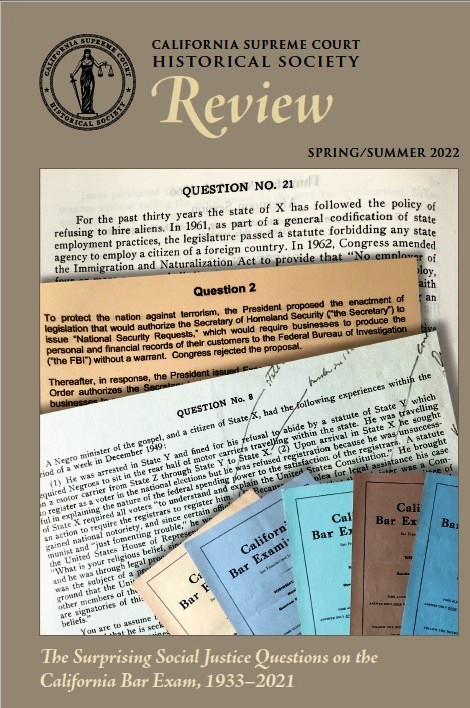
In our current issue, attorney Colleen Regan and I detail how California’s bar examination questions, to our surprise, tracked some of the twentieth century’s most pressing political and policy issues. In addition to asking prospective lawyers to untangle hypothetical negligence, contract and inheritance disputes, the California bar exam, from 1933-2021 often presented questions involving racial and gender equality, free speech, association, and religious expression — issues that generated fierce national debate and often violence. In addition to demonstrating the basic competencies necessary to practice law, we conclude that bar examiners in past decades included these social justice questions because they believed that lawyers had a responsibility to think broadly about equity and civil rights — issues newly resonant, particularly in the post–World War II years.

Tuesday, July 12, 2022

The Work-Life Balance & Other Myths

         It took far longer to get my first book to publication than I ever thought it would. It began as my dissertation, completed in 2005. The next year I began a tenure-track position at a small liberal arts college with a 3:3 teaching load and fairly heavy service and advising expectations. The year after that, my oldest child was diagnosed with both a disability and a chronic illness.

    His conditions entailed regular visits to medical specialists and therapists, some up to two hundred miles away; when at home, he required direct supervision at all times. When time allowed, I worked on the major revisions the manuscript required. Extended or multiple visits to archives were simply not a possibility, as he needed specialized care and could not be left. I would have to make the most of the material I had (and fortunately, I had quite a bit). I lost one entire summer to recovery from emergency surgery.

    Finally, after six years, I had a fully revised draft ready to submit to a press who had expressed interest. They sent it to readers, who returned thorough reviews which, while supportive, recommended substantive revisions. These were entirely fair, and I probably could have completed them in a year, under normal circumstances. However, my son's illness had just progressed from chronic to acute, and I decided I needed to focus all my energies on helping him.

    That situation was so overwhelming for the next few years that I had no thoughts or energy to spare for the manuscript. I didn't even look at it, in fact. But as my son slowly started to recover, I began to think about giving it another try. I got back in touch with the press, and we agreed that it probably wouldn't work to proceed with them anymore. Nonetheless, I tackled revisions in a serious way and began thinking about where else a good fit for the manuscript might be. And thanks to an editor, readers, indexer, copyeditor, and countless others willing to work through the exigencies of pandemic publishing, the book is now in print. More importantly, my son is doing well.

    I share my story not for sympathy or because I think it's unique--but because I recognize that these sorts of experiences are becoming all too common in the age of Covid and Long Covid. So many academics, especially caregivers, are seeing their work goals recede into the distance as they try to be the safety net that our society and institutions fails to provide.

    Many, particularly contingent and untenured faculty, are feeling anxious about how their caregiving responsibilities have affected, and continue to affect, their scholarly productivity. And they don't feel they can acknowledge their situation--I certainly have not, before now. I would like to normalize talking about some of the challenges we are facing. I'd also like to encourage those of us with tenure to be more creative in thinking about how to extend greater flexibility and support to our colleagues.

N.B.: I've attached labels to this post such as "Publishing advice" and "Research tips," which are quite misleading. Nothing here should be construed as advice or tips, as I do not recommend this path if you can at all avoid it. But I did want to assure anyone else who might be sharing a common experience that you are not alone.

--Kristin A. Olbertson