Showing posts with label Holidays. Show all posts

Friday, December 31, 2010

Happy New Year!

Here's hoping that 2011 brings you new adventures and takes you to spectacular places (past and present).

 Happy New Year from the Legal History Blog.

Friday, December 24, 2010

Happy Holidays!


We wish you, your family, and your four-legged friends a very happy holiday.

Thursday, November 25, 2010

Giving Thanks

At the Legal History Blog, we're thankful for:
  • our tireless Facebook coordinator, Clara Altman
  • our guest bloggers over the past year:  William E. Forbath, Thomas Gallanis, Ariela Gross, Stephen Vladeck, Mark Tushnet, and Karen Tani, and current guests Allison Brownell Tirres and Chris Tomlins
  • the newest on-going member of our team, Karen Tani
  • our 77 blog followers
  • the 263 people who like us on Facebook
  • the 408 (and counting) people who read us on Twitter
  • and especially to our 240,282 readers over the past year.  We do this for you.
Happy Thanksgiving!

Image source.

Saturday, October 30, 2010

Trick or treat?

This year I think I'll hand out copies of the First Amendment.

Happy Halloween!

Friday, April 30, 2010

Law Day at 52

May 1 is not only an international day of celebration for the labor movement, it is officially “Law Day, U.S.A.” President Dwight D. Eisenhower established the holiday in early 1958, just months after sending federal troops to Little Rock and shortly after the Soviet Union launched Sputnik into orbit. Both civil rights and the Cold War were clearly on his mind. “[T]he principle of guaranteed fundamental rights of individuals under the law is the heart and sinew of our Nation,” Eisenhower declared in his Law Day Proclamation. It distinguishes the U.S. "from the type of government that rules by might alone”; it makes the country “an inspiration and a beacon of light for oppressed peoples of the world.” Eisenhower invited citizens to use Law Day as “an opportunity to better understand and appreciate the manifold virtues” of a government ruled by law, “and to focus the attention of the world upon them.” The American Bar Association, which proposed the idea to Eisenhower, took the lead in planning commemorative events and programs.

Although Law Day is not well known, every president since Eisenhower has issued a Law Day Proclamation. (You can view them all on the Library of Congress website.) Taken together, they exemplify the malleability of the discourse of rights and law. For example, Eisenhower’s 1959 Proclamation, issued amidst “massive resistance” to desegregation, departs from the previous year’s in stressing that the rule of law must be recognized as supreme (“[A] free people can assure the blessings of liberty . . . only if they recognize the necessity that the rule of law shall be supreme”). Other elements remain the same, but receive more emphasis, such as the idea that adherence to the rule of law (combined here with a “system of free enterprise”) sets the U.S. apart from the non-democratic powers “enslav[ing] . . . one-third of the world.” The next year’s Proclamation (1960) strikes a more conciliatory tone (“[T]his Nation seeks only fairness and justice in its relations with other nations”), but by the time John F. Kennedy takes office, the country once again appears embroiled in a fight for survival. Kennedy’s 1962 Proclamation portrays an embattled nation, relying on the rule of law as a “vital bulwark[]” in its “struggle” to defend its way of life.

Subsequent years would witness an escalation of the fight against communist forces in Vietnam, yet President Lyndon Johnson’s Proclamations look inward rather than outward. The lawlessness they decry is not that of America’s foreign enemies, but of its own citizens, especially youth. Johnson’s 1964 Proclamation, for example, aspires to bring “to all citizens, and particularly to young Americans” a “fuller awareness” of the importance of “[r]espect for law.” The following year’s Proclamation hits the same notes, and frowns on those who demonstrate “apathy” and obstructionism (Americans must “support[] and aid[] the agencies of law enforcement” and -- an unusually specific mandate -- “giv[e] testimony in court when called”). 

This message grows increasingly urgent over the following years, as riots, assassinations, and public violence color the news – and call into question the legitimacy of the legal system. Johnson's 1968 Proclamation begs Americans to recognize that the law “is not the mere exercise of power” nor “just a device to enforce the status quo,” but a “system that permits existing rights to be protected, injustices to be remedied, and disputes to be resolved, without recourse to self-defeating violence.” The 1968 Proclamation also stands out for its suggestion – to some, its promise – that law responds to society: “Law is a process of continuous growth that allows the creation of new rights . . . through a deliberative, democratic process”; the legal system can yet become “more just, more effective, and more responsive to our people’s needs.” President Nixon’s Law Day Proclamations are what one might expect. He conveys openness to legal change, but emphasizes “orderly process.” He honors the law and the lawgivers, but “above all those citizens who keep the law,” the Silent Majority that swept him into office. Nixon’s 1974 Proclamation is particularly ironic: It notes that “the law retains its value and force because every person knows that no man or woman is above” its requirements. 

Ronald Reagan, another famous advocate of “law and order,” returns to Eisenhower’s “beacon of light” rhetoric in his 1982 Proclamation (Reagan uses “beacon of liberty”). The United States, in this telling, is a “model of representative democracy” for “oppressed peoples around the globe,” the proverbial City on a Hill. Reagan also states outright what other presidents left unsaid: that “Law Day U.S.A. stands in sharp contrast to ‘May Day’ observances conducted in the Communist world.” Like Christmas, Law Day is a celebration deliberately superimposed on a powerful alternative tradition.  

As we begin to write the history of our own times, the Law Day Proclamations will be valuable sources, for they identify the major issues that previous administrations associated with Law. President George H. W. Bush’s 1990 Proclamation, for example, mentions the HIV epidemic and crack babies. His 1992 Proclamation alludes to the acquittal of the four police officers accused of beating Rodney King, a decision that sparked the Los Angeles Riots. (The statement recognizes that “a large number of Americans” viewed the verdict as “indefensible,” but insists that “we must pursue peaceful, orderly means of resolving such concerns.”) President Clinton’s Proclamations discuss drive-by shootings (1994), the “information superhighway” (1995), and discrimination against homosexuals (1999). Interestingly, George W. Bush’s Proclamations say nothing of the fight against terrorism, the hallmark of his years in office. His 2001 Proclamation emphasizes the rights of crime victims; in 2002 and 2003 (after Senate Democrats blocked a number of his judicial nominees), he focuses on judges; his 2006 Proclamation is an ode to “Separate Branches” and “Balanced Powers.” President Obama’s first Law Day Proclamation (2009) may be one of the least “legal” of all: it celebrates the nation’s commitment to “the rule of law” and “equality under the law,” but its theme is the role of government in a country based on union. The U.S. government exists, according to this Proclamation, to pursue the common good, to do what we, in our individual capacities, cannot do for ourselves.

My favorite Law Day Proclamation, however, is from 1966. It not only includes a catchy marketing phrase (“Respect the Law – It Respects You”!), it captures both the importance and the limits of the Law Day initiative. “Liberty lies in the hearts of men and women,” the Proclamation opens, borrowing the words of the great Learned Hand. “[W]hen it dies there, no constitution, no law, no court can save it.”

Image credits: scale/flag, May Day cover

Thursday, December 31, 2009

Happy New Year!

Best wishes for 2010 from the Legal History Blog.Now it's time to celebrate....

Thursday, December 24, 2009

Happy Holidays

Did you know that Santa used to hail from Manhattan? Or that the origins of the fruitcake are said to be in a 16th century glut of sugar, leading to excessive quantities of sugar-preserved fruit in need of disposal?


Whereas, on or about the night prior to Christmas, there did occur at a certain improved piece of property (hereinafter 'the House') a general lack of stirring....

The Legal History Blog will be back soon.

Thursday, November 26, 2009

Happy Thanksgiving!

Hat tip.

We have many things to be thankful for this year at the Legal History Blog. High on the list is you, dear reader. Thanks for visiting. That's what keeps the blog going.

The Legal History Blog will be back soon.

Wednesday, November 25, 2009

On the Pilgrims

For your Thanksgiving, Randall Stephens at Religion in American History takes up the Pilgrims. He writes:

As Americans prepare to stuff their faces with turkey, pie, turkey pie, and all manner of bread-related foods, and clock in millions of hours of TV football viewing, it’s worth considering the Pilgrims, originators of America's holiday....How do Pilgrims fit into American history and religious history in general?

How low the founders of our national myth have fallen. Nineteenth-century Protestants celebrated the Pilgrims as hearty, pure-of-heart forbearers. Yet even in the 19th century Pilgrims had their share of detractors....

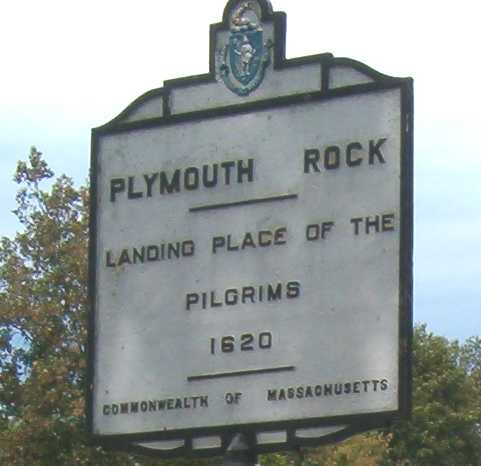
In 1881, Mark Twain delivered an uproarious address, in the form of a plea, to the New England Society of Philadelphia. Why all this “laudation and hosannaing” about the Pilgrims? he asked his audience. “The Pilgrims were a simple and ignorant race. They never had seen any good rocks before, or at least any that were not watched, and so they were excusable for hopping ashore in frantic delight and clapping an iron fence around this one.” “Plymouth Rock and the Pilgrims” was a classic piece of Sam Clemens’ contrarianism. As the whole country went mad with Pilgrim fever, Twain shouted, “Humbug!”
Continue reading here.

Saturday, October 31, 2009

H1N1 Halloween

In case you are having an H1N1 Halloween, I thought this reprisal of Frank's Halloween 2007 might be, um, well not comforting, but somehow fitting....
Happy Halloween from the Legal History Blog.

Sunday, May 10, 2009

Mother's Day in History

"Mother's Day" in the late-19th century was an an anti-war protest. Julia Ward Howe, author of the Battle Hymn of the Republic, wrote a Mother's Day Proclamation in 1870. It reads, in part:

Arise, then, women of this day! Arise all women who have hearts,whether our baptism be that of water or of fears!

Say firmly: "We will not have great questions decided by irrelevant agencies. Our husbands shall not come to us, reeking with carnage, for caresses and applause. Our sons shall not betaken from us to unlearn all that we have been able to teach them of charity, mercy and patience.

We women of one country will be too tender of those of another country to allow our sons to be trained to injure theirs. From the bosom of the devastated earth a voice goes up with our own.It says "Disarm, Disarm! The sword of murder is not the balance of justice."
The rest is here.

According to Ruth Rosen,

The story [of Mother's Day] begins in 1858 when a community activist named Anna Reeves Jarvis organized Mothers' Works Days in West Virginia. Her immediate goal was to improve sanitation in Appalachian communities. During the Civil War, Jarvis pried women from their families to care for the wounded on both sides.Afterward she convened meetings to persuade men to lay aside their hostilities.
In 1872, Julia Ward Howe, author of the "Battle Hymn of the Republic", proposed an annual Mother's Day for Peace....For the next 30 years, Americans celebrated Mothers' Day for Peace on June 2.
More from Rosen is here (scroll down).

Valarie Ziegler, author of Diva Julia: The Public Romance and Private Agony of Julia Ward Howe, was interviewed by Amy Goodman about Howe and Mother's Day in May 2005, on Democracy Now. She addresses the tension between Howe's Mother's Day Proclamation and The Battle Hymn of the Republic, which celebrated war.
I have seen Him in the watch fires of a hundred circling camps
They have builded Him an altar in the evening dews and damps;
I can read His righteous sentence by the dim and flaring lamps;
His day is marching on.
According to Ziegler, Howe "was absolutely committed to the Civil War." In The Battle Hymn, Howe was "asking people to devote themselves even to the last measure to get rid of slavery. So slavery was an important cause for her. Peace and women’s rights was also an important cause, and I mean, she clearly changed methods."
In a Slate essay, Soap to Ploughshares: How to return Mother's Day to its original meaning, Ruth Rosen discusses the way Mother's Day became the cards-and-flowers holiday we are now familiar with. Hat tip. Even non-profits capitalize on Mother's Day. But Rosen argues that
it is anti-war organizations like the Ploughshares Fund that return us to the original meaning of Mother's Day. Ploughshares has always promoted peace. Its current e-mail asks you to sign a declaration for Ground Zero, a campaign to create a nuclear-free world. In making this request, Ploughshares urges, "After all, what better way to honor our mothers than to return to the holiday's original purpose. … Reclaim the true meaning of Mother's Day, and leave a peaceful legacy to our children."

Friday, May 8, 2009

Last minute Mother's Day gift

If your mom's broadband speed is faster than my mom's, she just might appreciate something like this. (No need to watch the whole thing -- there is a link on the page to create your mom's own video, or at the end to send it to all the mother-figures you know.)
With thanks to Alicia and Ben.

Monday, January 19, 2009

MLK Day

The "foot soldiers" of the civil rights movement are remembered today in the Atlanta Journal's coverage of Martin Luther King Day. Time covers the history of the holiday. Meanwhile, Congressman John Lewis and other civil rights leaders reflect on the movement, and what Barack Obama's presidency means to them. The MLK Day of Service website has links to volunteer opportunities.

For researchers, historical materials on King are spread around. The Martin Luther King, Jr., Research & Education Institute, home of the King Papers Project, is at Stanford. There are many great resources in the website, including an annotated copy of King's Letter from Birmingham Jail, and a video of King's "I have a Dream" speech.
Important papers are also housed at the Dr. Martin Luther King, Jr. Archive at Boston University. The Robert W. Woodruff Library of the Atlanta University Center has just digitalized an important collection of King papers. Volumes of the published MLK papers are here, here and elsewhere.

And for that most famous speech, which was about so much more than dreams, here's a video from the 1963 March on Washington.


Update: Paul Harvey at Religion in American History, offers great links and reading ideas (and I completely agree regarding Nancy McLean's and Tom Sugrue's important books):
A little "off the beaten track" MLK day blogging from the Inverse Square Blog, featuring King's thoughts on science and religion (which sound a lot like Stephen Jay Gould's), and King's thoughts on war, peace, justice, community, civil rights, and religion, which sound not at all like a lot of those who quote him today but opposed him then (or would have if they were alive or old enough). The struggle to reclaim King's legacy from those who would distort his "content of their character" quotation, and those who fundamentally forget his drive for economic justice (rather than just "civil rights"), continues. Aside from Thomas Sugrue's Sweet Land of Liberty (the link takes you to my review), the best reading I've done on this lately is Nancy MacLean's Freedom is Not Enough, which is not about King per se, nor about "civil rights," but about the struggle for equal opportunity and pay in the workplace, which she places at the center of the struggle in the 1960s. She traces the enormously important consequences of Title VII of the Civil Rights Act of 1964 -- the passage of which was, of course, one of the motivating factors behind the 1963 March and the "Dream" speech.

Wednesday, December 31, 2008

Happy New Year!

Best wishes for the New Year from the Legal History Blog.


Thursday, December 25, 2008

Happy Holidays!

Best wishes for the holidays!


The Legal History Blog will be back on-line soon.


Wednesday, December 17, 2008

Holiday gift for your favorite legal historian

An ideal holiday gift for your favorite legal historian is membership in the American Society for Legal History. Student membership, at $20, is a bargain, and will give your legal history student a year of the leading journal in the field, the Law and History Review.

Become a member here, for new members, and here for renewing members. (For those renewing, you need your Member ID, which is on your LHR mailing label, or you can request it by e-mail.)
Overseas readers especially should act now. To cover costs of shipping the Law and History Review overseas, members outside of North America must add $10 to their membership fee. The price is going up however: "We regret that beginning on January 1, 2009, individuals and institutions resident outside of North America will need to add $25 (rather than $10) to these prices to cover overseas shipping of the journal." More info on that is here.

(By the way, when visiting the membership sign-up page, please disregard a paragraph that thanks you "for your interest in LERA membership." LERA is the Labor and Employment Relations Association, and the paragraph is a typo, to be corrected at some point.)
So pick up a stocking stuffer for your favorite grad student, or treat yourself to membership so that you, too, can be a legal historian!

Thursday, November 27, 2008

Happy Thanksgiving!

We have much to be thankful for this year at the Legal History Blog. My list includes you, dear reader, for keeping us going and bringing us over the 250,000 mark just in time for the Legal History Blog's second birthday, today!And now I hope you will forgive Dan and me a little time off-line. One of us is traveling and the other is cooking for seventeen. To keep you going, here is a Thanksgiving essay on how the bird came to be called a "turkey," and here is my favorite, fool-proof and delicious, recipe for pumpkin pie (substitute milk for the cream, but keep the 1/2 and 1/2). Flawless gravy can be found here (include the optional sherry). And more on Thanksgiving history is here.

Friday, October 31, 2008

Oh, horrors!

We try to be inclusive and non-partisan at the Legal History Blog. But as for Frank, well, he's been terrified ever since the Republican National Convention.

Happy Halloween!
Frank's hairstyle designed by Ruth Regina at Wiggles. The outfit, sorry to say, is not from Neiman Marcus.

Thursday, February 14, 2008

February 14

Tired of Hallmark? For your Valentine's Day, vintage e-Valentines!


And around the blogosphere, there are results of Feminist Law Prof's Valentine's Day poll (in response to the question: what are you doing for Valentine's Day, the most popular response was "when is it?"); and Diane Amann has a post on socially responsible flowers.

Monday, January 21, 2008

Thurgood Marshall and Martin Luther King, Jr.

Martin Luther King, Jr., whose birthday is celebrated today, and civil rights litigator Thurgood Marshall, were rivals in the 1960s, and are often thought of through the lens of conflict within the civil rights community. But there were important moments when the two came together. It was not just that the NAACP and the Legal Defense Fund represented King, for example during the Montgomery Bus Boycott. In 1964, Marshall, who generally supported legal change rather than civil disobedience, himself demonstrated on behalf of King’s philosophy of social change.

The occasion was the 1964 triennial national convention of the Episcopal Church, held in St. Louis, Missouri. Marshall was the first African American delegate from the New York diocese to attend. The conference honored Martin Luther King Jr., who was about to leave for Norway to receive the Nobel Peace Prize. King addressed the convention, calling upon Episcopalians to help with the civil rights struggle in the South. Most applauded, but some white delegates refused either to stand for King or to applaud.
The trouble occurred afterward at the House of Deputies meeting, when a resolution was introduced that spoke to the principles of King’s philosophy of nonviolent civil disobedience. The resolution “recognized the right of persons to disobey segregation laws that are in ‘basic conflict with the concept of human dignity under God.’” Civil disobedience had to be nonviolent, done only after “earnestly seeking the will of God in prayer.” Many in the clergy supported the proposal, but a number of lay delegates opposed it. “This is the first time in all of the history of this church that we have been asked to take a position that recognizes the right of people to disobey the law,” a Minneapolis delegate complained. “This is the way to chaos.” Reverend Gordon E. Gilett of Illinois responded: “One of my ancestors picked up a musket at Lexington and fought the British and I am certain we agree that was one of the greatest acts of civil disobedience.” When the measure came to a vote, it had the support of a majority of the clergy but did not receive enough support from lay delegates. The resolution was rejected. In protest, Marshall walked out.
Marshall’s walkout made headlines in New York and St. Louis. The Right Reverend Horace W. B. Donegan, bishop of the Diocese of New York, was “distressed” over the “unfortunate” incident and urged Marshall to stay. But Marshall was upset and angry. Then, the St. Louis Globe-Democrat blasted Marshall for his walkout:

Here is a Federal judge, the very embodiment of our law, acting as though he had turned in his judicial robes for a pair of sneakers and a CORE sweatshirt. The spectacle is ludicrous and not a little hypocritical.

This is a man who sits upon the United States Circuit Court of Appeals asking his church to encourage followers who violate selected laws “for reasons of conscience.”

The terrible danger of such an official endorsement of civil disobedience is that it leaves to the individual to judge what laws to violate, and individuals have different
ideas of “human dignity under God.”

This endorsement would have been an invitation to anarchy!

George L. Cadigan, bishop of Missouri, defended Marshall and publicly apologized on behalf of his city and his diocese, the host of the conference. Cadigan thought the attack on Marshall in the Globe-Democrat was unfair and ignored Christian teachings. The departure of Marshall, “our distinguished brother in Christ” was “a judgment on us all.”

Marshall was very angry when he got home to New York. But after sparking this controversy, he refused to comment on it. Reached at home in Manhattan, he told a reporter, “I just came out of there, that’s all. There are no conclusions to be drawn from that.”
There were important differences within the civil rights movement, and between Marshall and King. But just as the civil rights era changed America, it changed its participants. Perhaps King's national holiday is an appropriate time to reflect on the way, across what we usually think of as a divide between the movement and the lawyers, one leader supported another's message.

This passage is taken from Mary L. Dudziak, Exporting American Dreams: Thurgood Marshall's African Journey (Oxford University Press, forthcoming 2008). Cross-posted at Balkinization.