Showing posts with label Customary law. Show all posts

Thursday, October 15, 2026

Kelly on Liberian Legal History

Ezekiel Kelly, a Lecturer at Censil University, has posted two papers on the legal history of Liberia.  The first is Sovereignty on Trial: Liberian Law, Forced Labour and the League of Nations Commission of Inquiry, 1929–1930: 

I examine how Liberia used law and sovereignty to answer the forced-labour accusations of 1929–1930, and what the inquiry revealed about government in the interior. I read the commission’s report against the government’s replies, the legal provisions reproduced in the report and American diplomatic correspondence. I argue that Liberia’s defence depended on its claim to control both the investigation and the reforms that followed. The government authorised the inquiry, disputed parts of the evidence and accepted recommendations without accepting every finding. The report exposed a different relationship between government and the people required to work. Officials could demand labour through commissioners, chiefs and soldiers, while those subjected to these demands had limited access to officials who might protect them. The legal problem concerned the enforcement of freedom as much as its formal recognition. I also examine the unequal terms of international scrutiny. The commission investigated Firestone but qualified its findings by reference to corporate knowledge, and it recommended foreign officials as a remedy for Liberian misgovernment. I conclude that Liberia’s defence of independence must be considered alongside its failure to make constitutional protection accessible in the interior.
The second is Two Laws, One State: Customary Courts and the Legal Governance of Liberia's Hinterland, 1912-1956:

 I examine how Liberia's government incorporated customary authority into the administration of its hinterland and how the Supreme Court contested the resulting exercise of judicial power. Two judgments, Jedah and others v Horace (1916) and Karmo and another v Morris and another (1919), expose a disagreement within the state over the constitutional position of the interior. In Karmo, the government argued that constitutional restrictions did not govern executive action beyond the coastal counties. The Court answered that Liberia's claim to sovereignty carried constitutional obligations throughout its territory. Yet its reasoning also justified the incorporation of indigenous communities without their consent. Reading these decisions alongside the 1930 international inquiry and the 1956 Aborigines Law, I argue that constitutional review and administrative domination developed within the same legal order. The 1956 legislation made complaints, records and official supervision part of interior government while retaining courts closely connected to the executive. Legal plurality therefore requires an account of who controlled jurisdiction and access to review. The dates in the title define the proposed historical span; the precise statutory basis for the opening date remains to be established. 

--Dan Ernst 

Wednesday, October 8, 2025

CLH: Dialogues on Customary Law

 [We have the following announcement.  DRE]

Comparative Legal History: Dialogues on Customary Law.  5 November 2025 – 17:00-18:00hs (CET)

The journal Comparative Legal History is an official academic forum of the European Society for Comparative Legal History. Based in Europe, it welcomes contributions that explore law in different times and jurisdictions from across the globe. Submissions are currently welcome and are being assessed on a rolling basis. 

The journal will host a one-hour public session to discuss customary law in the context of comparative legal history. Editors (past and present) will present exploratory points, and all attendees will be invited to join in a general discussion. 

Customary laws were prevalent in Europe during the Middle Ages. In recent years there has been a resurgence in research projects concerning customary laws, and a number of questions need to be raised. To what extent are customary laws something that still needs to be studied? To what extent customary laws ought to be taught at universities to complement core modules such as family law, the laws of inheritance and property law to frame these topics in their historical context? To what extent is there merit in having journals and monograph series concentrate on comparative customary law? How should studies be undertaken? These, and other questions will be explored during this public session.

The event is free and open to the public, and it will take place via Teams. 

Registration is required by sending an email to clhdialogues@gmail.com.

Monday, January 15, 2024

Kuskowski, "The Time of Custom and the Medieval Myth of Ancient Customary Law"

The latest issue of Speculum (the journal of the Medieval Academy of America) includes an article of interest: "The Time of Custom and the Medieval Myth of Ancient Customary Law," by Ada Kuskowski (University of Pennsylvania). Here is the abstract:

Medieval custom has been variously described as old, long, repeated, remembered, or immemorial. These notions of the time of customary law can be traced to Fritz Kern’s “good old law.” While scholars have finessed or critiqued Kern’s conception, the assumption that custom had to be viewed as old or ancient law remains. This article examines the temporal framework of custom in lawbooks from late antiquity to the fourteenth century, as well as in modern history and historiography, to trace how and when the language of age and antiquity came to frame custom. When and how, in other words, did a medieval myth of an old, ancient, and even immemorial customary law form? Jurists who tried to define the term, first in late antiquity and then in the high Middle Ages, deployed various notions of time to separate a legal custom that worked like law from habitual practice. The lawbooks that described custom, on the other hand, tended to see it as current or presentist, and it was only around the turn of the fourteenth century that learned definitions worked their way into customary lawbooks. The medieval myth that customary law necessarily had to be old law turns out not to be medieval but modern.

The full article is available here (but behind a paywall).

-- Karen Tani

Friday, December 8, 2023

International Customary Laws Database Project

We have received a request for participants for an international research project, International Customary Laws Database Project, coordinated by Sylvain Soleil, professor in legal history at the University of Rennes.  It aims to

(1) put on line the sets of customary laws published throughout the world; (2) conduct an epistemological and interdisciplinary reflection on the writing down of oral traditions; (3) understand why certain political authorities have refused to put their legal traditions in writing; [and] (4) bring together researchers from all over the world to address these two issues.
Participants will transmit the text of customary laws in word form with a short introductory note.  The text and note would then be “integrated into the website of the Société de Législation Comparée (2024 - 2025).”  In exchange, participants would receive official certification of their participation, have access to the international network of participants, and be invited to take part in two videoconferences, in 2024 and 2025.

--Dan Ernst

Thursday, October 5, 2023

Deardorff's "Tale of Two Granadas"

Max Deardorff, University of Florida, has published A Tale of Two Granadas: Custom, Community, and Citizenship in the Spanish Empire, 1568–1668 (Cambridge University Press, 2023):

This book offers a wide-ranging analysis of transforming conceptions of citizenship in the Spanish monarchy as it became a global empire. Side-by-side case studies of old Granada (southern Spain, core settlement of Spain's last independent Islamic polity) and colonial New Kingdom of Granada (modern Colombia) show that Spanish ecclesiastics' involvement in the Council of Trent (1545-1563) went hand-in-hand with the monarchy's thinking about the structure and cohesion of its empire. With fine-grained archival work, the book shows how two subject communities -- Andalusi "moriscos" of old Granada and indigenous Muiscas of the New Kingdom of Granada -- weathered a century of political and social change that followed. At stake were the question of the terms of colonial indigenous integration into the monarchy’s social structures and the looming threat of disenfranchisement faced by Granada’s “moriscos.” A Tale of Two Granadas makes the case that even more than 1492, the year that completely reshaped the monarchy was 1568. That year was both the beginning of the famed Rebellion of the Alpujarras in southern Spain, and the year when the famous Junta Magna met in  Madrid to lay out grand new plans for the administration of the monarchy's colonies overseas.
Here is an endorsement:
‘In this lucidly written book, Max Deardorff explores what citizenship meant for those social actors in the early modern Spanish territories who faced degrees of exclusion due to their ethnicity and proximity to orthodox Christianity. Meticulously researched and engagingly written, Deardorff brings together the Iberian Atlantic by looking at lesser-studied regions and the people inhabiting their margins, and also, at the Spanish powerholders who moved across the two jurisdictions.’

Joanne Rappaport - Georgetown University
--Dan Ernst

Monday, May 1, 2023

Yannakakis, "Since Time Immemorial: Native Custom and Law in Colonial Mexico"

Duke University Press has published Since Time Immemorial: Native Custom and Law in Colonial Mexico (2023), by Yanna Yannakakis (Emory University). A description from the Press:

In Since Time Immemorial Yanna Yannakakis traces the invention of Native custom, a legal category that Indigenous litigants used in disputes over marriage, self-governance, land, and labor in colonial Mexico. She outlines how, in the hands of Native litigants, the European category of custom—social practice that through time takes on the normative power of law—acquired local meaning and changed over time. Yannakakis analyzes sources ranging from missionary and Inquisition records to Native pictorial histories, royal surveys, and Spanish and Native-language court and notarial documents. By encompassing historical actors who have been traditionally marginalized from legal histories and highlighting spaces outside the courts like Native communities, parishes, and missionary schools, she shows how imperial legal orders were not just imposed from above but also built on the ground through translation and implementation of legal concepts and procedures. Yannakakis argues that, ultimately, Indigenous claims to custom, which on the surface aimed to conserve the past, provided a means to contend with historical change and produce new rights for the future.
Advance praise:

“Rejecting an older bibliography that romanticized Native customs as ancient and autochthonous, Yanna Yannakakis studies how customs were formulated, how they changed, and how they became central to both law and politics during the colonial period. Rather than conserving a past, she astutely points out that customs enabled a host of different actors to adjust to a present and dream of a better future.” — Tamar Herzog

“Since Time Immemorial is a compelling study of how Indigenous communities in colonial Mexico adapted European concepts of custom to their own communal lifeways. It shows how they advanced those reformulated versions in Spanish courts of law, responding strategically to global changes and challenges in the name of local custom, ironically. As with her first book, The Art of Being In-between, Yanna Yannakakis has written a classic in the field of Latin American history.” — Kevin Terraciano

More information, including free access to the Introduction, is available here.

-- Karen Tani

Monday, November 7, 2022

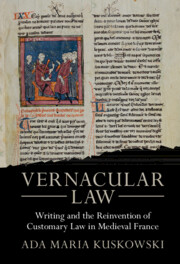
Kuskowski, "Vernacular Law Writing and the Reinvention of Customary Law in Medieval France"

 The Studies in Legal History Series at Cambridge University Press has released by Vernacular Law: Writing and the Reinvention of Customary Law in Medieval France, by Ada Maria Kuskowski (University of Pennsylvania). A description from the Press:

Custom was fundamental to medieval legal practice. Whether in a property dispute or a trial for murder, the aggrieved and accused would go to lay court where cases were resolved according to custom. What custom meant, however, went through a radical shift in the medieval period. Between the twelfth and thirteenth centuries, custom went from being a largely oral and performed practice to one that was also conceptualized in writing. Based on French lawbooks known as coutumiers, Ada Maria Kuskowski traces the repercussions this transformation – in the form of custom from unwritten to written and in the language of law from elite Latin to common vernacular – had on the cultural world of law. Vernacular Law offers a new understanding of the formation of a new field of knowledge: authors combined ideas, experience and critical thought to write lawbooks that made disparate customs into the field known as customary law.

Advance praise:

"This book is a marvel, mixing erudition and imagination. Describing the cultural upheaval of the writing of custom, Ada Kuskowski opens new doors to the understanding of medieval law." -- James Q. Whitman, 

"By studying the first coutumiers as a coherent whole, with a focus on language and manuscripts and an eye toward recent scholarship in legal history generally, Kuskowski defines a subject every bit as complex, interesting, and influential as the medieval Roman and canon laws that overshadow it in the historiography." -- Adam Kosto

More information is available here.

-- Karen Tani

Thursday, September 23, 2021

Medhi on the Indo-Afghan frontier

 Abhilash Medhi (Mount Holyoke) has published "Infrastructural Contingencies and Contingent Sovereignties on the Indo-Afghan Frontier" in Modern Asian Studies (2020), 1-38. Here's the abstract:

The Khyber Pass Railway is a defunct 42-kilometre-long railway line that connects the western reaches of Peshawar to the Afghan border. Completed in 1925 mainly to carry British troops, the railway line failed to attract decent passenger or commodity traffic. Instead, it made an impact on a more primal register. Negotiations carried out between the British Government of India and populations from around the Khyber to allow its construction reproduced and rearranged lines of authority among the latter. They also embedded colonial administrators in tribal hierarchies. Efforts to acquire land and labour opened up spaces of collaboration between the colonial administration and members of frontier tribes, effectively contributing towards a reconfiguration of sovereign power in the area. This article weaves questions of customary law and colonial legal cultures into a retelling of the history of the Khyber Pass Railway. Examining transactions across three domains of sovereign power—the economic right to use land, extension of juridical regimes, and territorial control—it argues that the operation of sovereignty in the late-colonial Indo–Afghan frontier did not adhere to conventional ideas about its concentration and monopoly. The colonial government as well as members of frontier tribes deployed the inconclusive nature of their transactions strategically and, often, sovereign power lay with the stakeholder who could determine which domains fell within the bounds of the sovereignty question and which domains fell without.

Further information is available on the Modern Asian Studies website via Cambridge University Press.

--Mitra Sharafi 

Friday, January 24, 2020

Lo Extrajudicial, Premo

My last two posts with Judith Mansilla discussed a dimension of law that consumed perhaps the greatest part of colonial Spanish Americans’ legal experiences: a world of verbal agreements, handshakes, and homemade contracts or bills of sale. But we confronted the historian’s dependence on the more official legal archive to provide us glimpses of this dimension, specifically on the civil case record where litigants and witnesses referred to their “pacts,” or “oral receipts.” 

We should not, however, assume that this dimension of law was unsanctioned or fell into a category of the broadly “normative” as opposed to the strictly “legal.” (cont'd)

Friday, December 20, 2019

Robichaud, "Animal City"

Fans of Hendrik Hartog's classic "Pigs and Positivism" might be intrigued by this new release from Harvard University Press: Animal City: The Domestication of America, by Andrew A. Robichaud (Boston University). A description from the Press:
Americans once lived alongside animals. They raised them, worked them, ate them, and lived off their products. This was true not just in rural areas but also in cities, which were crowded with livestock and beasts of burden. But as urban areas grew in the nineteenth century, these relationships changed. Slaughterhouses, dairies, and hog ranches receded into suburbs and hinterlands. Milk and meat increasingly came from stores, while the family cow and pig gave way to the household pet. This great shift, Andrew Robichaud reveals, transformed people’s relationships with animals and nature and radically altered ideas about what it means to be human.

As Animal City illustrates, these transformations in human and animal lives were not inevitable results of population growth but rather followed decades of social and political struggles. City officials sought to control urban animal populations and developed sweeping regulatory powers that ushered in new forms of urban life. Societies for the Prevention of Cruelty to Animals worked to enhance certain animals’ moral standing in law and culture, in turn inspiring new child welfare laws and spurring other wide-ranging reforms.

The animal city is still with us today. The urban landscapes we inhabit are products of the transformations of the nineteenth century. From urban development to environmental inequality, our cities still bear the scars of the domestication of urban America.
Advance praise:
“Based on exhaustive research, Animal City provides a rich description of nineteenth-century human and animal lives, including the landscapes, laws, economies, and institutions that shaped them. Robichaud has made a landmark contribution to how we understand this formative period in American urban and animal history.”—Peter Alagona 
“In ways that can seem unimaginable today, urban animals played a major role in shaping how nineteenth-century Americans debated laws, considered the boundaries of brutality, transformed economies and environments, and ultimately understood themselves. Through masterful storytelling and deep historical research, Andrew Robichaud paints this ecologically diverse urban world in vivid colors, showing readers that we cannot understand modern cities without acknowledging their controversial and often invisible animal past.”—Catherine McNeur
More information is available here.

-- Karen Tani

Wednesday, April 10, 2019

Two by Kadens on Custom, the Learned Law, and Early Modern Cheating

Emily Kadens, Northwestern University School of Law, has posted two writings.  The first is  Convergence and the Colonization of Custom in Pre-modern Europe, which appears in Comparative Legal History (2019), edited by Olivier Moreteau & Kjell Modeer.  It argues that “once men trained in the learned laws during the Middle Ages, they could no longer conceive of custom in the traditional manner, but rewrote the narrative of custom to fit into the framework of law established by the Roman law.”

The second is Cheating Pays and is forthcoming in volume 119 of the Columbia Law Review:
Common private-ordering theories predict that merchants have an incentive to act honestly because if they do not, they will get a bad reputation and their future businesses will suffer. In these theories, cheating is cheating whether the cheat is big or small. But while reputation-based private ordering may constrain the big cheat, it does not necessarily constrain the small cheat because of the difficulty in discovering certain types of low-level cheating and the consequent failure of the disciplining power of reputation. Yet the small cheat presents a significant challenge to modern contracting, both between businesses and in the contracts of adhesion imposed on consumers. To encourage private law scholars to address the unique governance challenges posed by low-level cheating, this Essay describes the conditions under which low-level cheating can flourish and become widespread. It demonstrates this so-called “Cheating Pays” scenario using a historical case study in which a seventeenth-century London grocer, trading under precisely those conditions that private-ordering theories predict will incentivize honesty, not only cheated extensively but also successfully remained in business after having been caught and publicly punished. Identifying the scenarios in which cheating pays has implications for how firms use contracts and how consumers might use the courts to try to reduce opportunistic behavior.

Friday, February 24, 2017

Rady on Hungarian customary law

We missed this book by Martyn Rady, UCL, out in 2015: Customary Law in Hungary: Courts, Texts, and the Tripartitum. From Oxford University Press:
Cover for 

Customary Law in Hungary


This is the first comprehensive treatment in any language of the history of customary law in Hungary, from the thirteenth to the twentieth centuries. Hungary's customary law was described by Stephen Werboczy in 1517 in the extensive law code known as the Tripartitum. As Werboczy explained, Hungarian law derived from the interplay of Romano-canonical law, statute, written instruments, and court judgments. It was also responsive, however, to popular conceptions of the law's content and application, as communicated through the lay membership of the kingdom's courts. Publication of the Tripartitum was intended to make the law more certain by fixing it in writing. Nevertheless, its text was customized by actual use, in the same way as the statute laws of the kingdom were adjusted as a consequence of court practice and of errors in their transmission.
The reputation attaching to the Tripartitum and Hungary's insulation from the Roman Law Reception meant that the Tripartitum continued to retain authority until well into the nineteenth century. Attempts to replace it foundered and it was the principal text on which the courts and the schools relied, not only in Habsburg Hungary but also in Transylvania. Courts, nevertheless, continued to modify its provisions in the interests of rendering judgments that they deemed either to be right or in conformity with developing practices. Even after the establishment of a parliamentary form of government in the nineteenth century, a strong customary element attached to Hungarian law, which was amplified by the association of customary law with national traditions. The consequence was that Hungary maintained aspects of a customary law regime until the Communist period.
Here's the Table of Contents:


1. The Legal Landscape
2. Customary Law and the Tripartitum
3. Customary Law, Legislation, and Letters
4. Customary Law and Medieval Courts
5. King and Nobility
6. The Nobleman and His Land
7. Crime and Prosecution
8. Medieval Procedure and Judicial Decision Making
9. Early Modern Legal Institutions
10. Codification after the Tripartitum
11. Courts and the Law in the Long Eighteenth Century
12. Custom and Law in the Modern Period

Conclusion: Customary Law in Hungary

Further information is available here.

Friday, June 3, 2016

Margins of the Market

Just out is a book by Johan Mathew (UMass Amherst) on illegality in the Indian Ocean: Margins of the Market: Trafficking and Capitalism across the Arabian Sea (University of California Press 2016). From the publisher:

What is the relationship between trafficking and free trade? Is trafficking the perfection or the perversion of free trade? Trafficking occurs thousands of times each day at borders throughout the world, yet we have come to perceive it as something quite extraordinary. How did this happen, and what role does trafficking play in capitalism? To answer these questions, Johan Mathew traces the hidden networks that operated across the Arabian Sea in the nineteenth and early twentieth centuries. Following the entangled history of trafficking and capitalism, he explores how the Arabian Sea reveals the gaps that haunt political borders and undermine economic models. Ultimately, he shows how capitalism was forged at the margins of the free market, where governments intervened, and traffickers turned a profit.

Here are some blurbs:

"This is a superb and vitally important book: conceptually sophisticated, imaginatively researched, and beautifully written. Johan Mathew brings into view the shifting networks of commerce around the Arabian Sea’s littoral, forged in the shadows of imperial regulation—a traffic in people, guns, and gold. This book is a breakthrough in Indian Ocean history, with huge contemporary resonance. And it is essential reading for anyone interested in the history of global capitalism."—Sunil Amrith, Harvard University

"This brilliant book draws on unique primary sources and private archives to tell vivid stories, beautifully framed and theoretically rich, about the traffic in licit and illicit goods across the Arabian Sea. Its wonderful account of the smuggling of coins, guns, and humans, and also of the secret world of price-setting, shows how such trade is the shadowy other of more mundane forms of capital accumulation."—Laleh Khalili, School of Oriental and African Studies, University of London

"Johan Mathew's Margins of the Market provides a valuable corrective to the prevalent idea that trafficking and smuggling operate outside capitalism. Mathew shows, in vivid detail and with wide-ranging, in-depth research, how modern empires and nations around the Arabian Sea have struggled to frame the market inside a vast world of coercive profit making—based on physical control of human beings, weapons, goods, and money—whose expansive margins in fact provide capitalism much of its lucrative, adaptive dynamism."—David Ludden, New York University


More information is available here, and you can take a peek inside here and here.

Monday, May 9, 2016

Kadens on Medieval Custom and the Medieval Law Merchant

Former LHB Guest Blogger Emily Kadens, Northwestern University School of Law, has recently posted two essays.  The first is Custom's Past, which is to appear in Custom’s Future: International Law in a Changing World, ed. Curtis A. Bradley (Cambridge 2016), 11-33:
This chapter argues that the modern publicists’ problems with custom grow out of the efforts of the medieval jurists to fit custom into the hierarchy of law. Trained in formal law, lawyers and judges expect all legally binding rules to have the characteristics of rules found in statute books and judicial opinions. This sort of lawyerly bias has its origin in the twelfth century, when the European tradition of formal legal study began. But custom had a prelegal existence, and in this “natural” state it did not fit the mold of enacted law. Natural custom was fluid, uncertain, equitable, and communitarian–features of a system of social regulation that lawyers no longer equate with law. Instead, for nearly 900 years, jurists and judges have been trying to force custom to look like what they have been trained to believe law is, and for nearly 900 years they have failed. Natural custom might, in certain circumstances, have functioned as law, but it did not function like law.
The second is The Medieval Law Merchant: The Tyranny of a Construct, which appeared in the Journal of Legal Analysis 7 (Winter 2015): 251-89:
The story of a medieval law merchant has a strong hold on scholars interested in private ordering. Despite numerous historical works demonstrating the falsity of the myth, it continues to be discussed regularly in scholarship as if it were an accurate portrayal of the past. This article tests the law merchant story against evidence about the mechanisms of medieval trade. It suggests that medieval commerce had little space for a specialized law, and that merchants had little need for it because of both the well-developed trading infrastructure and the actions of local governments to ensure the protection of legal rights.

Tuesday, April 12, 2016

Deal's "Law of the Whale Hunt"

Robert Deal, Marshall University, has published The Law of the Whale Hunt: Dispute Resolution, Property Law, and American Whalers, 1780–1880, in the Cambridge Historical Studies in American Law and Society book series, edited by Christopher L. Tomlins:
Whale oil lit the cities and greased the machines of the Industrial Revolution. In light of its importance, competition between whalers was high. Far from courts and law enforcement, competing crews of American whalers not known for their gentility and armed with harpoons tended to resolve disputes at sea over ownership of whales. Left to settle arguments on their own, whalemen created norms and customs to decide ownership of whales pursued by multiple crews. The Law of the Whale Hunt provides an innovative examination of how property law was created in the absence of formal legal institutions regulating the American whaling industry in the eighteenth and nineteenth centuries. Using depositions, court testimony, logbooks, and other previously unused primary sources, Robert Deal tells an exciting story of American whalers hunting in waters from the North Atlantic to the South Pacific and the Sea of Okhotsk.
Here’s the TOC:

1. Introduction
2. The biology, economics, and geography of Anglo-American whaling
3. Fast-fish, loose-fish
4. Iron holds the whale
5. Laws of honor
6. Halves
7. The environment of litigation
8. An untragic commons
9. Conclusion

Wednesday, September 25, 2013

Custom Now: A Symposium

I've recently learned of an interesting symposium on custom published in volume 48 of the Texas International Law Journal, which is  available on line:

 Introduction, by Emily Kadens

In the Name of Custom, Culture, and the Constitution: Korean Customary Law in Flux, by Marie Seong-Hak Kim

Legal Autonomy Versus Regulatory Law: Customary Law in Eastern Scandinavia, by Kjell Å. Modéer

Western Scandinavia: Exit “Bürgerliches Gesetzbuch” — The Resurrection of Customary Laws, by Peter Ørebech

False Jurisdictions? A Revisionist Take on Customary (Religious) Law in Germany, by Pascale Fournier & Pascal McDougall

The Law and Economics of Norms, by Juliet P. Kostritsky

Custom in American Property Law: A Vanishing Act, by Henry E. Smith

The Jurisprudence of Custom, by Frederick Schauer

An excerpt from the introduction by Emily Kadens, Northwestern Law, after the jump.

Wednesday, February 13, 2013

Orbach on Antitrust History

Barak Orbach, University of Arizona College of Law, has posted How Antitrust Lost Its Goal, which is forthcoming in the Fordham Law Review 81 (2013).  Here is the abstract:
George Edmunds (Library of Congress)
During the first seven decades of the Sherman Act, competition was the uncontroversial goal of antitrust. The introduction of the consumer welfare standard led to the dissipation of “competition” as the goal of U.S. competition laws. This Article explores how antitrust lost the goal of competition, and argues that this goal should be restored. The Article reevaluates several influential antitrust propositions. First, while “consumer welfare” was offered as a remedy for reconciling contrasts and inconsistencies in antitrust, the adoption of the standard sparked an enduring controversy and “set sail on a sea of doubt.” The consumer welfare standard has been a source of confusion and doctrinal uncertainty. Second, the small-business interests hypothesis, which has been often used to explain the enactment of the Sherman Act, is inconsistent with the well-documented historical record. Third, the logic of Robert Bork’s consumer welfare thesis supposedly requires restoration of “competition” as the goal of antitrust. The Article concludes with a straightforward observation: “Consumer welfare” may continue serving as the stated goal of U.S. competition laws but, practically, antitrust has always been and will always be about the preservation of competition.

Friday, June 15, 2012

Greer on the "Outer Commons" and the Dispossession of Native Americans

Property teachers will want to take special note of Alan Greer’s “Commons and Enclosure in the Colonization of North America,” American Historical Review 117 (April 2012): 365-86, especially if they’ve grown accustomed to teaching Johnson v. McIntosh as a synecdoche for a broader triumph of Lockean, individual property over the collective property of Native Americans.  Greer makes the interesting point that during colonization in North America dispossession was more typically worked by the expansion of the collective right of Europeans to use “waste” lands, which he calls the “outer commons,” for grazing and herding.  “Over the centuries,” he writes, indigenous peoples over a broad and ever-moving front would feel the effects of the advent of four-legged invaders even before the two-legged variety became a settled presence. . . .  A multi-species assault on the native commons really was underway as the colonial commons advanced across the face of the continent, bringing in its wake a colonial enclosure movement that left virtually no room for Indian people.”

Greer is Professor of History  and Canada Research Chair in Colonial North America at McGill University.

Saturday, March 12, 2011

Reasoning from History about Customary International Law

A recent exchange among legal scholars about customary international law may be of interest to legal historians. The authors reason from history. In Withdrawing from International Custom, 120 Yale L.J. 202 (2010), Curtis Bradley and Mitu Gulati (Law, Duke) made historical claims in arguing for a unilateral right of withdrawal from customary international law. The abstract follows.

Treaties are negotiated, usually written down, and often subject to cumbersome domestic ratification processes. Nonetheless, nations often have the right to withdraw unilaterally from them. By contrast, the conventional wisdom is that nations never have the legal right to withdraw unilaterally from the unwritten rules of customary international law (CIL), a proposition that we refer to as the “Mandatory View.” It is not obvious, however, why it should be easier to exit from treaties than from CIL, especially given the significant overlap that exists today between the regulatory coverage of treaties and CIL, as well as the frequent use of treaties as evidence of CIL. In this Article, we consider both the intellectual history and functional desirability of the Mandatory View. We find that a number of international law publicists of the eighteenth and nineteenth centuries thought that CIL rules were sometimes subject to unilateral withdrawal, at least if a nation gave notice about its intent. We also find that the Mandatory View did not come to dominate international law commentary until sometime in the twentieth century, and, even then, there were significant uncertainties about how the Mandatory View would work in practice. Moreover, we note that there are reasons to question the normative underpinnings of the shift to the Mandatory View, in that it may have been part of an effort to bind “uncivilized” states to the international law worked out by a small group of Western powers. After reviewing this history, we draw on theories developed with respect to contract law, corporate law, voting rules, and constitutional design to consider whether it is functionally desirable to restrict opt-out rights to the extent envisioned by the Mandatory View. We conclude that, although there are arguments for restricting opt-out in select areas of CIL, it is difficult to justify the Mandatory View as a general account of how CIL should operate.

William S. Dodge (Law-Hastings) responded to Bradley and Gulati in the most recent edition of the Yale Law Journal online. Dodge's response, Withdrawing from Customary International Law: Some Lessons from History, began this way:
[C]ustomary international law today binds all nations irrespective of their individual consent. In a recent article, Professors Curtis Bradley and Mitu Gulati point out that this has not always been true and ask whether it should continue to be. They contrast what they call the “Default View” of international law, which permitted nations to withdraw unilaterally from some international law rules upon proper notice, with what they call the “Mandatory View,” which denies nations a right of withdrawal. The authors date the shift from the Default View to the Mandatory View to the late nineteenth and early twentieth centuries, suggesting that it “may have evolved as part of an effort to bind new nations and former colonies to international law rules that had already been worked out by a handful of powerful states.” Having tarred the Mandatory View with the brush of imperialism, they propose a limited return to the Default View, under which some CIL rules—like sovereign immunity—would again be subject to a right of withdrawal. But Bradley and Gulati have misread the history of customary international law in three ways that cast doubt upon their proposal for change.

Friday, April 17, 2009

Rosser on Customary Tribal Law

Ezra Rosser, American University-Washington College of Law, has posted the paper Customary Law: The Way Things Were, Codified, which is forthcoming in Tribal Law Journal, 8 (2008). Here is the abstract:
Frequently referred to as “customary law,” the unique traditions and customs of different Native American tribes are cited by their tribal courts as authoritative and binding law. The recent use of customary law as a mechanism for deciding individual cases is not uniform among tribal court systems as it differs depending upon which tribe’s judges are working to place custom into contemporary judicial analysis. Understanding the present role of customary law in tribal law requires first understanding the nature of customary law and then understanding how it is being used. The effect of customary law is dependent upon the place it has in relation to other sources of law from tribal statutes to state common-law. Furthermore, the differing treatment afforded customary law by separate tribal court systems in many ways is a reflection of the degrees of proof required by different courts to establish what is or is not a tribal custom.
Image Credit: Cherokee Nation Judicial Branch