
--Dan Ernst. Schedule after the jump.
--Dan Ernst. Schedule after the jump.


Charlotte Christensen-Nugues, Lund University, has published, open-access, Consent and Coercion: Forced Marriages in Supplications to the Apostolic Penitentiary, 1484-92, in the Journal of Medieval History:
In the late Middle Ages, hundreds of Christians from all over Europe sent supplications to the Papal Curia to be freed from promises made under duress. This article analyses the supplications about forced marriages that were submitted to the Apostolic Penitentiary during the pontificate of Pope Innocent VIII (1484–92). The study is based on mainly unedited source material that has not been investigated before. The article examines who turned to the Penitentiary for annulment because of force (age, gender, and social status), who was designated as the compelling party, and, finally, what kind of coercion the petitioners had been subjected to. Particular focus is given to the narrative strategies of the petitioners and how their stories relate to legal theory and cultural norms in late medieval society.
--Dan Ernst
New from Oxford University Press: Reframing Treaties in the Late Medieval and Early Modern West, edited by Isabella Lazzarini, Luciano Piffanelli, and Diego Pirillo:
The history of peacemaking has traditionally been reduced to isolated case studies and seen as the prelude to the presumed 'universal' and 'modern' international order. Countering this one-dimensional and Eurocentric narrative, this multi-authored volume reconceptualizes peace treaties as a range of successful and failed agreements, settlements, truces, leagues, and other forms of conflict resolution, thus recovering their multilayered history throughout the medieval and early modern period. Rather than a series of 'great' treaties, peacemaking is reframed as a flexible phenomenon; a 'political grammar', whose complexity is reflected in its variety of forms and sources. Drawing on both diplomatic history and international relations studies, this volume traces the central role that peacemaking has played in the political history of the Western World.
--Dan Ernst. TOC after the jump.
[We have the following Call for Papers. DRE]
The Medieval Academy at 100: The 2025 Annual Meeting of the Medieval Academy of America. Harvard University, Cambridge MA, 20-22 March 2025.


Weekend Roundup is a weekly feature compiled by all the Legal History bloggers.

The latest issue of Speculum (the journal of the Medieval Academy of America) includes an article of interest: "The Time of Custom and the Medieval Myth of Ancient Customary Law," by Ada Kuskowski (University of Pennsylvania). Here is the abstract:
Medieval custom has been variously described as old, long, repeated, remembered, or immemorial. These notions of the time of customary law can be traced to Fritz Kern’s “good old law.” While scholars have finessed or critiqued Kern’s conception, the assumption that custom had to be viewed as old or ancient law remains. This article examines the temporal framework of custom in lawbooks from late antiquity to the fourteenth century, as well as in modern history and historiography, to trace how and when the language of age and antiquity came to frame custom. When and how, in other words, did a medieval myth of an old, ancient, and even immemorial customary law form? Jurists who tried to define the term, first in late antiquity and then in the high Middle Ages, deployed various notions of time to separate a legal custom that worked like law from habitual practice. The lawbooks that described custom, on the other hand, tended to see it as current or presentist, and it was only around the turn of the fourteenth century that learned definitions worked their way into customary lawbooks. The medieval myth that customary law necessarily had to be old law turns out not to be medieval but modern.
The full article is available here (but behind a paywall).
-- Karen Tani
Via New Books Network, we have word of a 2022 publication that we missed: International law in Europe, 700-1200 (Manchester University Press), by Jenny Benham (Cardiff University). A description from the Press:
Was there international law in the Middle Ages? Using treaties as its main source, this book examines the extent to which such a system of rules was known and followed in the period 700 to 1200. It considers how consistently international legal rules were obeyed, whether there was a reliance on justification of action and whether the system had the capacity to resolve disputed questions of fact and law. The book further sheds light on issues such as compliance, enforcement, deterrence, authority and jurisdiction, challenging traditional ideas over their role and function in the history of international law.
International law in Europe, 700-1200 will appeal to students and scholars of medieval Europe, international law and its history, as well as those with a more general interest in warfare, diplomacy and international relations.
More information is available here.
-- Karen Tani
[We have the following announcement. DRE. H/t: MW.]
Objects of Law in the Medieval and Early Modern Worlds. Universität Bern, Institut für Kunstgeschichte, Aug 29–30, 2024. Deadline: Nov 1, 2023. Corinne Mühlemann und Fatima Quraishi
Materials and texts function in a variety of ways in legal contexts, they forge diplomatic ties, grant gifts of land, levy taxes, regulate markets, etc. In the medieval and early modern worlds, these objects took on many different guises. Some were highly ornate objects, such as Fatimid marriage contracts where text was embroidered on woven silk, or tablets of authority produced in gold, silver or wood which allowed travelers to cross the Mongol Empire without difficulty, or wax seals imprinted with imperial images protected in textile bags. Other objects facilitated the execution of law in everyday life; glass weights, stamps for marking loaves of bread, length standards embedded in architecture, volume standards. The connection between the materiality of these artefacts and the law are multiple, their very nature conveyed information, performed authority, and communicated authenticity.
Although legal objects fall between disciplinary categories, their texts have been the main subject of scholarship. The conference, Objects of Law, proposes thinking more deeply about the artistic practices that shaped the materiality, iconography, and texts of legal objects in the medieval and early modern period. What forms did these objects take? How did their form confer authenticity and legal authority? What training or knowledge are evident in the objects? Objects of Law seeks dialogue between scholars working in art history, history, archaeology, legal history, and related disciplines that deal with legal objects. We welcome contributions from all geographical regions that relate to the medieval and early modern period. We invite contributions that address, but are not limited to, the following topics:
- The role of objects in legal practices
- The aesthetics of objects of law
- The artistic practices of crafting legal objects
Proposals should consist of an abstract in English for 30-minute papers (max 2000 characters incl. spaces) and a brief biography (max 1500 characters incl. spaces) in a single document (pdf or word). They should be submitted to: Corinne Mühlemann (corinne.muehlemann@unibe.ch) and Fatima Quraishi (fatimaq@ucr.edu) by November 1, 2023. Graduate students are highly encouraged to apply. Conference participants will be provided with accommodation in Bern for 3 nights and some travel expenses will be covered.
Cambridge University Press has published Patrimony and Law in Renaissance Italy (2022), by Thomas Kuehn (Clemson University). A description from the Press:

Family was a central feature of social life in Italian cities. In the Renaissance, jurists, humanists, and moralists began to theorize on the relations between people and property that formed the 'substance' of the family and what held it together over the years. Family property was a bundle of shared rights. This was most evident when brothers shared a household and enterprise, but it also faced overlapping claims from children and wives which the paterfamilias had to recognize. Thomas Kuehn explores patrimony in legal thought, and how property was inherited, managed and shared in Renaissance Italy. Managing a patrimony was not a simple task. This led to a complex and active conceptualization of shared rights, and a conscious application of devices in the law that could override liabilities and preserve the group, or carve out distinct shares for each member. This wide-ranging volume charts the ever-present conflicts that arose and were a constant feature of family life.
Praise from reviewers:
'Patrimony and Law in Renaissance Italy analyzes the family as part of the sharing economy at the intersection of law, property, and households in Renaissance Italy. It is an essential work for scholars seeking to understand the entangled development of individual legal rights amidst the increasing codification of family law and the evolving familial economy of medieval and Renaissance Italy.' -- Caroline Castiglione
'This important study features the creative tension between a legal environment oriented toward individuals and a social world that prized families and patrimonies. The writings of jurists who wrestled with this tension reveal a 'sharing economy,' a form of economic behavior whose existence upends our simple teleologies of gift and market.' -- Daniel Lord Smail
More information is available here. An interview with Professor Kuehn is available here, at New Books Network.
-- Karen Tani
The Libri Feudorum (the ‘Books of Fiefs’): An Annotated English Translation of the Vulgata recension with Latin Text, by Attilio Stella, has been published, open access, with Brill:
The I (the ‘books of fiefs’) are the earliest written body of feudal customs in Europe, codified in northern Italy c.1100-1250, which gave rise to feudal law as a branch of civil law. Their role in shaping modern ideas of feudalism has aroused an intense debate among medievalists, leading to deep re-thinking of the ‘feudal’ vocabulary and categories. This book offers an up-to-date English translation with a working Latin text introduced by a historical and historiographical overview of the Libri, thereby providing a valuable tool to understanding the long-standing importance of this collection over nine centuries of European history.
--Dan Ernst

Weekend Roundup is a weekly feature compiled by all the Legal History bloggers.
The Cambridge History of Medieval Canon Law, edited by Anders Winroth, Universitetet i Oslo, and John C. Wei, has been published.
Canon law touched nearly every aspect of medieval society, including many issues we now think of as purely secular. It regulated marriages, oaths, usury, sorcery, heresy, university life, penance, just war, court procedure, and Christian relations with religious minorities. Canon law also regulated the clergy and the Church, one of the most important institutions in the Middle Ages. This Cambridge History offers a comprehensive survey of canon law, both chronologically and thematically. Written by an international team of scholars, it explores, in non-technical language, how it operated in the daily life of people and in the great political events of the time. The volume demonstrates that medieval canon law holds a unique position in the legal history of Europe. Indeed, the influence of medieval canon law, which was at the forefront of introducing and defining concepts such as “equity,” “rationality," "office,” and “positive law,” has been enormous, long-lasting, and remarkably diverse.
In addition to the editors, the other contributors are Caroline Humfress, Abigail Firey, Greta Austin, Christof Rolker, Wolfgang P. Mueller, Martin Bertram, Andreas Meyer, Péter Erdo, Norman Tanner, Gisela Drossbach, Gero Dolezalek, Anthony Perron, Susan L'Engle, Charles de Miramon, Elizabeth Makowski, M. Izbicki, Rob Meens, Thomas Wetzstein, Sara McDougall, Franck Roumy, Lotte Kéry, Edward Peters, Frederick Russell, Ryan Greenwood, Peter G. Clarke, Peter Landau, and Thomas Izbicki. The TOC is here.
--Dan Ernst
[We have the following announcement. DRE]
The current pandemic has encouraged many to experiment with new formats for research and teaching. In our own contribution to the trend, the Max Planck Institute for Legal History and Legal Theory and the Faculty of Law at Tel Aviv University, in cooperation with the Faculty of Law at Goethe-Universität Frankfurt, will be hosting an online Transnational Legal History Workshop this coming semester.
Participants will discuss pre-circulated legal history papers that go beyond national framings, with authors hailing from institutions around the world. A sample of authors and topics:
The workshop will meet online Tuesdays at 7 pm Frankfurt time from mid-October to mid-January (with a break for Christmas/New Years).
Participation in the workshop is open to all interested scholars, junior and senior alike. Students may be able to receive academic credit through Tel Aviv University.
For more information and to register participation, please contact mpitauwkshp@gmail.com.
Thomas Duve (MPI & Goethe)
David Schorr (TAU)
Stefan Vogenauer (MPI & Goethe)

[We share the following announcement.]
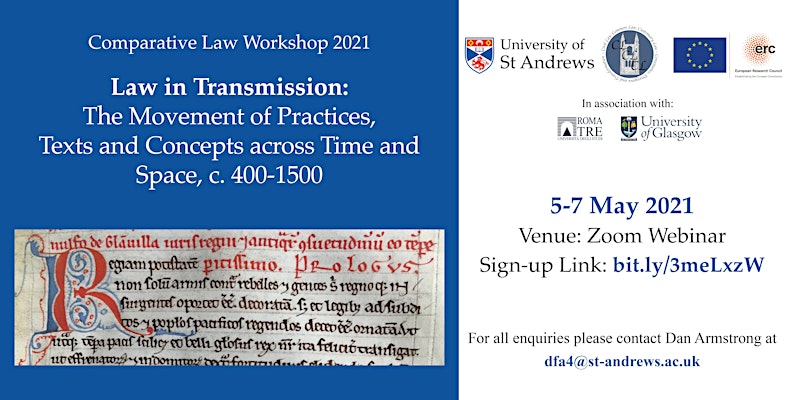
The Comparative Law Workshop 2021 will take place as a Zoom webinar on 5-7 May 2021. Please register here for "Law in Transmission: The Movement of Practices, Texts and Concepts across Time and Space, c.400-1500."
All times are given in British Summer Time.

Weekend Roundup is a weekly feature compiled by all the Legal History bloggers.
We’ve recently learned of the publication of A. J. Duggan, Popes, Bishops, and the Progress of Canon Law, c.1120–1234, ed. T.R. Baker (Brepols, 2020). Anne J. Duggan is Emeritus Professor of Medieval History and Fellow of King’s College London; Travis R. Baker (D.Phil, Oxford, 2017) is a private scholar living in the Diocese of Orange:
–Dan Ernst. TOC after the jump.This book considers the role of popes and bishops in the development of the law of the Church between 1120 and 1234. Although historians have traditionally seen the popes as the driving force behind the legal transformation of the Church in the twelfth and thirteenth centuries, the primary argument of this book is that the functioning of the process of consultation and appeal reveals a different picture: not of a relentless papal machine but of a constant dialogue between diocesan bishops and the papal Curia.
Bishops have always played a central role in the making and enforcement of the law of the Church, and none more so than the bishop of Rome. From convening and presiding over church councils to applying canon law in church courts, popes and bishops have exercised a decisive influence on the history of that law.
This book, a selection of Anne J. Duggan’s most significant studies on the history of canon law, highlights the interactive role of popes and bishops, and other prelates, in the development of ecclesiastical law and practice between 1120 and 1234. This emphasis directly challenges the pervasive influence of the concept of ‘papal monarchy’, in which popes, and not diocesan bishops and their legal advisers, have been seen as the driving force behind the legal transformation of the Latin Church in the twelfth and early thirteenth centuries. Contrary to the argument that the emergence of the papacy as the primary judicial and legislative authority in the Latin Church was the result of a deliberate programme of papal aggrandizement, the principal argument of this book is that the processes of consultation and appeal reveal a different picture: not of a relentless papal machine but of a constant dialogue between diocesan bishops and the papal Curia, in which the ‘papal machine’ evolved to meet the demand.
Abigail Dowling (Mercer University) and Richard Keyser (University of Wisconsin-Madison) have co-edited Conservation's Roots: Managing for Sustainability in Preindustrial Europe, 1100-1800, now out with Bergahn Books. From the press:

The ideas and practices that comprise “conservation” are often assumed to have arisen within the last two centuries. However, while conservation today has been undeniably entwined with processes of modernity, its historical roots run much deeper. Considering a variety of preindustrial European settings, this book assembles case studies from the medieval and early modern eras to demonstrate that practices like those advocated by modern conservationists were far more widespread and intentional than is widely acknowledged. As the first book-length treatment of the subject, Conservation’s Roots provides broad social, historical, and environmental context for the emergence of the nineteenth-century conservation movement.
There are legal themes and sources throughout this book's chapters. Table of Contents after the jump:
 We want to thank Thomas McSweeney of William & Mary Law for his series of posts prompted by his recently published book Priests of the Law: Roman Law and the Making of the Common Law’s First Professionals:


