Wednesday, April 18, 2012

Levinson to Lead ICH Summer Workshop

[We are moving up this previously posted announcement because the deadline of May 1 is not far off.]

Our friends at the Institute for Constitutional History have announced an Interdisciplinary Summer Workshop for Junior Faculty, to be held July 8-14, 2012, at Stanford, California, entitled “Assessing the US Constitution: Twenty-first-Century Responses to Eighteenth-Century Assumptions.”  The workshop will be led by Sanford Levinson, the W. St. John Garwood Jr. Centennial Chair in Law, University of Texas Law School, and Professor of Government, University of Texas at Austin.  It is jointly sponsored by the Institute for Constitutional History and the Stanford Constitutional Law Center.  For further information, please contact Maeva Marcus, the Director of the Institute for Constitutional History, at (202) 994-6562 or MMarcus@nyhistory.org

Professor Levinson explains:
It is an obvious truth that the drafters of the 1787 Constitution had a number of basic assumptions about the workings of what they called a “Republican Form of Government” and that the institutions established in Philadelphia reflected these assumptions.  To be sure, some of them, such as equal voting power in the Senate or the basis of representation in the House (i.e., the 3/5 rule), were the result of compromises, in which the losers (like James Madison with regard to the Senate) viewed the result as a “lesser evil” (to the greater evil of no Constitution at all) rather than a positive good.  Still, almost all of the institutions were defended by proponents of the Constitution, the most prominent, of course, being the collective Publius.  To a remarkable degree, America in 2012 continues to be governed through the structures established in 1787. 

The purpose of the seminar is quite simple:  To look at the justifications offered, particularly at the Philadelphia Convention and ensuing ratification debates (including, of course, The Federalist) and to assess the degree to which we find them persuasive over two centuries later.  The seminar is not about “constitutional interpretation” as that topic is usually defined.  That is, we will not be looking at the parts of the Constitution that have been significantly litigated and, therefore, “interpreted,” over the years, such as the assignment of powers to Congress in Article One, Section Eight.  Rather, we will be looking at examples of what in my forthcoming book I call “the Constitution of Settlement” (in contrast to the endlessly-litigated “Constitution of Conversation”)—bicameralism, the particular organization of power in the Senate, the presidential veto ,and  the process of constitutional amendment, among others.  
Readings will be taken from Professor Levinson’s book, Framed: America’s 51 Constitutions and the Crisis of Governance (Oxford University Press, 2012); The Federalist; The Founders’ Constitution; Akhil Reed Amar, America’s Constitution:  A Biography; and John Dinan, The American State Constitutional Tradition.

Workshop Leader
Sanford Levinson is the W. St. John Garwood Jr. Centennial Chair in Law, University of Texas Law School, and Professor of Government, University of Texas at Austin.  Among other books, he has written: Constitutional Faith (Princeton U. Press, 1988, 2nd ed. 2011), and Our Undemocratic Constitution:  Where the Constitution Goes Wrong (and How We the People Can Correct It) (Oxford U. Press, 2006, pb. ed. 2008).  He is also the co-editor of a widely used casebook, Processes of Constitutional Decision Making (5th ed. 2006).  He has written over 350 articles in law reviews as well as more general venues.  He was elected to the American Academy of Arts and Sciences in 2001.

Stipends and Support:  Participants will receive accommodation at the Munger Graduate Residence on the campus of Stanford Law School and a modest stipend for meals.  Participants will also receive a travel reimbursement up to $250.  Workshop participants are expected to attend all sessions and engage in all program activities. 

Eligibility and Application Procedure: The summer workshop is designed for university instructors who now teach or plan to teach courses in constitutional studies, including constitutional history, constitutional law, and related subjects.  Instructors who would like to devote a unit of a survey course to constitutional history are also welcome to apply.  All university-level instructors are encouraged to apply, including adjuncts and part-time faculty members, and post-doctoral fellows from any academic discipline associated with constitutional studies (history, political science, law, anthropology, sociology, literary criticism, etc.).

To apply, please submit the following materials: a detailed résumé or curriculum vitae with contact information; syllabi from any undergraduate course(s) in constitutional studies you currently teach; a 500- word statement describing your interest in both constitutional studies and this workshop; and a letter of recommendation from your department chair or other professional reference (sent separately by e-mail or post). The application statement should address your professional background, any special perspectives or experiences you might bring to the workshop, and how the workshop will enhance your teaching in constitutional studies.

The deadline for applications is May 1, 2012.  Applications should be sent via electronic mail to MMarcus@nyhistory.org. Successful applicants will be notified soon thereafter.

Tuesday, April 17, 2012

Conference: Libel: Discourses and Practices in Early Modern Britain and Europe

This weekend (April 20-21, 2012), the Alexander Library at Rutgers University (New Brunswick campus) is hosting a conference on "Libel: Discourses and Practices in Early Modern Britain and Europe, c.1500-1800.” Here's the announcement:
“Though some make slight of libels, yet you may see by them how the wind sits….More solid things do not show the complexion of the times so well, as ballads and libels” (John Selden).

Over the past twenty years, historians and critics have found ever more sophisticated ways to use early modern libels—what they said, how they said it, to whom and under what conditions—to reveal “the complexion of the times”.  This interdisciplinary conference builds upon two decades of pioneering work on early modern libel to open new areas of study and to connect hitherto disconnected fields and approaches. It explores the interrelationship of visual and textual
libel; the nature of libel as legal category, politico-religious discourse, literary form and underground communication in different confessional and national contexts; the transnational circulation of libelous texts and rumors; and the shifting meanings and uses of libel over more than two centuries of often turbulent political and cultural change.
More information, including a full program, is here.

Hat tip: H-Law

Ancient Perpsectives on the Prospects for Constitution Making

Credit
John J. Mulhern, Senior Fellow at the Fels Institute of Government and Adjunct Associate Professor of Classical Studies and Government Administration at the University of Pennsylvania, will lecture at Boston College’s Clough Center on the topic, The Prospects for Constitution Making: Two Ancient Perspectives, on Wednesday, April 25, at 4:30 p.m. in Room 121 of Boston College’s McGuinn Hall.  Mulhern has “published and taught extensively on government and politics from classical antiquity to the present, the interpretation of the Platonic dialogues, the history of logic, and the classical tradition.”

Gilman, Graber, and Whittington's "American Constitutionalism"

Just out is the first volume of a constitutional law casebook written by three political scientists who take a historical approach to the topic, Howard Gillman, Mark A. Graber, and Keith E. Whittington’s American Constitutionalism (Oxford University Press).  As Professor Whittington explains:
This is a book of cases and materials for teaching the history of American constitutionalism, and we think it is something of a landmark in the extent to which it integrates a developmental perspective into constitutional law teaching and makes available historical context and non-U.S. Supreme Court materials for constitutional scholars and instructors.  The book includes everything from Gibbons v. Ogden to Daniel Webster’s Speech opposing a military draft, from Missouri v. Holland to Theodore Roosevelt’s remarks on presidential power, from Printz v. United States to Caroline Krass’ memo on the use of military force in Libya.  Volume 2 will provide similar coverage of constitutional rights and liberties, from Fletcher v. Peck to Amy v. Smith, from Goodridge v. Department of Public Health to Attorney General Ashcroft’s letter to the National Rifle Association.
More particularly:
Constitutionalism in the United States is not determined solely by decisions made by the U.S. Supreme Court.  Moving beyond traditional casebooks, American Constitutionalism takes an innovative approach to the teaching of American constitutional law and politics.  Organized into the standard two-semester sequence, with volume one covering institutions and volume two covering rights and liberties, the text is distinctive in presenting the material in a historical organization within each volume and fully integrating the material into a political and legal context for students.

Many scholars have deepened our understanding of the development of our constitutional system, while also providing more interesting and sophisticated analyses of the political forces that shape constitutional debates and outcomes. American Constitutionalism has incorporated these lessons about how our constitutional system actually works while at the same time preserving what instructors and students find most engaging about the topic.  These new materials allow instructors to develop more interesting explanations and debates about familiar issues, while at the same time introducing students to vitally important questions that are often excluded from Court-centered textbooks.

American Constitutionalism offers a number of useful features.  It covers all important debates in American Constitution (not just those that have been recently litigated before the Supreme Court), organized by historical era.  It incorporates readings from all the prominent participants in those debates.  It clearly lays out the political and legal contexts of those materials.  It integrates more documents and cases than any other text on the market, including decisions made by elected officials and state courts.  The book offers numerous pedagogical features, including topical sections within each historical chapter, bulleted lists of major developments, explanatory headnotes for the readings, questions on court cases, illustrations and political cartoons, tables and figures, and suggested readings.  The text is supported by websites for students and teachers with extensive supplementary materials, including additional readings, sample syllabi, instructor guides, and presentation slides.
Julie Novkov, University of Albany, enthuses:
American Constitutionalism marks a new age in the teaching of constitutional law. The book elegantly presents a historicized and developmental account that unveils the political and institutional roots of contemporary constitutional controversies. History and politics come alive for students as they engage constitutional problems as concrete political and legal struggles with stakes that span all American institutions, not just the courts. After using this text, I can't imagine teaching constitutional law any other way.
Other blurbs, the table of contents, and sample chapters are here.

Update
"Con Law in the Round," Ken Kersch's Balkinization post on American Constitutionalism is here.

Monday, April 16, 2012

Pulitzer Prizes to Marable and Gaddis

photo credit
Manning Marable, who died just before the release of his monumental work Malcolm X: A Life of Reinvention,  has been awarded the Pulitzer Prize in History for this work.


John Lewis Gaddis is this year's winner of the Pulitzer in Biography for George F. Kennan: An American Life.

Other finalists in History were:  
  • “Empires, Nations & Families: A History of the North American West, 1800-1860,” by Anne F. Hyde (University of Nebraska Press) 
  • “The Eleventh Day: The Full Story of 9/11 and Osama Bin Laden,” by Anthony Summers and Robbyn Swan (Ballantine Books) 
  • “Railroaded: The Transcontinentals and the Making of Modern America,” by Richard White (W.W. Norton & Company).
Other finalists in Biography were: 
  • “Love and Capital: Karl and Jenny Marx and the Birth of a Revolution,” by Mary Gabriel (Little, Brown and Company)
  • “Malcolm X: A Life of Reinvention,” by Manning Marable (Viking).

When Insider Trading Was Legal

Chicago Board of Trade, circa 1900
The Kluge Center of the Library of Congress has announced the lecture When Insider Trading Was Legal, by the Kluge Fellow Mark Geiger at noon on Thursday, April 19, in Room LJ 119, Thomas Jefferson Building, 10 First St. S.E., Washington DC.
 The United States has stricter laws than any nation against insider trading in financial markets, but the earliest of these laws date only from 1909. Prior, stock and commodities exchanges governed themselves with minimal external oversight. Geiger will present a close-up view of member relationships and business practices within the Chicago Board of Trade during the later 19th century when rival groups of exchange members, often family-centered, competed for money and power on the trading floor. Members routinely employed tactics that now would be flagrantly illegal. Even so, they created an exchange of international importance, and introduced strategic financial innovations that transformed global markets.

2012 Hiring Update: Lowe to UVA

image credit
Congratulations to Jessica Lowe (J.D., Harvard Law School, Ph.D. candidate, Princeton University), who will be joining the University of Virginia School of Law this fall as an Associate Professor!

Lowe's current research project is her dissertation. Here's a description, from the Princeton website:
[The dissertation] explores criminal law and republican law reform in Virginia after the American Revolution and demonstrates an enduring connection between early national state and local courts. Titled Murder in the Shenandoah: Commonwealth v. John Crane and Law in Federal Virginia, it focuses on a 1791 murder in Virginia’s lower Shenandoah Valley – in modern-day West Virginia – in which a young gentleman killed his neighbor’s harvest worker and later invoked a “lunacy” defense. The dissertation tells the story of the case as it wound its way through the various stages of Virginia's court system and de-centers traditional dichotomies that have characterized the history of the region – state and local, east and west, gentry and non-gentry – to reveal how the new nation's most politically and legally influential state was, in the critical era of the 1790s, a world in motion.
Lowe also has a second project in the works: she traces the comparative hermeneutics of biblical and legal interpretation in the American South between 1776 and 1865, and uses it to write a history of Southern textualism. The project looks at the transition from the natural law arguments and evangelical anti-slavery of the Revolutionary era to the legal and biblical "strict construction" that dominated the South on the eve of the Civil War.

At UVA, she will be teaching courses in American legal history, constitutional history, the legal history of the South, criminal law, and the legal profession.

Congratulations to Jessica Lowe!

Update: the UVA press release is here.

Union, Race and Nation: An ICH Seminar

The Institute for Constitutional History is has announced another Robert H. Smith seminar for advanced graduate students and junior faculty, "Union, Race, and Nation: Creating the Federal Republic, 1776-1801."  It will meet September 13, 20, 27, October 4, 25, and Nov. 1 (Thursdays) from 3-5 pm. The seminar will meet at the New-York Historical Society, 170 Central Park West, New York City.  The instructors are Peter S. Onuf, the Thomas Jefferson Foundation Professor in the Corcoran Department of History at the University of Virginia, and Annette Gordon-Reed, who is a Professor of Law at Harvard Law School, a Professor of History in the Faculty of Arts and Sciences, and the Carol K. Pforzheimer Professor at the Radcliffe Institute for Advanced Study.

The Institute explains:
This seminar will explore the origins of American constitutionalism from 1776 through 1801, the years of Revolution to the election of Thomas Jefferson. We will explore the problem of union: empire and federal republic, the ratification debates and the development of political parties, slavery and freedom, state building, geopolitics and foreign affairs, and the Revolution of 1800. The assigned readings will consist of secondary works--some that provide an overview of the period under consideration and others that focus on specific topics and themes. We will also consider critical primary documents from that time including the Declaration of Independence, the Constitution, The Northwest Ordinance, and Jefferson's First Inaugural Address.

The seminar is designed for graduate students and junior faculty in history, political science, law, and related disciplines. All participants will be expected to complete the assigned readings and participate in seminar discussions. Although the Institute cannot offer academic credit directly for the seminar, students may be able to earn graduate credit through their home departments by completing an independent research project in conjunction with the seminar. Please consult with your advisor and/or director of graduate studies about these possibilities. Space is limited, so applicants should send a copy of their c.v. and a short statement on how this seminar will be useful to them in their research, teaching, or professional development. Materials will be accepted only by email at MMarcus@nyhistory.org until June 1, 2012. Successful applicants will be notified soon thereafter.

There is no tuition or other charge for this seminar, though participants will be expected to acquire the assigned books on their own.
Hat tip: H-Law

Sunday, April 15, 2012

The "Father of History," Emerging Markets, and More: This Week in the Book Pages

According to Stanley Payne, the history of the Spanish Civil War has benefited from the late twentieth century shift from studies that "privileged the role of heroes" to those that "placed the emphasis on the victim."  In The Wall Street Journal, Payne reviews Paul Preston's The Spanish Holocaust: Inquisition and Extermination in Twentieth Century Spain (Norton), which he explains "has the merit of looking in detail at the atrocities committed by both sides" of the Spanish Civil War, but ultimately reproduces "some of the oldest stereotypes" of the event.  The complete review is here.

Also, in The Wall Street Journal, in "How the World Gets Ahead," Matthew Rees reviews three books that address in different ways "the near-miraculous rise of emerging markets and the explosive growth of hitherto stagnant or failing economies" in the post-1970s world economy: Ruchi Sharma's Breakout Nations (Norton), Vijay V. Vaitheeswaran's Need, Speed, and Greed (Harper), and Philip E. Auerswald's The Coming Prosperity (Oxford).

Two reviews this week take up books that attempt historical recoveries of "founders" of different sorts.  In The New Republic: The Book Peter Green reviews Jennifer Roberts’s Herodotus: A Very Short Introduction (Oxford University Press).  Green writes:
Built on a vast but unobtrusive bedrock of fine scholarship, its research up-to-date, its judgments and interpretations well-balanced, its obvious affection for its subject never getting in the way of a necessary correction, its tone as amused, ironic, and humane as Herodotus’s own, this little volume is as near-perfect an introduction to the Father of History as one could hope for: the general readers for whom it is intended to count themselves lucky, and— expert credite— scholars may learn a thing or to from it as well.
According to Green, Robert's accomplishes a kind of historical recovery of a Herodutus who "suddenly...look[s] staggeringly modern" to ancient historians.  Read the complete review, here. 


In the Wall Street Journal, Alan Pell Crawford reviews David Barton's attempt at another kind of historical recovery in The Jefferson Lies: Exposing the Myths You've Always Believed About Thomas Jefferson (Thomas Nelson).  Barton, one of Time Magazine's 25 "most influential evangelicals" attempts to "set the record straight on the Hemings matter" by repeating well-trod arguments about Sally Hemings's uncertain paternity, and in the end, produces a history that, as Crawford writes, "does no service to his reputation-- or to the American past."  The complete review is here.


On another American president, The New York Times has a review of Richard Aldous's Reagan and Thatcher: The Difficult Relationship (Norton), a book that sheds light on the "many tensions and even conflicts" behind their "mutual applause" and challenges "the heroic" narrative "in which two great leaders continued the struggle for freedom waged for generations past by 'the English-speaking peoples.'"


“The First Pilgrims,” by Michael Sean Winters in The New Republic: The Book is a review of Timothy Matovina’s Latino Catholicism:Transformation in America’s Largest Church (Princeton University Press). Winters writes:
The historical experience of Latino Catholics was, in some ways, the reverse of what later European immigrants experienced. The nineteenth-century Irish and German immigrants left their homelands to come to America, but according to Timothy Matovina “the first large group of Hispanic Catholics became part of the nation during that same era without ever leaving home, as they were incorporated into its boundaries during U.S. territorial expansion into Florida and then westward.” Additionally, when restrictive immigration laws in the 1920s closed the doors to Europe, the Mexican Revolution initiated the first large-scale immigration of Latinos across the border into the United States. In the post-World War II era, “waves of Hispanic immigrants have comprised an increasingly significant portion of what was purportedly an established, Americanized, post-immigrant church.
Also reviewed this week: In TNR: The Book: Jim Yardley’s Brave Dragons: A Chinese Basketball Team, an American Coach, and TwoCultures Clashing (Knopf).  The New Republic also has a  review of Norman Davies, Vanished Kingdoms: The Rise and Fall of States and Nations (Viking), which Jacob Soll describes as a "colossal wreck of a book."  To find out why, read on here.  Subscribers can also find a review of Vanished Kingdoms in The Nation, here.


The New York Times has a review Blaine Harden’s Escape from Camp 14: One Man's Remarkable Odyssey from North Korea to Freedom in the West (Viking) and a review of Rachel Maddow's Drift: the Unmooring of American Military Power (Crown), and Peter Beinart's, The Crisis of Zionism (Times Books), which is here

The WSJ also has a review of David Clay Large's, Munich 1972: Tragedy, Terror, and Triumph at the Olympic Games and a review of Andrew Gumbel and Roger G. Charles, Oklahoma City: What the Investigation Missed-- And Why it Still Matters (William Morrow) ("The great value of "Oklahoma City" is not that it solves a mystery but that it reveals the limits, and vulnerabilities, of a no-expense-barred government investigation").

And some food for thought: The New York Times has Dwight Garner's review of Tyler Cowen, An Economist Gets Lunch: New Rules for Everyday Foodies (Dutton).  As Garner explains: “Mr. Cowen is a right-leaning economist and a contrarian foodie.  He takes aim at a fat target: food-world pretentiousness.  He attempts to skewer the slow-food, eat-local and eat-fresh movements; to him, they’re expensive and snobbish.  He praises modern agribusiness.  He admires the genetically modified animals and produce that opponents call Frankenfood."  But, “in relating all this," Garner concludes, "Mr. Cowen comes perilously close to suggesting that we shouldn’t care about where and how our food is grown.”

Happy reading!

Saturday, April 14, 2012

Weekend Roundup

  • Around the ColloquiaMichael Hoeflich, Kansas Law, spoke to the Boston College Legal History Roundtable on  "Lawyers and the Visual Arts, 1780-1870."  Hat tip: Legal Scholarship Blog
  • Understanding Slavery and the American Founding: A Conversation with Gordon Lloyd, Pepperdine Public Policy, is up on the Library of Law and Liberty website.  “Lloyd focuses on the debates in the Constitutional Convention of 1787 and the state constitutional ratifying conventions of 1788 in order to better understand the compromises leading framers made to accommodate the institution of slavery in the early republic.”
  • On Thursday John Barrett, St John's Law, circulated a nice post to the members of the Jackson List on the seventieth anniversary of a road trip FDR and Robert Jackson took to Charlottesville in April 1942.  I especially liked Jackson's reaction, as a former Attorney General, to news that FDR was appointing Sam Rosenman to be the first White House Counsel, especially in light of Georgetown Law's recent symposium on the office.
  • Included in Jared Goldstein's post today on Balkanization is an embedded link to several lectures from a conference on popular constitutionalism.  In his lecture, Mark Tushnet brings the story down to the Tea Party.  It starts at 20:15.
The Weekend Round-Up is a weekly feature compiled by all the Legal History bloggers

Friday, April 13, 2012

Journal of Supreme Court History 37:2

Here are the contents for the Journal of Supreme Court History, Vol. 37, no 2.

Introduction
Melvin I Urofsky

Articles

“No Bed of Roses” William Johnson, Thomas Jefferson and the Supreme Court, 1822-23
Mark R. Killenbeck

The Judicial Amendment
John V. Orth

Ambition Counteracting Ambition: Separation of Powers in Supreme Court Appointments
Barbara A. Perry

Judicial Bookshelf
Donald Grier Stephenson, Jr.
Index to Journal of Supreme Court History 1976-2011
Joel Fishman

Hat tip: H-Law

On the LHB Facebook Page: Corporations


This week on the Legal History Blog Facebook Page, we provided links to suggested reading and other sources on religion and legal history including Sarah Barringer Gordon’s, The Spirit of the Law and this video from the Gilder Lehrman Institute of A.E. Dick Howard on the Supreme Court and religious freedom.

Next week, we’ll have sources and readings on corporations such as the SEC Historical Society’s on-line archive.  As guest blogger Felice Batlan recently noted:
The SEC Historical Society’s on-line archive is now almost a decade old but remains underutilized by scholars.   Its collection includes important documents covering a time span between the late eighteenth century and the present day.  For example, its earliest document is the Buttonwood Agreement (1792), which might be considered the original founding document of what would become the New York Stock Exchange.  Its most recent document is a 2011 report involving financial accounting standards.  The collection also includes dozens of oral histories from SEC commissioners, division heads, other senior officials, and judges, such as Manny Cohen, Frank Easterbrook, and Roderick Hill. 

See the complete post here.

Franklin on Inventing the 'Traditional Concept' of Sex Discrimination

Cary Franklin, University of Texas School of Law, has an important new article in the Harvard Law Review:  Inventing the 'Traditional Concept' of Sex Discrimination.  She brings to the analysis of tradition underlying the interpretation of Title VII Eric Hobsbawm's work on The Invention of TraditionHobsbawm defined invented traditions this way:
'Invented tradition' is taken to mean a set of practices, normally governed by overtly or tacitly accepted rules and of a ritual or symbolic nature, which seek to inculcate certain values and norms of behaviour by repetition, which automatically implies continuity with the past. In fact, where possible, they normally attempt to establish continuity with a suitable historic past.... However, insofar as there is such reference to a historic past, the peculiarity of 'invented' traditions is that the continuity with it is largely fictitious. In short, they are responses to novel situations which take the form of reference to old situations, or which establish their own past by quasi-obligatory repetition.
Franklin employs Hobsbawm this way:
 This Article argues that the “traditional concept” of sex discrimination, as articulated by courts, is an “invented tradition.” The historian Eric Hobsbawm famously used that term to refer to social practices that purport to be old, or imply continuity with the past, but are actually quite recent in origin. By claiming to be deeply rooted in history, these practices seek “to give any desired change (or resistance to innovation) the sanction of precedent, social continuity, and natural law.”  Hobsbawm explained, for instance, “that a village’s claim to some common land or right ‘by custom from time immemorial’ often expresses not a historical fact, but the balance of forces in the constant struggle of village against lords or against other villages.”  This Article contends that the “traditional concept” of sex discrimination, as it was articulated in the 1970s, is just such a tradition. Courts claimed that their narrowly circumscribed definition of sex discrimination was deeply rooted in history, but in fact, it was quite new. It did not express a historical fact. It made a normative claim — not, in this case,about the boundaries of a particular plot of land but about the limits of Title VII’s prohibition of sex discrimination.
Bringing this classic analysis to bear on contemporary legal analysis has potential importance beyond Title VII.  History as a "useable past" is often drawn on by scholars, courts and litigants (in the plethora of historical amicus briefs).  For the past to be authoritative, there is a search for the "real," based on the idea that there is one true past that can be discovered.  This fuels instrumental historical research that seems to assume that uncovering history involves mining the past to collect as many seemly stable objects as possible (whether they be past laws, interpretations, ideas, or experiences).  A central feature of any critical work in historiography emphasizes the instability of the past, and the fact that we cannot know the past without interpretation.  And Hobsbawm cautions us that constructions of tradition often serve the function of legitimating current structures and social hierarchies.

Thanks to Franklin for bringing a critical understanding of tradition to bear on Title VII.  Now it should be carried into the "history and traditions" analysis in the area of unenumerated constitutional rights, and other areas where understandings of the past drive contemporary legal analysis.  Here's Franklin's abstract:
It is a commonplace in employment discrimination law that Title VII’s prohibition of sex discrimination has no legislative history. Courts have therefore argued that this prohibition must be restricted to the “traditional concept” of sex discrimination. Traditionally, courts suggest, discrimination “because of sex” referred only to practices that divided men and women into two perfectly sex-differentiated groups. Although Title VII doctrine has evolved over time, this “traditional concept” of sex discrimination continues to exert a powerful regulative influence over the law. It excludes certain claims — such as those by sexual minorities — from coverage and elevates the evidentiary burdens plaintiffs must satisfy in order to prove discrimination “because of sex.”

This article argues that the “traditional concept” of sex discrimination is an invented tradition. It purports to reflect the historical record, but in fact reflects normative judgments about how deeply the law should intervene in the sex-based regulation of the workplace. Recovering the largely forgotten legislative history of Title VII’s sex provision, this article shows that there was little consensus and much debate in the 1960s about what qualified as sex discrimination. Employers advanced the argument that Title VII applied only to practices that sorted men and women into two perfectly sex-differentiated groups in order to preserve the traditional gendered organization of the workplace and insulate particular employment practices from scrutiny. In the 1970s, courts adopted this interpretation but no longer cited the need to preserve conventional sex and family roles as a justification; instead, courts cited deference to the legislature and fidelity to tradition as justifications for interpreting the law narrowly. This article shows that history does not compel courts to interpret Title VII’s prohibition of sex discrimination in anticlassificationist terms — and that, in fact, in cases where anticlassificationism produces expansive rather than narrow results, courts have routinely departed from it. This tendency should prompt us to think critically about the assertion that deference to the legislature and fidelity to tradition require courts to adhere to a narrow conception of what it means to discriminate “because of sex.” The parameters of Title VII’s prohibition of sex discrimination have always been determined by normative judgments about how forcefully the law should intervene in practices that reflect and reinforce conventional understandings of sex and family roles.

Guggenheims go to two legal historians and two law profs

The John Simon Guggenheim Memorial Foundation has announced its 2012 recipients of Guggenheim Fellowships.  Laura Edwards, History, Duke University is well known to LHB readers.  Another legal historian, Douglas Flamming, History, Georgia Institute of Technology, is also an awardee.  Two law professors are also on this year's list.  Here are details from the Guggenheim website:
Ms. Laura F. Edwards, Professor of History, Duke University: A nation of rights: a legal history of the Civil War and Reconstruction.
 Mr. Douglas Flamming, Professor of History, Georgia Institute of Technology: Law of promise: the Civil Rights Act of 1964.

 Mr. James B. Jacobs, Warren E. Burger Professor of Law, New York University School of Law: Criminal records: jurisprudence and policy.

 Ms. Asifa Quraishi-Landes, Assistant Professor of Law, University of Wisconsin Law School: Islamic constitutionalism for the 21st century: Not secular. Not theocratic. Not impossible.
Congratulations to all!

Ferichs's "Short History of Socio-Legal Thinking"

Sabine Frerichs, University of Helsinki Law, has posted Studying Law, Economy, and Society: A Short History of Socio-Legal Thinking.  Here is the abstract:
This paper gives an overview of the development of socio-legal thinking in the last two centuries. It considers scholarship at the intersection of law, economy, and society and is thus equally interested in the fields of “economy and society”, “law and society”, and “law and economy” along with the respective sub-disciplines of economic sociology, legal sociology, and law and economics. The main argument is that socio-legal scholarship has followed a pattern of three generations, or successive paradigms, which are specified as “historicism”, “realism”, and “constructivism”. In outlining these developments, the paper aims to further the economic sociology of law, which reconnects law, economy, and society from a sociological point of view.

The paper first introduces the pattern of the three generations and specifies that pattern with regard to economic sociology, legal sociology, and social theory. Furthermore, the paper links the pattern to more general developments in the social-scientific field and condenses it in terms of “law in”, “law and”, and “law as” approaches. The remainder of the paper explores the three generations of socio-legal thinking in separate chapters, each starting with a view on the general background. The historicist paradigm is exemplified by historical jurisprudence, historical economics (including “old” institutional economics) and classical historical sociology (Marx, Durkheim, Weber, Tönnies). Realist scholarship is exemplified by legal realism (Holmes, Pound, Llewellyn), the “law and economics” (Posner) and the “law and society” (Friedman) movements. Constructivist scholarship is illustrated by recent scholarship in the economic sociology of law and the social theory of law (Luhmann, Habermas, Bourdieu).

Thursday, April 12, 2012

Conference on China and the Human at CUNY next week

Teemu Ruskola (Emory & visiting at Georgetown) has co-organized an exciting conference to be held next Thursday, April 19 at The Graduate Center, City University of New York.  The topic is China and the Human, and the meeting brings together contributors to a special issue of  the journal Social Text on this topic.  Here's the description:
China is everywhere in the news for its astounding economic development and its equally astonishing human rights abuses. Beginning with this curiously inverse relationship between economic success and political rights and freedom, the relationship of China and the human begs to be explored. Bringing together editors and contributors to Social Text's newly published double issue on "China and the Human" this interdisciplinary symposium seeks to question the self-evident nature of both "China" and "human" by examining the long career of the human in Chinese culture and thought, reaching back to ancient traditions and exploring the radical transformations under Maoism and in the current socialist-capitalist era. Join us for a series of panel discussions and conversations.
When & Where:  Thursday, 19 April 2012, 12-6pm, The Graduate Center, City University of New York, 365 Fifth Avenue, New York City, Rooms C201/C202.

The articles will appear in: Social Text 109/110 (Winter 2011/Spring 2012). The Introduction by Ruskola, David Eng and Shuang Shen is posted here.

Ashe on Women, Free Exercise, and Establishment in American Law

Women's Wrongs, Religions' Rights: Women, Free Exercise, and Establishment in American Law has been posted by Marie Ashe, Suffolk University Law School.  It appears in 21 Temple Political & Civil Rights Law Review 163 (Fall 2011).  Here's the abstract:
This article provides an historical examination of American Constitutional law concerning religion as it has evolved through three periods: the Mormon period of the late nineteenth century; the religious pluralism period of post-WW2 decades; and the multiculturalism period that began around 1990 and that remains underway. It examines Supreme Court interpretations of First Amendment provisions pertaining to religion, and it contextualizes those interpretations to explore their implications for women’s liberty and equality at each of the three periods. Its argument is that Constitutional doctrine relating to religion – through its multiple doctrinal reversals – has consistently entailed and depended upon negative constructions of women, sacrificing women’s liberty and equality interests in order to prefer and to cultivate the liberty and equality interests of churches.

American Political Thought: The Inaugural Issue

Th inaugural issue of American Political Thought: Ideas, Institutions, and Culture, edited by Michael Zuckert is out.  Here is the table of contents

Symposium: American Exceptionalism: Is It Real, Is It Good?

The Origins and Character of American Exceptionalism
James W. Ceaser

Cities of Man on a Hill
Patrick J. Deneen

Old Paradigms in History Die Hard in Political Science: US Foreign Policy and American Exceptionalism
Hilde Eliassen Restad

American Exceptionalism and National Identity
Peter S. Onuf

“Our Republican Example”: The Significance of the American Experiments in Government in the Twenty-First Century
Rogers M. Smith

Article: The Gospel according to the Apostle Ben
Ralph Lerner

Wednesday, April 11, 2012

Erman on Legacies of the Civil War for Puerto Rico's Search for Home Rule

Sam Erman, the Berger-Howe Fellow at the Harvard Law School, has posted Reconstruction and Empire: Legacies of the U.S. Civil War and Puerto Rican Struggles for Home Rule, 1898-1917.  Here is the abstract:
The Civil War and U.S. Empire transformed U.S. relationships among race, law, and constitutionalism in the late-19th and early-20th centuries. Traditional accounts portray these events as iterative, with Republicans and the Supreme Court abandoning ideals of Reconstruction just in time for the United States – through annexation from Spain of Puerto Rico, Guam, and the Philippines – to take a deliberate imperial turn in 1898-1899. That account is wrong. As recent scholarship has anticipated, debates over meanings of the Civil War, the early postbellum period, and the Reconstruction Amendments to the Constitution raged on into the 20th century. Puerto Rican leaders perceived the dynamic. Across 1898-1917, they sought traction with U.S. officials by asserting that political and constitutional issues arising from U.S. empire were best understood with reference to the Civil War and its aftermath. Close study of their efforts illuminates that legal legacies of Reconstruction, which initially formed potential limits on colonial governance, were eventually dismantled by the judges and elected officials who oversaw U.S. empire. In particular, before annexation of Puerto Rico – but not two decades later – it was reasonable to argue that the Constitution as modified by the 14th and 15th Amendments made all non-tribal U.S. peoples into (1) U.S. citizens with substantive privileges and immunities that included access to the franchise on the same terms as whites and (2) citizens of a state or of a territory on the road to statehood. In line with that shift, numerous prominent U.S. jurists in 1898 and not in 1917 asserted that annexation automatically brought U.S. citizenship, eventual statehood, and full constitutional protections all in a bundle. Hoping to benefit from the shift away from the ideals of Reconstruction, leading Puerto Rican politicians came to embrace white-supremacist mischaracterizations of that history as a tragic instance of northern tyranny. Asserting that those ostensible postbellum errors were being reprised in Puerto Rico, these island leaders argued – with mixed results – that Puerto Rico too required “Redemption” into home rule.

Dudziak on Robert Jackson on Law and Security after Nuremberg

Mary L. Dudziak, University of Southern California Law School, has posted Law, Power, and 'Rumors of War': Robert Jackson Confronts Law and Security after Nuremberg, which will appear in the Buffalo Law Review 360 (2012) 367.  Here is the abstract:
Library of Congress
Supreme Court Justice Robert Jackson’s most important legacy was his role as chief prosecutor for the United States at the Nuremberg Trials. This essay follows Jackson’s legal thought from his return to the United States after Nuremberg, until his death in 1954. Jackson hoped that the lesson of Nuremberg would be “to establish the supremacy of law over such lawless and catastrophic forces as war and persecutions.” Jackson changed law that applied to warfare. In looking to the future, he seems to have assumed that although law had changed, war would retain its essential character. Yet as the post-war years became instead the Cold War years, Jackson found himself in an era when the boundaries around wartime were eroding. The world entered an ambiguous era that seemed to be neither war nor peace. As Jackson himself would put it in 1951, rather than a break between wartime and peacetime, there was instead “a prolonged period of international tension and rumors of war, with war itself as the ever threatening alternative.”

Jackson’s response to the Cold War era was twofold. In cases involving members of the Communist Party, he argued that they were different in kind from other dissenters, so that the Justice who argued that the rule of law should apply to Nazi leaders also argued for a departure from applicable first amendment analysis because of the dangers posed by communism. In the area of war-related powers, Jackson took up more directly the ambiguous character of an era that seemed neither wartime nor peacetime. In this context, he favored limits on presidential power. Calling the Korean War an undeclared “foreign venture,” he argued in his famous Steel Seizure concurrence that it would subvert constitutional limits for a president to go to war without a declaration from congress, and then use that state of war as the basis for expanding his own domestic authority.

The essay is based on my contribution to the 2011 James McCormick Mitchell Lecture program at SUNY Buffalo Law School, which commemorated Robert Jackson’s inaugural Mitchell Lecture in October 1951.

Edley on "Fiat Flux: Evolving Purposes and Ideals of the Great American Public Law School"

Christopher Edley, Jr., the dean of the law school at the University if California, Berkeley, has published an article, "Fiat Flux: Evolving Purposes and Ideals of the Great American Public Law School," in the California Law Review (April 2012). The article considers the past, present and future of legal education. Edley's thoughts may be of interest to many of our readers. The introduction to the article follows; the full article is available here.  
Let us suppose that we can choose and bring about what a great law school will be decades from now. A direction is not difficult to propose, and an audience might be persuaded by verbal performance. But the cliché that past is prologue provides a better basis for choosing our direction. If we consider the earlier course of both great law schools and their accomplished graduates, I believe a rewarding path forward lies just beyond the surrounding thicket of the everyday.

To discover that path, it seems fitting in this Volume to start with the thoughts of my predecessor, the founding dean of Berkeley’s School of Jurisprudence. One hundred years ago, at the dedication of Boalt Memorial Hall, Dean William Carey Jones began his formal remarks somewhat provocatively:

The law schools of this country have never faced their problems. Like most institutions coming down from generation to generation, they have been slow to inquire into the original justification of their plans and programs, or to seek to learn whether what was once justified still retained its reason for being.

Reviewing the preceding one hundred years, Dean Jones stated, “[T]here is only one innovation of significant and essential importance that has been introduced.” This innovation was in the method instruction and was due mainly to the initiative of one person, Professor C.C. Langdell. The application that he made of the inductive method to the study of law has been well nigh revolutionary in its effects.

Our Dean knew Langdell’s method not only added much needed scientific rigor to legal study, but also demonstrated to students the essential lesson that to practice law is by its very nature to reform it: “[L]aw is a living principle, even as medicine is an advancing science. Law is in process of constant becoming. It is ever being re-created, not only through legislation, but through a sort of self-reproduction.”

To this I would add that a school of law—especially a public one—if it is to be and remain great, must be comparably dynamic. Indeed, it should be more so if it is to be not merely an echo of what the law is, but a clarion herald and perhaps agent of progress.
Part I of this Essay illustrates the evolutionary path the American Law School took during the twentieth century, from its early apprenticeship-based model to today’s modern university institution, enriched by diverse, Ph.D.-trained faculty. Part II provides three recommendations that collectively point toward a vision for the next few decades at the Great American Law School. First, we must embrace a curriculum designed to prepare students for legal careers outside the traditional practice of law. Second, we should strive to graduate effective societal problem-solvers—both lawyers and non-lawyers—by encouraging cross-disciplinary bonds across the research university campus. Finally, we must take seriously the Great Law School’s international role, and its duty to shape a global legal culture that will promote prosperity, security, and human dignity.

Application Process for 2012 Cromwell Dissertation Prize

The application deadline is nearing for the 2012 Cromwell Dissertation Prize, which is normally announced in early November, after the annual meeting of the Cromwell Foundation, and awarded at the annual meeting of the American Society for Legal History. Here's the call for applications, pulled from the ASLH website:
The William Nelson Cromwell Foundation* has generously funded a dissertation prize of $2,500. The winning dissertation may focus on any area of American legal history, including constitutional and comparative studies, but topics dealing with the colonial and early national periods will receive some preference. Anyone who received a Ph.D. in 2011 will be eligible for this year's prize. The Foundation awards the prize on the recommendation of the Cromwell Prize Advisory Committee of the American Society for Legal History.
To be considered for this year's prize, please send one hard-copy to the chair of the Cromwell Prize Advisory Committee and to each of the members of the subcommittee for the dissertation prize by May 31, 2012. 

Tuesday, April 10, 2012

Conference: Legal Regimes & Legal Change in Antiquity

Bay Area readers: the University of California, Berkeley will host a conference on Legal Regimes and Legal Change in Antiquity on April 13th and 14th, 2012. Here's the schedule:

Friday, April 13th
10.00-10.45 Introduction: Law in many pieces (Ari Bryen, UCB)
11.00-12.00 Nie pozwalam! The Athenian self-enforcing constitution and the procedure of graphe paranomon revised (Frederica Carrugati, Stanford)
12.15-1.15 Lawcourts and judicial administration in Hellenistic Athens: Old and new evidence (Nikolaos Papazarkadas, UCB)
Lunch
2.15-3.15 Law and the seizing of property and people in the Hellenistic world (Lisa Eberle, UCB)
3.30-4.30 The role of local judges in Roman jurisdiction: A case of Asia Minor provinces (Georgy Kantor, Oxford)
4.45-5.45 Pluralism and empire, from Rome to Robert Cover (Clifford Ando, U. Chicago)
Dinner 

Saturday, April 14th
9.45-10.45 Challenging the Roman municipal model : Greek responses to imperial rule (Cédric Brélaz, Strasbourg)
11.00-12.00 Dike’s dwellings: Jurisdiction and its spaces in the Roman Empire (Roland Faerber, Munich)
12.15-1.15 The view from below: Guilds, law, and the economy (Phil Venticinque, Cornell College)
Lunch
2.00-3.00 (Re)re-considering the Roman Colonate (Cam Grey, U. Penn)
3.15-4.15 Constituting late antique Muslim identities: The charity tax (Lena Salaymeh, UCB)
4.30-5.30: Closing Discussion

The Insanity Defense and the D.C. Circuit

Tomorrow the Historical Society of the D.C. Circuit will host the session Madness or Badness: Duran and the Evolution of the Insanity Defense in the D.C. Circuit:
Francisco Duran, who occasionally claimed to be God, said he fired 29 shots through the White House fence to remove a pernicious "mist" that hung over the White House. The prosecutor said he was a disturbed fame-seeker, angry at the government, who could have been faking a mental disorder. That case - and Duran's 1995 conviction - provide the framework for a program on the evolution of the federal insanity defense which the Historical Society will present on Wednesday, April 11, 4:30-6 p.m., in the Ceremonial Courtroom of the E. Barrett Prettyman U.S. Courthouse.

Stephen J. Morse, Professor of Psychology and Law in Psychiatry at the University of Pennsylvania , is scheduled to describe the case and the procession of rules governing the defense, followed by a compressed rendition of the closing arguments by the lawyers who made them, then Assistant U.S. Attorney Eric Dubelier, now a partner at Reed Smith, and Federal Public Defender for the D.C. Circuit, A.J. Kramer. Dr. Patrick Canavan, Chief Executive Officer at St. Elizabeths, will join these participants on a panel which will assess the success or futility of changes Congress imposed after the John Hinckley case.
 The event and the reception that follows is open to the public.  Here is the flyer.

Sleeman's Hoffman's "Course of Study"

We missed the publication last year of David Hoffman: Life, Letters and Lectures at the University of Maryland 1821-1837, ed. Bill Sleeman (Lawbook Exchange, 2011):
In 1817 David Hoffman published A Course of Legal Study, an ambitious, systematically organized program of readings for aspiring attorneys. It was widely acclaimed upon publication; Joseph Story said it offered “by far the most perfect system for the study of the law which has ever been offered to the public.” Hoffman published this book while helping to establish the Law Institute of the newly founded University of Maryland. He expounded the principles of the Course in his lectures. A few were published as pamphlets to promote Hoffman’s ideas and attract students. In 1837 he re-published them, along with a few related texts, in a book entitled Introductory Lectures, and Syllabus of a Course of Lectures, Delivered in the University of Maryland. The Law Library of the Library of Congress holds the only known copy.  Sleeman returns this rare volume to print and adds an illuminating biographical sketch of Hoffman and a consideration of his library that reprints an auction catalogue of his books prepared for his estate by Henry Wheaton.

History of Legal Publishing: Two Views

Two recent SSRN posts take up the history of legal publishing.  The first is the introduction to a collection of essays on the history of the legal treatise: Putting the Legal Treatise in its Place, by Angela Fernandez and Markus D. Dubber, University of Toronto Law, in Law Books in Action: Essays on the Anglo-American Legal Treatise, ed. Angela Fernandez and Markus D Dubber (Hart Publishing Co., April 2012)  Here is the abstract:
In 1976, while working on the first volume of The Transformation of American Law, Morton Horwitz noted that treatises were "the most neglected and really important sources of American legal history." Little has changed since then: treatises are still neglected, they are still really important, and not only in American legal history, but in common law history as a whole. This book aims to give legal treatises their due by undertaking an international and comparative analysis of the significance of the common law treatise in modern legal history and historiography.
In addition, Ross E. Davies, George Mason Law, addresses the history of a great American legal publisher in How West Law Was Made: The Company, its Products, and its Promotions, which appears in the Charleston Law Review 6 (Winter 2012): 231-282
Only in American law is West not primarily a geographical term. When we lawyers think of West we tend to think first of West Publishing Company – the preeminent source of printed law books since before we were born and of electronic law databases in recent years. But despite its importance to the development and dissemination of American law, West itself is a creature most of us do not know much about; we know only its products. That is not our fault, because there is only a little bit of information available, and much of that little bit is hard to find. This Article offers some perspective on the roots of West, the publishing company, and of its primacy (or at least the primacy of its brand) in the consciousness of modern American lawyers.
Update
 
Here are the contents of Law Books in Action:

Introduction: Putting the Legal Treatise in Its Place
Angela Fernandez and Markus D Dubber

1. Historicising Blackstone's Commentaries on The Laws of England: Difference and Sameness in Historical Time Kunal M Parker

2. 'Of Institutes and Treatises': Blackstone's Commentaries, Kent's Commentaries and Murdoch's Epitome of the Laws of Nova-Scotia Philip Girard

3. Tapping Reeve, Coverture and America's First Legal Treatise Angela Fernandez

4. Story'd Paradigms for the Nineteenth-Century Display of Anglo-American Legal Doctrine G Blaine Baker

5. A Province of Jurisprudence?: Invention of a Law of Constitutional Conventions Roman J Hoyos

6. Nineteenth-Century Treatises on English Contract Law Stephen Waddams

7. Of Treatises and Textbooks: The Literature of the Criminal Law in Nineteenth-Century Britain Lindsay Farmer

8. Truth and Privilege: Libel Treatises and the Transmission of Legal Norms in the Early Nineteenth-Century Anglo-American World Lyndsay Campbell

9. Renovate or Rebuild? Treatises, Digests and Criminal Law Codification Barry Wright

10. A Low Law Counter Treatise? 'Absentees' to 'Wreck' in British North America's First Justice of the Peace Manual Jim Phillips

11. Commentary: Effects of Scale: Toward a History of the Literature of Law Christopher Tomlins

Monday, April 9, 2012

The Tomlins Backlist

Christopher Tomlins
We’ve previously noted the posting of a new essay by Christopher Tomlins, CU Irvine Law, entitled After Critical Legal History.  He has since posted another new essay and a portion of his recently published “backlist.”  The other new essay is Demonic Ambiguities: Enchantment and Disenchantment in Nathaniel Turner’s Virginia:
This paper conjoins three texts – the “Confessions of Nat Turner,” Walter Benjamin’s “Capitalism as Religion,” and Max Weber’s “Science as a Vocation.” Benjamin and Weber provide interpretive prisms through which to examine Turner’s confession. Though quite unlike each other, each glances at the demonic – a matter of some significance when one considers the meaning of the “full faith and credit” held due the decision of the Southampton (Virginia) County Court to hang Turner for his attempted 1831 slave rebellion. Like guilt/debt, the dual meanings of Schuld that, for Benjamin, confirmed the existence of a religious – specifically a Christian – structure in capitalism, the conjunction of faith and credit has its own demonic ambiguity, simultaneously sacralizing (faith) and secularizing (credit) the authority of the law. In capitalism as religion and as law, these demonic ambiguities fuse together in an overwhelming simultaneity that is at once economic and juridical, moral and psychological, profane and sacral. This simultaneity – and Turner’s attempt to disrupt it – is the paper’s chief concern.
The recently published articles are:

Necessities of State: Police, Sovereignty, and the ConstitutionJournal of Policy History 20 (2008)
Over the last fifteen years, legal historians have been exploring conceptualizations of the state and state capacity as phenomena of police. In this essay, I offer a genealogy of police in nineteenth-century American constitutional law. I examine relationships among several distinct strands of development: domestic regulatory law, notably the commerce power; the law of indigenous peoples and immigrants; and the law of territorial acquisition. I show that in state and federal juridical discourse, police expresses unrestricted and undefined powers of governance rooted in a discourse of sovereign inheritance and state necessity, culminating in the increasingly pointed claim that as a nation-state the United States possesses limitless capacity “to do all acts and things which independent states may of right do.”

Mack, Representing the Race: The Creation of the Civil Rights Lawyer

Representing the Race: The Creation of the Civil Rights Lawyer by Kenneth Mack has just been published by Harvard University Press.  Here's the book description:
Representing the Race tells the story of an enduring paradox of American race relations, through the prism of a collective biography of African American lawyers who worked in the era of segregation. Practicing the law and seeking justice for diverse clients, they confronted a tension between their racial identity as black men and women and their professional identity as lawyers. Both blacks and whites demanded that these attorneys stand apart from their racial community as members of the legal fraternity. Yet, at the same time, they were expected to be “authentic”—that is, in sympathy with the black masses. This conundrum, as Kenneth W. Mack shows, continues to reverberate through American politics today.

Mack reorients what we thought we knew about famous figures such as Thurgood Marshall, who rose to prominence by convincing local blacks and prominent whites that he was—as nearly as possible—one of them. But he also introduces a little-known cast of characters to the American racial narrative. These include Loren Miller, the biracial Los Angeles lawyer who, after learning in college that he was black, became a Marxist critic of his fellow black attorneys and ultimately a leading civil rights advocate; and Pauli Murray, a black woman who seemed neither black nor white, neither man nor woman, who helped invent sex discrimination as a category of law. The stories of these lawyers pose the unsettling question: what, ultimately, does it mean to “represent” a minority group in the give-and-take of American law and politics?
And the endorsements:
Representing the Race is a wonderful excavation of the first era of civil rights lawyering, the product of prodigious research and a keen eye for revealing detail.
--Randall L. Kennedy, author of The Persistence of the Color Line: Racial Politics and the Obama Presidency

Ken Mack brings to this monumental work not only a profound understanding of law, biography, history and racial relations but also an engaging narrative style that brings each of his subjects dynamically alive. It is a truly wonderful book.
--Doris Kearns Goodwin, author of Team of Rivals: The Political Genius of Abraham Lincoln

A stunning reinterpretation of civil rights history for a twenty-first century audience, bringing to vivid life both famous and forgotten historical lawyers. Anyone who wishes to understand race relations in our modern era, including the racial politics that surrounds our first African American president, should read this book.
--Vernon Jordan

Ken Mack has written a rare book that forces us to reconsider the long history of civil rights. He offers an extraordinary account of a generation of attorneys who fought against Jim Crow and for professional recognition when the odds were against them. This is a masterwork.
--Thomas J. Sugrue, author of Sweet Land of Liberty: The Forgotten Struggle for Civil Rights in the North

Although civil rights lawyers occupy a central place in our nation's history, the nuances of their own position with regard to race, class, and professional stature bear closer examination. In this compelling new book, Mack recreates their individual and collective struggles and the triumphs that defined an era.
--Henry Louis Gates, Jr., W. E. B. Du Bois Institute for African and African American Research, Harvard University
Ken discusses the book here.

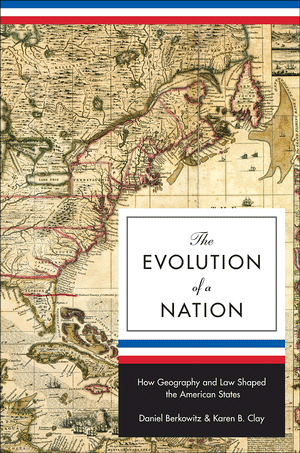
Gutzman on Berkowitz & Clay, "The Evolution of a Nation"

The Law & Politics Book Review has posted a review of The Evolution of a Nation: How Geography and Law Shaped the American States (Princeton University Press), by Daniel Berkowitz (University of Pittsburgh) and Karen B. Clay (Carnegie Mellon). Berkowitz and Clay are economists, but their research questions and historical analysis may be of interest.

Kevin R. C. Gutzman (Western Connecticut State University) offers the following overview:
Berkowitz and Clay say early on that, “The primary goal of this book … is to understand political and legal institutions,” because they assume that such institutions drive societies’ prosperity or poverty (pp. 3, 5). Particular factors that they consider are levels of political competition and judicial independence. Since levels of income are persistent, they posit that “conditions early in a state’s history may have played a formative role in shaping political and legal institutions.” Ultimately, they push their inquiry back as far as possible: to various environmental factors and to the legal traditions from which each state’s government descended.
Here's Gutzman on "[o]ne novel element of the book": "its classification of states according to whether they ever were civil-law jurisdictions."
It turns out that the thirteen that were – the eight states on America’s southern periphery from California to Florida, plus Arkansas, Missouri, Illinois, Indiana, and Michigan – continue to bear distinguishing characteristics from the states that always had common-law systems (p.10). This is highly counter-intuitive, as some of those jurisdictions had civil law only very briefly and long ago. Yet, Berkowitz and Clay establish a clear correlation: state governments of the civil-law states have always had more dominant legislatures and weaker judiciaries than the other states. This relative weakness of judiciaries has manifested, and continues to manifest, itself in numerous ways.
Read on here. The book's TOC and first chapter are available here.

Sunday, April 8, 2012

From Provincial Lawyer to “One of the Greatest Monsters of European History,” American Decline, and More: This Week in the Book Pages

“In 1788,” David Bell writes, “Robespierre was heading smoothly towards a future as a lonely, irritable pillar of his small town bar association.” How, then, did an “ambitious young provincial lawyer in late eighteenth-century France” become “the major figure in a revolutionary reign of terror?”  the New Republic: The Book has Bell’s review of Peter McPhee’s Robespierre: A Revolutionary Life (Yale University Press).  McPhee is Professor of History at University of Melbourne and has written extensively on the history of modern France.  Of his new book, Bell writes:
It is a fine piece of work. McPhee has a sure command of the period, has mastered the voluminous sources on Robespierre, and writes a robust, clean prose. And he practices a virtue that has become all too rare among present-day biographers: concision. (Among current studies of the American Founders, a book this length would most likely be “Part One of Six.”) McPhee is also quite right to point out that Robespierre was in no sense a pathological freak. He was perfectly capable of ordinary human emotions, relationships, even passions.
Read on, here.

For more on major figures in European history, the Wall Street Journal has “How to Start a Dynasty,” a review by Martin Rubin of Winter King: Henry VII and the Dawn of Tudor England (Simon & Schuster) by Thomas Penn.  Here's the intro:  
Everyone knows about Henry VIII, the English king who broke with the Roman Catholic Church so that he could divorce his pious wife and who ended up having five more wives, two of whom he beheaded. A popular ruler and hero to his people, he has become something of a hero onscreen as well, from Alexander Korda's "The Private Life of    Henry VIII" (1933) to the Showtime series "The Tudors." In the series, the lusty but deadly king is naturally the center of attention, but the dynasty's founding father—  Henry's own—is nowhere to be seen. As Thomas Penn shows us so vividly in "Winter King," the first Tudor monarch is as fascinating as his son and his life story nearly as full of drama and incident.
The full review is hereWinter King is also reviewed in the New York Times by Miranda Seymour.

And in more history that has made for some great television: the New Republic: The Book has a review by Alexander Nazaryan of The Real Mad Men:The Renegades of Madison Avenue and the Golden Age of Advertising (Running Press) by Andrew Cracknell.  Here is a sample of the review:
The examined life might be the only kind worth living—unless, that is, you happen to       work on Madison Avenue. Here, after all, is Cracknell’s opening serve: “It was the best of times, it was the best of times. To be white, male, and healthy in New York in the 1950s was to be as blessed as any individual at any time in human history.” The bygone   rajas of the Hindu Kush might quibble with his certainty, but I take Cracknell’s point.  That does mean, however, that Mad Men’s fictional Sterling Cooper Draper Pryce, with    all its casual sexism, misogyny and anti-Semitism, was for better or worse—for the worse, I suspect—an accurate depiction of the times.
You can read the full review, here.

In The New York Times, Walter Isaacson reviews Jon Gertner’s The Idea Factory: Bell Labs and the Great Age of American Innovation (Penguin Press). According to Isaacson, the book “explores one of the most critical issues of our time: What causes innovation? Why does it happen, and how might we nurture it?”  As Isaacson suggests, the history of Bell Labs speaks to pressing current problems: “With Bell Labs and other such idea factories disappearing and with government research money endangered, what will propel innovation and job creation for the next 50 years?”  You can also find a review of The Idea Factory in Slate, here.  

From the "Age of American Innovation" to the "Age of Descent," the theme of the New York Times book pages this week seems to be “American decline.”  Jonathan Freedland reviews two books by well-known names in foreign policy: Zbigniew Brzezinski, national security advisor to Jimmy Carter, (now author of “a throng of books on the same terrain: what American should do in the world”) has a new book, Strategic Vision: America and the Crisis of Global Power (Basic Books) and Robert Kagan, from Reagan’s State Department and now senior fellow at the Brookings Institution has written The World America Made (Alfred A. Knopf).  “Reading the books side by side,” Freedland writes, “is to be reminded not only of Carter versus Reagan but also of Kerry versus Bush.”  The full review is here.  And with a more domestic focus, Jonathan Rauch reviews Edward Luce’s Time to Start Thinking: America in the Age of Descent (Atlantic Monthly Press) (Luce’s book “could not be bettered as a compendium of American problems”— a better title, Rauch muses, might be “Time to Start Drinking”).

There is a lot of talk of regulation and online social networks around the web these days.  The Book has a review by Pierce Stanley of Consent for the Networked: The Worldwide Struggle for Internet Freedom (Basic Books) by Rebecca MacKinnon.  According to Stanley, MacKinnon’s book  “offers a framework for concerned citizens to understand complex power dynamics among governments, corporations, and citizens of cyberspace.”  But ultimately, Stanley concludes, “MacKinnon’s manifesto for “Netizens” is hardly more than the rhetorical puff of her much-celebrated TED talk.”  You can read the full review here

Other reviews this week: The WSJ has a review of Blaine Harden, Escape from Camp14: One Man’s Remarkable Odyssey from North Korea to Freedom in the West (Viking) about Shin Dong-hyuk’s flight from the North Korean gulag (“parts of ‘Escape from Camp 14’ can be painful to read.”  Hardin “writes in a direct, matter-of-fact style that puts that horrors he is relating in dark relief”).  Raymond Tallis reviews Eric R. Kandel’s The Age of Insight: The Quest to Understandthe Unconsicous in Art, Mind, and Brain (Random House).  And Carol Rolllyson reviews A.N. Wilson's Hitler (Basic Books).  The New York Times has a review of Elaine Pagels, Revelations:Visions, Prophecy, and Politics in the Book of Revelation (Viking)

On the heels of Jenna Weissman Joselit’s review in TNR, The New York Times has Janet Maslin’s review of Jonathan Sarna’s When General Grant Expelled the Jews (Schocken), an account of General Grant’s December 17, 1862 order to expel the Jews from Paducah, Tennessee that is “a careful, warts-and-all accounting of the ugliness surrounding all sides of this incident.”

Saturday, April 7, 2012

Weekend Round-Up

  • Announcing ConText, "a groundbreaking online tool developed by the Center for the Constitution at James Madison's Montpelier in partnership with the Brookings Institution. Working with an interdisciplinary group of historians, political theorists, lawyers, technological innovators, educators, and you, we are all together crowd-sourcing the most important documents in our nation's history."
  • The Harvard Law School Library's research guide for legal history, last updated March 29, is here.
  • Christina Burnett, Columbia Law, has published on Jotwell an appreciation of Rose Cuison Villazor, The Other Loving: Uncovering the Federal Government’s Racial Regulation of Marriage, 86 N.Y.U. L. Rev. 1361 (2011).
    The Weekend Round-Up is a weekly feature compiled by all the Legal History bloggers