 A notice for the conference "La morte nel prisma
criminale (19th-20th centuries)" (Benevento, September 21-22, 2015) appears
in this post on the blog of the European Society of Comparative Legal History.
A notice for the conference "La morte nel prisma
criminale (19th-20th centuries)" (Benevento, September 21-22, 2015) appears
in this post on the blog of the European Society of Comparative Legal History.Monday, September 14, 2015
La Morte nel Prisma Criminale
A notice for the conference "La morte nel prisma
criminale (19th-20th centuries)" (Benevento, September 21-22, 2015) appears
in this post on the blog of the European Society of Comparative Legal History.

Benton to Vanderbilt
We missed this announcement back in February: legal historian Lauren Benton, formerly of NYU, has moved to Vanderbilt University, to serve as Dean of the College of Arts and Science. An excerpt from Vanderbilt's press release:
Dean Benton is on the preliminary program for the upcoming ASLH meeting in Washington, DC, as the chair and commentator for the Friday 10:45 session, “Coping with Complexity: Comparative Perspectives on Jurisdiction, Crime, and Governance in Early Modern Empires.”
“Laurie exemplifies excellence as an intellectual leader,” Chancellor Nicholas S. Zeppos said. “During her time at NYU, she has focused on strengthening the faculty through hiring and retention, addressing systemic issues and strengthening connections across the university. I am confident she will be an outstanding dean for Vanderbilt’s College of Arts and Science and will further advance our efforts to promote interdisciplinary collaboration.”Read on here.
Dean Benton is on the preliminary program for the upcoming ASLH meeting in Washington, DC, as the chair and commentator for the Friday 10:45 session, “Coping with Complexity: Comparative Perspectives on Jurisdiction, Crime, and Governance in Early Modern Empires.”
Kessler on Freedman's Bureau Courts and Adversarialism
We've just noticed that the ASLH's website for the 2015 annual meeting in Washington includes a link to a paper circulated in advance of the conference. It is “Freedmen’s Bureau Courts and the Critique (and Resurgence) of Adversarialism," by Amalia Kessler, Stanford Law School, and it is part of the Friday, 10:45 session, "The Limits of (and Alternatives to) Common-Law Adversarialism":
John H. Langbein, Yale Law School, Chair
Amalia D. Kessler, Stanford University, “Freedmen’s Bureau Courts and the Critique (and Resurgence) of Adversarialism”
Renée Lettow Lerner, George Washington University Law School, “The Enduring Power of Federal Trial Judges to Comment on Evidence from the Nineteenth through the Twenty-first Century”
James E. Pfander, Northwestern University School of Law, “Standing in the Eighteenth Century Scottish Court of Session”
James C. Oldham, Georgetown University Law Center, Comment
John H. Langbein, Yale Law School, Chair
Amalia D. Kessler, Stanford University, “Freedmen’s Bureau Courts and the Critique (and Resurgence) of Adversarialism”
Renée Lettow Lerner, George Washington University Law School, “The Enduring Power of Federal Trial Judges to Comment on Evidence from the Nineteenth through the Twenty-first Century”
James E. Pfander, Northwestern University School of Law, “Standing in the Eighteenth Century Scottish Court of Session”
James C. Oldham, Georgetown University Law Center, Comment
Maris-Wolf on Free Blacks and Re-enslavement Law in Antebellum Virginia
The University of North Carolina Press has released Family Bonds: Free Blacks and Re-enslavement Law in Antebellum Virginia (April 2015), by Ted Maris-Wolf (the Colonial Williamsburg Foundation). A description from the Press:
A blurb of particular note:Between 1854 and 1864, more than a hundred free African Americans in Virginia proposed to enslave themselves and, in some cases, their children. Ted Maris-Wolf explains this phenomenon as a response to state legislation that forced free African Americans to make a terrible choice: leave enslaved loved ones behind for freedom elsewhere or seek a way to remain in their communities, even by renouncing legal freedom. Maris-Wolf paints an intimate portrait of these people whose lives, liberty, and use of Virginia law offer new understandings of race and place in the upper South. Maris-Wolf shows how free African Americans quietly challenged prevailing notions of racial restriction and exclusion, weaving themselves into the social and economic fabric of their neighborhoods and claiming, through unconventional or counterintuitive means, certain basic rights of residency and family. Employing records from nearly every Virginia county, he pieces together the remarkable lives of Watkins Love, Jane Payne, and other African Americans who made themselves essential parts of their communities and, in some cases, gave up their legal freedom in order to maintain family and community ties.
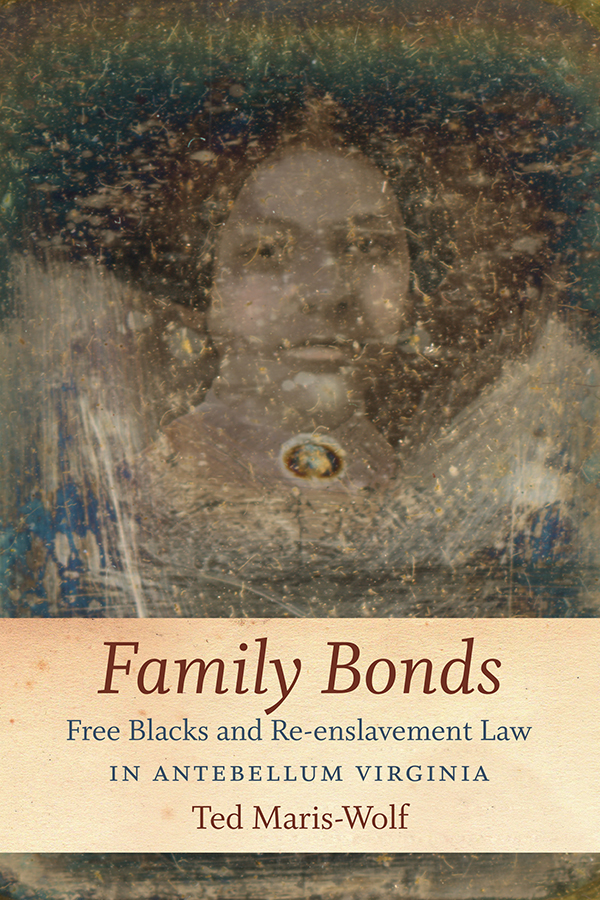
"Maris-Wolf breaks new ground in the study of free African Americans in the antebellum South, challenging previous scholars’ interpretations of why, at the height of pre–Civil War repression, free black Americans chose to enslave themselves. His style is smart, engaging, and grounded in social history, making Family Bonds a pleasure to read."--Martha S. JonesMore information is available here.
Sunday, September 13, 2015
Sunday Book Roundup
 Ian Klaus's Forging Capitalism: Rogues, Swindlers, Frauds and the Rise of Modern Finance (Yale University Press) is reviewed on H-Net.
H-Net also has a review of The Ordeal of the Reunion: A New History of Reconstruction by Mark Dahlgren Summers (UNC Press).
The New York Review of Books has a piece, "The Years of Rage," that examines films and books including Bryan Burrough's Days of Rage: America's Radical Underground, the FBI, and the Forgotten Age of Revolutionary Violence (Penguin).
And, The New York Times reviews A Nation of Nations: A Great American Immigration Story by Tom Gjelten (Simon & Schuster).
Saturday, September 12, 2015
ASLH 2015: That Supreme Court Reception!
[We're posting the following message from ASLH Treasurer Craig Klafter, which arrived in our in-boxes today.]
I write to encourage you to pre-register for the 2015 ASLH Annual Meeting. The meeting will take place in Washington, DC, from October 29th to November 1st, and will include a reception hosted by Justice Kagan at the Supreme Court of the United States. The preliminary program is available on the ASLH website. The deadline for pre-registration is September 27th, and only those pre-registered for the event will be permitted to attend the Supreme Court reception. If you have already registered, thank you. If not, you can register via the ASLH website.
I write to encourage you to pre-register for the 2015 ASLH Annual Meeting. The meeting will take place in Washington, DC, from October 29th to November 1st, and will include a reception hosted by Justice Kagan at the Supreme Court of the United States. The preliminary program is available on the ASLH website. The deadline for pre-registration is September 27th, and only those pre-registered for the event will be permitted to attend the Supreme Court reception. If you have already registered, thank you. If not, you can register via the ASLH website.
Weekend Roundup
- The Historical Presidency series of the Miller Center for Public Affairs continues Friday, September 18, from 12:00 p.m.-1:30 p.m., with David M. Kennedy on Franklin D. Roosevelt: An American Life in the "American Century.”
- We learn, via ConSource, of the National Constitutional Literacy Campaign, which "seeks to address the troubling decline in civics and constitutional literacy by bringing together a diverse group of organizations that educate citizens along the learning spectrum – from kindergarten to adulthood—about our nation’s Constitution and history." We hope they start an outreach program for presidential candidates.
- Mark Tushnet, Harvard Law School, will deliver “Varieties of Constitutionalism: The U.S. Version” as the Constitution Day lecture at the University of Montana in Missoula at noon on Thursday, September 17, in Law Building Room 101.
- The director of the La Guardia and Wagner Archives would like to raise awareness of its collections, which are very strong on New York City's political history. Here's a great chance to learn about Fiorello La Guardia while there's still an airport named after him.
Weekend Roundup is a weekly feature compiled by all the
Legal History bloggers.
Friday, September 11, 2015
Digitized Primary Sources on Race Discrimination and Foreign Relations
That’s the title of an interesting post over at Balkinization by LHB Founder Mary Dudziak on a series of posts by David Langbart
of the National Archives on discrimination against diplomats from newly independent
African countries in the early 1960s.
The Pope’s Other Jobs: Judge and Lawgiver
[There’s no topping Mike Widener, Rare Book Librarian &
Lecturer in Legal Research at the Yale Law School, for timeliness. Here, via H-Law, is an announcement of his and Anders Winroth's
new exhibit at the Yale Law Library.]
The Pope is universally known as the spiritual leader of the
Roman Catholic Church. But it is often forgotten that for much of the papacy's
history the Pope was the most important judicial and legislative authority in
western Europe.
 |
|
Decretales Gregorii IX (Venice, 1514) (credit)
|
A new exhibition at the Yale Law Library, "The Pope's
Other Jobs: Judge and Lawgiver," illustrates the Pope’s legal responsibilities
throughout history using rare books and a medieval manuscript from the Law
Library's outstanding collection. It is curated by Anders Winroth, Forst Family
Professor of History, Yale University, and Michael Widener, the Law Library's
Rare Book Librarian. Winroth is one of the world's leading authorities on
medieval canon law.
"In the Middle Ages, canon law (the law of the church)
took center stage as a most sophisticated legal system, not only inspiring much
secular law but also becoming recognized as the sole authority in several legal
fields, such as the law of marriage, the law of just war, and the legal
implications of oaths," said Winroth. The books and manuscripts in the
exhibition show how the papacy has shaped areas as diverse as human rights,
international boundaries, due process, and marriage law. Many of the legal
rights that Americans take for granted, such as the presumption of innocence
and the right against self-incrimination, are rooted in the decrees and
judicial decisions of medieval popes.
The exhibition is on display September 8-December 15, 2015,
in the Rare Book Exhibition Gallery, located on Level L2 of the Lillian Goldman
Law Library, Yale Law School (127 Wall Street, New Haven, CT). It will also appear online in the Yale Law Library Rare Books Blog.
For more information, contact Mike Widener at (203)
432-4494, email .
CFP: Policy History 2016
[We have the following announcement.]
The Institute for Political History, the Journal of Policy History, and the Peabody College of Vanderbilt University are hosting the ninth
biennial Conference on Policy History at the Loews® Vanderbilt Hotel in
Nashville, Tennessee from Wednesday, June 1 to Saturday, June 4, 2016.
We are currently accepting panel and paper proposals on all
topics regarding American political and policy history, political development,
and comparative historical analysis. Complete sessions, including two or three
presenters with chair/commentator(s), and individual paper proposals are
welcome. Participants may only appear once as a presenter in the program.
The deadline for submission is December 4, 2015.
Proposals for panels and papers must be submitted online at
the links below, and must include the
following:
1. Name(s)
2. Institutional Affiliation(s)
3. Status (i.e. ABD, Doctoral Student,
Assistant/Associate/Full Professor)
4. Email address(es).
5. Mailing Address(es).
6. Panel and paper title(s).
7. One (1) page single-spaced abstract of panel and papers
in Microsoft Word or PDF format.
8. One (1) page single-spaced description of panel participants
including educational background, major publications, awards or fellowships of
presenters, also in Microsoft Word or PDF format.
The 2016 Policy History Conference will also feature two
outstanding plenary sessions. Organized
by conference co-chairs Christopher Loss of Vanderbilt University and
Bartholomew Sparrow of the University of Texas at Austin, these panels are not
only timely in their nature but will examine the changing role of authority and
ideology in American political culture.
Liberalism in America
Andrew Rehfeld, Washington University in St. Louis
William Rorabaugh, University of Washington
Rogers Smith, University of Pennsylvania
Jeffrey Tulis, The University of Texas at Austin
Technology and the State
Angus Burgin, The Johns Hopkins University
Sarah Igo, Vanderbilt University
Margaret O'Mara, University of Washington
John Skrentny, University of California - San Diego
Thursday, September 10, 2015
Samito's "Lincoln and the Thirteenth Amendment"
Christian G. Samito, has published Lincoln and the Thirteenth Amendment in the
Concise Lincoln Library Series of the Southern Illinois University Press.
Long before the Civil War, Abraham Lincoln recognized the challenge American slavery posed to the ideals of the Declaration of Independence. A constitutional amendment would be the ideal solution to ending slavery, yet the idea of such an amendment conflicted with several of Lincoln’s long-held positions. In this study, Christian G. Samito examines how Lincoln’s opposition to amending the United States Constitution shaped his political views before he became president, and how constitutional arguments overcame Lincoln’s objections, turning him into a supporter of the Thirteenth Amendment by 1864. For most of his political career, Samito shows, Lincoln opposed changing the Constitution, even to overturn Supreme Court rulings with which he disagreed. Well into his presidency, he argued that emancipation should take place only on the state level because the federal government had no jurisdiction to control slavery in the states. Between January 1863 and mid-1864, however, Lincoln came to support a constitutional amendment to abolish slavery because it worked within the constitutional structure and preserved key components of American constitutionalism in the face of Radical Republican schemes. Samito relates how Lincoln made the amendment an issue in his 1864 reelection campaign, chronicles lobbying efforts and the final vote in the House on the amendment resolution, and interrogates various charges of corruption and back-room deals. He also considers the Thirteenth Amendment in the context of the Hampton Roads conference, Lincoln’s own thoughts on the meaning of the amendment, and the impact of Lincoln’s assassination on the reading of the amendment. Samito provides the authoritative historical treatment of a story so compelling it was recently dramatized in the movie Lincoln. Closing with a lively discussion that applies the Thirteenth Amendment to current events, this concise yet comprehensive volume demonstrates how the constitutional change Lincoln helped bring about continues to be relevant today.

Endorsements after the jump.
Note: Walter Gellhorn on Crowell v. Benson
Some time ago, I reported on Crowell v. Benson, 285 U.S. 22 (1932), as viewed from the docket books of Justices Pierce Butler and Owen Roberts, In Crowell, the US Supreme Court by a 5-3 vote decided that certain “jurisdictional” facts found by certain federal administrators were reviewable de novo in the federal courts. Administrative Law scholars tend to criticize Chief Justice Charles Evans Hughes for granting federal judges too much supervisory power over administrators. Federal Courts scholars tend to criticize him for leaving federal judges with too little. Here is another research note on the case, based on a letter in the Herbert Wechsler Papers at the Rare Book & Manuscript Library, Columbia University.
The letter is from Walter Gellhorn, a recent Columbia law graduate who was Harlan Fiske Stone’s legal secretary in the 1931 Term, to his classmate Wechsler, who would succeed him as Stone’s clerk and serve with him on the Columbia law faculty. The letter is part of an interesting correspondence enlivened by Gellhorn’s Court gossip, humor, and occasional earthiness. For example, after recounting his disagreement with Stone on the reasoning of an opinion, Gellhorn observed, “I'm a pain in the ass, even to myself.”
Gellhorn dated the letter “Midnight Monday” and wrote that “today we entered upon a two weeks' recess.” Matthew Hofstedt, Associate Curator, Office of the Curator, Supreme Court of the United States, kindly consulted the Supreme Court's journal for me and found (on p. 213) that on the day Crowell v. Benson was decided (February 23, 1932), the Chief Justice announced a recess from “Monday, February 29, to Monday, March 14, next.” Gellhorn wrote, then, at midnight, Monday, February 29, 1932.
The letter is from Walter Gellhorn, a recent Columbia law graduate who was Harlan Fiske Stone’s legal secretary in the 1931 Term, to his classmate Wechsler, who would succeed him as Stone’s clerk and serve with him on the Columbia law faculty. The letter is part of an interesting correspondence enlivened by Gellhorn’s Court gossip, humor, and occasional earthiness. For example, after recounting his disagreement with Stone on the reasoning of an opinion, Gellhorn observed, “I'm a pain in the ass, even to myself.”
Gellhorn dated the letter “Midnight Monday” and wrote that “today we entered upon a two weeks' recess.” Matthew Hofstedt, Associate Curator, Office of the Curator, Supreme Court of the United States, kindly consulted the Supreme Court's journal for me and found (on p. 213) that on the day Crowell v. Benson was decided (February 23, 1932), the Chief Justice announced a recess from “Monday, February 29, to Monday, March 14, next.” Gellhorn wrote, then, at midnight, Monday, February 29, 1932.
Wednesday, September 9, 2015
Using the Past: Romanists, Totalitarianism, and Its Legacy
[We have the following announcement.]
Programme of the “Using the past: Romanists, totalitarianism and its legacy” conference
Villa Lante al Gianicolo, Institutum Romanum Finlandiae (Rome), 22-23 October, 2015
22 October
14.00-15.15 Keynote
lecture: Lorena Atzeri (Università Statale, Milano): Francis de Zulueta:
A Roman Lawyer between Totalitarianisms
Chair: Kaius Tuori
Chair: Kaius Tuori
15.30-17.00 Session 1
Chair: Kaius Tuori
Frederick Whitling: Vertical Flights: National and International Uses of ‘Classical’ Pasts in Rome and Athens
Simon Strauß: Contemporary politics in Mommsen’s Staatsrecht
Ville Erkkilä: Wirkungsgeschichte. The long World War and legal historical hermeneutics
Chair: Kaius Tuori
Frederick Whitling: Vertical Flights: National and International Uses of ‘Classical’ Pasts in Rome and Athens
Simon Strauß: Contemporary politics in Mommsen’s Staatsrecht
Ville Erkkilä: Wirkungsgeschichte. The long World War and legal historical hermeneutics
17.00-17.30 Coffee break
17.30-19.00 Session 2
Chair: Tommaso Beggio
Sergio Castagnetti: Allusions to contemporary history in Francesco De Martino’s, Lo stato di Augusto (1935 and 1936)
Adolfo Giuliani: Approaching Roman law from an antiformalist perspective. The case of Riccardo Orestano (1909-1988)
Carla Masi Doria: Antonio Guarino: a young academic through fascism
Chair: Tommaso Beggio
Sergio Castagnetti: Allusions to contemporary history in Francesco De Martino’s, Lo stato di Augusto (1935 and 1936)
Adolfo Giuliani: Approaching Roman law from an antiformalist perspective. The case of Riccardo Orestano (1909-1988)
Carla Masi Doria: Antonio Guarino: a young academic through fascism
23 October
10.00-11.15 Keynote
lecture: Cosimo Cascione (Università Federico II, Napoli): The Idea of
Rome: Political Fascism and Fascist (Roman) Law
Chair: Ville Erkkilä
Chair: Ville Erkkilä
11.30-12.30 Session 3
Chair: Magdalena Kmak
Marko Petrak: With Riccobono against National Socialism and Real Socialism: Two Apologies of the Roman Law in the Totalitarian Era
Tommaso Beggio: Three letters by Paul Koschaker to Salvatore Riccobono: considerations on Roman law at the time of crisis
Chair: Magdalena Kmak
Marko Petrak: With Riccobono against National Socialism and Real Socialism: Two Apologies of the Roman Law in the Totalitarian Era
Tommaso Beggio: Three letters by Paul Koschaker to Salvatore Riccobono: considerations on Roman law at the time of crisis
12.30-14.00 Lunch break
14.00-15.30 Session 4
Chair: Tommaso Beggio
Stefania Gialdroni: The legal culture of the Romanist who wrote the Italian Civil Code under Fascism: An analysis based on the “Fondo Vassalli” of the Italian Senate Library
Valerio Rocco: Hegel’s conception of Roman law as a political weapon during the Fascist regime
Donatello Aramini: A Laboratory of Cultural Synthesis: the Institute of Roman Studies and the Fascist Myth of Rome
Chair: Tommaso Beggio
Stefania Gialdroni: The legal culture of the Romanist who wrote the Italian Civil Code under Fascism: An analysis based on the “Fondo Vassalli” of the Italian Senate Library
Valerio Rocco: Hegel’s conception of Roman law as a political weapon during the Fascist regime
Donatello Aramini: A Laboratory of Cultural Synthesis: the Institute of Roman Studies and the Fascist Myth of Rome
15.30-16.00 Coffee break
16.00-17.30 Session 5
Chair: Jacob Giltaij
Thomas Finkenauer & Andreas Herrmann: Coming to Terms – The Study of Roman law between Adaptation and Collaboration, 1933-1945
Eva Jakab: Refuge Roman Law? Life and Work of a Hungarian Scholar, Elemér Pólay
Kaius Tuori: Refugees and Collaborators: Romanists Adapting to Turbulent Times 1934-1964
Chair: Jacob Giltaij
Thomas Finkenauer & Andreas Herrmann: Coming to Terms – The Study of Roman law between Adaptation and Collaboration, 1933-1945
Eva Jakab: Refuge Roman Law? Life and Work of a Hungarian Scholar, Elemér Pólay
Kaius Tuori: Refugees and Collaborators: Romanists Adapting to Turbulent Times 1934-1964
This Fall in Minnesota's Legal History Workshop
[We have the following announcement.]
Fall 2015 Legal History Workshop, University of Minnesota, Professor Susanna Blumenthal
September 24
Matthew Sommer, Associate Professor of Chinese History, Stanford University
Selections from Polyandry And Wife-Selling In Qing Dynasty China: Survival Strategies And Judicial Interventions (University of California Press, 2015)
October 1
Mitra Sharafi, Associate Professor of Law, University of Wisconsin Law School
“Blood Testing and Fear of the False in British India”
October 8
Catherine Fisk, Chancellor's Professor of Law, University of California, Irvine School of Law
Selections from Authors at Work: Writing for Hire in Twentieth Century Film, Television, and Advertising (forthcoming, Harvard University Press)
October 15
Michael Zakim, Department Of History, Tel Aviv University, Visiting Scholar, Charles Warren Center, Harvard University
Selections from Accounting for Capitalism: The World the Clerk Made (forthcoming, University of Chicago Press)
October 22
Stuart Banner, Norman Abrams Professor of Law, UCLA School of Law
“Betting on Prices: Gambling and Investing in the 19th-Century United States”
November 5
Daniel Sharfstein, Professor of Law, Chancellor Faculty Fellow, and Co-director, Social Justice Program, Vanderbilt Law School
“Chief Joseph’s Struggle: Law, Lawlessness, and Administration in Nez Perce Country, 1872-1877”
November 12
Christopher N.J. Roberts, Associate Professor and Joseph & Edith Wargo Research Scholar, University of Minnesota Law School
“The Origins of Human Rights and the Ghost of Senator Bricker: Uncovering a Lost History”
November 19
Jeffrey Sklansky, Associate Professor of History, University of Illinois at Chicago
“The Value of Trust: Monetary Reform and the Ethic of Investment in the Progressive Era”
December 3
Malick Ghachem, Associate Professor of History, MIT
“The Revolt against the Indies Company”
All sessions will be held at the Law School (Room 471). For more information contact Angela Tanner, angelat@umn.edu
Fall 2015 Legal History Workshop, University of Minnesota, Professor Susanna Blumenthal
September 24
Matthew Sommer, Associate Professor of Chinese History, Stanford University
Selections from Polyandry And Wife-Selling In Qing Dynasty China: Survival Strategies And Judicial Interventions (University of California Press, 2015)
October 1
Mitra Sharafi, Associate Professor of Law, University of Wisconsin Law School
“Blood Testing and Fear of the False in British India”
October 8
Catherine Fisk, Chancellor's Professor of Law, University of California, Irvine School of Law
Selections from Authors at Work: Writing for Hire in Twentieth Century Film, Television, and Advertising (forthcoming, Harvard University Press)
October 15
Michael Zakim, Department Of History, Tel Aviv University, Visiting Scholar, Charles Warren Center, Harvard University
Selections from Accounting for Capitalism: The World the Clerk Made (forthcoming, University of Chicago Press)
October 22
Stuart Banner, Norman Abrams Professor of Law, UCLA School of Law
“Betting on Prices: Gambling and Investing in the 19th-Century United States”
November 5
Daniel Sharfstein, Professor of Law, Chancellor Faculty Fellow, and Co-director, Social Justice Program, Vanderbilt Law School
“Chief Joseph’s Struggle: Law, Lawlessness, and Administration in Nez Perce Country, 1872-1877”
November 12
Christopher N.J. Roberts, Associate Professor and Joseph & Edith Wargo Research Scholar, University of Minnesota Law School
“The Origins of Human Rights and the Ghost of Senator Bricker: Uncovering a Lost History”
November 19
Jeffrey Sklansky, Associate Professor of History, University of Illinois at Chicago
“The Value of Trust: Monetary Reform and the Ethic of Investment in the Progressive Era”
December 3
Malick Ghachem, Associate Professor of History, MIT
“The Revolt against the Indies Company”
All sessions will be held at the Law School (Room 471). For more information contact Angela Tanner, angelat@umn.edu
Tuesday, September 8, 2015
Tillman, "Ex Parte Merryman: Myth, History, and Scholarship"
Seth Barrett Tillman (National University of Ireland, Maynooth) has posted "Ex Parte Merryman: Myth, History, and Scholarship." The article is forthcoming in the Military Law Review (2016). Here's the abstract:
Ex parte Merryman is iconic. It is, arguably, the first major American case testing the scope of lawful military authority during war time. Not only during a war, but during a civil war. Not only were the civilian (judicial) authorities in conflict with the military authorities, but the Chief Justice of the United States clashed with the President — or, at least, that is the story as it is commonly told. It is an 1861 case, but the stakes were large and, sadly, the issues remain relevant if not eternal.The full paper is available here, at SSRN.
However, the standard restatement of the facts and holding of Ex parte Merryman appearing in many (if not most) law review articles is wrong. Moreover, these mistakes are not unique to academic lawyers; a fair number of judges, historians, and academics in allied fields make the same or very similar mistakes. These repeated errors are somewhat surprising because Merryman is, if not a leading case, only one short step removed from the received case law canon. To put it another way, what is frequently written about Merryman is a series of myths. This Article seeks to disentangle Merryman’s many myths from reality.
ASLH Program Announced
The preliminary program for the 2015 annual meeting of the American Society for Legal History, to be held in Washington, DC, next month, is now available here.
Ms. Peppercorn and Prof. Peregrina Present a Puzzle for Legal Historians to Ponder: Moving On from First Loves (aka the Curse of the Second Book Project)
Alas! The holiday weekend has come to an end; the fall semester is upon us. But cheer up! We aim to lift your spirits and facilitate your continued productivity with a new installment of our occasional advice column, "Ms. Peppercorn Considers."* Enjoy!
This post began with a prompt from an author who has just finished a (superb) book manuscript (now out for review at an eminent press). It occurred to Ms. Peppercorn that legal historians, like other mortals, may find themselves wrestling with basic questions about the meaning of life, such as “how the hell will I ever come up with a second book project?” Such nagging questions try our souls. There are so many excuses NOT to do a second book, and so much other work that lands on the shoulders of the newly published.
Nonetheless, we persevere. And some people out there recognize how hard it is to overcome commitment anxiety, fear of a whole new subject (or of just duplicating the first book), or even the notion that one should quit while ahead. For example, the William and Mary Quarterly and the Early Modern Studies Institute together sponsor an annual workshop geared toward mid-career scholars who work in early modern history. Last year’s conference, on legal history, saw fine work from a variety of perspectives (although it was notable that none of the papers was written by a scholar based in a law school).
And yet one hopes there’s more to be said than “Put your nose to the grindstone” and “grab lifelines where you find them.” To generate other ideas, we turned the tables on the author whose predicament prompted these musings and asked, ‘How does it feel to be without the ball and chain that filled your time for the past several years? And how are you thinking about whether and when to put on the yoke again?’ Read on for our conversation with the (pseudonymous) Professor Peregrina.
Monday, September 7, 2015
Ruben and Cornell, "Firearm Regionalism and Public Carry: Placing Southern Antebellum Case Law in Context"
Eric M. Ruben (New York University Brennan Center for Justice) and Saul A. Cornell (Fordham University) have posted "Firearm Regionalism and Public Carry: Placing Southern Antebellum Case Law in Context," which is forthcoming in the Yale Law Journal Forum. Here's the abstract:
In recent years, following the Supreme Court’s landmark originalist opinion in District of Columbia v. Heller, courts have been asked to strike down restrictions on the public carrying of handguns on the basis of the original understanding of the Second Amendment. One of the key sources used to justify this outcome is a family of opinions from the antebellum South asserting an expansive right to carry weapons in public. In this essay we explore whether that body of case law reflected a national consensus on the meaning of the right to bear arms or, in the alternative, a narrower regional conception of this right. We discuss how the South’s distinctive culture of slavery and honor influenced both public carry and regional jurisprudence, and how the case law originating from that culture cannot be extended to the rest of the country without explanation. We then draw on new post-Heller research to discuss an alternative American tradition — predominant outside the South — that was less enthusiastic about public carry and more accepting of public carry regulation. This analysis suggests that the view of the right to bear arms expressed in the nineteenth-century Southern opinions falls woefully short of reflecting a national consensus. Moreover, judges seeking historical guidance in public carry cases today should look to the alternative tradition that presumed the constitutional soundness of broad public carry restrictions.The essay came to our attention because the government cited it in a recent appeal to the U.S. Court of Appeals for the D.C. Circuit.
Sunday, September 6, 2015
Sunday Book Roundup
 The Federal Lawyer has a new issue, with several book reviews of note. Benjamin H. Barton's Glass Half Full: The Decline and Rebirth of the Legal Profession (Oxford University Press) is reviewed. More legal history is found in a review of Licensed to Practice: The Supreme Court Defines the American Medical Profession by James C. Mohr (Johns Hopkins University). There's also a review of James M. Denham's Fifty Years of Justice: A History of the U.S. District Court for the Middle District of Florida (University Press of Florida). All reviews from the September issue can be found here.
New Books has an interview with George H. Nash about his book The Crusade Years, 1933-1955: Herbert Hoover's Lost Memoir of the New Deal Era and Its Aftermath (Hoover Institution Press). And, Natalia Molina discusses her book, How Race is Made in America: Immigration, Citizenship, and the Historical Power of Racial Scripts (University of California Press).
Ari Berman talks about his Give Us the Ballot: The Modern Struggle for Voting Rights in America (Farrar Straus Giroux) on Politics & Prose."In her fascinating new study ... Professor of History and Urban Studies at UC San Diego Natalia Molina advances the study of U.S. immigration history and race relations by connecting the themes of race and citizenship in the construction of American racial categories. Using archival records held by the Immigration and Naturalization Service (INS), the U.S. Congress, local governments, and immigrant rights groups, Dr. Molina examines the period of Mexican immigration to the U.S. from 1924-1965. Employing a relational lens to her study, Professor Molina advances the theory of racial scripts to describe how ideas about Mexicans and Mexican immigration have been fashioned out of preexisting racial projects that sought to exclude African Americans and Asian immigrants from acquiring the full benefits of American citizenship."
H-Net adds several more reviews to the mix, including one of Charity and Sylvia: A Same-Sex Marriage in Early America by Rachel Hope Cleves (Oxford University Press).
The Myth of Seneca Falls: Memory and the Women's Suffrage Movement, 1848-1989 by Lisa Tetrault (UNC Press) is reviewed on H-Net.
Lowell J. Soike's Busy in the Cause Iowa, the Free-State Struggle in the West, and the Prelude to the Civil War (University of Nebraska Press) is reviewed as well on H-Net."Tetrault examines the myth that the 1848 meeting in Seneca Falls, New York, launched the woman suffrage movement. She does not argue that the Seneca Falls meeting was unimportant. Instead, she states that it has become a “venerated and celebrated story” that requires further scrutiny (p. 5). Tetrault demonstrates that Stanton and Anthony crafted this historical narrative during the late nineteenth century to ensure that their contemporaries and later generations recognized them as the movement’s leaders. By dating the movement to this meeting, Stanton, who helped organize the event and drafted the Declaration of Sentiments, became a founding mother. Inaccurate accounts placed Anthony at the meeting as well."
Saturday, September 5, 2015
Weekend Roundup
- Paul Finkelman, emeritus, Albany Law School, will give the address The Constitution and the 14th Amendment: Defining Citizenship, Thursday, Sept.10, at 5 p.m. in 418 Reed at Morehead State University.
- From the Junto: an interview with legal historian Saul Cornell (Fordham University) on "the Originalism debate."
- "Is Nuance Overrated?" The Chronicle of Higher Ed interviews the sociologist whose call to "F- Nuance" recently went viral.
- Ostensibly for Labor Day, but, really, for no particular reason: a rat catcher, his bowler, and a ferret via Library of Congress Blog.
Friday, September 4, 2015
Wadhia on the History of Prosecutorial Discretion in Immigration Cases
New from New York University Press: Beyond Deportation: The Role of Prosecutorial Discretion in Immigration Cases (June 2015), by Shoba Sivaprasad Wadhia (Faculty Scholar and Director of the Center for Immigrants’ Rights, Pennsylvania State University Dickinson School of Law). Here's a description from the Press:
A blurb of note:
When Beatles star John Lennon faced deportation from the U.S. in the 1970s, his lawyer Leon Wildes made a groundbreaking argument. He argued that Lennon should be granted “nonpriority” status pursuant to INS’s (now DHS’s) policy of prosecutorial discretion. In U.S. immigration law, the agency exercises prosecutorial discretion favorably when it refrains from enforcing the full scope of immigration law. A prosecutorial discretion grant is important to an agency seeking to focus its priorities on the “truly dangerous” in order to conserve resources and to bring compassion into immigration enforcement. The Lennon case marked the first moment that the immigration agency’s prosecutorial discretion policy became public knowledge. Today, the concept of prosecutorial discretion is more widely known in light of the Obama Administration’s Deferred Action for Childhood Arrivals or DACA program, a record number of deportations and a stalemate in Congress to move immigration reform.

Beyond Deportation is the first book to comprehensively describe the history, theory, and application of prosecutorial discretion in immigration law. It provides a rich history of the role of prosecutorial discretion in the immigration system and unveils the powerful role it plays in protecting individuals from deportation and saving the government resources. Shoba Sivaprasad Wadhia draws on her years of experience as an immigration attorney, policy leader, and law professor to advocate for a bolder standard on prosecutorial discretion, greater mechanisms for accountability when such standards are ignored, improved transparency about the cases involving prosecutorial discretion, and recognition of “deferred action” in the law as a formal benefit.
More information is available here."The definitive word on the all-important tool of prosecutorial discretion in immigration enforcement. Wadhia traces the fascinating history of the exercise of such discretion under U.S. immigration law, which includes careful study of the famous case of John Lennon and Yoko Ono through to the use of such discretion in President Obama's Deferred Action for Childhood Arrivals program. Rather than simply describing the history, Beyond Deportation offers concrete recommendations about prosecutorial discretion in immigration enforcement, including greater transparency in decisionmaking and rules that limit government attorneys in the exercise of discretion. Wadhia has written an important analysis of the most significant positive immigration development of the Obama administration." — Kevin R. Johnson, University of California, Davis
Subscribe to:
Posts (Atom)