Monday, April 11, 2022

Tarbert's "When Good Government Meant Big Government"

 We’ve started reading Jesse Tarbert’s When Good Government Meant Big Government: The Quest to Expand Federal Power, 1913–1933 (Columbia University Press) and like it a lot.  In case you missed it, The Docket interview is here.

The years after World War I have often been seen as an era when Republican presidents and business leaders brought the growth of government in the United States to a sudden and emphatic halt. In When Good Government Meant Big Government, the historian Jesse Tarbert inverts the traditional story by revealing a forgotten effort by business-allied reformers to expand federal power—and how that effort was foiled by Southern Democrats and their political allies.

Tarbert traces how a loose-knit coalition of corporate lawyers, bankers, executives, genteel reformers, and philanthropists emerged as the leading proponents of central control and national authority in government during the 1910s and 1920s. Motivated by principles of “good government” and using large national corporations as a model, these elite reformers sought to transform the federal government’s ineffectual executive branch into a modern organization with the capacity to solve national problems. They achieved some success during the presidency of Warren G. Harding, but the elite reformers’ support for federal antilynching legislation confirmed the worries of white Southerners who feared that federal power would pose a threat to white supremacy. Working with others who shared their preference for local control of public administration, Southern Democrats led a backlash that blocked enactment of the elite reformers’ broader vision for a responsive and responsible national government.

Offering a novel perspective on politics and policy in the years before the New Deal, this book sheds new light on the roots of the modern American state and uncovers a crucial episode in the long history of racist and antigovernment forces in American life.

--Dan Ernst

Saturday, April 9, 2022

Weekend Roundup

  • G. Edward White, Virginia Law is interviewed on the Learning Curve Podcast.  Aditya Bamzai, also Virginia Law, is interviewed on The Railroad Strike Case That Made History on Federal Injunctions on UVA Law's Common Law podcast.
  • "Paul Sabin, a leader in the field of environmental history, has been appointed the Randolph W. Townsend, Jr. Professor of History and Professor of American Studies" at Yale.  More
  • HLS’s Dehlia Umunna discusses Powell v. Alabama (1932) in a new series, Cases in Brief (HLT).
  • David Cole, ACLU and Georgetown Law, reviews Jamal Greene’s How Rights Went Wrong (NYRB).
  • ICYMI: New Artifacts Document the Soaring Popularity of Ruth Bader Ginsburg (Smithsonian). Bruce W. Dearstyne on why We Should Celebrate York State’s Birthday on April 20 (Gotham Gazette).  Julian Zelizer on What I Learned when Donald Trump Tried to "Correct" the Record (The Atlantic).  (Reminds us of Truman lobbying researchers at his presidential library.)

Weekend Roundup is a weekly feature compiled by all the Legal History bloggers.

Friday, April 8, 2022

Tushnet's "Hughes Court"

It's now out in print, from the Cambridge University Press: Mark V. Tushnet, Harvard Law School, has published The Hughes Court: From Progressivism to Pluralism, 1930 to 1941, the latest volume in the Oliver Wendell Holmes Devise History of the Supreme Court of the United States:

The Hughes Court: From Progressivism to Pluralism, 1930 to 1941
describes the closing of one era in constitutional jurisprudence and the opening of another. This comprehensive study of the Supreme Court from 1930 to 1941 – when Charles Evans Hughes was Chief Justice – shows how nearly all justices, even the most conservative, accepted the broad premises of a Progressive theory of government and the Constitution. The Progressive view gradually increased its hold throughout the decade, but at its end, interest group pluralism began to influence the law. By 1941, constitutional and public law was discernibly different from what it had been in 1930, but there was no sharp or instantaneous Constitutional Revolution in 1937 despite claims to the contrary. This study supports its conclusions by examining the Court's work in constitutional law, administrative law, the law of justiciability, civil rights and civil liberties, and statutory interpretation.
Here are some endorsements:

‘No one understands the politics of law better or takes the law more seriously than Mark Tushnet. With a complete mastery of the decisions of the Hughes Court, Tushnet shows us the justices as they saw themselves, professionals of disparate backgrounds, temperaments, and talents, dispatching, with the tools at hand, the disputes that ceaselessly came to them. Familiar constitutional landmarks are here, as is the high drama of Franklin D. Roosevelt’s ‘Court-packing’ plan, but so are more gradual changes in the law of the presidency, the administrative state, the federal courts, civil liberties, and civil rights that ended with the nation on the verge of a new constitutional order. Despite economic calamity and social strife, the Supreme Court thrived, not by being above politics, but by proving its worth by doing its job.’ Daniel R. Ernst, Carmack Waterhouse Professor of Legal History, Georgetown University Law Center

'In this tour de force, a master doctrinalist unpacks some of the twentieth century's most significant cases. In the process, he brilliantly unlocks the mystery of the Constitutional Revolution of 1937 that did not happen, investigates the invention of federal jurisdiction, explores the evolution of the administrative state, and illuminates the transformation of modern American liberalism. Bravo!' Laura Kalman, Distinguished Research Professor, University of California, Santa Barbara

 You can get a sense of the book’s scale from the TOC, after the jump:

Ablavsky Reviews Amar's "Words That Made Us"

Gregory Ablavsky, Stanford Law School, has posted Akhil Amar's Unusable Past, which is forthcoming in the Michigan Law Review:

This essay reviews Akhil Amar's recent constitutional history of the early United States, The Words That Made Us. In this volume, Amar seeks to offer a "fresh story of America" that provides a "usable past." I argue that the book fails on both fronts. On the contrary, much of what Amar peddles is very old, ignoring generations’ worth of scholarship while parroting a centuries-old nationalist constitutional hagiography. In particular, he believes that constitutional history must be, at core, a referendum on the handful of powerful men dubbed the Founders. His effort to defend them and the Constitution from critics paints him into difficult corners, including endorsing some dubious exculpatory narratives around the exclusion of women, Black people, and Native nations in early America.

One way forward toward a more inclusive, more usable constitutional history, I argue, is in the concept of a "constitutional conversation" that Amar uses to frame his book. In Amar's hands, this conversation becomes a narrow reconstruction of debates among what he calls the "Big Six" Founders. But for a generation, historians and scholars, including many in law schools, have offered a broader vision of the constitutional conversation highlighting how non-elite people, including subordinated groups, accessed and shaped constitutional law. But the work of synthesizing these accounts in a broader constitutional history has only just begun. This work, I argue, will offer both a fuller account of the constitutional conversation and a more usable past for a nation increasingly recognizing that it has always been a diverse and fractious place. 
--Dan Ernst

Gerber on Liberal Originalism and the Connecticut Constitution

Scott D. Gerber, Ohio Northern University Pettit College of Law, has posted Liberal Originalism in Connecticut Constitutional Interpretation, which is forthcoming in the Quinnipiac Law Review:

This Article is my contribution to a Quinnipiac Law Review symposium about the history of the Connecticut constitution. The first part of the Article explains what liberal originalism is. The second section chronicles the “higher law” background of colonial Connecticut. The third portion describes Connecticut’s profound commitment to the Declaration of Independence. The fourth segment assesses the draft U.S. Bill of Rights written in the hand of Connecticut’s own Roger Sherman. The conclusion maintains that a liberal originalist approach to interpreting the Connecticut constitution is preferable to the less generous approach to deciding individual rights cases articulated by the Connecticut Supreme Court in State v. Geisler (1992).

--Dan Ernst

Thursday, April 7, 2022

Briker & Driver, "Brown and Red: Defending Jim Crow in Cold War America"

Recently published in the Stanford Law Review: "Brown and Red: Defending Jim Crow in Cold War America," by Gregory Briker (Yale University, J.D./Ph.D. candidate) and Justin Driver (Yale Law School). The abstract:

It would be difficult to overstate the centrality of Brown v. Board of Education to American law and life. Legal scholars from across the ideological spectrum have lavished more attention on that Supreme Court decision than any other issued during the last century. In recent decades, the standard account of Brown has placed that most-scrutinized opinion in a geopolitical context. Brown, the standard account maintains, must be viewed as a product of the Cold War era. By the 1950s, the persistence of laws codifying racial subordination had become an embarrassment for the United States on the global stage. The U.S. effort to defeat communism around the world thus rendered the recognition of civil rights for Black Americans a Cold War imperative.

This Article complicates and challenges that account by exploring the central role that anticommunism played in segregationists’ opposition to Brown and civil rights. Throughout most of the twentieth century, a broad array of Americans contended that preserving Jim Crow was a Cold War imperative in its own right. For this group, anticommunism and segregation were not just compatible, but inextricably intertwined. Their ranks included northerners and southerners alike: politicians, jurists, columnists, and ordinary citizens. White supremacists did not invoke anticommunism merely as a disingenuous ploy to combat Brown. Both long before and long after 1954, anticommunism helped to shape the contours of segregationist thought. The defenders of Jim Crow assailed integration as a product of communistic central government authority. They insisted that racial equality would create discord within the United States, just as the Soviets desired, and that civil rights activists were tainted by communist affiliations. Many segregationists viewed themselves as committed Cold Warriors, undertaking closely connected fights against both a foreign ideological threat and a domestic social one. As such, the Cold War represented not only a divide between the United States and the Soviet Union; it also reflected a debate within the United States over the relationship between racial justice, national security, and foreign policy.

Understanding that segregationists viewed their cause as a Cold War imperative recasts dominant views within legal academia, where this essential component of Brown’s geopolitical context remains underappreciated. While it is tempting to dismiss every segregationist invocation of anticommunism as the product of either irrationality or opportunism, it would be a mistake to do so. Linking segregation with anticommunism transformed the defense of Jim Crow from a regional priority into a national one. Anticommunism also helped resolve a core tension in the segregationist belief that Black citizens did not actually want integration, allowing civil rights lawsuits to be attributed to communist agitation. Reckoning with this significant element of the civil rights era, this Article thus illuminates the logic of a racist worldview. In so doing, it provides a fuller, more accurate portrait of a critical period in constitutional history, of the complex dynamics undergirding legal change, and of the malleable, tenacious character of racism in modern America.

Read on here.

-- Karen Tani

Wednesday, April 6, 2022

Siegel, "The Politics of Constitutional Memory"

Reva Siegel (Yale Law School) has posted "The Politics of Constitutional Memory," forthcoming in the Georgetown Journal of Law & Public Policy. The abstract:

Those who sought votes for women made claims for liberty and equality in the family on which constitutional law might now draw—but there is no trace of their voices or claims in constitutional law. The Supreme Court scarcely mentions the Nineteenth Amendment when interpreting the Constitution. Nor do Supreme Court opinions mention those who led women’s quest for political voice or the constitutional arguments they made in support of women voting, even though these arguments spanned two centuries. There is no method of interpretation that the Justices employ with sufficient consistency to account for this silence in our law.

This Article introduces the concept of constitutional memory to explain this silence in our law. Constitutional interpreters produce constitutional memory as they make claims on the past that can guide decisions about the future. It is the role of constitutional memory to legitimate the exercise of authority; but constitutional memory plays a special role in legitimating the exercise of authority when constitutional memory systematically diverges from constitutional history. Systematic divergence between constitutional memory and constitutional history can legitimate authority by generating the appearance of consent to contested status relations and by destroying the vernacular of resistance. Though women contested their lack of political authority in the constitutional order over two centuries, there is no trace of their arguments in constitutional law.

To illustrate, the Article examines a long-running tradition of suffrage argument that began before the Reconstruction Amendments and continued in evolving forms after the ratification of the Nineteenth Amendment: that women needed the vote to democratize the family. Two centuries of constitutional arguments are nowhere reflected in the United States Reports. As a consequence, constitutional doctrines about liberty and equality in the family appear to lack historical antecedents.

But argument, inside and outside of courts, can counter the politics of memory. Justices across the spectrum regularly make heterodox claims on the past. Constitutional interpreters can invoke the voices of the disfranchised and the concerns that the disfranchised brought to the democratic reconstruction of America. Imagine how we might understand our Constitution in another generation if we did. 

A full draft is available here, at SSRN.

-- Karen Tani

Book Launch: "King Leopold's Ghostwriter"

 [We have the following announcement.  DRE.]

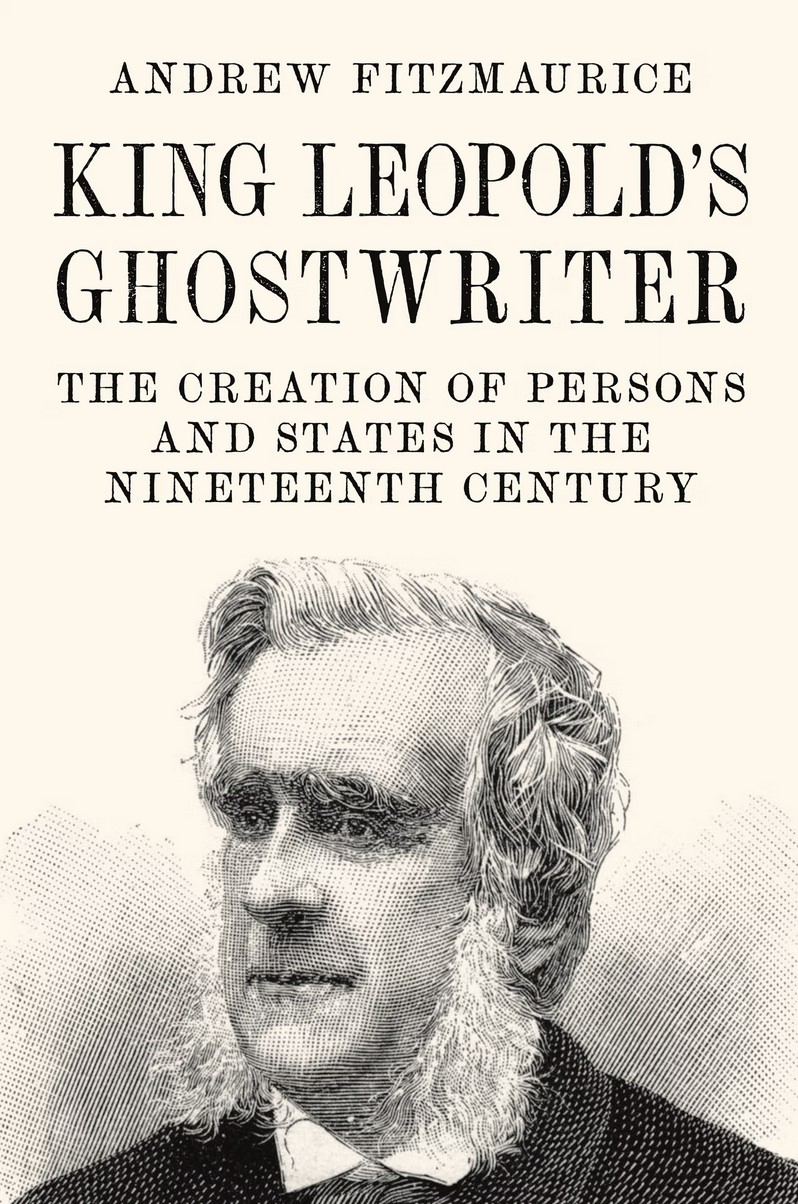
The Queen Mary School of Law, School of History, the Institute for Social Sciences and the Humanities and the Centre for the History of Political Thought, Queen Mary University of London, are delighted to be co-hosting a New Book Symposium on Professor Andrew Fitzmaurice’s King Leopold’s Ghostwriter: The Creation of Persons and States in the Nineteenth Century (Princeton, 2022). The event is organised by Professor Maksymilian Del Mar and Professor Georgios Varouxakis.  In addition to Professor Fitzmaurice, the speakers are Professor David Armitage (Harvard); Professor Michael Lobban (LSE); Professor Lisa Siraganian (Johns Hopkins); and Dr. Inge Van Hulle (Max Planck, Frankfurt).

Tuesday, April 5, 2022

Ernst to Deliver Fulton Lecture on Jerome Frank

I am honored more than I can possibly say to be delivering the 2022 Maurice and Muriel Fulton Lectureship in Legal History from 12:15PM – 1:20PM on Monday, April 18, at the University of Chicago Law School, from which I graduated some time ago.  My topic is Jerome Frank: The Making of a New Deal Lawyer:

For two years at the start of Franklin D. Roosevelt’s presidency, the legal realist and corporate attorney Jerome Frank was one of the more visible lawyers of the New Deal, publicly celebrated and privately deplored for trying to prevent meat packers, cigarette manufacturers, and milk distributors from mulcting the public.  Journalists saw Frank’s firing in February 1935 as the elimination of “the last stronghold of militant liberalism in the Roosevelt administration.” Professor Ernst will describe the making of this New Dealer, including Frank’s childhood and education on the South Side of Chicago, early law practice, sallies into Chicago politics, literary efforts, unsatisfying move to New York City, publication of the Freudian Law and the Modern Mind (1930) and entrée into the legal academe. 
--Dan Ernst

Monday, April 4, 2022

Litigating Racial Identity in Sipes and Hurd

[This post is for anyone who, likes me, teaches Shelley v. Kraemer, in a first-year Property class and has wished for a note on the decision of defendants' counsel to litigate their racial identity in the two companion cases, Sipes v. McGhee and Hurd v. Hodge.  DRE]

When summarizing the proceedings in Sipes v. McGhee, the Detroit branch of the litigation that reached the U.S. Supreme Court as Shelley v. Kraemer, Chief Justice Vinson observed that the petitioners "were found by the trial court to be Negroes" (SM 140).  In the companion case, Hurd v. Hodge, arising in the District of Columbia, the Chief Justice similarly noted that the petitioners James and Mary Hurd were "found by the trial court to be Negroes," even though James Hurd had maintained that he was "not a Negro, but a Mohawk Indian."  Therein lies a tale: the decision by Charles Hamilton Houston and other lawyers affiliated with the National Association for the Advancement of Colored People (NAACP) to force White property owners to prove the racial identity of the litigants in racially restrictive covenant cases.

Saturday, April 2, 2022

Weekend Roundup

  • In the New Rambler: Jonas Bens (Freie Universität Berlin) reviews Empire and the Making of Native Title: Sovereignty, Property and Indigenous People (Cambridge University Press, 2020), by Bain Attwood (Monash University). 
  • "The Queen has approved that Professor Helen Scott, Professor of Private Law at the University of Oxford, be appointed Regius Professor of Civil Law at the University of Cambridge, in succession to Professor David Ibbetson."  More.
  • Lea VanderVelde, professor of law and the Josephine R. Witte Chair, has been named the 2022 Research Scholar of the Year at the University of Iowa.
  • Laura Edwards, Princeton University, presents her book, Only the Clothes on Her Back: Clothing and the Hidden History of Power in the Nineteenth-Century United States, to the Washington History Seminar on April 4, 2022, at 4 PM ET.  Megan Sweeney, University of Michigan, and Martha Jones, Johns Hopkins University, comment.  Register here.
  • Gale Primary Sources has added some new collections, including Indigenous Peoples of North America, Part II: The Indian Rights Association, 1882–1986, and The Making of the Modern Law: Landmark Records and Briefs of the U.S. Courts of Appeals, Part II, 1891–1950.  More.
  • Joanna Grisinger at the DC history conference on the Palisades neighborhood’s opposition to jet airplanes at National Airport (WaPo).
  • The April 2022 newsletter of the Historical Society of the DC Circuit is now available
  • Update: "Constance Baker Motley, Civil Rights Queen, Paved the Way for Ketanji Brown Jackson," by Tomiko Brown-Nagin (Oprah Daily).

Weekend Roundup is a weekly feature compiled by all the Legal History bloggers

Friday, April 1, 2022

Monopoli on Feminist Legal History and Legal Pedagogy

Paula A. Monopoli, University of Maryland Francis King Carey School of Law, has posted Feminist Legal History and Legal Pedagogy, which also appears at 108 Virginia Law Review Online 91 (2022):

Women are mere trace elements in the traditional law school curriculum. They exist only on the margins of the canonical cases. Built on masculine norms, traditional modes of legal pedagogy involve appellate cases that overwhelmingly involve men as judges and advocates. The resulting silence signals that women are not makers of law—especially constitutional law. Teaching students critical modes of analysis like feminist legal theory and critical race feminism matters. But unmoored from feminist legal history, such critical theory is incomplete and far less persuasive. This Essay focuses on feminist legal history as foundational if students are to understand the implications of feminist legal theory. It offers several examples to illustrate how centering women and correcting their erasure from our constitutional memory is essential to educating future judges and advocates.
–Dan Ernst

Thursday, March 31, 2022

CFP: "Varieties of supervision: The surveillance of banks in a long-term perspective, 19th – early 21st century"

We have the following Call for Papers:
International conference, Paris, 26-27 January 2023

Varieties of supervision: The surveillance of banks in a long-term perspective, 19th – early 21st century

Since the global financial crisis of 2008, the history of banking regulation and supervision has experienced a revival of scholarly interest. Regulation, understood as the general framework defining the rules for banking activities, has attracted more attention than the practices of supervision. Nevertheless, supervisory histories continue to multiply. Scholars have widely examined the history of banking supervision in a national perspective and in an international perspective. The field now extends to colonial areas. But this historiography of banking supervision has several shortcomings. First, the literature has devoted more attention to the supervision of banks by government authorities, which could be described as “external” control, than to forms of control exerted by the banking sector, which could be labelled “internal” control, such as inspection and audit services, accounting practices, and proprietary risk models. Further, the literature more often deals with the second half of the 20th century than with the 19th century. The conference will aim to extend the scholarship on banking supervision by examining new actors, new periods, and by scrutinizing the practices more than the rules of control. In doing so, it aims to resituate the history of banking supervision in a broader history and thereby cast new light on the concept of “regulation”.

The conference aims to explore five main research avenues:

- Why supervise banks? What have been the purposes and objectives of banking control over the last two centuries, and what have been the historical factors for its development or evolution? In particular, we can question the role of crises, which were neither necessary (United States) nor sufficient (France) for the establishment of banking supervisory systems; the embeddedness of the various forms of banking control in national political, legal, economic and social structures; the influence exerted by other countries or other economic sectors than the financial sector; the role of wars and of monetary regimes.

- Which institutions have been in charge of banking control? This research avenue raises four questions: first, that of the necessity (or not) of the formalization of control, and the degree of formalization; second, that of the arbitration between hierarchical authority and self-regulation of the banking profession; third, that of the allocation of the supervisory authority to single or multiple institutions and to the central bank; fourth, that of the internal organization of these institutions.

- Control practices. In particular, we are interested in the words, procedures and human dimension of control. For example, the conference will reflect on the organization of information systems within banking institutions and networks (including the role of technology), and on the role of accounting, whose heterogeneity and complexity have made fraud and risk difficult to prevent and assess.

- Actors and stakeholders (individual and collective, private and public). The conference will aim to widen the actors responsible for control beyond the “external” public controllers usually considered – that is to say, the authorities – to also include the actors in charge of the “internal” control (for example, in banks’ own inspection services), as well as accountants, auditing companies, bankers’ associations, and rating agencies. Who were these actors? What was their expertise? What type of control have they exercised over banks? How were they organized? What was their vision of control? Biographical and prosopographical studies, analyses of actors’ networks or discourses shedding light on the social and political conditions for the evolution of the regulatory culture, from laissez-faire to state intervention, will be particularly welcome.

- The effectiveness and efficiency of control. This question refers both to fraud and control failures (from the controllers’ point of view), and to the cost and resources of supervisory systems. This question also invites us to re-examine the objectives of control and its place in the political economy of regulation: is the aim of banking control to preserve the stability or respectability of a bank or a financial centre? To ensure the compliance with a rule? To protect a profession? Or to defend the general interest (or specific interests, like bank shareholders, noteholders, managers, or depositors)? How have these goals evolved over time?

The conference will combine approaches from different disciplines (history, economics, sociology, law, management sciences, political science) and testimonials from actors involved in banking supervision. Innovative papers, particularly those filling the historiographical gaps mentioned above (internal control; 19th and first half of the 20th centuries; biographical and prosopographical studies), will be particularly welcome. The conference will also welcome contributions adopting a comparative perspective (for instance, between countries or between banks), analyses looking at the intersection of discourses and practices, or the circulation of people and techniques. We will be particularly interested in the varieties of scales (local, national, international) and levels of analysis (micro and macro) and in case studies linking “external” and “internal” control.

The conference will be held in French and English.

Paper proposals (approximately 600 words), accompanied by a short CV, should be sent by 31 May, 2022, to:


Participants will be asked to send preliminary papers (or extended abstracts) by November 2022.

Scientific committee:

Edoardo Altamura (Graduate Institute, Geneva)

Alexis Drach (University of Paris 8, IDHES UMR 8533 CNRS)

Thibaud Giddey (University of Oxford)

Michel Margairaz (University Paris 1 Panthéon-Sorbonne, IDHES UMR 8533 CNRS)

Jean-Luc Mastin (University Paris 8, IDHES UMR 8533 CNRS)

Olivier Feiertag (University Paris 1 Panthéon-Sorbonne, IDHES UMR 8533 CNRS)

Béatrice Touchelay (University of Lille, IRHiS UMR 8529 CNRS)

Sean Vanatta (University of Glasgow)

[Note: Original footnotes have been removed for ease of posting]

Tuesday, March 29, 2022

Tzouvala on Eurocentrism in International Legal History

Ntina Tzouvala, ANU College of Law, has posted The Specter of Eurocentrism in International Legal History, which appears in the Yale Journal of Law & the Humanities:

The honeymoon period of the “turn to history” in international law did not last long. On the surface everyone agreed that the past of the discipline remained under-examined and under-theorized. Additionally, few (if any) international legal scholars still believed in the most extreme versions of linear, progressivist narratives that imagined (international) law to be part and parcel of “the long march of mankind from the cave to the computer.” Nevertheless, important methodological differences persisted. These disagreements include the nature of historical time and, correspondingly, the relationship between the present and the past, the appropriate and permissible sources, the relationship between contingency and necessity, agency and structure, and aesthetic and theoretical choices between “thick description” and explanation. These deep theoretical divisions and the increasingly sour tone of the debate make the apparent consensus over the question of Eurocentrism worthy of closer examination. Simply put, scholars who agree on little else nonetheless acknowledge that the history of international law has been profoundly Eurocentric and that correcting this bias should be one of the main preoccupations of contemporary historical efforts. In fact, it is not uncommon that battles over other methodological questions are fought on the terrain of Eurocentrism, a point to which I will return shortly.
--Dan Ernst

Monday, March 28, 2022

Novak's "New Democracy" (and Pro Lecture)

William Novak’s Philip Pro Lecture in Legal History at the William S. Boyd School of Law, University of Nevada, Las Vegas, last week, is now available online.  (The sound soon after David Tanenhaus begins his introduction, so hang in there.)  Professor Novak spoke about his new book, New Democracy: The Creation of the Modern American State (Harvard University Press, 2022), in its own right and in relation to his first book, The People’s Welfare.  Independently, he was interviewed about the new book on Current.  

 Here's more on New Democracy, from HUP:

In the period between the Civil War and the New Deal, American governance was transformed, with momentous implications for social and economic life. A series of legal reforms gradually brought an end to nineteenth-century traditions of local self-government and associative citizenship, replacing them with positive statecraft: governmental activism intended to change how Americans lived and worked through legislation, regulation, and public administration. The last time American public life had been so thoroughly altered was in the late eighteenth century, at the founding and in the years immediately following.

William J. Novak shows how Americans translated new conceptions of citizenship, social welfare, and economic democracy into demands for law and policy that delivered public services and vindicated people’s rights. Over the course of decades, Americans progressively discarded earlier understandings of the reach and responsibilities of government and embraced the idea that legislators and administrators in Washington could tackle economic regulation and social-welfare problems. As citizens witnessed the successes of an energetic, interventionist state, they demanded more of the same, calling on politicians and civil servants to address unfair competition and labor exploitation, form public utilities, and reform police power.

Arguing against the myth that America was a weak state until the New Deal, New Democracy traces a steadily aggrandizing authority well before the Roosevelt years. The United States was flexing power domestically and intervening on behalf of redistributive goals for far longer than is commonly recognized, putting the lie to libertarian claims that the New Deal was an aberration in American history.
And here are some endorsements:
This much anticipated book is a magisterial revision of the history of modern American governance. More powerfully than any work I have read, it shows concretely when and how the modern American state took shape and what made it fundamentally different from what came before. Perhaps even more important, Novak’s account centers democracy in a way other works have simply overlooked. Outstanding, truly field-changing, New Democracy is sure to spark vital conversations for decades to come.”—Karen M. Tani, author of States of Dependency: Welfare, Rights, and American Governance, 1935–1972

“Novak’s dazzling New Democracy offers a striking reconceptualization of a pivotal era in the history of American governance. As he demonstrates, brilliantly and convincingly, the New Deal was built upon the radical ideas and novel administrative practices that reshaped American politics and law in the decades preceding FDR’s election in 1932.”—James T. Kloppenberg, author of Toward Democracy: The Struggle for Self-Rule in European and American Thought

“In this sweeping and provocative book, Novak forces us to think anew about public power and democracy in America and how both were transformed in the period from 1866 to 1932. Encompassing everything from citizenship to social policy, the profound changes he chronicles notably preceded the New Deal. Novak challenges us as never before to reexamine what we thought we knew about ‘the creation of the modern American state.’”—David A. Moss, author of Democracy: A Case Study

“A grand synthesis that retells the story of the rise of the modern American state by examining the fundamental grammar of state-building. Novak shows that Americans took ideas about citizenship, police power, public utility, social welfare, antimonopoly, and, most importantly, democracy and invested them with new power and meaning between the close of the Civil War and the beginning of the Great Depression. They laid the foundations for how Americans would continue to grapple with public problems, and how they would struggle over the meaning of democratic governance. A fitting capstone to a brilliant career.”—Kenneth W. Mack, author of Representing the Race: The Creation of the Civil Rights Lawyer

“The Progressive period, the decisive turning point in the rise of modern American government, law, policy, and planning, has attracted some of the greatest historians of our time. Novak now joins their ranks with New Democracy, dazzling in its erudition and provocative argumentation. It will be impossible to think about Progressivism—and the American state today—without reading this book first.”—Thomas J. Sugrue, author of The Origins of the Urban Crisis: Race and Inequality in Postwar Detroit

“Novak’s New Democracy is a remarkable achievement. Beautifully written and superbly researched, it illuminates the transformation of the American system of government between the Civil War and the New Deal, debunking the myths of both a weak American state and the New Deal as an aberration. An essential read for anyone who cares about the past and future of American democracy.”—Kate Andrias, Columbia Law School

--Dan Ernst

Sunday, March 27, 2022

Call for Projects and Proposals

[We are happy to post this Call for Projects and Proposals from the American Society for Legal History.  DRE.]

The Projects and Proposals Committee of the American Society for Legal History invites proposals for the funding of new initiatives in the study, presentation, and production of legal historical scholarship and in the communication of legal history to all its possible publics and audiences. It is the mission of the committee to find ways to bring talented new voices into our field, to promote novel forms of scholarly interchange, to support pedagogical experiments in legal history, and to seed new forms and venues for public history.

We welcome a broad range of proposals. We will consider providing support for conferences (including the costs of bringing together participants who could not otherwise afford to attend), scholarly publications, museum exhibits, pedagogical experiments, or any number of other collective pursuits. We encourage projects that seek to internationalize legal history by widening the study of legal history or by bringing a global array of scholars and students of legal history into conversation with one another. We also invite projects that promise to bring a younger generation of scholars and students into the field.

Most of the grants we have awarded have been less than $5000. Ordinarily, we would expect that projects would have other institutional collaborators and/or cosponsors (including home universities). Proposals may come from educational institutions or from informal groups or networks of individuals. In most cases, someone involved in the proposal will be a member of the Society, and we especially encourage proposals from members pursuing new endeavors or outreach in the field. Please note that we are not a funding source for ongoing and recurrent activities of the field or of the Society and will not recommend for funding projects that have already been funded at the recommendation of the committee three times. We do not support individual research projects.

Funds are usually expended in the calendar year following the award. However, in the event that a planned project must be postponed due to COVID-19 restrictions (or other unavoidable circumstances), allocated funds may be held over for future use for a reasonable period with approval of the Projects and Proposals Committee and in consultation with the ASLH Treasurer.

The deadline for receiving applications is September 15, 2022. The committee will then review the proposals and recommend a list to the Board of Directors of the Society in preparation for its meeting in November 2022.

Saturday, March 26, 2022

Weekend Roundup

  • The University of Illinois Chicago notes the receipt of the Bancroft Dissertation Prize by Ivón Padilla-Rodríguez, “a socio-legal historian of child migration,” who currently is one of UIC’s “Bridge to the Faculty” postdoctoral research associates.
  • Tomiko Brown-Nagin, Harvard University, will discuss her book Civil Rights Queen: Constance Baker Motley and the Struggle for Equality, in conversation with Sherrilyn Ifill, President and Director-Counsel Emeritus, NAACP Legal Defense and Educational Fund, Inc., on Monday, March 28, 2022, 6:30 PM - 7:30 PM.  To register and for more: here.
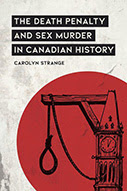
  • Ken Leyton-Brown reviews Carolyn Strange’s The Death Penalty And Sex Murder in Canadian History (University of Toronto Press, 2020).
  • Legal Historians Recorded: UVA Dean Risa Goluboff  testifies in favor of the confirmation of Judge Ketanji Brown Jackson.  Executive Director Ajay Mehrotra in the Season One finale of the ABF’s podcast "Whose Law Is It Anyway?"
  • The Delaware Heritage Commission’s notice of the death of Delaware Supreme Court Justice Randy J. Holland, whose 2013 book, Delaware’s Destiny Determined by Lewes appears on the Commission's website.
  • Marcus Rediker's eight tips “about the vexatious business of getting unruly words down onto the page.”
  • Gerard Magliocca, Samuel R. Rosen Professor of Law at Indiana University McKinney School of Law, explains why he wrote Washington’s Heir: The Life of Justice Bushrod Washington (Oxford University Press, 2022) (Current).
Weekend Roundup is a weekly feature compiled by all the Legal History bloggers.

Friday, March 25, 2022

Yackee on Colonialism, Foreign Investment and the Frieden Thesis

Jason W. Yackee, University of Wisconsin Law School, has posted Colonialism, Foreign Investment and Property Rights Reconsidered, a paper he will present next month at the 79th Annual Midwest Political Science Conference:

In an article in [International Organization], now somewhat old but still regularly cited, Professor Jeffrey Frieden (1994) imaginatively presented European colonialism as resolving what has become known as the “credible commitment” problem in the IPE literature on foreign investment. Frieden claimed that colonialism’s aim or function was to prevent expropriation of metropolitan investment. I revisit Frieden’s provocative interpretation, arguing that it gets things wrong—both about colonialism and investment. The better interpretation highlights themes associated with the school of historical rather than of rational institutionalism: the role of subjective ideas; of path dependence, and of unintended consequences. Through a close examination of French colonialism in Africa I show that the problem of credible commitment was both subjectively and objectively absent, and that patterns of colonial investment are better explained as a function of material factors, then-dominant economic beliefs and ideas, and the French government’s policy interventions and abstentions. The investment story of French colonialism in Africa is about the relative lack of private investment—arguably due, at least in part, to an excess of rights, allocated to the wrong people and of the wrong type—even in those sectors of the economy that Frieden suggests are most sensitive to the colonial resolution of credible commitment problems.
–Dan Ernst

Thursday, March 24, 2022

Kesselring and Stretton"s "Marriage, Separation, and Divorce in England, 1500-1700"

K. J. Kesselring and Tim Stretton have published Marriage, Separation, and Divorce in England, 1500-1700, with the Oxford University Press:

England is well known as the only Protestant state not to introduce divorce in the sixteenth-century Reformation. Only at the end of the seventeenth century did divorce by private act of parliament become available for a select few men and only in 1857 did the Divorce Act and its creation of judicial divorces extend the possibility more broadly. Aspects of the history of divorce are well known from studies which typically privilege the records of the church courts that claimed a monopoly on marriage. But why did England alone of all Protestant jurisdictions not allow divorce with remarriage in the era of the Reformation, and how did people in failed marriages cope with this absence? One part of the answer to the first question, Kesselring and Stretton argue, and a factor that shaped people's responses to the second, lay in another distinctive aspect of English law: its common-law formulation of coverture, the umbrella term for married women's legal status and property rights. The bonds of marriage stayed tightly tied in post-Reformation England in part because marriage was as much about wealth as it was about salvation or sexuality, and English society had deeply invested in a system that subordinated a wife's identity and property to those of the man she married. To understand this dimension of divorce's history, this study looks beyond the church courts to the records of other judicial bodies, the secular courts of common law and equity, to bring fresh perspective to a history that remains relevant today.

--Dan Ernst

Wednesday, March 23, 2022

Bilder on Harriot and Lurie on Taft at SCHS

The Supreme Court Historical Society has announced two events.  The first is Mary Sarah Bilder, BC Law, who on April 12, 2022, at 3 pm (EDT) will speak on her new book, Female Genius: George Washington and Eliza Harriot at the Dawn of the Constitution, which she discusses in this interview in BC Law’s magazine.  Register for her SCHS event here.

The second is a lecture by Jonathan Lurie, Professor Emeritus of History at Rutgers University-Newark, on "Chief Justice William Howard Taft and the Judicial Conference–A Centennial Retrospective."  The lecture will take place on May 4, 2022, at12 p.m. (EDT) and draw upon Professor Lurie’s book, The Chief Justiceship of William Howard Taft, 1921-1930.  Register here.

--Dan Ernst

Tuesday, March 22, 2022

Karol on Durer's Trademark Suits

Peter Karol, New England Law, has posted Albrecht Durer's Enforcement Actions: A Trademark Origin Story, which is forthcoming in the Vanderbilt Journal of Entertainment & Technology Law:

Dürer (NYPL)
This article offers a reappraisal of a pair of remarkably contemporary enforcement actions brought by the Northern Renaissance artist Albrecht Dürer (1471-1528) against copyists of his work. These cases have long been debated by art, cultural and copyright historians insofar as they appear to reject Dürer’s demand for proto-copyright protection for his prints. But surprisingly little attention has been paid by trademark scholars to the companion holdings—in the same cases—that affirm Dürer’s right to prevent use of his monogram on unauthorized reproductions.

This article seeks to fill that gap by analyzing Dürer’s cases through the lens of contemporary trademark theory. It argues that, properly contextualized and understood, these cases provide the first complete record we have of tribunals enjoining the unsanctioned use of a famous mark in commerce both to protect consumers from purchasing mislabeled goods and preserve the source-associative power of that sign. In so doing, they show us a path towards recentralizing the role of artists and authors as a core aspect of trademark law’s otherwise industrial legal history.

--Dan Ernst

Monday, March 21, 2022

Dodge et al. on Forum Non Conveniens

William S. Dodge, University of California, Davis School of Law, Maggie Gardner, Cornell Law School, and Christopher A. Whytock, University of California, Irvine, School of Law, have published The Many State Doctrines of Forum Non Conveniens, which is forthcoming in the Duke Law Journal:

Forum non conveniens is not as “ancient” or as monolithic as U.S. courts often assume. The doctrine, which permits judges to decline to hear cases they believe would more appropriately be heard in another sovereign’s courts, is often used today by both state and federal courts to dismiss claims brought by against local businesses. The Supreme Court, however, only adopted a general doctrine of forum non conveniens in 1947; the doctrine’s “deep roots in the common law” are thought instead to be planted in the states.

This Article tests that account by surveying the forum non conveniens doctrines of all fifty states and the District of Columbia. What we found should change how judges, practitioners, and scholars view the doctrine. First, forum non conveniens in the states does not have a “long history”—it is a twentieth-century phenomenon. Second, before the 1950s, no states permitted dismissal of claims brought against local defendants. Third, state experience with forum non conveniens has been and continues to be highly variable. Most states adopted a forum non conveniens doctrine only after the Supreme Court did; many initially rejected it; and half a dozen still prohibit its use in cases involving in-state plaintiffs or in-state causes of action. Idaho has not recognized the doctrine at all.

In addition to these doctrinal lessons, the states’ experience with forum non conveniens provides a useful case study for examining what we term “procedural federalism,” meaning the interactions between state and federal institutions that affect procedural development.

Procedural federalism reminds us that the procedure we have is not necessarily the “best” procedure we could conceive, while drawing our attention to pockets of divergence that may offer promising reforms. More broadly, it suggests a different approach to history than the one currently ascendant in federal courts and commentary. The iterative nature of procedural federalism makes clear that doctrines like forum non conveniens do not have perfect pasts, needing only to be rediscovered to be understood properly. Rather, procedural history is useful because it can help us understand how we ended up with the doctrines we have today, in order to better evaluate where we should go next.
--Dan Ernst

Sunday, March 20, 2022

American Legal History Symposium at Quinnipiac Law

“Topics in American Legal History,” an online symposium of the Quinnipiac University School of Law, takes place from 12-5 p.m. on Friday, March 25. It is free and open to the public, although registration is required.  Kate Masur, George Thomas, Elizabeth D. Katz, Philip Hamburger, and David Konig will present.  Professor Konig provides the keynote: "Teaching and Learning Law in the Early American Republic: What Professors Taught and What Students Learned."  More.

--Dan Ernst

Saturday, March 19, 2022

Weekend Roundup

  • "Rules and Exceptions: Casuistry, Equity, and Prerogative," the 2021-22 Cotterrell Lecture in Sociological Jurisprudence delivered by Lorraine Daston, Director Emerita of Max Planck Institute for the History of Science and Professor at the Committee on Social Thought at the University of Chicago, is now available on Queen Mary University of London’s YouTube channel
  • On March 31, the American Foundings series at the Catholic University of America continues with How Should We Remember? History, Meaning, and Community.  The panelists are Jack Rakove, Coe Professor of History and American Studies Emeritus, Stanford University; Jamelle Bouie, Opinion Columnist, New York Times, and Kate Masur, Professor of History, Northwestern UniversitySamuel Fisher, Assistant Professor of History, Catholic University of America, moderates.
  • On March 30, The National Museum of American History will posthumously present its Great Americans Medal to Ruth Bader Ginsburg “for her groundbreaking judicial work and commitment to gender equality and human rights accepted by her daughter and son  Professor Jane C. Ginsburg and James Ginsburg followed by a donation of significant artifacts representing Justice Ginsburg's Supreme Court career.”  More.
  • Also via National Archives Museum Online: Laura F. Edwards in conversation with Adam Rothman on her book, Only the Clothes on Her Back. More.
  • "The Cold War and the Canon of Liberalism," the 2022 Carlyle Lectures at the University of Oxford, by Samuel Moyn, Yale Law School, are available here.
  • In “The Economic Constitution,” Mark A. Graber reviews The Anti-Oligarchy Constitution: Reconstructing The Economic Foundations of American Democracy, by Joseph Fishkin and William Forbath (Democracy). 
  • Update: Legal history figures among the twenty-nine finalists for the ABA’s 2022 Silver Gavel Awards for Media and the Arts (ABA Journal).

Weekend Roundup is a weekly feature compiled by all the Legal History bloggers.

Friday, March 18, 2022

Steilen on the Steel Seizure Case

Matthew J. Steilen, SUNY at Buffalo Law School, has posted Life and Afterlife in the Steel Seizure Case, which is forthcoming in the Buffalo Law Review:

Robert H. Jackson (LC)
This Essay examines the proper role of the Supreme Court in deciding disputes between Congress and the President. Progressive commentators have recently argued that the Court ought to dismiss these cases as political questions, at least where doing so would give effect to congressional regulations of the President. The Court's interference is criticized as anti-democratic. The Essay advances a different conception of the Supreme Court's role by examining the famous Steel Seizure Case. In that case, the Court upheld an injunction barring President Truman from seizing the nation's steel mills, on grounds that doing so conflicted with a federal statute. The subsequent embrace of Justice Jackson's concurrence shows how Supreme Court decisions can guide the political resolution of disputes between Congress and the President. In its "afterlife"--its use by members of Congress, Executive Branch lawyers, and in later litigation--Jackson's concurrence has acquired a kind of democratic authority. It was quoted in legislative debates preceding the passage of the War Powers Resolution, the National Emergencies Act, and the Presidential Recordings Act, among other statutes. Justice Jackson’s broad, theoretical language and flexible framework proved useful to representatives. By constructing his concurrence this way, Jackson helped give it an afterlife and an essential place in structuring the political maintenance of our Constitution's separation of powers.
--Dan Ernst

Belt to Speak on "Disabling Democracy" at Georgetown Law

 [We have the following announcement.  DRE]

The Georgetown Legal History Colloquium continues on Monday, March 21 from 3:30-5:00, with Rabia Belt, Stanford Law School.  We will be discussing a chapter from Professor Belt's forthcoming book, "Disabling Democracy in America: Mental Incompetence, Citizenship, Suffrage, and the Law, 1819-1920."  The book examines how ideas about mental incompetence shaped the development of voting rights over the course of the long 19th century. The chapter we will be discussing explores the implications a continuous preoccupation with the meaning of mental incompetence had for Black voters both before and after the Civil War. The chapter is attached; please do not share it with others without permission.

Please note that this session will be online. Please register in advance using this link.  You will receive a Zoom link for the event after you register. If you have any difficulty registering, please let us know.

As before, if you know anyone who would like to attend, please ask them to contact us directly, and we will send them the registration link and paper. We look forward to seeing you!

K-Sue Park & Kevin Arlyck
Kevin.Arlyck@georgetown.edu

Thursday, March 17, 2022

Legal History Fellowships Announced

It must be that time of year: We recently received word of the award of three leading fellowships in Legal History.  First, the Berger-Howe:

Harvard Law School is pleased to announce that Jesse James will be the Raoul Berger-Mark DeWolfe Howe Legal History Fellow for the academic year 2022-2023.  Mr. James is a Ph.D. candidate in the Department of Classics at Columbia University, where he is completing his dissertation on “Greek International Law: Networks, Socialization, and Compliance.”  He received his B.A. in Classics from Cornell University and a J.D. from the University of California at Berkeley School of Law.  He is a regular member of the American School of Classical Studies at Athens.
Second, the Stanford Center for Law and History has announced that its fellow for 2022-2024 is Doris Morgan Rueda, a Ph.D. candidate at the University of Nevada, Las Vegas.  "Her research focuses on the development of juvenile justice systems in the American Southwest with a special interest in international juvenile justice, race, and Latinidad in the 20th century." 

Finally, a little bird (i.e. Twitter) just told us that Rafi Stern, a J.D.-Ph.D. candidate at Harvard, will be the Golieb Fellow at NYU Law for 2022-2023.

--Dan Ernst

RFP: History of the Third Circuit

 The US Court of Appeals for the Third Circuit has issued the following request for proposals for "publication of a history of the United States Court of Appeals for the Third Circuit” DRE]

Project overview: This request seeks proposals for a publication memorializing the history of the United States Court of Appeals for the Third Circuit.

Background: In 1982, a book titled Studies in the History of the United States Courts of the Third Circuit 1790-1980 was published. The Third Circuit Bicentennial Committee engaged Professor Stephen B. Presser to prepare this work. Much of the book chronicles the history of the United States District Courts within the Third Circuit. As Professor Presser acknowledged in his introduction, he “had written relatively little on the Court of Appeals,” (page viii), and only dedicated the final chapter in the book—thirty-two pages in length—to the Court of Appeals. The book may be accessed [here]. In the following years, many of the District Courts within the Third Circuit published histories of their courts. The Court of Appeals for the Third Circuit now seeks to publish its own history.

Research: A robust collection of primary and secondary sources is in the Court of Appeals for the Third Circuit’s archives and available for this project. These sources include judges’ papers, minutes, oral histories, photographs, annual reports, Third Circuit publications, and various books and articles. In addition, the substance of Studies in the History of the United States Courts of the Third Circuit 1790-1980 may be reproduced and otherwise employed, as the author does not own a copyright in that book.

Substantive Contents: Possible topics for the book may include the growth of the Court to its present size and changes over time, the culture and traditions of the Court, its role in shaping the law in certain areas (e.g., class actions, bankruptcy) and in different epochs (e.g., women’s suffrage, prohibition and organized crime, Civil Rights era decisions, the internet age), the influence of technology on Court business, and the COVID-19 experience.

Project Term: Thirty-six months or less from the signing of a contract with the author or authors.

Content of Proposal: Proposals should, among other things, detail the submitter’s vision for the project (including substantive content), the author(s) and each author’s biography, and suggested compensation. 

Deadline for Proposal: The deadline for proposals is June 30, 2022.

Submit Proposals to:
Hon. Michael A. Chagares, Chief Judge
United States Court of Appeals for the Third Circuit
James A. Byrne United States Courthouse
601 Market Street
Philadelphia, PA 19106
c/o joel_mchugh@ca3.uscourts.gov 

For inquiries, contact:
Joel McHugh
Deputy Circuit Executive
United States Court of Appeals for the Third Circuit
James A. Byrne United States Courthouse
601 Market Street
Philadelphia, PA 19106
joel_mchugh@ca3.uscourts.gov

Wednesday, March 16, 2022

New FJC Exhibit on the U.S. Court of Appeals

[The Federal Judicial Center has a new exhibit, The Role of the U.S. Courts of Appeals in the Federal Judiciary.  Here’s the introduction.  DRE]

Supreme Court Justice Byron White said in 1984, “Each of the courts of appeals . . . is for all practical purposes the final expositor of the federal law within its geographical jurisdiction.” More recently, a law professor wrote, “In large measure, it is the circuit courts that create U.S. law. They represent the true iceberg, of which the Supreme Court is but the most visible tip. The circuit courts play by far the greatest legal policymaking role in the United States judicial system.”

When Congress established them in 1891, the U.S. circuit courts of appeals (as they were known then) did not occupy such a lofty position in the federal judiciary. Created as a level of intermediate courts, their job consisted almost entirely of correcting errors made by the trial courts to relieve caseload pressure on the Supreme Court of the United States. Since that time, however, the U.S. courts of appeals have undergone significant change. As caseloads continued to rise during the early twentieth century, the Supreme Court lobbied for and was granted more discretion over its docket. A growing number of federal appeals became final in the courts of appeals unless the Supreme Court elected to hear them. With the courts of appeals as the last point of appellate review for the vast majority of federal cases, they expanded upon their initial—but still crucial—function of error correction and became instrumental in expounding the law as well.

The evolution of the courts of appeals and the increasing importance of their role are important themes permeating the broad historical overview of the courts provided here. This feature is divided into ten sections: 1) The Creation of the U.S. Courts of Appeals; 2) The Judges’ Bill of 1925; 3) Changing Dockets; 4) Differences Between Circuits; 5) Law of the Circuit; 6) En Banc Review; 7) Circuit Splits; 8) Implementation of Remedies; 9) Cases; and 10) Judges.

This feature is intended to expand upon the following existing resources from the FJC’s History of the Federal Judiciary website:

An overview page provides a brief history of the courts of appeals and links to more specific information about the appellate court in each judicial circuit. A page on the Evarts Act of 1891 summarizes the statute that created the courts of appeals and gives the full text of the law. An essay on the appellate jurisdiction of the federal courts details the kinds of cases the appellate courts have heard throughout their history. Finally, Volume II of Debates on the Federal Judiciary: A Documentary History covers legislative debates concerning the establishment of the courts of appeals.

Jansen to Lecture on Kantorowicz

On Wednesday, March 30, Professor Nils Jansen will give the Wilson Memorial Lecture at the Edinburgh Law School.  His topic will be "Hermann Kantorowicz' Concept of Legal Science and the Social Role of Legal Scholarship, Today":

Hermann Kantorowicz was a scholar who bridged the intellectual divide between Common and Civil Law both through his biography and his highly extensive work, which connected legal history, legal theory, and criminal law. This lecture will focus on Kantorowicz's idea of legal science. It will endeavour to show that Kantorowicz's problems still face us today and that there is a lot to learn from the questions he raised. One reason is that he discussed these questions in a manner which engaged deeply with contemporary philosophical scholarship (i.e. Heinrich Rickert, Wilhelm Windelband, and Max Weber). The other reason is that Kantorowicz developed his ideas of legal science wholly independently of 19th century (or contemporary) programmes aimed at re-constructing the law in the form of a fully rational and internally coherent system. In this respect, Kantorowicz's ideas fit in well with modern, more fluid, and complex notions of law and multi-layered legal systems.
You may attend  in person or online.  Details here.

--Dan Ernst

Tuesday, March 15, 2022

Fischer, "The Streets Belong to Us Sex, Race, and Police Power from Segregation to Gentrification"

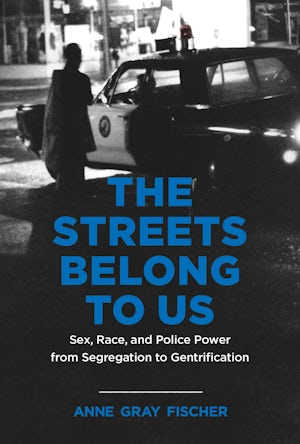
New from the University of North Carolina Press: The Streets Belong to Us: Sex, Race, and Police Power from Segregation to Gentrification, by Anne Gray Fischer (University of Texas at Dallas). A description from the Press:

Police power was built on women's bodies.

Men, especially Black men, often stand in as the ultimate symbol of the mass incarceration crisis in the United States. Women are treated as marginal, if not overlooked altogether, in histories of the criminal legal system. In The Streets Belong to Us—a searing history of women and police in the modern United States—Anne Gray Fischer narrates how sexual policing fueled a dramatic expansion of police power. The enormous discretionary power that police officers wield to surveil, target, and arrest anyone they deem suspicious was tested, legitimized, and legalized through the policing of women's sexuality and their right to move freely through city streets.

Throughout the twentieth century, police departments achieved a stunning consolidation of urban authority through the strategic discretionary enforcement of morals laws, including disorderly conduct, vagrancy, and other prostitution-related misdemeanors. Between Prohibition in the 1920s and the rise of "broken windows" policing in the 1980s, police targeted white and Black women in distinct but interconnected ways. These tactics reveal the centrality of racist and sexist myths to the justification and deployment of state power. Sexual policing did not just enhance police power. It also transformed cities from segregated sites of "urban vice" into the gentrified sites of Black displacement and banishment we live in today. By illuminating both the racial dimension of sexual liberalism and the gender dimension of policing in Black neighborhoods, The Streets Belong to Us illustrates the decisive role that race, gender, and sexuality played in the construction of urban police regimes.

A sample of advance praise:

“Anne Gray Fischer’s crucial book reveals the utterly pivotal role of the sexual policing of Black women in the vast buildup of police power across the twentieth-century United States. Brilliantly researched and compellingly argued, The Streets Belong to Us is a must-read for all who seek to understand the making of today’s policing crisis.”—Emily Thuma

"Well written, intellectually rigorous, and compelling, this impressive book tackles long-standing issues of policing and gender through the legal policies that impacted American women from the Great Depression to the mid-1990s. Its argument is historical and yet all too timely, making devastatingly clear how women's bodies, and particularly Black women's bodies, were central to strengthening and legitimizing the same carceral policing that violated and oppressed them."—Cheryl Hicks

The book is part of the Press's Justice, Power, and Politics series, edited by Heather Ann Thompson and Rhonda Y. Williams. 

More information is available here.

-- Karen Tani