Thursday, November 11, 2021

Cromwell Article Prize to Whiting

Each year, the William Nelson Cromwell Foundation makes a series awards, targeting graduate students and early career legal historians, on the recommendation of committees of the American Society for Legal History and announced at the ASLH's annual meeting.  The first we’ll notice is the Cromwell Article Prize, awarded to Gloria McCahon Whiting, “Race, Slavery, and the Problem of Numbers in Early New England: A View from Probate Court,” William and Mary Quarterly 77, no.3 (2020): 405-440.  Here is the citation:

Gloria McCahon Whiting’s “Race, Slavery, and the Problem of Numbers in Early New England: A View from Probate Court” is a creative, brave, and rigorous exemplar of legal history scholarship. Through an insightful, imaginative analysis of tens of thousands of probate court transactions in Suffolk County, Massachusetts, from 1639 to 1769, Whiting shows how historians can use legal archives to analyze both the structural contours of coercive institutions and the qualitative experiences of the individuals who strove to make lives within them.

Whiting’s use of legal archives makes an important intervention in slavery studies, where recent debates have questioned the reliance on such materials for their potential to repeat the violence that the law once rendered against enslaved persons. Using these archives can affirm the vision of those in power, dehumanizing the enslaved by representing them only through aggregation and abstraction. Whiting, however, shows the utility of these materials.  In her hands, aggregation does justice to historical subjects by accurately rendering the systems of power they endured. With careful counting, she upends conventional assumptions about the practice of slavery in colonial New England, demonstrating that enslaved persons of African descent quickly replaced indentured European labor and that Native Americans were never a significant source of bound labor in the region. She also uses the records to reveal qualitative insights into enslaved persons’ efforts to shape their own lives: to form families, make claims on owners and their heirs, hold property, engage in commerce, and seek freedom. Whiting excavates the persuasive talents of a bondsman name Titus who convinced the heirs of a slave owner to draft manumission papers. She writes about a girl in bondage named Rose who learned to read, studied religion, and convinced an owner that his claims to property in her were illegitimate. She traces kin relationships and documents property holdings of enslaved persons. She asks readers to imagine the world map that hung above the bed of an enslaved man named Philip and to consider what he might have imagined and remembered as he gazed at it. This article, modest and measured in tone, is an understated, yet vitally important and courageous piece of scholarship that uses law to understand the dynamics of power and the humanity of the powerless.
–Dan Ernst

Wednesday, November 10, 2021

Ramnath Receives Burbank and Surrency Prizes

We continue our posting of announcements and awards from the just-concluded annual meeting of the American Society for Legal History with an article that received two prizes: Kalyani Ramnath’s “Intertwined Itineraries: Debt, Decolonization, and International Law in Post-World War II South Asia,” Law and History Review 38 (February 2020).  It received the 2021 Jane Burbank Prize in Global Legal History with the following citation:

"Intertwined Itineraries" traces a routine case for debt recovery across jurisdictions in South Asia during the upheaval of decolonization and post war independence. In so doing, Ramnath weaves together histories of decolonization, legal pluralism, migration, jurisdiction, and professional legal networks in the making of international law. Beautifully written and well researched, Ramnath shows the reader how numerous and less well known partitions shaped the Indian subcontinent in 20th century South Asian political history.
It also received the 2021 ASLH Surrency Prize:
Kalyani Ramnath’s “Intertwined Itineraries” charts a whole world of law in motion.  From the courts of Madras to the rice and rubber fields of Southeast Asia, and from there to the law libraries of the Netherlands and India, she traces the travels of a single dispute and its afterlives across several genres of legal writing. She assembles a disparate cast of characters – a Tamil-Speaking Chettiar widow in Madras, a Polish scholar-in-exile, a Dutch scholar of international law in Utrecht – and threads her narrative needle through the most unlikely of places. The result is nothing less than a complete retelling of the histories of decolonization and international law in the Indian Ocean world, and of the many lost streams, disputes, and lives that poured into it. “Intertwined Itineraries” is an ambitious, bold, and breathtakingly creative piece of scholarship.
–Dan Ernst

Tuesday, November 9, 2021

Treanor to Deliver Chase Lecture on Gouverneur Morris

The Supreme Court Historical Society and the Georgetown Center for the Constitution will hold the 8th Annual Salmon P. Chase Lecture on November 17 at 6 pm EST.  William Treanor, Dean of the Georgetown University Law Center, will deliver The Case of the Dishonest Scrivener: Gouverneur Morris and the Creation of the Federalist Constitution in person in the Hart Auditorium in Georgetown Law’s McDonough Hall, 600 New Jersey Ave., NW.   The sponsors will livestream the event.  You may register here.

The Society is still accepting registrations for two other lectures.  The Original Meaning of the 14th Amendment, with Randy Barnett and Evan Bernick, will be held at noon on November 10. Making Minimum Wage: Elsie Parrish v. The West Coast Hotel Company with Helen Knowles will be held on December 8 at noon.  

--Dan Ernst

ASLH Election Results

Another announcement from the annual meeting of the American Society for Legal History: election results.

President-Elect: Barbara Welke

New members of the Board: Laura Edwards, Maggie Blackhawk, Michael Lobban, Lucy Salyer, and Dan Hulsebosch
 
New members of the Nominating Committee: John Wertheimer and Nurfadzilah Yahaya
 
Congratulations to all, and many thanks to those who are rotating out of these important positions.
 
-- Karen Tani

Monday, November 8, 2021

ASLH Names Whitman Honorary Fellow

 [Here is the citation for the Honorary Fellowship of the American Society for Legal History for James Q. Whitman.  It was read by Amalia D. Kessler, Lewis Talbot and Nadine Hearn Shelton Professor of International Legal Studies, Stanford Law School. DRE]

--This final announcement is particularly meaningful to me.

--I've learned from many truly remarkable teachers-several of whom are here. But there is only one Jim Whitman.  

--Ford Foundation Professor of Comparative and Foreign Law at Yale, Professor Whitman sets a model of scholarly erudition, brilliance, and creativity, as well as respectful, engaged and compassionate mentorship.  

--Professor Whitman is a prolific scholar, having published five monographs and at least fifty articles.  

--These works are extraordinary on multiple levels, including the depth of the learning on which they draw.
 
--Professor Whitman has an incredible command of numerous secondary and primary source literatures, spanning many different time periods and languages.  

--Indeed, his command of foreign languages alone is truly astounding.  

--But what is perhaps most remarkable is that he manages to draw on this erudition in ways that are never narrow and arcane but in service of a highly ambitious research agenda that probes some of the deepest, most enduring questions of social theory, while engaging directly with many of our most profound socio-legal challenges today.  

--His scholarship thus extends all the way from ancient Rome to the present-day and examines an incredibly diverse range of topics.  

--It has been recognized with numerous scholarly awards, as well as visiting professorships and honorary doctorates from around the globe.  

--His very first book, The Legacy of Roman Law in the German Romantic Era: Historical Vision and Legal Change, already demonstrates his unique ability to identify the profound interconnections between seemingly technical aspects of law and legal doctrine and our most profound social and political questions.
 
--By the end of this tour de force, we understand how it came to seem obvious to so many nineteenth-century German law professors and their followers that it was only through the study of ancient Roman law that it would be possible to develop a modern legal and political system suited to the distinctive "spirit" of the German people.

--In Harsh Justice: Criminal Punishment and the Widening Divide between America and Europe and a series of related articles, Professor Whitman develops his signature approach to comparative law, which focuses on divergences rather than convergences and roots these in deeply embedded historical structures.  

--More particularly, he locates the origins of continental European conceptions of dignity in a much older law of honor that was long central to maintaining the continent's legally enshrined status hierarchies.  

--Modern dignity law in Europe, he argues, arose as an effort to democratize upward, extending aristocratic treatment to all.  

--In contrast, the United States democratized by levelling downward.  

--The end result was the emergence of radically different approaches to a range of vital legal questions on the two sides of the Atlantic-including, among others, criminal punishment, privacy, and antidiscrimination.

--In The Origins of Reasonable Doubt: Theological Roots of the Criminal Trial, Professor Whitman brings together an extraordinary array of legal, philosophical and theological texts penned from the middle ages through the eighteenth century, on both sides of the English Channel, in order to reframe our understanding of Anglo-American criminal law's reasonable doubt standard.  

--Restoring the central role of theology in shaping law and legal systems for centuries, he rejects the commonly held understanding that the standard was intended to protect the criminal defendant from wrongful conviction and argues instead that it was designed to facilitate conviction by assuaging the anxieties of judges and jurors who feared that they would be eternally damned for sentencing someone to death.

--Professor Whitman's book, The Verdict of Battle: The Law of Victory and the Making of Modern War, inquires into the demise of the early-modern pitched battle.
 
--Drawing on a vast and difficult literature in multiple languages, he argues that the pitched battle is best understood as a legal procedure for resolving property disputes between competing sovereigns.  

--As such, it facilitated the construction of procedural rules that made it easy to determine which party was the victor, thus enabling adversaries to lay down arms relatively quickly and with limited bloodshed.  

--Troublingly, it was in no small part the rise of the modern republic that undermined this international legal system, giving rise to a previously unnecessary body of humanitarian law focused on minimizing the horrors of war.

--Professor Whitman's most recent book, Hitler's American Model: The United States and the Making of Nazi Race Law, examines American laws of race from the perspective of the German jurists responsible for building the Nazi legal system, demonstrating that contemporary U.S. race-based immigration law and anti-miscegenation laws served as a key model for the enactment of the Nuremberg laws.  

--In a recent conversation, our fellow legal historian Steven Wilf shared with me a wonderful Charlotte Brontë quote with which I was unfamiliar.  

--Writing to her publisher, Brontë praised a recent book she had read, noting that it "seems to give me eyes."  

--Through his pathbreaking scholarship and teaching, Professor Whitman has given eyes to all of us, profoundly transforming our understanding of the European past and its persistent legacies-and in ways that are sure to endure.  

--It is a great honor and pleasure to welcome him as an Honorary Fellow of the Society.

ASLH Names Tau Anzoátegui Honorary Fellow

[Here is the citation for the Honorary Fellowship of the American Society for Legal History for Víctor Tau Anzoátegui.  It was read by Amalia D. Kessler, Lewis Talbot and Nadine Hearn Shelton Professor of International Legal Studies, Stanford Law School. DRE]

--The Society is pleased to welcome as Honorary Fellow Víctor Tau Anzoátegui, former Titular Regular Professor of the History of Argentine Law in the Faculty of Law and Social Sciences of the University of Buenos Aires and Senior Researcher at the National Council for Scientific and Technical Research of Argentina.  

--Professor Tau is the pre-eminent legal historian of Latin America.  His work revolutionized the field of early modern Spanish American law.  

--He is also known as a generous mentor, not just to his own students but to every young scholar who crosses his path.

--Professor Tau graduated from the Faculty of Law and Social Sciences of the University of Buenos Aires as an Abogado in 1957.  

--He received a doctorate in Law and Social Sciences from the same faculty in 1963.  

--In addition to his position at the University of Buenos Aires, he has been Professor of the History of Public Law at the Catholic University of Argentina, First Deputy Director of the Instituto de Investigaciones de Historia del Derecho since 1995, and President of Argentina's Academia Nacional de la Historia (1994-1999).  

--He is a member of the national academies of history of Argentina, Spain, Peru, Bolivia, Paraguay, Uruguay, Brazil, Puerto Rico, Guatemala, and Colombia, and has been a visiting professor at the University of Hamburg, the Autonomous University of Barcelona, and the University of Oviedo.

--Before Professor Tau began his work, the standard narrative was that law in Spanish America was essentially an extension of centralized royal authority in Spain.  

--Colonial law in this view was expressed through royal decrees that defined the derecho indiano-the law of the Indies-as something largely separate from Spanish law itself and independent of social or cultural influences.  

--Professor Tau's great insight was that colonial law was not a separate domain-that neither in the colonies nor in Spain was there a codified written law, nor could law be reduced to royal orders.  

--Instead, he revealed the pervasiveness of customary law and wrote extensively about the messy character of Spanish American law.  

--Little by little by little, he dismantled the assumptions of the preceding generations.  
--He directed attention away from royal legislation, insisting instead that there was no one law but many different laws, that there was no coherent theoretical system but one based on specific solutions to specific problems, and that the authorities engaged in the task of making and applying the law were not just Spanish but also Indigenous, African, and local, as well as experts of all kinds and shapes.

--Professor Tau first articulated this approach in two volumes published in 1992, The law in Hispanic America: From Discovery to Emancipation and Casuismo y Sistema: Historical Inquiry into the Spirit of Derecho Indiano.  

--He was already justly celebrated for major works in Argentine national legal history that combined intellectual history, the history of institutions, political history, and the history of legal culture.  He expanded this perspective five years later in a third volume-New Horizons in the Historical Study of the Derecho Indiano-that set the agenda for the entire field.  

--Besides emphasizing the role of legal history as social and cultural history, Professor Tau identified previously-neglected research areas in the study of derecho indiano-such as histories of lawyers, book history, the importance of moral theology, the role of jurists, the production of local norms, and the long-lasting influence of colonial legal history on nation-states

--Beyond his own path-breaking scholarship, Professor Tau has invested deeply in the larger international community of legal historians.  

--For more than thirty years he has been a leader-and for many years director-of the most important institution dedicated to studying derecho indiano, the Instituto Internacional de Derecho Indiano in Buenos Aires.  

--Under his leadership, the Institute and its journal, Revista de Historia del Derecho, became an important center for research on legal history far beyond Argentina.  

--From his perch at the Institute, Professor Tau-a genuinely warm, open scholar who delights in the company of those who delight in legal history-has inspired generations of scholars in Argentina, Brasil, Mexico, Spain, Portugal, France, Italy, the Netherlands, Germany, the United States, and elsewhere, and connected them with one another as they pursued their research.  

--Indeed, every scholar we consulted commented on how generous Professor Tau had been to them when they were junior scholars or even graduate students who had wandered into the library of his Institute.

--The scholars we elect as Honorary Fellows are distinguished not simply by scholarship that has shaped the broad discipline of legal history and influenced the work of others, but also by their commitment to building their fields and helping other, younger, scholars stand on their shoulders and carry the work forward.  

--For decades, Professor Tau's care for the field he transformed and for the people who work in it have shined through everything he does.  

--He is a truly gifted, accomplished, and generous scholar who has revolutionized his field and built an international community while rarely leaving his birthplace, Buenos Aires.  

--We are pleased and honored to welcome him as an Honorary Fellow of the Society.

ASLH Names Dorsett Honorary Fellow

[Among the events at last weekend's annual meeting of the American Society for Legal History in New Orleans was the announcement of three new Honorary Fellows of the Society.  As the ASLH website explains: "Election as an Honorary Fellow of the American Society for Legal History is the highest honor the Society can confer. It recognizes distinguished historians whose scholarship has shaped the broad discipline of legal history and influenced the work of others. Honorary Fellows are the scholars we admire, whom we aspire to emulate, and on whose shoulders we stand." 

[Here is the citation for the first of the three, a frequent correspondent with LHB, Shaunnagh Dorsett. It was read by Amalia D. Kessler, Lewis Talbot and Nadine Hearn Shelton Professor of International Legal Studies, Stanford Law School.  DRE]

--The Society is pleased to welcome as an Honorary Fellow Shaunnagh Dorsett, Distinguished Professor at the Faculty of Law, University of Technology Sydney, and Faculty Research Fellow at the Faculty of Law, Victoria University of Wellington.  

--Professor Dorsett is a preeminent and influential scholar in the relatively young field of legal history in Australia and New Zealand.

--Professor Dorsett received a B.A. and LL.B. with Honours from the University of Tasmania in 1990 and an LL.M. from the University of Calgary in 1996.  

--In 2005 she received her Ph.D. from the University of New South Wales for her thesis, "Thinking Jurisdictionally: A Genealogy of Native Title."  

--She began her teaching career at Griffith University, where she rose to Senior Lecturer on the Faculty of Law before moving to the Faculty of Law of Victoria University of Wellington in 2004, first as Senior Lecturer, then as Reader-in-Law.  

--Upon joining the Faculty of Law at the University of Technology Sydney, in 2010, she continued her affiliation with the Faculty of Law at Victoria University as a Faculty Research Fellow.

--Across three books, two co-edited volumes of essays, and over forty articles and book chapters, Professor Dorsett has opened areas of study and speculation where no one had gone before, becoming a vital force in the advancement of Australasian legal history.  

--Her work is widely admired and is recognized internationally.  

--She has made major scholarly contributions to the legal history of 19th-century New Zealand and Australia, the wider legal history of the British Empire, and the jurisprudence of jurisdiction.  

--She has added enormously to our knowledge of the legal history of settler societies in the British diaspora, with particular reference to the encounter between Indigenous law and European law.  

--She writes about Australasia, Fiji, the Cape Colony, Gibraltar, and Canada.  

--Her work is read avidly by those who research settler-indigenous relations around the world, not only for its insights, but also for its method and style.  

--In her most recent book-Juridical Encounters: Maori and the Colonial Courts 1840-1852, published in 2017-Professor Dorsett combined an authoritative grasp of the jurisprudence of jurisdiction with exceptional empirical research to illuminate the wider process of colonization.  

--The book received awards from the Archives and Records Association of New Zealand and the Australian and New Zealand Law and History Society (2018).  

--It also was a finalist for the Ernest Scott Prize, awarded by the University of Melbourne to the book judged the most distinguished contribution to the history of Australia or New Zealand,

--Professor Dorsett is widely regarded as a brilliant mentor.  

--She is a superb communicator who is much in demand as a keynote speaker in the English-speaking world.  

--She is known for her tireless activity in organizing conferences, workshops, and colloquia, serving on editorial boards and prize committees, and creating and sustaining a worldwide network of scholars.  

--As one scholar and current Honorary Fellow of the Society told us, Professor Dorsett "stands at the very peak of Australasian engagement with legal history."  

--No one has contributed more in recent years to the field of legal history in Australia and New Zealand.  

--Through her scholarship and her mentorship and encouragement of other scholars, Professor Dorsett is, in the words of another scholar and current Honorary Fellow, truly "a vital force in the advancement of Australasian legal history."

--The scholars we elect as Honorary Fellows are distinguished exemplars who are as committed to building a future for their fields as they are to studying the past.  

--Professor Shaunnagh Dorsett is a worthy addition to that company.

--We are pleased and honored to welcome her as an Honorary Fellow of the Society.

CFP: Michigan Law 2022 Junior Scholars Conference

 [We have the following announcement.  DRE]

Michigan Law School 2022 Junior Scholars Conference, April 22-23, 2022.  Call for Papers
Deadline for Submission: January 10, 2022.  

The University of Michigan Law School is pleased to invite junior scholars to attend the 8th Annual Junior Scholars Conference, which will take place in-person on April 22-23, 2022, in Ann Arbor, Michigan.

The Conference provides junior scholars with a platform to present and discuss their work with peers and receive feedback from prominent members of the Michigan Law faculty. The Conference aims to promote fruitful collaboration between participants and to encourage their integration into a community of legal scholars. The Junior Scholars Conference is intended for academics in both law and related disciplines. Applications from graduate students, SJD/PhD candidates, postdoctoral researchers, lecturers, teaching fellows, and assistant professors (pre-tenure) who have not held an academic position for more than four years, are welcomed.

Cooperation with Michigan Law Journals: We are excited that this year the Conference will collaborate with several Michigan Law journals, all of which are among the highest ranked in their respective fields. The Michigan Law Review, the Michigan Journal of International Law, the Michigan Journal of Gender and Law, the Michigan Journal of Race and Law, Michigan Technology Law Review, the Michigan Journal of Law & Society, the Michigan Journal of Law Reform, and the Michigan Business & Entrepreneurial Law Review will give serious consideration to publish papers selected for the Conference that are within each journal's research agenda and meet its requirements. Additional details on the publication process will be provided after selection for participation in the Conference itself has been completed. In any event, there will be no obligation to accept any offer of publication that you may receive.

Submission: To apply to the Conference, please submit an abstract of no more than 500 words reflecting the unpublished work that you wish to present and a copy of your CV through the online submission form by January 10, 2022. Please submit all files as Microsoft Word documents. Please name the documents using the following format: Last name - First name - The nature of the document you are submitting (whether it be abstract, CV or funding). For example, the name of the abstract you are submitting would be: VAN DIJCKE - HANNAH - ABSTRACT. Selection will be based on the quality and originality of the abstract as well as its capacity to engage with other proposals and to foster a collaborative dialogue. Decisions will be communicated no later than February 9, 2022. Selected participants will be required to submit final papers by March 23, 2022, so that they may be sent to your faculty commentator and circulated among participants in advance.

Financial Assistance and Participation: A fund is available to help cover travel expenses and accommodation for selected participants. If you wish to be considered for financial assistance, please submit a separate written request through the online form specifying your city of departure, an estimate of travel costs, and other anticipated expenses for attending the Conference. We are aiming for this Conference to be an in-person event. However, if you are unable to travel to Ann Arbor because of travel restrictions, we are planning to provide an option for virtual attendance for those participants.

Questions may be directed to the Organizing Committee through the email address below.

Hannah Van Dijcke, Chair; Muhui Shi, Co-Chair        200 Hutchins Hall
Junior Scholars Conference Organizing Committee    625 South State Street
Center for International and Comparative Law            Ann Arbor, MI 48109-1215
University of Michigan Law School                            U.S.A.                
law-doconf@umich.edu

Friday, November 5, 2021

American Legal Education Abroad

NYU Press has published American Legal Education Abroad: Critical Histories, edited by Susan Bartie and David Sandomierski.  

The second half of the twentieth century witnessed the export of American power—both hard and soft—throughout the world. What role did US cultural and economic imperialism play in legal education? American Legal Education Abroad offers an unprecedented and surprising picture of the history of legal education in fourteen countries beyond the United States.

Each study in this book represents a critical history of the Americanization of legal education, reexamining prevailing narratives of exportation, transplantation, and imperialism. Collectively, these studies challenge the conventional wisdom that American ideas and practices have dominated globally. Editors Susan Bartie and David Sandomierski and their contributors suggest that to understand legal education and to respond thoughtfully to the mounting present-day challenges, it is essential to look beyond a particular region and consider not only the ideas behind legal education but also the broader historical, political, and cultural factors that have shaped them.

American Legal Education Abroad begins with an important foundational history by leading Harvard Law School historian Bruce Kimball, who explains the factors that created a transportable American legal model, and the book concludes with reflections from two prominent American law professors, Susan Carle and Bob Gordon, whose observations on recent disruptions within US law schools suggest that their influence within the global order of legal education may soon fall into further decline. This book should be considered an invaluable resource for anyone in the field of law.

An endorsement:

This fascinating collection of essays by eminent legal scholars and historians examines the global influence of American legal education. The essays are by no means formulaic, as the impact of American legal education is considered in the light of each country’s varied historical and political context, whether it be decolonization in Nigeria or post-Soviet experience in Estonia. The essays also eschew the simplistic and one-dimensional view that American legal education was accepted without question, as there was actual resistance on the part of France, for example, and Japan regarded it as irrelevant." ~Margaret Thornton, Professor of Law Emerita, The Australian National University
–Dan Ernst

Yang on Black Alternative to Police Ambulances in the Sixties

Tiffany Yang, Georgetown University Law Center, has posted “Send Freedom House!”: A Study in Police Abolition in volume 96 of the Washington Law Review:

Sparked by the police killings of George Floyd and Breonna Taylor, the 2020 uprisings accelerated a momentum of abolitionist organizing that demands the defunding and dismantling of policing infrastructures. Although a growing body of legal scholarship recognizes abolitionist frameworks when examining conventional proposals for reform, critics mistakenly continue to disregard police abolition as an unrealistic solution. This Essay helps dispel this myth of “impracticality” and illustrates the pragmatism of abolition by identifying a community-driven effort that achieved a meaningful reduction in policing we now take for granted. I detail the history of the Freedom House Ambulance Service, a Black civilian paramedic service in Pittsburgh, Pennsylvania, that was created in the late 1960s to confront the racialized violence and neglect inflicted by police ambulance drivers. This Essay outlines the now abolished practice of ambulance policing, explores the city’s response to Freedom House’s revolutionary program, and analyzes current efforts of police reform through this historical lens.

--Dan Ernst

Thursday, November 4, 2021

New Leadership at the Journal of Supreme Court History

[We have the following announcement.  DRE]

In June 2021, Melvin I. Urofsky retired as Chair of the Board of Editors of the Journal of Supreme Court History and as a member of the Publications Committee after giving exemplary and dedicated service to the Supreme Court Historical Society for nearly thirty years. Professor Urofsky’s departure is a significant loss for the Society, although he will stay on as an occasional book reviewer for the Journal.

We are pleased to announce that Timothy S. Huebner, the Associate Editor of the Journal has agreed to step up to become Chair of the Board of Editors. Huebner serves as Irma O. Sternberg Professor of History at Rhodes College and is the author of Liberty and Union: The Civil War Era and American Constitutionalism, The Southern Judicial Tradition: State Judges and Sectional Distinctiveness, 1790-1890, and The Taney Court: Justice, Rulings, and Legacy. “The Journal of Supreme Court History is the premier multi-disciplinary publication on the history of the Supreme Court and the Constitution, drawing together scholars and writers in the fields of history, the law and political science,” notes Huebner. “I consider it a high calling—and a real pleasure—to engage students, scholars, and the public about the history of this enduring yet evolving institution. I believe that in doing so, we all become better caretakers of our inherited tradition and wiser participants in our civic life.”
    
Timothy S. Huebner is the new Chair of the Board of Editors of the Journal of Supreme Court History. He serves as Irma O. Sternberg Professor of History at Rhodes College and is the author of Liberty and Union: The Civil War Era and American Constitutionalism, The Southern Judicial Tradition: State Judges and Sectional Distinctiveness, 1790-1890, and The Taney Court: Justice, Rulings, and Legacy.

Michael A. Ross, who has served on the Board for many years, will now take over as Associate Editor. Ross is Associate Professor of History at the University of Maryland and the author of Justice of Shattered Dreams: Samuel Freeman Miller and the Supreme Court during the Civil War Era and The Great New Orleans Kidnapping Case: Race, Law, and Justice in the Reconstruction Era.

Two new scholars, Brad Snyder and Helen J. Knowles, have agreed to join the Board of Editors. They join existing members Huebner, Ross, Ross E. Davies, Laura F. Edwards, Craig Joyce, Paul Kens, Lucas A. Powe Jr., and Donald Grier Stephenson Jr. Snyder teaches constitutional law, constitutional history, and sports law at Georgetown University. He is the author of The House of Truth: A Washington Political Salon and the Foundations of American Liberalism and A Well-Paid Slave: Curt Flood’s Fight for Free Agency in Professional Baseball. He recently contributed an article to the Journal titled Sacco-Vanzetti and the Supreme Court, and has given several lectures at the Supreme Court. Knowles teaches political science at Oswego State University of New York. She is the author of The Tie Goes to Freedom: Justice Anthony M. Kennedy on Liberty and Making Minimum Wage: Elsie Parrish v. The West Coast Hotel Company. Her article “May It Please the Court?: The Solicitor General’s Not So ‘Special’ Relationship–Archibald Cox and the 1963-1964 Reapportionment Cases” won the Society’s Hughes-Gossett Prize in 2006.

Finally, Mark Killenbeck, the Wylie H. Davis Distinguished Professor of Law at the University of Arkansas School of Law, has been named Consulting Editor, working with Executive Editor Clare Cushman to perform both line editing and content editing of articles. Professor Killenbeck has a long association with the Society. He has given two lectures in the Supreme Court chamber in the Society’s Leon Silverman Lecture Series and was the expert commentator for a Frank C. Jones Reenactment of the oral argument of the landmark decision M’Culloch v. Maryland (1819). His book, M’Culloch v. Maryland: Securing a Nation, published in 2006 by the University Press of Kansas, was the first book-length treatment of that important case.

Killenbeck was the inaugural speaker in the Historical Society’s First Monday Lecture series on October 7, 2019, with Justice Stephen G. Breyer as the host. More recently, he joined Farah Peterson, professor of law at the University of Chicago Law School, on October 4, 2021, for the second First Monday Lecture, a look back at the Supreme Court's 1821 term. He has also published a number of articles in the Journal, the most recent of which, “Fletcher, Whitney, and the Art of Disagreement,” was an expanded version of his 2019 First Monday lecture.

“The Society is delighted that we can formalize our long-standing relationship with Professor Killenbeck,” says Jim Duff, the Society’s Executive Director. “The Journal is an extraordinary publication,” Killenbeck observes. “It is a leading peer-reviewed venue that plays a key role in preserving the history of the Supreme Court, educating the bench, bar, and general public about the Court and the Constitution and their role in our nation. I look forward to working with the Society’s excellent staff and the Journal’s editors in the years ahead.”

Clare Cushman
The Supreme Court Historical Society

Wednesday, November 3, 2021

Torres-Spelliscy on "The Branding of Asian Immigrants in the Democratic and Republican Party Platforms and Supreme Court Opinions 1876-1924"

We recently noted Rabia Belt's contribution to the New York University Law Review's October 2021 symposium on "Voting and Representation: New Issues and Challenges." Another contribution of interest is "The Political Branding of Us and Them: The Branding of Asian Immigrants in the Democratic and Republican Party Platforms and Supreme Court Opinions 1876-1924," by Ciara Torres-Spelliscy (Stetson Law). Here's the abstract:

In this piece, I examine the political branding of Asian immigrants by comparing the rhetoric used in the political platforms of the Democratic and Republican parties from 1876 to 1924 to the language deployed in U.S. Supreme Court opinions during the same time period. The negative verbiage repeated at national political conventions branded the Chinese as a threat to labor, immoral, unassimilable, diseased, and invaders. Interestingly, the Republican authors of their political platforms were multiracial, and yet they produced rhetoric as harshly anti-Asian as their Democratic counterparts, who included ex-Confederate soldiers and even KKK members. And disappointingly, the Supreme Court picked up this derogatory language found in both parties’ political platforms and continued to echo it in cases that diminished the rights of Chinese and other Asian immigrants. This history is then linked to the present day through the example of the negative impact of politicians’ calling the contemporary COVID-19 pandemic “Kung Flu.” 

Read on here.

-- Karen Tani


Chemerinsky and Goodwin on Civil Liberties in Pandemics

Erwin Chemerinsky, University of California, Berkeley School of Law, and Michele Goodwin, University of California, Irvine, have published Civil Liberties in a Pandemic: The Lessons of
History
in the Cornell Law Review 106 (2021): 815-850

Throughout American history, whenever there has been a crisis the response has been a deprivation of rights. Today, the United States is in the midst of the worst health crisis in over a century. As of this writing, over 500,000 people have died. The pandemic reveals underlying institutional and infrastructural problems in society. We argue, based on history, there is every reason to fear that the pandemic could be used as justification for a massive deprivation of rights and abuses.

Part I of this Article sets the context: Throughout American history, whenever there has been a crisis the response has been an unnecessary loss of liberty. Part II describes how courts have widely used the test from Jacobson v. Massachusetts in analyzing the government’s restrictions that have been imposed in dealing with COVID-19 and explains why this is undesirable. Part III argues that the usual tests for constitutional rights should be applied in analyzing particular government restrictions and applies this in considering the restrictions that have been imposed in four areas: speech, religion, abortion, and business closure.

--Dan Ernst

Tuesday, November 2, 2021

Belt, "Mass Institutionalization and Civil Death"

The New York University Law Review has published "Mass Institutionalization and Civil Death," by Rabia Belt (Stanford Law School). The abstract:

Most scholars who study felon disenfranchisement trace its roots back to Reconstruction. Southern states drew up laws to disenfranchise people convicted of felonies as an ostensibly race-neutral way to diminish the political power of newly freed Black Americans. Viewed against this historical backdrop, the onset of mass incarceration in the current era expands the impact of a practice intended to be both racist and punitive from the start.

This account is true, but it is incomplete. Non-criminal mass institutionalization has also played—and continues to play—a role in systematic disenfranchisement. Marshaling a wealth of archival and historical evidence, from newspapers, legislative debates, congressional hearings, and court cases, I reveal that institutional disenfranchisement is not just about mass incarceration—a singular phenomenon sparked by the Civil War that happens solely within the carceral state and targeted only freed Black people. Institutional disenfranchisement began much earlier, included more spaces than the prison, and initially targeted white men. Indeed, the more familiar prison disenfranchisement had a shadowy twin within the welfare state. Civil death includes more ghosts than previously imagined.

Read on here. The article appears as part of a symposium on "Voting and Representation: New Issues and Challenges."

-- Karen Tani

Progressive Era Antitrust: A Seminar at USC Law


We've received this virtual poster for what looks to be an very important and interesting seminar at USC Gould Law on November 10.  To participate via Zoom, RSVP to AOpsRSVP@law.usc.edu.

--Dan Ernst

Monday, November 1, 2021

Evans on empire and madness

Catherine Evans (University of Toronto) has published Unsound Empire: Civilization and Madness in Late-Victorian Law with Yale University Press. The publisher calls this a "study of the internal tensions of British imperial rule told through murder and insanity trials." More from the press:  

Unsound Empire is a history of criminal responsibility in the nineteenth‑century British Empire told through detailed accounts of homicide cases across three continents. If a defendant in a murder trial was going to hang, he or she had to deserve it. Establishing the mental element of guilt—criminal responsibility—transformed state violence into law. And yet, to the consternation of officials in Britain and beyond, experts in new scientific fields posited that insanity was widespread and growing, and evolutionary theories suggested that wide swaths of humanity lacked the self‑control and understanding that common law demanded. Could it be fair to punish mentally ill or allegedly “uncivilized” people? Could British civilization survive if killers avoided the noose?

Praise for the book: 

 “Unsound Empire reconnoitres with late-Victorian jurists and medical men struggling with prisoners too dangerous to release and too mad to hang.  Catherine Evans’s micro-histories are strewn with eccentric characters and thick with tales that sparkle with stunning prose.” -Constance Backhouse

“This original, bold and beautifully crafted book brings legal history, the history of medicine and imperial history into dialogue. A must-read for anyone interested in a critical history of the British Empire.” -Renaud Morieux

 “Deeply researched and grippingly written, Unsound Empire demonstrates the centrality of imperial rule to the making of the common law and of legal competence to the emergence of political subjecthood, fundamentally transforming histories of law, medicine, and empire.” -Rohit De

Further information is available here.

--Mitra Sharafi

Thank you, Philip Thai!

We are thrilled to have had Professor Philip Thai (Northeastern University) as our October guest blogger this year. Here are his posts, all in one place, for your convenience: 

The first two posts share insights into Professor Thai's legal history research broadly and then on his book, China's War on Smuggling. The last three posts are just the thing if you are looking for a crash course in Chinese legal history since the archives opened up in the 1980s.

Thank you, Professor Thai! You can follow him on Twitter @philip_thai

--Mitra Sharafi

Sunday, October 31, 2021

Chinese Legal History: Five Books

Want to read more Chinese legal history but not sure where to start? In my previous post, I provided a select bibliography of English-language studies of Chinese legal history published since the 1980s. In this post, I will wrap up my tenure as guest blogger with recommendations for five books that I think are the best representative scholarship of the field. As with any shortlists, this list will invariably exclude other excellent titles. A final disclaimer: I have met or am even friends with almost all of the authors below, so this is hardly an objective list!

Sex, Law, and Society in Late Imperial China by Matthew H. Sommer 

If you could only read one book on Chinese legal history, I recommend this one. As I explained in an earlier post, this book made a deep impression on me even before I became a graduate student and sought to figure out what kind of historian I wanted to be. Sex, Law, and Society in Late Imperial China exemplifies the very best of new Chinese legal history. Its creative use of legal cases undergirds bold arguments that address big questions at the heart of Chinese family life, gender relations, sexual practices, and state-society relations. Sommer’s other study, Polyandry and Wife-Selling in Qing Dynasty China, was the inaugural winner of the ASLH Peter Gonville Stein Book Award and offers a sequel of sorts. 

Pirates and Publishers: A Social History of Copyright in Modern China by Fei-Hsien Wang

Can there be copyright without laws? This has been the question dominating research on the history of intellectual property in China. Fei-Hsien Wang addresses this important question—but she does so by departing from the assumptions that have encumbered prior debates. Rather than focusing on legislation as the foundation of studying intellectual property, she shifts the perspective to authors, publishers, and guilds and explores the many creative ways they asserted copyright. This book also asks broader questions about the nature of intellectual property that should resonate with researchers in other fields: how it was understood, defended, and appropriated. I always enjoy reading books that bring new perspectives to classic questions, and Pirates and Publishers has garnered considerable praise (as well as a Stein Book Award!) for doing exactly that.

Legal Lessons: Popularizing Laws in the People’s Republic of China, 1949–1989 by Jennifer Altehenger

Until recently, scholars have dismissed the relevance of law in the early People’s Republic, when the party-state governed through mass campaigns and dismantled the country’s legal institutions and legal profession. Jennifer Altehenger challenges this assumption by surveying the history of mass legal education and demonstrating how the party-state actually cared quite a bit about law. She argues that the promotion of legal education was not a cynical ploy by the regime aimed at inducing compliance but was instead a sincere effort aimed at fostering a new legal consciousness among the masses. How the party-state imparted its legal lessons and how individuals learned—or did not learn—such lessons are the key concerns of this book. Altehenger makes explicit comparisons between the People’s Republic and other socialist legal regimes, and I think this book would indeed make a nice companion to studies like Justice in Luritz: Experiencing Socialist Law in East Germany by Inga Markowitz. I also appreciated its creative methodology, which blended extensive archival research with innovative readings of visual propaganda like posters, photos, and cartoons sprinkled throughout the book.

Intolerable Cruelty: Marriage, Law, and Society in Early Twentieth-Century China by Margaret Kuo 

Margaret Kuo’s study offers a fascinating history of marriage and divorce during China's Republican era in early twentieth century. The empirical core of her study—built on more than 400 cases from the 1930s and 1940s—enables Kuo to amplify the “voices” of litigants, understand ordinary grievances, and trace the contours of an emerging “rights consciousness.” New laws of the Republic did not completely realize the stated aims of their drafters to dismantle Chinese patriarchy or emancipate women. Yet new laws did create liminal openings for women litigants to leave unhappy marriages or challenge abusive husbands. As Kuo shows, many women cannily appropriated new legal language in framing their lawsuits or resorted to creative litigation strategies to win favorable outcomes. Scholars looking for comparative legal histories of marriage, family, divorce, gender relations, and legal consciousness will be well-served by looking at Intolerable Cruelty. 

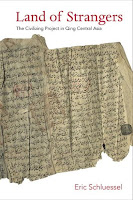
Land of Strangers: The Civilizing Project in Qing Central Asia by Eric Schluessel 

I usually do not recommend books that I have not read myself, but I will make an exception for this one. Friends have raved about Eric Schluessel’s Land of Strangers—even before it was recently awarded the John K. Fairbank Prize from the American Historical Association. It is easy to see why. Land of Strangers presents an ambitious history of how the Qing empire remade its western frontier and explores the instrumental role of law in this “civilizing project.” I just added it to my reading list, and I expect many others will do so too. 

China’s War on Smuggling: Law, Economic Life, and the Making of the Modern State, 1842–1965 by Philip Thai

I promised five titles, but I will abuse my prerogative as guest blogger to add my own book to the list! I hope readers concerned with questions of law and state-building; law and economic life; and, yes, law and criminality will find this book of interest. A paperback edition is coming out this December, and I hope this will make China’s War on Smuggling more financially justifiable for instructors to assign in their courses.

It was a true pleasure to use this platform to speak to my fellow legal historians. Once again, I am grateful to Mitra Sharafi for her invitation to serve as guest blogger. During the past year and a half, I have been focused on staying safe, getting on with life, and caring for my newborn son. Legal history was—sadly but unsurprisingly—not something to which I had given much thought amidst the chaos. Yet writing for the blog has served as a welcomed return to an old subject. It helped me reflect on the state of the field and remember how legal history has been intricately tied to my own intellectual journey. It was nice to think more about the scholarship that originally ignited my passions and less about the challenges of pandemic life, if only for a moment.

The last conference I attended prior to the outbreak of the pandemic happened to be ASLH Boston in November 2019. I am still unsure when I will return to the conference circuit again, but I eagerly look forward to seeing everyone soon! Please take care and stay safe.

—Philip Thai
E-mail | p.thai@northeastern.edu
Twitter | @philip_thai

Saturday, October 30, 2021

Weekend Roundup

  • Congratulations to Annette Gordon-Reed on her receipt of Mass Humanities’s Governor’s Award in the Humanities!  (HLT)
  • UC Irvine’s notice of Elizabeth Allen’s Uncertain Refuge: Sanctuary in the Literature of Medieval England (University of Pennsylvania Press, 2021).
  • ICYMI: The "Groveland Four" were wrongly accused in 1949, prosecutor says in motion to clear their names (ABAJ).  Lawsuit Against Harvard May Decide Who Owns Images of Enslaved People, by Valentina Di Liscia (Hyperallergic).  The Hastings College of the Law naming controversy (ABAJ).  Name the Marble Palace after the first Justice John Marshall Harlan?  (Politico).  Daniel Farber on the Four Myths of Presidential Power (HNN).

  Weekend Roundup is a weekly feature compiled by all the Legal History bloggers.

Friday, October 29, 2021

JSCH 46:2

The Journal of Supreme Court History 46:2 has now been published:

"Destructive to Judicial Dignity:" The Poetry of Melville Weston Fuller
Todd C. Peppers and Mary Crockett Hill

Law Clerk John Costelloe's Photographs of the Stone Court Justices, October 1943
John Q. Barrett

Defending Democracy: Speeches of the Warren Court Justices and Brown v. Board of Education
Robert A. Whitaker

Striving for Civil Rights: Senator Edward W. Brooke, President Richard Nixon's "Southern Strategy" and the Supreme Court
Jordan O. Alexander

The Lone Dissenter
Charles J. Cooper

Judicial Bookshelf
Grier D. Stephenson

Book Reviews

Shortlisted: Women in the Shadows of the Supreme Court
The Campaign Finance Cases: Buckley, McConnell, Citizens United, and McCutcheon
.
Paul Kens

–Dan Ernst

A Law and Society Job at John Jay

The John Jay College of Criminal Justice in the City University of New York is seeking a PhD or ABD near completion with "an active research agenda in law and society" to fill an assistant professorship.  A member of the department writes, "We are told Research area is open, and we would be VERY delighted to receive applications from sociolegal historians. History is a discipline that we are especially interested in for this search."  

--Dan Ernst

Roberts on the Age of Emergency in the British Empire

Christopher M. Roberts, Chinese University of Hong Kong Faculty of Law, has posted The Age of Emergency, which appears in the Washington University Global Studies Law Review 99 20 (2021): 99-169:

This article argues that the period from 1914 to 1926 saw a dramatic expansion in the development and dissemination of new forms of repressive public order legality within the British Empire, in a manner that has had enduring negative influence on legal orders around the world up to the present day. The article begins with the wartime years, exploring the innovations and extensions in repressive legality that took place both in Britain and around the empire. It then turns to examine the effect of the war's end, which, far from bringing the new repressive legal orders that had been put in place to an end, saw them extended in order to attempt to address political challenges to the status quo that came in the war's wake. Along the way, the article highlights the close relationship between martial and emergency law on the one hand and more regularized forms of repression on the other. In addition, the article draws attention to the fact that, however much the war may have provided a pretext, the repressive legal orders that were adopted were primarily aimed at suppressing movements fighting for greater rights and representation, be it in the form of a more egalitarian polity at home, or colonial independence across the imperial world. The article concludes with a brief exploration of some of the many ongoing legacies of the repressive approaches to law developed in the period across the former British colonial world.
 --Dan Ernst

Thursday, October 28, 2021

A Symposium on "The Reconstruction Amendments" at Notre Dame Law

[We have the following announcement of a conference at Notre Dame Law that starts today and focuses on The Reconstruction Amendments: Essential Documents by Kurt Lash, University of Richmond Law.  DRE]

On Thursday, October 28 and Friday, October 29, 2021 Volume 97 of the Notre Dame Law Review will host its annual Symposium in the Patrick F. McCartan Courtroom and 1030 Jenkins and Nanovic Halls.  This year’s Symposium is titled "Constitutional Reconstruction: History and the Meaning of the Thirteenth, Fourteenth, and Fifteenth Amendments."

The Symposium is being held in conjunction with the publication of Kurt Lash’s The Reconstruction Amendments: Essential Documents by the University of Chicago Press.  These volumes contain primary sources from the time of the adoption of the Reconstruction Amendments.  The Symposium is cosponsored by the Notre Dame Center for Citizenship & Constitutional Government; Notre Dame Program in Constitutional Structure; Illinois Program on Constitutional Theory, History, and Law; and Richmond School of Law Program on the American Constitution.

The Symposium will feature three panels of prominent scholars who will speak on what these sources add to the discussion of the original meanings of the Thirteenth, Fourteenth, and Fifteenth Amendments.

This year’s keynote speaker is Laura F. Edwards of Princeton University.  Professor Edwards’s keynote address will be published in the Symposium Issue of 97 alongside the articles written by the panelists.  The Symposium Issue will be released in the spring of 2022.

For further updates on the Notre Dame Law Review’s 2021 Symposium, please visit our website or follow us on Twitter: @NotreDameLRev.

Chinese Legal History: A Select Bibliography

In my previous post, I provided a brief overview of Chinese legal historiography. In this penultimate post, I want to offer a resource on more recent historical scholarship looking at any facet of Chinese law. Below is a list of English-language studies of Chinese legal history published after the 1980s with the opening of legal archives in China. These titles focus on the Qing dynasty (1644-1912); the Republican era (1912-1949); and the People’s Republic of China (1949-present). This list is by no means comprehensive, and titles are inexactly grouped by general categories. Since this list is directed at non-specialists, I have not included Chinese or Japanese scholarship, which have done even more work on the subject. (Please also forgive me if I have overlooked anyone's work!) Nonetheless, I hope this list offers an entry point for anyone who want to read more on this subject or diversify their legal history syllabi to include more studies of Chinese legal history.

For my forthcoming final post, I will spotlight five titles with more detailed descriptions. 

Overview of Chinese Legal History 

Xiaoqun Xu, Heaven Has Eyes: A History of Chinese Law (Oxford: Oxford University Press, 2020).

Philip C. C. Huang, Civil Justice in China: Representation and Practice in the Qing (Stanford, CA: Stanford University Press, 1996).

-----, Code, Custom, and Legal Practice in China: The Qing and the Republic Compared (Stanford, CA: Stanford University Press, 2002).

Law, Gender, and Sexuality 

Kathyrn Bernhardt, Women and Property in China, 960–1949 (Stanford, CA: Stanford University Press, 1999).

Margaret Kuo, Intolerable Cruelty Marriage, Law, and Society in Early Twentieth-Century China (Lanham: Rowman & Littlefield Publishers, 2012).

Matthew H. Sommer, Sex, Law, and Society in Late Imperial China (Stanford, CA: Stanford University Press, 2000).

-----, Polyandry and Wife-Selling in Qing Dynasty China Survival Strategies and Judicial Interventions (Berkeley, CA: University of California Press, 2015).

Janet M. Theiss, Disgraceful Matters: The Politics of Chastity in Eighteenth-Century China (Berkeley, CA: University of California Press, 2004).

Courts and Trials 

Daniel Asen, Death in Beijing: Murder and Forensic Science in Republican China (Cambridge: Cambridge University Press, 2016).

Quinn Javers, Conflict, Community, and the State in Late Imperial Sichuan: Making Local Justice (Milton: Routledge, 2019).

Bradley W. Reed, Talons and Teeth: County Clerks and Runners in the Qing Dynasty (Stanford, CA: Stanford University Press, 2000).

Xiaoqun Xu, Trial of Modernity: Judicial Reform in Early Twentieth-Century China (1901–1937) (Stanford, CA: Stanford University Press, 2008). 

Law and Legal Culture 

Robert E. Hegel and Katherine Carlitz, eds., Writing and the Law in Late Imperial China: Crime, Conflict, and Judgment (Seattle: University of Washington Press, 2007).

Eugenia Lean, Public Passions: The Trial of Shi Jianqiao and the Rise of Popular Sympathy in Republican China (Berkeley, CA: University of California Press, 2007).

Melissa Macauley, Social Power and Legal Culture: Litigation Masters in Late Imperial China (Stanford, CA: Stanford University Press, 1998).

Ting Zhang, Circulating the Code: Print Media and Legal Knowledge in Qing China (Seattle: University of Washington Press, 2020). 

Law and the Economy 

Maura D. Dykstra, “Complicated Matters: Commercial Dispute Resolution in Qing Chongqing from 1750 to 1911” (PhD dissertation: University of California, Los Angeles, 2014).

Philip Thai, China’s War on Smuggling: Law, Economic Life, and the Making of the Modern State, 1842–1965 (New York: Columbia University Press, 2018).

Fei-hsien Wang, Pirates and Publishers: A Social History of Copyright in Modern China (Princeton, NJ: Princeton University Press, 2019).

Madeleine Zelin, The Merchants of Zigong: Industrial Entrepreneurship in Early Modern China (New York: Columbia University Press, 2005).

-----, “A Deep History of Chinese Shareholding,” Law and History Review, vol. 37, no. 2 (2019): 325–351.

Madeleine Zelin, Jonathan K. Ocko, and Robert Gardella, eds., Contract and Property in Early Modern China (Stanford, CA: Stanford University Press, 2004).

Taisu Zhang, The Laws and Economics of Confucianism: Kinship and Property in Preindustrial China and England (Cambridge: Cambridge University Press, 2017). 

Law and Ethnic Statecraft 

Wesley B. Chaney, “Land, Trade, and the Law on the Sino-Tibetan Border, 1723–1911” (PhD dissertation: Stanford University, 2016).

-----, “Threats to Gong: Environmental Change and Social Transformation in Northwest China,” Late Imperial China, vol. 41, no. 2 (2020): 45–92.

Pamela Kyle Crossley, Helen F. Siu, and Donald S. Sutton, eds., Empire at the Margins: Culture, Identity, and Frontier in Early Modern China (Berkeley, CA: University of California Press, 2006).

Ying Hu, “Justice on the Steppe: Legal Institutions and Practice in Qing Mongolia” (PhD dissertation: Stanford University, 2014).

Eric Schluessel, Land of Strangers: The Civilizing Project in Qing Central Asia (New York: Columbia University Press, 2020). 

Law and Empire 

Pär Kristoffer Cassel, Grounds of Judgment: Extraterritoriality and Imperial Power in Nineteenth-Century China and Japan (Oxford: Oxford University Press, 2012).

Li Chen, Chinese Law in Imperial Eyes: Sovereignty, Justice, and Transcultural Politics (New York: Columbia University Press, 2015).

Jenny Huangfu Day, “The Enigma of a Taiping Fugitive: The Illusion of Justice and the ‘Political Offence Exception’ in Extradition from Hong Kong,” Law and History Review, vol. 39, no. 3 (2021): 415–450. 

Law in the Early People’s Republic 

Jennifer Altehenger, Legal Lessons: Popularizing Laws in the People’s Republic of China, 1949–1989 (Cambridge, MA: Harvard Asia Center, 2018).

Xiaoping Cong, Marriage, Law and Gender in Revolutionary China, 1940–1960 (Cambridge: Cambridge University Press, 2016).

Alexander Cook, The Cultural Revolution on Trial: Mao and the Gang of Four (Cambridge: Cambridge University Press, 2016).

Neil Diamant, Revolutionizing the Family: Politics, Love, and Divorce in Urban and Rural China, 1949–1968 (Berkeley, CA: University of California Press, 2000).

Klaus Mühlhahn, Criminal Justice in China: A History (Cambridge, MA: Harvard University Press, 2009).

Glenn Tiffert, “Judging Revolution: Beijing and the Birth of the PRC Judicial System (1906–1958)” (PhD dissertation: University of California, Berkeley, 2015).

Thank you once again for reading! I hope everyone will find this resource helpful.

—Philip Thai
E-mail | p.thai@northeastern.edu
Twitter | @philip_thai