Showing posts with label Crime. Show all posts

Monday, August 17, 2020

Pande on child marriage in colonial India

         Ishita Pande (Queen's University, Ontario) has published Sex, Law, and the Politics of Age: Child Marriage in India, 1891-1937 with Cambridge University Press. From the publisher: 
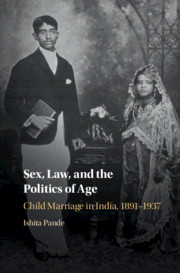

     Ishita Pande's innovative study provides a dual biography of India's path-breaking Child Marriage Restraint Act (1929) and of 'age' itself as a key category of identity for upholding the rule of law, and for governing intimate life in late colonial India. Through a reading of legislative assembly debates, legal cases, government reports, propaganda literature, Hindi novels and sexological tracts, Pande tells a wide-ranging story about the importance of debates over child protection to India's coming of age. By tracing the history of age in colonial India she illuminates the role of law in sculpting modern subjects, demonstrating how seemingly natural age-based exclusions and understandings of legal minority became the alibi for other political exclusions and the minoritization of entire communities in colonial India. In doing so, Pande highlights how childhood as a political category was fundamental not just to ideas of sexual norms and domestic life, but also to the conceptualisation of citizenship and India as a nation in this formative period. 
Praise for the book:  
"In this theoretically rigorous feminist history, Ishita Pande shows us how and why imperial 'age of consent' controversies should more aptly be read as regimes of reproductive temporality that shape minority and majority political claims in South Asian modernity in all its worldly ambition. Sex, Law and the Politics of Age opens up the terrain of 'juridical childhood' to a whole new set of questions and methods, rethinking girlhood as a prism of colonial and postcolonial ambition and a secularizing epistemic lever in the process." -Antoinette Burton
"A fascinating read, this book adeptly and sensitively renders the child as a moral-political category, and a socio-cultural construct, of modernity in colonial India. Through a close reading of the Child Marriage Restraint Act of 1929, Pande brilliantly intertwines debates on sexuality, childhood and age with the carving of a Hindu reformist nation." -Charu Gupta
"Here, finally, is a superbly researched and expansive South Asian/Indian history of the categories of age and consent, and their translations and tribulations within legal and social structures of surveillance and control. An indispensable book for scholars of law, gender and sexuality." -Anjali Arondekar
"Pande brilliantly deploys the generative power of gender analysis and queer theory to reinterpret one of the most widely-debated topics in colonial South Asian historiography: the question of ‘child marriage’. This rigorous and beautifully written book will be required reading for all historians and scholars of gender and sexuality in the twentieth century." -Todd Shepard 
You can join the author for an online book event, "Sex, Law, and the Politics of Age with Ishita Pande" on Monday, August 24, 2020 at 12.30-1.30pm CDT. Register here.
Further information about the book is available here.  
--Mitra Sharafi

Sunday, June 7, 2020

Empires of Vice: A First Book with Multiple Audiences

It is a pleasure to contribute to the Legal History Blog. My first book, entitled Empires of Vice: The Rise of Opium Prohibition across Southeast Asia was published recently. Throughout the month of June, I’ll be sharing a set of posts about this book, dwelling on the multiple audiences that I hope it may “speak” to.

As Dan Ernst mentioned in his kind introduction, I received my Ph.D. in political science, currently teach at an interdisciplinary school oriented toward international affairs and policy, and have written a book in the Histories of Economic Life series of Princeton University Press. Like many interdisciplinary creatures, I find it both exciting and challenging to articulate how and why my work matters to whom.

Empires of Vice is a book for political scientists, historians, specialists of Asian Studies, and policy makers, in overlapping but different ways. It is a book about the inner life of a bureaucratic state (that urges political scientists to be more curious about how the nitty-gritty ways that states actually govern). It is also a book about the anti-opium turn of multiple European empires across Southeast Asia during the late 19th and early 20th centuries (that gives reasons for historians to pay more attention to a place and process of change often run roughshod over in prevailing narratives about empires and opium that focus mainly on the British empire, India, and China). And Empires of Vice is also a book about how colonial legacies have shaped Southeast Asia's illicit economies and punitive drug laws today, which more broadly addresses normative challenges and policy implications for transnational problem-solving. 

Each of my posts will elaborate on these points. In addition, I plan to incorporate brief reflections on the practical aspects of “speaking” to different audiences in our current moment.

I write a time when the COVID-19 epidemic continues to unfold globally, making travel, in-person gatherings, conferences, and many conventional ways of presenting scholarship not possible. It is also an impassioned time in the United States where I live, with resounding calls for social change, anxious aspirations for and collective action aimed at profoundly refashioning the existing order. It thus feels like an especially difficult and selfish time to have a new book out. At the same time, it is also feels like an especially important time to think about alternative modes of virtual presentation that may very well become a new norm; to figure out ways to be clear about relevance, in the sense of being explicit about when and how one’s scholarship may (or may not) speak to ongoing events without detracting from its value. 

I have benefitted immensely from wonderful examples of scholars sharing their new books through podcasts (see Claire Edington’s Beyond the Asylum with the New Books Network), online interviews (see Durba Mitra’s Indian Sex Life with Notches), blogposts (see Jill Hasday’s Intimate Lies and the Law with the Legal History Blog) and other forms of virtual presentation (see this online book party for Arunabh Ghosh’s Making it Count). I hope to add to this growing digital archive, by sharing what I wish I had known in advance of some of the podcasts, interviews, short essays that I have done recently: seemingly mundane practical details that ended up mattering a lot for expressing ideas and communicating through different types of media (zoom, phone chats, written scripts), with different types of interlocutors (interviewers as my own students, colleagues, total strangers), and for different audiences (across disciplines and beyond the academy). I’ll also be linking to recently published books by people I admire, especially first-time authors in legal history, histories of empire, political science, and Southeast Asian studies.

I’ll wrap up this first post with an invitation. I’d love to learn from others with first books with multiple audiences, and also welcome suggestions from more seasoned authors and colleagues with more experience ushering their books into the virtual world. 

In my next post, I’ll be writing with legal historians in mind as an audience, highlighting how Empires of Vice explores the inner life of bureaucracies and its use of administrative archives for British and French colonial opium monopolies across Southeast Asia. I’ll also dwell on preparing for my interview with The Docket, the digital imprint of Law and History Review

Diana Kim


Author’s Photograph.
Card Catalogue at Archives nationales d’outre-mer (Aix-en-Provence, France)