Showing posts sorted by date for query novkov. Sort by relevance Show all posts

Tuesday, February 17, 2026

JACH (Winter 2026)

The Winter 2026 issue of the Journal of American Constitutional History is now available online:

Sovereign Power and the Sweeping Clause
John Mikhail

Contemporary disputes involving the separation of powers take on a different light when they are framed in terms of powers of the Government of the United States itself. The “all other powers” provision of the Necessary and Proper Clause distinguishes government powers from executive powers and gives Congress distinct legislative authorities with respect to each of these categories.
Symposium: A Tribute to Kenneth Kersch

Ken Kersch and the New Legal History: Beyond the Internalist/Externalist Divide
Dennis J. Wieboldt III

For Ken Kersch, developments in twentieth-century American constitutional law could not be adequately explained by either neat doctrinal evolution or the raw exercise of political power.

Ken Kersch as a Scholar of “The Other”
Sanford Levinson
Ken Kersch’s remarkable scholarship generates profound questions about the difficulties—and even limits—of truly engaging with those who do not share certain ontological or epistemological commitments.
Ken Kersch and the Meaning of Development: Law, Ideas, and the Politics of Constitutional Change
Michael A. Dichio and Paul E. Herron

Ken Kersch showed us that constitutional development is not a story of inevitable progress, but of contested traditions, shifting coalitions, and the discontinuous, non-linear unfolding of political development.

Broadening The Terrain of Political and Constitutional Thought, Unmasking Delusional Constitutional Arguments
Carol Nackenoff

By broadening the terrain of political and constitutional thought, Kersch brilliantly examined how constitutional faiths are forged and “law stories” are woven to create common identities.

The Roberts Court and the Past and Future of Religion as a Constitutional Concern
Julie Novkov

The Roberts Court’s reconfiguration of free exercise and anti-establishment doctrine is not a simple conservative backlash. Rather, it creates a viable path for empowering a right-wing religious political project.
The Roberts Court’s Reconstruction of Church and State
George Thomas
Chief Justice John Roberts’s opinion in Trinity Lutheran v. Comer (2017) breaks with past understandings of the Free Exercise Clause by merging a state discriminating against religious individuals with a state declining to fund religious institutions.
Five Lessons from Ken Kersch’s Conservatives and the Constitution for the Present Moment
James E. Fleming and Linda C. McClain

Ken Kersch’s Conservatives and the Constitution helps us see the second Trump Administration, not as an aberration, but as the fulfillment of certain conservative ideas that have been “hiding in plain sight.”

Forgetting Nothing, Learning Nothing: Constitutional Scholarship and the Political Development of the Modern Supreme Court
Calvin TerBeek

The "Lochner Era" was invented decades after the fact, and the 1970s were legal liberalism's zenith, not its decline. Constitutional law professors' standard story of legal liberalism gets it wrong on the front and back ends.

States’ Rights and Civil Rights: Barry Goldwater, Bill Buckley, Richard Nixon, and Southern Realignment
Sean Beienburg

Did invocations of states’ rights by southern segregationists permanently discredit constitutional federalism? A re-examination of the 1960s political realignment suggests Americans can embrace—or re-embrace—this feature of our Constitution, while remembering state autonomy is a strong presumption but one that has always been checked by the Constitution’s rights guarantees.

The Phenomenal Constitution
Austin Steelman

In Conservatives and the Constitution, Ken Kersch demonstrated that the continually reimagined Constitution is a “phenomenon” in American life, not an epiphenomenal result of more substantial politics.

Orthodox Originalism and Conservative Identity after Ken Kersch
Logan Everett Sawyer III

Kersch’s Conservatives and the Constitution showed not just that the conservative political movement shaped arguments about the Constitution, but that arguments about the Constitution were key to transforming a varied group of interests disaffected by New Deal and Great Society Liberalism into a coherent political identity and thus a powerful political order.

Wednesday, December 17, 2025

A Symposium in Honor of Ken Kersch

[We have the following announcement from Boston College’s Clough Center for the Study of Constitutional Democracy.  DRE]

Constructing the Constitutional Imagination: A Symposium in Honor of Ken I. Kersch


On February 20, 2026, the Clough Center will host a conference in honor of Ken I. Kersch, who passed away last November. In addition to directing the Clough Center from 2008 to 2012, Kersch served as a professor in BC's Political Science Department, where he taught classes on American conservatism, political thought, constitutional development, and civil liberties. A revered teacher and author of 5 books, Kersch was the recipient of, among other honors, the American Political Science Association's 2020 C. Herman Pritchett Award for the best book on law and courts. 

The Clough Center's conference will coincide with the publication of a special issue of the Journal of American Constitutional History that engages with Kersch's work in political science, history, and law. Speakers include Aziz Rana (Boston College), Sophia Lee (Penn), Mark Graber (Maryland), Justin Dyer (UT Austin), Mary Ziegler (UC Davis), Sanford Leinvson (UT Austin), Julie Novkov (SUNY Albany), Jonathan Gienapp (Stanford), Rogers Smith (Penn), Linda McClain (BU), James Fleming (BU), George Thomas (Claremont McKenna), Logan Sawyer (Georgia), Michael Dichio (Utah), Paul Herron (Providence), Sean Beienburg (Arizona State), Clement Fatovic (Florida International), Austin Steelman (Clemson), and Calvin TerBeek (Claremont McKenna). 

The Law School and Political Science departments are co-sponsoring this event. [Register here to attend.]

Update: The program is here

Saturday, February 15, 2025

Weekend Roundup

  • In a recent episode of Strict Scrutiny, Kate Shaw and Leah Litman speak with Jonathan Gienapp (Stanford University) "about what originalists get wrong about history and how the founders thought about the law."
  • Another report of that “wide-ranging discussion” at Stanford Law between Jonathan Gienapp and Michael McConnell “on how history, law, and politics intersect in constitutional interpretation” (SLS).
  • Is it surprising that, in these times, so many of the new leaders of the Organization of American Historians are scholars of legal and constitutional history? Congratulations to Annette Gordon-Reed, President; Marc Stein, President Elect; and Donna Clare Schuele, a new member of the Executive Board. Margot Canaday is a continuing member of the Executive Board.
  • Melissa Murray, NYU Law, will discuss History and the Courts with Christen Hammock Jones, doctoral student in American legal history at University of Pennsylvania; Christina D. Ponsa-Kraus, professor at Columbia Law, and Noah Rosenblum, NYU Law, at Brooklyn College on April 2 from 11:00 am to 12:15 pm.  Anna Law, Brooklyn College, will moderate.
  • John Q. Barrett on FDR's plans to resist a negative decision from the U.S. Supreme Court in the Gold Clause Cases (Jackson List). 
  • ICYMI: Jack Goldsmith on Departmentalism and DJT (Executive Functions).  Scott Bomboy on the History of the Constitution and Tariffs (NCC). 
  • Update: A compilation of trackers of DJT's executive orders by the Pence Law Library at American University-Washington College of Law.  H/t: MD.

Weekend Roundup is a weekly feature compiled by all the Legal History bloggers.

Monday, December 13, 2021

Nackenoff and Novkov's "American by Birth"

We’re unaccountably slow to post on this one.  Carol Nackenoff, Swarthmore College, and Julie Novkov, University at Albany, State University of New York, have published American by Birth: Wong Kim Ark and the Battle for Citizenship (University Press of Kansas):

American by Birth
explores the history and legacy of Wong Kim Ark and the 1898 Supreme Court case that bears his name, which established the automatic citizenship of individuals born within the geographic boundaries of the United States. In the late nineteenth century, much like the present, the United States was a difficult, and at times threatening, environment for people of color. Chinese immigrants, invited into the United States in the 1850s and 1860s as laborers and merchants, faced a wave of hostility that played out in organized private violence, discriminatory state laws, and increasing congressional efforts to throttle immigration and remove many long-term residents. The federal courts, backed by the Supreme Court, supervised the development of an increasingly restrictive and exclusionary immigration regime that targeted Chinese people. This was the situation faced by Wong Kim Ark, who was born in San Francisco in the 1870s and who earned his living as a cook. Like many members of the Chinese community in the American West he maintained ties to China. He traveled there more than once, carrying required reentry documents, but when he attempted to return to the United States after a journey from 1894 to 1895, he was refused entry and detained. Protesting that he was a citizen and therefore entitled to come home, he challenged the administrative decision in court. Remarkably, the Supreme Court granted him victory.

This victory was important for Wong Kim Ark, for the ethnic Chinese community in the United States, and for all immigrant communities then and to this day. Though the principle had links to seventeenth-century English common law and in the United States back to well before the American Civil War, the Supreme Court’s ruling was significant because it both inscribed the principle in constitutional terms and clarified that it extended even to the children of immigrants who were legally barred from becoming citizens. American by Birth is a richly detailed account of the case and its implications in the ongoing conflicts over race and immigration in US history; it also includes a discussion of current controversies over limiting the scope of birthright citizenship.

Here is an endorsement:

“We have long needed a biography of Wong Kim Ark, and American by Birth delivers. It’s the history of American citizenship, the tireless efforts of one man and his lawyers to challenge cruel and racist policies, and Wong Kim Ark’s continuing legacy today. Nackenoff and Novkov’s timely book is a must-read!” 
    —Erika Lee, author of America for Americans: A History of Xenophobia in the United States, and director of the Immigration History Research Center, University of Minnesota
Check out the Balkinization symposium, here.

Thursday, July 29, 2021

Knowles's "Making Minimum Wage"

Just out: Helen J. Knowles, Associate Professor of Political Science at the State University of New York at Oswego, has published Making Minimum Wage: Elsie Parrish versus the West Coast Hotel Company (University of Oklahoma Press):

The US Supreme Court’s 1937 decision in West Coast Hotel v. Parrish, upholding the constitutionality of Washington State’s minimum wage law for women, had monumental consequences for all American workers. It also marked a major shift in the Court’s response to President Franklin D. Roosevelt’s New Deal agenda. In Making Minimum Wage, Helen J. Knowles tells the human story behind this historic case.

West Coast Hotel v. Parrish pitted a Washington State hotel against a chambermaid, Elsie Parrish, who claimed that she was owed the state’s minimum wage. The hotel argued that under the concept of “freedom of contract,” the US Constitution allowed it to pay its female workers whatever low wages they were willing to accept. Knowles unpacks the legal complexities of the case while telling the litigants’ stories. Drawing on archival and private materials, including the unpublished memoir of Elsie’s lawyer, C. B. Conner, Knowles exposes the profound courage and resolve of the former chambermaid. Her book reveals why Elsie—who, in her mid-thirties was already a grandmother—was fired from her job at the Cascadian Hotel in Wenatchee, and why she undertook the outsized risk of suing the hotel for back wages.

Minimum wage laws are “not an academic question or even a legal one,” Elinore Morehouse Herrick, the New York director of the National Labor Relations Board, said in 1936. Rather, they are “a human problem.” A pioneering analysis that illuminates the life stories behind West Coast Hotel v. Parrish as well as the case’s impact on local, state, and national levels, Making Minimum Wage vividly demonstrates the fundamental truth of Morehouse Herrick’s statement.
Here are two endorsements:
In Making Minimum Wage, Helen J. Knowles ingeniously draws on a wealth of sources to make one of the most important of all the Supreme Court’s New Deal decisions come alive. With remarkable humanity, Knowles transforms the story of Elsie Parrish into an illuminating prism on the history of minimum wage legislation for women.” —Laura Kalman, author of The Long Reach of the Sixties: LBJ, Nixon, and the Making of the Contemporary Supreme Court

“This book brilliantly turns West Coast Hotel v. Parrish inside out, revealing the human struggles and experiences behind the doctrinal revolution of 1937. Helen J. Knowles rightfully places Parrish and her advocates at the center of New Deal labor politics and recovers a critical piece of the forgotten struggle over women’s minimum wages. This highly readable book will delight and fascinate anyone interested in labor history, constitutional development, or the regulation of women’s work in the United States.” —Julie Novkov, author of The Supreme Court and the Presidency: Struggles for Supremacy
--Dan Ernst.  H/t: JQB

Saturday, June 8, 2019

Weekend Roundup

  • The University of Chicago Law School has posted the video of Why Madison Matters: Rethinking Democracy in America,”  this year’s Maurice and Muriel Fulton Lectureship in Legal History, delivered by James T. Kloppenberg, the Charles Warren Professor of American History at Harvard University.   As the Law School’s website reports, “Drawing from Madison's writings along with those of other founding fathers, including James Wilson and Alexander Hamilton, Kloppenberg suggested that they aimed not merely to balance competing interests but to pursue what Madison called ‘justice and the general good.’”  
  • The Department of Government at the University of Texas at Austin invites graduate student submissions for the sixth annual Graduate Conference in Public Law, to be held October 24-25, 2019.  Among the contemplated submissions are papers on "Constitutional or Political Development."  Julie Novkov, University at Albany, SUNY, who writes at the intersection of law, history, US Political Development, and subordinated identities, will deliver the keynote.
  • Call for Papers: Law and Governance of a Global City: 17th-Century Amsterdam," June 2020.  "Four hundred years ago, like today, globalisation and urbanisation impacted the world’s cities. In seventeenth-century Amsterdam, the afflux of trade and migrants prompted rapid economic and demographic growth, resulting in dynamic multicultural urban life and leading to complex questions of governance."  H/t: JG.
 Weekend Roundup is a weekly feature compiled by all the Legal History bloggers.

Monday, July 30, 2018

Should I do an edited collection? Advice to Collection Editors

Credit: British Library Flickr
Group publications can be challenging in many ways. We asked legal historians for their advice on doing edited volumes or special issues (h/t: LSA Law and History CRN). Our questions: 
  • What works and what doesn’t? 
  • What did you learn the hard way or wish you had known from the start? 
  • Was it worth it in the end?
  • Were there any unexpected benefits?
We received a ton of responses. In the first post of this series, we shared advice on contributing a chapter as an author. This second post is about putting together such collections as an editor of the volume or special issue. The third will cover advice from scholars who have been editors of journals that produce special issues. 

Our title borrows from Karen Kelsky’s post on the same topic (h/t: The Professor is in).

  • From Sally Hadden, on work done with co-editors Al Brophy and Patti Minter:
    • “A strong vision before you begin inviting people is essential. Put it on paper, give it clarity and depth.
    • Imagine the ‘dream team’ of contributors you want and ask them first, but be prepared with other names to make sure your original strong vision doesn't go by the wayside if A or B is unavailable.
    • Shoot for a mix of established and brand-new scholars, so that your table of contents shows contributions from more than one generation [this may help sell to more than one generation too!]
    • Set clear deadlines up front.
    • If you have brand-new scholars contributing, stick to those deadlines. Their tenure may depend on it.
    • Provide regular feedback to your contributors. Don't leave them guessing. ("Thanks for your essays. We will be using this timetable to turn them around." "We've submitted the manuscript to the press." "We've had positive readers' reports." "We're sending out essays with editorial feedback for your review and revision." "Thanks for being so prompt in returning this revised essay." "The press tells us that we are in the fall catalog")
    • Ask your contributors to assist with the index by giving you the index terms they want to see covered, at a minimum.
    • Ask your contributors for suggestions about where the volume should be reviewed.
    • I was really lucky. I worked with two excellent co-editors, we moved the two volumes through the process promptly, we worked with presses whose editors kept their word about when things would happen. The vast majority of our contributors delivered when they said they would.”
• From another scholar: “Some thoughts on editing volumes.  Without meaning to, I have CO-edited three volumes and single-edited one volume of an author’s papers (working now on another’s).  I emphasize the co-edited part because that has been key to those volumes, but in different ways. [One] volume came about through the same editor that solicited my [own monograph]. I thought it would be selfish and unhelpful for me to be the lead person on both. So, I asked [X] to take the lead on that volume. The point here is that sometimes edited volumes can be about building a field and investment in a field. At that time, [X] was not centered in [the main theme of the edited volume]. His editorial work on that volume brought him squarely into a small field and, as a result, made our field much better because of his subsequent publications.  Around [year], a sometime teacher of mine, [Y], contacted me about contributing to a volume for our mutual teacher.... When I agreed, he then asked whether I knew other [similar scholars] who might contribute and suddenly I was co-editor. He never said this to me, but I have a feeling that the volume has stalled at some point...I give this history…because sometimes editing a volume is about getting worthy things started again.  One might start with 20 contributors in mind and only 8 end up doing anything. A secondary infusion of editorial help, in this case, pushed the whole thing in a way that I think fulfilled the purpose of the original idea.  For what it’s worth, the [non-US] publisher of that volume has repeatedly told me that this was his breakthrough into the US academic scene. [That publisher] has now become an important publisher of…monographs and edited volumes [on the theme of our volume]. I don’t really believe that our volume had much to do with it, but maybe a little. Finally, this new volume was a fun project for me because I got to work with my old mentor... I’m proud of the volume and its contributors, but the publication process with [publisher] was frustrating. It’s all style and format, but there are inconsistencies that the publisher introduced that we are now responsible for.  Substantively, the volume attempts a new state-of-the-field description/assessment, drawing on the expertise of many…In terms of takeaway, any edited volume should have a clear purpose. We intended to make [name’s] lifetime work more accessible. He covered all aspects of [theme] and so do we. That means the world looks different than if we started with [more standard] categories. We’re fine with that. Readers should adjust, because it’s worth it. I think it’s too early to say if we succeeded but I will always be happy with the goals.  So, as you can see, my experience suggests that various good reasons exist for editing volumes.  Cooperation was essential to those I’ve worked on and I recommend co-editing, if the work can be divided cleanly (as it was in each case for me).  In the case of single-editor volumes, it’s about why. So, general advice? Make sure you’re advancing a field and have a clear, unitary purpose behind a volume.”

Dan Ernst: “Having done one, I'm with the Karen [Kelsky] of the blogpost.” DE would be surprised if many editors of a volume would want to edit another one. “Law review symposia issues might be a different matter, because so much of the most awful part is shifted to the students, and there's a drop dead deadline.” “My general position is a strong presumption that the costs of such volumes usually outweigh the benefits. The whole should be decisively more than the sum of its parts. This usually happens only with a great deal of ex ante planning by an editor, who envisions a large, multifaceted problem or question, assigns pieces of it to the proper people, give them enough time and incentives, and rides herd and polices deadlines right up to final submission. Usually, the best efforts by editors to find order in essays culled from the on-going projects of even historians working within hailing distance of each other falls short of the mark.”


  • Jim Jaffe: “About editing:
    1. Make extra double sure that any co-editor is willing and able to do their share of the work. Editing a volume is a tedious and frustrating endeavor. There are a lot of slackers out there so avoid any free riders.
    2. Beware of contributors who may steal your idea. This happened to me after I gave up editing a volume of essays and then one of my contributors went on to edit and publish the exact same thing. Not all that unusual, I’ve been told.
    3. Make sure your publisher thoroughly understands the scope and audience for your project….The chief editor at [publisher] desperately wanted [a volume I was putting together] until he actually saw its contents. After putting in the work to prepare the table of contents, draft an introduction, etc., he decided it wouldn’t fit into their catalog after all. He didn’t seem to understand at the outset that the volume was to be historical and not contemporary.”
  • Sally Gordon:”I have been the editor of exactly NO edited volumes but have participated in several and written intros for a couple.  I also am on a faculty editorial board of a scholarly press and have seen how unmanageable many such projects are.  Honestly, keeping all the authors on point and within word limits is very difficult.  So now I understand better the urgency of the mandate to craft a piece to suit the main focus of a volume.  Without a really strong and careful editor, the authors kind of swim off in different directions, and such a volume without a clear focus can easily lose its way.”
  • Kelly Kennington: “I have not yet participated in an edited volume as either an author or an editor, largely because my university does not count such publications or work toward tenure and promotion unless it is peer reviewed.  I am currently working on a forum for a journal that will be peer reviewed, and I am one of the two organizers as well as a contributing author.  At the moment, we have only solicited the articles and discussed the time table, though, so I don't have much advice on how to do it.  We did find that the Journal was more open to doing a shorter forum than a special issue.”
  • Dan Klerman, speaking as a contributor, but with advice to editors of collections: “The only sticking point is that the slowest contributor (or editor) determines the publication date.  So for one of these books, I think the delay between submitting my final draft and publication was about 4 years.  So my main suggestion is pick people who can stick to a deadline and keep people moving.”
  • From a scholar who co-edited two volumes, and who has also done a symposium issue of a journal: “It isn't easy to get an edited volume accepted any more, and the first one I did (which was not on law) was hell on wheels.  The second one [with a co-editor] was idyllic.  The third one [co-edited, happening currently] has been slower than I would have liked, but that is because the contributors have been slow.  I know presses never to touch.”
  • Julie Novkov: “As an editor
    • the best volumes I’ve done have been worked on through conferences, where we have put together multiple panels with volume contributors presenting chapters and discussing others’ chapters. This really helps to get the main themes more integrated, and helps authors refer to each other in a less forced way
    • identify key themes early on and communicate them to authors
    • be willing to read and comment on even very early and preliminary drafts! Some of the best chapters start just as think pieces that the author then shapes as the volume develops
    • try to collect chapters from people at a variety of career stages and do what you can to get the people in the volume to know each other in real life. A volume project can also be a wonderful exercise in community building.
Every volume I’ve ever worked on, as a chapter author or as an editor, has been worth it!”

  • Wes Pue: “I’ve edited a number of journal special issues and some book collections. Here are some random thoughts: 
    1. The most frustrating are projects which cannot proceed without solid contributions from each of a number of contributors. All become hostage to the last to submit.  There are good and bad reasons for delayed delivery but the consequences are the same.
    2. Thematic unity is important but a prior determination that some topic(s) MUST be included invites hazard if the work is not in hand when it is needed. 
    3. A well-chosen co-editor can make a project fun, widen the intellectual scope, share the work, and expand the net of contributors.  I’ve benefited immensely from such arrangements. Sometimes, however, there is a ‘cost’ of losing decisions regarding items to include or reject. Having to reject something you wish to include makes for an unhappy moment. 
    4. I’ve liked working on projects emerging from working groups of loosely allied scholars, each exploring a topic or interdisciplinary enquiry from their own perspective.  This can push scholarship in new and innovative directions. 
    5. Getting edited books into print can be difficult compared with taking on guest editorship of a journal. Occasionally publishers encourage a volume but lose interest (possibly because of change of staff) before the work emerges. 
    6. Folks need to beware [of the] time commitment. Edited collections can take a ton of time (they don’t always). This can be costly to scholarly careers, especially for those stepping onto tenure track or wishing to do so.  Pick solid, reliable contributors, any one of whom can be left out if not ready to proceed by publication date.  It can be helpful to hire a good copy editor to assist (a task to be avoided by academics) if you can. Be prepared to reject submissions by friendly colleagues (ouch).”
  • Intisar Rabb: “I’ve largely had good experiences as an editor… Here are a few thoughts:
    • I loved the experience of a helping to compile recent co-edited volume. My co-editor and I convened a conference which then turned into a volume…in honor or a retiring colleague, who hated Festschrift compilations that were random selections of student and collegial writings, and preferred something thematic. Luckily, we were able to settle on [a] theme that started his academic career, was of close [interest] to us as editors, and where many of his students and colleagues had something to say. To be as inclusive as possible, we also opened up the conference through a call for papers, the best of which would be published in the volume, and we also asked other colleagues of the professor honored who could not attend the conference if they had something to contribute on the theme. For good measure, and to make it a scholarly publication worthy of the field, we published through an academic press, which included peer review. Because of the good will for the honoree (and draconian, threatening emails about being timely from the organizers and editors – which we knew we had to back up by being timely ourselves in the editing to make it before the honoree’s actual retirement), the conference was enlightening and jovial, and contributors were timely with their submissions. After the conference, we submitted the volume after 12 months, and it was published in 18 months – which is pretty fast!
    • Some benefits were getting to work closely with a friend and colleague on editorial decisions, and getting to know some of the work of colleagues in the field on a subject of close interest to me (I didn’t know that some were also moving in that direction) – so I found it well worth doing, and we even talked about keeping in touch to perhaps do further work together or at least read each others’ manuscripts in the future.”
Mitra Sharafi: “Good advice from a wise colleague: don’t think of being an editor of a group publication as research. It is service.”

A very big thank you to contributors!

Monday, July 23, 2018

Should I do an edited collection? Advice to Authors


Credit: British Library Flickr
Group publications can be challenging in many ways. We asked legal historians for their advice on doing edited volumes or special issues (h/t: LSA Law and History CRN). Our questions:
  • What works and what doesn’t?
  • What did you learn the hard way or wish you had known from the start?
  • Was it worth it in the end?
  • Were there any unexpected benefits?
We received a ton of responses. In the first post of this series, we share advice on contributing a chapter as an author. The second post will be about putting together such collections as an editor of the volume or special issue. The third will cover advice from scholars who have been editors of journals that produce special issues.

Our title borrows from Karen Kelsky’s post on the same topic (h/t: The Professor is in).

On the problem of delay:
  • “It's fun to work with/get feedback from people you know and trust, and I've had good experiences. In my experience, they are held hostage by the slowest author, so they tend to come out a few years later than initial (pessimistic) estimates. (I assume this blog post will be full of synonyms for ‘herding cats.’) I've been relatively fortunate that I haven't needed things to come out by a certain deadline for tenure/promotion, but I'd definitely warn junior scholars away from them if that was a concern.”
  • “My thoughts on contributing, particularly for untenured folks, is to be very careful about committing to something highly specialized or getting too much ‘in the weeds’ on a project, because a publisher can and will pull the plug, even on a finished volume. If you can't easily repurpose the chapter for another project, this can really impair your publishing agenda.”
  • “Here is my edited volume horror story: Workshop in 2011, I committed to publish piece (pre-tenure), book still languishing with [the publisher], although I corrected proofs about 2 (maybe 3) years ago (after tenure decision made without publication). AND I signed publication agreement that embargoes piece for 5 years after publication, which means that every year not published extends that embargo. AND I am now deeply embarrassed for the piece to appear with a current…date, when I wrote it using the literature of 2011. I will look like I completely ignored years of relevant work. No idea what is going on, but makes my last experience with an edited volume (5 years from conference to book) look speedy.”
  • “I had a mixed experience with an edited volume…I was very flattered to be asked and spent a decent chunk of my pre-tenure time writing an original contribution. But then years passed in which nothing happened, publication-wise, and I worried about the chapter getting stale. During that time, I received zero credit for this piece of scholarship within my own institution. The piece did not make it into my tenure file. But there were positives, too. I learned some valuable things from writing the chapter, and participating in the volume put me in scholarly and real-life conversation with some people I really admire.”
  • “One bandaid remedy to the staleness problem is to say in footnote 1: ‘This article was written in 2013.’ Obviously it’s still not great if your piece doesn’t come out until 5+ years after you wrote it (I’m in this situation with an article right now), but at least this tells the reader: ‘here is why you’re not seeing post-2013 literature in this piece, even though it has a 2019 publication date.’ I don’t usually post drafts on SSRN, academia.edu, or elsewhere, because I try to have only one version out there—the final one. But with the chapter I wrote several years ago whose edited volume shows no signs of coming out soon, I have asked the editors if I may post a draft of my chapter online, just to get it out there in some form.”
  • Jim Jaffe: “As a contributor, I’ve been fortunate enough to have excellent editors, but the entire process is a long one and can take much longer than publishing an article in a journal. Of course, some or most edited volumes are not peer reviewed, so the quality of the finished product varies. One might want to be aware of these things.”
  • Dan Klerman: “I have contributed chapters to several edited volumes and special issues recently. I have found the process to be very easy.  The editors had a very light touch, and everything went smoothly.  The only sticking point is that the slowest contributor (or editor) determines the publication date.  So for one of these books, I think the delay between submitting my final draft and publication was about 4 years.”
  • Intisar Rabb reports some good experiences as an author. However, as an author, “my main complaint is the time it takes to go from submission to publication, and the lack of communication from the editors sometimes in that process. I have often submitted materials, and 5 years later have waited on news of review or publication. I wish editors would be more timely and follow a schedule of publication that is reasonable (2 years is fine; 5 years is excessive). My other main complaint is the time it takes to go from solicitation [by the editors] to submission [by me], and the lack of communication from me sometimes in that process!”
  • Julie Novkov: “Meet your deadlines, for the love of whatever deity you worship!”
On the tenure & promotions process:
  • “It is important to ask yourself: how does this count for tenure or promotion? My view is that if you are counting on an edited volume to get you tenured or promoted you either shouldn’t do it or should not be promoted. I think it is important for individuals to have their own, independent pedigree and to use edited volumes as a way to advance an argument or to build something good for a field. Otherwise, do something else.”
  • Kelly Kennington: “I have not yet participated in an edited volume as either an author or an editor, largely because my university does not count such publications or work toward tenure and promotion unless it is peer reviewed.  Even if it is peer reviewed, edited collections count less than journal articles or, of course, monographs.  I was asked to be an author in a couple of edited collections and said no both times to focus on my book and articles that will count toward my promotion file.  I wish that the administration valued edited volume contributions, but until they do, I don't think I will get involved in one.  My time for research and writing is so limited…that I have to be careful with how I choose to spend it.”
On the coherence of the collection:
  • “As an author, I have contributed to several…volumes. The stinkers are those that just throw stuff together. For me, the process is often indicative of the result. I have twice been asked last-minute to contribute to something in order to ‘round out’ a volume. In both cases, the urgency was mere pretense (the volumes only appeared years later) and the resulting volumes were [a hodge-podge]. I regret doing those, but was trying to help someone in both cases. The best volumes as an author, for me, have been those that resulted from a coherent project (often including a preceding meeting/conference) in which contributors get a good sense of what the larger aim is…Moral? Don’t contribute to volumes where the point/purpose is not clear. Edited volumes, like everything, should have an argument, say something new. If they don’t, skip. If they do, and you like the direction, embrace the goal and make your contribution an integral part of the overarching effort."
  • Sally Gordon: “In terms of being an author, the difficulty that I have found is figuring out how best to craft my piece given [the parameters of the group publication].”
  • Julie Novkov: “As an author, it’s great if you can read the other chapters as they are in progress, or at least the ones in the same section of the volume as yours. If you can get either the introduction or a sense of the broad themes the editors are emphasizing, that really helps too.”
  • Jim Pfander: “I just published a chapter in a historical collection…It was on balance a worthwhile experience although the volume took a very long time to appear. The editors did a lovely job writing intros and other narrative material to stitch the various chapters together. Whether the end result has a genuine coherence and whether the chapters add to one another I cannot really say. But there’s more coherence than in some collections, partly because the editors encouraged the contributors to think in terms of historical periods.”
On edited collections that start with a conference:
  • Laura Edwards: “it seems like my best experiences with edited collections have come as a contributor, when the volume was connected to a conference, organized around the theme of the volume, where we presented papers and discussed them before revising.  I suspect there are a lot of reasons why that seemed to work so well.  For one, we all had an initial deadline for the conference, where we were all presenting.  Then the discussion of the papers was really helpful in thinking through revisions and also making a cohesive volume."
On the importance of edited volumes in certain sub-fields:
  • “In some sub-fields, people do book chapters, not law review articles (in part because it's hard to get published in a top law review coming from this sub-field). I wonder if people who do comparative legal history feel similarly? [A friend] felt that there was just no way to get around these volumes [in her field]. And she perceived a big risk in saying ‘no’ to participating in a volume that included big names in her field.”
On accessibility:
  • John Wertheimer: “As an author, a down side can be that sometimes scholarly indexes don’t include book chapters as they do journal articles and book titles. Consequently, the edited collection chapter can sort of fall off the edge of the earth, not to be heard from again. Folks working in your field might not ever find your piece if you publish it in an edited collection. It’s a line on your CV, but might not move the needle in the scholarly conversation.”
  • Sally Gordon: “[One] difficulty with such projects is that so few of them are available digitally, and I have generally advised early career scholars that participating in a symposium issue of a journal is likely to yield more readership than a traditional edited volume."
  • Dan Klerman: “Another issue is that book chapters seem to be hard for researchers to find.  Anything you can do to increase visibility and citations (e.g. get the chapters indexed in the standard services, into Google Scholar, or somehow into Westlaw or Lexis) would be really helpful. Sometimes I feel like these chapters seldom get read (or cited).”
When it is worth it:
  • Julie Novkov: “Every volume I’ve ever worked on, as a chapter author or as an editor, has been worth it!”
  • Sally Gordon: “there are occasions where a new field emerges that can be productively defined and explained in an edited volume as nowhere else, because it includes multiple perspectives and examples of scholarship.”
  • "There is apparently a new phenomenon called ‘pop up’ books. The idea is to do a volume on a super-expedited basis. Since everyone knows that's the deal in advance, I guess it solves some of the ‘herding cats’ issues that tend to arise later in the process.”
A very big thank you to contributors!

Saturday, April 28, 2018

Weekend Roundup

  • The Organization of American Historians recently announced the winners of its annual awards. You can see them all here.
  • Over in JOTWELL's Worklaw section, you'll find an admiring review of legal historian Deborah Dinner's "Beyond 'Best Practices': Employment-Discrimination Law in the Neoliberal Era," Indiana Law Journal (2017). Reviewer Henry L. Chambers, Jr. (Richmond School of Law) suggests that it should be required reading for anyone studying employment discrimination law.  
  • Harvard Law School Professor Intisar Rabb has been awarded the Trailblazer Award by the Massachusetts Black Lawyers Association.  Rabb, the director of Islamic Legal Studies at HLS, was recognized on March 22 at the organization’s 45th anniversary gala.”  More.
  • Keith Whittington’s Workshop in Constitutional Development at Princeton had quite a double bill last Monday: "The Jacksonian Makings of the Taney Court," by Mark Graber, University of Maryland Francis King Carey School of Law; and "Building the Administrative State: Courts and the Admission of Chinese Persons to the United States, 1870s-1920s," by Carol Nackenoff, Swarthmore College, and Julie Novkov, State University of New York-Albany
  • A recording of the ceremony for my installation at Georgetown Law as Carmack Waterhouse Professor of Legal History is here.  DRE
Weekend Roundup is a weekly feature compiled by all the Legal History bloggers.

Sunday, July 20, 2014

Sunday Book Roundup


This week over at Balkinization, Mark Graber reviews Looking for Rights in All the Wrong Places: Why State Constitutions Contain America’s Positive Rights by Emily Zackin (Princeton University Press). He calls the book "an excellent example of the wonderful scholarship that can be produced when exceptional scholars analyze state constitutions through the prism of state constitutional actors rather than through the prism of Warren Court liberalism."

Law and Politics Book Review has two reviews to note. The first is Jill Norgren’s Rebels at the Bar: The Fascinating, Forgotten Stories of America's First Women Lawyers (NYU Press), which “will be of interest to undergraduate and graduate students of American legal history, labor, and gender. Norgren’s well written and thorough volume illuminates the experiences of these determined women and shows the impact of their struggles on the legal profession and the struggles for women’s civil rights.” 

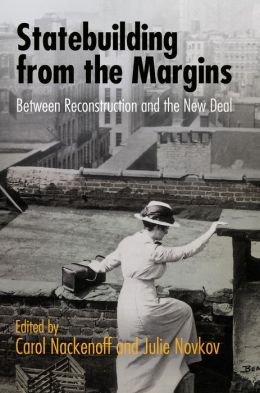
The second is Statebuilding from the Margins: Between Reconstruction and the New Deal edited by Carol Nackenoff and Julie Novkov (University of Pennsylvania Press).
“In an enjoyable, well-researched, and well-edited compilation of eclectic case studies edited by Carol Nackenoff and Julie Novkov, scholars examine how non-state actors of various civic, social, and ideological groups during the Progressive Era brought the state back in as a means of achieving desired policy ends. The accounts are notable for drawing attention to previously unexamined policy areas that provide leverage for claims that statebuilding is not always rational or linear, the distinction between public and private actors is not so cut-and-dried, and that the agency of actors is bounded by institutions and prevailing ideologies of the public good. Taken together, the chapters of this important contribution to the subfield of American Political Development exemplify the quintessential nature of the fragmented, piecemeal, inconsistent, and often jarring development of the capacity of the American state."
Abigail Perkiss talks with New Books in History about her new book, Making Good Neighbors: Civil Rights, Liberalism and Integration in Postwar Philadelphia (Cornell University Press).

And, Michael Bryant talks with New Books in Law about his new book, Eyewitness to Genocide: The Operation Reinhard Death Camp Trials, 1955-1966 (University of Tennessee Press). 

“A recent trend in Native studies is tribal-level examinations on indigenous nation-building and the expanding definitions of sovereignty, as well as examinations regarding citizenship that are inevitably generated from such endeavors. Brian Klopotek, in Recognition Odyssey: Indigeneity, Race, and Federal Tribal Recognition Policy in Three Louisiana Indian Communities, brings a much-needed perspective to these conversations through his detailed analysis of the variability in the recognition process and how success or failure is predicated more on the intersections of larger historical social structures with specific circumstances than on objective qualifications. Using a multidisciplinary approach combining history, anthropology, and sociology, Klopotek has written an immensely impressive and supremely complex history of three distinct Indian communities in late twentieth-century Louisiana seeking state and federal recognition: the Tunica-Biloxi, the Jena Choctaws, and the Clifton-Choctaws.”

Monday, March 31, 2014

New Release: Compton, "The Evangelical Origins of the Living Constitution"

New from Harvard University Press: The Evangelical Origins of the Living Constitution (March 2014), by John W. Compton (Chapman University). From the Press:
The New Deal is often said to represent a sea change in American constitutional history, overturning a century of precedent to permit an expanded federal government, increased regulation of the economy, and eroded property protections. John Compton offers a surprising revision of this familiar narrative, showing that nineteenth-century evangelical Protestants, not New Deal reformers, paved the way for the most important constitutional developments of the twentieth century.
Following the great religious revivals of the early 1800s, American evangelicals embarked on a crusade to eradicate immorality from national life by destroying the property that made it possible. Their cause represented a direct challenge to founding-era legal protections of sinful practices such as slavery, lottery gambling, and buying and selling liquor. Although evangelicals urged the judiciary to bend the rules of constitutional adjudication on behalf of moral reform, antebellum judges usually resisted their overtures. But after the Civil War, American jurists increasingly acquiesced in the destruction of property on moral grounds.
In the early twentieth century, Oliver Wendell Holmes and other critics of laissez-faire constitutionalism used the judiciary’s acceptance of evangelical moral values to demonstrate that conceptions of property rights and federalism were fluid, socially constructed, and subject to modification by democratic majorities. The result was a progressive constitutional regime—rooted in evangelical Protestantism—that would hold sway for the rest of the twentieth century.
The reviewers say:
John Compton’s superb book provides a fascinating account of the influence that evangelical attempts to stamp out drinking and lotteries had on American constitutional development. That, in itself, is worth the price of admission.—Mark Graber, University of Maryland Francis King Carey School of Law
The book’s clear, forcibly argued, and original thesis challenges some of the most influential scholarship in its field.—Ken I. Kersch, Boston College
As scholars and pundits debate whether the New Deal order is coming to an end, questions about its inception are particularly timely, and the author’s engagement with the question of how morals can influence constitutional politics is quite salient at this time.—Julie Novkov, University at Albany, State University of New York
More information is available here.

Thursday, January 2, 2014

Essays on American Statebuilding from Reconstruction to the New Deal

Out this month from the University of Pennsylvania Press is Statebuilding from the Margins: Between Reconstruction and the New Deal, edited by Carol Nackenoff and Julie Novkov.  It is a volume in the American Governance: Politics, Policy, and Public Law series.  Contributors are James Greer, Carol Nackenoff, Julie Novkov, Susan Pearson, Kimberly Smith, Marek D. Steedman, Patricia Strach, Kathleen Sullivan, Ann-Marie Szymanski.
The period between the Civil War and the New Deal was particularly rich and formative for political development. Beyond the sweeping changes and national reforms for which the era is known, Statebuilding from the Margins examines often-overlooked cases of political engagement that expanded the capacities and agendas of the developing American state. With particular attention to gendered, classed, and racialized dimensions of civic action, the chapters explore points in history where the boundaries between public and private spheres shifted, including the legal formulation of black citizenship and monogamy in the postbellum years; the racial politics of Georgia's adoption of prohibition; the rise of public waste management; the incorporation of domestic animal and wildlife management into the welfare state; the creation of public juvenile courts; and the involvement of women's groups in the creation of U.S. housing policy. In many of these cases, private citizens or organizations initiated political action by framing their concerns as problems in which the state should take direct interest to benefit and improve society.

Statebuilding from the Margins depicts a republic in progress, accruing policy agendas and the institutional ability to carry them out in a nonlinear fashion, often prompted and powered by the creative techniques of policy entrepreneurs and organizations that worked alongside and outside formal boundaries to get results. These Progressive Era initiatives established models for the way states could create, intervene in, and regulate new policy areas—innovations that remain relevant for growth and change in contemporary American governance.
Here are the blurbs:

"An engaging and original contribution to our understanding of a critical period in American political development. By surveying a range of different policy domains within a single historical era, these essays effectively catalogue the multiple ways in which private citizens and associations leveraged and augmented the scope of state intervention."—Elizabeth Clemens, University of Chicago

"The Progressive Era remains as controversial as it is vital for understanding the contemporary United States. Carol Nackenoff and Julie Novkov have orchestrated a set of rich, detailed and evocative studies on themes ranging from prohibition, urban government, environmentalism, housing and juvenile justice that together make for a highly original contribution to our understanding of twentieth-century America."—Daniel Carpenter, Harvard University

Friday, December 20, 2013

H-Law's "New Books in U.S. Constitutional/Legal History," Fall 2013 edition

Our friends at H-Law have sent out the Fall 2013 edition of New Books in U.S. Constitutional/Legal History. Timothy S. Huebner (Rhodes College) compiled and edited the list. In the coming weeks, we'll try to spotlight some items from the list that escaped our attention in previous months.
Abrams, Jeanne E.  Revolutionary Medicine:  The Founding Fathers and Mothers in Sickness and in Health.  New York:  New York University Press, 2013.  304 pp.  (cloth, $30.00, ebook).

Anderson, Karen.  Little Rock:  Race and Resistance at Central High School.  Princeton, N.J.:  Princeton University Press, 2013.  344 pp.  Paperback ed.  (paper, $24.95, ebook).

Baker, Bruce E. and Brian Kelly.  After Slavery:  Race, Labor, and Citizenship in the Reconstruction South.  Gainesville, Fla.:  University Press of Florida, 2013.  New Perspectives on the History of the South.  278 pp.  (cloth, $74.95).

Ball, Howard.  At Liberty to Die:  The Battle for Death with Dignity in America.  New York:  New York University Press, 2013.  224 pp.  Paperback ed.  (paper, $22.00, ebook).

Bernstein, Richard, ed.  An Expression of the American Mind:  Selected Writings of Thomas Jefferson.  London:  Folio Society, 2013.  616 pp.  (cloth, $79.95).

Blackman, Jon S.  Oklahoma’s Indian New Deal.  Norman, Okl.:  University of Oklahoma Press, 2013).  192 pp.  (cloth, $24.95).

Tuesday, April 17, 2012

Gilman, Graber, and Whittington's "American Constitutionalism"

Just out is the first volume of a constitutional law casebook written by three political scientists who take a historical approach to the topic, Howard Gillman, Mark A. Graber, and Keith E. Whittington’s American Constitutionalism (Oxford University Press).  As Professor Whittington explains:
This is a book of cases and materials for teaching the history of American constitutionalism, and we think it is something of a landmark in the extent to which it integrates a developmental perspective into constitutional law teaching and makes available historical context and non-U.S. Supreme Court materials for constitutional scholars and instructors.  The book includes everything from Gibbons v. Ogden to Daniel Webster’s Speech opposing a military draft, from Missouri v. Holland to Theodore Roosevelt’s remarks on presidential power, from Printz v. United States to Caroline Krass’ memo on the use of military force in Libya.  Volume 2 will provide similar coverage of constitutional rights and liberties, from Fletcher v. Peck to Amy v. Smith, from Goodridge v. Department of Public Health to Attorney General Ashcroft’s letter to the National Rifle Association.
More particularly:
Constitutionalism in the United States is not determined solely by decisions made by the U.S. Supreme Court.  Moving beyond traditional casebooks, American Constitutionalism takes an innovative approach to the teaching of American constitutional law and politics.  Organized into the standard two-semester sequence, with volume one covering institutions and volume two covering rights and liberties, the text is distinctive in presenting the material in a historical organization within each volume and fully integrating the material into a political and legal context for students.

Many scholars have deepened our understanding of the development of our constitutional system, while also providing more interesting and sophisticated analyses of the political forces that shape constitutional debates and outcomes. American Constitutionalism has incorporated these lessons about how our constitutional system actually works while at the same time preserving what instructors and students find most engaging about the topic.  These new materials allow instructors to develop more interesting explanations and debates about familiar issues, while at the same time introducing students to vitally important questions that are often excluded from Court-centered textbooks.

American Constitutionalism offers a number of useful features.  It covers all important debates in American Constitution (not just those that have been recently litigated before the Supreme Court), organized by historical era.  It incorporates readings from all the prominent participants in those debates.  It clearly lays out the political and legal contexts of those materials.  It integrates more documents and cases than any other text on the market, including decisions made by elected officials and state courts.  The book offers numerous pedagogical features, including topical sections within each historical chapter, bulleted lists of major developments, explanatory headnotes for the readings, questions on court cases, illustrations and political cartoons, tables and figures, and suggested readings.  The text is supported by websites for students and teachers with extensive supplementary materials, including additional readings, sample syllabi, instructor guides, and presentation slides.
Julie Novkov, University of Albany, enthuses:
American Constitutionalism marks a new age in the teaching of constitutional law. The book elegantly presents a historicized and developmental account that unveils the political and institutional roots of contemporary constitutional controversies. History and politics come alive for students as they engage constitutional problems as concrete political and legal struggles with stakes that span all American institutions, not just the courts. After using this text, I can't imagine teaching constitutional law any other way.
Other blurbs, the table of contents, and sample chapters are here.

Update
"Con Law in the Round," Ken Kersch's Balkinization post on American Constitutionalism is here.

Sunday, April 3, 2011

The Survey: Reconstructions


Just finished David Silkenat's new book Moments of Despair: Suicide, Divorce, & Debt in Civil War Era North Carolina, (UNC Press, 2011). A great read, its pushing me to rethink my usual approach to Reconstruction. For the past few years, I've spent a lot of time trying to recover the vigilante horror of the Ku Klux Klan, using it to flag the virulent racism that characterized the South at the time, along with the role of vigilantism generally in American legal history (meanwhile providing context to the Slaughterhouse Cases, United States v. Cruickshank, and so on). Helpful in this task have been Charles Lane's Day Freedom Died: The Colfax Massacre, the Supreme Court, and the Betrayal of Reconstruction John Witt's "Exodus of Elias Hill," in Patriots & Cosmopolitans, and Glenda Gilmore's Gender & Jim Crow: Women and the Politics of White Supremacy in North Carolina, 1896-1920. Yet, Silkenat's book paints a more complex portrait of the white South than any of the above, not simply a gang of bloodthirsty terrorists, but a profoundly broken, despondent group. Interestingly, the story coincides with the history of vice in the region (the focus of a new seminar I'm running at SLU). According to David Courtwright, southern whites had one of the highest morphine rates in the country following the war, partly due to "a pervasive depression." No one was more depressed, argues Courtwright, than former plantation owners, who also led the way in opium addiction. By the 1890s, opium had been joined by cocaine, prompting pharmacists to mix it with soda in Atlanta, and adding to an insurgent vice culture that I now think was beginning to characterize the region. In fact, one of the most interesting studies of the issue, conducted by Jeffrey Clayton Foster, shows that vice, and particularly drug use, were fueling integrated drug binges in places like Chattanooga and Knoxville. Here, some of the integrated prostitution cases in Julie Novkov's Racial Union: Law, Intimacy, and the White State in Alabama, come to mind, many involving not just sex, but also alcohol and drugs. Could C. Vann Woodward be right after all? Was there a moment of possibility for integration ... albeit fueled by depression and vice?

Photo credit: UNC Press

Tuesday, March 29, 2011

Book Review Edition of Tulsa Law Review

A Book Review issue of the Tulsa Law Review, 45 Tulsa L. Rev. 575 (Summer, 2010), co-edited by Sanford Levinson (Texas-Law & Political Science) and Mark Graber (Maryland-Law & Political Science), recently was published. The editors explain the origins and purposes of the issue in an introduction. They note:

Two polemics inspired this issue of the Tulsa Law Review. Writing in the May 2009 Texas Law Review, Levinson bemoaned the decline of book reviews in law student edited journals. Noting that a majority of the so-called "top" law reviews published no book reviews at all, he complained of the "willful refusal ... of America's leading law reviews to serve as a venue for serious discussion of important books relevant ... to thinking about law." n1 In his view, "both serious scholars and general readers alike" regard "book reviews as invaluable filtering mechanisms" for determining what of the many works published merit reading and which are best left on library shelves. Graber, in the spring 2002 issue of Law and Social Inquiry, had earlier condemned the failure of prominent law professors to engage relevant political-science literature. ....

Both are delighted that the reviews that follow not only think critically about major books recently published on constitutionalism, jurisprudence, and legal history, but also provide opportunities either for law professors to discuss works by political scientists/historians or for political scientists/historians to engage law professors on subjects of mutual interest and concern.

The volume includes reviews by Mark Tushnet, Gerald Rosenberg, Jamal Greene, Daniel Hamilton, Ernest Young, Rebecca Zietlow, Stephen Feldman and Julie Novkov, among others, who cover a wide range of works on subjects of interest to legal historians. The book review's table of contents is here. The volume itself is accessible through Lexis-Nexis.