Growing up in the second half of the 20th century, we are prone to think about our world and our work in terms of ideologies. Late 20th century historical discourse was dominated by a succession of ideas and theoretical frameworks. This mirrored the broader cultural and political discourse in which our work was set. For most of the last 75 years of the 20th century, Socialism, Fascism, Existentialism, Structuralism, Post-Structuralism, Conservatism, and other ideologies vied with one another broadly in our politics and narrowly at our academic conferences.Continue reading this very interesting essay here. The comments take up the question of whether theory vs. methodology is a false dichotomy. Surely we need innovations in both. Hat tip.
But it wasn’t always so. Late 19th and early 20th century scholarship was dominated not by big ideas, but by methodological refinement and disciplinary consolidation....
I believe we are at a similar moment of change right now, that we are entering a new phase of scholarship that will be dominated not by ideas, but once again by organizing activities, both in terms of organizing knowledge and organizing ourselves and our work. My difficulty in answering the question “What’s the big idea in history right now?” stems from the fact that, as a digital historian, I traffic much less in new theories than in new methods.
Friday, March 21, 2008
Ideas/Method/Technology
Sunset for Ideology, Sunrise for Methodology? a post at Found History, is being widely read in the history blogosphere. Tom Scheinfeldt writes:


Thursday, March 20, 2008
Why I write books...
Having been provoked when I am facing a deadline...
There is a diversity of methodologies in legal history, but legal history helps us understand the nature of legal system, and the relationship between law and social change. New transnational and comparative work (e.g. here and here), to take just one example, helps us to see that the new interest in globalization is not so new, and provides a window on the way national legal ideas have transnational sources and impacts. The sort of arguments found in historical work will generally take a different form than arguments in legal theory. We have a division of labor in the academy.
At a time when history has become a form of analysis on the Supreme Court (e.g. in PICS, Lopez and many other cases), this is hardly a time to turn away from legal history, including in legal education, in spite of recent contrary comments.
But the dismissal of legal history by law review editors is one reason that publishing in peer reviewed history journals and books, where the critical comments in the editorial process go to the substance of the historical arguments & evidence, can be so much more satisfying. There are, of course, exceptions. It usually depends on whether someone on a particular law review board has an interest and/or expertise in history.
While Lawrence Solum is right to imply that the above quote can be thought of as a parody of law review thinking (there is a more earnest take on the blog in question here), there is a substance behind the parody that needs to be engaged.
let me say only this: legal history that makes no argument is not good legal history. Legal history that is principally "prospective" is sometimes fine but can often be, well, "law office history," history in the service of advocacy. This sort of history may work in an amicus brief, but would not make it through peer review in a history journal.Legal history has its place, but you will be fighting a very large uphill battle in submitting a piece that has few to none prospective and/or normative conclusions.
What will Mary Dudziak say?
There is a diversity of methodologies in legal history, but legal history helps us understand the nature of legal system, and the relationship between law and social change. New transnational and comparative work (e.g. here and here), to take just one example, helps us to see that the new interest in globalization is not so new, and provides a window on the way national legal ideas have transnational sources and impacts. The sort of arguments found in historical work will generally take a different form than arguments in legal theory. We have a division of labor in the academy.
At a time when history has become a form of analysis on the Supreme Court (e.g. in PICS, Lopez and many other cases), this is hardly a time to turn away from legal history, including in legal education, in spite of recent contrary comments.
But the dismissal of legal history by law review editors is one reason that publishing in peer reviewed history journals and books, where the critical comments in the editorial process go to the substance of the historical arguments & evidence, can be so much more satisfying. There are, of course, exceptions. It usually depends on whether someone on a particular law review board has an interest and/or expertise in history.
While Lawrence Solum is right to imply that the above quote can be thought of as a parody of law review thinking (there is a more earnest take on the blog in question here), there is a substance behind the parody that needs to be engaged.
Likhovski on Legal Transplants and Legal Signaling (involving Israel, Harvard and Africa)
Argonauts of the Eastern Mediterranean: Legal Transplants and Signaling is a new paper by Assaf Likhovski, Tel Aviv University - School of Law.
Along the lines of this paper, there is much research to do on the involvement of lawyers from other nations in the development of legal institutions and legal education in Africa and elsewhere. For any Yale student looking for a topic, for example, there was a Yale Law School project in the 1960s on "Yale in Africa." And many law schools have faculty who spent a part of their career teaching in African law schools after independence, etc. Likhovski's paper broadens the transnational dimensions of work like this. Here's the abstract:
This paper tells the story of the Harvard-Israel Cooperative Research for Israel's Legal Development Program, created by a group of German-Jewish lawyers in the 1950s. The paper argues that an analysis of the history of the program, and a related program of Israeli legal aid to Africa in the 1960s, can suggest novel ways of understanding the social acts involved in the process of legal transplantation.
Much of the literature on legal transplants focuses on the legal norms that are transplanted, and connects the existence of the phenomenon of transplantation to the more general debate about the relative autonomy of law. In this paper I would like to shift the focus of the debate from discussion of the legal norms transplanted to the social acts involved in the process of transplantation.
My argument is that while transplantation may be motivated by utilitarian considerations, such as the desire to obtain foreign norms which are deemed superior to local law, it is sometimes also a process of signaling. Signaling theory seeks to explain a wide range of indirectly-utilitarian forms of behavior, ranging from the extravagant tails of peacocks to conspicuous consumption or monumental architecture in human societies. This paper argues that one of the roles of the Harvard Program (as well as the program of Israeli legal aid to Africa in the 1960s) was its use as a signaling device to communicate to Israel's potential western allies as well as its Arab enemies the fact that Israel was both a part of the civilized world, and thus a worthy partner for cooperation and a state strong enough to survive in the hostile environment into which it was born.
Along the lines of this paper, there is much research to do on the involvement of lawyers from other nations in the development of legal institutions and legal education in Africa and elsewhere. For any Yale student looking for a topic, for example, there was a Yale Law School project in the 1960s on "Yale in Africa." And many law schools have faculty who spent a part of their career teaching in African law schools after independence, etc. Likhovski's paper broadens the transnational dimensions of work like this. Here's the abstract:
This paper tells the story of the Harvard-Israel Cooperative Research for Israel's Legal Development Program, created by a group of German-Jewish lawyers in the 1950s. The paper argues that an analysis of the history of the program, and a related program of Israeli legal aid to Africa in the 1960s, can suggest novel ways of understanding the social acts involved in the process of legal transplantation.
Much of the literature on legal transplants focuses on the legal norms that are transplanted, and connects the existence of the phenomenon of transplantation to the more general debate about the relative autonomy of law. In this paper I would like to shift the focus of the debate from discussion of the legal norms transplanted to the social acts involved in the process of transplantation.
My argument is that while transplantation may be motivated by utilitarian considerations, such as the desire to obtain foreign norms which are deemed superior to local law, it is sometimes also a process of signaling. Signaling theory seeks to explain a wide range of indirectly-utilitarian forms of behavior, ranging from the extravagant tails of peacocks to conspicuous consumption or monumental architecture in human societies. This paper argues that one of the roles of the Harvard Program (as well as the program of Israeli legal aid to Africa in the 1960s) was its use as a signaling device to communicate to Israel's potential western allies as well as its Arab enemies the fact that Israel was both a part of the civilized world, and thus a worthy partner for cooperation and a state strong enough to survive in the hostile environment into which it was born.
Sisk on Uprooting the Pruneyard
Gregory C. Sisk, University of St. Thomas School of Law, has a new article, Uprooting the Pruneyard. It appears is the Rutgers Law Journal (2008). Here's the abstract: If, in the description of one constitutional scholar, text, history, structure, prudence, and doctrine are the building blocks of constitutional argument, then the California Supreme Court's landmark 1979 decision in Robins v. Pruneyard constructed a building without a supporting foundation, sturdy walls, or a covering roof. The court invoked the Liberty of Speech Clause in the California Constitution to impose duties upon private landowners, not merely upon government, to facilitate the political speech of others. But Pruneyard was a disembodied policy decision, severed from constitutional text, history, context, and developed legal reasoning. In this Article, the author revisits the Pruneyard decision, through a scrupulous analysis of the text and the context of the typical state constitutional speech clause, together with a fresh examination of original historical sources in state constitutional drafting. The author further addresses the continuing interplay in constitutional law between freedom of speech and guarantees for private property, insisting that weakening the latter ultimately compromises the former. Because Pruneyard has received persistent attention in ongoing constitutional debates for more than two decades, because more than thirty states share a similar text for (and much of the same history of) a constitutional liberty of speech clause, because Pruneyard is a period piece from a particular epoch in American constitutionalism, and because the jurisprudence of constitutional interpretation has progressed beyond that stage, the story of Pruneyard is a cautionary tale with national resonance.
Wednesday, March 19, 2008
Booth on Five Decades of Corporation Law
Richard A. Booth, Villanova University School of Law, has posted a new paper, Five Decades of Corporation Law - From Conglomeration to Equity Compensation. It is forthcoming in the Villanova Law Review. Here's the abstract: This brief essay recounts developments in corporation law over the last fifty years. It begins with the rise of finance capitalism and the conglomerate corporation which was followed by the emergence of hostile takeovers in the late 1970s and 1980s. One of the key events in this saga was the February 1, 1983 decision by the Delaware Supreme Court in Weinberger v. UOP, Inc. that effectively permitted the at-will elimination of minority stockholders through cashout mergers. Takeovers were also facilitated by two major financial developments: (1) the growth of institutional investors coupled with the growing taste of diversified investors for risk and (2) the emergence of the junk bond market as a source of cash to finance takeovers. Target managers vigorously sought ways to defend themselves from takeover. But the genie was out of the bottle. Although the initial motivation for takeovers was the bust up of inefficient conglomerate companies - because investors figured out that they could roll their own diversified portfolios more cheaply - diversified investors also figured out that they could tolerate more risk. So they demanded higher returns from all companies. Faced with this irresistible force, target managers also sought ways to share the gains. The result was that executive compensation evolved from a salary and bonus system to one based on stock options and other forms of equity. Equity compensation gave rise to two unintended - but quite happy - consequences. One is that it permits managers to share in the gains from divestitures and thus eliminated the bias for growing the company that went with the old salary and bonus system. The other is that it causes public companies to distribute available cash through repurchases designed to deal with the dilution that comes from the exercise of stock options. Ironically, the primary justification for takeovers had been that target companies tended to hoard cash and use it for uneconomic growth. Thus, the takeover did not die because of defensive tactics and protectionist state takeover laws. It simply went in house. The implications of this evolution are significant. For one, it calls into question the traditional notion that the stockholders own the company and that the CEO is a glorified employee. It may make more sense to think of stockholders and managers as in partnership with each other with the board of directors charged primarily with the role of arbitrating the competing claims of these two groups of owners. If this is the better view of the corporation, then executive compensation becomes the central concern of corporation law rather than an interesting subset of problems falling somewhere between the duty of care and the duty of loyalty. Moreover, under this view of the corporation, it would seem quite important to enforce rules against insider trading, whereas under the traditional view of the corporation the rationale for the prohibition of insider trading is not at all clear. This text of this essay was delivered as a lecture at the inauguration of the McGuinn Chair of Business Law at Villanova University School of Law on October 12, 2007.
Tuesday, March 18, 2008
Alan Dawley
Historian Alan Dawley, College of New Jersey, died suddenly from heart failure  while in Mexico recently studying Spanish and meeting with friends in the global justice movement. A widely read and admired U.S. historian, Dawley's most recent book set the progressive movement in a global context. His works include:
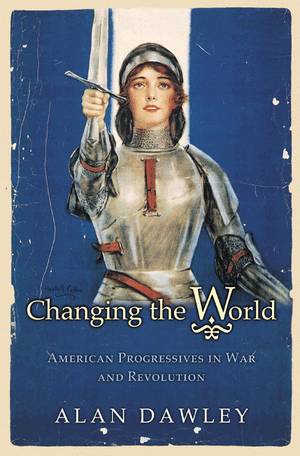
 while in Mexico recently studying Spanish and meeting with friends in the global justice movement. A widely read and admired U.S. historian, Dawley's most recent book set the progressive movement in a global context. His works include:
Changing the World: American Progressives in War and Revolution , 1914-1924 (Princeton University Press, 2003)
Struggles for Justice: Social Responsibility and the Liberal State (Harvard University Press, 1991)
(co-editor) Working for Democracy: American Workers from the Revolution to the Present (University of Illinois Press, 1985)
Class and Community: The Industrial Revolution in Lynn (Harvard University Press, 1976; Winner of the Bancroft Prize)
In lieu of sending flowers, the family asks that donations in his memory be sent to any of the following organizations that Alan supported:
Weaver's Way Community Programs: send checks in honor of Alan to 559 Carpenter Lane, Philadelphia, PA 19119;
American College of Nurse Midwives Foundation; when you donate, you can indicate that the donation is in honor of Alan.
Woodrow Wilson National Fellowship Foundation; when you donate, you can indicate that the donation is in honor of Alan.
A celebration of Alan Dawley's life and work is planned for June. To participate or send a remembrance, contact information is available here.
Horowitz on The Federalist Abroad in the World
Donald Horowitz, Duke, takes up a great topic, The Federalist Abroad in the World. There remains much important work to do on placing U.S. legal history in a global context. We can explore transnational dimensions of American legal ideas, American legal actors and the transnational reach of the state itself. Horowitz takes up an important example of the reach of the American founding.
The American example has affected other political struggles in various ways. The impact of American history on the politics, or at least the political rhetoric, of others was evident in the late 1950s, when Kenya independence leader Tom Mboya came to the United States and talked about George Washington. Kenyans drew inspiration from Americans' successful battle against the British Empire. More on that here.
Here's Horowitz's abstract:
This paper traces the influence of The Federalist Papers on five continents. From 1787 to roughly 1850, The Federalist was widely read and highly influential, especially in Europe and Latin America. Federalist justifications for federalism as a solution to the problem of creating a continental republic or to provincial rivalries were widely accepted. So, too, was the presidency, at least in Latin America, and that region adopted judicial review later in the nineteenth century. Presidentialism and judicial review fared less well in Western Europe. Following World War II, judicial review slowly became part of the standard equipment of new and old democracies alike, for reasons the paper attempts to specify. On the other hand, federalism is relatively rarely adopted, despite its potential for the alleviation of ethnic divisions. In general, the rights consciousness associated with the Anti-Federalists has prevailed over Federalist structural engineering in the contemporary period, even though many constitutional design scholars and advisors counsel constitution-makers to consider Madisonian approaches. In the United States, by contrast, Federalist ideas are firmly embedded in public consciousness but are increasingly rejected by some scholars, who see them as insufficiently majoritarian or excessively cumbersome to accomplish the work of government.
The American example has affected other political struggles in various ways. The impact of American history on the politics, or at least the political rhetoric, of others was evident in the late 1950s, when Kenya independence leader Tom Mboya came to the United States and talked about George Washington. Kenyans drew inspiration from Americans' successful battle against the British Empire. More on that here.
Here's Horowitz's abstract:
This paper traces the influence of The Federalist Papers on five continents. From 1787 to roughly 1850, The Federalist was widely read and highly influential, especially in Europe and Latin America. Federalist justifications for federalism as a solution to the problem of creating a continental republic or to provincial rivalries were widely accepted. So, too, was the presidency, at least in Latin America, and that region adopted judicial review later in the nineteenth century. Presidentialism and judicial review fared less well in Western Europe. Following World War II, judicial review slowly became part of the standard equipment of new and old democracies alike, for reasons the paper attempts to specify. On the other hand, federalism is relatively rarely adopted, despite its potential for the alleviation of ethnic divisions. In general, the rights consciousness associated with the Anti-Federalists has prevailed over Federalist structural engineering in the contemporary period, even though many constitutional design scholars and advisors counsel constitution-makers to consider Madisonian approaches. In the United States, by contrast, Federalist ideas are firmly embedded in public consciousness but are increasingly rejected by some scholars, who see them as insufficiently majoritarian or excessively cumbersome to accomplish the work of government.
3 books win the Bancroft
 This year's Bancroft Award goes to three books: Allan M. Brand
 t for The Cigarette Century: The Rise, Fall, and Deadly Persistence of the Product that Defined America (New York: Basic Books), Charles Postel for The Populist Vision (New York: Oxford University Press), and Peter Silver for Our Savage Neighbors: How Indian War Transformed Early America (New York: W. W. Norton & Company). The Bancroft is awarded annually by the Trustees of Columbia University to the authors of books of exceptional merit in the fields of American history, biography and diplomacy. The 2008 awards are for books published in 2007. Hat tip to Cliopatria.
Monday, March 17, 2008
2nd Amendment history at the Court
The Supreme Court hears arguments tomorrow in District of Columbia v. Heller, a rare Second Amendment case challenging the ban on handguns in Washington, D.C. Historians have filed briefs on both sides of the case on the question of the Second Amendment's historical meaning. There are also a number of new and older articles on the topic recently posted on SSRN.
There is a very long list of Amicus briefs in the case. The principal history briefs are, supporting the District of Columbia's defense of its law, the Brief of Jack N. Rakoffe, Saul Cornell, David T. Konig, William J. Novak, Lois G. Schoewerer, et al. On the other side is the BRIEF OF THE CATO INSTITUTE AND HISTORY PROFESSOR JOYCE LEE MALCOLM.
Paul Finkelman, Albany, has just posted his article, 'A Well Regulated Militia': The Second Amendment in Historical Perspective. Douglas G. Smith, Mason, has a recent paper, The Second Amendment and the Supreme Court. Clayton E. Cramer and Joseph Olson, Hamlin, have two recent papers, Pistols, Crime, and Public Safety in Early America, and a comparative paper about Britain, Gun Control: Political Fears Trump Crime Control. Historian Nathan Kozuskanich, Nipissing University, Ontario has a short piece on HNN, The Right to Bear Arms? What History Tells Us, discussing his argument in a longer article, ORIGINALISM, HISTORY, AND THE SECOND AMENDMENT: WHAT DID BEARING ARMS REALLY MEAN TO THE FOUNDERS? More on 2nd Amendment history is here.
For general background on the case, try the SCOTUS Wiki. For breaking news, the SCOTUS Blog is usually best. Various law blog reactions can be found here.
There is a very long list of Amicus briefs in the case. The principal history briefs are, supporting the District of Columbia's defense of its law, the Brief of Jack N. Rakoffe, Saul Cornell, David T. Konig, William J. Novak, Lois G. Schoewerer, et al. On the other side is the BRIEF OF THE CATO INSTITUTE AND HISTORY PROFESSOR JOYCE LEE MALCOLM.
Paul Finkelman, Albany, has just posted his article, 'A Well Regulated Militia': The Second Amendment in Historical Perspective. Douglas G. Smith, Mason, has a recent paper, The Second Amendment and the Supreme Court. Clayton E. Cramer and Joseph Olson, Hamlin, have two recent papers, Pistols, Crime, and Public Safety in Early America, and a comparative paper about Britain, Gun Control: Political Fears Trump Crime Control. Historian Nathan Kozuskanich, Nipissing University, Ontario has a short piece on HNN, The Right to Bear Arms? What History Tells Us, discussing his argument in a longer article, ORIGINALISM, HISTORY, AND THE SECOND AMENDMENT: WHAT DID BEARING ARMS REALLY MEAN TO THE FOUNDERS? More on 2nd Amendment history is here.
For general background on the case, try the SCOTUS Wiki. For breaking news, the SCOTUS Blog is usually best. Various law blog reactions can be found here.
Sunday, March 16, 2008
Book Review Round-up
A very quick round-up of history-related reviews, as I am traveling today...
ON DEEP HISTORY AND THE BRAIN, by Daniel Lord Smail (University of California Press), taking up human biology and history, is reviewed in the New York Times.
War is the subject of reviews in a number of papers. Ilya Ehrenburg and Vassily Grossman, The Unknown Black Book: The Holocaust in the German-Occupied Soviet Territories (Christopher Morris and Joshua Rubenstein, trans.) (Indiana University Press) is reviewed in the New York Sun. On World War I, Nicholas Baker, Human Smoke (Simon and Schuster) is also reviewed in the Sun.
More on Nazism, Nazi Literature in the Americas, by Roberto Bolaño, (translated by Chris Andrews) (NEW DIRECTIONS) is taken up in the San Francisco Chronicle.
A review of John Phillips and Martin Evans, Algeria: Anger of the Dispossessed is in the Washington Times.
The Washington Post has a round-up of books related to the war in Iraq.
ON DEEP HISTORY AND THE BRAIN, by Daniel Lord Smail (University of California Press), taking up human biology and history, is reviewed in the New York Times.
War is the subject of reviews in a number of papers. Ilya Ehrenburg and Vassily Grossman, The Unknown Black Book: The Holocaust in the German-Occupied Soviet Territories (Christopher Morris and Joshua Rubenstein, trans.) (Indiana University Press) is reviewed in the New York Sun. On World War I, Nicholas Baker, Human Smoke (Simon and Schuster) is also reviewed in the Sun.
More on Nazism, Nazi Literature in the Americas, by Roberto Bolaño, (translated by Chris Andrews) (NEW DIRECTIONS) is taken up in the San Francisco Chronicle.
A review of John Phillips and Martin Evans, Algeria: Anger of the Dispossessed is in the Washington Times.
The Washington Post has a round-up of books related to the war in Iraq.
Saturday, March 15, 2008
Sweeney on The Lexington
The Lexington is a new article by Joseph Conrad Sweeney, Fordham School of Law. It appears in the Journal of Maritime Law and Commerce (2008). Here's the abstract: The decision by the Supreme Court in New Jersey Steam Navigation Co. v. Merchants' Bank of Boston (The Lexington) marked a turning point in American legal history. Federal courts sitting as courts of admiralty had been preoccupied with war and neutrality and the extension of maritime law to inland waters. But in the case of the Lexington the Court decided that the admiralty jurisdiction of the United States is defined by limits found in ancient English statutes and customs. In the same case, the Court held that a marine carrier could be liable to a shipper for damage to cargo despite exculpatory clauses in the contract of carriage, anticipating the Harter Act of 1893 and the Carriage of Goods by Sea Act of 1936. With these decisions, the Court prepared the courts of the United States to serve the emerging commercial needs of a proud new democracy.
Schwaiger on the History of the 11th Amendment as Foreign Policy to Circumscribe the Treaty Power
Michael T. Schwaiger of the Alaska Public Defender Agency has posted a new article, A Visible Radiation: Interpreting the History of the Eleventh Amendment as Foreign Policy to Circumscribe the Treaty Power. It appeared in the Duke Journal of Constitutional Law & Public Policy (2007). Here's the abstract: In this Essay, I make two arguments. First, I argue that the national government may not use the Treaty Power to abrogate Eleventh Amendment protections. The Eleventh Amendment voided specific provisions of the Treaty of Peace that states feared would grant British creditors actionable claims against them and, by cabining the Treaty Power, additionally prevented the national government from negotiating a new treaty that would have held states accountable for their denials of British claims. Whatever the original meaning of the Treaty Power was at the Framing, the Eleventh Amendment redefined and curtailed it dramatically. In fact, the Framers of the Eleventh Amendment saw the Supremacy Clause, and the policy reasons underlying it, not as grounds to tolerate an expansive Treaty Power, but rather as the very reasons to amend the Constitution. The background of the Eleventh Amendment as a response to the Treaty of Peace must be considered in any complete picture of the constitutional balance between the national and state governments in light of the Treaty Power. Second, I argue that the states ratified the Eleventh Amendment to protect themselves from out-of-state plaintiffs - but only out-of-state plaintiffs - with claims based on diversity or federal question jurisdiction. The states ratified the Eleventh Amendment in reaction to Chisholm v. Georgia but did so more as Chisholm pertained to British creditors than as Chisholm pertained to American, out-of-state creditors. As a domestic policy measure, the Eleventh Amendment protected interests within each state and simultaneously cut short the emergence of a national court that could have held states accountable for practices that were discriminatory, corrupt, or dangerous to national security. As a foreign policy measure, the Eleventh Amendment expressed American outrage over Britain's refusal to evacuate military posts in the Northwest and expressed the American refusal to pay debts to British creditors. To protect states from British creditors, the ratifiers of the Eleventh Amendment had to preclude British merchants from bringing treaty-based claims under either federal question or diversity jurisdiction. They did not have to preclude in-state plaintiffs from bringing federal question claims, because British merchants could not practicably assign their claims to in-state plaintiffs. Competing interpretations of the Eleventh Amendment insufficiently consider its purpose as a foreign policy measure.
Friday, March 14, 2008
Siegel on Injunctions for Defamations, Juries, and the Clarifying Light of 1868
Stephen A. Siegel, De Paul University College of Law, has posted a new article, Injunctions for Defamation, Juries, and the Clarifying Light of 1868. It is forthcoming in the Buffalo Law Review. Here's the abstract: This article raises two issues of contemporary constitutional law. The first is a question of free speech: the propriety of the judiciary's current retreat from the traditional rule that equity cannot enjoin defamatory speech, which until now has been one of the unwavering precepts of the American law of remedies. The second is a question of constitutional jurisprudence: when determining the rights that citizens have against state government, should jurists who consider themselves originalists seek the meaning of the Bill of Rights in 1789, when the Bill was first adopted, or in 1868, when the Fourteenth Amendment made it applicable to the states? As a contribution to the judiciary's reassessment of the traditional no injunction for defamation rule, this Article revises our understanding of rule's history and discusses the implications of that revision for the current debate on the no injunction rule's continued propriety. The historiography of the rule traces back to Roscoe Pound's 1916 article Equitable Relief Against Defamation and Injuries to Personality. In Pound's view, the rule was not settled at the nation's founding. I will argue that it was. Also in Pound's view, the rule was founded on such anachronistic concerns as the limitation of equity's jurisdiction to the protection of property rights. I will argue that it was founded in on considerations that still should influence us: distrust of judges and respect for the role of juries in free speech controversies. In light of this argument, the Article suggests that if it is proper to depart from the traditional no injunction rule, the Supreme Court should find that the First Amendment imposes two jury-centered limitations on the departure: 1) no injunction may issue without a jury determination that the speech was defamatory; and 2) no injunction be enforced without a jury determination that the injunction was violated by speech that continues to be defamatory. By insisting on the inclusion of a jury in both the liability and enforcement proceedings, the insight of the constitution makers of the importance of a popular check on government regulation of speech may be retained. As a contribution to the practice of originalism, this Article establishes a historical point with which Pound had no concern: the evidence supporting the claim that the no injunction for defamation rule was an established aspect free speech is far more clear and abundant if we consider the Reconstruction era rather than the nation's Founding. This point illustrates the importance, when discussing the limitations imposed by the Fourteenth Amendment on the states, of shifting the focus from the meaning of the Bill of Rights in 1791 to its meaning in 1868. In this way, the paper contributes to the substantive debate on the future of the no injunction for defamation rule while it illustrates the importance of focusing on the evolution of Bill of Rights norms between 1789 and 1868 when interpreting the restrictions the Fourteenth Amendment imposes on the states.
Andrews on The Human Rights Movement at Middle Age
Penelope Andrews, CUNY School of Law, has posted a new essay, Some Middle-Age Spread, a Few Mood Swings, and Growing Exhaustion: The Human Rights Movement at Middle Age. It appeared in the Tulsa Law Review (2006). Here's the abstract: This paper was presented at a symposium, "The Scholar as Activist", dedicated to the work of Nadine Strossen, President of the ACLU. This paper focuses on the subject of international human rights law and the engagement of scholars as activists in this area of law. At fifty-plus years, and therefore soundly middle aged, the global human rights project today provides occasion for reflection and evaluation. This paper observes that human rights have increasingly become the language of progressive politics. In many ways, this focus on human rights globally echoes the struggle for civil liberties and civil rights in the United States in earlier decades. Then, despite widespread opposition, the vision of a society underpinned by human rights and dignity seemed attainable; this emboldened generations of activists and inspired many scholars. And sometimes, inspiration and boldness merged to shape the scholar as activist. The path-breaking contributions of scholars like John Hope Franklin, C. Vann Woodward, and Kenneth Clark to the 1954 decision of Brown v. Board of Education reflect the scholar as activist in the finest light. Using the South African democratic process as a case in point, the article assesses the transformative potential of human rights law.
Wednesday, March 12, 2008
Oregon Constitutional History Web Archive Honored
 Crafting the Oregon Constitution has received an Honorable Mention in what is being called the "first annual Best Archives of the Web awards" at at ArchivesNext. The site is maintained by the Oregon State Archives.
Before the constitution was framed, according to the site, Oregon fever gripped America, beginning in the 1840s. You can follow debates at the 1857 conference, with information about delegates, and coverage of substantive debates, including on the role of the judiciary. The original constitution begins here. Hat tip.
Ely on Rufus W. Peckham and Economic Liberty
 James W. Ely Jr., Vanderbilt, has posted a new paper, Rufus W. Peckham and Economic Liberty. Here's the abstract:
It is striking that Justice Rufus W. Peckham has received so little scholarly attention and remains without a biography. He was, of course, the author of the Lochner v. New York (1905), one of the most famous and contested decisions in the history of the Supreme Court. Moreover, Peckham wrote important opinions dealing with contractual freedom, anti-trust law, eminent domain, dormant commerce power, and the Eleventh Amendment. He was clearly among the intellectual leaders of the Fuller Court. This paper seeks to take a fresh look at Peckham's career and assess his contributions to constitutional jurisprudence. The paper argues that Peckham, although a champion of economic liberty, was neither a doctrinaire adherent to laissez-faire principles or a one-sided defender of large-scale business interest. Instead, his overriding concern was to protect small, self-sufficient entrepreneurs from both excessive governmental regulation and exploitation by concentrated private power. Image credit.
O'Connor on the History of Science and Patentability under the Constitution's IP Clause
More IP history. Sean M. O'Connor, University of Washington, has posted a new paper, Using Insights from the History of Science to Redefine Patentable Subject Matter Under the IP Clause of the U.S. Constitution. Here's the abstract: Over the past few years, Congress, the Supreme Court, academics, and the public in the United States have become increasingly concerned with the scope of patentable subject matter. Various critiques based on notions of patent thickets, anti-commons, and upstream patents in particular argue that research is being hindered by excessive patenting of scientific and technological innovation. While empirical evidence supporting these claims is scant - indeed some recent research rebuts the claims - the concern that too much scientific innovation is being patented still resonates across society. This paper argues that a re-examination of the scope of the Progress (or IP) Clause in the U.S. Constitution with the aid of research and insights from the interdisciplinary field of history and philosophy of science opens the door for a new approach to patentable subject matter.
Tuesday, March 11, 2008
Verizon-madness
Apologies for the paucity of posts. I planned to catch up on various things on a 5 hour train ride today, but instead spent hours on the phone with your favorite wireless company, which did not result in restoration of the mobile broadband service that they're charging me quite a bit for. If readers have good luck with any mobile broadband companies, especially their customer service troubleshooting, it would be so helpful to all if you would share info/advice in the comments.
Monday, March 10, 2008
Gomez-Arostegui on What History Teaches Us about Copyright Injunctions and the Inadequate-Remedy-At-Law Requirement
Tomas Gomez-Arostegui, Lewis & Clark Law School, did research at the National Archives of the U.K. (aka PRO) for his new paper, What History Teaches Us About Copyright Injunctions and the Inadequate-Remedy-At-Law Requirement. Here's the abstract: Our Supreme Court has held that as a general matter an injunction cannot issue if there is an adequate remedy at law. This follows, according to the Court, because the standard for when injunctions may issue derives directly from the practice of the English Court of Chancery around 1789, which followed the same principle. This Article argues that the Supreme Court's reading of general Chancery custom is inapposite in copyright cases, and that, as a matter of historical practice, the Chancery never inquired into whether a copyright plaintiff had an adequate remedy at law. The remedies at law were deemed categorically inadequate. The Supreme Court could thus hold today, without running afoul of traditional equitable principles, that a copyright injunction can issue without regard to the adequacy of money damages. This Article reaches its conclusion only after undertaking the most comprehensive treatment of the subject to date. It relies primarily on the original manuscript records of 215 infringement suits brought in the Court of Chancery from 1660 to 1800, which are stored at the National Archives in Kew, England, and a further review of earlier copyright-infringement suits circa 1557 to 1660 in antecedent tribunals, many of which are also only available in manuscript form. The topic of this Article is particularly timely given the Supreme Court's recent decision in eBay Inc. v. MercExchange, L.L.C. (2006), where it discussed the standard for issuing injunctions in patent cases, and where Chief Justice Roberts stated in a concurring opinion that lower courts should consider the inadequacy requirement in light of historical practices.
Two from Green on Equal Protection Revisionism
Christopher R. Green, University of Mississippi, has posted two new papers calling for a revisionist approach to the Equal Protection Clause. The first is: The Original Sense of the Equal) Protection Clause: Pre-Enactment History. Here's the abstract: The Supreme Court has long understood the Equal Protection Clause - "[N]or [shall any State] deny to any person within its jurisdiction the equal protection of the laws" - as a generic antidiscrimination provision. This article challenges that interpretation. Applying a constitutional theory that takes the sense historically expressed by constitutional language as interpretively binding, but not that language's historically-understood or historically-intended referent, I argue that the Clause instead requires States to supply "the protection of the laws" - and supply it equally - to everyone subject to the State's decrees. This article reviews evidence from the 1866 Congressional debates, explains how the language of the Clause in its historical setting expresses the allegiance-for-protection contractual tradition, documents the extensive tradition of using "the protection of the laws" to refer to the remedial and law-enforcement functions of government, and criticizes the textual foundation of the traditional view of the Clause. Elsewhere I consider subsequent interpretations of the Clause and explain why a duty-to-protect Equal Protection Clause would have great significance today.
Green's second paper is The Original Sense of the (Equal) Protection Clause: Subsequent Interpretation and Application. Here's the abstract: The Supreme Court has long understood the Equal Protection Clause--"[N]or [shall any State] deny to any person within its jurisdiction the equal protection of the laws"--as a generic antidiscrimination provision. This article challenges that interpretation. Applying a constitutional theory that takes the sense historically expressed by constitutional language as interpretively binding, but not that language's historically-understood or historically-intended referent, I argue that the Clause instead requires States to supply "the protection of the laws"--and supply it equally--to everyone subject to the State's decrees. Elsewhere I consider how the allegiance-for-protection contractual tradition and the history of "the protection of the laws" support a duty-to-protect reading of the Clause. This article reviews how a duty-to-protect reading of the Equal Protection Clause was adopted in the Civil Rights Act of 1871 and explained at great length in the debates leading to it, and argues that the Privileges or Immunities Clause, which speaks of the rights of citizens, makes far more sense than the Equal Protection Clause as a provision forbidding second-class citizenship and civil inequality. The duty-to-protect view found a few early judicial adherents, but it was soon swamped by a generic antidiscrimination reading after Slaughterhouse. A duty-to-protect Equal Protection Clause would forbid gross misbehavior in the provision of protective services, act as an open-courts provision akin to Magna Charta paragraph 40 and related state-constitutional provisions, require that police services be supplied equally, forbid inequalities like race-based jury nullification that favor criminal or civil defendants, fill a gap in the reasoning in Roe v. Wade on the inference from fetal personhood to the requirement of protection, require that the marital rape exemption be abandoned, suggest serious constitutional troubles for our current system of prosecutorial discretion, and allow the federal government to provide enforcement and remedial services when states have failed to do so.
Green's second paper is The Original Sense of the (Equal) Protection Clause: Subsequent Interpretation and Application. Here's the abstract: The Supreme Court has long understood the Equal Protection Clause--"[N]or [shall any State] deny to any person within its jurisdiction the equal protection of the laws"--as a generic antidiscrimination provision. This article challenges that interpretation. Applying a constitutional theory that takes the sense historically expressed by constitutional language as interpretively binding, but not that language's historically-understood or historically-intended referent, I argue that the Clause instead requires States to supply "the protection of the laws"--and supply it equally--to everyone subject to the State's decrees. Elsewhere I consider how the allegiance-for-protection contractual tradition and the history of "the protection of the laws" support a duty-to-protect reading of the Clause. This article reviews how a duty-to-protect reading of the Equal Protection Clause was adopted in the Civil Rights Act of 1871 and explained at great length in the debates leading to it, and argues that the Privileges or Immunities Clause, which speaks of the rights of citizens, makes far more sense than the Equal Protection Clause as a provision forbidding second-class citizenship and civil inequality. The duty-to-protect view found a few early judicial adherents, but it was soon swamped by a generic antidiscrimination reading after Slaughterhouse. A duty-to-protect Equal Protection Clause would forbid gross misbehavior in the provision of protective services, act as an open-courts provision akin to Magna Charta paragraph 40 and related state-constitutional provisions, require that police services be supplied equally, forbid inequalities like race-based jury nullification that favor criminal or civil defendants, fill a gap in the reasoning in Roe v. Wade on the inference from fetal personhood to the requirement of protection, require that the marital rape exemption be abandoned, suggest serious constitutional troubles for our current system of prosecutorial discretion, and allow the federal government to provide enforcement and remedial services when states have failed to do so.
Sunday, March 9, 2008
Risk, Race, the Right and Teapot Dome in the Book Reviews
In this "age of terror," with scholarly institutes focusing on the significance of fear, it is interesting to have two new books out that argue that this isn't such a frightening age after all. Risk: The Science and Politics of Fear, by Dan Gardner (Virgin)and Panicology, by Simon Briscoe and Hugh Aldersey-Williams (Viking) are reviewed in today's Guardian (UK). Rafael Behr writes of Gardner's findings:

Our poor troglodyte minds are simply not equipped to process the complexity of modern living, especially where risk is concerned. We hear about a terrorist attack; we see the gruesome consequences on TV and before we can calculate the probability that we personally will be blown up, our brains have reacted as if we are being charged by a rhino: no time to think! Run!...Evolution has taught us to prioritise anecdotal evidence because, unlike statistics, our imaginations can process it into something resembling our personal experience. 'It could have been me' is a common response to news of a disaster, although usually the mathematical probability of it actually having been you is infinitesimal.
Panicked about the impact of the corporation on politics? Time for a new take on Teapot Dome. The Teap ot Dome Scandal: How Big Oil Bought the Harding White House and Tried to Steal the Country, by Laton McCartney (Random House) is reviewed today in the Philadelphia Inquirer. Leonard Boasberg writes:
 ot Dome Scandal: How Big Oil Bought the Harding White House and Tried to Steal the Country, by Laton McCartney (Random House) is reviewed today in the Philadelphia Inquirer. Leonard Boasberg writes:
 Harding was a "dark horse" for the presidential nomination. But the "Oil King of Oklahoma," Jake Hamon, shopping for a president, decided that this undistinguished senator was his man, with the understanding that Hamon would become secretary of the interior. In that position, he would try to wrest control over the naval oil reserves at Teapot Dome in Wyoming and Elk Hills and Buena Vista, Calif., from the secretary of the Navy....Hamon strewed money around the Chicago GOP convention, buying delegates and influence. Collaborating with Harding's campaign manager and political brain, the crafty Ohio fixer Harry Micajah Daugherty, Hamon bought the nomination for Harding, according to McCartney. Alas, Hamon never took office. His mistress shot him.
The story continues, here.
Legal historian Daniel Sharfstein, Vanderbilt, reviews Richard Thompson Ford's new book THE RACE CARD: How Bluffing About Bias Makes Race Relations Worse (Farrar Straus & Giroux). "When Ford delves into the intricacies of post-racist America," he writes, "the book crackles with insight and pierces the pieties of left and right." However,
The legacy of Jim Crow is more pervasive than Ford allows. He suggests, for example, that the incompetent response to Hurricane Katrina can be attributed to President Bush's narrow political self-interest, not to his racism. But Ford doesn't address the modern Republican Party's calculated strategy to become the party of segregationists and white Southerners. Similarly, if discrimination against Spanish speakers seems distinct from race in the abstract, language was an unsubtle proxy for race in segregated schools, workplaces and jury pools in the American Southwest for much of the 20th century. But this history only heightens the urgency of today's problems, to which Ford, in his pragmatic and passionate effort to redefine civil rights, brings a jolt of clarity.

Finally, Eric Arnesen, University of Illinois, reviews William A. Link's new book Righteous Warrior: Jesse Helms and the Rise of Modern Conservatism (St. Martin's) for the Chicago Tribune. He finds it "a judicious and comprehensive biography of Helms, a man who 'left a permanent stamp on late-twentieth-century American public life,'" noting that "the book is, if anything, overly kind to its subject."
Saturday, March 8, 2008
Kelley on Exporting Western Law to the Developing World: The Troubling Case of Niger
Thomas Kelley III, University of North Carolina, Chapel Hill, has a new essay Exporting Western Law to the Developing World: The Troubling Case of Niger. It appeared in Global Jurist (2007). Here's the abstract: In recent years the West has dispatched "rule doctors" across the developing world to guide poor countries through the process of legal modernization and westernization. Their goal, laid out by the so-called Washington Consensus, has been to reform those countries' legal systems so that they might share in the economic bounty of globalization. But things have not always gone well, particularly – this paper argues – where those rule doctors have ignored existing legal traditions. The paper focuses on the particular case of Niger, one of the poorest countries in the world. At present, most of Niger's citizens rely on magio-religious traditions to accomplish what we in the West would consider law. One important, and from a Western perspective colorful, Nigerien legal tradition is its citizens' reliance on an oracle called the gon to identify wrongdoers and restore harmony to their communities. The paper will describe the gon, and will point out some of the ways that it differs fundamentally from Western conceptions of law. It then will conclude that Washington Consensus law reform in Niger will fail, and will very likely cause social unrest, unless it takes a different tack and finds a way to accommodate existing legal traditions.
Hat tip: Comparative Law Blog.
Hat tip: Comparative Law Blog.
Litman on 'Billowing White Goo' (aka copyright history)
Billowing White Goo is a new essay by Jessica Litman, University of Michigan. It is forthcoming in the Columbia Journal of Law & the Arts. Here's the abstract: In this paper, written for a symposium on Fair Use: Incredibly Expanding or Extraordinarily Shrinking?, I argue that the size of the fair use footprint has remained about the same over the past three decades, while the size and scope of copyright's exclusive rights have expanded markedly. In order to protect a broader range of worthy uses under the fair use umbrella, courts have adopted new tests tailored to privilege particular sorts of uses, but in doing so they haven't expanded fair use so much as they have moved it around. In part I of the paper, I briefly summarize the recent history of fair use from the Copyright Office's initial recommendations that Congress codify it through the tests the courts have articulated for applying it. I then turn to the expansion in exclusive rights under section 106. Some of that expansion derives from the architecture of the 1976 Act. Although Congress sought, with particular exceptions, to draft the statute to incorporate the substance of extant law, it drafted the bounded exclusive copyright rights in broad terms and the exceptions to those rights in specific terms. Over 30 years, the specifically worded exceptions have grown obsolete much more quickly than the broadly worded exclusive rights, leaving those rights subject to fewer and narrower exceptions than when the law was enacted. This may be a poor design for copyright laws in policy terms, but it was a choice Congress made. In contrast, the massive recent expansion in the scope of individual section 106 exclusive rights is occurring outside of the legislative process. Advocates have persuaded courts to construe each of the once-bounded exclusive rights more broadly. Once discrete exclusive rights are morphing into an all-purpose general use right. Our understanding of copyright is evolving into the notion that all uses of copyrighted work must be authorized, either by the statute or by the copyright owner. Unauthorized uses, it would follow, must be piracy. I argue that that construction of the copyright statute is completely untenable, especially as it applies to personal uses. Moreover, I suggest, expansion of that sort is as a practical matter inconsistent with a resolve to keep fair use cabined within traditional boundaries as a special privilege for exceptional cases.
Friday, March 7, 2008
Goldberg, A Historical Guide to the Future of Marriage for Same-Sex Couples
A Historical Guide to the Future of Marriage for Same-Sex Couples, just posted by Suzanne B. Goldberg, Columbia, consists of a short essay introducing an historical brief in a New Jersey same-sex marriage case. It was published, with the full brief in the Columbia Journal of Gender and Law (2006). Here's the abstract: This article critically analyzes the evolving history of marriage, prompted by the marriage equality claims brought by same-sex couples. The article includes a copy of an amicus brief submitted on behalf of historians to a New Jersey appellate court in Lewis v. Harris, an ultimately successful challenge to the denial of relationship recognition rights for same-sex couples.
Thursday, March 6, 2008
George Fredrickson has died
George Fredrickson, a towering figure in U.S. and comparative history, died February 25 at home in Stanford, California at the age of 73. He was the Edgar E. Robinson Professor o f United States History, Emeritus, at Stanford. The Stanford Report remembers him his way:
 f United States History, Emeritus, at Stanford. The Stanford Report remembers him his way:
Frederickson was a powerful force in reshaping historical views of the Civil War and race relations in the United States. He helped invent the field of comparative history through his seminal work White Supremacy: A Comparative Study of American and South African History, which was a finalist for the Pulitzer Prize. Few, if any, other historians have so imaginatively used a comparative approach to racism in America.
"George Fredrickson was an incredible scholar. The cope and depth of his knowledge was breathtaking," said Hazel Rose Markus, the Davis-Brack Professor in the Behavioral Sciences. "Even in a brief conversation with hi,m non-historians immediately understood how today was composed of the past and everyone knew they needed to know more.
"Most significantly, his work has changed the way historians and social scientists think about race. George Fredrickson has helped us understand race as a dynamic system of attitudes and institutionalized practices. This system is rooted in a belief in white supremacy, and it persistently shapes societies and individuals."
He was an a ctivist who participated in the 1963 March on Washington, campaigned for divestment in South Africa at Stanford, and after the 1992 riots in Los Angeles, "he decried 'the new face of racism' in the Stanford Daily: 'The heart of the matter is the probable belief of these decent citizens that they are in no way responsible for the inner city conditions that spawn crime, disorder and police brutality.'"
 ctivist who participated in the 1963 March on Washington, campaigned for divestment in South Africa at Stanford, and after the 1992 riots in Los Angeles, "he decried 'the new face of racism' in the Stanford Daily: 'The heart of the matter is the probable belief of these decent citizens that they are in no way responsible for the inner city conditions that spawn crime, disorder and police brutality.'"
Among his books, White Supremacy: A Comparative Study in American and South African History (1981), which compared the histories of South African apartheid and racial segregation in the United States, was a finalist for the Pulitzer Prize. Today's Los Angeles Times obituary draws from David Brion Davis's New York Times review, calling the book "a model of comparative history, 'one of the most brilliant and successful . . . ever written.'"
"He was a pioneer," Ariela Gross, a professor of law and history at USC who studied for her doctorate under Fredrickson, said this week. "He published 'White Supremacy' at a time when most people studying slavery in the United States were doing groundbreaking work but very locally focused, looking at the social history of the U.S. . . . Now everybody is writing about slavery from an Atlantic perspective. Everyone is doing comparative and transnational work, 25 years later."
At The Edge of the American West, where he is eloquently remembered, are these words of Fredrickson's:
I am convinced that the few who have a genuine interest in ideas and a powerful urge to find meaning and coherence in their experience are able to tell us more about a crisis of values, with its inevitable confusion and ambivalence, than the many who avoid difficult issues and are content to speak in outdated clichés.


George Fredrickson's books included: The Inner Civil War: Northern Intellectuals and the Crisis of the Union (1965); The Black Image in the White Mind: The Debate on Afro-American Character and Destiny (1971); White Supremacy: A Comparative Study of American and South African History (1981); The Arrogance of Race: Historical Perspectives on Slavery, Racism and Social Inequity (1988); Racism: A Short History (2002); Black Liberation: A Comparative History of Black Ideologies in the United States and South Africa (1995). His last book, Big Enough to Be Inconsistent: Abraham Lincoln Confronts Slavery and Race (Harvard University Press), was published shortly before his death.
Update: A 2006 special issue of Safundi: The Journal of South African and American Studies took up the impact of Friedrickson's work. He is remembered here in the New York Times. Hat tip.
Zuker, Better a Catholic Than a Communist?
Better a Catholic Than a Communist has just been published by James Zucker, a recent University of Virginia Law School graduate and 5th Circuit law clerk, in the Virginia Law Review. It is nice to see a law school supporting good student work in legal history all the way to publication. Here's the abstract: In 1948, the Supreme Court in McCollum v. Board of Education declared a “released time” program for religious instruction in the Champaign, Illinois, public schools unconstitutional. Four years later in Zorach v. Clauson, the Court upheld an almost identical program in the New York City public schools. The Court distinguished the two programs on the grounds that the instruction in Champaign occurred in the school building, while the instruction in New York occurred off school grounds. It is clear this factual distinction was persuasive to at least one justice, yet Justice Douglas inexplicably included in his opinion for the Court another justification for finding the New York plan constitutional. He wrote that Americans “are a religious people whose institutions presuppose a Supreme Being.” This Note offers an explanation for Justice Douglas’s appeal to Americans as a religious people and contends that the argument was persuasive to the majority, save for Justice Burton. It argues that increasing post-war anti-Catholicism and the Court’s decision in Everson created a climate in 1948 where the country was concerned with a growing Catholic influence in the public schools. Following Everson, McCollum provided the Court with an opportunity to draw a line and establish Mr. Jefferson’s high wall, so much discussed in Everson, between the church and state sponsored education. Following McCollum, however, the country’s concern shifted to Communism. With this shift, the country’s perception of “released time” public education changed. Instead of viewing these programs as opportunities for Catholic influence in the public schools, the country viewed public religious education as an opportunity to oppose the spread of “Godless Communism,” and opposition to “released time” education was characterized as support for totalitarianism. This Note posits that Justice Douglas’s appeal to the religious character of America reflected the changed historical context from McCollum to Zorach, namely, that by 1952 it was better to be a Catholic than a Communist.
Collins on Jurisdictional Exceptionalism
Michael G. Collins, University of Virginia, has just published Jurisdictional Exceptionalism in the Virginia Law Review (2007). Here's the abstract: Challenges to federal court subject matter jurisdiction enjoy exceptional treatment: They resist procedural regulation, they are immune to waiver, and they may be raised at any time during a case, even by the party who invoked the federal court’s jurisdiction in the first instance. Such treatment is said to arise from the limited nature of federal judicial power. Nevertheless, the current ability to raise jurisdictional challenges—however and whenever—proves to be a comparatively recent development. During the early Republic, the federal courts were governed by a highly formalized common-law pleading regime that constricted the time and manner of jurisdictional objections, that embraced a robust notion of waiver, and that created disincentives to challenging jurisdiction. The result was that federal courts heard cases in which the pleadings may have suggested subject matter jurisdiction but in which jurisdiction was lacking in fact. Mid-nineteenth century developments associated with code pleading brought an increased focus on jurisdictional facts, and the Reconstruction Congress provided greater opportunities for jurisdictional challenges than those available at common law. But it was not until the mid-1930’s that the Supreme Court fully articulated the modern notion that jurisdictional defects could be raised in any manner and at any time—a notion that was soon embodied in the Federal Rules of Civil Procedure. This underexplored history of pleading and jurisdiction—particularly that of the early Republic—suggests understandings of the federal courts’ limited jurisdiction that may be in tension with current views. It may also offer possibilities for (as well as limits on) procedural reform aimed at restricting the currently open-ended ability to raise jurisdictional challenges in federal court.
Tuesday, March 4, 2008
Fenster on The 9/11 Commission and Institutional Form
Mark Fenster, University of Florida has posted a new paper, Designing Transparency: The 9/11 Commission and Institutional Form. Here's the abstract: Surpassing the low expectations established by previous investigatory commissions and overcoming the political and legal obstacles created by the Bush administration's opposition to its creation, the 9/11 Commission accomplished what appeared to be the impossible: an authoritative investigation, a widely-read final report, and direct influence on significant legislation. At a time when legal scholars have committed themselves to the study of innovative institutional design, the formal legal innovations and administrative operations of the 9/11 Commission warrant close examination to consider whether and how it can serve as a model for similar institutions in the future. This Article argues that the 9/11 Commission indeed offers an important model for encouraging or forcing the executive branch to disclose information about an especially significant and controversial past event or future decision. As such, it suggests that Congress or the President consider establishing such commissions when information held by the executive branch can help the public to hold the state accountable for past actions or decide whether to support important, irreversible decisions the state must imminently make. The 9/11 Commission demonstrates that transparency can be better achieved in a time of crisis through institutional design than through constitutional common law and statute. The Article is less sanguine, however, about the 9/11 Commission as a model for policy formation. With limited accountability and relative independence from the political branches, an ad hoc, independent institution can make errors or misjudgments that can in turn have undue influence over the legislative process. Congress or the President should therefore limit the legal authority granted to investigative advisory commissions established during times of crisis so that political actors can fully deliberate over their prescriptions.
Adams on Cardozo and the history of the American Law Institute
This paper explores an influential reform agenda - the notion of a Ministry of Justice - advanced by Justice Benjamin Nathan Cardozo, one of the American Law Institute's founding members. The article in which Justice Cardozo introduced the concept of a Ministry of Justice was published in the Harvard Law Review the very month that the exploratory committee was formed that ultimately recommended the formation of the American Law Institute, and two years before the Institute itself was founded. This article explores the extent, if any, to which the reform agenda that Justice Cardozo propounded in this famous article was fulfilled by the founding of the Institute.
Monday, March 3, 2008
Kessler is new LHR Book Review Editor for non-American Legal History
 Amalia Kessler, Stanford Law School, is a new Associate Editor of the Law and History Review, and will join Alfred Brophy in editing book reviews. According to LHR Editor David Tanenhaus,
Professor Kessler will be responsible for book reviews on the non-Americas. Her research focuses on the evolution of commercial law and civil procedure and explores the roots of modern market culture and of present-day due process norms. The American Society for Legal History (ASLH) awarded her "Enforcing Virtue: Social Norms and Self-Interest in an Eighteenth-Century Merchant Court," the 2005 Surrency Prize for the best article published in LHR in 2004. Professor Brophy will continue his excellent service as LHR's Associate Editor responsible for book reviews on the Americas.
Kessler has a new book, A Revolution in Commerce: The Parisian Merchant Court and the Rise of Commercial Society in Eighteenth-Century France (Yale University Press, 2007). Here's what the press had to say about it:
This groundb reaking book provides the first comprehensive account of the juridiction consulaire, or Merchant Court, of eighteenth-century Paris. Drawing on extensive archival research, Amalia D. Kessler reconstructs the workings of the court and the commercial law that it applied and uses these to shed new light on questions about the relationship between commerce and modernity that are of deep and abiding interest to lawyers, historians, and social scientists alike.
Kessler shows how the merchants who were associated with the court—and not just elite thinkers and royal reformers—played a key role in reconceptualizing commerce as the credit-fueled private exchange necessary to sustain the social order. Deploying this modern conception of commerce in a variety of contexts, ranging from litigation over negotiable instruments to corporatist battles for status and jurisdiction, these merchants contributed (largely inadvertently and to their ultimate regret) to the demise of corporatism as both conceptual framework and institutional practice. In so doing, they helped bring about the social and political revolution of 1789.
Highly readable and engaging, A Revolution in Commerce provides important new insights into the rise of commercial modernity by demonstrating the remarkable role played by the law in ideological and institutional transformation.
This groundb
reaking book provides the first comprehensive account of the juridiction consulaire, or Merchant Court, of eighteenth-century Paris. Drawing on extensive archival research, Amalia D. Kessler reconstructs the workings of the court and the commercial law that it applied and uses these to shed new light on questions about the relationship between commerce and modernity that are of deep and abiding interest to lawyers, historians, and social scientists alike.Kessler shows how the merchants who were associated with the court—and not just elite thinkers and royal reformers—played a key role in reconceptualizing commerce as the credit-fueled private exchange necessary to sustain the social order. Deploying this modern conception of commerce in a variety of contexts, ranging from litigation over negotiable instruments to corporatist battles for status and jurisdiction, these merchants contributed (largely inadvertently and to their ultimate regret) to the demise of corporatism as both conceptual framework and institutional practice. In so doing, they helped bring about the social and political revolution of 1789.
Highly readable and engaging, A Revolution in Commerce provides important new insights into the rise of commercial modernity by demonstrating the remarkable role played by the law in ideological and institutional transformation.
And the blurbs:
"A really good historian as well as a really good lawyer, Kessler offers an accomplished and imaginative interpretation of the origins of liberal legal-economic market culture in eighteenth-century Paris."—Robert W. Gordon, Yale University
“A Revolution in Commerce is an erudite, original, and compelling treatment of one of the great problems of modern historiography: the relationship between capitalism and merchant practices, on the one hand, and late eighteenth-century political revolution, on the other.”—John Fabian Witt, Columbia University
“A Revolution in Commerce is an erudite, original, and compelling treatment of one of the great problems of modern historiography: the relationship between capitalism and merchant practices, on the one hand, and late eighteenth-century political revolution, on the other.”—John Fabian Witt, Columbia University
Rao on posse comitatus, Tucker on Canandian shareholder liability and more in the new LHR
The full Spring 2008 issue of the Law and History Review is published and available on-line. Susanna Blumenthal's article and the responses have been noted earlier. The Spring issue also includes The Federal Posse Comitatus Doctrine: Slavery, Compulsion, and Statecraft in Mid-Nineteenth-Century America by Gautham Rao; Shareholder and Director Liability for Unpaid Workers' Wages in Canada: From Condition of Granting Limited Liability to Exceptional Remedy by Eric Tucker and a long list of book reviews by various legal history luminaries. Here's editor David Tanenhaus's introduction: This issue of Law and History Review presents three articles on North America. The authors are all interested in the emergence of legalities, especially the role that ideas and ideologies play in their creation and maintenance. Collectively, they investigate the problem of slavery for the development of nineteenth-century American statecraft, the enduring tensions between protective labor law and corporate capitalism in modern Canada, and the elusive question of individual responsibility in nineteenth-century American jurisprudence.
Our first article, by Gautham Rao, examines the federal posse comitatus doctrine (i.e., the federal government's power to compel the service of free individuals) to investigate how the problem of slavery redefined the relationship between individuals and the federal state in mid-nineteenth-century America. In theory and practice, this doctrine underscored the massive expansion of government power during the Civil War and Reconstruction. Without adequate capacity to enforce the Fugitive Slave Law of 1850, the federal government "commanded" American citizens to assist law enforcement as a posse comitatus. But the doctrine's foundational relations with slavery proved problematic. For those subjected to its power—abolitionists, union and confederate conscripts, and defeated southerners—the posse comitatus itself appeared as a category of servitude. The Posse Comitatus Act of 1878 conveniently repudiated an era of federal power that was inextricably connected to slavery and servitude. Once freed from the image of slavery, the federal posse comitatus doctrine quietly entered the mainstream of the American state.
In our second article, Eric Tucker examines what has happened in Canada when protective labor law has conflicted with the norms of capitalist legality. As he explains, shareholder liability for unpaid workers' wages was first enacted in mid-nineteenth-century New York State as a condition of providing investors with easy access to the corporate form at a time when there was deep disquiet about its legitimacy. Although the Canadian debate was more muted, prominent reform politicians expressed similar concerns about the corporation, leading them to impose first shareholder and then director liability for unpaid workers' wages. In the latter part of the nineteenth century, as the norms of separate legal personality and the limited liability of the makers and managers of corporations hardened into legal bedrock, the understanding of director liability as a condition of incorporation was inverted by the judiciary and treated as an exceptional privilege to be enjoyed only by the most vulnerable workers. In the late twentieth century, the Supreme Court of Canada adopted a similar line of reasoning to justify its holding that workers were not entitled to recover unpaid termination and severance pay from directors when their corporate employers defaulted.
Our third article, by Susanna Blumenthal, serves as the foundation for this issue's forum, "Consciousness and Culpability on Trial." As she notes, scholars have often depicted nineteenth-century American lawyers as resolute guardians of traditional ideas about freedom and responsibility, dogmatically opposing the deterministic doctrines of medical science. By focusing on the works of those who forged the interdisciplinary field of medical jurisprudence in the antebellum period, she reconsiders the problem of responsibility as it was conceived by doctors and lawyers. She reveals that both professions subscribed to the same basic model of moral agency—one reflecting the influence of the optimistic Common Sense philosophy of the Scottish Enlightenment. This model encouraged the identification of freedom with conventional rationality and morality, pointing toward the paradoxical conclusion that the only fully responsible persons were those who would never deviate from the laws of God and man. As they grappled with this attributive dilemma, medico-legal commentators came to see the wisdom of the alienists' hypothesis of insanity, endorsing substantial revisions of the common law of non compos mentis. However, most of these commentators—doctors as well as lawyers—drew the line at the doctrine of "moral insanity" and continued to insist that "self-neglect" was the root cause of most forms of depravity. This remained the case to the end of the century, even as a rising generation of medical scientists offered new reasons for doubting the autonomy of the will. Yet it is difficult to discern whether those who held to this model of moral agency did so as a matter of principle, practicality, or sheer habit. Sarah A. Seo and John Fabian Witt, and John Mikhail, offer comments on Blumenthal's essay. Her response concludes the issue's exploration of the emergence of enduring North American legalities.
Continue reading here.
Our first article, by Gautham Rao, examines the federal posse comitatus doctrine (i.e., the federal government's power to compel the service of free individuals) to investigate how the problem of slavery redefined the relationship between individuals and the federal state in mid-nineteenth-century America. In theory and practice, this doctrine underscored the massive expansion of government power during the Civil War and Reconstruction. Without adequate capacity to enforce the Fugitive Slave Law of 1850, the federal government "commanded" American citizens to assist law enforcement as a posse comitatus. But the doctrine's foundational relations with slavery proved problematic. For those subjected to its power—abolitionists, union and confederate conscripts, and defeated southerners—the posse comitatus itself appeared as a category of servitude. The Posse Comitatus Act of 1878 conveniently repudiated an era of federal power that was inextricably connected to slavery and servitude. Once freed from the image of slavery, the federal posse comitatus doctrine quietly entered the mainstream of the American state.
In our second article, Eric Tucker examines what has happened in Canada when protective labor law has conflicted with the norms of capitalist legality. As he explains, shareholder liability for unpaid workers' wages was first enacted in mid-nineteenth-century New York State as a condition of providing investors with easy access to the corporate form at a time when there was deep disquiet about its legitimacy. Although the Canadian debate was more muted, prominent reform politicians expressed similar concerns about the corporation, leading them to impose first shareholder and then director liability for unpaid workers' wages. In the latter part of the nineteenth century, as the norms of separate legal personality and the limited liability of the makers and managers of corporations hardened into legal bedrock, the understanding of director liability as a condition of incorporation was inverted by the judiciary and treated as an exceptional privilege to be enjoyed only by the most vulnerable workers. In the late twentieth century, the Supreme Court of Canada adopted a similar line of reasoning to justify its holding that workers were not entitled to recover unpaid termination and severance pay from directors when their corporate employers defaulted.
Our third article, by Susanna Blumenthal, serves as the foundation for this issue's forum, "Consciousness and Culpability on Trial." As she notes, scholars have often depicted nineteenth-century American lawyers as resolute guardians of traditional ideas about freedom and responsibility, dogmatically opposing the deterministic doctrines of medical science. By focusing on the works of those who forged the interdisciplinary field of medical jurisprudence in the antebellum period, she reconsiders the problem of responsibility as it was conceived by doctors and lawyers. She reveals that both professions subscribed to the same basic model of moral agency—one reflecting the influence of the optimistic Common Sense philosophy of the Scottish Enlightenment. This model encouraged the identification of freedom with conventional rationality and morality, pointing toward the paradoxical conclusion that the only fully responsible persons were those who would never deviate from the laws of God and man. As they grappled with this attributive dilemma, medico-legal commentators came to see the wisdom of the alienists' hypothesis of insanity, endorsing substantial revisions of the common law of non compos mentis. However, most of these commentators—doctors as well as lawyers—drew the line at the doctrine of "moral insanity" and continued to insist that "self-neglect" was the root cause of most forms of depravity. This remained the case to the end of the century, even as a rising generation of medical scientists offered new reasons for doubting the autonomy of the will. Yet it is difficult to discern whether those who held to this model of moral agency did so as a matter of principle, practicality, or sheer habit. Sarah A. Seo and John Fabian Witt, and John Mikhail, offer comments on Blumenthal's essay. Her response concludes the issue's exploration of the emergence of enduring North American legalities.
Continue reading here.
Miller and Ruru on The Doctrine of Discovery in the United States and New Zealand
Robert J. Miller, Lewis & Clark, and Jacinta Ruru, University of Otago, have posted a new paper, An Indigenous Lens into Comparative Law: The Doctrine of Discovery in the United States and New Zealand. Here's the abstract: North America and New Zealand were colonized by England under an international legal principle that is known today as the Doctrine of Discovery. When Europeans set out to explore and exploit new lands in the fifteenth through the twentieth centuries, they justified their sovereign and property claims over these territories and the Indigenous people with the Discovery Doctrine. This legal principle was justified by religious and ethnocentric ideas of European and Christian superiority over the other cultures, religions, and races of the world. The Doctrine provided that newly-arrived Europeans automatically acquired property rights in the lands of Native people and gained political and commercial rights over the inhabitants. England was an avid supporter of the Doctrine and used it around the world. The English colonial governments and colonists in New Zealand and America, and later the American state and federal governments and New Zealand governments, all utilized Discovery and still use it today to exercise legal rights to Native lands and to control their Indigenous people. In this article, the authors, an American Indian and a New Zealand Maori, use a comparative law methodology to trace and compare the legal and historical application of Discovery in both countries. The evidence uncovered helps to explain the current state of United States Indian law and the New Zealand law relating to Maoris. While the countries did not apply the elements of Discovery in the exact same manner, and at the same time periods, the similarities of their use of Discovery are striking and not the least bit surprising since the Doctrine was English law. Viewing American and New Zealand history in light of the international law Doctrine of Discovery helps to expand one's knowledge of both countries and their Indigenous peoples.
Palmer on Historical Notes on the First Codes and Institutions in French Louisiana
Historical Notes on the First Codes and Institutions in French Louisiana is a new paper by Vernon V. Palmer, Tulane Law School. It is forthcoming in ESSAYS IN HONOR OF SAÚL LITVINOFF, Moréteau et al. eds. (Claitor's Publishing, 2008). Here's the abstract: The attachment of people to their laws and their use of it as a proxy to continue their culture cannot be more graphically illustrated than in the case of Louisiana. The various links between a general history of the times and legal history in a more narrow sense cannot be divorced or overemphasized. Indeed a purely "legal" history devoid of socio-political context is probably just as misleading as a "general" history that makes no mention of law. Though aware of a need for balance, my purpose in these Notes is in fact to stress the legal side of history before and after the Purchase. One reason why I believe this has value is that there is clear linkage between legal developments in the two periods. I would offer only one illustration. The same kind of chauvinism in 1768 which insurrected against the sudden introduction of Spanish law would resurface in 1803 as a Spanish-French chauvinism now ready to defend a mixed civil-law heritage and to resist by all political means the introduction of Common Law in Louisiana. The link between figures such as Lafrenière and Livingston, who were of course widely separated by time and circumstance, would lie in their common defense of the legal status quo against abrupt legal change and their mutual dread of alien laws. The second and more important reason for publishing these Notes is that relatively little is known or has been written about the earlier period. With but few exceptions, historians who have written about the law and institutions of the colonial period have been non-lawyers and they have sometimes given us a rather fanciful interpretation of the legal documents at their disposal. This is undoubtedly due in large measure to the difficulty of accessing the original sources in the archives of Louisiana, France and Spain, but there has also been the difficulty of understanding the background legal context into which they fit.
Sunday, March 2, 2008
Wiki-loving & more in the Book Reviews
Nicholson Baker's New York Review of Books essay, The Charms of Wikipedia, is ostensibly a review of Wikipedia: The Missing Manual by John Broughton (Pogue Press/O'Reilly). But instead it is an entertaining account of his own journey-to-the-center-of-the Wiki-earth.
Eric Arnesan has a round-up of newer and older works in African American history in the Chicago Tribune, including Pullman Porters and the Rise of Protest Politics in Black America, 1925-1945 by Beth Tompkins Bates (University of North Carolina Press, 2000) and Time Longer than Rope: A Century of African American Activism, 1850-1950, Charles M. Payne and Adam Green, eds. (New York University Press, 2003).
 Tribune, including Pullman Porters and the Rise of Protest Politics in Black America, 1925-1945 by Beth Tompkins Bates (University of North Carolina Press, 2000) and Time Longer than Rope: A Century of African American Activism, 1850-1950, Charles M. Payne and Adam Green, eds. (New York University Press, 2003).
1968 is the topic of Sway, a new novel by Zachary Lazar (Little, Brown), reviewed in the Philadelphia Inquirer by Dan DeLuca. He finds that "the great accomplishment of Sway is to take figures of '60s myth and turn them into compelling, believably human - if often abrasive - characters that live and breathe on the page."
9/11 Revisionism in Shenon, The Commission
"Now its the revisionists' turn," says Michael Dobbs in his Washington Post review of THE COMMISSION: The Uncensored History of the 9/11 Investigation by Philip Shenon (Twelve). The 2004 Report of the 9/11 commission was praised as a "tour de force" by Arthur Schlesinger Jr. and others. Shernon's new book instead focuses on its failings.

According to Dobbs, the book is "a detailed narrative of the most important government investigative body since the Warren Commission." The story's "hero, or anti-hero, of The Commission is Zelikow, a history professor at the University of Virginia, former State Department counselor and author of several books on foreign policy, including one written with Secretary of State Condoleezza Rice. Shenon recounts several conflicts of interest that might have raised questions about Zelikow's suitability to direct the 9/11 investigation."
Although the author "makes a good case that Zelikow, for all his brilliance, was often arrogant and abrasive," he is "less convincing when he argues that Zelikow used his position to try to skew the final report. As the commissioners noted in their statement defending Zelikow, the 'proper standard for judgment is the quality of the report' itself." Further, Shernon's "sourcing falls short of the standard set by the 9/11 commission. His book includes 14 pages of often vague notes, compared to 114 pages in the 9/11 report." Dobbs concludes: "Future historians will almost certainly come across evidence that the commission overlooked. But four years later, the 9/11 report stands up pretty well -- despite Shenon's dogged revisionism."

According to Dobbs, the book is "a detailed narrative of the most important government investigative body since the Warren Commission." The story's "hero, or anti-hero, of The Commission is Zelikow, a history professor at the University of Virginia, former State Department counselor and author of several books on foreign policy, including one written with Secretary of State Condoleezza Rice. Shenon recounts several conflicts of interest that might have raised questions about Zelikow's suitability to direct the 9/11 investigation."
Although the author "makes a good case that Zelikow, for all his brilliance, was often arrogant and abrasive," he is "less convincing when he argues that Zelikow used his position to try to skew the final report. As the commissioners noted in their statement defending Zelikow, the 'proper standard for judgment is the quality of the report' itself." Further, Shernon's "sourcing falls short of the standard set by the 9/11 commission. His book includes 14 pages of often vague notes, compared to 114 pages in the 9/11 report." Dobbs concludes: "Future historians will almost certainly come across evidence that the commission overlooked. But four years later, the 9/11 report stands up pretty well -- despite Shenon's dogged revisionism."
Saturday, March 1, 2008
Buccafusco on Spiritualism and Will(s) in the Age of Contract
Spiritualism and Will(s) in the Age of Contract is a new paper by Christopher J. Buccafusco, University of Chicago. Here's the abstract: Spiritualism was one of the most salient cultural phenomena of late-nineteenth-century American life. The belief of considerable numbers of respectable citizens that they could communicate with the dead via an entranced medium called into question both popular and scientific conceptions of rationality, volition, and freedom. In turn, these changing ideas about the mind challenged American law's commitment to its belief in free and reasonable legal actors. This Article, the first to consider Spiritualism's implications for American law, examines the legal reaction to the anxieties Spiritualism generated for the age of contract. Principally, it looks at the judicial response to cases of Spiritualists' wills that were challenged on the grounds of insanity and undue influence. In dealing with such cases, I argue, American judges adopted a realist, pragmatic strategy of promoting polyphonic discussion and preserving democratic decision making. Approaching the subject from the perspective of cultural legal history, I suggest that popular culture, science, and the law were mutually constitutive discourses in which nineteenth-century Americans enacted their anxieties about the mind, the will, and the family. Finally, I argue that a contextualized understanding of these nineteenth-century debates can suggest much about current legal debates about rationality, responsibility, and volition engendered by recent discoveries in behavioral economics, the psychology of emotions, and cognitive neuroscience.
New Blog: Cruz Lines
 My colleague David Cruz at USC Law School has just launched his new blog, Cruz Lines. He describes it as "a legal blog offering excursions into the Constitution, equality law, sex, gender identity, and sexual orientation."
Welcome to the blogosphere!
Subscribe to:
Posts (Atom)