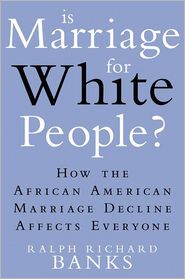
"
Is Marriage for White People?" In the
New York Times Sunday Book Review
Imani Perry takes up Stanford law professor
Ralph Richard Banks's provocatively titled
new book. Here's a taste:
Banks doesn’t offer a jeremiad about the decline of black family values
in the way of so many others who do little more than regurgitate Daniel
Patrick Moynihan’s 1965 report . . . . Refreshingly, Banks offers a well-researched and probing
discussion of why marriage rates are so low among black Americans.
In clean and efficient prose, Banks presents a lucid picture of romantic
life in black America. Moreover, he disposes of the mythology that the
failure to marry is primarily an underclass phenomenon, turning his
attention especially to the lives of middle-class black women. He has
set out to answer the question: Why are black women “half as likely as
white women to be married, and more than three times as likely as white
women never to marry”?
Perry's "primary criticism" of the book is its "prescriptive measure," which in Perry's words amounts to the suggestion that "
[b]lack women . . . be more open to marrying outside their race." Earlier coverage by Feminist Law Prof blogger Bridget Crawford is
here; lots more at the book's website,
here.
Also in the
NYT,
American Dreamers: How the Left Changed a Nation (Knopf), by historian and longtime editor of
Dissent magazine
Michael Kazin. According to
Beverly Gage (
here), the book is an earnest analysis of the left's failures and successes, and a "bid to reclaim the left’s utopian spirit for an age of diminished expectations."

"As the obsolescence and even the demise of the book are widely foretold, it is all the more important—and comforting—to recognize how a book can change the world." So begins
Drew Gilpin Faust's review of
Mightier Than the Sword: Uncle Tom’s Cabin and the Battle for America (W. W. Norton), by
David Reynolds. Read on
here, at the
New Republic.
TNR also offers reviews of
The Bear: History of a Fallen King (Harvard/Belknap), by French medievalist Michel Pastoureau (an "
odd study," "permeate[d]" with "bitterness" on behalf of the dethroned beast), and
Alcibiades (Casement Publishing), by P.J. Rhodes (
praised for delivering a "just, and damning" verdict of the "Athenian playboy, general and traitor").
The
Wall Street Journal covers four books on
Columbus, all by authors without formal training in history ("
Faulty Navigators"). Reviewer
Felipe Fernández-Armesto is not impressed. "Columbus, like Napoleon and Hitler," he writes, "is an object of fascination among readers. Something of a crank himself, he notoriously attracts cranky authors, as crag calls forth to crag." After providing a glimpse of "the dispiriting litany of errors" he discovered in the texts under review, Fernández-Armesto contemplates "what drives these writers to parade their inadequacies in the marketplace." He urges academic historians to be less welcoming to non-specialists who don't "bother[] to do the basic work."
Also reviewed in the
WSJ: Michael C. Toth's
Founding Federalist: The Life of Oliver Ellsworth, the latest installment of the Intercollegiate Studies Institute's series of "forgotten founders" biographies (
here); and David Stevenson's
With Our Backs to the Wall: Victory and Defeat in 1918 (Harvard/Belknap), a "masterly study" of how World War I came to an end (
here).
"I'm bitextual," announces
Lawrence Douglas over at the
Chronicle Review (a section of the
Chronicle of Higher Ed). A professor of law, jurisprudence, and social thought at Amherst and a regular contributor to scholarly conversations, Douglas also just completed his second novel,
The Vices (Other Press). Read on
here.
This week a reader introduced me to the UK monthly "
History Today." The articles are "popular" in style; the book reviews cover the popular and the more academic. This month's
issue includes an
article on nineteenth-century efforts to "
photograph madness," and short reviews of
Sanctuary and Crime in the Middle Ages (Fordham University Press), by Karl Shoemaker (
here);
Millions Like Us: Women's Lives in War and Peace 1939-1949 (Viking), by Virginia Nicholson (
here); and
Crooked Talk: Five Hundred Years of the Language of Crime (Random House), by Jonathon Green (
here).
A new issue of the
London Review of Books is out. Not much jumped out at me, but you may want to peruse the TOC,
here.
 Our friends at Oregon Law write that Hendrik Hartog, the Class of 1921 Bicentennial Professor in the History of American Law and
Liberty, professor of history, and director of the Program in American
Studies at Princeton University, will serve as the inaugural distinguished lecturer for the Law, Culture and Humanities Initiative. His visit will take place on September 28 and 29 and culminate in a presentation from 3:30 to 5 p.m. Thursday, Sept. 29, in the Knight Library Browsing Room, on his forthcoming book, Someday All This Will Be Yours: A History of Inheritance and Old Age.