Tuesday, May 14, 2019

Ranney on Mississippi's legal history

Joseph A. Ranney, Marquette University Law School has published A Legal History of Mississippi: Race, Class, and the Struggle for Opportunity with the University of Mississippi Press. From the publisher:
A Legal History of Mississippi: Race, Class, and the Struggle for OpportunityIn A Legal History of Mississippi: Race, Class, and the Struggle for Opportunity, legal scholar Joseph A. Ranney surveys the evolution of Mississippi's legal system and analyzes the ways in which that system has changed during the state's first two hundred years. Through close research, qualitative analysis, published court decisions, statutes, and law review articles, along with unusual secondary sources including nineteenth-century political and legal journals and journals of state constitutional conventions, Ranney indicates how Mississippi law has both shaped and reflected the state's character and, to a certain extent, how Mississippi's legal evolution compares with that of other states.
Ranney examines the interaction of Mississippi law and society during key periods of change including the colonial and territorial eras and the early years of statehood when the legal foundations were laid; the evolution of slavery and slave law in Mississippi; the state's antebellum role as a leader of Jacksonian legal reform; the unfolding of the response to emancipation and wartime devastation during Reconstruction and the early Jim Crow era; Mississippi's legal evolution during the Progressive Era and its legal response to the crisis of the Great Depression; and the legal response to the civil rights revolution of the mid-twentieth century and the cultural revolutions of the late twentieth century.
Histories of the law in other states are starting to appear, but there is none for Mississippi. Ranney fills that gap to help us better understand the state as it enters its third century.
 Further information is available here.

-Mitra Sharafi

Monday, May 13, 2019

Three English Revolutions: An ICH Summer Workshop

[We are moving this up because the deadline of May 15 will soon be upon us.  DRE]

We have the following announcement of an Interdisciplinary Summer Workshop in Constitutional History, to be held July 7-12, 2019, at Stanford, California on "Three English Revolutions."  The workshop is sponsored by the Institute for Constitutional History with the Stanford Constitutional Law Center.
This seminar will explore the role played by the two seventeenth-century English Revolutions (of 1642-1660 and 1688-9) in the constitutional debates surrounding the American Revolution and the formation of the state and federal constitutions. Particular attention will be paid to the way in which English controversies about representation, the royal prerogative, and the history of parliament reemerged in the American context and shaped the development of the presidency.
The workshop leaders are Eric Nelson, the Robert M. Beren Professor of Government at Harvard University, and Michael McConnell, the Richard and Frances Mallery Professor and Director of the Constitutional Law Center at Stanford Law School, and a Senior Fellow at the Hoover Institution.
Stipends and Support: Participants will receive accommodation at the Munger Graduate Residence on the campus of Stanford Law School and a modest stipend for meals. Participants will also receive a travel reimbursement up to $250. Workshop participants are expected to attend all sessions and engage in all program activities. Eligibility and Application Procedure: The summer workshop is designed for university instructors who now teach or plan to teach courses in constitutional studies, including constitutional history, constitutional law, and related subjects. Instructors who would like to devote a unit of a survey course to constitutional history are also welcome to apply. All university-level instructors are encouraged to apply, including adjuncts and part-time faculty members, and post-doctoral fellows from any academic discipline associated with constitutional studies (history, political science, law, anthropology, sociology, literary criticism, etc.).

To apply, please submit the following materials: a detailed résumé or curriculum vitae with contact information; syllabi from any undergraduate course(s) in constitutional studies you currently teach; a 500- word statement describing your interest in both constitutional studies and this workshop; and a letter of recommendation from your department chair or other professional reference (sent separately by e-mail or post). The application statement should address your professional background, any special perspectives or experiences you might bring to the workshop, and how the workshop will enhance your teaching in constitutional studies. The Deadline for Applications deadline is May 15, 2019. Applications should be sent via electronic mail to MMarcus@nyhistory.org. Successful applicants will be notified soon thereafter.

For Further Information Please Contact: Maeva Marcus Director, Institute for Constitutional History New-York Historical Society and The George Washington University Law School (202) 994-6562 MMarcus@nyhistory.org

"Chevron" Revisited

The Historical Society of the District of Columbia Circuit is holding another of its reenactments of historic cases.  On June 13, 2019, it is Chevron's turn.  Among the participants are the leading administrative law scholars, including Gillian Metzger, John Manning, my Georgetown Law colleague David Vladeck, and Christopher Walker.  

Dan Ernst

Ernst on the New Deal FCC

My latest, "The Shallow State: The Federal Communications Commission and the New Deal,"  University of Pennsylvania Journal of Law & Public Affairs 4 (May 2019): 403-458, is now available from SSRN and Penn Law's online repository:
Eugene Octave Sykes (LC)
American lawyers and law professors commonly turn to the New Deal for insights into the law and politics of today’s administrative state.  Usually, they have looked to agencies created in the 1930s that became the foundation of the postwar political order.  Some have celebrated these agencies; others have deplored them as the core of an elitist, antidemocratic Deep State.  This article takes a different tack by studying the Federal Communications Commission and its predecessor the Federal Radio Commission, an agency created before the New Deal.  For most of Franklin D. Roosevelt’s first two presidential terms, the FCC languished within the “Shallow State,” bossed about by patronage-seeking politicians, network lobbyists, and the radio bar.  When Roosevelt finally let a network of lawyers in his administration try to clean up the agency, their success or failure turned on whether it could hire the kind of young, smart, hard-working lawyers who had at other agencies proven themselves to be the “shock troops of the New Deal.”  Only after James Lawrence Fly, formerly general counsel of the Tennessee Valley Authority, became chairman and hired lawyers like himself did the FCC set sail.  It cleaned up its licensing of radio stations and addressed monopoly power in the industry without becoming the tool of an authoritarian president or exceeding its legislative and political mandates.
I’m quite grateful to Amanda L. LeSavage, the Editor-in-Chief for Volume 4 of the Journal of Law & Public Affairs, and other members of her staff who worked on what I know was a challenging piece.

Sunday, May 12, 2019

ASLH Student Research Colloquium 2019

[We have the following announcement.  DRE]

The American Society for Legal History will host a Student  Research Colloquium (SRC) onWednesday, Nov. 20, and Thursday, Nov. 21, 2019, immediately preceding the ASLH’s annual meeting in Boston, Massachusetts. The SRC annually enables eight Ph.D.students and law students to discuss their in-progress dissertations and articles with distinguished ASLH-affiliated scholars.

The SRC’s target audience includes early-post-coursework graduate students and historically minded law students. The colloquium seeks to introduce participating students to legal history, to each other, and to the legal-historical scholarly community. Students working in all chronological periods, including ancient and medieval history, and all geographical fields are encouraged to apply, as are students who have not yet received any formal training in legal history. Applicants who have not yet had an opportunity to present their work to the ASLH are particularly encouraged to apply. A student may be on the program for the annual meeting and participate in the SRC in the same year.

Each participating student will pre-circulate a twenty-page, double-spaced, footnoted paper to the entire group. The group will discuss these papers at the colloquium, under the guidance of two faculty directors. The ASLH will provide at least partial and, in most cases, total reimbursement for travel, hotel, and conference-registration costs.

The application deadline is July 15, 2019. Applicants should electronically submit:
  • a cover letter describing, among other things, how far along you are and how many years remain in your course of study;
  • a CV;
  • a two-page, single-spaced “research statement” that begins with a title and proceeds to describe the in-progress research project that you propose to present at the colloquium; and
  • a letter of recommendation from a faculty member, sent separately from, or together with, the other materials.
Organizers will notify all applicants of their decisions by August 15, 2019. Please direct questions and applications to John Wertheimer at: srcproposals@aslh.net.

Saturday, May 11, 2019

Weekend Roundup

  • Michael Klarman devoted his talk in HLS’s “Last Lectures” series to Thurgood Marshall and Ruth Bader Ginsburg, whose lawyering, he said, evinces “hope and resilience in what I find to be an alarming political landscape.”  More.
  • The Norman Transcript kvells over the winning of the Supreme Court Historical Society’s Journal of Supreme Court History by University of Oklahoma graduating senior Adam Hines for “Ralph Waldo Emerson & Oliver Wendell Holmes, Jr.: The Subtle Raptures of Postponed Power," to appear in the May edition of the Journal of Supreme Court History.  Mr. Hines was a student of OU's Andrew Porwancher.
  • At San Francisco State, Steve Harris “uses role-playing to transport his students into the past” in a constitutional-history-laden course.  His student Serafina Kernberger's Ben Franklin alone is worth the click. He was drawing upon techniques learned in Barnard College’s Reacting to the Past program, which holds its Nineteenth Annual Faculty Institute, this year devoted to Democratic Education in Uncertain Times on June 12-15, 2019.
  • ICYMI:  Daniel Okrent on the history of anti-immigration laws in the United States on NPR.
Weekend Roundup is a weekly feature compiled by all the Legal History bloggers.

Friday, May 10, 2019

Roberts on the Imperial Origins of American Public Administration

Alasdair S. Roberts, University of Massachusetts Amherst School of Public Policy, has posted Bearing the White Man's Burden: American Empire and the Origin of Public Administration:
Taft in The Philippines, 1901-03 (LC)
Conventional wisdom about the origin of American public administration is mistaken in several ways. It overlooks the American experiment with colonial administration in the two decades following the Spanish-American war. Academics wrote textbooks, taught courses, and proposed new schools to prepare young men for colonial service. At the same time, reformers used the new dependencies as proving grounds for administrative reforms they wanted at home. Colonial administration was comparative in its approach: American academics and reformers often sought to emulate the practices of European empires. The project of colonial administration was not value-neutral or concerned with establishing "efficient democracy." On the contrary, it was founded on a belief in the superiority of Anglo-Saxon civilization and the need to maintain "white man's rule." Some academics who expressed such views are now counted as pioneers in American public administration.

Publisher's Query: Holmes's "Black Book"

[We have received the following query from the managing editor of Talbot Publishing.  DRE]

Justice Oliver Wendell Holmes (LC)
As publishers of books on law and legal history, we are currently working on a book entitled The Black Book of Justice Holmes: Text Transcripts and Commentary, edited by Michael H. Hoeflich and Steven Epstein.

The book will consist of a facsimile of the manuscript of Justice Holmes’ Black Book (from Harvard Law Library) along with a transcription of the text, as well as introductory materials. We are very pleased to be the publishers of this book that will bring this important primary source to a larger audience.  127 of the 173 pages of transcriptions are thus far completed and in place in the book.

We are looking for general feedback in terms of page presentation,  but are also looking for scholars who might be interested in providing additional essays to be included in our prefatory materials.

Please contact vhorowitz@lawbookexchange.com.

Valerie Horowitz
Managing Editor, Talbot Publishing (an imprint of The Lawbook Exchange, Ltd.)
33 Terminal Avenue, Clark, New Jersey 07066-1321
Tel: 732-382-1800; Toll Free 800-422-6686 in USA or Canada
Fax: 732-382-1887

Narrative as a Mode of Argument

The most practical course I took in grad school was Writing History with Marni Sandweiss, where I learned how to use narrative as a mode of argument. Historians already do this when they decide which characters to follow, how to frame conflict, and when and where to begin and end their story. What was especially helpful for me was learning how to use organization—the unfolding of a story—to make an argument.

One good example is Malcolm Gladwell’s New Yorker essay, “Offensive Play.” It’s a braided narrative of two different stories, one about football and the other about dogfighting. Gladwell never explicitly claims that the injuries sustained by football players are an inherent part of the game and, thus, that the sport is fundamentally immoral. Instead, he raises the question and to answer it, he weaves in sections about dogfighting. Readers, of course, come to the very conclusion that Gladwell wants them to reach, transferring their reactions in one context to the other. But the effect is much more powerful than it would have been if Gladwell had pontificated directly on the ethics of dangerous sports.

I thought about narrative organization often, especially when writing about the history of traffic. My challenge was twofold. First, how could I make an ostensibly boring topic like traffic interesting? Given our familiarity with cars and traffic today, how could I capture the sense of bewilderment at the traffic problem in the early twentieth century? Simply declaring that traffic was a big problem that interested many important people in the early years of the automobile didn’t seem to work. The second challenge was directly connected to the argument I wanted to make. How could I convey that the traffic problem was so serious, overwhelming, and massive that American society built an entirely new mode of governance? How could I relate to contemporary readers that the solution, which is taken as a given today, was not assumed a century ago?

To figure out how to create historical suspense, I went back to Erik Larson’s Devil in the White City. Incidentally, this book offers another compelling example of a braided narrative, interlacing the stories of Daniel Burnham, the mastermind of the 1893 World Fair, and H.H. Holmes, a mastermind serial killer, to portray both the potential and pathos of modernity.

Another one of Larson’s narrative techniques is to hold back certain details until the right moment in order to give readers the same perspective as the historical actors. Consider the following example [spoiler alert]. Early in the book, Larson introduces one of the conflicts in the plot: Burnham desperately desired a structure to “out-Eiffel Eiffel” to showcase the greatness of American architecture and engineering. There was a competition. Several entries proposed a tower even taller than the one at the Paris Exposition, but Burnham deemed towers unoriginal. Two chapters later, we read about a 33-year-old engineer from Pittsburgh with a flash of insight. Pages later, we learn that his idea “embodied little ‘dead load,’ the static weight of immobile masses of brick and steel. Nearly all of it was ‘live load,’ meaning weight that changes over time, as when a train passages over a bridge.” [What is this? I wondered.] This proposal was accepted and then, on second thought, revoked because it was deemed un-buildable.

Finally, the resolution, on page 185: The engineer refined his plans. The structure would be a “vertically revolving wheel” carrying “thirty-six cars, each about the size of a Pullman, each holding sixty people and equipped with its own lunch counter” and “when filled to capacity the wheel would propel 2,160 people at a time three hundred feet into the sky over Jackson Park, a bit higher than the crown of the now six-year-old Statue of Liberty.” I still didn’t get it until the last sentence of the chapter, which finally revealed the name of the engineer from Pittsburgh, George Washington Gale Ferris. What stayed with me from this narrative is the ambition behind a now common feature of state fairs and amusement parks.

In Policing the Open Road, I juxtaposed stories and played with the organization of chapters, sections, paragraphs, and even sentences. I made this effort not just to engage readers, but also to advance the argument. But there are tradeoffs. When a writer avoids direct, declarative expressions of argument (the “I argue that…”), there is the possibility that readers might miss the point. When writing and editing, I constantly asked myself whether I was asking the reader to do too much. Would a reader feel drawn in or wonder if I was hiding the ball? To be sure, there were places where I had to lay out my argument. But the wonderful thing about writing a book is the freedom to experiment with narrative.

Sarah Seo

Murray, Shaw, & Seigel, eds., "Reproductive Rights and Justice Stories"

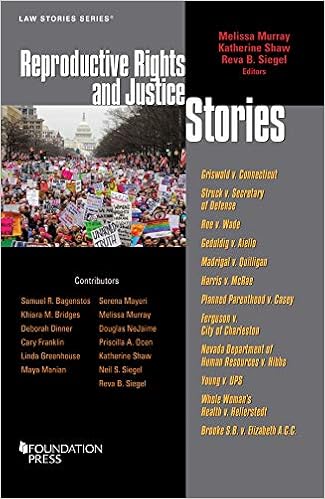
New from Foundation Press, in the "Law Stories" Series, Reproductive Rights and Justice Stories, edited by Melissa Murray (NYU Law), Katherine Shaw (Benjamin N. Cardozo School of Law), and Reva B. Siegel (Yale Law School). A description from the Press:
This book tells the movement and litigation stories behind important reproductive rights and justice cases. The twelve chapters span topics including contraception, abortion, pregnancy, and assisted reproductive technologies, telling the stories of these cases using a wide-lens perspective that illuminates the complex ways law is debated and forged―in social movements, in representative government, and in courts. Some of the chapters shed new light on cases that are very much part of the constitutional law canon―Griswold v. Connecticut, Roe v. Wade, Planned Parenthood v. Casey, Nevada Department of Human Resources v. Hibbs. Others introduce the reader to new cases from state and lower federal courts that illuminate paths not taken in the law. 
Reading the cases together highlights the lived horizon in which individuals have encountered and struggled with questions of reproductive rights and justice at different eras in our nation’s history―and so reveals the many faces of law and legal change. The volume is being published at a critical and perhaps pivotal moment for this area of law. The changing composition of the Supreme Court, increased executive and legislative action, and shifting political interests have all pushed issues of reproductive rights and justice to the forefront of contemporary discourse. The volume is suited to a wide range of law school courses, including constitutional law, family law, employment law, and reproductive rights and justice; it could also be assigned in undergraduate or graduate courses on history, gender studies, and reproductive rights and justice.
All of the editors have contributed solo- or co-authored essays. The other contributors are: Samuel R. Bagenstos (University of Michigan Law); Khiara M. Bridges (Boston University School of Law); Deborah Dinner (Emory Law); Cary Franklin (University of Texas at Austin School of Law); Linda Greenhouse (New York Times/Yale Law School); Maya Manian (University of San Francisco School of Law); Serena Mayeri (University of Pennsylvania School of Law); Douglas NeJaime (Yale Law School); Priscilla A. Ocen (Loyola Law School, Los Angeles); Neil S. Siegel (Duke Law).

It looks like some of the essays are available on SSRN. For example, here is Reva Siegel and Linda Greenhouse's chapter on "The Unfinished Story of Roe v. Wade."

Thursday, May 9, 2019

CFP: New Histories of Sovereigns and Sovereignties

[The “interest group” of the European Society of International Law Annual (ESIL) on the History of International Law has sent us the following call for papers for a session at the ESIL’s conference in Athens on September 12, 2019 .]

New Histories of Sovereigns and Sovereignties
Deadline 31 May 2019

Sovereigns and sovereignty have long been key aspects for histories of international law. Doctrinal definitions of sovereignty have been instrumentalized in political struggles throughout history. In the era of revolutions, instrumental uses of leading law textbooks like Vattel’s even led to constitutional overthrows. Therefore, changing ideas of sovereignty, the emergence and disappearance of particular sovereign states, and the sovereignty of international organisations inspired much debate among lawyers, and between lawyers and politicians in the last centuries. More recently, many of the major works in the contemporary revival of international legal history took sovereigns, their empires, their equality or inequality or even their property as starting points for new critical histories of the discipline and the role of international law in the expansion of the European state model or the rise of imperialism.

For our Interest Group meeting at the ESIL Annual Conference in Athens we are soliciting paper presentations that continue this path and promise novel ways of thinking about sovereigns and sovereignty. Potential topics may include (but are not limited to):
  • Potential paths for the field to explore now that the critical works have become the new mainstream literature. For example, what might a revisionist history of sovereignty look like?
  • The hybrid nature of legal argumentation in specific political and constitutional struggles and their transnational reverberations.
  • Papers exploring to what extent the centrality of sovereignty in the history of international law is warranted.
  • Examples of resistance to interpretations of sovereignty, or the concept itself.
  • Forgotten sovereigns and interpretations of sovereignty.
Papers using underexploited primary sources or involving archival work will receive our special attention. We particularly welcome proposals from and about women, and encourage early career scholars or those without current university affiliations to apply. We consider submissions written in French and English.

Abstracts of up to 500 words must be submitted no later than 31 May 2019 to esilighil@gmail.com on behalf of the Steering Committee of the Interest Group, which shall collectively supervise the blind peer-review process. The Interest Group is unable to provide funding for travel and accommodation. Please see the ESIL website for information about travel grants and carers’ grants offered to ESIL members (deadline: 5 June), and other relevant information about the conference.

Selected speakers are strongly encouraged to become members of the Society and to register for the Annual Conference; please note, however, that the Society is unable to offer reduced conference registration fees to speakers at pre-conference events (please do not register as agora speakers).

Selected speakers can indicate their interest in being considered for the ESIL Young Scholar Prize, if they meet the eligibility conditions as stated on the ESIL website. The ESIL Secretariat must be informed of all speakers who wish to be considered for the Prize by 15 May at the very latest.

Weinberger Named Berger-Howe Fellow

[We have the following announcement.]

The Program in Law and History at Harvard Law School is pleased to announce that the Raoul Berger-Mark deWolfe Howe Fellow in Legal History for the academic year 2019-2020 will be Lael D. Weinberger.  Mr. Weinberger is a Ph.D. candidate in history at the University of Chicago, where he also received his J.D.  During his fellowship year he will continue working on his dissertation, “Law, Rights, and Courts for America and the World, 1914–1948.”

Deadline Approaching to Apply for AJLH US Editor-in-Chief

Reminder: the American Journal of Legal History seeks applications for US Editor-in-Chief. The Press and the current editor will begin reviewing applications on June 1.
American Journal of Legal History – applications invited for post of US Editor-in-Chief 
Oxford University Press (OUP) is seeking to recruit a new co-Editor for the American Journal of Legal History (AJLH) with special expertise in the legal history of the United States. Professor Al Brophy, who currently co-edits the AJLH with Professor Stefan Vogenauer, is planning to step down due to ongoing health issues. Professor Brophy has been a key figure in the successful relaunch of the journal after it joined forces with OUP. The publishers are now seeking to appoint his successor for an initial term of three years, with effect from 1 September 2019.

The AJLH was founded in 1957 and was the first English-language periodical in the field. It was relaunched as an OUP publication at the beginning of 2016 with new editors, Professors Al Brophy (University of Alabama School of Law, Tuscaloosa) and Stefan Vogenauer (Max Planck Institute for European Legal History, Frankfurt). The new AJLH aims to publish outstanding scholarship on all facets and periods of legal history. While retaining its focus on American legal history, it accommodates the enormous broadening of the intellectual horizon of the discipline over the past decade and is particularly interested in contributions of a comparative, international or transnational nature. Book reviews are a regular feature. The new AJLH is a quarterly, peer-reviewed journal. 
For further information on the editorial role please visit here. 

Wednesday, May 8, 2019

CFP: 100 Years of Canadian Bankruptcy and Insolvency Law

[We have the following conference announcement and call for papers.]

Western University Faculty of Law in London, ON Canada will be hosting the 100 Years of Canadian Bankruptcy and Insolvency Law Conference on May 22-23, 2020.  The conference will commemorate the 100th anniversary of the coming into force of the Bankruptcy Act, 1919, the basis of Canada's modern bankruptcy regime.

The conference organizers welcome papers that offer legal history perspectives on the evolution of bankruptcy law in Canada and other jurisdictions. Other topics are covered in the Call for Papers. Proposals are due June 24, 2019.

Thomas Telfer, Western University (ttelfer@uwo.ca).

Anderson on 19th-Century Trial Manuals on Jury Challenges

April J. Anderson has posted Peremptory Challenges at the Turn of the Nineteenth Century: Development of Modern Jury Selection Strategies As Seen in Practitioners’ Trial Manuals, which she wrote as a Yale Law student in a seminar on the history of the jury trial.  It is forthcoming in 2020 in the Stanford Journal of Civil Rights and Civil Liberties:
Peremptory strikes on the basis of race, national origin, religion, and class are well-known problems in modern jury selection, and have led to calls to abolish peremptory strikes altogether. Defenders of peremptory strikes argue that they are a fixture of the common law system that should not be discarded because of a few abuses.

This Article explores how and why strategic jury selection developed in the United States by looking at previously unstudied primary source materials: nineteenth-century trial-attorneys’ practice guides. Peremptory challenges and voir dire are difficult to study because court records often leave them out. Even when strikes are recorded, an attorney’s strategy may not be evident to the outsider. But practice guide materials reveal these strategies, demonstrating that nineteenth-century attorneys used peremptory strikes to eliminate jurors based on stereotypes regarding race, national origin, religion, and class. They also show how a number of features of the modern American jury selection system—most notably, extended pretrial questioning of jurors—were expanded from their more limited common law forms to make it easier for lawyers to either respond to particular social prejudices in American society or to make discriminatory peremptory challenges.

These findings have important implications for the modern-day debate over peremptory challenges. While proponents of peremptory challenges point to their ancient origins as justification for keeping them, a historical perspective shows that modern jury selection looks nothing like its English common law progenitor. Analysis of turn-of-the-century practices, the beginnings of the procedures we use now, exposes modern abuses as part of a trend that began in the 1800s. Simply put, the problems reformers now point to are not recent abuses that have crept in to an ancient system. They have existed for as long as the jury selection procedures we know have been practiced. Modern jury selection and abusive tactics grew up simultaneously in the 1800s as a reaction to the country’s social divisions, suggesting that discrimination as a trial strategy is inevitable in a heterogeneous society where courts allow extended voir dire and unfettered peremptory challenges.
---DRE

Call for Nominations: Cromwell Article Prize

We have the following announcement (note the May 31 deadline):
The William Nelson Cromwell Foundation Article prize is awarded annually for the best article in American legal history published by an early career scholar. Articles published in 2018 in the field of American legal history, broadly conceived, will be considered. There is a preference for articles in the colonial and early national periods. Articles in the Law and History Review are eligible for the Surrency Prize and will not be considered for the Cromwell Article Prize.

The author of the winning article receives a prize of $5,000. The Foundation awards the prize after a review of the recommendation of the Cromwell Prize Advisory Committee of the American Society for Legal History. The Cromwell Foundation makes the final award, in consultation with a subcommittee from the American Society for Legal History. This subcommittee invites nominations for the article prize. Authors are invited to nominate themselves or others may nominate works meeting the criteria that they have read and enjoyed. Please send a brief letter of nomination, no longer than a page, along with an electronic copy (or URL of the publication site) of the article, by May 31, 2019, to the subcommittee chair, Prof. David Konig, at cromwellarticleprize@gmail.com.

Tuesday, May 7, 2019

Schwartz on Lamazoff on the Bank War

David S. Schwartz, University of Wisconsin Law School, has posted Coin, Currency, and Constitution: Reconsidering the National Bank Precedent, a review essay on Eric Lomazoff’s Reconstructing the National Bank Controversy: Politics and Law in the Early Republic (2018) It is forthcoming in volume 117 of the Michigan law Review (2019):
The constitutional debates surrounding the First and Second Banks of the United States generated the first major precedents regarding the scope of federal legislative powers, and their importance continues to resonate today. Eric Lomazoff's important new book, Reconstructing the National Bank Controversy, is the first scholarly study that views the National Bank controversy as a continuous 55-year sequence of events, whose highlights include the adoption of Alexander Hamilton's proposed Bank of the United States in 1791, John Marshall's decision in McCulloch v. Maryland in 1819, and Andrew Jackson's veto of the Second Bank recharter in 1832. Lomazoff persuasively establishes that a Madisonian consensus supporting the creation of the Second Bank in 1816 " largely overlooked by constitutional scholars " was framed in a way that tried, albeit unsuccessfully, to downplay the Necessary and Proper Clause and the idea of implied powers by emphasizing the existence of a federal power to regulate the national currency, linked to the Coinage Clause. The book review goes on to argue that the National Bank controversy demonstrates that many antebellum partisans of limited enumerated powers -- mainstream Jeffersonian Republicans, Jacksonian Democrats, and even James Madison himself -- were quite happy to work around enumerated powers in order to meet the political demands and objectives of the moment. This lends support to the suggestion that enumerationism (the ideology of limited enumerated powers) was never, in practice, the "true" original meaning of the Constitution.

Harrison on Public Rights and Article III

John C. Harrison, University of Virginia School of Law, has posted Public Rights, Private Privileges, and Article III, which is forthcoming in the Georgia Law Review:
This article addresses the constitutional justification for adjudication by executive agencies that rests on the presence of a public right. The Supreme Court most recently relied on that rationale in Oil States Energy Services v. Greene’s Energy Group in 2018. As the Justices are aware, the public rights rationale originated in the 19th century, and was for many decades the dominant explanation for the performance of adjudicative functions by executive agencies. In light of the Court’s evident interest in the 19th century system, this article explores that system in depth and seeks to identify the ways in which it authorizes and limits executive adjudication. The older system focused on public rights, private rights, and private privileges. The courts protected the private rights they found in the primary law, including federal statutes that created such rights. Private privileges, unlike private rights, could be affected by the unilateral exercise of a proprietary right of the government – that is, by the exercise of a public right. The interest in receiving a payment from the Treasury was a classic example of a private privilege, provided Congress had not given the private recipient a judicially enforceable claim to it. When the executive administered the government’s own legal interests according to the law, it often performed a function that resembled adjudication. That function was nevertheless an exercise of executive power, because executive officials act for the government as proprietor and contracting party. Executive adjudication thus was permissible under the older system when Congress created the relation of public right and private privilege. Whether Congress may do so depends, like other questions concerning congressional power, on the scope of Congress’s enumerated powers and the affirmative limitations on it. The article identifies the questions concerning congressional power that must be answered in order to decide when Congress may create the relations that underwrite executive adjudication under the older system, and shows that the scope for that form of decision making may be quite broad. One constitutional rule is notably absent from the list of constraints: the vesting of the judicial power in the courts by Article III. The constitutional function of the courts is to protect rights. Under the older system, whether a private person has a right with respect to any specific interest depends on the primary law, not Article III. The judicial power took public rights, private rights, and private privileges as it found them.

Monday, May 6, 2019

Rothchild on the US and International Copyright

John Rothchild, Wayne State University Law School, has posted How the United States Stopped Being a Pirate Nation and Learned to Love International Copyright, which appeared in the Pace Law Review 39 (2018): 361-451:
From the time of the first federal copyright law in 1790 until enactment of the International Copyright Act in 1891, U.S. copyright law did not apply to works by authors who were not citizens or residents of the United States. U.S. publishers took advantage of this lacuna in the law, and the demand among American readers for books by popular British authors, by reprinting the books of these authors without their authorization and without paying a negotiated royalty to them.

Keppler, "The Pirate Publisher" (LC)
This Article tells the story of how proponents of extending copyright protections to foreign authors—called international copyright—finally succeeded after more than fifty years of failed efforts. Beginning in the 1830s, the principal opponents of international copyright were U.S. book publishers, who were unwilling to support a change in the law that would require them to pay negotiated copyright royalties to British authors and, even worse from their perspective, would open up the American market to competition from British publishers. U.S. publishers were quite content with the status quo—a system of quasi-copyright called “trade courtesy.” That system came crashing down in the 1870s, when non-establishment publishers who did not benefit from trade courtesy decided to ignore its norms, publishing their own cheap, low-quality editions of books by British authors in competition with the editions published by the establishment publishers. As a result, most U.S. publishers came to support extending copyright to foreigEditn authors as a means of preventing competition from publishers of the cheap editions.

Once the publishers withdrew their opposition, another powerful interest group came to the fore: typesetters, bookbinders, printers, and other workers in the book-manufacturing industries. These groups opposed international copyright unless it were accompanied by rules assuring that they would not be thrown out of work by a transfer of book manufacturing from the United States to England. In the 1891 Act, the typesetters achieved what they sought: a provision requiring books to be typeset in the United States as a condition of copyright. In this way, U.S. copyright law implemented an element of U.S. trade policy.

The manufacturing clause, as this requirement was called, was gradually watered down over the succeeding decades and lingered in the copyright law until 1986. Yet the entanglement of copyright law with trade policy continued, in the World Trade Organization treaty system and elsewhere.

As a major exporter of books, software, movies, and other articles embodying copyrighted works, the United States has sought in multiple forums to strengthen the protections those works receive under the laws of other nations, sometimes provoking pushback from countries that are net importers of intellectual property goods. When pursuing these goals in the twenty-first century, U.S. policymakers would do well to bear in mind this country’s forgotten history as the greatest copyright pirate nation of the nineteenth century.

Newman on Meat Inspection and Public Choice

Patrick Newman, Florida Southern College, has posted another installment of his research on the politics of meat inspection, Public Interest or Public Choice? The Beef Trust and the 1906 Meat Inspection Act:
The Meat Market, 1906 (LC)
This paper challenges the recent research of public interest historians and argues the evidence supports a public choice interpretation of the 1906 Meat Inspection Act. First, the Beef Trust’s slaughter of diseased meat was due to the uncertainty over the science of disease transmission and using it was the only way at the time to make meat affordable to consumers. Second, critics of the Beef Trust’s sanitary practices were often biased and they exaggerated the problem. Third, the evidence is consistent with the argument that the Beef Trust captured the regulation because the law was associated with an increase in their market share, less product choice, and higher meat prices, all of which hurt consumers.
Dan Ernst

A Book Greater than the Sum of its Chapters

When I learned that the academic book market had changed, my goals shifted too. Of course, the essence of the project remained the same. Policing the Open Road is about how the introduction of a technological shock in American society—the mass adoption of cars—transformed American governance, policing, criminal procedure, and the relationship between individual citizens and the state. The overarching argument posits that all of these changes responded to the necessity of disciplining “law-abiding” citizen-drivers, which raised a profound and troubling question: What did freedom mean in a modern, automotive society that policed all its citizens? Ultimately, the law’s solution to the potential arbitrary policing of “Everyman,” I argue, led directly to the systematic discriminatory policing of racial minorities.

To figure out how to tell this story, I had to think about the book as a whole. In light of the realities of academic teaching today, I also crafted each chapter to stand alone, each with its own narrative, cast of characters, and argument. Here’s a short breakdown:

  • Chapter 1, “A Mystery of Traffic” gives an account of how the mass adoption of the automobile led to the shift from nineteenth-century governance based on common law and voluntarism to twentieth-century governance based on discretionary policing.
  • Chapter 2, “From Lumbering Foot Patrolmen to Motor-Mounted Policemen” traces the emergence of twentieth-century professionalized police to the need to manage traffic and “law-abiding” traffic violators.
  • Chapter 3, “The Automotive Fourth Amendment” examines the technology-driven demise of classical legal thought in criminal procedure and the resulting expansion of police discretion. Or, for crim pro folks, this chapter tells the story about how the Carroll automobile exception in 1925 culminated with the Terry stop-and-frisk in 1968.
  • Chapter 4, “It Could Happen to You” offers an alternative account of the Warren Court’s due process revolution by juxtaposing the Court’s landmark cases with its car cases.
  • Chapter 5, “The Right to Privacy in Public” integrates the histories of policing and the twentieth-century administrative state to explain why the major legal theories of the twentieth century—classical legal thought, legal realism, and legal process theory—failed to offer a principled method to both justify and constrain police discretion.
  • Chapter 6, “The Fourth Amendment Tool in Criminal Patrol” is a legal history of driving while black that shows that underlying proceduralism was a fundamental acceptance of discretionary policing—to the point of countenancing racialized policing.

One could easily pick up Policing the Open Road and start with any chapter. But, as with any book, readers would miss important narrative and thematic through lines without reading from beginning to end. One is the sense of dramatic change in state power and discretionary policing from the beginning of the twentieth century to the present.

Second, although it’s hard to miss my argument about causation, readers of select chapters may not catch my periodization. I argue that the turn to procedure in American law was an outgrowth of events in American society that took place in the 1920s and 30s.

Let me give an example that will be familiar to those who have read my essay, “The New Public,” which appears, significantly modified, as Chapter 5 (more on this in a future post). One of the main characters in this chapter is Charles Reich, who wrote the 1970 bestseller The Greening of America. In 1966 as a Yale law professor, he also wrote about his numerous encounters with the police in his car. These stops were about more than the annoyances of getting pulled over too many times. They were also about the invasion of his privacy. As a closeted gay man at a time when sodomy was a crime in all states but one, Reich went for long drives to escape the burdens of keeping his secret. So when the police questioned his whereabouts in his car, they were prying into the most intimate parts of his personal life.

Readers who read Chapter 5 will come away understanding the struggles of a legal progressive and realist who, in his attempts to delineate some limits on the police, flirted with classical legal thought but settled on an entirely different solution that ultimately expanded the police’s power even more. There is a sense that Reich conceded too much; a contemporary wrote in Playboy that Reich’s proposals for police reform were “well-meaning” but not enough.

But readers who have also read Chapter 1 will find it difficult to judge Reich’s concession to discretionary policing. Further confirming that larger social forces were at play, Reich’s proposals essentially mirrored policy choices and legal changes from the 1920s and 30s that accommodated police discretion, which are detailed in Chapters 2 and 3. Readers of Chapters 3 and 4 will also appreciate the constraints that the public/private dichotomy imposed on Reich’s thinking about the police problem and American legal thought more generally. And while Chapter 5 mentions the implications of Reich’s reforms, it is in Chapter 6 where readers learn about the devastating consequences of proceduralism in Fourth Amendment jurisprudence.

Like any author, I’m thrilled and honored whenever anyone reads something I’ve written. I know I’ll still be thrilled and honored if someone decides to pick and choose a chapter from Policing the Open Road rather than read the whole thing. I understand that authors have to earn their readers. I’ll pick up on this and narrative strategies in the next post.

Sarah Seo

Sunday, May 5, 2019

Registration for ASLH 2019 Now Open!

[We have the following announcement.]

Registration is now open [here] for the 2019 ASLH annual meeting in Boston, Massachusetts, November 21-24, 2019.  A $179.00 conference rate has been negotiated with the Boston Park Plaza.

Did you know that staying at the conference hotel will benefit ASLH? We need to book a minimum number of rooms to avoid penalties. Please help us keep conference costs down by booking your stay at the conference hotel. The link will appear in your confirmation email.

Also available are registrations for exhibitors and advertisements in the annual meeting program.

Saturday, May 4, 2019

Weekend Roundup

  • If you'd like to see how legal historians' scholarship figured in the recently decided Emoluments Clause decision Blumenthal v. Trump, Judge Sullivan's decision is here.  I was pleased to note the Judge's particular reliance on the scholarship of my Georgetown Law colleague John Mikhail.   Marcia Coyle discusses the historians' brief in the case in the National Law Journal.  H/t DV.  --DRE 
  • We have received a call for papers from the Theory and History of Law Center of the University of Lisbon on the 250th anniversary of what our computer somewhat dubiously translates from the Portuguese as “A Good Reason Law of August 18, 1769.”  Deadline is May 31, 2019. 
  •  The Historical Society of the New York Courts has posted an excerpt from Paul McGrath's "People v. Croswell: Alexander Hamilton and the Transformation of the Common Law of Libel," which originally appeared in Judicial Notice, the Society's journal, available here.
Weekend Roundup is a weekly feature compiled by all the Legal History bloggers.

Friday, May 3, 2019

Quinn on a "Fallen" Woman Judge

Mae C. Quinn, University of Florida Levin College of Law, has posted Fallen Woman (Re)framed: Judge Jean Hortense Norris, New York City - 1912-1955, which is forthcoming in the University of Kansas Law Review 67 (2019): 451-512:
Jean H. Norris (wiki)
This Article seeks to surface and understand more than what is already known about Jean Hortense Norris as a lawyer, jurist, and feminist legal realist—as well as a woman for whom sex very much became part of her professional persona and work. This article analyzes the lack of legal protections provided to Norris and troubling nature of her removal from the bench given the evidence presented and standards applied. Finally, this Article seeks to provide further context for Jean Norris’s alleged misconduct charges to suggest that as a woman who dared to blur gender boundaries, embrace her professional power, and offer a unique vision of the “fairer sex,” she was held to a different standard than her male peers and made to pay the price with her career. In these ways, this Article provides a more complete picture of Jean Norris beyond a shamed and disrobed judge. And it begins to move Judge Norris out of legal history’s margins so that she may be remembered as more than mere mugshot in the American imagination.
--DRE

Thomas on the 19th Amendment and Pay Equity

Tracy A. Thomas, University of Akron School of Law, has posted More than the Vote: The Nineteenth Amendment as Proxy for Gender Equality, which is forthcoming in the Stanford Journal of Civil Rights and Civil Liberties (2019):
The original idea behind the Nineteenth Amendment was never just about the vote. Instead, the first women's rights movement 175 years ago, like the modern movement for the Equal Rights Amendment, sought comprehensive equality for women in all avenues of life. The constitutional text for women’s full equality and emancipation has changed over the centuries; first embodied in the grant of the vote as a proxy for structural change, and now incorporated into the demand for “equal rights.” Yet women have been consistent over time in understanding the radical idea that systems of governance, family, industry, and church need dismantling and reconstructing in order to support women’s equality and emancipation.

This paper first details the origins of women’s political demand for the vote as part of a comprehensive social reform. It then discusses the four strands of the comprehensive early women’s rights agenda for gender equality focused on the political state, domestic family, economic industry, and religious church. Finally, it connects the suffrage activism with demands for an equal rights amendment to realize the full civil rights of equality envisioned by and for women.

This long view of women’s rights shows that the movement was not solely about suffrage, but that the vote stood as a shorthand for a complete revolution of the interlocking systems supporting women’s oppression and denying women equal rights. The legal history illustrates that “women’s rights” has always been a multiple issue, multiple systems platform, even as certain issues like suffrage or abortion have been isolated in the dominant public discourse, often driven there by opponents of gender equality. Appreciating the context and constitutional history of the Nineteenth Amendment supports a more robust understanding of constitutional guarantees of gender equality today, supporting interpretations of “equal protection” under the Fourteenth Amendment to encompass the full array of public and private rights.
 --DRE

Sohoni on "The Trump Administration and the Law of the Lochner Era"

Mila Sohoni (University of San Diego School of Law) has posted "The Trump Administration and the Law of the Lochner Era," which appears in Volume 107 of the Georgetown Law Journal (2019). Though not a conventional legal history article, the piece may interest readers for its argument about the parallels between our present moment and the so-called "Lochner era." Here's the abstract:
During the Lochner era, the Supreme Court shielded liberty of contract and property rights; it privileged private ordering and restrained the reach of government regulation; and it embraced robust conceptions of national sovereignty with respect to immigration and trade. Though Lochner itself remains an anti-canonical case, many of the conceptions of rights, state power, and sovereignty embraced by the Lochner-era Court persist in legal and political discourse today. This Article shows that these ideas now have a politically powerful sponsor and proponent in the Trump Administration. The motif of a constitutional framework over a century old appears in the Trump Administration’s policy positions and legal approach to areas as diverse as health insurance regulation, administrative law, regulatory reform, net neutrality, drug law, immigration, and tariffs. Grappling with these resemblances reacquaints us with some neglected aspects of the constitutional thought of our past, casts fresh light upon the unfolding events of the present day, and allows us to better anticipate what the future will bring. Mapping the grammar of rights and power that permeates the Trump Administration’s agenda for government and law, this Article explains how that Administration might bend the road forward back to the past.
Read on here.

-- Karen Tani

Burney, Hamlin and friends on Global Forensic Cultures

Out now with Johns Hopkins University Press is Global Forensic Cultures: Making Fact and Justice in the Modern Era, edited by Ian Burney, University of Manchester and Christopher Hamlin, University of Notre Dame. From the publisher: 

Contemporary forensic science has achieved unprecedented visibility as a compelling example of applied expertise. But the common public view—that we are living in an era of forensic deliverance, one exemplified by DNA typing—has masked the reality: that forensic science has always been unique, problematic, and contested. Global Forensic Cultures aims to rectify this problem by recognizing the universality of forensic questions and the variety of practices and institutions constructed to answer them.
Groundbreaking essays written by leaders in the field address the complex and contentious histories of forensic techniques. Contributors also examine the co-evolution of these techniques with the professions creating and using them, with the systems of governance and jurisprudence in which they are used, and with the socioeconomic, political, racial, and gendered settings of that use. Exploring the profound effect of "location" (temporal and spatial) on the production and enactment of forms of forensic knowledge during the century before CSI became a household acronym, the book explores numerous related topics, including the notion of burden of proof, changing roles of experts and witnesses, the development and dissemination of forensic techniques and skills, the financial and practical constraints facing investigators, and cultures of forensics and of criminality within and against which forensic practitioners operate.
Covering sites of modern and historic forensic innovation in the United States, Europe, and farther-flung imperial and global settings, these essays tell stories of blood, poison, corpses; tracking persons and attesting documents; truth-making, egregious racism, and sinister surveillance. Each chapter is a finely grained case study. Collectively, Global Forensic Cultures supplies a historical foundation for the critical appraisal of contemporary forensic institutions which has begun in the wake of DNA-based exonerations.
Table of Contents after the jump:

Thursday, May 2, 2019

Collins on Hayden Covington

Ronald K. L. Collins’s “Thoughts on Hayden C. Covington and the Paucity of Litigation Scholarship," published in the FIU Law Review 13(2019): 599-637 as part of a symposium on Barnette v. West Virginia, is available here.
The world of American free speech law is populated with many names, from Benjamin Bache to Benjamin Gitlow, from James Madison to Alexander Meiklejohn, and from Holmes and Brandeis to Kennedy and Roberts. And then there is Floyd Abrams, the most noted First Amendment lawyer of our time. But what of Hayden Covington, who argued more First Amendment cases in the Supreme Court than all others? Who was he and what is his legacy? And what does his obscurity say about today’s public law scholarship?

The Future of Books?

“Professors don’t assign books anymore.” This was my editor at Harvard UP, right after I had signed my book contract for Policing the Open Road.

I murmured back something like, “Hmm … that’s interesting.” But my mind was actually roaring, “WHAT?!”

Let me back up. In college, I got a glimpse of what it meant to be an historian, to study history. It meant going beyond learning dates and who did what—that was just the starting point. The next level was about interpretation. Textbooks, I discovered, were for beginners. Advanced students read academic history books, the culmination of a historian’s research on a topic. Each interpreter of the past had a distinctive voice and offered a different perspective. History in its highest form, I learned, was a never-ending conversation about how to understand the past and, therefore, also our present.

The beginning-of-the-semester ritual of lugging home a stack of books from the bookstore became for me one marker that I was really learning history. I still remember many books from those impressionable years, like Chris Stansell’s City of Women and Drew Faust’s Mothers of Invention. These books were powerful. Studying history changed how I thought about almost everything. As a concrete example, I became a feminist in college.

Back then, it never occurred to me that one day I could write a history book. The thought of writing words that people I did not know might want to read was too preposterous to even enter my mind. This goal developed slowly, in small steps, and over many years. By the time I arrived in grad school, writing a book seemed like a distant, but attainable, dream.

So I didn’t quite know how to respond when my editor essentially told me that my dream would not end the way I had always imagined. Realistically, the chances of my book—most history books—appearing on a syllabus are small. The fortunate ones get a chapter or two copied for a course packet. Like my airline miles, the reward had changed just as I was nearing the finish line. There are no more free flights, just free magazines.

Two years ago, I didn’t have a platform to start a conversation about these changes. I still don’t really, but I do have LHB for the month of May. So I’ll open with some questions; feel free to leave comments below or email me if you have any insights. Assuming my editor is right (and I’m sure he has the numbers to know), why is it that professors are assigning fewer books? And is there anything that can be done to bring books back into the curriculum?

In the next post, I’ll write more about the case for books. I’ll also share how I wrote Policing the Open Road so that readers might want to read the whole thing.

Sarah Seo

Laird and Witt on Inventing the War Crime

Jessica Laird and John Fabian Witt, respectively, a student and professor at the Yale Law School, have posted Inventing the War Crime: An Internal Theory, which is forthcoming in the Virginia Journal of International Law 59 (2019):
Ever since the war crime became a central concept in public international law during the war crimes trials at Nuremberg, international lawyers have sought to establish deep historical roots for the practice of prosecuting war crimes. But on close examination, the supposed historical precedents from long ago collapse — and for an important reason. The war crime is a distinctively modern and contingent mechanism for enforcing the laws of armed conflict. This Article offers an account of how and why the war crime arose in the nineteenth and twentieth centuries, one that locates the advent of the modern concept in a set of procedural and jurisdictional developments distinctive to the modern era. A nineteenth-century configuration of legal concepts and state institutions pressed a new idea for international law out of the fissures of the international state system. For reasons rooted in the history of warfare and in the distinctive structure of the United States Constitution, that configuration arose most starkly in the United States, where Civil War jurists coined the phrase “war crime” and cemented the modern concept to which it is attached.

Cairns's Watson Lectures on Slavery and Scotland

The recordings of Slavery and the Law in Eighteenth-Century Scotland, the Alan Watson Memorial Lectures for 2019, delivered by Professor John W. Cairns at the Centre for Legal History at the University of Edinburgh, have been posted on the Centre’s website.  The lectures are "Enslaved and Enslavers in Scotland" (February 14, 2019); "Managing the Enslaved?" (February 21, 2019); and "Challenging Enslavement" (February 28, 2019).

Wednesday, May 1, 2019

Schwartz on Jackson's Bank Veto and McCulloch

David S. Schwartz, University of Wisconsin Law School, has posted Defying McCulloch? Jackson's Bank Veto Reconsidered, which is forthcoming in volume 71 of the Arkansas Law Review (2019):
President Andrew Jackson (LC)
Andrew Jackson's 1832 veto of the bill to recharter the Second Bank of the United States is conventionally understood as a monumental rejection of judicial supremacy, in which the President defied the Supreme Court's constitutional ruling in McCulloch v. Maryland and asserted the right of the president to interpret the Constitution independently. Constitutional scholars view the Bank Veto as the archetypal statement of "departmentalism," the view that each branch of the government has the power and duty to interpret the Constitution for itself. As revisionists have pointed out, however, that extreme characterization of the Bank Veto is plainly wrong: by saying only that the Bank was constitutional, McCulloch necessarily left discretionary space on policy grounds to reject a national bank. And by leaving the "degree of necessity" to congressional determination, McCulloch allows legislators " and the President, who acts in a legislative capacity when considering whether to sign a bill into law " to decide that a legislative proposal is unconstitutional for reasons not necessarily discussed by the Supreme Court. In this article, I argue that both accounts are radically incomplete. The Bank Veto Message, ghost-written in large part by future Chief Justice Roger B. Taney, was a lawyerly doctrinal text, offering a road map for an impending Taney Court jurisprudence of states' rights that does not defy, but subtly undermines McCulloch's conception of implied federal powers without overruling McCulloch.
---Daniel Ernst

Cromwell-ASLH Research Fellowships

[We have the following announcement.  Note the deadline of July 1, 2019.  DRE]

CALL FOR APPLICATIONS: ASLH CROMWELL RESEARCH FELLOWSHIPS

In 2019, the William Nelson Cromwell Foundation will make available a number of $5,000 fellowship awards to support research and writing in American legal history by early-career scholars. Early career generally includes those researching or writing a PhD dissertation (or equivalent project) and recent recipients of a graduate degree working on their first major monograph or research project. The number of awards made is at the discretion of the Foundation. In the past several years, the trustees of the Foundation have made between five and ten awards. Scholars who are not at the early stages of their careers may seek research grants directly from the Foundation. For more information, see the Grants page on the Cromwell Foundation’s website.

Application Process for 2019.  The Committee for Research Fellowships and Awards of the American Society for Legal History (ASLH) reviews the applications and makes recommendations to the Foundation. (The Cromwell Foundation was established in 1930 to promote and encourage scholarship in legal history, particularly in the colonial and early national periods of the United States. The Foundation has supported the publication of legal records as well as historical monographs.)  To apply, please use this link.

After filling out an application form, applicants will be prompted to upload a description of their proposed project (double-spaced, maximum 6 pages including notes; please include a working title), a budget, a timeline, a short c.v. (no longer than 3 pages), and the names and contact information of two academic referees from whom the applicant has requested letters of recommendation.  Recommenders may upload their letters at this link.

Applications must be completed and recommendations received no later than midnight on July 1, 2019.

Your application should make clear the relevance of law to your project. The most successful applicants demonstrate how law (broadly construed) is at the center of their projects, and how their research will tell us something new about law.

Your proposal should engage with relevant scholarship in the field. While this discussion can be brief, the most successful applicants explain how their projects tell us something new.

Your application should have a clear budget that is specific about how and where you plan to spend research funds.

You will receive a confirmation email within a few days of submitting your application; if you do not receive such an email, please follow up.

Please direct any questions to the committee at smayeri@law.upenn.edu and include “Cromwell” in the subject line.

During the pendency of their application, candidates for Fellowships should keep the Committee apprised of any change of address. Successful applicants will be notified by early November. An announcement of the awards will also be made at the annual meeting of the American Society of Legal History.

Welcome, Sarah Seo! / Seo, "Policing the Open Road"

We are delighted to welcome Professor Sarah Seo to the blog for the month of May. She is currently Associate Professor of Law at the University of Iowa College of Law and a visiting professor at Columbia Law School.

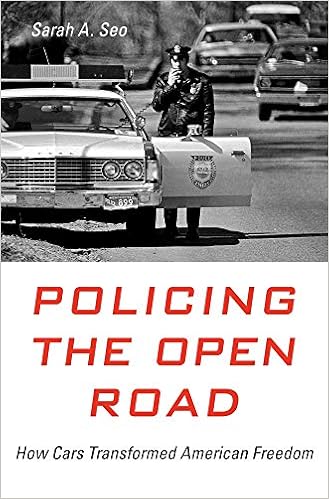
She is the author of Policing the Open Road: How Cars Transformed American Freedom, out just this month from Harvard University Press. Here's a description from the Press:
Sarah Seo (credit)
When Americans think of freedom, they often picture the open road. Yet nowhere are we more likely to encounter the long arm of the law than in our cars. Sarah Seo reveals how the rise of the automobile led us to accept—and expect—pervasive police power. As Policing the Open Road makes clear, this radical transformation in the nature and meaning of American freedom has had far-reaching political and legal consequences. 
Before the twentieth century, most Americans rarely came into contact with police officers. But with more and more drivers behind the wheel, police departments rapidly expanded their forces and increased officers’ authority to stop citizens who violated traffic laws. The Fourth Amendment—the constitutional protection against unreasonable searches and seizures—did not effectively shield individuals from government intrusion while driving. Instead, jurists interpreted the amendment narrowly. In a society dependent on cars, everyone—the law-breaking and law-abiding alike—would be subject to discretionary policing. 
Seo overturns prevailing interpretations of the Warren Court’s due process revolution. The justices’ efforts to protect Americans did more to accommodate than to limit police intervention, and the new criminal procedures inadvertently sanctioned discrimination by officers of the law. Constitutional challenges to traffic stops largely failed, and motorists “driving while black” had little recourse to question police demands. Seo shows how procedures designed to safeguard us on the road ultimately undermined the nation’s commitment to equal protection before the law.
In advance praise, Bernard Harcourt describes Policing the Open Road as "a brilliant and groundbreaking book that will fundamentally reshape the way we think about the police, criminal procedure, and American freedom."

Professor Seo is also the author of numerous essays and articles, including one out just this year from the Yale Law Journal: "Democratic Policing Before the Due Process Revolution." Her work has also appeared in the Law and History Review and Law & Social Inquiry, among other venues.

Prior to joining the faculty at Iowa, Professor Seo held legal history fellowships at New York University School of Law and the University of Virginia Law School. She also clerked for two federal court judges: Judge Denny Chin, then of the U.S. District Court for the Southern District of New York, and Judge Reena Raggi of the U.S. Court of Appeals for the Second Circuit. She received her Ph.D. in History from Princeton University and her J.D. from Columbia Law School.

Welcome, Sarah Seo!

-- Karen Tani

Mathen on advisory opinions in Canada

Carissima Mathen, University of Ottawa, has published Courts Without Cases: The Law and Politics of Advisory Opinions with Hart. From the press: 
Media of Courts Without Cases
Since 1875, Canadian courts have been permitted to act as advisors alongside their ordinary, adjudicative role. This book offers the first detailed examination of that role from a legal perspective. 
When one thinks of courts, it is most often in the context of deciding cases: live disputes involving spirited, adversarial debate between opposing parties. Sometimes, though, a court is granted the power to answer questions in the absence of such disputes through advisory opinions (also called references). These proceedings raise many questions: about the judicial role, about the relationship between courts and those who seek their 'advice', and about the nature of law.
Tracking their use in Canada since the country's Confederation and looking to the experience of other legal systems, the book considers how advisory opinions draw courts into the complex relationship between law and politics.
With attention to key themes such as the separation of powers, federalism, rights and precedent, this book provides an important and timely study of a fascinating phenomenon.
 Praise for the book: 

“This book is the first in-depth study of the profound impact on Canadian constitutional law produced by judicial 'advisory opinions' issued in response to the direct 'reference' of legal questions to the courts by governments. From the Persons case to the Secession Reference, reference opinions have come to dominate the Canadian constitutional landscape. But the reference procedure has been oddly overlooked by constitutional scholars-until now. For Carissima Mathen, this unusual point of legal procedure is the vehicle for a magisterial exploration of the history, politics, theory, and practice of constitutionalism in Canada. Courts Without Cases is a brilliant contribution to the literature on Canadian constitutional law and politics.” –  Mark D Walters

“Courts Without Cases is a lucid, original, insightful and highly readable contribution to our understanding of law and politics. References brought by Government to the Supreme Court have led to many of the most important Supreme Court decisions, from same-sex marriage to Quebec's secession, from the regulation of prostitution, guns and financial markets to the composition of the Senate and the Supreme Court itself. Mathen masterfully weaves the story of these significant judgments with the political and institutional dynamics which shape them.” –  Lorne Sossin

Further information is available here.

-Mitra Sharafi