Showing posts with label sex. Show all posts

Sunday, February 15, 2026

Sunday Roundup

  • NYU Law's notice of Ashraf Ahmed, Lev Menand, and Noah Rosenblum's article, "The Making of Presidential Administration,” upon its naming as winner of the annual Award for Scholarship in Administrative Law from the American Bar Association Section of Administrative Law and Regulatory Practice. The notice also includes a Q&A with Rosenblum. 
  • Historical research figured prominently in the decision of Judge Chad F. Kenney, Eastern District of Pennsylvania, turning aside a challenge to the qui tam provisions from the False Claims Act on unitary executive grounds (JDSupra). 
  • A notice of UC Berkeley professor David Henkin's legal-history-laden course on love, sex and marriage. 
  • In March, SWOP NSW will host walking tours of Sydney’s historic "red light district."  “With 8 speakers each evening, the tour will cover both the personal anecdotes of those involved in sex work and the legislation that has shaped their lives. Speakers will share their stories on various topics, including current, historical, and future laws that aim to protect sex workers, as well as the advocates who have been instrumental in achieving these legal advancements." 
  • Vice President Mike Pence and former Deputy Assistant to the President Greg Jacob are teaching the course, The Character of the American Constitution, at George Mason’s Schar School of Policy and Government.  The first class “walked students through the origins of the Declaration of Independence, exploring what the Declaration meant and where the writers got the ideas.”  (GMU).

--Dan Ernst 

Wednesday, December 17, 2025

LHR 43:2

Law and History Review 43:2 (2025), a special issue, has now been published on-line.  Here is the TOC:

Archives of Sexual Violence in Conflict Zones
Rosemary Byrne, Stephanie McCurry, Jane Ohlmeyer

Women and Sexual Violence in the “1641 Depositions”
Jane Ohlmeyer

Ku Klux Klan Violence and the Problem of Evidence
Stephanie McCurry

Collective Sexual Violence in Turkey, 1894–1924: What we know and how we know it
Benny Morris

Archives of Sexual Violence: Some Testimonies from the Partition of India
Sucheta Mahajan

Women on the Death Railway: A Microhistory of Victimization and Agency
W.L. Cheah

“Hints” of Sexual Violence: What the Akayesu Trial Archive at the International Criminal Tribunal for Rwanda Tells Us About Uncovering Sexual Violence Testimony in Conflict Archives
Rosemary Byrn

--Dan Ernst 

Thursday, September 18, 2025

Larson on Rape and Medieval Canon Law

Atria A. Larson, Saint Louis University, has published Lucretia (and Lucia) and the Medieval Canonists: Guilt, Consent, and Chastity in the Early Canonistic Jurisprudence of Rape, online in Law and History Review:

This essay explores a key stage in the legal history of the concepts of consent and guilt in cases of rape, namely in twelfth-century canon law in the work of Gratian and the early canonists who commented on his Decretum. It substantially revises the account that currently exists in scholarship and explains that confusion between raptus and rape and a limited read of the Decretum have combined to provide a problematic picture in which, it has been claimed, neither Gratian nor broader medieval canon law took rape seriously as an offence. The essay focuses on the underexplored Causa 32 in the Decretum and discusses how Gratian very directly addressed forced coitus in that section of his text, both condemning it and exonerating women of all guilt who are forced to have sex without their consent. Gratian and the decretists ended up changing the discourse on rape, in part through their treatment of both Lucretia of Roman legend and an early Christian martyr, Lucia. Their considerations, which intersected with theology, resulted in a legal principle that a raped wife cannot be charged with adultery. Since their considerations could also be applied to any rape victim, their work is important for the development of rape law and legal notions of consent.

--Dan Ernst 

Monday, November 14, 2022

Book Event: Strum's "On Account of Sex"

[We have the following announcement.  DRE]

Please join [the American Historical Association and Woodrow Wilson Center] for a Washington History Seminar Panel with Philippa Strum on On Account of Sex: Ruth Bader Ginsburg and the Making of Gender Equality Law, Monday, November 21 at 4:00 pm ET.  Click here to register for the webinar, which will be recorded and the video will be posted on the Washington History Seminar YouTube Channel.  Commenting is Deborah Archer, the president of the ACLU, a tenured professor of clinical law and director of the Civil Rights Clinic at New York University School of Law, and co-faculty director of the Center on Race, Inequality, and the Law at NYU Law.

Long before she was “Notorious,” RBG was an attorney arguing and winning gender equality cases before the Supreme Court. Dr. Strum contends that RBG’s greatest contribution came not as a jurist but in persuading the Justices of the 1970s, whom RBG described as needing a grade school-level education about sex discrimination, to rethink stereotypes about the proper roles for men and women and declare sex discrimination to be unconstitutional. Her pathbreaking approach to the law could not be more relevant today.

Monday, July 11, 2022

AJLH 62:2

Here is the TOC for American Journal of Legal History 62:2 (June 2022):

British Policy towards the Incorporation of the Baltic States into the USSR: A Dilemma of de facto and de jure Recognition    
Evgeny Tikhonravov
 
The Judicial Failsafe: American Legal Colonialism in the Philippines    
Timothy J Foley
 
Amnesty and the Limits of Transitional Justice in Brazil: The Case of Expelled Low-Ranking Soldiers, 1964–2014    
Marilia CorrĂȘa
 
Book Reviews
 
Susan J. Pearson, The Birth Certificate: An American History    
Teal Arcadi
 
Inge Van Hulle, Britain and International Law in West Africa    
Joyman Lee
 
Anne Gray Fischer, The Streets Belong to Us: Sex, Race, and Police Power from Segregation to Gentrification    
Marie-Amélie George

--Dan Ernst

Saturday, October 23, 2021

Weekend Roundup

  • We have word of two upcoming events sponsored by the Supreme Court Historical Society.  On  “November 10, 2021 at 12:00 p.m. EST, the Society will host A Virtual Conversation - The Original Meaning of the 14th Amendment with Randy Barnett and Evan Bernick.  The discussion will be based on their newly published book, The Original Meaning of the Fourteenth Amendment: Its Letter and Spirit. On December 8, 2021, at 12:00 p.m. EST, the Society will host Making Minimum Wage: Elsie Parrish v. The West Coast Hotel Company: A Lecture by Helen Knowles.  The lecture is inspired by her newly published book, Making Minimum Wage: Elsie Parrish v. The West Coast Hotel Company.”  Both are free to all and will be held over Zoom.
  • The Max Planck Institute for Legal History and Legal Theory has announced “a new lecture series, the Max Planck Lectures in Legal History and Legal Theory.  Six times a year, renowned scholars in the fields of legal history and legal theory are invited to present their current research.  The lectures are open to the public and will be held at 4.15 pm (on changing weekdays) at the Max Planck Institute for Legal History and Legal Theory.” 
  • New in the latest issue of the Journal of American History: “There isn't no trouble at all if the state law would keep out”: Indigenous People and New York's Carceral State by Christopher Clements.  The article “examines the history of racialized policing practices, jurisdictional disputes, and tribal governance in and around reservation communities in New York. Focusing primarily on the Akwesasne Mohawk Nation, which straddles the U.S.- Canada border, he asks how carceral state development affected Indigenous people and lands and how carcerality intertwined with settler colonialism during the first half of the twentieth century.”
  • Martti Koskenniemi, Professor of International Law (emeritus) University of Helsinki, will speak in the Global Forum Seminar of the School of Governance, Law and Society of Tallinn University on Expansion of International Legal History: Recent Debates on November 23, 2021, 16:00 - 18:00.
  • Yesterday the University at Buffalo Law School held the panel discussion “Sex, Solicitation, and the Supreme Court: Remembering People v. Uplinger.”  The session addressed “the ordeal of Robert Uplinger, a gay man who was arrested in Buffalo’s Allentown neighborhood in 1981 after propositioning another man on the steps of the Lenox Hotel. The other person turned out to be an undercover police officer, and Uplinger was charged with violating a state law prohibiting loitering ‘for the purpose to engage in deviate sexual intercourse.’” More
  • We just learned of the Duke Center for Firearms Law’s Repository of Historical Gun Laws, “a searchable database of gun laws from the medieval age to 1776 in England and from the colonial era to the middle of the twentieth century in the United States.”
  • ICYMI: An illustrated history of vaccine mandates in the United States (Chicago Tribune). Inside the Robert Caro Archive (Gothamist)(H/t: JQB).

 Weekend Roundup is a weekly feature compiled by all the Legal History bloggers.

Friday, June 25, 2021

Barzun on MacKinnon on Sexual Harrassment

Charles L. Barzun, University of Virginia School of Law, has posted The Common Law and Critical Theory, which is forthcoming in the University of Colorado Law Review:

Because common-law doctrines have long served as targets for critical theorists, it would be easy to see the common law and critical theory as essentially antagonistic with each other. But that would be a mistake. In fact, both critical theory and the common law—or, at least, one interpretation of the common law—license a quite similar, and similarly holistic, form of reasoning. Specifically, they both draw normative inferences from explanatory claims and vice versa. This symposium essay uses a case study to illustrate this quite general point. Catharine MacKinnon’s revolutionary argument that sexual harassment constitutes sex discrimination under the Civil Rights Act of 1964 is a vivid example not only of critical theory but also of an holistic interpretation of the common law. Because common-law reasoning and critical theory are analytically compatible in this way, I conclude by suggesting that each tradition has something to learn from the other.

--Dan Ernst

Tuesday, May 11, 2021

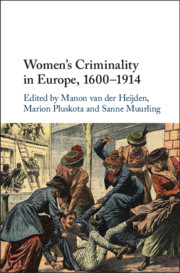
van der Heijden, Pluskota, Muurling and friends on women's criminality in Europe

Manon van der Heijden, Marion Pluskota, and Sanne Muurling (all at Universiteit Leiden) have co-edited the volume, Women's Criminality in Europe, 1600-1914 with Cambridge University Press. From the publisher: 

Bringing together the most current research on the relationship between crime and gender in the West between 1600 and 1914, this authoritative volume places female criminality within its everyday context. It reveals how their socio-economic and cultural contexts provided women with 'agency' against a range of European backdrops, despite a fundamentally patriarchal criminal justice system, and includes in-depth analysis of original sources to show how changing living standards, employment, schooling and welfare arrangements had a direct impact on the quality of life of working class women, their risk of becoming involved in crime, and the likelihood of being prosecuted for it. Rather than treating women's criminality as always exceptional, this study draws out the similarities between female and male criminality, demonstrating how an understanding of specific cultural and socio-economic contexts is essential to explain female criminality, both why their criminal patterns changed, and how their crimes were represented by contemporaries.

Table of Contents after the jump: 

Wednesday, March 3, 2021

CFP: Gender and justice in Scotland

 [We share the following Call, via the Edinburgh Legal History Blog. Submissions are due by 19 March 2021.]

Gender and justice in Scotland: historical and legal perspectives 

‘Gender and Justice in Scotland: Historical and Legal Perspectives’ is a collaborative symposium between the University of Glasgow’s Centre for Gender History and the School of Law. The historical struggle for gender equality has transformed women’s access to justice in Scotland today. Over the last two centuries, Scottish feminists and their supporters campaigned for women’s right to vote, to own property, to seek marital separation, to obtain custody of their children and to have bodily autonomy. Understanding women’s access to justice in the Scottish past can help legal practitioners and the courts make better-informed decisions when encountering similar problems today. The ways in which we make sense of women’s social agency needs to acknowledge the intersectional nature of ongoing discrimination throughout history. Even today, the struggle for gender equality is far from complete, and a glaring disparity between the achieved equality of women and their lived realities still remains. 

This is a call for papers which aims to explore issues affecting women’s access to justice in Scotland across time and space, and we welcome research on all Scottish courts, regions, jurisdictions, ethnicities, sexual and gendered identities, languages and religious and confessional identities. We also welcome papers that approach Scotland through a comparative or international perspective. Post-graduate students are particularly encouraged to apply. We welcome abstracts from a variety of disciplines, including (but not limited to): history, law, criminology and social science. We invite papers that address the following or related themes in a historical or legal perspective: • inheritance, succession and family law • cohabitants’ rights on separation and death • civil partnership, marriage, and divorce • civil remedies for domestic abuse and gender-based violence • reproductive health rights • parental rights and responsibilities, children and adoption. 

The symposium will be held online on 6 and 7 May 2021. Please send a 300-word abstract with a short biography to the organiser with ‘Gender and Justice’ in the subject line by 19 March 2021. 

Organiser: Dr Rebecca Mason, ESRC Postdoctoral Fellow in the School of Law Email: contact@womenmarriagelawscotland.org 

Co-organisers: Dr Maud Bracke and Dr Jackie Clarke (Centre for Gender History); Professor Jane Mair (School of Law).

--Mitra Sharafi

Friday, January 22, 2021

Schmidt on Theodor Sternberg and the "Closet of Conceptualism"

Over at the blog "History | Sexuality | Law," Katharina Isabel Schmidt, a PhD candidate in history at Princeton University and a JSD candidate in law at the Yale Law School, has posted Theodor Sternberg and the Closet of Conceptualism.  The essay commences:

Sometime in the mid-1930s, German jurist Theodor Sternberg (1878-1950) concluded that law and love were incompatible. In one of his “erotosophical” fragments, he claimed that affective bonds thrived under anarchy. Love, for Sternberg had to be free from egoism and compulsion, eschew both duty and obligation. “Coitus,” especially, was divine in origin—God’s love for the world incarnate—and just like God’s love was limitless, sexuality knew no law.

--Dan Ernst

Wednesday, September 23, 2020

Barzun on MacKinnon

Charles L. Barzun, University of Virginia School of Law, has posted Catharine MacKinnon and the Common Law:

Few scholars have influenced an area of law more profoundly than Catharine MacKinnon. In Sexual Harassment of Working Women (1979), MacKinnon virtually invented the law of sexual harassment by arguing that it constitutes a form of discrimination under Title VII of the Civil Rights Act of 1964. Her argument was in some ways quite radical. She argued, in effect, that sexual harassment was not what it appeared to be. Behavior that judges at the time had thought was explained by the particular desires (and lack thereof) of individuals was better understood as a form of social domination of women by men. Judges, she argued, had failed to see that such conduct was a form of oppression because the social and legal categories through which they interpreted it was itself the product of male power.

This argument is not your typical legal argument. It may not even seem like a legal argument at all. But this article explains why on one, but only one, model of legal reasoning, MacKinnon’s argument properly qualifies as a form of legal reasoning. Neither the rationalist nor the empiricist tradition of common-law adjudication can explain the rational force of her argument. But a third, holistic tradition of the common law captures its logic well. It does so because, like MacKinnon’s argument (but unlike the other two traditions), it treats judgments of fact and value as interdependent. This structural compatibility between MacKinnon’s argument about gender oppression, on the one hand, and the holistic tradition of the common law, on the other, has theoretical and practical implications. It not only tells us something about the nature of law; it also suggests that critical theorists (like MacKinnon) may have more resources within the common law tradition to make arguments in court than has been assumed.

--Dan Ernst

Monday, June 8, 2020

Siegel on The Pregnant Citizen

Reva Siegel, Yale Law School, has posted The Pregnant Citizen, from Suffrage to the Present, which is forthcoming in the Georgetown Law Journal:
This Article examines how courts have responded to the equal protection claims of pregnant citizens over the century women were enfranchised. The lost history it recovers shows how equal protection changed—initially allowing government to enforce traditional family roles by exempting laws regulating pregnancy from close review, then over time subjecting laws regulating pregnancy to heightened equal protection scrutiny.

It is generally assumed that the Supreme Court’s 1974 decision in Geduldig v. Aiello insulates the regulation of pregnancy from equal protection scrutiny. The Article documents the traditional sex-role understandings Geduldig preserved and then demonstrates how the Supreme Court itself has limited the decision’s authority.

In particular, I show that the Rehnquist Court integrated laws regulating pregnancy into the equal protection sex-discrimination framework. In United States v. Virginia, the Supreme Court analyzed a law mandating the accommodation of pregnancy as classifying on the basis of sex and subject to heightened scrutiny; Virginia directs judges to look to history in enforcing the Equal Protection Clause to ensure that laws regulating pregnancy are not “used, as they once were . . . to create or perpetuate the legal, social, and economic inferiority of women.” In Nevada Department of Human Resources v. Hibbs, the Court then applied the antistereotyping principle to laws regulating pregnancy, as a growing number of commentators and courts have observed.

I conclude the Article by considering how courts and Congress might enforce the rights in Virginia and Hibbs in cases involving pregnancy under both the Fourteenth and the Nineteenth Amendments. To remedy law-driven sex-role stereotyping that has shaped the workplace, the household, and politics, the Article proposes that Congress adopt legislation mandating the reasonable accommodation of pregnant employees, such as the Pregnant Workers Fairness Act. These sex-role stereotypes affect all workers, but exact the greatest toll on low-wage workers and workers of color who are subject to rigid managerial supervision.

When we locate equal protection cases in history, we can see how an appeal to biology can enforce traditional sex roles as it did in Geduldig—and see why a court invoking Geduldig today to insulate the regulation of pregnancy from scrutiny under Virginia and Hibbs would not respect stare decisis, but instead retreat from core principles of the equal protection sex-discrimination case law.
--Dan Ernst

Monday, December 16, 2019

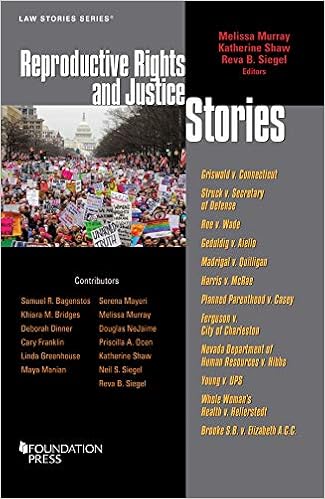
Shaw, Siegel and Murray's Introduction to "Reproductive Rights and Justice Stories"

Katherine Shaw, Yeshiva University-Benjamin N. Cardozo School of Law, Reva Siegel, Yale Law School, and Melissa Murray, New York University School of Law, have posted their introduction to Reproductive Rights and Justice Stories:
This book of "Reproductive Rights and Justice Stories" brings together important cases involving the state regulation of sex, childbearing, and parenting. We tell the story of twelve cases, some canonical and some far less known, involving contraception, abortion, pregnancy, and parenthood. The chapters tell their stories using a wide-lens perspective that illuminates the complex ways law is forged and debated in social movements, in representative government, and in courts.

As a field, "reproductive rights and justice” is relatively new, and its contours are quite broad, encompassing the various ways law shapes the decision “whether to bear or beget a child” and the conditions under which families are created and sustained. Some of the cases included in this volume are very much part of the constitutional law canon; more are not. Until recently, these cases have not often been conceived of as part of a unified field of law.

This volume remedies that oversight. Reading this group of cases together makes visible forms and effects of reproductive regulation that are less evident when the cases are read in isolation or in their more familiar doctrinal contexts. The framework of “reproductive justice” highlights the intersecting relations of race, class, sexuality, and sex that shape the regulation of reproduction. It examines the many ways law shapes the choice to have, as well as to avoid having, children. The volume addresses decisionmaking about contraception and abortion—the traditional subject matter of “reproductive rights”—in this larger reproductive justice framework, and locates this body of law alongside cases that consider a wider range of issues, including sterilization, assisted reproductive technology, pregnancy discrimination, the criminalization of pregnancy, and access to reproductive health care.

The chapters in this volume narrate the cases in ways that enlarge the field in which we analyze the work of courts. To be sure, the chapters tell stories about the individual litigants and lawyers behind important cases. But the stories recognize courts as but one of many institutions in our constitutional democracy, and they show how conflicts over law unfold in the institutions of civil society (medicine, religion, media), in democratic politics (social movements, political parties, and representative government), as well as in the courts. The stories feature ordinary women and men struggling with laws that govern the ways they make families, and show how members of the community, government officials, lawyers, and judges respond. In the process, these stories situate litigation histories in a larger social field, revealing the interplay of bottom-up and top-down forces that provoke, shape, and legitimate judicial decisions, and the role that struggle over courts and rights plays in forging new norms.
--Dan Ernst

Thursday, September 26, 2019

The Strange Symbiosis of Libel and the Popular Press


My thanks once more for the opportunity to be your guest blogger this month. This will be my final post.

The Strange Symbiosis of Libel and the Popular Press

In late 1920, London daily newspapers had a field day recounting the scene before the King’s Bench and a special jury. A slander case pitted writer Marguerite Radclyffe-Hall against St. George Lane Fox-Pitt, son of famed archeologist Augustus Pitt-Rivers. Fox-Pitt had recently learned from Admiral Troubridge that Radclyffe-Hall had taken up with the Admiral’s estranged wife. Fox-Pitt used this information to discredit Radclyffe-Hall at the Society of Psychical Research, purportedly calling her a “grossly immoral woman.” In court, Fox-Pitt denied that he had ever called the plaintiff “immoral.” Or, he equivocated, if he had done so, he had not meant it maliciously. Indeed, if he meant it at all, the claim pertained to her work, not to Radclyffe-Hall herself. According to the Daily Mirror, the courtroom burst into laughter as Fox-Pitt attempted to describe the immorality implicit in Radclyffe-Hall’s psychic account of a “spook horse” bathing in heaven. Not even the judge seemed able to move past the strangeness of spiritualist study to follow Fox-Pitt’s point [1]. Radclyffe-Hall won her slander suit, receiving £500 damages, a decision upheld on appeal in 1921 [2]. She won thanks to the little-known 1891 Slander of Women Act that allowed women (and only women) in England and Wales to sue for sexual slander without having to prove damages. The law would remain on the books until 2013.
I have been thinking quite a bit about this Act since starting research on reputation. It gets mentioned regularly in legal primers as one of the few caveats in British defamation law. Whereas the law generally requires proof of financial damages in cases of oral slander, the 1891 Act exempted women, since the quintessential middle-class Victorian woman presumably had no market income to lose. There are only a few hits when one searches for cases in the law reports, not leaving the historian much to draw from. If one shifts one’s view from law reports to the newspapers, however, one finds several dozen cases over the law’s 122-year life, the bulk of them taking place between its 1891 passage and 1940. With each expansion of the online British Newspaper Archive, I find more. Some of the stories are set up as general-interest stories, while other slander of women cases were less visible. Editors clearly deemed Radclyffe-Hall’s trial to be good entertainment for readers, and covered it on the first or second pages of their papers.   
As a historical repository of courtroom drama, newspapers are unparalleled sources. But they are far from being neutral parties, of course. It is perhaps hard to find an area of research in which this is more the case than in questions surrounding defamation. Members of the press were outspoken in their critique of libel law at every stage. Nevertheless, journalist critics of libel laws rarely advocated the outright abolition of defamation law. Radclyffe-Hall’s case and Kelly v. Sherlock (see my previous post) offer useful ways of thinking about newspapers’ relationship with defamation cases and how historians might take the relationship into account.
Radclyffe-Hall’s case was a society case. It was entertaining, and it would sell well. Thanks to amendments to the libel laws in the 1880s, news outlets could report on court proceedings so long as the reporting was done accurately and without malice. Targeting an ever-wider readership, especially among women, mass newspapers could bank on the appeal of a social celebrity like Radclyffe-Hall. The seeming ridiculousness of the whole affair likely made the courtroom drama all the more appealing. The laughter in the courtroom stood in for newspaper editorializing, which would have been off limits—or, rather, open to libel charges in turn. Indeed, the entire scene underscores an implicit agreement about the bounds of civility in the period. It was permissible to laugh at Fox-Pitt for his unchivalrous and inept condemnation of Radclyffe-Hall. His inhibitions about addressing her sexuality in the courtroom can be attributed to the Slander of Women Act’s blanket prohibition on criticism of a woman’s virtue. But the courtroom and wider public also seemed remarkably at ease with Radclyffe-Hall’s well-known lesbianism a decade before she published her seminal (and censored) Well of Loneliness. It helped, of course, that the case involved a psychical society, not politics; the stakes were lower. This could not be said about Kelly v. Sherlock. 
Sherlock got into trouble not because he published about Kelly but because of the manner in which he discussed Kelly. Kelly was indeed fair game. He’d made himself a target of public interest, as Baron Bramwell ruled in the trial at the Manchester assizes in August 1865. While there might be a privilege in sermonizing to one’s flock (Bramwell was doubtful, but upheld it), there was no pastoral privilege to criticize civil officials. By so doing, Bramwell held, Kelly opened himself to public rebuke [3]. Sherlock’s infraction, then, was not criticizing Kelly, but doing so in an overly vitriolic manner. It was a contemptuous attack on his professional persona. Newspapers that reported on Kelly and Sherlock could do so without feeling that they were betraying their profession or inviting trouble themselves because, to them, the case helped clarify the boundaries of legitimate journalistic practice. Journalists were not unqualified defenders of journalistic latitude, and saw no reason to be so. They were comfortable with a legally-enforced code of journalistic civility.
It is significant when even those with an interest in criticizing a norm assent to it in principle, since this reflects the power of a social norm. On my bus ride home today, I was reading the 1967 Report of the Joint Committee on Censorship of the Theatre. In his testimony to the committee, Kenneth Tynan, then fighting to have Hochhuth’s Soldiers staged, demanded the end of censorship. His phrasing early in his testimony is of note: “there should be no restriction short of libel on the presentation of historical characters living or dead” [4]. 

[1] Daily Express, November 19, 1920, p. 1; Daily Mirror, November 19, 1920, p. 2. 
[2] "Court of Appeal." Times, March 16, 1921, p. 5.
[3] 686 Kelly v Sherlock, Queen's Bench Division, 13 June 1866, (1865-66) L.R. 1 Q.B. 686, 689.
[4] Testimony of Kenneth Tynan January 24, 1967, as found in the Minutes of Evidence appended to the Joint Committee on Censorship of the Theatre, p. 80.

--Caroline Shaw

Friday, May 10, 2019

Murray, Shaw, & Seigel, eds., "Reproductive Rights and Justice Stories"

New from Foundation Press, in the "Law Stories" Series, Reproductive Rights and Justice Stories, edited by Melissa Murray (NYU Law), Katherine Shaw (Benjamin N. Cardozo School of Law), and Reva B. Siegel (Yale Law School). A description from the Press:
This book tells the movement and litigation stories behind important reproductive rights and justice cases. The twelve chapters span topics including contraception, abortion, pregnancy, and assisted reproductive technologies, telling the stories of these cases using a wide-lens perspective that illuminates the complex ways law is debated and forged―in social movements, in representative government, and in courts. Some of the chapters shed new light on cases that are very much part of the constitutional law canon―Griswold v. Connecticut, Roe v. Wade, Planned Parenthood v. Casey, Nevada Department of Human Resources v. Hibbs. Others introduce the reader to new cases from state and lower federal courts that illuminate paths not taken in the law. 
Reading the cases together highlights the lived horizon in which individuals have encountered and struggled with questions of reproductive rights and justice at different eras in our nation’s history―and so reveals the many faces of law and legal change. The volume is being published at a critical and perhaps pivotal moment for this area of law. The changing composition of the Supreme Court, increased executive and legislative action, and shifting political interests have all pushed issues of reproductive rights and justice to the forefront of contemporary discourse. The volume is suited to a wide range of law school courses, including constitutional law, family law, employment law, and reproductive rights and justice; it could also be assigned in undergraduate or graduate courses on history, gender studies, and reproductive rights and justice.
All of the editors have contributed solo- or co-authored essays. The other contributors are: Samuel R. Bagenstos (University of Michigan Law); Khiara M. Bridges (Boston University School of Law); Deborah Dinner (Emory Law); Cary Franklin (University of Texas at Austin School of Law); Linda Greenhouse (New York Times/Yale Law School); Maya Manian (University of San Francisco School of Law); Serena Mayeri (University of Pennsylvania School of Law); Douglas NeJaime (Yale Law School); Priscilla A. Ocen (Loyola Law School, Los Angeles); Neil S. Siegel (Duke Law).

It looks like some of the essays are available on SSRN. For example, here is Reva Siegel and Linda Greenhouse's chapter on "The Unfinished Story of Roe v. Wade."

Tuesday, April 16, 2019

Sethna, Davis and friends on travel for abortion

Out with Johns Hopkins University Press is Abortion Across Borders: Transnational Travel and Access to Abortion Services, edited by Christabelle Sethna, University of Ottawa and Gayle Davis, University of Edinburgh. Many of the chapters are historical in approach, focusing on travel for abortion since the 1960s. From the press: 
Safe, legal, and affordable abortion is widely recognized as an essential medical service for women across the world. When access to that service is denied or restricted, women are compelled to carry unwanted pregnancies to term, seek backstreet abortionists, attempt self-induced abortions, or even travel to less restrictive states, provinces, and countries to receive care.
Abortion across Borders focuses on travel across domestic and international boundaries to terminate a pregnancy. Christabelle Sethna and Gayle Davis have gathered a cadre of authors to examine how restrictive policies force women to move both within and across national borders in order to reach abortion providers, often at great expense, over long distances and with significant safety risks. Taking historical and contemporary perspectives, contributors examine the situation in regions that include Texas, Prince Edward Island, Ireland, Australia, the United Kingdom, and Eastern Europe. Throughout, they take a feminist intersectional approach to transnational travel and access to abortion services that is sensitive to inequalities of gender, race, and class in reproductive health care.
This multidisciplinary volume raises challenging logistical, legal, and ethical questions while exploring the gendered aspects of medical tourism. A noticeable rollback of reproductive rights and renewed attention to border security in many parts of the world will make Abortion across Borders of timely interest to scholars of gender and women's studies, health, medicine, law, mobility studies, and reproductive justice.
Table of Contents after the jump: