Showing posts with label British legal history. Show all posts

Monday, March 2, 2026

Chowdhury to Lecture on the British Constitution, Capitalism and Constitutional Change

Tanzil Chowdhury, Queen Mary University of London, will lecture on The British Constitution, capitalism and constitutional change at ANU Law School on March 4 2026 from 1:00pm - 2:00pm:

This talk is from Associate Professor Chowdhury's current book project that examines the transformation of the British Constitution over the last century. His argument is that we cannot understand significant changes to the British constitution without understanding the broader historical developments in capitalist social relations and the significant social antagonisms that have occurred throughout the last 100 or so years. Capitalism is a totality of different social relations and processes oriented around the value form; different social relations (economic, but also political, legal, cultural, moral etc) which are all important to the reproduction of that social totality. 

Contrary to heteronomous theories of constitutional change (including some Marxist ones), this project seeks to understand constitutions (the different institutional combinations of state and social power, subject formations, forms of mediation and characterisations of legality) as having an internal relation with capitalist social relations. In that sense, constitutions cannot be abstracted from capitalist social relations and are in fact, as he will argue, historically specific to capitalism. 

However, even though constitutions are internally related to capitalist social relations, that does not mean that capitalist societies are not fraught with all manner of tensions, contradictions and ruptures. This is not therefore a rigid economistic and deterministic theory of constitutional development, but one which takes seriously the historical distinctness of the legal form, constitutionalism, and the specific work they do (or not) in the reproduction of capitalist social relations. 

Constitutionalism, as he will argue, operates at different levels within the contradictory totality of capitalist social relations. Changes to the British constitution are the results of specific forms of struggle over the reproduction of capitalist social relations. In this paper, he will set out some examples of this theoretical approach and focus on how I will periodise the last century of the British constitution which connect to distinct forms of what I will call historical forms of capitalist constitutionalism.

--Dan Ernst 

Monday, February 2, 2026

"Law and Justice in the 1950s" (in England and Wales)

Just out from University of London Press: Law and Justice in the 1950s: Case Studies From a Neglected Decade, edited by Fiona Cownie and Rosemary Auchmuty and published in association with the Institute of Advanced Legal Studies:

The 1950s was a decade of considerable legal development in England and Wales, despite often being regarded as very conservative in contrast to the more radical 1960s and 1970s. This collection illustrates the breadth of those developments, providing a sociolegal perspective on a range of topics across criminal, property, family, commercial, environmental and public law, and legal education. It examines the social, political and economic context of the decade to reveal how legal developments in the 1950s have much greater significance than has generally been acknowledged to date. Drawing on case studies from the Great London Smog in 1952, the treatment of women in the Wolfenden Report and divorce law reform, to the takeover battle for the Savoy Hotel in 1953, law on the radio and more, the chapters throw new light on current debates about the relationship between law and issues of justice, inclusion and equality in different spheres of activity.

Written for historians and legal specialists alike, this book explores the stories behind the laws in this neglected decade. In revealing the historical context, arguments and controversies raised at the time and the different perspectives of the parties involved, it offers a greater understanding of why we have the law we have now and of these issues as they continue to be played out in the early twenty-first century.

Here is an endorsement that matters: 

This ground-breaking book provides an exciting new perspective on the role of law in England and Wales during the 1950s. New stories not already recorded in standard legal histories are carefully examined, including an eye-opening series on education, and the conjunction between women and the home. Wide-ranging and engaging, it is a fine achievement.  
—David Sugarman, Professor Emeritus, Law School, Lancaster University, UK

--Dan Ernst.  TOC after the jump. 

Thursday, January 29, 2026

CFP: Four Nations Law and the Humanities

[We have the following CFP for The Four Nations Law and the Humanities Forums.  DRE]

We are excited to announce the calls for papers for Four Nations Law and the Humanities Forums 2026!

Located around the country during 2026, the forums will provide an important space to develop research excellence at the intersections of law and the humanities, and foster intellectual community, supporting early-career scholars. Hosted at the University of Glasgow, Queen’s University Belfast, University of Warwick, and Cardiff University, these workshops are a series held across the four UK nations, in collaboration with the Law and the Humanities Hub (LHub) at the Institute of Advanced Legal Studies.

The forums will workshop ECRs’ work in progress and offer a rigorous context addressing the nature of interdisciplinary research in law and the humanities and its paths of development.

Criteria for Selection.  Contributions developed by early-career scholars will be selected based on their demonstration of excellence in scholarship and practice. Proposed participation may be written papers or creative work (in visual, sonic, film, etc. form), at any intersection within Law and the Humanities, including research that connects law with history, philosophy, literature, art, performance, linguistics, cultural and media studies, creative practice, and other humanistically-informed fields and methods.
     
Eligibility: The forums are open to individuals currently pursuing a PhD or DPhil, or who are within seven years of having completed their PhD, with due accommodation for career breaks, who are actively carrying out research in Law and the Humanities.

Forums Dates.  The dates of the workshops are as follows:

21st May - University of Glasgow
25th June - Queen’s University Belfast
2nd  July - Cardiff University
17th July - University of Warwick 

The workshops will bring law and humanities scholarship to wider audiences through the engagement of legal scholars as well as humanities scholars, ensuring that the research is not confined to law or the humanities.

Forums Format.  A limited number of works in progress will be selected for each forum. Each forum will be based on pre-reading of all papers and works by all attendees, and will include:

A friendly opening session;

Workshop sessions of 45 minutes dedicated to the submitted papers/works. Each session will include an invited senior commentator and an open discussion addressing subject matter, method, interdisciplinarity, and creativity. The authors/creators will not be expected to present.  The discussion will include all participants in conversational style (not as a Q&A).

The scholarship, creative practice, and networking will be fostered and supported through the participating institutions and LHub, via the Four Nations website, a concluding online plenary, and associated networks such as Legal Humanities Association and the Art/Law Network.

Submissions.  Please submit a CV; statement of interest in the forum, including an explanation of your eligibility (up to 250 words); and a 500-1,200-word proposal for a paper, or in the case of an artwork submission, the work and a 300-word description. Please also indicate which location you wish to attend.  

If accepted, submission of the completed paper will be expected a month prior to the chosen workshop, and should be up to 6000 words, or the completed artwork if non-text. 

Proposal Submission Deadlines.  Dates for the submission are as below.  

28th February - University of Glasgow
31st March - Queen’s University Belfast
30th April - Cardiff University and University of Warwick

NB: Location preferences may not always be possible.  Please send the above to Lucy.FinchettMaddock@gold.ac.uk and Lhub@sas.ac.uk. 

Completed Works Deadlines for Accepted Proposals:

21st May - University of Glasgow
25th May - Queen’s University Belfast
2nd June - Cardiff University
17th June - University of Warwick

For further information, please do contact Lucy.FinchettMaddock@gold.ac.uk and LHub@sas.ac.uk.

With thanks to funding from IALS LHub, Learned Society Wales, and University of Dundee, for their additional funding and support.

Tuesday, December 16, 2025

CFP: Violence in the Medieval and Early Modern North

[We have the following CFP.  DRE]

"Violence in the Medieval and Early Modern North."  Aberdeen Medieval and Early Modern North Conference, University of Aberdeen, Scotland

In 1336, a battle took place in the Wars of Scottish Independence in which Edward III of England burnt Aberdeen to the ground. In 1644, the Battle of Aberdeen saw the clash between Covenanter and Royalist forces in the Wars of the Three Kingdoms, with the battle and its aftermath shaking Aberdeen and its denizens. While living memory of these events has faded away, their scars can still faintly be seen. Battles, plague, witch trials and legal cases of domestic abuse have all left their mark on Aberdeen and have shaped the way we view the past. 

Violence in the medieval and early modern world is central to our construction and understanding of the past. Although we have dates and locations, the details of violent enaction are often hazy. Violence, then as now, heavily colours the pages of history, with societal expectations often being enforced through threat of violence. Thus, we propose an exploration of violence for this year's conference, inspecting closely what is considered violence, what is determined as avoiding violence, and who decides the definitions of such things.

We encourage researchers to explore how violence was interpreted, enacted and avoided in the medieval and early modern north. How does the reality of the medieval and early modern world reflect how we view the past? How did Vikings, Knights and Musketeers handle the violence of their occupations? Do we still enact violence on the past as researchers? What were the aftereffects of violence, on the body, on architecture, and on society? From witch trials, war, bizarre medical practices, and natural phenomenon, this conference will investigate the violence of the past. 

We're seeking papers on the topic of violence and its intersections with:

  • Memory and Trauma 
  • Judicial and Legal Systems
  • Literature and Artistic Representations
  • Domestic and Public Spheres
  • Gender, Race, Class, and Disability Studies
  • Military and War Studies
  • Religious and Ecclesiastical History
  • Histories of Medicine and the Body
  • Medievalism and Early Modern Reception
  • History of Emotions (e.g. anger, humour etc.)
  • Ecocriticism 
  • Manuscript Studies and Material Culture 

While we invite papers on all parts of the north, we especially welcome papers on Aberdeen and northern Scotland. The conference will be held on 25-26 May 2026 at the University of Aberdeen, Scotland.  Please email abstracts of no more than 250 words to medievalandearlymodernaberdeen@gmail.com.  Deadline:15 January 2026 @ 23:59(GMT).

Friday, December 12, 2025

Oldham's "Law and Politics at the National Industrial Relations Court"

New from Hart/Bloomsbury: Law and Politics at the National Industrial Relations Court 1970-75: "Rather Peculiar Things," by Peter Oldhan, K.C.:

 Constitutional and employment lawyers, and indeed anyone interested in the history of the times, will not want to be without this deeply researched yet entertaining work.

When the Heath Government came to power in 1970, it set up the National Industrial Relations Court to referee highly contentious disputes between unions and employers. Regarded with hostility by the labour movement from the start, the Court and its President, Sir John Donaldson, faced mounting suspicion, and were regularly front-page news. When Donaldson jailed five dockers in 1972 – the Pentonville Five – for defying the Court's orders, strikes erupted and the docks closed. With the country's food supplies dwindling, a state of emergency loomed. How had it come to this? Could a way through be found?

This is a revelatory account of the National Industrial Relations Court's defining crisis, set in the context of a wider, and frequently startling, exposition of how Donaldson went about his role as its President.

Peter Oldham KC combines decades of experience as a barrister with archival research to shine a bright new light on how and why the Court found itself doing – in Donaldson's own words – "rather peculiar things."

--Dan Ernst.  TOC after the jump. 

Wednesday, December 10, 2025

A Festschrift for W.N. Osborough

New from Four Courts Press: A Sense of Place: Studies in British and Irish legal history in memory of W.N. Osborough, edited by Sparky Booker and Kevin Costello:

W.N. Osborough was described by the Irish Times on his death in 2020 as Ireland’s ‘greatest legal historian’. He wrote prolifically on Irish legal history and culture for over fifty years, re-established legal history as an undergraduate option in university law degrees and was the moving force behind the establishment of the Irish Legal History Society in 1988.

Throughout this volume the authors uncover new insights into the evolution and practice of law in Britain and Ireland and honour Nial’s impressively wide-ranging interests, which spanned traditional periodizations and geographical divides.

Contributors: Sir John Baker, Paul Brand, Jane Ohlmeyer, Colum Kenny, Robin Frame, Sparky Booker, Niamh Howlin, Thomas Mohr, Ian Williams, Kevin Costello, R.H. Helmholz, Charles Lysaght, Richard McMahon, Paddy Waldron, Paul O’Brien, Mary O’Dowd, Colm Lennon and John McCafferty. 

Sparky Booker is a historian of law, culture and society in late medieval Ireland. She is Assistant Professor in Irish Medieval history at TCD . Kevin Costello is an assistant professor at UCD. His principal research interests lie in the fields of Legal History and Administrative Law.

--Dan Ernst 

Tuesday, November 4, 2025

Studies in the History of Tax Law

New from Hart/Bloomsbury: Studies in the History of Tax Law, Volume 12, edited by Peter Harris and Dominic de Cogan, University of Cambridge:

Collecting papers from the biennial Cambridge Tax Law History Conference, the book is a key resource for those interested in tax law and legal history [and continues a] prestigious series investigating current tax policy debates in an historical context.  The authors are a mix of senior tax professionals from academia, the judiciary, and practice, with representatives from 9 countries. The chapters fall within 3 basic categories:

1. UK tax, looking at a variety of topics ranging from income tax (introduction and deduction at source), tax administration (Scotland), cases and judges (Lord Wilberforce), to the Peasants' Revolt, indirect taxation (tonnage tax and excise), and tax concepts (beneficial ownership).

2. International taxation, with chapters on the origins of the international income tax order, the UN (1950s and 60s), and VAT (origins and procedure).

3. Non-UK tax systems, including chapters on income tax in Singapore and early developments in Japan, South Africa (GAAR), an influential Canadian report (Carter Commission), taxation in classical Athens, and in the medieval Italian city-states.

--Dan Ernst.  TOC after the jump 

Epidemics and the Law

New from Hart/Bloomsbury: Epidemics and the Law from Plague to the Present, edited by Emily Gordon, Charles Mitchell and Ian Williams (University College London):

Building on previous studies of infectious diseases undertaken by social historians of medicine, this collection explores the histories of epidemics and disease by looking at the legal measures deployed against them.

Whilst previous works have considered the mechanisms by which legal change occurs, the social and political assumptions on which new laws and new legal structures are premised and the social changes which follow, this book focuses on the way in which historical actors understood law to be a complex means of responding to disease and the way in which that law shaped (and limited) the responses which could be made to disease.

Taking an interdisciplinary approach, it features contributions from scholars across a range of academic disciplines who consider the wider implications of epidemics and disease beyond the obvious health effects. The collection focuses first on regulatory responses such as the quarantine laws and border policies in the eighteenth century, the framing of 'disease' in the Colonial Immigration Acts in the nineteenth century and the ethics of public health in the twentieth century in Great Britain. It then goes on to consider developments in broader legal doctrine which themselves resulted from social and/or legal responses to disease, including the centralisation of labour regulation in the wake of the black death, property disputes about leper houses, pest houses and fever hospitals, and the prosecution of medical professionals for disease transmission in 19th century England.

Methodologically all the chapters are historical, but a range of approaches has been taken, from quite traditional doctrinal legal history through socio-legal history to traditional political and social history, to bring the history of epidemics and the legal measures deployed against them in to sharp focus.

--Dan Ersnt.  TOC after the jump. 

Thursday, October 16, 2025

Rubinelli on British Debates on Referenda and Social Democracy

Lucia Rubinelli, Yale University, has published The Shortest Way to Democracy: Debates about the Referendum and Socialist Democratic Theory in the Late Nineteenth Century in Law and History Review:

This article explores how late nineteenth-century British socialists theorized the relationship between socialism and democracy through debates about the referendum. At the 1896 London Congress of the Second International, Fabians such as Sidney and Beatrice Webb and George Bernard Shaw defended parliamentary representation, expertise, and leadership as essential to socialist politics. In contrast, radicals in the Social Democratic Federation, and the Independent Labour Party advanced a theory of “real democracy” centered on direct popular legislation. Rejecting parliamentarism as corrupt, they envisioned referenda, mandates, and recall as tools to secure individual sovereignty and to dissolve the dominance of permanent majorities. This model redefined majority rule as transient, issue-specific, and plural, challenging both plebiscitary leadership and technocratic elitism. Although the International ultimately adopted the referendum only for strategic purposes, these debates reveal an original, if forgotten, socialist account of democracy as a form of pluralist, non-electoral majoritarianism.

--Dan Ernst

Newman on the End of Slavery in Britain

Simon P. Newman, University of Glasgow, has published Taken Not Given: The End of Slavery in Britain in Law and History Review:

Between the mid-seventeenth and the late-eighteenth centuries thousands of enslaved people were brought to the British Isles. Many were enslaved, and they were publicly bought and sold, marked by brands, collars and manacles, and some were sent from Britain into plantation slavery. Slavery did not, hoverer, flourish in Britain. By the time of Somerset v Stewart (1772) and Knight v Wedderburn (1778) the large majority of people of color in Britain were free, many of them self-liberated. Despite the best efforts of enslavers to maintain their property rights in people, the enslaved regularly escaped. Newspaper “runaway advertisements” were invented in London during the second half of the seventeenth century, and between the 1650s and 1770s they reveal the development of the freedom seeker in the public sphere. The Somerset and Knight decisions did little to change slavery in the British Isles but rather confirmed a change that was all but complete. The most significant impact of the decisions was in the colonies, where planters interpreted the courts’ actions as evidence of a growing imperial threat to the institution of slavery.

--Dan Ernst 

Kesselring on Star Chamber and Conspiracy

K. J. Kesselring, Dalhousie University, has published Conspiracy, Crime, and Conflict in the Court of Star Chamber in Law and History Review:

To those living through them, the Elizabethan and early Stuart years of England’s history seemed unusually riven by plots and conspiracies. Protestants feared the public effects of the private machinations of the Scottish queen and her supporters, of Jesuits, and of perfidious “papists” more generally. Catholic polemicists countered with narratives of dark deeds done by men who subverted rather than served the Crown: “secret histories” circulated that warned of William and Robert Cecil, the earl of Leicester, and others undermining the public state of the realm. Very real conspiracies by men such as the Earl of Essex and Guy Fawkes fostered fears of others. From the hard and hungry 1590s, protests against enclosures and lack of food became so common and concerning that the authorities contrived to brand some such riots as the products of treasonous conspiracies that threatened not just particular landlords or grain merchants but the public at large. Over the early seventeenth century, fears of covert machinations by both the poor and the powerful only increased, culminating in the fear that King Charles himself had become a pawn in a Catholic conspiracy that endangered the lives and liberties of his subjects. Talk of plots and conspiracies—real and imagined—abounded in an increasingly divided and discordant political culture, seen as threatening a “public” they arguably helped to create.
--Dan Ernst

Wednesday, April 30, 2025

Keener on Calvin's Case and Birthright Citizenship

Benjamin Keener, University of Pennsylvania Carey Law School, has posted Calvin's Case and Birthright Citizenship, which appears in the University of Pennsylvania Law Review Online:

Calvin’s Case established the birthright rule for English subjects. President Trump’s Executive Order 14160 asserts that the children of illegally present aliens are not natural born citizens because they are not “subject to the jurisdiction” of the United States. Certain scholars defending this executive order claim that the birthright rule in Calvin’s Case helps determine the meaning of “subject to the jurisdiction” in the Fourteenth Amendment’s Citizenship Clause. These scholars claim that the rule requires alien parents to be “in amity” to give birth to natural born subjects. They claim that illegally present parents do not have this status.

These readings of Calvin’s Case are wrong. Furthermore, a birthright rule requiring parental “amity” would still guarantee citizenship for the children of illegally present aliens. By probing the meanings of allegiance, natural-born subjecthood, and enemy alienage, this essay clarifies the extent to which Calvin’s Case and the common law can inform the meaning of the Citizenship Clause. Calvin’s Case supports the traditional understanding that individuals born in the United States are, absent extraordinary circumstances, citizens.

--Dan Ernst

Tuesday, October 3, 2023

Sonin's "Shareholders and Stakeholders"

Joanne F Sonin has published Shareholders and Stakeholders: The Unrealised Promise of Company Law Reform in Post-War Britain (Bloomsbury/Hart):

This book explores the evolution of the shareholder in post-war Britain within the context of changing legal, political, economic, and social conditions. It examines how the post-war transformation of the shareholder body influenced relationships amongst stakeholders, impacting corporate behaviour and the legal and political efforts to govern industry and financial markets.

The book addresses a number of themes, including: 1) how the movements for democratisation influenced the treatment of shareholder interests and the calls for stakeholder representation; 2) how the rhetoric of change created a narrative that deflected from the lack of systemic legal reforms and protected the status quo; 3) how, in the post-war consensus environment, political positions on equity ownership de-radicalised, which proved unsustainable against a background of increasing political polarisation and industrial unrest; and 4) how the institutionalisation of the post-war shareholder body had profound effects on industry, the financial markets, and the economy.

With these themes as a foundation, the evolutionary arch of the post-war shareholder is examined, focusing on developments that influenced the treatment and perception of shareholder and stakeholder interests, including nationalisations, shareholder democracy, corporate purpose, and industrial democracy.

The book further considers how these post-war changes contribute to the post-1979 legal treatment of shareholder and stakeholder interests, including subsequent changes to the Companies Act and the development of corporate governance codes. Parallels to contemporary movements for stakeholder capitalism, corporate purpose, and ESG are drawn.

The historical analysis of the post-war shareholder provides a framework for considering current questions on shareholder primacy and the demands for systemic legal reforms. These missed opportunities for meaningful changes to the treatment of shareholder interests in UK company law serve as useful precedents for evaluating subsequent periods.

--Dan Ernst

Tuesday, May 2, 2023

BLHC 2024: Insiders and Outsiders in the History of Law

[We have the following announcement of the CFP for the 26th British Legal History Conference, which will take July 3-6, 2024, at the University of Bristol Law School.  The full call is here.  DRE]

The theme for the British Legal History Conference 2024, "Insiders and Outsiders in the History of Law". . .  Participants will be encouraged to explore the theme by reflecting on dividing lines drawn in the history of the law, and on who, or what, is within and without them.

Insiders, for example, may be lawyers, judges, parliamentarians, monarchs, and others with the power to influence law and its enforcement. Outsiders may be those often left out of, or marginalised in, classical accounts of legal history: for example, women, outlaws, colonial subjects, and enslaved people.

Consideration of insiders and outsiders also prompts us to examine jurisdictional dividing lines and classificatory rules, including substantive doctrinal boundaries and the borders between legal systems.

Moreover, the theme invites reflections on the study of legal history itself: which subjects and methods, and whose voices, are inside or outside our discipline?

Monday, September 26, 2022

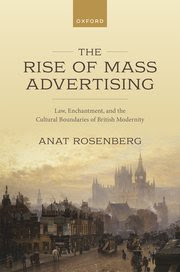
Rosenberg's "Rise of Mass Advertising"

Anat Rosenberg’s The Rise of Mass Advertising: Law, Enchantment, and the Cultural Boundaries of British Modernity has been published by Oxford University Press. From the website:

The Rise of Mass Advertising is a first cultural legal history of advertising in Britain, tracing the rise of mass advertising c.1840-1914 and its legal shaping. The emergence of this new system disrupted the perceived foundations of modernity. The idea that culture was organized by identifiable fields of knowledge, experience, and authority came under strain as advertisers claimed to share values with the era's most prominent fields, including news, art, science, and religiously inflected morality. While cultural boundaries grew blurry, the assumption that the world was becoming progressively disenchanted was undermined, as enchanted experiences multiplied with the transformation of everyday environments by advertising. Magical thinking, a dwelling in mysteries, searches for transfiguration, affective connection between humans and things, and powerful fantasy disrupted assumptions that the capitalist economy was a victory of reason.

The Rise of Mass Advertising examines how contemporaries came to terms with the disruptive impact by mobilizing legal processes, powers, and concepts. Law was implicated in performing boundary work that preserved the modern sense of field distinctions. Advertising's cultural meanings and its organization were shaped dialectically vis-à-vis other fields in a process that mainstreamed and legitimized it with legal means, but also construed it as an inferior simulation of the values of a progressive modernity, exhibiting epistemological shortfalls and aesthetic compromises that marked it apart from adjacent fields. The dual treatment meanwhile disavowed the central role of enchantment, in what amounted to a normative enterprise of disenchantment. One of the ironies of this enterprise was that it ultimately drove professional advertisers to embrace enchantment as their peculiar expertise.

The analysis draws on an extensive archive that bridges disciplinary divides. It offers a novel methodological approach to the study of advertising, which brings together the history of capitalism, the history of knowledge, and the history of modern disenchantment, and yields a new account of advertising's significance for modernity.

Review copies can be obtained by filling out this form or emailing reviews.global@oup.com This code: AAFLYG6 provides a 30% discount on the OUP website.

Tuesday, October 26, 2021

Colley in Washington History Seminar

The Washington History Seminar will convene virtually on Monday, November 1 at 4:00 pm ET for Linda Colley, Princeton University, to discuss “the aims and methods involved in her recent book The Gun, the Ship, and the Pen: Warfare, Constitutions and the Making of the Modern World (2021), and comment[] in retrospect on some of its arguments about the connections after 1750 between patterns of conflict, the exponential spread of written constitutions across continents, and the progress (and limits) of rights.”  Daniel Hulsebosch, New York University, and Dane Kennedy, George Washington University, will comment.  Register here.

--Dan Ernst

Tuesday, August 31, 2021

British Legal History Conference: Deadline Extended

[We are moving this post up, as we have just learned that the deadline for submissions has been extended to September 27, 2021.  DRE]

Law and Constitutional Change: The 25th British Legal History Conference 2022, in association with the Irish Legal History Society.  Queen's University, Belfast.  6-9 July 2022

Abstracts are invited for the 25th British Legal History Conference which is being run jointly with the Irish Legal History Society and hosted by Queen's University Belfast, on Wednesday 6 July - Saturday 9 July 2022.  

The conference was originally scheduled for 2021. Queen's, Belfast, was given the honour of hosting the BLHC in 2021, because it is a significant year in the "Decade of Centenaries"  in Ireland, north and south, marking both the centenary of the opening in June 1921 of the Parliament of Northern Ireland, established under the Government of Ireland Act 1920, and the centenary of the signing of articles of agreement for the Anglo-Irish Treaty in December 1921, leading to the establishment of the Irish Free State.   The conference theme, "Law and Constitutional Change", was chosen against this background.  The Covid-19 pandemic intervened, making postponement unavoidable.  

Organising the conference in 2022 will, however, allow us to celebrate the half-centenary of the British Legal History Conference, first held in Aberystwyth in 1972.  Our hope is that attendance at the conference can be in person, but this will be kept under review and, if necessary, the option of online attendance/participation will be considered.

Conference papers can examine from any historical perspective the relationship between law and constitutional change. The difficulty of defining constitutional change was noted by the Select Committee on the Constitution in their report, The Process of Constitutional Change (HL Paper 177, 2011, para. 10), but they identified several examples, without being exhaustive: parliamentary sovereignty; the rule of law and the rights and liberties of the individual; the union state; representative government; and state membership of international organisations, such as (then) the EU and the Commonwealth.  These are, of course, only examples and the conference theme will be interpreted in all its breadth.

In the context of present-day analysis of the political and constitutional upheavals in British-Irish relations in the early 1920s, the President of Ireland, Michael D. Higgins, has adopted the Irish word, Machnamh, meaning reflection, contemplation, meditation and thought, for a series of online reflections.  In the spirit of Machnamh, we invite you to join the conversation on law and constitutional change in Queen's, Belfast, in July 2022.

Please note the following rules:

  • If you submitted an abstract in 2020, you must make a fresh submission.
  • Abstracts must be for individual papers only, not for panels. Co-authored papers are acceptable.
  • Only one abstract should be submitted per person.
  • Abstracts must be submitted as Microsoft Word documents using the online portal on the Call for Papers page of the conference website.  Please do not submit by email.
  • Abstracts must not exceed 500 words.

Please indicate if your proposal is contingent on the availability of an option of online participation.  The deadline for submission of abstracts is [September 27, 2021].  Queries can be emailed to BLHC-2022-info@qub.ac.uk  At the conference, individual oral presentations will last 15-20 minutes.

We hope to publish the programme on the conference website in October 2021.  Details of plenary speakers will also appear there in due course. Proposals from postgraduate and early career researchers are welcome. Further information about travel to Belfast, accommodation, and so on, will be added to the conference website during 2021-2022.

Poster competition. This, the second joint BLHC - ILHS conference, was proposed by Sir Anthony Hart, retired High Court judge, former president of ILHS and enthusiastic supporter of BLHCs, who died suddenly in July 2019.  A poster competition is planned during the 2022 conference as a tribute to Tony.  There will be two prizes, including one for the PGR/early career category. The prizes are generously funded by the Journal of Legal History and by the Irish Legal History Society.  Details of the competition will be posted on the conference website.

Wednesday, July 1, 2020

BLHC Postponed to 2022

[We have, via the Irish Legal History Society and LPK, the following announcement of the postponement of the British Legal History Conference (BHLC) 2021.  DRE]

As a result of continuing uncertainty caused by the coronavirus pandemic, in particular in relation to international travel, the organisers of the British Legal History Conference 2021 have decided to postpone the conference to 6-9 July 2022.  This decision has been taken in consultation with the BLHC Continuation Committee.

The theme for BLHC 2022 is unchanged: Law and Constitutional Change and, as originally planned, the conference will be organised in association with the Irish Legal History Society.

A fresh call for papers will be made on 15 March 2021.  Registration will open in February 2022.  The conference website will shortly be updated.

To preserve the usual biennial pattern of BLHCs, arrangements will be made by the BLHC Continuation Committee for the conference following the Queen’s, Belfast event to be held in 2024.

Friday, May 8, 2020

Kelly and Burrell on British Patent Law

Catherine Kelly, University of Bristol, and Robert Burrell, University of Melbourne Law School, have posted two relatively recent articles from their backlist.  One is Myths of the Medical Methods Exclusion: Medicine and Patents in Nineteenth Century Britain, published in Legal Studies 38 (2018): 607-626:
This paper explores the interaction of British medical practitioners with the nascent intellectual property system in the nineteenth century. It challenges the generally accepted view that throughout the nineteenth century there was a settled or professionally agreed hostility to patenting. It demonstrates that medical practitioners made more substantial use of the patent system and related forms of protection than has previously been recognised. Nevertheless, the rate of patenting remained lower than in other fields of technical endeavour, but this can largely be explained by the public nature of medical practice during this period. This paper therefore seeks to retell the history of the exclusion of medical methods from patent protection, an exclusion whose history has produced a substantial body of scholarship. However, its aims go beyond this in that it also seeks to illuminate how medical practitioners engaged with the broader political and policy landscape in order to secure financial remuneration for their inventions. Through an exploration of how prominent doctors interacted with Parliament around claims for a financial reward, it demonstrates that doctors sought to use reputational advantage to leverage financial success and the important role that Parliament could play in that process. 
The other is Parliamentary Rewards and the Evolution of the Patent System, which appeared in the Cambridge Law Journal 74(1915): 423-449:
This article examines the impact on the patent system of rewards for innovation across the eighteenth and early nineteenth centuries. During this period Parliament would regularly grant rewards to inventors, with many of these rewards being set out in legislation. This legislation provided Parliament with the opportunity to promote a model of state support for inventors; a model that made public disclosure of the invention a precondition for assistance from the State. This had important implications for patent law, in particular, in helping to develop the role of the patent specification and the doctrine of sufficiency of disclosure. In this way the reward system helped establish the framework under which the State would provide support for inventors. Simultaneously, however, the reward system created a space in which inventors would have to do more than meet the minimum requirement of public disclosure. Rewards allowed the State to distinguish between different classes of inventor and to make special provision for particularly worthy individuals. In this way the reward system recognised the contribution of the ‘heroic inventor’, whilst leaving the core of the patent system undisturbed.
--Dan Ernst

Monday, September 30, 2019

Thank you, Caroline Shaw!

We are very happy to have had Professor Caroline Shaw (Bates College) join us as guest blogger in September 2019. Here's a round-up of her posts: 


Thank you for sharing your insights on everything from 19th-c. newspapers to student writing strategies, Prof. Shaw! 

--Mitra Sharafi