This paper is a rough draft of two chapters in a book-in-progress. It explores the advocacy, institution-building and constitutional imaginary of a handful of socialist lawyers, as they helped build the International Ladies Garment Workers Union in early twentieth century New York. These lawyer-leaders along with union chiefs, thousands of rank and file leaders and activists, and hundreds of thousands of new immigrant workers waged massive general strikes and forged industry-wide agreements and collective bargaining, while they also clashed over just how democratic and pluralist their socialist union would be.--Dan Ernst
These struggles were a site of constant legal invention. They drew new immigrant workers into a deeply contentious experiment in reconstructing labor-capital relations on the basis of group rights with no footing in the official legal order: to organize, strike, and bargain on an industry-wide basis, to be dealt with by employers not as individual workers but as one big corporate body. The official order did more than refuse to recognize these rights; it condemned workers’ efforts to exercise them. Yet, despite the courts’ best efforts, this dramatic experiment largely succeeded; and the union membership ending up rallying behind the lawyer-leaders and activists committed to a deeply democratic, federated, socialist and multi-cultural vision of “group rights” and union organization.
In the process, they forged a new rights consciousness - a consciousness of both peoplehood and class, mixing ethno-racial and class based conceptions of group rights. Not simply a brand of rights talk, it was a social and constitutional imaginary. Such an imaginary dwells at the intersection of ideas and social action. It is an assembly of analytic, normative and narrative pieces, along with what Raymond Williams calls “structures of feeling.” An imaginary gains traction in virtue of its capacity to express ideas, aspirations and normative principles about social structures and social relations, at the same time as it explains and helps reproduce – or, in the case of a counter-hegemonic imaginary like this one, helps efforts to remake – those structures and relations. The Jewish socialist constitutional imaginary whose adventures the paper follows did all three: expressed, explained and helped remake.
Jewish Workers in N.Y. Needle Trades (NYPL)
In addition to testing out the notion of a constitutional imaginary, this paper about the past has a present political point. Today, corporate and group rights are found mostly in the normative and conceptual toolkits of various kinds of conservative thinkers. Liberals and progressives see them as fraught with dangers for individual freedom. If liberal democracy is imperiled, the response should be shoring up the individual civil rights and civil liberties of post-New Deal liberalism, enshrined by the Warren and Burger Courts.
A century ago, things looked different. When left-leaning liberals, “advanced Progressives” and socialists imagined what might come next, after the overthrow of constitutional laissez-faire, it was not only Jews like the ones in this paper but many others who hoped that group rights would be part of the new constitutional firmament. Like left-leaning legal, political and social thinkers in many parts of the globe, they thought that modern liberalism could not make good on its promises of individual freedom and equality unless it took on board key precepts from its rivals and interlocutors: pluralism and socialism. They saw corporate and group rights as building blocks of a social-democratic and pluralist liberalism – or of a liberal and pluralist socialism. Individual rights alone could not secure a broad distribution of power on behalf of members of subordinate economic and ethno-racial groups. That kind of distributional work also required group rights.
When the dust settled, of course, there were no such group rights in the post-New Deal firmament. There were some individual rights doing certain kinds of functionally similar work. But in the politico-constitutional milieu of the Cold War, even these were pressed into an older liberal legal mold. So, one of the ambitions of this work-in-progress is to acquaint liberal and progressive readers with an alternate brand of American constitutionalism in action, more pluralist and socialist than the one we got.
During the Cold War, the socialist pluralist outlook of the lawyer-leaders in this story was repressed and forgotten. It had features worth remembering. It refused to choose between ethno-racial particularity and class universalism. It fashioned institutions, forms of advocacy and a legal and constitutional discourse that took up the competing claims of socialism, pluralism and liberalism, and individual and group rights, mediating the inescapable tensions among them and subjecting them all to stubbornly democratic principles. It rejected the notion of putting off the empowerment of ordinary workers for the indefinite socialist future, instead striving to implement it in the capitalist present, with the legal and institutional tools at hand. Its practitioners explained their ethics and style of advocacy in terms of the moral and political logic of a social movement that strives to prefigure the kind of world it hopes to create. It also rejected prevailing romantic, racialist conceptions of ethno-racial group identities, in favor of a pragmatic, open-ended view that emphasized democratic agency, change and self-invention. As we revisit the socialist tradition, this chapter in socialist history and legal history offers food for thought.
Showing posts with label Socialism. Show all posts
Monday, November 25, 2019
Forbath on Radical Lawyering and Constitutional Imagination on the Lower East Side
William E. Forbath, University of Texas at Austin School of Law, has posted Class Struggle, Group Rights and Socialist Pluralism on the Lower East Side–Radical Lawyering and Constitutional Imagination in the Early Twentieth Century:
Friday, October 18, 2019
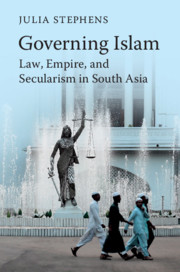
Stephens' Governing Islam
In 2018, Julia Stephens (Rutgers University) published Governing Islam: Law, Empire, and Secularism in Modern South Asia with Cambridge University Press. From the publisher:
Further information about the book is available here.
--posted by Mitra Sharafi
Praise for the book:Governing Islam traces the colonial roots of contemporary struggles between
Islam and secularism in India, Pakistan, and Bangladesh. The book uncovers the paradoxical workings of colonial laws that promised to separate secular and religious spheres, but instead fostered their vexed entanglement. It shows how religious laws governing families became embroiled with secular laws governing markets, and how calls to protect religious liberties clashed with freedom of the press. By following these interactions, Stephens asks us to reconsider where law is and what it is. Her narrative weaves between state courts, Islamic fatwas on ritual performance, and intimate marital disputes to reveal how deeply law penetrates everyday life. In her hands, law also serves many masters - from British officials to Islamic jurists to aggrieved Muslim wives. The resulting study shows how the neglected field of Muslim law in South Asia is essential to understanding current crises in global secularism.
"This book is nothing less than a landmark in its lucid, subtle, and persuasive arguments about the transformation of Islamic law in its encounter with colonial legal discourses and institutions. Basing herself on an archive of extraordinary breadth, Stephens revises old assumptions about Muslim law and about the consequences of colonial governance at every turn. This analysis of the past illuminates a present in urgent need of fresh understanding." -Barbara D. Metcalf
"Governing Islam is a masterful and compelling book that explores modern South Asia's Muslim legal history through ideas about religion, economy, gender, custom, colonialism, and socialism. Using primary sources in multiple languages, Julia Stephens reveals the many layers of law for Muslims. The result is simply superb - a fascinating portrait of vernacular, colonial, and post-colonial legal cultures, all intertwined and with plenty of intriguing twists." -Mitra SharafiWatch Prof. Stephens' 2015 interview on the book project on Yale's The MacMillan Report.
"A major work of scholarship that brings together the history of law, religion and family in British India to tell the story of South Asian secularism. Erudite and sophisticated in tone this is a much-needed monograph at a time when the idea of secular India faces its gravest threat." -Seema Alavi
Further information about the book is available here.
--posted by Mitra Sharafi
Thursday, February 14, 2019
Socialist Interpretations of Legal History in Soviet-Occupied Eastern Europe
[We have word of the following workshop.] EuroStorie and Institut für Neuere Privatrechtsgeschichte, Deutsche und Rheinische Rechtsgeschichte are co-organizing "Socialist interpretations of legal history" workshop at the University of Cologne in March (22.-23.3.).
Socialist interpretations of legal history. The histories and historians of law and justice in the GDR, Poland and the Baltic states under the reign of communism
The aim of the workshop at hand is to concentrate on the interaction between historians and communist regimes, but rather than investigating the control exercised by the communist states, we focus on the position of legal historians and their representations of history. How did the historians see the recent past, and how did that affect their vision on the future? What elements remained from the era preceding communism, and with what means did the scholars find leeway between strict ideological preconditions and their scholarly identity?
After the Second World War, the Soviet occupied Eastern part of Germany, Poland and Baltic States all experienced – in a varying thoroughness – a drastic reorganization of higher education, which was purported to root socialist worldview to their respective academia. Consequently, in the following years also legal scholars advertised the anti-fascist, peaceable and democratizing characteristics of socialist law as an antidote to all what the western legal system supposedly encouraged and embodied. At the same time western continental legal science concentrated on the long lines of legal history, constructing its view as an exact opposite to what started to take shape as the socialist legal science.
Rather than treating legal history and jurisprudence as mere political tools of the communist regimes, our workshop at hand focuses on the history of the scholarly representations of legal history and jurisprudence. We presume that writing the history of a community or a legal system left free space for scholars to express themselves as scientists, citizens and temporal subjects, even in communist regimes. Furthermore, we argue that this space for personal interpretation becomes evident in the works of the legal historians and legal scientists.
The workshop is being arranged in a cooperation by the Centre of Excellence 'Law, Identity and the European Narratives' at the University of Helsinki and The Institut für neuere Privatrechtsgeschichte, University of Cologne. The workshop attempts to bring together scholars and approaches from variety of disciplines and fields of study. Our confirmed key-note speakers are Michal Kopecek (Jena/Prague), Marianna Muravyeva (Helsinki) and Lauri Mälksoo (Tartu). In order to analyze the ‘socialist interpretations of legal history’ in different times and regions across the Eastern Central Europe and former USSR, our workshop concentrates on (but is not restricted to) the following characteristics of socialist legal science and historiography.
Socialist interpretations of legal history. The histories and historians of law and justice in the GDR, Poland and the Baltic states under the reign of communism
The aim of the workshop at hand is to concentrate on the interaction between historians and communist regimes, but rather than investigating the control exercised by the communist states, we focus on the position of legal historians and their representations of history. How did the historians see the recent past, and how did that affect their vision on the future? What elements remained from the era preceding communism, and with what means did the scholars find leeway between strict ideological preconditions and their scholarly identity?
After the Second World War, the Soviet occupied Eastern part of Germany, Poland and Baltic States all experienced – in a varying thoroughness – a drastic reorganization of higher education, which was purported to root socialist worldview to their respective academia. Consequently, in the following years also legal scholars advertised the anti-fascist, peaceable and democratizing characteristics of socialist law as an antidote to all what the western legal system supposedly encouraged and embodied. At the same time western continental legal science concentrated on the long lines of legal history, constructing its view as an exact opposite to what started to take shape as the socialist legal science.
Rather than treating legal history and jurisprudence as mere political tools of the communist regimes, our workshop at hand focuses on the history of the scholarly representations of legal history and jurisprudence. We presume that writing the history of a community or a legal system left free space for scholars to express themselves as scientists, citizens and temporal subjects, even in communist regimes. Furthermore, we argue that this space for personal interpretation becomes evident in the works of the legal historians and legal scientists.
The workshop is being arranged in a cooperation by the Centre of Excellence 'Law, Identity and the European Narratives' at the University of Helsinki and The Institut für neuere Privatrechtsgeschichte, University of Cologne. The workshop attempts to bring together scholars and approaches from variety of disciplines and fields of study. Our confirmed key-note speakers are Michal Kopecek (Jena/Prague), Marianna Muravyeva (Helsinki) and Lauri Mälksoo (Tartu). In order to analyze the ‘socialist interpretations of legal history’ in different times and regions across the Eastern Central Europe and former USSR, our workshop concentrates on (but is not restricted to) the following characteristics of socialist legal science and historiography.
Friday, December 22, 2017
Hasegawa on Crime & Punishment in the Russian Revolution
Tsuyoshi Hasegawa, UC Santa Barbara,
has published Crime and Punishment in the Russian Revolution: Mob Justice and Police in Petrograd with Harvard University Press. From
the publisher:
Praise for the book:Russians from all walks of life poured into the streets of the imperial capital after the February Revolution of 1917, joyously celebrating the end of Tsar Nicholas II’s monarchy. One year later, with Lenin’s Bolsheviks now in power, Petrograd’s deserted streets presented a very different scene. No celebrations marked the Revolution’s anniversary. Amid widespread civil strife and lawlessness, a fearful citizenry stayed out of sight.
In Crime and Punishment in the Russian Revolution, Tsuyoshi Hasegawa offers a new perspective on Russia’s revolutionary year through the lens of violent crime and its devastating effect on ordinary people. When the Provisional Government assumed power after Nicholas II’s abdication, it set about instituting liberal reforms, including eliminating the tsar’s regular police. But dissolving this much-hated yet efficient police force and replacing it with a new municipal police led rapidly to the breakdown of order and services. Amid the chaos, crime flourished. Gangs of criminals, deserters, and hooligans brazenly roamed the streets. Mass prison escapes became common. And vigilantism spread widely as ordinary citizens felt compelled to take the law into their own hands, often meting out mob justice on suspected wrongdoers.The Bolsheviks swept into power in the October Revolution but had no practical plans to reestablish order. As crime continued to escalate and violent alcohol riots almost drowned the revolutionary regime, they redefined it as “counterrevolutionary activity,” to be dealt with by the secret police, whose harshly repressive, extralegal means of enforcement helped pave the way for a Communist dictatorship.
“Hasegawa is one of our leading historians of the February Revolution… [He] makes a strong case that the catastrophic social breakdown, most especially the violent crime that pervaded life in Petrograd after the collapse of the monarchy, ‘served as a stepping-stone toward the creation of the pervasive instrument of terror that became an integral part of the Communist dictatorship.’” -Joshua Rubenstein
“This book makes a fundamental
contribution to our understanding of the Russian Revolution by revealing the
violent, chaotic lived experience of the revolution in the capital city. In a
narrative full of colorful characters and stories, Hasegawa gives us a
street-level view of the collapse of state authority that cleared the way for
the Bolshevik seizure of power.” -Eric Lohr
“Hasegawa addresses the very
important, largely ignored thus far, role of crime and the breakdown of social
order and public safety. In doing so he changes the way we think and write
about the Russian Revolution, making this one of the more original things I
have seen in a very long time.” -Rex Wade
Further information is available here.
Labels:
Communism,
Crime and Criminal Law,
Marxism,
revolution,
Russia,
Socialism
Subscribe to:
Posts (Atom)