Showing posts with label colonialism and postcolonialism. Show all posts

Wednesday, February 5, 2020

Khosla on the Indian Constitution

Coming out this month by Madhav Khosla (Ashoka University) is India's Founding Moment: The Constitution of a Most Surprising Democracy with Harvard University Press. From the publisher:
Cover: India’s Founding Moment in HARDCOVER
Britain’s justification for colonial rule in India stressed the impossibility of Indian self-government. And the empire did its best to ensure this was the case, impoverishing Indian subjects and doing little to improve their socioeconomic reality. So when independence came, the cultivation of democratic citizenship was a foremost challenge.
Madhav Khosla explores the means India’s founders used to foster a democratic ethos. They knew the people would need to learn ways of citizenship, but the path to education did not lie in rule by a superior class of men, as the British insisted. Rather, it rested on the creation of a self-sustaining politics. The makers of the Indian Constitution instituted universal suffrage amid poverty, illiteracy, social heterogeneity, and centuries of tradition. They crafted a constitutional system that could respond to the problem of democratization under the most inhospitable conditions. On January 26, 1950, the Indian Constitution—the longest in the world—came into effect.
More than half of the world’s constitutions have been written in the past three decades. Unlike the constitutional revolutions of the late eighteenth century, these contemporary revolutions have occurred in countries characterized by low levels of economic growth and education, where voting populations are deeply divided by race, religion, and ethnicity. And these countries have democratized at once, not gradually. The events and ideas of India’s Founding Moment offer a natural reference point for these nations where democracy and constitutionalism have arrived simultaneously, and they remind us of the promise and challenge of self-rule today.
Advance praise for the book:

“Erudite, analytically dazzling, and with a rare understanding of both India’s and democracy’s challenges, Madhav Khosla’s India’s Founding Moment gives readers unparalleled access to the ideas behind India’s radical experiment in democratic constitution-making. As that noble vision is now under assault from sinister forces that Gandhi, Nehru, and Ambedkar knew well, we all should ponder Khosla’s all-too-timely book and do whatever we can to prevent the demise of India’s constitutional order.”—Martha C. Nussbaum

“This brilliant and challenging book shows how political choices—what to put in a constitution, the locus of effective power, and the forms of representation—can create citizens who can and must govern themselves in a modern democracy while facing deep challenges caused by poverty, caste, and illiteracy. It is at once a contribution to Indian constitutional history, constitutional theory, and political theory, and is a ‘must read’ for everyone in those fields.”—Mark Tushnet

“This is a sensitive analysis of the moral imagination behind the Indian Constitution, a document intended to free the democratic process from sectarian identities and to strengthen centralized state power. As Indian democracy struggles to stay on the rails, Khosla’s book is a timely reminder of what it was meant to be.”—Partha Chatterjee

Further information is available here.

--Mitra Sharafi 

Monday, February 3, 2020

Coffey on secession and the British Commonwealth

We missed this one in 2018: Donal K. Coffey (Max Planck Institute for European Legal History) published " 'The Right to Shoot Himself': Secession in the British Commonwealth of Nations," The Journal of Imperial and Commonwealth History 39:2 (2018), 117-39. Here is the abstract:
The ultimate test of whether an association is voluntary or not is if you can leave it. It is difficult, at this remove, to appreciate how live an issue secession from the British commonwealth of nations was in the 1920s and 1930s. It occupied an inordinate amount of time and negotiation for a doctrine that had been ostensibly conceded in 1920. Yet, much as with the case of the appeal to the judicial committee of the privy council, once the dominions sought to take advantage of the freedom which had been guaranteed by official statements, they found a formidable amount of diplomatic pressure and legal opinion brought to bear to indicate that no such right could be officially declared. This article traces the evolution of the arguments about the right to secede in the 1930s, and examines how the right came eventually to be exercised in the case of the new commonwealth countries in the 1940s. It concludes by examining how the doctrine of secession as developed in the 1930s was abandoned in order to retain Indian membership in the commonwealth.
Further information is available here.

--Mitra Sharafi

Friday, December 13, 2019

Bhatia on the Indian Constitution

Gautam Bhatia (practicing lawyer and independent scholar) has published The Transformative Constitution: A Radical Biography in Nine Acts with HarperCollins India. From the press:
We think of the Indian Constitution as a founding document, embodying a moment of profound transformation from being ruled to becoming a nation of free and equal citizenship. Yet the working of the Constitution over the last seven decades has often failed to fulfil that transformative promise. Not only have successive Parliaments failed to repeal colonial-era laws that are inconsistent with the principles of the Constitution, but constitutional challenges to these laws have also failed before the courts. Indeed, in numerous cases, the Supreme Court has used colonial-era laws to cut down or weaken the fundamental rights. The Transformative Constitution by Gautam Bhatia draws on pre-Independence legal and political history to argue that the Constitution was intended to transform not merely the political status of Indians from subjects to citizens, but also the social relationships on which legal and political structures rested. He advances a novel vision of the Constitution, and of constitutional interpretation, which is faithful to its text, structure and history, and above all to its overarching commitment to political and social transformation.
The book has been shortlisted for the Tata Literature Live Non-Fiction Book of the Year 2019. Further information is available here.

--Mitra Sharafi

Friday, October 18, 2019

Stephens' Governing Islam

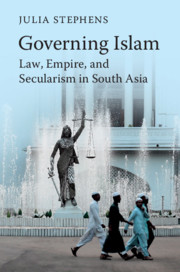
In 2018, Julia Stephens (Rutgers University) published Governing Islam: Law, Empire, and Secularism in Modern South Asia with Cambridge University Press. From the publisher: 
Governing IslamGoverning Islam traces the colonial roots of contemporary struggles between 
Islam and secularism in India, Pakistan, and Bangladesh. The book uncovers the paradoxical workings of colonial laws that promised to separate secular and religious spheres, but instead fostered their vexed entanglement. It shows how religious laws governing families became embroiled with secular laws governing markets, and how calls to protect religious liberties clashed with freedom of the press. By following these interactions, Stephens asks us to reconsider where law is and what it is. Her narrative weaves between state courts, Islamic fatwas on ritual performance, and intimate marital disputes to reveal how deeply law penetrates everyday life. In her hands, law also serves many masters - from British officials to Islamic jurists to aggrieved Muslim wives. The resulting study shows how the neglected field of Muslim law in South Asia is essential to understanding current crises in global secularism.
Praise for the book:
 "This book is nothing less than a landmark in its lucid, subtle, and persuasive arguments about the transformation of Islamic law in its encounter with colonial legal discourses and institutions. Basing herself on an archive of extraordinary breadth, Stephens revises old assumptions about Muslim law and about the consequences of colonial governance at every turn. This analysis of the past illuminates a present in urgent need of fresh understanding." -Barbara D. Metcalf
"Governing Islam is a masterful and compelling book that explores modern South Asia's Muslim legal history through ideas about religion, economy, gender, custom, colonialism, and socialism. Using primary sources in multiple languages, Julia Stephens reveals the many layers of law for Muslims. The result is simply superb - a fascinating portrait of vernacular, colonial, and post-colonial legal cultures, all intertwined and with plenty of intriguing twists." -Mitra Sharafi 

"A major work of scholarship that brings together the history of law, religion and family in British India to tell the story of South Asian secularism. Erudite and sophisticated in tone this is a much-needed monograph at a time when the idea of secular India faces its gravest threat." -Seema Alavi
Watch Prof. Stephens' 2015 interview on the book project on Yale's The MacMillan Report. 

Further information about the book is available here.

--posted by Mitra Sharafi

Friday, June 14, 2019

Blackhawk on "Federal Indian Law as a Paradigm Within Public Law"

As I read Katie Eyer's piece on JOTWELL yesterday -- an admiring review of a recent article by Maggie Blackhawk (Penn Law) -- I was reminded that we had not yet flagged this article for our readers. There is lots of legal history here! Here's the abstract for "Federal Indian Law as a Paradigm Within Public Law," published this spring in the Harvard Law Review.
U.S. public law has long taken slavery and Jim Crow segregation as a paradigm case through which to understand our constitutional law: cases adjudicating issues of slavery and segregation form the keystones of our constitutional canon. Reconstruction, or the so-called “Second Founding,” and the Civil Rights Era periodize our constitutional histories. Slavery and Jim Crow segregation supply normative lessons about the strengths and failings of our constitutional framework. This paradigm teaches that if there is too much power in the states and not enough limitation on state power in the form of national power or rights, America might again reenact similar atrocities. Although there is much to learn from the United States’ tragic history with slavery and Jim Crow segregation, resting our public law on this binary paradigm has led to incomplete models and theories. This Nation’s tragic history of colonialism and violent dispossession of Native lands, resources, culture, and even children offers different, yet equally important, lessons about our constitutional framework.

In this Article, I argue for a more inclusive paradigm that reaches beyond the black/white binary, and I highlight the centrality of federal Indian law and this Nation’s tragic history with colonialism to public law. Currently, to the extent that federal Indian law is discussed at all within public law, it is generally considered sui generis and consigned to a “tiny backwater.” While I concede that the colonial status of Native peoples and the recognition of inherent tribal sovereignty do render aspects of federal Indian law exceptional, federal Indian law and Native history have much to teach about reimagining the constitutional history of the United States. Interactions between the national government and Native Nations have shaped the warp and woof of our constitutional law from the Founding across a range of substantive areas, including vertical and horizontal separation of powers, the Treaty Clause, war powers, executive powers in times of exigency, and many others. I aim to open a conversation as to whether these doctrines ought to take their rightful place in the canon or, perhaps, the anticanon.

Beyond simple canonization, federal Indian law offers paradigmatic lessons about the strengths and failings of our constitutional framework. Broadening the binary paradigm to include federal Indian law could allow interventions into a range of general principles of public law. It has often been said that federal Indian law is “incoherent” and in need of reform, because the doctrine does not comport with general public law principles. But perhaps it is the general principles of public law, and the incomplete paradigm of slavery and Jim Crow segregation on which those principles rest, that are in need of reform.

More than simple canonization, the inclusion of federal Indian law as an additional paradigm case could lead to fundamental reformulation. A full catalogue is beyond the scope of this Article, but I offer an example here in the hope that it will invite more. As I’ll show, federal Indian law leads public law to a very different set of principles in the context of minority protection, unsettling reigning theories of how best to distribute and limit power in order to prevent government abuse of minorities. Unlike slavery and Jim Crow segregation, federal Indian law teaches that nationalism is no panacea for majority tyranny, and that rights can wound as well as shield minorities.
Here's a taste of Professor Eyer's review:
Federal Indian law might seem an unlikely paradigm around which to center our understanding of constitutional law. But as Maggie Blackhawk lays out in her excellent new article, Federal Indian Law as Paradigm Within Public Law, the history of Native Nations and indigenous peoples in the United States, and their treatment as constitutional subjects, is equally central to our constitutional history as slavery and Jim Crow. And yet it is far less common for Native history to play a role in our canonical stories and in our understandings of what constitutional law does, or ought to, provide.

Read on here.

-- Karen Tani

Wednesday, June 5, 2019

The Limits of Law: Cases

We asked the 2018-19 Davis Fellows the following question: how has your time at the Davis Center led to new insights about the reach and limits of law and legalities? Here is one set of answers that relate to each scholar's area of study (our other posts in this series are here and here):


Wednesday, February 13, 2019

Newman, "A Dark Inheritance: Blood, Race, and Sex in Colonial Jamaica"

Recently out from Yale University Press: A Dark Inheritance: Blood, Race, and Sex in Colonial Jamaica (2018), by Brooke N. Newman (Virginia Commonwealth University). A description from the Press:
Credit: Virginia Commonwealth University
Focusing on Jamaica, Britain’s most valuable colony in the Americas by the mid-eighteenth century, this book explores the relationship between racial classifications and the inherited rights and privileges associated with British subject status. Brooke Newman reveals the centrality of notions of blood and blood mixture to evolving racial definitions and sexual practices in colonial Jamaica and to legal and political debates over slavery and the rights of imperial subjects on both sides of the Atlantic. 
Weaving together a diverse range of sources, Newman shows how colonial racial ideologies rooted in fictions of blood ancestry at once justified permanent, hereditary slavery for Africans and barred members of certain marginalized groups from laying claim to British liberties on the basis of hereditary status. This groundbreaking study demonstrates that challenges to an Atlantic slave system underpinned by distinctions of blood had far-reaching consequences for British understandings of race, gender, and national belonging.
A few blurbs:
“In this richly researched and cogently argued book, Brooke Newman reveals how ideas about blood and law and the making of a slave society in colonial Jamaica helped to construct as well as deconstruct racial difference in the imperial order. Few historians have done a better job of analyzing the intersections of gender, sexuality, and race in the print culture of the British Empire. A must read for any historian of slavery and abolition.”—Manisha Sinha

“Brooke Newman's fascinating account of colonial Jamaican racial politics reveals the British investment in concepts of inherited blood, birthright, and Christianity as the legal foundation for English privilege and enslaved African subordination.”—Kathleen M. Brown
More information is available here. And you can find a nice Q&A with Professor Newman about the book here.

Monday, January 14, 2019

Thornberry on Rape in South Africa

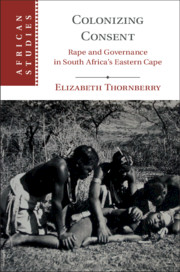
Out this month with Cambridge University Press is Colonizing Consent: Rape and Governance in South Africa's Eastern Cape by Elizabeth Thornberry, Johns Hopkins University. From the publisher: 
Colonizing ConsentElizabeth Thornberry uses historical evidence to shed light on South Africa's contemporary epidemic of sexual violence. Drawing on over a thousand cases from a diverse set of courts, Thornberry reconstructs the history of rape in South Africa's Eastern Cape, from the precolonial era to the triumph of legal and sexual segregation, and digs deep into questions of conceptions of sexual consent. Through this process, Thornberry also demonstrates the political stakes of disputes over sexual consent, and the ways in which debates over the regulation of sexuality shaped both white and black politics in this period. From customary authority to missionary Christianity and humanitarian liberalism to segregationism, political claims implied theories of sexual consent, and enabled distinctive claims to control female sexuality. The political history of rape illuminates not only South Africa's contemporary crisis of sexual violence, but the entangled histories of law, sexuality, and politics across the globe.
Here is the Table of Contents:

  • Introduction: writing the history of rape
  • 1. Custom and consent in Xhosaland
  • 2. Sex and spiritual power
  • 3. Liberalism and the colonial law of sexual violence
  • 4. Rape and racial boundaries
  • 5. Navigating the politics of consent
  • Conclusion: rape and the postcolony.
Further information is available here.

Friday, January 11, 2019

Motha on sovereignty and violence

Stewart Motha (Birkbeck College, University of London) published Archiving Sovereignty: Law, History, Violence with the University of Michigan Press in 2018. From the publisher:

Book cover for 'Archiving Sovereignty'Archiving Sovereignty shows how courts use fiction in their treatment of sovereign violence. Law’s complicity with imperial and neocolonial practices occurs when courts inscribe and repeat the fabulous tales that provide an alibi for archaic sovereign acts that persist in the present. The United Kingdom’s depopulation of islands in the Indian Ocean to serve the United States’ neoimperial interests, Australia’s exile and abandonment of refugees on remote islands, the failure to acknowledge genocidal acts or colonial dispossession, and the memorial work of the South African Constitution after apartheid are all sustained by historical fictions. This history-work of law constitutes an archive where sovereign violence is mediated, dissimulated, and sustained. Stewart Motha extends the concept of the “archive,” as site of origin and source of authority, to signifying what law does in preserving and disavowing the past at the same time. 
Sovereignty is often cast as a limit-concept, constituent force, determining the boundary of law. Archiving Sovereignty reverses this to explain how judicial pronouncements inscribe and sustain extravagant claims to exceptionality and sovereign solitude. This wide-ranging, critical work distinguishes between myths that sustain neocolonial orders and fictions that generate new forms of political and ethical life.
 Praise for the book:

“Set in and around the Indian Ocean, Archiving Sovereignty is a thoughtful meditation on how the law traffics in fictions—the ‘as if’—as it adjudicates state sovereignty in contexts of colonial and postcolonial violence. Elegantly written, it invites an important consideration of the law’s complex work as historical archivist.” - Avery F. Gordon

“Stewart Motha re-envisions the Indian Ocean as a material site of law, violence, and dispossession that he compellingly terms an ‘archive of the present.’ Drawing comparatively from Australia, South Africa, and the Chagos Archipelago, Motha offers a beautifully crafted analysis of law and sovereignty, how they draw from and disavow their entangled colonial histories.” - Renisa Mawani

“Of the many interwoven themes in Archiving Sovereignty, the driving motif for me is Kant’s ‘as if,’ which responds to the disappearance of metaphysical objectivity. If objects are the only knowable facts, the unknowable is suspended in the ‘as if.’ This is true for a lie (such as acting as if law were grounded in nature or acting as if sovereignty were a power in itself) as well as for a fertile fiction. We must then think of the ‘as if’ in its relation to an absence of first law, and think of sovereignty as the ‘as if’ of a postulation of ‘nothing’ at the centre of existence. Stewart Motha explores this double dimension, its commingling and unravelling, its aporias and suggestions that are of course inexhaustible. This research is at the heart of the concerns and expectations of the present time.” - Jean-Luc Nancy

“Through a series of brilliant readings of contemporary cases of exile and exclusion the source of legality, the archive, is exposed as an unstable archipelago and excoriated as the fictive mark of sovereign solitude.” - Peter Goodrich

Further information is available here.

Monday, January 7, 2019

Special Issue: Law and Legality in Modern India


A special issue on "Law and Legality in Modern Indian History" has come out in Comparative Studies of South Asia, Africa and the Middle East (2018) 38:3. It is edited by Alastair McClure (University of Chicago) and Saumya Saxena (Law Commission of India/University of Cambridge)
Here's the line-up with abstracts:
  • Alastair McClure and Saumya Saxena, "Introduction: Law and Legality in Modern Indian History": This introduction offers a critical survey of existing literature on law in modern India and presents an overview of the four essays in the special section, which illustrates new directions in the field of Indian legal history.
  • Upendra Baxi, " 'Touch It Not, If You Are Not a Historian.' Toward a New Historiography of Colonial Indian Law: Recrafting Clio": This conversation is largely about the ways of doing and writing histories: whether legal/juridical or social histories of law. The difference between the two genres is briefly explored in Baxi’s essay, but obviously more collaborative work is needed. As concerns histories of human rights, it would seem the mainstream and the varying dissident crafts of writing history have largely ignored the micro stories of cruelties in state and civil society. How periodization poses many a challenge to the craft of writing histories of law is explored, as are the interplays in writing history between subjection and resistance in colonial and postcolonial times. The text highlights the need for a new (and ongoing) debate about the viability of subaltern studies of history and history writing.
  • Alastair McClure, "Sovereignty, Law, and the Politics of Forgiveness in Colonial India, 1858-1903": The Queen’s Proclamation in 1858, her first gesture as the sovereign figurehead of India, offered amnesty to large numbers of those involved in the rebellion. From this point, the royal figure would be invoked at jubilee celebrations and royal durbars, offering royal pardon to prisoners. On these occasions, up to 10 percent of prisoners were released. Indicative of the broader refashioning of colonial rule that occurred after the rebellion, this essay examines these rare but spectacular events by positioning the history of pardon within the wider structure of colonial law and sovereignty. It attempts to do this by drawing out a symbiotic relationship tying together the employment and nonemployment of physical violence, placing the sovereign right to punish and kill within the same analytical lens as the ensnaring promise of forgiveness.
  • Leigh Denault, "Little Republics or Petty Republics?: The Panchayat, Imperial Sovereignty, and Discourses of Self-Government in British India, ca. 1870-1917": Alternately seen as a local-level court of arbitration, a union or committee, or village or municipal council, the concept of the South Asian panchayat was a sociopolitical and legal palimpsest. Retaining traces of meaning accrued from multiple incarnations, contestations, and appropriations, it would become a touchstone for early Indian liberals, radicals, and nationalists, as well as for imperialists concerned with the local devolution of sovereignty. Colonial definitions and redefinitions, however, obscure as much as they reveal about the multiple and shifting meanings of the panchayat for colonized subjects. The panchayat has been seen as primarily a product of Orientalist imagining—ultimately adopted, in an act of strategic essentialism, by Indian nationalists at the end of the nineteenth century. But it was never solely a product of the colonial imagination. Rather, colonial experimentation with older discourses on the panchayat in the context of drives for local governance sparked a more substantive set of reassessments that would transform discourses of law, state, and society in colonial and postcolonial India.
  • Saumya Saxena, "Commissions, Committees, and Custodians of Muslim Personal Law in Postindependence India": Shah Bano was sixty-three years old when her husband divorced her in 1978. He refused to pay maintenance to her beyond a period of three months (iddat), claiming his obligation extended no further than three menstrual cycles of his wife’s. While the court decided in favor of granting maintenance to Shah Bano in 1985, Parliament subsequently overturned the judgment through the Muslim Women’s Act, 1986, to create alternate provisions. The case triggered a tremendous wave of protests simultaneously, against unfair provisions of Muslim law and against the state’s interference in matters of religion. This essay documents the prehistory of this iconic case to demonstrate that neither the controversy nor the judgment was novel, as scholarship has repeatedly claimed. Family law had historically been a contentious arena that enabled conversations between the state and religion, courts and Parliament, and diverse social movements and coreligionists, engaging all institutions central to Indian democracy.
Further information is available here.

Wednesday, December 26, 2018

Pappas on Native American dispossession

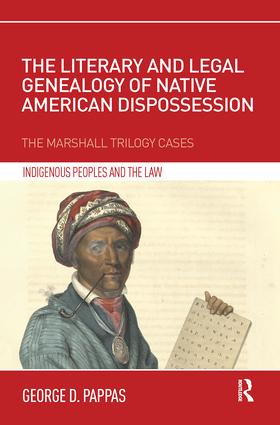
Back in 2016, George D. Pappas (a practicing lawyer in North Carolina) published The Literary and Legal Genealogy of Native American Dispossession: The Marshall Trilogy Cases with Routledge. From the press: 
The Literary and Legal Genealogy of Native American Dispossession: The Marshall Trilogy Cases, 1st Edition (Paperback) book coverThe Literary and Legal Genealogy of Native American Dispossession offers a unique interpretation of how literary and public discourses influenced three U.S. Supreme Court Rulings written by Chief Justice John Marshall with respect to Native Americans. These cases, Johnson v. M’Intosh (1823), Cherokee Nation v. Georgia (1831) and Worcester v. Georgia (1832), collectively known as the Marshall Trilogy, have formed the legal basis for the dispossession of indigenous populations throughout the Commonwealth. The Trilogy cases are usually approached as ‘pure’ legal judgments. This book maintains, however, that it was the literary and public discourses from the early sixteenth through to the early nineteenth centuries that established a discursive tradition which, in part, transformed the American Indians from owners to ‘mere occupants’ of their land. Exploring the literary genesis of Marshall’s judgments, George Pappas draws on the work of Michel Foucault, Edward Said and Homi Bhabha, to analyse how these formative U.S. Supreme Court rulings blurred the distinction between literature and law.
Here is the Table of Contents:

Part I Theoretical Foundations & The Marshall Trilogy Cases 
Chapter 1. Theoretical Foundations 
Chapter 2. The Marshall Trilogy Cases: An Overview 
Chapter 3. Colonial Knowledge: A Unity of Discourses 

Part II Refining the Native American 
Chapter 4 Theory of Discourse in a Colonial Context: Edward Said and the American Eighteenth Century Literary Archive 
Chapter 5 The Discourse of the Vanishing Indian in Literature 
Chapter 6 Fenimore Cooper’s The Last of the Mohicans 
Chapter 7 The Wilderness in American Art and Literature 

Part III Resistance to Colonial Discourse 
Chapter 8. Law and Literature 
Chapter 9. Cherokee Resistance: Mimicry as Deception

Further information is available here.

Friday, December 21, 2018

Slaughter on the New Historiography of Human Rights

Joseph Slaughter, Columbia University, has posted Hijacking Human Rights: Neoliberalism, the New Historiography, and the End of the Third World, which appears in Human Rights Quarterly 40 (November 2018): 735-75:
Recent histories identify the 1970s as the “breakthrough” period when human rights discourse gained traction globally. However, most of the new historiographers adopt an Americo-Eurocentric perspective that disregards events and peoples in the rest of the world. For many in the Global South, the Western rediscovery of human rights looks more like retrenchment and repossession, part of a larger “roll back” of Third World agendas to decolonize the international order. The 1970s also witnessed increased airline hijackings and a reversal in the meaning of “terrorism.” Together, these forces effected a neoliberal hijacking of human rights.