Showing posts with label Indian Ocean. Show all posts

Friday, September 22, 2023

LHR 41:3

Law and History Review 41:3 (August 2023) has been published.  It is a special issue, “Paper Empires: Layers of Law in Colonial South Asia and the Indian Ocean,” with guest editors Nandini Chatterjee, Alicia Schrikker, and Dries Lyna. (Links are provided to the articles published open access.)

Paper Empires: Layers of Law in Colonial South Asia and the Indian Ocean
Nandini Chatterjee, Alicia Schrikker, Dries Lyna

An Empire in Disguise: The Appropriation of Pre-Existing Modes of Governance in Dutch South Asia, 1650–1800
Alicia Schrikker, Byapti Sur

Material Pluralism and Symbolic Violence: Palm Leaf Deeds and Paper Land Grants in Colonial Sri Lanka, 1680–1795
Dries Lyna, Luc Bulten

The Power of Parwanas: Indo-Persian Grants and the Making of Empire in Eighteenth-Century Southern India
Leonard R. Hodges, Nandini Chatterjee
   
Registering and Regulating Family Life: The School Thombos in Dutch Sri Lanka
Bente de Leede, Nadeera Rupesinghe

A New Language of Rule: Alwar's Administrative Experiment, c. 1838–58
Elizabeth M. Thelen

A True Copy? Documents and the Production of Legality in the Bombay Inam Commission
Dominic Vendell

Oceanic Mobility and the Empire of the Pass System
Bhavani Raman

The Sailing Scribes: Circulating Law in the Twentieth-Century Indian Ocean
Fahad Ahmad Bishara

Persistence of Practice in Law's Parwana and Palm Leaf Empire
Paul D. Halliday
   
–Dan Ernst

Friday, November 4, 2022

Yahaya to Lecture on the Capitalisms of the Indian Ocean

Nurfadzilah Yahaya, Yale University, will virtually present Capitalisms of the Indian Ocean, in the Global History of Capitalism Seminar of the Oxford Centre for Global History on Tuesday, November 8, at 15:00.  Click here to link to the talk. 

This paper explores the dark side of powers of attorney used to administer property in Yemen and Southeast Asia. I highlight how the popularity of this legal device in the early twentieth century produced a different kind of belonging beyond official ‘citizenship’ as property-owners based 4000 miles away became important stakeholders in British and Dutch colonies at the opposite end of the Indian Ocean because actions specified in the powers of attorney had no end date based the assumption that conditions such as ownership, sovereign rulers, and legal systems will remain the same over several generations. These documents constructed new temporalities. Building on my first book, I explore the subversive side of this phenomenon to shed light on the full dimension of this common practice which is normally hailed as an empowering tool. I pay attention to how death is the direct impetus for the proliferation of powers of attorney across the Indian Ocean because testators produced powers of attorney close to the end of their lives. Were they drawn up in panic? Many unprepared heirs transferred their power to another person almost immediately upon inheriting property. It took a high level of trust to invest power in others perpetually across the Indian Ocean, and to entrust them to appoint someone who would in turn appoint someone unknown down the line resulting in a chain of faceless agents whose power emanated from one single document produced once upon a time. There was much potential for dysfunction across centuries.

--Dan Ernst


Monday, June 21, 2021

2021 Boucher Prize to Wood

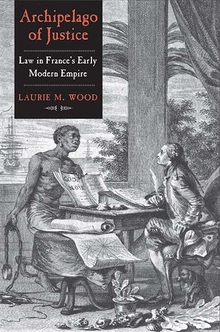
Laurie Wood (Florida State University) has won the 2021 Boucher Prize from the French Colonial Historical Society for her book, Archipelago of Justice: Law in France's Early Modern Empire, published by Yale University Press in 2020. 

Here's the citation: 
Laurie M. Wood’s Archipelago of Justice: Law in France’s Early Modern Empire is the winner of the 2020 Mary Alice and Philip Boucher prize. Archipelago of Justice offers a major contribution to an emerging scholarship seeking to integrate the histories of the Atlantic and Indian Ocean empires in order to better understand how the early modern French empire operated as a whole. Wood achieves this remarkable accomplishment through her focus on the conseils. In the early modern French empire, the conseils—regional law courts—bound a far-flung and diverse imperial system together through a network of institutions, people, and practices. In Archipelago of Justice, Wood focuses our attention across the entire system of these crucial legal institutions (the administrative equivalent of the parlements of metropolitan France), along with the people who staffed them and the subjects who petitioned them, to show how they created power, order, and the very nature of French colonialism. Based on astonishing archival tenacity, the book is beautifully written through powerful case studies and stories that bring to life both the powerful and the marginalized in vivid detail. Its most powerful and creative intervention is surely at the level of framing. Approaching the conseil and its agents as a whole, Wood navigates from the Caribbean to the Indian Ocean, helping us see these frequently separate worlds together, as they were legally bound together in the early modern era through the fascinating history of the conseil.

Professor Wood will be guest blogging at the LHB in the future. In the meantime: many congratulations!

--Mitra Sharafi 

Saturday, September 12, 2020

Moorings

In the eastern end of the Indian Ocean, the hardening of racial boundaries from the second half of the nineteenth century onwards occurred under the aegis of a globalized imperial system. According to Dutch classification, every non-white person in the Netherlands Indies was part of a European empire. The vast majority of Indies population were of course Dutch subjects, but there were people relegated to the category of ‘Foreign Orientals.’ For example, Malays were often labeled ‘Britisch-Maleiers,’ even if in Dutch territory simply because the Malay peninsula, identified as place of origin for all Malays, had fallen under British influence in the closing decades of the nineteenth century. By the early twentieth century, Chinese subjects who originated from Taiwan were recognized as Japanese because the territory was colonised by Japan in 1895. South Asian populations in the Dutch colony on the other hand were alternatingly labelled ‘Britisch-Indiers,’ ‘Klingaleezen’ and ‘Bengaleezen.’ Because Dutch colonial censuses were not diligently undertaken, we do not know the proportion of the South Asian population throughout the colonial period; the only systematic colonial census published in 1930 put the population at 1-3% depending on their location in the vast archipelago. Evidently, urban areas in Padang, Medan and Surabaya had enough South Asians for them to have their own quarters with their own community heads.
    Yet the much older category of ‘mooren’ predated these categories, appearing in both VOC (Dutch East India Company) records and Dutch colonial government records before 1850 especially. Who were these ‘mooren’ exactly? A clue is provided by the fact that the term ‘klingaleezen’ was sometimes substituted for ‘mooren.’ By using the term ‘mooren,’ Dutch authorities linked South Indian Muslims with other Muslims much further away in Spain (who once ruled them) a few centuries before. But this link excluded non-Muslims from Malabar and parts of southern India. The ‘Hindoe-Klingaleezen’ were a “neglected” people the Dutch should pay more attention to, a Dutch newspaper lamented in 1918, which suggest that on its own, the term only referred to Muslims. Also, why did “Bengaleezen,” a label that applied to all Indians from northern India regardless of origin, remain a distinct but undifferentiated category too? Although nearly all references to ‘mooren’ after 1800 refer only to the Indian subcontinent, the term emerged out of Dutch experience in Sri Lanka from 1640 to 1796 referring to Muslims of Tamil descent who were living in Dutch Ceylon who were of mixed ethnicity. “But more likely, if not certain, is that they are descended from the 'Mooren,' or so-called Klingaleezen of the Malabar coast,” the reporter of Sumatra Courant noted in September 1871. They came mainly for trade, another reporter wrote in De Locomotief in 1873. The term, in other words had many layers some of which were shed by the Dutch colonial government who took over from the defunct VOC in 1800. By subsequently connecting the ‘mooren’ classification with the subcontinent only, the Dutch government got round the awkwardness of taking over corporate VOC rule by dint of forgetting their association with Dutch Ceylon by implying that those earlier ‘mooren’ are an artefact of an era that had recently ended. 'Mooren' in Netherlands Indies on the other hand were supposedly from the subcontinent instead. The question remains as to how the klingaleezen identified themselves since their voices are rarely found in the archives but in September 1927, a group classified as klingaleezen wrote to the colonial government requested that they not be referred as such anymore since the term is humiliating. The term “kling” had evolved into a racial slur by then in parts of Southeast Asia.
    The category of ‘Britisch-Indiers’ was taken literally. In 1886, the British government in India requested that the Dutch government accept the appointment of a ‘British-Indian Protector’ from the Straits Settlement of Penang to oversee south Indian immigrants (referred to as klingaleezen) in Deli in northeast Sumatra, the site of many tobacco plantations. The south Indian coolies who traveled to work in these plantations were not only claimed by British as subjects but made to sail from southern India to British Penang first before looping back to Deli across the Straits of Malacca although their passage was paid by plantation owners in Sumatra. Dutch authorities were aghast that their authority did not suffice, but British capital buoyed the Dutch tobacco industry and the advantage of having an interpreter in the form of the Protector enticed them to accept the appointment. This arrangement aligned with their imperialistic view of governance.
    Slightly up north, Siam challenged this conception of a world organized according to empires in the late nineteenth century as an independent nation not colonized by Europeans who nonetheless increasingly determined its borders. Through copious inter-imperial correspondence between Bangkok, Singapore and Batavia, the Dutch took it upon themselves to police the presence of Chinese, Malays and South Asians in Siam. The obsession led to the proliferation of “reispas” (travel pass) and travel certificates issued by Dutch consulates, both of which functioned as some kind of proto passport and visa, instruments that first emerged in the colonial world as the late Adam McKeown pointed out in his vast oeuvre. 
    Generally, it was impossible for most people to move freely in the Asia-Pacific region. Ultimately, colonial classification was an inscription practice obsessed with legibility and smoothness although normative confusion between categories persisted by design. Everything was coded and was capable of being endlessly recoded. While much of mobility research is preoccupied with the association between origins and destinations, we know we can move while staying still because one mechanism for mobility is paradoxically dispossession.
 
--Nurfadzilah Yahaya

Saturday, September 5, 2020

Ceci n'est pas un chameau

In writing my book Fluid Jurisdictions: Arabs and Colonial Law in Southeast Asia (Ithaca: Cornell University Press, 2020), I approach legal history as a series of ‘portals.’ Each legal system and each legal device opened up a world of possibilities. The more a legal system is used, the deeper the sovereign ruler’s jurisdictions and vice versa. Likewise, each legal device such as a power of attorney echoes other similar or commensurable devices such as a wakala across legal systems and cultures further extending its utility across different jurisdictions. A series of portals connected the western end of the Indian Ocean to the eastern end allowing users to jump across huge spaces to enact various actions ranging from transferring economic power to granting a divorce. By generating links tied to institutional legal bureaucracies between otherwise disjointed points, they broadened the orbits of economic production and family responsibility. The use of colonial legal portals in particular came at high cost for most people because colonial legal systems tend to hold people captive. Before going through a portal, one had options, but once one passed through a door to colonial jurisdictions, it was hard to leave for myriad reasons.


I marvel at how little was opaque when it came to law in the eyes of my historical actors - the diasporic Arabs who originated from Hadhramaut in Yemen who seemed to adeptly navigate English common law, Dutch civil law and colonial reformulations of Islamic law in Southeast Asia. They created a scattered accumulation of legal documentation which we inherit today that reveal new-fangled colonial legal systems at every turn that because laws differed from island to island even as they came under a single jurisdiction at times in the vast archipelago in Southeast Asia. Colonial subjects legal practitioners were creating and discovering their own legal systems in ‘real time.’ Just like how I dwell on laws, legal classifications, legal documents, these people in the past also took time to dwell on the same things in multiple languages and idioms with higher stakes of course. To dwell is the first step towards a commitment, a willingness to engage with something strange.


Although I eventually turned to legal history as the main framework for my book, my original question focuses on the spaces in Southeast Asia to illuminate what truly happened in specific locations with particular jurisdictions. My starting question a decade ago was “why did Southeast Asian port-cities whose histories are often exalted for being mixed remain ethnically and socio-economically so divisive?” For example, Muslim subjects (later citizens) were divided ethnically even when classified as one community by colonial and national bureaucracies. It is tempting perhaps to merely blame European colonialism for deepening societal rifts in many ways but this is inadequate. I became intent on discovering the exact contours of the relationship amongst colonial subjects within the new colonial environments in the nineteenth century. As I dug further in the archives, I found that the diasporic peoples I was tracing were rooting themselves in Southeast Asia, intertwining their roots with that of colonial jurisdictions which deepened over time with the added weight of subjects’ expectations. Territorial jurisdictions within maritime Southeast Asia became paramount in the stories I tell although personal jurisdictions tied to older forms of sovereignty still traveled within individuals who continued to make unexpected connections across vast geographical expanses under oppressive rule.


To open a door, to dwell, to take root – that is the history of law in the colonies.


In the photograph on the cover of my book is a life-sized camel with a jubilant expression made out of wood, cloth and possibly metal on wheels accompanying a procession of Arabs in Surabaya located in Java who were commemorating the inauguration of Dutch Queen Wilhelmina in 1898 whose portrait is on the left. The Arabs in the foreground had their swords drawn as was customary at parades, weddings and special occasions. Amongst them, I spotted one of my main historical actors, the Kapitan Arab (head of the Arabs) of the Surabaya Arab community from the Bobsaid clan, a name I have encountered only in Surabaya. Sech Hasan bin Abdulla Bobsaid stood apart from his community slightly in front of them with his face to the camera. Clearly, he was the one who led the Arab delegation at this parade, flanked by members of his community, and the ecstatic camel and more subdued elephant replicas. The camel embodies this new creature in town – colonial legal forms which were mobile, tractable, reimagined versions of older laws moving forward into the twentieth century. My blog posts this month will focus on other aspects of this phenomenon.

 --Nurfadzilah Yahaya

Monday, March 16, 2020

Wood on law in the early modern French empire

Out soon by Laurie Wood, Florida State University, is Archipelago of Justice: Law in France's Early Modern Empire, published by Yale University Press. From the publisher: 
This book is a groundbreaking evaluation of the interwoven trajectories of the people, such as itinerant ship-workers and colonial magistrates, who built France’s first empire between 1680 and 1780 in the Atlantic and Indian Oceans. These imperial subjects sought political and legal influence via law courts, with strategies that reflected local and regional priorities, particularly regarding slavery, war, and trade. Through court records and legal documents, Wood reveals how courts became liaisons between France and new colonial possessions.
Praise for the book:

 “Laurie Wood makes innovative and sophisticated use of hitherto ignored legal sources to reconstruct the complex socio-political relationships that shaped life in the eighteenth-century French Caribbean and Indian Ocean.”—Richard B. Allen

"Laurie Wood has written an innovative, original book that will be of great value to anyone interested in early modern France and its overseas empire. She shows, lucidly and on the basis of exhaustive research, how ordinary people throughout the empire, in vastly disparate territories, were able to make use of a remarkably uniform legal system, based in the so-called conseils supĂ©rieurs. In short, she shows convincingly how this legal system helped to knit the empire together."—David Bell

Archipelago of Justice combines local and transnational frames of reference to show how the magistrates and litigants of a far-flung network of courts at the outer limits of the monarchy’s sphere of authority helped tie France’s global empire together into a largely unified and cohesive whole.”— Michael Breen

Further information is available here.

--Mitra Sharafi

Thursday, October 31, 2019

Thank you, Fahad Bishara!

We are happy to have had Professor Fahad Bishara (University of Virginia) join us as guest blogger in October 2019. Here is a list of his posts all in one place, for your convenience:
Thank you for sharing your thoughts on everything from course design to oceanic legal histories, Prof. Bishara!

--Mitra Sharafi

Tuesday, October 1, 2019

Welcome, Fahad Bishara!

BisharaIn October 2019, Fahad Bishara, Assistant Professor of History at the University of Virginia will be guest blogging here. 

Prof. Bishara specializes in the economic and legal history of the Indian Ocean and Islamic world. His  book, A Sea of Debt: Law and Economic Life in the Western Indian Ocean, 1780-1950 (Cambridge University Press, 2017) is a legal history of economic life in the Western Indian Ocean, told through the story of the Arab and Indian settlement and commercialization of East Africa during the nineteenth century. It won the J. Willard Hurst Prize (awarded by the Law and Society Association), the Jerry Bentley prize (awarded by the World History Association), and the Peter Gonville Stein book award (given by the American Society for Legal History). 

Prof. Bishara is currently working on two projects. The first narrates 500 years of world history from the deck of an Indian Ocean dhow, and takes on issues of global capitalism, international law, empire, mobility, and scale in historical writing. The second explores the Indian Ocean trade in dates and uses it as a platform for examining the dynamics of a transregional bazaar economy in the 19th and early 20th centuries, but also sets that story against the backdrop of a longer connected history of the Gulf and Indian Ocean.

Welcome, Fahad Bishara!

--Mitra Sharafi

Monday, June 3, 2019

Khalilieh, "Islamic Law of the Sea"

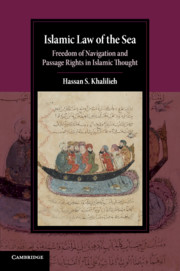
Cambridge University Press has published Islamic Law of the Sea: Freedom of Navigation and Passage Rights in Islamic Thought (April 2019), by Hassan S. Khalilieh (University of Haifa, Israel). A description from the Press:
The doctrine of modern law of the sea is commonly believed to have developed from Renaissance Europe. Often ignored though is the role of Islamic law of the sea and customary practices at that time. In this book, Hassan S. Khalilieh highlights Islamic legal doctrine regarding freedom of the seas and its implementation in practice. He proves that many of the fundamental principles of the pre-modern international law governing the legal status of the high seas and the territorial sea, though originating in the Mediterranean world, are not a necessarily European creation. Beginning with the commonality of the sea in the Qur'an and legal methods employed to insure the safety, security, and freedom of movement of Muslim and aliens by land and sea, Khalilieh then goes on to examine the concepts of the territorial sea and its security premises, as well as issues surrounding piracy and its legal implications as delineated in Islamic law.
More information is available here.

-- Karen Tani

Saturday, April 6, 2019

Weekend Roundup

  • A new issue (2:1) of The Docket–the online sidekick of Law and History Review–has gone live.  Check it out! 
  • The American Council of Learned Societies has announced its fellows for 2019, among them Laura Edwards (for “Only the Clothes on Her Back: Textiles, Law, and Commerce in the Nineteenth-Century United States”); Amanda H. Frost (for “Unmaking Americans: A History of Citizenship Stripping in the United States”); Katherine Unterman (for "The Colonial Constitution: Law and Empire in the US Territories”); and Kimberly Welch (for “Lending and Borrowing Across the Color Line in the Antebellum American South”).
  • Here’s some timely and unfortunately apt comparative constitutionalism: LĂ©nárd Sándor, Chief Counsel to the Constitutional Court of Hungary and, currently, a visiting foreign fellow at the Federal Judicial Center, in conversation with Jeffrey Rosen.
  • And, in other news from the FJC, check out the most recent addition to the Center's unit to our Famous Federal Trials series, U.S. v. Guiteau, written by Winston Bowman.
  • Postdoc opportunity at McGill's Indian Ocean World Centre: details here. The deadline is May 15, 2019.
  • Also for early career scholars: Oxford's Centre for Socio-Legal Studies has a Call out for a "Law in Context" Early Career Workshop. Those applications are due July 10, 2019.
   Weekend Roundup is a weekly feature compiled by all the Legal History bloggers.

Wednesday, February 27, 2019

CFP: Law & Environment in the Indian Ocean World

[We share the following announcement. The deadline for submissions is May 15, 2019.]

Call for Papers:

Ordering the Anthropocene: Law & the Environment in the Indian Ocean World

A workshop convened by Debjani Bhattacharyya (Drexel University) and Laurie Wood (Florida State University)

4-5th October 2019

Hosted by Drexel University, with the generous sponsorship of the American Society for Legal History & Drexel University


 What can historians of law achieve from engaging with their colleagues studying environmental changes over time? How have emerging regulatory regimes (imperial, property-oriented, maritime, medical, etc.) joined the domains of science and law in new ways? And how can legal historians retool their methods to study deep histories of landscape transformations and climate? These questions are especially pertinent for the Indian Ocean region, where these concerns have both past and contemporary relevance: e.g. rising sea levels in the Maldives and Andaman Islands; coastal erosion and disputes over new-land formation along the littorals of Bay of Bengal; island-building in Singapore (with sand from Gulf states); disaster relief following the 2004 tsunami and earthquake, which especially affected Indonesia and Malaysia; food security around the Horn of Africa; and some of the world’s busiest shipping routes.


Time shapes the traffic in what constitutes truth in these two broad disciplinary arenas. Legal historians typically analyze cases, each with a specific lifespan of years or decades. Environmental phenomena, by contrast, often span centuries or even geological epochs. We propose a workshop to address the temporality of expertise and evidence which will bring legal historians whose disciplinary focus is bounded by the temporality of a case, together with environmental historians and historians of science who are increasingly doing histories of deep-time. For instance, when legal historians study regulatory regimes of intellectual property to material cultures. It works with an anthropogenic lifespan: copyrights, patents, objects, labor, commodities. Whereas environmental phenomenon, which are increasingly entering regulatory domains, work with long timescales spanning geological, seasonal and solar temporalities. As states are beginning to exert regulatory powers increasingly in legal and scientific regimes, the legal timescale of a case is getting entangled in deep historical timescales.

We invite abstracts for an exploratory workshop, where we will discuss articles/chapters in progress and which have not been submitted for publication. Articles which are in preliminary review stages are welcome, but not those in galley proofs. The purpose of the workshop is to receive comments and feedback on works in progress with the possibility for incorporating the discussions of the workshop. The presenters will be paired with senior discussants who will offer feedback on their articles/chapters and then open it up for discussion. Presenters will be required to submit their articles/chapters of 8000 words and no more than 12,000 words by 30 August 2019. All presenters and discussants will be required to read the articles beforehand which will be made available through a secure dropbox account. The purpose of the workshop is to:
  • Bring together senior and junior scholars of law and/or environment who are working in the newly-vibrant field of Indian Ocean World history.
  • Generate a methodological conversation between legal historians and historians of environment and science anchored on the category of time and how differing notions shape practices of evidence selection, gathering and testimony in the court and laboratory.
The workshop will consist of 4 panels, with 2 presenters in each panel. We will pair legal historians with historians of environment to explore how common terminology around evidence, witness, reason, expertise is affected by concepts of time that are distinct in each discipline. We welcome papers exploring the following questions broadly:
·         Where does law/do legal regimes collide with the material world?
·         Where/when/how/why do natural phenomena become entangled in ordering regimes?
·         How do these relationships (re)configure the human as social (e.g. relational, hierarchical, vocal) and material (e.g. embodied, constrained by lifespan, etc.)?

Application Instructions

Interested applicants should submit a 300-word abstract and short c.v. to the convenors by 15 May 2019: Debjani Bhattacharyya (db893@drexel.edu) and Laurie Wood (lmwood@fsu.edu ). Article-length papers (8,000-10,000 words) will be due for circulation among participants and invited commentators by 30 August 2019. Domestic airfare, accommodation, and most meals will be provided thanks to support from the American Society for Legal History and Drexel University.

Friday, January 11, 2019

Motha on sovereignty and violence

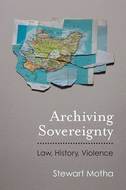
Stewart Motha (Birkbeck College, University of London) published Archiving Sovereignty: Law, History, Violence with the University of Michigan Press in 2018. From the publisher:

Book cover for 'Archiving Sovereignty'Archiving Sovereignty shows how courts use fiction in their treatment of sovereign violence. Law’s complicity with imperial and neocolonial practices occurs when courts inscribe and repeat the fabulous tales that provide an alibi for archaic sovereign acts that persist in the present. The United Kingdom’s depopulation of islands in the Indian Ocean to serve the United States’ neoimperial interests, Australia’s exile and abandonment of refugees on remote islands, the failure to acknowledge genocidal acts or colonial dispossession, and the memorial work of the South African Constitution after apartheid are all sustained by historical fictions. This history-work of law constitutes an archive where sovereign violence is mediated, dissimulated, and sustained. Stewart Motha extends the concept of the “archive,” as site of origin and source of authority, to signifying what law does in preserving and disavowing the past at the same time. 
Sovereignty is often cast as a limit-concept, constituent force, determining the boundary of law. Archiving Sovereignty reverses this to explain how judicial pronouncements inscribe and sustain extravagant claims to exceptionality and sovereign solitude. This wide-ranging, critical work distinguishes between myths that sustain neocolonial orders and fictions that generate new forms of political and ethical life.
 Praise for the book:

“Set in and around the Indian Ocean, Archiving Sovereignty is a thoughtful meditation on how the law traffics in fictions—the ‘as if’—as it adjudicates state sovereignty in contexts of colonial and postcolonial violence. Elegantly written, it invites an important consideration of the law’s complex work as historical archivist.” - Avery F. Gordon

“Stewart Motha re-envisions the Indian Ocean as a material site of law, violence, and dispossession that he compellingly terms an ‘archive of the present.’ Drawing comparatively from Australia, South Africa, and the Chagos Archipelago, Motha offers a beautifully crafted analysis of law and sovereignty, how they draw from and disavow their entangled colonial histories.” - Renisa Mawani

“Of the many interwoven themes in Archiving Sovereignty, the driving motif for me is Kant’s ‘as if,’ which responds to the disappearance of metaphysical objectivity. If objects are the only knowable facts, the unknowable is suspended in the ‘as if.’ This is true for a lie (such as acting as if law were grounded in nature or acting as if sovereignty were a power in itself) as well as for a fertile fiction. We must then think of the ‘as if’ in its relation to an absence of first law, and think of sovereignty as the ‘as if’ of a postulation of ‘nothing’ at the centre of existence. Stewart Motha explores this double dimension, its commingling and unravelling, its aporias and suggestions that are of course inexhaustible. This research is at the heart of the concerns and expectations of the present time.” - Jean-Luc Nancy

“Through a series of brilliant readings of contemporary cases of exile and exclusion the source of legality, the archive, is exposed as an unstable archipelago and excoriated as the fictive mark of sovereign solitude.” - Peter Goodrich

Further information is available here.

Friday, August 17, 2018

A conversation between Bishara and Seng

In April, Comparative Studies in Society and History hosted an online exchange between two of its authors writing about law on opposite sides of the Indian Ocean. Here's the opening set-up for a conversation between Fahad Bishara, University of Virginia and Guo-Quan Seng, Cornell University:

LEGAL ANOMALY

FAHAD AHMAD BISHARA, “‘No country but the ocean”: Reading International Law from the Deck of an Indian Ocean Dhow, ca. 1900”

GUO-QUAN SENG, “The Gender Politics of Confucian Family Law: Contracts, Credit, and Creole Chinese Bilateral Kinship in Dutch Colonial Java (1850s–1900)”


In “No country but the ocean”: Reading International Law from the Deck of an Indian Ocean Dhow, ca. 1900,” Fahad Ahmad Bishara considers the legal imaginaries of Indian Ocean mariners sailing out of the port of Sur, on the Arabian Peninsula. Maritime legal culture entailed a domestication and vernacularization of international law, not least in the ways it was materially manifested in flags and, for these captains, efficacious French documents (titres). These objects-at-sea extended legal regimes of the land, but also refracted and transformed them to captains’ own idiosyncratic purposes. Flags and documents were used to foment exchanges far beyond what they actually secured or promised; for example, titres were freely transferred from one ship, and sailor, to another. Bishara recounts a microhistory of a 1905 court case of Muscat-based dhows suspected of slave-trading, arbitrated at the Hague. The essay reveals the affordances and limits presented to seafarers sailing under a French flag and bearing French papers, though on a mostly British sea. At the same time, it highlights the processes by which dhow captains from Sur appropriated these imperial technologies and grounded them in their own world, framing their encounter with the British navy as the latest in a long string of imperial entanglements at sea, and anchoring the French titres in a regional regime of safe-conduct passes.

Attending to a different form of legal anomaly, Guo-Quan Seng’s essay, “The Gender Politics of Confucian Family Law: Contracts, Credit, and Creole Chinese Bilateral Kinship in Dutch Colonial Java (1850s–1900)” documents the extraordinary economic power enjoyed by creole Chinese women in nineteenth-century Java. These women possessed inheritance rights and directed their household economies, often retaining substantial wealth independent from husbands’ debts or other family liabilities. Beginning in the 1860s, though, Dutch officials began to administer Chinese family law in the colonial courts, and they did so relying on abstract ideals of Confucianist ethics grounded in Sinological studies and formalist textual interpretations. Confucianist legal doctrines of the male as natural head of the household began to inform Dutch legal norms. As a result, by the 1880s women’s autonomous wealth was made vulnerable to husbands’ debt and obligations. Seng shows that Dutch Confucianism, installed in the name of Chinese “tradition,” deprived creole Chinese women of legal rights that they had long enjoyed in actual tradition and practice.

Follow the rest of the conversation here.

Friday, March 30, 2018

Peabody on Slavery & Family in the French Indian Ocean

Sue Peabody, Washington State University, published Madeleine's Children: Family, Freedom, Secrets, and Lies in France's Indian Ocean Colonies with Oxford University Press in 2017. From the publisher:
Cover for 

Madeleines Children


Madeleine's Children uncovers a multigenerational saga of an enslaved family in India and two islands, RĂ©union and Mauritius, in the eastern empires of France and Britain during the eighteenth and nineteenth centuries. A tale of legal intrigue, it reveals the lives and secret relationships between slaves and free people that have remained obscure for two centuries.
 As a child, Madeleine was pawned by her impoverished family and became the slave of a French woman in Bengal. She accompanied her mistress to France as a teenager, but she did not challenge her enslavement there on the basis of France's Free Soil principle, a consideration that did not come to light until future lawyers investigated her story. In France, a new master and mistress purchased her, despite laws prohibiting the sale of slaves within the kingdom. The couple transported Madeleine across the ocean to their plantation in the Indian Ocean colonies, where she eventually gave birth to three children: Maurice, Constance, and Furcy. One died a slave and two eventually became free, but under very different circumstances. On 21 November 1817, Furcy exited the gates of his master's mansion and declared himself a free man. The lawsuit waged by Furcy to challenge his wrongful enslavement ultimately brought him before the Royal Court of Paris, despite the extreme measures that his putative master, Joseph Lory, deployed to retain him as his slave.
 A meticulous work of archival detection, Madeleine's Children investigates the cunning, clandestine, and brutal strategies that masters devised to keep slaves under their control-and paints a vivid picture of the unique and evolving meanings of slavery and freedom in the Indian Ocean world.
Praise for the book:

"What does it mean to be free? To be a slave? To belong to a family? In this remarkable book, historian Sue Peabody--one of the world's leading authorities on slavery in the French Empire--shows that these big questions are often intertwined. Through an intimate portrait of one enslaved man fighting for his dignity, Peabody shines a brilliant light on the worlds in which he and his forebears lived, stretching from India to the Mascarene Islands to the courts of Paris. This is both biography and global history at their very best." -Brett Rushforth

"This gripping family history of slavery and freedom in France and its Indian Ocean empire during the eighteenth and nineteenth centuries resurrects in inviting detail the lives of Madeleine--sold into slavery in India and freed on Bourbon Island, though not told of her manumission for nineteen years--and of her children. With help from family and friends, Furcy, one of those children held in slavery by ruse, vigorously pursued legal recognition of his free status in the Mascarene Islands of the Indian Ocean and in France--and won. Drawing on thousands of pages of archival and legal documents to reconstruct their lives with astonishing detail, Peabody presents us with the first autobiographical narrative of slaves held by French citizens and in the process illuminates the internal architectures of slavery and freedom in France's Indian Ocean colonies."-Pier M. Larson

"'Madeleine's Children' is a detailed exposition of the lives of slaves in the Indian Ocean world in the late eighteenth to early nineteenth centuries. Based on years of meticulous research, it brings vividly to life the tensions between slave-owners and slaves during a tumultuous period of shifting legal challenges to, and definitions of, slavery. Thoroughly recommended to scholars of the Indian Ocean world and of slavery." -Gwyn Campbell

Further information is available here.