Showing posts with label law of the sea. Show all posts

Friday, February 14, 2025

Sellars on the UN Convention on the Law of the Sea

Kirsten Sellars has published A ‘Constitution for the Oceans': The Long Hard Road to the UN Convention on the Law of the Sea (Cambridge University Press):

The UN Convention on the Law of the Sea, signed in 1982, was the culmination of half a century of legal endeavour. Earlier attempts to create  a treaty regime governing the oceans – at League of Nations and United Nations conferences held in 1930, 1958 and 1960 – had all failed to settle the breadth of the territorial sea, and in two cases failed to settle anything at all.  During the negotiations, legal concepts were formulated and reformulated: straight baselines inspired archipelagic baselines; fishing conservation zones became exclusive economic zones; innocent passage through straits metamorphosed into transit passage through straits; and seabed common heritage was replaced by the parallel system of seabed exploitation. Many of the issues that animated the delegates during the negotiations – ocean pollution, overfishing, naval mobility, continental shelf claims and the impact of seabed mining – continue to exercise policymakers and lawyers to this day.

--Dan Ernst

Sunday, September 10, 2023

Harry Scheiber and the Law of the Sea

The legal historian Harry Scheiber has never been just a legal historian; he was also been a scholar of the Law of the Sea.  On September 13-14, 2023, the Law of the Sea Institute at Berkeley Law is hosting a Zoom-accessible conference in his honor:

The conference is being held to honor the lifetime achievements of Professor Harry N. Scheiber, a renowned scholar of the law of the sea, in his retirement. Professor Scheiber has been a pioneer in the field of ocean law, and his work has had a profound impact on the development of international law. It will bring together leading experts from the Law of the Sea Institute (LOSI) community and the broader ocean law, policy, and scientific communities to discuss the future of the law of the sea.

Day 1 of the conference will be held from 8:30 a.m. - 5:00 p.m., with a reception dinner from 7:00 - 9:00 p.m. Pacific on Wednesday, the 13th. Day 2 will be held from 9:00 a.m. - 2:00 p.m. on Thursday, the 14th. The conference program will be sent out soon to those interested in attending, and a Zoom schedule will be sent to those who express interest in the webinar. 

--Dan Ernst.  H/t SBG

Monday, June 3, 2019

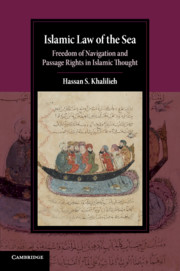
Khalilieh, "Islamic Law of the Sea"

Cambridge University Press has published Islamic Law of the Sea: Freedom of Navigation and Passage Rights in Islamic Thought (April 2019), by Hassan S. Khalilieh (University of Haifa, Israel). A description from the Press:
The doctrine of modern law of the sea is commonly believed to have developed from Renaissance Europe. Often ignored though is the role of Islamic law of the sea and customary practices at that time. In this book, Hassan S. Khalilieh highlights Islamic legal doctrine regarding freedom of the seas and its implementation in practice. He proves that many of the fundamental principles of the pre-modern international law governing the legal status of the high seas and the territorial sea, though originating in the Mediterranean world, are not a necessarily European creation. Beginning with the commonality of the sea in the Qur'an and legal methods employed to insure the safety, security, and freedom of movement of Muslim and aliens by land and sea, Khalilieh then goes on to examine the concepts of the territorial sea and its security premises, as well as issues surrounding piracy and its legal implications as delineated in Islamic law.
More information is available here.

-- Karen Tani

Thursday, December 21, 2017

Margolies & McClure on Transnational Frontiers

Transnational Frontiers of Asia and Latin America since 1800 (Hardback) book coverEdited by Jaime Moreno Tejada (Chulalongkorn University, Thailand) and Bradley Tatar (UNIST, South Korea), Transnational Frontiers of Asia and Latin America since 1800 (Routledge, 2017) includes two articles of legal historical interest.

The first is by Daniel S. Margolies, Virginia Wesleyan College: "Spatiality, jurisdiction, and sovereignty in early Latin American approaches to the Law of the Sea," 85-97. An excerpt:

Jurisdictional claims over oceanic spaces in the immediate postwar period deserve close attention, since the oceanic spaces proximate to sovereign coastlines were a central focus of global competition for control of seabed resources and the ability to construct and regulate the overall jurisdictional order of the post-World War II world system. Latin American nations were at the center of this moment of political-economic competition and legal innovation, particularly Mexico, Argentina, Chile, and Peru. These nations individually and forcefully pursued expansive sovereignty and jurisdictional claims on the offshore continental shelf....The purpose of this chapter is to explore the contingent involvement of...Latin American states in this project of reconceptualizing and restructuring global ocean spaces as new varieties of sovereign and jurisdictional space, or what can be conceptualized as new or freshly expanded state space. 
The second article is by Alastair McClure, McGill University: "State building and problematic geopolitical spaces in South Asia: The Himalayas and the extradition treaty of 1855," 98-110. A passage from the opening:
In the midst of...state building drives of the nineteenth century, the Himalayan border between colonial India and Nepal...remained a relatively unmanageable terrain...[As] ruling powers began to take steps towards modern statehood, the protection of trade, control of movement, and concerns surrounding rebellious networks became increasingly important issues. Once it was clear that neat lines of sovereignty could not be drawn across the Himalayan border, the region became a site of power play between these emerging neighboring states and the individuals that transgressed the thresholds. These issues of security and power consistently spilled over ill-defined boundaries as criminals and men of "bad character" resided in or traveled through this borderland to escape punishment....Piecing together information from the correspondence between the Resident of Nepal and the British Government of India, this chapter seeks to offer insight into the "specific cultures of governance" possessed by these states...The chapter will seek to outline how the priorities of Nepal and colonial India converged and clashed through attempts to pacify this region, particularly in relation to the formation of laws of extradition and the policing and maintenance of their borders.
Further information on the book is available here and on Google Books here